
Belarus beyond 2020 Implications for Russia and
TG
Published · 9 slides · 0 views

1 / 1
Description
Belarus beyond 2020 Implications for Russia and the West Summary of main findings and scenarios The opinions articulated herein represent the views of the author(s) and do not necessarily reflect the position of the European Leadership
Related Topics
Share
Embed code
Download this presentation From Below
"Belarus beyond 2020 Implications for Russia and" is the property of its rightful owner. Permission is granted to download and print the materials on this website for personal, non-commercial use only, and to display it on your personal computer provided you do not modify the materials and that you retain all copyright notices contained in the materials. By downloading content from our website, you accept the terms of this agreement.
Presentation Transcript
01
Belarus beyond 2020
Implications for Russia and the West Summary of main findings and scenarios The opinions articulated herein represent the views of the author(s) and do not necessarily reflect the position of the European Leadership Network or any of its members. The ELN’s aim is to encourage debates that will help develop Europe’s capacity to address the pressing foreign, defence, and security policy challenges of our time.<br>
02
These slides are intended to provide a quick reference tool or as a source of briefing material for officials.
Please read and reference the full report here. About the Author
Ben Challis is a Policy Fellow at the European Leadership Network (ELN) where he focuses on Russia-West relations, with a particular focus on the relationship between dynamics in Eastern Europe, the Caucuses and global security issues. Prior to joining the ELN, Ben spent 5 years working for the UK’s Department for International Development (DFID). Ben was embedded in the Foreign and Commonwealth Office’s Eastern Europe and Central Asia Directorate where he focused on governance, economics and stability issues in the Eastern Partnership and Western Balkans countries.
If you have comments, feedback or wish to discuss the issues raised further please contact Ben at BenC@europeanleadershipnetwork.org<br>
Please read and reference the full report here. About the Author
Ben Challis is a Policy Fellow at the European Leadership Network (ELN) where he focuses on Russia-West relations, with a particular focus on the relationship between dynamics in Eastern Europe, the Caucuses and global security issues. Prior to joining the ELN, Ben spent 5 years working for the UK’s Department for International Development (DFID). Ben was embedded in the Foreign and Commonwealth Office’s Eastern Europe and Central Asia Directorate where he focused on governance, economics and stability issues in the Eastern Partnership and Western Balkans countries.
If you have comments, feedback or wish to discuss the issues raised further please contact Ben at BenC@europeanleadershipnetwork.org<br>
03
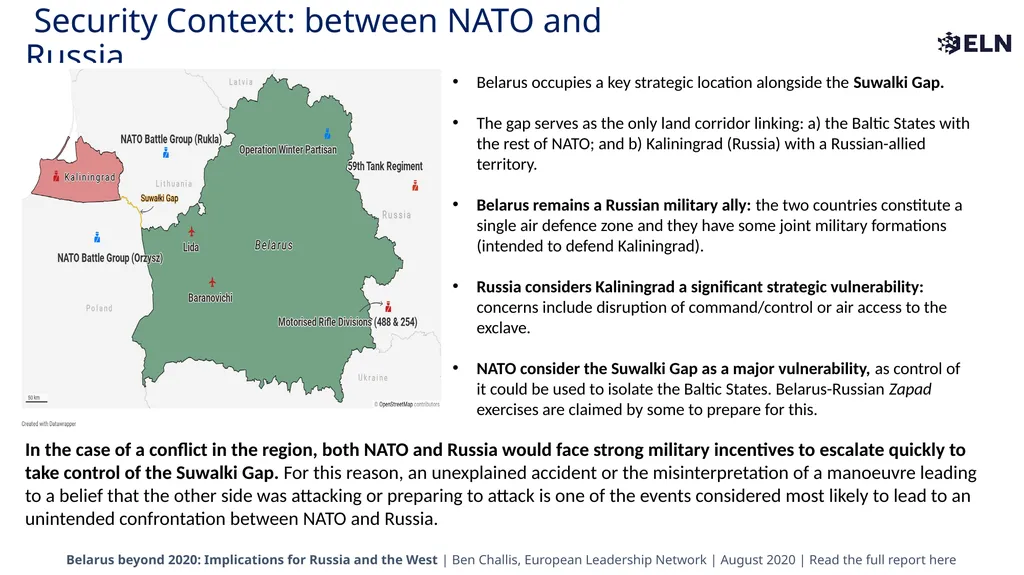
Security Context: between NATO and Russia Belarus occupies a key strategic location alongside the Suwalki Gap.
The gap serves as the only land corridor linking: a) the Baltic States with the rest of NATO; and b) Kaliningrad (Russia) with a Russian-allied territory.
Belarus remains a Russian military ally: the two countries constitute a single air defence zone and they have some joint military formations (intended to defend Kaliningrad).
Russia considers Kaliningrad a significant strategic vulnerability: concerns include disruption of command/control or air access to the exclave.
NATO consider the Suwalki Gap as a major vulnerability, as control of it could be used to isolate the Baltic States. Belarus-Russian Zapad exercises are claimed by some to prepare for this. In the case of a conflict in the region, both NATO and Russia would face strong military incentives to escalate quickly to take control of the Suwalki Gap. For this reason, an unexplained accident or the misinterpretation of a manoeuvre leading to a belief that the other side was attacking or preparing to attack is one of the events considered most likely to lead to an unintended confrontation between NATO and Russia. Belarus beyond 2020: Implications for Russia and the West | Ben Challis, European Leadership Network | August 2020 | Read the full report here<br>
The gap serves as the only land corridor linking: a) the Baltic States with the rest of NATO; and b) Kaliningrad (Russia) with a Russian-allied territory.
Belarus remains a Russian military ally: the two countries constitute a single air defence zone and they have some joint military formations (intended to defend Kaliningrad).
Russia considers Kaliningrad a significant strategic vulnerability: concerns include disruption of command/control or air access to the exclave.
NATO consider the Suwalki Gap as a major vulnerability, as control of it could be used to isolate the Baltic States. Belarus-Russian Zapad exercises are claimed by some to prepare for this. In the case of a conflict in the region, both NATO and Russia would face strong military incentives to escalate quickly to take control of the Suwalki Gap. For this reason, an unexplained accident or the misinterpretation of a manoeuvre leading to a belief that the other side was attacking or preparing to attack is one of the events considered most likely to lead to an unintended confrontation between NATO and Russia. Belarus beyond 2020: Implications for Russia and the West | Ben Challis, European Leadership Network | August 2020 | Read the full report here<br>
04
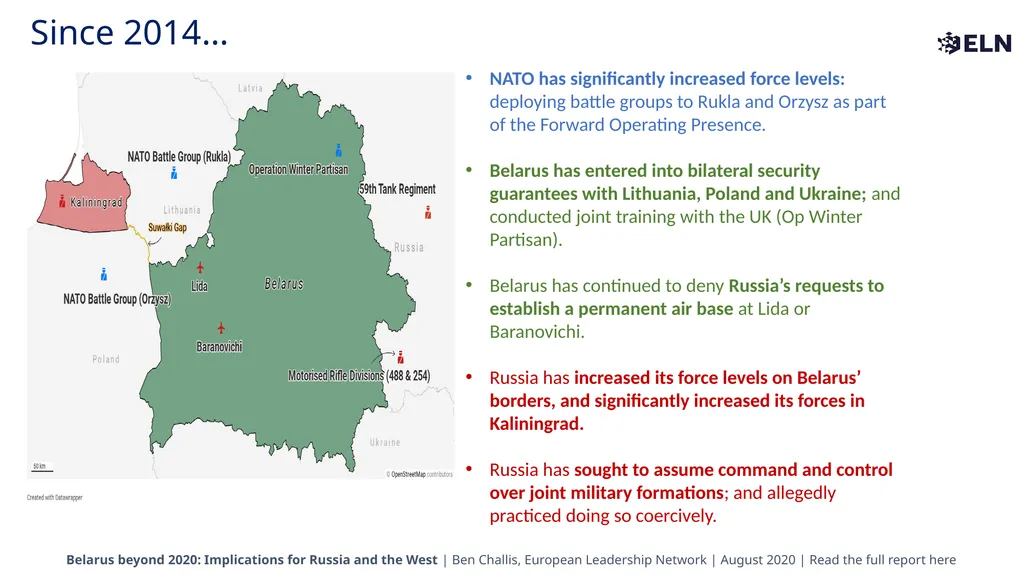
Since 2014… NATO has significantly increased force levels: deploying battle groups to Rukla and Orzysz as part of the Forward Operating Presence.
Belarus has entered into bilateral security guarantees with Lithuania, Poland and Ukraine; and conducted joint training with the UK (Op Winter Partisan).
Belarus has continued to deny Russia’s requests to establish a permanent air base at Lida or Baranovichi.
Russia has increased its force levels on Belarus’ borders, and significantly increased its forces in Kaliningrad.
Russia has sought to assume command and control over joint military formations; and allegedly practiced doing so coercively. Belarus beyond 2020: Implications for Russia and the West | Ben Challis, European Leadership Network | August 2020 | Read the full report here<br>
Belarus has entered into bilateral security guarantees with Lithuania, Poland and Ukraine; and conducted joint training with the UK (Op Winter Partisan).
Belarus has continued to deny Russia’s requests to establish a permanent air base at Lida or Baranovichi.
Russia has increased its force levels on Belarus’ borders, and significantly increased its forces in Kaliningrad.
Russia has sought to assume command and control over joint military formations; and allegedly practiced doing so coercively. Belarus beyond 2020: Implications for Russia and the West | Ben Challis, European Leadership Network | August 2020 | Read the full report here<br>
05
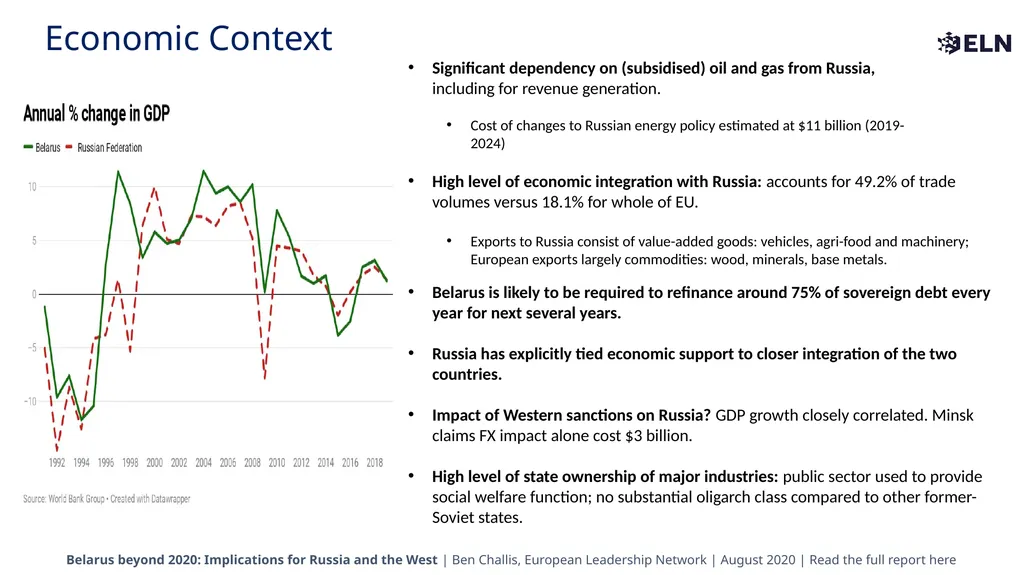
Economic Context Belarus beyond 2020: Implications for Russia and the West | Ben Challis, European Leadership Network | August 2020 | Read the full report here<br>
06
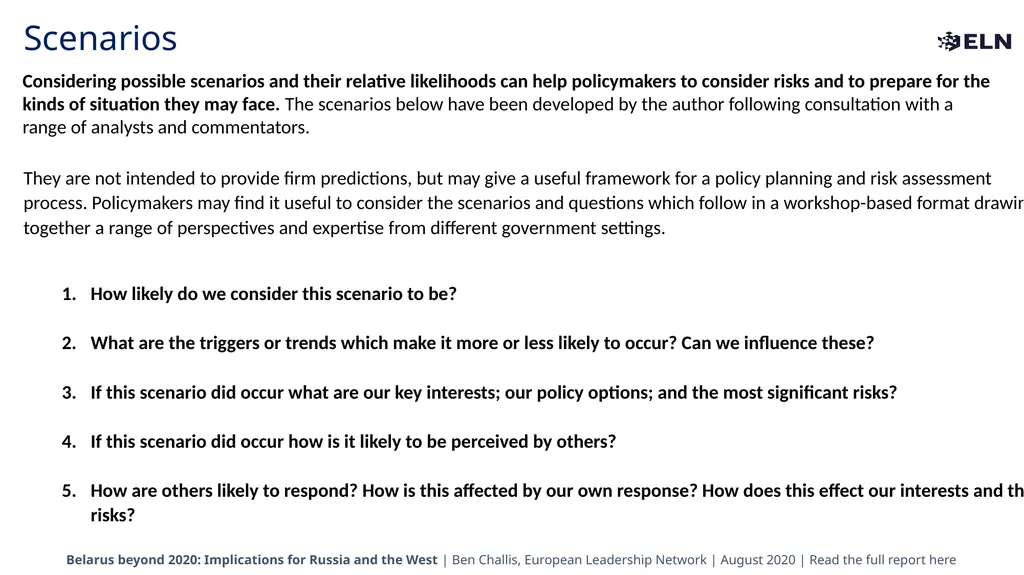
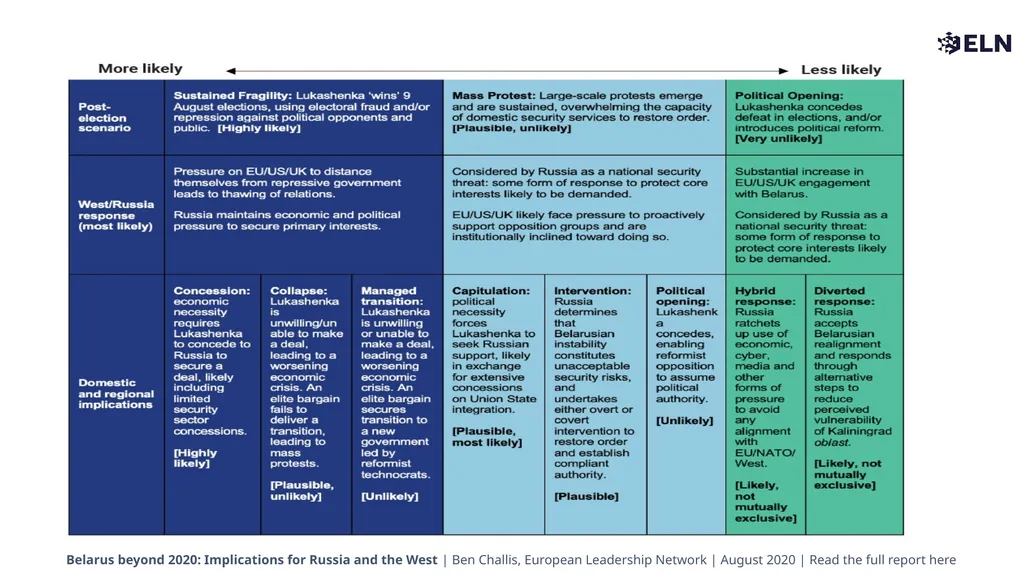
Scenarios Considering possible scenarios and their relative likelihoods can help policymakers to consider risks and to prepare for the kinds of situation they may face. The scenarios below have been developed by the author following consultation with a range of analysts and commentators. They are not intended to provide firm predictions, but may give a useful framework for a policy planning and risk assessment process. Policymakers may find it useful to consider the scenarios and questions which follow in a workshop-based format drawing together a range of perspectives and expertise from different government settings.
How likely do we consider this scenario to be?
What are the triggers or trends which make it more or less likely to occur? Can we influence these?
If this scenario did occur what are our key interests; our policy options; and the most significant risks?
If this scenario did occur how is it likely to be perceived by others?
How are others likely to respond? How is this affected by our own response? How does this effect our interests and the risks? Belarus beyond 2020: Implications for Russia and the West | Ben Challis, European Leadership Network | August 2020 | Read the full report here<br>
How likely do we consider this scenario to be?
What are the triggers or trends which make it more or less likely to occur? Can we influence these?
If this scenario did occur what are our key interests; our policy options; and the most significant risks?
If this scenario did occur how is it likely to be perceived by others?
How are others likely to respond? How is this affected by our own response? How does this effect our interests and the risks? Belarus beyond 2020: Implications for Russia and the West | Ben Challis, European Leadership Network | August 2020 | Read the full report here<br>
07
Belarus beyond 2020: Implications for Russia and the West | Ben Challis, European Leadership Network | August 2020 | Read the full report here<br>
08
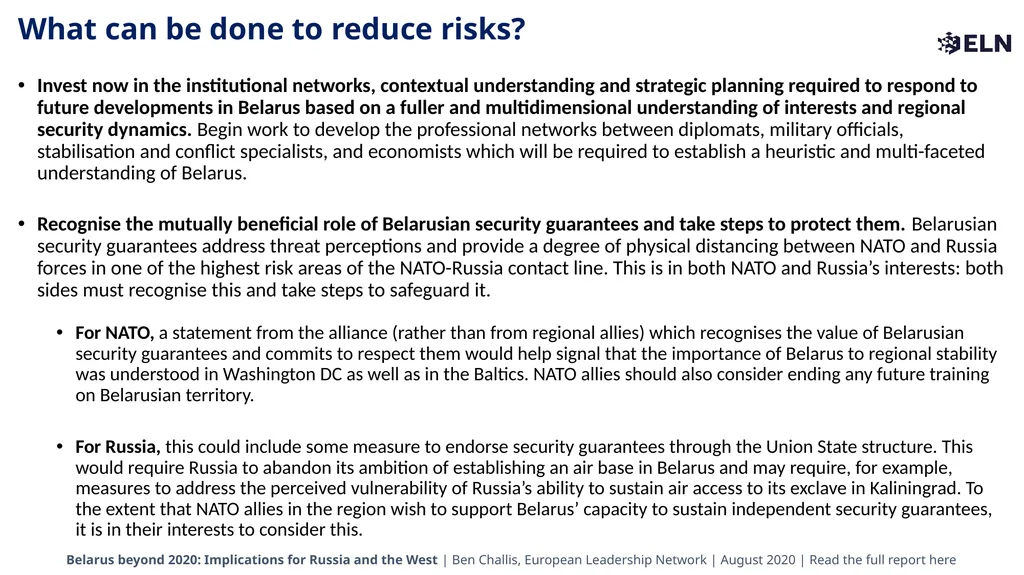
What can be done to reduce risks? Invest now in the institutional networks, contextual understanding and strategic planning required to respond to future developments in Belarus based on a fuller and multidimensional understanding of interests and regional security dynamics. Begin work to develop the professional networks between diplomats, military officials, stabilisation and conflict specialists, and economists which will be required to establish a heuristic and multi-faceted understanding of Belarus.
Recognise the mutually beneficial role of Belarusian security guarantees and take steps to protect them. Belarusian security guarantees address threat perceptions and provide a degree of physical distancing between NATO and Russia forces in one of the highest risk areas of the NATO-Russia contact line. This is in both NATO and Russia’s interests: both sides must recognise this and take steps to safeguard it.
For NATO, a statement from the alliance (rather than from regional allies) which recognises the value of Belarusian security guarantees and commits to respect them would help signal that the importance of Belarus to regional stability was understood in Washington DC as well as in the Baltics. NATO allies should also consider ending any future training on Belarusian territory.
For Russia, this could include some measure to endorse security guarantees through the Union State structure. This would require Russia to abandon its ambition of establishing an air base in Belarus and may require, for example, measures to address the perceived vulnerability of Russia’s ability to sustain air access to its exclave in Kaliningrad. To the extent that NATO allies in the region wish to support Belarus’ capacity to sustain independent security guarantees, it is in their interests to consider this. Belarus beyond 2020: Implications for Russia and the West | Ben Challis, European Leadership Network | August 2020 | Read the full report here<br>
Recognise the mutually beneficial role of Belarusian security guarantees and take steps to protect them. Belarusian security guarantees address threat perceptions and provide a degree of physical distancing between NATO and Russia forces in one of the highest risk areas of the NATO-Russia contact line. This is in both NATO and Russia’s interests: both sides must recognise this and take steps to safeguard it.
For NATO, a statement from the alliance (rather than from regional allies) which recognises the value of Belarusian security guarantees and commits to respect them would help signal that the importance of Belarus to regional stability was understood in Washington DC as well as in the Baltics. NATO allies should also consider ending any future training on Belarusian territory.
For Russia, this could include some measure to endorse security guarantees through the Union State structure. This would require Russia to abandon its ambition of establishing an air base in Belarus and may require, for example, measures to address the perceived vulnerability of Russia’s ability to sustain air access to its exclave in Kaliningrad. To the extent that NATO allies in the region wish to support Belarus’ capacity to sustain independent security guarantees, it is in their interests to consider this. Belarus beyond 2020: Implications for Russia and the West | Ben Challis, European Leadership Network | August 2020 | Read the full report here<br>
09
What can be done to reduce risks? Take a tailored and human security centric approach to economic relations with Belarus. European governments will come under pressure to reverse improved relations with Lukashenka in the aftermath of repressive elections. Limit such reversals to the political space and keep lines of economic support open. International financial institutions (IFIs) and other donors should sustain lines of credit. Take a gradual approach to reform which prioritises the preservation of economic security for citizens, and adopts creative thinking to shift away from a zero-sum model of eastern- or western-oriented economies.
Take additional steps to address the risks of military confrontation in the region. Belarus provides a further reminder of the need to address the poorly managed risk of confrontation in the Baltic region. The high-concentration of high-alert military force; deterioration of arms control treaties; and the absence of military-to-military communication is dangerous. Re-establishing military to military communication between operational commanders to manage accidents or crises should be an urgent task. This does not signal a return to business as usual but a sensible precaution to manage a period of prolonged hostility. Take steps to improve military transparency around Belarusian borders: including by providing opportunities for observation and unilaterally reducing notification thresholds to reflect modern force postures. Finally, both sides should take forward existing agreements to reduce the risk of an accident: such as the ICAO measures on civil and military aviation over the Baltic Sea from 2017. Belarus beyond 2020: Implications for Russia and the West | Ben Challis, European Leadership Network | August 2020 | Read the full report here<br>
Take additional steps to address the risks of military confrontation in the region. Belarus provides a further reminder of the need to address the poorly managed risk of confrontation in the Baltic region. The high-concentration of high-alert military force; deterioration of arms control treaties; and the absence of military-to-military communication is dangerous. Re-establishing military to military communication between operational commanders to manage accidents or crises should be an urgent task. This does not signal a return to business as usual but a sensible precaution to manage a period of prolonged hostility. Take steps to improve military transparency around Belarusian borders: including by providing opportunities for observation and unilaterally reducing notification thresholds to reflect modern force postures. Finally, both sides should take forward existing agreements to reduce the risk of an accident: such as the ICAO measures on civil and military aviation over the Baltic Sea from 2017. Belarus beyond 2020: Implications for Russia and the West | Ben Challis, European Leadership Network | August 2020 | Read the full report here<br>