BENEFIT COST ANALYSIS OF RESEARCH, DEVELOPMENT AND INNOVATION (RDI) INFRASTRUCTURES Strategy for Europe 2020 Kristina Gogić, mag.iur.LLM RDI INFRASTRUCTURES Benefit Cos Analysis (BCA) of the research, development and innovation (RDI)
"BENEFIT COST ANALYSIS OF RESEARCH, DEVELOPMENT AND" is the property of its rightful owner. Permission is granted to
download and print the materials on this website for personal, non-commercial use only, and to display it
on your personal computer provided you do not modify the materials and that you retain all copyright
notices contained in the materials. By downloading content from our website, you accept the terms of this
agreement.
Presentation Transcript
01
BENEFIT COST ANALYSIS OF RESEARCH, DEVELOPMENT AND INNOVATION (RDI) INFRASTRUCTURES Strategy for Europe 2020 Kristina Gogić, mag.iur./LLM<br>
02
RDI INFRASTRUCTURES Benefit Cos Analysis (BCA) of the research, development and innovation (RDI) infrastructures is a new field; 1)
The research, development and innovation (RDI) infrastructure is the generic name for investment projects that are designed and operated according to very different specifications and cannot be analyzed with the same degree of standardisation of methods as,
- for example, in railways or water; 2)<br>
03
RDI INFRASTRUCTURES While the target groups of other infrastructures are relatively well identified:
- e.g. passangers for high-speed rail or residents in a urban area for solid waste management,
the multifaced nature of RDI is such that many types of direct and indirect taget groups are involved:
- from business to the general public;
Each of them has standing in the BCA, and this makes the evaluation of infrastructures a particulary complex task.<br>
04
RDI INFRASTRUCTURES It is expected that over the planning period (2014.-2020.) a portofolio of BCA of RDI infrastructures will be gradually built within the European Union (EU) Member States (MS), following the high priority given to research and innovation for the EU growth strategy;1)
Many research and innovation R&I projects face difficulties in securing finance despite being fundamentally good projects;<br>
05
INNOVFIN ADVISORY InnovFin Advisory (IFA) was set up as a joint European Investment Bank – European Commission initiative under Horizon 2020
IFA assists eligible public and private counterparts to improve the bankability and investment readiness of large, complex, innovative projects that need substantial long term investments<br>
06
RDI IN THE EU POLICY AGENDA RDI are at the core of the policy agenda as key drivers of sustainable long-term economic development
Strategy for Europe 2020 puts RDI at the top of the EU agenda for smart, sustainable and inclusive growth
The European Commission lauched the „innovation Union” flagship initiative, aimed to ensure that innovation ideas can be turned into products and services that create economic growth and jobs.<br>
07
Standard BCA of RDI Infrastructures Definition of RDI infrastructures Research and development infrastructures are science related physical realisations (laboratories, facilities, etc.) developed with the main purpose of acquiring new knowledge in a given scientific and technological field; 1)
Innovation infrastructures are infrastructures aimed at combining knowledge and technology for the development of new or improved products, services and business processes that could be sold on the marketplace 2), 3)<br>
08
Standard BCA of RDI Infrastructures Description/Presentation of the context Socio-economic trend; 1)
Policy and legislative framework; 2)
Geographical conditions and availability of resources; 3)
Current level of research and innovation; 4)
Conditions of the existing research facilities and infrastructural needs 5)<br>
09
Standard BCA of RDI Infrastructures Definition of objectives RDI projects can be associated with a multitude of long-term objectives; i.e.: 1)
- strenghten the cooperation between research, innovation,
education and business to create more jobs and increase economic
competitiveness;
- enhance the attractiveness of a cluster or science park for investors
and companies; 2)
- promote the mobility of researchs and associated exchange of ideas<br>
10
Standard BCA of RDI Infrastructures Project identification The proposed project must be described in details as a self-sufficient unit of analysis;
- when RDI investments consist of single-site facilities, the project
identification becomes relatively straightforward 1)
- geographically distributed RDI facilities, consisting of a network of
infrastructures and equipment located in different places (or
countries) can also be identified as a self-sufficient project if there
is a strong functional relationship among all of its parts 2)<br>
11
Project identification RDI investments aimed at fostering cooperation between a number of research facilities and knowledge transfer/innovation facilities; - located in the same area (city or region); - are not incorporated within one single-site infrastructure; - could still be considered as a single project and a self-sufficient unit of analysis for the purpose of the BCA as long as they create strong synergies, critical mass and achieve cost savings for each facility involved<br>
12
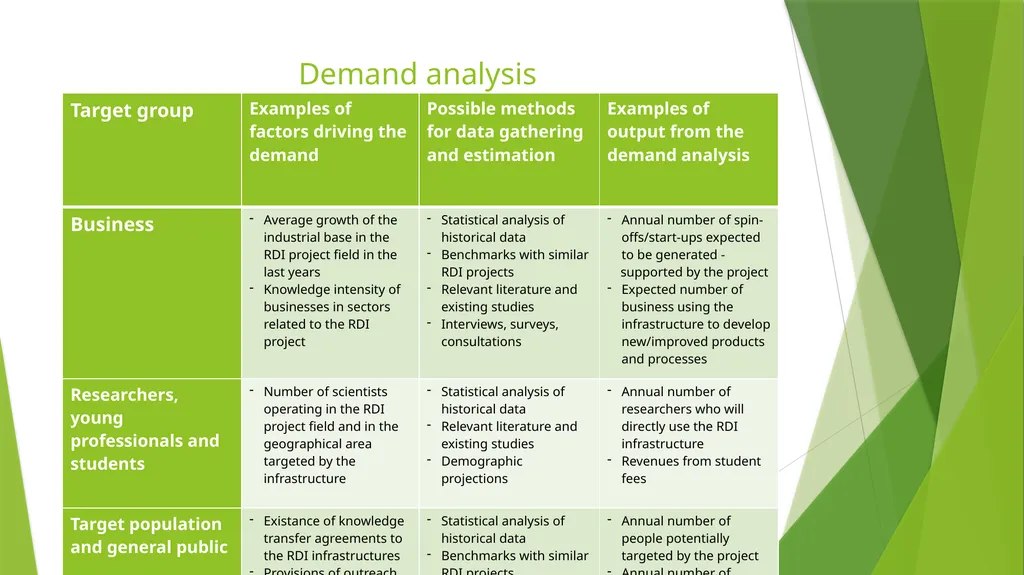
Standard BCA of RDI Infrastructures Demand analysis The demand of RDI infrastructures is actually driven by the social and economic needs expressed by a multiplicity of target groups; i.e. stakeholders who/which will ultimately benefit from the intervention; 1)
The macro categories of target groups, which drive the demand for the RDI project at regional and/or national level, can be identified:
- business; 2)
- researchers, young professional and students; 3)
- target population and the general public 4) 5)<br>
13
Demand analysis<br>
14
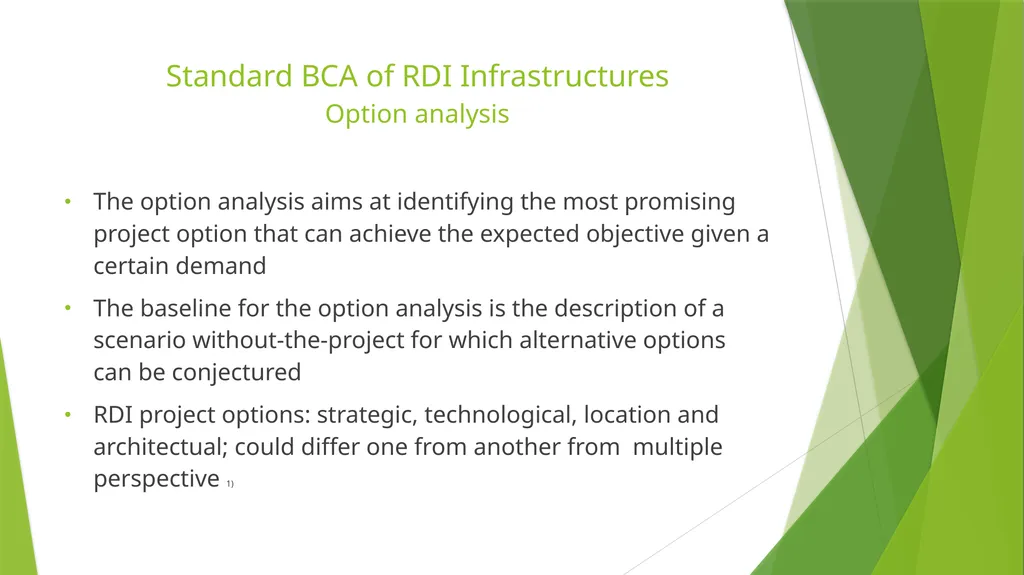
Standard BCA of RDI Infrastructures Option analysis The option analysis aims at identifying the most promising project option that can achieve the expected objective given a certain demand
The baseline for the option analysis is the description of a scenario without-the-project for which alternative options can be conjectured
RDI project options: strategic, technological, location and architectual; could differ one from another from multiple perspective 1)<br>
15
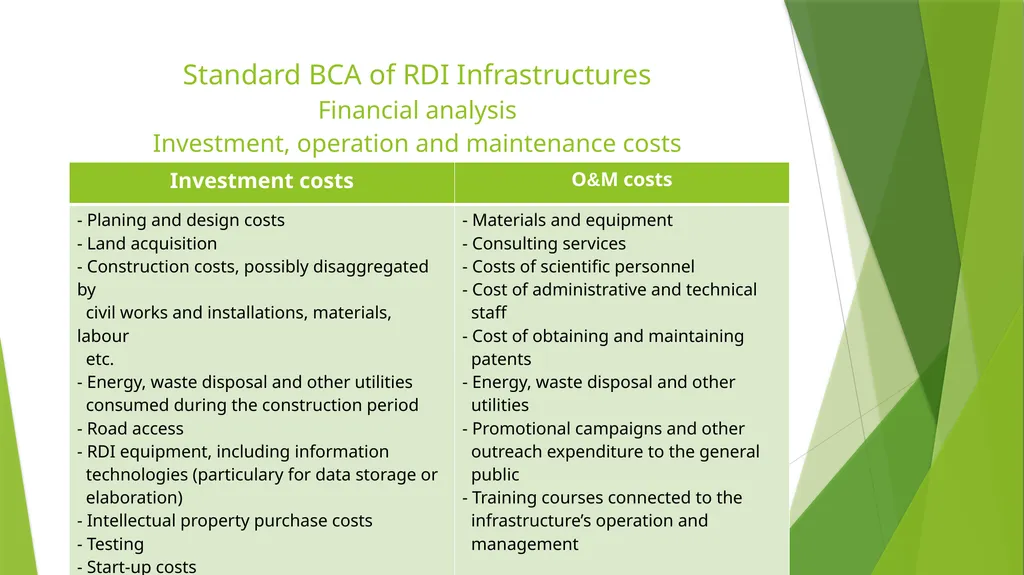
Standard BCA of RDI Infrastructures Financial analysis Investment, operation and maintenance costs<br>
16
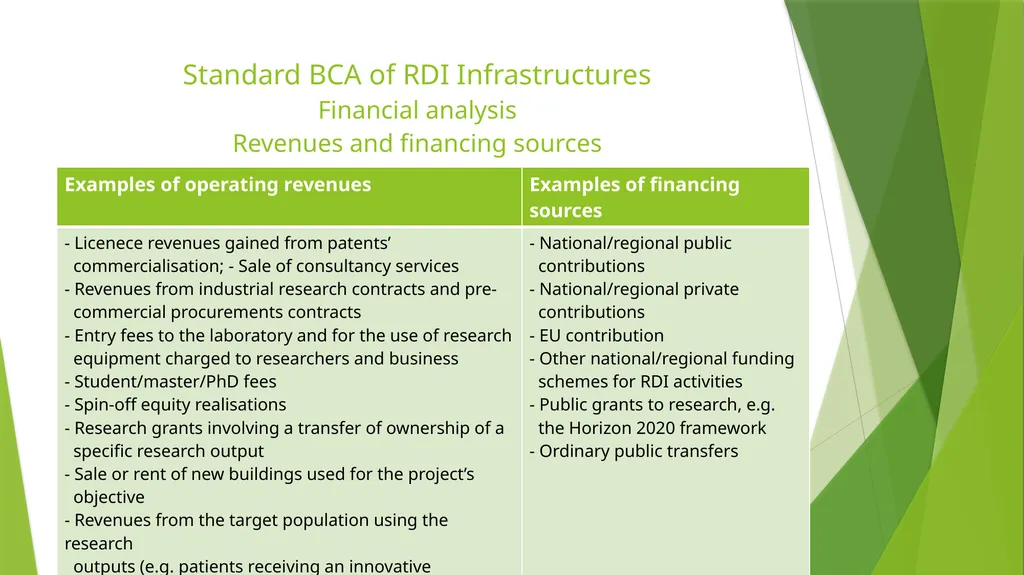
Standard BCA of RDI Infrastructures Financial analysis Revenues and financing sources<br>
17
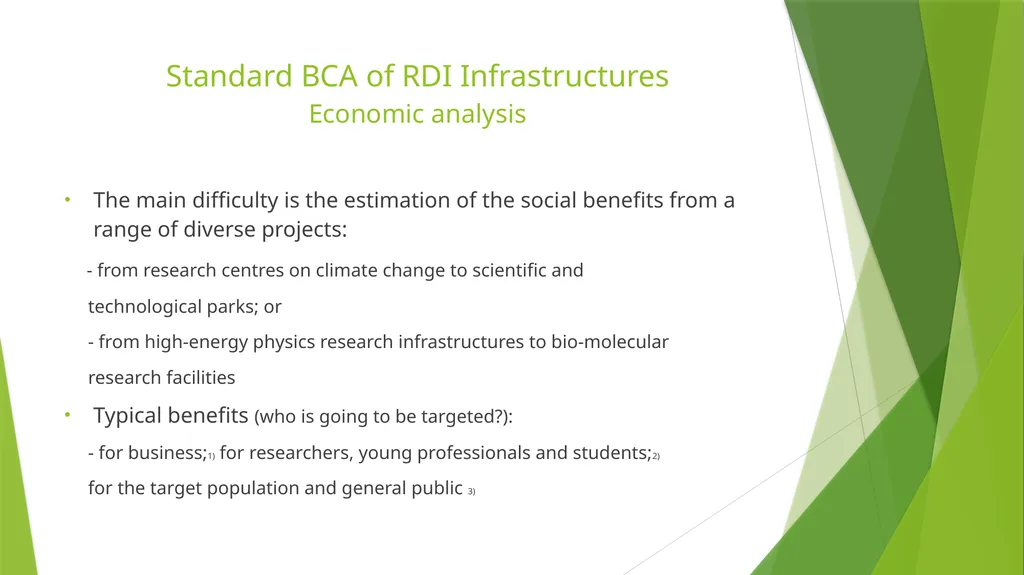
Standard BCA of RDI Infrastructures Economic analysis The main difficulty is the estimation of the social benefits from a range of diverse projects:
- from research centres on climate change to scientific and
technological parks; or
- from high-energy physics research infrastructures to bio-molecular
research facilities
Typical benefits (who is going to be targeted?):
- for business;1) for researchers, young professionals and students;2)
for the target population and general public 3)<br>
18
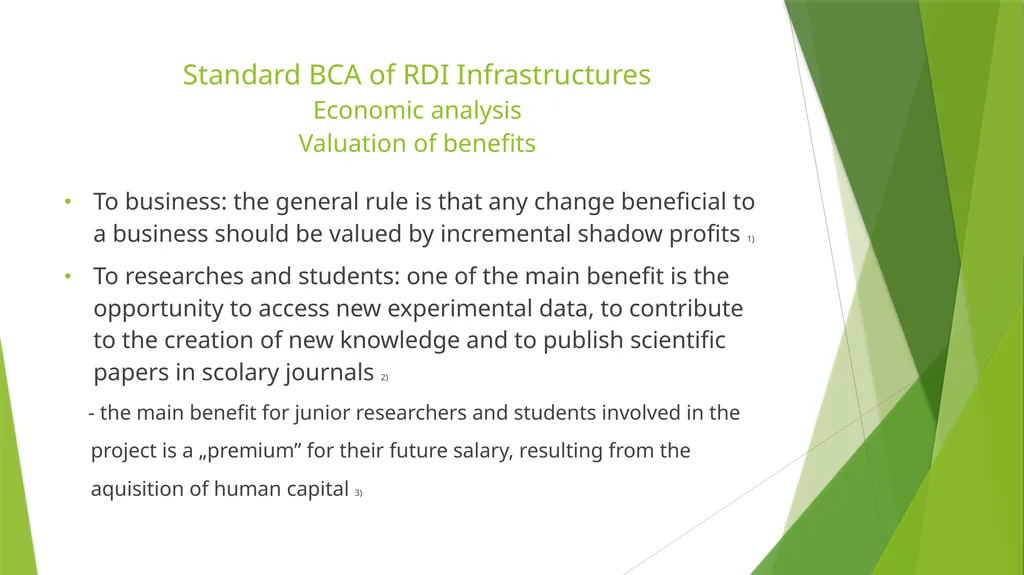
Standard BCA of RDI Infrastructures Economic analysis Valuation of benefits To business: the general rule is that any change beneficial to a business should be valued by incremental shadow profits 1)
To researches and students: one of the main benefit is the opportunity to access new experimental data, to contribute to the creation of new knowledge and to publish scientific papers in scolary journals 2)
- the main benefit for junior researchers and students involved in the
project is a „premium” for their future salary, resulting from the
aquisition of human capital 3)<br>
19
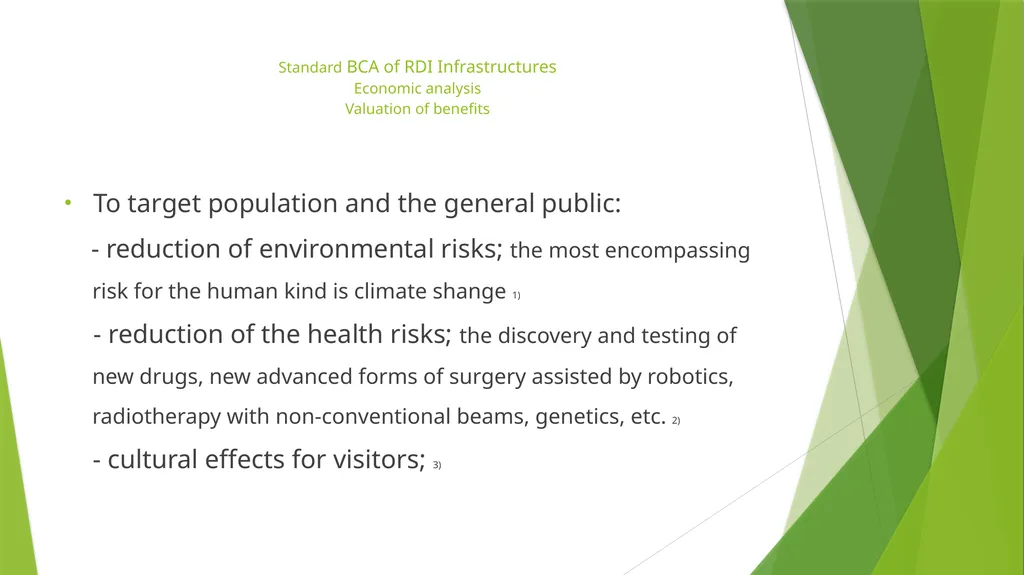
Standard BCA of RDI Infrastructures Economic analysis Valuation of benefits To target population and the general public:
- reduction of environmental risks; the most encompassing
risk for the human kind is climate shange 1)
- reduction of the health risks; the discovery and testing of
new drugs, new advanced forms of surgery assisted by robotics,
radiotherapy with non-conventional beams, genetics, etc. 2)
- cultural effects for visitors; 3)<br>
20
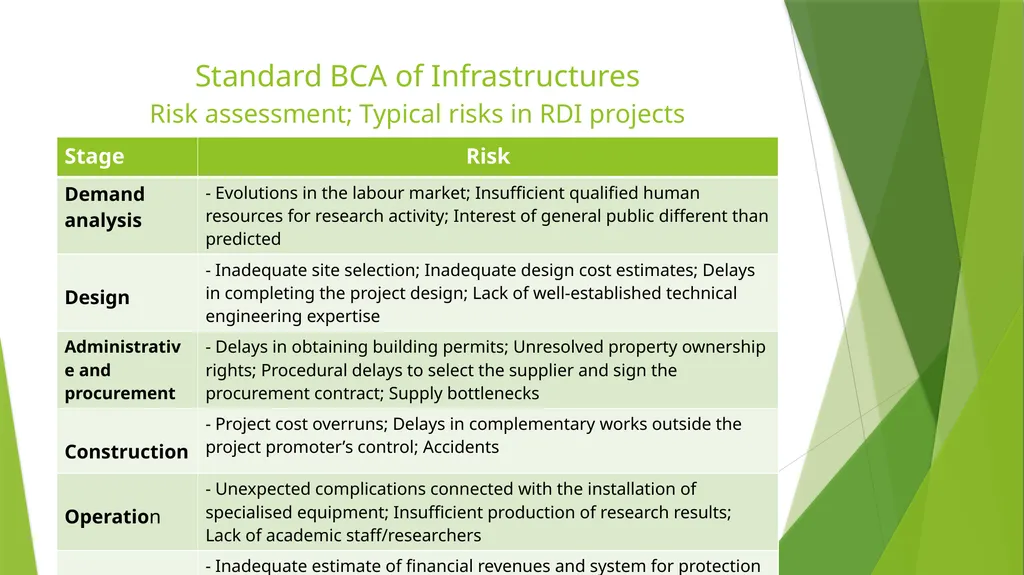
Standard BCA of Infrastructures Risk assessment; Typical risks in RDI projects<br>
21
THANK YOU ON YOUR ATTENTION!
www.kristinagogic.com
Questions?
kristina.gogic@ombudsman.hr
kristinagogic1@gmail.com<br>