
Benin Finance Scan Analysis Sanitation Service
LD
Published · 25 slides · 0 views

1 / 1
Description
Benin Finance Scan Analysis Sanitation Service Delivery Project November 2015 PATHDoune Porter Agenda 1. Purpose and objectives 2. Macroeconomic and finance industry context 3. Consumer finance 4. Finance for entrepreneurs 5. Guarantee
Related Topics
Share
Embed code
Download this presentation From Below
"Benin Finance Scan Analysis Sanitation Service" is the property of its rightful owner. Permission is granted to download and print the materials on this website for personal, non-commercial use only, and to display it on your personal computer provided you do not modify the materials and that you retain all copyright notices contained in the materials. By downloading content from our website, you accept the terms of this agreement.
Presentation Transcript
01
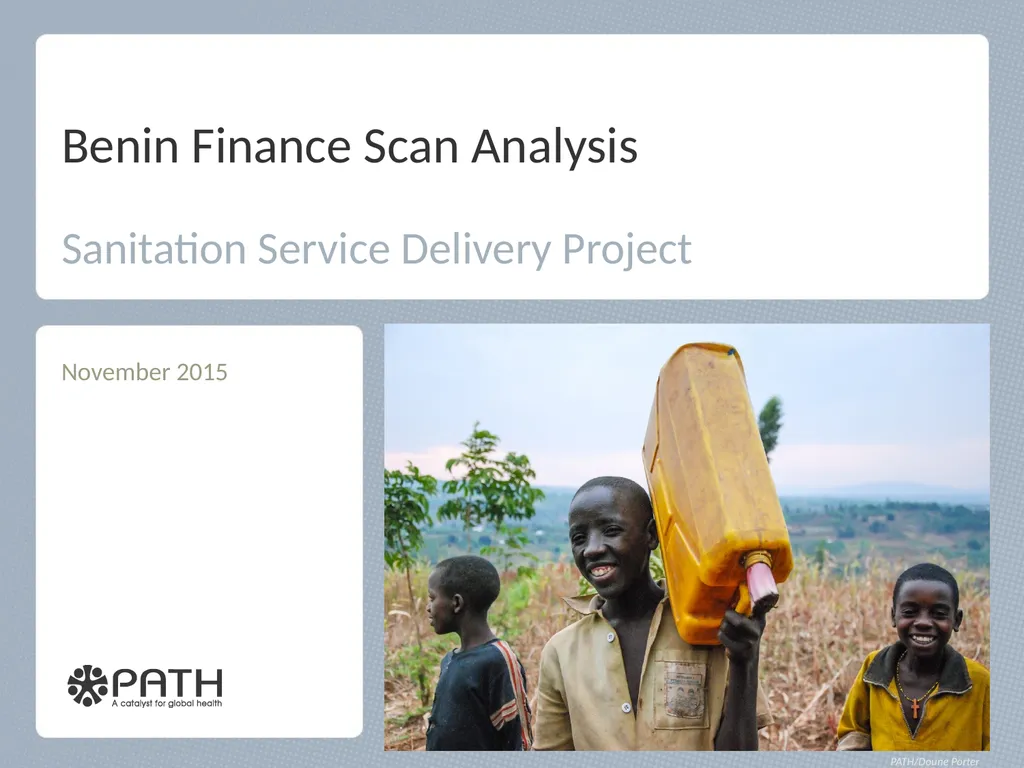
Benin Finance Scan Analysis Sanitation Service Delivery Project November 2015 PATH/Doune Porter<br>
02
Agenda 1. Purpose and objectives
2. Macroeconomic and finance industry context
3. Consumer finance
4. Finance for entrepreneurs
5. Guarantee fund sources
6. Microfinance regulator and industry association
7. Recommendations
8. Appendices and acknowledgments 12/4/2018 Page 2<br>
2. Macroeconomic and finance industry context
3. Consumer finance
4. Finance for entrepreneurs
5. Guarantee fund sources
6. Microfinance regulator and industry association
7. Recommendations
8. Appendices and acknowledgments 12/4/2018 Page 2<br>
03
Purpose and Objective Purpose
Gain an understanding of the role of finance organizations in the project settings, their operations, and their actual and potential involvement with sanitation-related products. Finance organizations include microfinance institutions (MFIs), banks, savings and lending groups, cooperatives, and other organizations—potentially informal—offering finance to individuals or businesses.
Objectives
Understand finance organization business models and current loan options, with a particular focus on financing for low-income consumers (both men and women), and small and medium-size enterprises (SMEs).
Identify and describe the structure of consumer-focused loans, specifically consumption loans.
Obtain insights into motivations and barriers to adding loan products to existing portfolios.
Identify potential financing partners with whom to pilot consumer and supply-side sanitation and FSM (fecal sludge management) loans.
Understand the financing context, based on gender, with regard to roles, knowledge and beliefs, access to assets, legal rights, status and power, and decision-making. 12/4/2018 Page 3<br>
Gain an understanding of the role of finance organizations in the project settings, their operations, and their actual and potential involvement with sanitation-related products. Finance organizations include microfinance institutions (MFIs), banks, savings and lending groups, cooperatives, and other organizations—potentially informal—offering finance to individuals or businesses.
Objectives
Understand finance organization business models and current loan options, with a particular focus on financing for low-income consumers (both men and women), and small and medium-size enterprises (SMEs).
Identify and describe the structure of consumer-focused loans, specifically consumption loans.
Obtain insights into motivations and barriers to adding loan products to existing portfolios.
Identify potential financing partners with whom to pilot consumer and supply-side sanitation and FSM (fecal sludge management) loans.
Understand the financing context, based on gender, with regard to roles, knowledge and beliefs, access to assets, legal rights, status and power, and decision-making. 12/4/2018 Page 3<br>
04
§2. Macroeconomic and finance industry context 12/4/2018 Page 4<br>
05
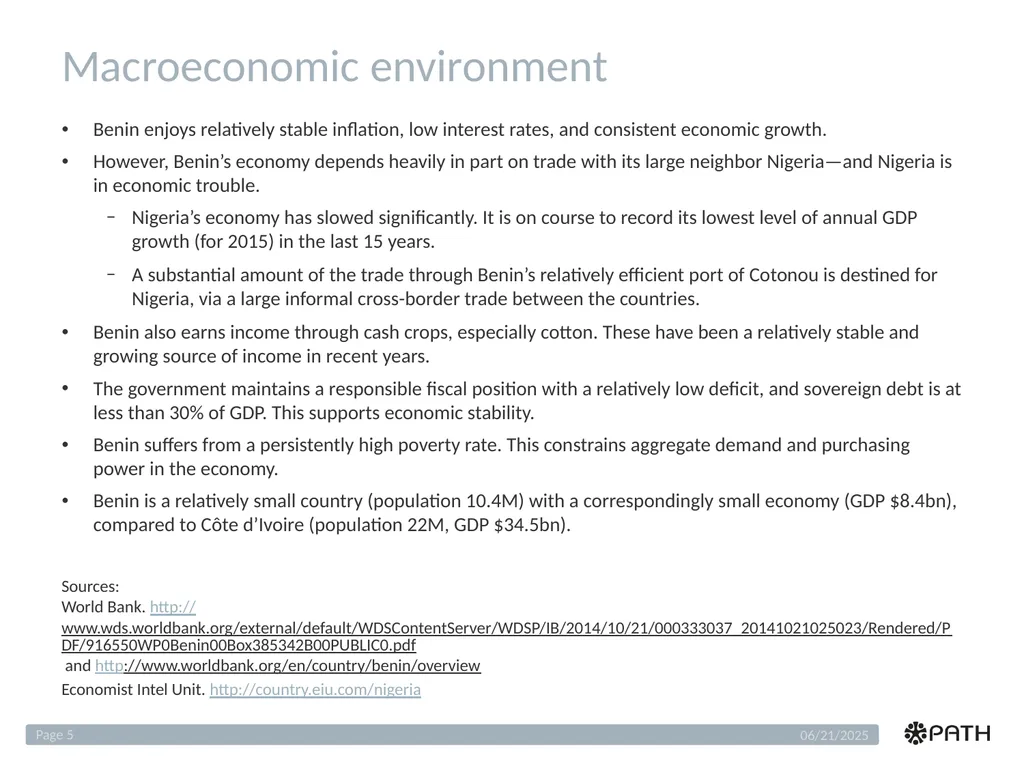
Macroeconomic environment Benin enjoys relatively stable inflation, low interest rates, and consistent economic growth.
However, Benin’s economy depends heavily in part on trade with its large neighbor Nigeria—and Nigeria is in economic trouble.
Nigeria’s economy has slowed significantly. It is on course to record its lowest level of annual GDP growth (for 2015) in the last 15 years.
A substantial amount of the trade through Benin’s relatively efficient port of Cotonou is destined for Nigeria, via a large informal cross-border trade between the countries.
Benin also earns income through cash crops, especially cotton. These have been a relatively stable and growing source of income in recent years.
The government maintains a responsible fiscal position with a relatively low deficit, and sovereign debt is at less than 30% of GDP. This supports economic stability.
Benin suffers from a persistently high poverty rate. This constrains aggregate demand and purchasing power in the economy.
Benin is a relatively small country (population 10.4M) with a correspondingly small economy (GDP $8.4bn), compared to Côte d’Ivoire (population 22M, GDP $34.5bn).
Sources: World Bank. http://www.wds.worldbank.org/external/default/WDSContentServer/WDSP/IB/2014/10/21/000333037_20141021025023/Rendered/PDF/916550WP0Benin00Box385342B00PUBLIC0.pdf and http://www.worldbank.org/en/country/benin/overview
Economist Intel Unit. http://country.eiu.com/nigeria 12/4/2018 Page 5<br>
However, Benin’s economy depends heavily in part on trade with its large neighbor Nigeria—and Nigeria is in economic trouble.
Nigeria’s economy has slowed significantly. It is on course to record its lowest level of annual GDP growth (for 2015) in the last 15 years.
A substantial amount of the trade through Benin’s relatively efficient port of Cotonou is destined for Nigeria, via a large informal cross-border trade between the countries.
Benin also earns income through cash crops, especially cotton. These have been a relatively stable and growing source of income in recent years.
The government maintains a responsible fiscal position with a relatively low deficit, and sovereign debt is at less than 30% of GDP. This supports economic stability.
Benin suffers from a persistently high poverty rate. This constrains aggregate demand and purchasing power in the economy.
Benin is a relatively small country (population 10.4M) with a correspondingly small economy (GDP $8.4bn), compared to Côte d’Ivoire (population 22M, GDP $34.5bn).
Sources: World Bank. http://www.wds.worldbank.org/external/default/WDSContentServer/WDSP/IB/2014/10/21/000333037_20141021025023/Rendered/PDF/916550WP0Benin00Box385342B00PUBLIC0.pdf and http://www.worldbank.org/en/country/benin/overview
Economist Intel Unit. http://country.eiu.com/nigeria 12/4/2018 Page 5<br>
06
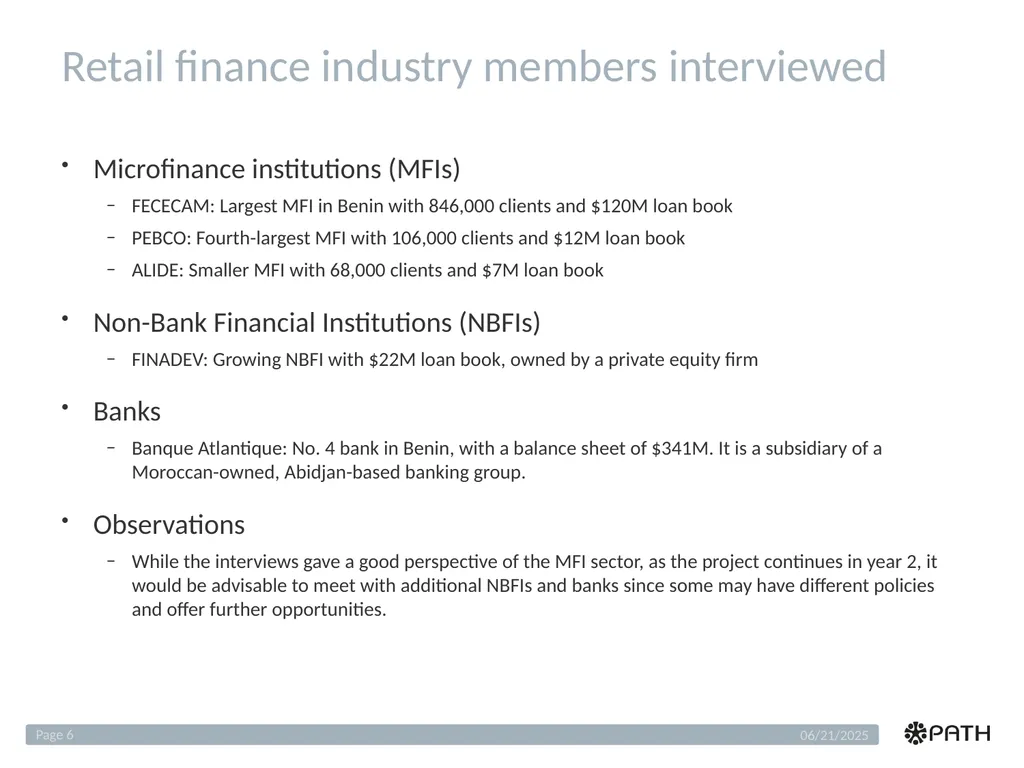
Retail finance industry members interviewed Microfinance institutions (MFIs)
FECECAM: Largest MFI in Benin with 846,000 clients and $120M loan book
PEBCO: Fourth-largest MFI with 106,000 clients and $12M loan book
ALIDE: Smaller MFI with 68,000 clients and $7M loan book
Non-Bank Financial Institutions (NBFIs)
FINADEV: Growing NBFI with $22M loan book, owned by a private equity firm
Banks
Banque Atlantique: No. 4 bank in Benin, with a balance sheet of $341M. It is a subsidiary of a Moroccan-owned, Abidjan-based banking group.
Observations
While the interviews gave a good perspective of the MFI sector, as the project continues in year 2, it would be advisable to meet with additional NBFIs and banks since some may have different policies and offer further opportunities. 12/4/2018 Page 6<br>
FECECAM: Largest MFI in Benin with 846,000 clients and $120M loan book
PEBCO: Fourth-largest MFI with 106,000 clients and $12M loan book
ALIDE: Smaller MFI with 68,000 clients and $7M loan book
Non-Bank Financial Institutions (NBFIs)
FINADEV: Growing NBFI with $22M loan book, owned by a private equity firm
Banks
Banque Atlantique: No. 4 bank in Benin, with a balance sheet of $341M. It is a subsidiary of a Moroccan-owned, Abidjan-based banking group.
Observations
While the interviews gave a good perspective of the MFI sector, as the project continues in year 2, it would be advisable to meet with additional NBFIs and banks since some may have different policies and offer further opportunities. 12/4/2018 Page 6<br>
07
§3. Consumer finance 12/4/2018 Page 7<br>
08
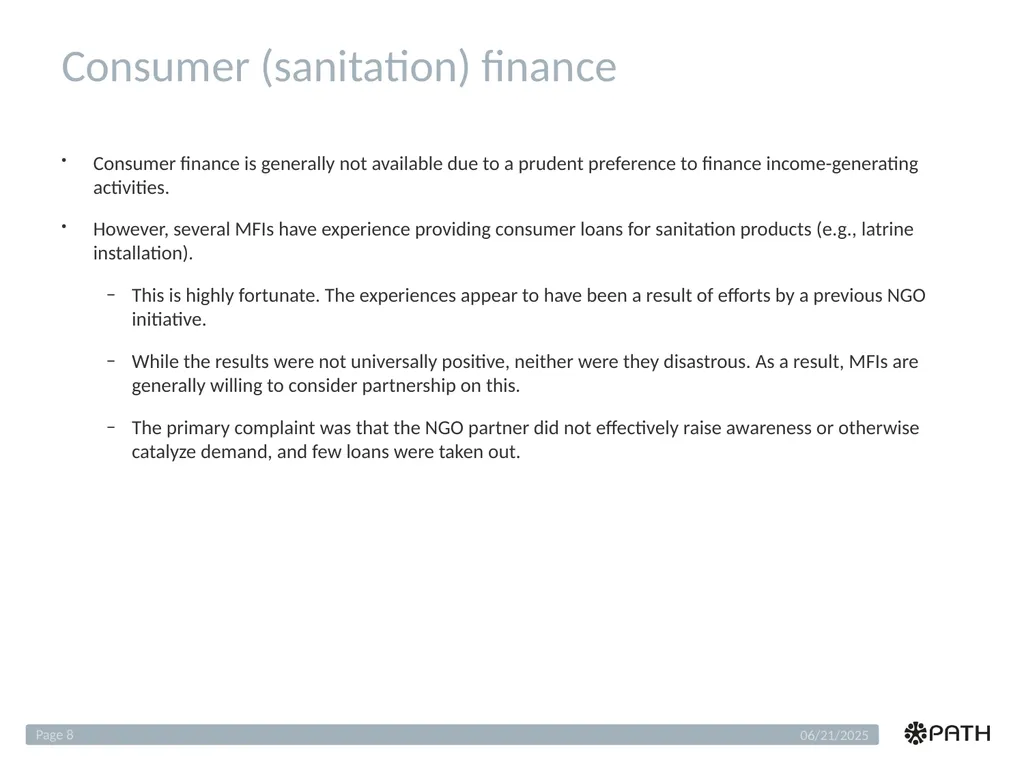
Consumer (sanitation) finance Consumer finance is generally not available due to a prudent preference to finance income-generating activities.
However, several MFIs have experience providing consumer loans for sanitation products (e.g., latrine installation).
This is highly fortunate. The experiences appear to have been a result of efforts by a previous NGO initiative.
While the results were not universally positive, neither were they disastrous. As a result, MFIs are generally willing to consider partnership on this.
The primary complaint was that the NGO partner did not effectively raise awareness or otherwise catalyze demand, and few loans were taken out. 12/4/2018 Page 8<br>
However, several MFIs have experience providing consumer loans for sanitation products (e.g., latrine installation).
This is highly fortunate. The experiences appear to have been a result of efforts by a previous NGO initiative.
While the results were not universally positive, neither were they disastrous. As a result, MFIs are generally willing to consider partnership on this.
The primary complaint was that the NGO partner did not effectively raise awareness or otherwise catalyze demand, and few loans were taken out. 12/4/2018 Page 8<br>
09
Key issue: Demand Very low demand for sanitation loans seen from two pilots to date.
Emphasized by both MFIs with sanitation loan experience.
Generally attributed to inadequate demand generation by NGO partner.
However, Beninese NGO (DECAM-Bethesda) and Dutch NGO partners (WASTE and SNV) have years of experience. They may have made a considerable professional effort to generate demand in the pilot areas.
Loan pricing extended likely represents a best-case scenario due to subsidies.
Ticket size of $250 to $400 and interest rate of 15%, for example, are both on lower, reasonable end of the range for latrine construction ticket and consumer interest rates.
Fundamental issues may be at play.
“The practice of open defecation means that households do not often see the importance of having latrines in relation to the high cost of their construction.” – PEBCO (MFI institution)
“Very often it is the landlords/owners that are the beneficiaries of a credit given at a low interest rate.” – PEBCO
Team feels it may be too early to say whether it is primarily due to a fundamental lack of demand (something that cannot be solved by awareness), or a lack of awareness, or a combination of both.
Both pilots did not meet MFI expectations for uptake.
They emphasized the small numbers involved, only 100 to 250 households in both cases, only approximately 0.01%–0.02% of their large client bases (106,000 to 846,000 clients). 12/4/2018 Page 9<br>
Emphasized by both MFIs with sanitation loan experience.
Generally attributed to inadequate demand generation by NGO partner.
However, Beninese NGO (DECAM-Bethesda) and Dutch NGO partners (WASTE and SNV) have years of experience. They may have made a considerable professional effort to generate demand in the pilot areas.
Loan pricing extended likely represents a best-case scenario due to subsidies.
Ticket size of $250 to $400 and interest rate of 15%, for example, are both on lower, reasonable end of the range for latrine construction ticket and consumer interest rates.
Fundamental issues may be at play.
“The practice of open defecation means that households do not often see the importance of having latrines in relation to the high cost of their construction.” – PEBCO (MFI institution)
“Very often it is the landlords/owners that are the beneficiaries of a credit given at a low interest rate.” – PEBCO
Team feels it may be too early to say whether it is primarily due to a fundamental lack of demand (something that cannot be solved by awareness), or a lack of awareness, or a combination of both.
Both pilots did not meet MFI expectations for uptake.
They emphasized the small numbers involved, only 100 to 250 households in both cases, only approximately 0.01%–0.02% of their large client bases (106,000 to 846,000 clients). 12/4/2018 Page 9<br>
10
Key issue: Risk Sanitation loans are perceived as relatively high risk.
Primarily, as they are a form of consumption loan, and the low-resource context tends to privilege income-generation activities in the eyes of lenders.
Set-up and transaction costs are also relatively quite high in light of small loan volumes seen in past pilots.
If the consumers come to know such loans are supported by an NGO or government fund, this can substantially increase the risk that consumers will choose not to repay the loans. 12/4/2018 Page 10<br>
Primarily, as they are a form of consumption loan, and the low-resource context tends to privilege income-generation activities in the eyes of lenders.
Set-up and transaction costs are also relatively quite high in light of small loan volumes seen in past pilots.
If the consumers come to know such loans are supported by an NGO or government fund, this can substantially increase the risk that consumers will choose not to repay the loans. 12/4/2018 Page 10<br>
11
Key issues: Risk (continued) All MFIs indicated that loan guarantees would be required.
This may also reflect past experience with the two NGO-MFI sanitation pilots; in both cases the NGO provided such guarantees. So the expectation is set.
This view was reinforced by other stakeholders in the MFI sector such as the regulator and industry association, who were aware of the previous experiences.
FECECAM, the largest MFI in Benin, mentioned a relatively good leverage ratio for guarantees—30:100. However the precise allocation of risk would need to be explored. FECECAM indicated that, in the past, the NGO project has taken the first losses up to the amount of its guarantee. From an Sanitation Service Delivery project perspective, it would be preferable if FECECAM shared directly in the first losses so they would have an incentive to avoid such losses through more attention to risk evaluation of applicants and recovery. 12/4/2018 Page 11<br>
This may also reflect past experience with the two NGO-MFI sanitation pilots; in both cases the NGO provided such guarantees. So the expectation is set.
This view was reinforced by other stakeholders in the MFI sector such as the regulator and industry association, who were aware of the previous experiences.
FECECAM, the largest MFI in Benin, mentioned a relatively good leverage ratio for guarantees—30:100. However the precise allocation of risk would need to be explored. FECECAM indicated that, in the past, the NGO project has taken the first losses up to the amount of its guarantee. From an Sanitation Service Delivery project perspective, it would be preferable if FECECAM shared directly in the first losses so they would have an incentive to avoid such losses through more attention to risk evaluation of applicants and recovery. 12/4/2018 Page 11<br>
12
§4. Finance for entrepreneurs
In particular, for Micro, Small, and Medium Enterprises (MSME) and SMEs 12/4/2018 Page 12<br>
13
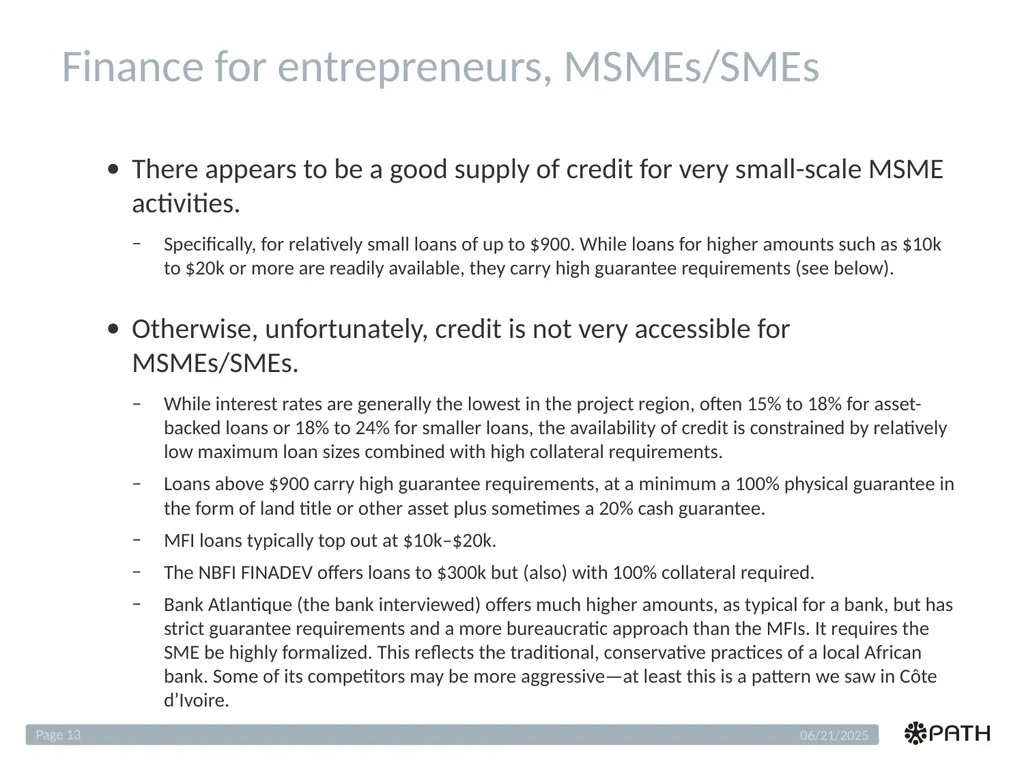
Finance for entrepreneurs, MSMEs/SMEs There appears to be a good supply of credit for very small-scale MSME activities.
Specifically, for relatively small loans of up to $900. While loans for higher amounts such as $10k to $20k or more are readily available, they carry high guarantee requirements (see below).
Otherwise, unfortunately, credit is not very accessible for MSMEs/SMEs.
While interest rates are generally the lowest in the project region, often 15% to 18% for asset-backed loans or 18% to 24% for smaller loans, the availability of credit is constrained by relatively low maximum loan sizes combined with high collateral requirements.
Loans above $900 carry high guarantee requirements, at a minimum a 100% physical guarantee in the form of land title or other asset plus sometimes a 20% cash guarantee.
MFI loans typically top out at $10k–$20k.
The NBFI FINADEV offers loans to $300k but (also) with 100% collateral required.
Bank Atlantique (the bank interviewed) offers much higher amounts, as typical for a bank, but has strict guarantee requirements and a more bureaucratic approach than the MFIs. It requires the SME be highly formalized. This reflects the traditional, conservative practices of a local African bank. Some of its competitors may be more aggressive—at least this is a pattern we saw in Côte d’Ivoire. 12/4/2018 Page 13<br>
Specifically, for relatively small loans of up to $900. While loans for higher amounts such as $10k to $20k or more are readily available, they carry high guarantee requirements (see below).
Otherwise, unfortunately, credit is not very accessible for MSMEs/SMEs.
While interest rates are generally the lowest in the project region, often 15% to 18% for asset-backed loans or 18% to 24% for smaller loans, the availability of credit is constrained by relatively low maximum loan sizes combined with high collateral requirements.
Loans above $900 carry high guarantee requirements, at a minimum a 100% physical guarantee in the form of land title or other asset plus sometimes a 20% cash guarantee.
MFI loans typically top out at $10k–$20k.
The NBFI FINADEV offers loans to $300k but (also) with 100% collateral required.
Bank Atlantique (the bank interviewed) offers much higher amounts, as typical for a bank, but has strict guarantee requirements and a more bureaucratic approach than the MFIs. It requires the SME be highly formalized. This reflects the traditional, conservative practices of a local African bank. Some of its competitors may be more aggressive—at least this is a pattern we saw in Côte d’Ivoire. 12/4/2018 Page 13<br>
14
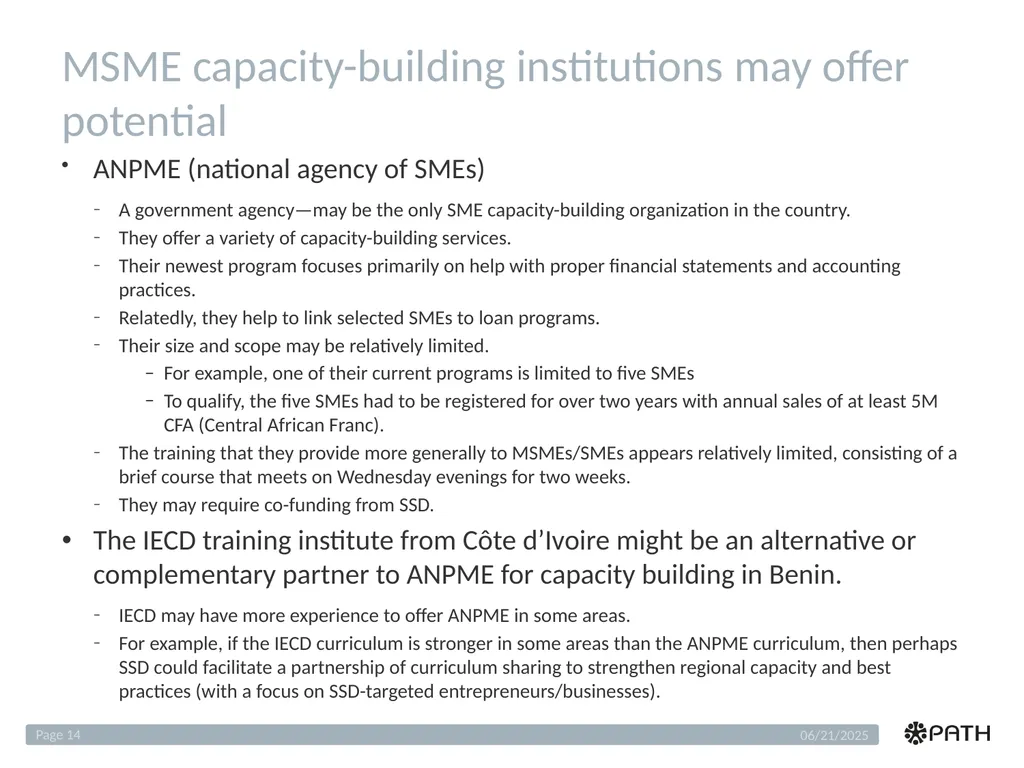
MSME capacity-building institutions may offer potential ANPME (national agency of SMEs)
A government agency—may be the only SME capacity-building organization in the country.
They offer a variety of capacity-building services.
Their newest program focuses primarily on help with proper financial statements and accounting practices.
Relatedly, they help to link selected SMEs to loan programs.
Their size and scope may be relatively limited.
For example, one of their current programs is limited to five SMEs
To qualify, the five SMEs had to be registered for over two years with annual sales of at least 5M CFA (Central African Franc).
The training that they provide more generally to MSMEs/SMEs appears relatively limited, consisting of a brief course that meets on Wednesday evenings for two weeks.
They may require co-funding from SSD.
The IECD training institute from Côte d’Ivoire might be an alternative or complementary partner to ANPME for capacity building in Benin.
IECD may have more experience to offer ANPME in some areas.
For example, if the IECD curriculum is stronger in some areas than the ANPME curriculum, then perhaps SSD could facilitate a partnership of curriculum sharing to strengthen regional capacity and best practices (with a focus on SSD-targeted entrepreneurs/businesses). 12/4/2018 Page 14<br>
A government agency—may be the only SME capacity-building organization in the country.
They offer a variety of capacity-building services.
Their newest program focuses primarily on help with proper financial statements and accounting practices.
Relatedly, they help to link selected SMEs to loan programs.
Their size and scope may be relatively limited.
For example, one of their current programs is limited to five SMEs
To qualify, the five SMEs had to be registered for over two years with annual sales of at least 5M CFA (Central African Franc).
The training that they provide more generally to MSMEs/SMEs appears relatively limited, consisting of a brief course that meets on Wednesday evenings for two weeks.
They may require co-funding from SSD.
The IECD training institute from Côte d’Ivoire might be an alternative or complementary partner to ANPME for capacity building in Benin.
IECD may have more experience to offer ANPME in some areas.
For example, if the IECD curriculum is stronger in some areas than the ANPME curriculum, then perhaps SSD could facilitate a partnership of curriculum sharing to strengthen regional capacity and best practices (with a focus on SSD-targeted entrepreneurs/businesses). 12/4/2018 Page 14<br>
15
§5. Guarantee fund sources 12/4/2018 Page 15<br>
16
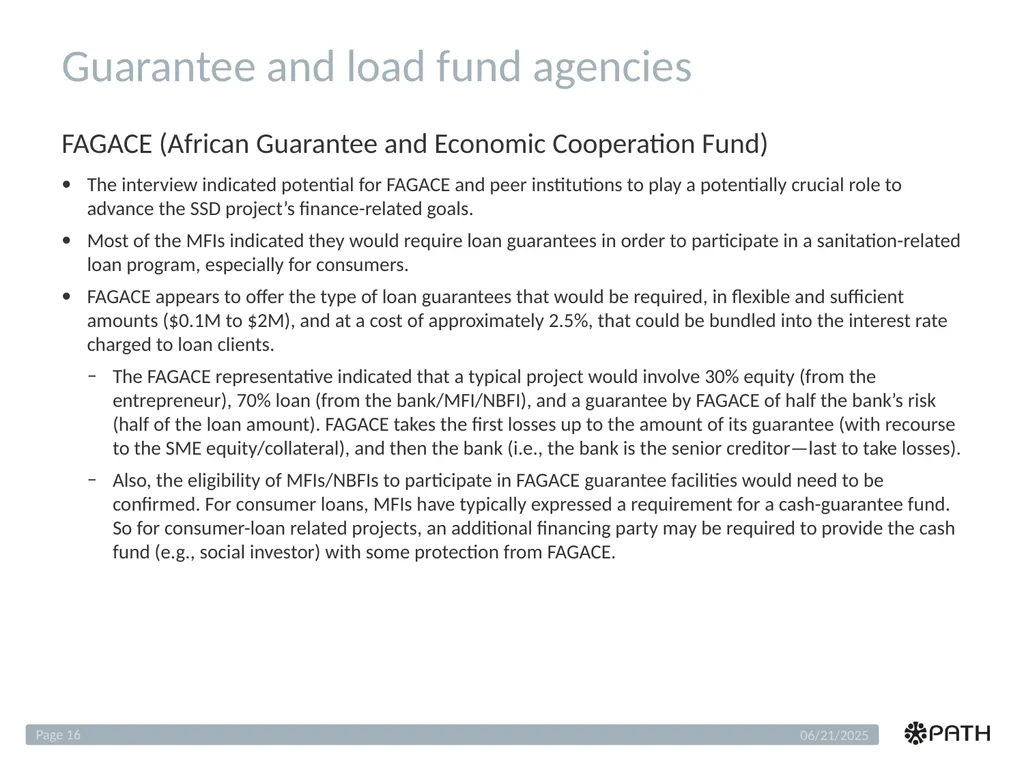
Guarantee and load fund agencies FAGACE (African Guarantee and Economic Cooperation Fund)
The interview indicated potential for FAGACE and peer institutions to play a potentially crucial role to advance the SSD project’s finance-related goals.
Most of the MFIs indicated they would require loan guarantees in order to participate in a sanitation-related loan program, especially for consumers.
FAGACE appears to offer the type of loan guarantees that would be required, in flexible and sufficient amounts ($0.1M to $2M), and at a cost of approximately 2.5%, that could be bundled into the interest rate charged to loan clients.
The FAGACE representative indicated that a typical project would involve 30% equity (from the entrepreneur), 70% loan (from the bank/MFI/NBFI), and a guarantee by FAGACE of half the bank’s risk (half of the loan amount). FAGACE takes the first losses up to the amount of its guarantee (with recourse to the SME equity/collateral), and then the bank (i.e., the bank is the senior creditor—last to take losses).
Also, the eligibility of MFIs/NBFIs to participate in FAGACE guarantee facilities would need to be confirmed. For consumer loans, MFIs have typically expressed a requirement for a cash-guarantee fund. So for consumer-loan related projects, an additional financing party may be required to provide the cash fund (e.g., social investor) with some protection from FAGACE. 12/4/2018 Page 16<br>
The interview indicated potential for FAGACE and peer institutions to play a potentially crucial role to advance the SSD project’s finance-related goals.
Most of the MFIs indicated they would require loan guarantees in order to participate in a sanitation-related loan program, especially for consumers.
FAGACE appears to offer the type of loan guarantees that would be required, in flexible and sufficient amounts ($0.1M to $2M), and at a cost of approximately 2.5%, that could be bundled into the interest rate charged to loan clients.
The FAGACE representative indicated that a typical project would involve 30% equity (from the entrepreneur), 70% loan (from the bank/MFI/NBFI), and a guarantee by FAGACE of half the bank’s risk (half of the loan amount). FAGACE takes the first losses up to the amount of its guarantee (with recourse to the SME equity/collateral), and then the bank (i.e., the bank is the senior creditor—last to take losses).
Also, the eligibility of MFIs/NBFIs to participate in FAGACE guarantee facilities would need to be confirmed. For consumer loans, MFIs have typically expressed a requirement for a cash-guarantee fund. So for consumer-loan related projects, an additional financing party may be required to provide the cash fund (e.g., social investor) with some protection from FAGACE. 12/4/2018 Page 16<br>
17
Guarantee and load fund agencies (continued) The procedure to develop such a facility with FAGACE was outlined and requires a level of coordination among sanitation-sector stakeholders that SSD may be well-positioned to provide.
Specifically, the most notable requirement relates to the formation of an Economic Interest Consortium made up of industry stakeholders as a prerequisite to arrangement of a guarantee facility.
The FAGACE official appeared eager to partner with SSD.
Contrasts favorably to the reception given by some other stakeholders, such as ALAFIA and the MFI regulatory agency that emphasized SSD would need to cover their costs.
Importantly, FAGACE also operates in Côte d’Ivoire. A (potential) regional partner. 12/4/2018 Page 17<br>
Specifically, the most notable requirement relates to the formation of an Economic Interest Consortium made up of industry stakeholders as a prerequisite to arrangement of a guarantee facility.
The FAGACE official appeared eager to partner with SSD.
Contrasts favorably to the reception given by some other stakeholders, such as ALAFIA and the MFI regulatory agency that emphasized SSD would need to cover their costs.
Importantly, FAGACE also operates in Côte d’Ivoire. A (potential) regional partner. 12/4/2018 Page 17<br>
18
Guarantee and load fund agencies (continued) National Microfinance Fund (FNM)
While, in principle, they offer lines of credit and guarantee funds that may be of use to the SSD project, the process of partnering with this government agency appears extremely complicated.
Specifically, a formal collaboration between the SSD project and the government of Benin is required as a prerequisite for the FNM to consider partnership. This would need to include:
A joint policy, with agreement among three ministries: Health, Environment, and Microfinance.
FAGACE and other regional agencies likely offer more opportunities 12/4/2018 Page 18<br>
While, in principle, they offer lines of credit and guarantee funds that may be of use to the SSD project, the process of partnering with this government agency appears extremely complicated.
Specifically, a formal collaboration between the SSD project and the government of Benin is required as a prerequisite for the FNM to consider partnership. This would need to include:
A joint policy, with agreement among three ministries: Health, Environment, and Microfinance.
FAGACE and other regional agencies likely offer more opportunities 12/4/2018 Page 18<br>
19
§6. Microfinance regulator and industry association 12/4/2018 Page 19<br>
20
Regulator and MFI industry association Most MFIs commented that the sector is effectively regulated.
The regulator is concerned primarily with supervision of the sector, naturally enough.
The MFI industry association is concerned primarily with advocacy for the interests of the MFIs, with the regulator and other relevant parts of the government and political leadership.
Both stressed the need for funding from the SSD project to their agency or association as an essential element of any partnership.
Both were fairly directive in their advice to the SSD project.
Given the influence of these two bodies, if a partnership were to go sour (for example, when greater funding was demanded), then it could put a variety of project activities at risk.
It may be preferable to keep the regulator and ALAFIA (the MFI industry association) politely informed of project progress (such as with informal meetings every six months) and look to other opportunities for active partnerships (such as FAGACE). Also, informally, their advice can be taken from time to time. 12/4/2018 Page 20<br>
The regulator is concerned primarily with supervision of the sector, naturally enough.
The MFI industry association is concerned primarily with advocacy for the interests of the MFIs, with the regulator and other relevant parts of the government and political leadership.
Both stressed the need for funding from the SSD project to their agency or association as an essential element of any partnership.
Both were fairly directive in their advice to the SSD project.
Given the influence of these two bodies, if a partnership were to go sour (for example, when greater funding was demanded), then it could put a variety of project activities at risk.
It may be preferable to keep the regulator and ALAFIA (the MFI industry association) politely informed of project progress (such as with informal meetings every six months) and look to other opportunities for active partnerships (such as FAGACE). Also, informally, their advice can be taken from time to time. 12/4/2018 Page 20<br>
21
§7. Recommendations 12/4/2018 Page 21<br>
22
Recommendations (preliminary impressions) Consumer finance for sanitation appears to face a demand challenge.
The MFIs rightly point out that a convincing solution to stimulate demand would be crucial to render partnership worthwhile.
Risk is the other issue that confronts consumer finance for sanitation; however, there are signs this could be addressed by partnering with guarantee agencies.
FAGACE partnership could be key to enable productive MFI partnerships.
Among the MFIs interviewed, both FECECAM and PEBCO would be of interest for partnerships. Both appear to have sufficient size and management expertise. They also have experience with NGOs and sanitation. FECECAM is distinguished by its large size, while PEBCO has perhaps the strongest natural interest, given the role of sanitation in its 1990s-era origin story. 12/4/2018 Page 22<br>
The MFIs rightly point out that a convincing solution to stimulate demand would be crucial to render partnership worthwhile.
Risk is the other issue that confronts consumer finance for sanitation; however, there are signs this could be addressed by partnering with guarantee agencies.
FAGACE partnership could be key to enable productive MFI partnerships.
Among the MFIs interviewed, both FECECAM and PEBCO would be of interest for partnerships. Both appear to have sufficient size and management expertise. They also have experience with NGOs and sanitation. FECECAM is distinguished by its large size, while PEBCO has perhaps the strongest natural interest, given the role of sanitation in its 1990s-era origin story. 12/4/2018 Page 22<br>
23
Recommendations (preliminary impressions) (continued) For SME finance, FINADEV and Banque Atlantique could be important due in part to their ability to issue larger loans.
Over the course of year 2, it would be worthwhile to interview a few more NBFIs and banks since some are more progressive than others with respect to collateral requirements and other policies.
Consider a twin approach to capacity-building partnerships, to use the local strengths of ANIPME and multifaceted program of IECD.
Follow-up on FAGACE’s recommendation to meet with BOAD, and generally explore for additional development bank and guarantee fund partners (such as African Guarantee Fund based in Nairobi).
Note that this recommendation also applies to Côte d’Ivoire. The PSI country teams plan to coordinate their follow-up with the agencies mentioned. 12/4/2018 Page 23<br>
Over the course of year 2, it would be worthwhile to interview a few more NBFIs and banks since some are more progressive than others with respect to collateral requirements and other policies.
Consider a twin approach to capacity-building partnerships, to use the local strengths of ANIPME and multifaceted program of IECD.
Follow-up on FAGACE’s recommendation to meet with BOAD, and generally explore for additional development bank and guarantee fund partners (such as African Guarantee Fund based in Nairobi).
Note that this recommendation also applies to Côte d’Ivoire. The PSI country teams plan to coordinate their follow-up with the agencies mentioned. 12/4/2018 Page 23<br>
24
§8. Appendices an acknowledgements 12/4/2018 Page 24<br>
25
Appendices and acknowledgments The analysis in this presentation is based upon review of the detailed interview summaries from PSI. The interested reader is referred to these summaries for reference (on file with PSI).
Grateful acknowledgments to the PSI interview team, who also provided useful comments and suggestions on this analysis:
Bernard Elegbe
Carolle Akotondji
Stephene Quenum
Olivier Gnankpa 12/4/2018 Page 25<br>
Grateful acknowledgments to the PSI interview team, who also provided useful comments and suggestions on this analysis:
Bernard Elegbe
Carolle Akotondji
Stephene Quenum
Olivier Gnankpa 12/4/2018 Page 25<br>