
Benson Sim United Nations Statistics Division

Description: Benson Sim United Nations Statistics Division Islamic finance in the national accounts 11th Meeting of the Advisory Expert Group on National Accounts 5-7 December 2017 New York, United States of America Outline of presentation Background
Related Topics
Download Presentation
"Benson Sim United Nations Statistics Division" is the property of its rightful owner. Permission is granted to download and print the materials on this website for personal, non-commercial use only, and to display it on your personal computer provided you do not modify the materials and that you retain all copyright notices contained in the materials. By downloading content from our website, you accept the terms of this agreement.
Presentation Transcript
slide1. Benson Sim
United Nations Statistics Division Islamic finance in the
national accounts 11th Meeting of the Advisory Expert Group on National Accounts
5-7 December 2017
New York, United States of America<br>
slide2. Outline of presentation Background
What has been done
Discussions at Beirut workshop
Key conclusions of Beirut workshop
Key recommendations of Beirut workshop
Looking ahead
Questions for the AEG 2<br>
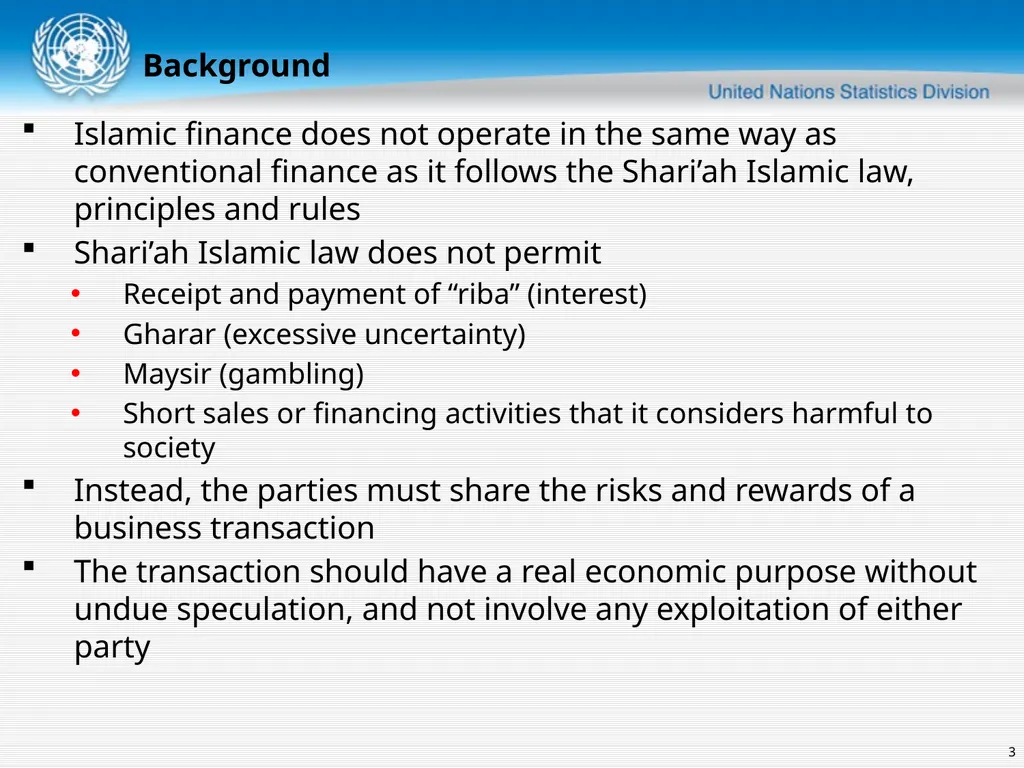
slide3. Background Islamic finance does not operate in the same way as conventional finance as it follows the Shari’ah Islamic law, principles and rules
Shari’ah Islamic law does not permit
Receipt and payment of “riba” (interest)
Gharar (excessive uncertainty)
Maysir (gambling)
Short sales or financing activities that it considers harmful to society
Instead, the parties must share the risks and rewards of a business transaction
The transaction should have a real economic purpose without undue speculation, and not involve any exploitation of either party 3<br>
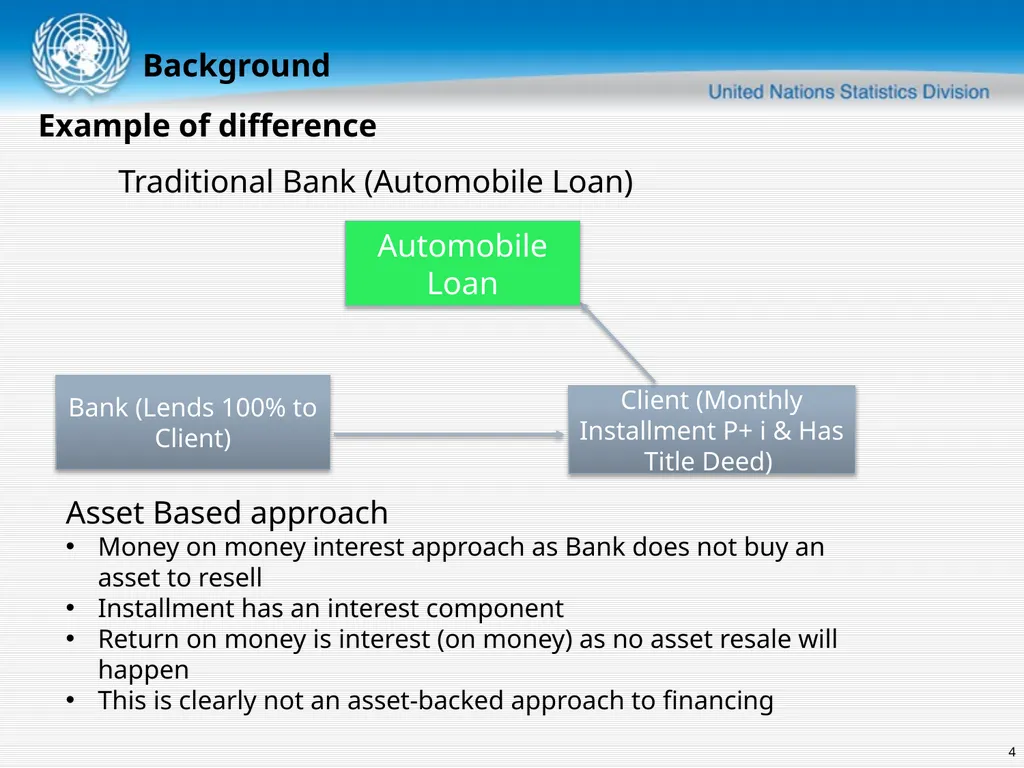
slide4. Background 4 Example of difference Traditional Bank (Automobile Loan) Client (Monthly Installment P+ i & Has Title Deed) Bank (Lends 100% to Client) Asset Based approach
Money on money interest approach as Bank does not buy an asset to resell
Installment has an interest component
Return on money is interest (on money) as no asset resale will happen
This is clearly not an asset-backed approach to financing Automobile Loan<br>
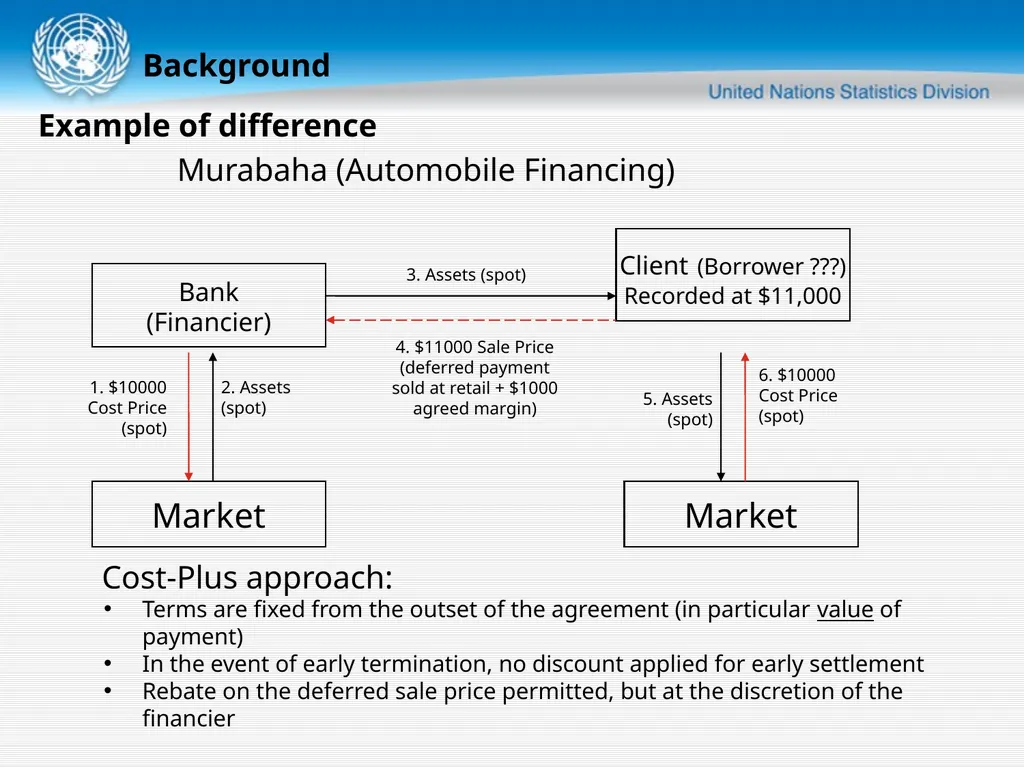
slide5. Background Example of difference Murabaha (Automobile Financing) Cost-Plus approach:
Terms are fixed from the outset of the agreement (in particular value of payment)
In the event of early termination, no discount applied for early settlement
Rebate on the deferred sale price permitted, but at the discretion of the financier Market Bank
(Financier) Client (Borrower ???) Recorded at $11,000 Market 1. $10000 Cost Price (spot) 2. Assets (spot) 3. Assets (spot) 4. $11000 Sale Price (deferred payment sold at retail + $1000 agreed margin) 5. Assets (spot) 6. $10000 Cost Price (spot)<br>
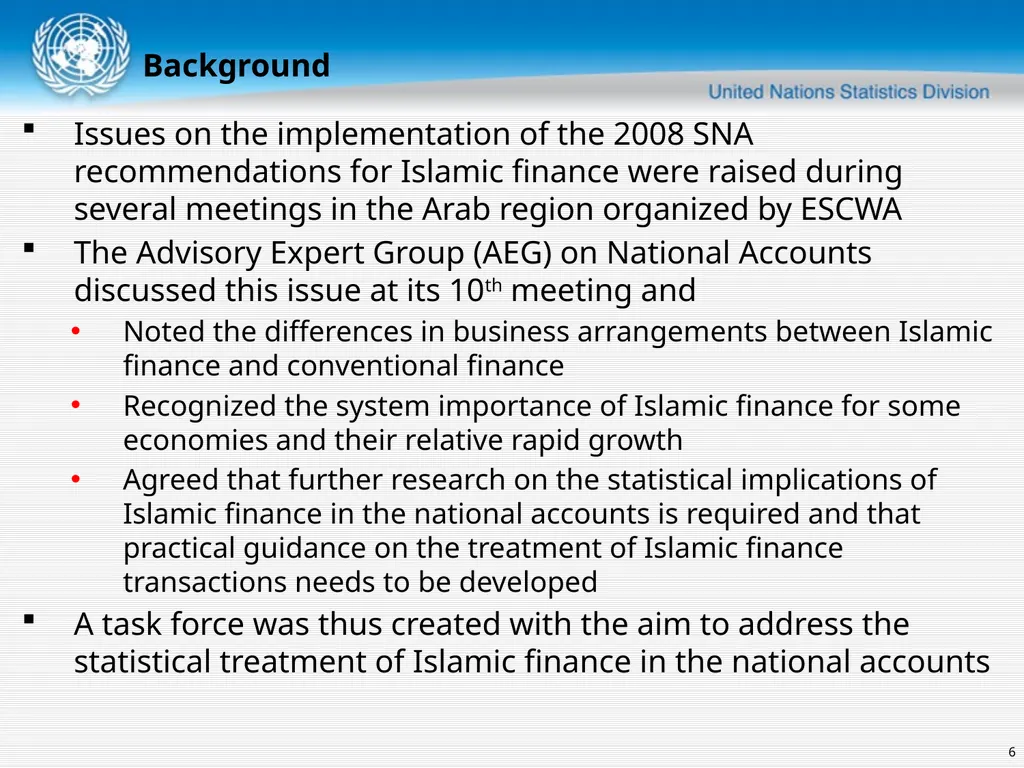
slide6. Background Issues on the implementation of the 2008 SNA recommendations for Islamic finance were raised during several meetings in the Arab region organized by ESCWA
The Advisory Expert Group (AEG) on National Accounts discussed this issue at its 10th meeting and
Noted the differences in business arrangements between Islamic finance and conventional finance
Recognized the system importance of Islamic finance for some economies and their relative rapid growth
Agreed that further research on the statistical implications of Islamic finance in the national accounts is required and that practical guidance on the treatment of Islamic finance transactions needs to be developed
A task force was thus created with the aim to address the statistical treatment of Islamic finance in the national accounts 6<br>
slide7. What has been done A WebEx meeting among key stakeholders to identify key areas of work was organized in June 2017
Islamic finance website to consolidate relevant materials and provide updates on the work done has been set up (see https://unstats.un.org/unsd/nationalaccount/ud-IF.asp)
A Workshop on Islamic Finance in the National Accounts was organized in Beirut, Lebanon, from 24-26 October 2017 7<br>
slide8. Discussions at Beirut workshop Workshop saw
Presentations and draft recommendations on
Use of income statements and balance sheets of Islamic banks for compiling national accounts
Sectorization of Islamic financial corporations
Classification of Islamic financial instruments
Classification of corresponding property income associated with Islamic financial instruments
Calculation of output and value added of Islamic financial services
International initiatives to collect data on Islamic finance
Country practices in compiling Islamic finance statistics, challenges involved and solutions to overcome these challenges
Workshop resulted in a number of key conclusions and recommendations 8<br>
slide9. Key conclusions The 2008 SNA provides the overarching integrating framework to measure the activities of Islamic finance
The accompanying international classification schemes such as ISIC Rev. 4 and CPC Ver. 2.1 are meant to provide general guidance and recommendations
Thus, they should not be amended to specifically accommodate the various elements of Islamic finance
Rather, compiling agencies can consider disaggregating the relevant categories in international classification schemes to the relevant Islamic finance sub-categories in the national reporting of data 9 Relevance of the 2008 SNA framework<br>
slide10. Key conclusions There are important differences between the income statements and balance sheets of Islamic banks and conventional banks
A thorough understanding of these differences is needed to determine how to use the income statements and balance sheets of Islamic banks in the compilation of national accounts
The Islamic bank framework of the IFSB potentially provides a good source of information for compiling Islamic finance statistics in the national accounts
There is a need to determine whether Islamic banks or its clients are the economic owners of the non-financial assets related to sales, lease and equity financing which are reported on the balance sheets of Islamic banks 10 Use of income statements and balance sheets of Islamic banks<br>
slide11. Key conclusions There is a need for worked examples to illustrate how to make use of these income statements and balance sheets to calculate the various elements of Islamic finance such as property income and output in the national accounts
Solutions to obtain separate data on Islamic windows need to be developed as such data are typically not collected by regulatory or supervisory authorities 11 Use of income statements and balance sheets of Islamic banks<br>
slide12. Key conclusions Islamic financial corporations can be allocated to the subsectors of the financial corporations sector as outlined in the 2008 SNA
However, the allocation of Islamic financial corporations to the deposit-taking corporations except the central bank subsector will need to be reconciled with the consequent classification of at least one of their financial instruments on the liabilities side as deposits and the corresponding property income payable as interest
Sovereign wealth funds if they are institutional units and provide financial services on a market basis to the government are allocated to the captive financial institutions and moneylenders subsector 12 Sectorization of Islamic financial corporations<br>
slide13. Key conclusions Islamic insurance corporations should be allocated to the insurance subsector given that the nature of their economic activity is no different from that of conventional insurance corporations 13 Sectorization of Islamic financial corporations<br>
slide14. Key conclusions The existing sectorization of Islamic financial corporations and classification of Islamic financial instruments for compiling monetary and financial statistics using the classification schemes in the 2008 SNA are intended to obtain major macroeconomic aggregate indicators such as money supply (broad money) and credit
There is a need to reconcile the existing sectorization and classification with the perceptible shift to second era Islamic finance such as profit and loss sharing accounts, Islamic financial instruments with hybrid features and the classification of the associated property income in the national accounts 14 Classification of Islamic financial instruments<br>
slide15. Key conclusions The reconciliation exercise will also need to assess the impact on the measurement of debt and money supply arising from classifying Islamic financial instruments as equity and non-equity in the 2008 SNA framework 15 Classification of Islamic financial instruments<br>
slide16. Key conclusions There is a need to assess whether the current concept of interest in the 2008 SNA can be interpreted to include the property income associated with Islamic financial instruments that are classified as deposits, loans or debt securities
There is a need to reconcile the classification of the investment income payable to holders of unrestricted profit-sharing investment accounts and the subsequent reinvestment of a portion of this investment income in the profit equalization reserves 16 Classification of corresponding property income<br>
slide17. Key conclusions There is a need to assess whether it is appropriate to calculate the output of the financial intermediation services provided by Islamic financial corporations which are classified as deposit-taking corporations using the FISIM formula, and if yes, determine the appropriate reference and financing rates to be used in the calculation of these services
There is a need to develop practical guidance on how to calculate the quarterly output of Islamic financial services whose returns are only known ex-post annually
There is a need to develop methods to estimate the intermediate consumption of Islamic financial corporations and Islamic windows in order to calculate their value added 17 Output and value added of Islamic financial services<br>
slide18. Key conclusions There is a need for regional and international organizations which are collecting data on Islamic finance to explore collaborative efforts in order to reduce duplication and respondent burden
Links to the databases of these international organizations should be included on UNSD’s Islamic finance website to enhance user accessibility to the data which are collected
There is a need for regional and international organizations which are collecting data on Islamic finance to consider standardizing their data collection and dissemination methods using internationally-endorsed standards such as Statistical Data and Metadata eXchange (SDMX) protocols 18 International initiatives to collect data on Islamic finance<br>
slide19. Key recommendations Two working groups should be formed to streamline the work to tackle the issues which were raised during the workshop
First working group will work on
Use of income statements and balance sheets of Islamic banks for compiling national accounts
Sectorization of Islamic financial corporations
Classification of Islamic financial instruments
Classification of the corresponding property income associated with Islamic financial instruments
Calculation of output and value added of Islamic financial services 19<br>
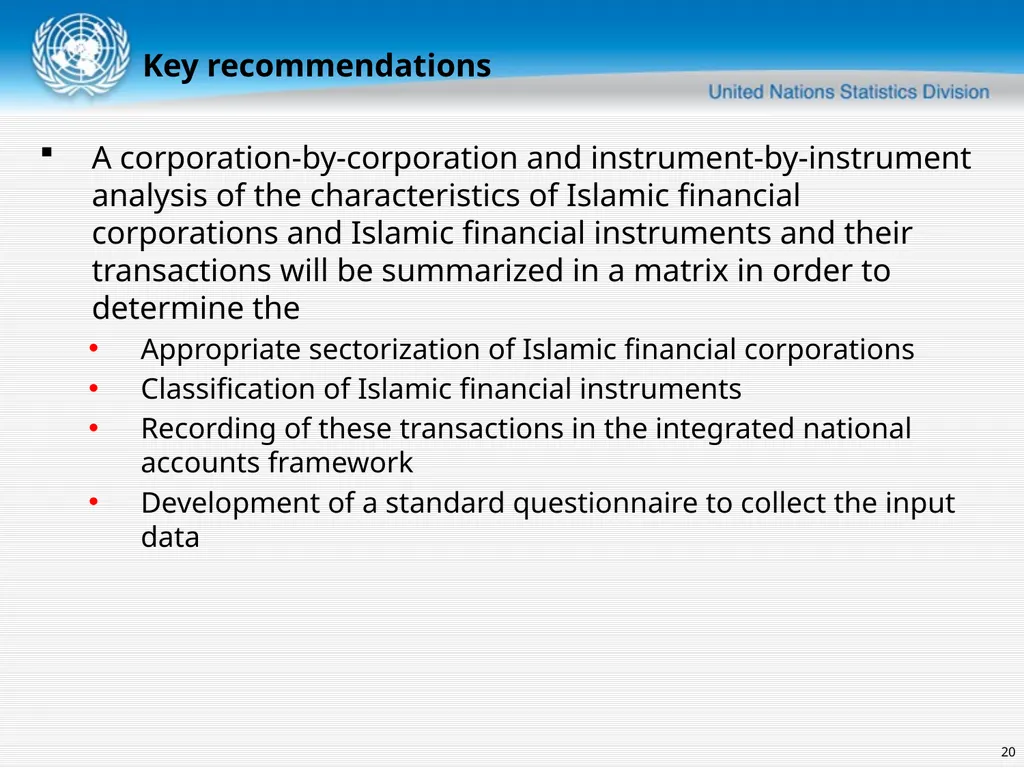
slide20. Key recommendations A corporation-by-corporation and instrument-by-instrument analysis of the characteristics of Islamic financial corporations and Islamic financial instruments and their transactions will be summarized in a matrix in order to determine the
Appropriate sectorization of Islamic financial corporations
Classification of Islamic financial instruments
Recording of these transactions in the integrated national accounts framework
Development of a standard questionnaire to collect the input data 20<br>
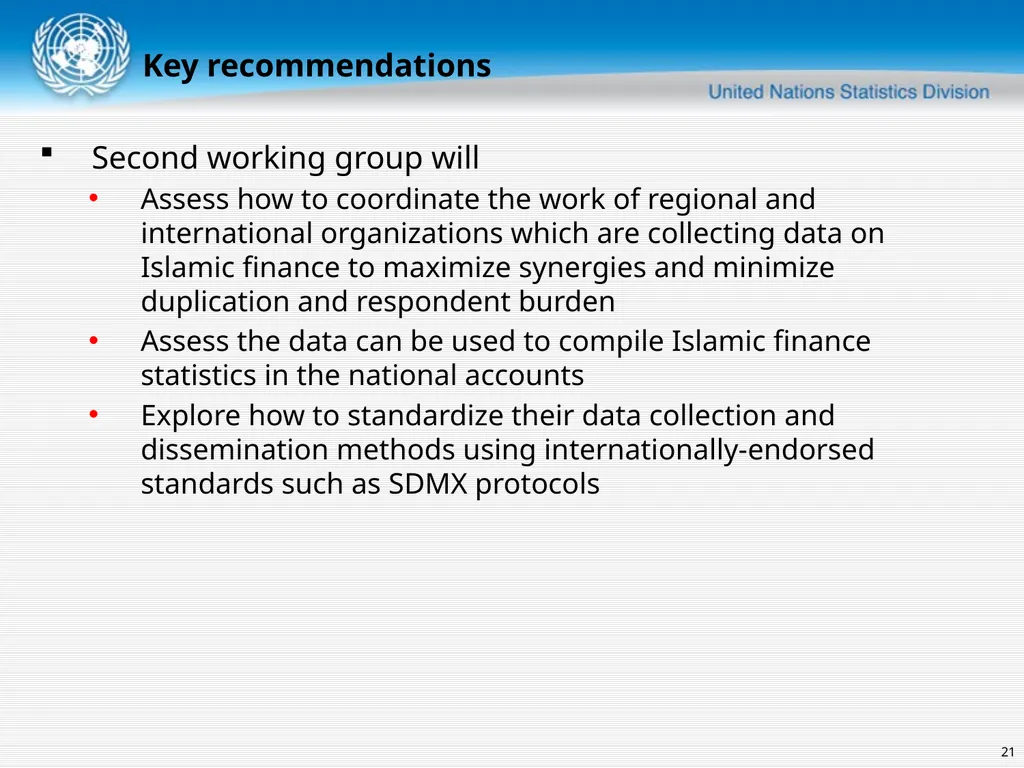
slide21. Key recommendations Second working group will
Assess how to coordinate the work of regional and international organizations which are collecting data on Islamic finance to maximize synergies and minimize duplication and respondent burden
Assess the data can be used to compile Islamic finance statistics in the national accounts
Explore how to standardize their data collection and dissemination methods using internationally-endorsed standards such as SDMX protocols 21<br>
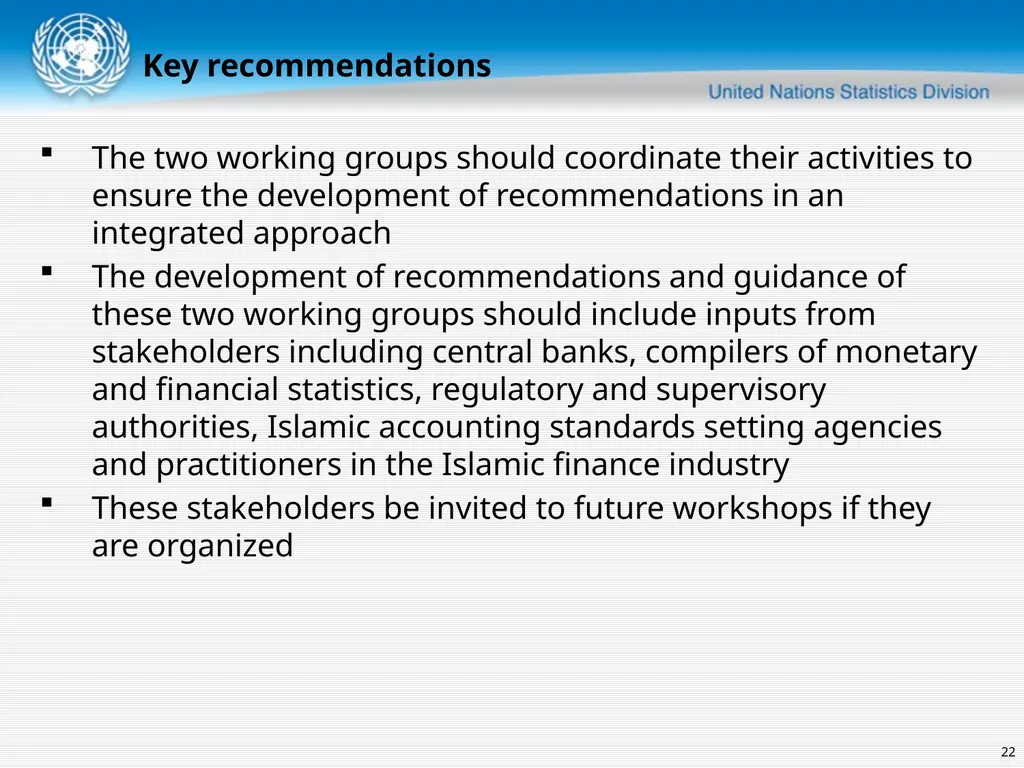
slide22. Key recommendations The two working groups should coordinate their activities to ensure the development of recommendations in an integrated approach
The development of recommendations and guidance of these two working groups should include inputs from stakeholders including central banks, compilers of monetary and financial statistics, regulatory and supervisory authorities, Islamic accounting standards setting agencies and practitioners in the Islamic finance industry
These stakeholders be invited to future workshops if they are organized 22<br>
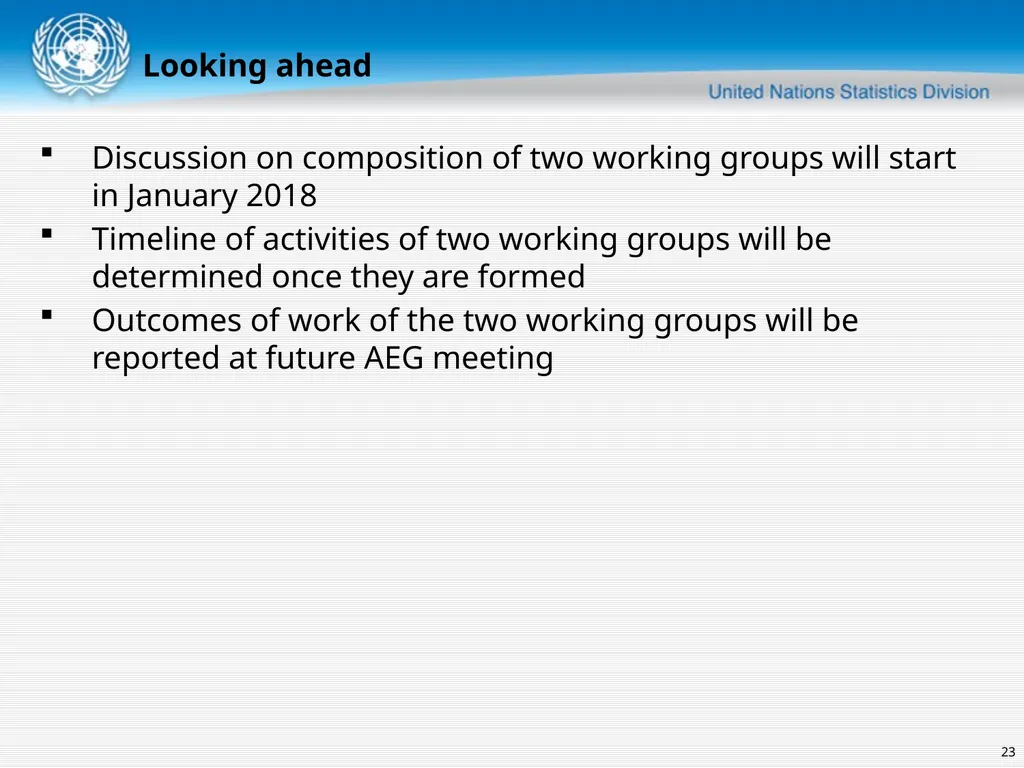
slide23. Looking ahead Discussion on composition of two working groups will start in January 2018
Timeline of activities of two working groups will be determined once they are formed
Outcomes of work of the two working groups will be reported at future AEG meeting 23<br>
slide24. Questions for the AEG The AEG is requested to provide guidance on the key recommendations presented in paragraphs 28-32 of the paper 24<br>
slide25. 25 Thank you<br>
United Nations Statistics Division Islamic finance in the
national accounts 11th Meeting of the Advisory Expert Group on National Accounts
5-7 December 2017
New York, United States of America<br>
slide2. Outline of presentation Background
What has been done
Discussions at Beirut workshop
Key conclusions of Beirut workshop
Key recommendations of Beirut workshop
Looking ahead
Questions for the AEG 2<br>
slide3. Background Islamic finance does not operate in the same way as conventional finance as it follows the Shari’ah Islamic law, principles and rules
Shari’ah Islamic law does not permit
Receipt and payment of “riba” (interest)
Gharar (excessive uncertainty)
Maysir (gambling)
Short sales or financing activities that it considers harmful to society
Instead, the parties must share the risks and rewards of a business transaction
The transaction should have a real economic purpose without undue speculation, and not involve any exploitation of either party 3<br>
slide4. Background 4 Example of difference Traditional Bank (Automobile Loan) Client (Monthly Installment P+ i & Has Title Deed) Bank (Lends 100% to Client) Asset Based approach
Money on money interest approach as Bank does not buy an asset to resell
Installment has an interest component
Return on money is interest (on money) as no asset resale will happen
This is clearly not an asset-backed approach to financing Automobile Loan<br>
slide5. Background Example of difference Murabaha (Automobile Financing) Cost-Plus approach:
Terms are fixed from the outset of the agreement (in particular value of payment)
In the event of early termination, no discount applied for early settlement
Rebate on the deferred sale price permitted, but at the discretion of the financier Market Bank
(Financier) Client (Borrower ???) Recorded at $11,000 Market 1. $10000 Cost Price (spot) 2. Assets (spot) 3. Assets (spot) 4. $11000 Sale Price (deferred payment sold at retail + $1000 agreed margin) 5. Assets (spot) 6. $10000 Cost Price (spot)<br>
slide6. Background Issues on the implementation of the 2008 SNA recommendations for Islamic finance were raised during several meetings in the Arab region organized by ESCWA
The Advisory Expert Group (AEG) on National Accounts discussed this issue at its 10th meeting and
Noted the differences in business arrangements between Islamic finance and conventional finance
Recognized the system importance of Islamic finance for some economies and their relative rapid growth
Agreed that further research on the statistical implications of Islamic finance in the national accounts is required and that practical guidance on the treatment of Islamic finance transactions needs to be developed
A task force was thus created with the aim to address the statistical treatment of Islamic finance in the national accounts 6<br>
slide7. What has been done A WebEx meeting among key stakeholders to identify key areas of work was organized in June 2017
Islamic finance website to consolidate relevant materials and provide updates on the work done has been set up (see https://unstats.un.org/unsd/nationalaccount/ud-IF.asp)
A Workshop on Islamic Finance in the National Accounts was organized in Beirut, Lebanon, from 24-26 October 2017 7<br>
slide8. Discussions at Beirut workshop Workshop saw
Presentations and draft recommendations on
Use of income statements and balance sheets of Islamic banks for compiling national accounts
Sectorization of Islamic financial corporations
Classification of Islamic financial instruments
Classification of corresponding property income associated with Islamic financial instruments
Calculation of output and value added of Islamic financial services
International initiatives to collect data on Islamic finance
Country practices in compiling Islamic finance statistics, challenges involved and solutions to overcome these challenges
Workshop resulted in a number of key conclusions and recommendations 8<br>
slide9. Key conclusions The 2008 SNA provides the overarching integrating framework to measure the activities of Islamic finance
The accompanying international classification schemes such as ISIC Rev. 4 and CPC Ver. 2.1 are meant to provide general guidance and recommendations
Thus, they should not be amended to specifically accommodate the various elements of Islamic finance
Rather, compiling agencies can consider disaggregating the relevant categories in international classification schemes to the relevant Islamic finance sub-categories in the national reporting of data 9 Relevance of the 2008 SNA framework<br>
slide10. Key conclusions There are important differences between the income statements and balance sheets of Islamic banks and conventional banks
A thorough understanding of these differences is needed to determine how to use the income statements and balance sheets of Islamic banks in the compilation of national accounts
The Islamic bank framework of the IFSB potentially provides a good source of information for compiling Islamic finance statistics in the national accounts
There is a need to determine whether Islamic banks or its clients are the economic owners of the non-financial assets related to sales, lease and equity financing which are reported on the balance sheets of Islamic banks 10 Use of income statements and balance sheets of Islamic banks<br>
slide11. Key conclusions There is a need for worked examples to illustrate how to make use of these income statements and balance sheets to calculate the various elements of Islamic finance such as property income and output in the national accounts
Solutions to obtain separate data on Islamic windows need to be developed as such data are typically not collected by regulatory or supervisory authorities 11 Use of income statements and balance sheets of Islamic banks<br>
slide12. Key conclusions Islamic financial corporations can be allocated to the subsectors of the financial corporations sector as outlined in the 2008 SNA
However, the allocation of Islamic financial corporations to the deposit-taking corporations except the central bank subsector will need to be reconciled with the consequent classification of at least one of their financial instruments on the liabilities side as deposits and the corresponding property income payable as interest
Sovereign wealth funds if they are institutional units and provide financial services on a market basis to the government are allocated to the captive financial institutions and moneylenders subsector 12 Sectorization of Islamic financial corporations<br>
slide13. Key conclusions Islamic insurance corporations should be allocated to the insurance subsector given that the nature of their economic activity is no different from that of conventional insurance corporations 13 Sectorization of Islamic financial corporations<br>
slide14. Key conclusions The existing sectorization of Islamic financial corporations and classification of Islamic financial instruments for compiling monetary and financial statistics using the classification schemes in the 2008 SNA are intended to obtain major macroeconomic aggregate indicators such as money supply (broad money) and credit
There is a need to reconcile the existing sectorization and classification with the perceptible shift to second era Islamic finance such as profit and loss sharing accounts, Islamic financial instruments with hybrid features and the classification of the associated property income in the national accounts 14 Classification of Islamic financial instruments<br>
slide15. Key conclusions The reconciliation exercise will also need to assess the impact on the measurement of debt and money supply arising from classifying Islamic financial instruments as equity and non-equity in the 2008 SNA framework 15 Classification of Islamic financial instruments<br>
slide16. Key conclusions There is a need to assess whether the current concept of interest in the 2008 SNA can be interpreted to include the property income associated with Islamic financial instruments that are classified as deposits, loans or debt securities
There is a need to reconcile the classification of the investment income payable to holders of unrestricted profit-sharing investment accounts and the subsequent reinvestment of a portion of this investment income in the profit equalization reserves 16 Classification of corresponding property income<br>
slide17. Key conclusions There is a need to assess whether it is appropriate to calculate the output of the financial intermediation services provided by Islamic financial corporations which are classified as deposit-taking corporations using the FISIM formula, and if yes, determine the appropriate reference and financing rates to be used in the calculation of these services
There is a need to develop practical guidance on how to calculate the quarterly output of Islamic financial services whose returns are only known ex-post annually
There is a need to develop methods to estimate the intermediate consumption of Islamic financial corporations and Islamic windows in order to calculate their value added 17 Output and value added of Islamic financial services<br>
slide18. Key conclusions There is a need for regional and international organizations which are collecting data on Islamic finance to explore collaborative efforts in order to reduce duplication and respondent burden
Links to the databases of these international organizations should be included on UNSD’s Islamic finance website to enhance user accessibility to the data which are collected
There is a need for regional and international organizations which are collecting data on Islamic finance to consider standardizing their data collection and dissemination methods using internationally-endorsed standards such as Statistical Data and Metadata eXchange (SDMX) protocols 18 International initiatives to collect data on Islamic finance<br>
slide19. Key recommendations Two working groups should be formed to streamline the work to tackle the issues which were raised during the workshop
First working group will work on
Use of income statements and balance sheets of Islamic banks for compiling national accounts
Sectorization of Islamic financial corporations
Classification of Islamic financial instruments
Classification of the corresponding property income associated with Islamic financial instruments
Calculation of output and value added of Islamic financial services 19<br>
slide20. Key recommendations A corporation-by-corporation and instrument-by-instrument analysis of the characteristics of Islamic financial corporations and Islamic financial instruments and their transactions will be summarized in a matrix in order to determine the
Appropriate sectorization of Islamic financial corporations
Classification of Islamic financial instruments
Recording of these transactions in the integrated national accounts framework
Development of a standard questionnaire to collect the input data 20<br>
slide21. Key recommendations Second working group will
Assess how to coordinate the work of regional and international organizations which are collecting data on Islamic finance to maximize synergies and minimize duplication and respondent burden
Assess the data can be used to compile Islamic finance statistics in the national accounts
Explore how to standardize their data collection and dissemination methods using internationally-endorsed standards such as SDMX protocols 21<br>
slide22. Key recommendations The two working groups should coordinate their activities to ensure the development of recommendations in an integrated approach
The development of recommendations and guidance of these two working groups should include inputs from stakeholders including central banks, compilers of monetary and financial statistics, regulatory and supervisory authorities, Islamic accounting standards setting agencies and practitioners in the Islamic finance industry
These stakeholders be invited to future workshops if they are organized 22<br>
slide23. Looking ahead Discussion on composition of two working groups will start in January 2018
Timeline of activities of two working groups will be determined once they are formed
Outcomes of work of the two working groups will be reported at future AEG meeting 23<br>
slide24. Questions for the AEG The AEG is requested to provide guidance on the key recommendations presented in paragraphs 28-32 of the paper 24<br>
slide25. 25 Thank you<br>