01
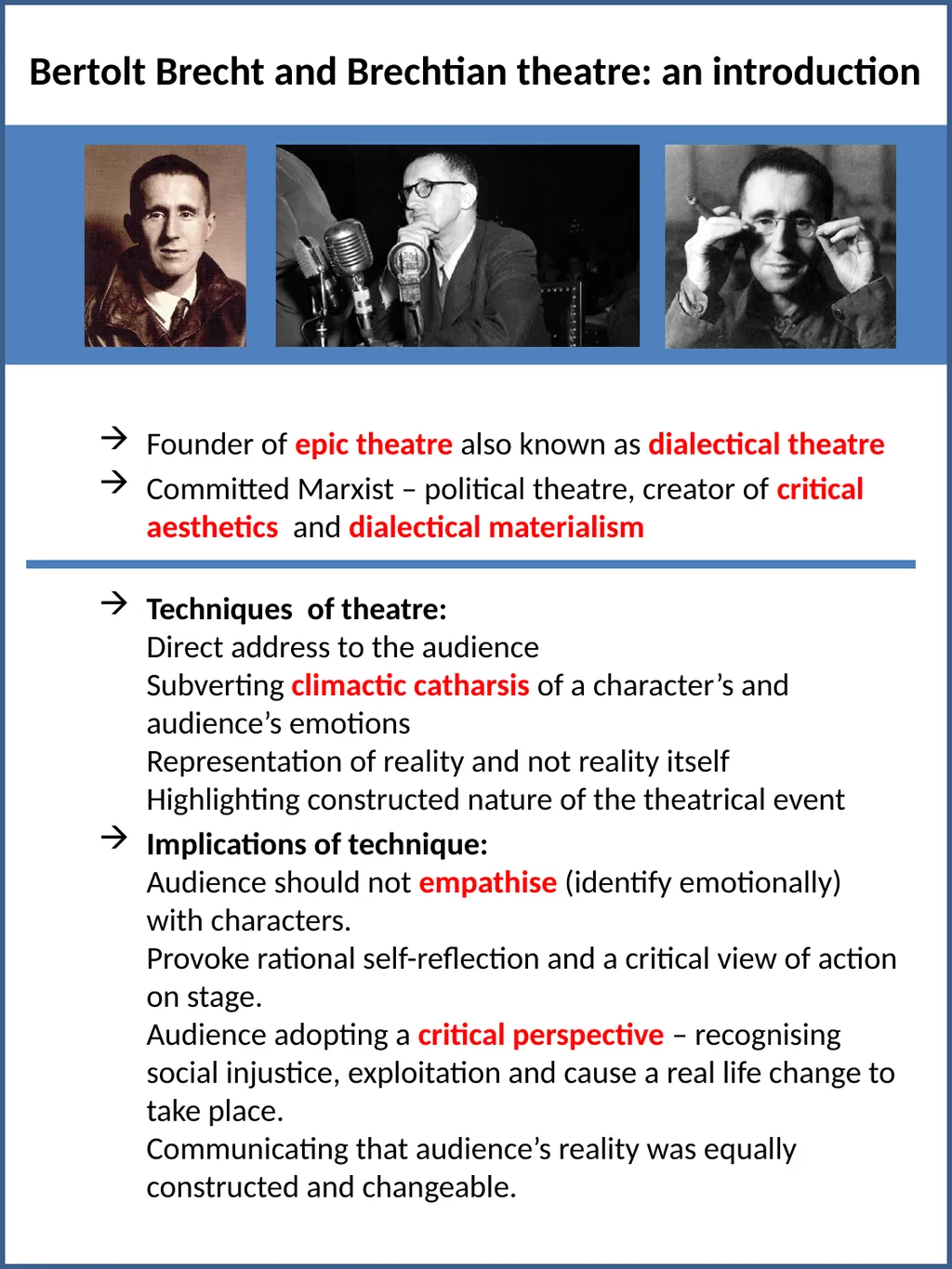
Bertolt Brecht and Brechtian theatre: an introduction Founder of epic theatre also known as dialectical theatre
Committed Marxist – political theatre, creator of critical aesthetics and dialectical materialism�
Techniques of theatre:�Direct address to the audience�Subverting climactic catharsis of a character’s and audience’s emotions�Representation of reality and not reality itself�Highlighting constructed nature of the theatrical event
Implications of technique:�Audience should not empathise (identify emotionally) with characters.�Provoke rational self-reflection and a critical view of action on stage.�Audience adopting a critical perspective – recognising social injustice, exploitation and cause a real life change to take place.�Communicating that audience’s reality was equally constructed and changeable.<br>
02
:::::::: [GLOSSARY OF BRECHTIAN TERMINOLOGY] :::::::: DEFAMILIARIZATION EFFECT�A distancing or alienating effect where the audience are discouraged from empathising with the characters through an obvious, self-conscious, astonishing technique of theatrical delivery. The use of actor’s direct address to the audience, bright stage lighting, songs interrupting action, explanatory placards, third person or past tense narration and speaking stage directions out loud.�In German: Verfremdungseffekt AESTHETICS�Dealing with the nature of art, beauty and taste. In theatre, it relates to the visual palette of what the audience sees on stage: stage design, costume, lighting, character appearance, lighting, character movement, props and proxemics. EPIC THEATRE�The goal of epic theatre is in almost direct opposition to Stanislavski’s naturalistic approach to theatre. Rather than causing the audience to be immersed in the story (to suspend one’s disbelief, to escape, vicariously live through characters), the goal of epic theatre is for the audience to always be aware that they are watching a play, with many self-conscious reminders throughout the performance. DIALECTICAL MATERIALISM�Strand of Marxism discussing how economics (no matter how industry progresses) will inevitably decay. Brechtian theatre is concerned with the contradiction of society’s pursuit for progress that leads to regression. MARXISM�An ideology that attempted to revolutionise social change that focused on class relations and the dangers of the capitalist industry. Brechtian theatre actively supported Marxist ideologies. CATHARSIS�A sudden emotional breakdown or climax that includes overwhelming feelings of pity, sorrow, laughter resulting in an absolute change in emotion resulting in renewal, restoration and revitalization. EMPATHY
Identifying or even relating personally to a character in a story to the point you almost live through their experiences and share their goals, conflicts and experiences.
Brechtian theatre and Brechtian influenced theatre is interested in distancing you from the characters to the point where you have almost no emotional involvement with them whatsoever. This approach to storytelling is to encourage you to be critical rather than emotional in your perception of the play. AVANT-GARDE�The study of beauty, in this case, in theatrical form. PROTAGONIST�The main character in a story, with goals, conflicts and the one the audience is most likely to empathise with. However, in Brechtian theatre, the protagonist(s) can be as equally distancing as any antagonists. ANTAGONIST�In direct conflict with the protagonist. The antagonist can be anything from an external character to an internal state of mind. Brecht explores antagonisms. GESTUS�Mode of acting that is an embodiment of attitude. “BREAKING THE FOURTH WALL”�Directly talking to and addressing the audience as a participant in the play. THEATRE MONTAGE TECHNIQUE�Character and story interruptions, contradictions in story, fragmented storylines, contrasts reminding the audience of the rhythmic artifice of the stage. Brechtian theatre uses the montage technique to be self-conscious – encouraging the audience to critique rather than suspend one’s disbelief. IDEOLOGY�A person’s values, attitudes, beliefs and opinions that can be consciously, sub-consciously and/or unconsciously expressed through someone’s art. Brechtian theatre is highly ideological.<br>