Best practices for the self-assessment Agnė Grajauskienė Freelance Quality Assurance Manager, former Reviews Manager at ENQA Goran Dakovic Reviews Manager, ENQA 1.10.2018 ENQA Seminar for agencies preparing for an initial external review 1
"Best practices for the self-assessment Agnė" is the property of its rightful owner. Permission is granted to
download and print the materials on this website for personal, non-commercial use only, and to display it
on your personal computer provided you do not modify the materials and that you retain all copyright
notices contained in the materials. By downloading content from our website, you accept the terms of this
agreement.
Presentation Transcript
01
Best practices for the self-assessment Agnė Grajauskienė
Freelance Quality Assurance Manager, former Reviews Manager at ENQA
Goran Dakovic
Reviews Manager, ENQA 1.10.2018 ENQA Seminar for agencies preparing for an initial external review 1<br>
02
Self-assessment report is not a goal in itself SAR – final outcome of a whole self-evaluation process
Self-critical internal consideration – What works well? What could be improved?
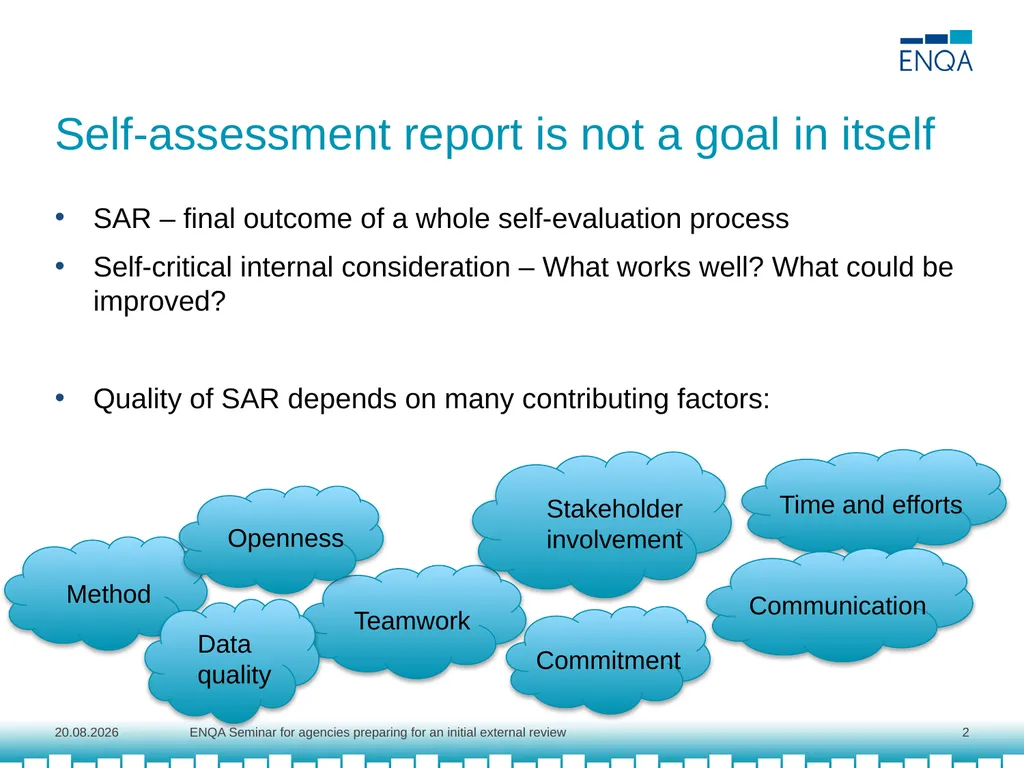
Quality of SAR depends on many contributing factors: 1.10.2018 ENQA Seminar for agencies preparing for an initial external review 2<br>
03
What would be important To take into account the views of a wide range of stakeholders to inform self-evaluation
To agree on the timeline for development of SAR - clear indication of what each contributor is expected to provide and when
To reserve enough time for writing/editing. To look both backward and forward – SAR not only states what has been achieved but also reflects on what could be done to enhance activities in the future.
To follow the structure and to use clear language
Minimum description, maximum analysis and self-evaluation 1.10.2018 ENQA Seminar for agencies preparing for an initial external review 3<br>
04
1.10.2018 ENQA Seminar for agencies preparing for an initial external review 4<br>
05
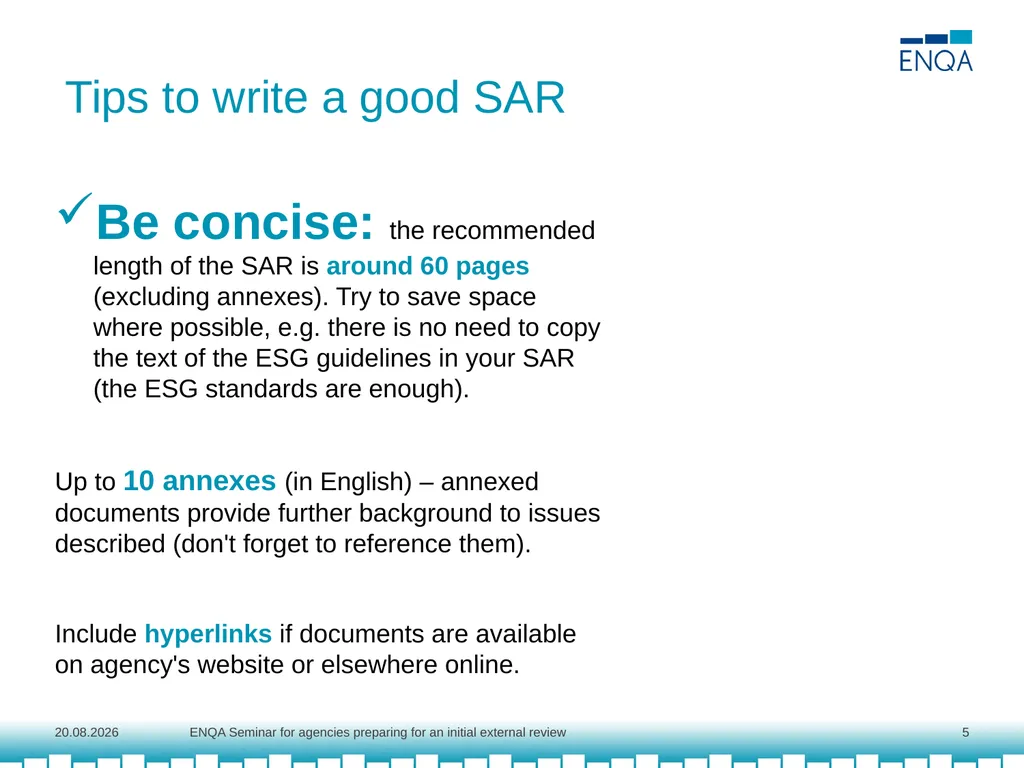
Tips to write a good SAR Be concise: the recommended length of the SAR is around 60 pages (excluding annexes). Try to save space where possible, e.g. there is no need to copy the text of the ESG guidelines in your SAR (the ESG standards are enough).
Up to 10 annexes (in English) – annexed documents provide further background to issues described (don't forget to reference them).
Include hyperlinks if documents are available on agency's website or elsewhere online. 1.10.2018 ENQA Seminar for agencies preparing for an initial external review 5<br>
06
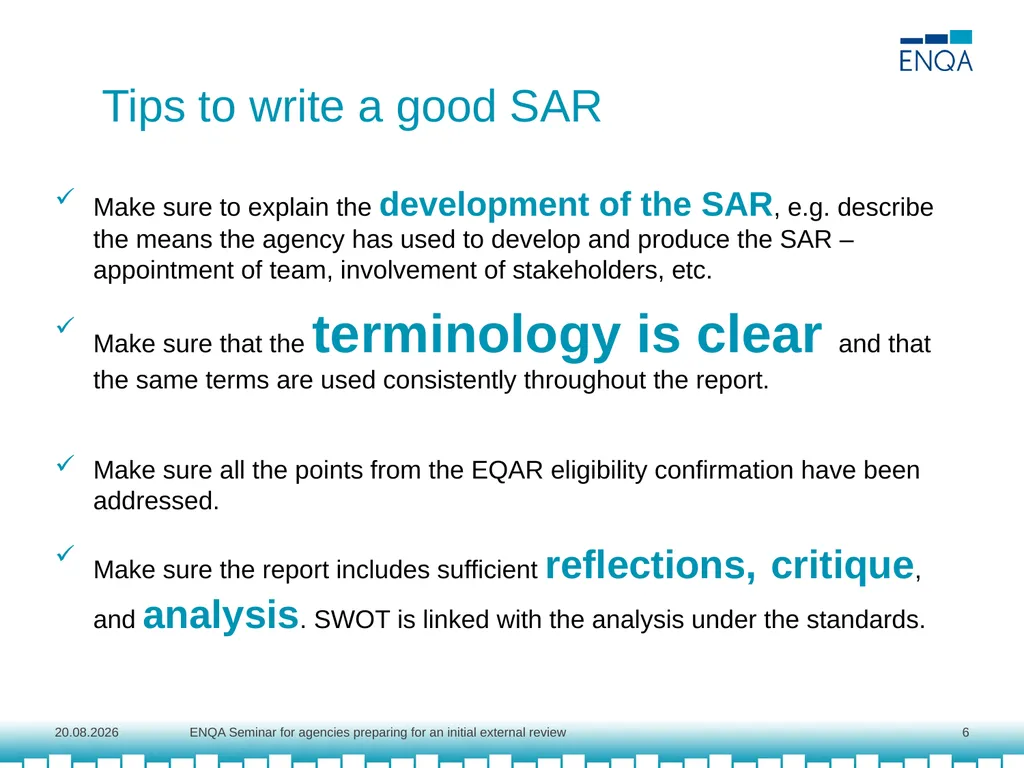
Tips to write a good SAR Make sure to explain the development of the SAR, e.g. describe the means the agency has used to develop and produce the SAR – appointment of team, involvement of stakeholders, etc.
Make sure that the terminology is clear and that the same terms are used consistently throughout the report.
Make sure all the points from the EQAR eligibility confirmation have been addressed.
Make sure the report includes sufficient reflections, critique, and analysis. SWOT is linked with the analysis under the standards. 1.10.2018 ENQA Seminar for agencies preparing for an initial external review 6<br>
07
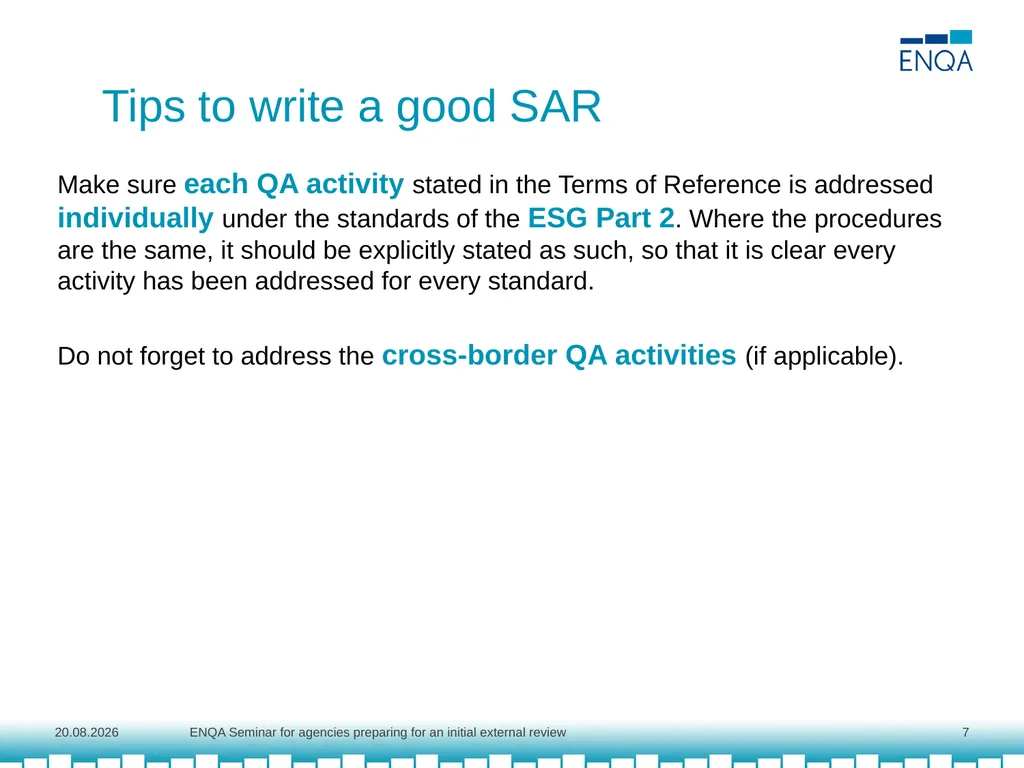
Tips to write a good SAR Make sure each QA activity stated in the Terms of Reference is addressed individually under the standards of the ESG Part 2. Where the procedures are the same, it should be explicitly stated as such, so that it is clear every activity has been addressed for every standard.
Do not forget to address the cross-border QA activities (if applicable). 1.10.2018 ENQA Seminar for agencies preparing for an initial external review 7<br>
08
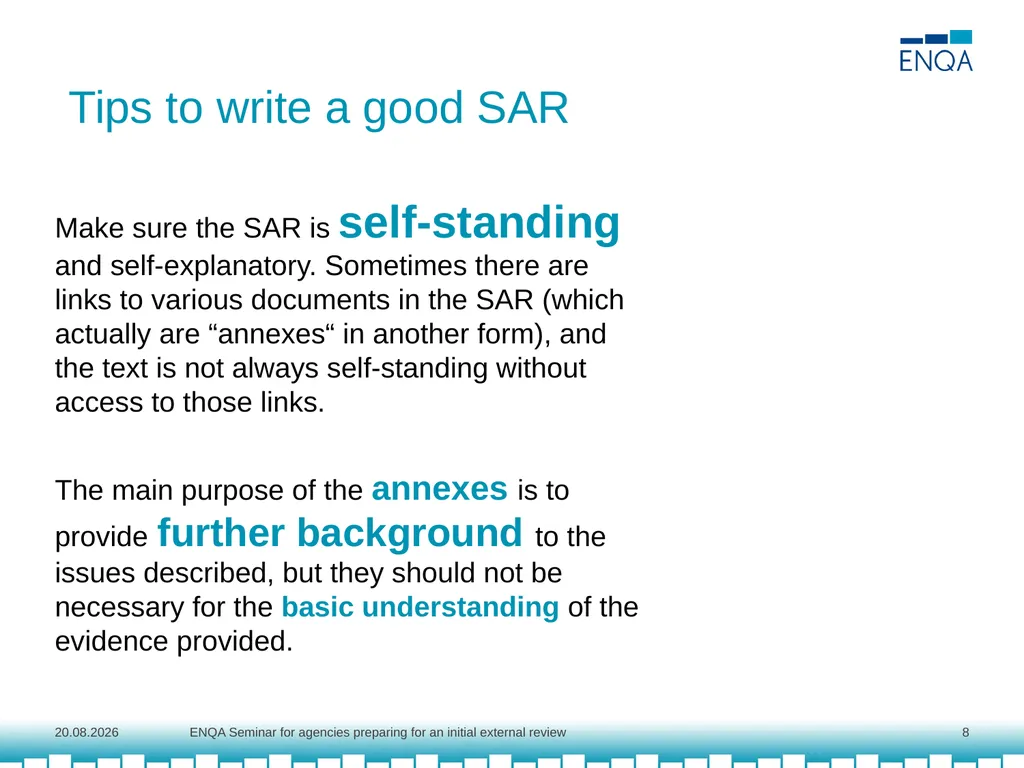
Tips to write a good SAR Make sure the SAR is self-standing and self-explanatory. Sometimes there are links to various documents in the SAR (which actually are “annexes“ in another form), and the text is not always self-standing without access to those links.
The main purpose of the annexes is to provide further background to the issues described, but they should not be necessary for the basic understanding of the evidence provided. 1.10.2018 ENQA Seminar for agencies preparing for an initial external review 8<br>
09
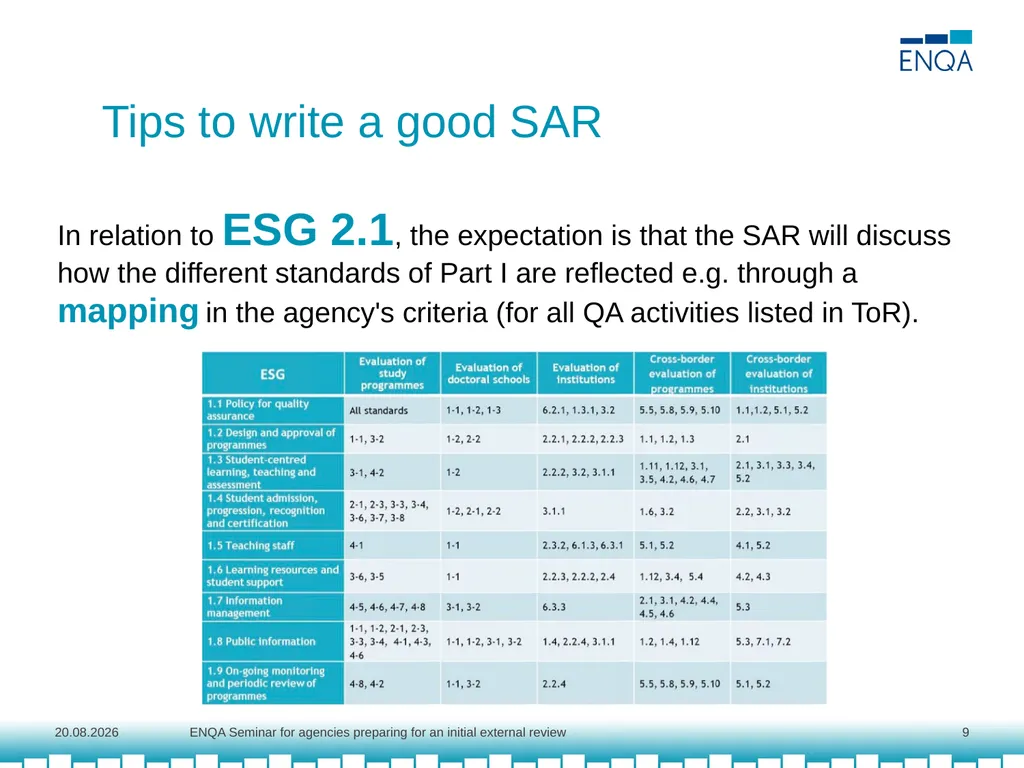
Tips to write a good SAR In relation to ESG 2.1, the expectation is that the SAR will discuss how the different standards of Part I are reflected e.g. through a mapping in the agency's criteria (for all QA activities listed in ToR). 1.10.2018 ENQA Seminar for agencies preparing for an initial external review 9<br>
10
Tips to write a good SAR Make sure to not only mention the agency’s collaboration with different stakeholders and the means you collects feedback from them, but also discuss how the feedback is analysed and mention some of the stakeholders’ actual opinions.
Summary of feedback analysis
can be added as an annex. 1.10.2018 ENQA Seminar for agencies preparing for an initial external review 10<br>
11
Best practices for the self-assessment 1.10.2018 ENQA Seminar for agencies preparing for an initial external review 11 Workshop<br>