BID: X Conferencia Anual sobre Compras Gubernamentales de las Américas: Compras Públicas para el Desarrollo Procurement Procurement Processes: International Perspectives on Why They Matter What the Current Hot Topics Are Daniel I.
Related Topics
Share
Embed code
Download this presentation From Below
"BID: X Conferencia Anual sobre Compras" is the property of its rightful owner. Permission is granted to
download and print the materials on this website for personal, non-commercial use only, and to display it
on your personal computer provided you do not modify the materials and that you retain all copyright
notices contained in the materials. By downloading content from our website, you accept the terms of this
agreement.
Presentation Transcript
01
BID: X Conferencia Anual sobre Compras Gubernamentales de las Américas: Compras Públicas para el Desarrollo Procurement & Procurement Processes: International Perspectives on Why They Matter & What the Current Hot Topics Are Daniel I. Gordon
Senior Advisor, Government Procurement Law Program
The George Washington University
Law School
Washington, DC<br>
02
Why Public Procurement Matters It’s a lot of public money
Approximately 15-20 percent of GDP
U.S. federal level: More than US$450 billion / year
EU procurements covered by Directives: same amount, or more<br>
03
Why Public Procurement Matters More Now As national budgets feel pressure, growing appreciation of the need to spend procurement money wisely, to further national development: among other areas, in transportation infrastructure and the health and education sectors
In some countries, privatization and shrinking of the public workforce have increased the role of government procurement, especially for services
Growing recognition of the link between procurement and corruption: see Feb. 2014 EU Commission Anti-Corruption Report<br>
04
Why Public Procurement Processes Matter “Normal” purchasing incentives to achieve goals of value for money and purchasing speed don’t function as well, so we impose process rules as surrogates for those incentives
Public purchasers aren’t spending their own money
And we add further goals, due to concern about possible waste, fraud and abuse of public funds: competition, transparency, accountability
And then many systems add additional goals of furthering public policies from outside the procurement realm: helping domestic businesses, domestic small businesses, particular social or ethnic groups, and many more
Process rules are meant to ensure those various goals are served<br>
05
Result: Tension Constant tension, in every system, between and among:
Those saying that public bodies should buy just like businesses buy
These critics tend to focus on the public procurement system’s failure to meet the goals of any purchasing system: the slowness of public procurement, high prices paid, and low quality received
Those saying that public bodies must be transparent and accountable
These critics tend to focus on the risk of fraud and corruption, and on conflicts of interest
Those saying that public procurement is failing to serve non-procurement public policy goals
These critics tend to focus on purchases from foreign sources and from large domestic sources<br>
06
Recent International Developments The UN Commission on International Trade Law (UNCITRAL) revised its Model Procurement Law in 2011 (and published an excellent Guide to Enactment in 2012)
The WTO’s revised Agreement on Government Procurement came into force earlier this year
The European Union has just revised its Procurement Directives<br>
07
Hot Topics Internationally Use of Internet-based (e-) procurement, including electronic reverse auctions
More inclusive assessment of price
Use of non-price factors
… including those rated on a sliding scale (not pass/fail)
… and allowing tradeoffs between non-price factors and price (called “price/quality ratio” in the new EU Directive) – often labeled “value for money”<br>
08
Hot Topics Internationally Framework contracts
Note link to question of aggregating demand, joint purchasing & centralized purchasing agency
Complaint mechanisms for vendors
Difficulty of measuring & ensuring effectiveness
Increased focus on the process for exclusion of bidders
Issue of remedial measures and how (if at all) they should be taken into account<br>
09
Hot Topics Internationally Permitting negotiations with vendors
Domestic preferences & preferences for (domestic) SMEs<br>
10
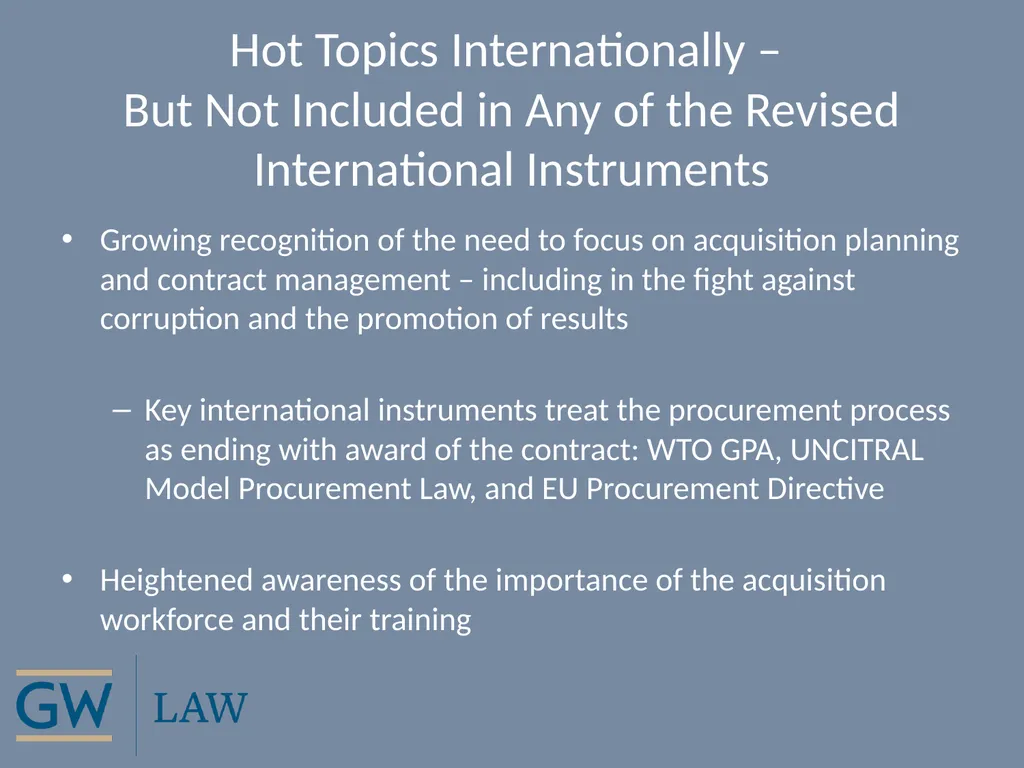
Hot Topics Internationally – But Not Included in Any of the Revised International Instruments Growing recognition of the need to focus on acquisition planning and contract management – including in the fight against corruption and the promotion of results
Key international instruments treat the procurement process as ending with award of the contract: WTO GPA, UNCITRAL Model Procurement Law, and EU Procurement Directive
Heightened awareness of the importance of the acquisition workforce and their training<br>
11
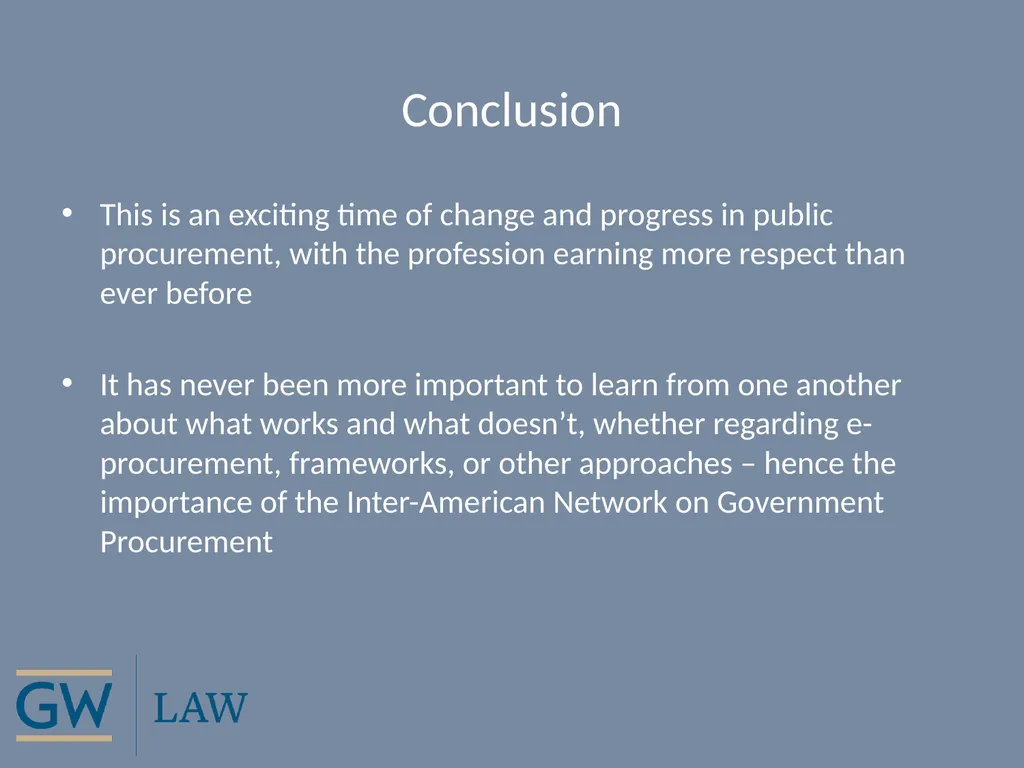
Conclusion This is an exciting time of change and progress in public procurement, with the profession earning more respect than ever before
It has never been more important to learn from one another about what works and what doesn’t, whether regarding e-procurement, frameworks, or other approaches – hence the importance of the Inter-American Network on Government Procurement<br>