
Big Data Ethical Considerations Big Data : What is
Description: Big Data Ethical Considerations Big Data : What is it Big data is a field that treats ways to analyze, systematically extract information from, or otherwise deal with data sets that are too large or complex to be dealt with by traditional
Related Topics
Download Presentation
"Big Data Ethical Considerations Big Data : What is" is the property of its rightful owner. Permission is granted to download and print the materials on this website for personal, non-commercial use only, and to display it on your personal computer provided you do not modify the materials and that you retain all copyright notices contained in the materials. By downloading content from our website, you accept the terms of this agreement.
Presentation Transcript
slide1. Big Data Ethical Considerations<br>
slide2. Big Data : What is it Big data is a field that treats ways to analyze, systematically extract information from, or otherwise deal with data sets that are too large or complex to be dealt with by traditional data-processing application software. (src: https://en.wikipedia.org/wiki/Big_data )<br>
slide3. Big Data Vs AI We can think of "AI" as the algorithms that act upon the big data
A "big data" set is too large to be handled by humans
Algorithms can find "interesting" patterns within the data that a human would not find on their own<br>
slide4. Interesting patterns It is still up to a human to define what "interesting" means. This might be, for example, the parts of the picture that deviate the most from the "neighbouring" pixels or it might be the part of the image with the most colours in it.
It might mean detecting that two pieces of data are correlated with each other<br>
slide5. Example By analyzing the data en masse, a computer might pick out patterns that we otherwise would not have noticed.
It might have never occurred to use to compare two different data sets
This can lead to improvements in public policy, medicine, academic success, etc<br>
slide6. Example : Student Success Identify students at risk of failure and provide more support
Identify things students can do pro-actively to avoid being in those situations
Discover which resources are most utilized.
Some of this is simple and not really "AI" but some patterns may be harder to spot<br>
slide7. Activity (5 minutes) : IS this good? At the University of Alabama, data analysis found that students who asked for their transcripts were at risk of dropping out of school.
In response, school administrators decided to offer more resources to students who request transcripts
Src: https://edtechmagazine.com/higher/article/2019/08/what-can-real-time-data-analytics-do-higher-education-perfcon<br>
slide8. Activity (5 minutes) : IS this good? At Georgia State University, they used analytical tools to give academic counselors information sooner, again to highlight struggling students
According to the school, graduation rates among African Americans and Hispanic students increased from 18% to 55% after doing this.
However, it may be too "big brothery" An alarming quote: “As soon as a student makes a wrong turn, the system’s already recalibrating to get him or her back on the right path,”
Src: https://edtechmagazine.com/higher/article/2019/05/universities-use-data-analytics-tools-support-academic-advising<br>
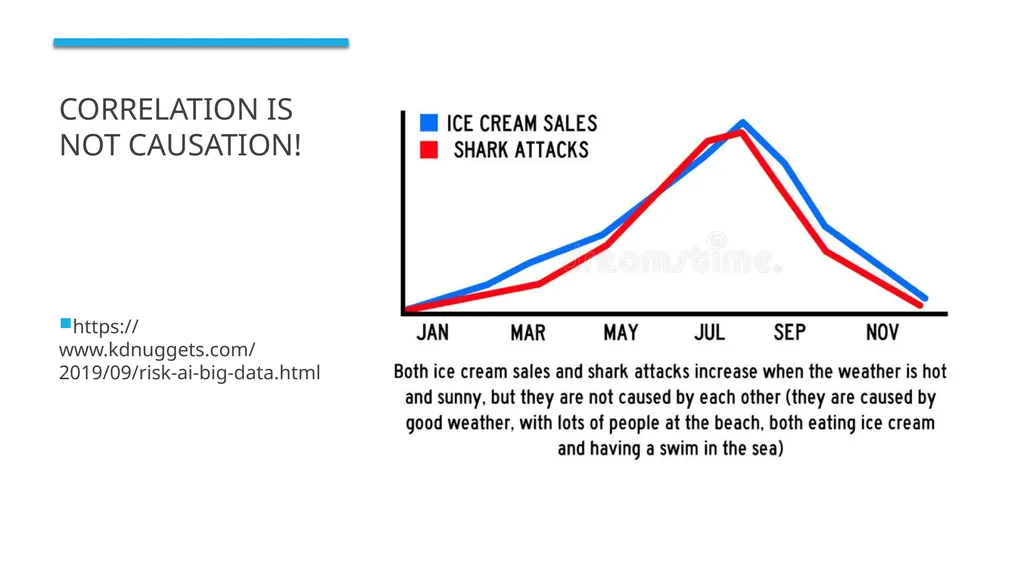
slide9. Correlation is not Causation! https://www.kdnuggets.com/2019/09/risk-ai-big-data.html<br>
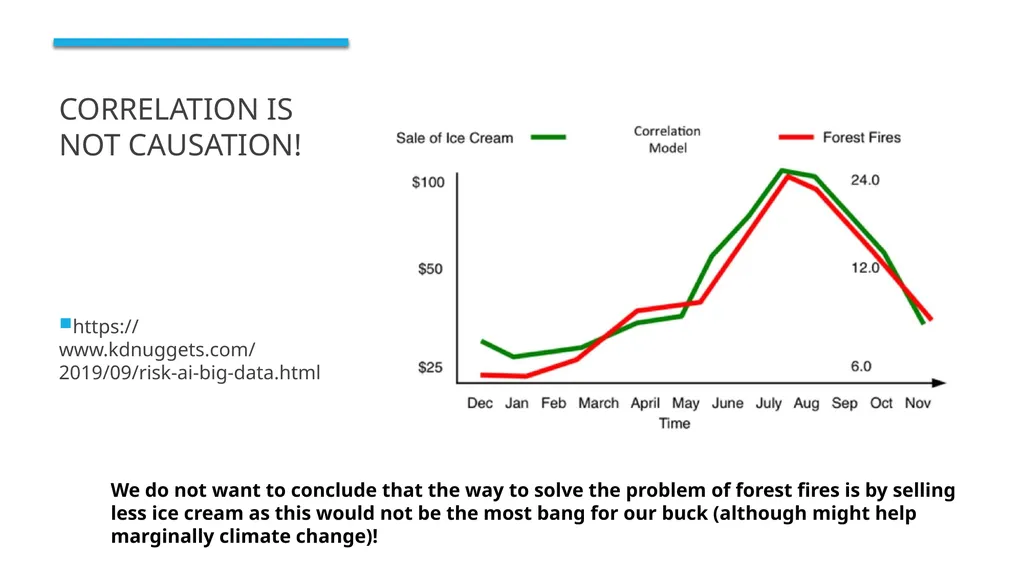
slide10. Correlation is not Causation! https://www.kdnuggets.com/2019/09/risk-ai-big-data.html We do not want to conclude that the way to solve the problem of forest fires is by selling less ice cream as this would not be the most bang for our buck (although might help marginally climate change)!<br>
slide11. Correlation concerns In the previous examples, there is a latent variable (temperature or summer) that is causing the two other variables to be connected.
In some cases though, they may not even be related at all!
It may just be random chance!<br>
slide12. Consider Correlation supersedes causation, and science can advance even without coherent models, unified theories, or really any mechanistic explanation at all
https://www.wired.com/2008/06/pb-theory/<br>
slide13. Limited Understanding If we identify what we think is a causation but don't fully understand it, can we do anything useful with the data?<br>
slide14. P-Hacking We rely a lot on statistically significant data
We compare an experimental group to a control group, and if the experimental group has a "statistically significant" improvement, we consider the experiment a success
Statistically significant usually means that if the two groups were NOT different, that there is only a 5% chance that you'd see results differing by as much as they did.
In some cases, it is 1%, but it's rarely lower than that<br>
slide15. Uncommon events Happen! Activity: Spend 2 or 3 minutes thinking of an event that is uncommon but that does occur
Can you put a numerical quantity on that number?<br>
slide16. Some commonly occurring uncommon events Snake eyes on 2 dice : 1/36 chance = 2.78%
Hurricanes : 10-15 per year throughout all of North America.
Car accidents : Individually, it is very unlikely you will get into a car accident, but it is very likely that someone will get into a car accident<br>
slide17. Issue If an event is unlikely to occur in any one sample, but there are enough samples, then it is in fact likely that it will occur!<br>
slide18. P-Hacking If you try 20 different theories, and these theories are "random" then you'll likely find one that accidentally works.
This is a problem with computers because they can easily try out hundreds or thousands of theories based on the number of input variables we use
A computer algorithm will not have an intuition to remove input fields (such as ice cream) that clearly have nothing to do with the problem<br>
slide19. Reproducibility An important concept in the scientific method is related to reproducibility of results
The fact that on one sample group A outperformed group B does not mean anything if you can't repeat reproduce those results
If this concept is applied correctly, it will help prevent p-hacking as the results shouldn't occur twice in a row<br>
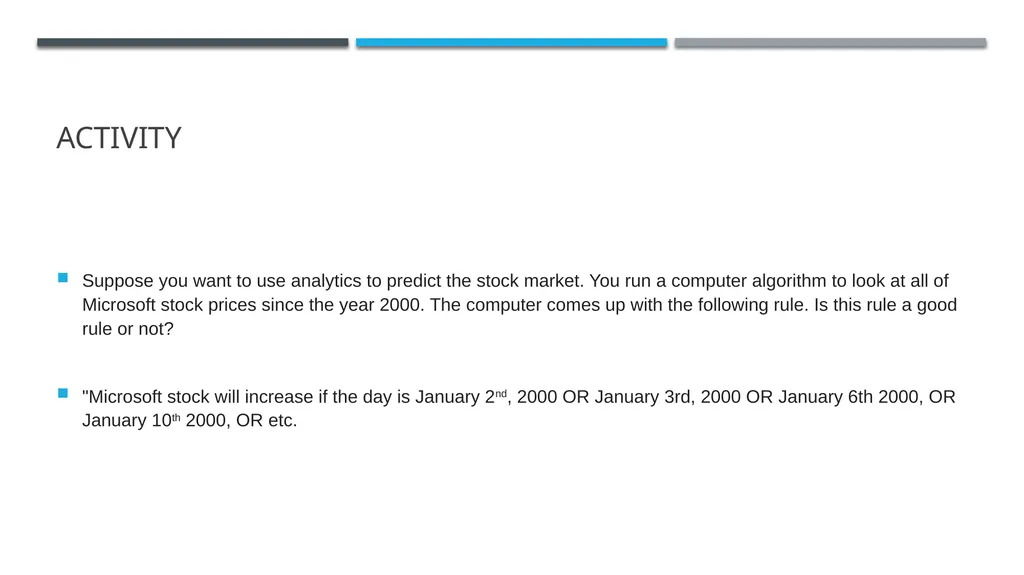
slide20. Activity Suppose you want to use analytics to predict the stock market. You run a computer algorithm to look at all of Microsoft stock prices since the year 2000. The computer comes up with the following rule. Is this rule a good rule or not?
"Microsoft stock will increase if the day is January 2nd, 2000 OR January 3rd, 2000 OR January 6th 2000, OR January 10th 2000, OR etc.<br>
slide21. Useless at Predicting the Future The previous rule is useless at predicting the future
It describes perfectly the past events, but because it is so tied, or overfit, to them it has no predictive value
This result cannot be reproduced on new data<br>
slide22. Analytic Rules It's important not to let analytic rules drive things
Analytic rules are the basics of many bad things such as racial profiling, stereotyping, etc<br>
slide23. Should we ignore analytics completely? Of course not! But we should seek to explain the data and the relationships between the various fields.
We should also aim to reproduce the results on a larger sampling.
If we can't do either of the above two bullet points, we should have a healthy skepticism.<br>
slide24. General Problems with Analytics (both Big and Small Data) It's important not to let analytic rules alone drive things
Analytic rules are the basics of many bad things such as racial profiling, stereotyping, etc<br>
slide25. Food For Thought What can we do to minimize the risk of attributing a causation when there is none?
Is there ever value in using a model that is known to be wrong? Does it matter as long as our model can predict the future?
Evaluate the trade-off involved with using big data specifically as it related to stereotyping?
Is using big data to analyze demographics inherently racist?<br>
slide2. Big Data : What is it Big data is a field that treats ways to analyze, systematically extract information from, or otherwise deal with data sets that are too large or complex to be dealt with by traditional data-processing application software. (src: https://en.wikipedia.org/wiki/Big_data )<br>
slide3. Big Data Vs AI We can think of "AI" as the algorithms that act upon the big data
A "big data" set is too large to be handled by humans
Algorithms can find "interesting" patterns within the data that a human would not find on their own<br>
slide4. Interesting patterns It is still up to a human to define what "interesting" means. This might be, for example, the parts of the picture that deviate the most from the "neighbouring" pixels or it might be the part of the image with the most colours in it.
It might mean detecting that two pieces of data are correlated with each other<br>
slide5. Example By analyzing the data en masse, a computer might pick out patterns that we otherwise would not have noticed.
It might have never occurred to use to compare two different data sets
This can lead to improvements in public policy, medicine, academic success, etc<br>
slide6. Example : Student Success Identify students at risk of failure and provide more support
Identify things students can do pro-actively to avoid being in those situations
Discover which resources are most utilized.
Some of this is simple and not really "AI" but some patterns may be harder to spot<br>
slide7. Activity (5 minutes) : IS this good? At the University of Alabama, data analysis found that students who asked for their transcripts were at risk of dropping out of school.
In response, school administrators decided to offer more resources to students who request transcripts
Src: https://edtechmagazine.com/higher/article/2019/08/what-can-real-time-data-analytics-do-higher-education-perfcon<br>
slide8. Activity (5 minutes) : IS this good? At Georgia State University, they used analytical tools to give academic counselors information sooner, again to highlight struggling students
According to the school, graduation rates among African Americans and Hispanic students increased from 18% to 55% after doing this.
However, it may be too "big brothery" An alarming quote: “As soon as a student makes a wrong turn, the system’s already recalibrating to get him or her back on the right path,”
Src: https://edtechmagazine.com/higher/article/2019/05/universities-use-data-analytics-tools-support-academic-advising<br>
slide9. Correlation is not Causation! https://www.kdnuggets.com/2019/09/risk-ai-big-data.html<br>
slide10. Correlation is not Causation! https://www.kdnuggets.com/2019/09/risk-ai-big-data.html We do not want to conclude that the way to solve the problem of forest fires is by selling less ice cream as this would not be the most bang for our buck (although might help marginally climate change)!<br>
slide11. Correlation concerns In the previous examples, there is a latent variable (temperature or summer) that is causing the two other variables to be connected.
In some cases though, they may not even be related at all!
It may just be random chance!<br>
slide12. Consider Correlation supersedes causation, and science can advance even without coherent models, unified theories, or really any mechanistic explanation at all
https://www.wired.com/2008/06/pb-theory/<br>
slide13. Limited Understanding If we identify what we think is a causation but don't fully understand it, can we do anything useful with the data?<br>
slide14. P-Hacking We rely a lot on statistically significant data
We compare an experimental group to a control group, and if the experimental group has a "statistically significant" improvement, we consider the experiment a success
Statistically significant usually means that if the two groups were NOT different, that there is only a 5% chance that you'd see results differing by as much as they did.
In some cases, it is 1%, but it's rarely lower than that<br>
slide15. Uncommon events Happen! Activity: Spend 2 or 3 minutes thinking of an event that is uncommon but that does occur
Can you put a numerical quantity on that number?<br>
slide16. Some commonly occurring uncommon events Snake eyes on 2 dice : 1/36 chance = 2.78%
Hurricanes : 10-15 per year throughout all of North America.
Car accidents : Individually, it is very unlikely you will get into a car accident, but it is very likely that someone will get into a car accident<br>
slide17. Issue If an event is unlikely to occur in any one sample, but there are enough samples, then it is in fact likely that it will occur!<br>
slide18. P-Hacking If you try 20 different theories, and these theories are "random" then you'll likely find one that accidentally works.
This is a problem with computers because they can easily try out hundreds or thousands of theories based on the number of input variables we use
A computer algorithm will not have an intuition to remove input fields (such as ice cream) that clearly have nothing to do with the problem<br>
slide19. Reproducibility An important concept in the scientific method is related to reproducibility of results
The fact that on one sample group A outperformed group B does not mean anything if you can't repeat reproduce those results
If this concept is applied correctly, it will help prevent p-hacking as the results shouldn't occur twice in a row<br>
slide20. Activity Suppose you want to use analytics to predict the stock market. You run a computer algorithm to look at all of Microsoft stock prices since the year 2000. The computer comes up with the following rule. Is this rule a good rule or not?
"Microsoft stock will increase if the day is January 2nd, 2000 OR January 3rd, 2000 OR January 6th 2000, OR January 10th 2000, OR etc.<br>
slide21. Useless at Predicting the Future The previous rule is useless at predicting the future
It describes perfectly the past events, but because it is so tied, or overfit, to them it has no predictive value
This result cannot be reproduced on new data<br>
slide22. Analytic Rules It's important not to let analytic rules drive things
Analytic rules are the basics of many bad things such as racial profiling, stereotyping, etc<br>
slide23. Should we ignore analytics completely? Of course not! But we should seek to explain the data and the relationships between the various fields.
We should also aim to reproduce the results on a larger sampling.
If we can't do either of the above two bullet points, we should have a healthy skepticism.<br>
slide24. General Problems with Analytics (both Big and Small Data) It's important not to let analytic rules alone drive things
Analytic rules are the basics of many bad things such as racial profiling, stereotyping, etc<br>
slide25. Food For Thought What can we do to minimize the risk of attributing a causation when there is none?
Is there ever value in using a model that is known to be wrong? Does it matter as long as our model can predict the future?
Evaluate the trade-off involved with using big data specifically as it related to stereotyping?
Is using big data to analyze demographics inherently racist?<br>