
Big Data, Learning Analytics and Education
FD
Published · 28 slides · 0 views
1 / 1

Description
Big Data, Learning Analytics and Education Aleksanda Klašnja-Milićević Mirjana Ivanović Introduction Big data - large, massive volume of data difficult to be processed by traditional and standard software and database techniques. Term - Web
Related Topics
Share
Embed code
Download this presentation From Below
"Big Data, Learning Analytics and Education" is the property of its rightful owner. Permission is granted to download and print the materials on this website for personal, non-commercial use only, and to display it on your personal computer provided you do not modify the materials and that you retain all copyright notices contained in the materials. By downloading content from our website, you accept the terms of this agreement.
Presentation Transcript
01
Big Data, Learning Analytics and Education Aleksanda Klašnja-Milićević
Mirjana Ivanović<br>
Mirjana Ivanović<br>
02
Introduction Big data - large, massive volume of data difficult to be processed by traditional and standard software and database techniques.
Term - Web search companies - extract useful information from extremely large distributed aggregations of loosely-structured data.
Big data - great potential for improving business in companies, healthcare, e-learning, and in wide range of data-driven industries and provide support for more intelligent decisions. 2<br>
Term - Web search companies - extract useful information from extremely large distributed aggregations of loosely-structured data.
Big data - great potential for improving business in companies, healthcare, e-learning, and in wide range of data-driven industries and provide support for more intelligent decisions. 2<br>
03
Definitions Understanding and definition of big data:
depends not only on a massive amount of data but
also have to consider what the technology and which size of big data that technology could handle
2001 by Laney - ‘Big data can be characterized by the three Vs:
‘volume’ - very large volume of data (expressed in terms of terabytes, records, transactions, tables, files),
‘velocity’ - rapid generation (expressed in terms of batch, near time, real time, streams) and
‘variety’ - various modalities (expressed in terms of structured, unstructured, semi-structured, or of all mentioned)’. 3<br>
depends not only on a massive amount of data but
also have to consider what the technology and which size of big data that technology could handle
2001 by Laney - ‘Big data can be characterized by the three Vs:
‘volume’ - very large volume of data (expressed in terms of terabytes, records, transactions, tables, files),
‘velocity’ - rapid generation (expressed in terms of batch, near time, real time, streams) and
‘variety’ - various modalities (expressed in terms of structured, unstructured, semi-structured, or of all mentioned)’. 3<br>
04
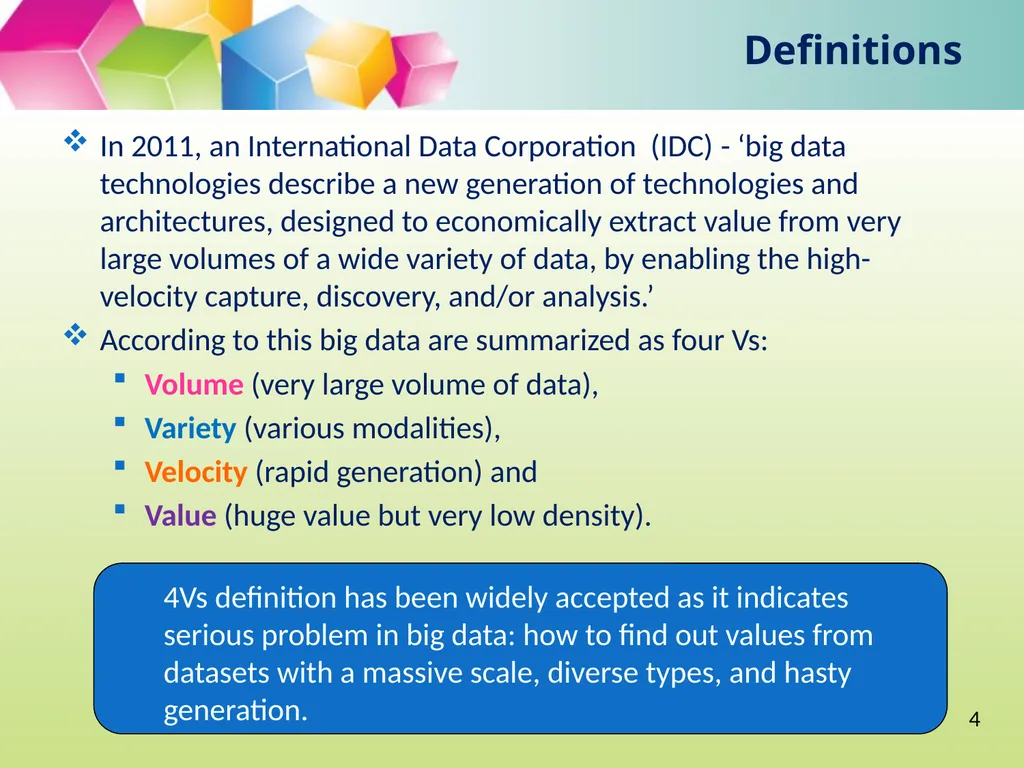
Definitions In 2011, an International Data Corporation (IDC) - ‘big data technologies describe a new generation of technologies and architectures, designed to economically extract value from very large volumes of a wide variety of data, by enabling the high-velocity capture, discovery, and/or analysis.’
According to this big data are summarized as four Vs:
Volume (very large volume of data),
Variety (various modalities),
Velocity (rapid generation) and
Value (huge value but very low density). 4Vs definition has been widely accepted as it indicates serious problem in big data: how to find out values from datasets with a massive scale, diverse types, and hasty generation. 4<br>
According to this big data are summarized as four Vs:
Volume (very large volume of data),
Variety (various modalities),
Velocity (rapid generation) and
Value (huge value but very low density). 4Vs definition has been widely accepted as it indicates serious problem in big data: how to find out values from datasets with a massive scale, diverse types, and hasty generation. 4<br>
05
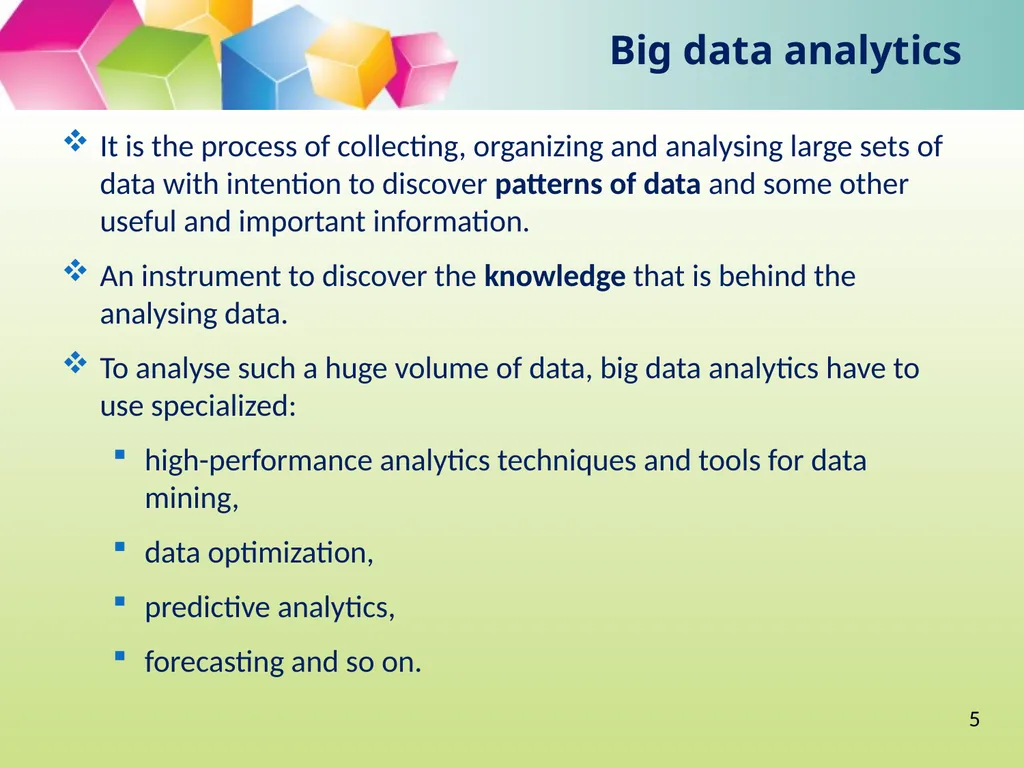
Big data analytics It is the process of collecting, organizing and analysing large sets of data with intention to discover patterns of data and some other useful and important information.
An instrument to discover the knowledge that is behind the analysing data.
To analyse such a huge volume of data, big data analytics have to use specialized:
high-performance analytics techniques and tools for data mining,
data optimization,
predictive analytics,
forecasting and so on. 5<br>
An instrument to discover the knowledge that is behind the analysing data.
To analyse such a huge volume of data, big data analytics have to use specialized:
high-performance analytics techniques and tools for data mining,
data optimization,
predictive analytics,
forecasting and so on. 5<br>
06
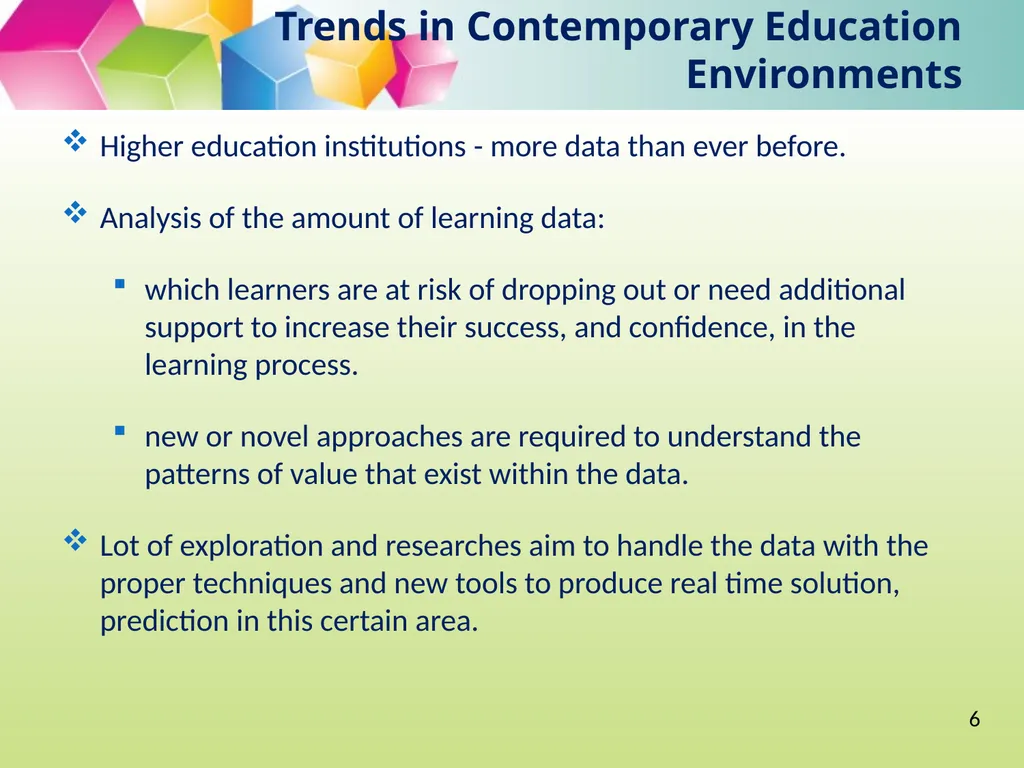
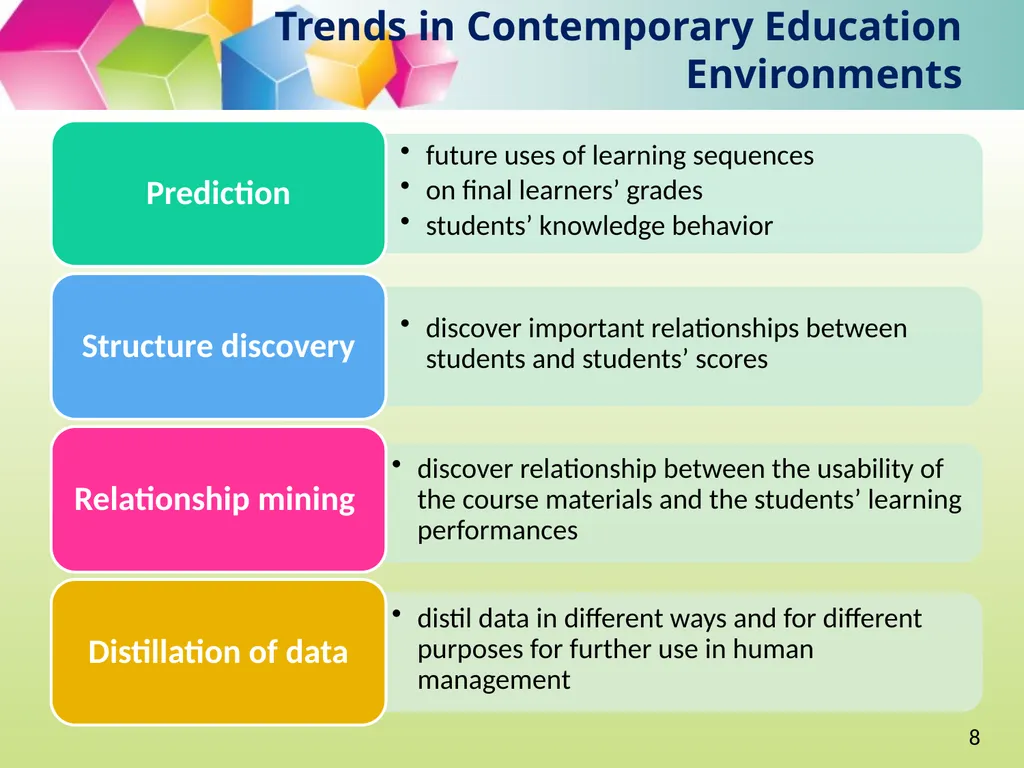
Trends in Contemporary Education Environments Higher education institutions - more data than ever before.
Analysis of the amount of learning data:
which learners are at risk of dropping out or need additional support to increase their success, and confidence, in the learning process.
new or novel approaches are required to understand the patterns of value that exist within the data.
Lot of exploration and researches aim to handle the data with the proper techniques and new tools to produce real time solution, prediction in this certain area. 6<br>
Analysis of the amount of learning data:
which learners are at risk of dropping out or need additional support to increase their success, and confidence, in the learning process.
new or novel approaches are required to understand the patterns of value that exist within the data.
Lot of exploration and researches aim to handle the data with the proper techniques and new tools to produce real time solution, prediction in this certain area. 6<br>
07
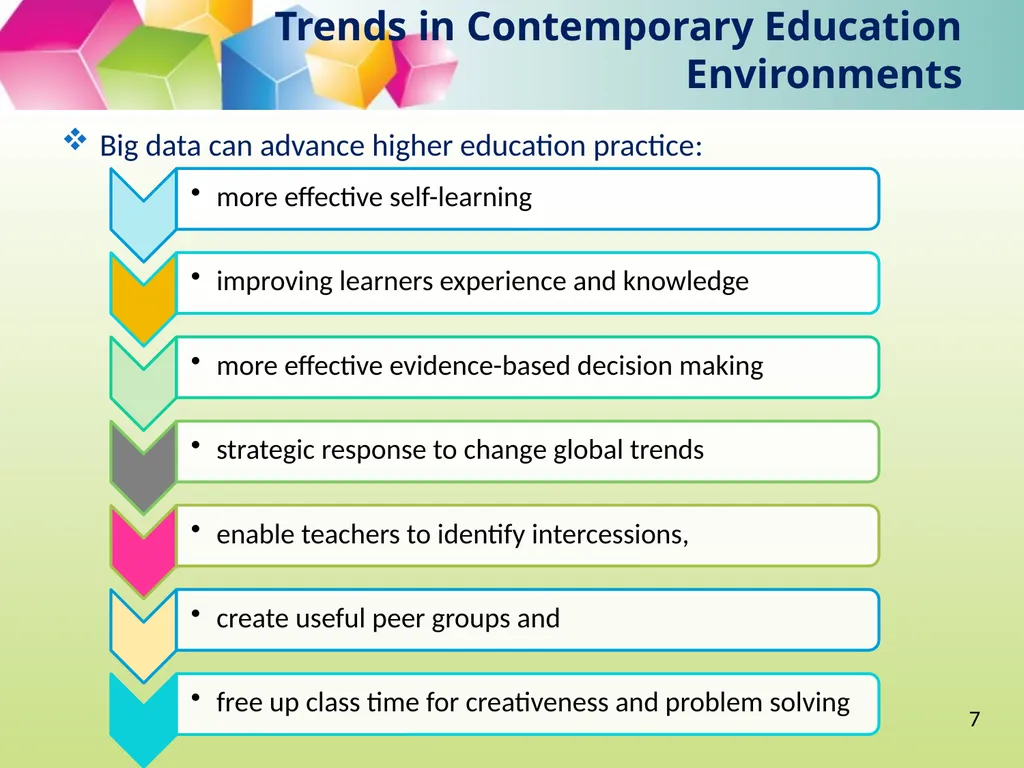
Big data can advance higher education practice: Trends in Contemporary Education Environments 7<br>
08
Trends in Contemporary Education Environments 8<br>
09
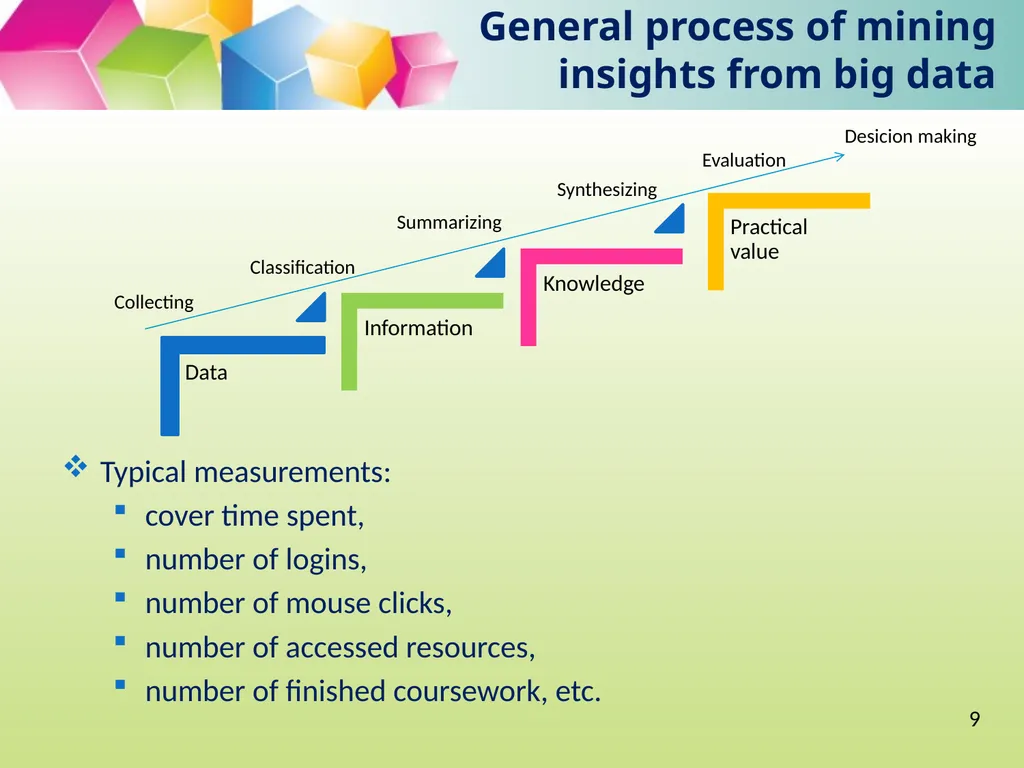
General process of mining insights from big data Typical measurements:
cover time spent,
number of logins,
number of mouse clicks,
number of accessed resources,
number of finished coursework, etc. Collecting Classification Summarizing Synthesizing Evaluation Desicion making 9<br>
cover time spent,
number of logins,
number of mouse clicks,
number of accessed resources,
number of finished coursework, etc. Collecting Classification Summarizing Synthesizing Evaluation Desicion making 9<br>
10
Capabilities of an
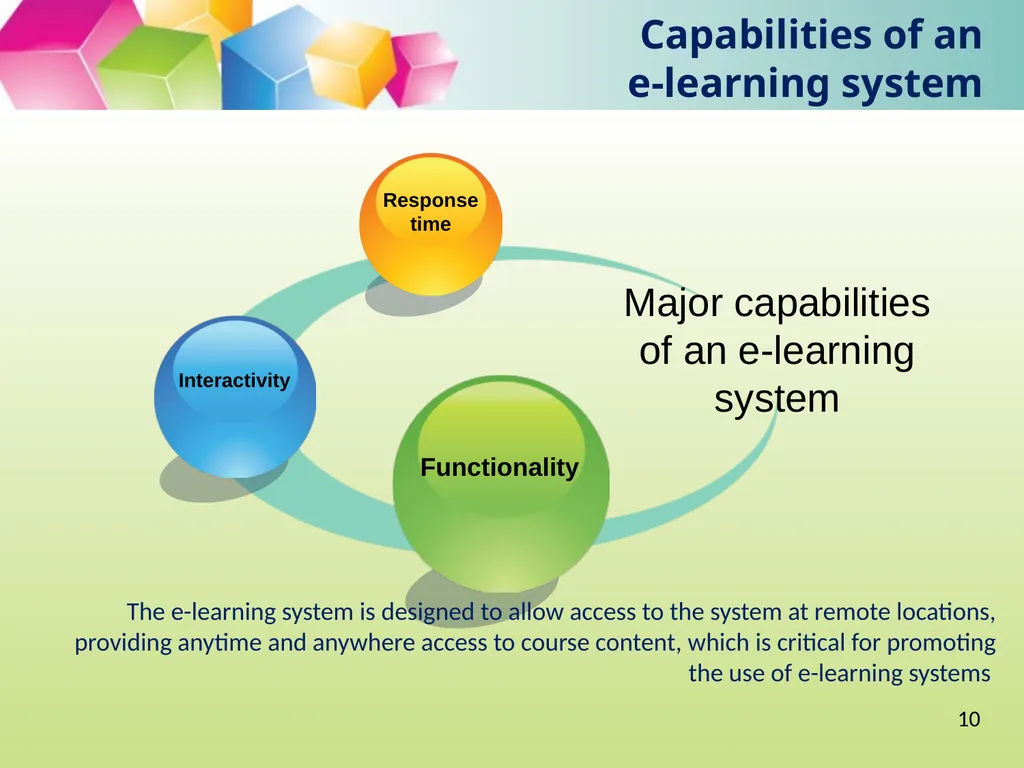
e-learning system Major capabilities of an e-learning system Functionality Interactivity Response time The e-learning system is designed to allow access to the system at remote locations, providing anytime and anywhere access to course content, which is critical for promoting the use of e-learning systems 10<br>
11
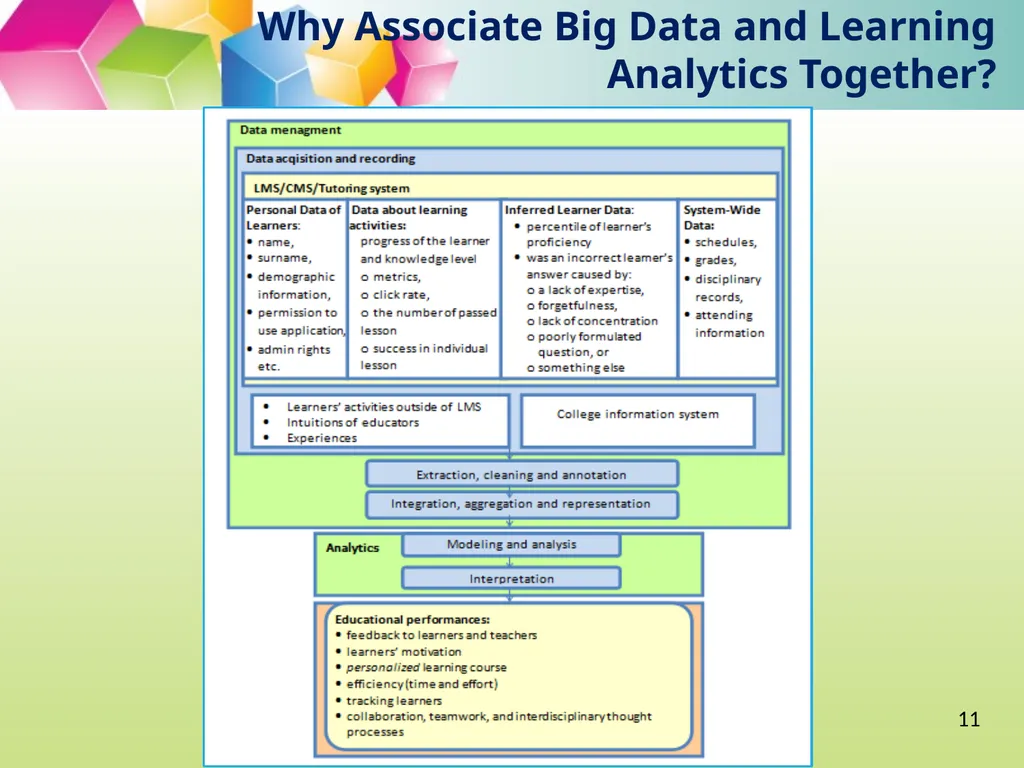
Why Associate Big Data and Learning Analytics Together? 11<br>
12
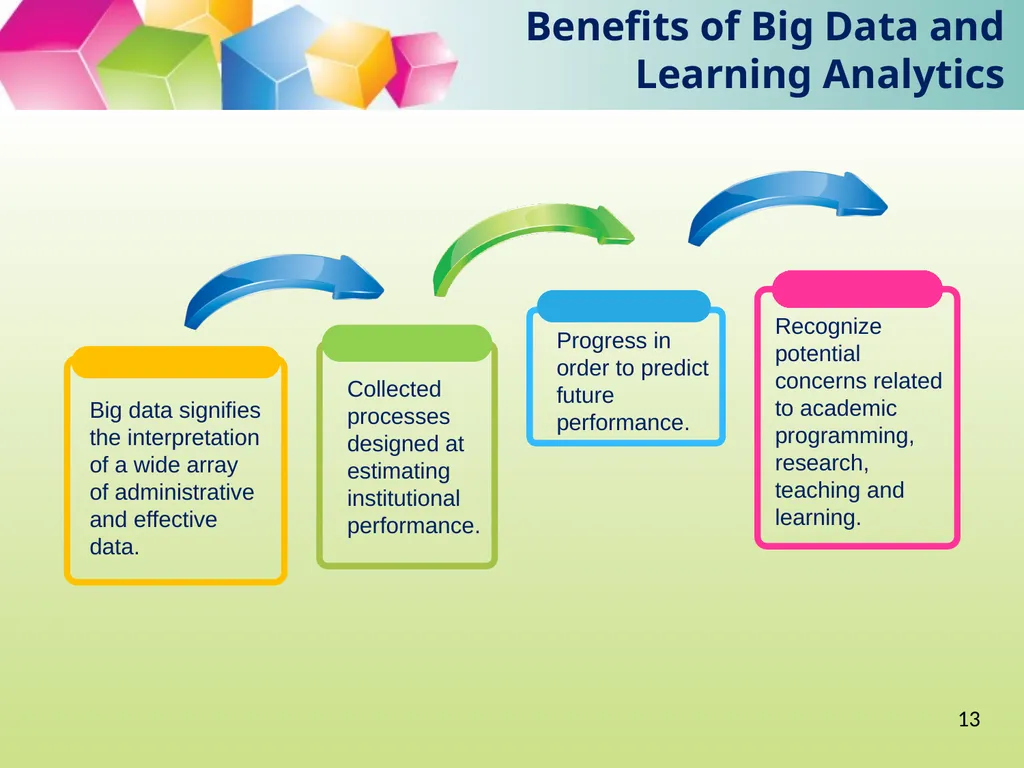
Big data signifies the interpretation of a wide array of administrative and effective data. Recognize potential concerns related to academic programming, research, teaching and learning. Progress in order to predict future performance. Collected processes designed at estimating institutional performance. Benefits of Big Data and Learning Analytics 13<br>
13
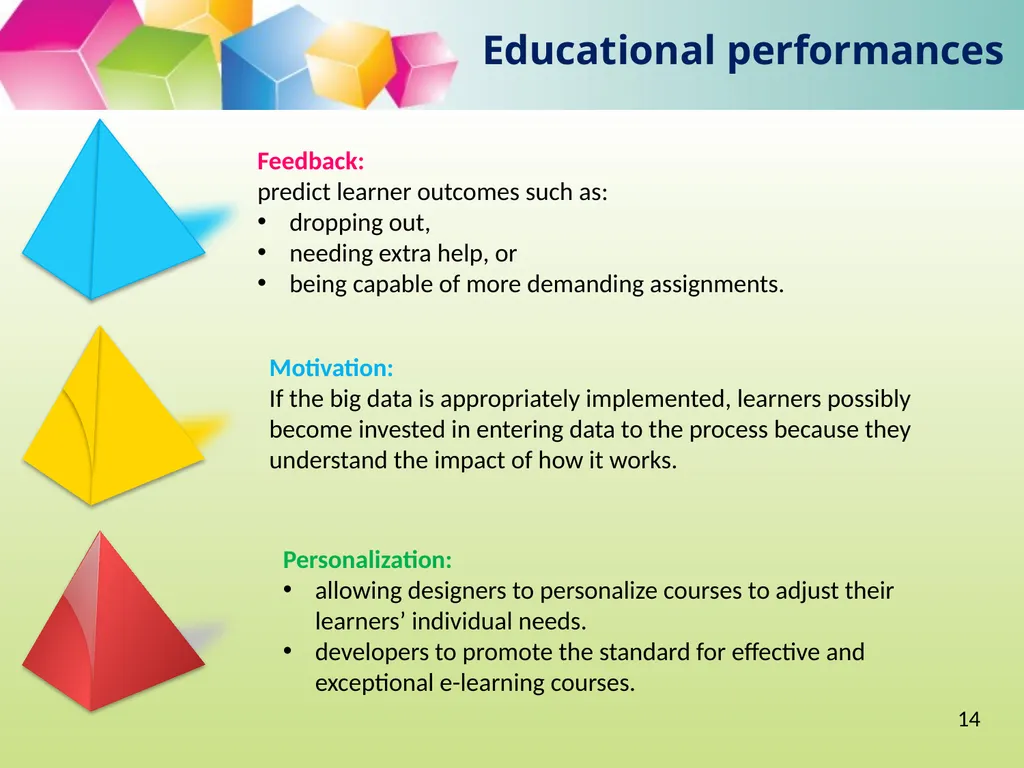
Educational performances Feedback:
predict learner outcomes such as:
dropping out,
needing extra help, or
being capable of more demanding assignments. Motivation:
If the big data is appropriately implemented, learners possibly become invested in entering data to the process because they understand the impact of how it works. Personalization:
allowing designers to personalize courses to adjust their learners’ individual needs.
developers to promote the standard for effective and exceptional e-learning courses. 14<br>
predict learner outcomes such as:
dropping out,
needing extra help, or
being capable of more demanding assignments. Motivation:
If the big data is appropriately implemented, learners possibly become invested in entering data to the process because they understand the impact of how it works. Personalization:
allowing designers to personalize courses to adjust their learners’ individual needs.
developers to promote the standard for effective and exceptional e-learning courses. 14<br>
14
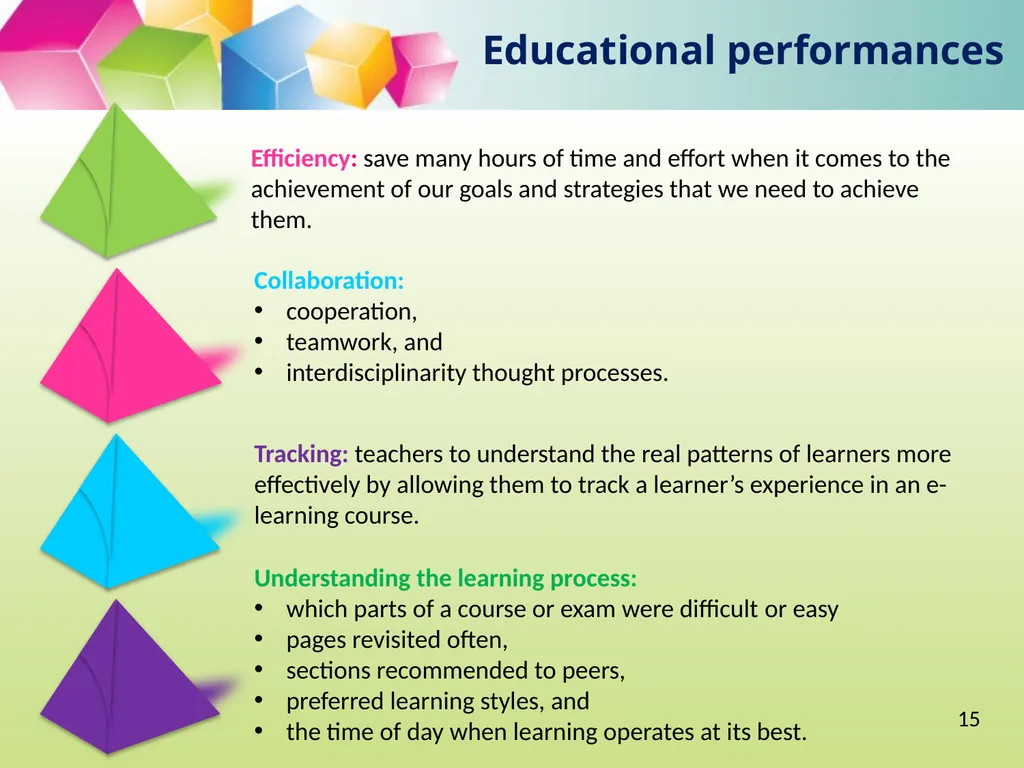
Efficiency: save many hours of time and effort when it comes to the achievement of our goals and strategies that we need to achieve them. Collaboration:
cooperation,
teamwork, and
interdisciplinarity thought processes. Tracking: teachers to understand the real patterns of learners more effectively by allowing them to track a learner’s experience in an e-learning course. Understanding the learning process:
which parts of a course or exam were difficult or easy
pages revisited often,
sections recommended to peers,
preferred learning styles, and
the time of day when learning operates at its best. Educational performances 15<br>
cooperation,
teamwork, and
interdisciplinarity thought processes. Tracking: teachers to understand the real patterns of learners more effectively by allowing them to track a learner’s experience in an e-learning course. Understanding the learning process:
which parts of a course or exam were difficult or easy
pages revisited often,
sections recommended to peers,
preferred learning styles, and
the time of day when learning operates at its best. Educational performances 15<br>
15
The Application Development Framework For any big data platform - an application development framework which can make simpler:
the process of development,
execution,
testing, and debugging appropriate educational software components
and building blocks.
Such type of framework should contain:
model development tools and techniques;
capability for program loading, implementation, and process scheduling;
the system configuration and management tools. 16<br>
the process of development,
execution,
testing, and debugging appropriate educational software components
and building blocks.
Such type of framework should contain:
model development tools and techniques;
capability for program loading, implementation, and process scheduling;
the system configuration and management tools. 16<br>
16
Several technologies to handle big data Map-Reduce,
Hadoop,
NoSQL,
PIG and
Hive.
Databases for managing data of this size are generically known as NoSQL databases - “not only SQL".
NoSQL databases are simpler than SQL databases in terms of data manipulation abilities, but can handle larger amounts of data. 17<br>
Hadoop,
NoSQL,
PIG and
Hive.
Databases for managing data of this size are generically known as NoSQL databases - “not only SQL".
NoSQL databases are simpler than SQL databases in terms of data manipulation abilities, but can handle larger amounts of data. 17<br>
17
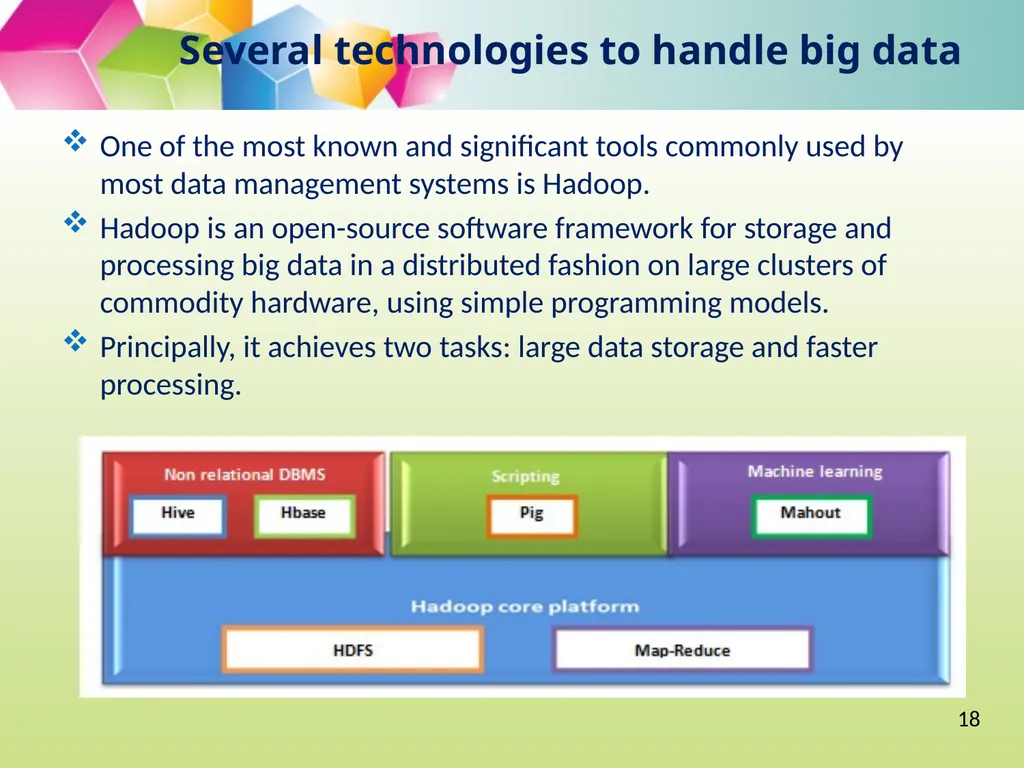
Several technologies to handle big data One of the most known and significant tools commonly used by most data management systems is Hadoop.
Hadoop is an open-source software framework for storage and processing big data in a distributed fashion on large clusters of commodity hardware, using simple programming models.
Principally, it achieves two tasks: large data storage and faster processing. 18<br>
Hadoop is an open-source software framework for storage and processing big data in a distributed fashion on large clusters of commodity hardware, using simple programming models.
Principally, it achieves two tasks: large data storage and faster processing. 18<br>
18
Several technologies to handle big data Hive
Data warehouse framework built on top of Hadoop
Used for ad hoc querying with an SQL type query language - more complex analysis
Designed for batch processing, not online transaction processing
Does not offer real-time queries
Pig
High-level data-flow language (Pig Latin) and
Execution framework whose compiler produces sequences of Map-Reduce programs (for execution within Hadoop)
Each Pig Latin program consists of multiple steps, each step being a type of query
Support ad-hoc data analysis
Data can be queried directly without the need for importing into tables 19<br>
Data warehouse framework built on top of Hadoop
Used for ad hoc querying with an SQL type query language - more complex analysis
Designed for batch processing, not online transaction processing
Does not offer real-time queries
Pig
High-level data-flow language (Pig Latin) and
Execution framework whose compiler produces sequences of Map-Reduce programs (for execution within Hadoop)
Each Pig Latin program consists of multiple steps, each step being a type of query
Support ad-hoc data analysis
Data can be queried directly without the need for importing into tables 19<br>
19
several technologies to handle big data Mahout
project for building scalable machine learning libraries, with most algorithms built on top of Hadoop and using the Map-Reduce paradigm
HBase
distributed, scalable, big data store that runs on top of HDFS
provides random, real time access to big data
was created for hosting very large tables with billions of rows and millions of columns
Tables in HBase can serve as the input and output for Map-Reduce jobs run in Hadoop
HBase is very different from traditional relational databases, like MySQL, PostgreSQL, Oracle, etc. 20<br>
project for building scalable machine learning libraries, with most algorithms built on top of Hadoop and using the Map-Reduce paradigm
HBase
distributed, scalable, big data store that runs on top of HDFS
provides random, real time access to big data
was created for hosting very large tables with billions of rows and millions of columns
Tables in HBase can serve as the input and output for Map-Reduce jobs run in Hadoop
HBase is very different from traditional relational databases, like MySQL, PostgreSQL, Oracle, etc. 20<br>
20
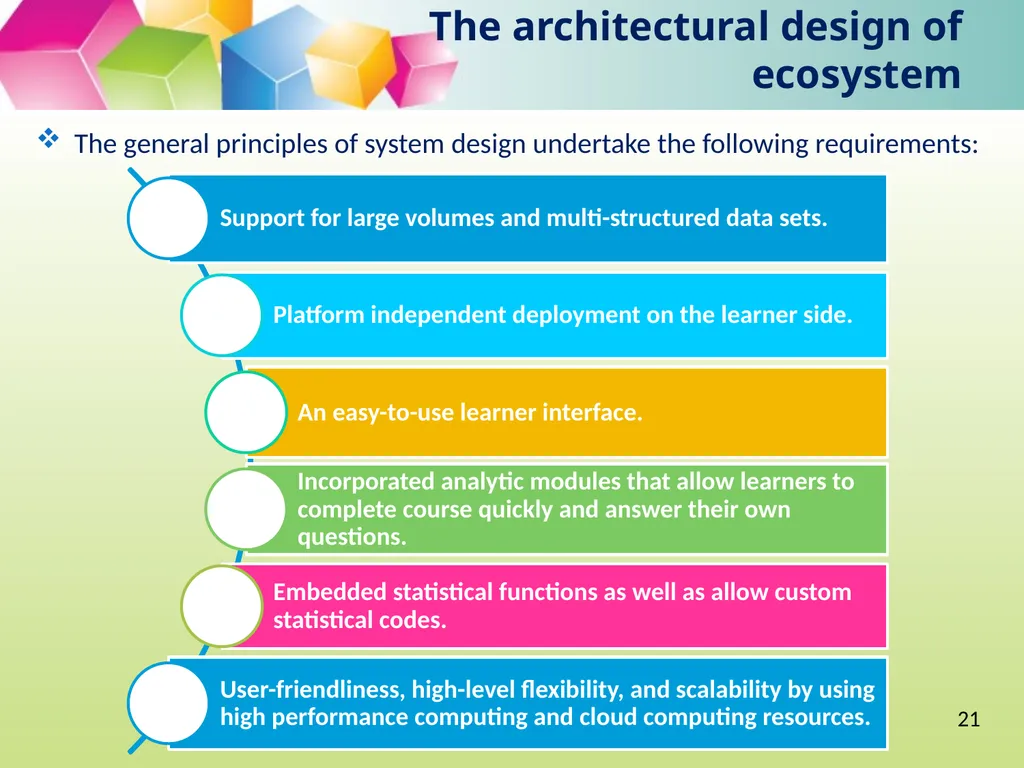
The architectural design of ecosystem The general principles of system design undertake the following requirements: 21<br>
21
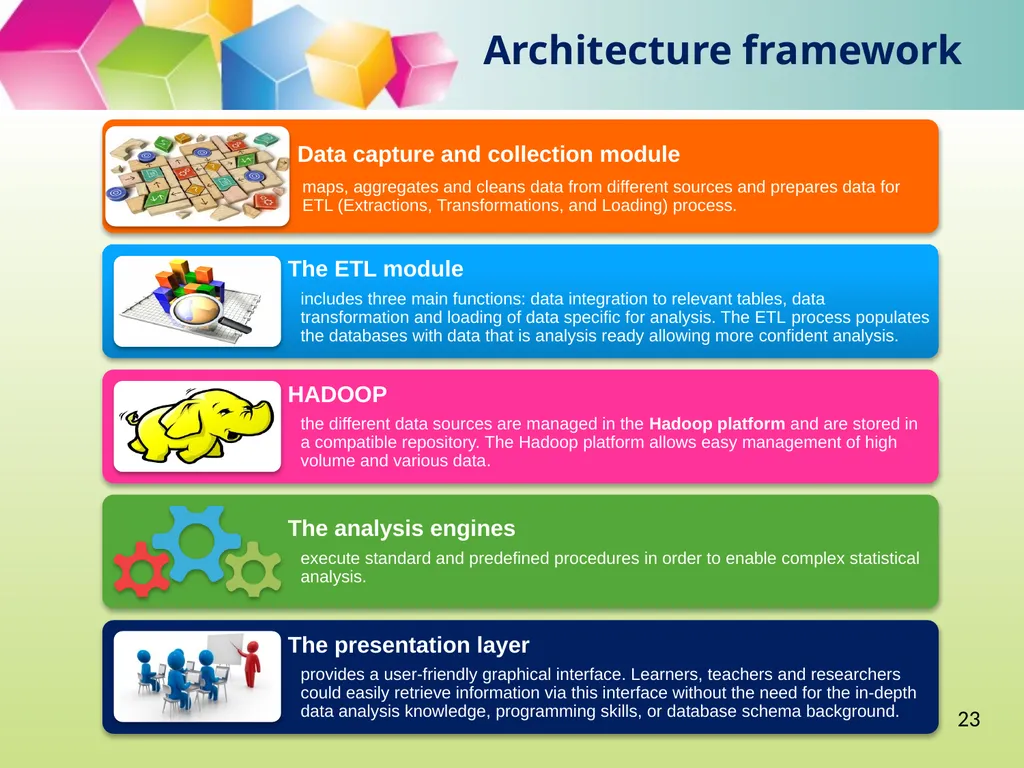
Architecture framework 23<br>
22
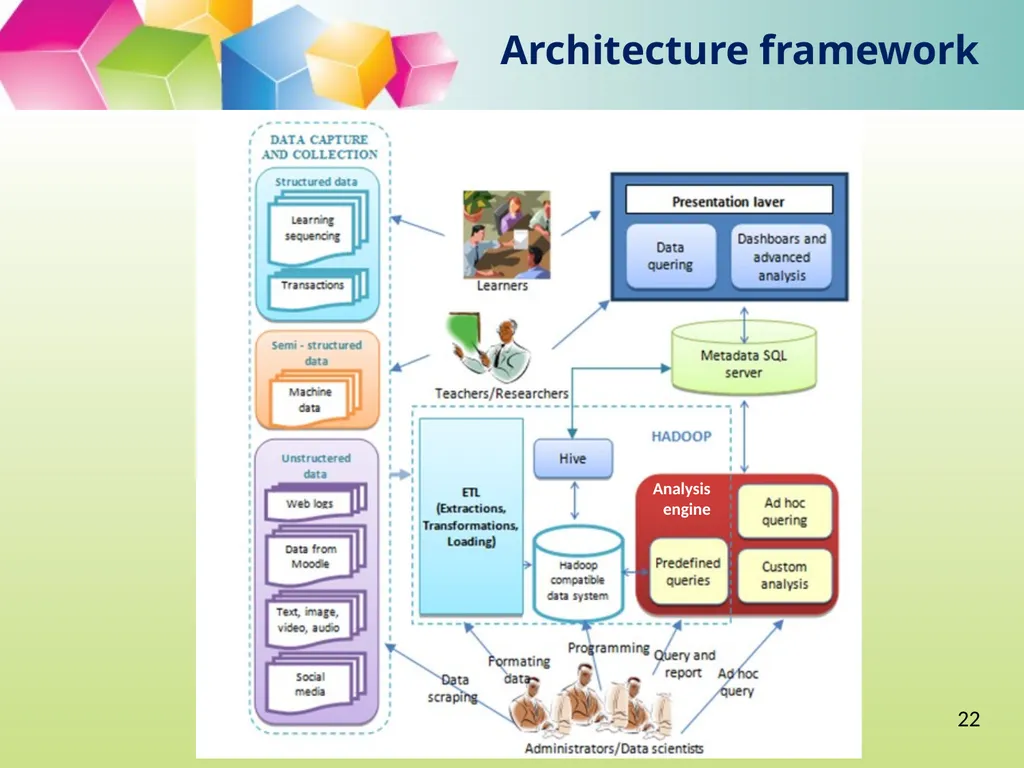
Architecture framework 22 Analysis engine<br>
23
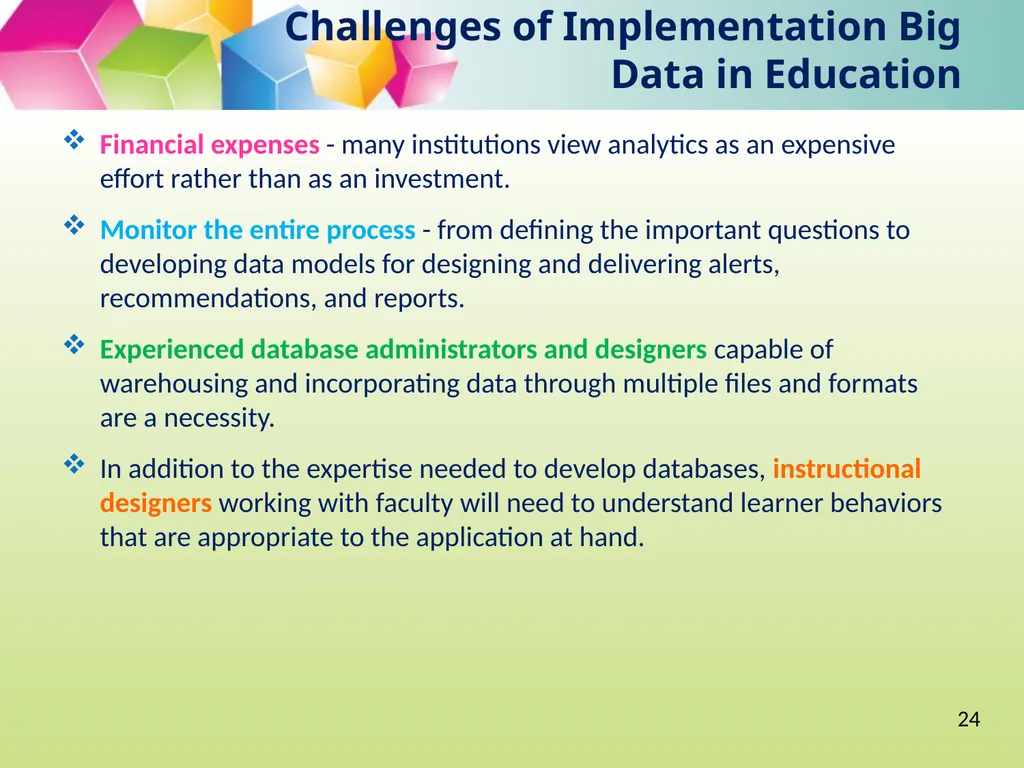
Challenges of Implementation Big Data in Education Financial expenses - many institutions view analytics as an expensive effort rather than as an investment.
Monitor the entire process - from defining the important questions to developing data models for designing and delivering alerts, recommendations, and reports.
Experienced database administrators and designers capable of warehousing and incorporating data through multiple files and formats are a necessity.
In addition to the expertise needed to develop databases, instructional designers working with faculty will need to understand learner behaviors that are appropriate to the application at hand. 24<br>
Monitor the entire process - from defining the important questions to developing data models for designing and delivering alerts, recommendations, and reports.
Experienced database administrators and designers capable of warehousing and incorporating data through multiple files and formats are a necessity.
In addition to the expertise needed to develop databases, instructional designers working with faculty will need to understand learner behaviors that are appropriate to the application at hand. 24<br>
24
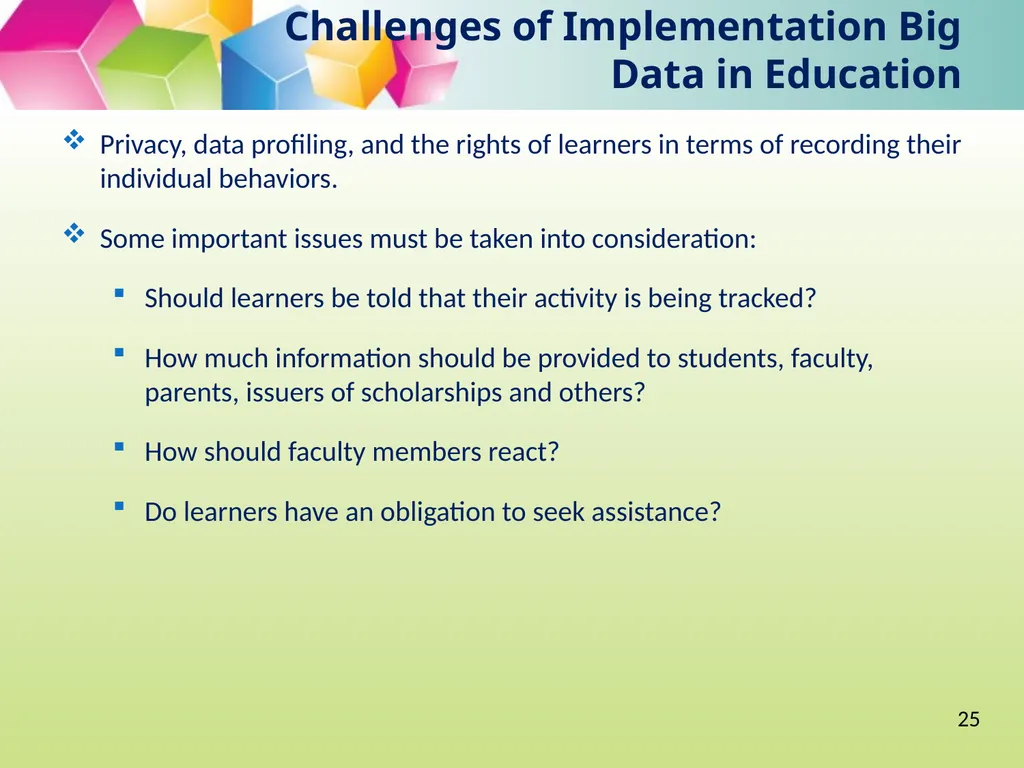
Challenges of Implementation Big Data in Education Privacy, data profiling, and the rights of learners in terms of recording their individual behaviors.
Some important issues must be taken into consideration:
Should learners be told that their activity is being tracked?
How much information should be provided to students, faculty, parents, issuers of scholarships and others?
How should faculty members react?
Do learners have an obligation to seek assistance? 25<br>
Some important issues must be taken into consideration:
Should learners be told that their activity is being tracked?
How much information should be provided to students, faculty, parents, issuers of scholarships and others?
How should faculty members react?
Do learners have an obligation to seek assistance? 25<br>
25
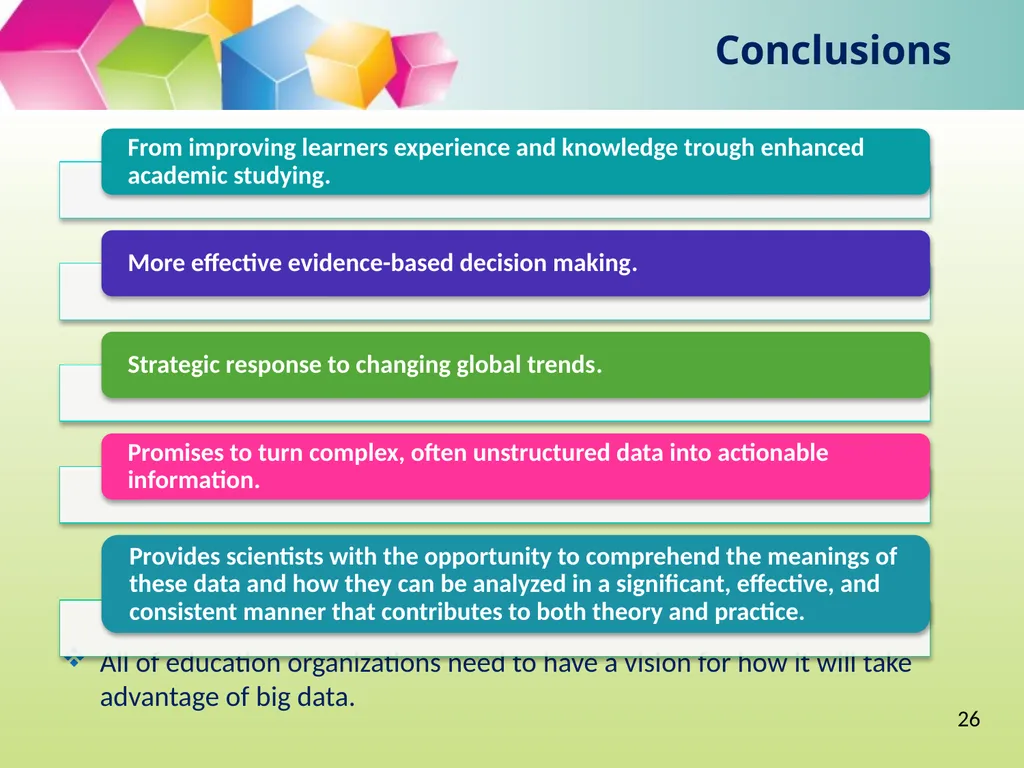
Conclusions All of education organizations need to have a vision for how it will take advantage of big data. 26<br>
26
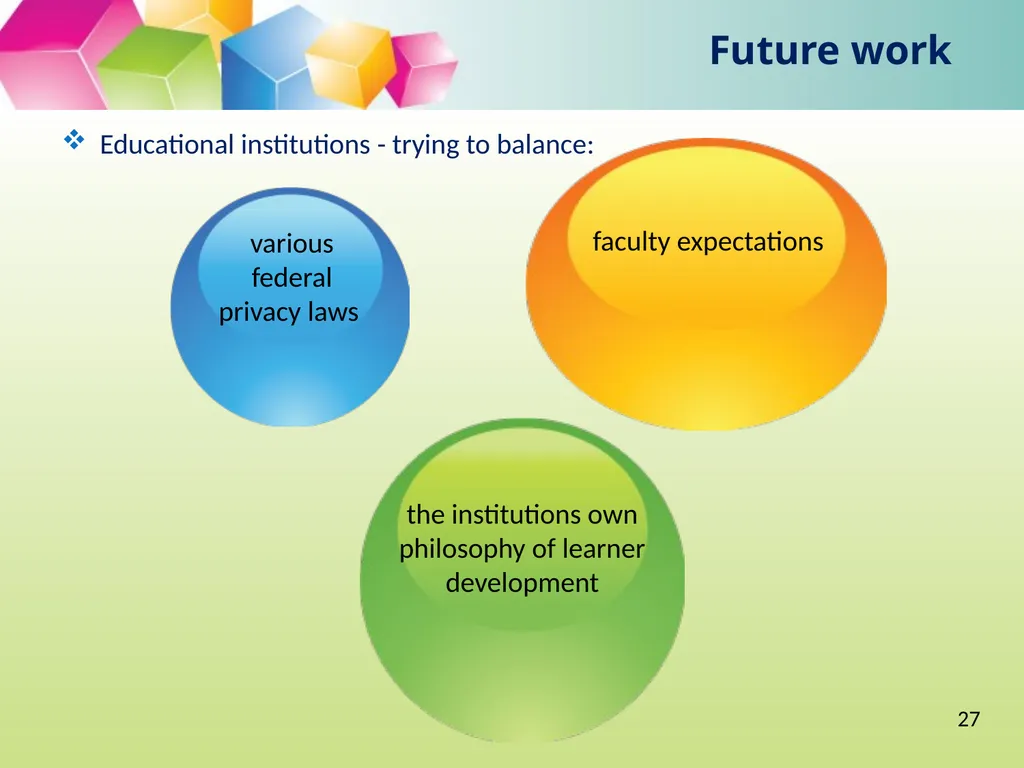
Future work Educational institutions - trying to balance: faculty expectations various federal privacy laws the institutions own philosophy of learner development 27<br>
27
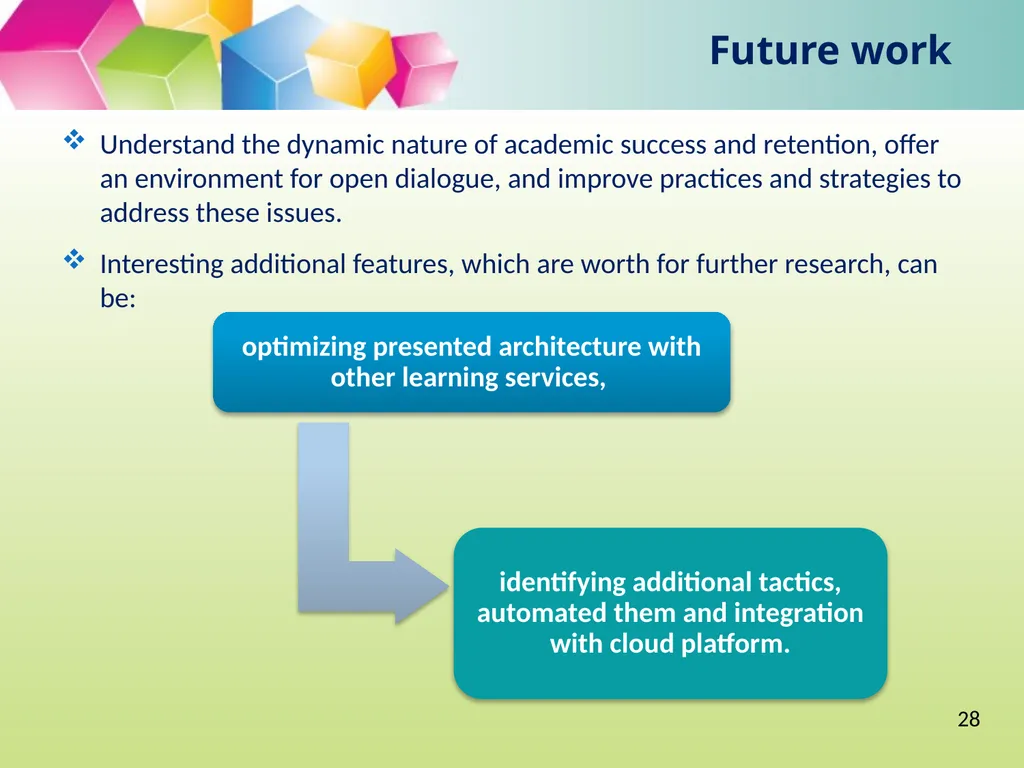
Future work Understand the dynamic nature of academic success and retention, offer an environment for open dialogue, and improve practices and strategies to address these issues.
Interesting additional features, which are worth for further research, can be: 28<br>
Interesting additional features, which are worth for further research, can be: 28<br>
28
Thank You !<br>