Big DATA What is Big Data? huge data is generated by different sources such as business people, marketing, education, engineering, medicine, social media, on-line transactions, call centers, sensors, web logs and telecommunication.
"Big DATA What is Big Data? huge data is generated" is the property of its rightful owner. Permission is granted to
download and print the materials on this website for personal, non-commercial use only, and to display it
on your personal computer provided you do not modify the materials and that you retain all copyright
notices contained in the materials. By downloading content from our website, you accept the terms of this
agreement.
Presentation Transcript
01
Big DATA<br>
02
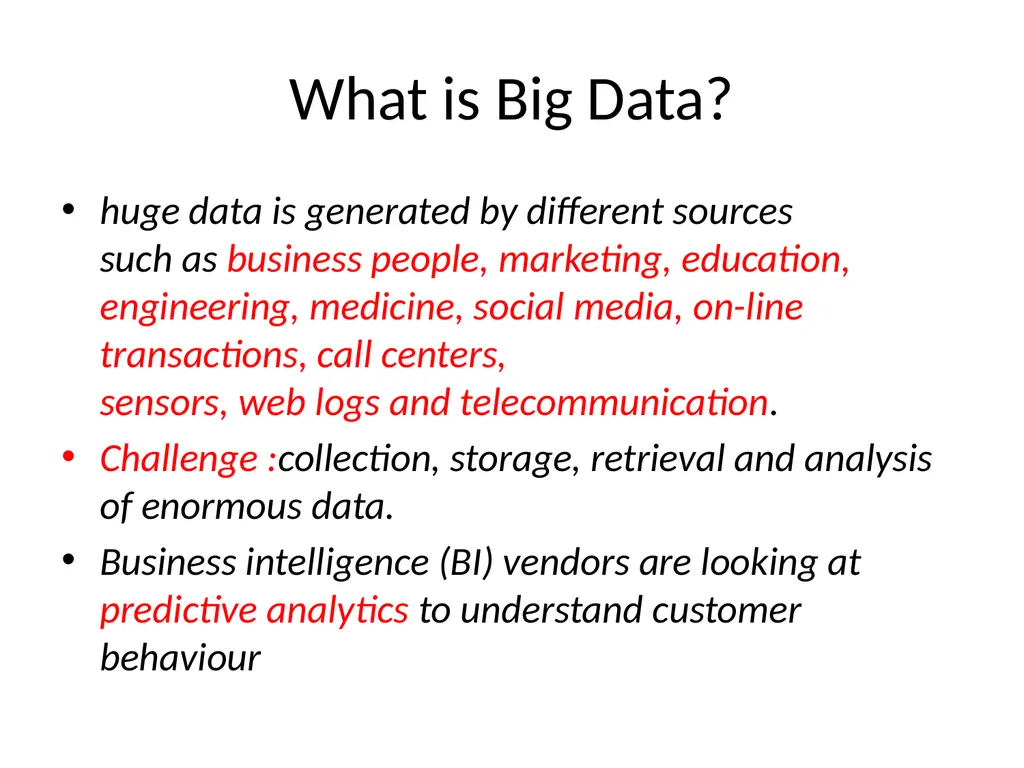
What is Big Data? huge data is generated by different sources such as business people, marketing, education, engineering, medicine, social media, on-line transactions, call centers, sensors, web logs and telecommunication.
Challenge :collection, storage, retrieval and analysis of enormous data.
Business intelligence (BI) vendors are looking at predictive analytics to understand customer behaviour<br>
03
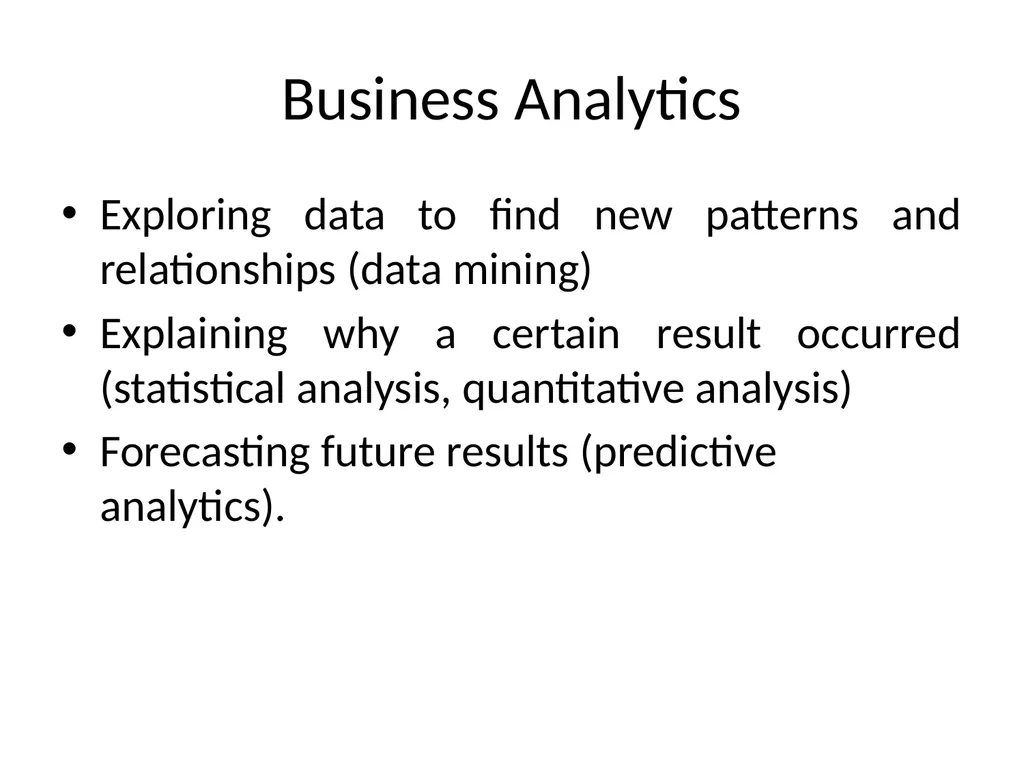
Business Analytics Exploring data to find new patterns and relationships (data mining)
Explaining why a certain result occurred (statistical analysis, quantitative analysis)
Forecasting future results (predictive analytics).<br>
04
Business intelligence (BI) Business intelligence (BI) is an umbrella term that includes the applications, infrastructure and tools, and best practices that enable access to and analysis of information to improve and optimize decisions and performance says Gartner.<br>
05
Big Data Big data refers to datasets whose size is beyond the ability of typical database software tools to capture, store, manage, and analyze the nformation
As the data is increasing voluminously in size from petabytes (1 petabyte=1024 terabytes), exabytes (1 exabyte=1024 petabytes),zettabytes (1 zettabyte=1024 exabytes), yottabytes (1 exabyte=1024 yottabytes).<br>
06
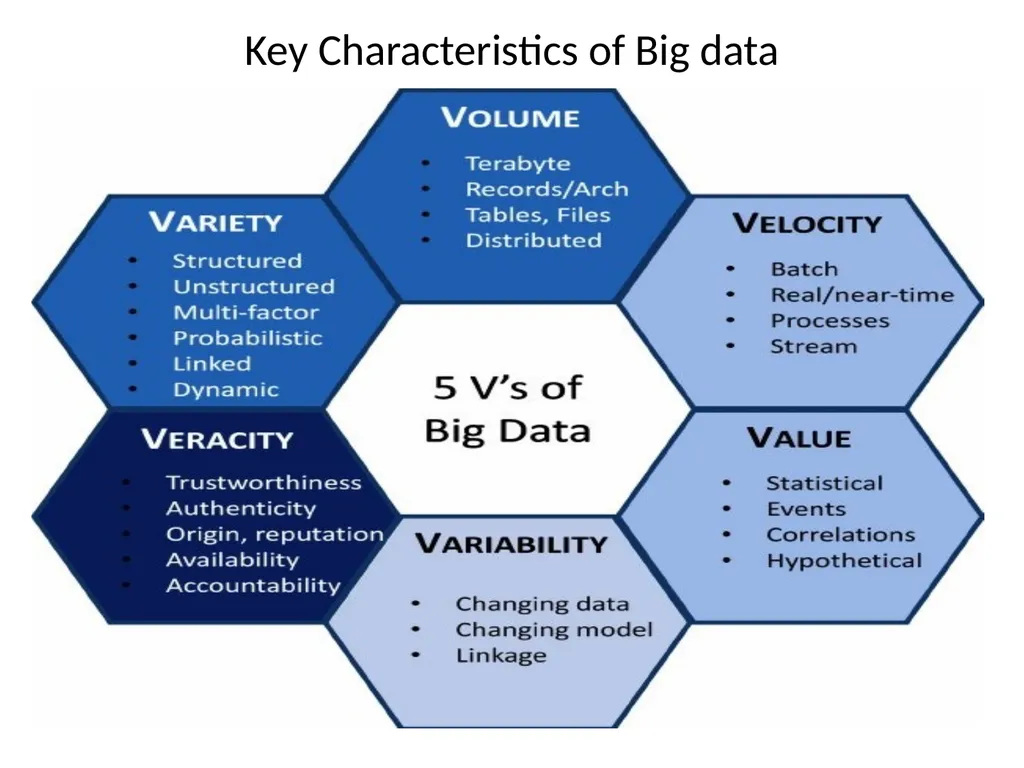
Key Characteristics of Big data<br>
07
different ways in which the data can be processed Operational Database: (OLTP) Online Transaction Processing (DBMSs).
Data Warehousing: (OLAP) Online Analytical
Processing.
Stream Computing: Due to uninterrupted networks data is arriving in continuous stream 24/7 a day. This data need to be captured and processed using RealTime Analytics Processing (RTAP).<br>
08
Big Data Technology 1 Hadoop:
An open source (free) software framework for processing huge datasets on certain kinds of problems on a distributed system.
Its development was inspired by Google’s MapReduce and Google File System.
It was originally developed at Yahoo! and is now managed as a project of the Apache Software Foundation.<br>
09
HBase: An open source (free), distributed, nonrelational database modeled on oogle’s Big Table.
It was originally developed by Powerset and is now managed as a project of the Apache Software foundation as part of the Hadoop. Big Data Technology<br>
10
MapReduce: A software framework introduced by Google for processing huge datasets on certain kinds of problems on a distributed system. Also implemented in Hadoop.
Cassandra: An open source (free) database management system designed to handle huge amounts of data on a distributed system.
This system was originally developed at Facebook and is now managed as a project of the Apache Software foundation. Big Data Technology<br>
11
5. Extract, transform, and load: (ETL)Software tools used to extract data from outside sources, transform them to fit operational needs, and load them into a database or data warehouse.
6 Cloud computing: Cloud computing as a computing paradigm in which highly scalable computing resources, often configured as a distributed system, are provided as a service through a network. Big Data Technology<br>
12
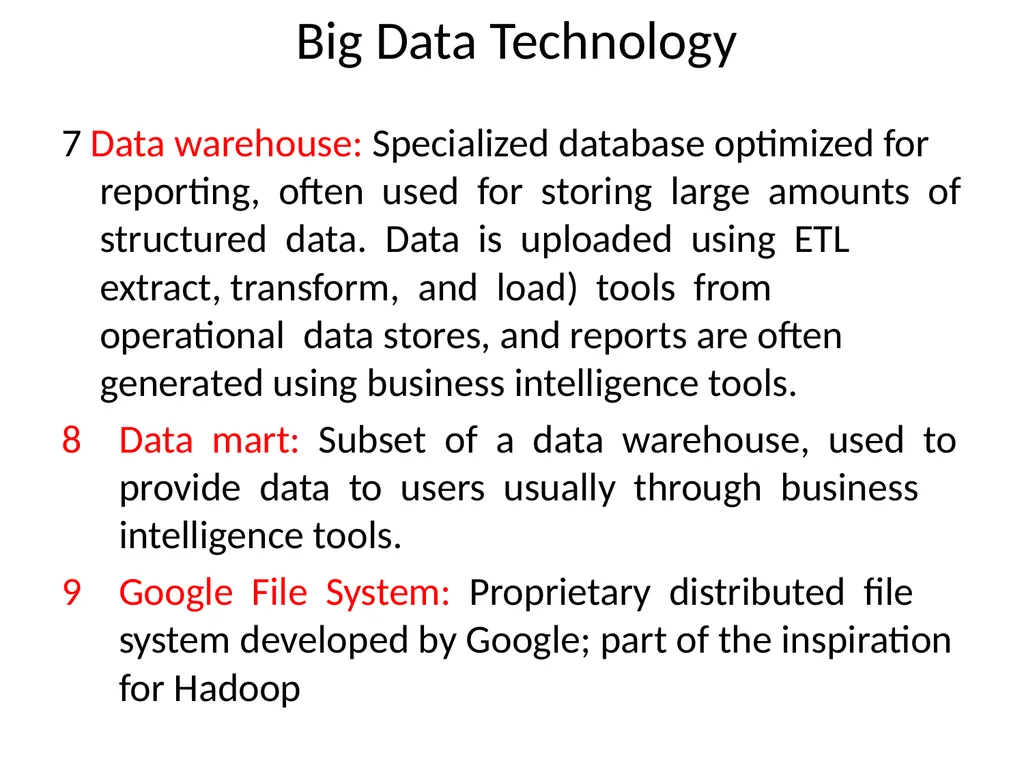
7 Data warehouse: Specialized database optimized for reporting, often used for storing large amounts of structured data. Data is uploaded using ETL extract, transform, and load) tools from operational data stores, and reports are often generated using business intelligence tools.
Data mart: Subset of a data warehouse, used to provide data to users usually through business intelligence tools.
Google File System: Proprietary distributed file system developed by Google; part of the inspiration for Hadoop Big Data Technology<br>
13
descriptive analytics,
predictive analytics, and
prescriptive analytics. Big Data analytics - classification<br>
14
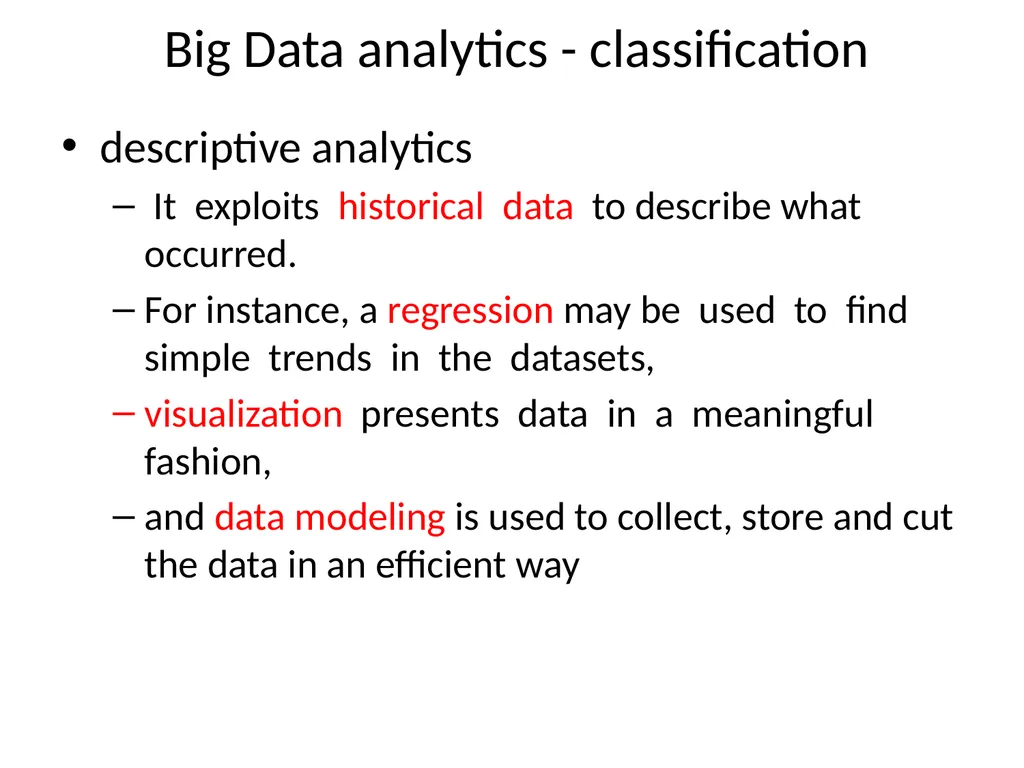
descriptive analytics
It exploits historical data to describe what occurred.
For instance, a regression may be used to find simple trends in the datasets,
visualization presents data in a meaningful fashion,
and data modeling is used to collect, store and cut the data in an efficient way Big Data analytics - classification<br>
15
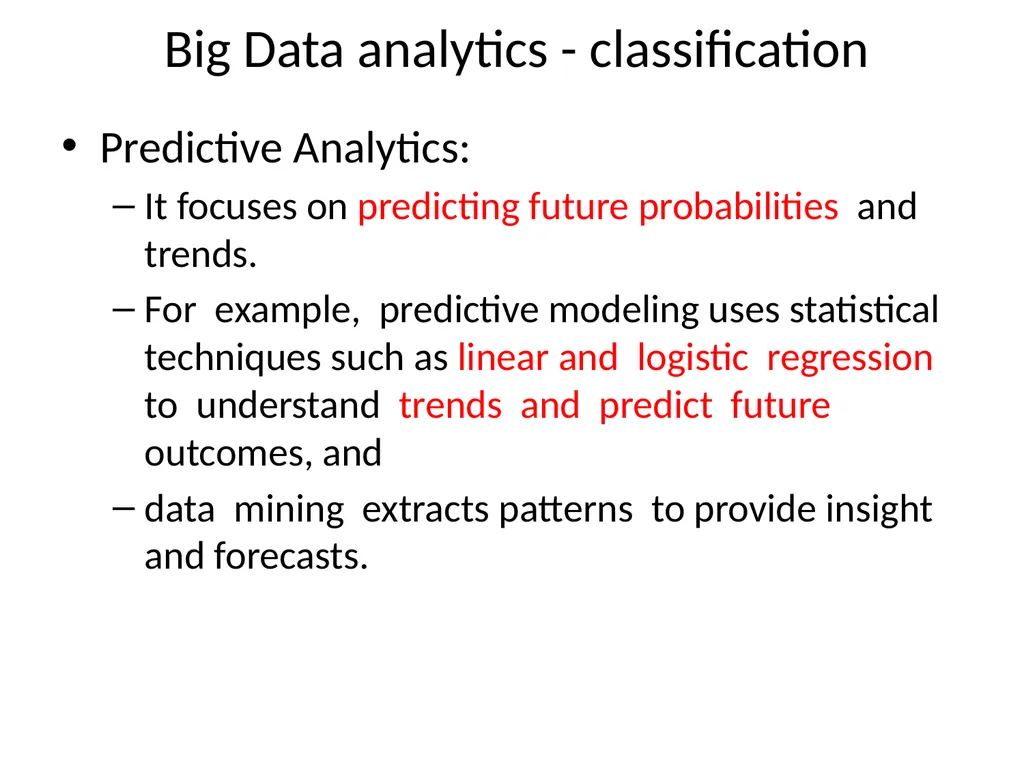
Predictive Analytics:
It focuses on predicting future probabilities and trends.
For example, predictive modeling uses statistical techniques such as linear and logistic regression to understand trends and predict future outcomes, and
data mining extracts patterns to provide insight and forecasts. Big Data analytics - classification<br>
16
Prescriptive Analytics:
It addresses decision making and efficiency.
For example, simulation is used to analyze complex systems to gain insight into system behavior and identify issues and optimization techniques are used to find optimal solutions under given constraints Big Data analytics - classification<br>
17
A wide variety of data from different sources can be captured, stored, and processed. More real-time analytics may be conducted from desktops or mobile devices for ad hock decision making.
Large volumes of non-transactional data can be included in analytics.
The time to solution is significantly shortened.
Future possibility of automation of data modeling. Benefits of big data in predictive analytics<br>