BIHAR ANIMAL SCIENCUNIVERSITY BIHAR VETERINARY COLLEGE, PATNA Department of Animal Nutrition ANN-602 UNIT-I (ANIMAL NUTRITION- Mineral, Vitamins and Feed Additives) Lecture on Calcium and Phosphorus Date- 03102020 Dr. Pramod Kumar
"BIHAR ANIMAL SCIENCUNIVERSITY BIHAR VETERINARY" is the property of its rightful owner. Permission is granted to
download and print the materials on this website for personal, non-commercial use only, and to display it
on your personal computer provided you do not modify the materials and that you retain all copyright
notices contained in the materials. By downloading content from our website, you accept the terms of this
agreement.
Presentation Transcript
01
BIHAR ANIMAL SCIENCUNIVERSITY BIHAR VETERINARY COLLEGE, PATNA Department of Animal Nutrition ANN-602
UNIT-I (ANIMAL NUTRITION- Mineral, Vitamins and Feed Additives)
Lecture on
Calcium and Phosphorus
Date- 03/10/2020
Dr. Pramod Kumar
Assistant Professor-cum-Jr. Scientist
Dept. Of Livestock Farm Complex
Bihar Veterinary College, BASU, Patna-14<br>
02
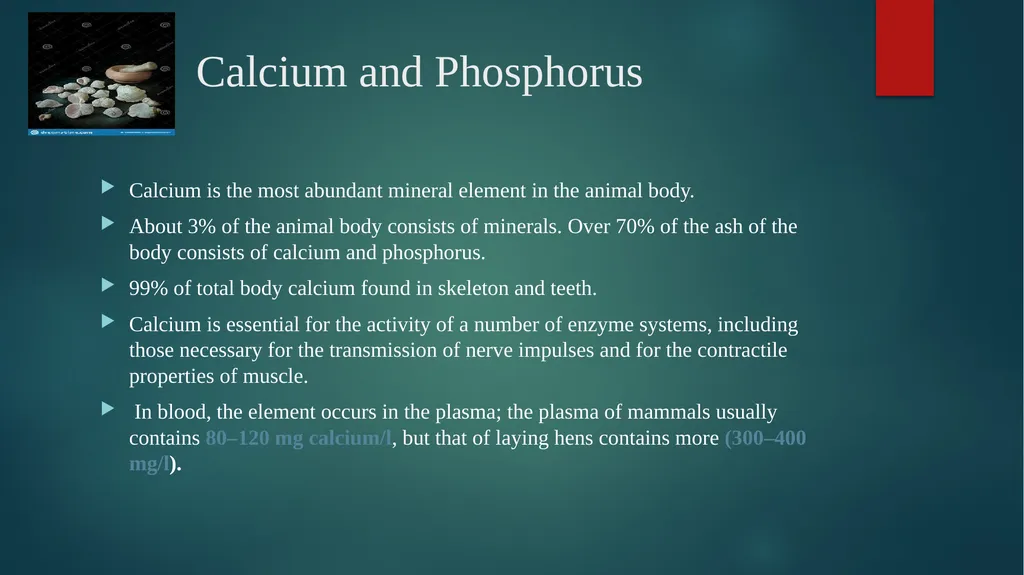
Calcium and Phosphorus Calcium is the most abundant mineral element in the animal body.
About 3% of the animal body consists of minerals. Over 70% of the ash of the body consists of calcium and phosphorus.
99% of total body calcium found in skeleton and teeth.
Calcium is essential for the activity of a number of enzyme systems, including those necessary for the transmission of nerve impulses and for the contractile properties of muscle.
In blood, the element occurs in the plasma; the plasma of mammals usually contains 80–120 mg calcium/l, but that of laying hens contains more (300–400 mg/l).<br>
03
Composition of Bone Bone is highly complex in structure, the dry matter consisting of approximately 460 g mineral matter/kg, 360 g protein/kg and 180 g fat/kg.
Bone ash contains approximately 360 g calcium/kg, 170 g phosphorus/kg and 10 g magnesium/kg.
The skeleton is not a stable unit in the chemical sense, since large amounts of the calcium and phosphorus in bone can be liberated by reabsorption. This takes place particularly during lactation and egg production, although the exchange of calcium and phosphorus between bones and soft tissue is always a continuous process. Resorption of calcium is controlled by the action of the parathyroid gland.
If animals are fed on a low-calcium diet, the ionic calcium concentration in the extracellular fluid falls, the parathyroid gland is stimulated and the hormone produced causes resorption of bone, liberating calcium to meet the requirements of the animal. Since calcium is combined with phosphorus in bone, the phosphorus is also liberated and excreted by the animal.<br>
04
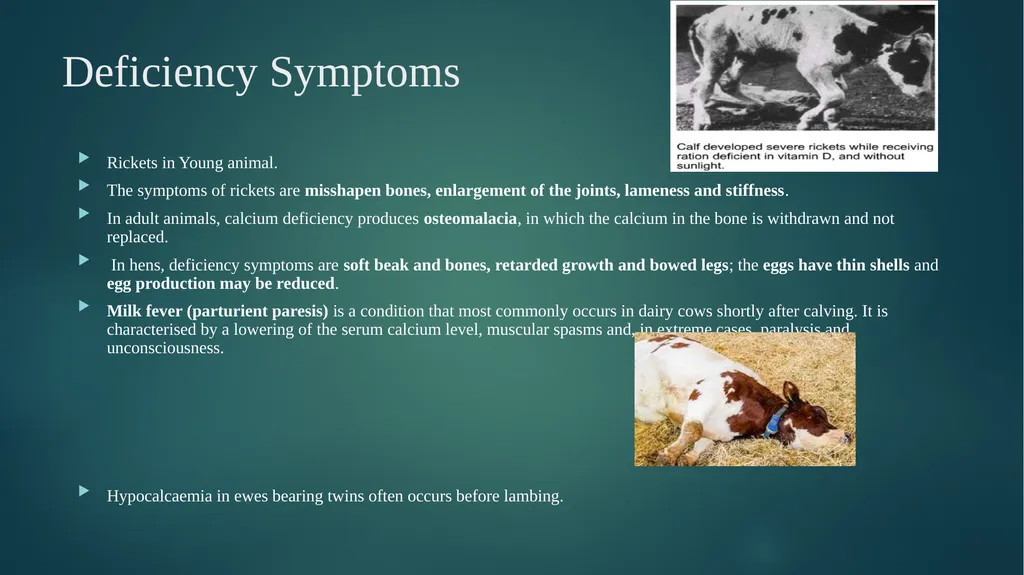
Deficiency Symptoms Rickets in Young animal.
The symptoms of rickets are misshapen bones, enlargement of the joints, lameness and stiffness.
In adult animals, calcium deficiency produces osteomalacia, in which the calcium in the bone is withdrawn and not replaced.
In hens, deficiency symptoms are soft beak and bones, retarded growth and bowed legs; the eggs have thin shells and egg production may be reduced.
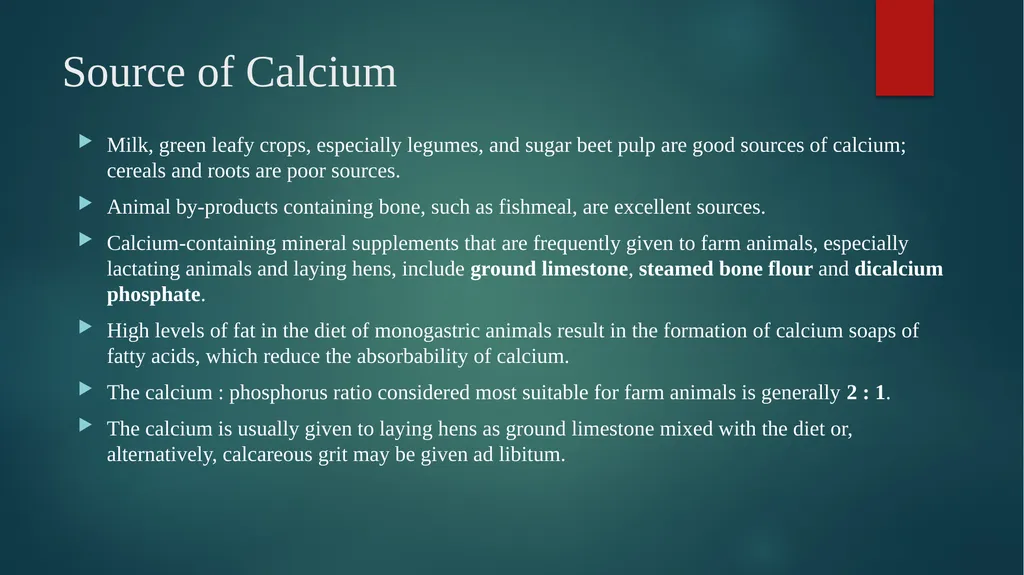
Milk fever (parturient paresis) is a condition that most commonly occurs in dairy cows shortly after calving. It is characterised by a lowering of the serum calcium level, muscular spasms and, in extreme cases, paralysis and unconsciousness.
Hypocalcaemia in ewes bearing twins often occurs before lambing.<br>
05
Source of Calcium Milk, green leafy crops, especially legumes, and sugar beet pulp are good sources of calcium; cereals and roots are poor sources.
Animal by-products containing bone, such as fishmeal, are excellent sources.
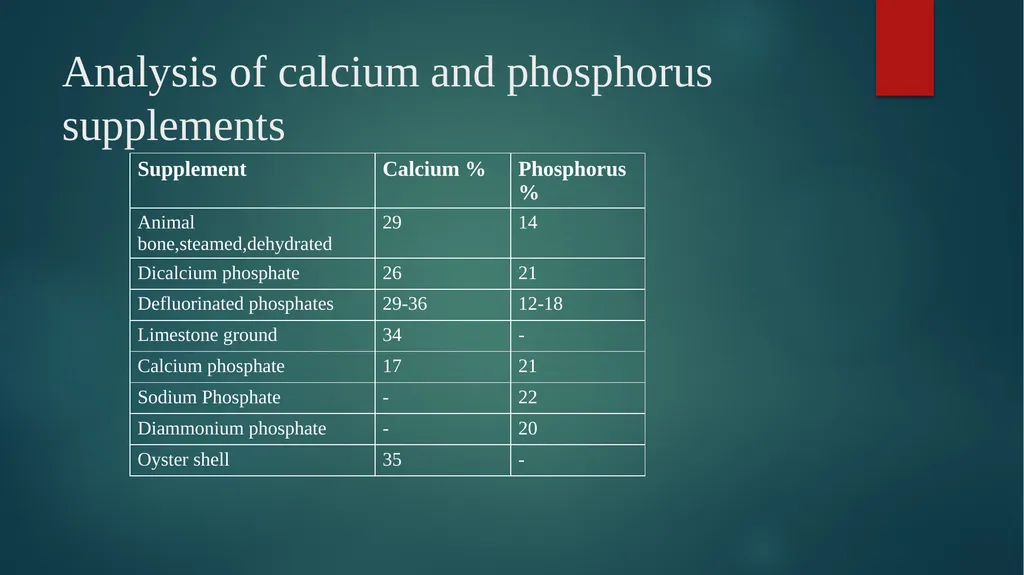
Calcium-containing mineral supplements that are frequently given to farm animals, especially lactating animals and laying hens, include ground limestone, steamed bone flour and dicalcium phosphate.
High levels of fat in the diet of monogastric animals result in the formation of calcium soaps of fatty acids, which reduce the absorbability of calcium.
The calcium : phosphorus ratio considered most suitable for farm animals is generally 2 : 1.
The calcium is usually given to laying hens as ground limestone mixed with the diet or, alternatively, calcareous grit may be given ad libitum.<br>
06
Analysis of calcium and phosphorus supplements<br>
07
Phosphorus Phosphorus has more known functions than any other mineral element in the animal body.
The close association of phosphorus with calcium in bone has already been mentioned.
In addition, phosphorus occurs in phosphoproteins, nucleic acids and phospholipids.
The element plays a vital role in energy metabolism in the formation of sugar-phosphates and adenosine di- and triphosphates.
Whereas 99 per cent of the calcium found in the body occurs in the bones and teeth, the proportion of the phosphorus in these structures is about 80–85 per cent of the total; the remainder is in the soft tissues and fluids.
The control of phosphorus metabolism is different from that of calcium. If it is in an available form, phosphorus is absorbed well even when there is an excess over requirement.
Plasma phosphorus diffuses into saliva and in ruminants the large amount of chewing during rumination results in saliva being the major input of phosphorus into the rumen rather than the food.<br>
08
Deficiency Symptoms Like calcium, phosphorus is required for bone formation and a deficiency can also cause rickets or osteomalacia.
Pica, or depraved appetite, has been noted in cattle when there is a deficiency of phosphorus in the diet.
In chronic phosphorus deficiency, animals may have stiff joints and muscular weakness.
Low dietary intake of phosphorus has also been associated with poor fertility, with apparent dysfunction of the ovaries causing inhibition, depression or irregularity of oestrus.
Subnormal growth in young animals and low liveweight gains in mature animals are characteristic symptoms of phosphorus deficiency in all species.<br>
09
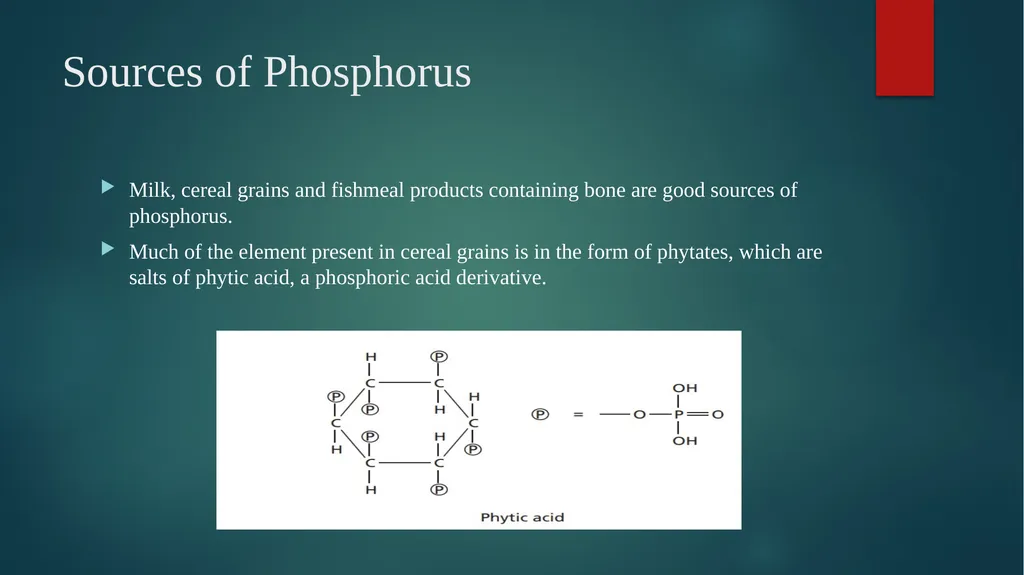
Sources of Phosphorus Milk, cereal grains and fishmeal products containing bone are good sources of phosphorus.
Much of the element present in cereal grains is in the form of phytates, which are salts of phytic acid, a phosphoric acid derivative.<br>
10
Insoluble calcium and magnesium phytates occur in cereals and other plant products.
Experiments with chicks have shown that the phosphorus of calcium phytate is utilised only 10 per cent as effectively as disodium phosphate.
In studies with laying hens, phytate phosphorus was utilised about half as well as dicalcium phosphate..
Intestinal phytase activity from the microflora has been observed, but it appears to be of little importance in the pig.
Phytate phosphorus appears therefore to be utilised by ruminants as readily as other forms of phosphorus, although studies using radioactive isotopes indicate that the availability of phosphorus may range from 0.33 to 0.90. Recent studies with a fungal source of phytase added to the diet of pigs have shown significant increases in ileal and total tract digestibility of phytate phosphorus.
Feeding with high levels of phosphorus should be avoided as the excess is excreted and contributes to pollution by encouraging the growth of algae in water courses.
High phosphorus intake in association with magnesium can lead to the formation of mineral deposits in the bladder and urethra (urolithiasis or urinary calculi) and blockage of the flow of urine in male sheep and cattle.<br>