
BING 6004: Intro to Computational BioEngineering
CB
Published · 26 slides · 0 views
1 / 1
Description
BING 6004: Intro to Computational BioEngineering Spring 2016 Lecture 1: Using Python Expressions and Variables Bienvenido Vélez UPR Mayaguez Reference: How to Think Like a Computer Scientist: Learning with Python Introduction to Python
Related Topics
Download this presentation From Below
"BING 6004: Intro to Computational BioEngineering" is the property of its rightful owner. Permission is granted to download and print the materials on this website for personal, non-commercial use only, and to display it on your personal computer provided you do not modify the materials and that you retain all copyright notices contained in the materials. By downloading content from our website, you accept the terms of this agreement.
Share
Embed code
Presentation Transcript
01
BING 6004: Intro to Computational BioEngineering
Spring 2016
Lecture 1: Using Python Expressions and Variables
Bienvenido Vélez
UPR Mayaguez
Reference: How to Think Like a Computer Scientist: Learning with Python Introduction to Python programming for Bioinformatics 1<br>
Spring 2016
Lecture 1: Using Python Expressions and Variables
Bienvenido Vélez
UPR Mayaguez
Reference: How to Think Like a Computer Scientist: Learning with Python Introduction to Python programming for Bioinformatics 1<br>
02
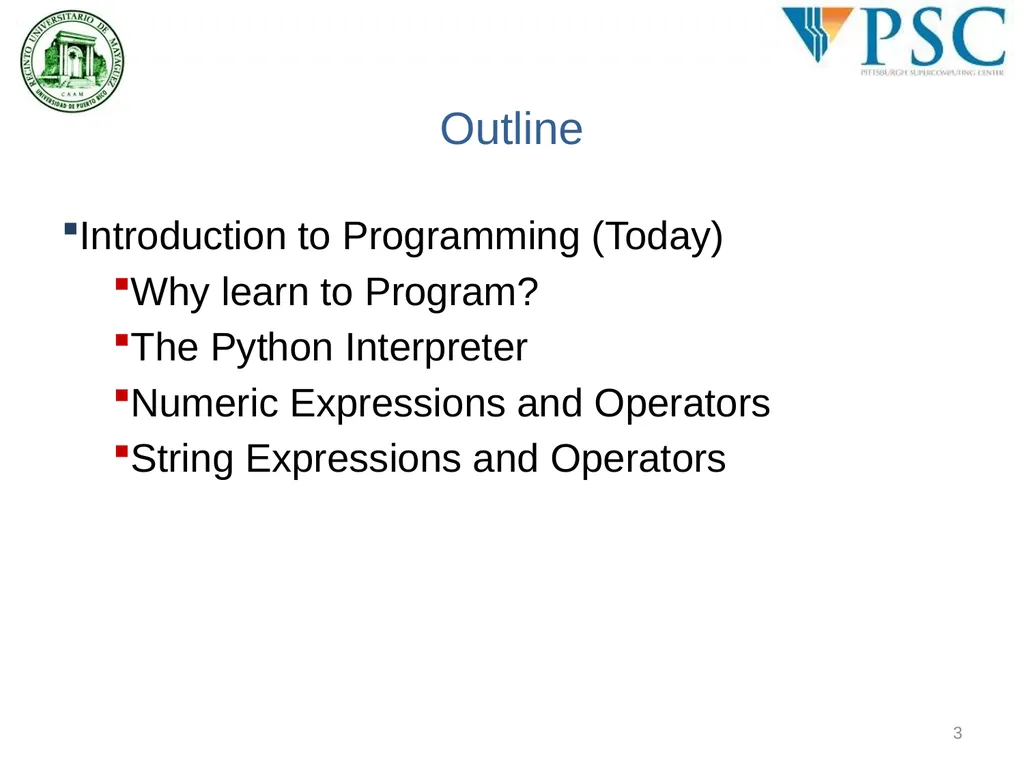
Introduction to Programming (Today)
Why learn to Program?
The Python Interpreter
Numeric Expressions and Operators
String Expressions and Operators Outline 3<br>
Why learn to Program?
The Python Interpreter
Numeric Expressions and Operators
String Expressions and Operators Outline 3<br>
03
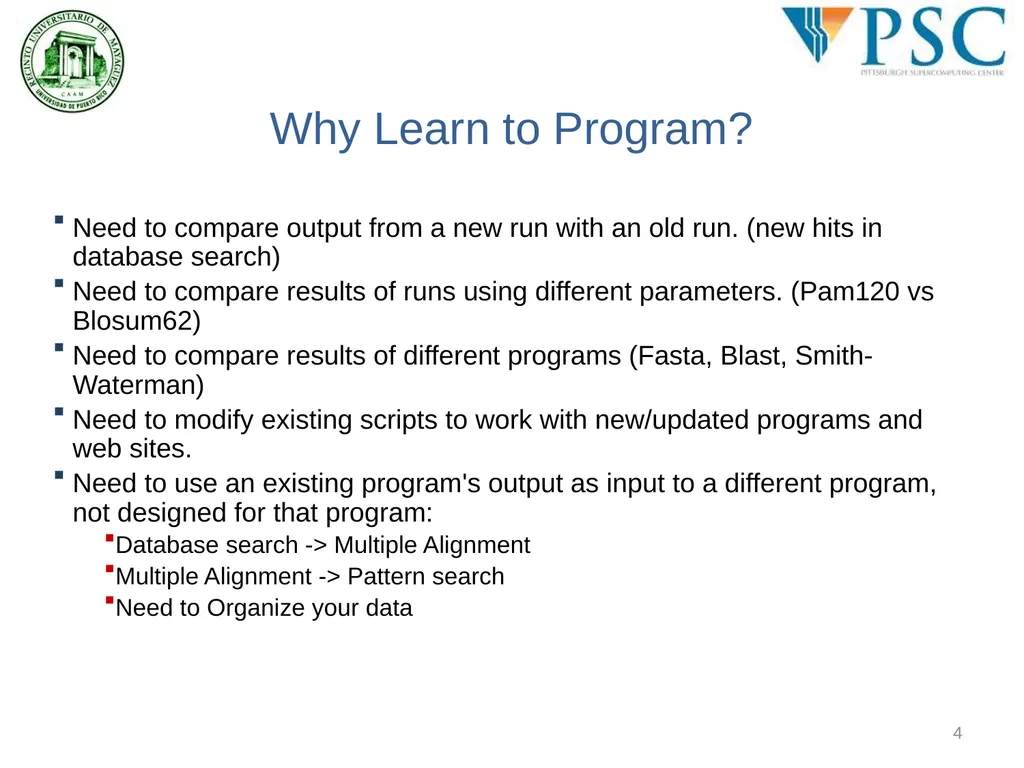
Why Learn to Program? 4 Need to compare output from a new run with an old run. (new hits in database search)
Need to compare results of runs using different parameters. (Pam120 vs Blosum62)
Need to compare results of different programs (Fasta, Blast, Smith-Waterman)
Need to modify existing scripts to work with new/updated programs and web sites.
Need to use an existing program's output as input to a different program, not designed for that program:
Database search -> Multiple Alignment
Multiple Alignment -> Pattern search
Need to Organize your data<br>
Need to compare results of runs using different parameters. (Pam120 vs Blosum62)
Need to compare results of different programs (Fasta, Blast, Smith-Waterman)
Need to modify existing scripts to work with new/updated programs and web sites.
Need to use an existing program's output as input to a different program, not designed for that program:
Database search -> Multiple Alignment
Multiple Alignment -> Pattern search
Need to Organize your data<br>
04
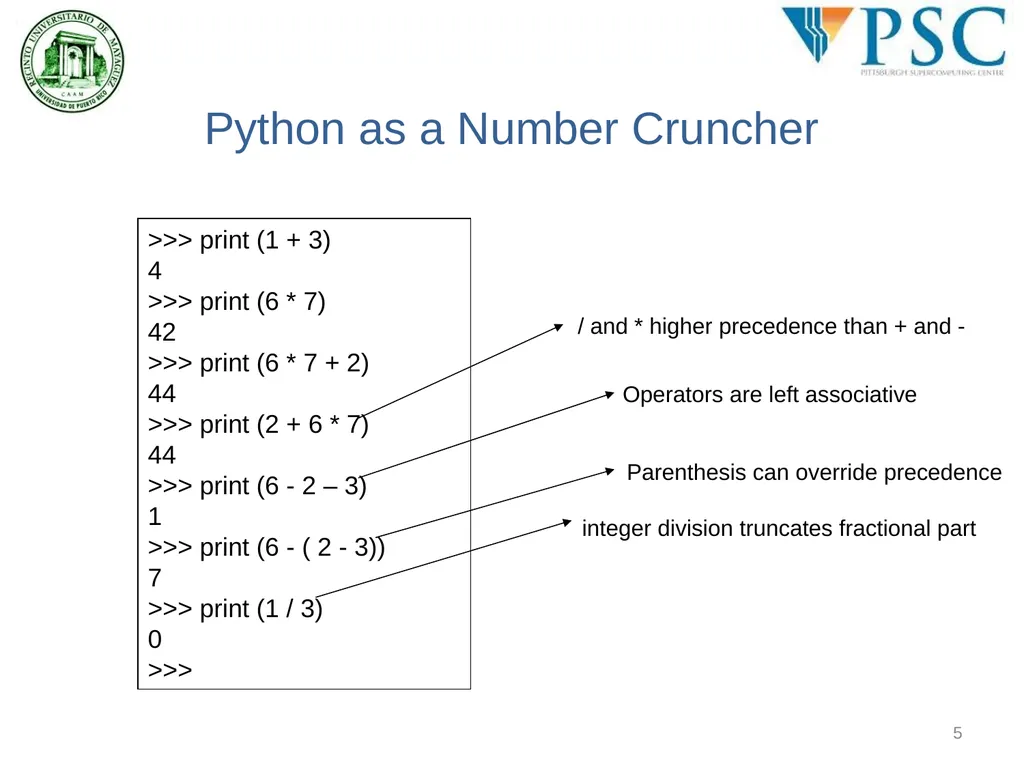
Python as a Number Cruncher 5 >>> print (1 + 3)
4
>>> print (6 * 7)
42
>>> print (6 * 7 + 2)
44
>>> print (2 + 6 * 7)
44
>>> print (6 - 2 – 3)
1
>>> print (6 - ( 2 - 3))
7
>>> print (1 / 3)
0
>>> / and * higher precedence than + and - integer division truncates fractional part Operators are left associative Parenthesis can override precedence<br>
4
>>> print (6 * 7)
42
>>> print (6 * 7 + 2)
44
>>> print (2 + 6 * 7)
44
>>> print (6 - 2 – 3)
1
>>> print (6 - ( 2 - 3))
7
>>> print (1 / 3)
0
>>> / and * higher precedence than + and - integer division truncates fractional part Operators are left associative Parenthesis can override precedence<br>
05
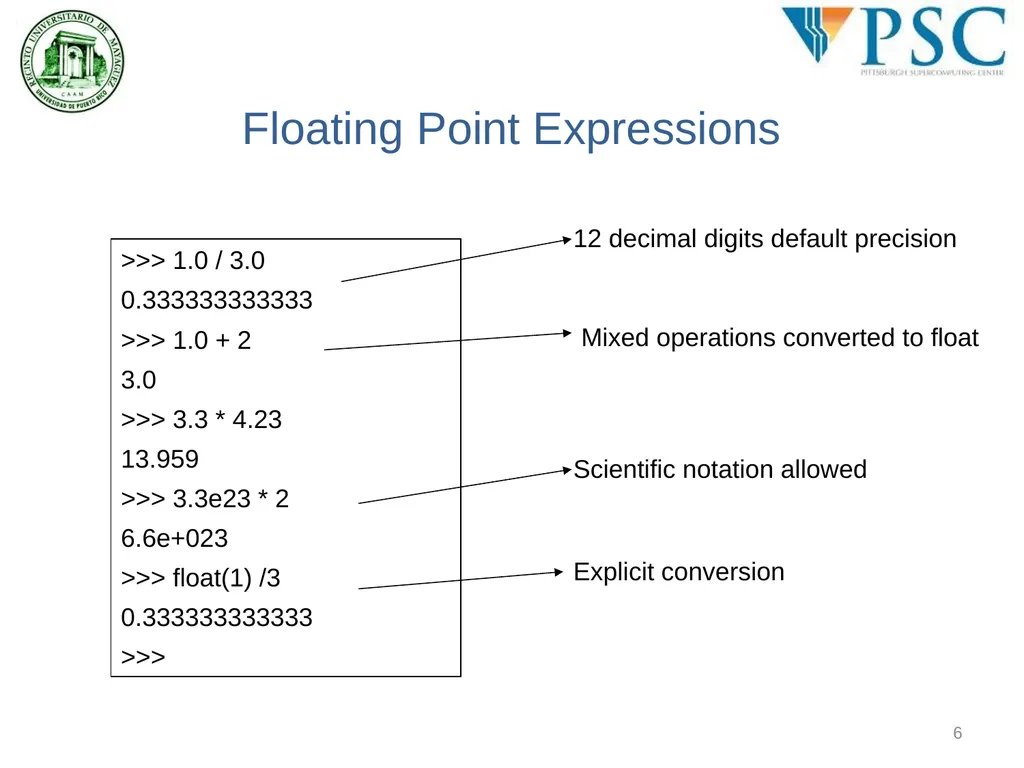
Floating Point Expressions 6 >>> 1.0 / 3.0
0.333333333333
>>> 1.0 + 2
3.0
>>> 3.3 * 4.23
13.959
>>> 3.3e23 * 2
6.6e+023
>>> float(1) /3
0.333333333333
>>> Mixed operations converted to float Scientific notation allowed 12 decimal digits default precision Explicit conversion<br>
0.333333333333
>>> 1.0 + 2
3.0
>>> 3.3 * 4.23
13.959
>>> 3.3e23 * 2
6.6e+023
>>> float(1) /3
0.333333333333
>>> Mixed operations converted to float Scientific notation allowed 12 decimal digits default precision Explicit conversion<br>
06
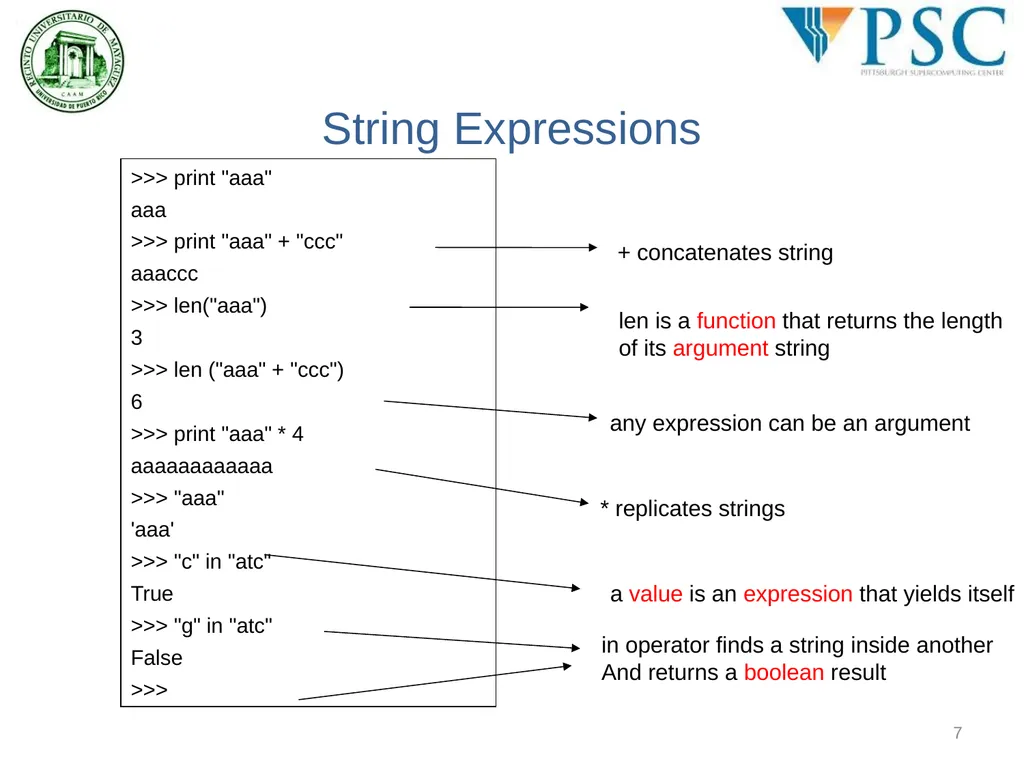
String Expressions 7 >>> print "aaa"
aaa
>>> print "aaa" + "ccc"
aaaccc
>>> len("aaa")
3
>>> len ("aaa" + "ccc")
6
>>> print "aaa" * 4
aaaaaaaaaaaa
>>> "aaa"
'aaa'
>>> "c" in "atc"
True
>>> "g" in "atc"
False
>>> + concatenates string len is a function that returns the length
of its argument string any expression can be an argument * replicates strings a value is an expression that yields itself in operator finds a string inside another
And returns a boolean result<br>
aaa
>>> print "aaa" + "ccc"
aaaccc
>>> len("aaa")
3
>>> len ("aaa" + "ccc")
6
>>> print "aaa" * 4
aaaaaaaaaaaa
>>> "aaa"
'aaa'
>>> "c" in "atc"
True
>>> "g" in "atc"
False
>>> + concatenates string len is a function that returns the length
of its argument string any expression can be an argument * replicates strings a value is an expression that yields itself in operator finds a string inside another
And returns a boolean result<br>
07
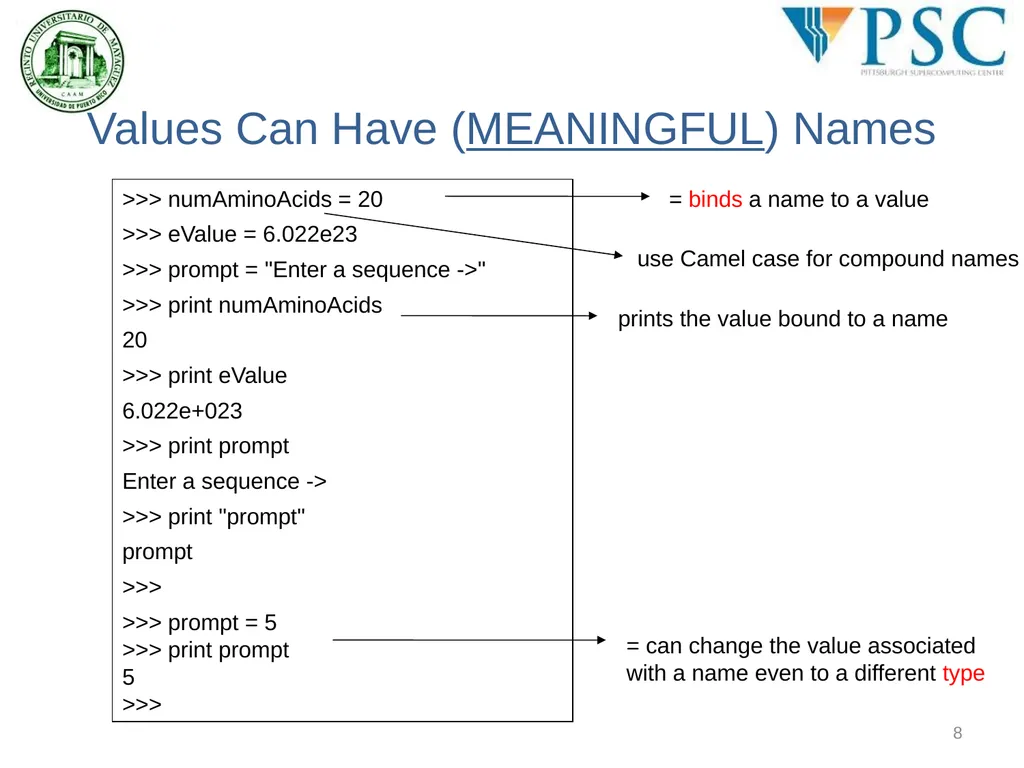
Values Can Have (MEANINGFUL) Names 8 >>> numAminoAcids = 20
>>> eValue = 6.022e23
>>> prompt = "Enter a sequence ->"
>>> print numAminoAcids
20
>>> print eValue
6.022e+023
>>> print prompt
Enter a sequence ->
>>> print "prompt"
prompt
>>>
>>> prompt = 5
>>> print prompt
5
>>> = binds a name to a value prints the value bound to a name = can change the value associated
with a name even to a different type use Camel case for compound names<br>
>>> eValue = 6.022e23
>>> prompt = "Enter a sequence ->"
>>> print numAminoAcids
20
>>> print eValue
6.022e+023
>>> print prompt
Enter a sequence ->
>>> print "prompt"
prompt
>>>
>>> prompt = 5
>>> print prompt
5
>>> = binds a name to a value prints the value bound to a name = can change the value associated
with a name even to a different type use Camel case for compound names<br>
08
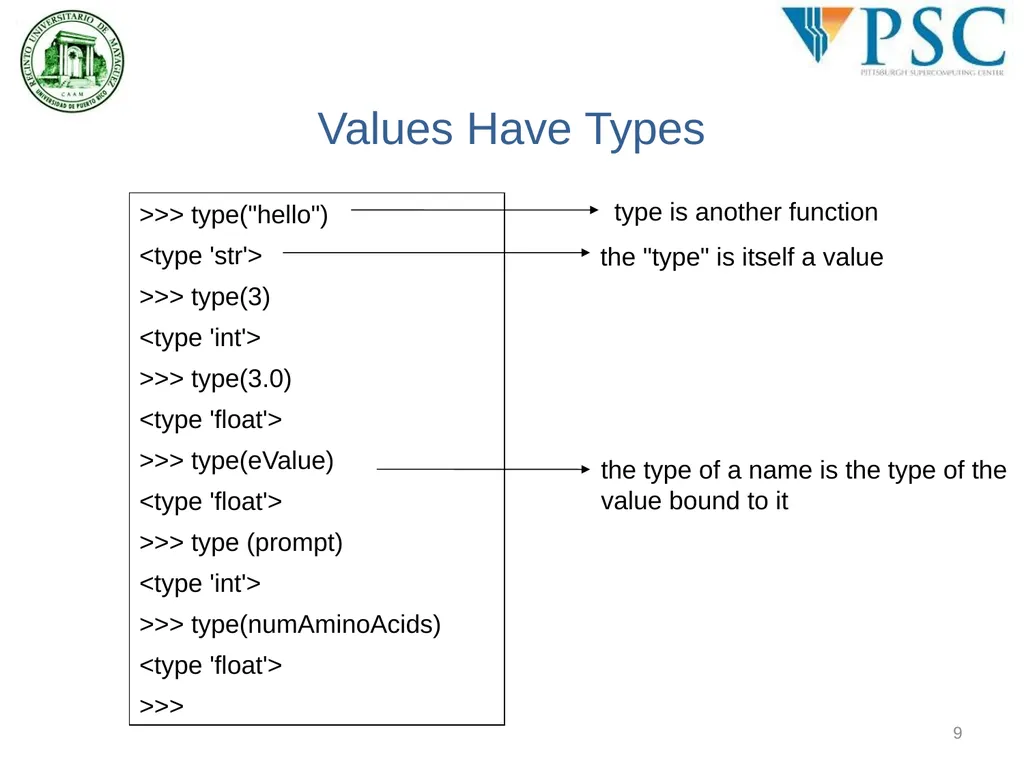
Values Have Types 9 >>> type("hello")
<type 'str'>
>>> type(3)
<type 'int'>
>>> type(3.0)
<type 'float'>
>>> type(eValue)
<type 'float'>
>>> type (prompt)
<type 'int'>
>>> type(numAminoAcids)
<type 'float'>
>>> type is another function the type of a name is the type of the
value bound to it the "type" is itself a value<br>
<type 'str'>
>>> type(3)
<type 'int'>
>>> type(3.0)
<type 'float'>
>>> type(eValue)
<type 'float'>
>>> type (prompt)
<type 'int'>
>>> type(numAminoAcids)
<type 'float'>
>>> type is another function the type of a name is the type of the
value bound to it the "type" is itself a value<br>
09
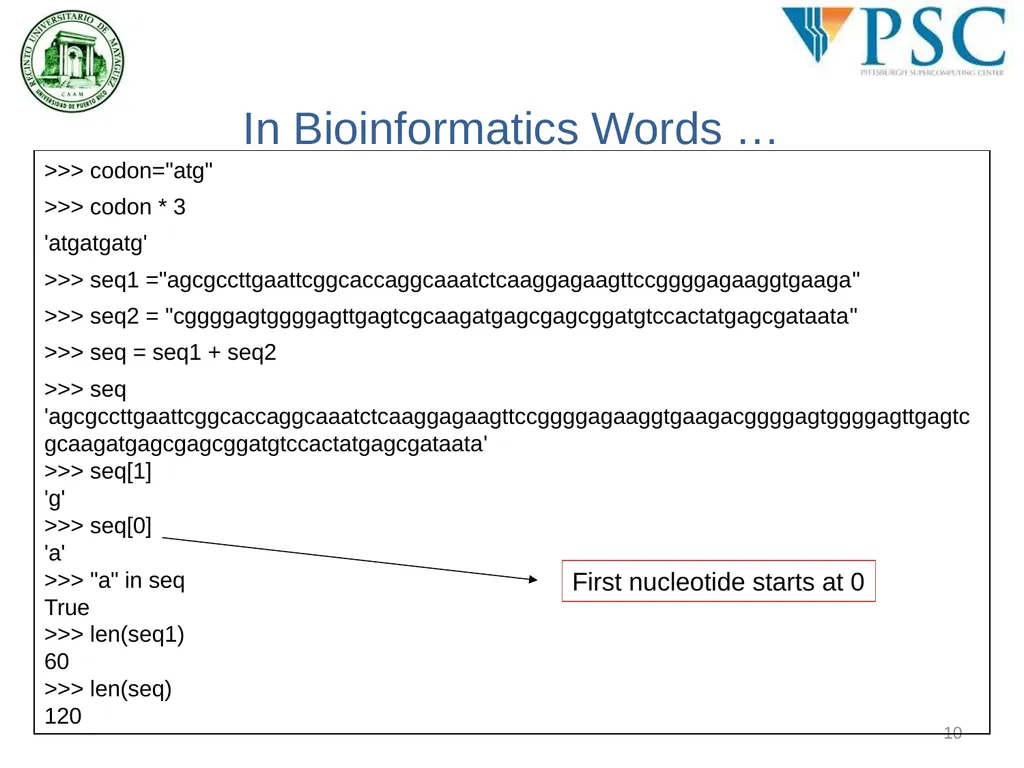
In Bioinformatics Words … 10 >>> codon="atg"
>>> codon * 3
'atgatgatg'
>>> seq1 ="agcgccttgaattcggcaccaggcaaatctcaaggagaagttccggggagaaggtgaaga"
>>> seq2 = "cggggagtggggagttgagtcgcaagatgagcgagcggatgtccactatgagcgataata"
>>> seq = seq1 + seq2
>>> seq
'agcgccttgaattcggcaccaggcaaatctcaaggagaagttccggggagaaggtgaagacggggagtggggagttgagtcgcaagatgagcgagcggatgtccactatgagcgataata'
>>> seq[1]
'g'
>>> seq[0]
'a'
>>> "a" in seq
True
>>> len(seq1)
60
>>> len(seq)
120 First nucleotide starts at 0<br>
>>> codon * 3
'atgatgatg'
>>> seq1 ="agcgccttgaattcggcaccaggcaaatctcaaggagaagttccggggagaaggtgaaga"
>>> seq2 = "cggggagtggggagttgagtcgcaagatgagcgagcggatgtccactatgagcgataata"
>>> seq = seq1 + seq2
>>> seq
'agcgccttgaattcggcaccaggcaaatctcaaggagaagttccggggagaaggtgaagacggggagtggggagttgagtcgcaagatgagcgagcggatgtccactatgagcgataata'
>>> seq[1]
'g'
>>> seq[0]
'a'
>>> "a" in seq
True
>>> len(seq1)
60
>>> len(seq)
120 First nucleotide starts at 0<br>
10
More Bioinformatics
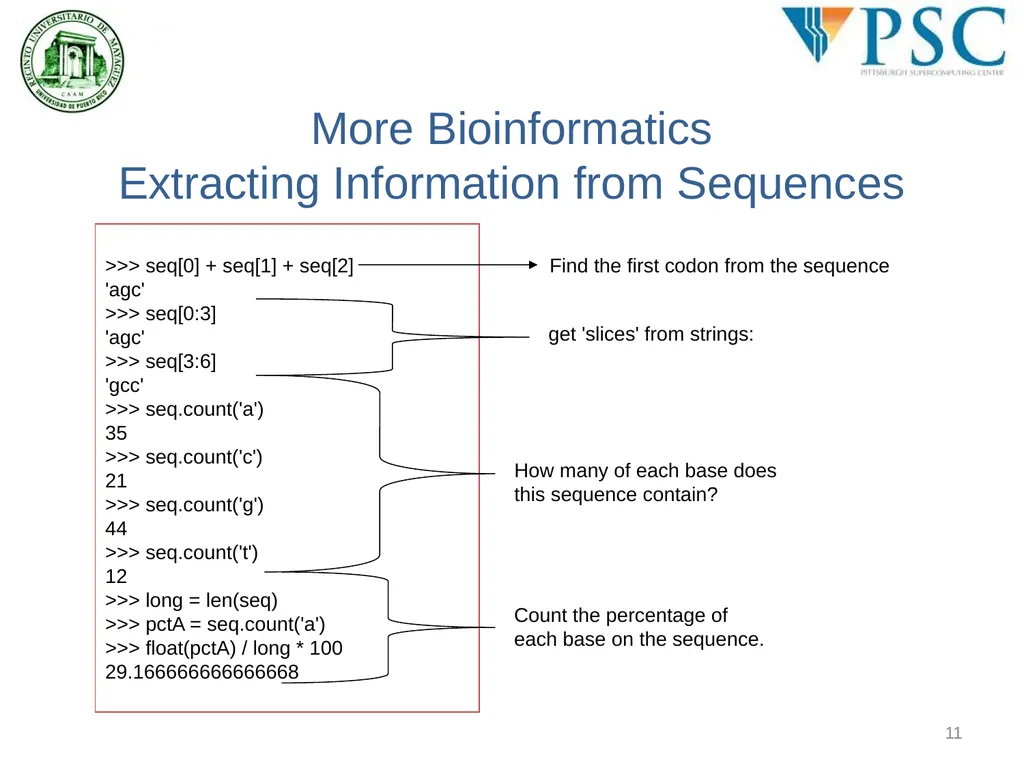
Extracting Information from Sequences 11 >>> seq[0] + seq[1] + seq[2]
'agc'
>>> seq[0:3]
'agc'
>>> seq[3:6]
'gcc'
>>> seq.count('a')
35
>>> seq.count('c')
21
>>> seq.count('g')
44
>>> seq.count('t')
12
>>> long = len(seq)
>>> pctA = seq.count('a')
>>> float(pctA) / long * 100
29.166666666666668 Find the first codon from the sequence get 'slices' from strings: How many of each base does
this sequence contain? Count the percentage of
each base on the sequence.<br>
'agc'
>>> seq[0:3]
'agc'
>>> seq[3:6]
'gcc'
>>> seq.count('a')
35
>>> seq.count('c')
21
>>> seq.count('g')
44
>>> seq.count('t')
12
>>> long = len(seq)
>>> pctA = seq.count('a')
>>> float(pctA) / long * 100
29.166666666666668 Find the first codon from the sequence get 'slices' from strings: How many of each base does
this sequence contain? Count the percentage of
each base on the sequence.<br>
11
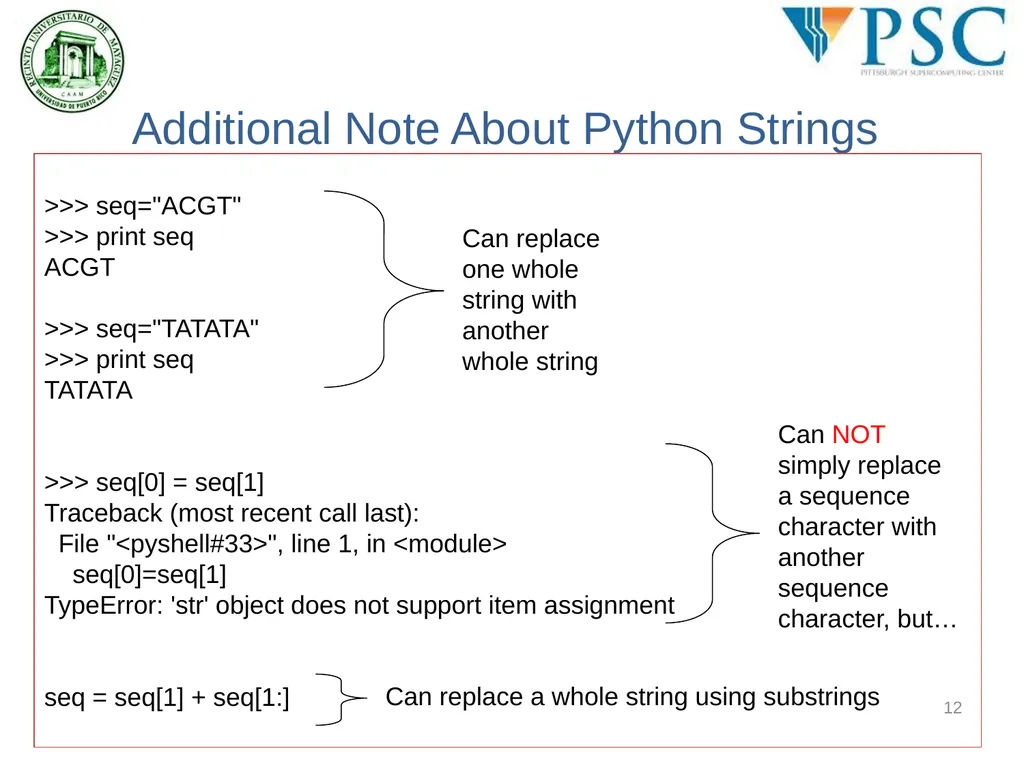
Additional Note About Python Strings 12 >>> seq="ACGT"
>>> print seq
ACGT
>>> seq="TATATA"
>>> print seq
TATATA
>>> seq[0] = seq[1]
Traceback (most recent call last):
File "<pyshell#33>", line 1, in <module>
seq[0]=seq[1]
TypeError: 'str' object does not support item assignment
seq = seq[1] + seq[1:] Can replace one whole string with another whole string Can NOT simply replace a sequence character with another sequence character, but… Can replace a whole string using substrings<br>
>>> print seq
ACGT
>>> seq="TATATA"
>>> print seq
TATATA
>>> seq[0] = seq[1]
Traceback (most recent call last):
File "<pyshell#33>", line 1, in <module>
seq[0]=seq[1]
TypeError: 'str' object does not support item assignment
seq = seq[1] + seq[1:] Can replace one whole string with another whole string Can NOT simply replace a sequence character with another sequence character, but… Can replace a whole string using substrings<br>
12
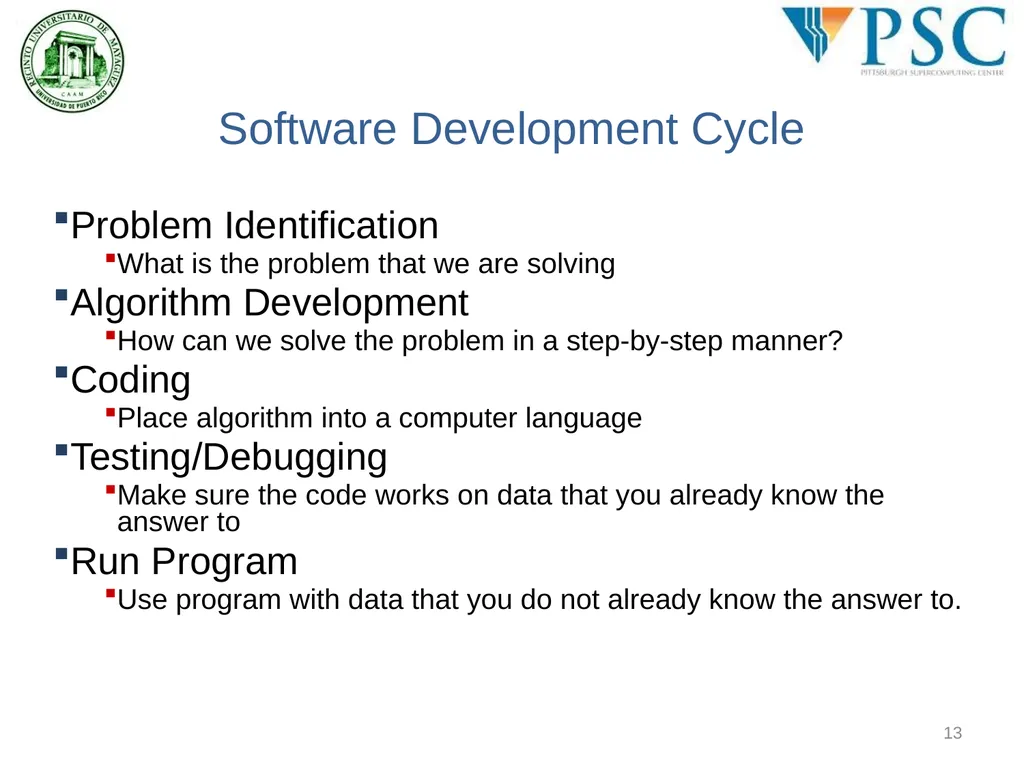
Problem Identification
What is the problem that we are solving
Algorithm Development
How can we solve the problem in a step-by-step manner?
Coding
Place algorithm into a computer language
Testing/Debugging
Make sure the code works on data that you already know the answer to
Run Program
Use program with data that you do not already know the answer to. Software Development Cycle 13<br>
What is the problem that we are solving
Algorithm Development
How can we solve the problem in a step-by-step manner?
Coding
Place algorithm into a computer language
Testing/Debugging
Make sure the code works on data that you already know the answer to
Run Program
Use program with data that you do not already know the answer to. Software Development Cycle 13<br>
13
First, lets learn to SAVE our programs in a file:
From Python Shell: File -> New Window
From New Window: File->Save
Then, To run the program in the new window:
From New Window: Run->Run Module Lets Try It With Some Examples! 14<br>
From Python Shell: File -> New Window
From New Window: File->Save
Then, To run the program in the new window:
From New Window: Run->Run Module Lets Try It With Some Examples! 14<br>
14
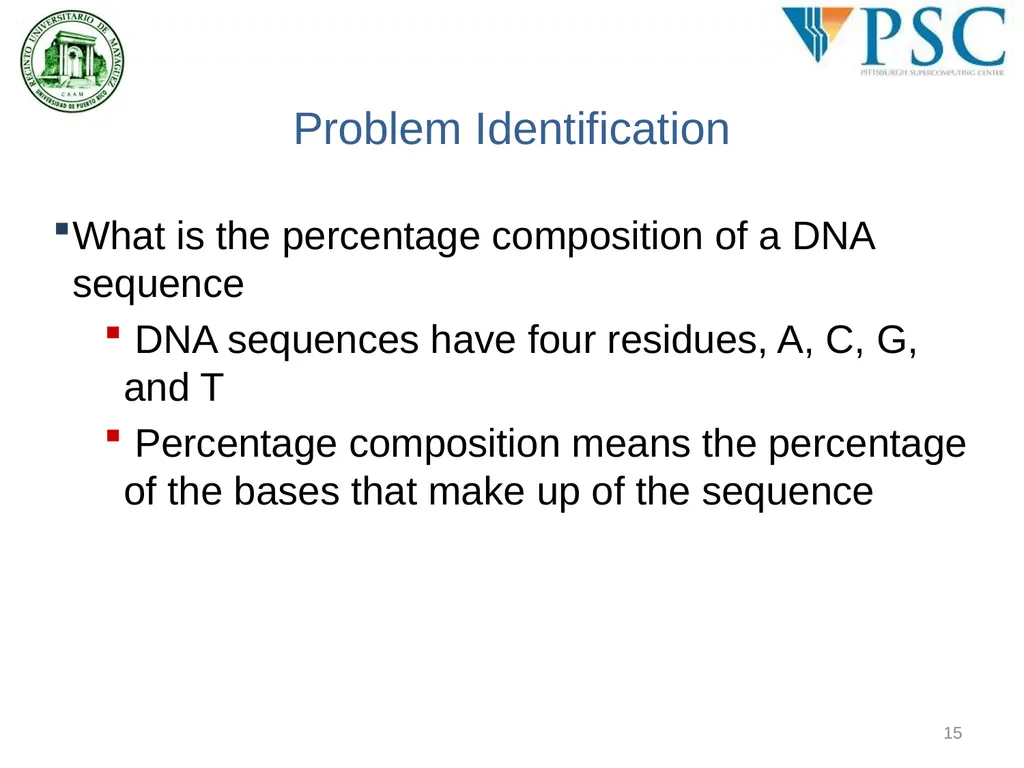
What is the percentage composition of a DNA sequence
DNA sequences have four residues, A, C, G, and T
Percentage composition means the percentage of the bases that make up of the sequence Problem Identification 15<br>
DNA sequences have four residues, A, C, G, and T
Percentage composition means the percentage of the bases that make up of the sequence Problem Identification 15<br>
15
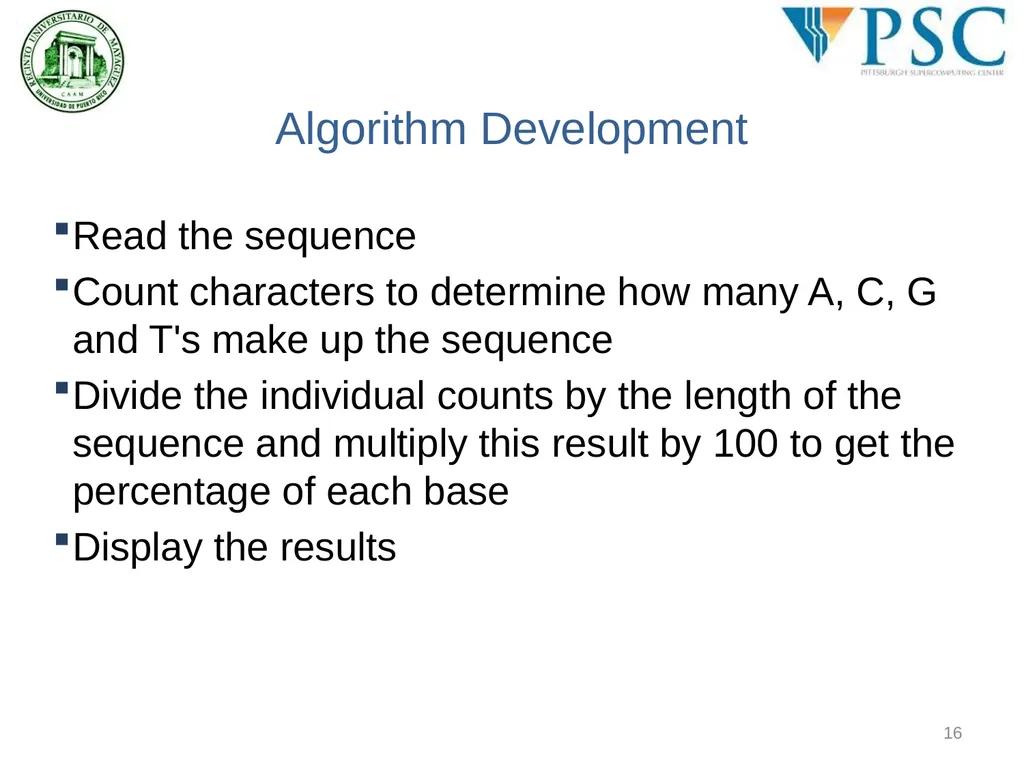
Read the sequence
Count characters to determine how many A, C, G and T's make up the sequence
Divide the individual counts by the length of the sequence and multiply this result by 100 to get the percentage of each base
Display the results Algorithm Development 16<br>
Count characters to determine how many A, C, G and T's make up the sequence
Divide the individual counts by the length of the sequence and multiply this result by 100 to get the percentage of each base
Display the results Algorithm Development 16<br>
16
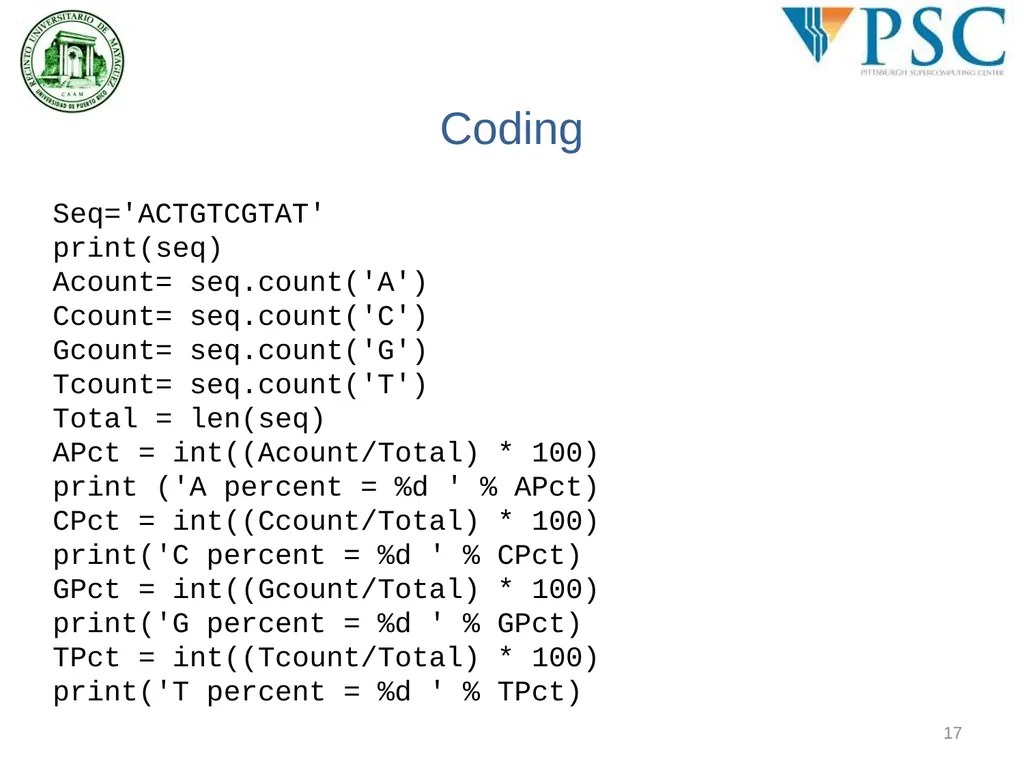
Coding 17 Seq='ACTGTCGTAT'
print(seq)
Acount= seq.count('A')
Ccount= seq.count('C')
Gcount= seq.count('G')
Tcount= seq.count('T')
Total = len(seq)
APct = int((Acount/Total) * 100)
print ('A percent = %d ' % APct)
CPct = int((Ccount/Total) * 100)
print('C percent = %d ' % CPct)
GPct = int((Gcount/Total) * 100)
print('G percent = %d ' % GPct)
TPct = int((Tcount/Total) * 100)
print('T percent = %d ' % TPct)<br>
print(seq)
Acount= seq.count('A')
Ccount= seq.count('C')
Gcount= seq.count('G')
Tcount= seq.count('T')
Total = len(seq)
APct = int((Acount/Total) * 100)
print ('A percent = %d ' % APct)
CPct = int((Ccount/Total) * 100)
print('C percent = %d ' % CPct)
GPct = int((Gcount/Total) * 100)
print('G percent = %d ' % GPct)
TPct = int((Tcount/Total) * 100)
print('T percent = %d ' % TPct)<br>
17
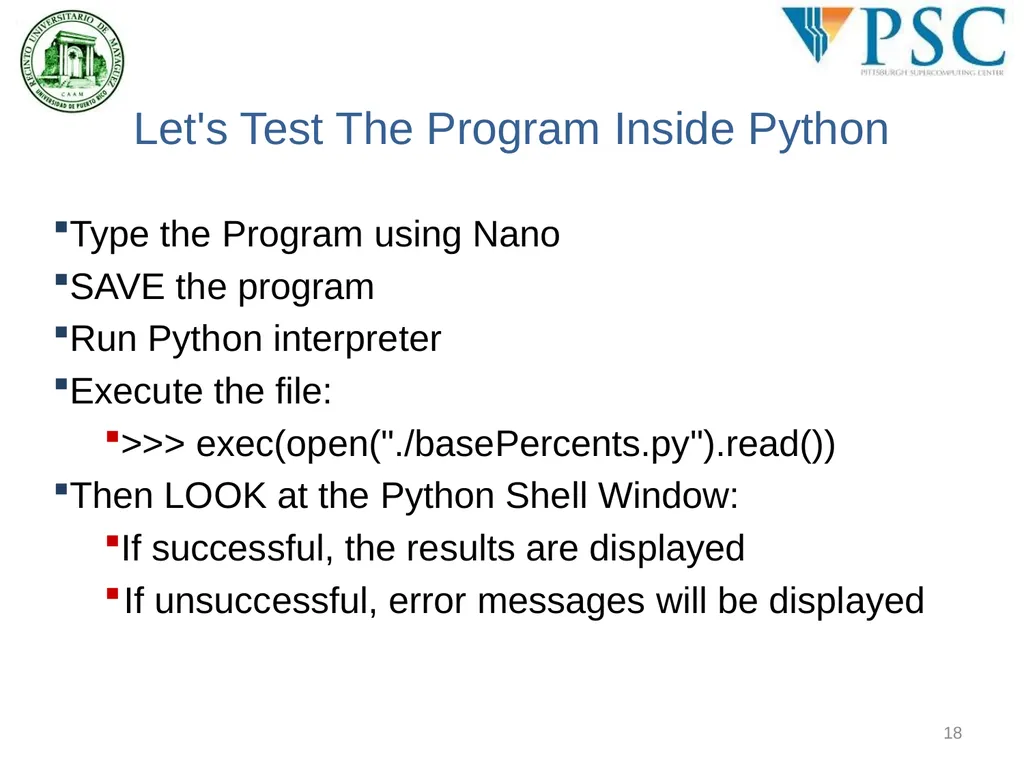
Type the Program using Nano
SAVE the program
Run Python interpreter
Execute the file:
>>> exec(open("./basePercents.py").read())
Then LOOK at the Python Shell Window:
If successful, the results are displayed
If unsuccessful, error messages will be displayed Let's Test The Program Inside Python 18<br>
SAVE the program
Run Python interpreter
Execute the file:
>>> exec(open("./basePercents.py").read())
Then LOOK at the Python Shell Window:
If successful, the results are displayed
If unsuccessful, error messages will be displayed Let's Test The Program Inside Python 18<br>
18
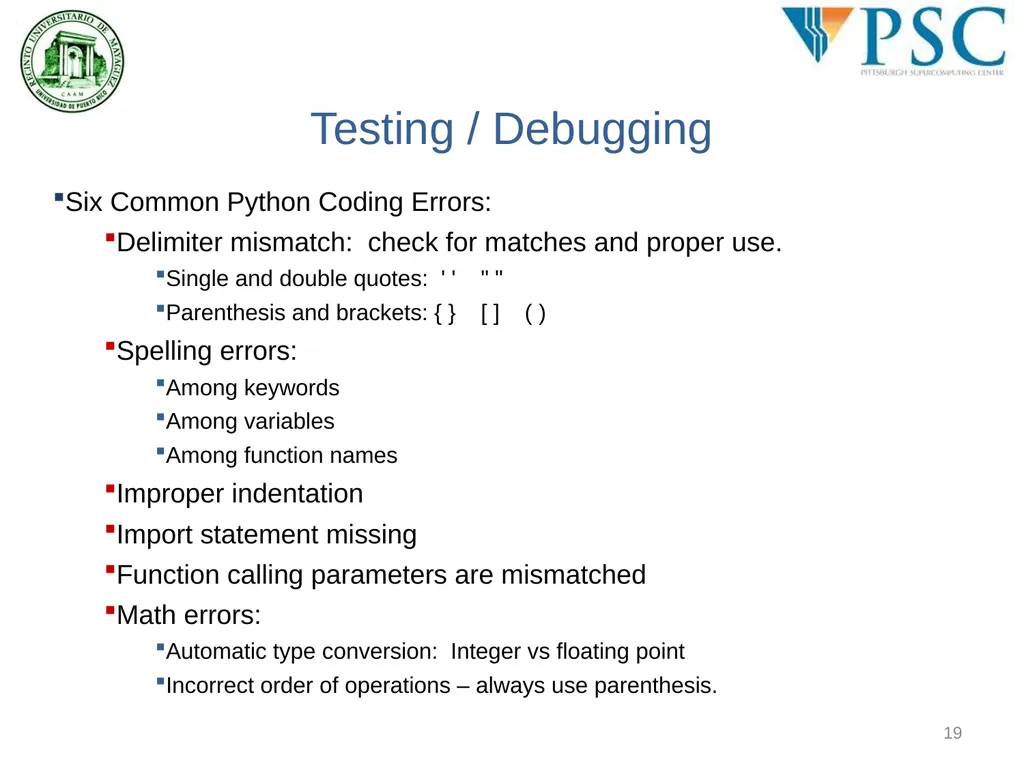
Six Common Python Coding Errors:
Delimiter mismatch: check for matches and proper use.
Single and double quotes: ' ' " "
Parenthesis and brackets: { } [ ] ( )
Spelling errors:
Among keywords
Among variables
Among function names
Improper indentation
Import statement missing
Function calling parameters are mismatched
Math errors:
Automatic type conversion: Integer vs floating point
Incorrect order of operations – always use parenthesis. Testing / Debugging 19<br>
Delimiter mismatch: check for matches and proper use.
Single and double quotes: ' ' " "
Parenthesis and brackets: { } [ ] ( )
Spelling errors:
Among keywords
Among variables
Among function names
Improper indentation
Import statement missing
Function calling parameters are mismatched
Math errors:
Automatic type conversion: Integer vs floating point
Incorrect order of operations – always use parenthesis. Testing / Debugging 19<br>
19
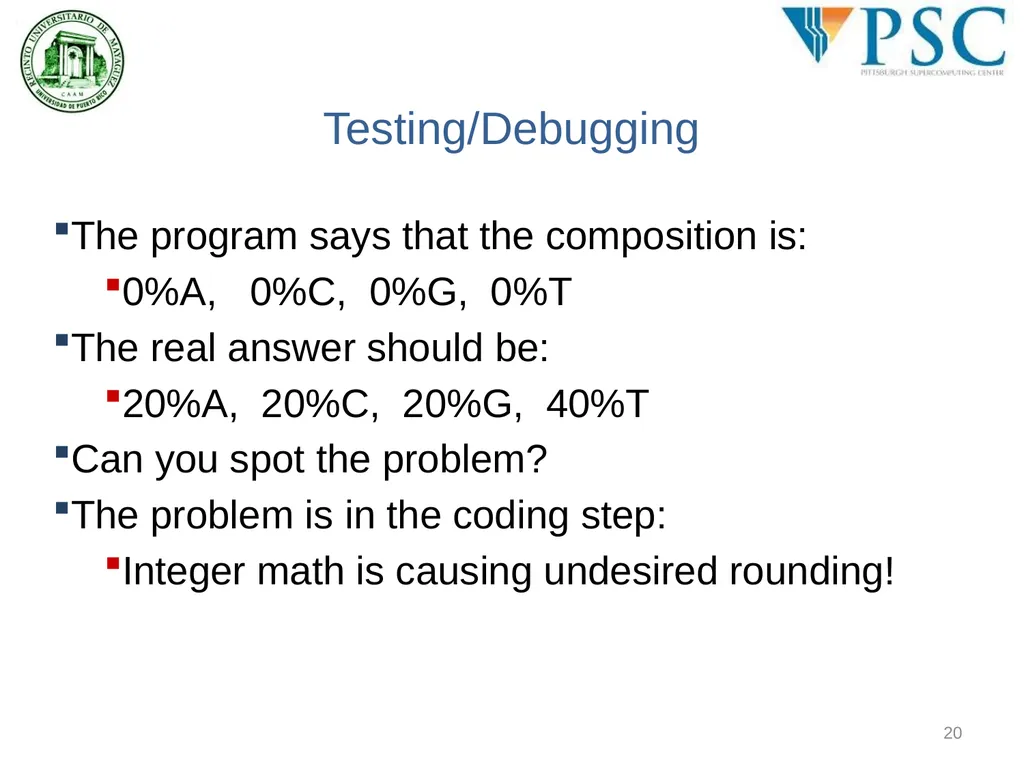
The program says that the composition is:
0%A, 0%C, 0%G, 0%T
The real answer should be:
20%A, 20%C, 20%G, 40%T
Can you spot the problem?
The problem is in the coding step:
Integer math is causing undesired rounding! Testing/Debugging 20<br>
0%A, 0%C, 0%G, 0%T
The real answer should be:
20%A, 20%C, 20%G, 40%T
Can you spot the problem?
The problem is in the coding step:
Integer math is causing undesired rounding! Testing/Debugging 20<br>
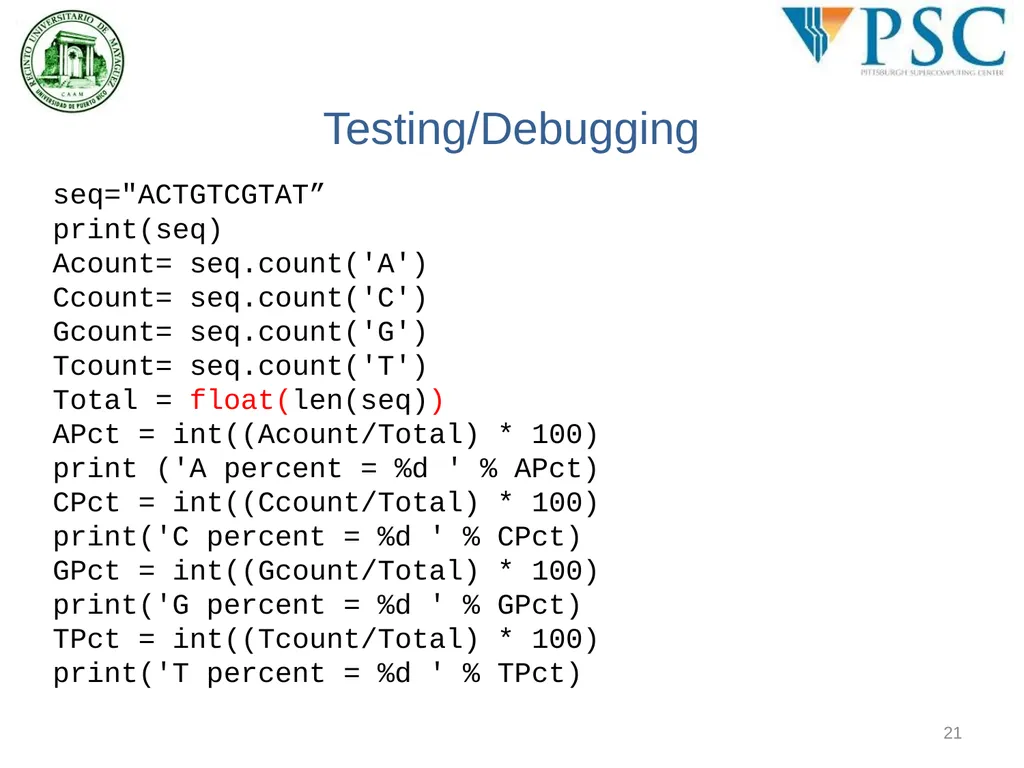
20
Testing/Debugging 21 seq="ACTGTCGTAT”
print(seq)
Acount= seq.count('A')
Ccount= seq.count('C')
Gcount= seq.count('G')
Tcount= seq.count('T')
Total = float(len(seq))
APct = int((Acount/Total) * 100)
print ('A percent = %d ' % APct)
CPct = int((Ccount/Total) * 100)
print('C percent = %d ' % CPct)
GPct = int((Gcount/Total) * 100)
print('G percent = %d ' % GPct)
TPct = int((Tcount/Total) * 100)
print('T percent = %d ' % TPct)<br>
print(seq)
Acount= seq.count('A')
Ccount= seq.count('C')
Gcount= seq.count('G')
Tcount= seq.count('T')
Total = float(len(seq))
APct = int((Acount/Total) * 100)
print ('A percent = %d ' % APct)
CPct = int((Ccount/Total) * 100)
print('C percent = %d ' % CPct)
GPct = int((Gcount/Total) * 100)
print('G percent = %d ' % GPct)
TPct = int((Tcount/Total) * 100)
print('T percent = %d ' % TPct)<br>
21
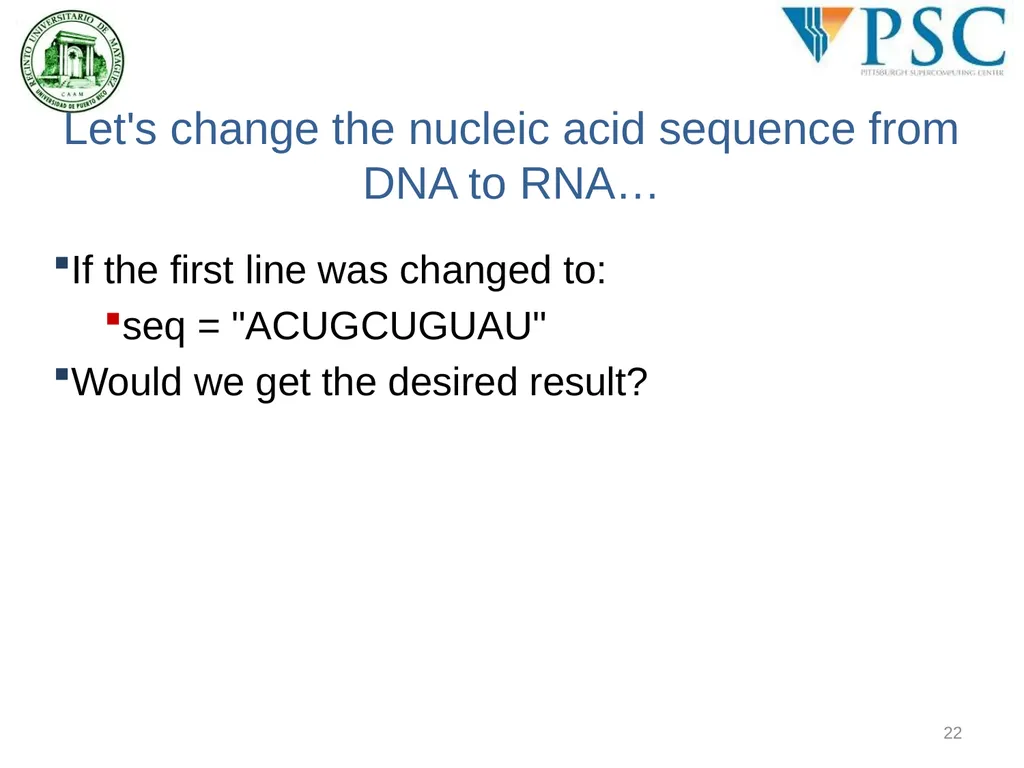
If the first line was changed to:
seq = "ACUGCUGUAU"
Would we get the desired result? Let's change the nucleic acid sequence from DNA to RNA… 22<br>
seq = "ACUGCUGUAU"
Would we get the desired result? Let's change the nucleic acid sequence from DNA to RNA… 22<br>
22
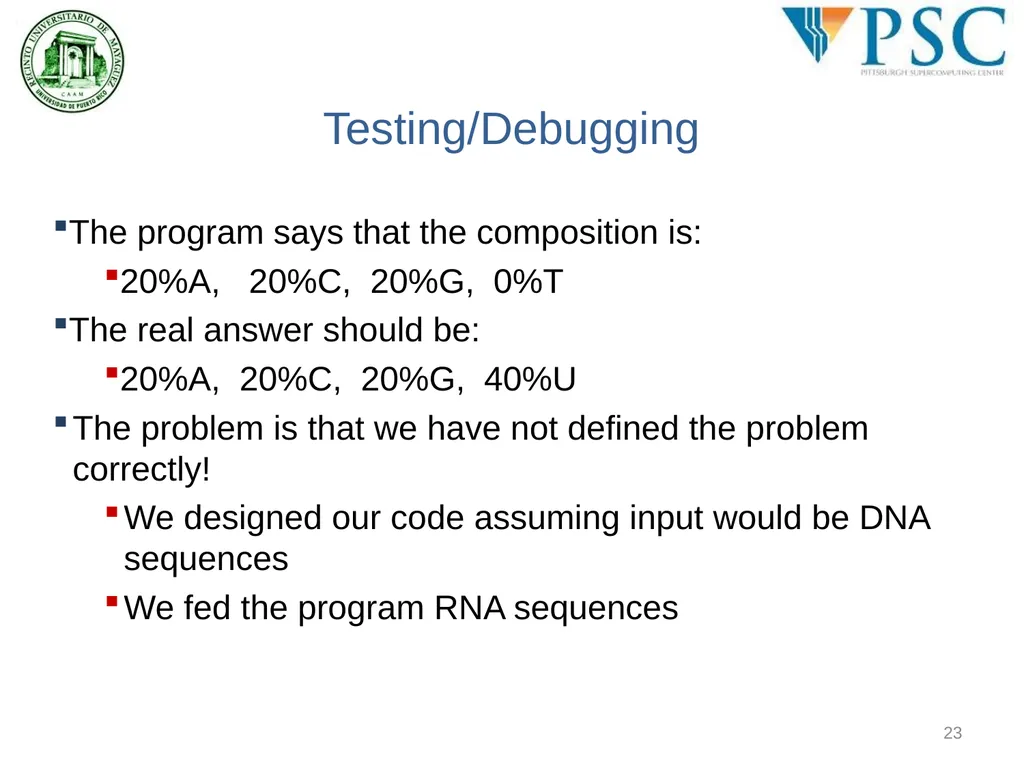
The program says that the composition is:
20%A, 20%C, 20%G, 0%T
The real answer should be:
20%A, 20%C, 20%G, 40%U
The problem is that we have not defined the problem correctly!
We designed our code assuming input would be DNA sequences
We fed the program RNA sequences Testing/Debugging 23<br>
20%A, 20%C, 20%G, 0%T
The real answer should be:
20%A, 20%C, 20%G, 40%U
The problem is that we have not defined the problem correctly!
We designed our code assuming input would be DNA sequences
We fed the program RNA sequences Testing/Debugging 23<br>
23
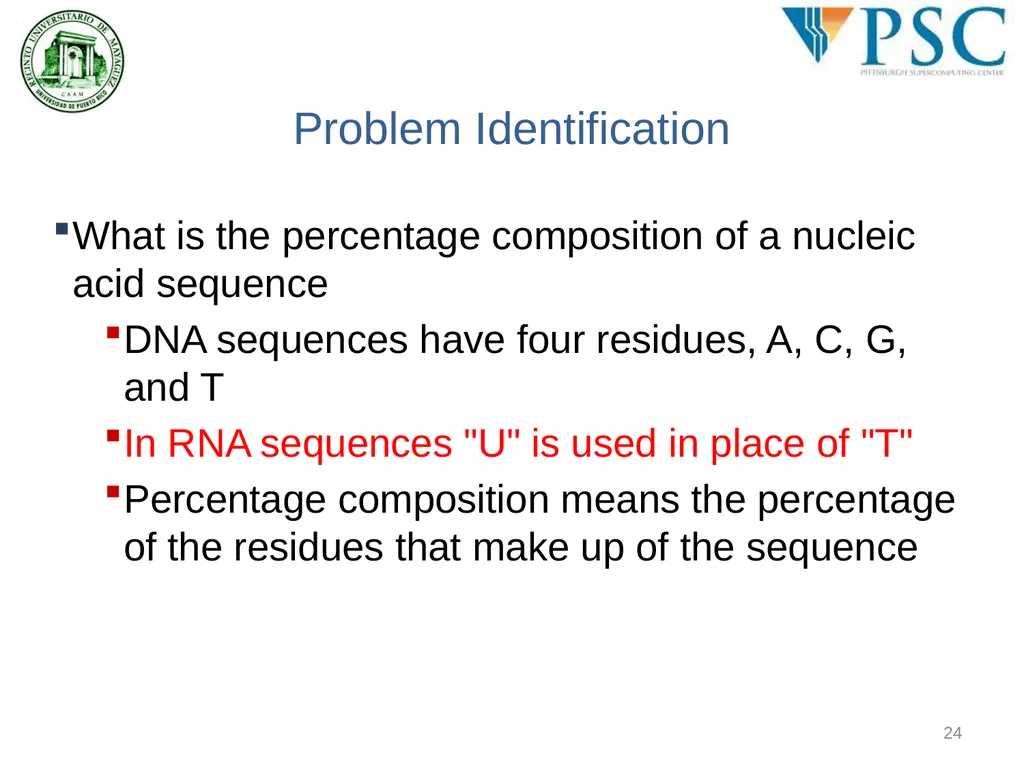
What is the percentage composition of a nucleic acid sequence
DNA sequences have four residues, A, C, G, and T
In RNA sequences "U" is used in place of "T"
Percentage composition means the percentage of the residues that make up of the sequence Problem Identification 24<br>
DNA sequences have four residues, A, C, G, and T
In RNA sequences "U" is used in place of "T"
Percentage composition means the percentage of the residues that make up of the sequence Problem Identification 24<br>
24
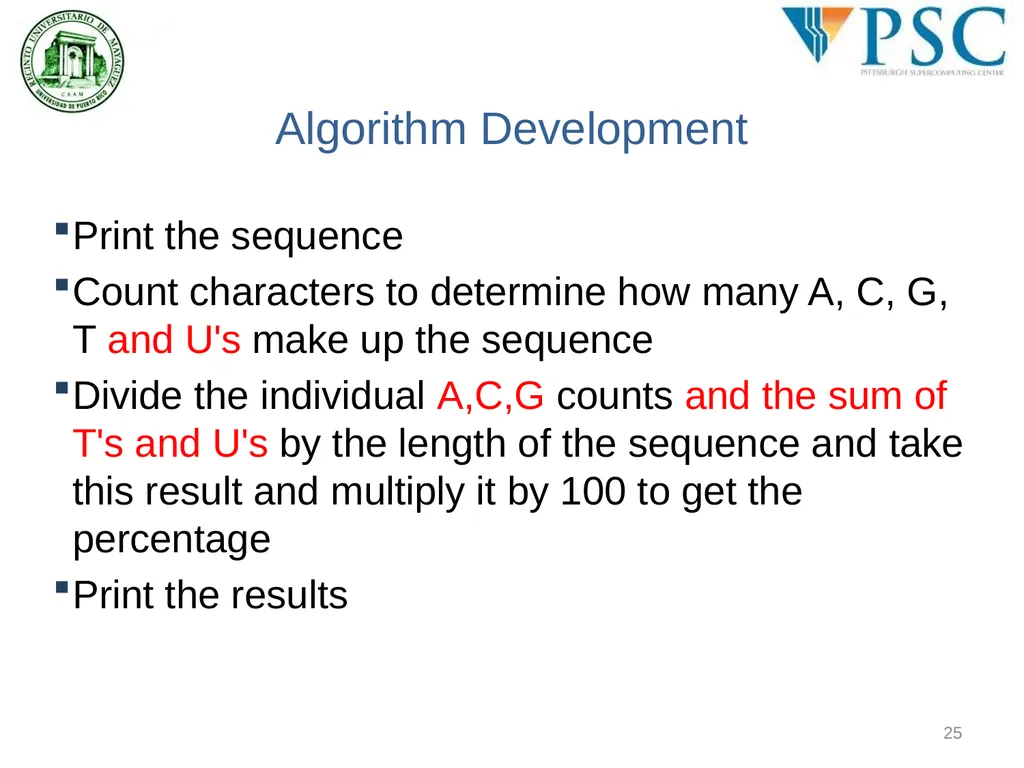
Print the sequence
Count characters to determine how many A, C, G, T and U's make up the sequence
Divide the individual A,C,G counts and the sum of T's and U's by the length of the sequence and take this result and multiply it by 100 to get the percentage
Print the results Algorithm Development 25<br>
Count characters to determine how many A, C, G, T and U's make up the sequence
Divide the individual A,C,G counts and the sum of T's and U's by the length of the sequence and take this result and multiply it by 100 to get the percentage
Print the results Algorithm Development 25<br>
25
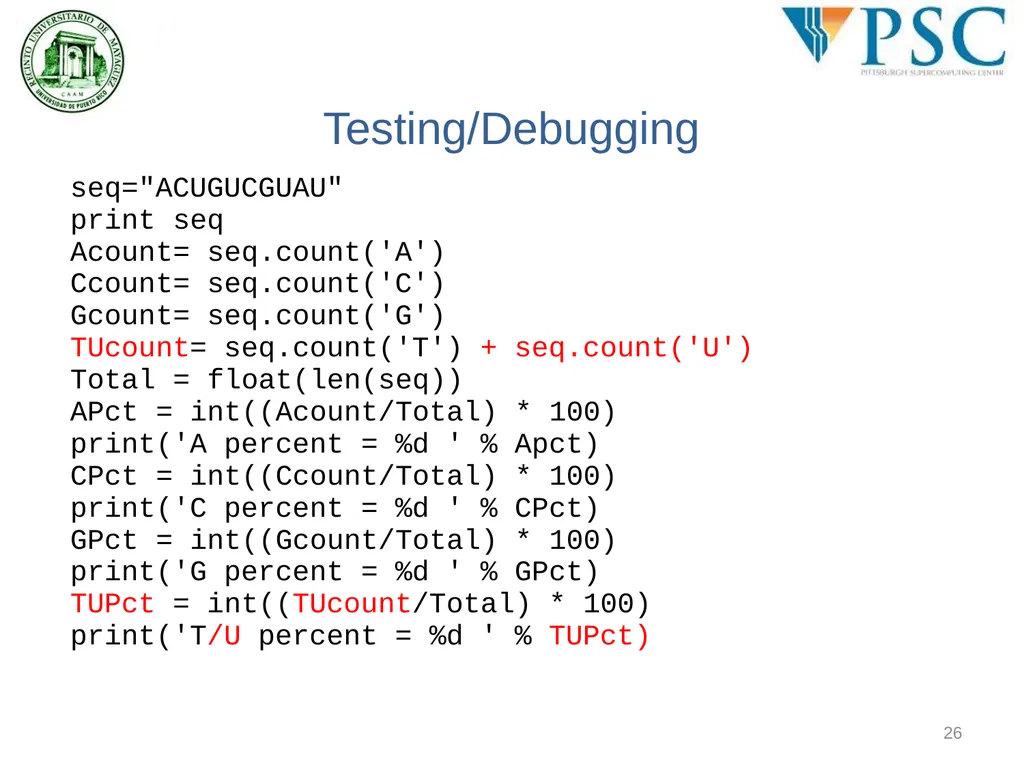
Testing/Debugging 26 seq="ACUGUCGUAU"
print seq
Acount= seq.count('A')
Ccount= seq.count('C')
Gcount= seq.count('G')
TUcount= seq.count('T') + seq.count('U')
Total = float(len(seq))
APct = int((Acount/Total) * 100)
print('A percent = %d ' % Apct)
CPct = int((Ccount/Total) * 100)
print('C percent = %d ' % CPct)
GPct = int((Gcount/Total) * 100)
print('G percent = %d ' % GPct)
TUPct = int((TUcount/Total) * 100)
print('T/U percent = %d ' % TUPct)<br>
print seq
Acount= seq.count('A')
Ccount= seq.count('C')
Gcount= seq.count('G')
TUcount= seq.count('T') + seq.count('U')
Total = float(len(seq))
APct = int((Acount/Total) * 100)
print('A percent = %d ' % Apct)
CPct = int((Ccount/Total) * 100)
print('C percent = %d ' % CPct)
GPct = int((Gcount/Total) * 100)
print('G percent = %d ' % GPct)
TUPct = int((TUcount/Total) * 100)
print('T/U percent = %d ' % TUPct)<br>
26
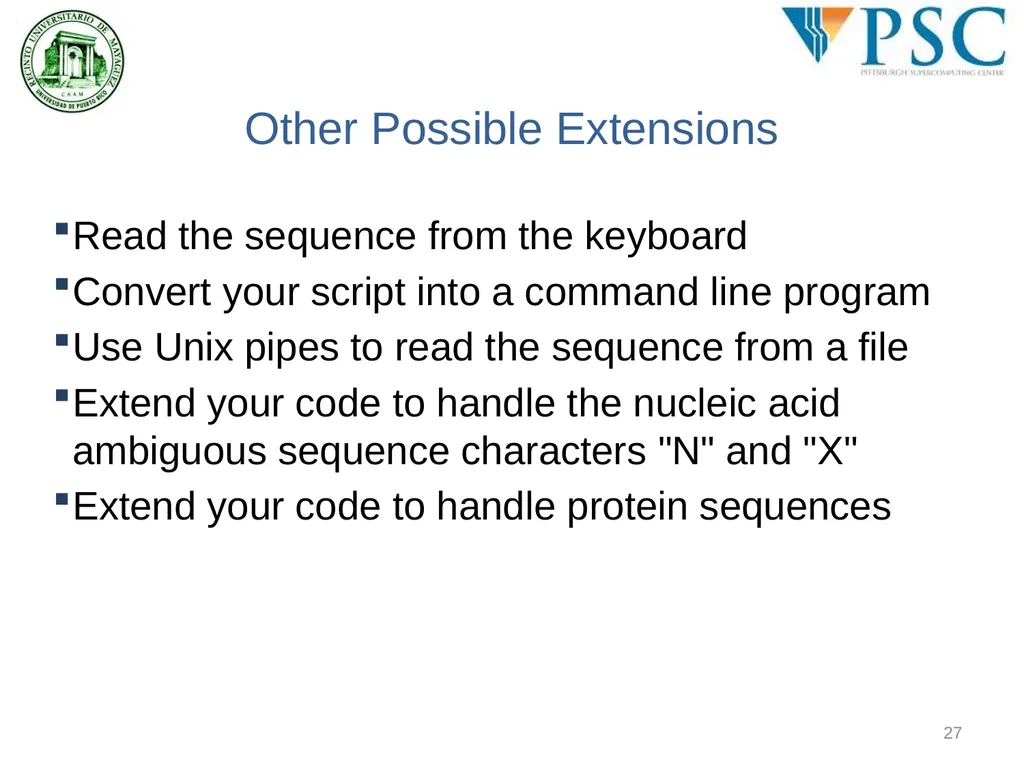
Read the sequence from the keyboard
Convert your script into a command line program
Use Unix pipes to read the sequence from a file
Extend your code to handle the nucleic acid ambiguous sequence characters "N" and "X"
Extend your code to handle protein sequences Other Possible Extensions 27<br>
Convert your script into a command line program
Use Unix pipes to read the sequence from a file
Extend your code to handle the nucleic acid ambiguous sequence characters "N" and "X"
Extend your code to handle protein sequences Other Possible Extensions 27<br>