
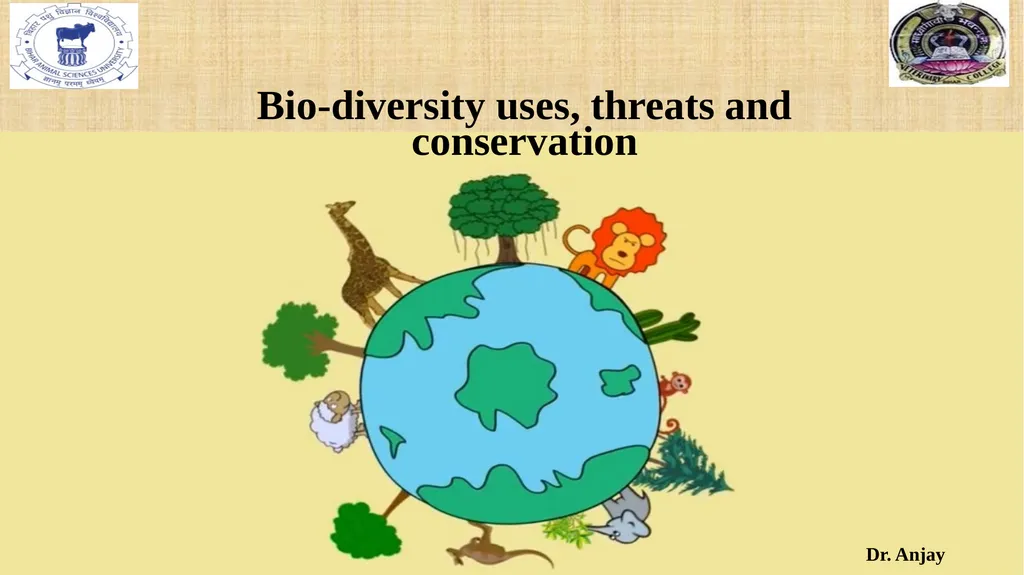
Bio-diversity uses, threats and conservation Dr.
SB
Published · 23 slides · 0 views

1 / 1
Description
Bio-diversity uses, threats and conservation Dr. Anjay 10172020 1 The word biodiversity is a contraction of biological diversity. The father of biodiversity Edward O. Wilson (an eminent entomologist) first coined this term in 1986.
Related Topics
Download this presentation From Below
"Bio-diversity uses, threats and conservation Dr." is the property of its rightful owner. Permission is granted to download and print the materials on this website for personal, non-commercial use only, and to display it on your personal computer provided you do not modify the materials and that you retain all copyright notices contained in the materials. By downloading content from our website, you accept the terms of this agreement.
Share
Embed code
Presentation Transcript
01
Bio-diversity uses, threats and conservation Dr. Anjay 10/17/2020 1<br>
02
The word “biodiversity” is a contraction of “biological diversity”.
The father of biodiversity Edward O. Wilson (an eminent entomologist) first coined this term in 1986.
Diversity is a vast concept refers to the range of variations or differences among some set of entities; biological diversity thus refers to varieties within the living world.
The term 'biodiversity' is generally considered as an ‘Umbrella term’ referring to organisms found within the living world.
It is commonly used to describe the number, variety of life and variability of living organisms. 10/17/2020 2<br>
The father of biodiversity Edward O. Wilson (an eminent entomologist) first coined this term in 1986.
Diversity is a vast concept refers to the range of variations or differences among some set of entities; biological diversity thus refers to varieties within the living world.
The term 'biodiversity' is generally considered as an ‘Umbrella term’ referring to organisms found within the living world.
It is commonly used to describe the number, variety of life and variability of living organisms. 10/17/2020 2<br>
03
Bio-diversity:
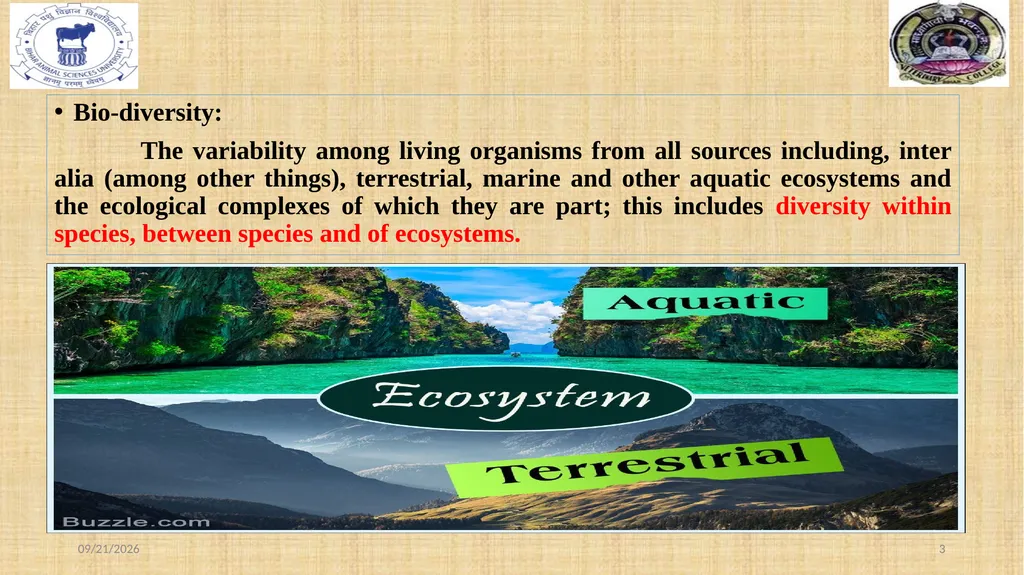
The variability among living organisms from all sources including, inter alia (among other things), terrestrial, marine and other aquatic ecosystems and the ecological complexes of which they are part; this includes diversity within species, between species and of ecosystems. 10/17/2020 3<br>
The variability among living organisms from all sources including, inter alia (among other things), terrestrial, marine and other aquatic ecosystems and the ecological complexes of which they are part; this includes diversity within species, between species and of ecosystems. 10/17/2020 3<br>
04
Elements of bio-diversity The predicted number of total species varies from 5 to 50 million and averages at 14 million.
Out of the total known species, about 60 % are insects, about 16 % are higher plants and only about 0.3 % is mammals.
The most unique feature of Earth is the existence of life and the most extraordinary feature of life is its diversity.
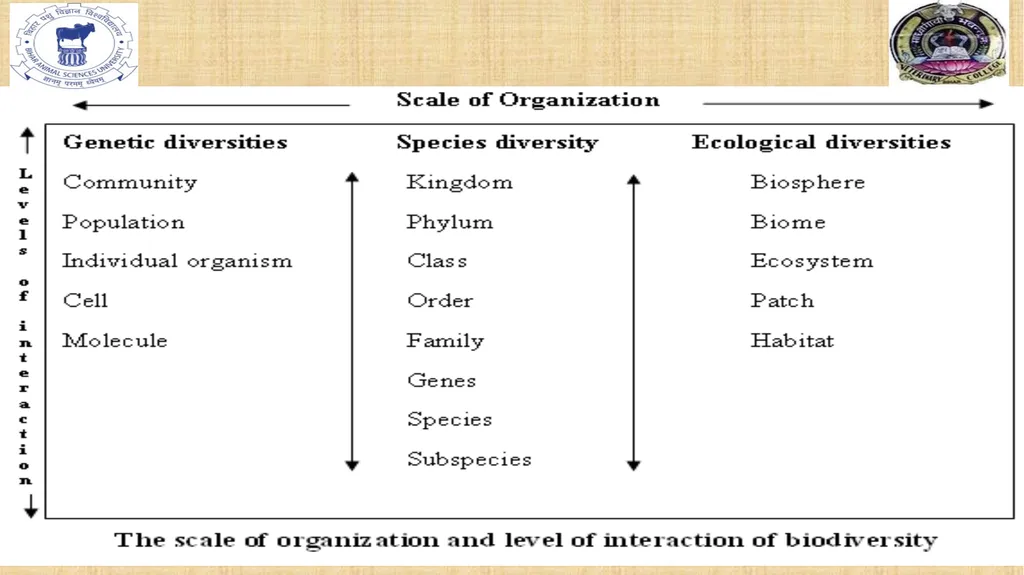
Bio-diversity is normally treated in terms of genes, species and ecosystems in correspondence with three fundamental hierarchical levels of biological organization.
The three diversities are referred as genetic, species and ecosystem diversity. 10/17/2020 4<br>
Out of the total known species, about 60 % are insects, about 16 % are higher plants and only about 0.3 % is mammals.
The most unique feature of Earth is the existence of life and the most extraordinary feature of life is its diversity.
Bio-diversity is normally treated in terms of genes, species and ecosystems in correspondence with three fundamental hierarchical levels of biological organization.
The three diversities are referred as genetic, species and ecosystem diversity. 10/17/2020 4<br>
05
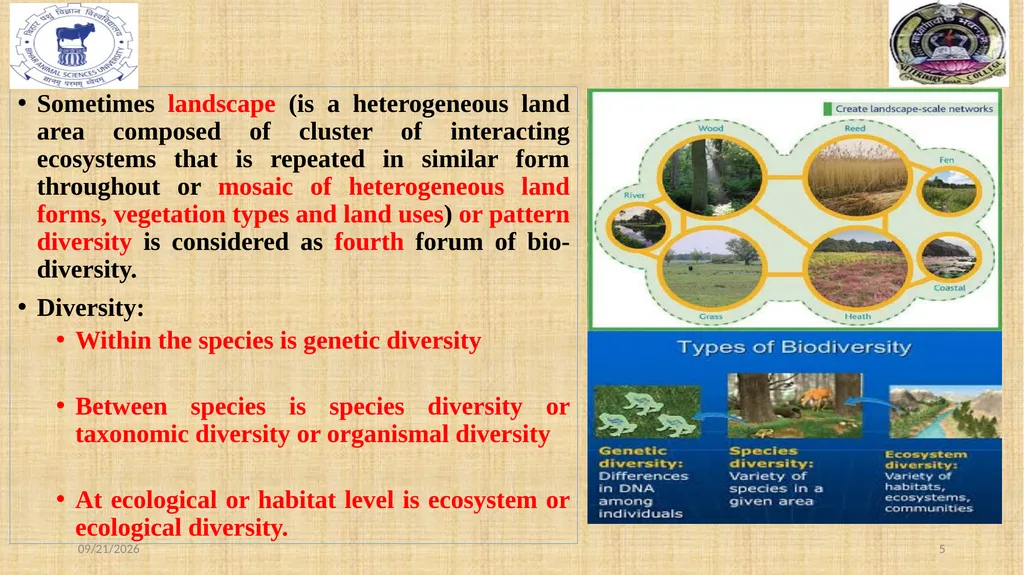
Sometimes landscape (is a heterogeneous land area composed of cluster of interacting ecosystems that is repeated in similar form throughout or mosaic of heterogeneous land forms, vegetation types and land uses) or pattern diversity is considered as fourth forum of bio-diversity.
Diversity:
Within the species is genetic diversity
Between species is species diversity or taxonomic diversity or organismal diversity
At ecological or habitat level is ecosystem or ecological diversity. 10/17/2020 5<br>
Diversity:
Within the species is genetic diversity
Between species is species diversity or taxonomic diversity or organismal diversity
At ecological or habitat level is ecosystem or ecological diversity. 10/17/2020 5<br>
06
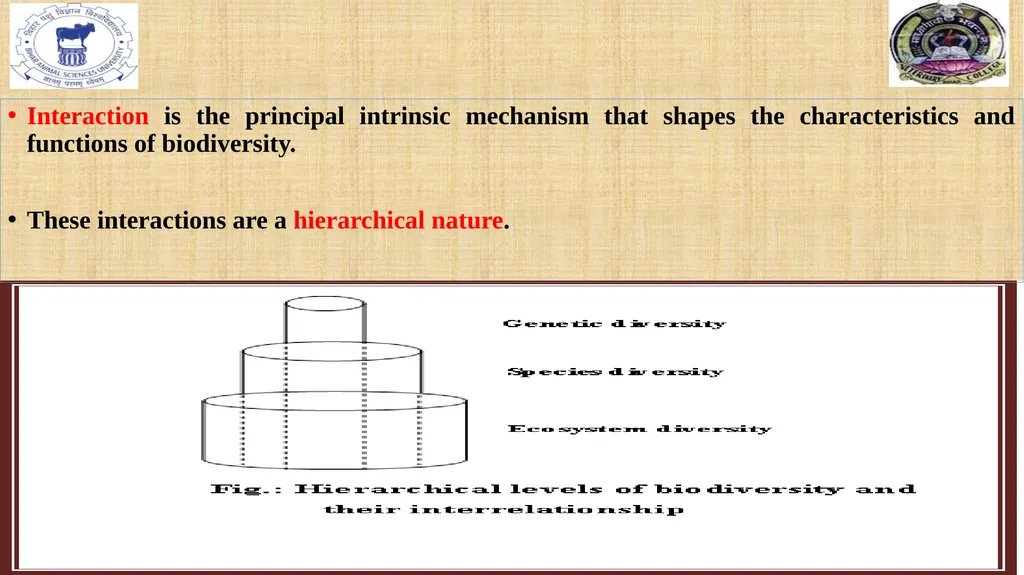
Interaction is the principal intrinsic mechanism that shapes the characteristics and functions of biodiversity.
These interactions are a hierarchical nature. 10/17/2020 6<br>
These interactions are a hierarchical nature. 10/17/2020 6<br>
07
10/17/2020 7<br>
08
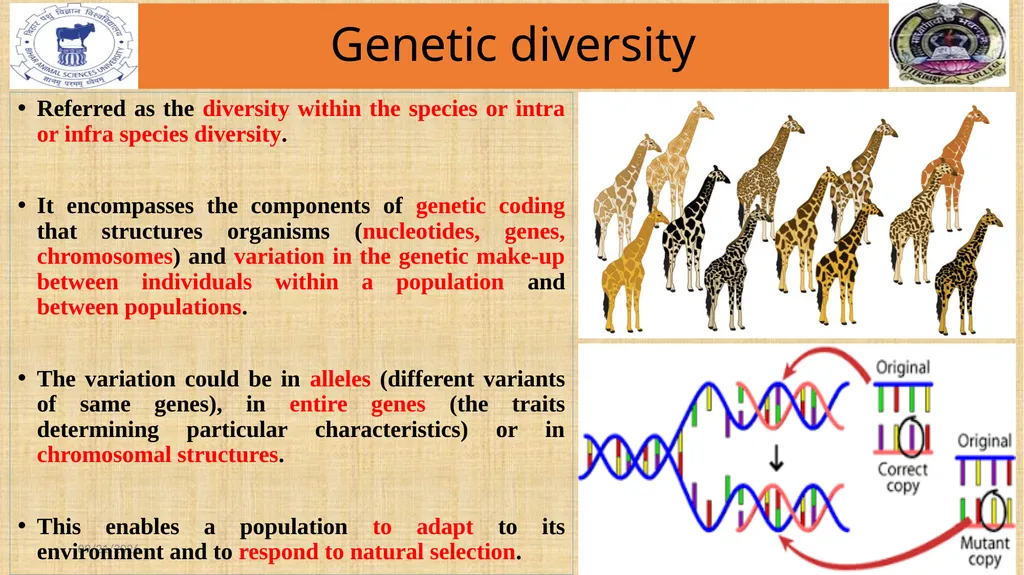
Genetic diversity Referred as the diversity within the species or intra or infra species diversity.
It encompasses the components of genetic coding that structures organisms (nucleotides, genes, chromosomes) and variation in the genetic make-up between individuals within a population and between populations.
The variation could be in alleles (different variants of same genes), in entire genes (the traits determining particular characteristics) or in chromosomal structures.
This enables a population to adapt to its environment and to respond to natural selection. 10/17/2020 8<br>
It encompasses the components of genetic coding that structures organisms (nucleotides, genes, chromosomes) and variation in the genetic make-up between individuals within a population and between populations.
The variation could be in alleles (different variants of same genes), in entire genes (the traits determining particular characteristics) or in chromosomal structures.
This enables a population to adapt to its environment and to respond to natural selection. 10/17/2020 8<br>
09
If a species has more genetic diversity, it can adapt better to the changed environmental conditions.
Lower diversity in a species leads to uniformity and the amount of genetic variation is the basis of speciation (evolution of new species).
It has a key role in the maintenance of diversity at species levels.
Genetic diversity within a species often increases with environmental variability.
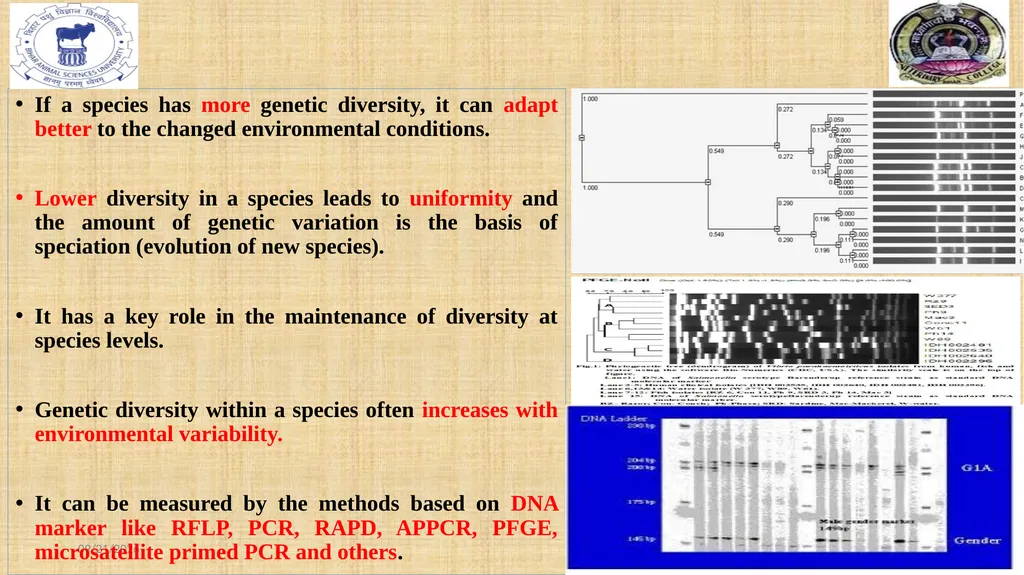
It can be measured by the methods based on DNA marker like RFLP, PCR, RAPD, APPCR, PFGE, microsatellite primed PCR and others. 10/17/2020 9<br>
Lower diversity in a species leads to uniformity and the amount of genetic variation is the basis of speciation (evolution of new species).
It has a key role in the maintenance of diversity at species levels.
Genetic diversity within a species often increases with environmental variability.
It can be measured by the methods based on DNA marker like RFLP, PCR, RAPD, APPCR, PFGE, microsatellite primed PCR and others. 10/17/2020 9<br>
10
Species diversity Species are distinct units of diversity, each playing a specific role in an ecosystem.
Therefore loss of species has consequences for the ecosystem as a whole.
Refers to the variety of living species within a geographic area.
It encompasses the taxonomic hierarchy and its components, from individuals upwards to species, genera and beyond.
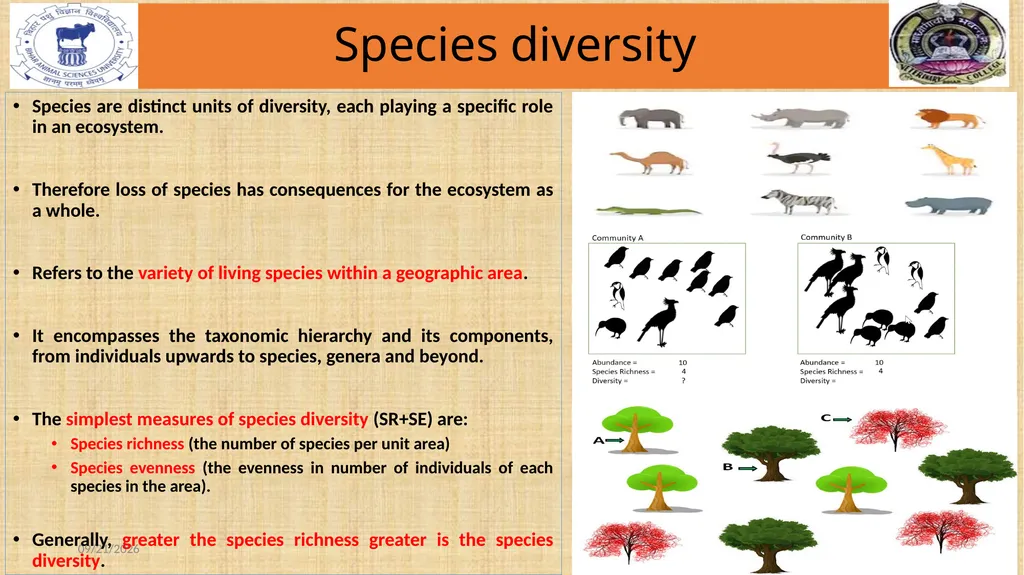
The simplest measures of species diversity (SR+SE) are:
Species richness (the number of species per unit area)
Species evenness (the evenness in number of individuals of each species in the area).
Generally, greater the species richness greater is the species diversity. 10/17/2020 10<br>
Therefore loss of species has consequences for the ecosystem as a whole.
Refers to the variety of living species within a geographic area.
It encompasses the taxonomic hierarchy and its components, from individuals upwards to species, genera and beyond.
The simplest measures of species diversity (SR+SE) are:
Species richness (the number of species per unit area)
Species evenness (the evenness in number of individuals of each species in the area).
Generally, greater the species richness greater is the species diversity. 10/17/2020 10<br>
11
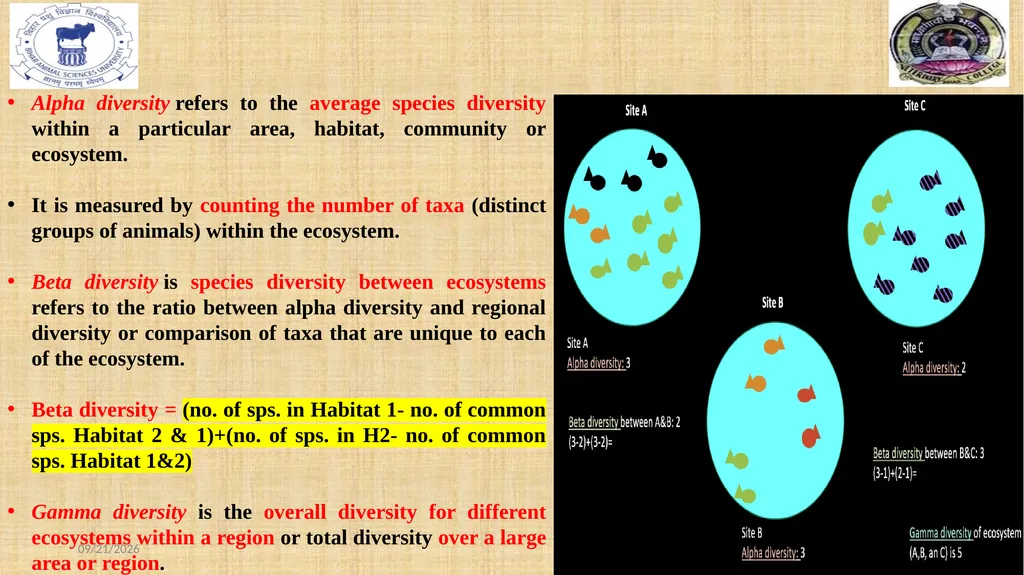
Alpha diversity refers to the average species diversity within a particular area, habitat, community or ecosystem.
It is measured by counting the number of taxa (distinct groups of animals) within the ecosystem.
Beta diversity is species diversity between ecosystems refers to the ratio between alpha diversity and regional diversity or comparison of taxa that are unique to each of the ecosystem.
Beta diversity = (no. of sps. in Habitat 1- no. of common sps. Habitat 2 & 1)+(no. of sps. in H2- no. of common sps. Habitat 1&2)
Gamma diversity is the overall diversity for different ecosystems within a region or total diversity over a large area or region. 10/17/2020 11<br>
It is measured by counting the number of taxa (distinct groups of animals) within the ecosystem.
Beta diversity is species diversity between ecosystems refers to the ratio between alpha diversity and regional diversity or comparison of taxa that are unique to each of the ecosystem.
Beta diversity = (no. of sps. in Habitat 1- no. of common sps. Habitat 2 & 1)+(no. of sps. in H2- no. of common sps. Habitat 1&2)
Gamma diversity is the overall diversity for different ecosystems within a region or total diversity over a large area or region. 10/17/2020 11<br>
12
The different types of the direct-use value of biodiversity are for food, medicine, biological control, industrial materials, recreational harvesting and ecotourism.
Food: in form of vegetables, fruit, nuts, meat, milk as well as food colorants, flavoring and preservatives.
Medicine: Willow trees (salicylic acid; aspirin), Foxglove (digitoxin), Atropa belladonna (atropine), Opium sativum (codeine), Papaver somniferum (morphine), Chinchona ledgeriana (quinine).
Animals source products (e.g. anticoagulants, coagulants, vasodilator agents) and for models on which to test potentially useful drugs or techniques.
Biological control: Vector Control using biological aget
Industrial materials: building materials, fibers, dyes, resins, gums, adhesives, rubber, oils and waxes, agricultural chemicals (including pesticides) and perfumes.
Recreational harvesting: It is the harvesting of animals (e.g. fish, reptiles, birds, mammals) for display and as pets. Uses of Biodiversity 10/17/2020 12<br>
Food: in form of vegetables, fruit, nuts, meat, milk as well as food colorants, flavoring and preservatives.
Medicine: Willow trees (salicylic acid; aspirin), Foxglove (digitoxin), Atropa belladonna (atropine), Opium sativum (codeine), Papaver somniferum (morphine), Chinchona ledgeriana (quinine).
Animals source products (e.g. anticoagulants, coagulants, vasodilator agents) and for models on which to test potentially useful drugs or techniques.
Biological control: Vector Control using biological aget
Industrial materials: building materials, fibers, dyes, resins, gums, adhesives, rubber, oils and waxes, agricultural chemicals (including pesticides) and perfumes.
Recreational harvesting: It is the harvesting of animals (e.g. fish, reptiles, birds, mammals) for display and as pets. Uses of Biodiversity 10/17/2020 12<br>
13
Threats to biodiversity The global change in the factors responsible for biodiversity results into loss of biodiversity.
Factors:
Land conversion,
Greater climatic changes & global warming,
Pollution,
Exploitation of natural resources,
Interference of ecosystem by alien species,
Habitat destruction
Genetic manipulation of species. 10/17/2020 13<br>
Factors:
Land conversion,
Greater climatic changes & global warming,
Pollution,
Exploitation of natural resources,
Interference of ecosystem by alien species,
Habitat destruction
Genetic manipulation of species. 10/17/2020 13<br>
14
The secondary causes:
Population growth,
Unsustainable patterns of consumption,
Increased waste production,
Urban development and
International conflict. 10/17/2020 14<br>
Population growth,
Unsustainable patterns of consumption,
Increased waste production,
Urban development and
International conflict. 10/17/2020 14<br>
15
Mega biodiversity and Hot Spots Distribution of biological species across the world differs with some area having full of life and others without life. However the majority of region falls in between.
Mega diversity zone can be defined as the regions with large number of species in an ecosystem.
Hot spots concept was developed by Norman Myers in 1988.
These are the richest and the most threatened reservoirs of plant and animal life on earth.
There are 34 hot spots for conservation of biodiversity has been identified worldwide, including four Indian hotspots. 10/17/2020 15<br>
Mega diversity zone can be defined as the regions with large number of species in an ecosystem.
Hot spots concept was developed by Norman Myers in 1988.
These are the richest and the most threatened reservoirs of plant and animal life on earth.
There are 34 hot spots for conservation of biodiversity has been identified worldwide, including four Indian hotspots. 10/17/2020 15<br>
16
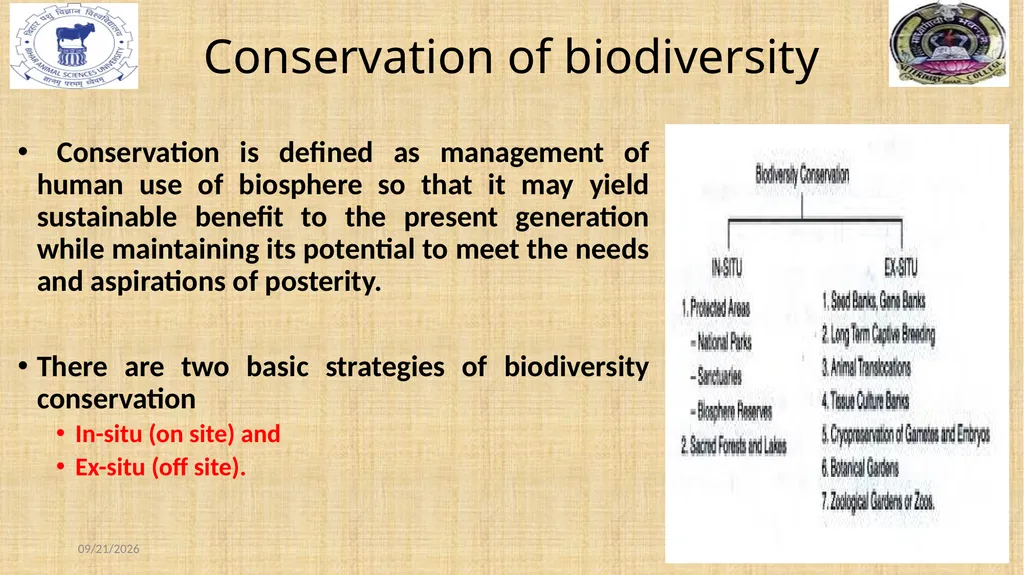
Conservation of biodiversity Conservation is defined as management of human use of biosphere so that it may yield sustainable benefit to the present generation while maintaining its potential to meet the needs and aspirations of posterity.
There are two basic strategies of biodiversity conservation
In-situ (on site) and
Ex-situ (off site). 10/17/2020 16<br>
There are two basic strategies of biodiversity conservation
In-situ (on site) and
Ex-situ (off site). 10/17/2020 16<br>
17
In-situ Conservation Conservation of organism in its natural home through protection of a group of typical ecosystems by a network of protected areas, biosphere reserves, sacred forests and sacred lakes.
Protected areas: such as National Parks and Wildlife Sanctuaries are areas of land and/or sea especially dedicated to the protection and maintenance of biological diversity, and of natural and associated cultural resources.
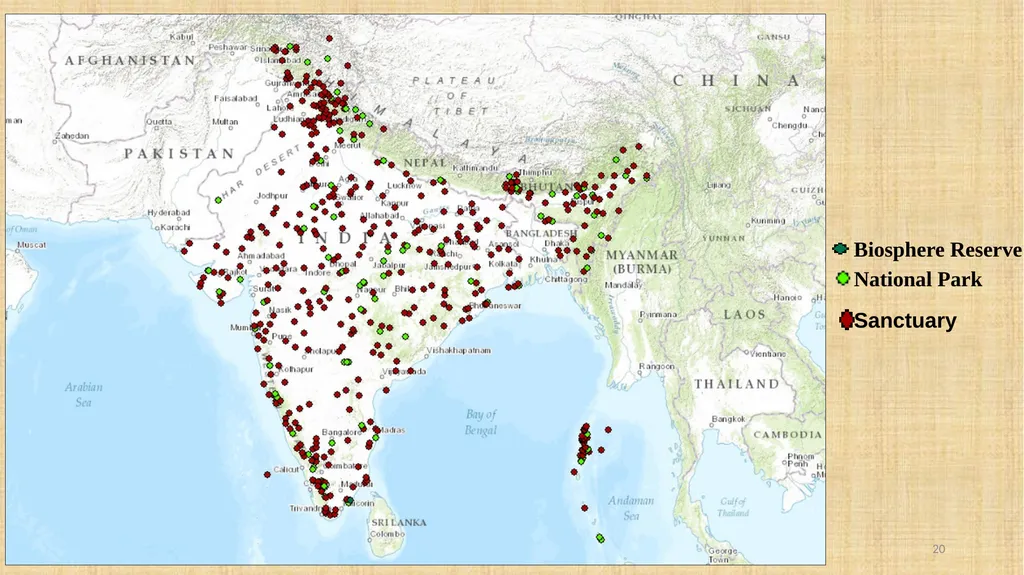
There are more than 37000 protected areas around the world, while India has 612 protected areas (99 National Parks and 513 Wildlife Sanctuaries). 10/17/2020 17<br>
Protected areas: such as National Parks and Wildlife Sanctuaries are areas of land and/or sea especially dedicated to the protection and maintenance of biological diversity, and of natural and associated cultural resources.
There are more than 37000 protected areas around the world, while India has 612 protected areas (99 National Parks and 513 Wildlife Sanctuaries). 10/17/2020 17<br>
18
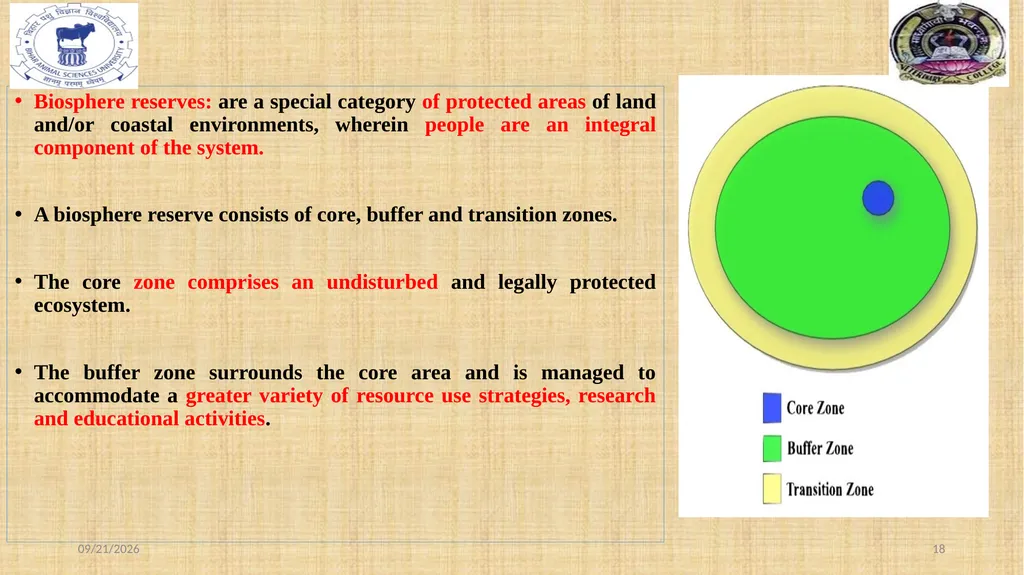
Biosphere reserves: are a special category of protected areas of land and/or coastal environments, wherein people are an integral component of the system.
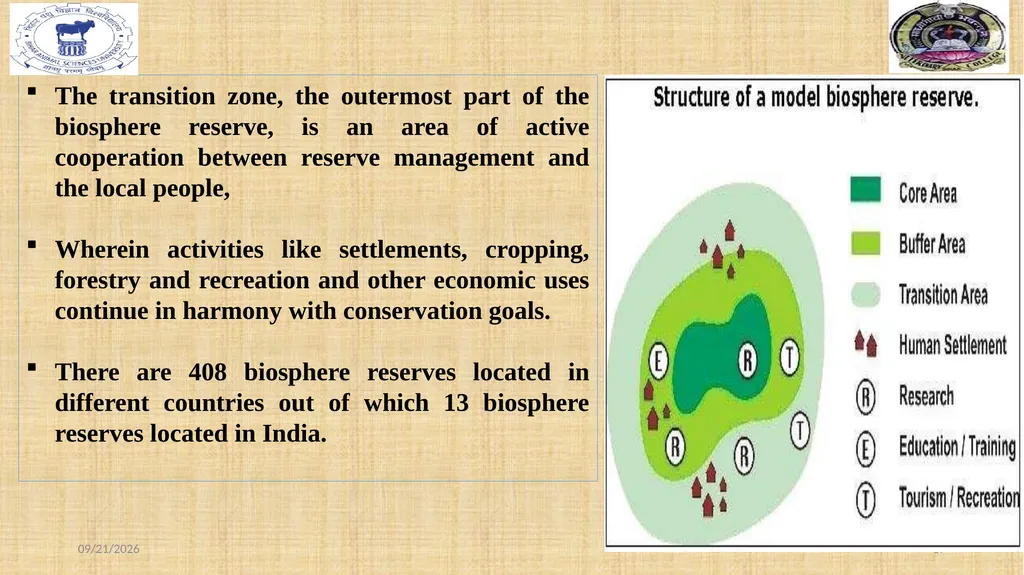
A biosphere reserve consists of core, buffer and transition zones.
The core zone comprises an undisturbed and legally protected ecosystem.
The buffer zone surrounds the core area and is managed to accommodate a greater variety of resource use strategies, research and educational activities. 10/17/2020 18<br>
A biosphere reserve consists of core, buffer and transition zones.
The core zone comprises an undisturbed and legally protected ecosystem.
The buffer zone surrounds the core area and is managed to accommodate a greater variety of resource use strategies, research and educational activities. 10/17/2020 18<br>
19
The transition zone, the outermost part of the biosphere reserve, is an area of active cooperation between reserve management and the local people,
Wherein activities like settlements, cropping, forestry and recreation and other economic uses continue in harmony with conservation goals.
There are 408 biosphere reserves located in different countries out of which 13 biosphere reserves located in India. 10/17/2020 19<br>
Wherein activities like settlements, cropping, forestry and recreation and other economic uses continue in harmony with conservation goals.
There are 408 biosphere reserves located in different countries out of which 13 biosphere reserves located in India. 10/17/2020 19<br>
20
Biosphere Reserve National Park Sanctuary 10/17/2020 20<br>
21
Ex-situ Conservation Conservation of organisms in botanical gardens, zoos, conservation stands, gene, pollen, seed, seedling, tissue culture and DNA banks.
There are more than 1500 botanical gardens in the world containing more than 80,000 species and many of these now have seed banks, tissue culture facilities and other ex situ technologies.
Similarly there are more than 800 professionally managed zoos around the world with about 3000 species of mammals, birds, reptiles and amphibians.
Many of these zoos have well developed captive breeding programmes.
Plants and animals conserved in botanical gardens, arboreta, zoos and aquaria can be used to restore degraded land, reintroduce species into wild, and restock depleted populations. 10/17/2020 21<br>
There are more than 1500 botanical gardens in the world containing more than 80,000 species and many of these now have seed banks, tissue culture facilities and other ex situ technologies.
Similarly there are more than 800 professionally managed zoos around the world with about 3000 species of mammals, birds, reptiles and amphibians.
Many of these zoos have well developed captive breeding programmes.
Plants and animals conserved in botanical gardens, arboreta, zoos and aquaria can be used to restore degraded land, reintroduce species into wild, and restock depleted populations. 10/17/2020 21<br>
22
Biodiversity conservation in India India is known for its rich heritage of biodiversity
It is one of the 17 mega-diverse countries in the world with 7–8 % of the world’s recorded plant and animal species.
Amongst the existing biota, 91,307 species of animals (2,557 Protista), 12,470 general invertebrates, 69,903 arthropods, 4,994 vertebrates, and 45,500 species of plants as well as 5,650 microbial species have been documented in India.
About 5,150 plant species and 1,837 animal species are endemic to India.
Its cultural and traditional diversity includes over 550 tribal communities of 227 traditional groups spread over 5,000 forested villages. 10/17/2020 22<br>
It is one of the 17 mega-diverse countries in the world with 7–8 % of the world’s recorded plant and animal species.
Amongst the existing biota, 91,307 species of animals (2,557 Protista), 12,470 general invertebrates, 69,903 arthropods, 4,994 vertebrates, and 45,500 species of plants as well as 5,650 microbial species have been documented in India.
About 5,150 plant species and 1,837 animal species are endemic to India.
Its cultural and traditional diversity includes over 550 tribal communities of 227 traditional groups spread over 5,000 forested villages. 10/17/2020 22<br>
23
Suggested Reading An advanced textbook on biodiversity principles and practice – Krishnamurthy.
Biodiversity: An Introduction-Kevin J. Gaston and John I. Spicer.
Biodiversity and its conservation (UNIT 4): Definition and significance of biodiversity: Mait4us.weebly.com.
Biodiversity and Its Conservation: Proceedings of the National Academy of Sciences, India. 10/17/2020 23<br>
Biodiversity: An Introduction-Kevin J. Gaston and John I. Spicer.
Biodiversity and its conservation (UNIT 4): Definition and significance of biodiversity: Mait4us.weebly.com.
Biodiversity and Its Conservation: Proceedings of the National Academy of Sciences, India. 10/17/2020 23<br>