BioPerl cpan Open a terminal and type binsu - start cpan, accept all defaults install Bio::Graphics use Bio::Seq; use Bio::SeqIO; create a sequence object of some DNA my seq Bio::Seq-new( -id testseq, -seq CATGTAGATAG);
"BioPerl cpan Open a terminal and type /bin/su -" is the property of its rightful owner. Permission is granted to
download and print the materials on this website for personal, non-commercial use only, and to display it
on your personal computer provided you do not modify the materials and that you retain all copyright
notices contained in the materials. By downloading content from our website, you accept the terms of this
agreement.
Presentation Transcript
01
BioPerl<br>
02
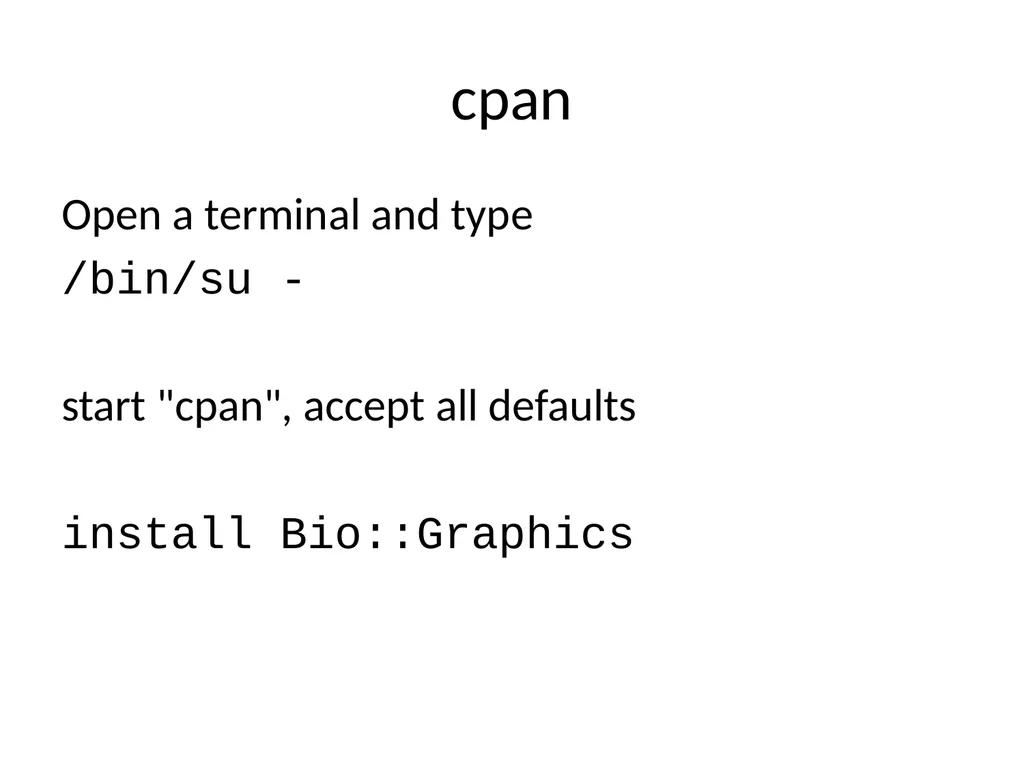
cpan Open a terminal and type
/bin/su -
start "cpan", accept all defaults
install Bio::Graphics<br>
03
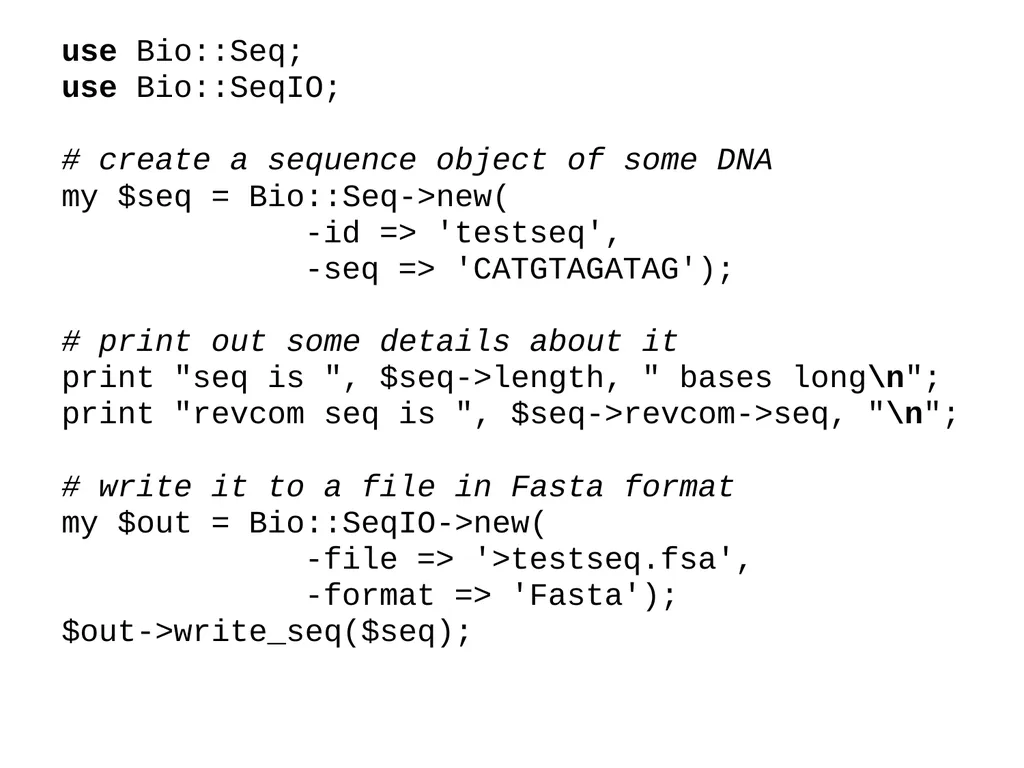
use Bio::Seq;
use Bio::SeqIO;
# create a sequence object of some DNA
my $seq = Bio::Seq->new(
-id => 'testseq',
-seq => 'CATGTAGATAG');
# print out some details about it
print "seq is ", $seq->length, " bases long\n";
print "revcom seq is ", $seq->revcom->seq, "\n";
# write it to a file in Fasta format
my $out = Bio::SeqIO->new(
-file => '>testseq.fsa',
-format => 'Fasta');
$out->write_seq($seq);<br>
04
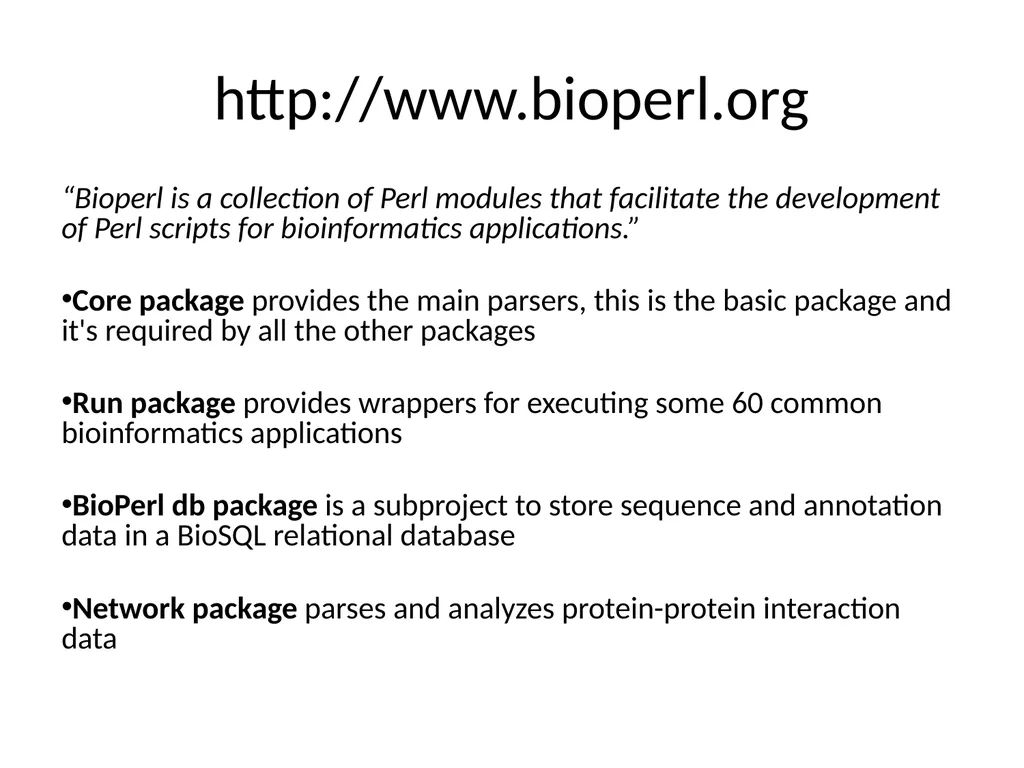
http://www.bioperl.org “Bioperl is a collection of Perl modules that facilitate the development of Perl scripts for bioinformatics applications.”
Core package provides the main parsers, this is the basic package and it's required by all the other packages
Run package provides wrappers for executing some 60 common bioinformatics applications
BioPerl db package is a subproject to store sequence and annotation data in a BioSQL relational database
Network package parses and analyzes protein-protein interaction data<br>
05
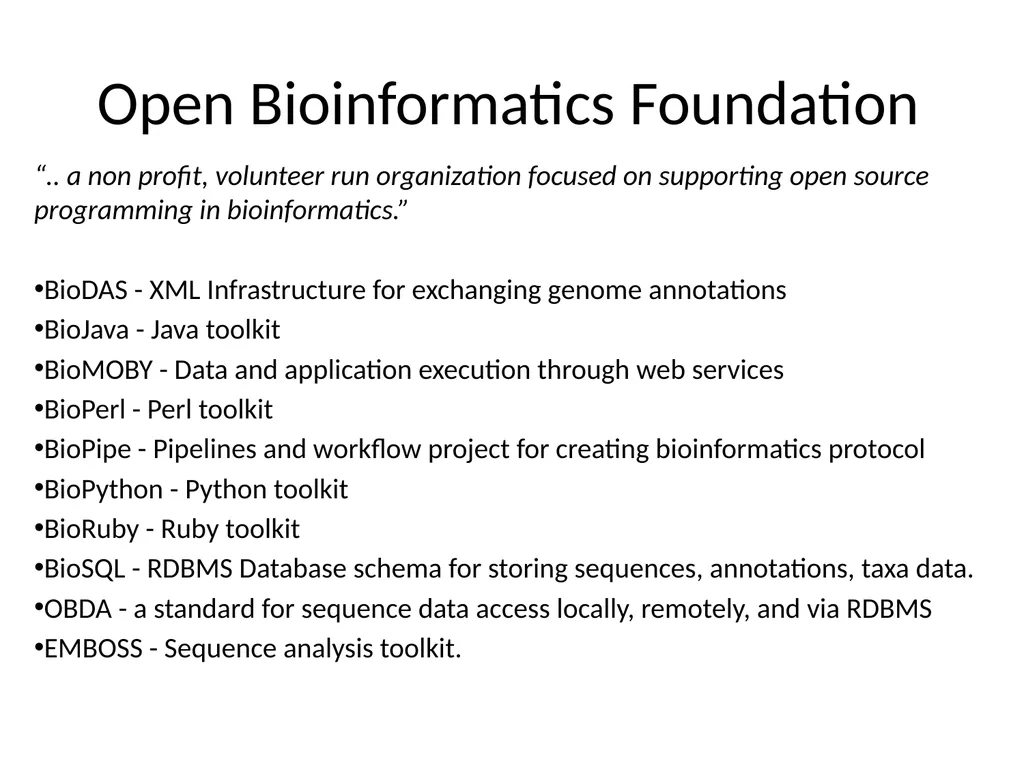
Open Bioinformatics Foundation “.. a non profit, volunteer run organization focused on supporting open source programming in bioinformatics.”
BioDAS - XML Infrastructure for exchanging genome annotations
BioJava - Java toolkit
BioMOBY - Data and application execution through web services
BioPerl - Perl toolkit
BioPipe - Pipelines and workflow project for creating bioinformatics protocol
BioPython - Python toolkit
BioRuby - Ruby toolkit
BioSQL - RDBMS Database schema for storing sequences, annotations, taxa data.
OBDA - a standard for sequence data access locally, remotely, and via RDBMS
EMBOSS - Sequence analysis toolkit.<br>
06
Open Bioinformatics Foundation “.. a non profit, volunteer run organization focused on supporting open source programming in bioinformatics.”
BioDAS - XML Infrastructure for exchanging genome annotations
BioJava - Java toolkit
BioMOBY - Data and application execution through web services
BioPerl - Perl toolkit
BioPipe - Pipelines and workflow project for creating bioinformatics protocol
BioPython - Python toolkit
BioRuby - Ruby toolkit
BioSQL - RDBMS Database schema for storing sequences, annotations, taxa data.
OBDA - a standard for sequence data access locally, remotely, and via RDBMS
EMBOSS - Sequence analysis toolkit.<br>
07
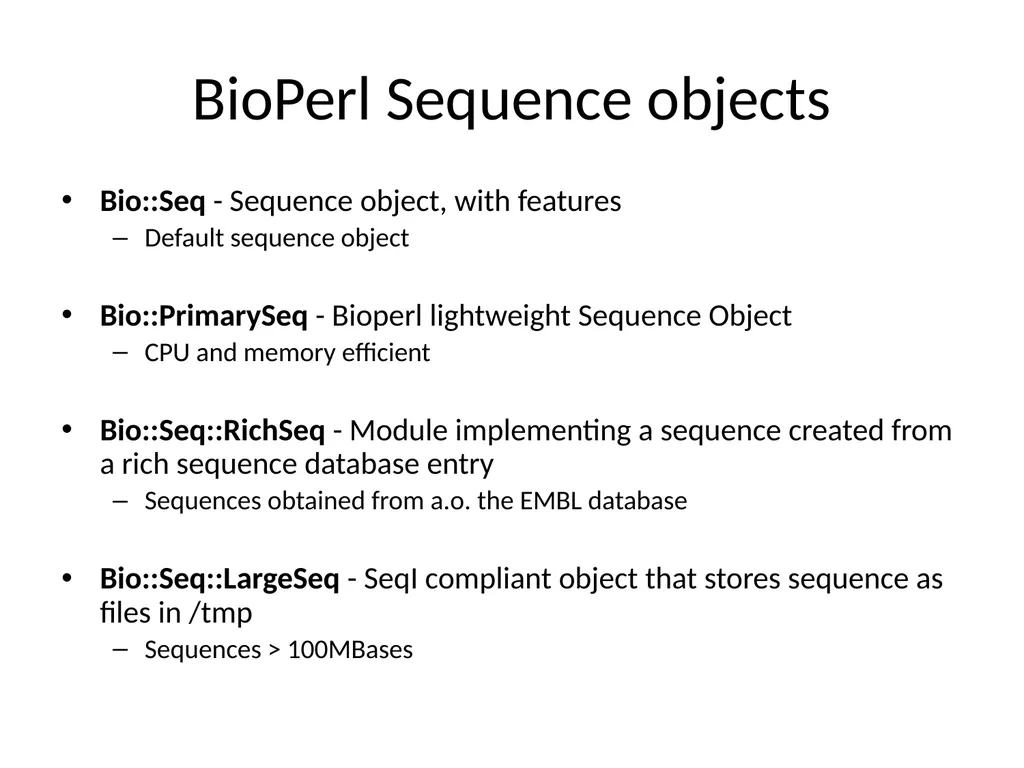
BioPerl Sequence objects Bio::Seq - Sequence object, with features
Default sequence object
Bio::PrimarySeq - Bioperl lightweight Sequence Object
CPU and memory efficient
Bio::Seq::RichSeq - Module implementing a sequence created from a rich sequence database entry
Sequences obtained from a.o. the EMBL database
Bio::Seq::LargeSeq - SeqI compliant object that stores sequence as files in /tmp
Sequences > 100MBases<br>
08
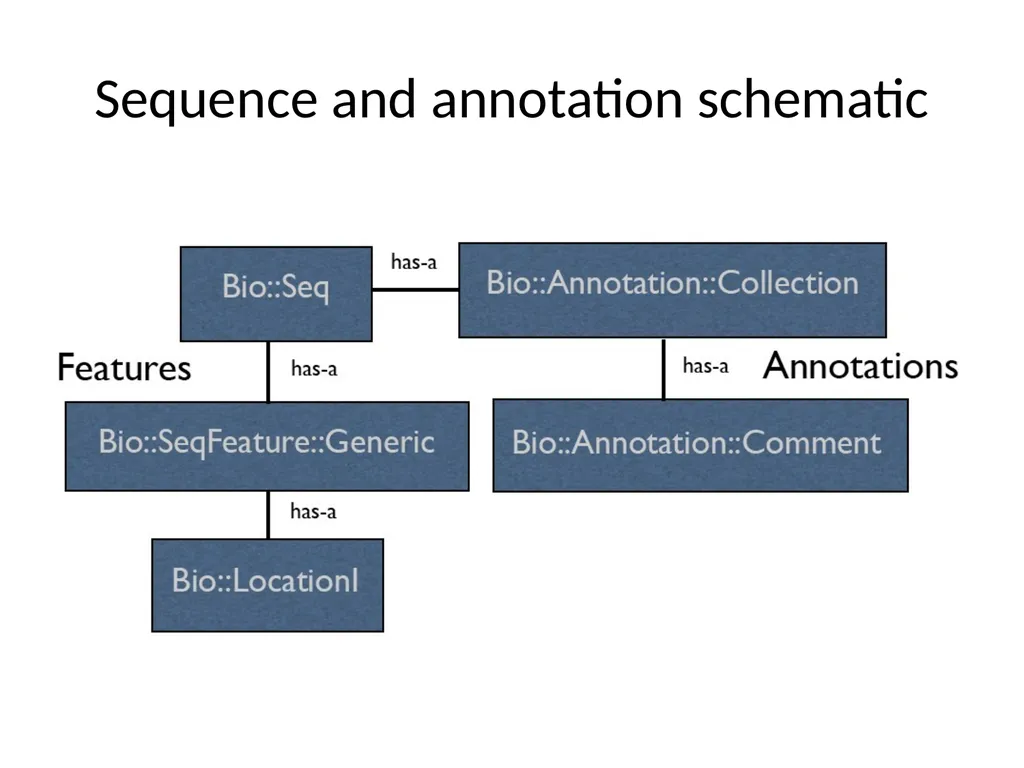
Sequence and annotation schematic<br>
09
Incomplete list of topics covered by BioPerl:
Accessing sequence data from local and remote databases
Manipulating sequences
Translating
Obtaining basic sequence statistics (SeqStats,SeqWord)
Identifying restriction enzyme sites (Bio::Restriction)
Identifying amino acid cleavage sites (Sigcleave)
Running BLAST
Parsing BLAST and FASTA
Searching for genes and other structures on genomic DNA (Genscan, Sim4, Grail, Genemark, ESTScan, MZEF, EPCR)
Aligning 2 sequences
Aligning multiple sequences (Clustalw.pm, TCoffee.pm)
Manipulating clusters of sequences (Cluster, ClusterIO)
Representing sequence annotations
Using 3D structure objects and reading PDB files (StructureI, Structure::IO)
Tree objects and phylogenetic trees (Tree::Tree, TreeIO, PAML)
Bibliographic objects for querying bibliographic databases (Biblio)
Graphics objects for representing sequence objects as images (Graphics)
Sequence manipulation using the Bioperl EMBOSS and PISE interfaces<br>
10
Exercises At: http://bioperl.org/wiki/HOWTO:Graphics
Try to run the: “A Better Version of the Feature Renderer” script.
Modify the script to accept an accession number instead of a filename and retrieve the corresponding sequence from the EMBL database. Test with accession number: J02933
Hint: “Bio::DB::EMBL”, where is the database located?
Create a BioPerl sequence object from the example1.fasta and add the ORF starting at position 11 as a feature. Display the resulting sequence object using the feature renderer script.<br>