04
Motivation Need a way to pay over a communication channel
Without a trusted third party
Need to rely on cryptographic proof instead of trust
My claimed account balance can be independently verified
Allow two parties to transact directly with each other
Without the need of a trusted third party
Bitcoin: a solution to double spending problem
Using a distributed timestamp server to generate proof of the chronological order of transactions
Assumptions: Honest nodes control more CPU power than attacking nodes<br>
05
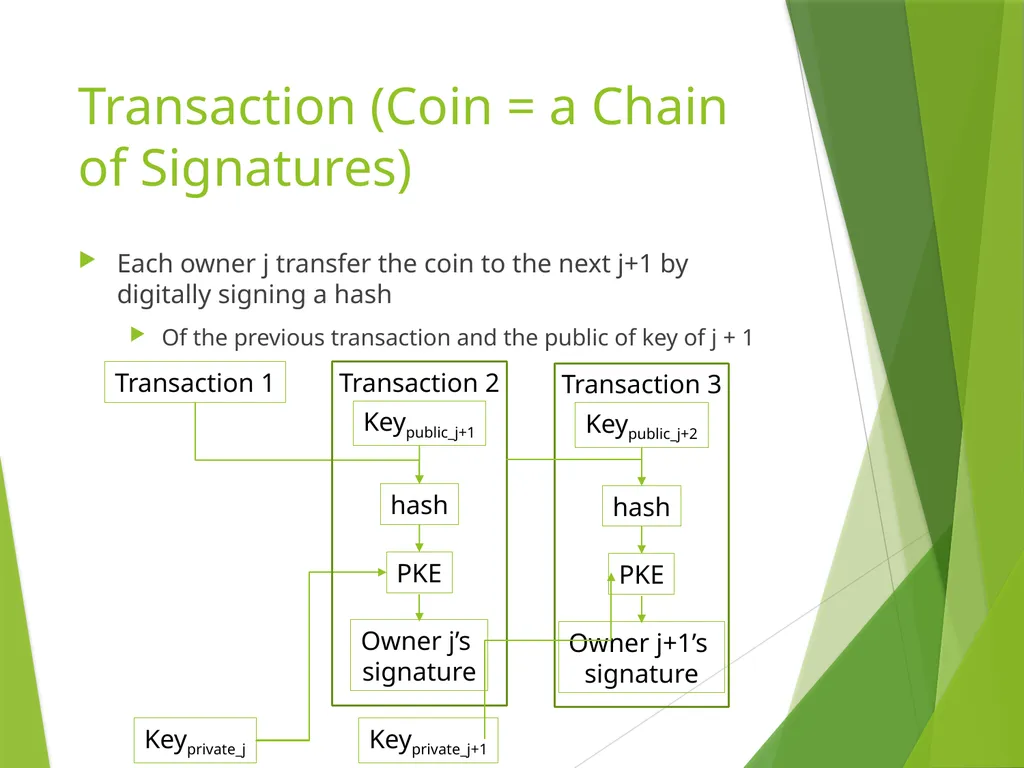
Transaction An electronic coin as a chain (cryptographic transfer history) of digital signatures<br>
06
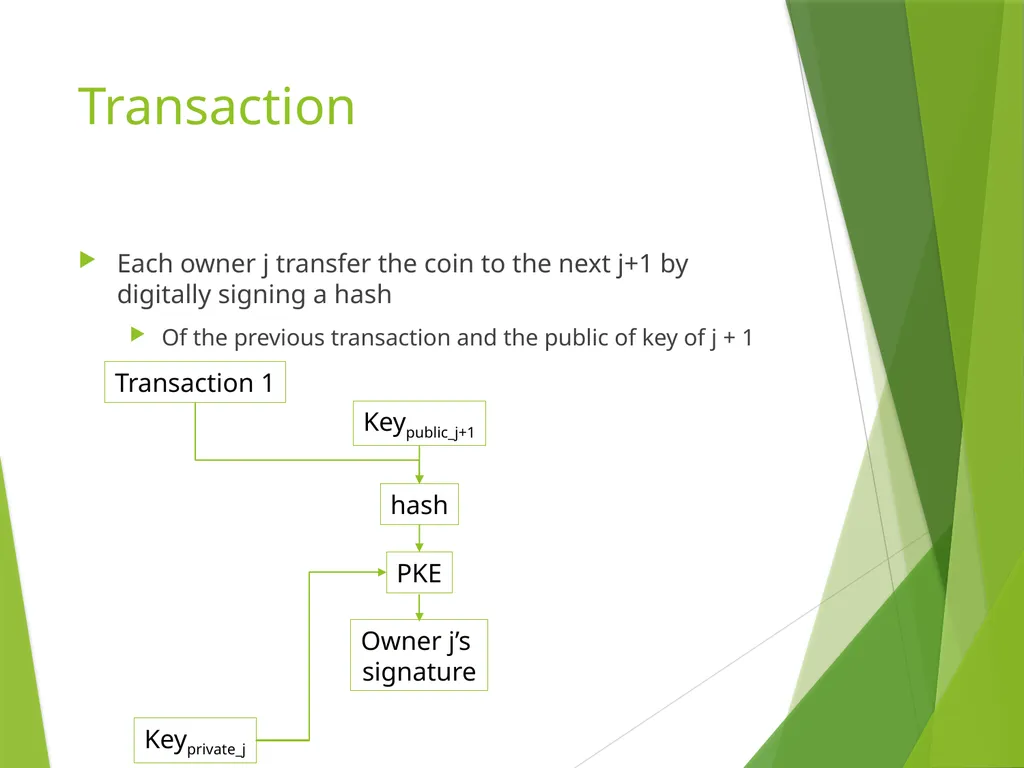
Transaction Each owner j transfer the coin to the next j+1 by digitally signing a hash
Of the previous transaction and the public of key of j + 1<br>
07
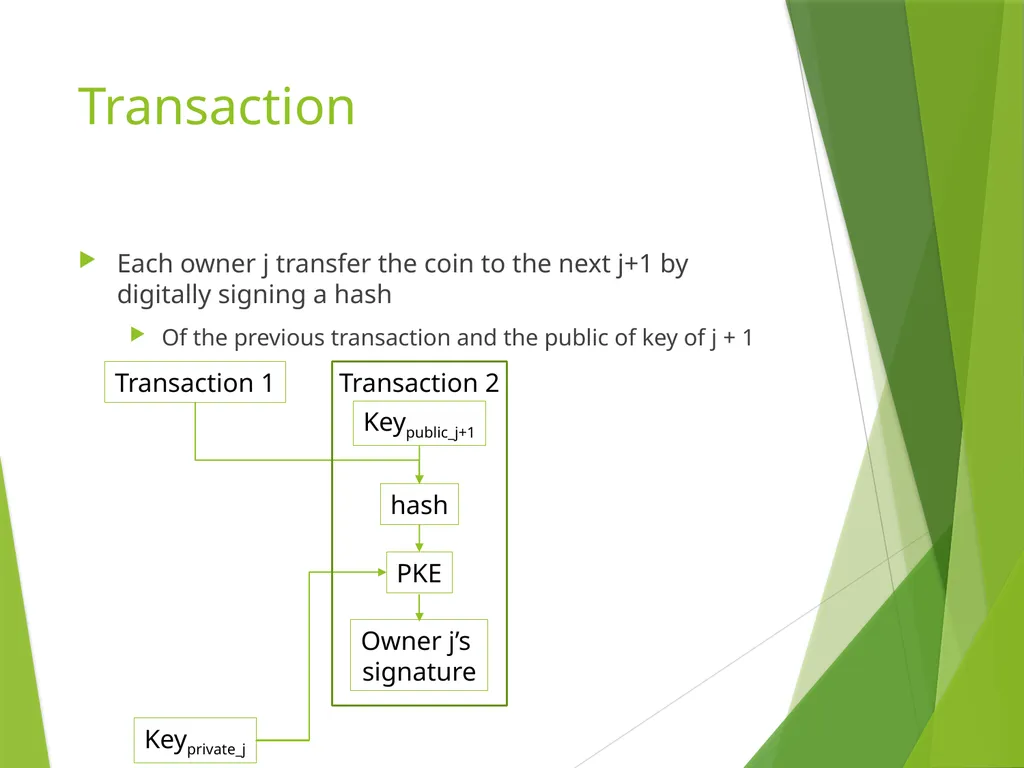
Transaction Each owner j transfer the coin to the next j+1 by digitally signing a hash
Of the previous transaction and the public of key of j + 1 Transaction 1 Keypublic_j+1 Keyprivate_j hash PKE Transaction 2 Owner j’s
signature<br>
08
Transaction (Coin = a Chain of Signatures) Each owner j transfer the coin to the next j+1 by digitally signing a hash
Of the previous transaction and the public of key of j + 1 Transaction 1 Keypublic_j+1 Keyprivate_j hash PKE Transaction 2 Owner j’s
signature<br>
09
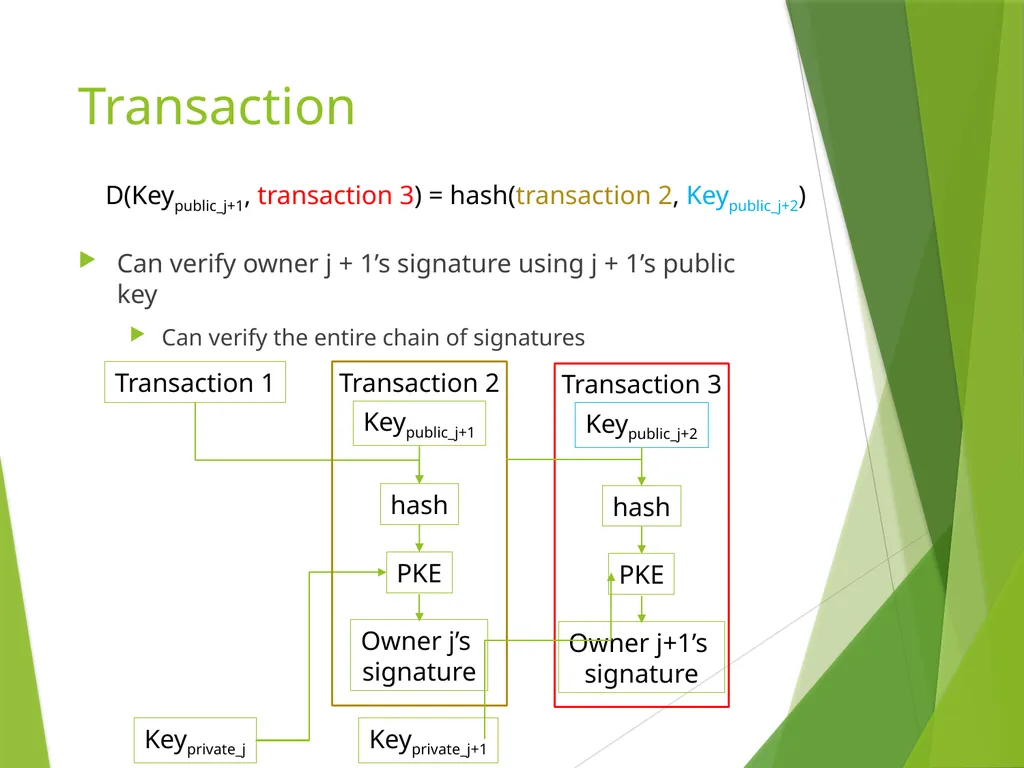
Transaction Can verify owner j + 1’s signature using j + 1’s public key
Can verify the entire chain of signatures Transaction 1 Keypublic_j+1 Keyprivate_j hash PKE Transaction 2 Owner j’s
signature Keypublic_j+2 hash PKE Transaction 3 Owner j+1’s
signature Keyprivate_j+1 D(Keypublic_j+1, transaction 3) = hash(transaction 2, Keypublic_j+2)<br>
10
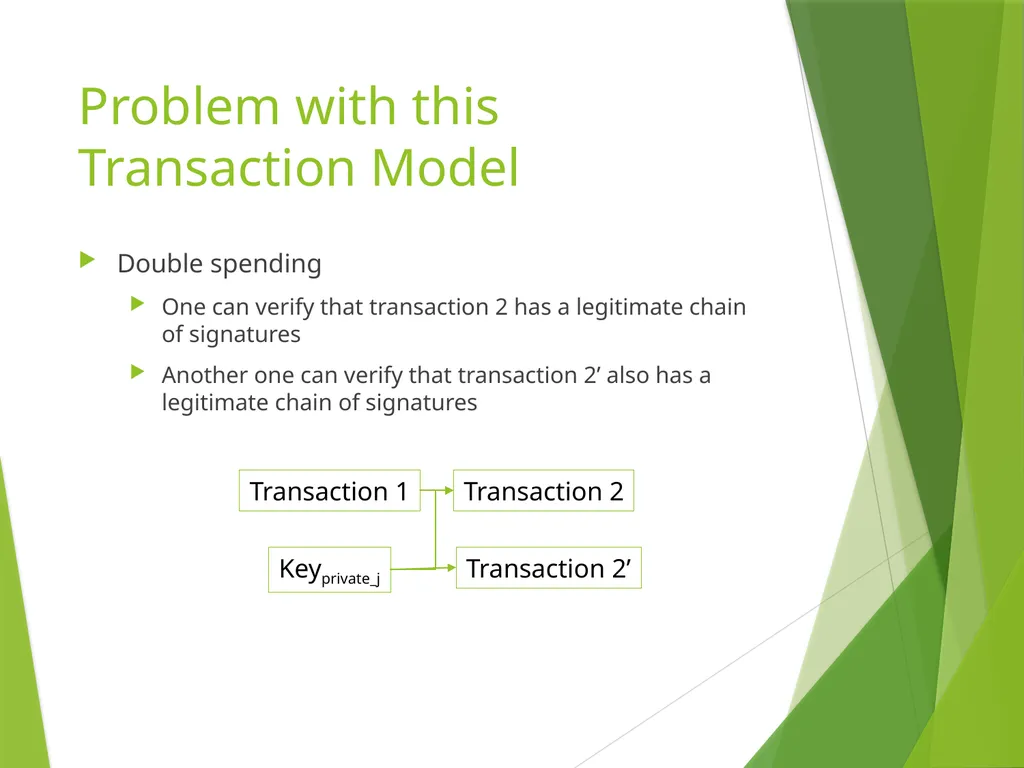
Problem with this Transaction Model Double spending
One can verify that transaction 2 has a legitimate chain of signatures
Another one can verify that transaction 2’ also has a legitimate chain of signatures Transaction 1 Keyprivate_j Transaction 2 Transaction 2’<br>
11
One Solution Use a trusted central authority—mint
After each transaction
Coin must be returned to the mint to issue a new coin
Only coins issued from the mint are trusted
Drawback
Every transaction needs to go through the mint<br>
12
Arriving Another Solution If someone signs the same transaction (history) twice
Only the first signature counts
To be able to detect the second signature
Global knowledge is required
Mint’s centralized model relies on global knowledge
Without a trusted party
Transactions must be publically announced
All participants need to agree on a single history of the order in which the announcement was received
The payee needs proof that at the time of transaction
Majority of nodes agreed he received the first signature<br>
13
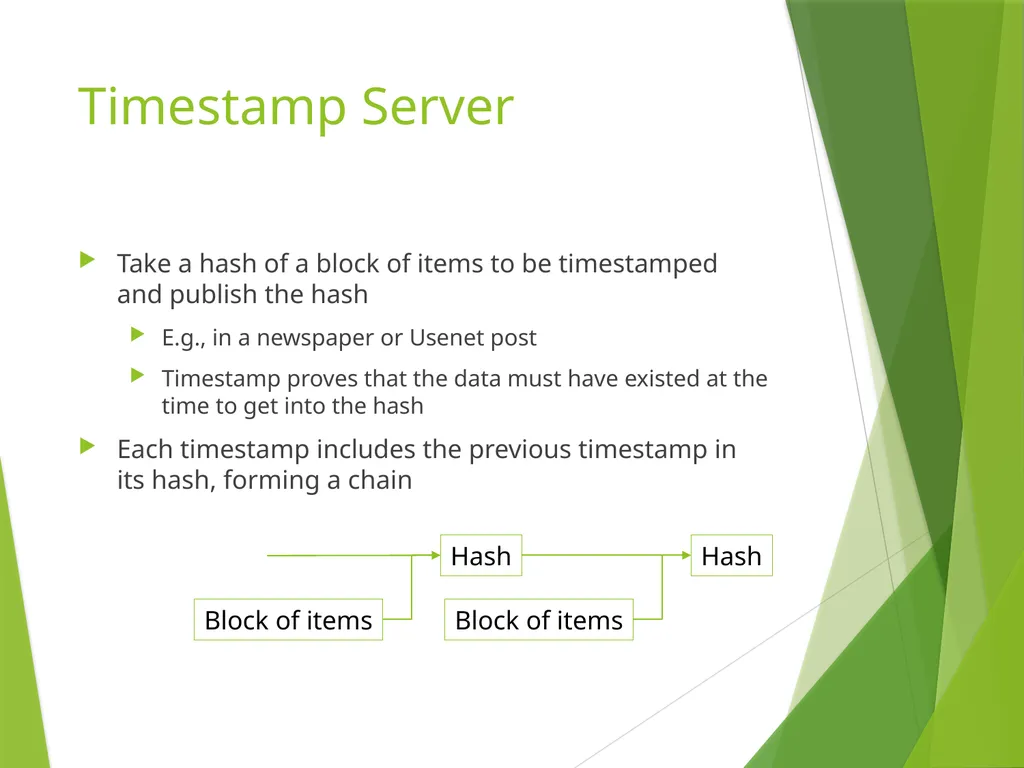
Timestamp Server Take a hash of a block of items to be timestamped and publish the hash
E.g., in a newspaper or Usenet post
Timestamp proves that the data must have existed at the time to get into the hash
Each timestamp includes the previous timestamp in its hash, forming a chain Hash Block of items Hash Block of items<br>
14
Proof of Work If effort to generate the timestamp hash chain is low, someone with the CPU cycles to rewrite the history
Need proof of work to make this process expensive<br>
15
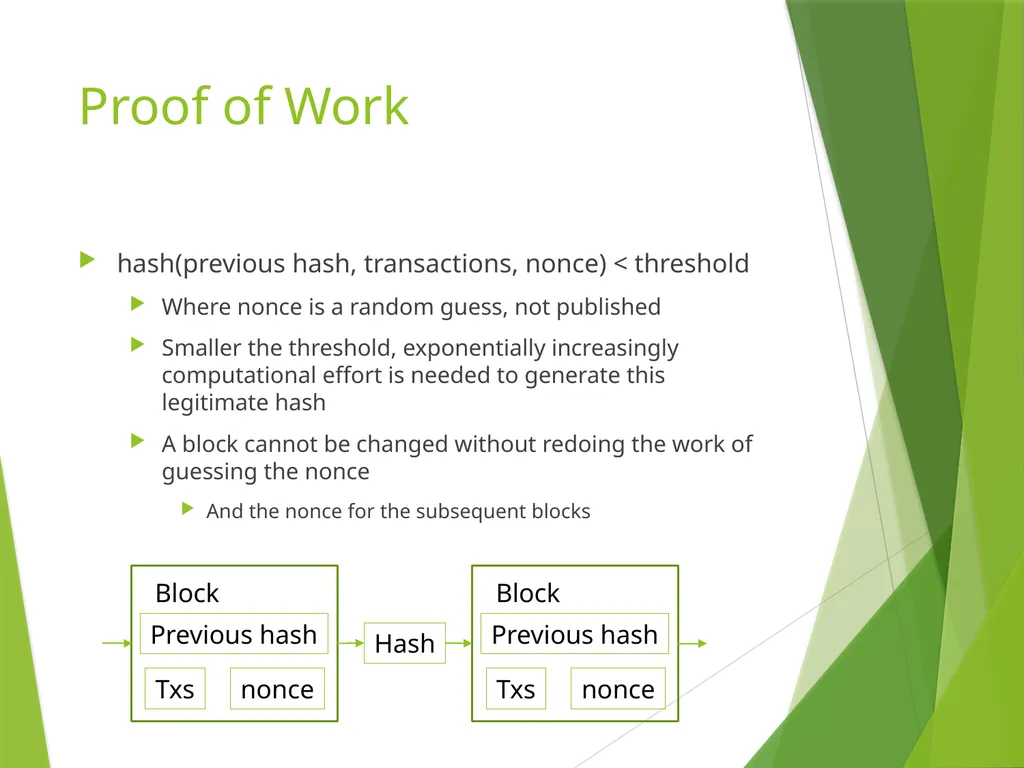
Proof of Work hash(previous hash, transactions, nonce) < threshold
Where nonce is a random guess, not published
Smaller the threshold, exponentially increasingly computational effort is needed to generate this legitimate hash
A block cannot be changed without redoing the work of guessing the nonce
And the nonce for the subsequent blocks<br>
16
Proof of Work The majority decision is based on the longest block chain or the greatest proof of work effort invested
Note
Proof of work is not voted by the number of IP addressed
But by the number of CPU cycles
If most CPU cycles are controlled by honest nodes, the honest chain will grow faster than competing chains
To modify the past, an attacker would have to redo the proof for all blocks<br>
17
Proof of Work As hardware speed increases overtime
The threshold for proof of work reduces
Difficulty of guessing a correct nonce increases
Targeting an average number of blocks generated per hour<br>
18
Proof-of-Work Network Run the following steps
New transactions are broadcast to all nodes
Each node collects new transactions into a block
Each node solves for the nonce for its block
If the nonce is found, broadcasts the block to all nodes
Nodes accept the block if all transactions in it are valid and not already spent
Nodes accept the block by creating the next block in the chain, using the hash of the accepted block<br>
19
Proof-of-Work Network Nodes always consider the longest chain
If two chains are received, the tie will be broken with the next proof
Nodes working on the shorter chain will switch to the longer chain
Nodes can detect a missed block if the previous hash field mismatched<br>
20
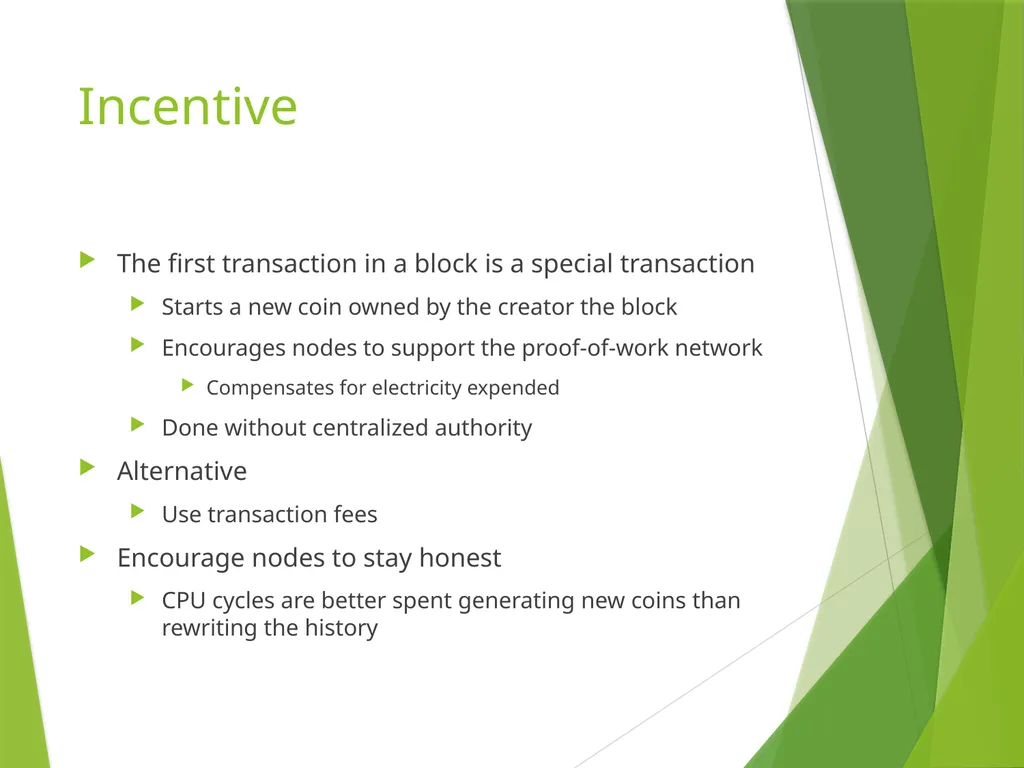
Incentive The first transaction in a block is a special transaction
Starts a new coin owned by the creator the block
Encourages nodes to support the proof-of-work network
Compensates for electricity expended
Done without centralized authority
Alternative
Use transaction fees
Encourage nodes to stay honest
CPU cycles are better spent generating new coins than rewriting the history<br>
21
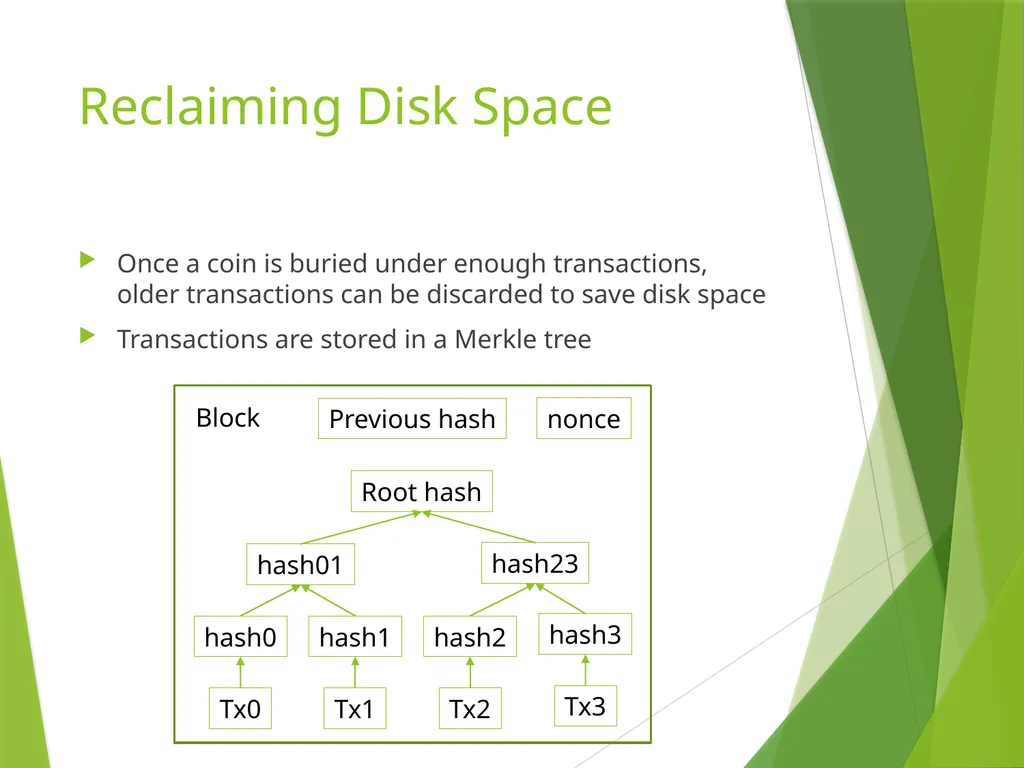
Reclaiming Disk Space Once a coin is buried under enough transactions, older transactions can be discarded to save disk space
Transactions are stored in a Merkle tree<br>
22
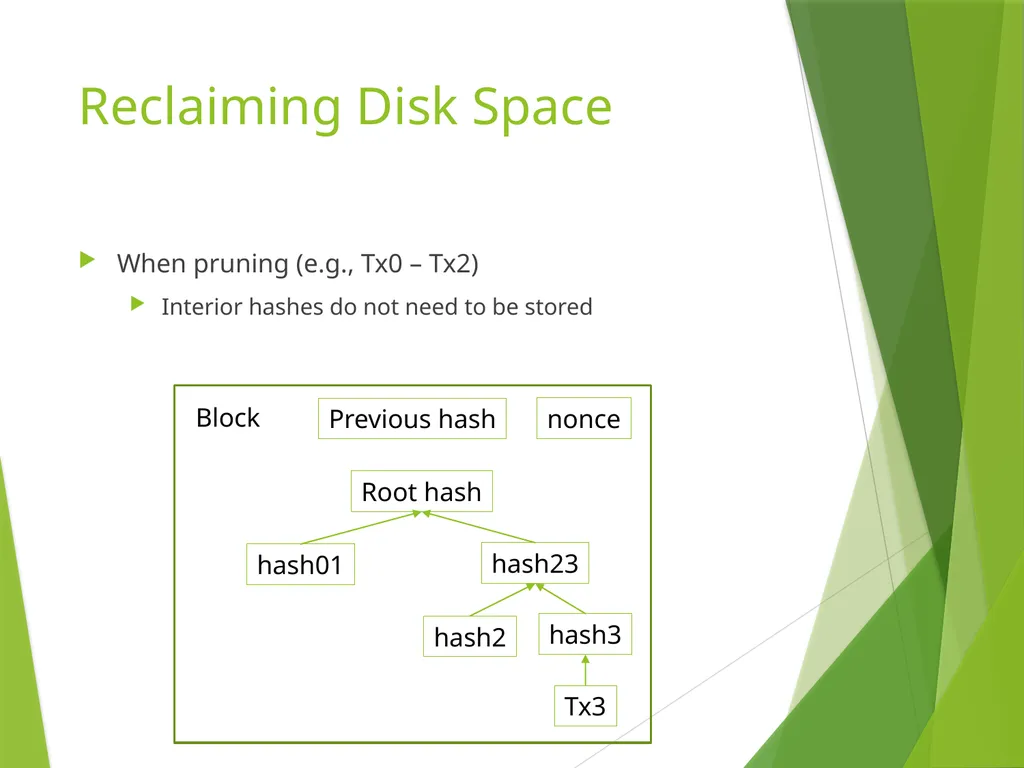
Reclaiming Disk Space When pruning (e.g., Tx0 – Tx2)
Interior hashes do not need to be stored<br>
23
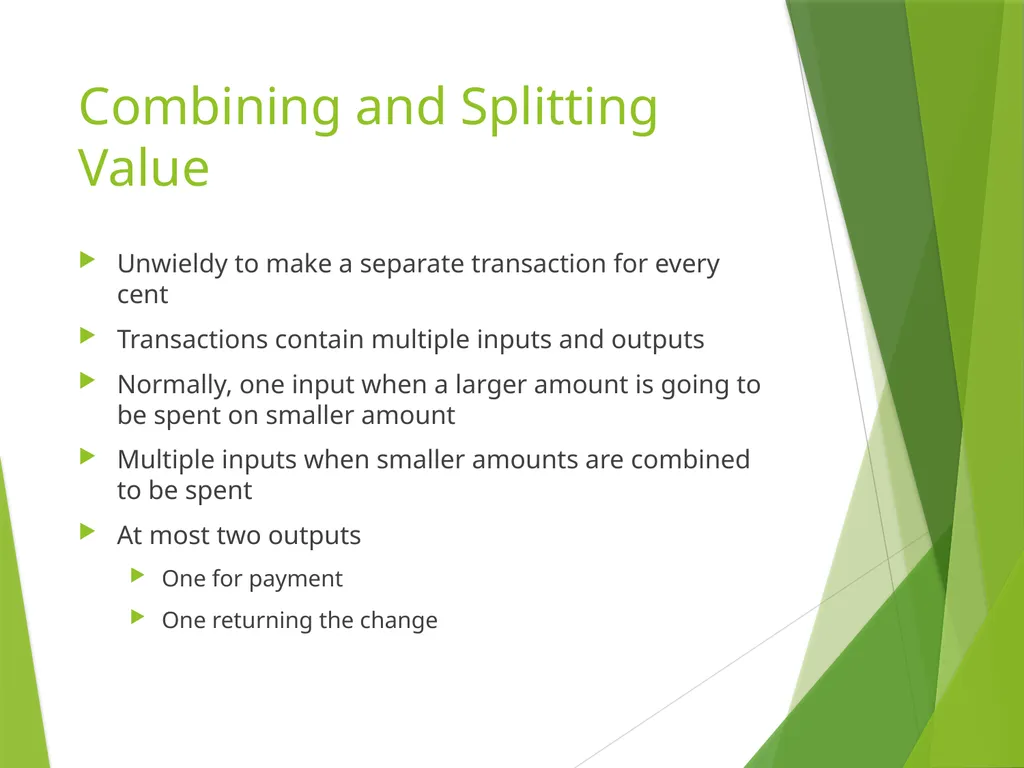
Combining and Splitting Value Unwieldy to make a separate transaction for every cent
Transactions contain multiple inputs and outputs
Normally, one input when a larger amount is going to be spent on smaller amount
Multiple inputs when smaller amounts are combined to be spent
At most two outputs
One for payment
One returning the change<br>
24
Privacy All transactions are announced publicly
Need to keep public key anonymous
Ideally a new key pair is used for each transaction
Still a problem for multi-input transactions<br>
25
Calculations Attackers are likely to change one of its own transactions to take back money recently spent
For large transactions, wait for 5-6 blocks to be committed based on the transacted block
Very difficult for an attacker to alter the history beyond this chain length<br>
26
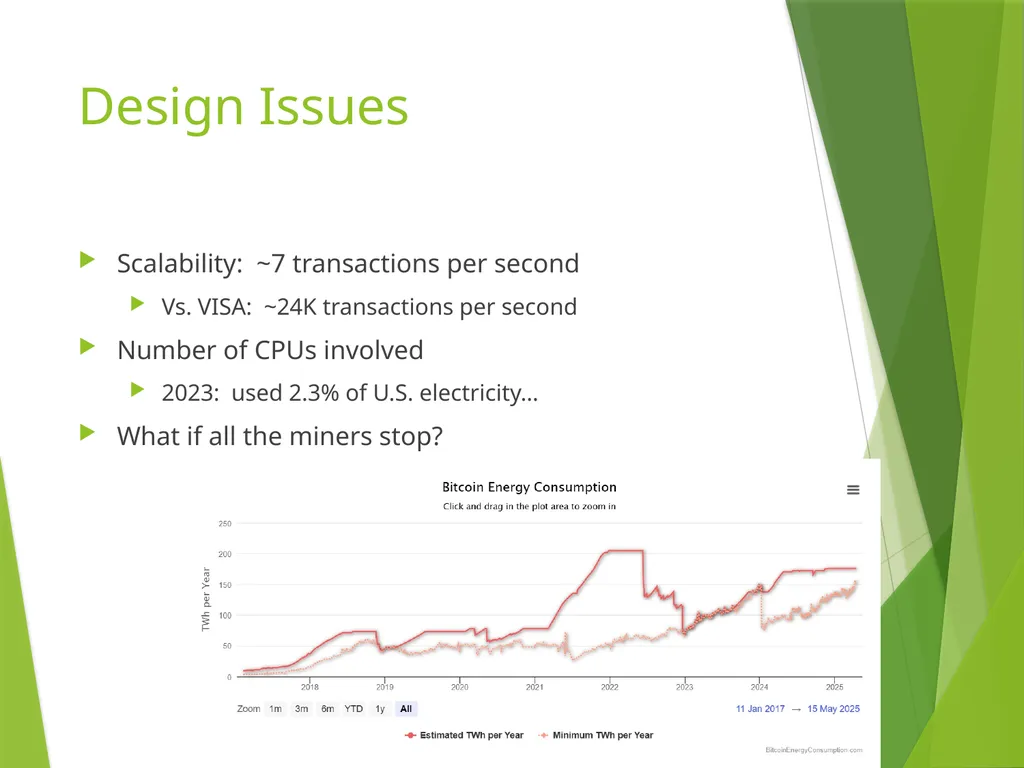
Design Issues Scalability: ~7 transactions per second
Vs. VISA: ~24K transactions per second
Number of CPUs involved
2023: used 2.3% of U.S. electricity…
What if all the miners stop?<br>