
Blind and partially sighted students in post 16
CM
Published · 23 slides · 0 views

1 / 1

Description
Blind and partially sighted students in post 16 education Rosaleen Dempsey , Deputy Lead, Children, Young People, Families Education (Devolved Nations), RNIB Tara Chattaway: Head of Education, Thomas Pocklington Trust Workshop aims This
Related Topics
Share
Embed code
Download this presentation From Below
"Blind and partially sighted students in post 16" is the property of its rightful owner. Permission is granted to download and print the materials on this website for personal, non-commercial use only, and to display it on your personal computer provided you do not modify the materials and that you retain all copyright notices contained in the materials. By downloading content from our website, you accept the terms of this agreement.
Presentation Transcript
01
Blind and partially sighted students in post 16 education Rosaleen Dempsey , Deputy Lead, Children, Young People, Families & Education (Devolved Nations), RNIB
Tara Chattaway: Head of Education, Thomas Pocklington Trust<br>
Tara Chattaway: Head of Education, Thomas Pocklington Trust<br>
02
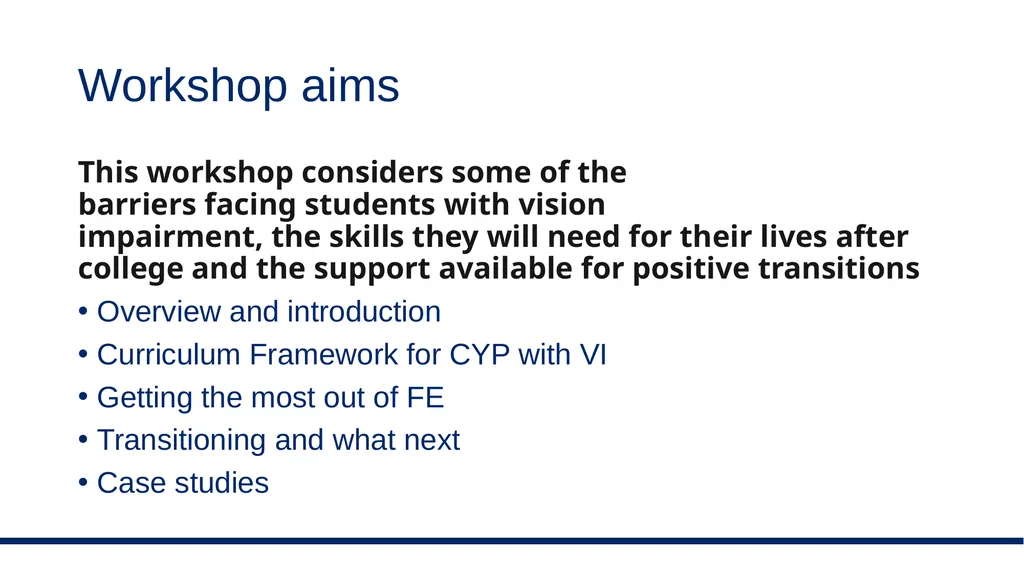
Workshop aims This workshop considers some of the barriers facing students with vision impairment, the skills they will need for their lives after college and the support available for positive transitions
Overview and introduction
Curriculum Framework for CYP with VI
Getting the most out of FE
Transitioning and what next
Case studies<br>
Overview and introduction
Curriculum Framework for CYP with VI
Getting the most out of FE
Transitioning and what next
Case studies<br>
03
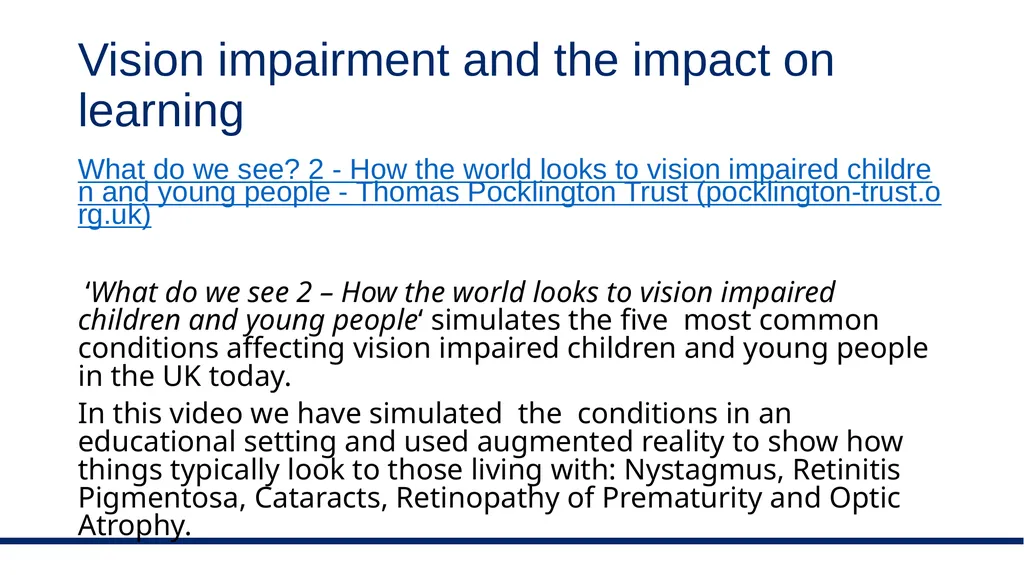
Vision impairment and the impact on learning What do we see? 2 - How the world looks to vision impaired children and young people - Thomas Pocklington Trust (pocklington-trust.org.uk)
‘What do we see 2 – How the world looks to vision impaired children and young people‘ simulates the five most common conditions affecting vision impaired children and young people in the UK today.
In this video we have simulated the conditions in an educational setting and used augmented reality to show how things typically look to those living with: Nystagmus, Retinitis Pigmentosa, Cataracts, Retinopathy of Prematurity and Optic Atrophy.<br>
‘What do we see 2 – How the world looks to vision impaired children and young people‘ simulates the five most common conditions affecting vision impaired children and young people in the UK today.
In this video we have simulated the conditions in an educational setting and used augmented reality to show how things typically look to those living with: Nystagmus, Retinitis Pigmentosa, Cataracts, Retinopathy of Prematurity and Optic Atrophy.<br>
04
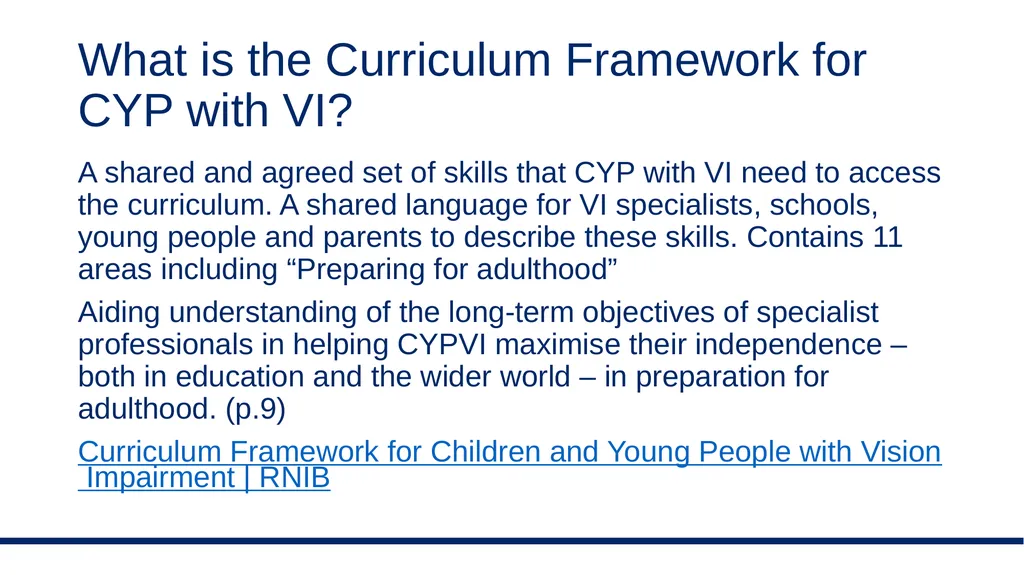
What is the Curriculum Framework for CYP with VI? A shared and agreed set of skills that CYP with VI need to access the curriculum. A shared language for VI specialists, schools, young people and parents to describe these skills. Contains 11 areas including “Preparing for adulthood”
Aiding understanding of the long-term objectives of specialist professionals in helping CYPVI maximise their independence – both in education and the wider world – in preparation for adulthood. (p.9)
Curriculum Framework for Children and Young People with Vision Impairment | RNIB<br>
Aiding understanding of the long-term objectives of specialist professionals in helping CYPVI maximise their independence – both in education and the wider world – in preparation for adulthood. (p.9)
Curriculum Framework for Children and Young People with Vision Impairment | RNIB<br>
05
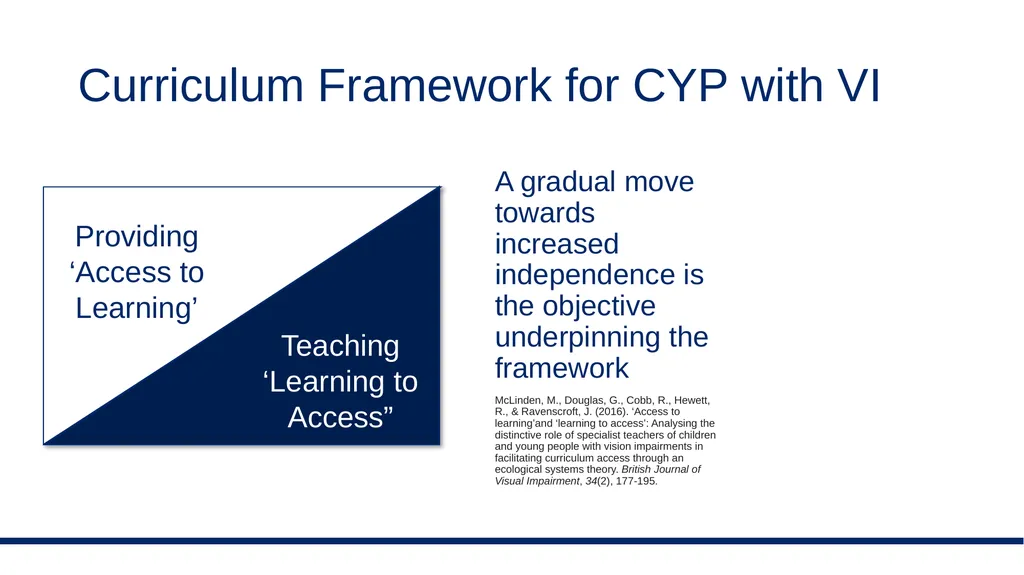
Curriculum Framework for CYP with VI A gradual move towards increased independence is the objective underpinning the framework
McLinden, M., Douglas, G., Cobb, R., Hewett, R., & Ravenscroft, J. (2016). ‘Access to learning’and ‘learning to access’: Analysing the distinctive role of specialist teachers of children and young people with vision impairments in facilitating curriculum access through an ecological systems theory. British Journal of Visual Impairment, 34(2), 177-195. Providing ‘Access to Learning’ Teaching ‘Learning to Access”<br>
McLinden, M., Douglas, G., Cobb, R., Hewett, R., & Ravenscroft, J. (2016). ‘Access to learning’and ‘learning to access’: Analysing the distinctive role of specialist teachers of children and young people with vision impairments in facilitating curriculum access through an ecological systems theory. British Journal of Visual Impairment, 34(2), 177-195. Providing ‘Access to Learning’ Teaching ‘Learning to Access”<br>
06
Overview of barriers Navigating around the college or university, perhaps with cane or guide dog.
Living away from home
Using access technology
Accessing examinations
Work experience and building on the CV<br>
Living away from home
Using access technology
Accessing examinations
Work experience and building on the CV<br>
07
Getting the most out of Further Education – important skills for young people Mobility & Independent living skills (Habilitation)
Understanding access technology
Accessing examinations<br>
Understanding access technology
Accessing examinations<br>
08
Mobility & Independent Living Skills (Habilitation) Habilitation is the process of helping visually impaired children and young people to achieve as much independence as possible in their daily lives. We do this by providing personalised training and support in mobility, orientation and independence. Working across any environment that a child/young person interacts e.g., home, school, college, community and social environments. (Guide Dogs UK) Cane skills (if appropriate)
Accommodating a guide dog
Moving safely around their accommodation and public spaces
Independent living skills: self-care, cooking, managing money, support into employment<br>
Accommodating a guide dog
Moving safely around their accommodation and public spaces
Independent living skills: self-care, cooking, managing money, support into employment<br>
09
Understanding Access Technology Many devices have accessibility built in e.g., smart phones or tablets, others come from specialist suppliers of products designed for people with sight loss e.g., magnification or screen reading software on computers. Like al students, students with a vision impairment have individual learning styles and use technology differently
Students may be new to Access Technology and require training
It is important that key staff (including support staff) can familiarise themselves with the student’s access technology<br>
Students may be new to Access Technology and require training
It is important that key staff (including support staff) can familiarise themselves with the student’s access technology<br>
10
Examinations access FE & HE establishments should familiarise themselves with the VI accessibility guidance from the relevant examining body. As far as possible the exam arrangements should be in line with the student’s normal way of working
Preparation and planning for exams with the student is key, especially if the student is taking exams in a different way than they’ve been used to
Use of technology in exams is permitted e.g., an iPad with the connectivity turned off<br>
Preparation and planning for exams with the student is key, especially if the student is taking exams in a different way than they’ve been used to
Use of technology in exams is permitted e.g., an iPad with the connectivity turned off<br>
11
Resources and useful links Habilitation
Guide Dogs mobility training for children | Guide Dogs
Access Technology
RNIB technology resource hub: facts, tips and guides - RNIB - See differently
Useful assistive and productivity tools for students - Thomas Pocklington Trust (pocklington-trust.org.uk)
Making college accessible - Thomas Pocklington Trust (pocklington-trust.org.uk)
Accessible Technology for students’ webinar to find out what tech is out there:
Accessibility for students webinar https://www.pocklington-trust.org.uk/technology/accessible-technology-for-students/
Exam Access
UCAF best practice Standards - UK Association for Accessible formats (ukaaf.org)
NatSIP exam access NatSIP - Examination access for children and young people with sensory impairment
Exam boards’ exam access guidance e.g., JCQ Access Arrangements, Reasonable Adjustments and Special Consideration - JCQ Joint Council for Qualifications<br>
Guide Dogs mobility training for children | Guide Dogs
Access Technology
RNIB technology resource hub: facts, tips and guides - RNIB - See differently
Useful assistive and productivity tools for students - Thomas Pocklington Trust (pocklington-trust.org.uk)
Making college accessible - Thomas Pocklington Trust (pocklington-trust.org.uk)
Accessible Technology for students’ webinar to find out what tech is out there:
Accessibility for students webinar https://www.pocklington-trust.org.uk/technology/accessible-technology-for-students/
Exam Access
UCAF best practice Standards - UK Association for Accessible formats (ukaaf.org)
NatSIP exam access NatSIP - Examination access for children and young people with sensory impairment
Exam boards’ exam access guidance e.g., JCQ Access Arrangements, Reasonable Adjustments and Special Consideration - JCQ Joint Council for Qualifications<br>
12
Resources and useful links Further Education Support
Five Steps into mainstream college - Thomas Pocklington Trust (pocklington-trust.org.uk)
Transition guidance - Thomas Pocklington Trust (pocklington-trust.org.uk)
Technology and accessibility in further education - Thomas Pocklington Trust (pocklington-trust.org.uk)<br>
Five Steps into mainstream college - Thomas Pocklington Trust (pocklington-trust.org.uk)
Transition guidance - Thomas Pocklington Trust (pocklington-trust.org.uk)
Technology and accessibility in further education - Thomas Pocklington Trust (pocklington-trust.org.uk)<br>
13
Transitioning on University and Employment<br>
14
Steps into university UCAS
Applying for university
Financing your studies
Choosing the right accommodation
Getting support in place
Taking a gap year/deferring
Six Steps into Higher Education - Thomas Pocklington Trust (pocklington-trust.org.uk)<br>
Applying for university
Financing your studies
Choosing the right accommodation
Getting support in place
Taking a gap year/deferring
Six Steps into Higher Education - Thomas Pocklington Trust (pocklington-trust.org.uk)<br>
15
Get the right support in place Disability team
Individual assessment
Discuss exam arrangements
Library support
What systems they use and how accessible they are
We have a list of helpful questions to ask Resources
Getting support in place at university - Thomas Pocklington Trust (pocklington-trust.org.uk) – watch our webinar
Chris, a disability adviser talks through what needs to be considered
Step five: Getting support in place at university - Thomas Pocklington Trust (pocklington-trust.org.uk)<br>
Individual assessment
Discuss exam arrangements
Library support
What systems they use and how accessible they are
We have a list of helpful questions to ask Resources
Getting support in place at university - Thomas Pocklington Trust (pocklington-trust.org.uk) – watch our webinar
Chris, a disability adviser talks through what needs to be considered
Step five: Getting support in place at university - Thomas Pocklington Trust (pocklington-trust.org.uk)<br>
16
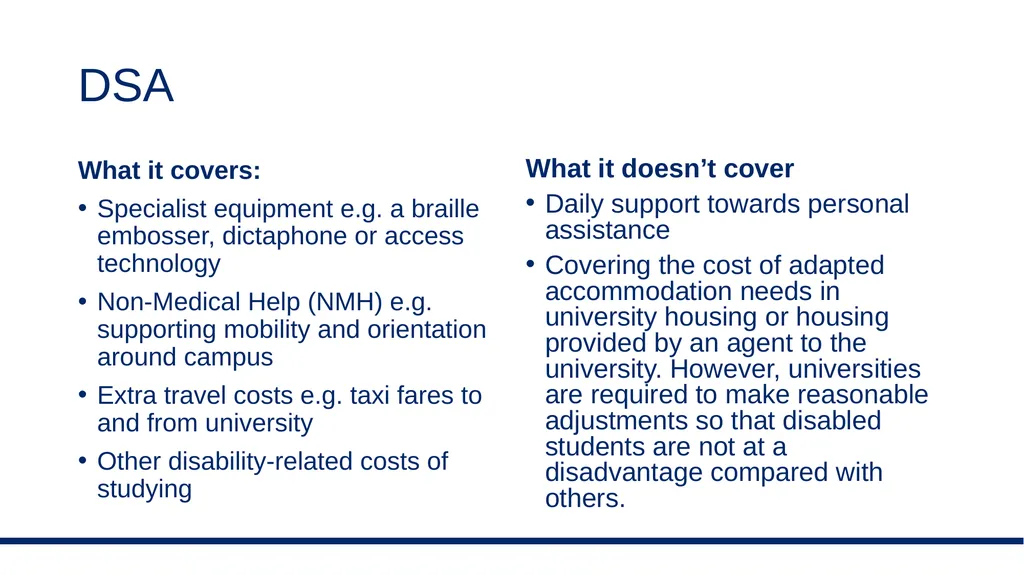
DSA What it covers:
Specialist equipment e.g. a braille embosser, dictaphone or access technology
Non-Medical Help (NMH) e.g. supporting mobility and orientation around campus
Extra travel costs e.g. taxi fares to and from university
Other disability-related costs of studying What it doesn’t cover
Daily support towards personal assistance
Covering the cost of adapted accommodation needs in university housing or housing provided by an agent to the university. However, universities are required to make reasonable adjustments so that disabled students are not at a disadvantage compared with others.<br>
Specialist equipment e.g. a braille embosser, dictaphone or access technology
Non-Medical Help (NMH) e.g. supporting mobility and orientation around campus
Extra travel costs e.g. taxi fares to and from university
Other disability-related costs of studying What it doesn’t cover
Daily support towards personal assistance
Covering the cost of adapted accommodation needs in university housing or housing provided by an agent to the university. However, universities are required to make reasonable adjustments so that disabled students are not at a disadvantage compared with others.<br>
17
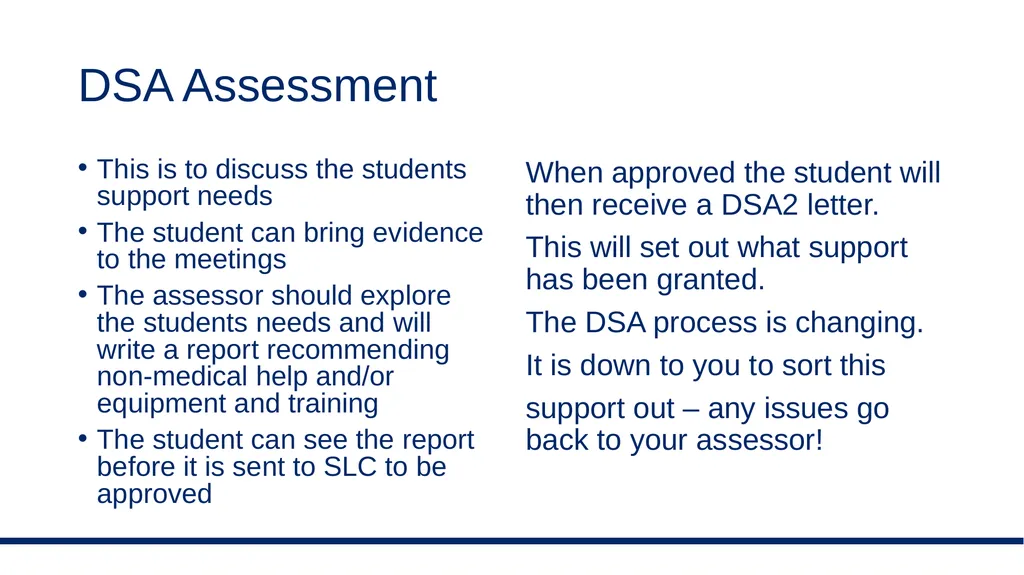
DSA Assessment This is to discuss the students support needs
The student can bring evidence to the meetings
The assessor should explore the students needs and will write a report recommending non-medical help and/or equipment and training
The student can see the report before it is sent to SLC to be approved When approved the student will then receive a DSA2 letter.
This will set out what support has been granted.
The DSA process is changing.
It is down to you to sort this
support out – any issues go back to your assessor!<br>
The student can bring evidence to the meetings
The assessor should explore the students needs and will write a report recommending non-medical help and/or equipment and training
The student can see the report before it is sent to SLC to be approved When approved the student will then receive a DSA2 letter.
This will set out what support has been granted.
The DSA process is changing.
It is down to you to sort this
support out – any issues go back to your assessor!<br>
18
Resources Your DSA application - Thomas Pocklington Trust (pocklington-trust.org.uk)
This includes a webinar presented by SLC on the process
Listen to podcast talking you through the process and everything that you will need to know
Episode 3 - Disabled Students’ Allowance (natsip.org.uk)<br>
This includes a webinar presented by SLC on the process
Listen to podcast talking you through the process and everything that you will need to know
Episode 3 - Disabled Students’ Allowance (natsip.org.uk)<br>
19
Employment Services Blind and partially sighted people work in a variety jobs across all sectors.
RNIB and TPT provide employment resources and support to people with sight loss seeking work and to employers. Resources
RNIB Employment Service
Equality, rights and employment - RNIB - See differently
TPT Employment Service
Employment - Thomas Pocklington Trust (pocklington-trust.org.uk)<br>
RNIB and TPT provide employment resources and support to people with sight loss seeking work and to employers. Resources
RNIB Employment Service
Equality, rights and employment - RNIB - See differently
TPT Employment Service
Employment - Thomas Pocklington Trust (pocklington-trust.org.uk)<br>
20
Case study one Jake
Jake is 19 and is planning to attend his local FE college in September to study for his GCSE Maths, English and ICT.
Jake has Retinitis Pigmentosa, a degenerative eye condition. He is registered as Severely Sight Impaired and is a guide dog user.
Jake has applied to stay in college accommodation as he wants to be as independent as possible. He uses a laptop with the screen reading software JAWS in class. What skills might Jake need for a successful transition to the FE College?
What skills and knowledge might college staff need to support Jake in his studies?<br>
Jake is 19 and is planning to attend his local FE college in September to study for his GCSE Maths, English and ICT.
Jake has Retinitis Pigmentosa, a degenerative eye condition. He is registered as Severely Sight Impaired and is a guide dog user.
Jake has applied to stay in college accommodation as he wants to be as independent as possible. He uses a laptop with the screen reading software JAWS in class. What skills might Jake need for a successful transition to the FE College?
What skills and knowledge might college staff need to support Jake in his studies?<br>
21
Case study two Niamh is 19 and is going to university to study engineering. She has diabetic retinopathy and uses a cane.
She will be moving away from home for the first time. What support should she be looking to put in place?
Who at the university should she be speaking to?<br>
She will be moving away from home for the first time. What support should she be looking to put in place?
Who at the university should she be speaking to?<br>
22
Contact details – TPT Education team TPT Student Support Service:
For anyone bps aged 11+ who is in or entering mainstream secondary, further or higher education.
Studentsupport@pocklington-trust.org.uk
support line on 0203 757 8040
Student support - Thomas Pocklington Trust (pocklington-trust.org.uk)
Join our Student Support Community Facebook group<br>
For anyone bps aged 11+ who is in or entering mainstream secondary, further or higher education.
Studentsupport@pocklington-trust.org.uk
support line on 0203 757 8040
Student support - Thomas Pocklington Trust (pocklington-trust.org.uk)
Join our Student Support Community Facebook group<br>
23
RNIB Contact Details RNIB Helpline
0303 123 9999
helpline@rnib.org.uk
Children, Young People, Families & Education Service
cypf@rnib.org.uk
Website
www.rnib.org.uk<br>
0303 123 9999
helpline@rnib.org.uk
Children, Young People, Families & Education Service
cypf@rnib.org.uk
Website
www.rnib.org.uk<br>