
BLM workshop feedback; further steps for the

Description: BLM workshop feedback; further steps for the council and BEA July 2020 Key words of how attendees felt at the beginning of the workshop Poll Results 1. Do you feel comfortable raising issues relating to equality and diversity in the
Related Topics
Download Presentation
"BLM workshop feedback; further steps for the" is the property of its rightful owner. Permission is granted to download and print the materials on this website for personal, non-commercial use only, and to display it on your personal computer provided you do not modify the materials and that you retain all copyright notices contained in the materials. By downloading content from our website, you accept the terms of this agreement.
Presentation Transcript
slide1. BLM workshop feedback; further steps for the council and BEA July 2020<br>
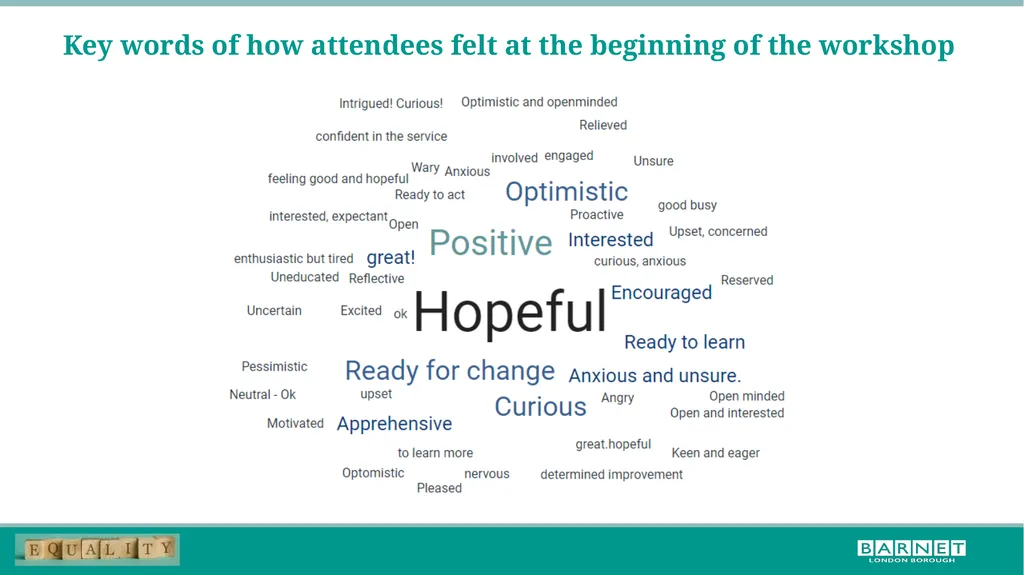
slide2. Key words of how attendees felt at the beginning of the workshop<br>
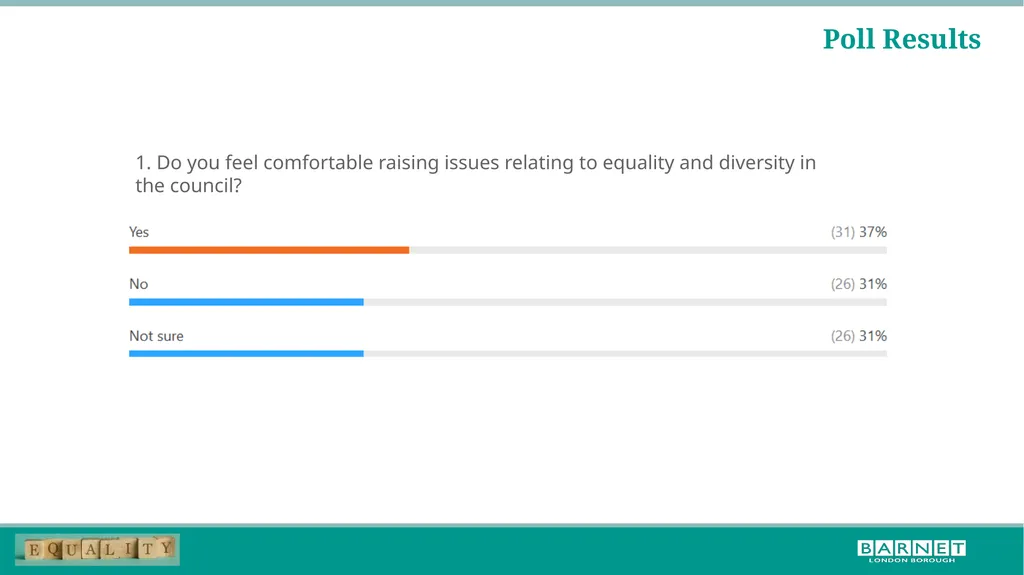
slide3. Poll Results 1. Do you feel comfortable raising issues relating to equality and diversity in the council?<br>
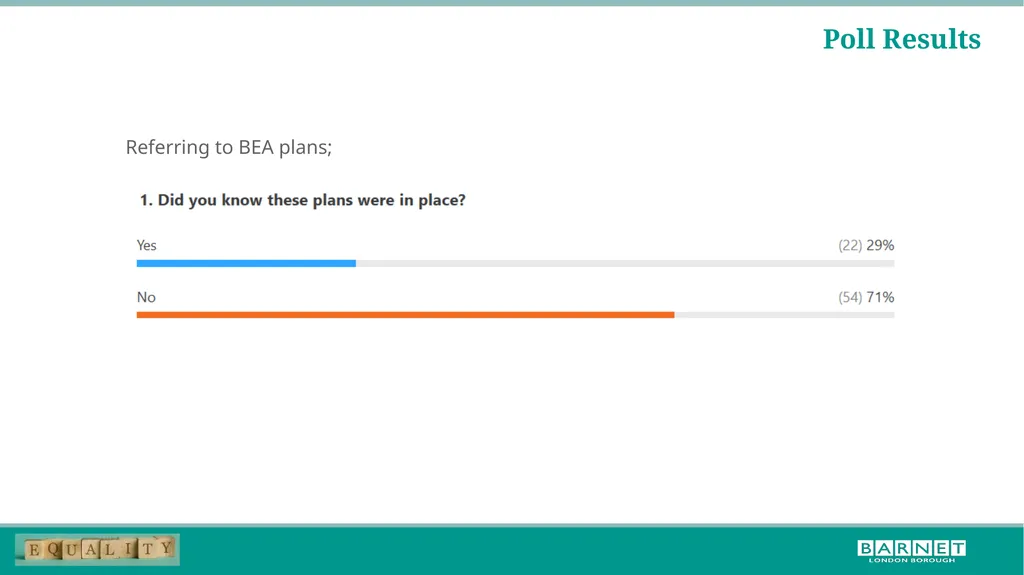
slide4. Poll Results Referring to BEA plans;<br>
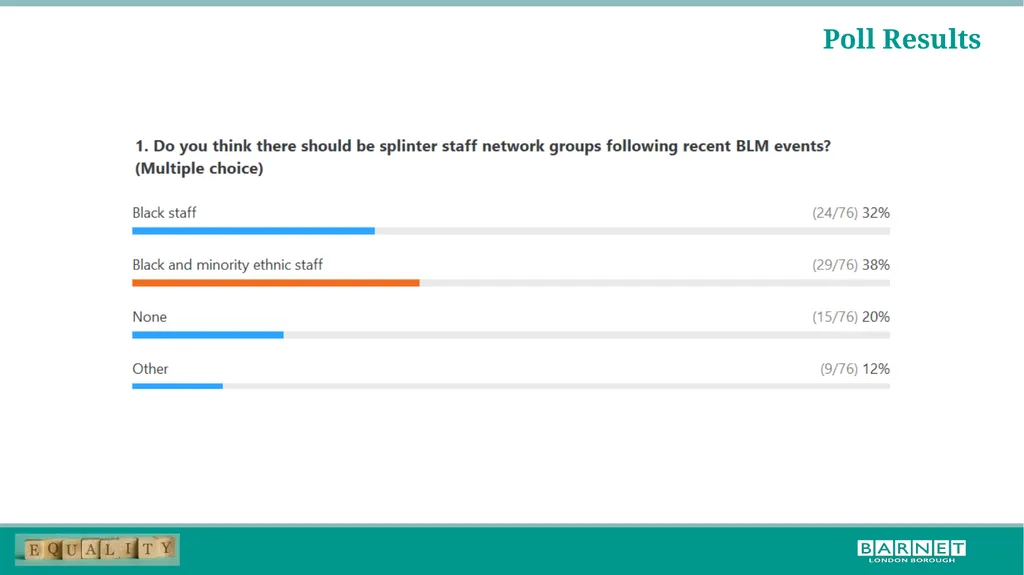
slide5. Poll Results<br>
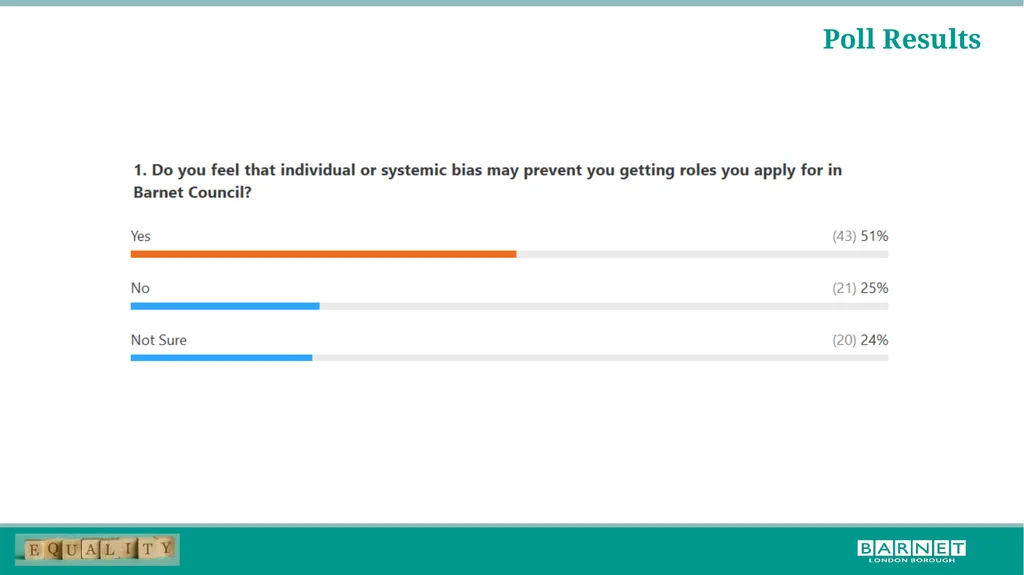
slide6. Poll Results<br>
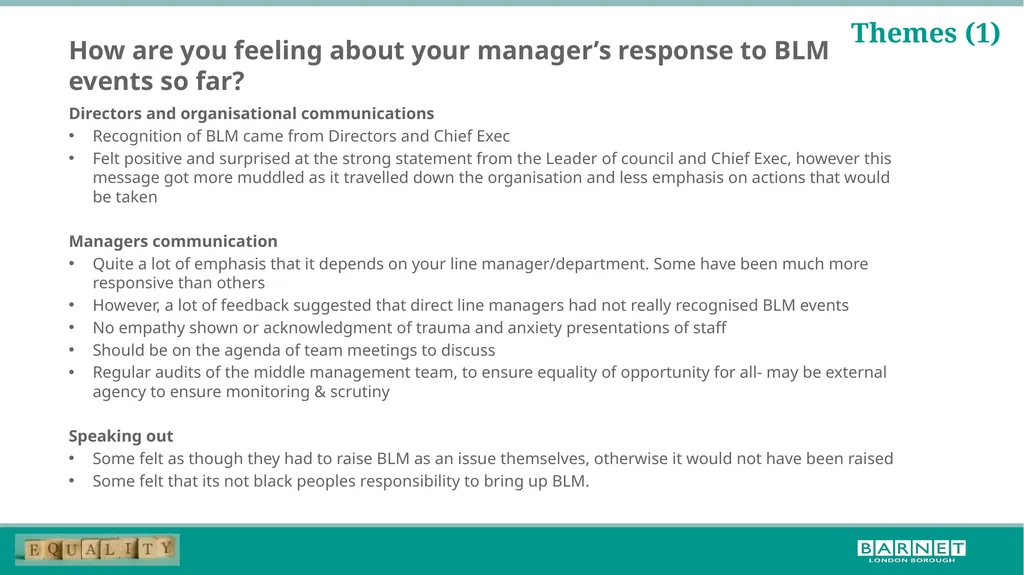
slide7. Themes (1) Directors and organisational communications
Recognition of BLM came from Directors and Chief Exec
Felt positive and surprised at the strong statement from the Leader of council and Chief Exec, however this message got more muddled as it travelled down the organisation and less emphasis on actions that would be taken
Managers communication
Quite a lot of emphasis that it depends on your line manager/department. Some have been much more responsive than others
However, a lot of feedback suggested that direct line managers had not really recognised BLM events
No empathy shown or acknowledgment of trauma and anxiety presentations of staff
Should be on the agenda of team meetings to discuss
Regular audits of the middle management team, to ensure equality of opportunity for all- may be external agency to ensure monitoring & scrutiny
Speaking out
Some felt as though they had to raise BLM as an issue themselves, otherwise it would not have been raised
Some felt that its not black peoples responsibility to bring up BLM. How are you feeling about your manager’s response to BLM events so far?<br>
slide8. Strengths
The work of BEA recently has produced a lot of positive response, with the sense being that this needs to continue and not become tokenistic.
Resource sharing on yammer has been useful
Impressed by events that are going on e.g. Black History Month.
Social work teams- strength based practise. Asking individual about backgrounds, what they would like to have, what services they can use
Improvements - understanding, leaders training and diversity
Can seem tokenistic if not backed up with systemic change and diversity being reflected in senior management UNITAS and youth pages are diverse, although this not reflected in adult corporate web pages
No tangible change since the Managers session in 2018. Leaders and councillors need training. Do they understand the issues or are they just being PC
Idea floated to have a cultural calendar – put diversity dates automatically onto outlook.
Opportunities to get on
Perception and stories being shared about recruitment and not getting equal opportunities at promotion. i.e. Interims who’s jobs have not been open to other people to apply. Fixed term contracts and jobs not being advertised fairly. Themes (2) What are the strengths in the Council’s EDI approach and what can be improved ?<br>
slide9. Recognition of BLM by directors & managers
Good and timely messages from the Chief Exec and Leader being delivered in May
Good response from BEA
Needs a lot of work doing to improve in the future
The aforementioned response from direct line mangers needs to change
Mixed positive and negative feelings, but a lot of focus on the next steps and if there will be tangible change in the council
Mixed response at director level. i.e. one director has responded plus reached out and others have said nothing at all.
Outward facing
How can we be better at celebrating black and minority groups at Barnet?
Acknowledge that the EDI steering group needs to be better at publishing/sharing notes. There's a need to get better at updating people what’s going on.
We need to capture residents’ responses to BLM & EDI
Engage the councils many partners in this process – they need to follow suit.
Councillors need to be included and part of this training too. There are clear disparities – no diversity across senior management and above.
Action will be taken
Need independent monitoring there are genuine prejudices constantly being overlooked for promotions and within recruitment.
Structural changes need to place within the council
Recruitment - do BAME feel comfortable in going for promotions?
Conduct more workshops like this Themes (3) How are you feeling about the Council’s response to recent BLM events so far?<br>
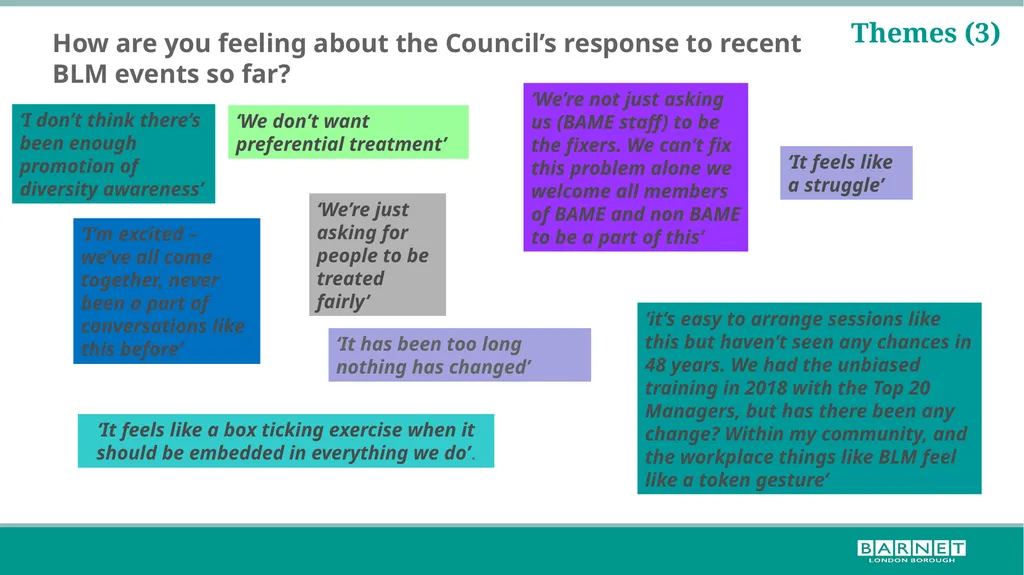
slide10. ‘We don’t want preferential treatment’ ‘We’re not just asking us (BAME staff) to be the fixers. We can’t fix this problem alone we welcome all members of BAME and non BAME to be a part of this’ ‘It feels like a struggle’ ‘I don’t think there’s been enough promotion of diversity awareness’ ‘We’re just asking for people to be treated fairly’ ‘I’m excited – we’ve all come together, never been a part of conversations like this before’ ‘It has been too long nothing has changed’ ‘It feels like a box ticking exercise when it should be embedded in everything we do’. How are you feeling about the Council’s response to recent BLM events so far? ‘it’s easy to arrange sessions like this but haven’t seen any chances in 48 years. We had the unbiased training in 2018 with the Top 20 Managers, but has there been any change? Within my community, and the workplace things like BLM feel like a token gesture’ Themes (3)<br>
slide11. What do you need to see change in the Council’s EDI approach?
Structural change
Currently there is too much tokenism within the Council’s treatment of equality and diversity. This needs to be addressed and tackled to achieve real change.
Unconscious bias training to be mandatory and a review of HR policies
There should be a greater sharing of useful resources
Better data to track progress and regular training for all staff.
Changes in HR policy required - interview panels need to be more diverse, exit interviews, more diverse grad schemes, breaking of the ‘glass ceiling’ that BAME members of staff feel there is
Being treated fairly and feeling supported
Zero tolerance to racism whether it’s overt racism or micro aggression. There is a feeling that people cannot advocate for positions without being labelled as aggressive. Need to look at ways in which people can anonymously raise incidents of microaggression/overt racism in the workplace and encouraging a culture of supporting/reporting incidents if witnessed.
Open conversations needed (regular inclusion in team meetings), as well as safe forums for people to share their experiences.
Diversity of senior leadership
Representation in senior leadership; the lack of representation in SMT is demotivating and there is a belief that opportunities are not open to all Themes (4)<br>
slide12. Aspirational targets
Publicly available data
Encourage employees to disclose information
Mandatory unconscious bias training
Unconscious bias workshops for executives and middle management teams
Executive sponsorship: an SMT member accountable for delivery of aspirational targets
Reverse mentoring
Challenge school and university selection bias
Use relevant and appropriate language in job specifications
Diverse interview panels
Transparent and fair reward and recognition
Diversity in supply chains
Diversity from work experience level
Transparency on career pathways
Explain how success has been achieved
Establish networks and these networks to regularly meet with HR
Provide mentoring and sponsorship
‘What’s on your mind’ regular listening circle for staff
Include the equalities/diversity calendar events on all staff’s calendars
Ensuring psychologically safe routes for raising concerns (specifically by appointing Freedom to Speak Up Guardians)
Exit interviews Recommendations from BEA about moving forwards as an organisation<br>
slide13. BEA Next Steps<br>
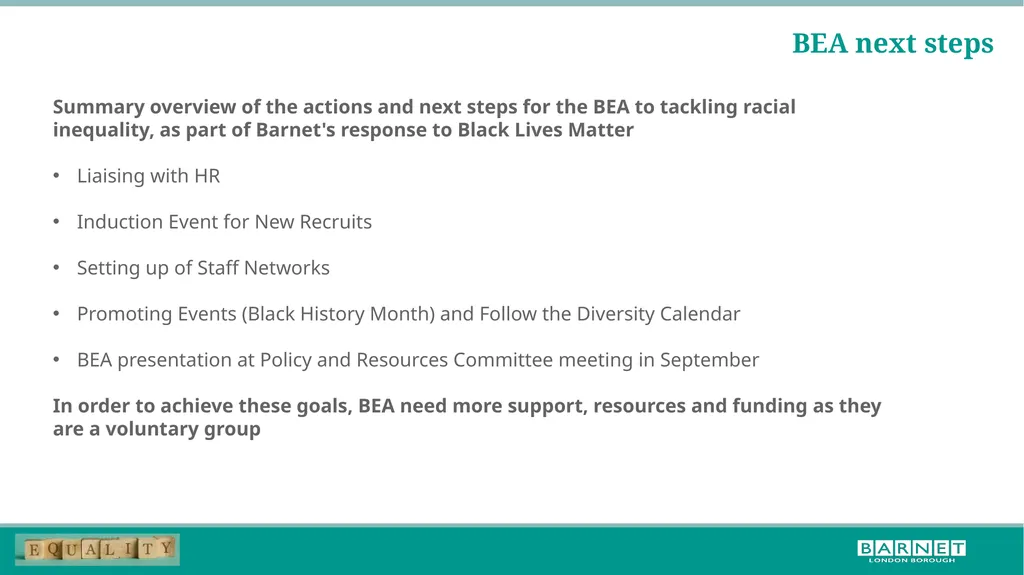
slide14. Summary overview of the actions and next steps for the BEA to tackling racial inequality, as part of Barnet's response to Black Lives Matter
Liaising with HR
Induction Event for New Recruits
Setting up of Staff Networks
Promoting Events (Black History Month) and Follow the Diversity Calendar
BEA presentation at Policy and Resources Committee meeting in September
In order to achieve these goals, BEA need more support, resources and funding as they are a voluntary group BEA next steps<br>
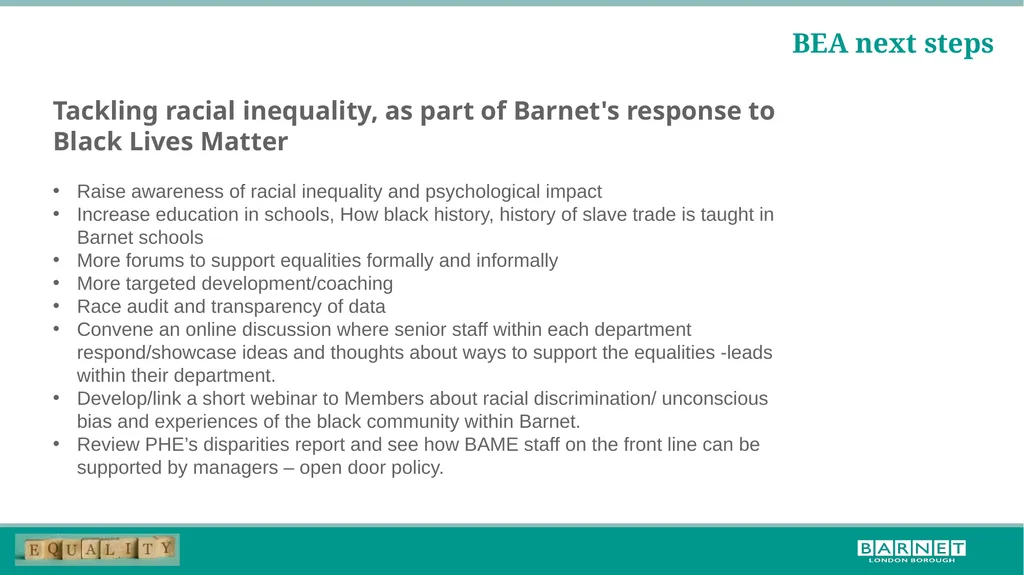
slide15. Tackling racial inequality, as part of Barnet's response to Black Lives Matter
Raise awareness of racial inequality and psychological impact
Increase education in schools, How black history, history of slave trade is taught in Barnet schools
More forums to support equalities formally and informally
More targeted development/coaching
Race audit and transparency of data
Convene an online discussion where senior staff within each department respond/showcase ideas and thoughts about ways to support the equalities -leads within their department.
Develop/link a short webinar to Members about racial discrimination/ unconscious bias and experiences of the black community within Barnet.
Review PHE’s disparities report and see how BAME staff on the front line can be supported by managers – open door policy. BEA next steps<br>
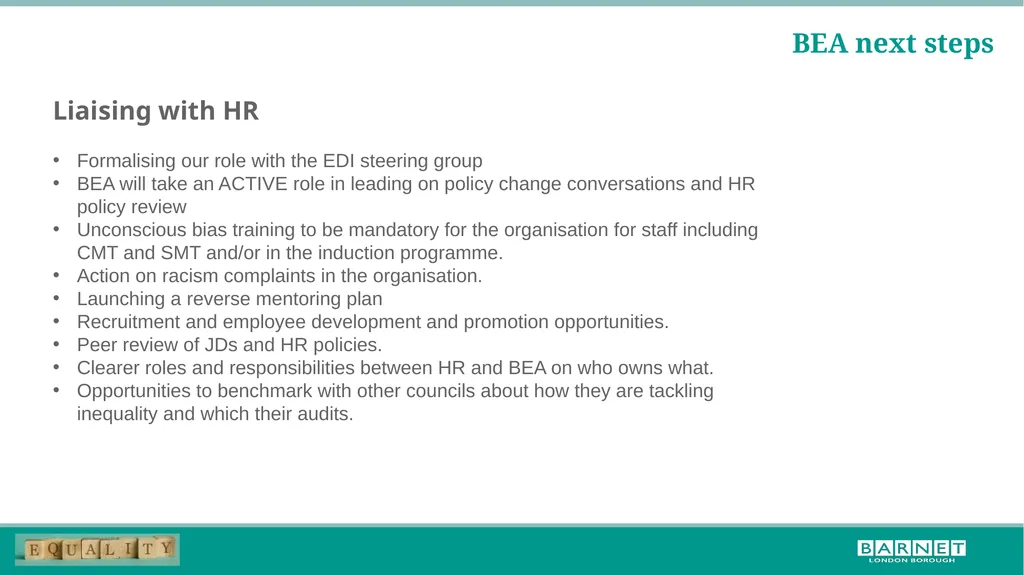
slide16. Liaising with HR
Formalising our role with the EDI steering group
BEA will take an ACTIVE role in leading on policy change conversations and HR policy review
Unconscious bias training to be mandatory for the organisation for staff including CMT and SMT and/or in the induction programme.
Action on racism complaints in the organisation.
Launching a reverse mentoring plan
Recruitment and employee development and promotion opportunities.
Peer review of JDs and HR policies.
Clearer roles and responsibilities between HR and BEA on who owns what.
Opportunities to benchmark with other councils about how they are tackling inequality and which their audits. BEA next steps<br>
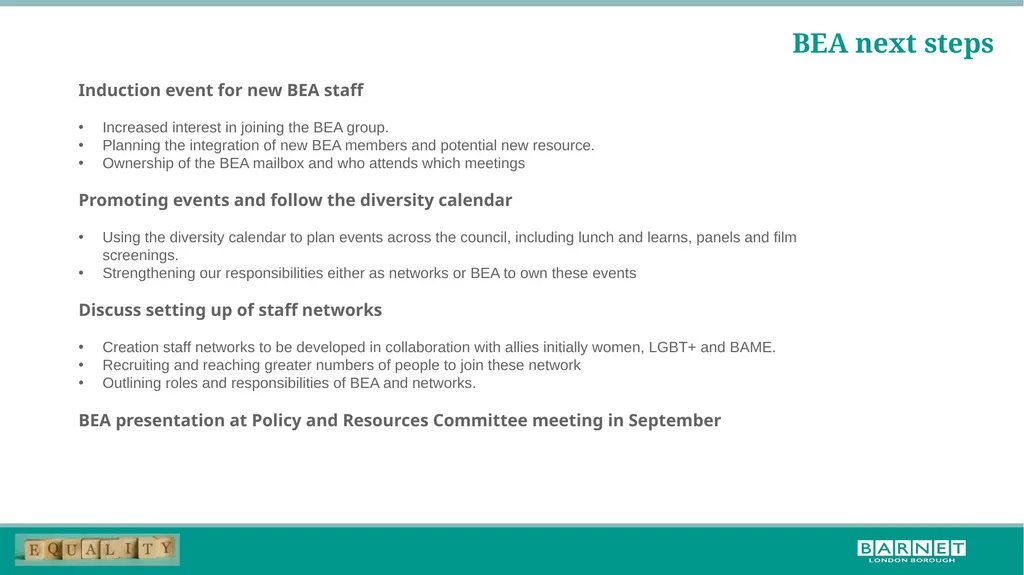
slide17. BEA next steps Induction event for new BEA staff
Increased interest in joining the BEA group.
Planning the integration of new BEA members and potential new resource.
Ownership of the BEA mailbox and who attends which meetings
Promoting events and follow the diversity calendar
Using the diversity calendar to plan events across the council, including lunch and learns, panels and film screenings.
Strengthening our responsibilities either as networks or BEA to own these events
Discuss setting up of staff networks
Creation staff networks to be developed in collaboration with allies initially women, LGBT+ and BAME.
Recruiting and reaching greater numbers of people to join these network
Outlining roles and responsibilities of BEA and networks.
BEA presentation at Policy and Resources Committee meeting in September<br>
slide2. Key words of how attendees felt at the beginning of the workshop<br>
slide3. Poll Results 1. Do you feel comfortable raising issues relating to equality and diversity in the council?<br>
slide4. Poll Results Referring to BEA plans;<br>
slide5. Poll Results<br>
slide6. Poll Results<br>
slide7. Themes (1) Directors and organisational communications
Recognition of BLM came from Directors and Chief Exec
Felt positive and surprised at the strong statement from the Leader of council and Chief Exec, however this message got more muddled as it travelled down the organisation and less emphasis on actions that would be taken
Managers communication
Quite a lot of emphasis that it depends on your line manager/department. Some have been much more responsive than others
However, a lot of feedback suggested that direct line managers had not really recognised BLM events
No empathy shown or acknowledgment of trauma and anxiety presentations of staff
Should be on the agenda of team meetings to discuss
Regular audits of the middle management team, to ensure equality of opportunity for all- may be external agency to ensure monitoring & scrutiny
Speaking out
Some felt as though they had to raise BLM as an issue themselves, otherwise it would not have been raised
Some felt that its not black peoples responsibility to bring up BLM. How are you feeling about your manager’s response to BLM events so far?<br>
slide8. Strengths
The work of BEA recently has produced a lot of positive response, with the sense being that this needs to continue and not become tokenistic.
Resource sharing on yammer has been useful
Impressed by events that are going on e.g. Black History Month.
Social work teams- strength based practise. Asking individual about backgrounds, what they would like to have, what services they can use
Improvements - understanding, leaders training and diversity
Can seem tokenistic if not backed up with systemic change and diversity being reflected in senior management UNITAS and youth pages are diverse, although this not reflected in adult corporate web pages
No tangible change since the Managers session in 2018. Leaders and councillors need training. Do they understand the issues or are they just being PC
Idea floated to have a cultural calendar – put diversity dates automatically onto outlook.
Opportunities to get on
Perception and stories being shared about recruitment and not getting equal opportunities at promotion. i.e. Interims who’s jobs have not been open to other people to apply. Fixed term contracts and jobs not being advertised fairly. Themes (2) What are the strengths in the Council’s EDI approach and what can be improved ?<br>
slide9. Recognition of BLM by directors & managers
Good and timely messages from the Chief Exec and Leader being delivered in May
Good response from BEA
Needs a lot of work doing to improve in the future
The aforementioned response from direct line mangers needs to change
Mixed positive and negative feelings, but a lot of focus on the next steps and if there will be tangible change in the council
Mixed response at director level. i.e. one director has responded plus reached out and others have said nothing at all.
Outward facing
How can we be better at celebrating black and minority groups at Barnet?
Acknowledge that the EDI steering group needs to be better at publishing/sharing notes. There's a need to get better at updating people what’s going on.
We need to capture residents’ responses to BLM & EDI
Engage the councils many partners in this process – they need to follow suit.
Councillors need to be included and part of this training too. There are clear disparities – no diversity across senior management and above.
Action will be taken
Need independent monitoring there are genuine prejudices constantly being overlooked for promotions and within recruitment.
Structural changes need to place within the council
Recruitment - do BAME feel comfortable in going for promotions?
Conduct more workshops like this Themes (3) How are you feeling about the Council’s response to recent BLM events so far?<br>
slide10. ‘We don’t want preferential treatment’ ‘We’re not just asking us (BAME staff) to be the fixers. We can’t fix this problem alone we welcome all members of BAME and non BAME to be a part of this’ ‘It feels like a struggle’ ‘I don’t think there’s been enough promotion of diversity awareness’ ‘We’re just asking for people to be treated fairly’ ‘I’m excited – we’ve all come together, never been a part of conversations like this before’ ‘It has been too long nothing has changed’ ‘It feels like a box ticking exercise when it should be embedded in everything we do’. How are you feeling about the Council’s response to recent BLM events so far? ‘it’s easy to arrange sessions like this but haven’t seen any chances in 48 years. We had the unbiased training in 2018 with the Top 20 Managers, but has there been any change? Within my community, and the workplace things like BLM feel like a token gesture’ Themes (3)<br>
slide11. What do you need to see change in the Council’s EDI approach?
Structural change
Currently there is too much tokenism within the Council’s treatment of equality and diversity. This needs to be addressed and tackled to achieve real change.
Unconscious bias training to be mandatory and a review of HR policies
There should be a greater sharing of useful resources
Better data to track progress and regular training for all staff.
Changes in HR policy required - interview panels need to be more diverse, exit interviews, more diverse grad schemes, breaking of the ‘glass ceiling’ that BAME members of staff feel there is
Being treated fairly and feeling supported
Zero tolerance to racism whether it’s overt racism or micro aggression. There is a feeling that people cannot advocate for positions without being labelled as aggressive. Need to look at ways in which people can anonymously raise incidents of microaggression/overt racism in the workplace and encouraging a culture of supporting/reporting incidents if witnessed.
Open conversations needed (regular inclusion in team meetings), as well as safe forums for people to share their experiences.
Diversity of senior leadership
Representation in senior leadership; the lack of representation in SMT is demotivating and there is a belief that opportunities are not open to all Themes (4)<br>
slide12. Aspirational targets
Publicly available data
Encourage employees to disclose information
Mandatory unconscious bias training
Unconscious bias workshops for executives and middle management teams
Executive sponsorship: an SMT member accountable for delivery of aspirational targets
Reverse mentoring
Challenge school and university selection bias
Use relevant and appropriate language in job specifications
Diverse interview panels
Transparent and fair reward and recognition
Diversity in supply chains
Diversity from work experience level
Transparency on career pathways
Explain how success has been achieved
Establish networks and these networks to regularly meet with HR
Provide mentoring and sponsorship
‘What’s on your mind’ regular listening circle for staff
Include the equalities/diversity calendar events on all staff’s calendars
Ensuring psychologically safe routes for raising concerns (specifically by appointing Freedom to Speak Up Guardians)
Exit interviews Recommendations from BEA about moving forwards as an organisation<br>
slide13. BEA Next Steps<br>
slide14. Summary overview of the actions and next steps for the BEA to tackling racial inequality, as part of Barnet's response to Black Lives Matter
Liaising with HR
Induction Event for New Recruits
Setting up of Staff Networks
Promoting Events (Black History Month) and Follow the Diversity Calendar
BEA presentation at Policy and Resources Committee meeting in September
In order to achieve these goals, BEA need more support, resources and funding as they are a voluntary group BEA next steps<br>
slide15. Tackling racial inequality, as part of Barnet's response to Black Lives Matter
Raise awareness of racial inequality and psychological impact
Increase education in schools, How black history, history of slave trade is taught in Barnet schools
More forums to support equalities formally and informally
More targeted development/coaching
Race audit and transparency of data
Convene an online discussion where senior staff within each department respond/showcase ideas and thoughts about ways to support the equalities -leads within their department.
Develop/link a short webinar to Members about racial discrimination/ unconscious bias and experiences of the black community within Barnet.
Review PHE’s disparities report and see how BAME staff on the front line can be supported by managers – open door policy. BEA next steps<br>
slide16. Liaising with HR
Formalising our role with the EDI steering group
BEA will take an ACTIVE role in leading on policy change conversations and HR policy review
Unconscious bias training to be mandatory for the organisation for staff including CMT and SMT and/or in the induction programme.
Action on racism complaints in the organisation.
Launching a reverse mentoring plan
Recruitment and employee development and promotion opportunities.
Peer review of JDs and HR policies.
Clearer roles and responsibilities between HR and BEA on who owns what.
Opportunities to benchmark with other councils about how they are tackling inequality and which their audits. BEA next steps<br>
slide17. BEA next steps Induction event for new BEA staff
Increased interest in joining the BEA group.
Planning the integration of new BEA members and potential new resource.
Ownership of the BEA mailbox and who attends which meetings
Promoting events and follow the diversity calendar
Using the diversity calendar to plan events across the council, including lunch and learns, panels and film screenings.
Strengthening our responsibilities either as networks or BEA to own these events
Discuss setting up of staff networks
Creation staff networks to be developed in collaboration with allies initially women, LGBT+ and BAME.
Recruiting and reaching greater numbers of people to join these network
Outlining roles and responsibilities of BEA and networks.
BEA presentation at Policy and Resources Committee meeting in September<br>