
Block 4: Financing of energy efficiency projects
YM
Published · 16 slides · 0 views
1 / 1

Description
Block 4: Financing of energy efficiency projects 4.1 Financial sources in general D.T4.4.1 e-learning course FEEDSCHOOLS, by HEP ESCO Block 4: Financing of energy efficiEncy projects This block is part of a training package developed to
Related Topics
Share
Embed code
Download this presentation From Below
"Block 4: Financing of energy efficiency projects" is the property of its rightful owner. Permission is granted to download and print the materials on this website for personal, non-commercial use only, and to display it on your personal computer provided you do not modify the materials and that you retain all copyright notices contained in the materials. By downloading content from our website, you accept the terms of this agreement.
Presentation Transcript
01
Block 4: Financing of energy efficiency projects
4.1 Financial sources in general D.T4.4.1 e-learning course FEEDSCHOOLS, by HEP ESCO<br>
4.1 Financial sources in general D.T4.4.1 e-learning course FEEDSCHOOLS, by HEP ESCO<br>
02
Block 4: Financing of energy efficiEncy projects This block is part of a training package developed to provide local authorities with free tuition that may inspire and help them in adopting new technical and financial solutions to implement ‘nearly Zero Energy Building’ (NZEB) renovation activities in schools.
After an Overview of possible financial sources for EE projects, this block will introduce Financial sources for EE projects, Comparative analysis of possible financial sources and Available and acceptable financing shemes (Country analysis).
Beginner: No special knowledge is needed<br>
After an Overview of possible financial sources for EE projects, this block will introduce Financial sources for EE projects, Comparative analysis of possible financial sources and Available and acceptable financing shemes (Country analysis).
Beginner: No special knowledge is needed<br>
03
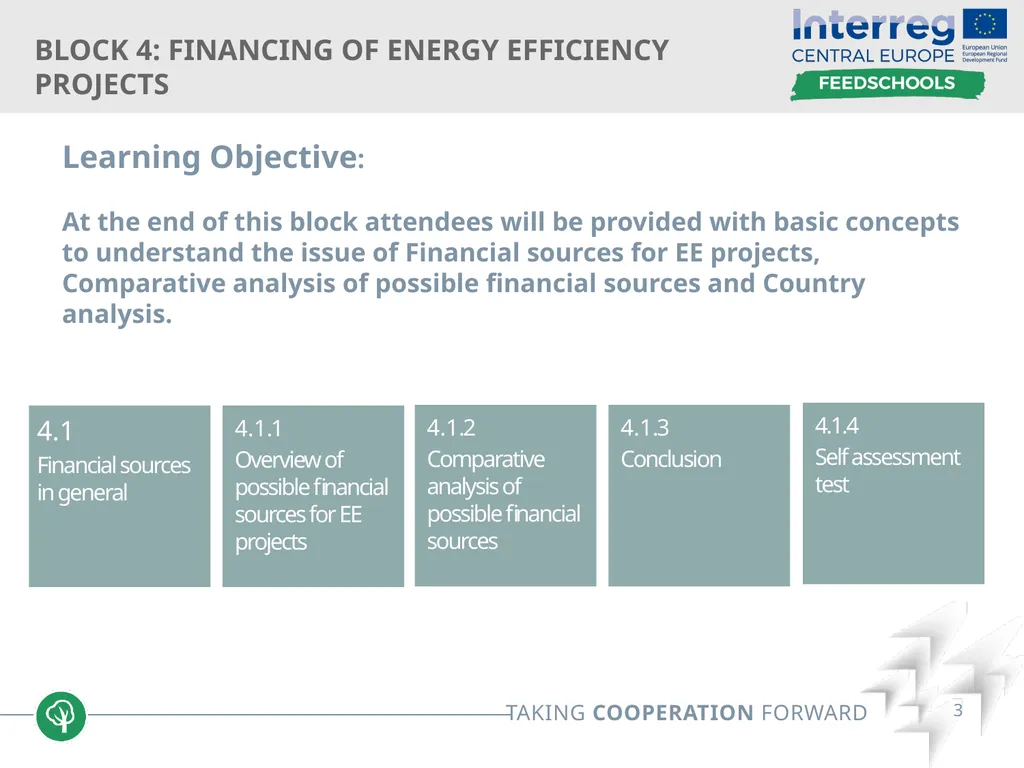
Block 4: Financing of energy efficiency projects 4.1
Financial sources in general 4.1.1
Overview of possible financial sources for EE projects 4.1.2
Comparative analysis of possible financial sources 4.1.3
Conclusion Learning Objective:
At the end of this block attendees will be provided with basic concepts to understand the issue of Financial sources for EE projects, Comparative analysis of possible financial sources and Country analysis. 4.1.4
Self assessment test<br>
04
4.1
Financial sources in general 4.1 Objective
After an Overview of possible financial sources for EE projects, this block will introduce Financial sources for EE projects, Comparative analysis of possible financial sources and Available and acceptable financing shemes (Country analysis) Block 4: Financing of energy efficiency projects<br>
05
4.1.1 Overview of possible financial sources for EE projects Own (budget) financing
Traditional financing of projects in cities and municipalities relies dominantly on the use of own budget
Challenges:
insufficient revenue base with which to fund projects
dependence on revenue transfers from regional or national governments (risk)
This introduces further uncertainties and makes commitment to multi-year programs of capital expenditures more difficult<br>
06
4.1.1 Overview of possible financial sources for EE projects Credit (loan) financing
National governments often impose limits on borrowing by municipalities to prevent them getting into financial difficulties and lead to uncontrolled increase of the public debt – > debt limitations
EE projects are not typical capital expenditure projects that can be readily assessed and approved by higher authorities
EE projects, with relatively low public profiles, are likely to have a lower priority than other pressing or mandated needs
Soft loans are dedicated credit lines for EE measures extended to end users at preferential terms in terms of maturity and/or interest rates - often provided by national or international development banks (e.g. EIB, EBRD) and further distributed to designated markets through regional partner retail banks
.<br>
07
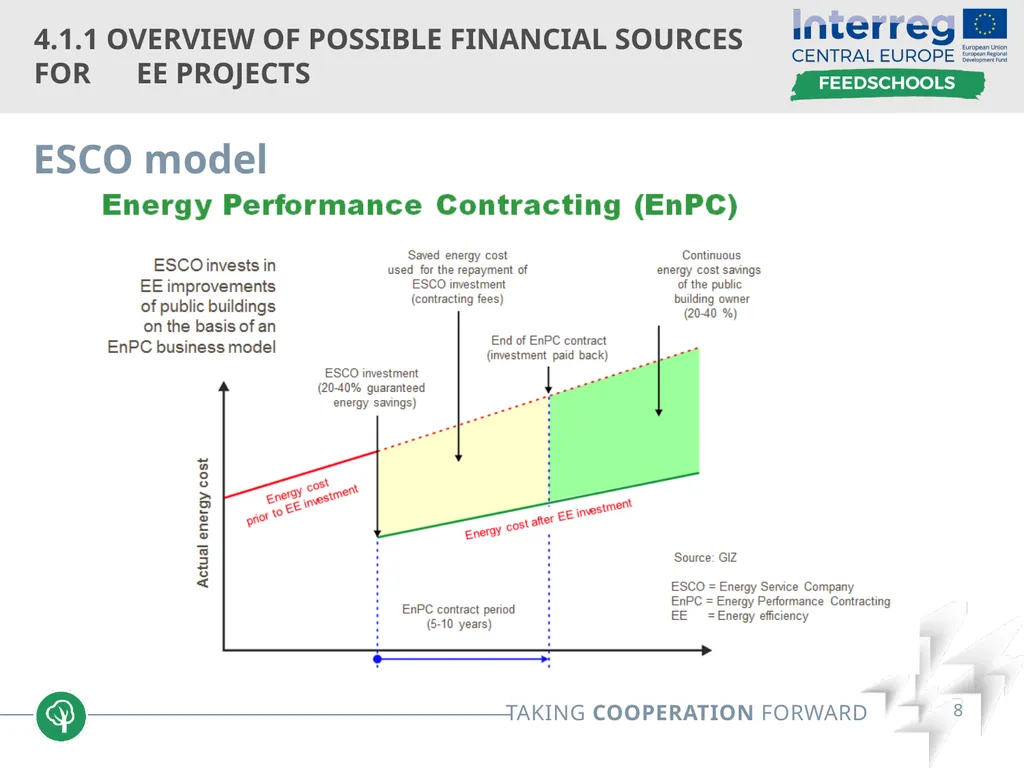
4.1.1 Overview of possible financial sources for EE projects ESCO model
ESCOs are companies that work on a basis of energy performance contracts
ESCO is responsible for optimizing building services systems and system operations in existing buildings across all branches of construction and maintenance
ESCO is a guarantees level of savings over a defined period
Before a tender is made, an energy cost baseline is determined for facility
Proceeding from the energy cost baseline, the ESCO guarantees an annual energy cost savings (in EUR, calculated on a fixed price basis with the energy prices of the reference year) to the customer over the entire contract period
A fixed proportion of these guaranteed savings is set as the contracting fee, which the ESCO receives from the client to finance the investment. Usually, the fee is set lower that the guaranteed saving in order for client to immediately benefit from savings.
.<br>
08
4.1.1 Overview of possible financial sources for EE projects ESCO model<br>
09
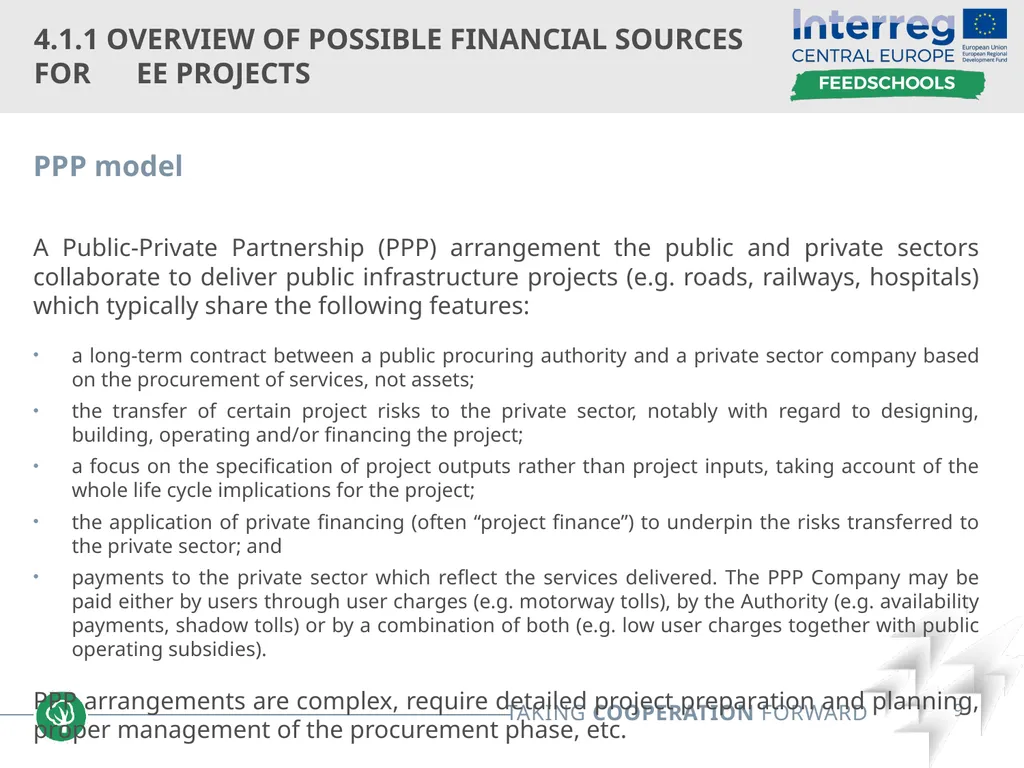
4.1.1 Overview of possible financial sources for EE projects PPP model
A Public-Private Partnership (PPP) arrangement the public and private sectors collaborate to deliver public infrastructure projects (e.g. roads, railways, hospitals) which typically share the following features:
a long-term contract between a public procuring authority and a private sector company based on the procurement of services, not assets;
the transfer of certain project risks to the private sector, notably with regard to designing, building, operating and/or financing the project;
a focus on the specification of project outputs rather than project inputs, taking account of the whole life cycle implications for the project;
the application of private financing (often “project finance”) to underpin the risks transferred to the private sector; and
payments to the private sector which reflect the services delivered. The PPP Company may be paid either by users through user charges (e.g. motorway tolls), by the Authority (e.g. availability payments, shadow tolls) or by a combination of both (e.g. low user charges together with public operating subsidies).
PPP arrangements are complex, require detailed project preparation and planning, proper management of the procurement phase, etc.<br>
10
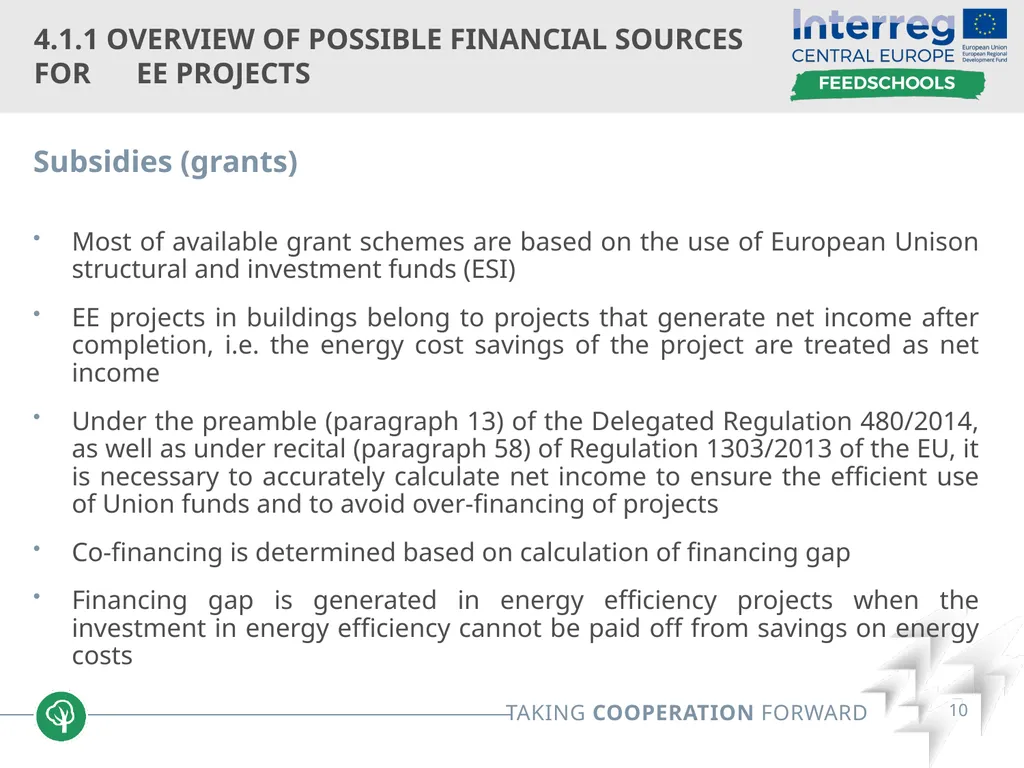
4.1.1 Overview of possible financial sources for EE projects Subsidies (grants)
Most of available grant schemes are based on the use of European Unison structural and investment funds (ESI)
EE projects in buildings belong to projects that generate net income after completion, i.e. the energy cost savings of the project are treated as net income
Under the preamble (paragraph 13) of the Delegated Regulation 480/2014, as well as under recital (paragraph 58) of Regulation 1303/2013 of the EU, it is necessary to accurately calculate net income to ensure the efficient use of Union funds and to avoid over-financing of projects
Co-financing is determined based on calculation of financing gap
Financing gap is generated in energy efficiency projects when the investment in energy efficiency cannot be paid off from savings on energy costs<br>
11
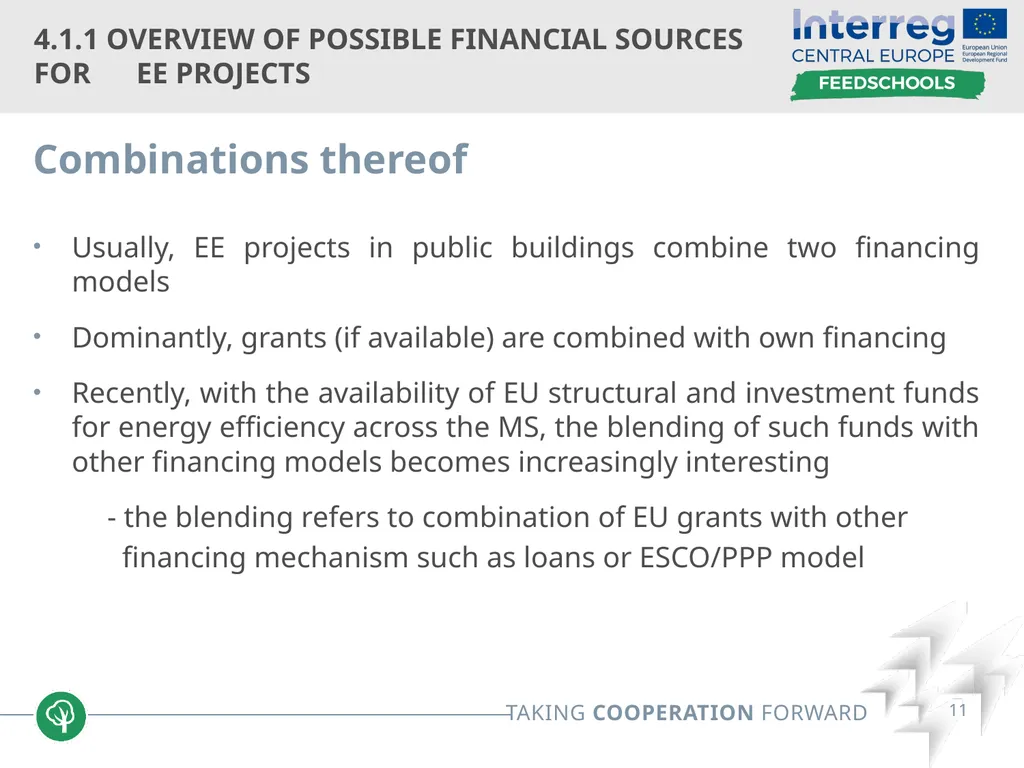
4.1.1 Overview of possible financial sources for EE projects Combinations thereof
Usually, EE projects in public buildings combine two financing models
Dominantly, grants (if available) are combined with own financing
Recently, with the availability of EU structural and investment funds for energy efficiency across the MS, the blending of such funds with other financing models becomes increasingly interesting
- the blending refers to combination of EU grants with other
financing mechanism such as loans or ESCO/PPP model<br>
12
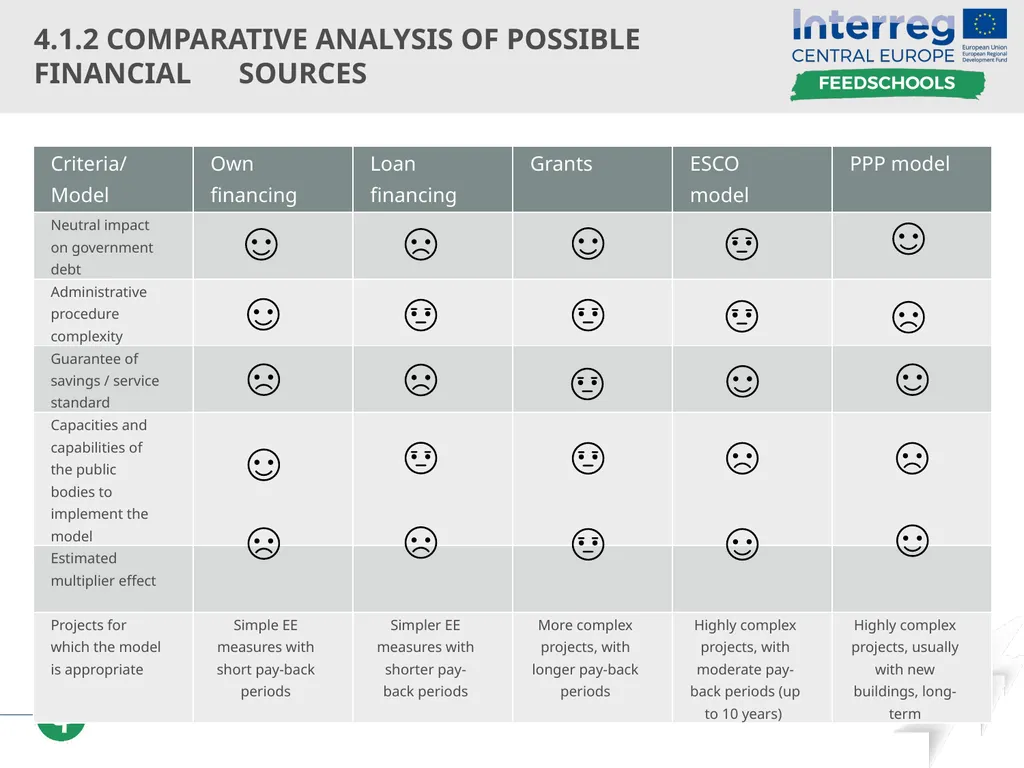
4.1.2 Comparative analysis of possible financial sources<br>
13
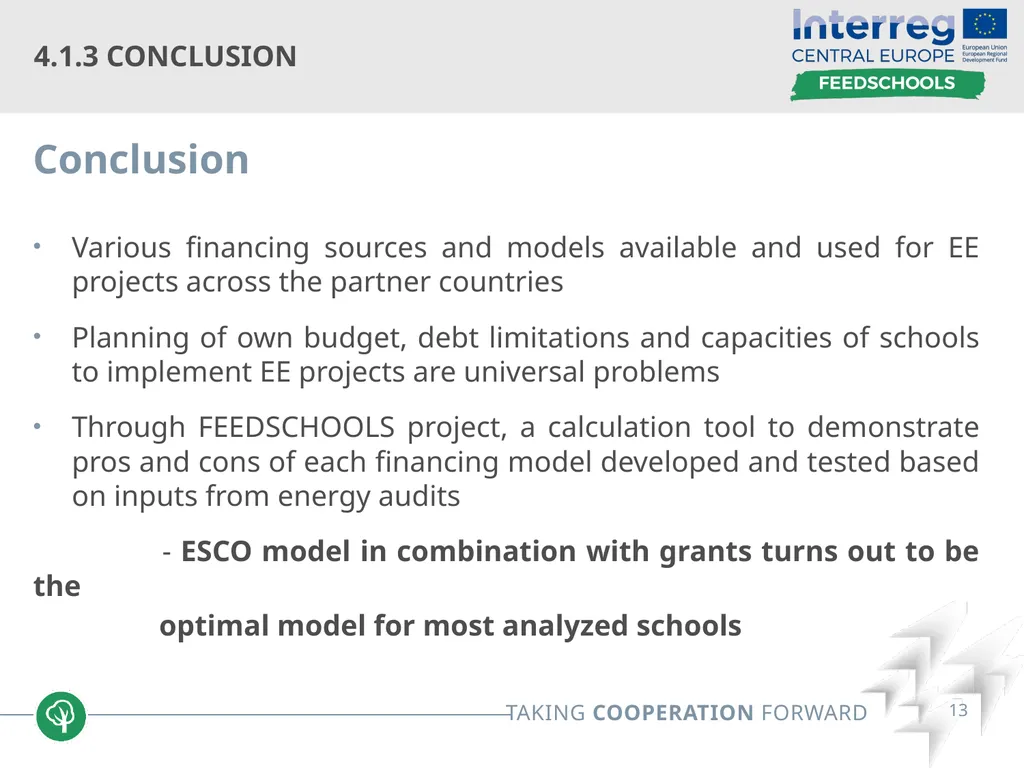
4.1.3 Conclusion Conclusion
Various financing sources and models available and used for EE projects across the partner countries
Planning of own budget, debt limitations and capacities of schools to implement EE projects are universal problems
Through FEEDSCHOOLS project, a calculation tool to demonstrate pros and cons of each financing model developed and tested based on inputs from energy audits
- ESCO model in combination with grants turns out to be the
optimal model for most analyzed schools<br>
14
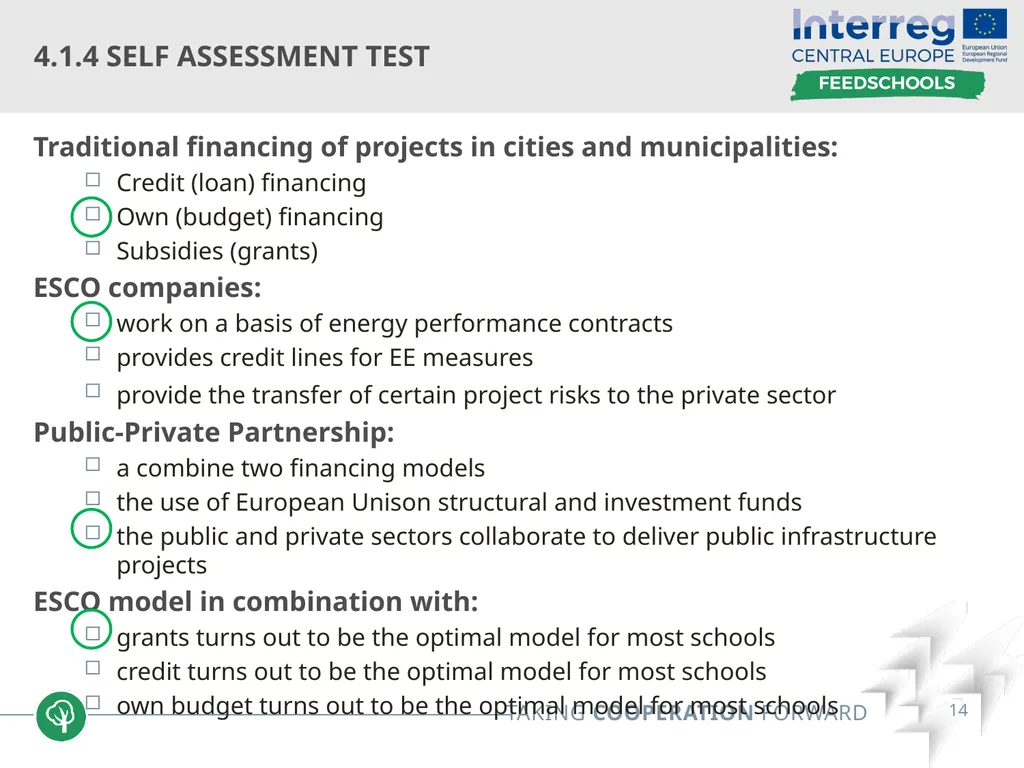
4.1.4 Self assessment test Traditional financing of projects in cities and municipalities:
Credit (loan) financing
Own (budget) financing
Subsidies (grants)
ESCO companies:
work on a basis of energy performance contracts
provides credit lines for EE measures
provide the transfer of certain project risks to the private sector
Public-Private Partnership:
a combine two financing models
the use of European Unison structural and investment funds
the public and private sectors collaborate to deliver public infrastructure projects
ESCO model in combination with:
grants turns out to be the optimal model for most schools
credit turns out to be the optimal model for most schools
own budget turns out to be the optimal model for most schools<br>
15
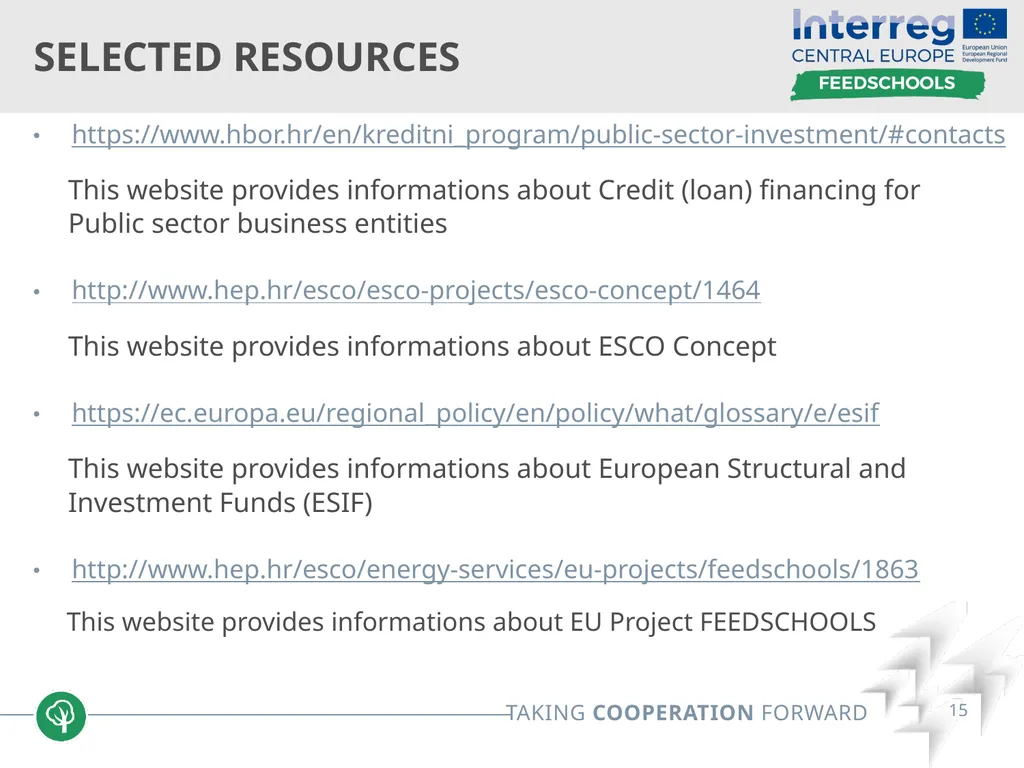
Selected resources https://www.hbor.hr/en/kreditni_program/public-sector-investment/#contacts
This website provides informations about Credit (loan) financing for
Public sector business entities
http://www.hep.hr/esco/esco-projects/esco-concept/1464
This website provides informations about ESCO Concept
https://ec.europa.eu/regional_policy/en/policy/what/glossary/e/esif
This website provides informations about European Structural and
Investment Funds (ESIF)
http://www.hep.hr/esco/energy-services/eu-projects/feedschools/1863
This website provides informations about EU Project FEEDSCHOOLS<br>
16
Goran Hanžek, HEP-ESCO,Croatia (Author and Tutor) +385 1 6321471 goran.hanzek@hep.hr www.hep.hr/esco facebook.com/feedschools linkedin.com/in/feedschools twitter.com/feedschools<br>