
BREXIT 2 The Master’s 2020 Research Report
A
Published · 23 slides · 0 views

1 / 1





Description
BREXIT 2 The Masters 2020 Research Report Briefing Given by Emeritus Professor Allan Buckwell Imperial College September 28th 2020 Presentation logistics and support courtesy of Consulting in Agriculture Brexit 2 UK Food and Agriculture
Related Topics
Share
Embed code
Download this presentation From Below
"BREXIT 2 The Master’s 2020 Research Report" is the property of its rightful owner. Permission is granted to download and print the materials on this website for personal, non-commercial use only, and to display it on your personal computer provided you do not modify the materials and that you retain all copyright notices contained in the materials. By downloading content from our website, you accept the terms of this agreement.
Presentation Transcript
01
BREXIT 2
The Master’s 2020 Research Report Briefing
Given by
Emeritus Professor Allan Buckwell – Imperial College
September 28th 2020 Presentation logistics and support
courtesy of Consulting in Agriculture<br>
02
Brexit 2
UK Food and Agriculture post-Brexit The legislative framework
Agriculture and Environment Bills
The two Withdrawal Acts 2018 and 2020
The UK – EU Free Trade Agreement
Other trade agreements
What happens after 1/1/21?
The issue of standards
Five visions for UK food and land use according to:
The Committee on Climate Change (CCC)
Dieter Helm
Tim Lang
The Food, Farming and Countryside Commission (FFCC)
Henry Dimbleby’s National Food Strategy (NFS)
Where is this leading us – with what implications?
Conclusions<br>
Agriculture and Environment Bills
The two Withdrawal Acts 2018 and 2020
The UK – EU Free Trade Agreement
Other trade agreements
What happens after 1/1/21?
The issue of standards
Five visions for UK food and land use according to:
The Committee on Climate Change (CCC)
Dieter Helm
Tim Lang
The Food, Farming and Countryside Commission (FFCC)
Henry Dimbleby’s National Food Strategy (NFS)
Where is this leading us – with what implications?
Conclusions<br>
03
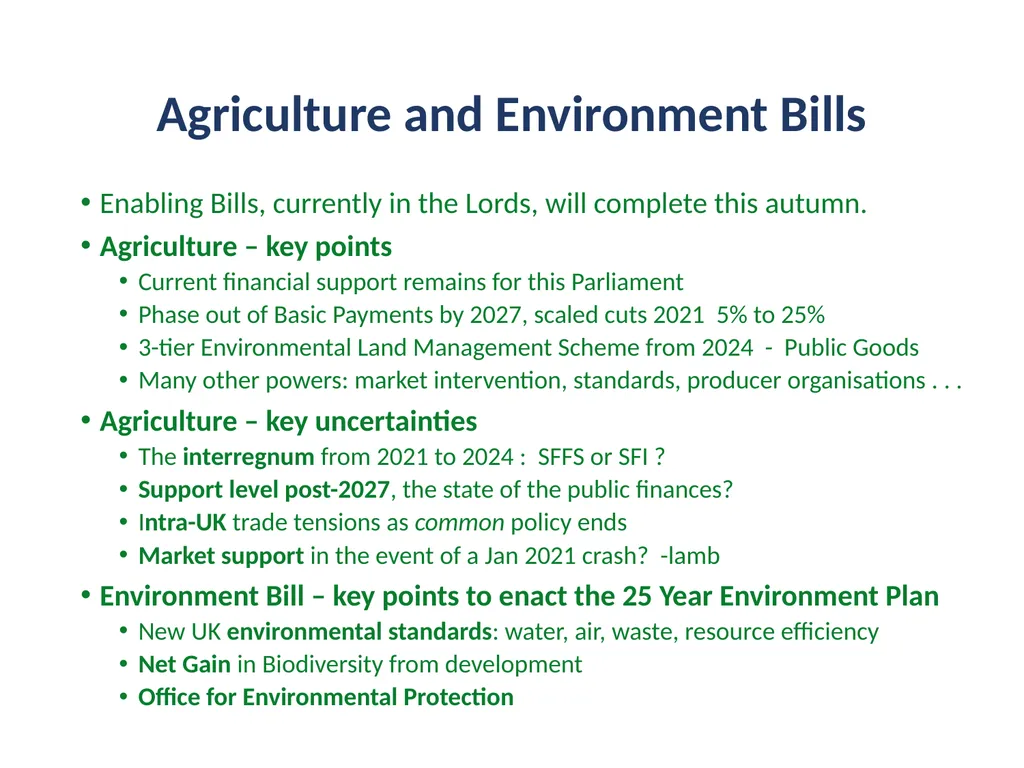
Agriculture and Environment Bills Enabling Bills, currently in the Lords, will complete this autumn.
Agriculture – key points
Current financial support remains for this Parliament
Phase out of Basic Payments by 2027, scaled cuts 2021 5% to 25%
3-tier Environmental Land Management Scheme from 2024 - Public Goods
Many other powers: market intervention, standards, producer organisations . . .
Agriculture – key uncertainties
The interregnum from 2021 to 2024 : SFFS or SFI ?
Support level post-2027, the state of the public finances?
Intra-UK trade tensions as common policy ends
Market support in the event of a Jan 2021 crash? -lamb
Environment Bill – key points to enact the 25 Year Environment Plan
New UK environmental standards: water, air, waste, resource efficiency
Net Gain in Biodiversity from development
Office for Environmental Protection<br>
Agriculture – key points
Current financial support remains for this Parliament
Phase out of Basic Payments by 2027, scaled cuts 2021 5% to 25%
3-tier Environmental Land Management Scheme from 2024 - Public Goods
Many other powers: market intervention, standards, producer organisations . . .
Agriculture – key uncertainties
The interregnum from 2021 to 2024 : SFFS or SFI ?
Support level post-2027, the state of the public finances?
Intra-UK trade tensions as common policy ends
Market support in the event of a Jan 2021 crash? -lamb
Environment Bill – key points to enact the 25 Year Environment Plan
New UK environmental standards: water, air, waste, resource efficiency
Net Gain in Biodiversity from development
Office for Environmental Protection<br>
04
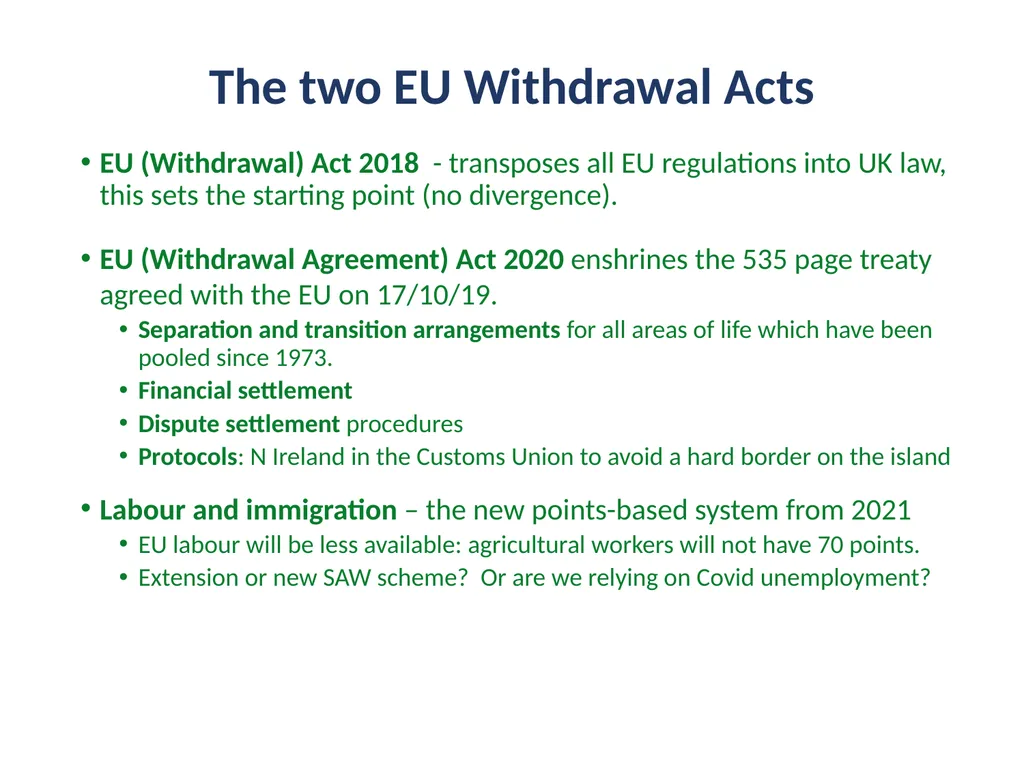
The two EU Withdrawal Acts EU (Withdrawal) Act 2018 - transposes all EU regulations into UK law, this sets the starting point (no divergence).
EU (Withdrawal Agreement) Act 2020 enshrines the 535 page treaty agreed with the EU on 17/10/19.
Separation and transition arrangements for all areas of life which have been pooled since 1973.
Financial settlement
Dispute settlement procedures
Protocols: N Ireland in the Customs Union to avoid a hard border on the island
Labour and immigration – the new points-based system from 2021
EU labour will be less available: agricultural workers will not have 70 points.
Extension or new SAW scheme? Or are we relying on Covid unemployment?<br>
EU (Withdrawal Agreement) Act 2020 enshrines the 535 page treaty agreed with the EU on 17/10/19.
Separation and transition arrangements for all areas of life which have been pooled since 1973.
Financial settlement
Dispute settlement procedures
Protocols: N Ireland in the Customs Union to avoid a hard border on the island
Labour and immigration – the new points-based system from 2021
EU labour will be less available: agricultural workers will not have 70 points.
Extension or new SAW scheme? Or are we relying on Covid unemployment?<br>
05
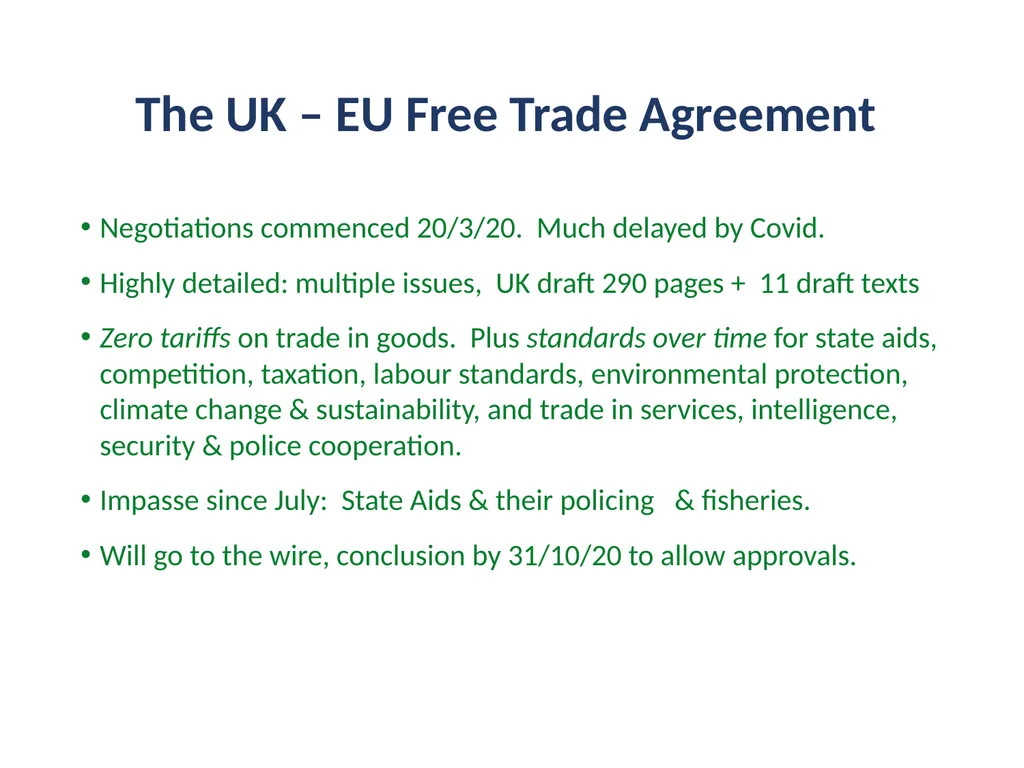
The UK – EU Free Trade Agreement Negotiations commenced 20/3/20. Much delayed by Covid.
Highly detailed: multiple issues, UK draft 290 pages + 11 draft texts
Zero tariffs on trade in goods. Plus standards over time for state aids, competition, taxation, labour standards, environmental protection, climate change & sustainability, and trade in services, intelligence, security & police cooperation.
Impasse since July: State Aids & their policing & fisheries.
Will go to the wire, conclusion by 31/10/20 to allow approvals.<br>
Highly detailed: multiple issues, UK draft 290 pages + 11 draft texts
Zero tariffs on trade in goods. Plus standards over time for state aids, competition, taxation, labour standards, environmental protection, climate change & sustainability, and trade in services, intelligence, security & police cooperation.
Impasse since July: State Aids & their policing & fisheries.
Will go to the wire, conclusion by 31/10/20 to allow approvals.<br>
06
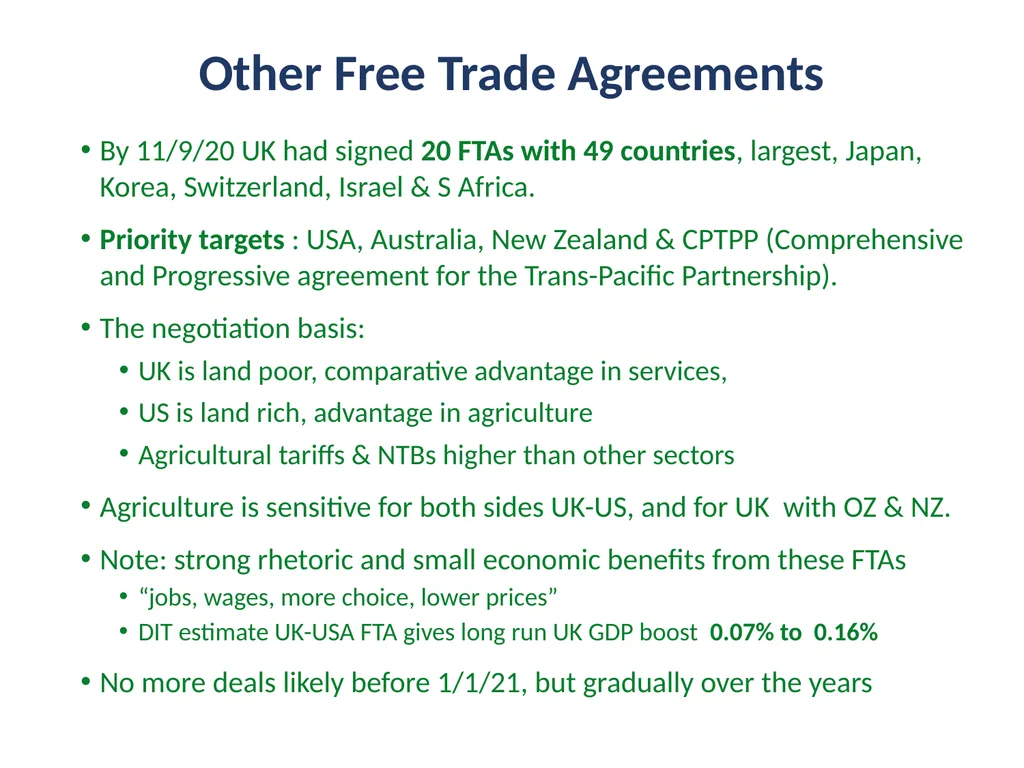
Other Free Trade Agreements By 11/9/20 UK had signed 20 FTAs with 49 countries, largest, Japan, Korea, Switzerland, Israel & S Africa.
Priority targets : USA, Australia, New Zealand & CPTPP (Comprehensive and Progressive agreement for the Trans-Pacific Partnership).
The negotiation basis:
UK is land poor, comparative advantage in services,
US is land rich, advantage in agriculture
Agricultural tariffs & NTBs higher than other sectors
Agriculture is sensitive for both sides UK-US, and for UK with OZ & NZ.
Note: strong rhetoric and small economic benefits from these FTAs
“jobs, wages, more choice, lower prices”
DIT estimate UK-USA FTA gives long run UK GDP boost 0.07% to 0.16%
No more deals likely before 1/1/21, but gradually over the years<br>
Priority targets : USA, Australia, New Zealand & CPTPP (Comprehensive and Progressive agreement for the Trans-Pacific Partnership).
The negotiation basis:
UK is land poor, comparative advantage in services,
US is land rich, advantage in agriculture
Agricultural tariffs & NTBs higher than other sectors
Agriculture is sensitive for both sides UK-US, and for UK with OZ & NZ.
Note: strong rhetoric and small economic benefits from these FTAs
“jobs, wages, more choice, lower prices”
DIT estimate UK-USA FTA gives long run UK GDP boost 0.07% to 0.16%
No more deals likely before 1/1/21, but gradually over the years<br>
07
What will happen after 1/1/21?
(a) Deal: UK – EU FTA agreed Assume zero tariffs, no new NTBs
Trade with the EU
Paperwork, physical checks & delays at ports
Extra costs mean exporter gets less, importer pays more
How much depends on preparations & good will
Longer run? When and how divergence appears in labour, social, environment, technology & food standards.
Trade with Rest of the World (RoW)
New UK Global tariff (UKGT) applies.
UKGT is close to but not identical to the EU CET. Could spark some Rules of Origin issues, plus N Ireland is supposed to follow the CET, EU fears N Ireland becomes a back door entry for 3rd country goods.
In the longer run all depends on the FTAs agreed<br>
Trade with the EU
Paperwork, physical checks & delays at ports
Extra costs mean exporter gets less, importer pays more
How much depends on preparations & good will
Longer run? When and how divergence appears in labour, social, environment, technology & food standards.
Trade with Rest of the World (RoW)
New UK Global tariff (UKGT) applies.
UKGT is close to but not identical to the EU CET. Could spark some Rules of Origin issues, plus N Ireland is supposed to follow the CET, EU fears N Ireland becomes a back door entry for 3rd country goods.
In the longer run all depends on the FTAs agreed<br>
08
What will happen after 1/1/21?
(b) No deal and likely ill-will! Trade with the EU: EU applies CET to UK X; UK applies UKGT to EU X
Even more paperwork & delays at ports until traders & border agency learn
Hard to predict which supply chain, and which pinch-point catches the news
Compared to now, for intra-EU trade UK import prices rise. As a net food importer food prices will rise and protection of UK.
Worst hit are UK agri-food exporters – are any unaware of this? What interventions will be made to support the market & their effect?
Longer run? As above - depends when & how regulatory divergence appears
Trade with Rest of the World (RoW) is as case (a)
Same as if UK-EU deal is agreed<br>
Even more paperwork & delays at ports until traders & border agency learn
Hard to predict which supply chain, and which pinch-point catches the news
Compared to now, for intra-EU trade UK import prices rise. As a net food importer food prices will rise and protection of UK.
Worst hit are UK agri-food exporters – are any unaware of this? What interventions will be made to support the market & their effect?
Longer run? As above - depends when & how regulatory divergence appears
Trade with Rest of the World (RoW) is as case (a)
Same as if UK-EU deal is agreed<br>
09
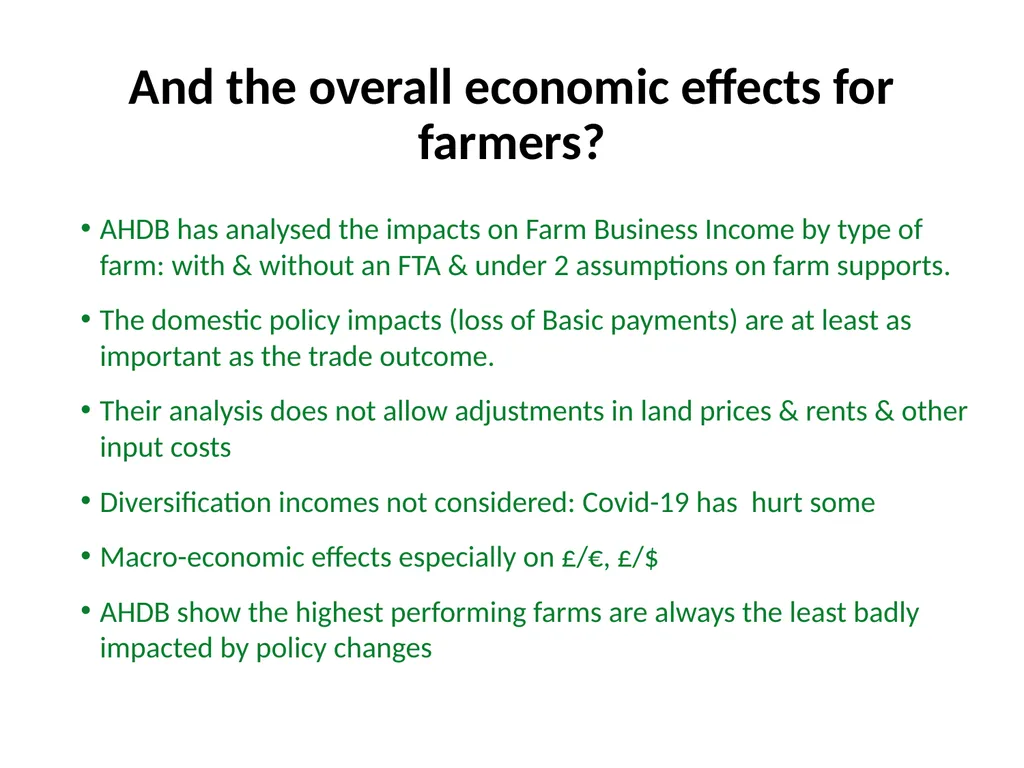
And the overall economic effects for farmers? AHDB has analysed the impacts on Farm Business Income by type of farm: with & without an FTA & under 2 assumptions on farm supports.
The domestic policy impacts (loss of Basic payments) are at least as important as the trade outcome.
Their analysis does not allow adjustments in land prices & rents & other input costs
Diversification incomes not considered: Covid-19 has hurt some
Macro-economic effects especially on £/€, £/$
AHDB show the highest performing farms are always the least badly impacted by policy changes<br>
The domestic policy impacts (loss of Basic payments) are at least as important as the trade outcome.
Their analysis does not allow adjustments in land prices & rents & other input costs
Diversification incomes not considered: Covid-19 has hurt some
Macro-economic effects especially on £/€, £/$
AHDB show the highest performing farms are always the least badly impacted by policy changes<br>
10
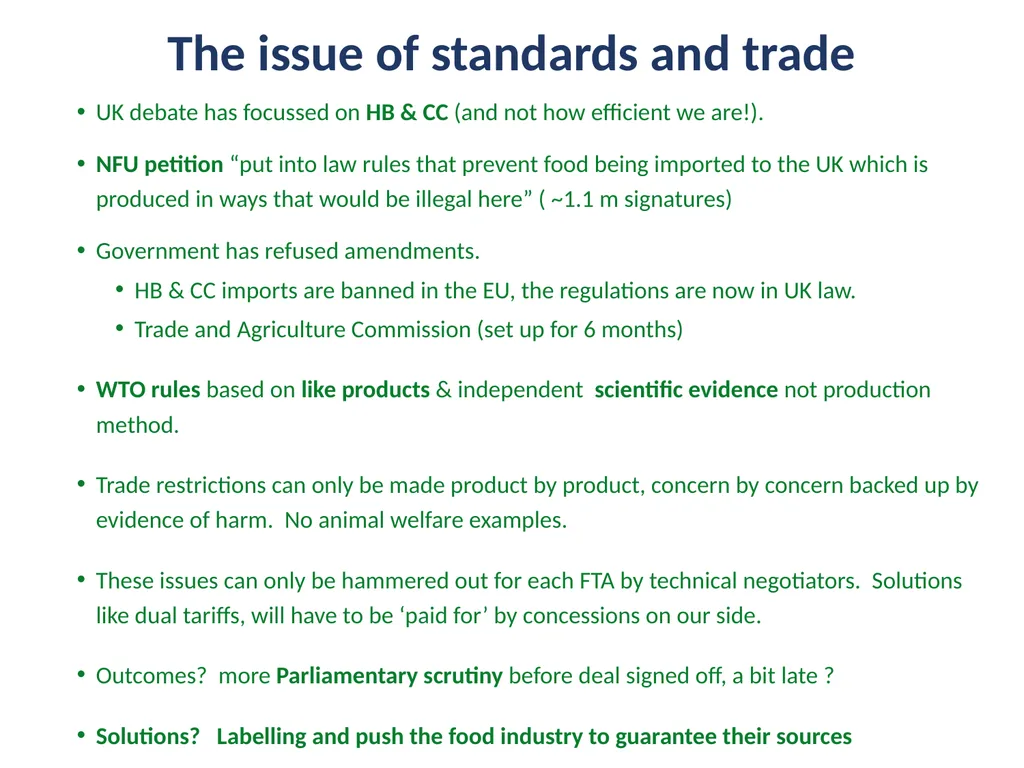
The issue of standards and trade UK debate has focussed on HB & CC (and not how efficient we are!).
NFU petition “put into law rules that prevent food being imported to the UK which is produced in ways that would be illegal here” ( ~1.1 m signatures)
Government has refused amendments.
HB & CC imports are banned in the EU, the regulations are now in UK law.
Trade and Agriculture Commission (set up for 6 months)
WTO rules based on like products & independent scientific evidence not production method.
Trade restrictions can only be made product by product, concern by concern backed up by evidence of harm. No animal welfare examples.
These issues can only be hammered out for each FTA by technical negotiators. Solutions like dual tariffs, will have to be ‘paid for’ by concessions on our side.
Outcomes? more Parliamentary scrutiny before deal signed off, a bit late ?
Solutions? Labelling and push the food industry to guarantee their sources<br>
NFU petition “put into law rules that prevent food being imported to the UK which is produced in ways that would be illegal here” ( ~1.1 m signatures)
Government has refused amendments.
HB & CC imports are banned in the EU, the regulations are now in UK law.
Trade and Agriculture Commission (set up for 6 months)
WTO rules based on like products & independent scientific evidence not production method.
Trade restrictions can only be made product by product, concern by concern backed up by evidence of harm. No animal welfare examples.
These issues can only be hammered out for each FTA by technical negotiators. Solutions like dual tariffs, will have to be ‘paid for’ by concessions on our side.
Outcomes? more Parliamentary scrutiny before deal signed off, a bit late ?
Solutions? Labelling and push the food industry to guarantee their sources<br>
11
That’s where we are up to on Brexit
meanwhile
a succession of reports have emerged on how Britain should grasp the opportunity of making our own agricultural, environmental and trade policies
we’ll skim through five 26/03/2018 www.risefoundation.eu #RISE_fnd<br>
12
Visions for UK food and land use - 1
Committee on Climate Change (CCC)
Land Use Policies for Net Zero UK Agriculture and Land Use, Land use change and Forestry (LULUCF) have to be considered together
Agricultural emissions cannot reach zero by 2050, therefore must release land for C sequestration in biomass and soils especially peat
Five broad actions:
Reduce agriculture emissions
Afforestation 13% to 17%, 30,000 ha per year for 30 years
Peatland rewetting 50% or upland, 25% of lowland
Bioenergy crops with CCS
Reducing consumption (20%) of C-intensive foods, beef and dairy
41 policy actions suggested: regulation, public funds, private funds government and food industry actions on consumption
Recognises carbon border taxes may be necessary<br>
Agricultural emissions cannot reach zero by 2050, therefore must release land for C sequestration in biomass and soils especially peat
Five broad actions:
Reduce agriculture emissions
Afforestation 13% to 17%, 30,000 ha per year for 30 years
Peatland rewetting 50% or upland, 25% of lowland
Bioenergy crops with CCS
Reducing consumption (20%) of C-intensive foods, beef and dairy
41 policy actions suggested: regulation, public funds, private funds government and food industry actions on consumption
Recognises carbon border taxes may be necessary<br>
13
Visions for UK food and land use - 2
Dieter Helm, Chair of Natural Capital Committee
Green and Prosperous Land We are destroying natural capital we depend on, biodiversity, soil fertility, clean air & water and stable climate
Highly critical of agriculture & Ag policy, wrong signals,
This can be resolved by:
Public goods strictly interpreted
Polluter pays principle – fertilisers, pesticides & carbon
Net environmental gain
Nature Fund to implement the 25YEP
National nature plan based on robust accounting of natural capital and overseen by an independent Environmental Protection Agency<br>
Highly critical of agriculture & Ag policy, wrong signals,
This can be resolved by:
Public goods strictly interpreted
Polluter pays principle – fertilisers, pesticides & carbon
Net environmental gain
Nature Fund to implement the 25YEP
National nature plan based on robust accounting of natural capital and overseen by an independent Environmental Protection Agency<br>
14
Visions for UK food and land use - 3
Tim Lang – City University
Feeding Britain Long and detailed critique of the complete food system
Food culture our eating patterns and what drives them
Diets and health
Inequalities and food poverty
Biodiversity crisis
Climate crisis
Economic structures and powers in the food chain
Claims these ‘locked in’ therefore only radical shake-up can work
Proposes
Many high level reviews
Much institutional change
On agriculture: reward public goods including food value (?), strengthening competition policy, doubling farmers’ share of value added in food chain, introducing full cost accounting for food internalising externalities<br>
Food culture our eating patterns and what drives them
Diets and health
Inequalities and food poverty
Biodiversity crisis
Climate crisis
Economic structures and powers in the food chain
Claims these ‘locked in’ therefore only radical shake-up can work
Proposes
Many high level reviews
Much institutional change
On agriculture: reward public goods including food value (?), strengthening competition policy, doubling farmers’ share of value added in food chain, introducing full cost accounting for food internalising externalities<br>
15
Visions for UK food and land use - 4
RSA - Food & Farming Countryside Commission
Our future in the land High-level, experienced people, 2-year study premised on the food and land system is broken wrt health, environment, climate and the structural imbalances in the food chain
Proposes 15 actions around 3 themes:
Healthy food is everybody’s business
Level playing field, more F&V&N&P, public procurement, community food plans
Farming is a force for change
10 yr transition to sustainable agroecological farming, innovation, advice, cooperation and a National Agroecology Bank
The countryside has to work for all
National land use strategy, skills, housing, National Nature Service<br>
Proposes 15 actions around 3 themes:
Healthy food is everybody’s business
Level playing field, more F&V&N&P, public procurement, community food plans
Farming is a force for change
10 yr transition to sustainable agroecological farming, innovation, advice, cooperation and a National Agroecology Bank
The countryside has to work for all
National land use strategy, skills, housing, National Nature Service<br>
16
Visions for UK food and land use - 5
Henry Dimbleby – Chair of the National Food Strategy
Part 1 – children’s nutrition and trade Set up by Government 8/19, 25 members, Defra staffed, initially 1 yr
To suggest the first National Food Strategy for 75 yrs to address “environmental and health problems of food system to ensure security of supply and maximise benefits of new technology”
Timetable & focus shot by Covid-19 & Brexit
Part 1 analysis: poor diet & Covid death rate, Covid risks in meat processing plants, punishing effect on hospitality sector, rise in food poverty, plus fears of trade standards being diluted in trade negotiations
Part 1 Proposes
4 measures for children’s nutrition and food poverty
3 measures on trade: link tariffs to standards, publish reports on impacts of proposed trade agreements, parliamentary scrutiny of trade agreements
Part 2 will propose a New Green Revolution which will “comprehensively transform” our food system for a better future “where our food no longer makes us, or our planet, sick”<br>
To suggest the first National Food Strategy for 75 yrs to address “environmental and health problems of food system to ensure security of supply and maximise benefits of new technology”
Timetable & focus shot by Covid-19 & Brexit
Part 1 analysis: poor diet & Covid death rate, Covid risks in meat processing plants, punishing effect on hospitality sector, rise in food poverty, plus fears of trade standards being diluted in trade negotiations
Part 1 Proposes
4 measures for children’s nutrition and food poverty
3 measures on trade: link tariffs to standards, publish reports on impacts of proposed trade agreements, parliamentary scrutiny of trade agreements
Part 2 will propose a New Green Revolution which will “comprehensively transform” our food system for a better future “where our food no longer makes us, or our planet, sick”<br>
17
Don’t overlook the EU:
similar reports have lead to Green Deal & its Farm to Fork and Biodiversity Strategies<br>
18
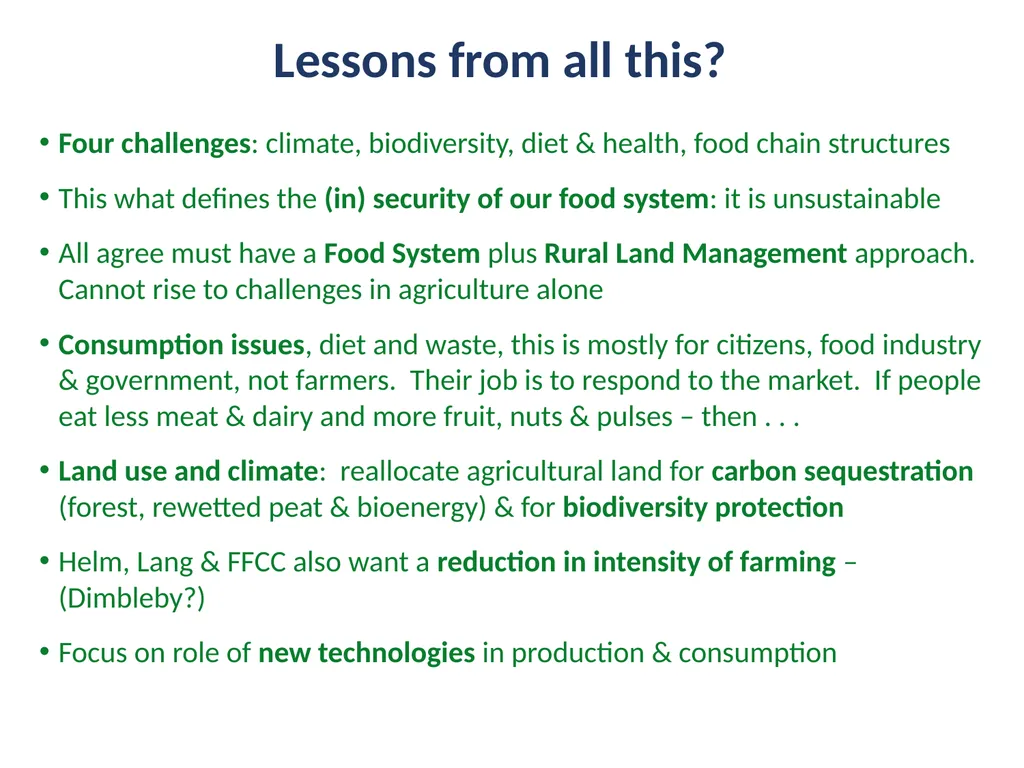
Lessons from all this? Four challenges: climate, biodiversity, diet & health, food chain structures
This what defines the (in) security of our food system: it is unsustainable
All agree must have a Food System plus Rural Land Management approach. Cannot rise to challenges in agriculture alone
Consumption issues, diet and waste, this is mostly for citizens, food industry & government, not farmers. Their job is to respond to the market. If people eat less meat & dairy and more fruit, nuts & pulses – then . . .
Land use and climate: reallocate agricultural land for carbon sequestration (forest, rewetted peat & bioenergy) & for biodiversity protection
Helm, Lang & FFCC also want a reduction in intensity of farming –(Dimbleby?)
Focus on role of new technologies in production & consumption<br>
This what defines the (in) security of our food system: it is unsustainable
All agree must have a Food System plus Rural Land Management approach. Cannot rise to challenges in agriculture alone
Consumption issues, diet and waste, this is mostly for citizens, food industry & government, not farmers. Their job is to respond to the market. If people eat less meat & dairy and more fruit, nuts & pulses – then . . .
Land use and climate: reallocate agricultural land for carbon sequestration (forest, rewetted peat & bioenergy) & for biodiversity protection
Helm, Lang & FFCC also want a reduction in intensity of farming –(Dimbleby?)
Focus on role of new technologies in production & consumption<br>
19
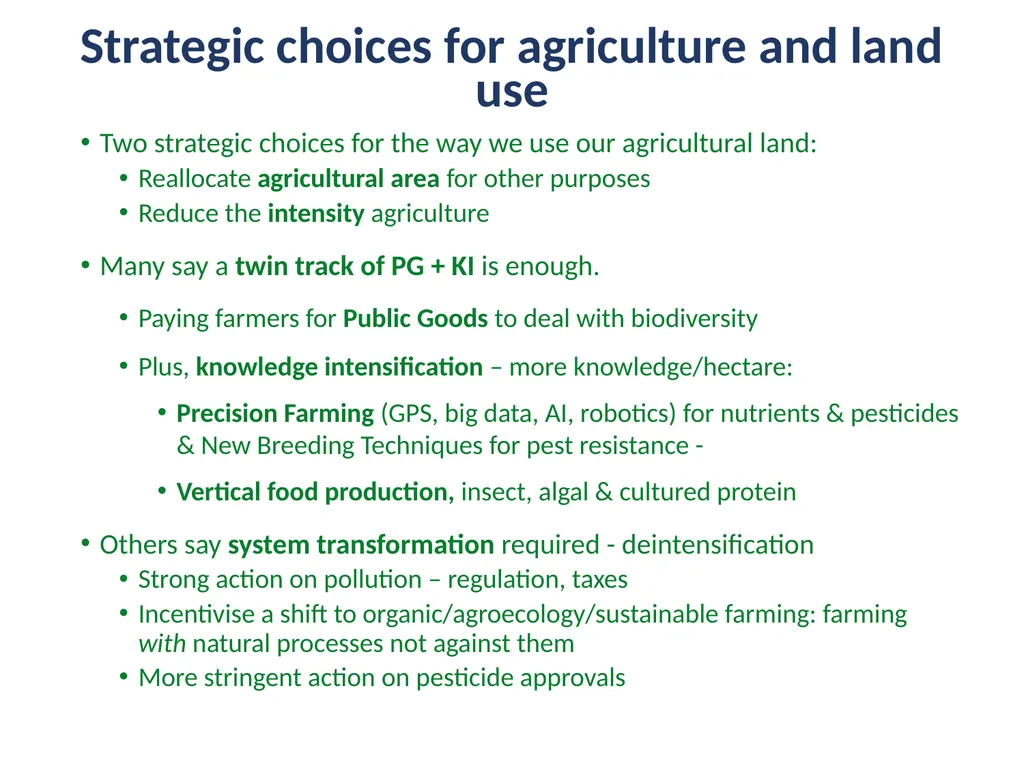
Strategic choices for agriculture and land use Two strategic choices for the way we use our agricultural land:
Reallocate agricultural area for other purposes
Reduce the intensity agriculture
Many say a twin track of PG + KI is enough.
Paying farmers for Public Goods to deal with biodiversity
Plus, knowledge intensification – more knowledge/hectare:
Precision Farming (GPS, big data, AI, robotics) for nutrients & pesticides & New Breeding Techniques for pest resistance -
Vertical food production, insect, algal & cultured protein
Others say system transformation required - deintensification
Strong action on pollution – regulation, taxes
Incentivise a shift to organic/agroecology/sustainable farming: farming with natural processes not against them
More stringent action on pesticide approvals<br>
Reallocate agricultural area for other purposes
Reduce the intensity agriculture
Many say a twin track of PG + KI is enough.
Paying farmers for Public Goods to deal with biodiversity
Plus, knowledge intensification – more knowledge/hectare:
Precision Farming (GPS, big data, AI, robotics) for nutrients & pesticides & New Breeding Techniques for pest resistance -
Vertical food production, insect, algal & cultured protein
Others say system transformation required - deintensification
Strong action on pollution – regulation, taxes
Incentivise a shift to organic/agroecology/sustainable farming: farming with natural processes not against them
More stringent action on pesticide approvals<br>
20
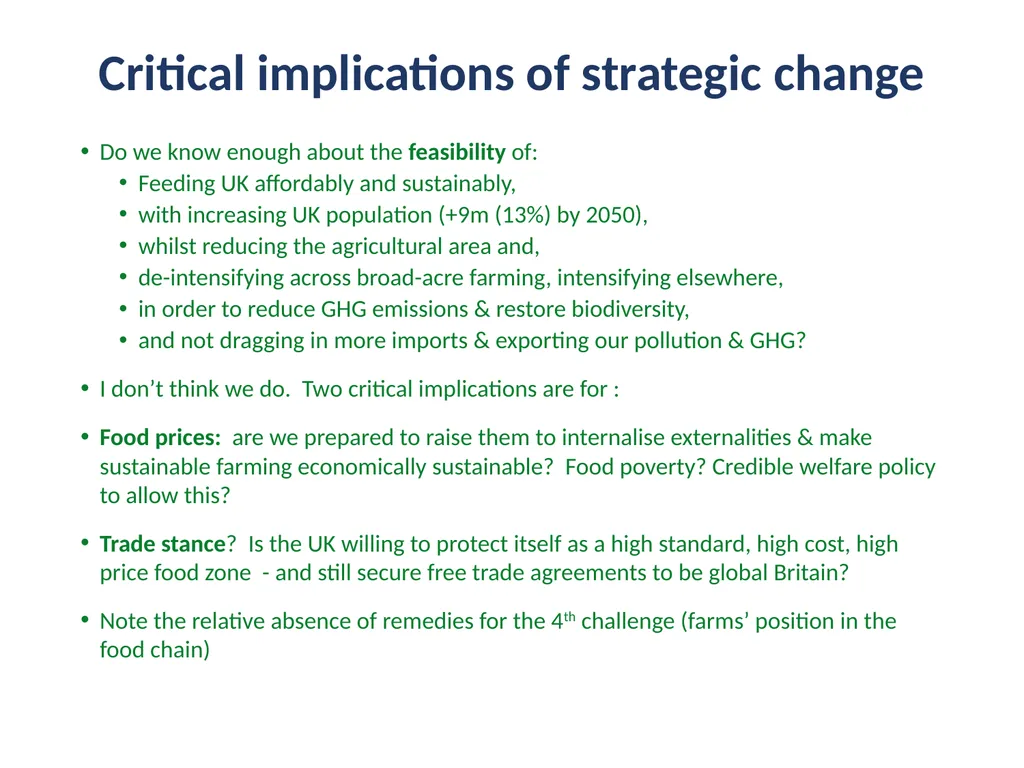
Critical implications of strategic change Do we know enough about the feasibility of:
Feeding UK affordably and sustainably,
with increasing UK population (+9m (13%) by 2050),
whilst reducing the agricultural area and,
de-intensifying across broad-acre farming, intensifying elsewhere,
in order to reduce GHG emissions & restore biodiversity,
and not dragging in more imports & exporting our pollution & GHG?
I don’t think we do. Two critical implications are for :
Food prices: are we prepared to raise them to internalise externalities & make sustainable farming economically sustainable? Food poverty? Credible welfare policy to allow this?
Trade stance? Is the UK willing to protect itself as a high standard, high cost, high price food zone - and still secure free trade agreements to be global Britain?
Note the relative absence of remedies for the 4th challenge (farms’ position in the food chain)<br>
Feeding UK affordably and sustainably,
with increasing UK population (+9m (13%) by 2050),
whilst reducing the agricultural area and,
de-intensifying across broad-acre farming, intensifying elsewhere,
in order to reduce GHG emissions & restore biodiversity,
and not dragging in more imports & exporting our pollution & GHG?
I don’t think we do. Two critical implications are for :
Food prices: are we prepared to raise them to internalise externalities & make sustainable farming economically sustainable? Food poverty? Credible welfare policy to allow this?
Trade stance? Is the UK willing to protect itself as a high standard, high cost, high price food zone - and still secure free trade agreements to be global Britain?
Note the relative absence of remedies for the 4th challenge (farms’ position in the food chain)<br>
21
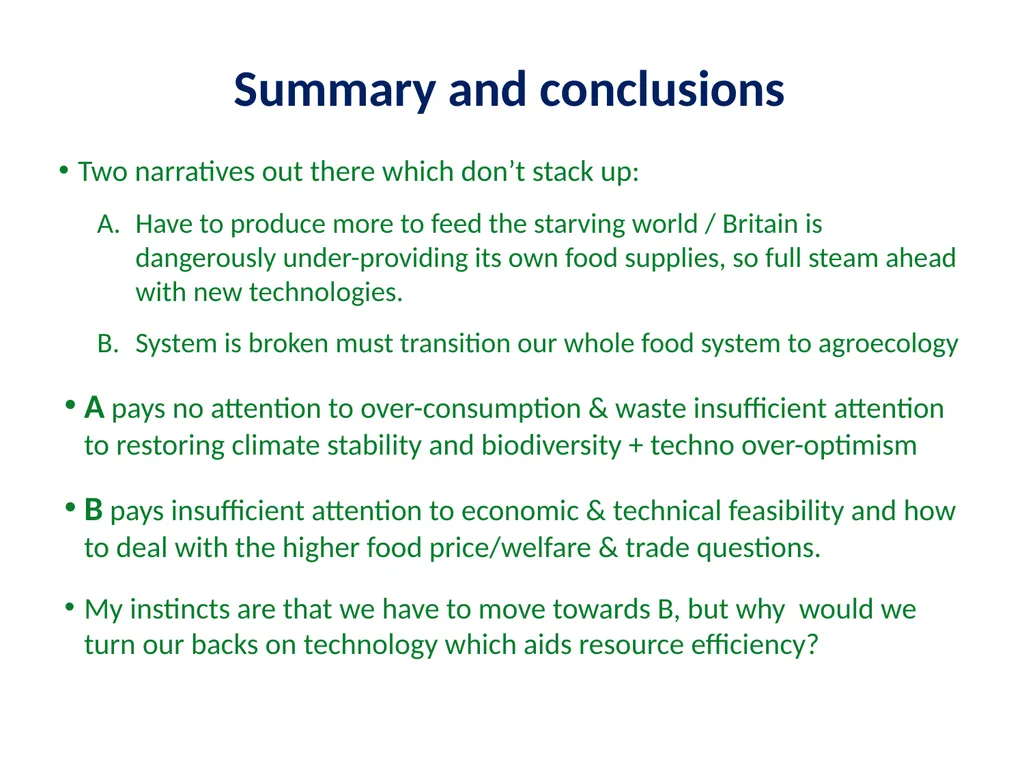
Summary and conclusions Two narratives out there which don’t stack up:
Have to produce more to feed the starving world / Britain is dangerously under-providing its own food supplies, so full steam ahead with new technologies.
System is broken must transition our whole food system to agroecology
A pays no attention to over-consumption & waste insufficient attention to restoring climate stability and biodiversity + techno over-optimism
B pays insufficient attention to economic & technical feasibility and how to deal with the higher food price/welfare & trade questions.
My instincts are that we have to move towards B, but why would we turn our backs on technology which aids resource efficiency?<br>
Have to produce more to feed the starving world / Britain is dangerously under-providing its own food supplies, so full steam ahead with new technologies.
System is broken must transition our whole food system to agroecology
A pays no attention to over-consumption & waste insufficient attention to restoring climate stability and biodiversity + techno over-optimism
B pays insufficient attention to economic & technical feasibility and how to deal with the higher food price/welfare & trade questions.
My instincts are that we have to move towards B, but why would we turn our backs on technology which aids resource efficiency?<br>
22
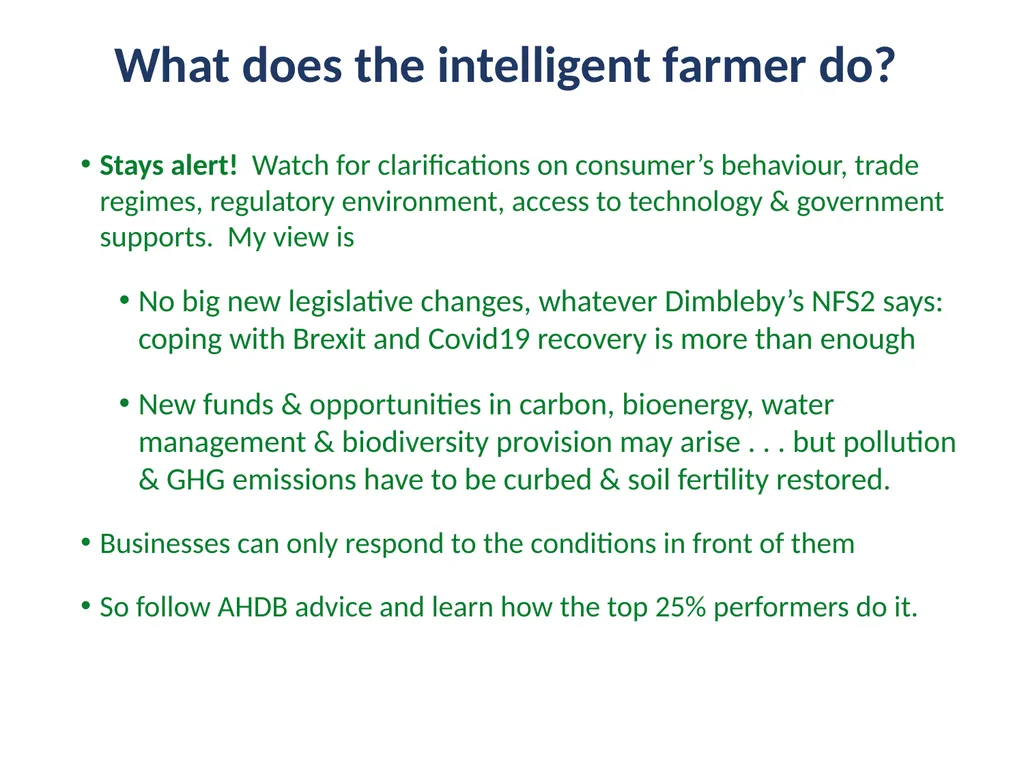
What does the intelligent farmer do? Stays alert! Watch for clarifications on consumer’s behaviour, trade regimes, regulatory environment, access to technology & government supports. My view is
No big new legislative changes, whatever Dimbleby’s NFS2 says: coping with Brexit and Covid19 recovery is more than enough
New funds & opportunities in carbon, bioenergy, water management & biodiversity provision may arise . . . but pollution & GHG emissions have to be curbed & soil fertility restored.
Businesses can only respond to the conditions in front of them
So follow AHDB advice and learn how the top 25% performers do it.<br>
No big new legislative changes, whatever Dimbleby’s NFS2 says: coping with Brexit and Covid19 recovery is more than enough
New funds & opportunities in carbon, bioenergy, water management & biodiversity provision may arise . . . but pollution & GHG emissions have to be curbed & soil fertility restored.
Businesses can only respond to the conditions in front of them
So follow AHDB advice and learn how the top 25% performers do it.<br>
23
Thanks for your attention
I hope you will read the full report
and find it informative
Good luck allan.buckwell@gmail.com<br>