
Briefing to Select Committee on Communications and

Description: Briefing to Select Committee on Communications and Public Enterprises Briefing on Cost to Communicate and ECSECNS Compliance Rubben Mohlaloga - Acting Chairperson Wed, 2 Aug 2017 1 Table of contents Cost to Communicate ECSECNS
Related Topics
Download Presentation
"Briefing to Select Committee on Communications and" is the property of its rightful owner. Permission is granted to download and print the materials on this website for personal, non-commercial use only, and to display it on your personal computer provided you do not modify the materials and that you retain all copyright notices contained in the materials. By downloading content from our website, you accept the terms of this agreement.
Presentation Transcript
slide1. Briefing to Select Committee on Communications and Public Enterprises
“Briefing on Cost to Communicate and ECS/ECNS Compliance” Rubben Mohlaloga - Acting Chairperson
Wed, 2 Aug 2017 1<br>
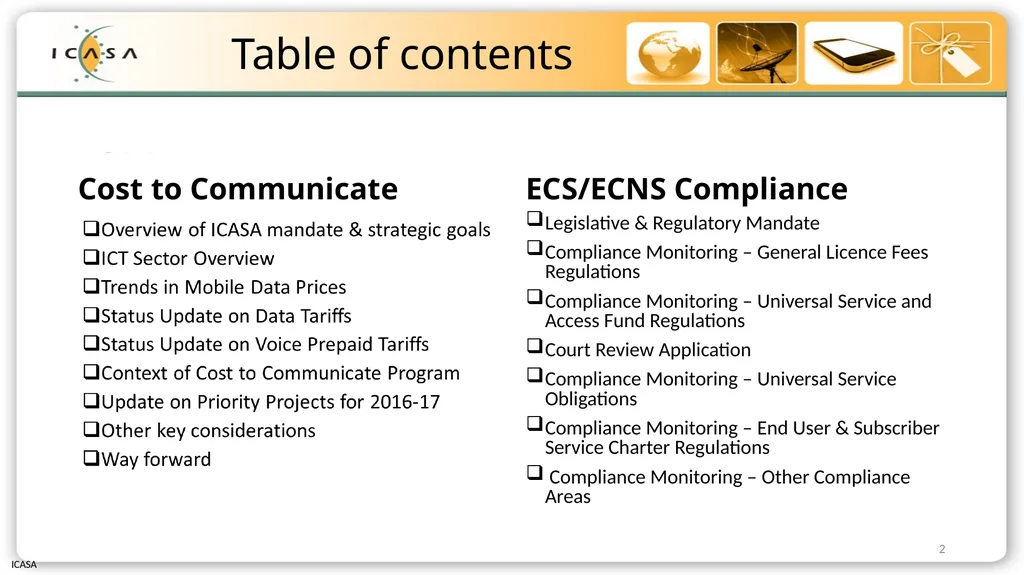
slide2. Table of contents Cost to Communicate ECS/ECNS Compliance Legislative & Regulatory Mandate
Compliance Monitoring – General Licence Fees Regulations
Compliance Monitoring – Universal Service and Access Fund Regulations
Court Review Application
Compliance Monitoring – Universal Service Obligations
Compliance Monitoring – End User & Subscriber Service Charter Regulations
Compliance Monitoring – Other Compliance Areas 2<br>
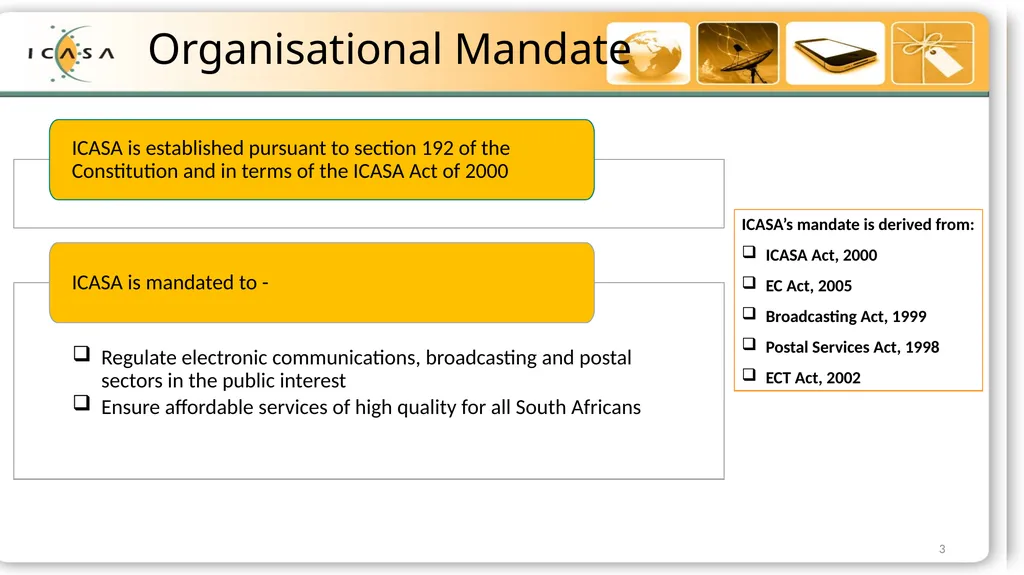
slide3. Organisational Mandate 3 ICASA’s mandate is derived from:
ICASA Act, 2000
EC Act, 2005
Broadcasting Act, 1999
Postal Services Act, 1998
ECT Act, 2002<br>
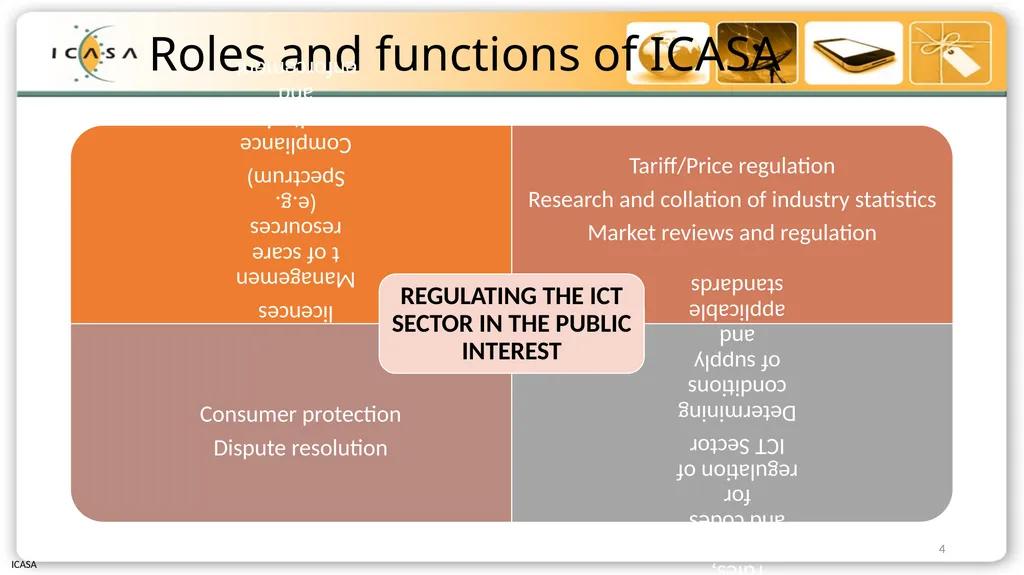
slide4. Roles and functions of ICASA 4<br>
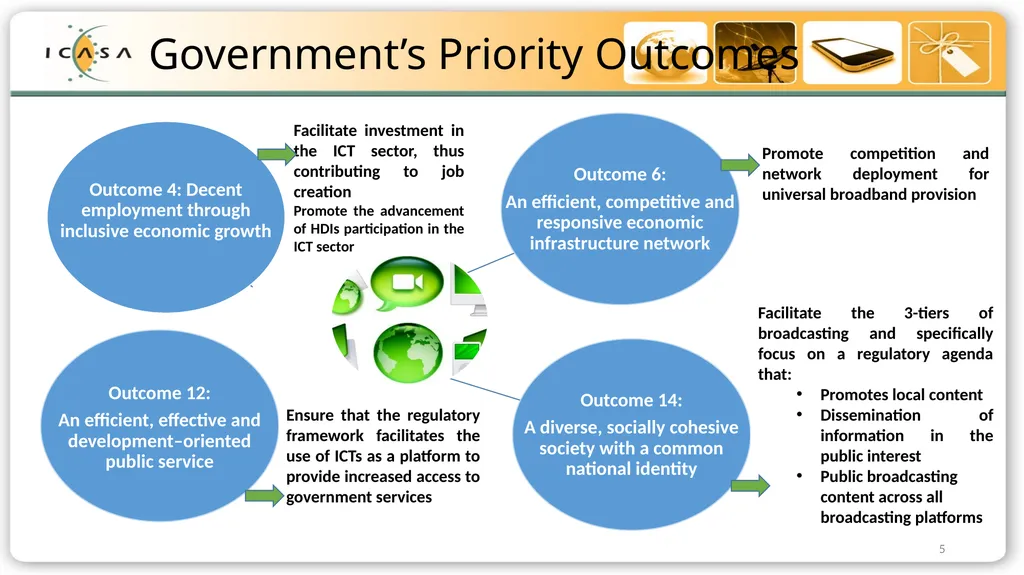
slide5. Government’s Priority Outcomes 5 Promote competition and network deployment for universal broadband provision Facilitate the 3-tiers of broadcasting and specifically focus on a regulatory agenda that:
Promotes local content
Dissemination of information in the public interest
Public broadcasting content across all broadcasting platforms Ensure that the regulatory framework facilitates the use of ICTs as a platform to provide increased access to government services Facilitate investment in the ICT sector, thus contributing to job creation
Promote the advancement of HDIs participation in the ICT sector<br>
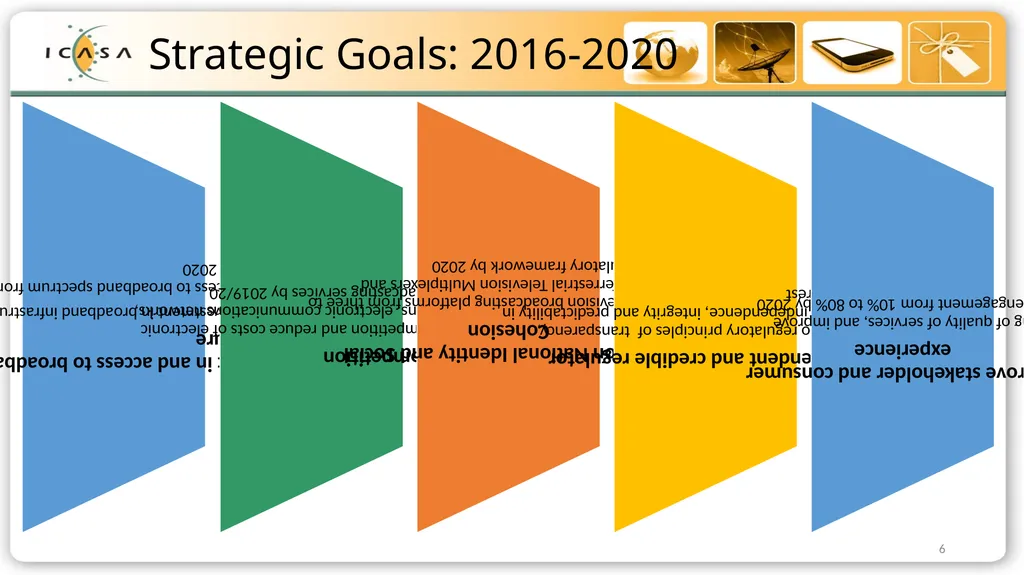
slide6. Strategic Goals: 2016-2020 6<br>
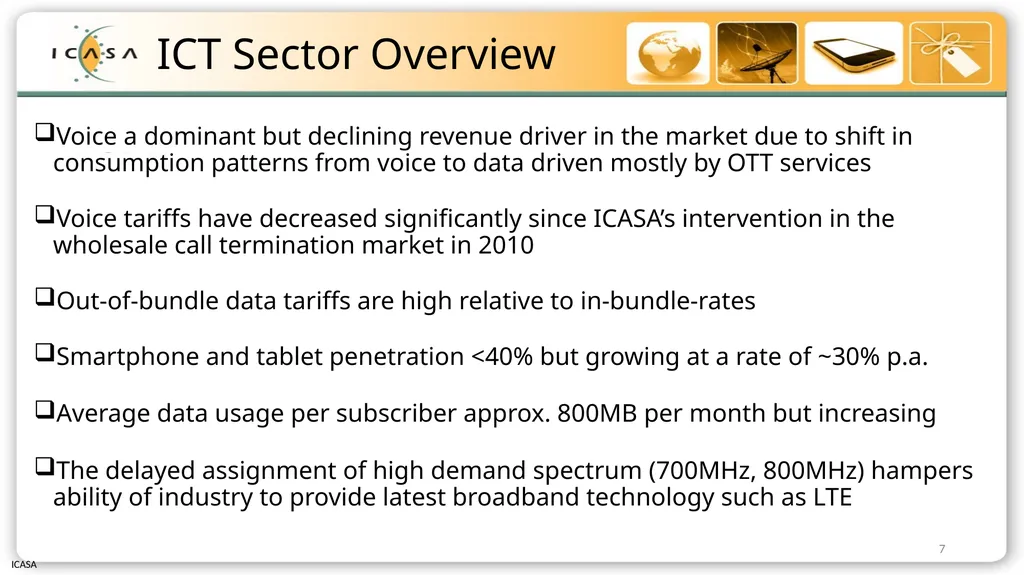
slide7. ICT Sector Overview Voice a dominant but declining revenue driver in the market due to shift in consumption patterns from voice to data driven mostly by OTT services
Voice tariffs have decreased significantly since ICASA’s intervention in the wholesale call termination market in 2010
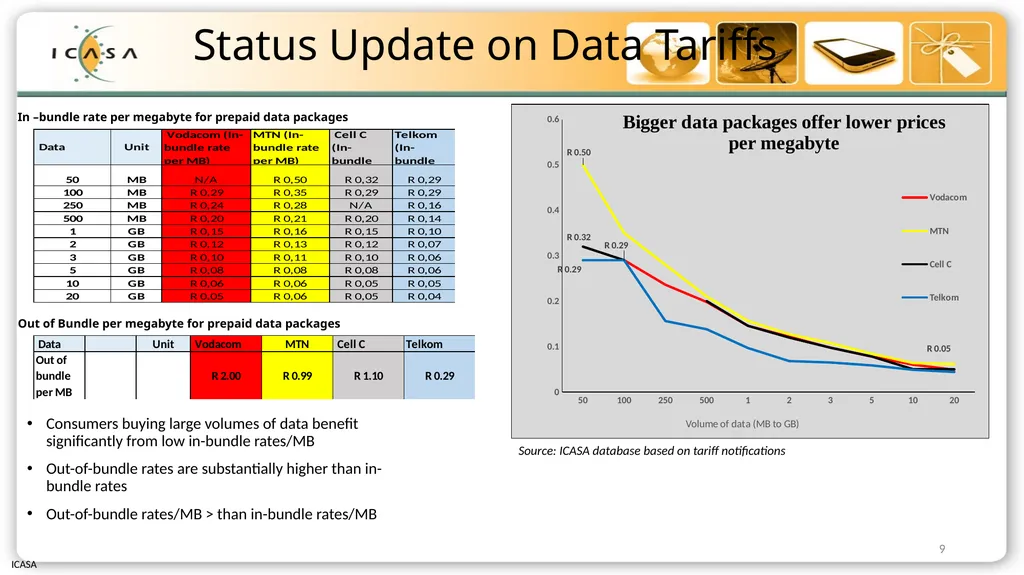
Out-of-bundle data tariffs are high relative to in-bundle-rates
Smartphone and tablet penetration <40% but growing at a rate of ~30% p.a.
Average data usage per subscriber approx. 800MB per month but increasing
The delayed assignment of high demand spectrum (700MHz, 800MHz) hampers ability of industry to provide latest broadband technology such as LTE 7<br>
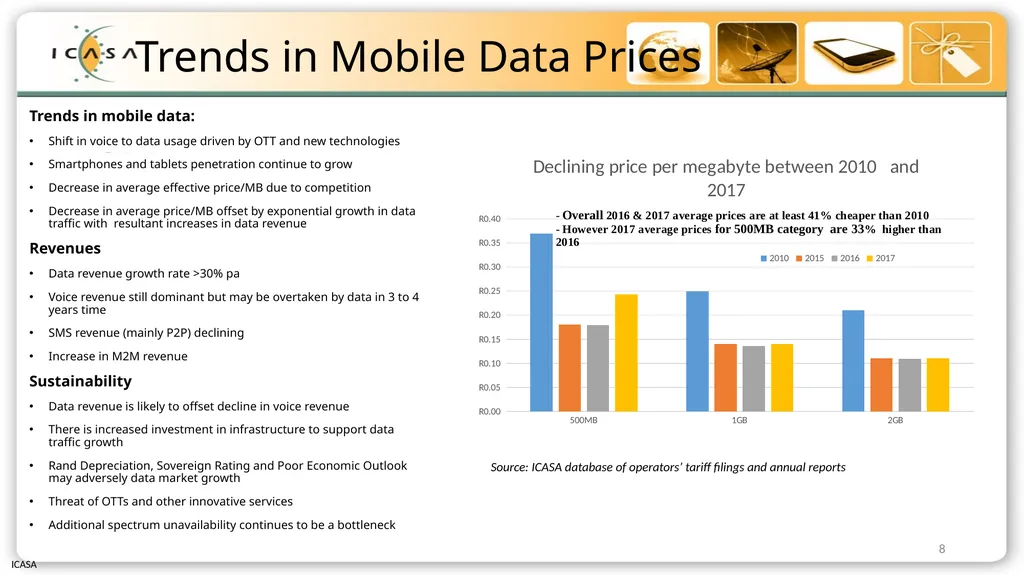
slide8. Trends in Mobile Data Prices Trends in mobile data:
Shift in voice to data usage driven by OTT and new technologies
Smartphones and tablets penetration continue to grow
Decrease in average effective price/MB due to competition
Decrease in average price/MB offset by exponential growth in data traffic with resultant increases in data revenue
Revenues
Data revenue growth rate >30% pa
Voice revenue still dominant but may be overtaken by data in 3 to 4 years time
SMS revenue (mainly P2P) declining
Increase in M2M revenue
Sustainability
Data revenue is likely to offset decline in voice revenue
There is increased investment in infrastructure to support data traffic growth
Rand Depreciation, Sovereign Rating and Poor Economic Outlook may adversely data market growth
Threat of OTTs and other innovative services
Additional spectrum unavailability continues to be a bottleneck Source: ICASA database of operators’ tariff filings and annual reports 8<br>
slide9. Status Update on Data Tariffs Source: ICASA database based on tariff notifications 9 Out of Bundle per megabyte for prepaid data packages In –bundle rate per megabyte for prepaid data packages Consumers buying large volumes of data benefit significantly from low in-bundle rates/MB
Out-of-bundle rates are substantially higher than in-bundle rates
Out-of-bundle rates/MB > than in-bundle rates/MB<br>
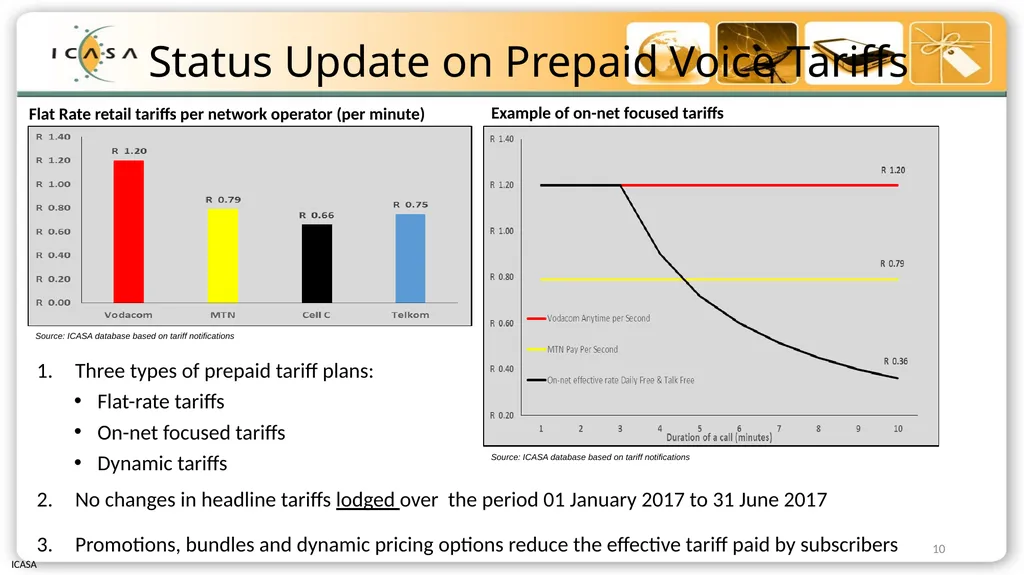
slide10. Status Update on Prepaid Voice Tariffs Three types of prepaid tariff plans:
Flat-rate tariffs
On-net focused tariffs
Dynamic tariffs
No changes in headline tariffs lodged over the period 01 January 2017 to 31 June 2017
Promotions, bundles and dynamic pricing options reduce the effective tariff paid by subscribers Example of on-net focused tariffs Source: ICASA database based on tariff notifications 10 Flat Rate retail tariffs per network operator (per minute) Source: ICASA database based on tariff notifications<br>
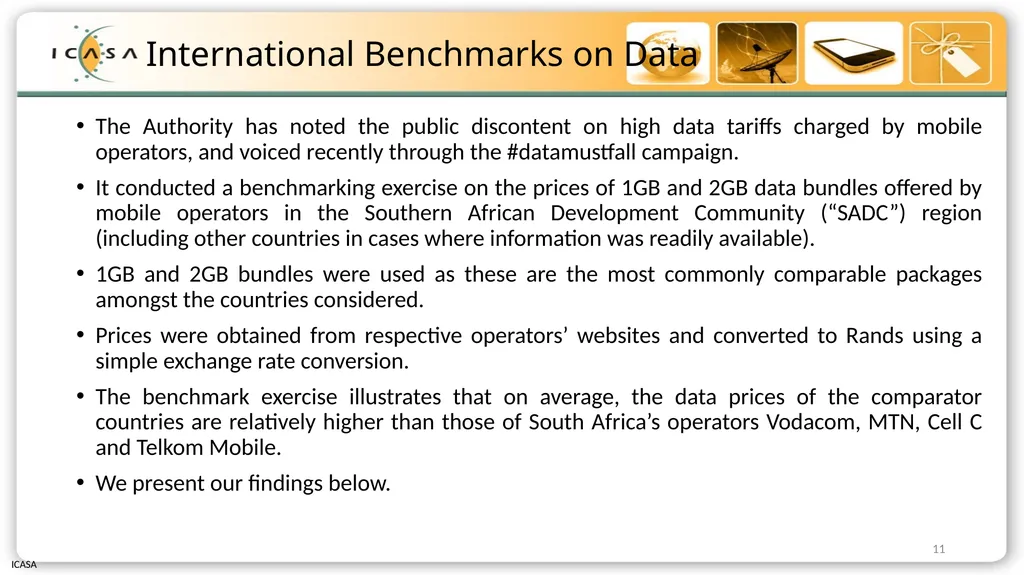
slide11. 11 The Authority has noted the public discontent on high data tariffs charged by mobile operators, and voiced recently through the #datamustfall campaign.
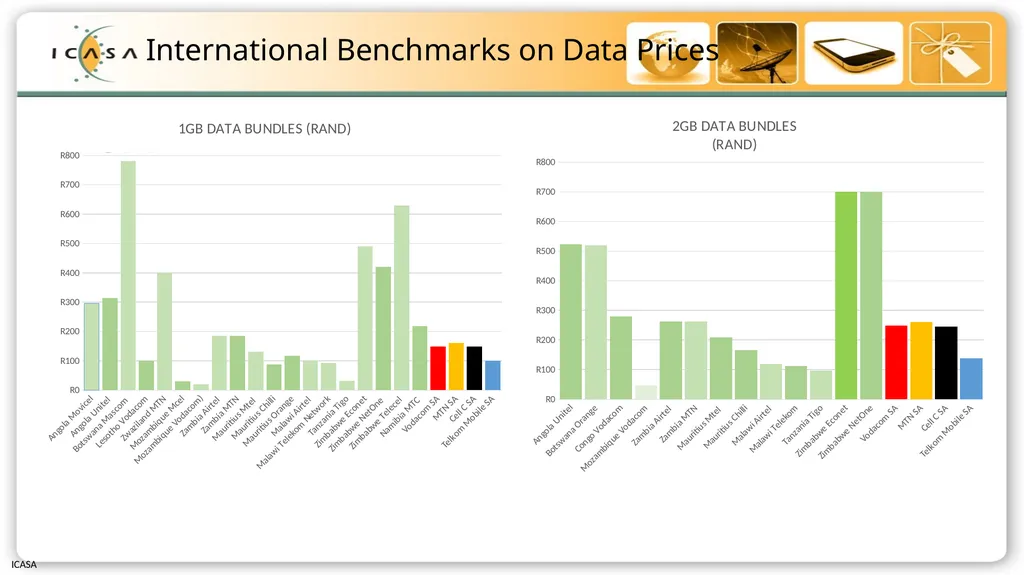
It conducted a benchmarking exercise on the prices of 1GB and 2GB data bundles offered by mobile operators in the Southern African Development Community (“SADC”) region (including other countries in cases where information was readily available).
1GB and 2GB bundles were used as these are the most commonly comparable packages amongst the countries considered.
Prices were obtained from respective operators’ websites and converted to Rands using a simple exchange rate conversion.
The benchmark exercise illustrates that on average, the data prices of the comparator countries are relatively higher than those of South Africa’s operators Vodacom, MTN, Cell C and Telkom Mobile.
We present our findings below. International Benchmarks on Data<br>
slide12. International Benchmarks on Data Prices<br>
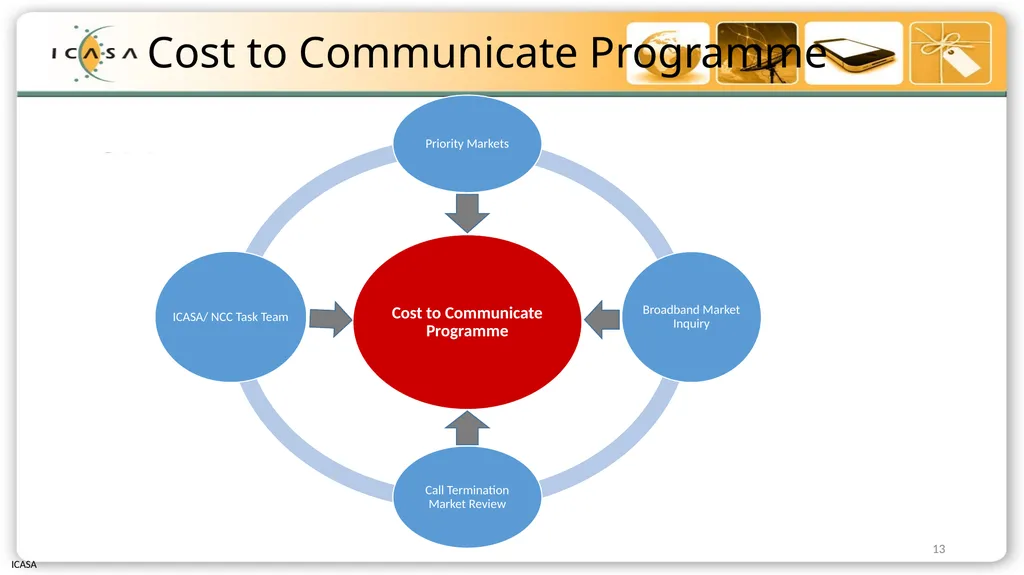
slide13. Cost to Communicate Programme 13<br>
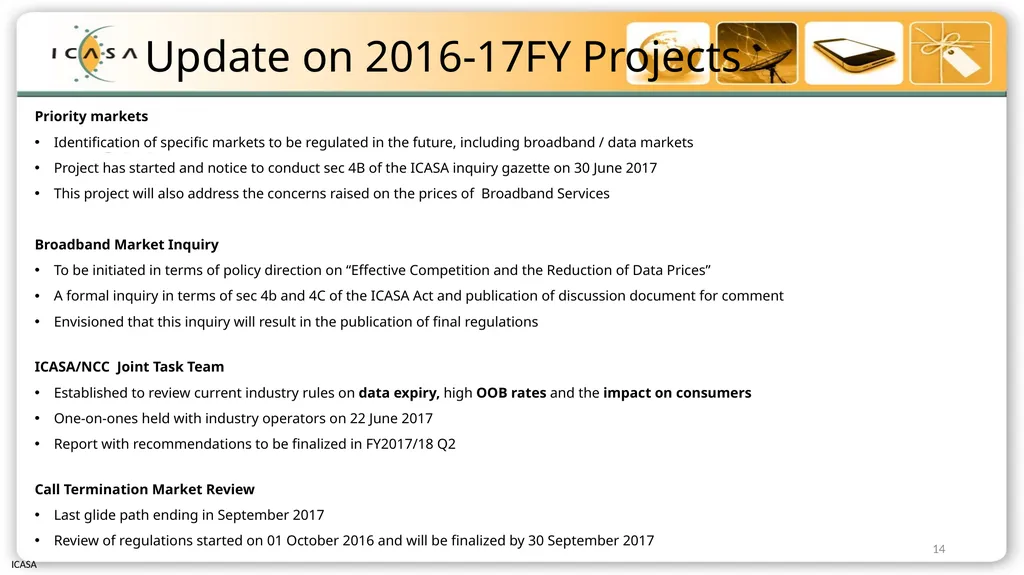
slide14. Update on 2016-17FY Projects 14 Priority markets
Identification of specific markets to be regulated in the future, including broadband / data markets
Project has started and notice to conduct sec 4B of the ICASA inquiry gazette on 30 June 2017
This project will also address the concerns raised on the prices of Broadband Services
Broadband Market Inquiry
To be initiated in terms of policy direction on “Effective Competition and the Reduction of Data Prices”
A formal inquiry in terms of sec 4b and 4C of the ICASA Act and publication of discussion document for comment
Envisioned that this inquiry will result in the publication of final regulations
ICASA/NCC Joint Task Team
Established to review current industry rules on data expiry, high OOB rates and the impact on consumers
One-on-ones held with industry operators on 22 June 2017
Report with recommendations to be finalized in FY2017/18 Q2
Call Termination Market Review
Last glide path ending in September 2017
Review of regulations started on 01 October 2016 and will be finalized by 30 September 2017<br>
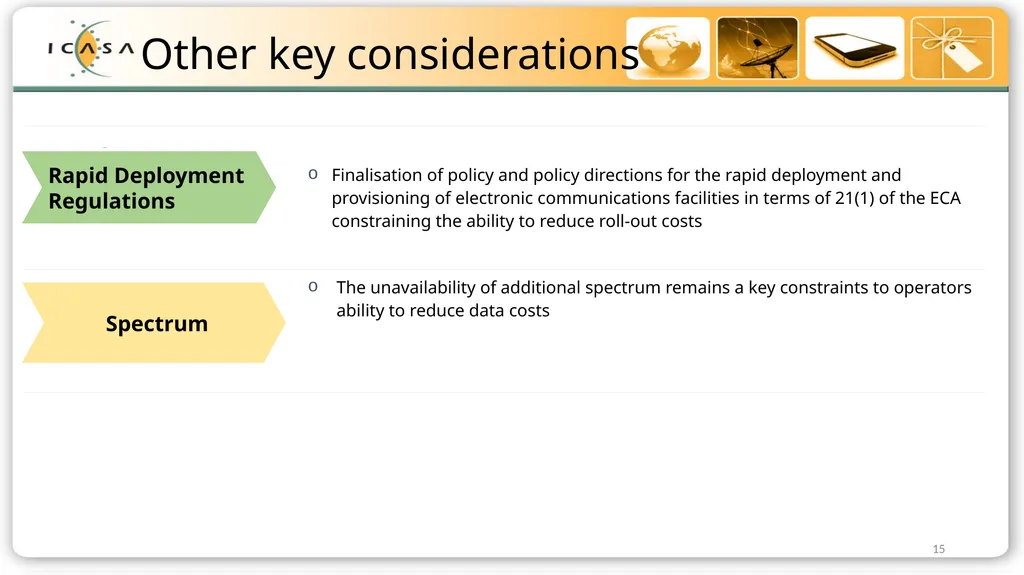
slide15. Other key considerations 15 Chief Operations Officer
(Regulatory Projects Office) Rapid Deployment Regulations Spectrum<br>
slide16. Conclusion & Way forward Prepaid data (and voice tariffs) showing a declining trend
Transparency of data and high out-of-bundle still a concern
ICASA to investigate the broadband retail tariffs in the 2017/18FY
Collaborative arrangements in place between ICASA and the National Consumer Commission to investigate and review regulations on data billing and expiry period for data bundles
Regular publication of industry data to empower consumers (e.g. tariffs analysis report)
ICASA will cooperate with the Competition Commission inquiry into the high cost of data in South Africa as announced by the Minister of Economic Development, Ebrahim Patel 16<br>
slide17. ECS/ECNS Compliance<br>
slide18. 18 Legislative & Regulatory Mandate The Independent Communications Authority of South Africa Act 13 of 2000 (ICASA Act);
Electronic Communications Act 36 of 2005 (ECA);
Broadcasting Act 4 of 1999;
Postal Services Act 124 1998;
Licence Terms and Conditions; and
Relevant Regulations.<br>
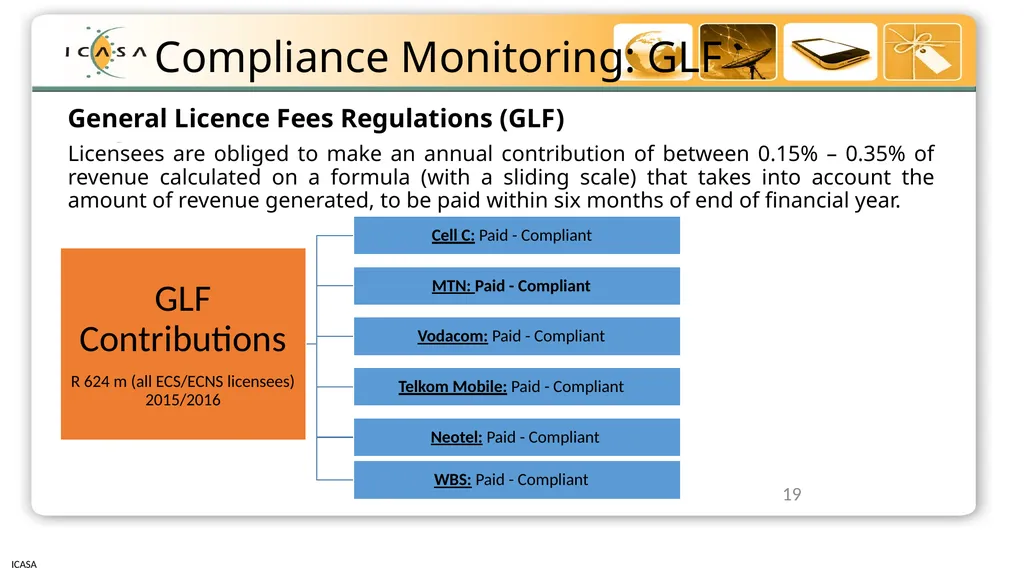
slide19. General Licence Fees Regulations (GLF)
Licensees are obliged to make an annual contribution of between 0.15% – 0.35% of revenue calculated on a formula (with a sliding scale) that takes into account the amount of revenue generated, to be paid within six months of end of financial year. 19 Compliance Monitoring: GLF<br>
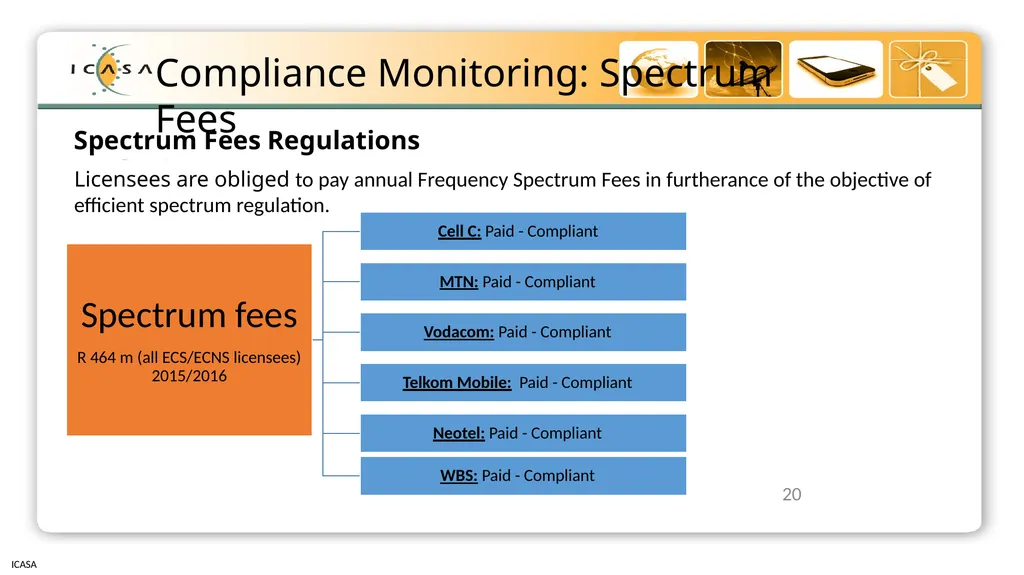
slide20. Spectrum Fees Regulations
Licensees are obliged to pay annual Frequency Spectrum Fees in furtherance of the objective of efficient spectrum regulation. 20 Compliance Monitoring: Spectrum Fees<br>
slide21. Universal Service and Access Fund (USAF)
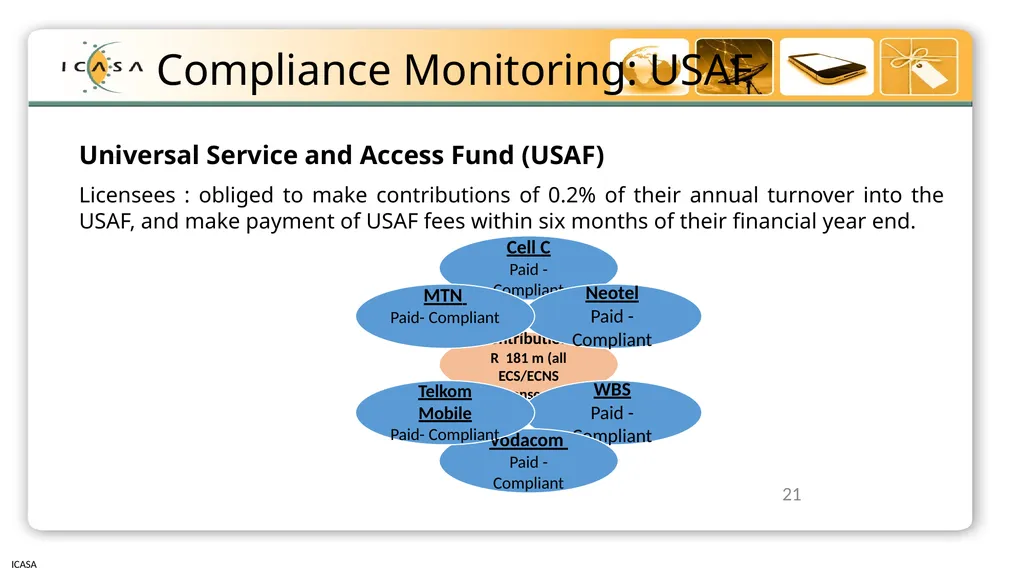
Licensees : obliged to make contributions of 0.2% of their annual turnover into the USAF, and make payment of USAF fees within six months of their financial year end. 21 Compliance Monitoring: USAF<br>
slide22. Universal Service Obligations (USO’s)
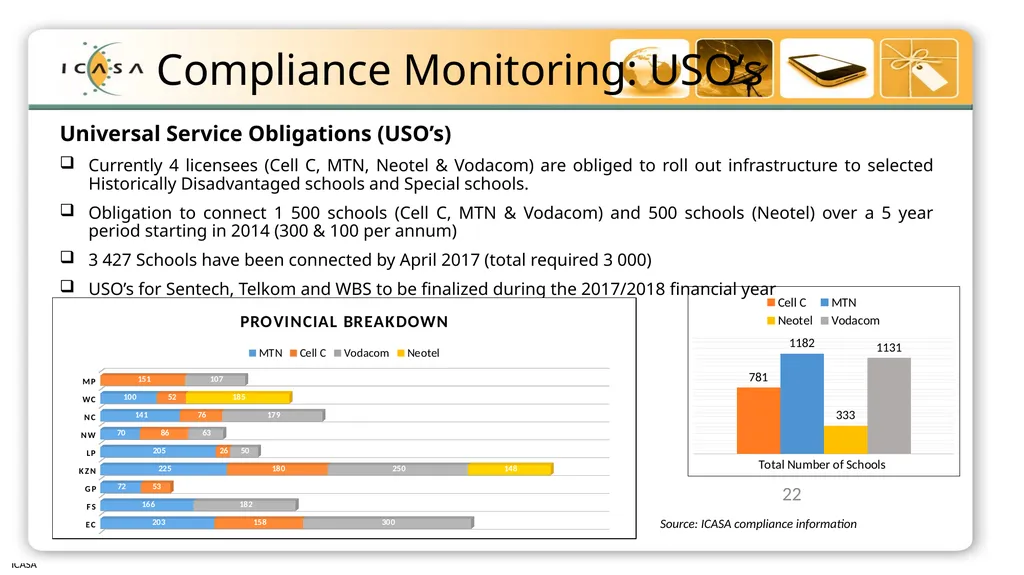
Currently 4 licensees (Cell C, MTN, Neotel & Vodacom) are obliged to roll out infrastructure to selected Historically Disadvantaged schools and Special schools.
Obligation to connect 1 500 schools (Cell C, MTN & Vodacom) and 500 schools (Neotel) over a 5 year period starting in 2014 (300 & 100 per annum)
3 427 Schools have been connected by April 2017 (total required 3 000)
USO’s for Sentech, Telkom and WBS to be finalized during the 2017/2018 financial year 22 Compliance Monitoring: USO’s Source: ICASA compliance information<br>
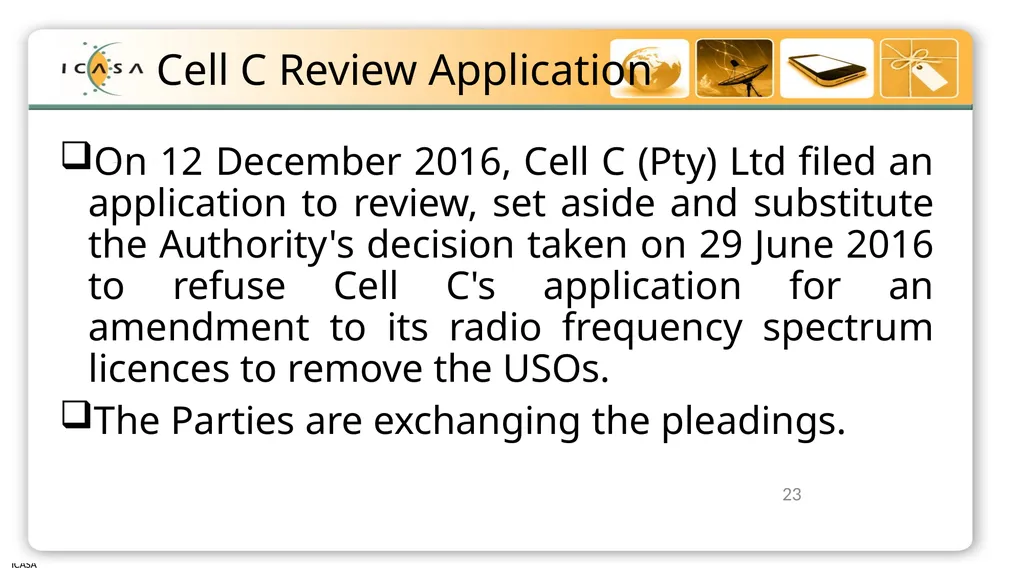
slide23. On 12 December 2016, Cell C (Pty) Ltd filed an application to review, set aside and substitute the Authority's decision taken on 29 June 2016 to refuse Cell C's application for an amendment to its radio frequency spectrum licences to remove the USOs.
The Parties are exchanging the pleadings. 23 Cell C Review Application<br>
slide24. End User & Subscriber Service Charter (EUSSC) Regulations
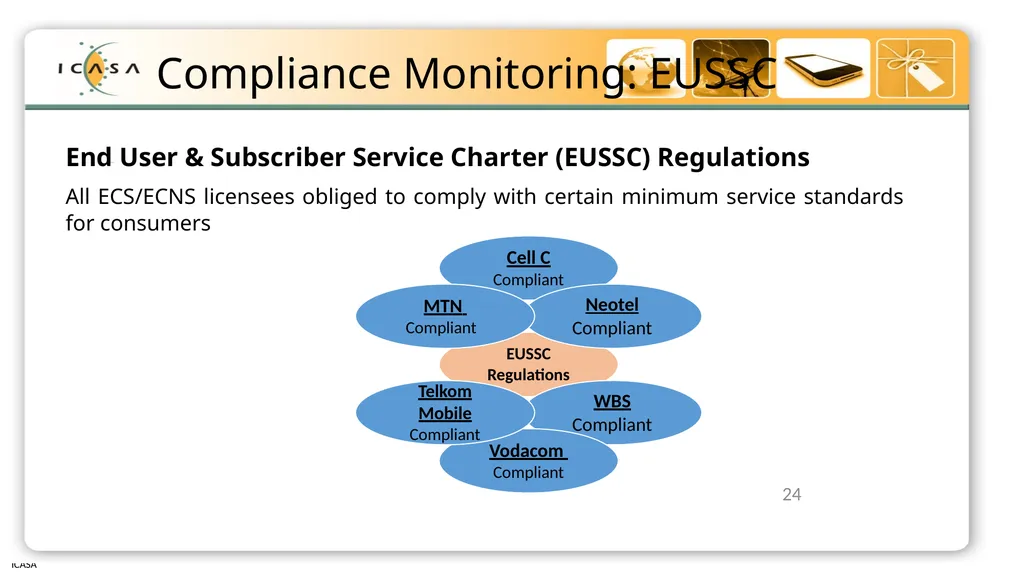
All ECS/ECNS licensees obliged to comply with certain minimum service standards for consumers 24 Compliance Monitoring: EUSSC<br>
slide25. 25 Compliance monitoring: Other Other Compliance Areas:
ECS/ECNS licensees are also monitored for compliance on the following:
Shareholding
Management and staff distribution
Submission of Interconnection / Facilities Leasing Agreements for review
Submission of notifications
Mobile operators (Cell C, MTN, Vodacom & Telkom Mobile) found to be generally compliant with the above requirements as well as other regulatory obligations
Non-compliance is escalated to the Complaints and Compliance Commission (CCC) for adjudication<br>
slide26. Thank you<br>
Wed, 2 Aug 2017 1<br>
slide2. Table of contents Cost to Communicate ECS/ECNS Compliance Legislative & Regulatory Mandate
Compliance Monitoring – General Licence Fees Regulations
Compliance Monitoring – Universal Service and Access Fund Regulations
Court Review Application
Compliance Monitoring – Universal Service Obligations
Compliance Monitoring – End User & Subscriber Service Charter Regulations
Compliance Monitoring – Other Compliance Areas 2<br>
slide3. Organisational Mandate 3 ICASA’s mandate is derived from:
ICASA Act, 2000
EC Act, 2005
Broadcasting Act, 1999
Postal Services Act, 1998
ECT Act, 2002<br>
slide4. Roles and functions of ICASA 4<br>
slide5. Government’s Priority Outcomes 5 Promote competition and network deployment for universal broadband provision Facilitate the 3-tiers of broadcasting and specifically focus on a regulatory agenda that:
Promotes local content
Dissemination of information in the public interest
Public broadcasting content across all broadcasting platforms Ensure that the regulatory framework facilitates the use of ICTs as a platform to provide increased access to government services Facilitate investment in the ICT sector, thus contributing to job creation
Promote the advancement of HDIs participation in the ICT sector<br>
slide6. Strategic Goals: 2016-2020 6<br>
slide7. ICT Sector Overview Voice a dominant but declining revenue driver in the market due to shift in consumption patterns from voice to data driven mostly by OTT services
Voice tariffs have decreased significantly since ICASA’s intervention in the wholesale call termination market in 2010
Out-of-bundle data tariffs are high relative to in-bundle-rates
Smartphone and tablet penetration <40% but growing at a rate of ~30% p.a.
Average data usage per subscriber approx. 800MB per month but increasing
The delayed assignment of high demand spectrum (700MHz, 800MHz) hampers ability of industry to provide latest broadband technology such as LTE 7<br>
slide8. Trends in Mobile Data Prices Trends in mobile data:
Shift in voice to data usage driven by OTT and new technologies
Smartphones and tablets penetration continue to grow
Decrease in average effective price/MB due to competition
Decrease in average price/MB offset by exponential growth in data traffic with resultant increases in data revenue
Revenues
Data revenue growth rate >30% pa
Voice revenue still dominant but may be overtaken by data in 3 to 4 years time
SMS revenue (mainly P2P) declining
Increase in M2M revenue
Sustainability
Data revenue is likely to offset decline in voice revenue
There is increased investment in infrastructure to support data traffic growth
Rand Depreciation, Sovereign Rating and Poor Economic Outlook may adversely data market growth
Threat of OTTs and other innovative services
Additional spectrum unavailability continues to be a bottleneck Source: ICASA database of operators’ tariff filings and annual reports 8<br>
slide9. Status Update on Data Tariffs Source: ICASA database based on tariff notifications 9 Out of Bundle per megabyte for prepaid data packages In –bundle rate per megabyte for prepaid data packages Consumers buying large volumes of data benefit significantly from low in-bundle rates/MB
Out-of-bundle rates are substantially higher than in-bundle rates
Out-of-bundle rates/MB > than in-bundle rates/MB<br>
slide10. Status Update on Prepaid Voice Tariffs Three types of prepaid tariff plans:
Flat-rate tariffs
On-net focused tariffs
Dynamic tariffs
No changes in headline tariffs lodged over the period 01 January 2017 to 31 June 2017
Promotions, bundles and dynamic pricing options reduce the effective tariff paid by subscribers Example of on-net focused tariffs Source: ICASA database based on tariff notifications 10 Flat Rate retail tariffs per network operator (per minute) Source: ICASA database based on tariff notifications<br>
slide11. 11 The Authority has noted the public discontent on high data tariffs charged by mobile operators, and voiced recently through the #datamustfall campaign.
It conducted a benchmarking exercise on the prices of 1GB and 2GB data bundles offered by mobile operators in the Southern African Development Community (“SADC”) region (including other countries in cases where information was readily available).
1GB and 2GB bundles were used as these are the most commonly comparable packages amongst the countries considered.
Prices were obtained from respective operators’ websites and converted to Rands using a simple exchange rate conversion.
The benchmark exercise illustrates that on average, the data prices of the comparator countries are relatively higher than those of South Africa’s operators Vodacom, MTN, Cell C and Telkom Mobile.
We present our findings below. International Benchmarks on Data<br>
slide12. International Benchmarks on Data Prices<br>
slide13. Cost to Communicate Programme 13<br>
slide14. Update on 2016-17FY Projects 14 Priority markets
Identification of specific markets to be regulated in the future, including broadband / data markets
Project has started and notice to conduct sec 4B of the ICASA inquiry gazette on 30 June 2017
This project will also address the concerns raised on the prices of Broadband Services
Broadband Market Inquiry
To be initiated in terms of policy direction on “Effective Competition and the Reduction of Data Prices”
A formal inquiry in terms of sec 4b and 4C of the ICASA Act and publication of discussion document for comment
Envisioned that this inquiry will result in the publication of final regulations
ICASA/NCC Joint Task Team
Established to review current industry rules on data expiry, high OOB rates and the impact on consumers
One-on-ones held with industry operators on 22 June 2017
Report with recommendations to be finalized in FY2017/18 Q2
Call Termination Market Review
Last glide path ending in September 2017
Review of regulations started on 01 October 2016 and will be finalized by 30 September 2017<br>
slide15. Other key considerations 15 Chief Operations Officer
(Regulatory Projects Office) Rapid Deployment Regulations Spectrum<br>
slide16. Conclusion & Way forward Prepaid data (and voice tariffs) showing a declining trend
Transparency of data and high out-of-bundle still a concern
ICASA to investigate the broadband retail tariffs in the 2017/18FY
Collaborative arrangements in place between ICASA and the National Consumer Commission to investigate and review regulations on data billing and expiry period for data bundles
Regular publication of industry data to empower consumers (e.g. tariffs analysis report)
ICASA will cooperate with the Competition Commission inquiry into the high cost of data in South Africa as announced by the Minister of Economic Development, Ebrahim Patel 16<br>
slide17. ECS/ECNS Compliance<br>
slide18. 18 Legislative & Regulatory Mandate The Independent Communications Authority of South Africa Act 13 of 2000 (ICASA Act);
Electronic Communications Act 36 of 2005 (ECA);
Broadcasting Act 4 of 1999;
Postal Services Act 124 1998;
Licence Terms and Conditions; and
Relevant Regulations.<br>
slide19. General Licence Fees Regulations (GLF)
Licensees are obliged to make an annual contribution of between 0.15% – 0.35% of revenue calculated on a formula (with a sliding scale) that takes into account the amount of revenue generated, to be paid within six months of end of financial year. 19 Compliance Monitoring: GLF<br>
slide20. Spectrum Fees Regulations
Licensees are obliged to pay annual Frequency Spectrum Fees in furtherance of the objective of efficient spectrum regulation. 20 Compliance Monitoring: Spectrum Fees<br>
slide21. Universal Service and Access Fund (USAF)
Licensees : obliged to make contributions of 0.2% of their annual turnover into the USAF, and make payment of USAF fees within six months of their financial year end. 21 Compliance Monitoring: USAF<br>
slide22. Universal Service Obligations (USO’s)
Currently 4 licensees (Cell C, MTN, Neotel & Vodacom) are obliged to roll out infrastructure to selected Historically Disadvantaged schools and Special schools.
Obligation to connect 1 500 schools (Cell C, MTN & Vodacom) and 500 schools (Neotel) over a 5 year period starting in 2014 (300 & 100 per annum)
3 427 Schools have been connected by April 2017 (total required 3 000)
USO’s for Sentech, Telkom and WBS to be finalized during the 2017/2018 financial year 22 Compliance Monitoring: USO’s Source: ICASA compliance information<br>
slide23. On 12 December 2016, Cell C (Pty) Ltd filed an application to review, set aside and substitute the Authority's decision taken on 29 June 2016 to refuse Cell C's application for an amendment to its radio frequency spectrum licences to remove the USOs.
The Parties are exchanging the pleadings. 23 Cell C Review Application<br>
slide24. End User & Subscriber Service Charter (EUSSC) Regulations
All ECS/ECNS licensees obliged to comply with certain minimum service standards for consumers 24 Compliance Monitoring: EUSSC<br>
slide25. 25 Compliance monitoring: Other Other Compliance Areas:
ECS/ECNS licensees are also monitored for compliance on the following:
Shareholding
Management and staff distribution
Submission of Interconnection / Facilities Leasing Agreements for review
Submission of notifications
Mobile operators (Cell C, MTN, Vodacom & Telkom Mobile) found to be generally compliant with the above requirements as well as other regulatory obligations
Non-compliance is escalated to the Complaints and Compliance Commission (CCC) for adjudication<br>
slide26. Thank you<br>