Bringing a selection index into the IRRI programs Giovanny E. Covarrubias-Pazaran Approach Understand the targeted pipeline Breeding pipeline 1: market segments Hard White- Optimum Environment (HW-OE) and Hard White- Heat Tolerant Early
"Bringing a selection index into the IRRI programs" is the property of its rightful owner. Permission is granted to
download and print the materials on this website for personal, non-commercial use only, and to display it
on your personal computer provided you do not modify the materials and that you retain all copyright
notices contained in the materials. By downloading content from our website, you accept the terms of this
agreement.
Presentation Transcript
01
Bringing a selection index into the IRRI programs Giovanny E. Covarrubias-Pazaran<br>
02
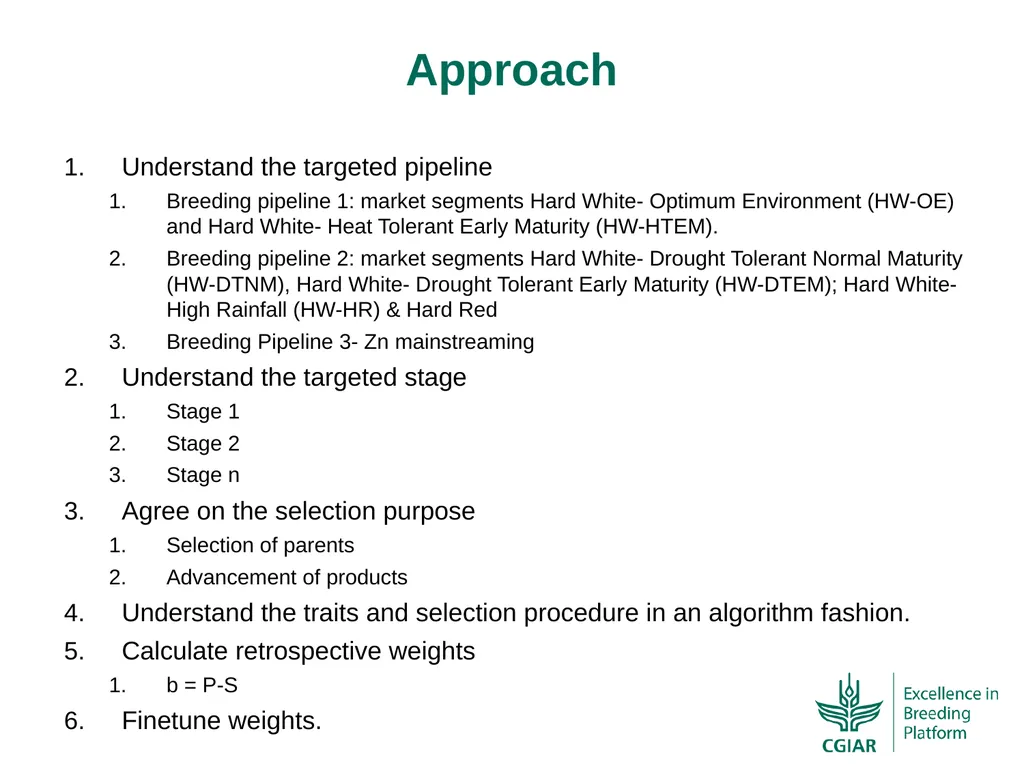
Approach Understand the targeted pipeline
Breeding pipeline 1: market segments Hard White- Optimum Environment (HW-OE) and Hard White- Heat Tolerant Early Maturity (HW-HTEM).
Breeding pipeline 2: market segments Hard White- Drought Tolerant Normal Maturity (HW-DTNM), Hard White- Drought Tolerant Early Maturity (HW-DTEM); Hard White- High Rainfall (HW-HR) & Hard Red
Breeding Pipeline 3- Zn mainstreaming
Understand the targeted stage
Stage 1
Stage 2
Stage n
Agree on the selection purpose
Selection of parents
Advancement of products
Understand the traits and selection procedure in an algorithm fashion.
Calculate retrospective weights
b = P-S
Finetune weights.<br>
03
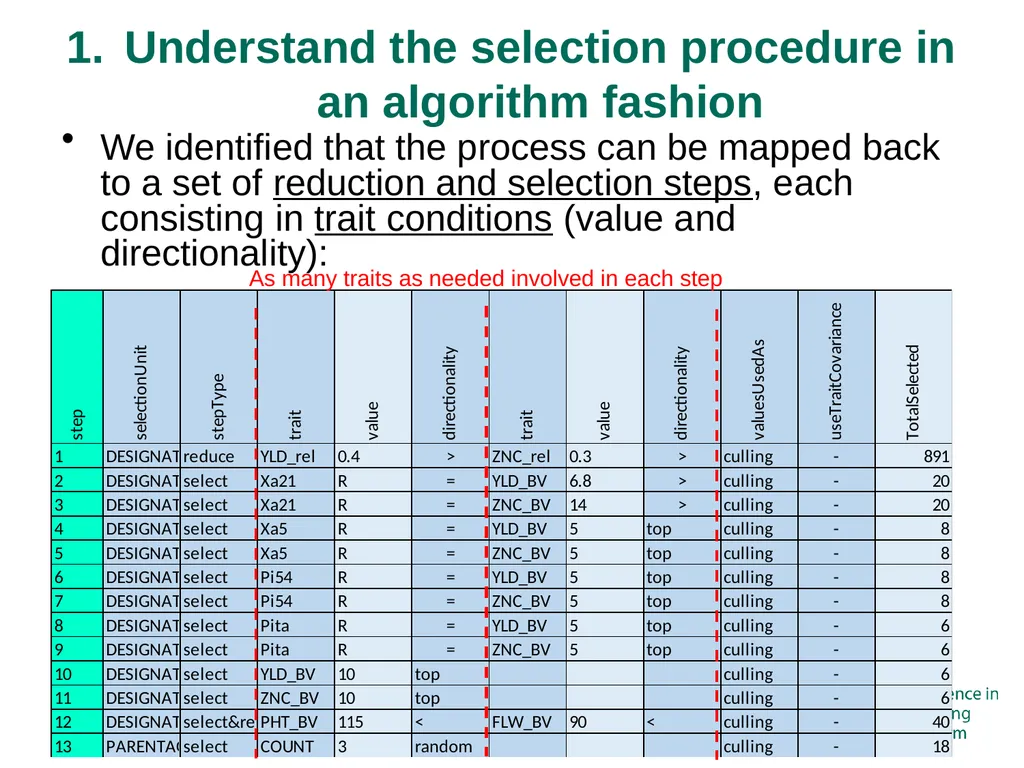
Understand the selection procedure in an algorithm fashion We identified that the process can be mapped back to a set of reduction and selection steps, each consisting in trait conditions (value and directionality): As many traits as needed involved in each step<br>
04
Can we recreate or improve Josh’s selections? We compared the selections made by Josh vs the algorithm and a selection index.
Current method gives a strong weight to single-trait transgressive individuals.<br>
05
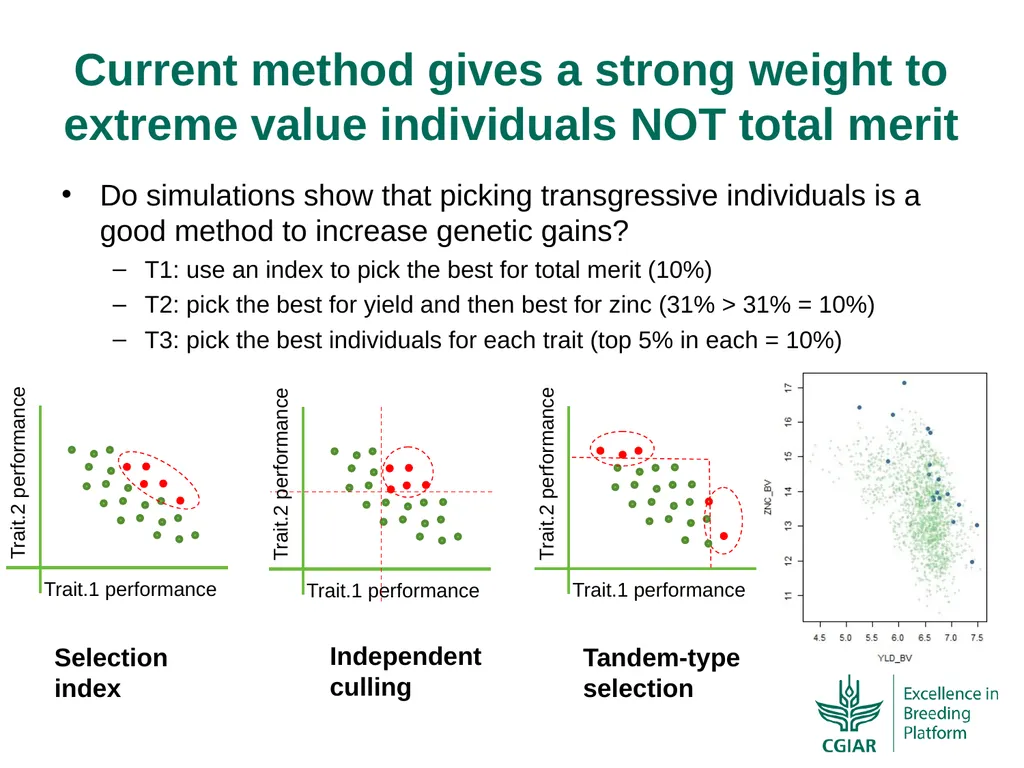
Trait.1 performance Current method gives a strong weight to extreme value individuals NOT total merit Do simulations show that picking transgressive individuals is a good method to increase genetic gains?
T1: use an index to pick the best for total merit (10%)
T2: pick the best for yield and then best for zinc (31% > 31% = 10%)
T3: pick the best individuals for each trait (top 5% in each = 10%) Trait.2 performance Trait.1 performance Trait.2 performance Trait.1 performance Trait.2 performance Independent
culling Selection
index Tandem-type
selection<br>
06
The best parents are not the extreme value individuals with lack of performance in other traits Trait.1 performance Trait.2 performance Trait.1 performance Trait.2 performance Independent culling Selection index Trait 1 Trait 2 Trait.1 performance Trait.2 performance Tandem-type selection<br>
07
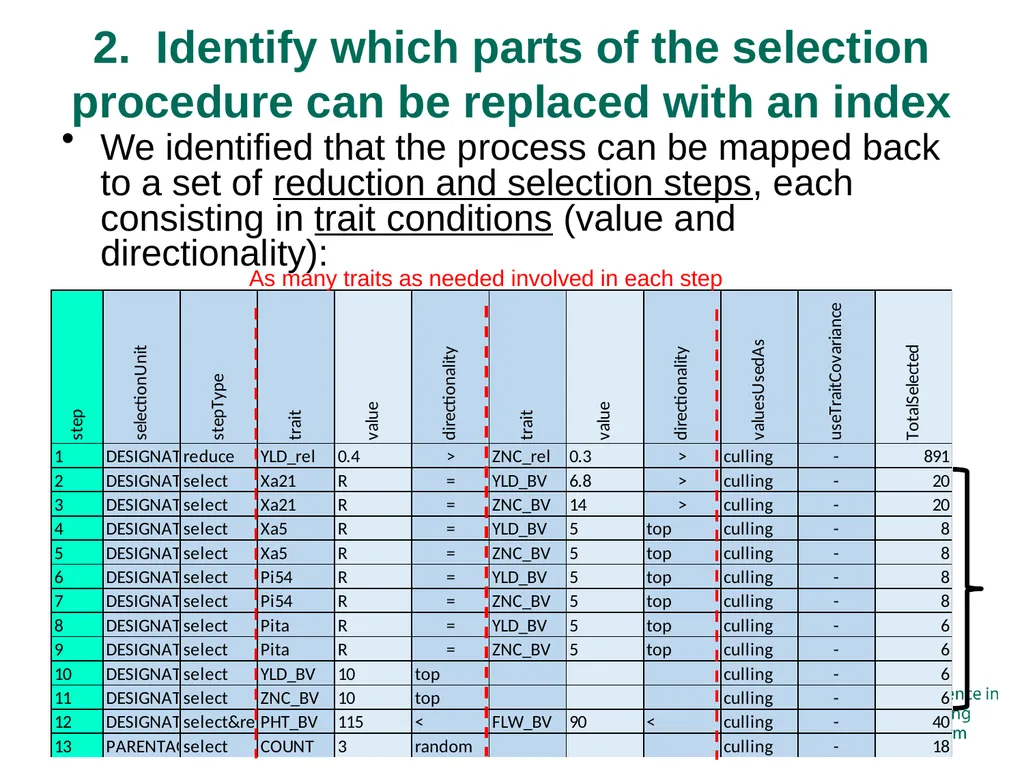
2. Identify which parts of the selection procedure can be replaced with an index We identified that the process can be mapped back to a set of reduction and selection steps, each consisting in trait conditions (value and directionality): As many traits as needed involved in each step<br>
08
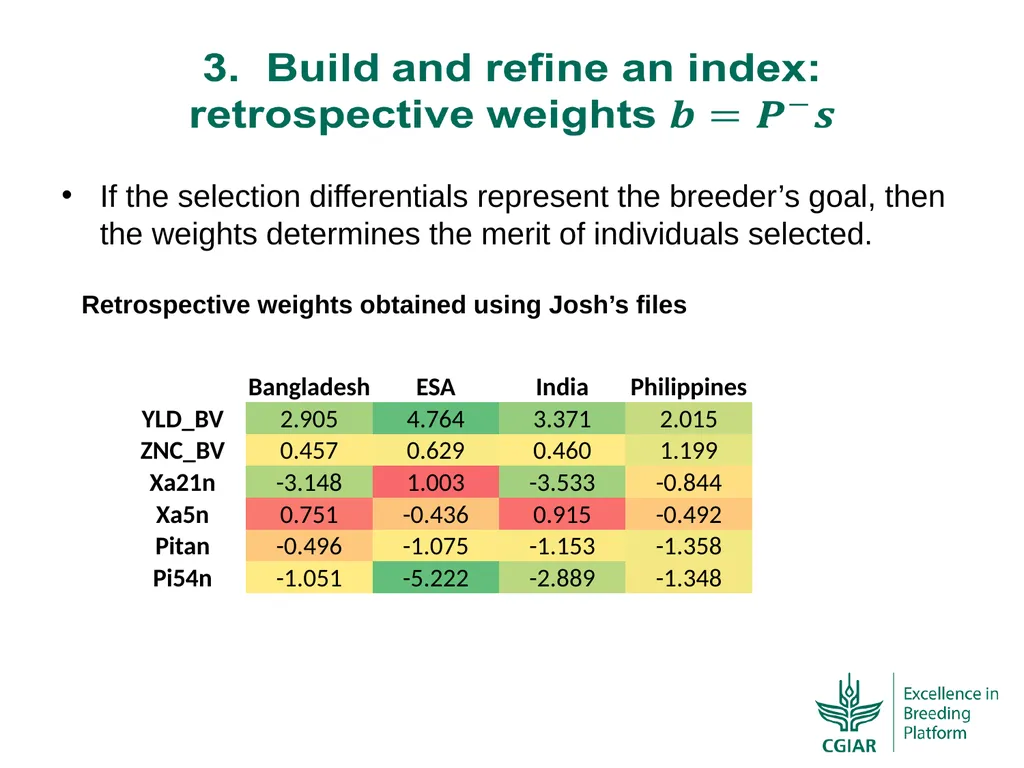
If the selection differentials represent the breeder’s goal, then the weights determines the merit of individuals selected. Retrospective weights obtained using Josh’s files<br>
09
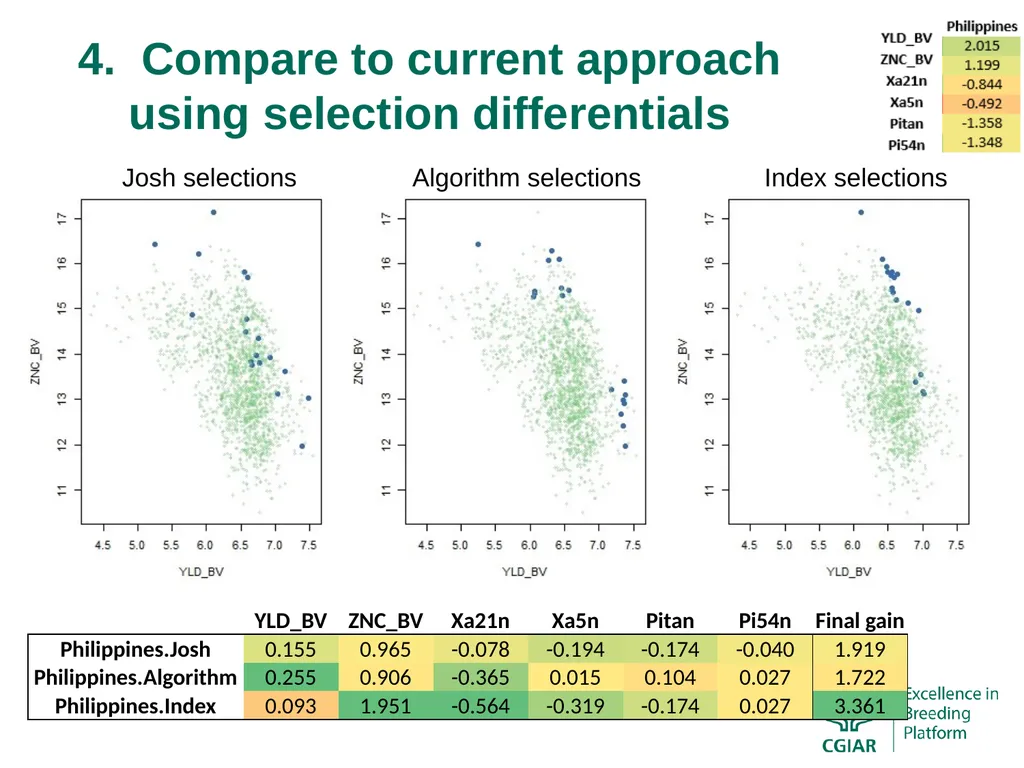
4. Compare to current approach using selection differentials Josh selections Algorithm selections Index selections<br>
10
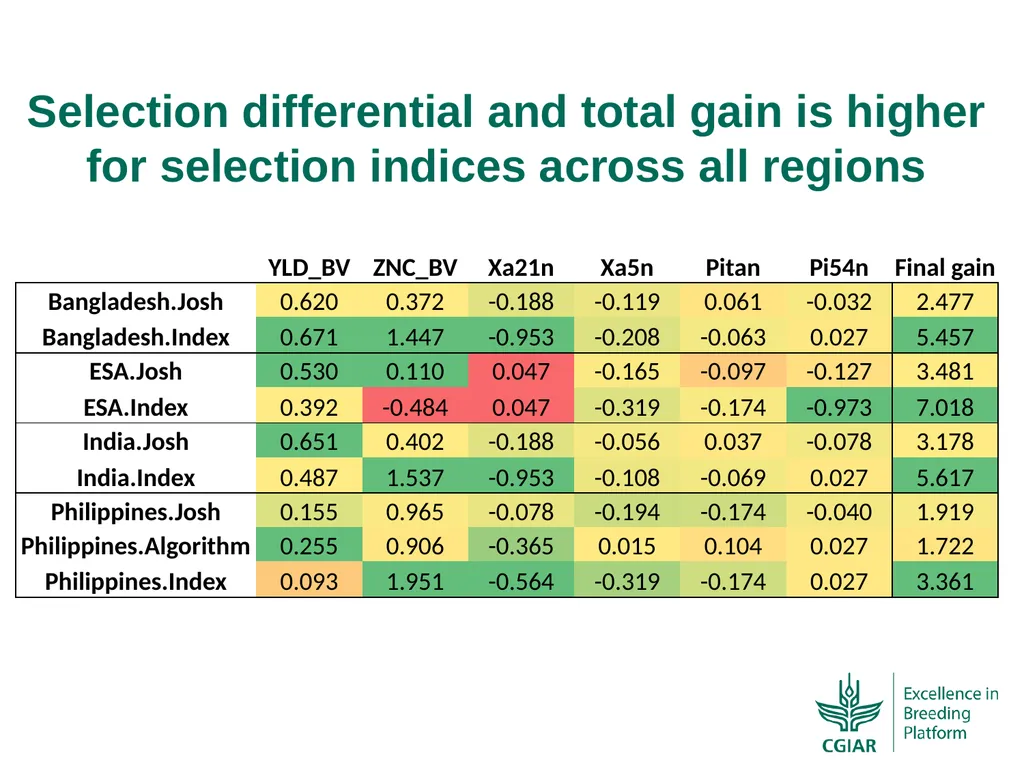
Selection differential and total gain is higher for selection indices across all regions<br>
11
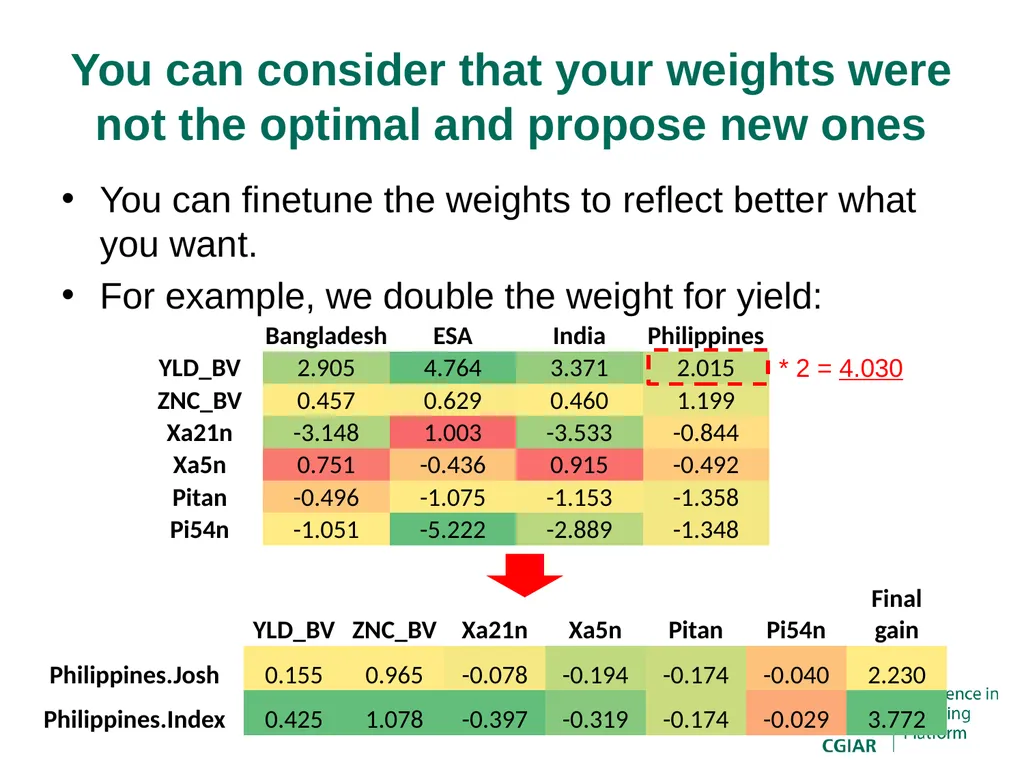
You can consider that your weights were not the optimal and propose new ones You can finetune the weights to reflect better what you want.
For example, we double the weight for yield: * 2 = 4.030<br>
12
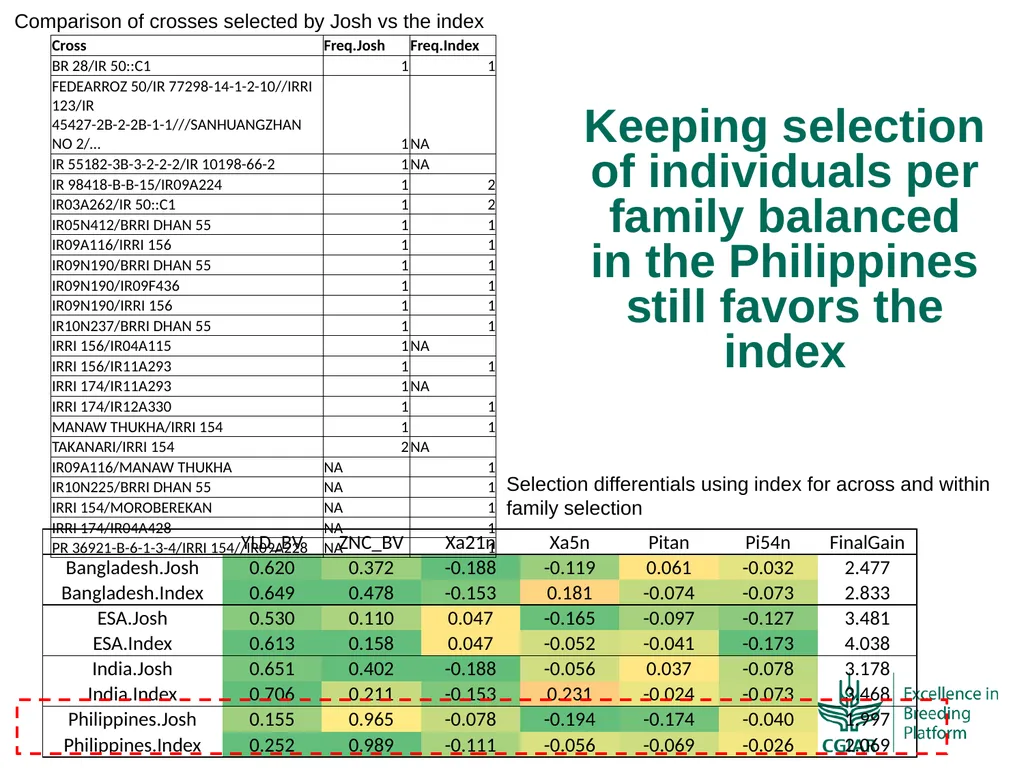
Keeping selection of individuals per family balanced in the Philippines still favors the index Comparison of crosses selected by Josh vs the index Selection differentials using index for across and within family selection<br>