Budget Execution Guidance for FY 24 Close-Out and critical updates on the FY 25 Budget 1 May 15, 2024 Jason Berlow, ORD Finance, Management Analyst Tony Laracuente, Director of Field Operations, ORD Kari Points, Administrative Officer, Iowa
"Budget Execution Guidance for FY 24 Close-Out and" is the property of its rightful owner. Permission is granted to
download and print the materials on this website for personal, non-commercial use only, and to display it
on your personal computer provided you do not modify the materials and that you retain all copyright
notices contained in the materials. By downloading content from our website, you accept the terms of this
agreement.
Presentation Transcript
01
Budget Execution Guidance for FY 24 Close-Out
and critical updates on the FY 25 Budget 1 May 15, 2024
Jason Berlow, ORD Finance, Management Analyst
Tony Laracuente, Director of Field Operations, ORD
Kari Points, Administrative Officer, Iowa City
Diane Murphy, Budget Analyst, ORD Finance
Erin Olson, Budget Analyst, ORD Finance<br>
02
Objectives of Today’s Presentation 2<br>
03
Section 1: FY 24 close out guidance 3<br>
04
FY 24 Carryover Guidance By 9/30/24 the follow criteria must be met:
All stations must achieve a carryover target allowance of 2% of the total station Research (0161A1 24-25) appropriation/allocation. 4<br>
05
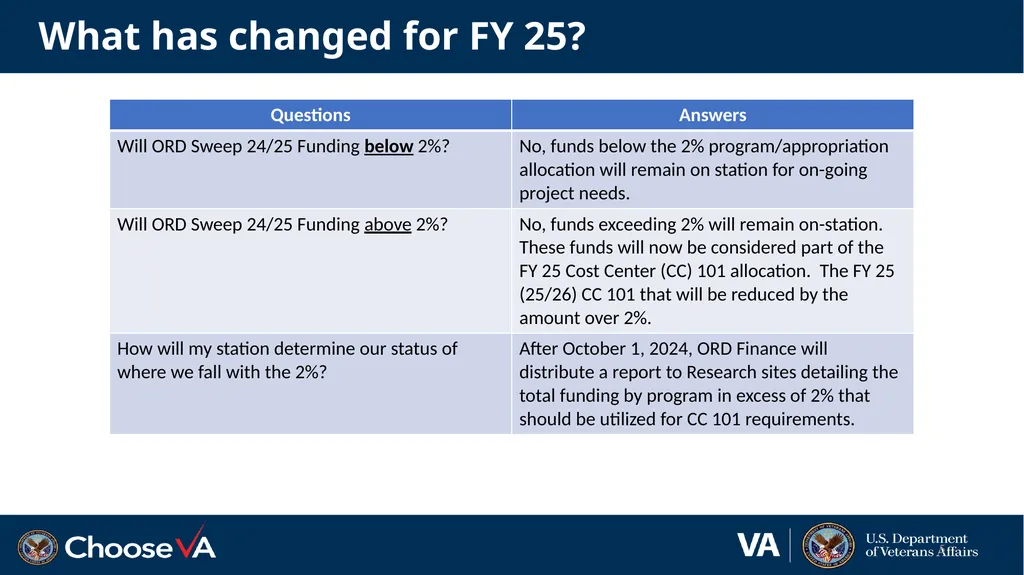
What has changed for FY 25? 5<br>
06
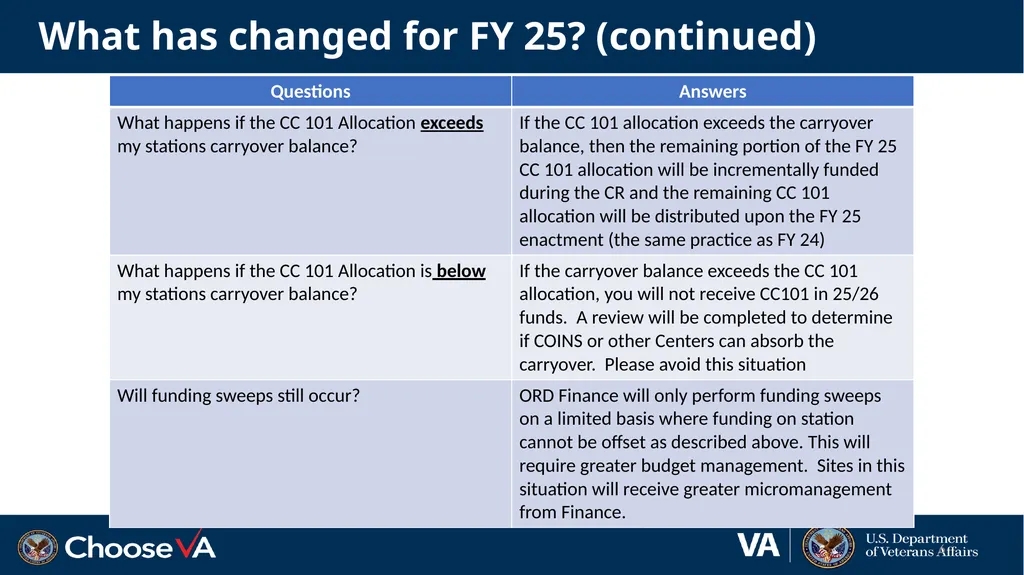
What has changed for FY 25? (continued) 6<br>
07
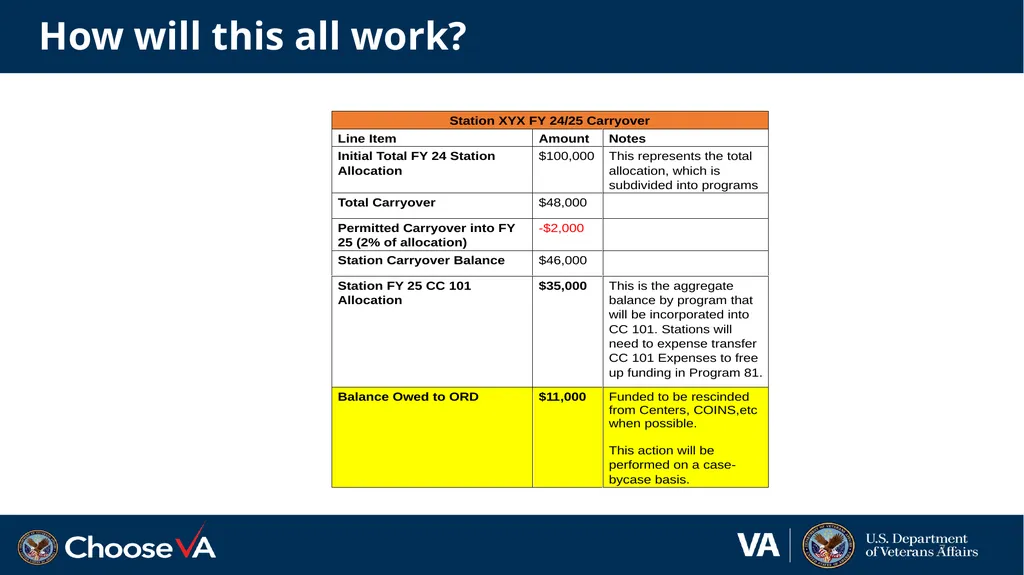
7 How will this all work?<br>
08
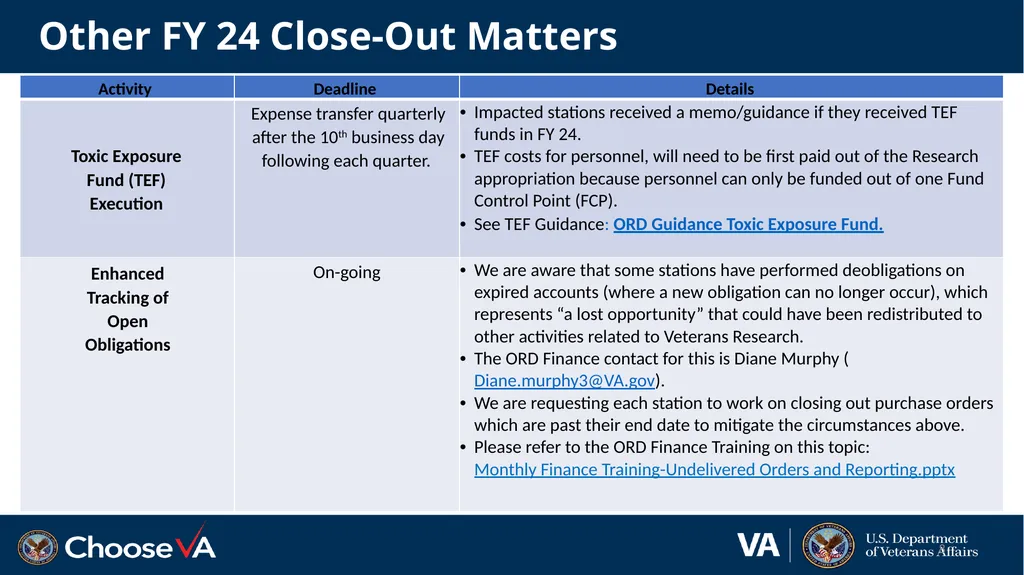
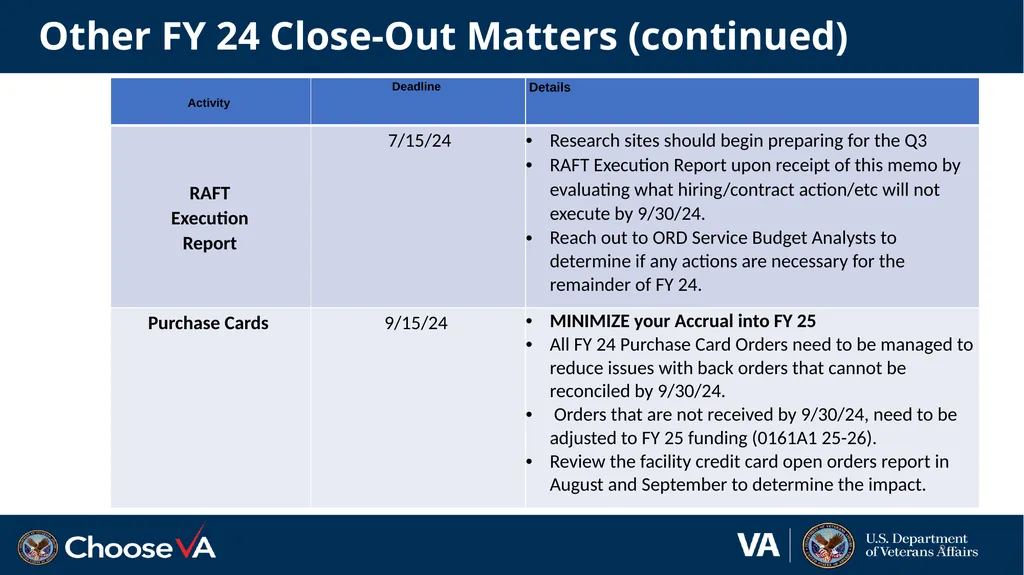
Other FY 24 Close-Out Matters 8<br>
09
Other FY 24 Close-Out Matters (continued) 9<br>
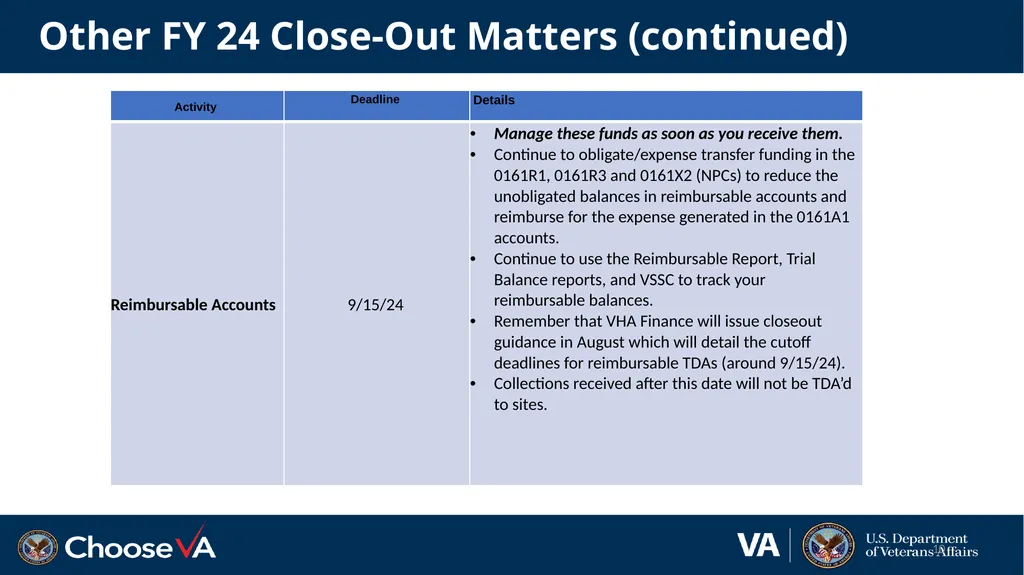
10
Other FY 24 Close-Out Matters (continued) 10<br>
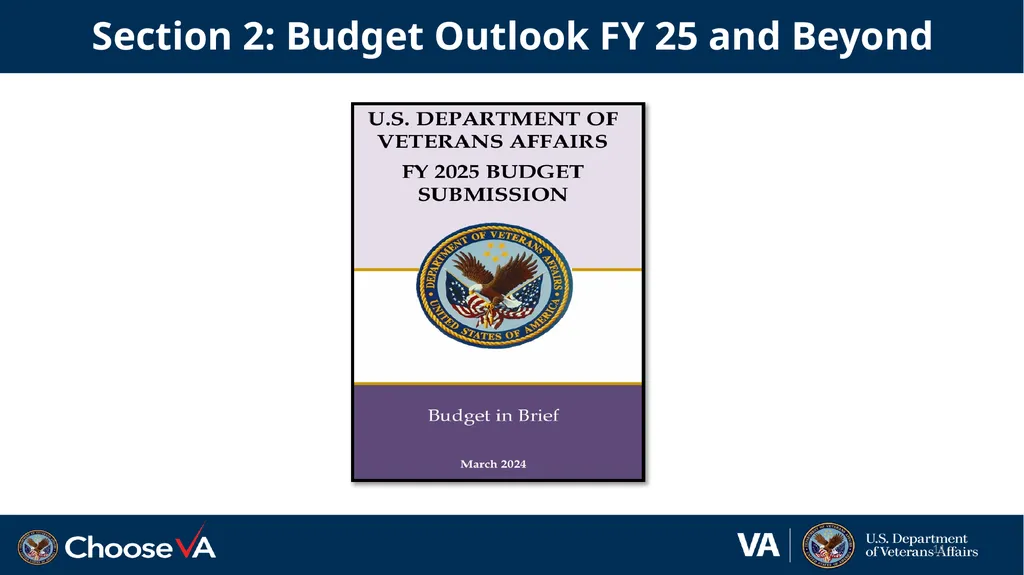
11
Section 2: Budget Outlook FY 25 and Beyond 11<br>
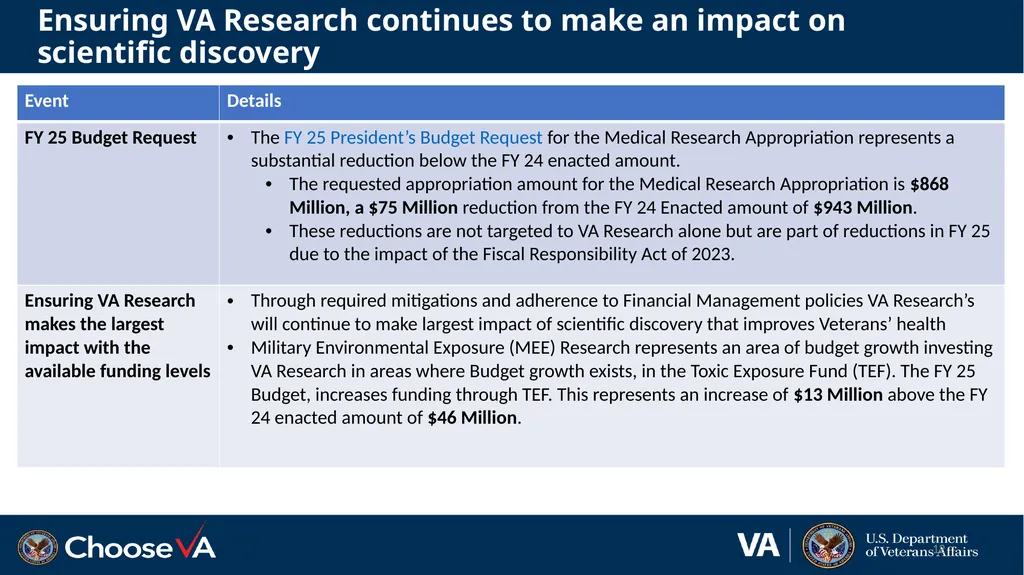
12
Ensuring VA Research continues to make an impact on scientific discovery 12<br>
13
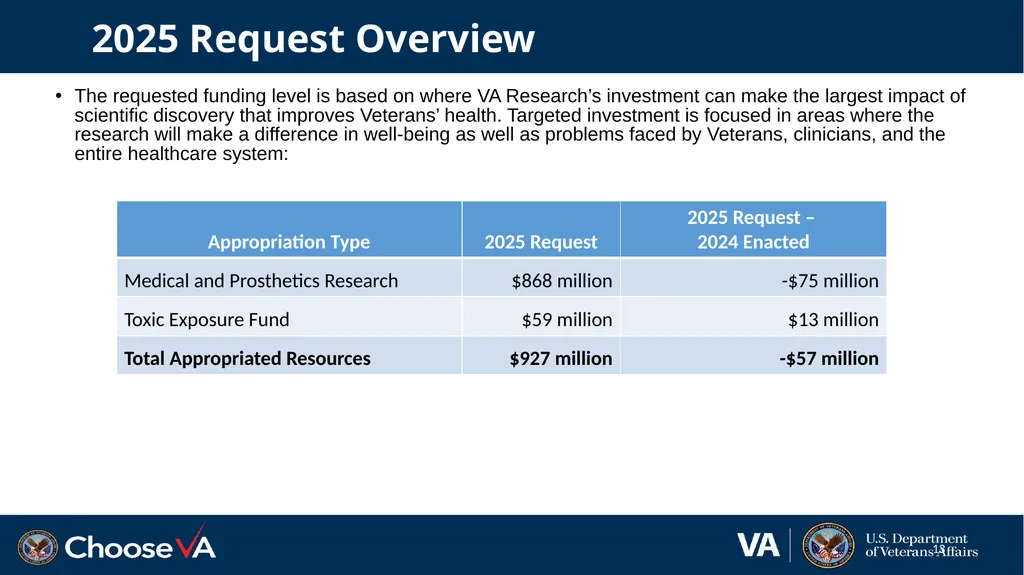
The requested funding level is based on where VA Research’s investment can make the largest impact of scientific discovery that improves Veterans’ health. Targeted investment is focused in areas where the research will make a difference in well-being as well as problems faced by Veterans, clinicians, and the entire healthcare system: 13 2025 Request Overview<br>
14
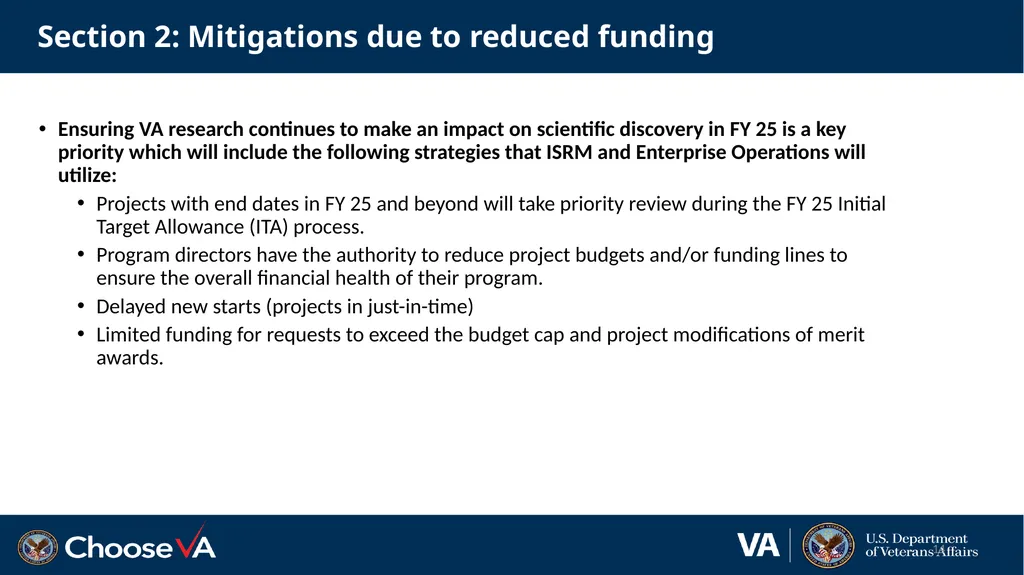
Section 2: Mitigations due to reduced funding 14 Ensuring VA research continues to make an impact on scientific discovery in FY 25 is a key priority which will include the following strategies that ISRM and Enterprise Operations will utilize:
Projects with end dates in FY 25 and beyond will take priority review during the FY 25 Initial Target Allowance (ITA) process.
Program directors have the authority to reduce project budgets and/or funding lines to ensure the overall financial health of their program.
Delayed new starts (projects in just-in-time)
Limited funding for requests to exceed the budget cap and project modifications of merit awards.<br>
15
FY 25 CR BEGIN PREPARATIONS FOR A FY 25 CONTINUING RESOLUTION (CR): Prepare for the FY 25 CR now, so you are ready on October 1s by planning for the following:
Plan to start FY 25 under one/multiple CRs for a significant portion of the fiscal year (like FY 24).
Make sure that July 1st and October 1st project starts are implemented early in the fiscal year by hiring staff, purchasing supplies, and buying equipment.
Ensure your acquisition packages are submitted to RPO East as early as possible and work with Fiscal to allow you to overcommit your FCP in VISTA.
Refer to ORD FY 24 CR Guidance for complete guidance on executing funding during a CR (the FY 25 CR guidance will be issued in September). 15<br>
16
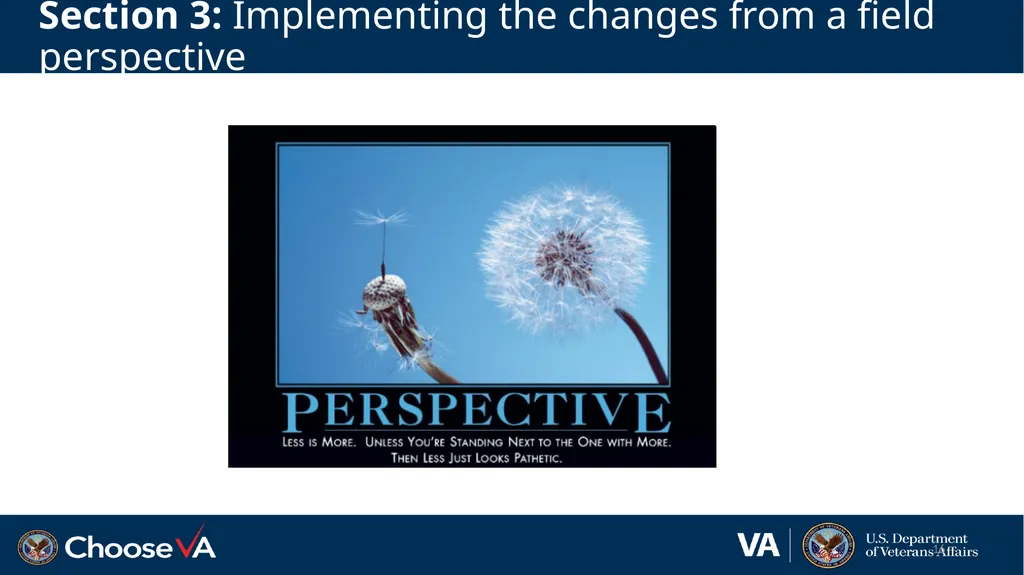
Section 3: Implementing the changes from a field perspective 16<br>
17
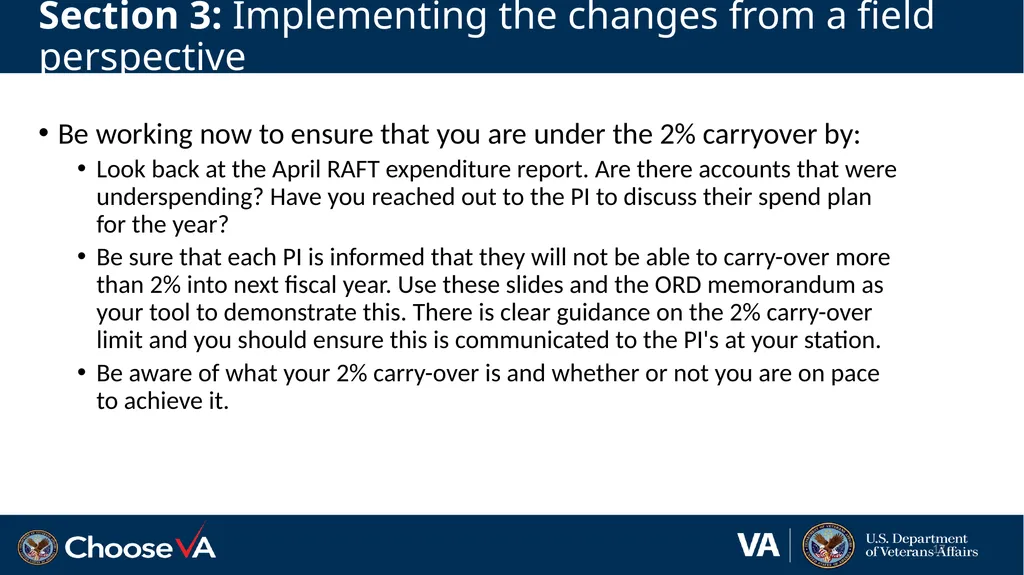
Section 3: Implementing the changes from a field perspective Be working now to ensure that you are under the 2% carryover by:
Look back at the April RAFT expenditure report. Are there accounts that were underspending? Have you reached out to the PI to discuss their spend plan for the year?
Be sure that each PI is informed that they will not be able to carry-over more than 2% into next fiscal year. Use these slides and the ORD memorandum as your tool to demonstrate this. There is clear guidance on the 2% carry-over limit and you should ensure this is communicated to the PI's at your station.
Be aware of what your 2% carry-over is and whether or not you are on pace to achieve it. 17<br>
18
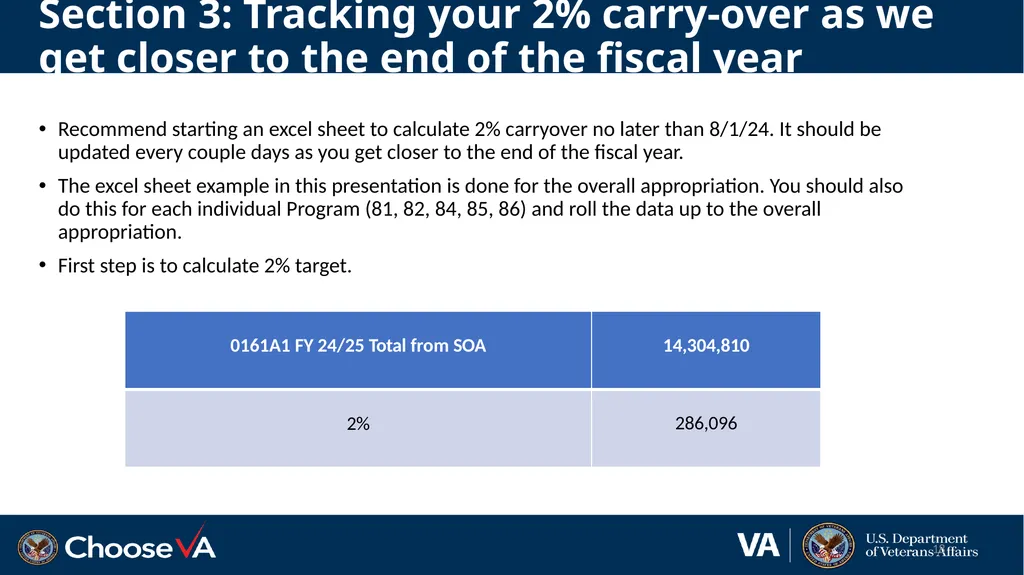
Section 3: Tracking your 2% carry-over as we get closer to the end of the fiscal year Recommend starting an excel sheet to calculate 2% carryover no later than 8/1/24. It should be updated every couple days as you get closer to the end of the fiscal year.
The excel sheet example in this presentation is done for the overall appropriation. You should also do this for each individual Program (81, 82, 84, 85, 86) and roll the data up to the overall appropriation.
First step is to calculate 2% target. 18<br>
19
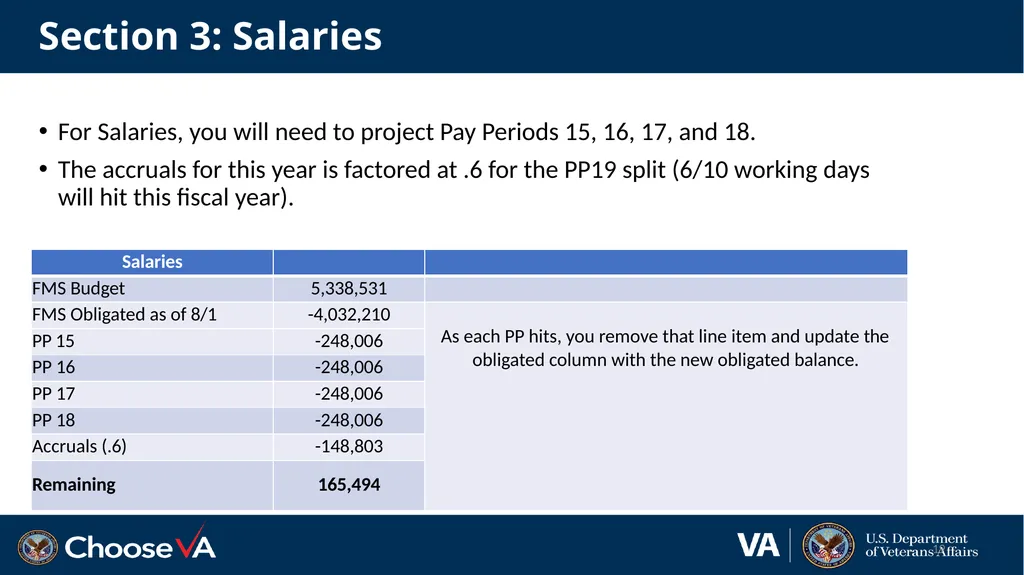
Section 3: Salaries For Salaries, you will need to project Pay Periods 15, 16, 17, and 18.
The accruals for this year is factored at .6 for the PP19 split (6/10 working days will hit this fiscal year). 19<br>
20
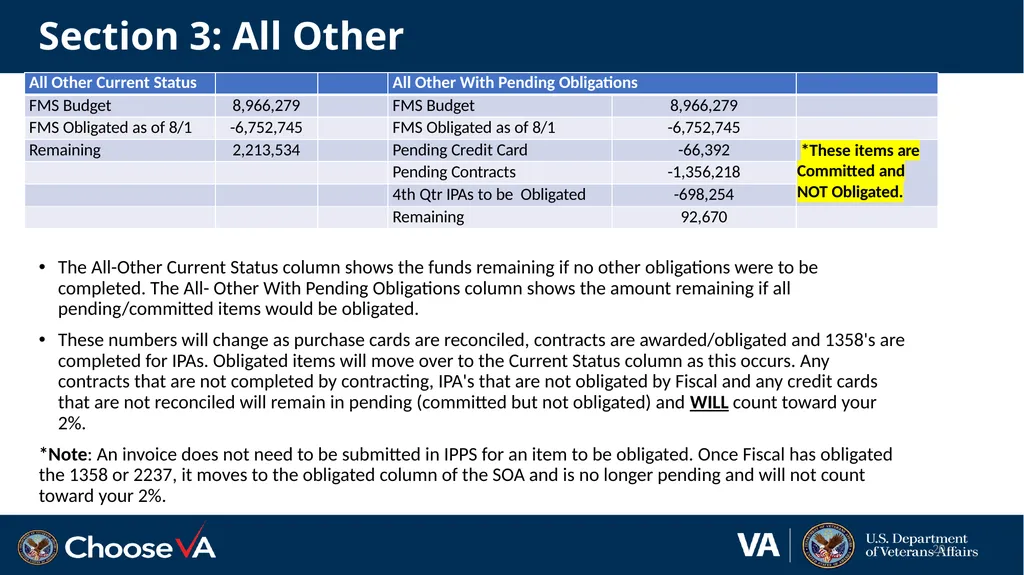
Section 3: All Other The All-Other Current Status column shows the funds remaining if no other obligations were to be completed. The All- Other With Pending Obligations column shows the amount remaining if all pending/committed items would be obligated.
These numbers will change as purchase cards are reconciled, contracts are awarded/obligated and 1358's are completed for IPAs. Obligated items will move over to the Current Status column as this occurs. Any contracts that are not completed by contracting, IPA's that are not obligated by Fiscal and any credit cards that are not reconciled will remain in pending (committed but not obligated) and WILL count toward your 2%.
*Note: An invoice does not need to be submitted in IPPS for an item to be obligated. Once Fiscal has obligated the 1358 or 2237, it moves to the obligated column of the SOA and is no longer pending and will not count toward your 2%. 20<br>
21
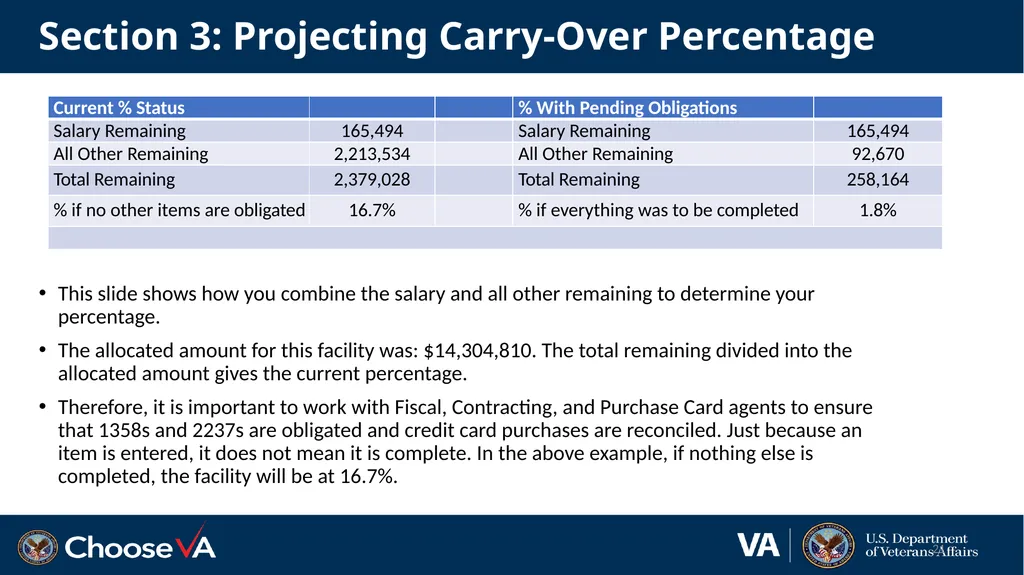
Section 3: Projecting Carry-Over Percentage This slide shows how you combine the salary and all other remaining to determine your percentage.
The allocated amount for this facility was: $14,304,810. The total remaining divided into the allocated amount gives the current percentage.
Therefore, it is important to work with Fiscal, Contracting, and Purchase Card agents to ensure that 1358s and 2237s are obligated and credit card purchases are reconciled. Just because an item is entered, it does not mean it is complete. In the above example, if nothing else is completed, the facility will be at 16.7%. 21<br>
22
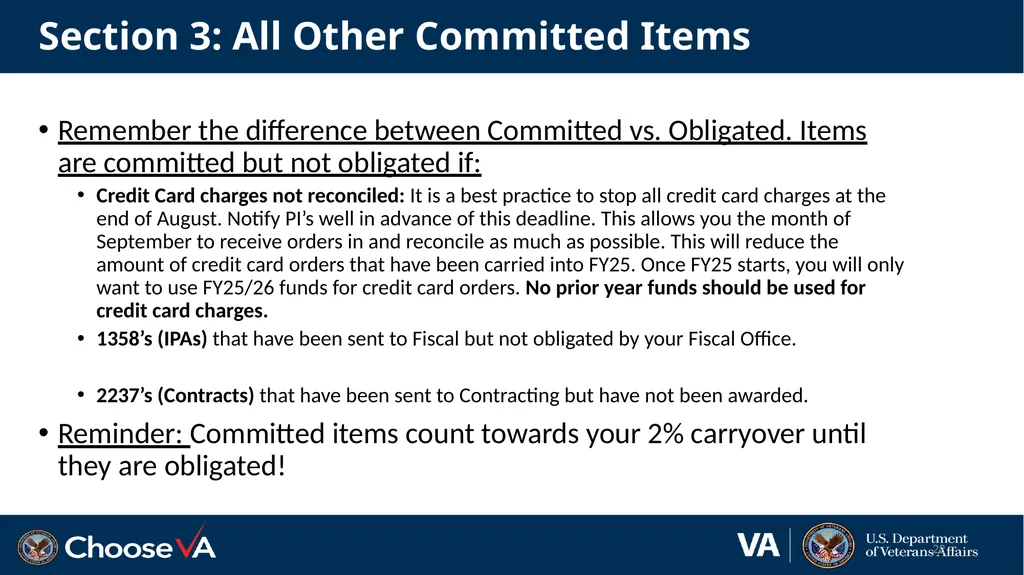
Section 3: All Other Committed Items Remember the difference between Committed vs. Obligated. Items are committed but not obligated if:
Credit Card charges not reconciled: It is a best practice to stop all credit card charges at the end of August. Notify PI’s well in advance of this deadline. This allows you the month of September to receive orders in and reconcile as much as possible. This will reduce the amount of credit card orders that have been carried into FY25. Once FY25 starts, you will only want to use FY25/26 funds for credit card orders. No prior year funds should be used for credit card charges.
1358’s (IPAs) that have been sent to Fiscal but not obligated by your Fiscal Office.
2237’s (Contracts) that have been sent to Contracting but have not been awarded.
Reminder: Committed items count towards your 2% carryover until they are obligated! 22<br>
23
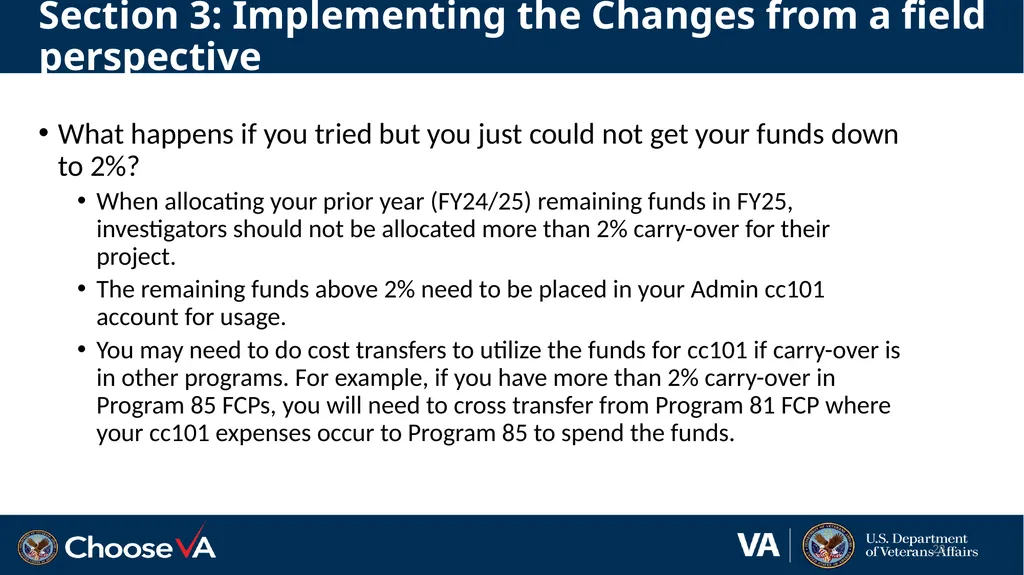
Section 3: Implementing the Changes from a field perspective What happens if you tried but you just could not get your funds down to 2%?
When allocating your prior year (FY24/25) remaining funds in FY25, investigators should not be allocated more than 2% carry-over for their project.
The remaining funds above 2% need to be placed in your Admin cc101 account for usage.
You may need to do cost transfers to utilize the funds for cc101 if carry-over is in other programs. For example, if you have more than 2% carry-over in Program 85 FCPs, you will need to cross transfer from Program 81 FCP where your cc101 expenses occur to Program 85 to spend the funds. 23<br>