
BUDGET REDUCTIONS TRENDS RESTRICTED 1 Personnel
CP
Published · 14 slides · 0 views

1 / 1
Description
BUDGET REDUCTIONS TRENDS RESTRICTED 1 Personnel Capital Operating CURRENT MTEF ALLOCATIONS RESTRICTED 2 RESTRICTED 3 CURRENT MTEF ALLOCATIONS National Revised MTEF Allocations: 202223 and 202425 as received on 28 January 2022 Special
Related Topics
Share
Embed code
Download this presentation From Below
"BUDGET REDUCTIONS TRENDS RESTRICTED 1 Personnel" is the property of its rightful owner. Permission is granted to download and print the materials on this website for personal, non-commercial use only, and to display it on your personal computer provided you do not modify the materials and that you retain all copyright notices contained in the materials. By downloading content from our website, you accept the terms of this agreement.
Presentation Transcript
01
BUDGET REDUCTIONS TRENDS RESTRICTED 1 Personnel Capital Operating<br>
02
CURRENT MTEF ALLOCATIONS RESTRICTED 2<br>
03
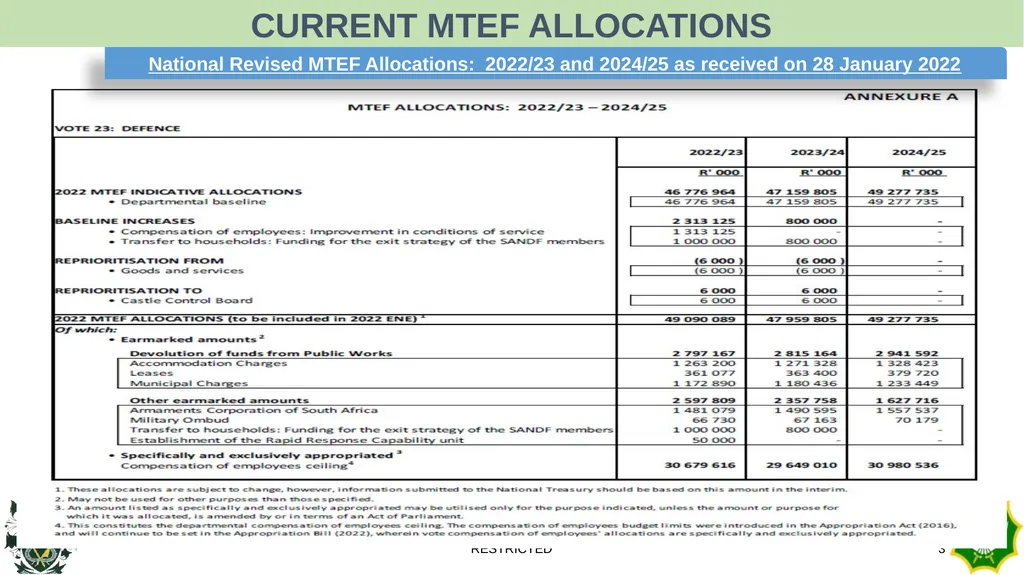
RESTRICTED 3 CURRENT MTEF ALLOCATIONS National Revised MTEF Allocations: 2022/23 and 2024/25 as received on 28 January 2022<br>
04
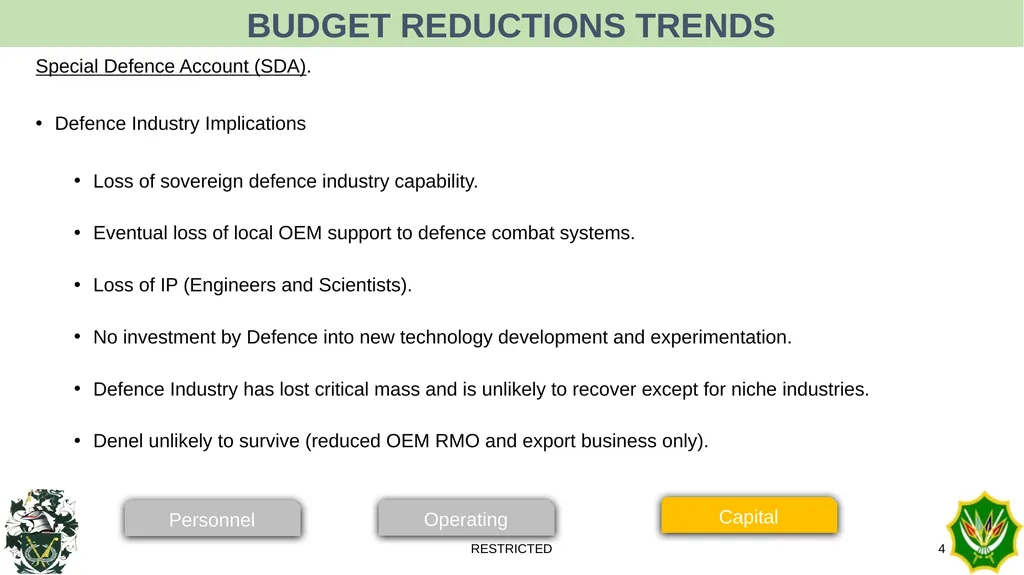
Special Defence Account (SDA).
Defence Industry Implications
Loss of sovereign defence industry capability.
Eventual loss of local OEM support to defence combat systems.
Loss of IP (Engineers and Scientists).
No investment by Defence into new technology development and experimentation.
Defence Industry has lost critical mass and is unlikely to recover except for niche industries.
Denel unlikely to survive (reduced OEM RMO and export business only). RESTRICTED 4 BUDGET REDUCTIONS TRENDS Personnel Capital Operating<br>
05
Special Defence Account (SDA).
Implications for the DOD should the Contracts be terminated.
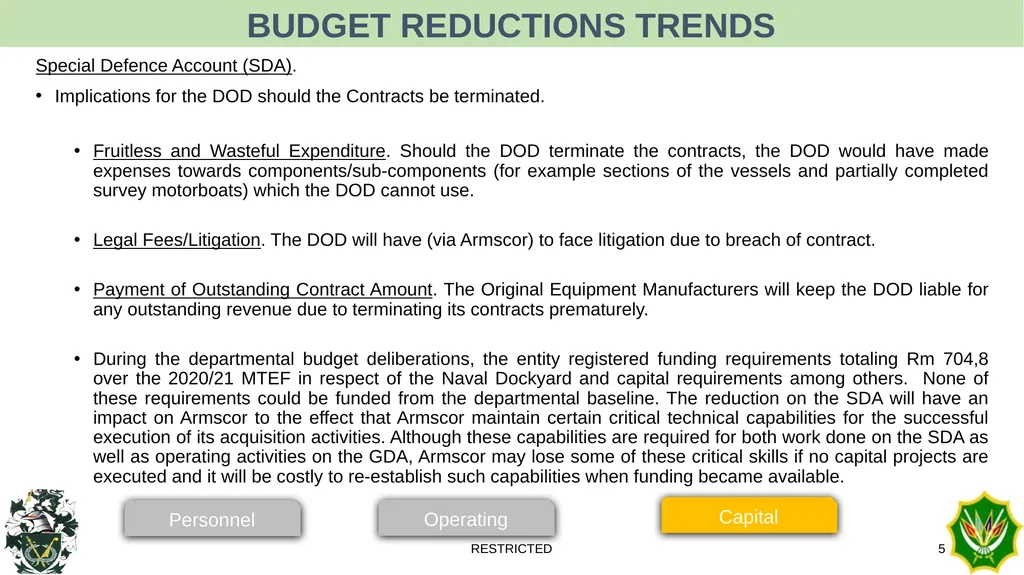
Fruitless and Wasteful Expenditure. Should the DOD terminate the contracts, the DOD would have made expenses towards components/sub-components (for example sections of the vessels and partially completed survey motorboats) which the DOD cannot use.
Legal Fees/Litigation. The DOD will have (via Armscor) to face litigation due to breach of contract.
Payment of Outstanding Contract Amount. The Original Equipment Manufacturers will keep the DOD liable for any outstanding revenue due to terminating its contracts prematurely.
During the departmental budget deliberations, the entity registered funding requirements totaling Rm 704,8 over the 2020/21 MTEF in respect of the Naval Dockyard and capital requirements among others. None of these requirements could be funded from the departmental baseline. The reduction on the SDA will have an impact on Armscor to the effect that Armscor maintain certain critical technical capabilities for the successful execution of its acquisition activities. Although these capabilities are required for both work done on the SDA as well as operating activities on the GDA, Armscor may lose some of these critical skills if no capital projects are executed and it will be costly to re-establish such capabilities when funding became available. RESTRICTED 5 BUDGET REDUCTIONS TRENDS Personnel Capital Operating<br>
06
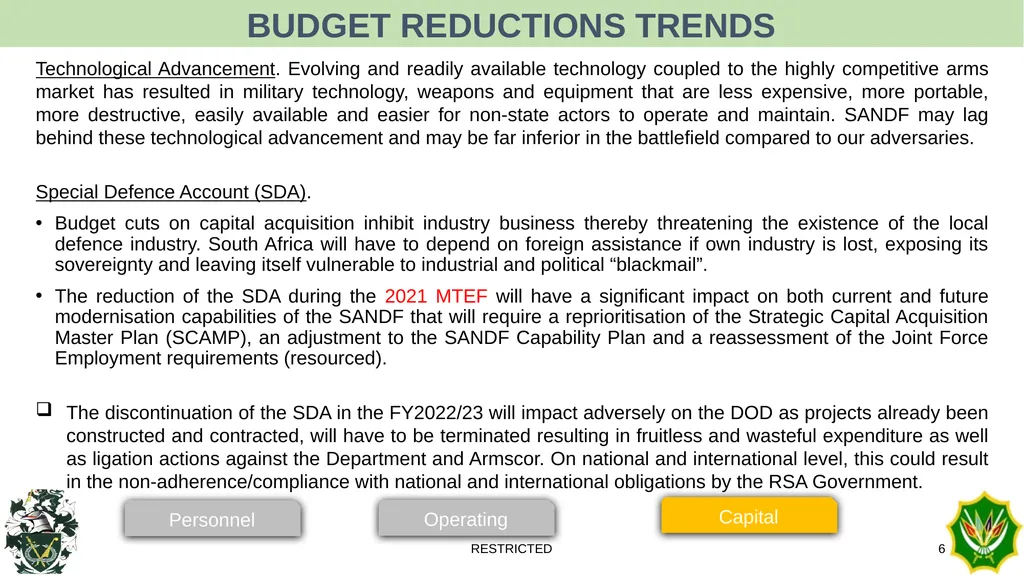
Technological Advancement. Evolving and readily available technology coupled to the highly competitive arms market has resulted in military technology, weapons and equipment that are less expensive, more portable, more destructive, easily available and easier for non-state actors to operate and maintain. SANDF may lag behind these technological advancement and may be far inferior in the battlefield compared to our adversaries.
Special Defence Account (SDA).
Budget cuts on capital acquisition inhibit industry business thereby threatening the existence of the local defence industry. South Africa will have to depend on foreign assistance if own industry is lost, exposing its sovereignty and leaving itself vulnerable to industrial and political “blackmail”.
The reduction of the SDA during the 2021 MTEF will have a significant impact on both current and future modernisation capabilities of the SANDF that will require a reprioritisation of the Strategic Capital Acquisition Master Plan (SCAMP), an adjustment to the SANDF Capability Plan and a reassessment of the Joint Force Employment requirements (resourced).
The discontinuation of the SDA in the FY2022/23 will impact adversely on the DOD as projects already been constructed and contracted, will have to be terminated resulting in fruitless and wasteful expenditure as well as ligation actions against the Department and Armscor. On national and international level, this could result in the non-adherence/compliance with national and international obligations by the RSA Government. RESTRICTED 6 BUDGET REDUCTIONS TRENDS Personnel Capital Operating<br>
07
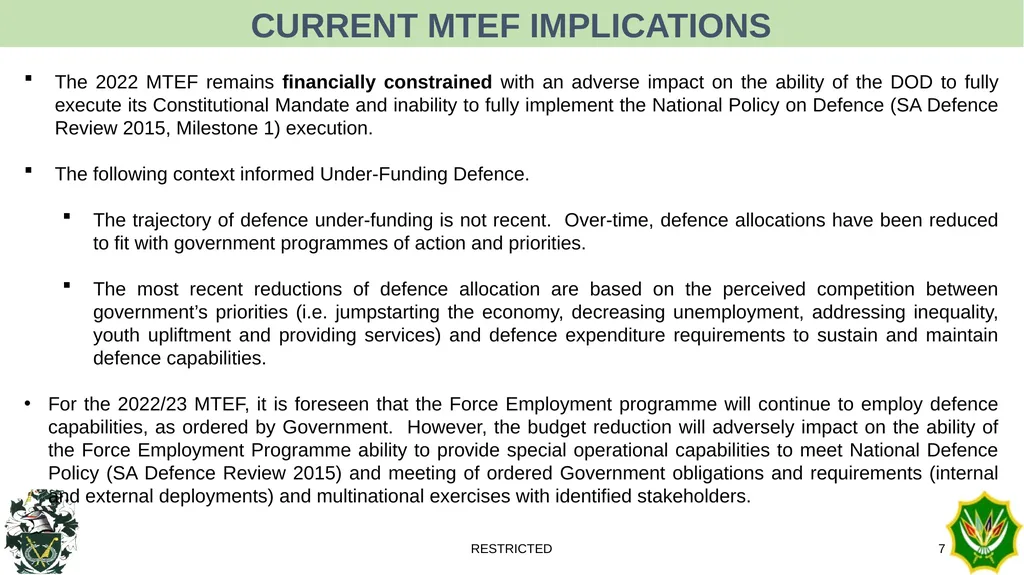
RESTRICTED 7 CURRENT MTEF IMPLICATIONS The 2022 MTEF remains financially constrained with an adverse impact on the ability of the DOD to fully execute its Constitutional Mandate and inability to fully implement the National Policy on Defence (SA Defence Review 2015, Milestone 1) execution.
The following context informed Under-Funding Defence.
The trajectory of defence under-funding is not recent. Over-time, defence allocations have been reduced to fit with government programmes of action and priorities.
The most recent reductions of defence allocation are based on the perceived competition between government’s priorities (i.e. jumpstarting the economy, decreasing unemployment, addressing inequality, youth upliftment and providing services) and defence expenditure requirements to sustain and maintain defence capabilities.
For the 2022/23 MTEF, it is foreseen that the Force Employment programme will continue to employ defence capabilities, as ordered by Government. However, the budget reduction will adversely impact on the ability of the Force Employment Programme ability to provide special operational capabilities to meet National Defence Policy (SA Defence Review 2015) and meeting of ordered Government obligations and requirements (internal and external deployments) and multinational exercises with identified stakeholders.<br>
08
RESTRICTED 8 CURRENT MTEF IMPLICATIONS Border Safeguarding
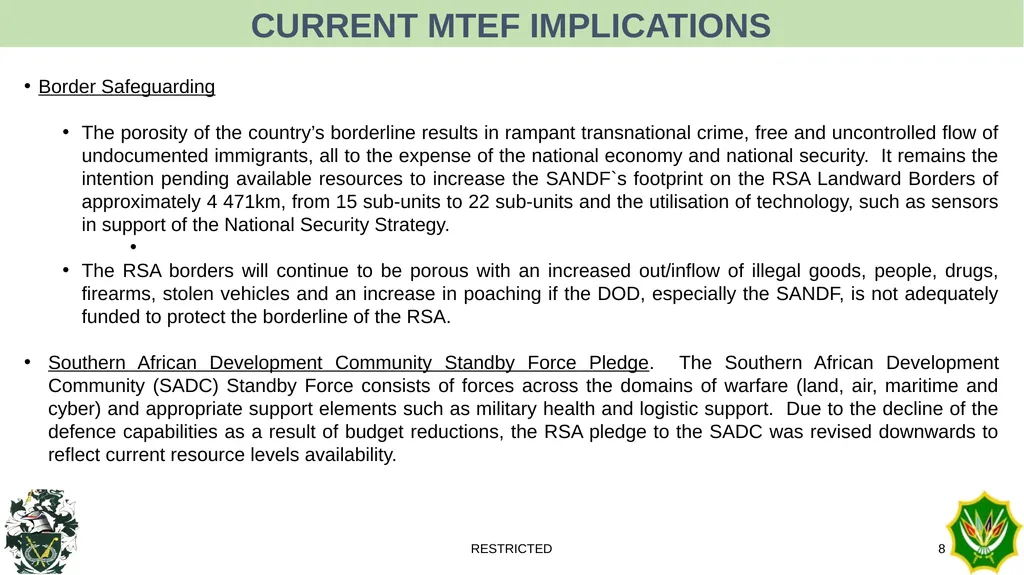
The porosity of the country’s borderline results in rampant transnational crime, free and uncontrolled flow of undocumented immigrants, all to the expense of the national economy and national security. It remains the intention pending available resources to increase the SANDF`s footprint on the RSA Landward Borders of approximately 4 471km, from 15 sub-units to 22 sub-units and the utilisation of technology, such as sensors in support of the National Security Strategy.
The RSA borders will continue to be porous with an increased out/inflow of illegal goods, people, drugs, firearms, stolen vehicles and an increase in poaching if the DOD, especially the SANDF, is not adequately funded to protect the borderline of the RSA.
Southern African Development Community Standby Force Pledge. The Southern African Development Community (SADC) Standby Force consists of forces across the domains of warfare (land, air, maritime and cyber) and appropriate support elements such as military health and logistic support. Due to the decline of the defence capabilities as a result of budget reductions, the RSA pledge to the SADC was revised downwards to reflect current resource levels availability.<br>
09
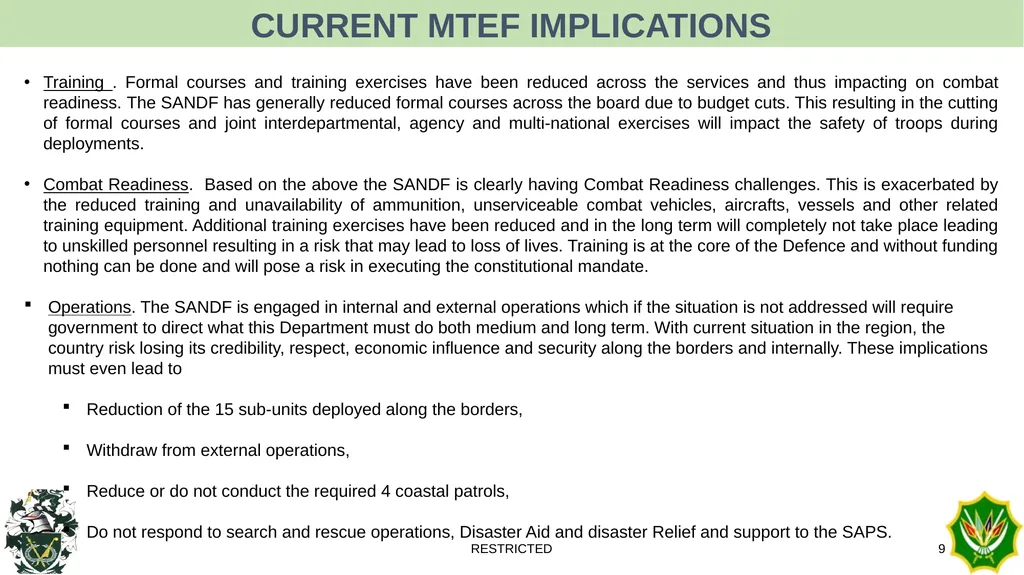
RESTRICTED 9 CURRENT MTEF IMPLICATIONS Training . Formal courses and training exercises have been reduced across the services and thus impacting on combat readiness. The SANDF has generally reduced formal courses across the board due to budget cuts. This resulting in the cutting of formal courses and joint interdepartmental, agency and multi-national exercises will impact the safety of troops during deployments.
Combat Readiness. Based on the above the SANDF is clearly having Combat Readiness challenges. This is exacerbated by the reduced training and unavailability of ammunition, unserviceable combat vehicles, aircrafts, vessels and other related training equipment. Additional training exercises have been reduced and in the long term will completely not take place leading to unskilled personnel resulting in a risk that may lead to loss of lives. Training is at the core of the Defence and without funding nothing can be done and will pose a risk in executing the constitutional mandate.
Operations. The SANDF is engaged in internal and external operations which if the situation is not addressed will require government to direct what this Department must do both medium and long term. With current situation in the region, the country risk losing its credibility, respect, economic influence and security along the borders and internally. These implications must even lead to
Reduction of the 15 sub-units deployed along the borders,
Withdraw from external operations,
Reduce or do not conduct the required 4 coastal patrols,
Do not respond to search and rescue operations, Disaster Aid and disaster Relief and support to the SAPS.<br>
10
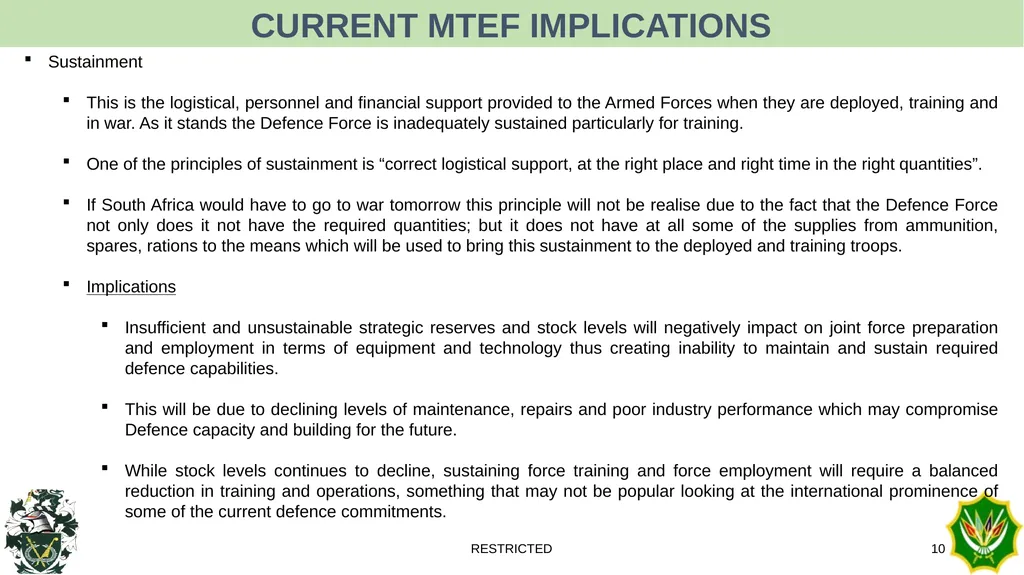
RESTRICTED 10 CURRENT MTEF IMPLICATIONS Sustainment
This is the logistical, personnel and financial support provided to the Armed Forces when they are deployed, training and in war. As it stands the Defence Force is inadequately sustained particularly for training.
One of the principles of sustainment is “correct logistical support, at the right place and right time in the right quantities”.
If South Africa would have to go to war tomorrow this principle will not be realise due to the fact that the Defence Force not only does it not have the required quantities; but it does not have at all some of the supplies from ammunition, spares, rations to the means which will be used to bring this sustainment to the deployed and training troops.
Implications
Insufficient and unsustainable strategic reserves and stock levels will negatively impact on joint force preparation and employment in terms of equipment and technology thus creating inability to maintain and sustain required defence capabilities.
This will be due to declining levels of maintenance, repairs and poor industry performance which may compromise Defence capacity and building for the future.
While stock levels continues to decline, sustaining force training and force employment will require a balanced reduction in training and operations, something that may not be popular looking at the international prominence of some of the current defence commitments.<br>
11
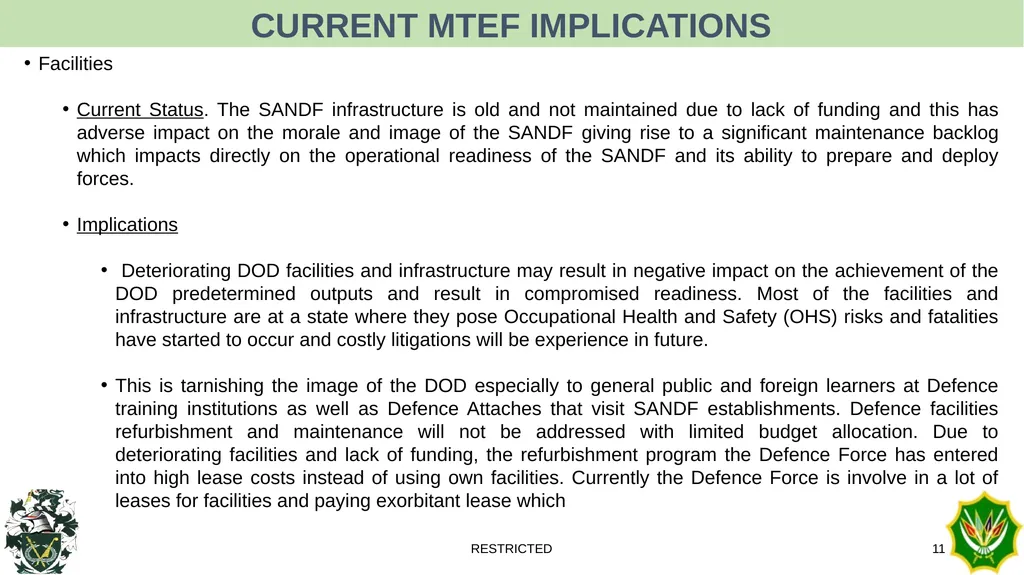
RESTRICTED 11 CURRENT MTEF IMPLICATIONS Facilities
Current Status. The SANDF infrastructure is old and not maintained due to lack of funding and this has adverse impact on the morale and image of the SANDF giving rise to a significant maintenance backlog which impacts directly on the operational readiness of the SANDF and its ability to prepare and deploy forces.
Implications
Deteriorating DOD facilities and infrastructure may result in negative impact on the achievement of the DOD predetermined outputs and result in compromised readiness. Most of the facilities and infrastructure are at a state where they pose Occupational Health and Safety (OHS) risks and fatalities have started to occur and costly litigations will be experience in future.
This is tarnishing the image of the DOD especially to general public and foreign learners at Defence training institutions as well as Defence Attaches that visit SANDF establishments. Defence facilities refurbishment and maintenance will not be addressed with limited budget allocation. Due to deteriorating facilities and lack of funding, the refurbishment program the Defence Force has entered into high lease costs instead of using own facilities. Currently the Defence Force is involve in a lot of leases for facilities and paying exorbitant lease which<br>
12
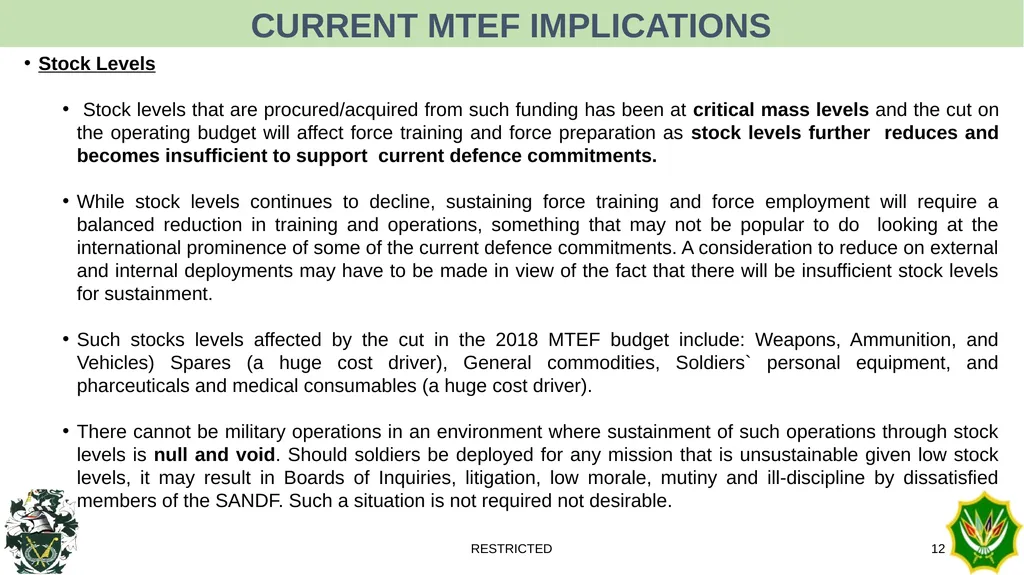
RESTRICTED 12 CURRENT MTEF IMPLICATIONS Stock Levels
Stock levels that are procured/acquired from such funding has been at critical mass levels and the cut on the operating budget will affect force training and force preparation as stock levels further reduces and becomes insufficient to support current defence commitments.
While stock levels continues to decline, sustaining force training and force employment will require a balanced reduction in training and operations, something that may not be popular to do looking at the international prominence of some of the current defence commitments. A consideration to reduce on external and internal deployments may have to be made in view of the fact that there will be insufficient stock levels for sustainment.
Such stocks levels affected by the cut in the 2018 MTEF budget include: Weapons, Ammunition, and Vehicles) Spares (a huge cost driver), General commodities, Soldiers` personal equipment, and pharceuticals and medical consumables (a huge cost driver).
There cannot be military operations in an environment where sustainment of such operations through stock levels is null and void. Should soldiers be deployed for any mission that is unsustainable given low stock levels, it may result in Boards of Inquiries, litigation, low morale, mutiny and ill-discipline by dissatisfied members of the SANDF. Such a situation is not required not desirable.<br>
13
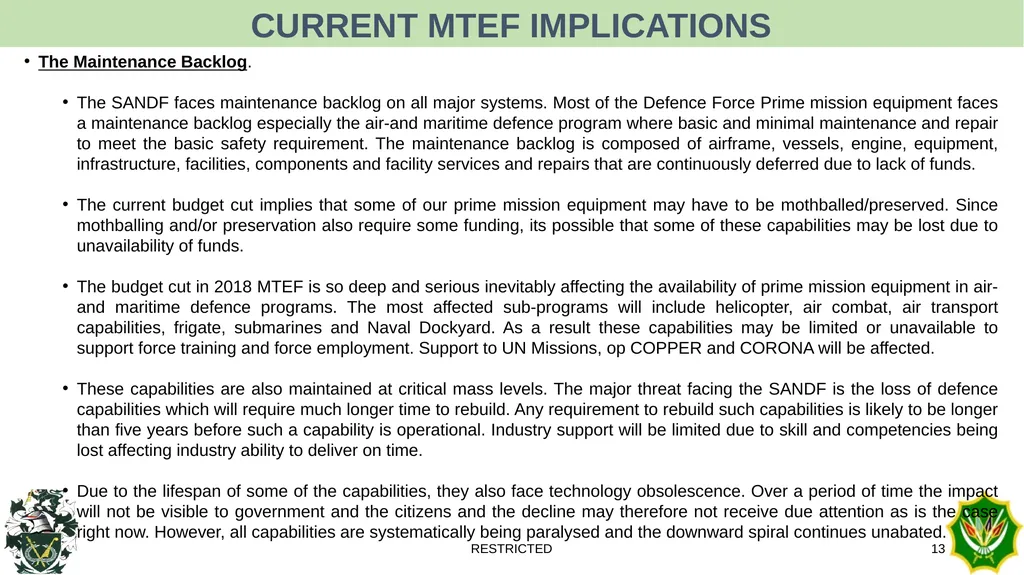
RESTRICTED 13 CURRENT MTEF IMPLICATIONS The Maintenance Backlog.
The SANDF faces maintenance backlog on all major systems. Most of the Defence Force Prime mission equipment faces a maintenance backlog especially the air-and maritime defence program where basic and minimal maintenance and repair to meet the basic safety requirement. The maintenance backlog is composed of airframe, vessels, engine, equipment, infrastructure, facilities, components and facility services and repairs that are continuously deferred due to lack of funds.
The current budget cut implies that some of our prime mission equipment may have to be mothballed/preserved. Since mothballing and/or preservation also require some funding, its possible that some of these capabilities may be lost due to unavailability of funds.
The budget cut in 2018 MTEF is so deep and serious inevitably affecting the availability of prime mission equipment in air- and maritime defence programs. The most affected sub-programs will include helicopter, air combat, air transport capabilities, frigate, submarines and Naval Dockyard. As a result these capabilities may be limited or unavailable to support force training and force employment. Support to UN Missions, op COPPER and CORONA will be affected.
These capabilities are also maintained at critical mass levels. The major threat facing the SANDF is the loss of defence capabilities which will require much longer time to rebuild. Any requirement to rebuild such capabilities is likely to be longer than five years before such a capability is operational. Industry support will be limited due to skill and competencies being lost affecting industry ability to deliver on time.
Due to the lifespan of some of the capabilities, they also face technology obsolescence. Over a period of time the impact will not be visible to government and the citizens and the decline may therefore not receive due attention as is the case right now. However, all capabilities are systematically being paralysed and the downward spiral continues unabated.<br>
14
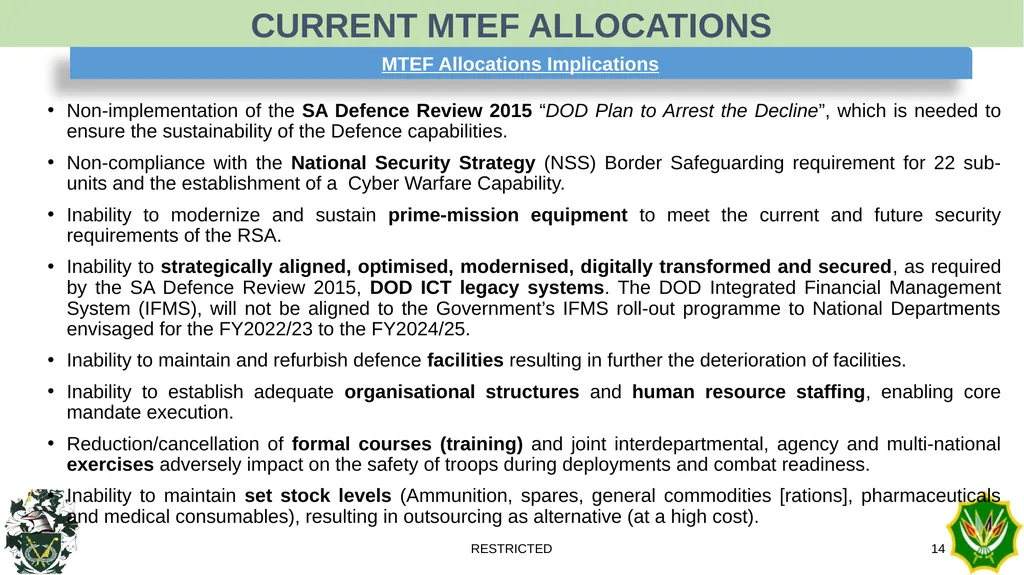
Non-implementation of the SA Defence Review 2015 “DOD Plan to Arrest the Decline”, which is needed to ensure the sustainability of the Defence capabilities.
Non-compliance with the National Security Strategy (NSS) Border Safeguarding requirement for 22 sub-units and the establishment of a Cyber Warfare Capability.
Inability to modernize and sustain prime-mission equipment to meet the current and future security requirements of the RSA.
Inability to strategically aligned, optimised, modernised, digitally transformed and secured, as required by the SA Defence Review 2015, DOD ICT legacy systems. The DOD Integrated Financial Management System (IFMS), will not be aligned to the Government’s IFMS roll-out programme to National Departments envisaged for the FY2022/23 to the FY2024/25.
Inability to maintain and refurbish defence facilities resulting in further the deterioration of facilities.
Inability to establish adequate organisational structures and human resource staffing, enabling core mandate execution.
Reduction/cancellation of formal courses (training) and joint interdepartmental, agency and multi-national exercises adversely impact on the safety of troops during deployments and combat readiness.
Inability to maintain set stock levels (Ammunition, spares, general commodities [rations], pharmaceuticals and medical consumables), resulting in outsourcing as alternative (at a high cost). RESTRICTED 14 CURRENT MTEF ALLOCATIONS MTEF Allocations Implications<br>