
Budgeting at Montclair State University Overview
JO
Published · 21 slides · 0 views

1 / 1
Description
Budgeting at Montclair State University Overview for Budget Managers Office of Budget and Planning November 1, 2023 1 Introduction This presentation is for new budget managers and staff that will be involved in budgeting. It provides an
Related Topics
Share
Embed code
Download this presentation From Below
"Budgeting at Montclair State University Overview" is the property of its rightful owner. Permission is granted to download and print the materials on this website for personal, non-commercial use only, and to display it on your personal computer provided you do not modify the materials and that you retain all copyright notices contained in the materials. By downloading content from our website, you accept the terms of this agreement.
Presentation Transcript
01
Budgeting at Montclair State University
Overview for Budget Managers Office of Budget and Planning November 1, 2023 1<br>
02
Introduction This presentation is for new budget managers and staff that will be involved in budgeting.
It provides an overview of budget management concepts, departments, systems, and processes.
See the Budget and Planning website for the complete Budget Policies and Procedures, and other resources such as forms and job aids.
Staff responsible for budgeting and purchasing must attend training for Workday Financials. Division and college budget managers must attend training for the Adaptive Planning system.
For Workday budget training, see the Budget and Planning website announcement of the next Budget Functions Class, or call X7428 2<br>
It provides an overview of budget management concepts, departments, systems, and processes.
See the Budget and Planning website for the complete Budget Policies and Procedures, and other resources such as forms and job aids.
Staff responsible for budgeting and purchasing must attend training for Workday Financials. Division and college budget managers must attend training for the Adaptive Planning system.
For Workday budget training, see the Budget and Planning website announcement of the next Budget Functions Class, or call X7428 2<br>
03
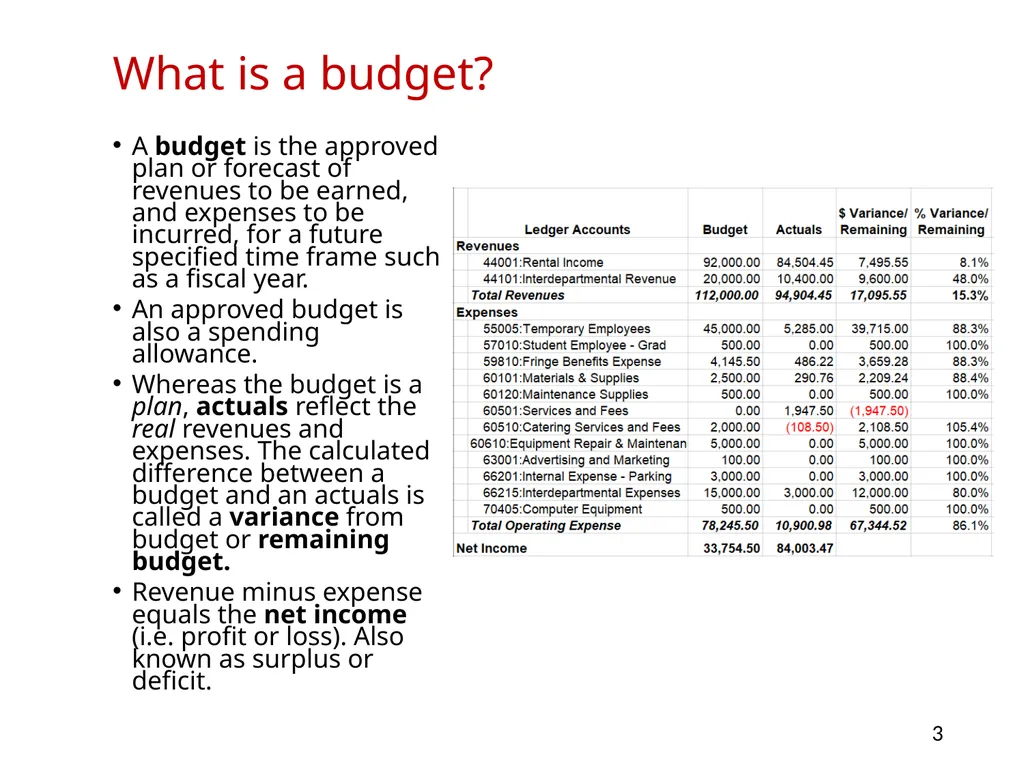
What is a budget? A budget is the approved plan or forecast of revenues to be earned, and expenses to be incurred, for a future specified time frame such as a fiscal year.
An approved budget is also a spending allowance.
Whereas the budget is a plan, actuals reflect the real revenues and expenses. The calculated difference between a budget and an actuals is called a variance from budget or remaining budget.
Revenue minus expense equals the net income (i.e. profit or loss). Also known as surplus or deficit. 3<br>
An approved budget is also a spending allowance.
Whereas the budget is a plan, actuals reflect the real revenues and expenses. The calculated difference between a budget and an actuals is called a variance from budget or remaining budget.
Revenue minus expense equals the net income (i.e. profit or loss). Also known as surplus or deficit. 3<br>
04
Office of Budget and Planning The Office of Budget and Planning (aka Budget Office) reports to the Office of the President and works closely with Finance and Treasury. Duties include:
Management of the University’s operating budgets, gifts, and capital appropriations
Oversee the annual budget planning process (Budget Call)
Provide reporting and analysis to the President, Board of Trustees and others
Review budgets for proposed new programs
Approve budget amendments and re-allocations
Position budget management (personnel budgets)
Manage and recommend budgeting policies
Prepare the annual State appropriation request
Manage the Adaptive Planning system
Learn more at www.montclair.edu/budget-planning/ 4<br>
Management of the University’s operating budgets, gifts, and capital appropriations
Oversee the annual budget planning process (Budget Call)
Provide reporting and analysis to the President, Board of Trustees and others
Review budgets for proposed new programs
Approve budget amendments and re-allocations
Position budget management (personnel budgets)
Manage and recommend budgeting policies
Prepare the annual State appropriation request
Manage the Adaptive Planning system
Learn more at www.montclair.edu/budget-planning/ 4<br>
05
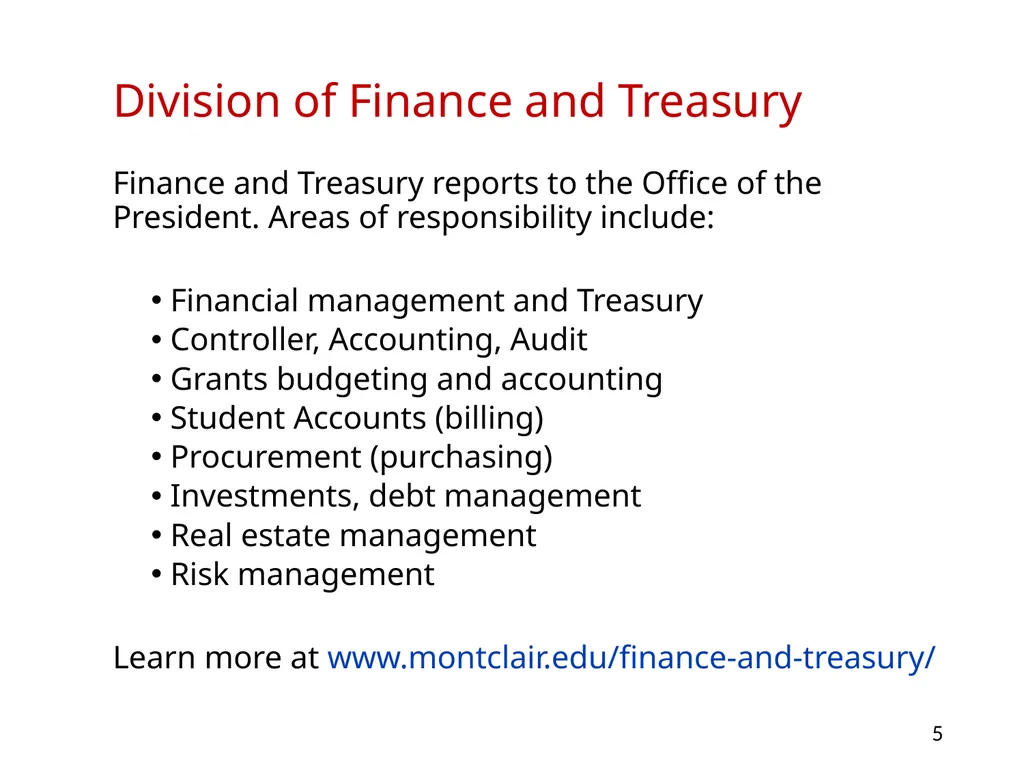
Division of Finance and Treasury Finance and Treasury reports to the Office of the President. Areas of responsibility include:
Financial management and Treasury
Controller, Accounting, Audit
Grants budgeting and accounting
Student Accounts (billing)
Procurement (purchasing)
Investments, debt management
Real estate management
Risk management
Learn more at www.montclair.edu/finance-and-treasury/ 5<br>
Financial management and Treasury
Controller, Accounting, Audit
Grants budgeting and accounting
Student Accounts (billing)
Procurement (purchasing)
Investments, debt management
Real estate management
Risk management
Learn more at www.montclair.edu/finance-and-treasury/ 5<br>
06
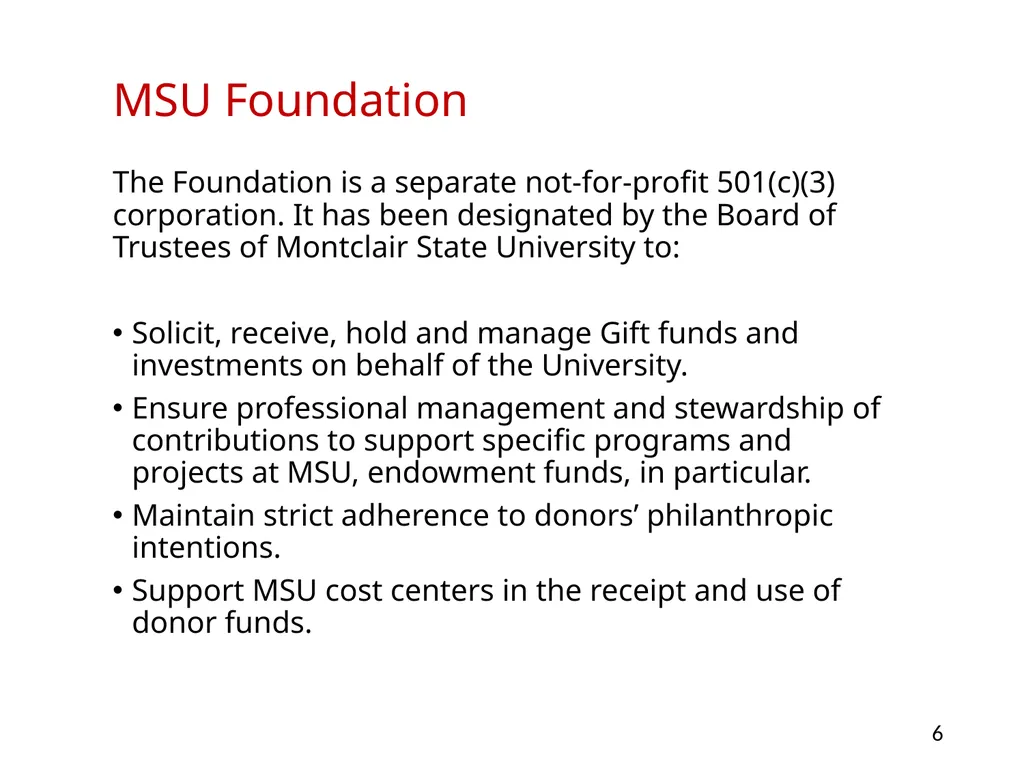
MSU Foundation The Foundation is a separate not-for-profit 501(c)(3) corporation. It has been designated by the Board of Trustees of Montclair State University to:
Solicit, receive, hold and manage Gift funds and investments on behalf of the University.
Ensure professional management and stewardship of contributions to support specific programs and projects at MSU, endowment funds, in particular.
Maintain strict adherence to donors’ philanthropic intentions.
Support MSU cost centers in the receipt and use of donor funds. 6<br>
Solicit, receive, hold and manage Gift funds and investments on behalf of the University.
Ensure professional management and stewardship of contributions to support specific programs and projects at MSU, endowment funds, in particular.
Maintain strict adherence to donors’ philanthropic intentions.
Support MSU cost centers in the receipt and use of donor funds. 6<br>
07
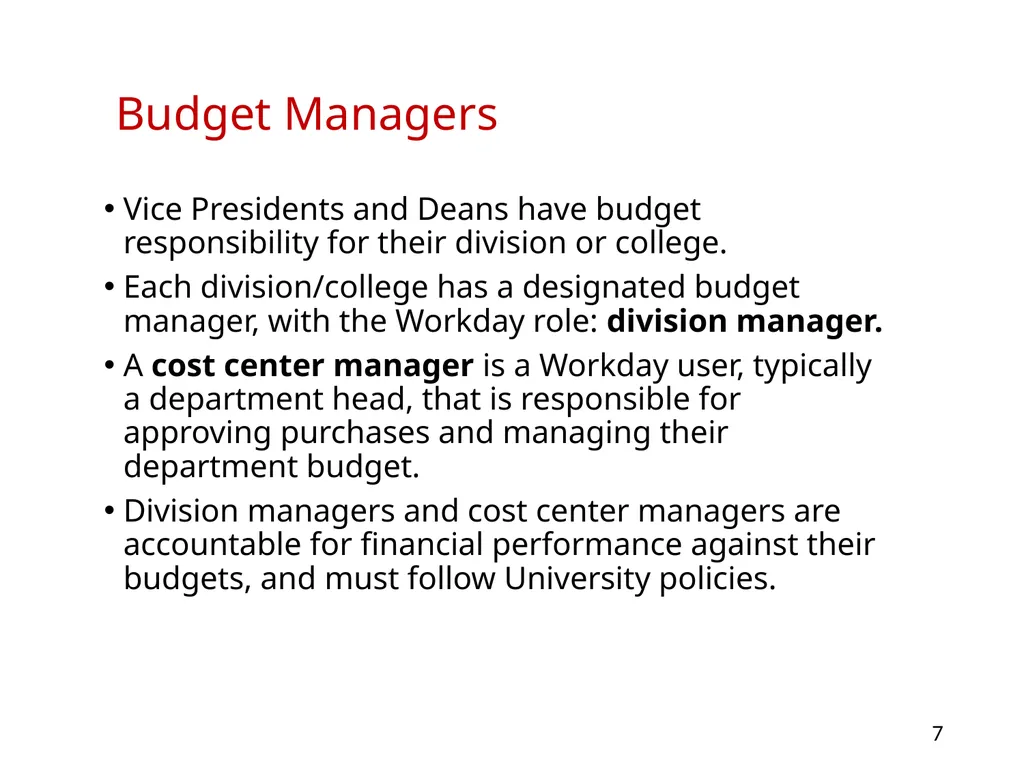
Budget Managers Vice Presidents and Deans have budget responsibility for their division or college.
Each division/college has a designated budget manager, with the Workday role: division manager.
A cost center manager is a Workday user, typically a department head, that is responsible for approving purchases and managing their department budget.
Division managers and cost center managers are accountable for financial performance against their budgets, and must follow University policies. 7<br>
Each division/college has a designated budget manager, with the Workday role: division manager.
A cost center manager is a Workday user, typically a department head, that is responsible for approving purchases and managing their department budget.
Division managers and cost center managers are accountable for financial performance against their budgets, and must follow University policies. 7<br>
08
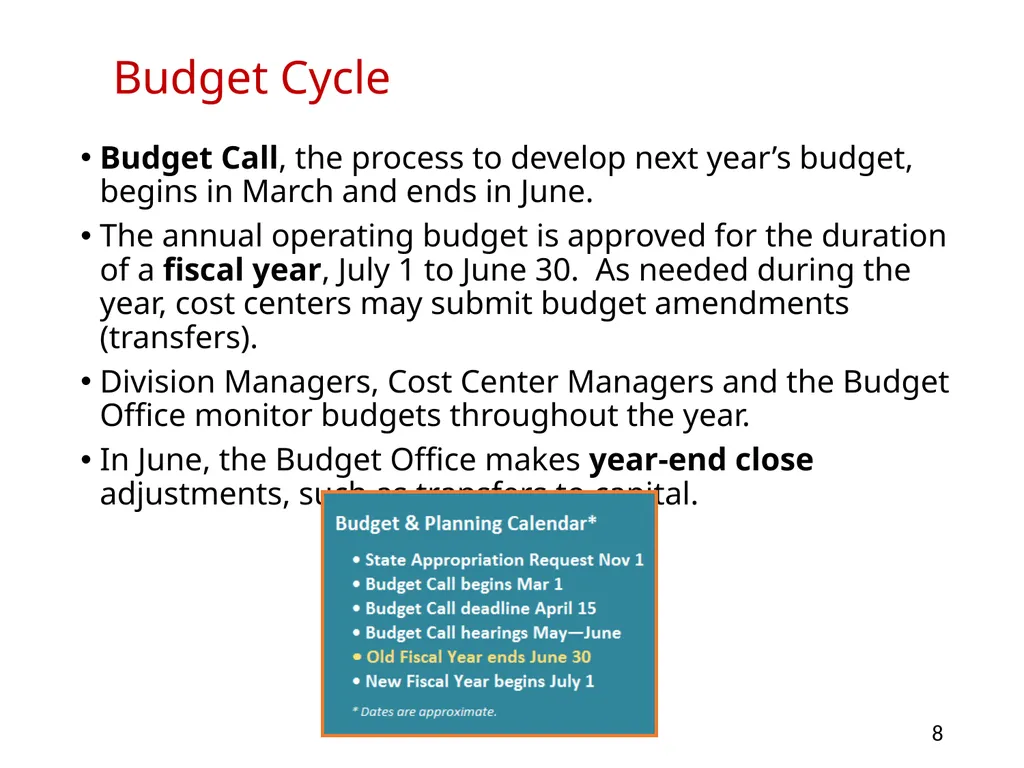
Budget Cycle Budget Call, the process to develop next year’s budget, begins in March and ends in June.
The annual operating budget is approved for the duration of a fiscal year, July 1 to June 30. As needed during the year, cost centers may submit budget amendments (transfers).
Division Managers, Cost Center Managers and the Budget Office monitor budgets throughout the year.
In June, the Budget Office makes year-end close adjustments, such as transfers to capital. 8<br>
The annual operating budget is approved for the duration of a fiscal year, July 1 to June 30. As needed during the year, cost centers may submit budget amendments (transfers).
Division Managers, Cost Center Managers and the Budget Office monitor budgets throughout the year.
In June, the Budget Office makes year-end close adjustments, such as transfers to capital. 8<br>
09
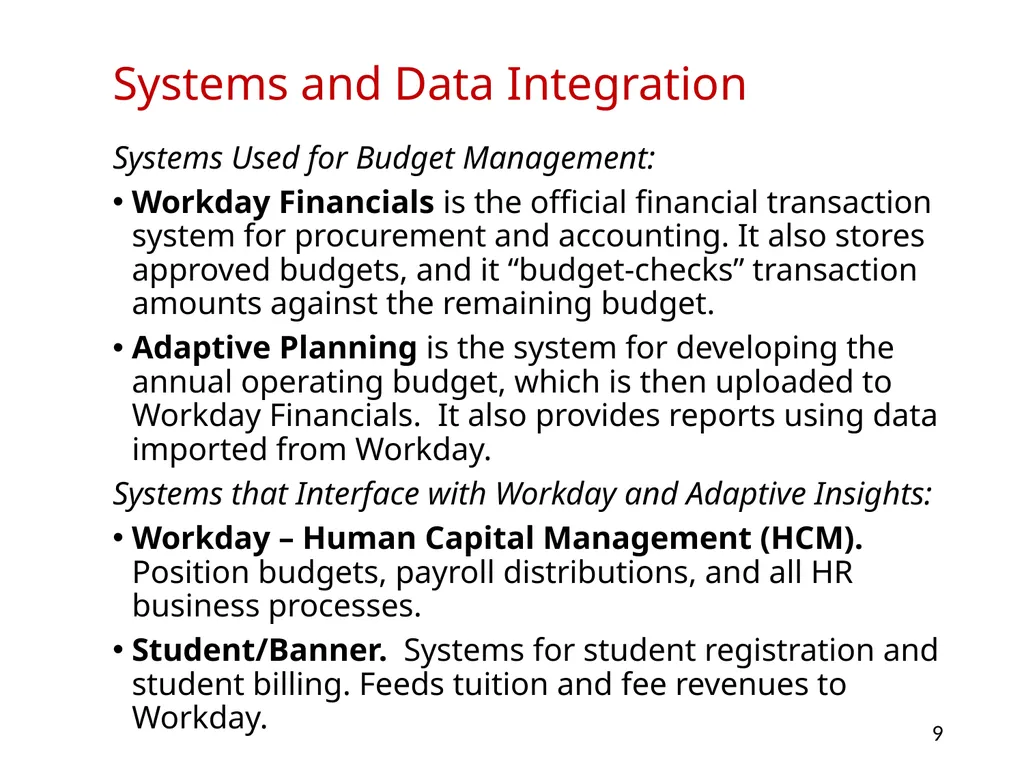
Systems and Data Integration Systems Used for Budget Management:
Workday Financials is the official financial transaction system for procurement and accounting. It also stores approved budgets, and it “budget-checks” transaction amounts against the remaining budget.
Adaptive Planning is the system for developing the annual operating budget, which is then uploaded to Workday Financials. It also provides reports using data imported from Workday.
Systems that Interface with Workday and Adaptive Insights:
Workday – Human Capital Management (HCM). Position budgets, payroll distributions, and all HR business processes.
Student/Banner. Systems for student registration and student billing. Feeds tuition and fee revenues to Workday. 9<br>
Workday Financials is the official financial transaction system for procurement and accounting. It also stores approved budgets, and it “budget-checks” transaction amounts against the remaining budget.
Adaptive Planning is the system for developing the annual operating budget, which is then uploaded to Workday Financials. It also provides reports using data imported from Workday.
Systems that Interface with Workday and Adaptive Insights:
Workday – Human Capital Management (HCM). Position budgets, payroll distributions, and all HR business processes.
Student/Banner. Systems for student registration and student billing. Feeds tuition and fee revenues to Workday. 9<br>
10
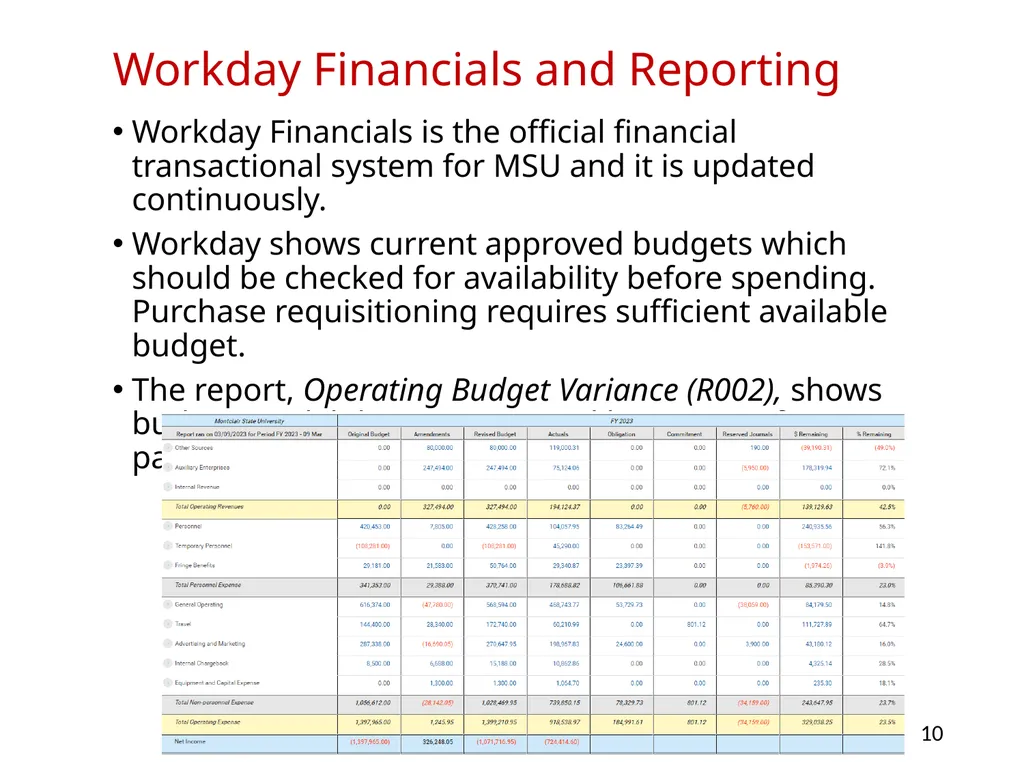
Workday Financials and Reporting Workday Financials is the official financial transactional system for MSU and it is updated continuously.
Workday shows current approved budgets which should be checked for availability before spending. Purchase requisitioning requires sufficient available budget.
The report, Operating Budget Variance (R002), shows budget availability, summarized by account for a particular cost center. 10<br>
Workday shows current approved budgets which should be checked for availability before spending. Purchase requisitioning requires sufficient available budget.
The report, Operating Budget Variance (R002), shows budget availability, summarized by account for a particular cost center. 10<br>
11
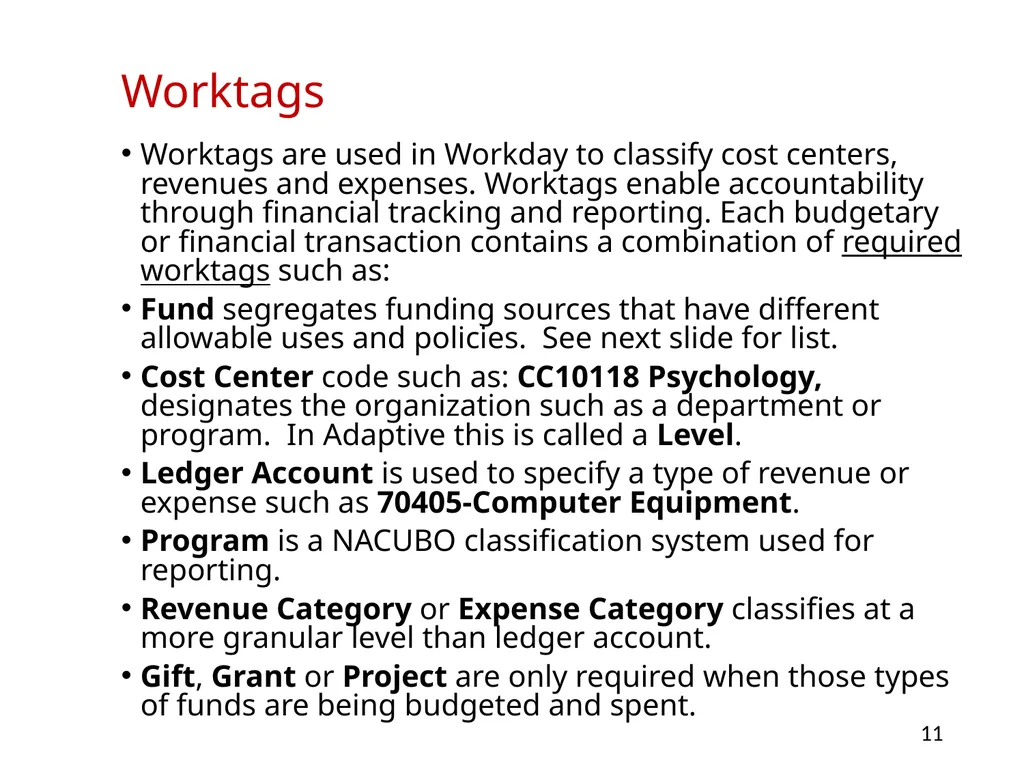
Worktags Worktags are used in Workday to classify cost centers, revenues and expenses. Worktags enable accountability through financial tracking and reporting. Each budgetary or financial transaction contains a combination of required worktags such as:
Fund segregates funding sources that have different allowable uses and policies. See next slide for list.
Cost Center code such as: CC10118 Psychology, designates the organization such as a department or program. In Adaptive this is called a Level.
Ledger Account is used to specify a type of revenue or expense such as 70405-Computer Equipment.
Program is a NACUBO classification system used for reporting.
Revenue Category or Expense Category classifies at a more granular level than ledger account.
Gift, Grant or Project are only required when those types of funds are being budgeted and spent. 11<br>
Fund segregates funding sources that have different allowable uses and policies. See next slide for list.
Cost Center code such as: CC10118 Psychology, designates the organization such as a department or program. In Adaptive this is called a Level.
Ledger Account is used to specify a type of revenue or expense such as 70405-Computer Equipment.
Program is a NACUBO classification system used for reporting.
Revenue Category or Expense Category classifies at a more granular level than ledger account.
Gift, Grant or Project are only required when those types of funds are being budgeted and spent. 11<br>
12
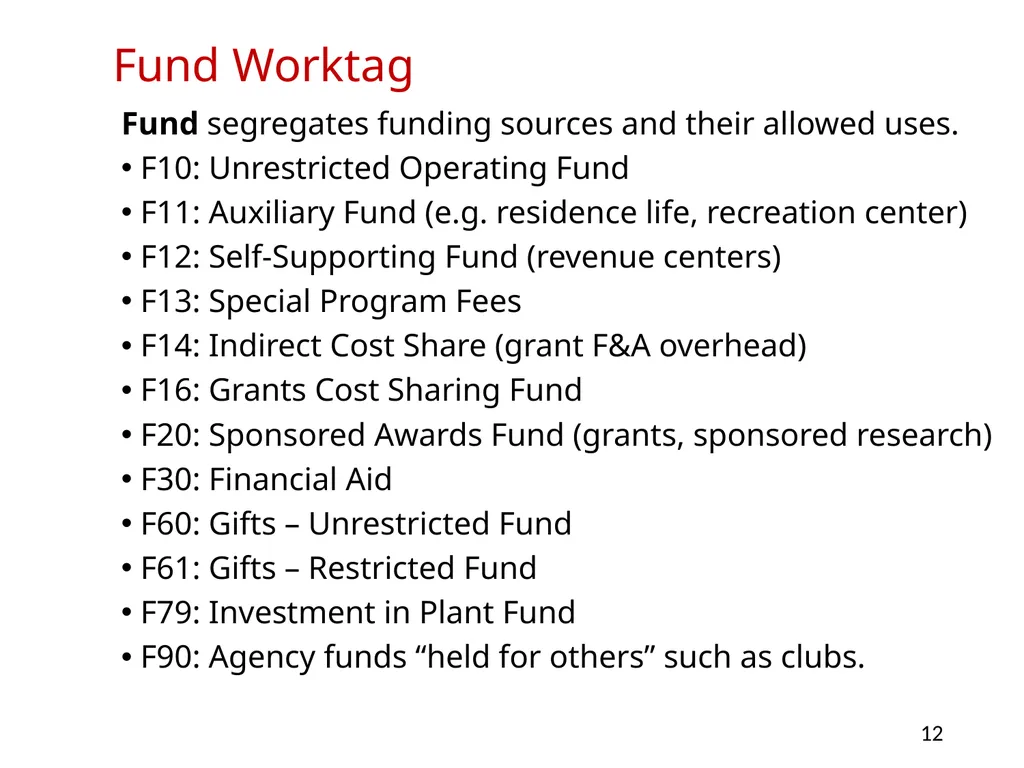
Fund Worktag Fund segregates funding sources and their allowed uses.
F10: Unrestricted Operating Fund
F11: Auxiliary Fund (e.g. residence life, recreation center)
F12: Self-Supporting Fund (revenue centers)
F13: Special Program Fees
F14: Indirect Cost Share (grant F&A overhead)
F16: Grants Cost Sharing Fund
F20: Sponsored Awards Fund (grants, sponsored research)
F30: Financial Aid
F60: Gifts – Unrestricted Fund
F61: Gifts – Restricted Fund
F79: Investment in Plant Fund
F90: Agency funds “held for others” such as clubs. 12<br>
F10: Unrestricted Operating Fund
F11: Auxiliary Fund (e.g. residence life, recreation center)
F12: Self-Supporting Fund (revenue centers)
F13: Special Program Fees
F14: Indirect Cost Share (grant F&A overhead)
F16: Grants Cost Sharing Fund
F20: Sponsored Awards Fund (grants, sponsored research)
F30: Financial Aid
F60: Gifts – Unrestricted Fund
F61: Gifts – Restricted Fund
F79: Investment in Plant Fund
F90: Agency funds “held for others” such as clubs. 12<br>
13
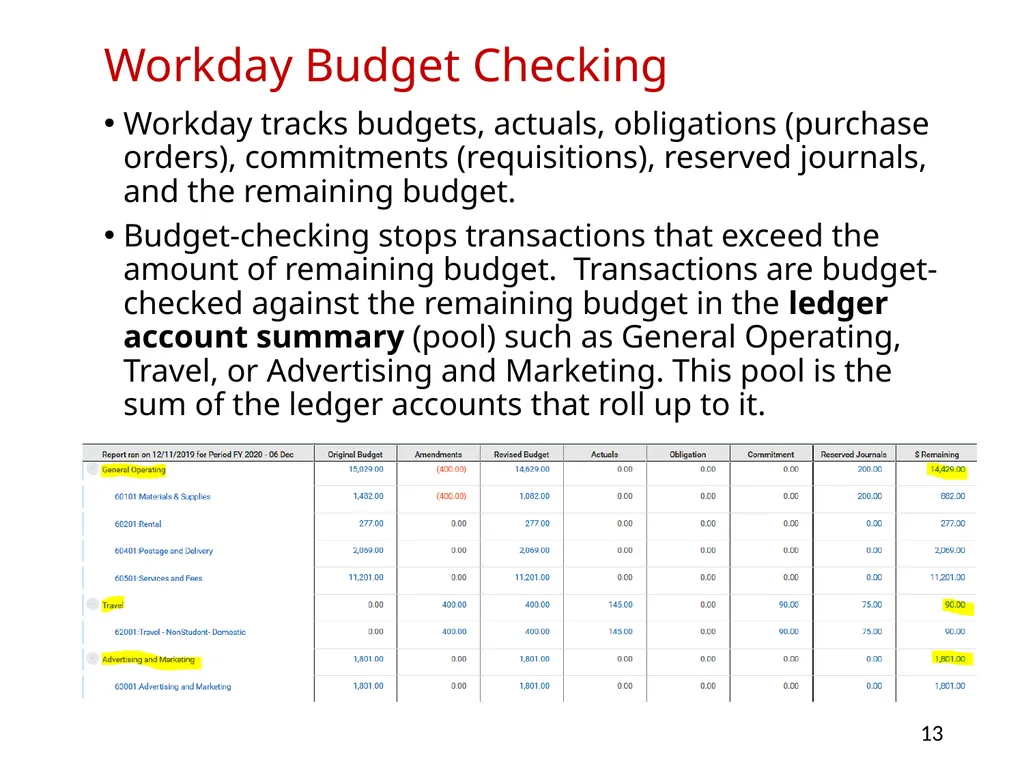
Workday Budget Checking Workday tracks budgets, actuals, obligations (purchase orders), commitments (requisitions), reserved journals, and the remaining budget.
Budget-checking stops transactions that exceed the amount of remaining budget. Transactions are budget-checked against the remaining budget in the ledger account summary (pool) such as General Operating, Travel, or Advertising and Marketing. This pool is the sum of the ledger accounts that roll up to it. 13<br>
Budget-checking stops transactions that exceed the amount of remaining budget. Transactions are budget-checked against the remaining budget in the ledger account summary (pool) such as General Operating, Travel, or Advertising and Marketing. This pool is the sum of the ledger accounts that roll up to it. 13<br>
14
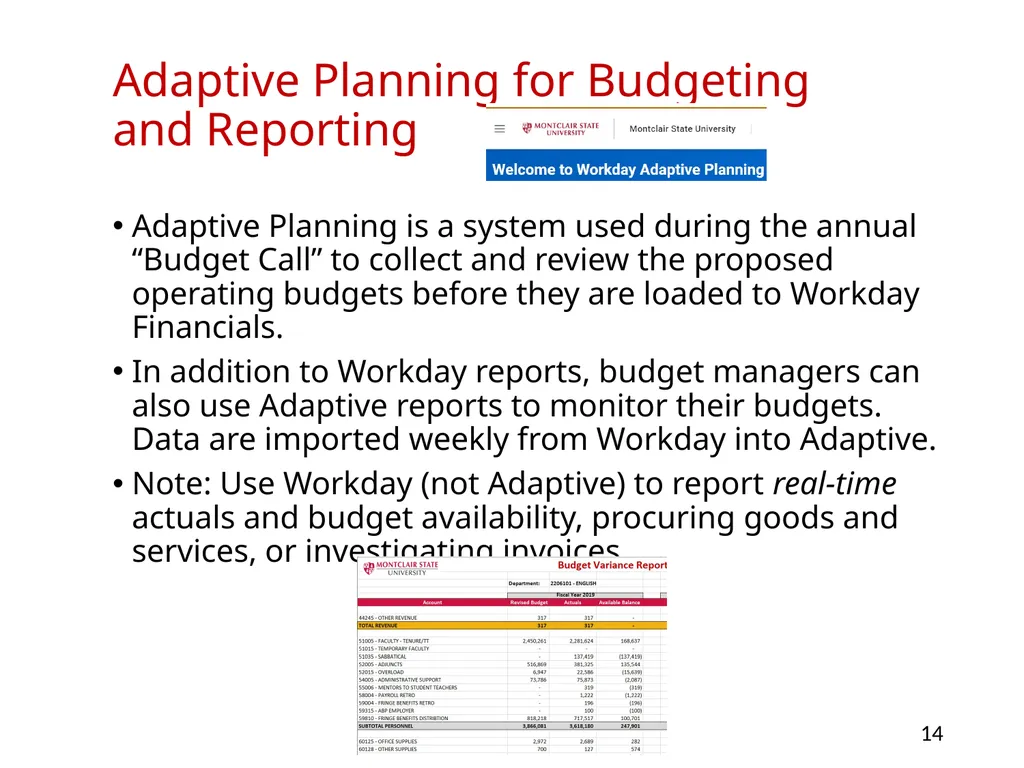
Adaptive Planning for Budgeting and Reporting Adaptive Planning is a system used during the annual “Budget Call” to collect and review the proposed operating budgets before they are loaded to Workday Financials.
In addition to Workday reports, budget managers can also use Adaptive reports to monitor their budgets. Data are imported weekly from Workday into Adaptive.
Note: Use Workday (not Adaptive) to report real-time actuals and budget availability, procuring goods and services, or investigating invoices. 14<br>
In addition to Workday reports, budget managers can also use Adaptive reports to monitor their budgets. Data are imported weekly from Workday into Adaptive.
Note: Use Workday (not Adaptive) to report real-time actuals and budget availability, procuring goods and services, or investigating invoices. 14<br>
15
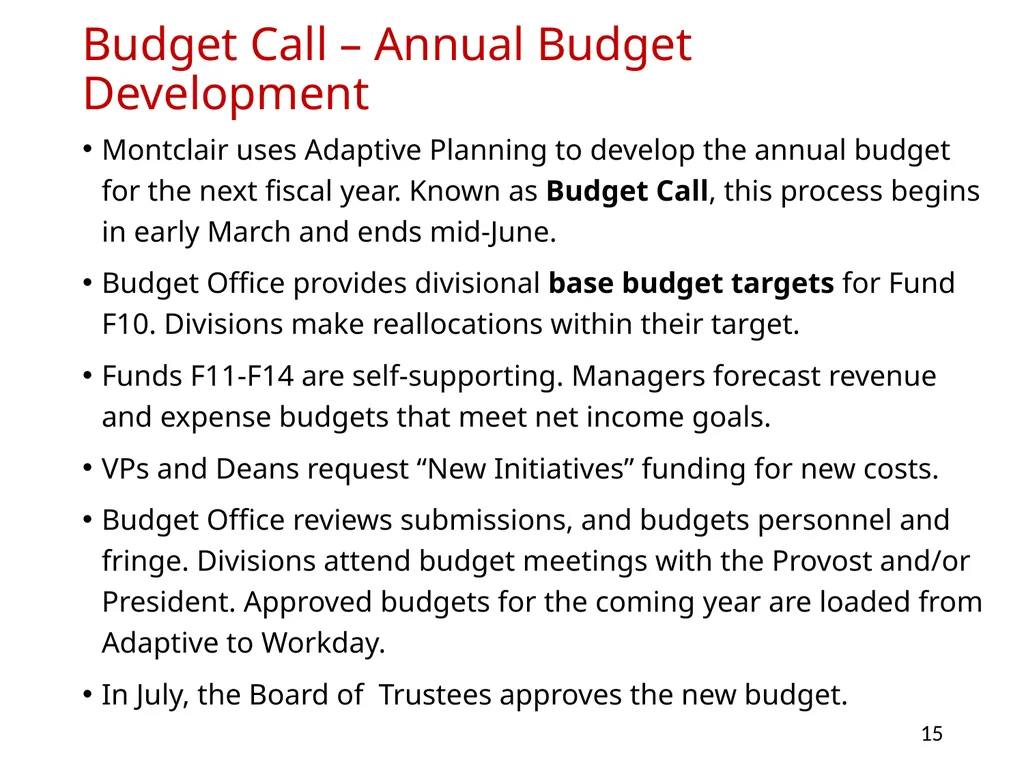
Budget Call – Annual Budget Development Montclair uses Adaptive Planning to develop the annual budget for the next fiscal year. Known as Budget Call, this process begins in early March and ends mid-June.
Budget Office provides divisional base budget targets for Fund F10. Divisions make reallocations within their target.
Funds F11-F14 are self-supporting. Managers forecast revenue and expense budgets that meet net income goals.
VPs and Deans request “New Initiatives” funding for new costs.
Budget Office reviews submissions, and budgets personnel and fringe. Divisions attend budget meetings with the Provost and/or President. Approved budgets for the coming year are loaded from Adaptive to Workday.
In July, the Board of Trustees approves the new budget. 15<br>
Budget Office provides divisional base budget targets for Fund F10. Divisions make reallocations within their target.
Funds F11-F14 are self-supporting. Managers forecast revenue and expense budgets that meet net income goals.
VPs and Deans request “New Initiatives” funding for new costs.
Budget Office reviews submissions, and budgets personnel and fringe. Divisions attend budget meetings with the Provost and/or President. Approved budgets for the coming year are loaded from Adaptive to Workday.
In July, the Board of Trustees approves the new budget. 15<br>
16
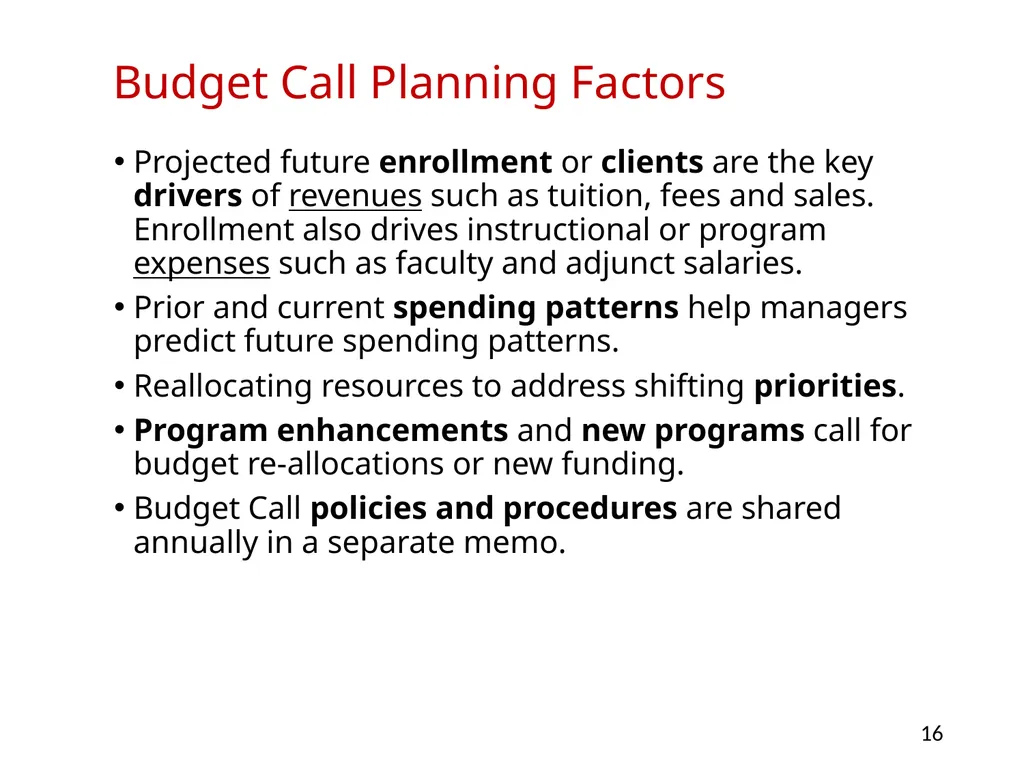
Budget Call Planning Factors Projected future enrollment or clients are the key drivers of revenues such as tuition, fees and sales. Enrollment also drives instructional or program expenses such as faculty and adjunct salaries.
Prior and current spending patterns help managers predict future spending patterns.
Reallocating resources to address shifting priorities.
Program enhancements and new programs call for budget re-allocations or new funding.
Budget Call policies and procedures are shared annually in a separate memo. 16<br>
Prior and current spending patterns help managers predict future spending patterns.
Reallocating resources to address shifting priorities.
Program enhancements and new programs call for budget re-allocations or new funding.
Budget Call policies and procedures are shared annually in a separate memo. 16<br>
17
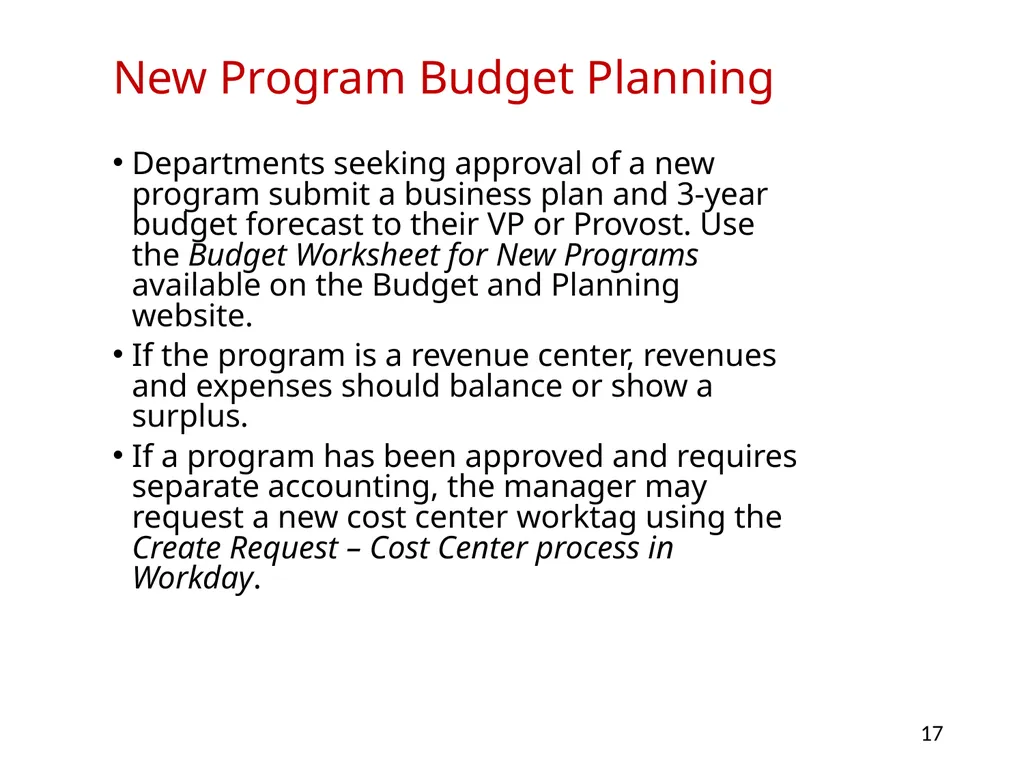
New Program Budget Planning Departments seeking approval of a new program submit a business plan and 3-year budget forecast to their VP or Provost. Use the Budget Worksheet for New Programs available on the Budget and Planning website.
If the program is a revenue center, revenues and expenses should balance or show a surplus.
If a program has been approved and requires separate accounting, the manager may request a new cost center worktag using the Create Request – Cost Center process in Workday. 17<br>
If the program is a revenue center, revenues and expenses should balance or show a surplus.
If a program has been approved and requires separate accounting, the manager may request a new cost center worktag using the Create Request – Cost Center process in Workday. 17<br>
18
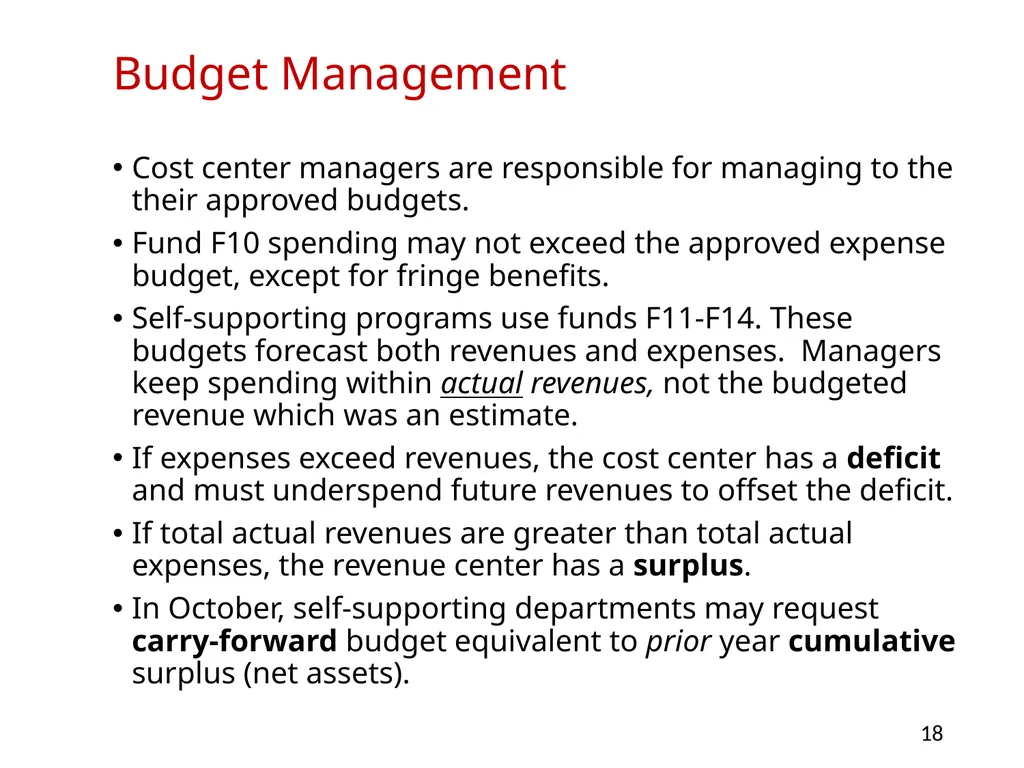
Budget Management Cost center managers are responsible for managing to the their approved budgets.
Fund F10 spending may not exceed the approved expense budget, except for fringe benefits.
Self-supporting programs use funds F11-F14. These budgets forecast both revenues and expenses. Managers keep spending within actual revenues, not the budgeted revenue which was an estimate.
If expenses exceed revenues, the cost center has a deficit and must underspend future revenues to offset the deficit.
If total actual revenues are greater than total actual expenses, the revenue center has a surplus.
In October, self-supporting departments may request carry-forward budget equivalent to prior year cumulative surplus (net assets). 18<br>
Fund F10 spending may not exceed the approved expense budget, except for fringe benefits.
Self-supporting programs use funds F11-F14. These budgets forecast both revenues and expenses. Managers keep spending within actual revenues, not the budgeted revenue which was an estimate.
If expenses exceed revenues, the cost center has a deficit and must underspend future revenues to offset the deficit.
If total actual revenues are greater than total actual expenses, the revenue center has a surplus.
In October, self-supporting departments may request carry-forward budget equivalent to prior year cumulative surplus (net assets). 18<br>
19
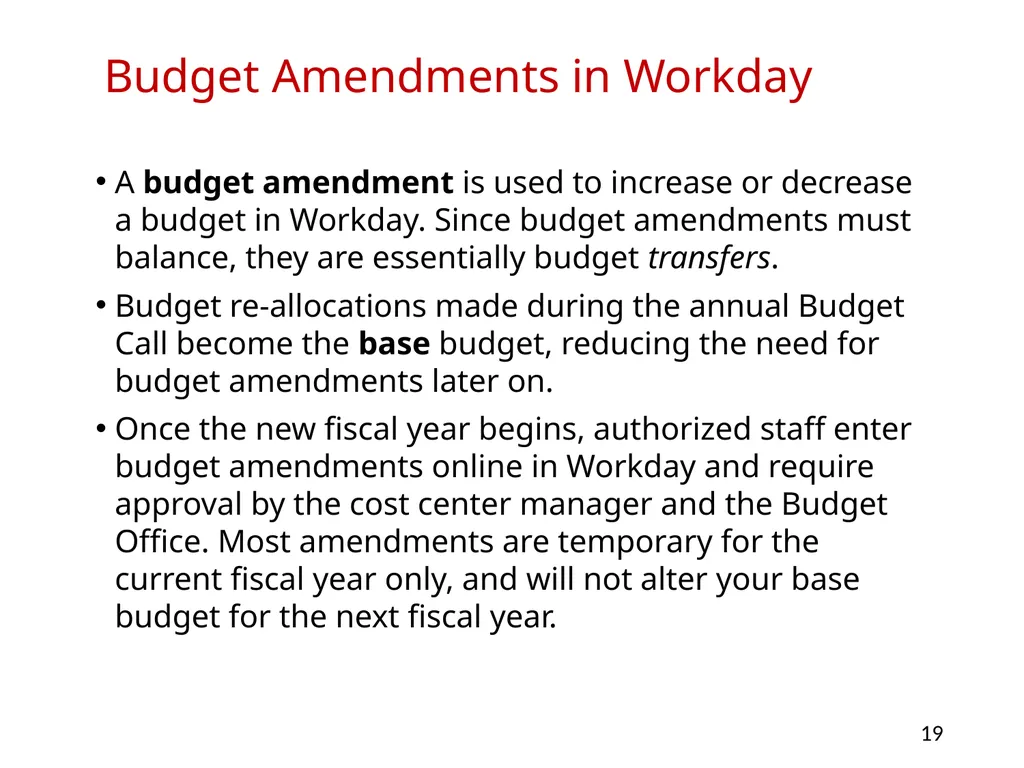
Budget Amendments in Workday A budget amendment is used to increase or decrease a budget in Workday. Since budget amendments must balance, they are essentially budget transfers.
Budget re-allocations made during the annual Budget Call become the base budget, reducing the need for budget amendments later on.
Once the new fiscal year begins, authorized staff enter budget amendments online in Workday and require approval by the cost center manager and the Budget Office. Most amendments are temporary for the current fiscal year only, and will not alter your base budget for the next fiscal year. 19<br>
Budget re-allocations made during the annual Budget Call become the base budget, reducing the need for budget amendments later on.
Once the new fiscal year begins, authorized staff enter budget amendments online in Workday and require approval by the cost center manager and the Budget Office. Most amendments are temporary for the current fiscal year only, and will not alter your base budget for the next fiscal year. 19<br>
20
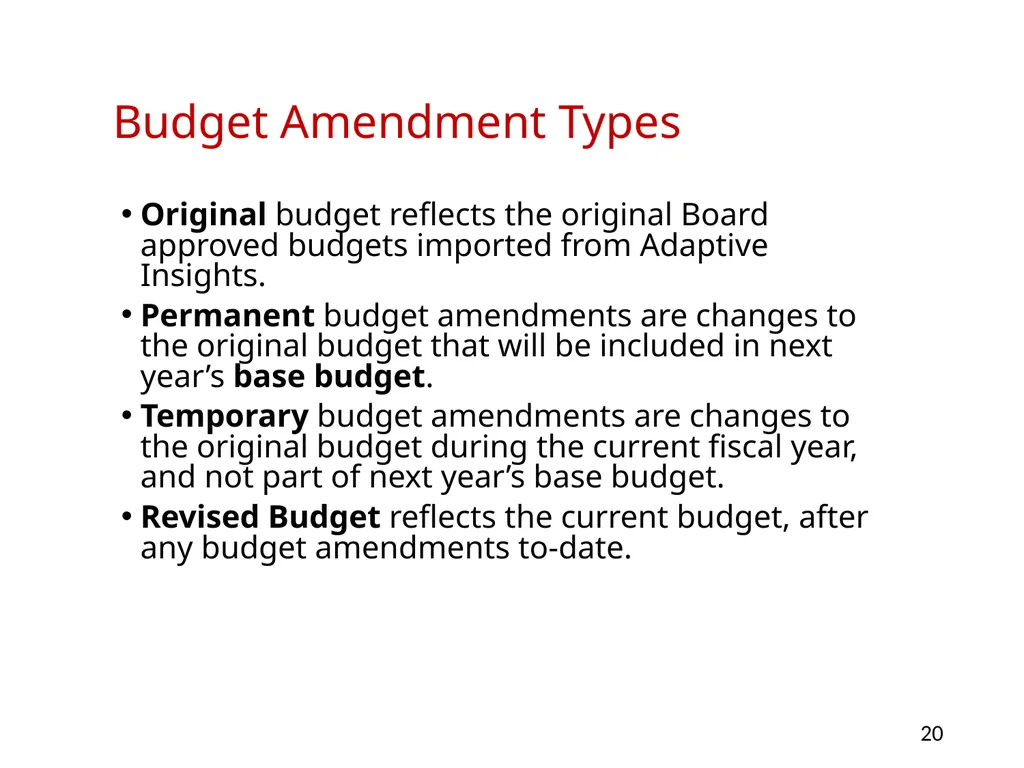
Budget Amendment Types Original budget reflects the original Board approved budgets imported from Adaptive Insights.
Permanent budget amendments are changes to the original budget that will be included in next year’s base budget.
Temporary budget amendments are changes to the original budget during the current fiscal year, and not part of next year’s base budget.
Revised Budget reflects the current budget, after any budget amendments to-date. 20<br>
Permanent budget amendments are changes to the original budget that will be included in next year’s base budget.
Temporary budget amendments are changes to the original budget during the current fiscal year, and not part of next year’s base budget.
Revised Budget reflects the current budget, after any budget amendments to-date. 20<br>
21
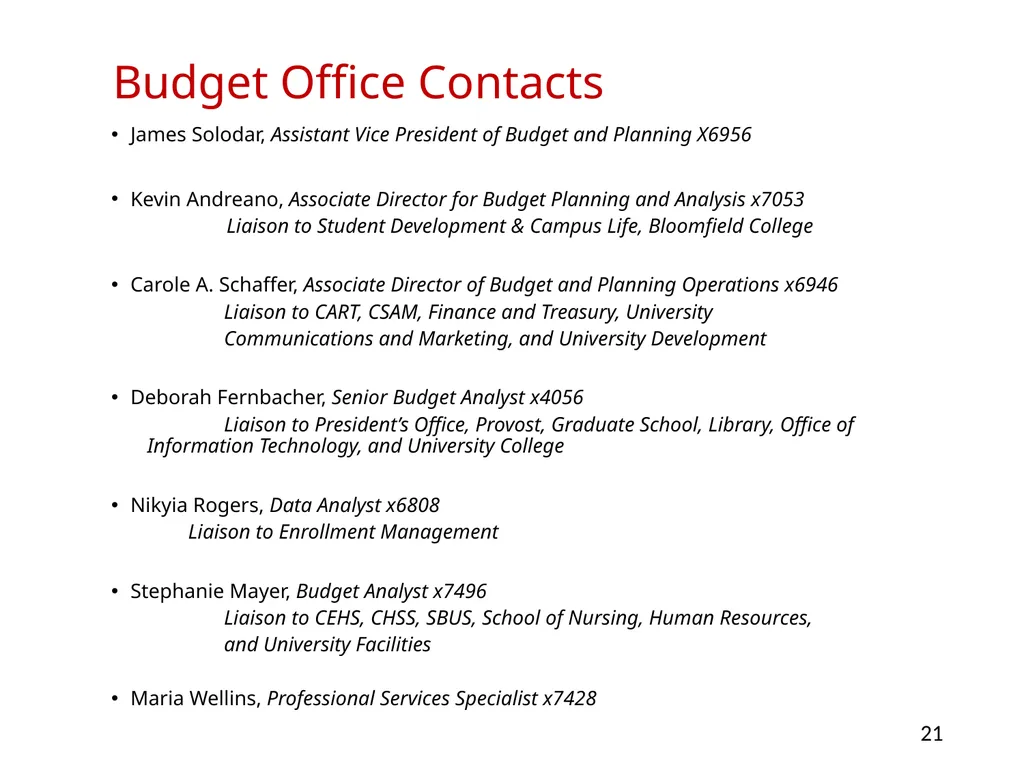
Budget Office Contacts James Solodar, Assistant Vice President of Budget and Planning X6956
Kevin Andreano, Associate Director for Budget Planning and Analysis x7053
Liaison to Student Development & Campus Life, Bloomfield College
Carole A. Schaffer, Associate Director of Budget and Planning Operations x6946
Liaison to CART, CSAM, Finance and Treasury, University
Communications and Marketing, and University Development
Deborah Fernbacher, Senior Budget Analyst x4056
Liaison to President’s Office, Provost, Graduate School, Library, Office of Information Technology, and University College
Nikyia Rogers, Data Analyst x6808
Liaison to Enrollment Management
Stephanie Mayer, Budget Analyst x7496
Liaison to CEHS, CHSS, SBUS, School of Nursing, Human Resources,
and University Facilities
Maria Wellins, Professional Services Specialist x7428 21<br>
Kevin Andreano, Associate Director for Budget Planning and Analysis x7053
Liaison to Student Development & Campus Life, Bloomfield College
Carole A. Schaffer, Associate Director of Budget and Planning Operations x6946
Liaison to CART, CSAM, Finance and Treasury, University
Communications and Marketing, and University Development
Deborah Fernbacher, Senior Budget Analyst x4056
Liaison to President’s Office, Provost, Graduate School, Library, Office of Information Technology, and University College
Nikyia Rogers, Data Analyst x6808
Liaison to Enrollment Management
Stephanie Mayer, Budget Analyst x7496
Liaison to CEHS, CHSS, SBUS, School of Nursing, Human Resources,
and University Facilities
Maria Wellins, Professional Services Specialist x7428 21<br>