
Budgeting & Budgetary Control Cost & Management
A
Published · 44 slides · 0 views
1 / 1

Description
Budgeting Budgetary Control Cost Management Accounting Ms. Chathuri Senarath Budgets, budgeting and budgetary control A budget is an estimate or plan, expressed in quantitative terms, that outlines the consequences of the acquisition or
Related Topics
Download this presentation From Below
"Budgeting & Budgetary Control Cost & Management" is the property of its rightful owner. Permission is granted to download and print the materials on this website for personal, non-commercial use only, and to display it on your personal computer provided you do not modify the materials and that you retain all copyright notices contained in the materials. By downloading content from our website, you accept the terms of this agreement.
Share
Embed code
Presentation Transcript
01
Budgeting &
Budgetary Control Cost & Management Accounting
Ms. Chathuri Senarath<br>
Ms. Chathuri Senarath<br>
02
Budgets, budgeting and budgetary control A budget is an estimate or plan, expressed in quantitative terms, that outlines the consequences of the acquisition or use of an organization’s resources.
The process of preparation of budgets is called budgeting. No system of planning can be successful without an effective and efficient system of control. Budgeting is closely connected with control. The exercise of control in the organization with the help of budgets is known as budgetary control.<br>
The process of preparation of budgets is called budgeting. No system of planning can be successful without an effective and efficient system of control. Budgeting is closely connected with control. The exercise of control in the organization with the help of budgets is known as budgetary control.<br>
03
Why budgeting ? Planning
Control & Performance Evaluation
Communication & Coordination
Motivation<br>
Control & Performance Evaluation
Communication & Coordination
Motivation<br>
04
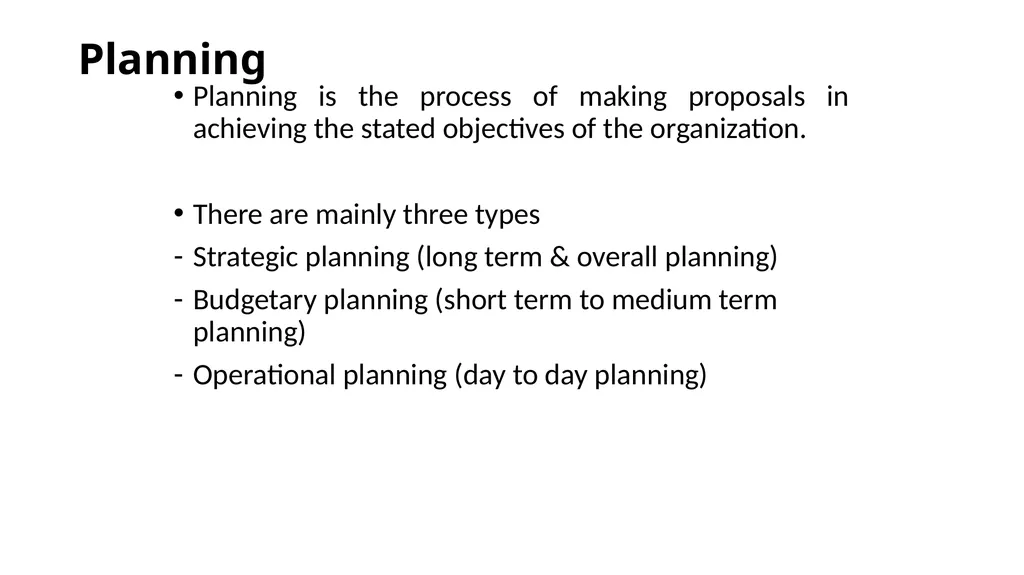
Planning Planning is the process of making proposals in achieving the stated objectives of the organization.
There are mainly three types
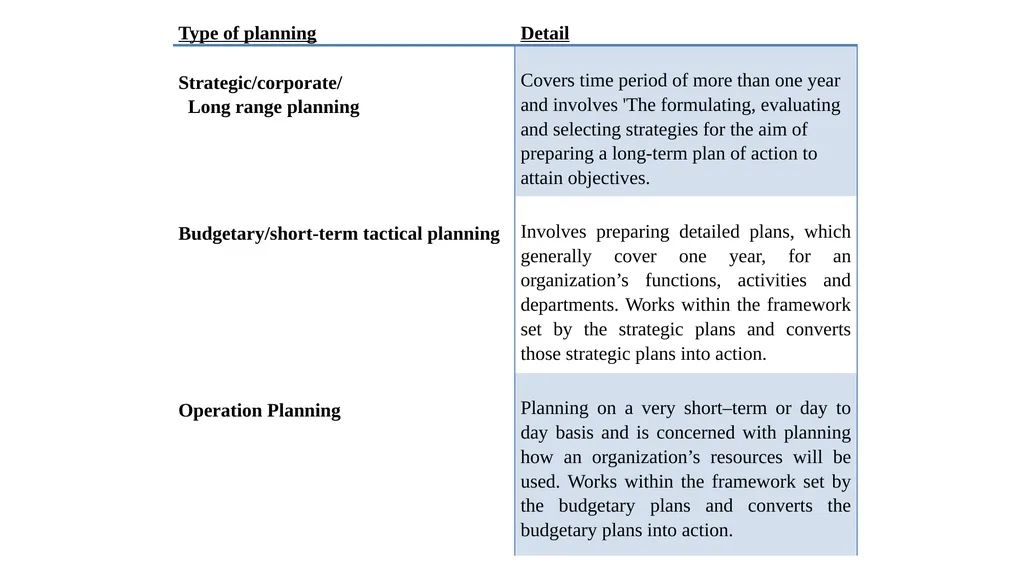
Strategic planning (long term & overall planning)
Budgetary planning (short term to medium term planning)
Operational planning (day to day planning)<br>
There are mainly three types
Strategic planning (long term & overall planning)
Budgetary planning (short term to medium term planning)
Operational planning (day to day planning)<br>
05
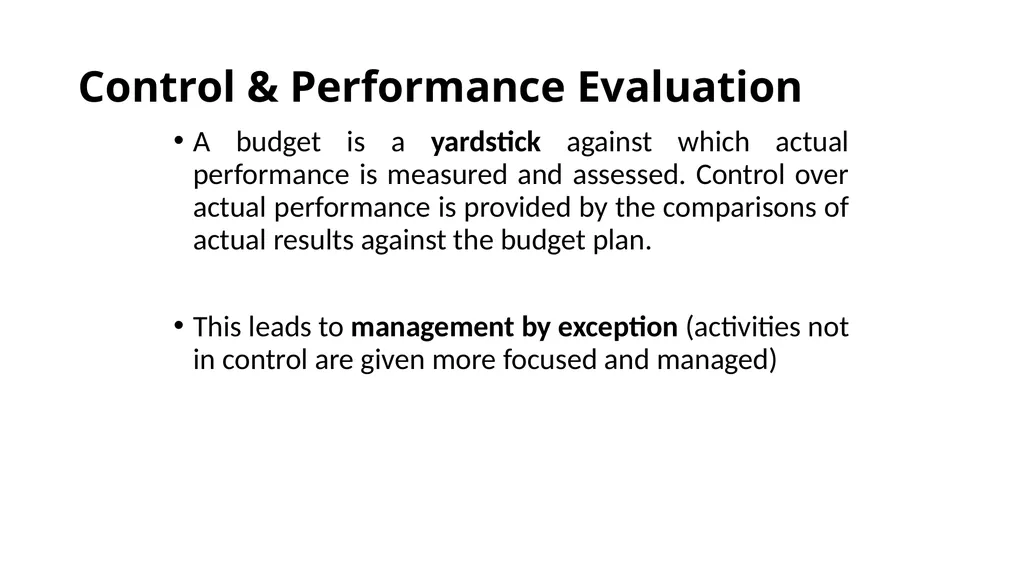
Control & Performance Evaluation A budget is a yardstick against which actual performance is measured and assessed. Control over actual performance is provided by the comparisons of actual results against the budget plan.
This leads to management by exception (activities not in control are given more focused and managed)<br>
This leads to management by exception (activities not in control are given more focused and managed)<br>
06
Motivation Budget is a useful device in influencing managers & their sub-ordinates’ behavior.
A well planned budget is likely to develop a positive behavior, if it is complemented with a proper rewarding system.<br>
A well planned budget is likely to develop a positive behavior, if it is complemented with a proper rewarding system.<br>
07
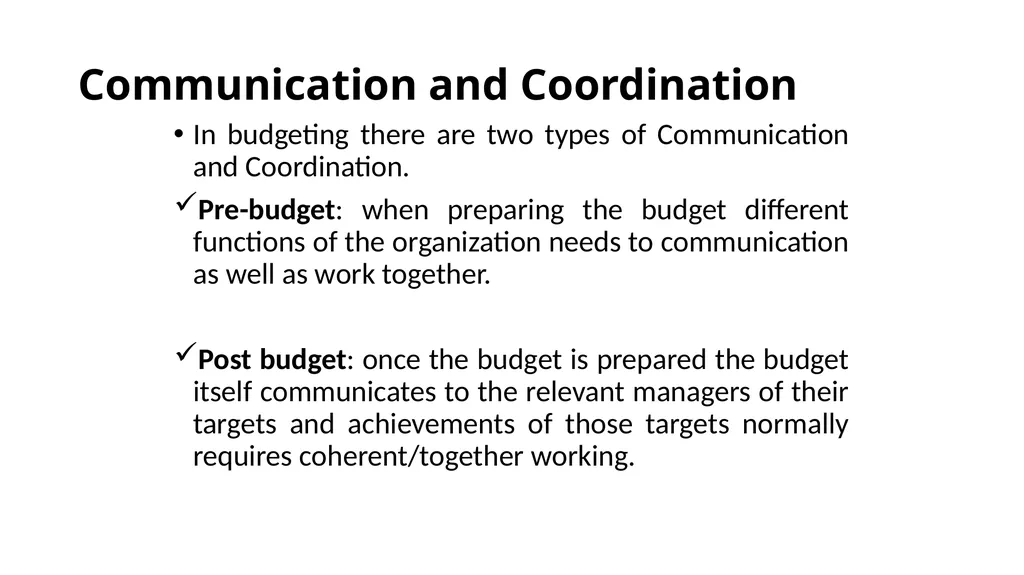
Communication and Coordination In budgeting there are two types of Communication and Coordination.
Pre-budget: when preparing the budget different functions of the organization needs to communication as well as work together.
Post budget: once the budget is prepared the budget itself communicates to the relevant managers of their targets and achievements of those targets normally requires coherent/together working.<br>
Pre-budget: when preparing the budget different functions of the organization needs to communication as well as work together.
Post budget: once the budget is prepared the budget itself communicates to the relevant managers of their targets and achievements of those targets normally requires coherent/together working.<br>
08
Planning – Budgetary How? The approaches<br>
09
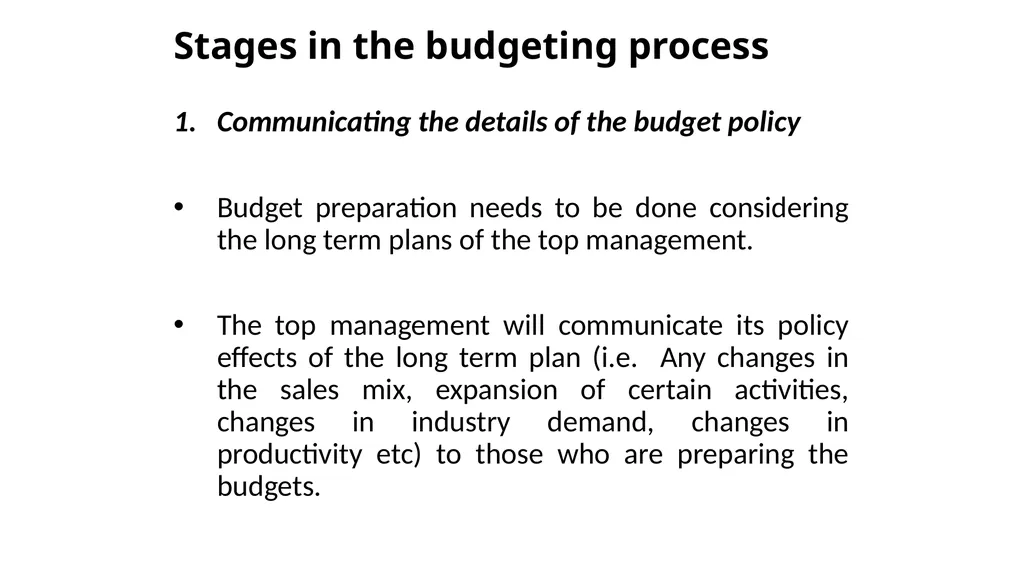
Stages in the budgeting process Communicating the details of the budget policy
Budget preparation needs to be done considering the long term plans of the top management.
The top management will communicate its policy effects of the long term plan (i.e. Any changes in the sales mix, expansion of certain activities, changes in industry demand, changes in productivity etc) to those who are preparing the budgets.<br>
Budget preparation needs to be done considering the long term plans of the top management.
The top management will communicate its policy effects of the long term plan (i.e. Any changes in the sales mix, expansion of certain activities, changes in industry demand, changes in productivity etc) to those who are preparing the budgets.<br>
10
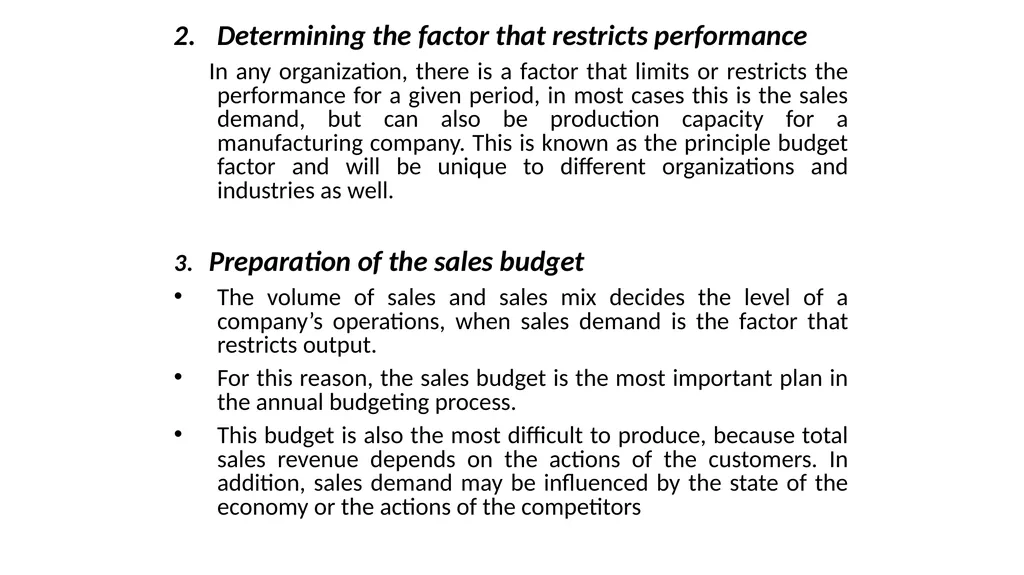
Determining the factor that restricts performance
In any organization, there is a factor that limits or restricts the performance for a given period, in most cases this is the sales demand, but can also be production capacity for a manufacturing company. This is known as the principle budget factor and will be unique to different organizations and industries as well.
3. Preparation of the sales budget
The volume of sales and sales mix decides the level of a company’s operations, when sales demand is the factor that restricts output.
For this reason, the sales budget is the most important plan in the annual budgeting process.
This budget is also the most difficult to produce, because total sales revenue depends on the actions of the customers. In addition, sales demand may be influenced by the state of the economy or the actions of the competitors<br>
In any organization, there is a factor that limits or restricts the performance for a given period, in most cases this is the sales demand, but can also be production capacity for a manufacturing company. This is known as the principle budget factor and will be unique to different organizations and industries as well.
3. Preparation of the sales budget
The volume of sales and sales mix decides the level of a company’s operations, when sales demand is the factor that restricts output.
For this reason, the sales budget is the most important plan in the annual budgeting process.
This budget is also the most difficult to produce, because total sales revenue depends on the actions of the customers. In addition, sales demand may be influenced by the state of the economy or the actions of the competitors<br>
11
4. Initial preparation of various budgets
The budget holders (managers responsible for meeting the budgeted performance) can get involved in the preparation of budgets whereby they will submit the budgets relevant to their department to the top management for approval. Any changes will then be made and reconciled to meet the needs of the company. The budget will be set based on the policy of the company.
5. Negotiation of budgets
When the budgets are set at the lower levels and submitted for approval to the top management, it is natural to have disagreements on certain costs and also budget slack will be included. Therefore negotiation will take place to bring the budget to a level agreeable to everyone.<br>
The budget holders (managers responsible for meeting the budgeted performance) can get involved in the preparation of budgets whereby they will submit the budgets relevant to their department to the top management for approval. Any changes will then be made and reconciled to meet the needs of the company. The budget will be set based on the policy of the company.
5. Negotiation of budgets
When the budgets are set at the lower levels and submitted for approval to the top management, it is natural to have disagreements on certain costs and also budget slack will be included. Therefore negotiation will take place to bring the budget to a level agreeable to everyone.<br>
12
6. Coordination and review of budgets
When the budgets are been set, it will be done by an individual manager relevant to his/her own department this disregarding the organizational requirements. Also budgets set by different departments may not be compatible with each other
e.g. Factory manager would include the purchase of equipment in his/her budget when there are actually, no funds available in the finance department.
Therefore the budgets need to be coordinated properly and revised in order to get the best fir with each other.<br>
When the budgets are been set, it will be done by an individual manager relevant to his/her own department this disregarding the organizational requirements. Also budgets set by different departments may not be compatible with each other
e.g. Factory manager would include the purchase of equipment in his/her budget when there are actually, no funds available in the finance department.
Therefore the budgets need to be coordinated properly and revised in order to get the best fir with each other.<br>
13
Final acceptance of budget
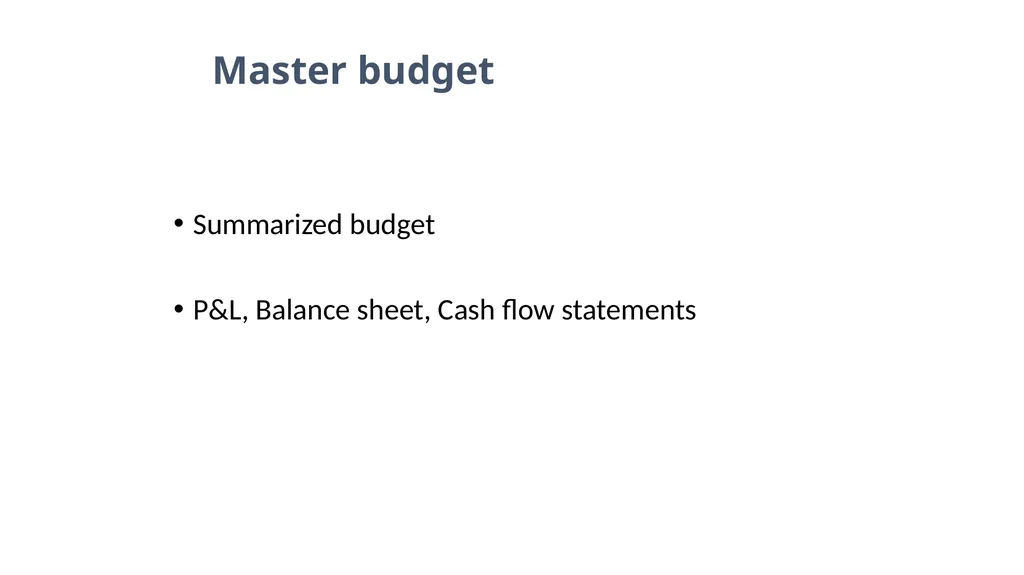
When all the budges are in harmony with each other, they are summarized into a master budget consisting the budgeted profit and loss, balance sheet and a cash flow statement. After the master budget has been approved, responsibility will be given to the individual departments to carry out their own budgets.
8. Budget review
At the end of the particular period, the budgets need to be compared with the actual performance of the department and results should be given to the respective departments. This will act as a motivational tool for the budget holders to appraise themselves and strive to be better. Also the management will have to make changes to the existing budgets whenever the environment changes so that meaningful comparisons can be made with the actual.<br>
When all the budges are in harmony with each other, they are summarized into a master budget consisting the budgeted profit and loss, balance sheet and a cash flow statement. After the master budget has been approved, responsibility will be given to the individual departments to carry out their own budgets.
8. Budget review
At the end of the particular period, the budgets need to be compared with the actual performance of the department and results should be given to the respective departments. This will act as a motivational tool for the budget holders to appraise themselves and strive to be better. Also the management will have to make changes to the existing budgets whenever the environment changes so that meaningful comparisons can be made with the actual.<br>
14
Budgetary Planning approaches Different organizations approach budgeting differently.
Main Approaches (concerned with where budgeting is done)
Alternative Approaches (concerned with; where ever it is, how it is done)<br>
Main Approaches (concerned with where budgeting is done)
Alternative Approaches (concerned with; where ever it is, how it is done)<br>
15
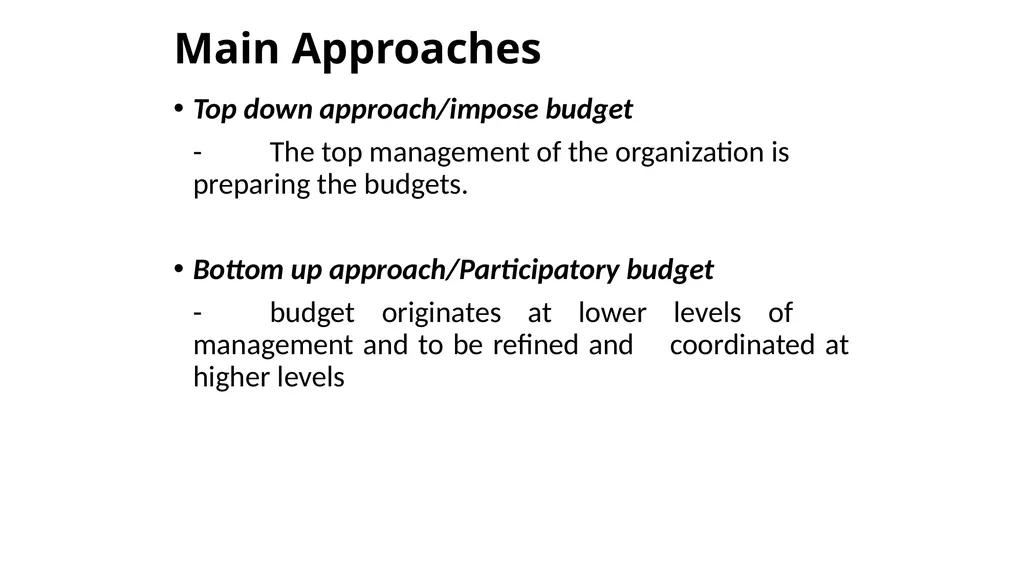
Main Approaches Top down approach/impose budget
- The top management of the organization is preparing the budgets.
Bottom up approach/Participatory budget
- budget originates at lower levels of management and to be refined and coordinated at higher levels<br>
- The top management of the organization is preparing the budgets.
Bottom up approach/Participatory budget
- budget originates at lower levels of management and to be refined and coordinated at higher levels<br>
16
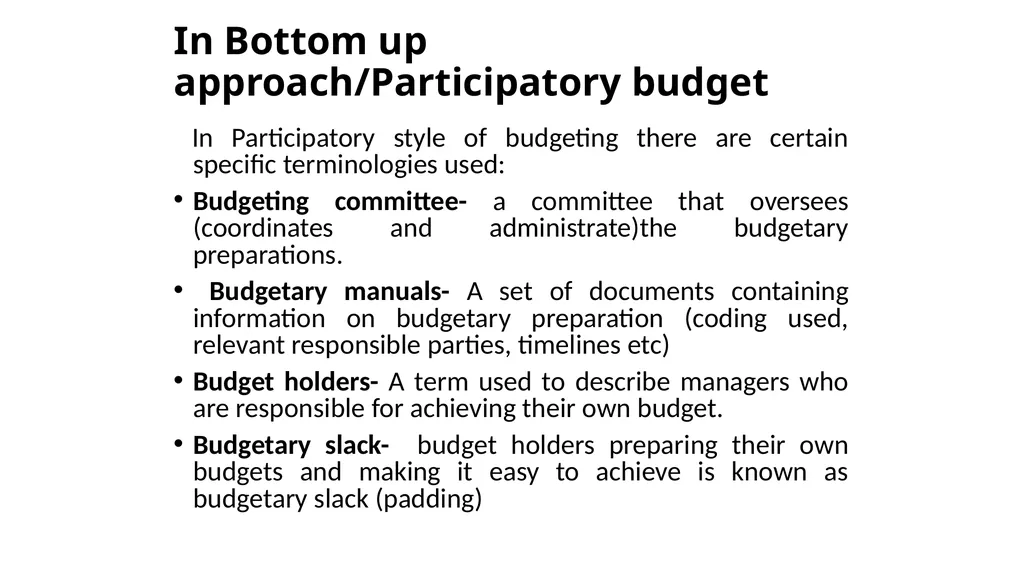
In Bottom up approach/Participatory budget In Participatory style of budgeting there are certain specific terminologies used:
Budgeting committee- a committee that oversees (coordinates and administrate)the budgetary preparations.
Budgetary manuals- A set of documents containing information on budgetary preparation (coding used, relevant responsible parties, timelines etc)
Budget holders- A term used to describe managers who are responsible for achieving their own budget.
Budgetary slack- budget holders preparing their own budgets and making it easy to achieve is known as budgetary slack (padding)<br>
Budgeting committee- a committee that oversees (coordinates and administrate)the budgetary preparations.
Budgetary manuals- A set of documents containing information on budgetary preparation (coding used, relevant responsible parties, timelines etc)
Budget holders- A term used to describe managers who are responsible for achieving their own budget.
Budgetary slack- budget holders preparing their own budgets and making it easy to achieve is known as budgetary slack (padding)<br>
17
Alternative Approaches Incremental
Rolling
ZBB
ABB
PPBS<br>
Rolling
ZBB
ABB
PPBS<br>
18
Incremental Next year’s budget prepared on the current year’s budget/Actual.
plus an extra amount for estimated growth or inflation next year.<br>
plus an extra amount for estimated growth or inflation next year.<br>
19
Rolling When the earliest period has lapsed an equal period is added in order to maintain a budget for a fixed period, and if required existing plans are also amended.<br>
20
ZBB (Zero Based Budgeting) rejects the traditional budgeting view
Approach as it is prepared for the first time = zero based
all cost elements are justified and prioritized
Used mainly with discretionary costs and support activity
(marketing, research, training, maintenance)<br>
Approach as it is prepared for the first time = zero based
all cost elements are justified and prioritized
Used mainly with discretionary costs and support activity
(marketing, research, training, maintenance)<br>
21
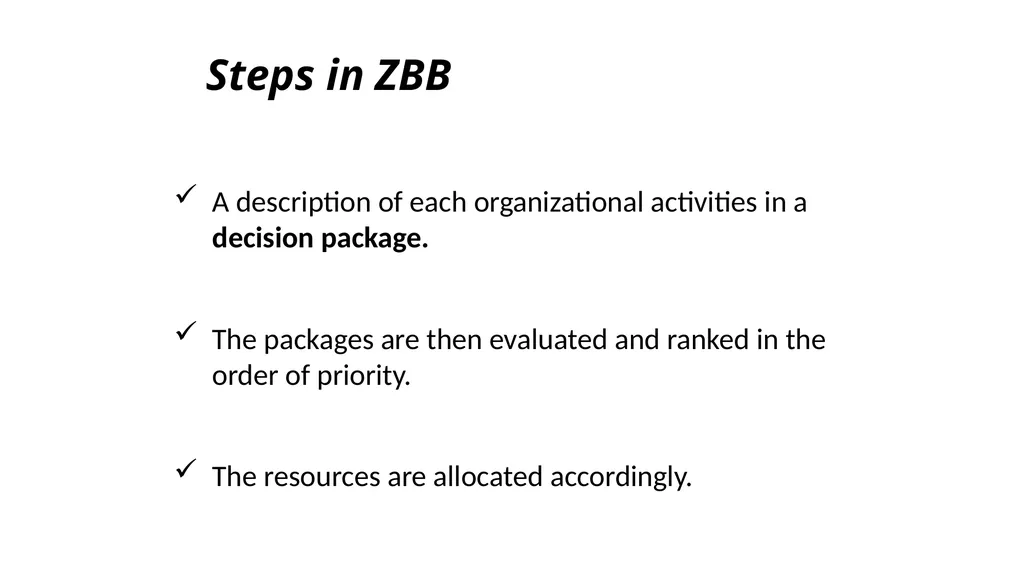
Steps in ZBB A description of each organizational activities in a decision package.
The packages are then evaluated and ranked in the order of priority.
The resources are allocated accordingly.<br>
The packages are then evaluated and ranked in the order of priority.
The resources are allocated accordingly.<br>
22
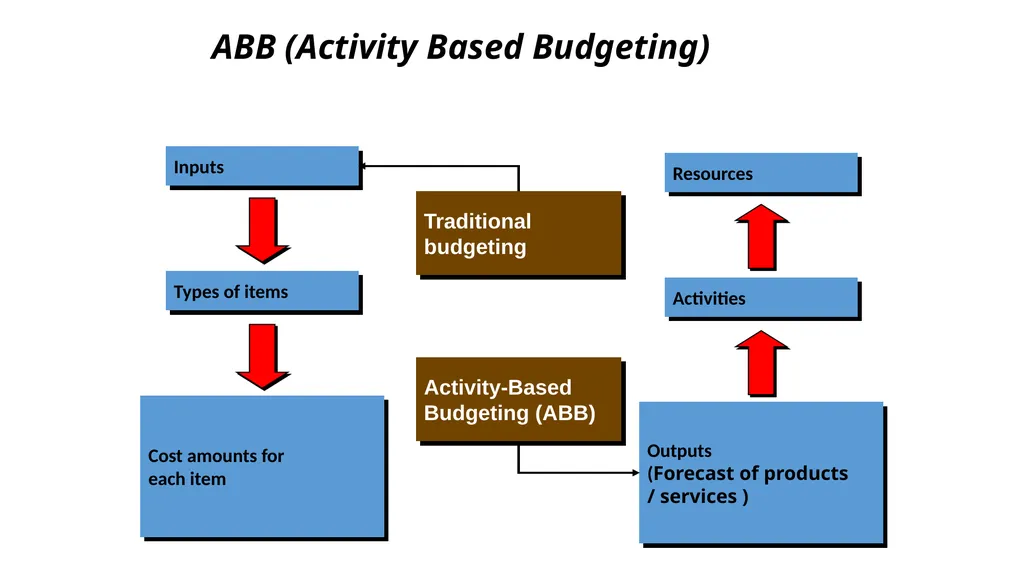
ABB (Activity Based Budgeting) Inputs Cost amounts for
each item Types of items Resources Outputs
(Forecast of products / services ) Activities<br>
each item Types of items Resources Outputs
(Forecast of products / services ) Activities<br>
23
PPBS (Programme planning Budgeting System) For non profit making organizations<br>
24
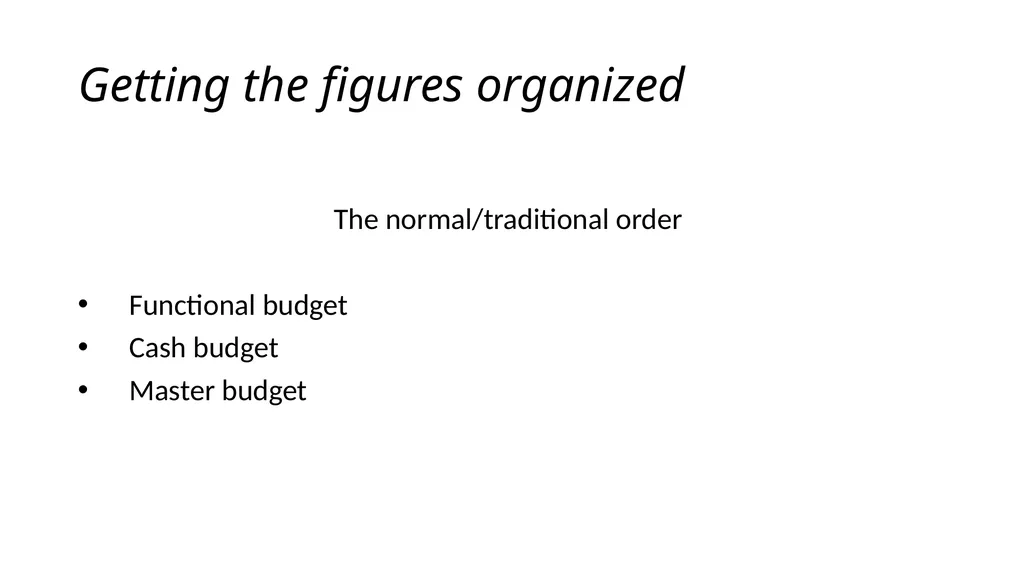
Getting the figures organized The normal/traditional order
Functional budget
Cash budget
Master budget<br>
Functional budget
Cash budget
Master budget<br>
25
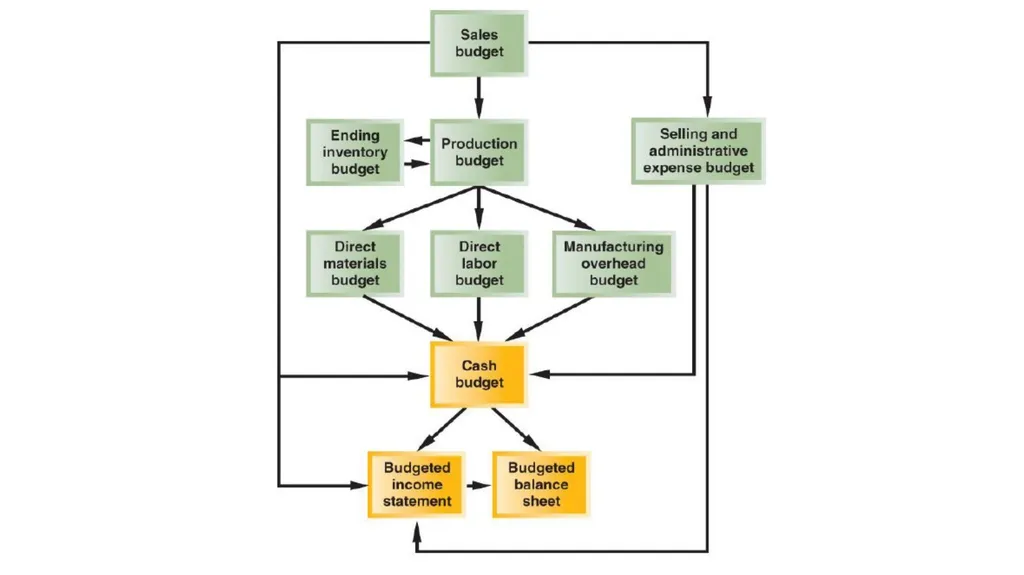
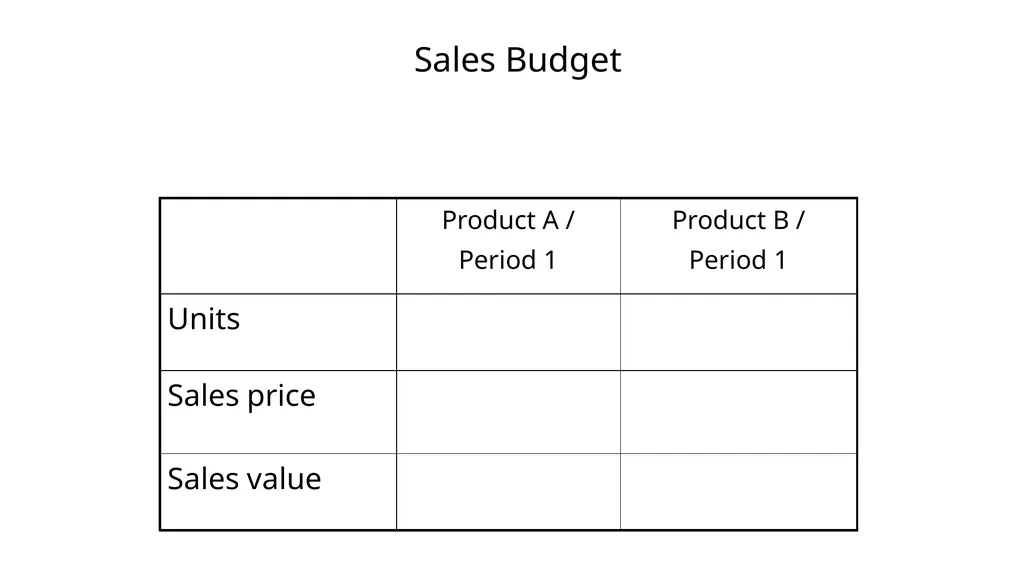
Sales Budget<br>
26
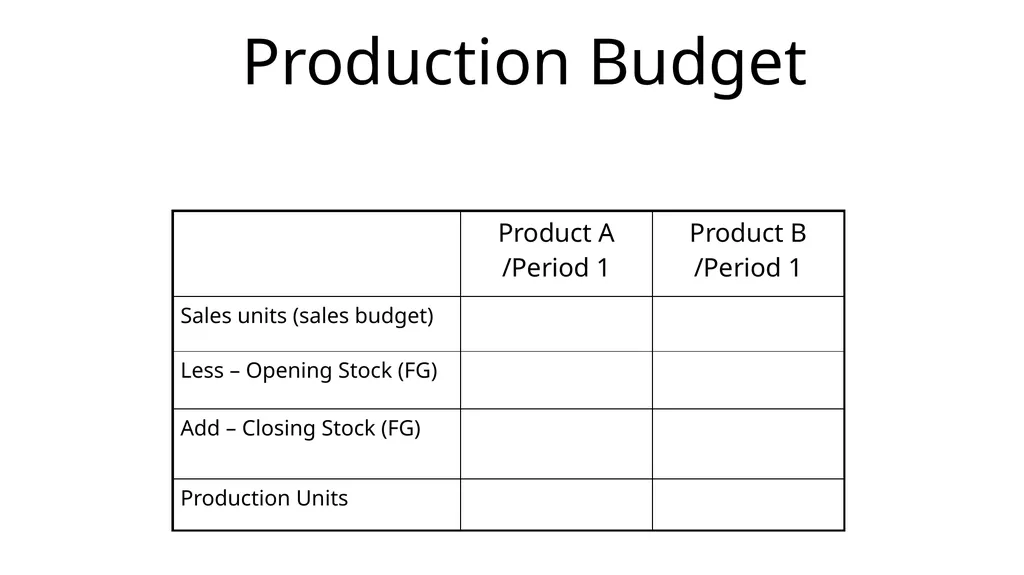
Production Budget<br>
27
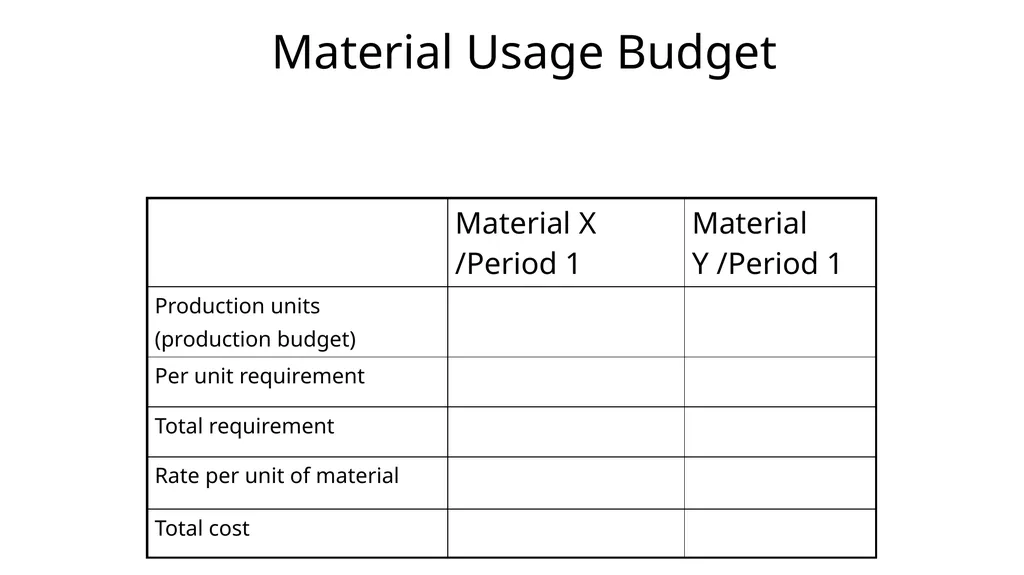
Material Usage Budget<br>
28
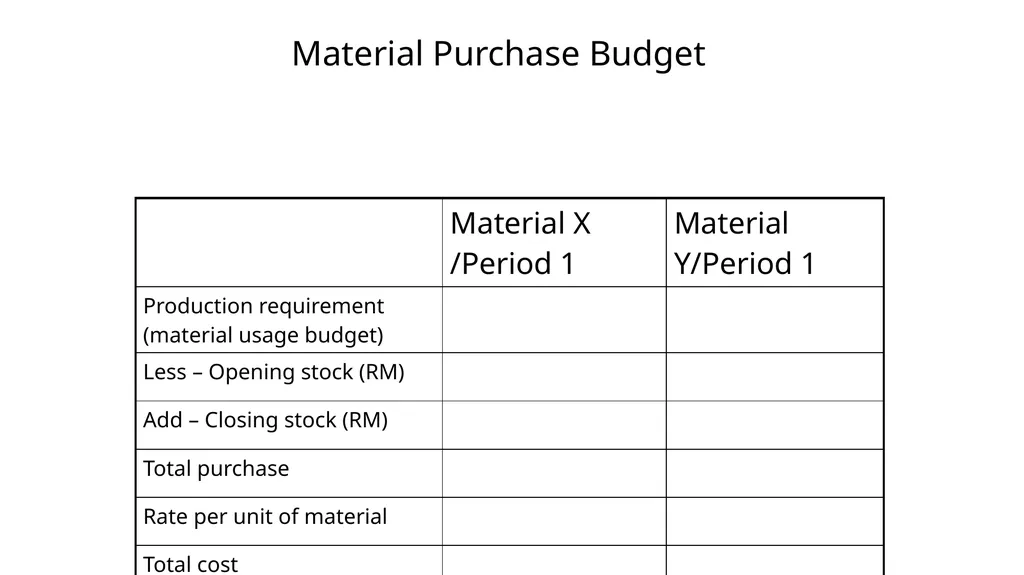
Material Purchase Budget<br>
29
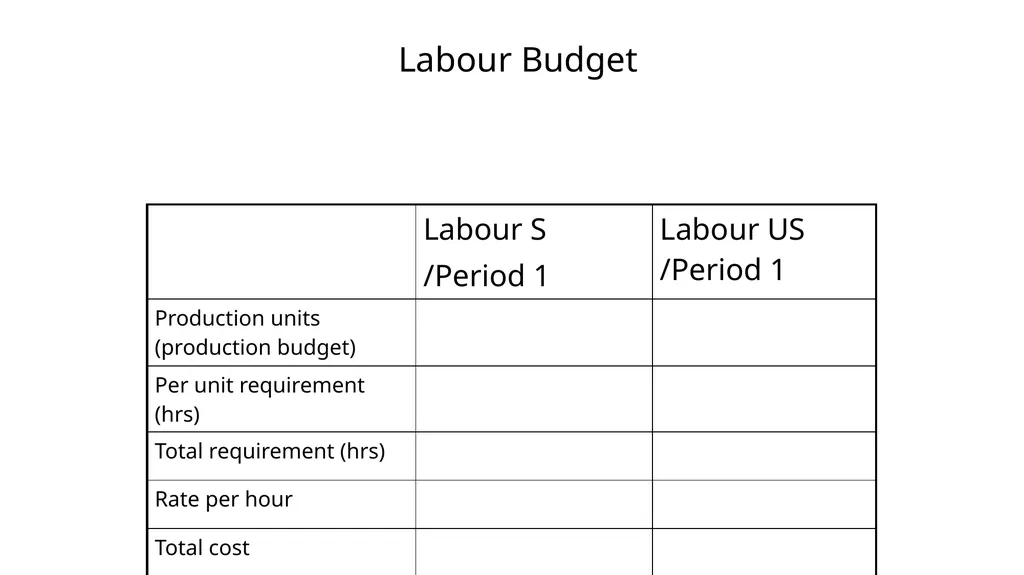
Labour Budget<br>
30
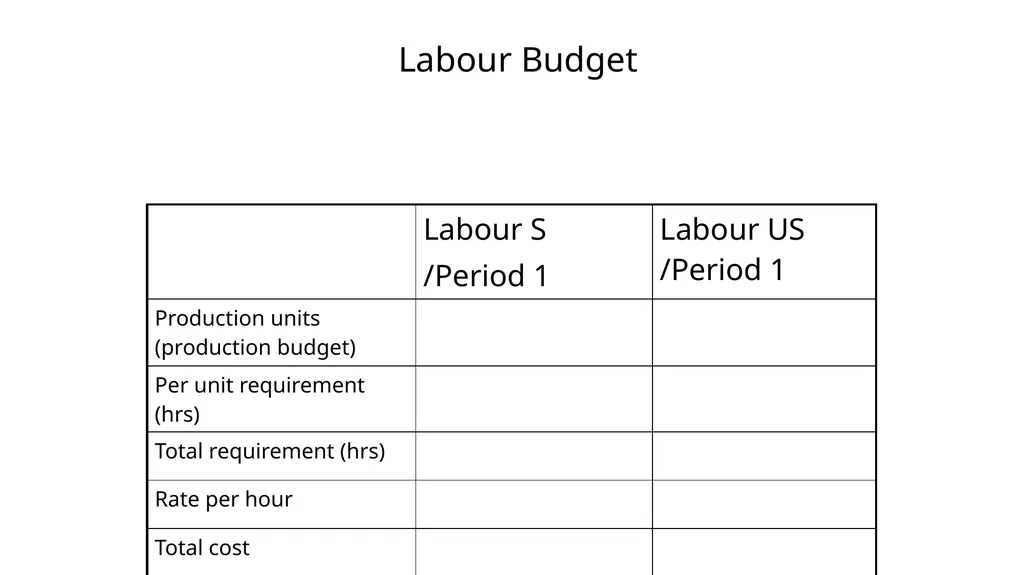
Labour Budget<br>
31
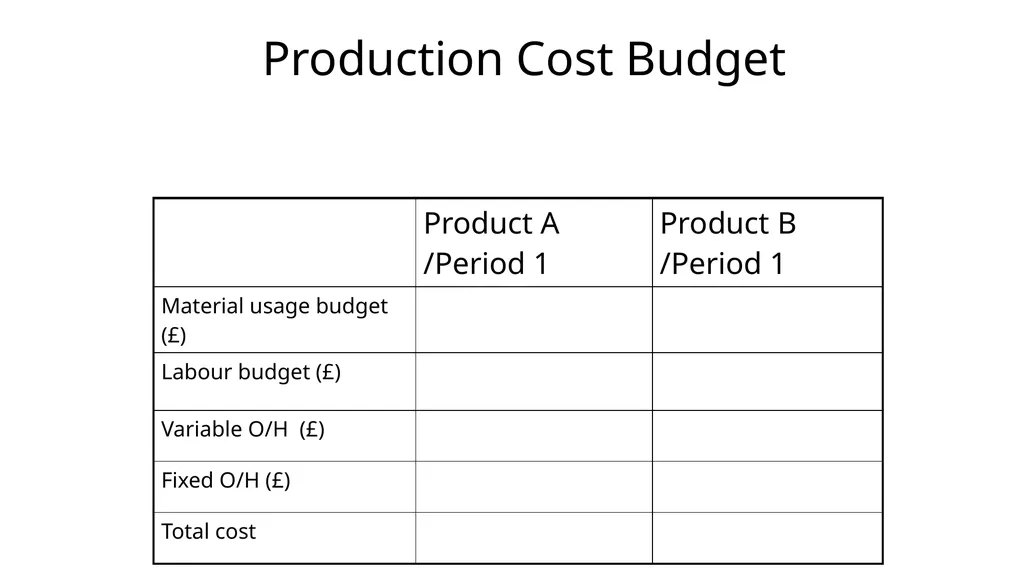
Production Cost Budget<br>
32
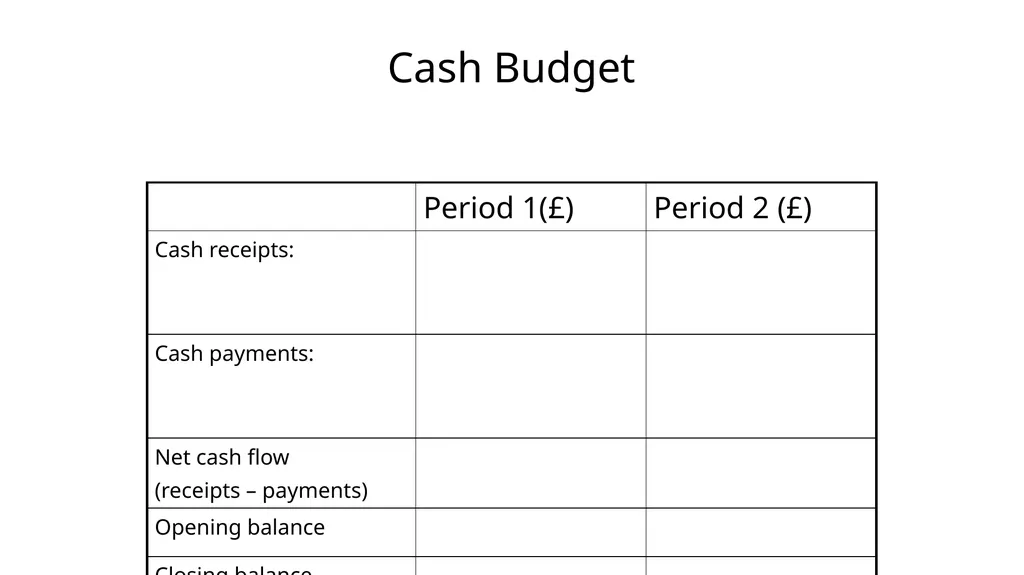
Cash Budget<br>
33
Summarized budget
P&L, Balance sheet, Cash flow statements Master budget<br>
P&L, Balance sheet, Cash flow statements Master budget<br>
34
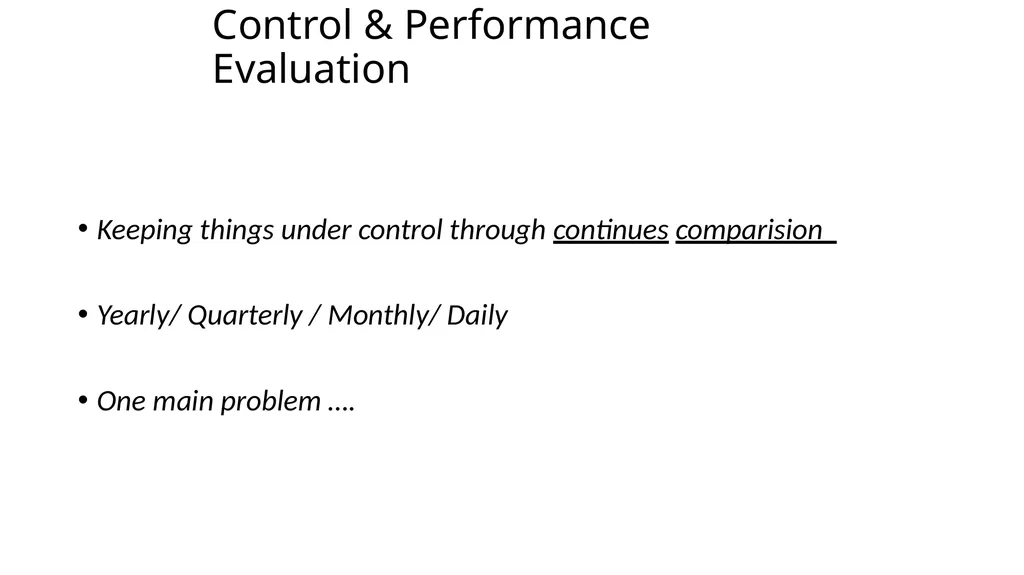
Control & Performance Evaluation Keeping things under control through continues comparision
Yearly/ Quarterly / Monthly/ Daily
One main problem ….<br>
Yearly/ Quarterly / Monthly/ Daily
One main problem ….<br>
35
Budgetary control But comparisons should be between like with like terms
Fixed and Flexed (budget cost allowance)
How to Flex ??<br>
Fixed and Flexed (budget cost allowance)
How to Flex ??<br>
36
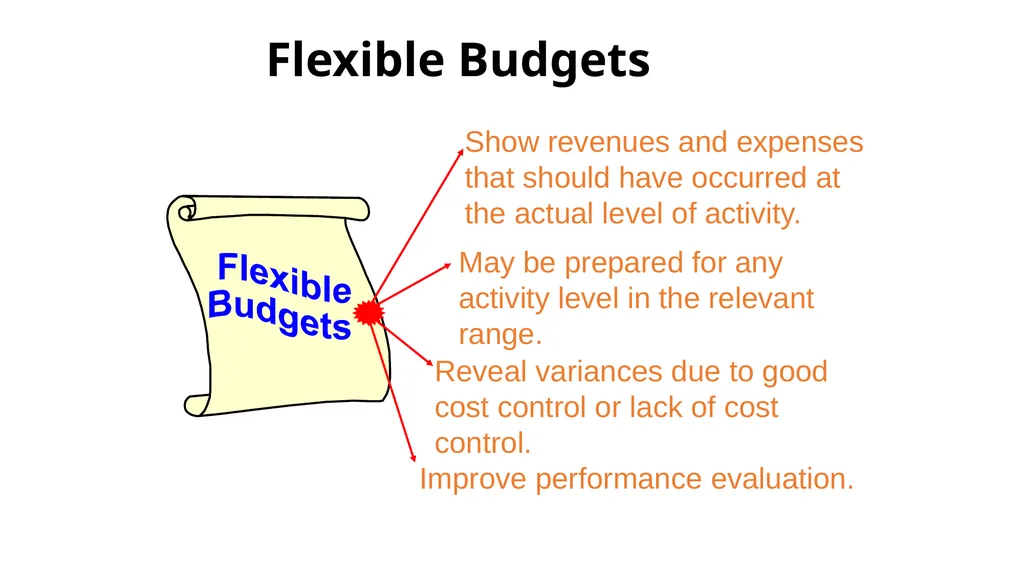
Flexible Budgets Improve performance evaluation. May be prepared for any activity level in the relevant range. Show revenues and expenses
that should have occurred at the actual level of activity. Reveal variances due to good cost control or lack of cost control.<br>
37
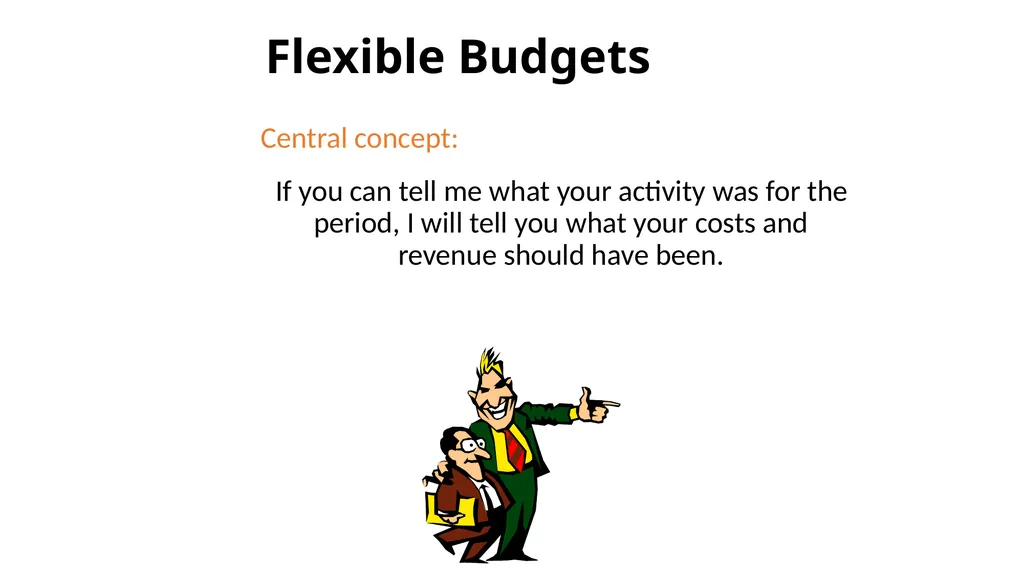
Flexible Budgets Central concept:
If you can tell me what your activity was for the period, I will tell you what your costs and revenue should have been.<br>
If you can tell me what your activity was for the period, I will tell you what your costs and revenue should have been.<br>
38
Flexible Budgeting Technique Let’s look at organisations that produce the same kind of (i.e. standard) product on a regular basis.
The question we ask is what happens to costs if we change / increase the output.
Identify fixed and variable cost elements of budget / identify semi-variable costs using the high - low method.
Calculate the unit cost of variable elements.
Multiply by the new volume level.
Fixed costs remain constant.<br>
The question we ask is what happens to costs if we change / increase the output.
Identify fixed and variable cost elements of budget / identify semi-variable costs using the high - low method.
Calculate the unit cost of variable elements.
Multiply by the new volume level.
Fixed costs remain constant.<br>
39
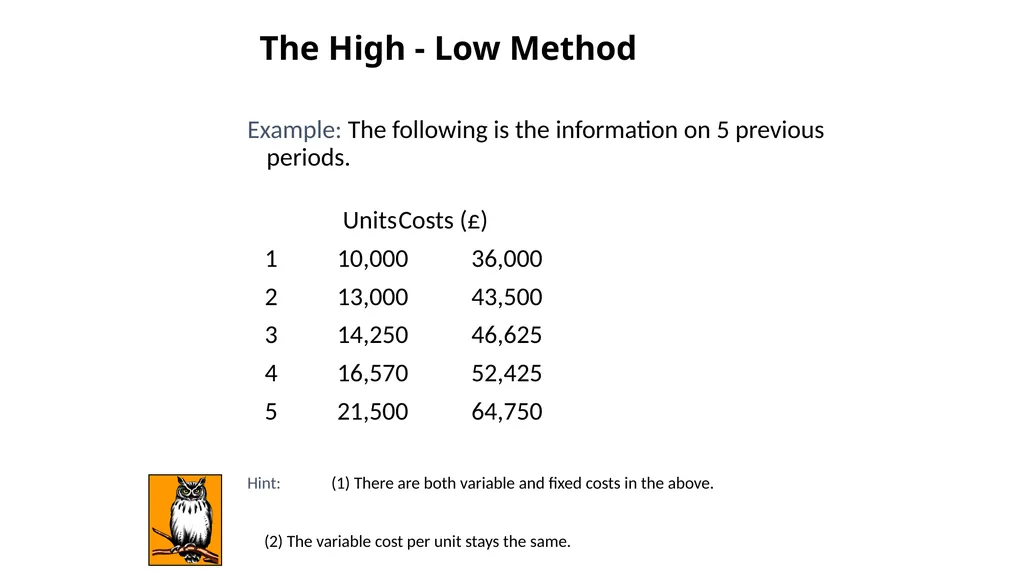
The High - Low Method Example: The following is the information on 5 previous periods.
Units Costs (£)
1 10,000 36,000
2 13,000 43,500
3 14,250 46,625
4 16,570 52,425
5 21,500 64,750
Hint: (1) There are both variable and fixed costs in the above.
(2) The variable cost per unit stays the same.<br>
Units Costs (£)
1 10,000 36,000
2 13,000 43,500
3 14,250 46,625
4 16,570 52,425
5 21,500 64,750
Hint: (1) There are both variable and fixed costs in the above.
(2) The variable cost per unit stays the same.<br>
40
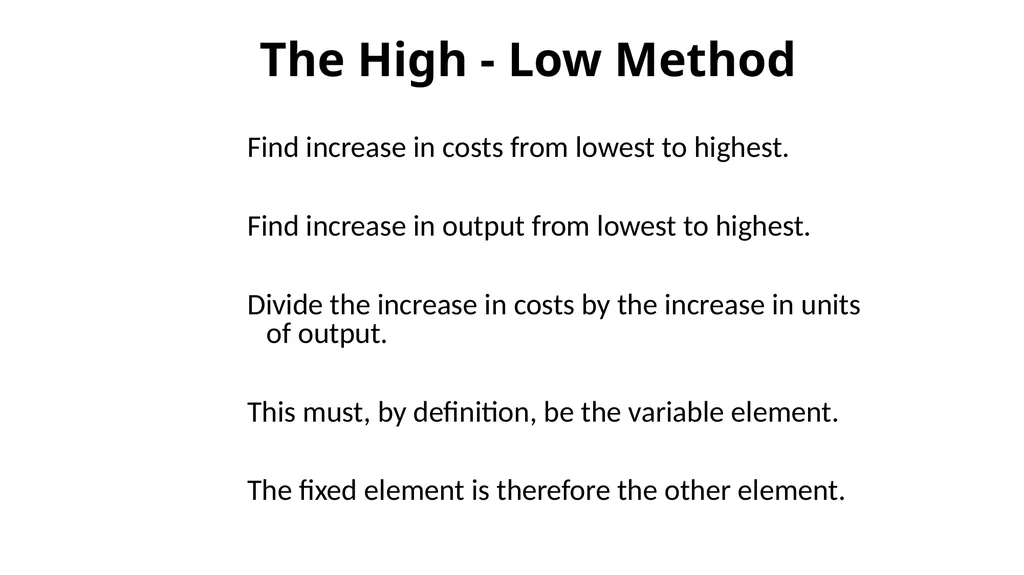
The High - Low Method Find increase in costs from lowest to highest.
Find increase in output from lowest to highest.
Divide the increase in costs by the increase in units of output.
This must, by definition, be the variable element.
The fixed element is therefore the other element.<br>
Find increase in output from lowest to highest.
Divide the increase in costs by the increase in units of output.
This must, by definition, be the variable element.
The fixed element is therefore the other element.<br>
41
Budgetary control Feedback
Feed forward<br>
Feed forward<br>
42
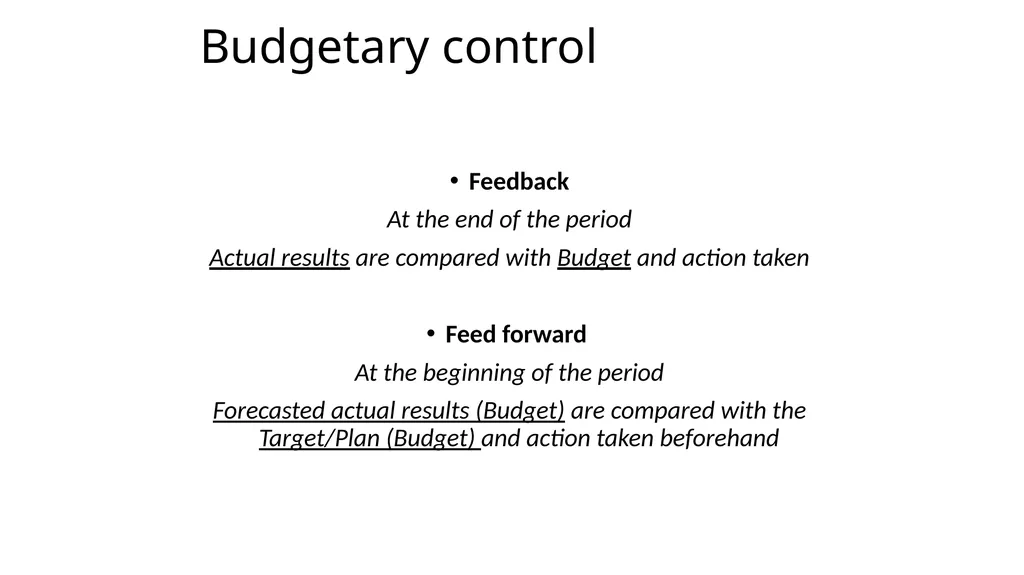
Budgetary control Feedback
At the end of the period
Actual results are compared with Budget and action taken
Feed forward
At the beginning of the period
Forecasted actual results (Budget) are compared with the Target/Plan (Budget) and action taken beforehand<br>
At the end of the period
Actual results are compared with Budget and action taken
Feed forward
At the beginning of the period
Forecasted actual results (Budget) are compared with the Target/Plan (Budget) and action taken beforehand<br>