
Budgeting Externally Sponsored Research Proposals






Description: Budgeting Externally Sponsored Research Proposals Office of Research Administration September 2010 Its clearly a budget. Its got a lot of numbers in it. George W. Bush (43rd US president) PLEASE NOTE: The policies, procedures and
Related Topics
Download Presentation
"Budgeting Externally Sponsored Research Proposals" is the property of its rightful owner. Permission is granted to download and print the materials on this website for personal, non-commercial use only, and to display it on your personal computer provided you do not modify the materials and that you retain all copyright notices contained in the materials. By downloading content from our website, you accept the terms of this agreement.
Presentation Transcript
slide1. Budgeting Externally Sponsored Research Proposals Office of Research Administration
September 2010<br>
slide2. “It's clearly a budget. It's got a lot of numbers in it.”
— George W. Bush (43rd US president)<br>
slide3. PLEASE NOTE: The policies, procedures and rates provided in this presentation are accurate as of September 2015, but are constantly evolving and changing.
If you are considering or have decided to submit a proposal, please contact Dee Myall to notify ORSP of your intent and to verify current budgeting policies.
dee@shsu.edu or 936-294-4032)<br>
slide4. Sponsored Research Functions
The Office of Research and Sponsored Programs (ORSP)
Primarily involved with opportunity identification and
proposal submission.
The Office of Research Administration (ORA)
Primarily involved after an award is received
Both are located in the Roy Adams House<br>
slide5. ORSP Responsibilities:
Internal Grant Program ($5,000 – 15,000)
Identifying funding and collaborative opportunities
Proposal strategy
Proposal writing, formatting & proofreading
Proposal requirements (word/page length, font size, etc.)<br>
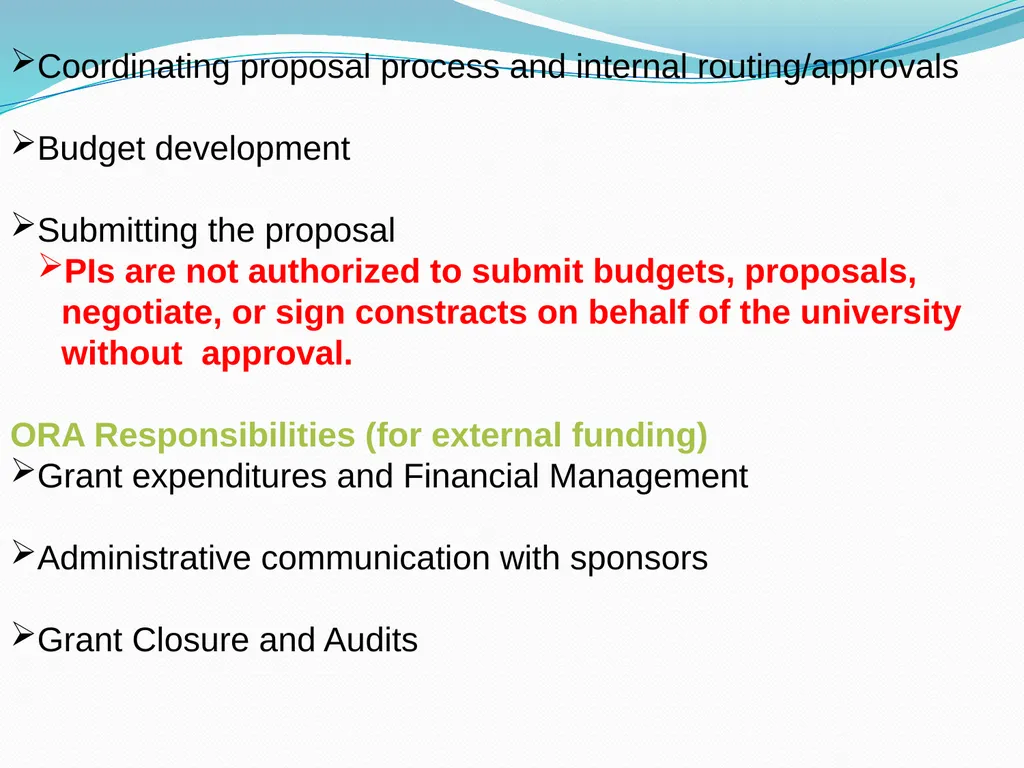
slide6. Coordinating proposal process and internal routing/approvals
Budget development
Submitting the proposal
PIs are not authorized to submit budgets, proposals, negotiate, or sign constracts on behalf of the university without approval.
ORA Responsibilities (for external funding)
Grant expenditures and Financial Management
Administrative communication with sponsors
Grant Closure and Audits<br>
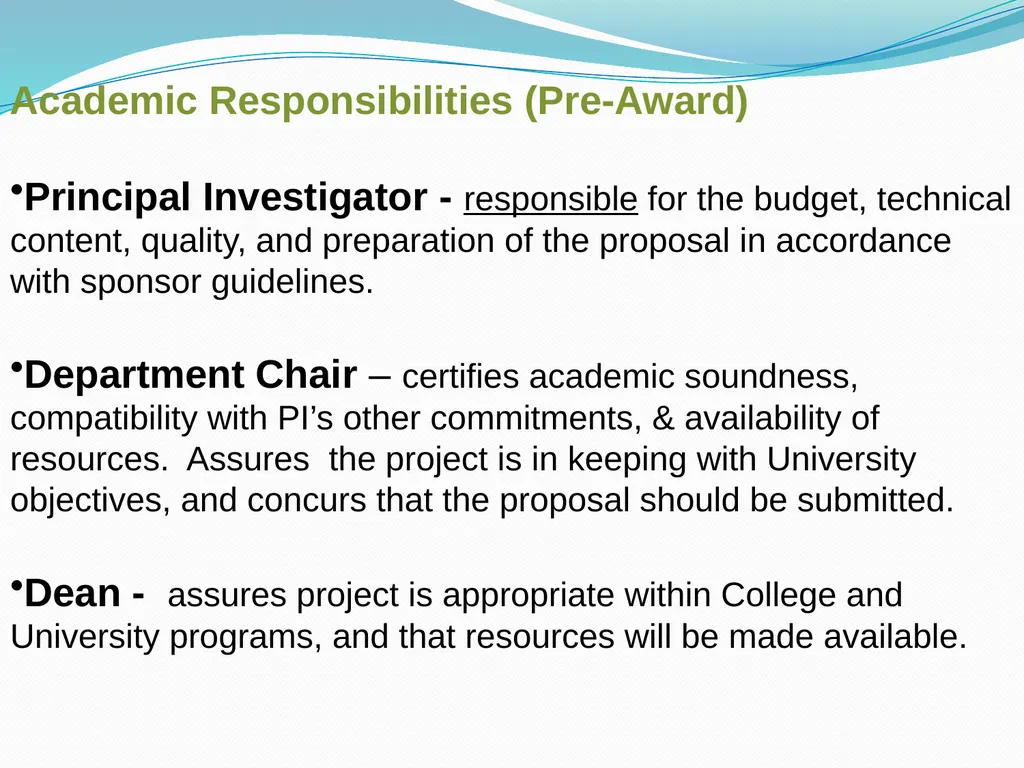
slide7. Academic Responsibilities (Pre-Award)
Principal Investigator - responsible for the budget, technical content, quality, and preparation of the proposal in accordance with sponsor guidelines.
Department Chair – certifies academic soundness, compatibility with PI’s other commitments, & availability of resources. Assures the project is in keeping with University objectives, and concurs that the proposal should be submitted.
Dean - assures project is appropriate within College and University programs, and that resources will be made available.<br>
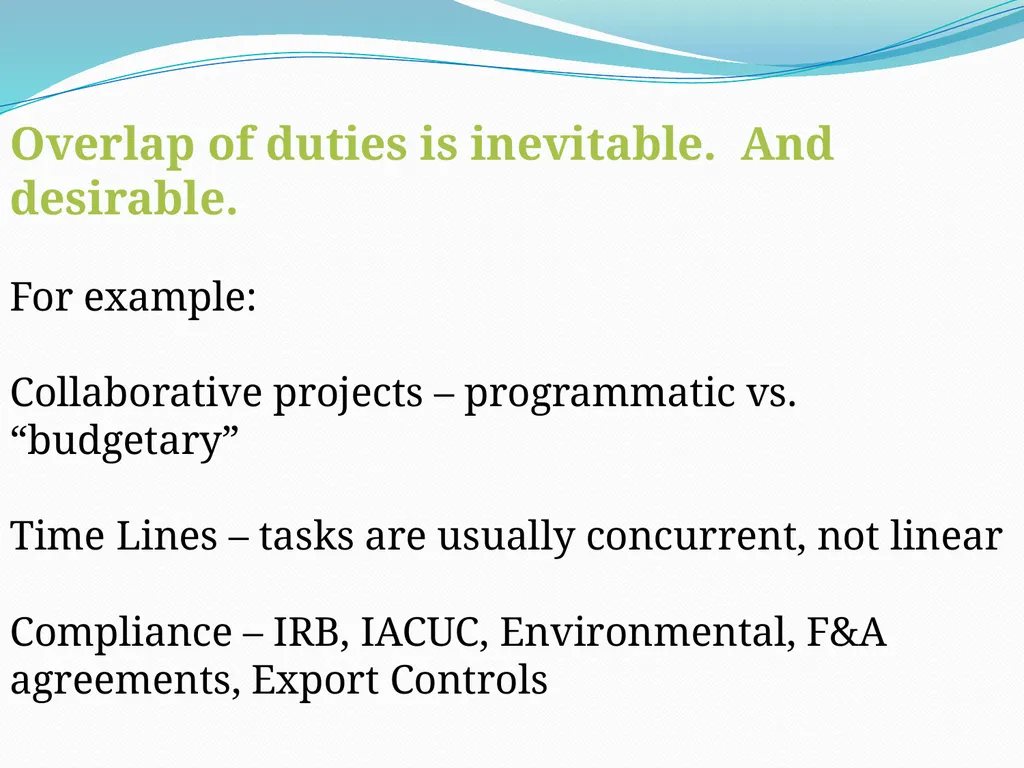
slide8. Overlap of duties is inevitable. And desirable.
For example:
Collaborative projects – programmatic vs. “budgetary”
Time Lines – tasks are usually concurrent, not linear
Compliance – IRB, IACUC, Environmental, F&A agreements, Export Controls<br>
slide10. Mutual cooperation among ORA, ORSP and PIs will produce the strongest proposal. We each have areas of expertise. And weaknesses.
ORA understands accounting principles and federal requirements, but you know your programs
How often do you review federal audit standards or OMB circulars?
Could a proposal from a math professor benefit from the expertise of a journalism major?<br>
slide11. After you have decided to submit a proposal, what is the next step?<br>
slide12. To Start the Proposal Process, Contact the ORA Proposal Administrator Dee Myall
936-294-4032 dee@shsu.edu Business
Education
Humanities & Social Sciences
Extended Programs Criminal Justice
Arts
Sciences
Any other areas<br>
slide13. Good things are not done in a hurry. ORSP should be notified at least 30 days before the due date for typical proposals.
The complexity of your proposal determines when you should contact us, but the sooner, the better.<br>
slide14. Common Causes of Delay
External Collaborators/Partners/Subcontractors
Long project period (over 3 years)
High Dollar Amount ($500K+)
Private Foundations/Sponsors we have not worked with before
Christmas and Summer Periods
Add extra prep time for any of these situations<br>
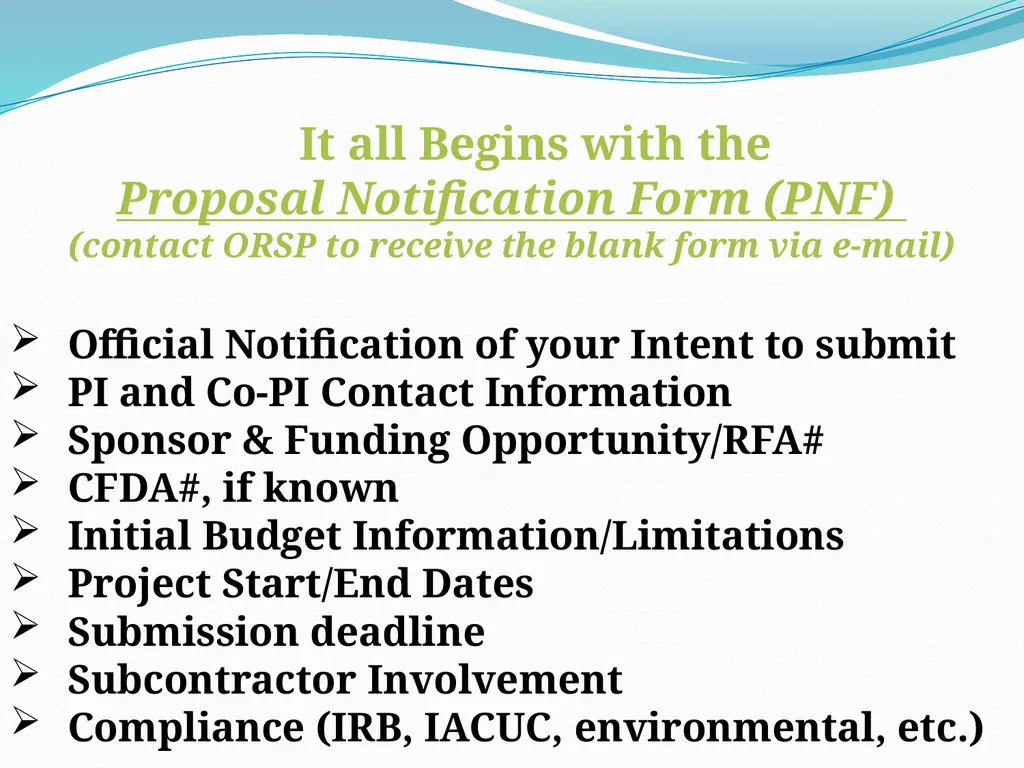
slide15. It all Begins with the
Proposal Notification Form (PNF)
(contact ORSP to receive the blank form via e-mail)
Official Notification of your Intent to submit
PI and Co-PI Contact Information
Sponsor & Funding Opportunity/RFA#
CFDA#, if known
Initial Budget Information/Limitations
Project Start/End Dates
Submission deadline
Subcontractor Involvement
Compliance (IRB, IACUC, environmental, etc.)<br>
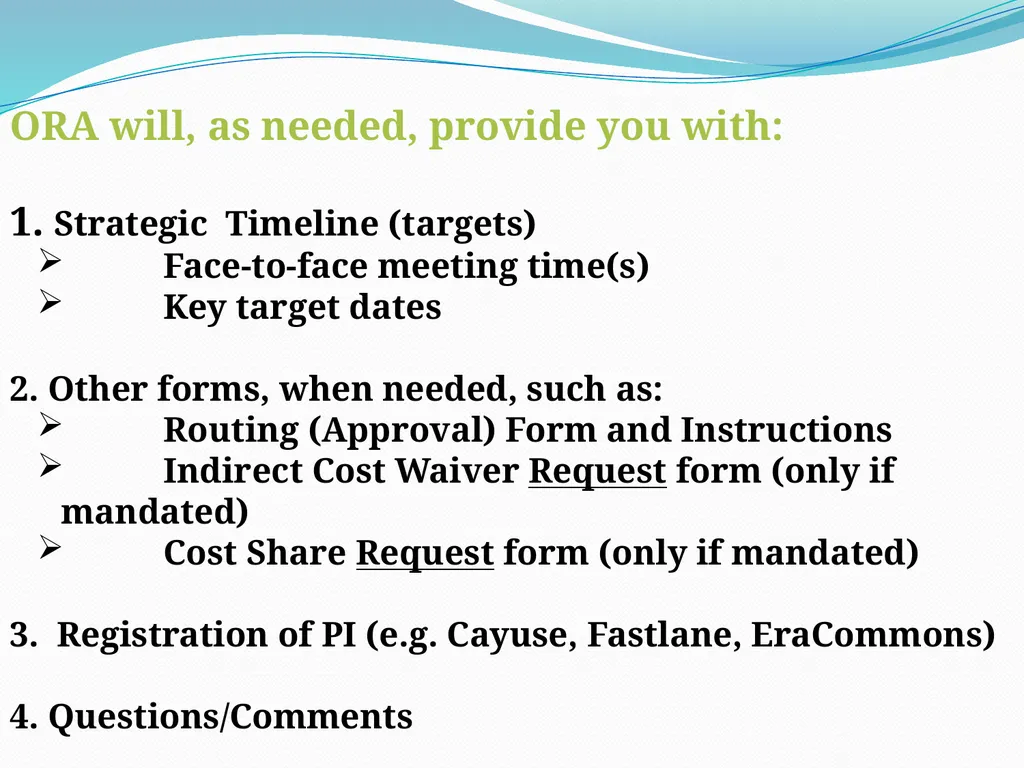
slide16. ORA will, as needed, provide you with:
1. Strategic Timeline (targets)
Face-to-face meeting time(s)
Key target dates
2. Other forms, when needed, such as:
Routing (Approval) Form and Instructions
Indirect Cost Waiver Request form (only if mandated)
Cost Share Request form (only if mandated)
3. Registration of PI (e.g. Cayuse, Fastlane, EraCommons)
4. Questions/Comments<br>
slide17. We Focus on the “Business” of Proposals. Financial Accountability starts with your budget.<br>
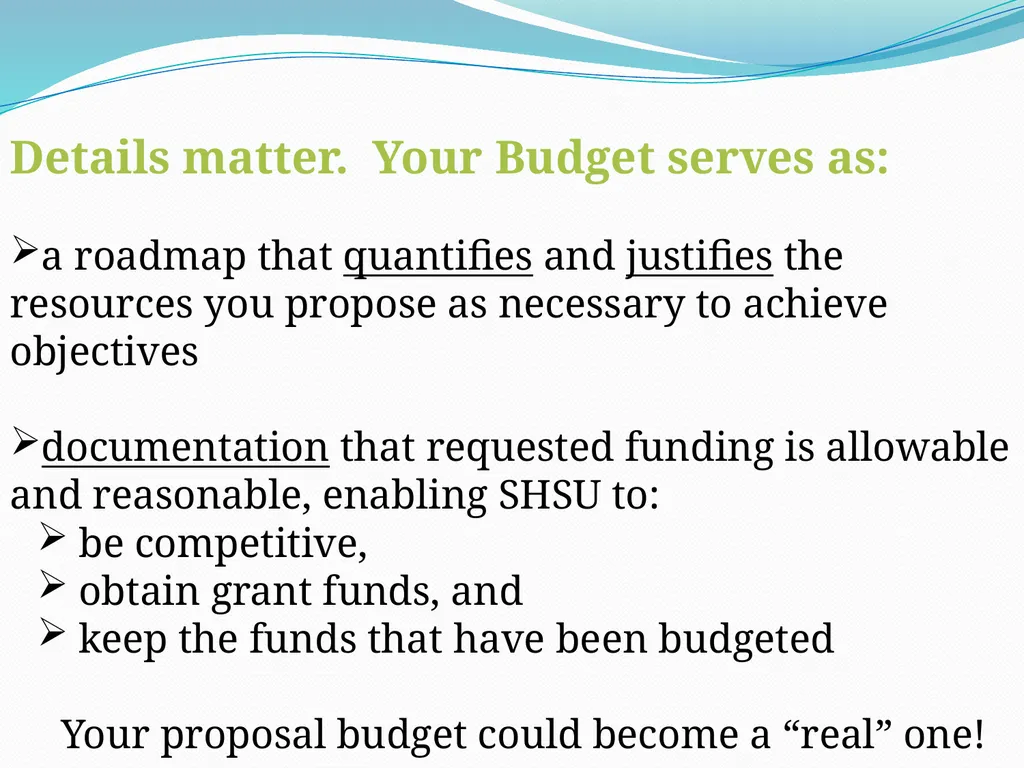
slide18. Details matter. Your Budget serves as:
a roadmap that quantifies and justifies the resources you propose as necessary to achieve objectives
documentation that requested funding is allowable and reasonable, enabling SHSU to:
be competitive,
obtain grant funds, and
keep the funds that have been budgeted
Your proposal budget could become a “real” one!<br>
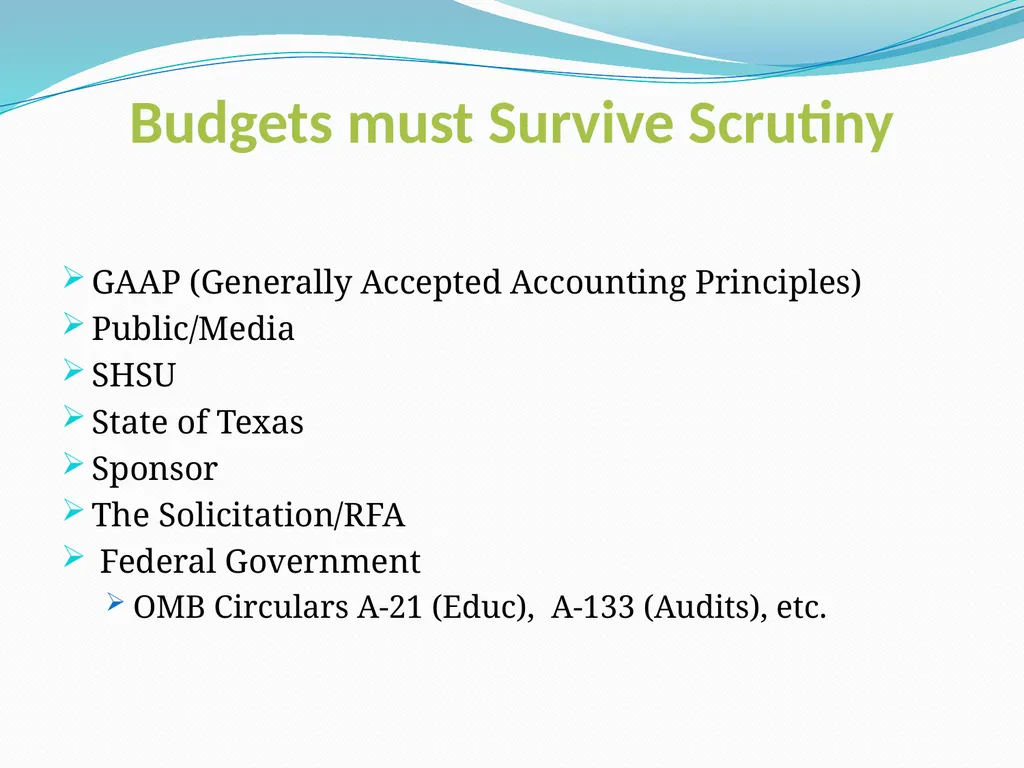
slide19. Budgets must Survive Scrutiny GAAP (Generally Accepted Accounting Principles)
Public/Media
SHSU
State of Texas
Sponsor
The Solicitation/RFA
Federal Government
OMB Circulars A-21 (Educ), A-133 (Audits), etc.<br>
slide20. To create a budget that will be compliant, we must understand some Essential Budget Terms<br>
slide21. All Proposed Costs Must be: Allowable
Reasonable
Allocable
Consistently Treated<br>
slide22. Reasonable Costs Reflect costs that a “prudent” person would accept
Sponsor will have numerous budgets from which to compare<br>
slide23. Allocable Costs Costs that can be assigned, individually or as a group, to a cost objective in a “reasonable and realistic” proportion.
Costs are allocable to a proposal when incurred solely for the benefit of the sponsored project<br>
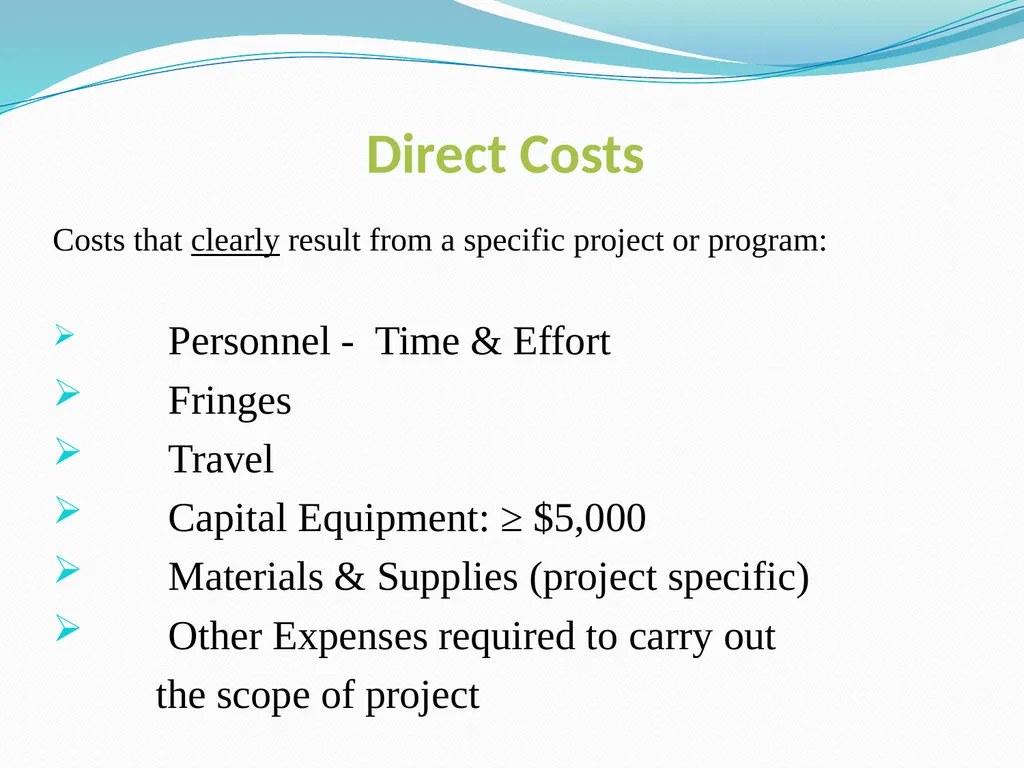
slide24. Direct Costs Costs that clearly result from a specific project or program:
Personnel - Time & Effort
Fringes
Travel
Capital Equipment: ≥ $5,000
Materials & Supplies (project specific)
Other Expenses required to carry out
the scope of project<br>
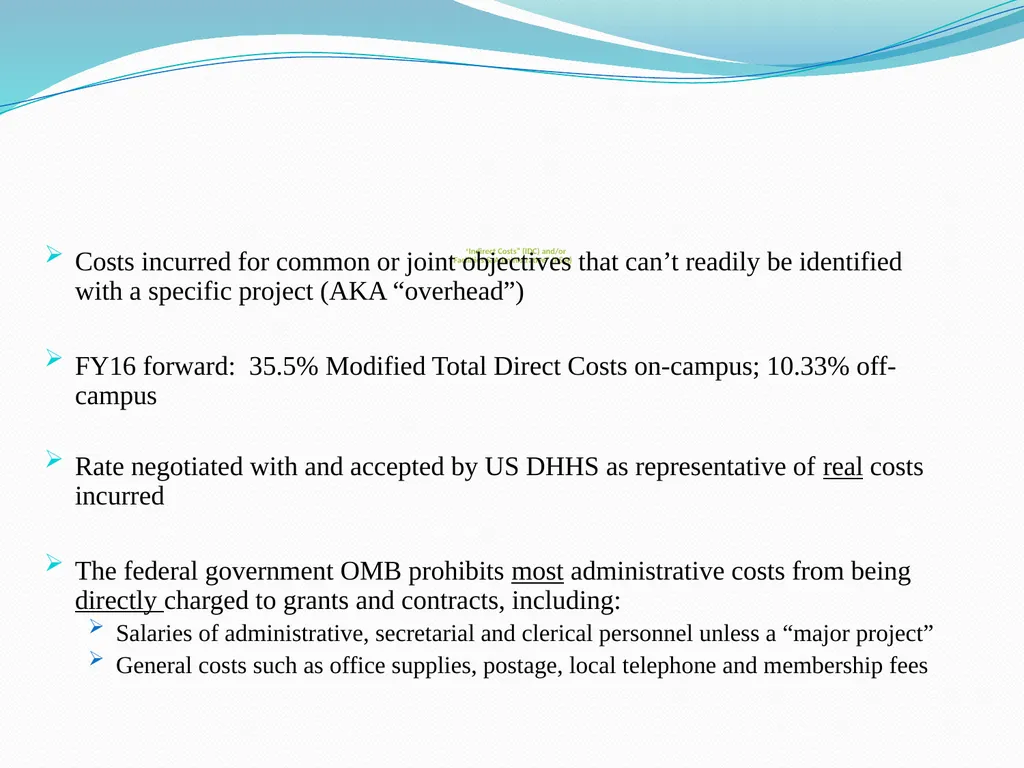
slide25. “Indirect Costs” (IDC) and/or “Facilities & Administrative” (F&A) Costs incurred for common or joint objectives that can’t readily be identified with a specific project (AKA “overhead”)
FY16 forward: 35.5% Modified Total Direct Costs on-campus; 10.33% off-campus
Rate negotiated with and accepted by US DHHS as representative of real costs incurred
The federal government OMB prohibits most administrative costs from being directly charged to grants and contracts, including:
Salaries of administrative, secretarial and clerical personnel unless a “major project”
General costs such as office supplies, postage, local telephone and membership fees<br>
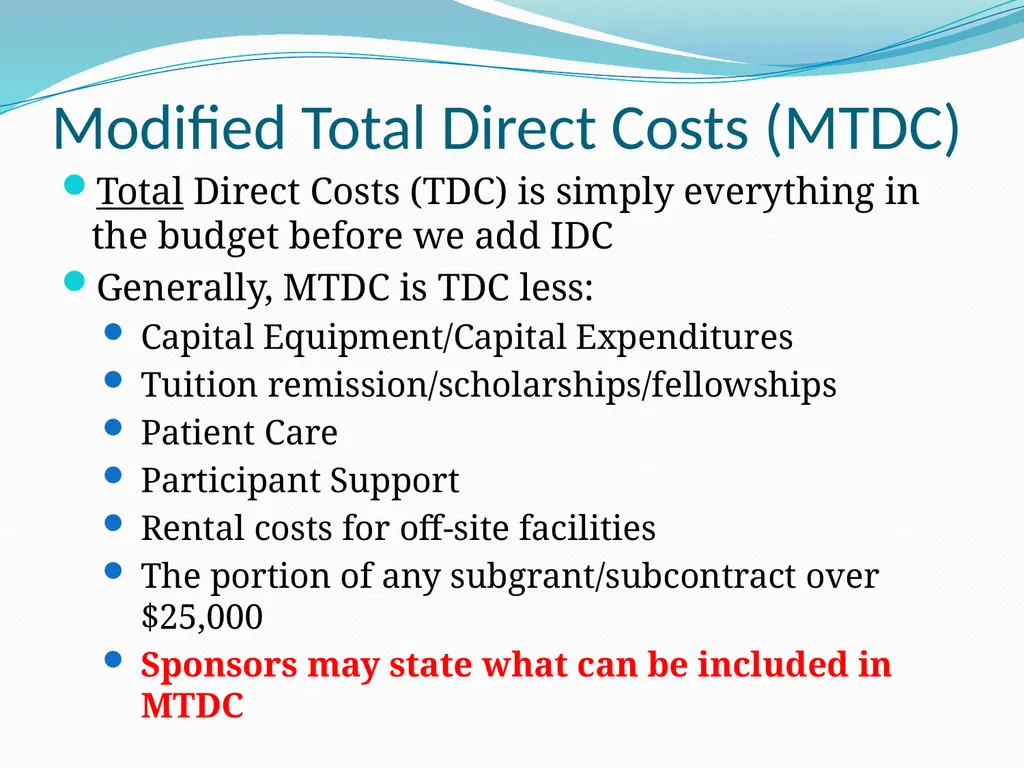
slide26. Modified Total Direct Costs (MTDC) Total Direct Costs (TDC) is simply everything in the budget before we add IDC
Generally, MTDC is TDC less:
Capital Equipment/Capital Expenditures
Tuition remission/scholarships/fellowships
Patient Care
Participant Support
Rental costs for off-site facilities
The portion of any subgrant/subcontract over $25,000
Sponsors may state what can be included in MTDC<br>
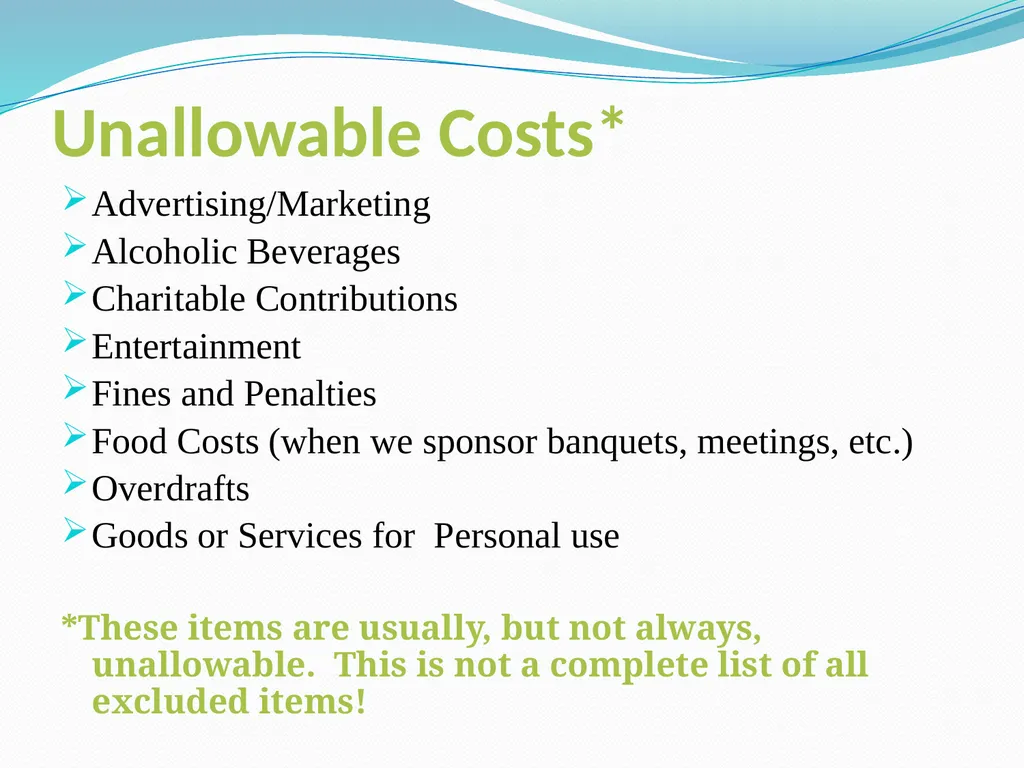
slide27. Unallowable Costs* Advertising/Marketing
Alcoholic Beverages
Charitable Contributions
Entertainment
Fines and Penalties
Food Costs (when we sponsor banquets, meetings, etc.)
Overdrafts
Goods or Services for Personal use
*These items are usually, but not always, unallowable. This is not a complete list of all excluded items!<br>
slide28. Budget Categories The categories of allowable, budgeted line items vary only slightly among different sponsors, but the way the line items are combined and the format in which they must be presented frequently varies.<br>
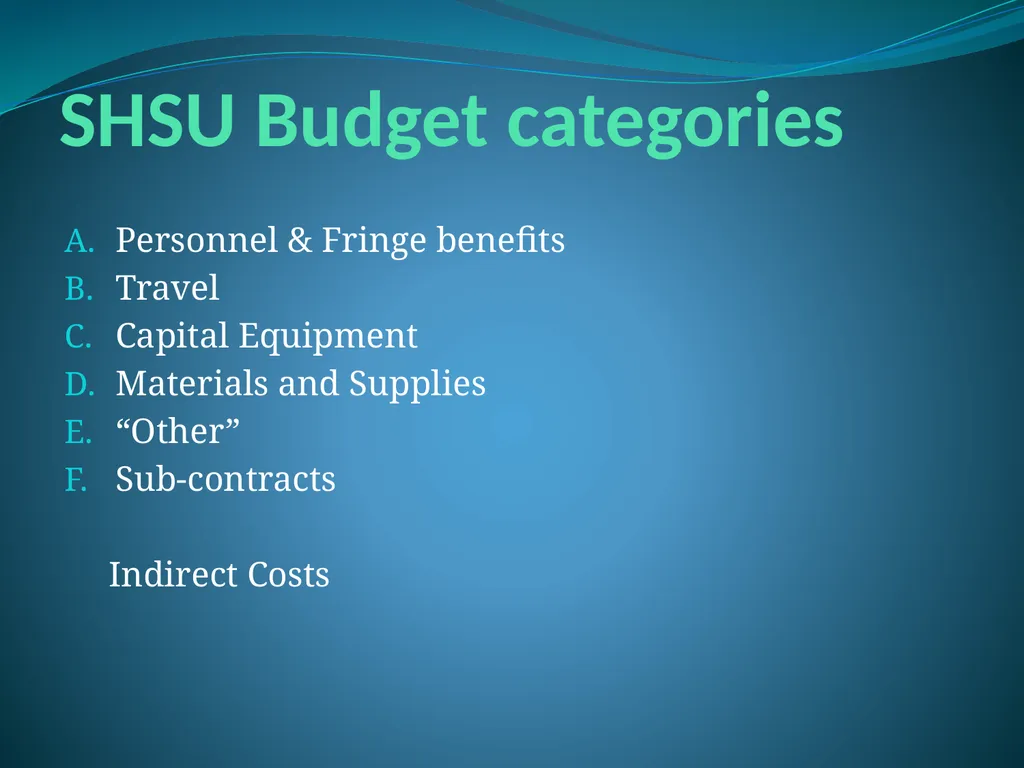
slide29. SHSU Budget categories Personnel & Fringe benefits
Travel
Capital Equipment
Materials and Supplies
“Other”
Sub-contracts
Indirect Costs<br>
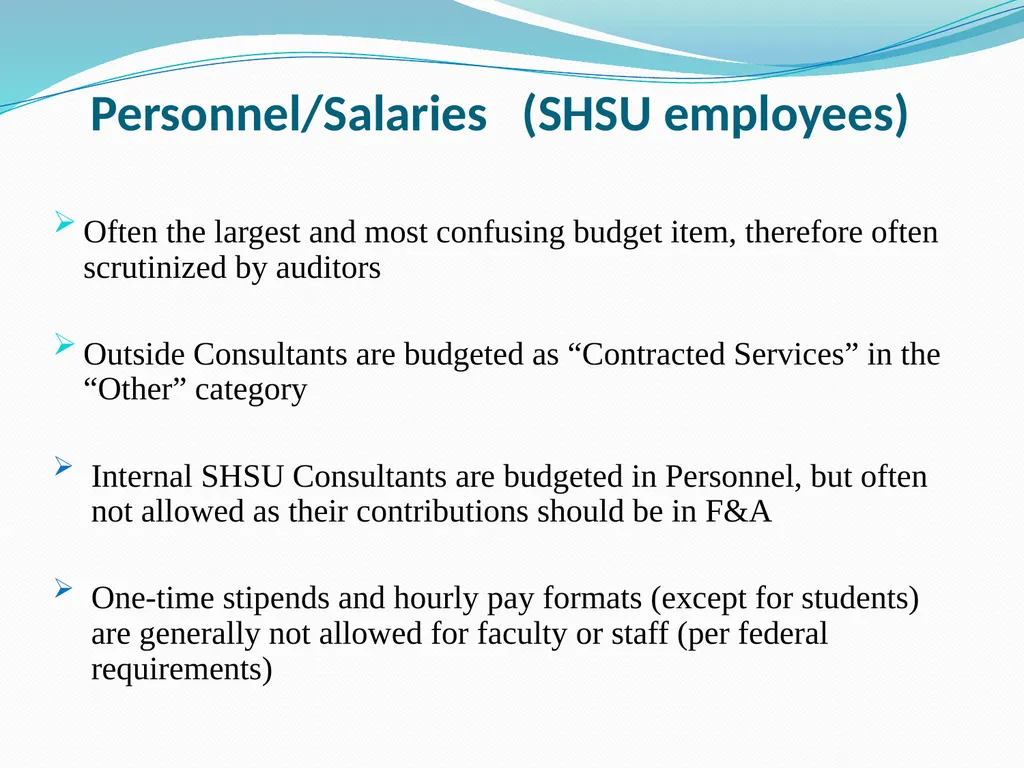
slide30. Personnel/Salaries (SHSU employees) Often the largest and most confusing budget item, therefore often scrutinized by auditors
Outside Consultants are budgeted as “Contracted Services” in the “Other” category
Internal SHSU Consultants are budgeted in Personnel, but often not allowed as their contributions should be in F&A
One-time stipends and hourly pay formats (except for students) are generally not allowed for faculty or staff (per federal requirements)<br>
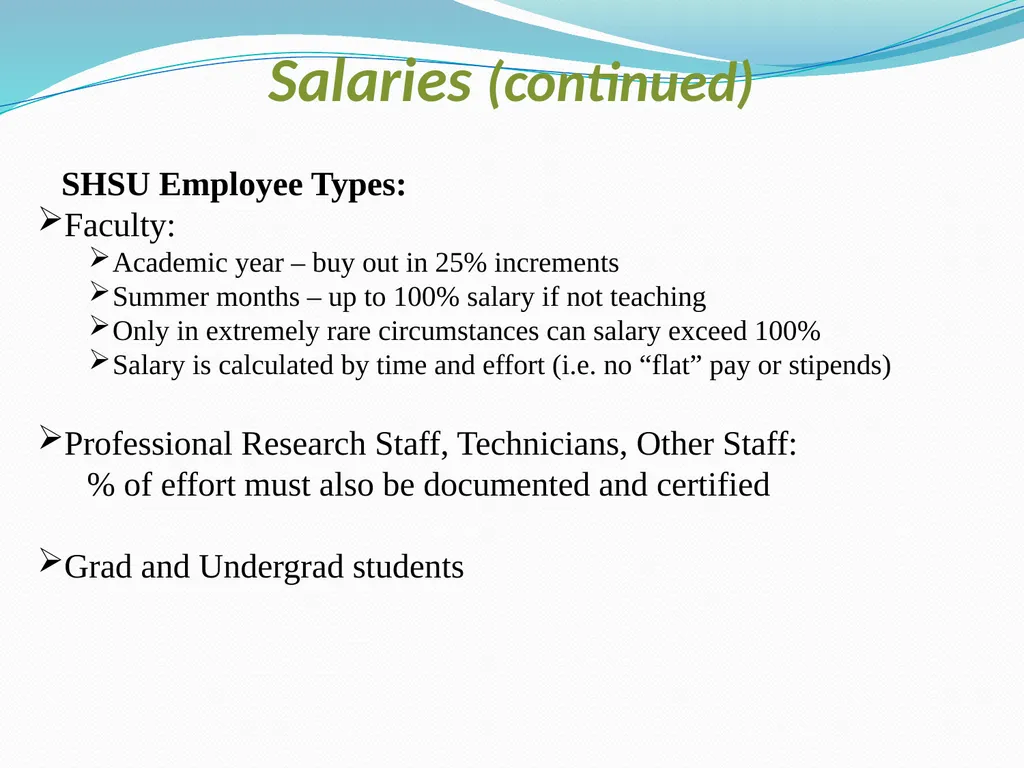
slide31. Salaries (continued)
SHSU Employee Types:
Faculty:
Academic year – buy out in 25% increments
Summer months – up to 100% salary if not teaching
Only in extremely rare circumstances can salary exceed 100%
Salary is calculated by time and effort (i.e. no “flat” pay or stipends)
Professional Research Staff, Technicians, Other Staff:
% of effort must also be documented and certified
Grad and Undergrad students<br>
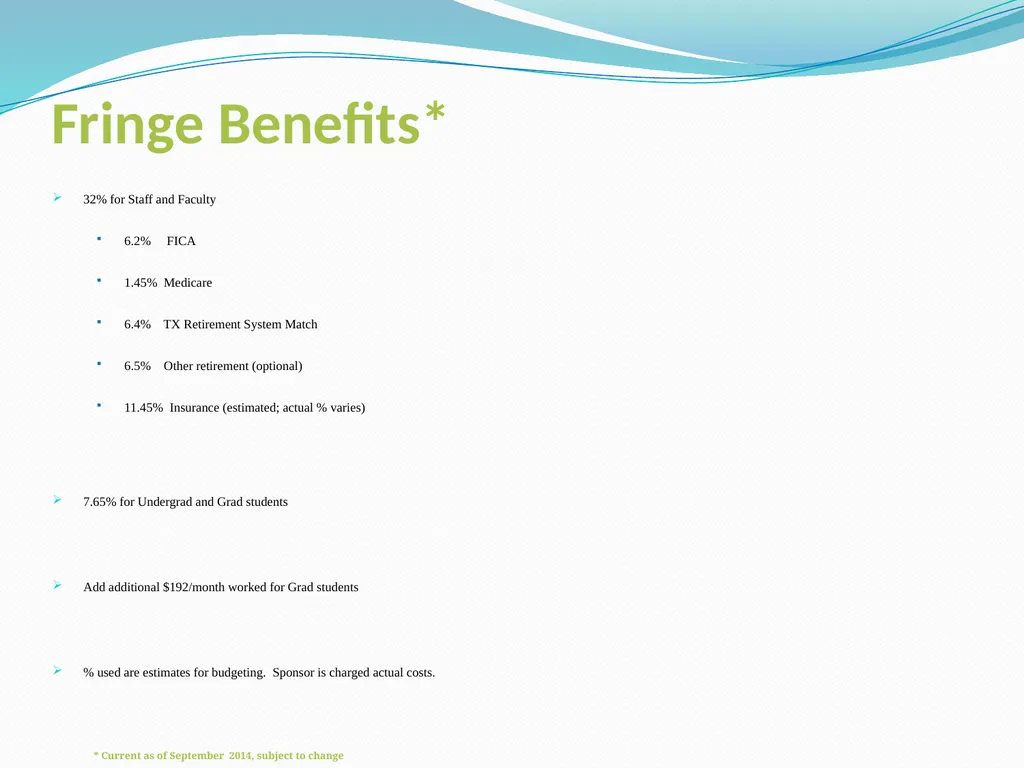
slide32. Fringe Benefits* 32% for Staff and Faculty
6.2% FICA
1.45% Medicare
6.4% TX Retirement System Match
6.5% Other retirement (optional)
11.45% Insurance (estimated; actual % varies)
7.65% for Undergrad and Grad students
Add additional $192/month worked for Grad students
% used are estimates for budgeting. Sponsor is charged actual costs.
* Current as of September 2014, subject to change<br>
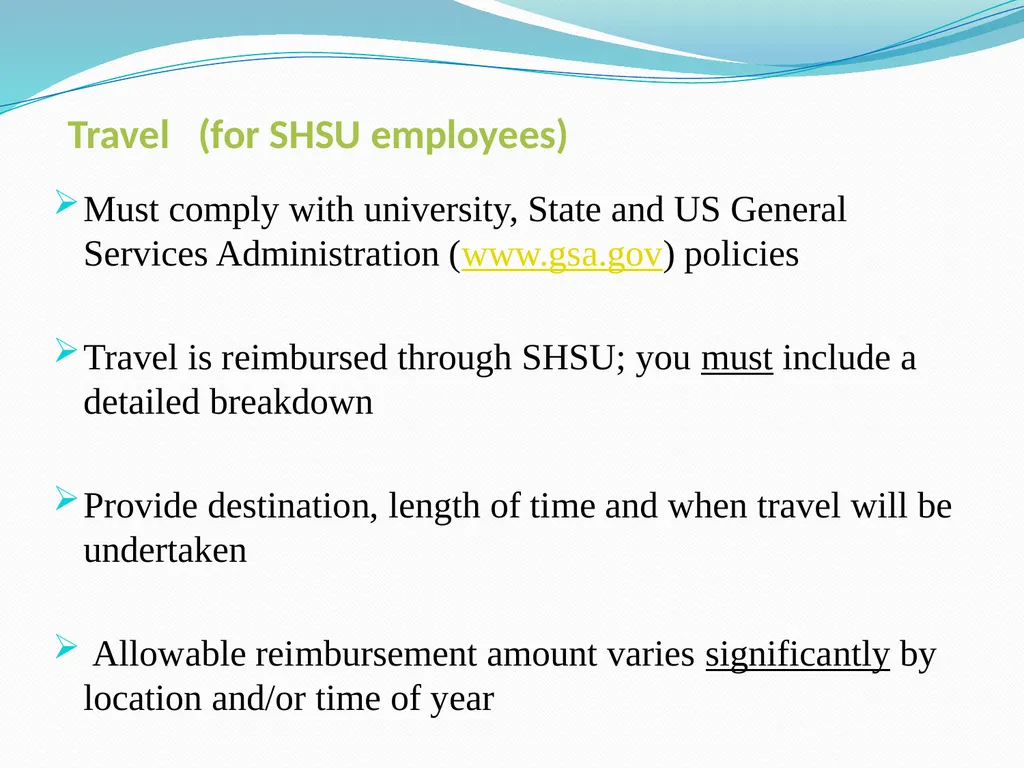
slide33. Travel (for SHSU employees) Must comply with university, State and US General Services Administration (www.gsa.gov) policies
Travel is reimbursed through SHSU; you must include a detailed breakdown
Provide destination, length of time and when travel will be undertaken
Allowable reimbursement amount varies significantly by location and/or time of year<br>
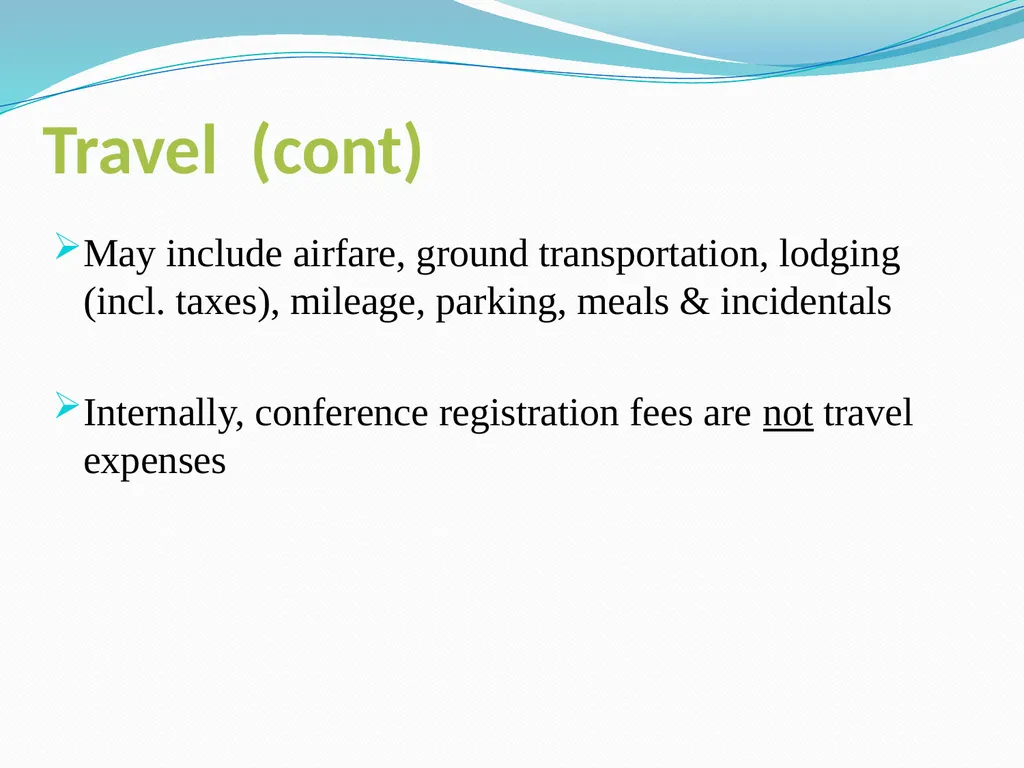
slide34. Travel (cont) May include airfare, ground transportation, lodging (incl. taxes), mileage, parking, meals & incidentals
Internally, conference registration fees are not travel expenses<br>
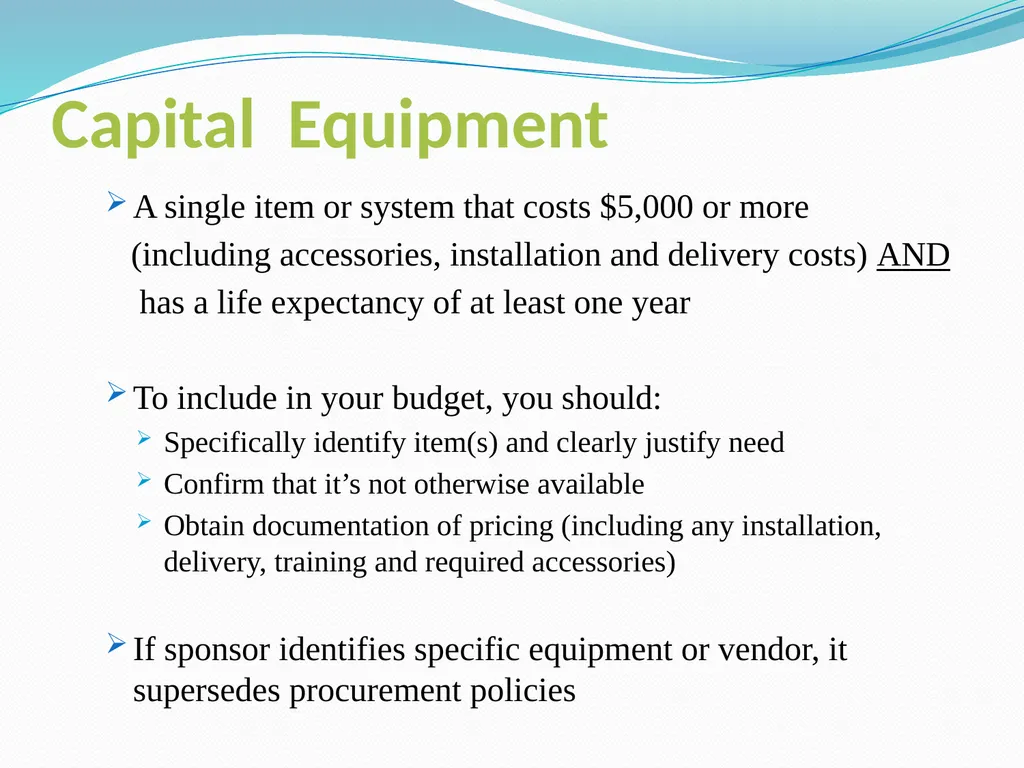
slide35. Capital Equipment A single item or system that costs $5,000 or more
(including accessories, installation and delivery costs) AND
has a life expectancy of at least one year
To include in your budget, you should:
Specifically identify item(s) and clearly justify need
Confirm that it’s not otherwise available
Obtain documentation of pricing (including any installation, delivery, training and required accessories)
If sponsor identifies specific equipment or vendor, it supersedes procurement policies<br>
slide36. Equipment Special Purpose Equipment - used only for proposed research or other technical activities
General Purpose Equipment - use is not limited only to research, or other technical activities; often not allowed<br>
slide37. Consumable/Expendable Equipment and Supplies Identify, quantify and justify
Includes items such as,
Small electronic components, most computers
Lab supplies
Software
Specialized/specific to project
General office supplies, BUT these are usually covered under F&A costs, unless quantity is significant<br>
slide38. Common “Other” Budget Items Participant Support Costs/Stipends
Meeting/retreat Costs (Note: review sponsor guidelines)
Conference registration fees
Contracted Services/Consultants, other professional fees
Non-Capital Equipment (less than $5,000)<br>
slide39. Outside Consultants “Contracted Services”
Sponsor rate caps may apply
Most sponsors want to see an hourly rate
Determine if direct contract or if it must be procured
Letter of Commitment and Statement of Work are required
Prime sponsor may have additional requirements
Travel and any other expenses must be itemized and allowable
Entered in the SHSU Budget under “Other”<br>
slide40. Red Flags Computers/Laptops/Printers
Equipment or major purchases near the end of the project
Routine Office supplies or general purpose equipment
Charging for Administrative time when minimal<br>
slide41. Budgeting Tips Your budget could be awarded exactly as submitted
Sponsor approval of Budget does not ensure allowability of all items
Calculations must be correct & match Budget Justification
Use Excel, not Word
Formula errors are hard to detect
Beware of the “trickle down” effect when making changes
SHSU requires a specific budget format, but sponsor usually requires a different format.
Look for each solicitation’s budget limitations & requirements, especially:
Indirect Cost limitations (common for state or private funds)
Personnel/Salary (e.g. NSF usually has a 2-summer month max)
Consultant rates (most federal funds)<br>
slide42. Budgeting Tips (continued) Develop a clear justification of ALL expenses
For multi-year projects, use a reasonable (3-5%) cost
escalator for faculty & staff salries
Use a team approach
Consider prior, related proposals – yours or others
Be diligent, but don’t overstress; a Budget is just an
intelligent estimate<br>
slide43. Constant Evolution Externally, politics, governmental policies and “hot” topics of emphasis are beyond our control
We monitor, interpret, react and relay these changes to you
Internal Changes:
Fringe Benefits rate revised
Indirect Costs rate revised
Cayuse424 - a hosted web site for proposal development and submission
Banner Financial System implemented<br>
slide44. Change is inevitable –
except from a vending machine.
-Robert C. Gallagher<br>
slide45. ……………………………………………….. Contact ORA early in the proposal process because essentially anything we have just told you could be different next week, next month or next year!<br>
slide46. Questions ?<br>
slide47. Thank you for being here today!!
Please let us know if there is anything we can do to assist you.
Dee Myall, Associate Director
936-294-4032 dee@shsu.edu<br>
September 2010<br>
slide2. “It's clearly a budget. It's got a lot of numbers in it.”
— George W. Bush (43rd US president)<br>
slide3. PLEASE NOTE: The policies, procedures and rates provided in this presentation are accurate as of September 2015, but are constantly evolving and changing.
If you are considering or have decided to submit a proposal, please contact Dee Myall to notify ORSP of your intent and to verify current budgeting policies.
dee@shsu.edu or 936-294-4032)<br>
slide4. Sponsored Research Functions
The Office of Research and Sponsored Programs (ORSP)
Primarily involved with opportunity identification and
proposal submission.
The Office of Research Administration (ORA)
Primarily involved after an award is received
Both are located in the Roy Adams House<br>
slide5. ORSP Responsibilities:
Internal Grant Program ($5,000 – 15,000)
Identifying funding and collaborative opportunities
Proposal strategy
Proposal writing, formatting & proofreading
Proposal requirements (word/page length, font size, etc.)<br>
slide6. Coordinating proposal process and internal routing/approvals
Budget development
Submitting the proposal
PIs are not authorized to submit budgets, proposals, negotiate, or sign constracts on behalf of the university without approval.
ORA Responsibilities (for external funding)
Grant expenditures and Financial Management
Administrative communication with sponsors
Grant Closure and Audits<br>
slide7. Academic Responsibilities (Pre-Award)
Principal Investigator - responsible for the budget, technical content, quality, and preparation of the proposal in accordance with sponsor guidelines.
Department Chair – certifies academic soundness, compatibility with PI’s other commitments, & availability of resources. Assures the project is in keeping with University objectives, and concurs that the proposal should be submitted.
Dean - assures project is appropriate within College and University programs, and that resources will be made available.<br>
slide8. Overlap of duties is inevitable. And desirable.
For example:
Collaborative projects – programmatic vs. “budgetary”
Time Lines – tasks are usually concurrent, not linear
Compliance – IRB, IACUC, Environmental, F&A agreements, Export Controls<br>
slide10. Mutual cooperation among ORA, ORSP and PIs will produce the strongest proposal. We each have areas of expertise. And weaknesses.
ORA understands accounting principles and federal requirements, but you know your programs
How often do you review federal audit standards or OMB circulars?
Could a proposal from a math professor benefit from the expertise of a journalism major?<br>
slide11. After you have decided to submit a proposal, what is the next step?<br>
slide12. To Start the Proposal Process, Contact the ORA Proposal Administrator Dee Myall
936-294-4032 dee@shsu.edu Business
Education
Humanities & Social Sciences
Extended Programs Criminal Justice
Arts
Sciences
Any other areas<br>
slide13. Good things are not done in a hurry. ORSP should be notified at least 30 days before the due date for typical proposals.
The complexity of your proposal determines when you should contact us, but the sooner, the better.<br>
slide14. Common Causes of Delay
External Collaborators/Partners/Subcontractors
Long project period (over 3 years)
High Dollar Amount ($500K+)
Private Foundations/Sponsors we have not worked with before
Christmas and Summer Periods
Add extra prep time for any of these situations<br>
slide15. It all Begins with the
Proposal Notification Form (PNF)
(contact ORSP to receive the blank form via e-mail)
Official Notification of your Intent to submit
PI and Co-PI Contact Information
Sponsor & Funding Opportunity/RFA#
CFDA#, if known
Initial Budget Information/Limitations
Project Start/End Dates
Submission deadline
Subcontractor Involvement
Compliance (IRB, IACUC, environmental, etc.)<br>
slide16. ORA will, as needed, provide you with:
1. Strategic Timeline (targets)
Face-to-face meeting time(s)
Key target dates
2. Other forms, when needed, such as:
Routing (Approval) Form and Instructions
Indirect Cost Waiver Request form (only if mandated)
Cost Share Request form (only if mandated)
3. Registration of PI (e.g. Cayuse, Fastlane, EraCommons)
4. Questions/Comments<br>
slide17. We Focus on the “Business” of Proposals. Financial Accountability starts with your budget.<br>
slide18. Details matter. Your Budget serves as:
a roadmap that quantifies and justifies the resources you propose as necessary to achieve objectives
documentation that requested funding is allowable and reasonable, enabling SHSU to:
be competitive,
obtain grant funds, and
keep the funds that have been budgeted
Your proposal budget could become a “real” one!<br>
slide19. Budgets must Survive Scrutiny GAAP (Generally Accepted Accounting Principles)
Public/Media
SHSU
State of Texas
Sponsor
The Solicitation/RFA
Federal Government
OMB Circulars A-21 (Educ), A-133 (Audits), etc.<br>
slide20. To create a budget that will be compliant, we must understand some Essential Budget Terms<br>
slide21. All Proposed Costs Must be: Allowable
Reasonable
Allocable
Consistently Treated<br>
slide22. Reasonable Costs Reflect costs that a “prudent” person would accept
Sponsor will have numerous budgets from which to compare<br>
slide23. Allocable Costs Costs that can be assigned, individually or as a group, to a cost objective in a “reasonable and realistic” proportion.
Costs are allocable to a proposal when incurred solely for the benefit of the sponsored project<br>
slide24. Direct Costs Costs that clearly result from a specific project or program:
Personnel - Time & Effort
Fringes
Travel
Capital Equipment: ≥ $5,000
Materials & Supplies (project specific)
Other Expenses required to carry out
the scope of project<br>
slide25. “Indirect Costs” (IDC) and/or “Facilities & Administrative” (F&A) Costs incurred for common or joint objectives that can’t readily be identified with a specific project (AKA “overhead”)
FY16 forward: 35.5% Modified Total Direct Costs on-campus; 10.33% off-campus
Rate negotiated with and accepted by US DHHS as representative of real costs incurred
The federal government OMB prohibits most administrative costs from being directly charged to grants and contracts, including:
Salaries of administrative, secretarial and clerical personnel unless a “major project”
General costs such as office supplies, postage, local telephone and membership fees<br>
slide26. Modified Total Direct Costs (MTDC) Total Direct Costs (TDC) is simply everything in the budget before we add IDC
Generally, MTDC is TDC less:
Capital Equipment/Capital Expenditures
Tuition remission/scholarships/fellowships
Patient Care
Participant Support
Rental costs for off-site facilities
The portion of any subgrant/subcontract over $25,000
Sponsors may state what can be included in MTDC<br>
slide27. Unallowable Costs* Advertising/Marketing
Alcoholic Beverages
Charitable Contributions
Entertainment
Fines and Penalties
Food Costs (when we sponsor banquets, meetings, etc.)
Overdrafts
Goods or Services for Personal use
*These items are usually, but not always, unallowable. This is not a complete list of all excluded items!<br>
slide28. Budget Categories The categories of allowable, budgeted line items vary only slightly among different sponsors, but the way the line items are combined and the format in which they must be presented frequently varies.<br>
slide29. SHSU Budget categories Personnel & Fringe benefits
Travel
Capital Equipment
Materials and Supplies
“Other”
Sub-contracts
Indirect Costs<br>
slide30. Personnel/Salaries (SHSU employees) Often the largest and most confusing budget item, therefore often scrutinized by auditors
Outside Consultants are budgeted as “Contracted Services” in the “Other” category
Internal SHSU Consultants are budgeted in Personnel, but often not allowed as their contributions should be in F&A
One-time stipends and hourly pay formats (except for students) are generally not allowed for faculty or staff (per federal requirements)<br>
slide31. Salaries (continued)
SHSU Employee Types:
Faculty:
Academic year – buy out in 25% increments
Summer months – up to 100% salary if not teaching
Only in extremely rare circumstances can salary exceed 100%
Salary is calculated by time and effort (i.e. no “flat” pay or stipends)
Professional Research Staff, Technicians, Other Staff:
% of effort must also be documented and certified
Grad and Undergrad students<br>
slide32. Fringe Benefits* 32% for Staff and Faculty
6.2% FICA
1.45% Medicare
6.4% TX Retirement System Match
6.5% Other retirement (optional)
11.45% Insurance (estimated; actual % varies)
7.65% for Undergrad and Grad students
Add additional $192/month worked for Grad students
% used are estimates for budgeting. Sponsor is charged actual costs.
* Current as of September 2014, subject to change<br>
slide33. Travel (for SHSU employees) Must comply with university, State and US General Services Administration (www.gsa.gov) policies
Travel is reimbursed through SHSU; you must include a detailed breakdown
Provide destination, length of time and when travel will be undertaken
Allowable reimbursement amount varies significantly by location and/or time of year<br>
slide34. Travel (cont) May include airfare, ground transportation, lodging (incl. taxes), mileage, parking, meals & incidentals
Internally, conference registration fees are not travel expenses<br>
slide35. Capital Equipment A single item or system that costs $5,000 or more
(including accessories, installation and delivery costs) AND
has a life expectancy of at least one year
To include in your budget, you should:
Specifically identify item(s) and clearly justify need
Confirm that it’s not otherwise available
Obtain documentation of pricing (including any installation, delivery, training and required accessories)
If sponsor identifies specific equipment or vendor, it supersedes procurement policies<br>
slide36. Equipment Special Purpose Equipment - used only for proposed research or other technical activities
General Purpose Equipment - use is not limited only to research, or other technical activities; often not allowed<br>
slide37. Consumable/Expendable Equipment and Supplies Identify, quantify and justify
Includes items such as,
Small electronic components, most computers
Lab supplies
Software
Specialized/specific to project
General office supplies, BUT these are usually covered under F&A costs, unless quantity is significant<br>
slide38. Common “Other” Budget Items Participant Support Costs/Stipends
Meeting/retreat Costs (Note: review sponsor guidelines)
Conference registration fees
Contracted Services/Consultants, other professional fees
Non-Capital Equipment (less than $5,000)<br>
slide39. Outside Consultants “Contracted Services”
Sponsor rate caps may apply
Most sponsors want to see an hourly rate
Determine if direct contract or if it must be procured
Letter of Commitment and Statement of Work are required
Prime sponsor may have additional requirements
Travel and any other expenses must be itemized and allowable
Entered in the SHSU Budget under “Other”<br>
slide40. Red Flags Computers/Laptops/Printers
Equipment or major purchases near the end of the project
Routine Office supplies or general purpose equipment
Charging for Administrative time when minimal<br>
slide41. Budgeting Tips Your budget could be awarded exactly as submitted
Sponsor approval of Budget does not ensure allowability of all items
Calculations must be correct & match Budget Justification
Use Excel, not Word
Formula errors are hard to detect
Beware of the “trickle down” effect when making changes
SHSU requires a specific budget format, but sponsor usually requires a different format.
Look for each solicitation’s budget limitations & requirements, especially:
Indirect Cost limitations (common for state or private funds)
Personnel/Salary (e.g. NSF usually has a 2-summer month max)
Consultant rates (most federal funds)<br>
slide42. Budgeting Tips (continued) Develop a clear justification of ALL expenses
For multi-year projects, use a reasonable (3-5%) cost
escalator for faculty & staff salries
Use a team approach
Consider prior, related proposals – yours or others
Be diligent, but don’t overstress; a Budget is just an
intelligent estimate<br>
slide43. Constant Evolution Externally, politics, governmental policies and “hot” topics of emphasis are beyond our control
We monitor, interpret, react and relay these changes to you
Internal Changes:
Fringe Benefits rate revised
Indirect Costs rate revised
Cayuse424 - a hosted web site for proposal development and submission
Banner Financial System implemented<br>
slide44. Change is inevitable –
except from a vending machine.
-Robert C. Gallagher<br>
slide45. ……………………………………………….. Contact ORA early in the proposal process because essentially anything we have just told you could be different next week, next month or next year!<br>
slide46. Questions ?<br>
slide47. Thank you for being here today!!
Please let us know if there is anything we can do to assist you.
Dee Myall, Associate Director
936-294-4032 dee@shsu.edu<br>