
Building Financial Futures: Parents’ Perspectives
LS
Published · 14 slides · 0 views

1 / 1
Description
Building Financial Futures: Parents Perspectives on Youth Financial Education Research from the SIFMA Foundation October 2024 About the survey Methodology The SIFMA Foundations Building Financial Futures Survey was conducted by Wakefield
Related Topics
Share
Embed code
Download this presentation From Below
"Building Financial Futures: Parents’ Perspectives" is the property of its rightful owner. Permission is granted to download and print the materials on this website for personal, non-commercial use only, and to display it on your personal computer provided you do not modify the materials and that you retain all copyright notices contained in the materials. By downloading content from our website, you accept the terms of this agreement.
Presentation Transcript
01
Building Financial Futures:
Parents’ Perspectives on Youth Financial Education Research from the SIFMA Foundation
October 2024<br>
October 2024<br>
02
About the survey Methodology
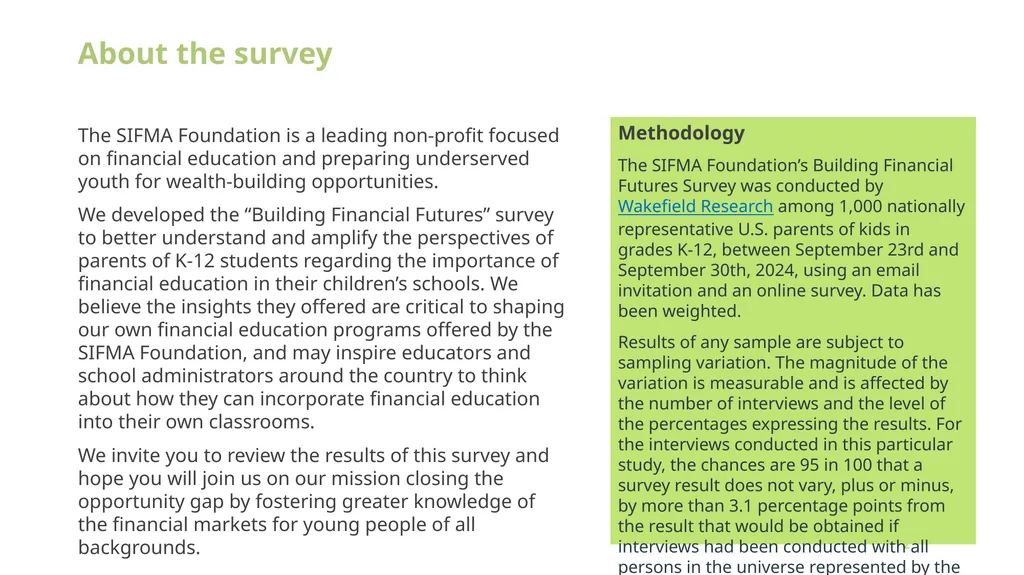
The SIFMA Foundation’s Building Financial Futures Survey was conducted by Wakefield Research among 1,000 nationally representative U.S. parents of kids in grades K-12, between September 23rd and September 30th, 2024, using an email invitation and an online survey. Data has been weighted.
Results of any sample are subject to sampling variation. The magnitude of the variation is measurable and is affected by the number of interviews and the level of the percentages expressing the results. For the interviews conducted in this particular study, the chances are 95 in 100 that a survey result does not vary, plus or minus, by more than 3.1 percentage points from the result that would be obtained if interviews had been conducted with all persons in the universe represented by the sample. The SIFMA Foundation is a leading non-profit focused on financial education and preparing underserved youth for wealth-building opportunities.
We developed the “Building Financial Futures” survey to better understand and amplify the perspectives of parents of K-12 students regarding the importance of financial education in their children’s schools. We believe the insights they offered are critical to shaping our own financial education programs offered by the SIFMA Foundation, and may inspire educators and school administrators around the country to think about how they can incorporate financial education into their own classrooms.
We invite you to review the results of this survey and hope you will join us on our mission closing the opportunity gap by fostering greater knowledge of the financial markets for young people of all backgrounds. 2<br>
The SIFMA Foundation’s Building Financial Futures Survey was conducted by Wakefield Research among 1,000 nationally representative U.S. parents of kids in grades K-12, between September 23rd and September 30th, 2024, using an email invitation and an online survey. Data has been weighted.
Results of any sample are subject to sampling variation. The magnitude of the variation is measurable and is affected by the number of interviews and the level of the percentages expressing the results. For the interviews conducted in this particular study, the chances are 95 in 100 that a survey result does not vary, plus or minus, by more than 3.1 percentage points from the result that would be obtained if interviews had been conducted with all persons in the universe represented by the sample. The SIFMA Foundation is a leading non-profit focused on financial education and preparing underserved youth for wealth-building opportunities.
We developed the “Building Financial Futures” survey to better understand and amplify the perspectives of parents of K-12 students regarding the importance of financial education in their children’s schools. We believe the insights they offered are critical to shaping our own financial education programs offered by the SIFMA Foundation, and may inspire educators and school administrators around the country to think about how they can incorporate financial education into their own classrooms.
We invite you to review the results of this survey and hope you will join us on our mission closing the opportunity gap by fostering greater knowledge of the financial markets for young people of all backgrounds. 2<br>
03
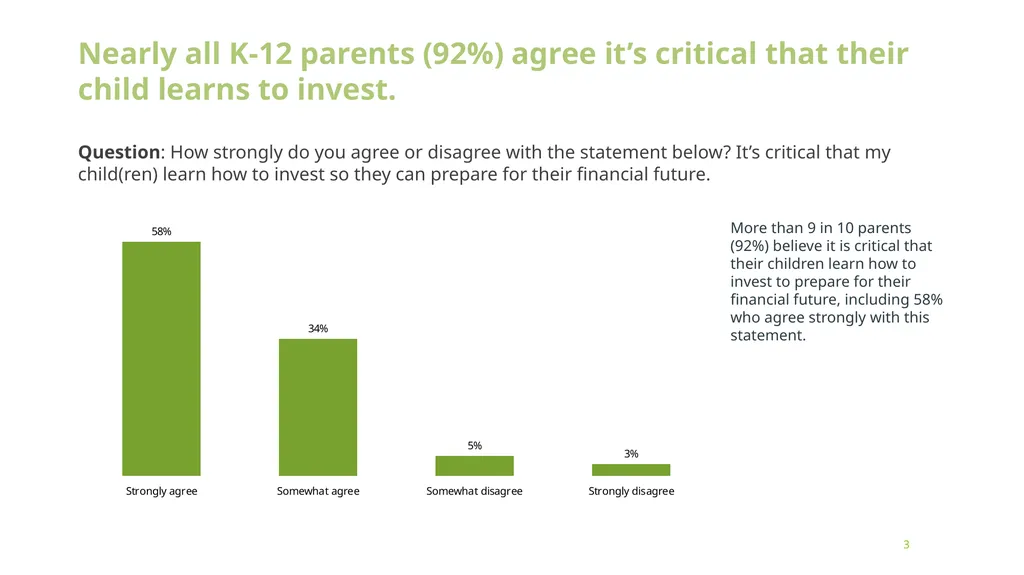
Nearly all K-12 parents (92%) agree it’s critical that their child learns to invest. Question: How strongly do you agree or disagree with the statement below? It’s critical that my child(ren) learn how to invest so they can prepare for their financial future. More than 9 in 10 parents (92%) believe it is critical that their children learn how to invest to prepare for their financial future, including 58% who agree strongly with this statement. 3<br>
04
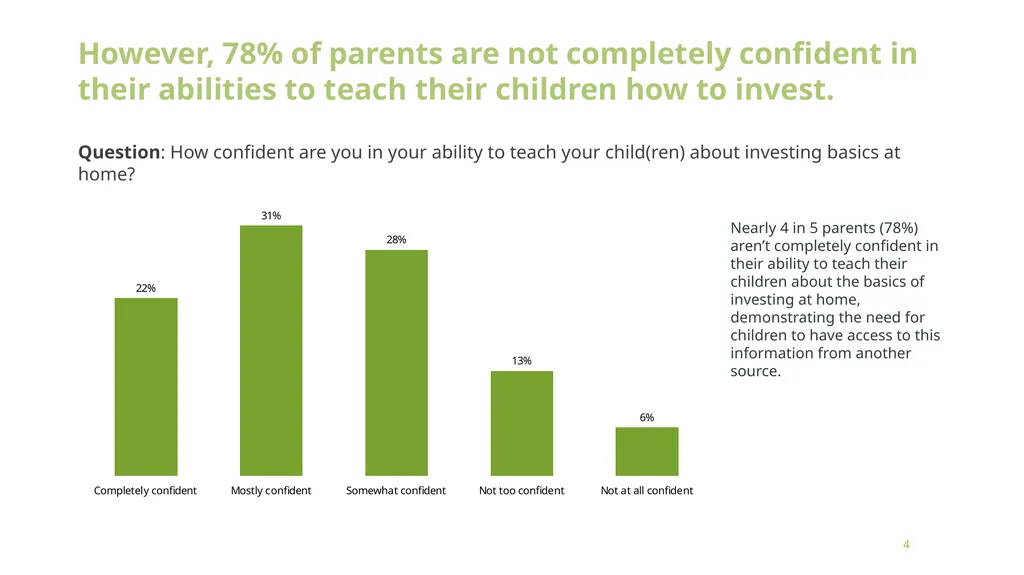
However, 78% of parents are not completely confident in their abilities to teach their children how to invest. Question: How confident are you in your ability to teach your child(ren) about investing basics at home? Nearly 4 in 5 parents (78%) aren’t completely confident in their ability to teach their children about the basics of investing at home, demonstrating the need for children to have access to this information from another source. 4<br>
05
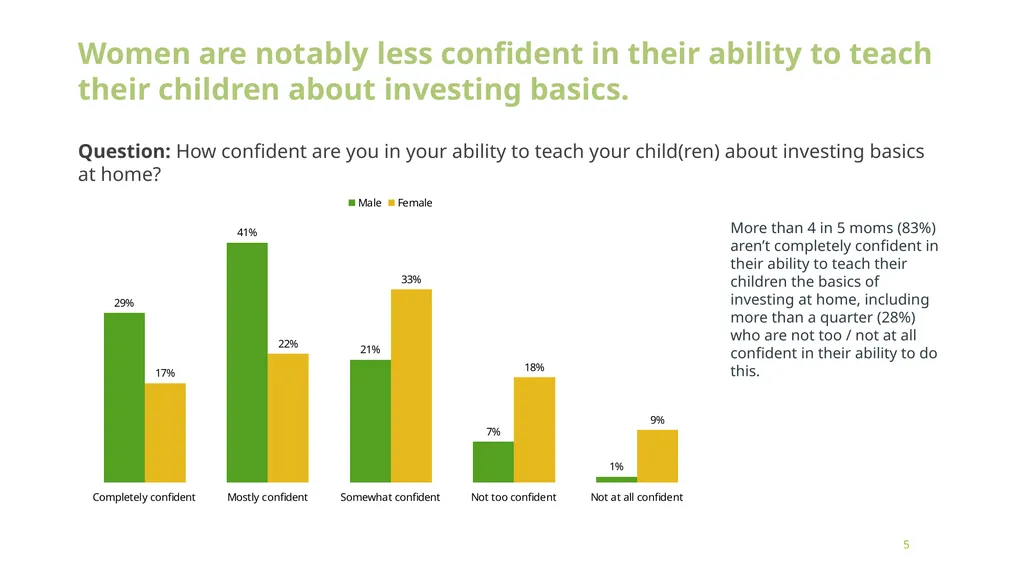
Women are notably less confident in their ability to teach their children about investing basics. Question: How confident are you in your ability to teach your child(ren) about investing basics at home? More than 4 in 5 moms (83%) aren’t completely confident in their ability to teach their children the basics of investing at home, including more than a quarter (28%) who are not too / not at all confident in their ability to do this. 5<br>
06
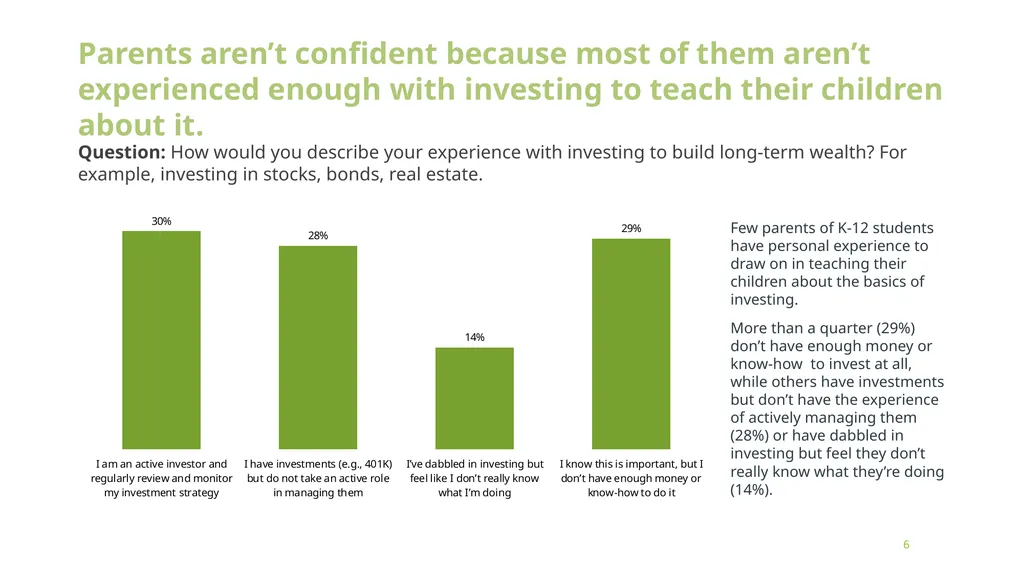
Parents aren’t confident because most of them aren’t experienced enough with investing to teach their children about it. Question: How would you describe your experience with investing to build long-term wealth? For example, investing in stocks, bonds, real estate. Few parents of K-12 students have personal experience to draw on in teaching their children about the basics of investing.
More than a quarter (29%) don’t have enough money or know-how to invest at all, while others have investments but don’t have the experience of actively managing them (28%) or have dabbled in investing but feel they don’t really know what they’re doing (14%). 6<br>
More than a quarter (29%) don’t have enough money or know-how to invest at all, while others have investments but don’t have the experience of actively managing them (28%) or have dabbled in investing but feel they don’t really know what they’re doing (14%). 6<br>
07
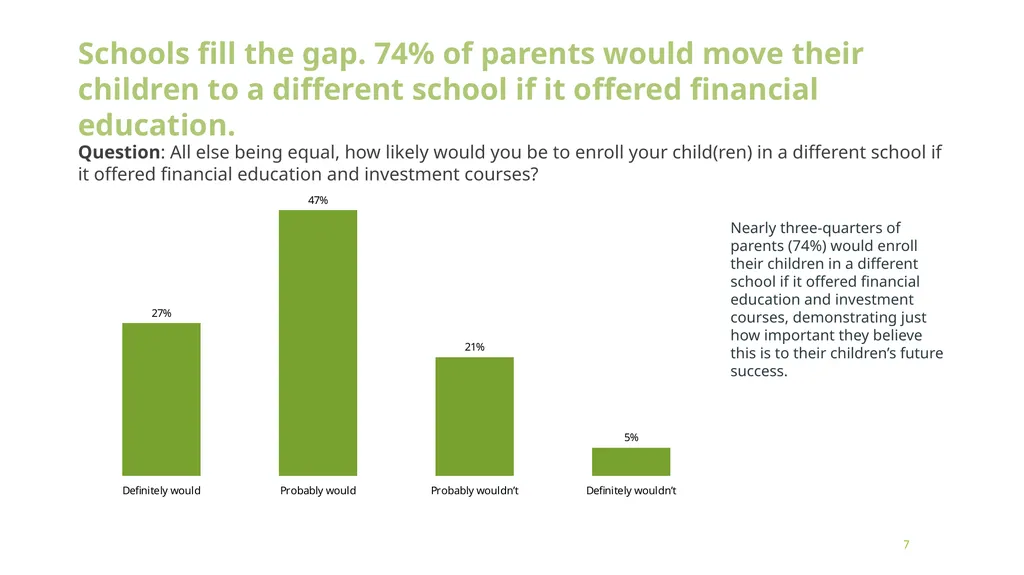
Schools fill the gap. 74% of parents would move their children to a different school if it offered financial education. Question: All else being equal, how likely would you be to enroll your child(ren) in a different school if it offered financial education and investment courses? Nearly three-quarters of parents (74%) would enroll their children in a different school if it offered financial education and investment courses, demonstrating just how important they believe this is to their children’s future success. 7<br>
08
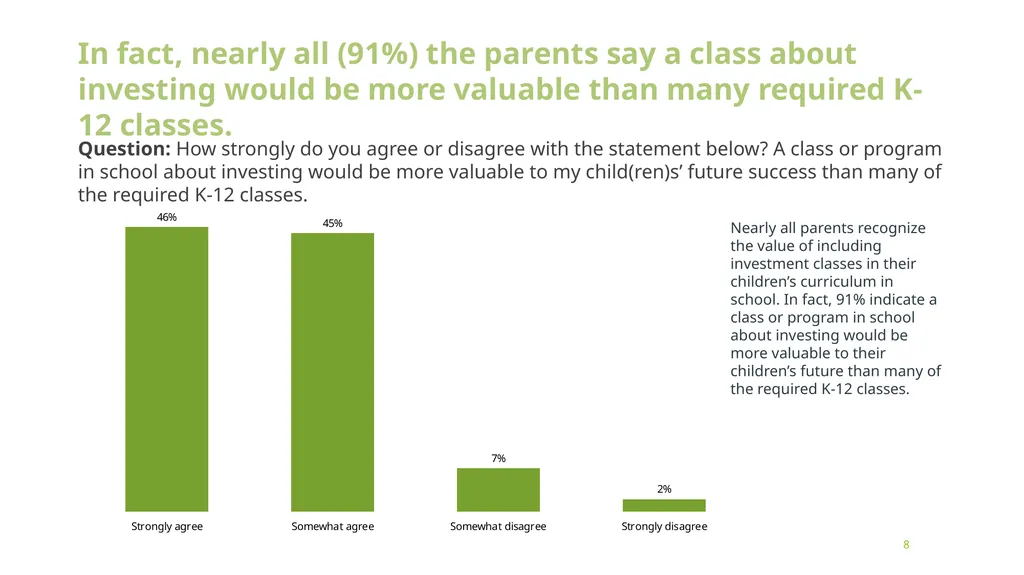
In fact, nearly all (91%) the parents say a class about investing would be more valuable than many required K-12 classes. Question: How strongly do you agree or disagree with the statement below? A class or program in school about investing would be more valuable to my child(ren)s’ future success than many of the required K-12 classes. Nearly all parents recognize the value of including investment classes in their children’s curriculum in school. In fact, 91% indicate a class or program in school about investing would be more valuable to their children’s future than many of the required K-12 classes. 8<br>
09
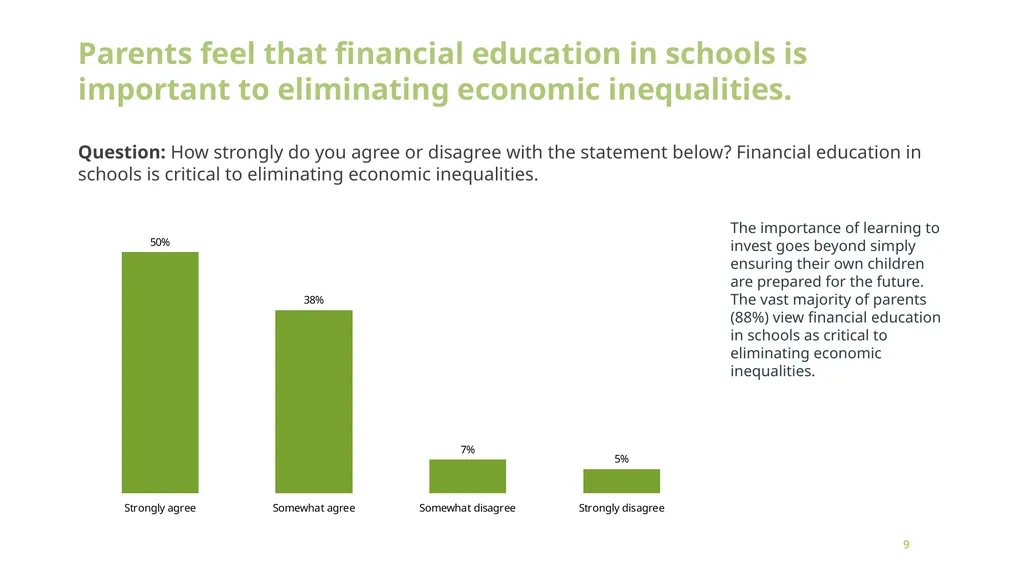
Parents feel that financial education in schools is important to eliminating economic inequalities. Question: How strongly do you agree or disagree with the statement below? Financial education in schools is critical to eliminating economic inequalities. The importance of learning to invest goes beyond simply ensuring their own children are prepared for the future. The vast majority of parents (88%) view financial education in schools as critical to eliminating economic inequalities. 9<br>
10
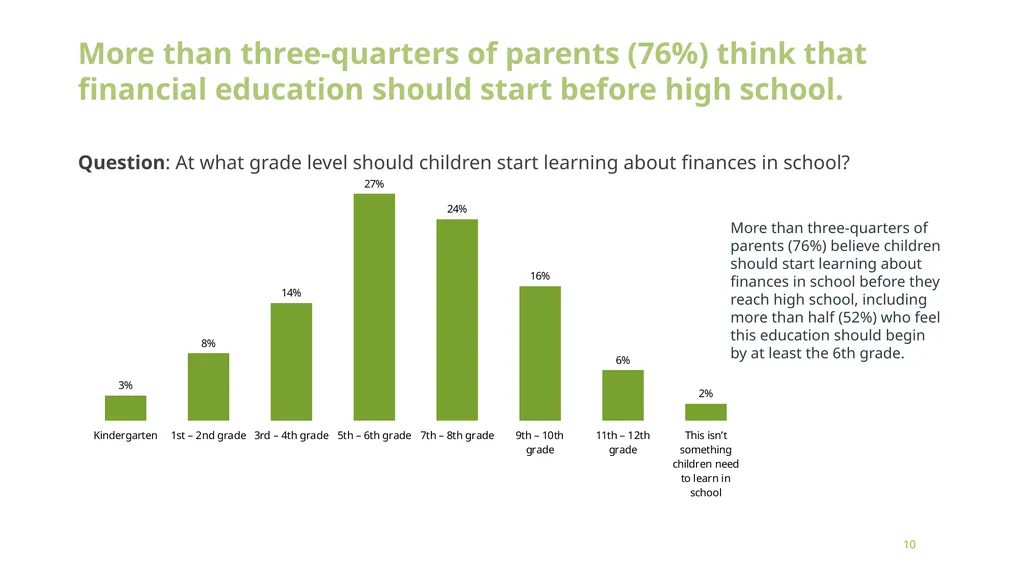
More than three-quarters of parents (76%) think that financial education should start before high school. Question: At what grade level should children start learning about finances in school? More than three-quarters of parents (76%) believe children should start learning about finances in school before they reach high school, including more than half (52%) who feel this education should begin by at least the 6th grade. 10<br>
11
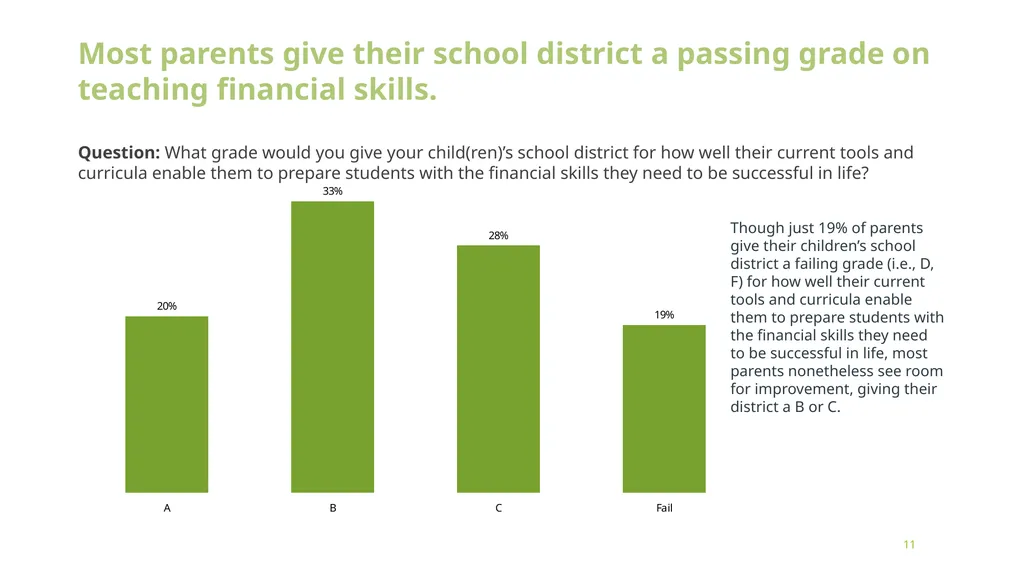
Most parents give their school district a passing grade on teaching financial skills. Question: What grade would you give your child(ren)’s school district for how well their current tools and curricula enable them to prepare students with the financial skills they need to be successful in life? Though just 19% of parents give their children’s school district a failing grade (i.e., D, F) for how well their current tools and curricula enable them to prepare students with the financial skills they need to be successful in life, most parents nonetheless see room for improvement, giving their district a B or C. 11<br>
12
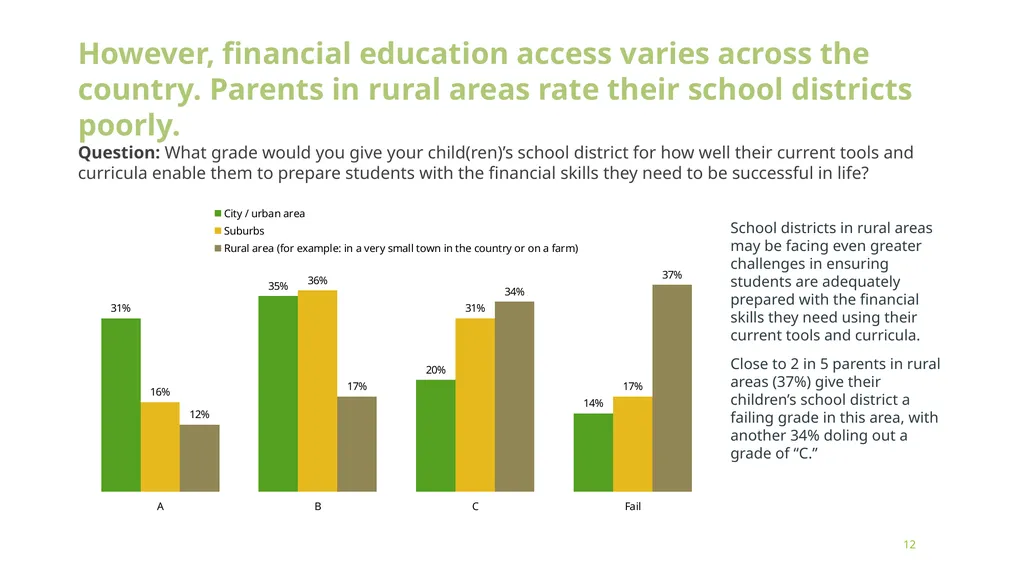
However, financial education access varies across the country. Parents in rural areas rate their school districts poorly. Question: What grade would you give your child(ren)’s school district for how well their current tools and curricula enable them to prepare students with the financial skills they need to be successful in life? School districts in rural areas may be facing even greater challenges in ensuring students are adequately prepared with the financial skills they need using their current tools and curricula.
Close to 2 in 5 parents in rural areas (37%) give their children’s school district a failing grade in this area, with another 34% doling out a grade of “C.” 12<br>
Close to 2 in 5 parents in rural areas (37%) give their children’s school district a failing grade in this area, with another 34% doling out a grade of “C.” 12<br>
13
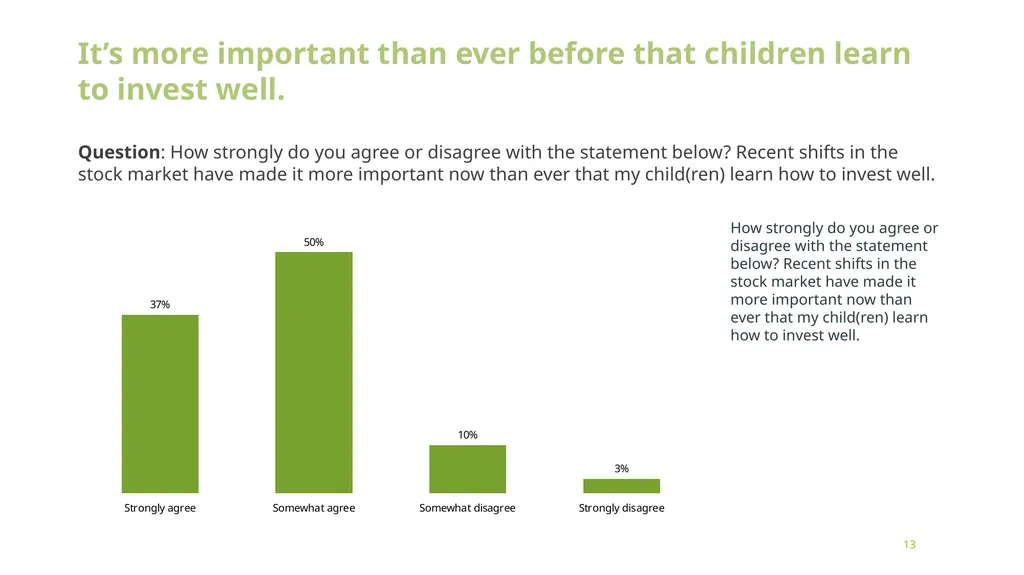
It’s more important than ever before that children learn to invest well. Question: How strongly do you agree or disagree with the statement below? Recent shifts in the stock market have made it more important now than ever that my child(ren) learn how to invest well. How strongly do you agree or disagree with the statement below? Recent shifts in the stock market have made it more important now than ever that my child(ren) learn how to invest well. 13<br>
14
For more information, please contact: Michael Sherman, SIFMA Foundation, msherman@sifma.org
John Welch, Edelman Smithfield, John.Welch@edelmansmithfield.com The SIFMA Foundation is committed to closing the opportunity gap by fostering greater knowledge of the financial markets for young people of all backgrounds. Drawing on the support and expertise of educators and the financial industry, the Foundation provides financial education to strengthen economic opportunity across communities and increase awareness of the benefits of the global marketplace. Since 1977, the Foundation’s flagship program, The Stock Market Game™, has guided more than 23 million students on their path to financial independence by attaining stronger life skills, improving academic achievement, and boosting their social-emotional learning. For more information on the SIFMA Foundation, visit www.sifma.org/foundation. About the SIFMA Foundation<br>
John Welch, Edelman Smithfield, John.Welch@edelmansmithfield.com The SIFMA Foundation is committed to closing the opportunity gap by fostering greater knowledge of the financial markets for young people of all backgrounds. Drawing on the support and expertise of educators and the financial industry, the Foundation provides financial education to strengthen economic opportunity across communities and increase awareness of the benefits of the global marketplace. Since 1977, the Foundation’s flagship program, The Stock Market Game™, has guided more than 23 million students on their path to financial independence by attaining stronger life skills, improving academic achievement, and boosting their social-emotional learning. For more information on the SIFMA Foundation, visit www.sifma.org/foundation. About the SIFMA Foundation<br>