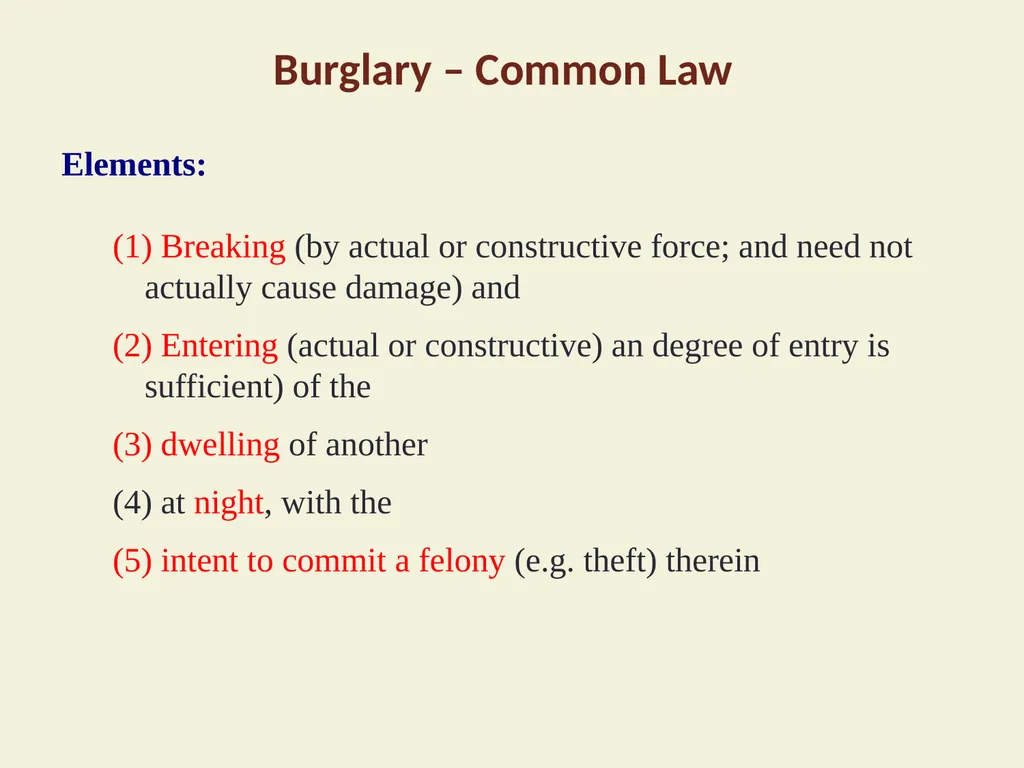
Burglary Common Law Elements: Breaking (by actual or constructive force; and need not actually cause damage) and Entering (actual or constructive) an degree of entry is sufficient) of the dwelling of another at night, with the intent to
"Burglary – Common Law Elements: Breaking (by" is the property of its rightful owner. Permission is granted to
download and print the materials on this website for personal, non-commercial use only, and to display it
on your personal computer provided you do not modify the materials and that you retain all copyright
notices contained in the materials. By downloading content from our website, you accept the terms of this
agreement.
Presentation Transcript
01
Burglary – Common Law Elements:
Breaking (by actual or constructive force; and need not actually cause damage) and
Entering (actual or constructive) an degree of entry is sufficient) of the
dwelling of another
at night, with the
intent to commit a felony (e.g. theft) therein<br>
02
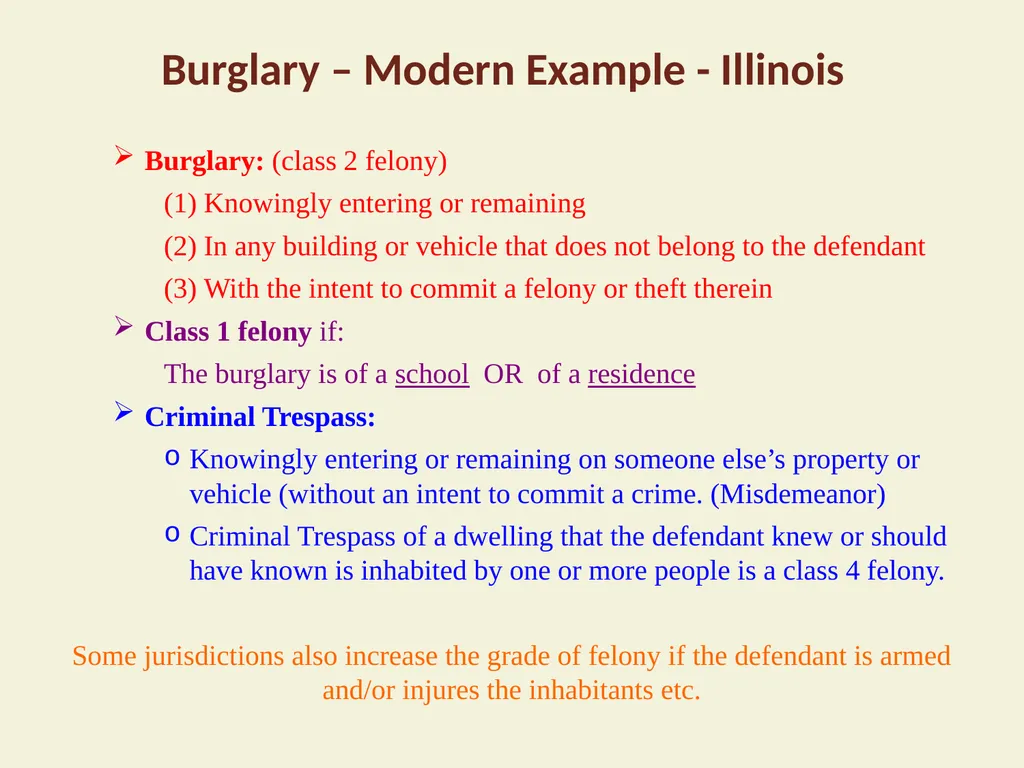
Burglary – Modern Example - Illinois Burglary: (class 2 felony)
Knowingly entering or remaining
In any building or vehicle that does not belong to the defendant
With the intent to commit a felony or theft therein
Class 1 felony if:
The burglary is of a school OR of a residence
Criminal Trespass:
Knowingly entering or remaining on someone else’s property or vehicle (without an intent to commit a crime. (Misdemeanor)
Criminal Trespass of a dwelling that the defendant knew or should have known is inhabited by one or more people is a class 4 felony.
Some jurisdictions also increase the grade of felony if the defendant is armed and/or injures the inhabitants etc.<br>
03
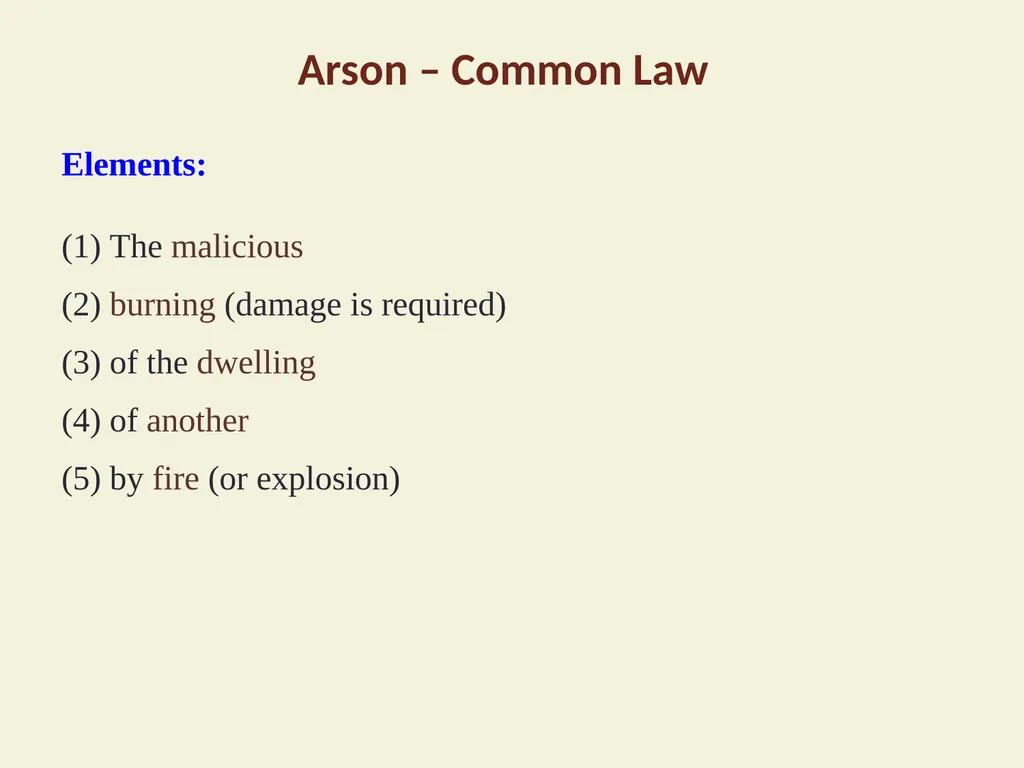
Arson – Common Law Elements:
The malicious
burning (damage is required)
of the dwelling
of another
by fire (or explosion)<br>
04
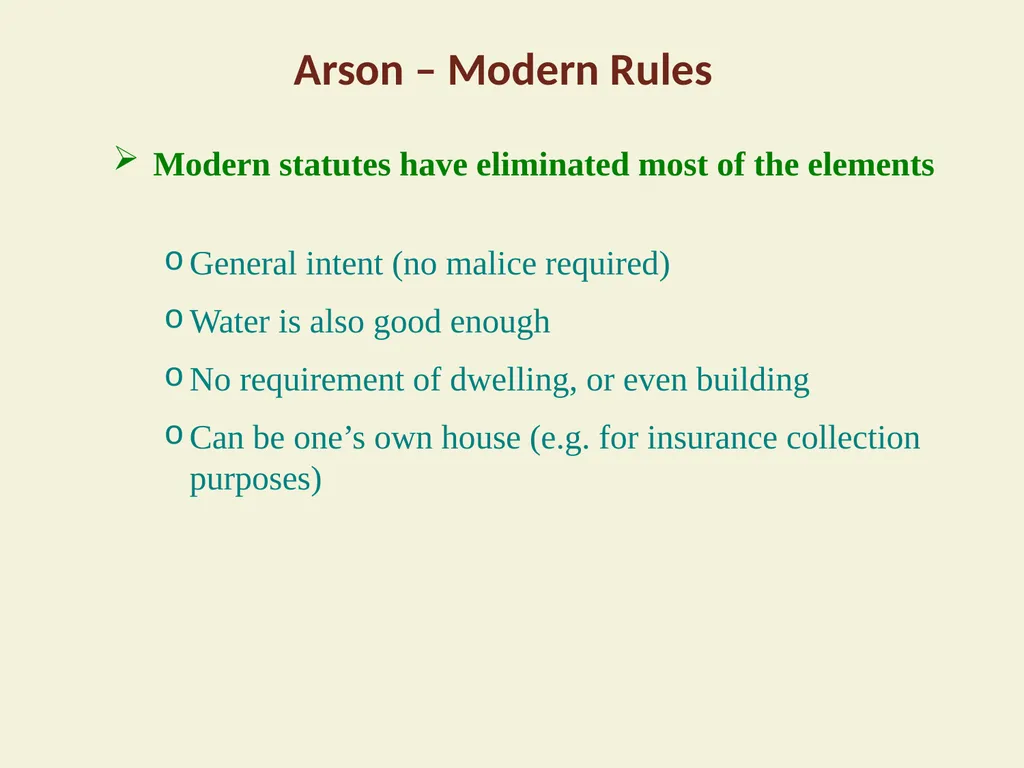
Arson – Modern Rules Modern statutes have eliminated most of the elements
General intent (no malice required)
Water is also good enough
No requirement of dwelling, or even building
Can be one’s own house (e.g. for insurance collection purposes)<br>
05
QUIZ TIME<br>
06
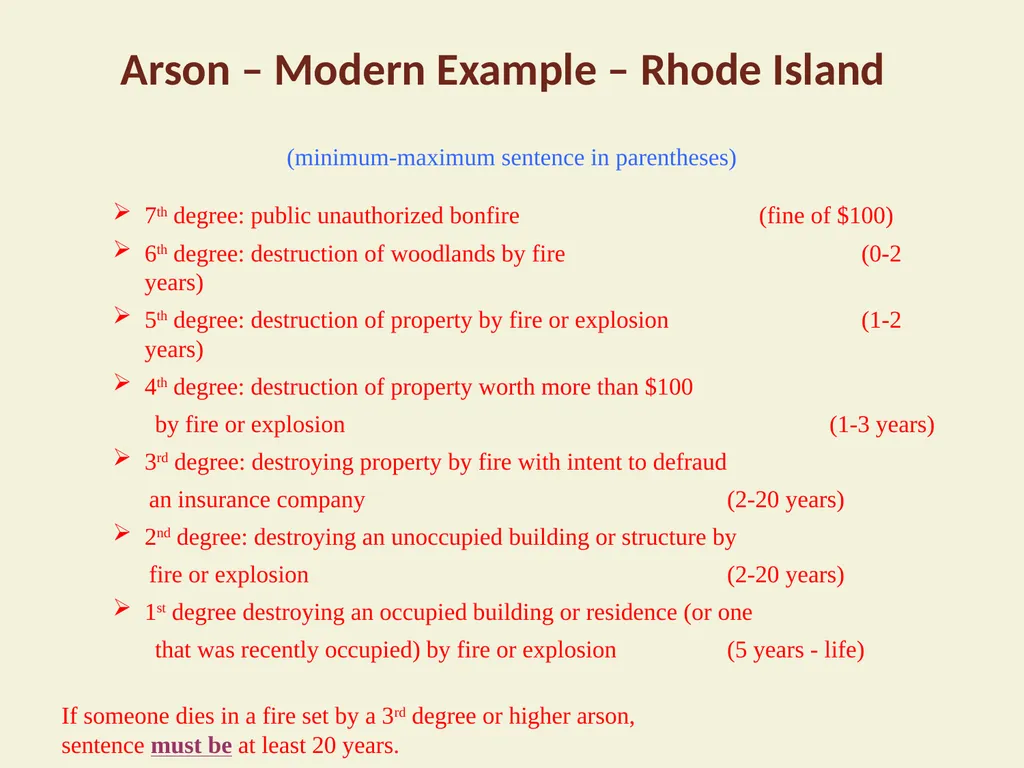
Arson – Modern Example – Rhode Island (minimum-maximum sentence in parentheses)
7th degree: public unauthorized bonfire (fine of $100)
6th degree: destruction of woodlands by fire (0-2 years)
5th degree: destruction of property by fire or explosion (1-2 years)
4th degree: destruction of property worth more than $100
by fire or explosion (1-3 years)
3rd degree: destroying property by fire with intent to defraud
an insurance company (2-20 years)
2nd degree: destroying an unoccupied building or structure by
fire or explosion (2-20 years)
1st degree destroying an occupied building or residence (or one
that was recently occupied) by fire or explosion (5 years - life)
If someone dies in a fire set by a 3rd degree or higher arson,
sentence must be at least 20 years.<br>