
Business Plan Presentation Cotton Seed Treatment
T
Published · 59 slides · 0 views

1 / 1

Description
Business Plan Presentation Cotton Seed Treatment Plant AAM Associação Algodoeira de Moçambique Maputo, July 2020 1 Executive Summary Background The cotton subsector is one of the most organized and impactful subsectors in Mozambique. In
Related Topics
Share
Embed code
Download this presentation From Below
"Business Plan Presentation Cotton Seed Treatment" is the property of its rightful owner. Permission is granted to download and print the materials on this website for personal, non-commercial use only, and to display it on your personal computer provided you do not modify the materials and that you retain all copyright notices contained in the materials. By downloading content from our website, you accept the terms of this agreement.
Presentation Transcript
01
Business Plan Presentation Cotton Seed Treatment Plant
AAM – Associação Algodoeira de Moçambique
Maputo, July 2020 1<br>
AAM – Associação Algodoeira de Moçambique
Maputo, July 2020 1<br>
02
Executive Summary Background
The cotton subsector is one of the most organized and impactful subsectors in Mozambique. In the last years an average of 216.000 farmers, produced seed cotton in an area of 152.000 Hectares, with an average yeld of 0.46 TN/HA, wich results in an average year production of 74.000 TN of seed cotton. Despite its great impact, the seed currently in use in the subsector remains degenerate and, therefore, not very productive, either in the field or in the ginneries and an improve in the quality seed can generate a greater impact per USD invested.
Objective
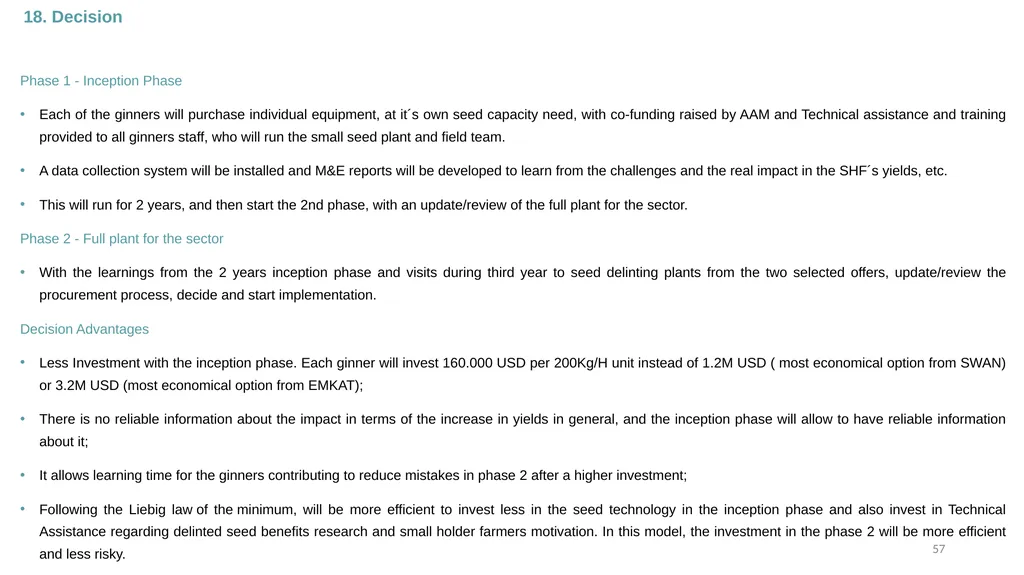
AAM plans to improve the farmers cotton seed quality by implementing a seed delinting, cleaning, coating and packaging plant. In order to decrease the investment risk, in the inception phase, each Ginnery will purchase individual equipment, at it´s own seed capacity need, with co-funding raised by AAM and Technical assistance and training provided to all ginners staff, who will run the small seed plant and field team. With the learnings from the 2 years inception phase in the 3rd year AAM will do the final decision to go for a seed treatment plant in Nampula province that will treat the seeds from all the ginners.
Investment
The inception phase results in a investment of around 184.000 USD per each 100 Tones/Year of seed need for each Ginnery. The second phase will need an investment of between 1.1 M USD and 4 M USD for a 3.000 Tones/Year of seed need and between 1.8 M USD and 5.7 M USD for a 5.000 Tones/Year of seed need and will promoted by a cooperative created by the AAM ginnery members with possible entries of some subsector partners.
Impact
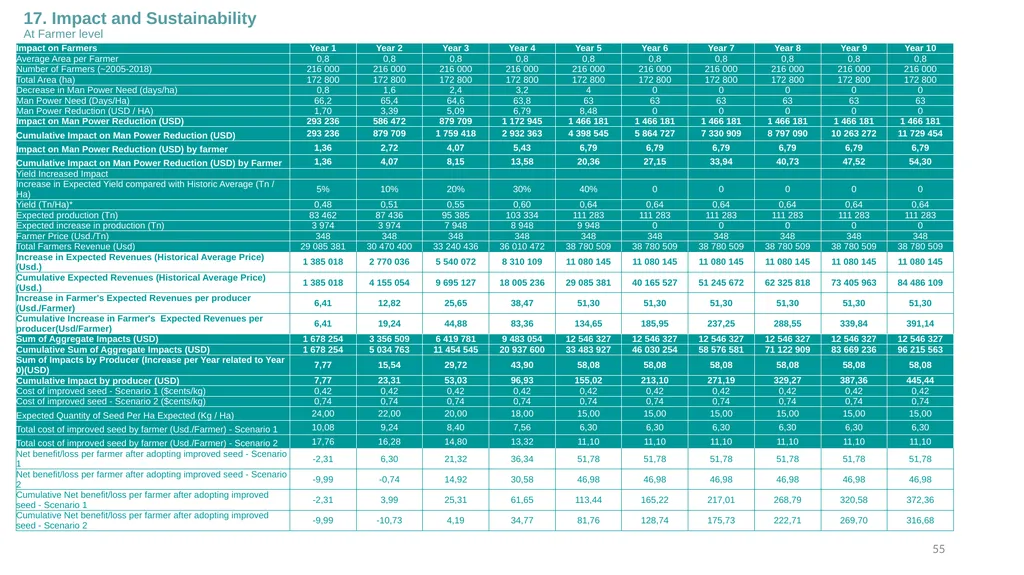
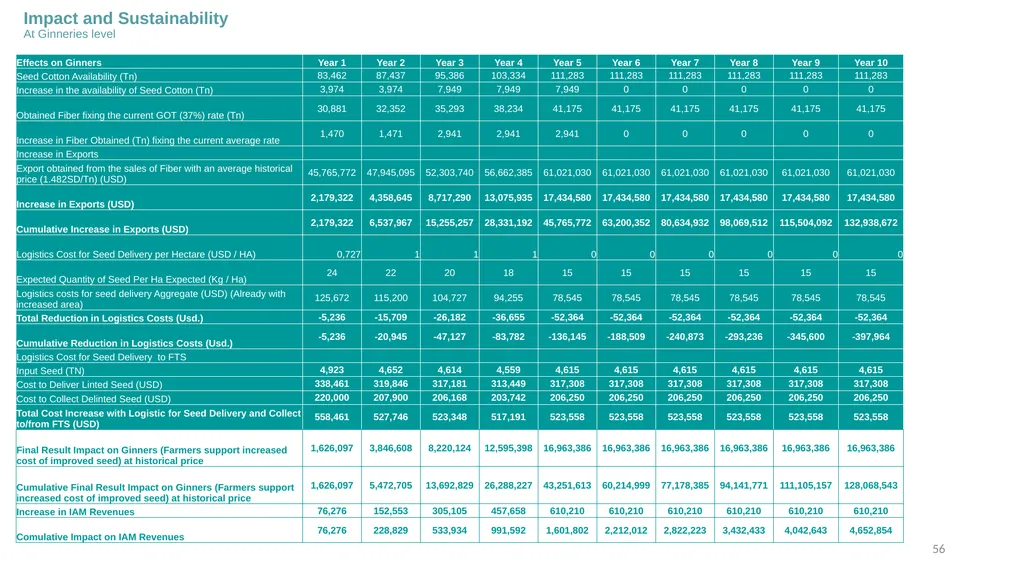
The seed treatment plant can have a 10 Years cumulative positive impact of around 95 M USD on farmers, around 445 USD of income increase per farmer. For the Ginners, the seed treatment plant can have a 10 Years cumulative positive impact of around 128 M USD and for IAM the same impact will be around 4.6 M USD. 2<br>
The cotton subsector is one of the most organized and impactful subsectors in Mozambique. In the last years an average of 216.000 farmers, produced seed cotton in an area of 152.000 Hectares, with an average yeld of 0.46 TN/HA, wich results in an average year production of 74.000 TN of seed cotton. Despite its great impact, the seed currently in use in the subsector remains degenerate and, therefore, not very productive, either in the field or in the ginneries and an improve in the quality seed can generate a greater impact per USD invested.
Objective
AAM plans to improve the farmers cotton seed quality by implementing a seed delinting, cleaning, coating and packaging plant. In order to decrease the investment risk, in the inception phase, each Ginnery will purchase individual equipment, at it´s own seed capacity need, with co-funding raised by AAM and Technical assistance and training provided to all ginners staff, who will run the small seed plant and field team. With the learnings from the 2 years inception phase in the 3rd year AAM will do the final decision to go for a seed treatment plant in Nampula province that will treat the seeds from all the ginners.
Investment
The inception phase results in a investment of around 184.000 USD per each 100 Tones/Year of seed need for each Ginnery. The second phase will need an investment of between 1.1 M USD and 4 M USD for a 3.000 Tones/Year of seed need and between 1.8 M USD and 5.7 M USD for a 5.000 Tones/Year of seed need and will promoted by a cooperative created by the AAM ginnery members with possible entries of some subsector partners.
Impact
The seed treatment plant can have a 10 Years cumulative positive impact of around 95 M USD on farmers, around 445 USD of income increase per farmer. For the Ginners, the seed treatment plant can have a 10 Years cumulative positive impact of around 128 M USD and for IAM the same impact will be around 4.6 M USD. 2<br>
03
Content 1. Brief analysis of the cotton sector Pag 4 10. Location and facilities Pag 41
2. Short and medium term cotton seed needs 11. Environmental Assessment requirements Pag 45
and availability Pag 8 12. Legal and Legislation requirements Pag 47
3. Brief presentation of the 2030 Alliance Pag 9 13. Marketing-Mix Pag 48
4. Proposed business model according with 14. Investment and operating budget Pag 49
the Alliance 2030 principles Pag 10 15. Financial and Economic model and sustainability Pag 51
5. Strategic Analysis Pag 11 16. Risk Assessment and Mitigation Strategy Pag 54
6. Special Purpose Vehicle Pag 19 17. Impact and sustainability Pag 55
7. Management Model Pag 28 18. Decision Pag 57
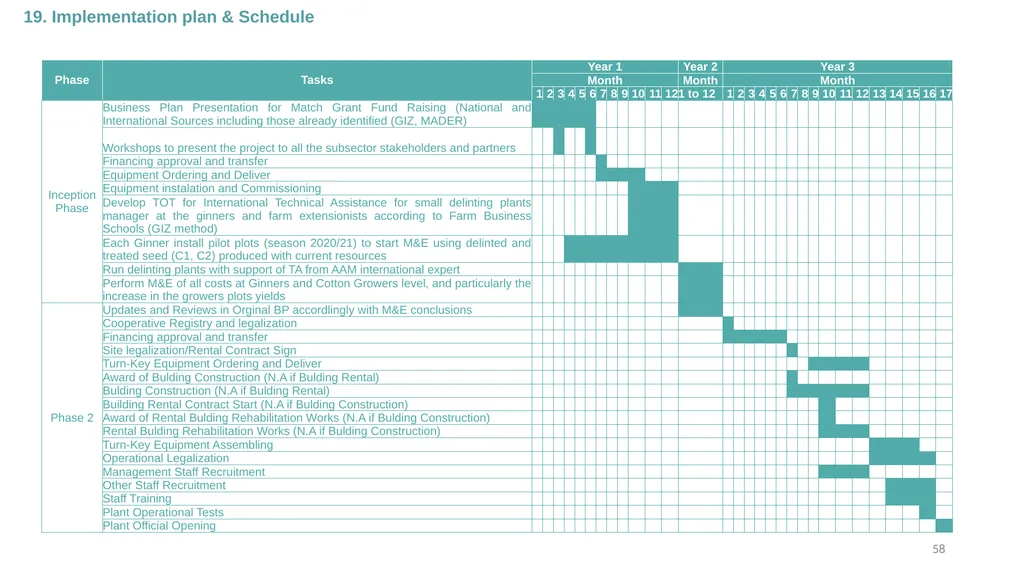
8. Technical solution and feasibility Pag 36 19. Implementation plan and schedule Pag 58
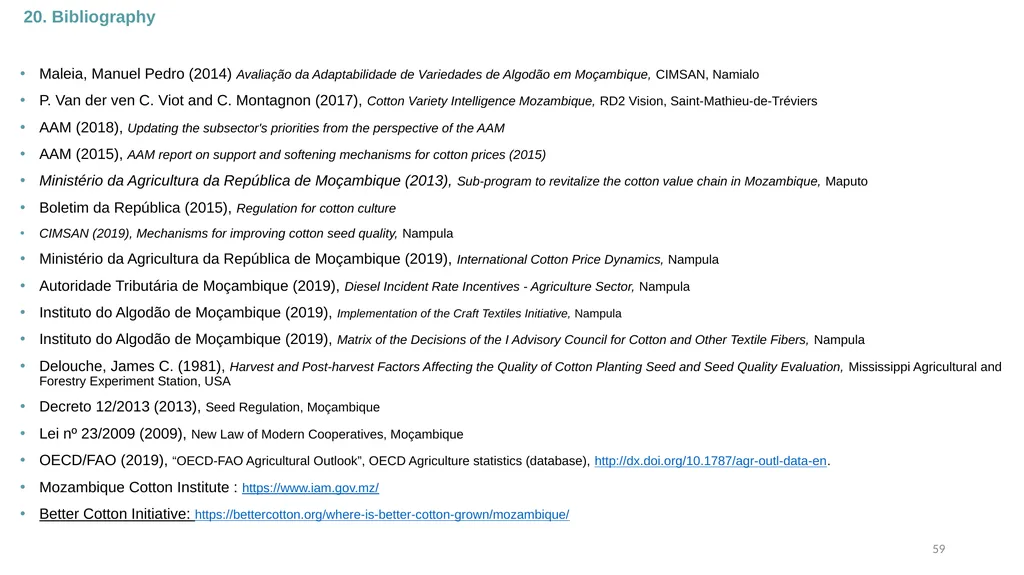
9. Operational Model Pag 40 20. Bibliography Pag 59 3<br>
2. Short and medium term cotton seed needs 11. Environmental Assessment requirements Pag 45
and availability Pag 8 12. Legal and Legislation requirements Pag 47
3. Brief presentation of the 2030 Alliance Pag 9 13. Marketing-Mix Pag 48
4. Proposed business model according with 14. Investment and operating budget Pag 49
the Alliance 2030 principles Pag 10 15. Financial and Economic model and sustainability Pag 51
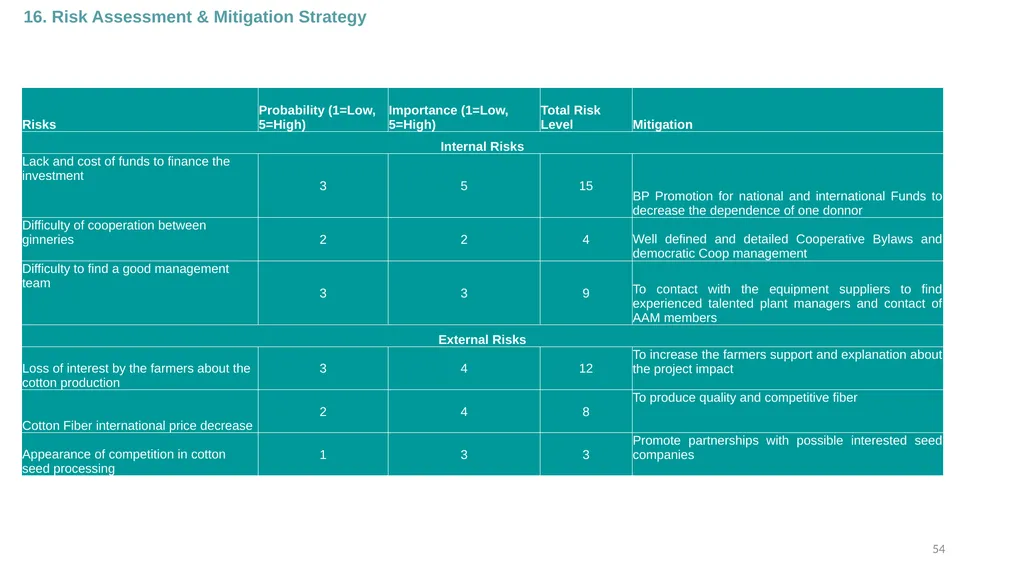
5. Strategic Analysis Pag 11 16. Risk Assessment and Mitigation Strategy Pag 54
6. Special Purpose Vehicle Pag 19 17. Impact and sustainability Pag 55
7. Management Model Pag 28 18. Decision Pag 57
8. Technical solution and feasibility Pag 36 19. Implementation plan and schedule Pag 58
9. Operational Model Pag 40 20. Bibliography Pag 59 3<br>
04
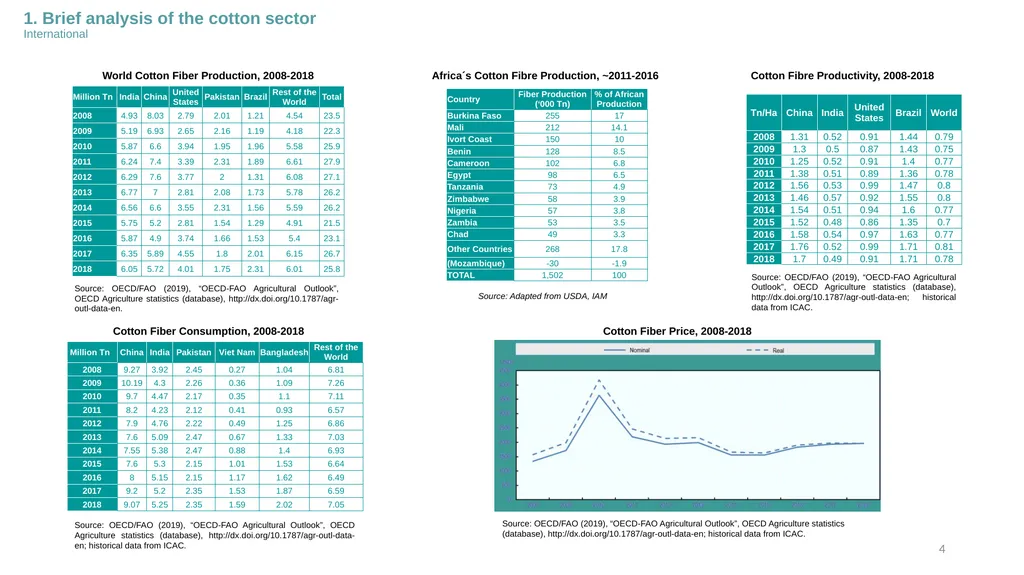
1. Brief analysis of the cotton sector
International World Cotton Fiber Production, 2008-2018 Source: OECD/FAO (2019), “OECD-FAO Agricultural Outlook”, OECD Agriculture statistics (database), http://dx.doi.org/10.1787/agr-outl-data-en. Africa´s Cotton Fibre Production, ~2011-2016 Source: Adapted from USDA, IAM Cotton Fibre Productivity, 2008-2018 Cotton Fiber Consumption, 2008-2018 Source: OECD/FAO (2019), “OECD-FAO Agricultural Outlook”, OECD Agriculture statistics (database), http://dx.doi.org/10.1787/agr-outl-data-en; historical data from ICAC. Source: OECD/FAO (2019), “OECD-FAO Agricultural Outlook”, OECD Agriculture statistics (database), http://dx.doi.org/10.1787/agr-outl-data-en; historical data from ICAC. Cotton Fiber Price, 2008-2018 Source: OECD/FAO (2019), “OECD-FAO Agricultural Outlook”, OECD Agriculture statistics (database), http://dx.doi.org/10.1787/agr-outl-data-en; historical data from ICAC. 4<br>
05
Brief analysis of the cotton sector
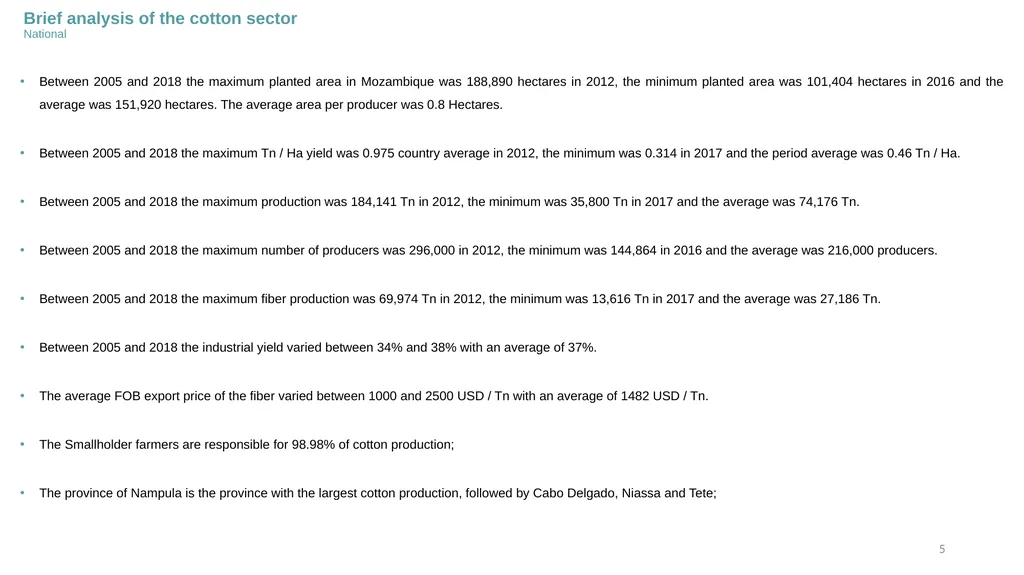
National Between 2005 and 2018 the maximum planted area in Mozambique was 188,890 hectares in 2012, the minimum planted area was 101,404 hectares in 2016 and the average was 151,920 hectares. The average area per producer was 0.8 Hectares.
Between 2005 and 2018 the maximum Tn / Ha yield was 0.975 country average in 2012, the minimum was 0.314 in 2017 and the period average was 0.46 Tn / Ha.
Between 2005 and 2018 the maximum production was 184,141 Tn in 2012, the minimum was 35,800 Tn in 2017 and the average was 74,176 Tn.
Between 2005 and 2018 the maximum number of producers was 296,000 in 2012, the minimum was 144,864 in 2016 and the average was 216,000 producers.
Between 2005 and 2018 the maximum fiber production was 69,974 Tn in 2012, the minimum was 13,616 Tn in 2017 and the average was 27,186 Tn.
Between 2005 and 2018 the industrial yield varied between 34% and 38% with an average of 37%.
The average FOB export price of the fiber varied between 1000 and 2500 USD / Tn with an average of 1482 USD / Tn.
The Smallholder farmers are responsible for 98.98% of cotton production;
The province of Nampula is the province with the largest cotton production, followed by Cabo Delgado, Niassa and Tete; 5<br>
Between 2005 and 2018 the maximum Tn / Ha yield was 0.975 country average in 2012, the minimum was 0.314 in 2017 and the period average was 0.46 Tn / Ha.
Between 2005 and 2018 the maximum production was 184,141 Tn in 2012, the minimum was 35,800 Tn in 2017 and the average was 74,176 Tn.
Between 2005 and 2018 the maximum number of producers was 296,000 in 2012, the minimum was 144,864 in 2016 and the average was 216,000 producers.
Between 2005 and 2018 the maximum fiber production was 69,974 Tn in 2012, the minimum was 13,616 Tn in 2017 and the average was 27,186 Tn.
Between 2005 and 2018 the industrial yield varied between 34% and 38% with an average of 37%.
The average FOB export price of the fiber varied between 1000 and 2500 USD / Tn with an average of 1482 USD / Tn.
The Smallholder farmers are responsible for 98.98% of cotton production;
The province of Nampula is the province with the largest cotton production, followed by Cabo Delgado, Niassa and Tete; 5<br>
06
Brief analysis of the cotton sector
The need for quality seed and the opportunity to get immediate results just by treating the current seed The seed currently in use in the subsector remains degenerate and, therefore, not very productive, either in the field or in the ginneries;
The Ginneries provide the vast majority of seeds from the previous harvest to farmers free of charge, leading to the degeneration of varieties
The low germination rate of weak seeds results in lower yields, reduced income for farmers and lower levels of productivity across the value chain
The seeds supplied to farmers, in addition to not being certified, are not “delinted” which means that:
It is more bulky, more expensive and complicated to transport;
Mechanical planting is not possible
Farmers need more time/labour in the field to slow down overgrowth of plants per hole and / or make the thinning and hoeing, and ginners have to provide more than ideal seeds to cover waste; 6<br>
The Ginneries provide the vast majority of seeds from the previous harvest to farmers free of charge, leading to the degeneration of varieties
The low germination rate of weak seeds results in lower yields, reduced income for farmers and lower levels of productivity across the value chain
The seeds supplied to farmers, in addition to not being certified, are not “delinted” which means that:
It is more bulky, more expensive and complicated to transport;
Mechanical planting is not possible
Farmers need more time/labour in the field to slow down overgrowth of plants per hole and / or make the thinning and hoeing, and ginners have to provide more than ideal seeds to cover waste; 6<br>
07
Brief analysis of the cotton sector
The need for quality seed and the opportunity to get immediate results just by treating the current seed Cotton Seed Delinting and Treatement allows:
Carry out the selection of damaged or diseased seeds;
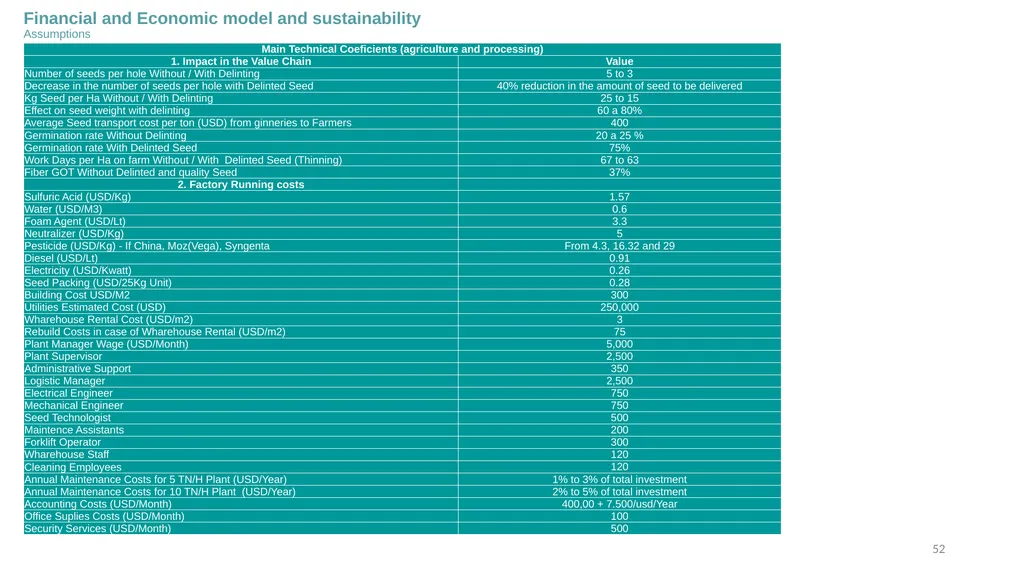
Decrease the weight of seeds transported by 25 to 40% (with an impact on logistics costs) and significantly increase the germination rate from 60% to 80%;
It decreases the necessary amount of seeds per hole from the current 5 used to 1 to 3;
It reduces the amount of labour required by the farmer, mainly in thinning that has an impact in reducing in average 80%, from 5 to 1 Working day, or 6% the total days of labour (67 to 63 working days per hectare);
The treatment given to the seed after delinting allows to obtain a seed more resistant to pests and diseases;
The impact that delinting has on increasing productivity by Hectare is being studied with cotton experts but is estimated that can increase the productivity between 30 and 40%, so from the actual average of 460Kg/Ha to 640Kg/Ha;
Based on approximately 216,000 producers(average 2005-18), with an average area of 0.8 Hectares each, delinting would allow an increase in production of 7,949 Tn of seed cotton a year;
Based on the price of 23,000 Meticais paid to the producer per ton of seed cotton, it would mean an increase of 11,080,000 Million USD in the total producers' income per year;
An increase of IAM revenues, based on the increase of exported quantities; 7<br>
Carry out the selection of damaged or diseased seeds;
Decrease the weight of seeds transported by 25 to 40% (with an impact on logistics costs) and significantly increase the germination rate from 60% to 80%;
It decreases the necessary amount of seeds per hole from the current 5 used to 1 to 3;
It reduces the amount of labour required by the farmer, mainly in thinning that has an impact in reducing in average 80%, from 5 to 1 Working day, or 6% the total days of labour (67 to 63 working days per hectare);
The treatment given to the seed after delinting allows to obtain a seed more resistant to pests and diseases;
The impact that delinting has on increasing productivity by Hectare is being studied with cotton experts but is estimated that can increase the productivity between 30 and 40%, so from the actual average of 460Kg/Ha to 640Kg/Ha;
Based on approximately 216,000 producers(average 2005-18), with an average area of 0.8 Hectares each, delinting would allow an increase in production of 7,949 Tn of seed cotton a year;
Based on the price of 23,000 Meticais paid to the producer per ton of seed cotton, it would mean an increase of 11,080,000 Million USD in the total producers' income per year;
An increase of IAM revenues, based on the increase of exported quantities; 7<br>
08
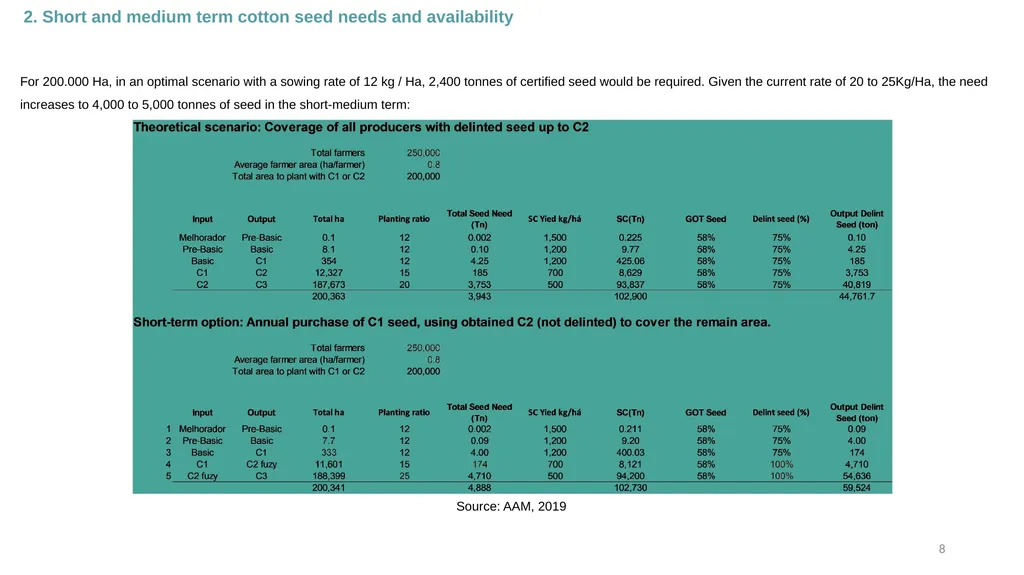
2. Short and medium term cotton seed needs and availability For 200.000 Ha, in an optimal scenario with a sowing rate of 12 kg / Ha, 2,400 tonnes of certified seed would be required. Given the current rate of 20 to 25Kg/Ha, the need increases to 4,000 to 5,000 tonnes of seed in the short-medium term: Source: AAM, 2019 8<br>
09
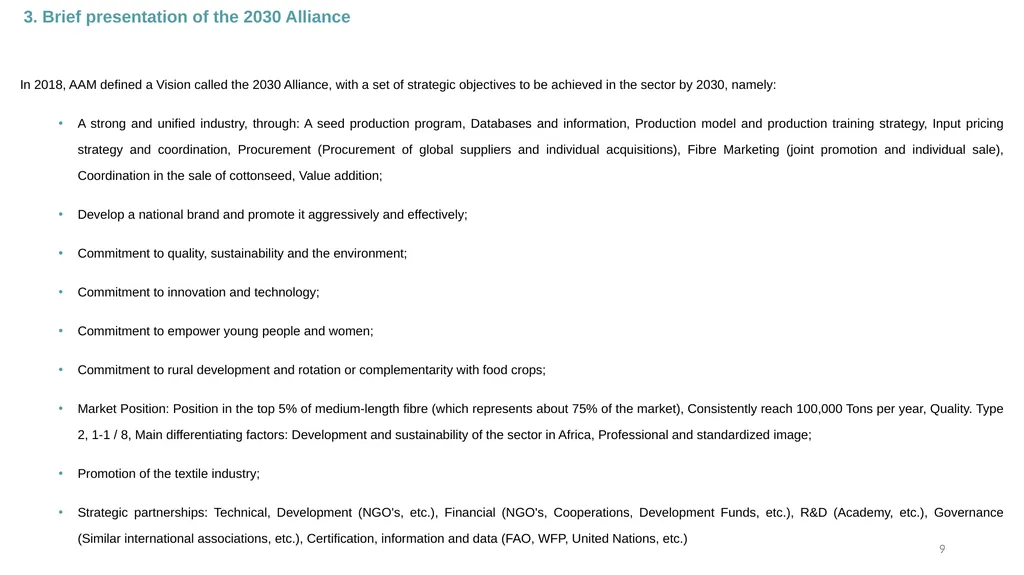
3. Brief presentation of the 2030 Alliance In 2018, AAM defined a Vision called the 2030 Alliance, with a set of strategic objectives to be achieved in the sector by 2030, namely:
A strong and unified industry, through: A seed production program, Databases and information, Production model and production training strategy, Input pricing strategy and coordination, Procurement (Procurement of global suppliers and individual acquisitions), Fibre Marketing (joint promotion and individual sale), Coordination in the sale of cottonseed, Value addition;
Develop a national brand and promote it aggressively and effectively;
Commitment to quality, sustainability and the environment;
Commitment to innovation and technology;
Commitment to empower young people and women;
Commitment to rural development and rotation or complementarity with food crops;
Market Position: Position in the top 5% of medium-length fibre (which represents about 75% of the market), Consistently reach 100,000 Tons per year, Quality. Type 2, 1-1 / 8, Main differentiating factors: Development and sustainability of the sector in Africa, Professional and standardized image;
Promotion of the textile industry;
Strategic partnerships: Technical, Development (NGO's, etc.), Financial (NGO's, Cooperations, Development Funds, etc.), R&D (Academy, etc.), Governance (Similar international associations, etc.), Certification, information and data (FAO, WFP, United Nations, etc.) 9<br>
A strong and unified industry, through: A seed production program, Databases and information, Production model and production training strategy, Input pricing strategy and coordination, Procurement (Procurement of global suppliers and individual acquisitions), Fibre Marketing (joint promotion and individual sale), Coordination in the sale of cottonseed, Value addition;
Develop a national brand and promote it aggressively and effectively;
Commitment to quality, sustainability and the environment;
Commitment to innovation and technology;
Commitment to empower young people and women;
Commitment to rural development and rotation or complementarity with food crops;
Market Position: Position in the top 5% of medium-length fibre (which represents about 75% of the market), Consistently reach 100,000 Tons per year, Quality. Type 2, 1-1 / 8, Main differentiating factors: Development and sustainability of the sector in Africa, Professional and standardized image;
Promotion of the textile industry;
Strategic partnerships: Technical, Development (NGO's, etc.), Financial (NGO's, Cooperations, Development Funds, etc.), R&D (Academy, etc.), Governance (Similar international associations, etc.), Certification, information and data (FAO, WFP, United Nations, etc.) 9<br>
10
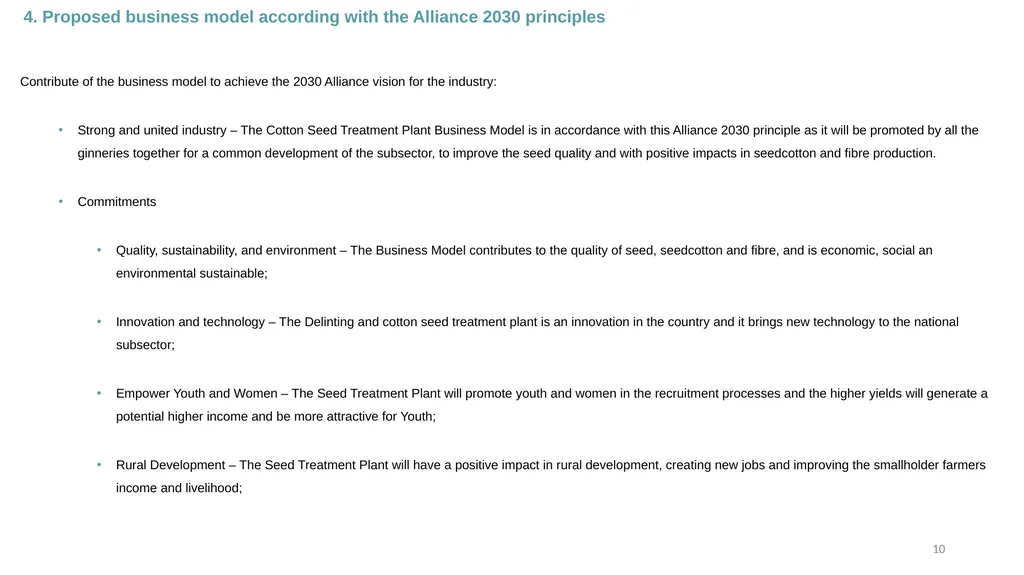
4. Proposed business model according with the Alliance 2030 principles Contribute of the business model to achieve the 2030 Alliance vision for the industry:
Strong and united industry – The Cotton Seed Treatment Plant Business Model is in accordance with this Alliance 2030 principle as it will be promoted by all the ginneries together for a common development of the subsector, to improve the seed quality and with positive impacts in seedcotton and fibre production.
Commitments
Quality, sustainability, and environment – The Business Model contributes to the quality of seed, seedcotton and fibre, and is economic, social an environmental sustainable;
Innovation and technology – The Delinting and cotton seed treatment plant is an innovation in the country and it brings new technology to the national subsector;
Empower Youth and Women – The Seed Treatment Plant will promote youth and women in the recruitment processes and the higher yields will generate a potential higher income and be more attractive for Youth;
Rural Development – The Seed Treatment Plant will have a positive impact in rural development, creating new jobs and improving the smallholder farmers income and livelihood; 10<br>
Strong and united industry – The Cotton Seed Treatment Plant Business Model is in accordance with this Alliance 2030 principle as it will be promoted by all the ginneries together for a common development of the subsector, to improve the seed quality and with positive impacts in seedcotton and fibre production.
Commitments
Quality, sustainability, and environment – The Business Model contributes to the quality of seed, seedcotton and fibre, and is economic, social an environmental sustainable;
Innovation and technology – The Delinting and cotton seed treatment plant is an innovation in the country and it brings new technology to the national subsector;
Empower Youth and Women – The Seed Treatment Plant will promote youth and women in the recruitment processes and the higher yields will generate a potential higher income and be more attractive for Youth;
Rural Development – The Seed Treatment Plant will have a positive impact in rural development, creating new jobs and improving the smallholder farmers income and livelihood; 10<br>
11
5. Strategic Analysis
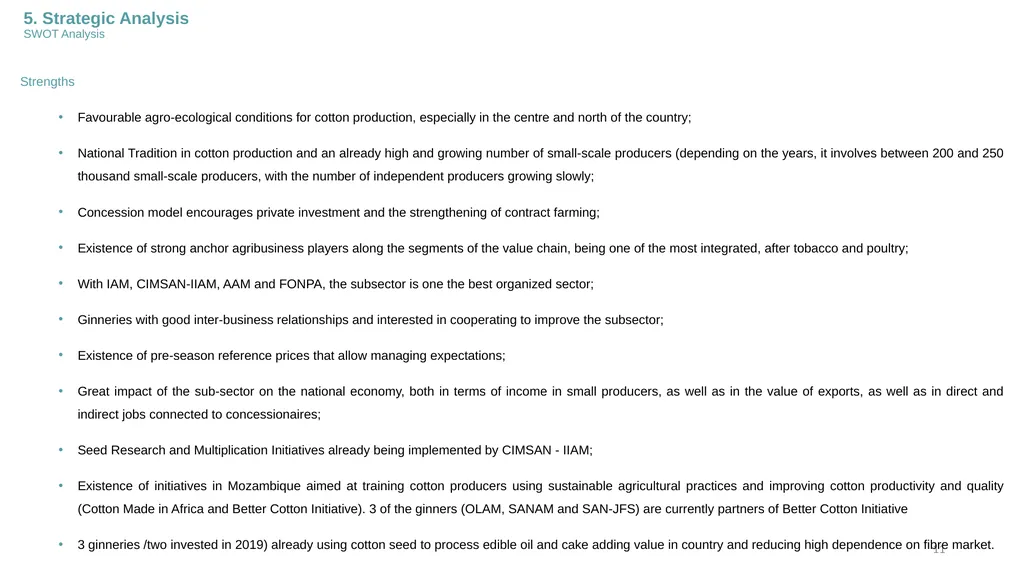
SWOT Analysis Strengths
Favourable agro-ecological conditions for cotton production, especially in the centre and north of the country;
National Tradition in cotton production and an already high and growing number of small-scale producers (depending on the years, it involves between 200 and 250 thousand small-scale producers, with the number of independent producers growing slowly;
Concession model encourages private investment and the strengthening of contract farming;
Existence of strong anchor agribusiness players along the segments of the value chain, being one of the most integrated, after tobacco and poultry;
With IAM, CIMSAN-IIAM, AAM and FONPA, the subsector is one the best organized sector;
Ginneries with good inter-business relationships and interested in cooperating to improve the subsector;
Existence of pre-season reference prices that allow managing expectations;
Great impact of the sub-sector on the national economy, both in terms of income in small producers, as well as in the value of exports, as well as in direct and indirect jobs connected to concessionaires;
Seed Research and Multiplication Initiatives already being implemented by CIMSAN - IIAM;
Existence of initiatives in Mozambique aimed at training cotton producers using sustainable agricultural practices and improving cotton productivity and quality (Cotton Made in Africa and Better Cotton Initiative). 3 of the ginners (OLAM, SANAM and SAN-JFS) are currently partners of Better Cotton Initiative
3 ginneries /two invested in 2019) already using cotton seed to process edible oil and cake adding value in country and reducing high dependence on fibre market. 11<br>
Favourable agro-ecological conditions for cotton production, especially in the centre and north of the country;
National Tradition in cotton production and an already high and growing number of small-scale producers (depending on the years, it involves between 200 and 250 thousand small-scale producers, with the number of independent producers growing slowly;
Concession model encourages private investment and the strengthening of contract farming;
Existence of strong anchor agribusiness players along the segments of the value chain, being one of the most integrated, after tobacco and poultry;
With IAM, CIMSAN-IIAM, AAM and FONPA, the subsector is one the best organized sector;
Ginneries with good inter-business relationships and interested in cooperating to improve the subsector;
Existence of pre-season reference prices that allow managing expectations;
Great impact of the sub-sector on the national economy, both in terms of income in small producers, as well as in the value of exports, as well as in direct and indirect jobs connected to concessionaires;
Seed Research and Multiplication Initiatives already being implemented by CIMSAN - IIAM;
Existence of initiatives in Mozambique aimed at training cotton producers using sustainable agricultural practices and improving cotton productivity and quality (Cotton Made in Africa and Better Cotton Initiative). 3 of the ginners (OLAM, SANAM and SAN-JFS) are currently partners of Better Cotton Initiative
3 ginneries /two invested in 2019) already using cotton seed to process edible oil and cake adding value in country and reducing high dependence on fibre market. 11<br>
12
Strategic Analysis
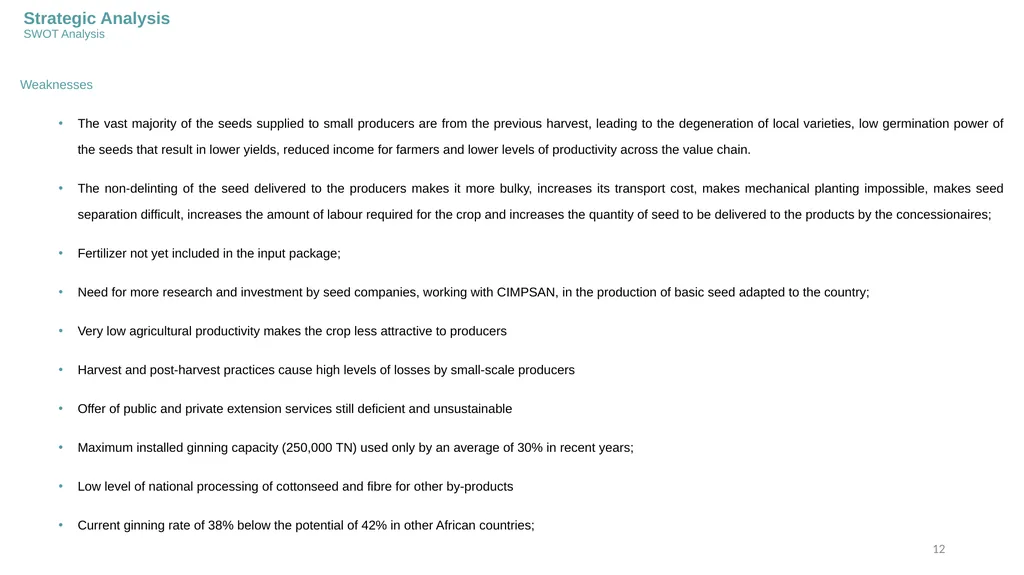
SWOT Analysis Weaknesses
The vast majority of the seeds supplied to small producers are from the previous harvest, leading to the degeneration of local varieties, low germination power of the seeds that result in lower yields, reduced income for farmers and lower levels of productivity across the value chain.
The non-delinting of the seed delivered to the producers makes it more bulky, increases its transport cost, makes mechanical planting impossible, makes seed separation difficult, increases the amount of labour required for the crop and increases the quantity of seed to be delivered to the products by the concessionaires;
Fertilizer not yet included in the input package;
Need for more research and investment by seed companies, working with CIMPSAN, in the production of basic seed adapted to the country;
Very low agricultural productivity makes the crop less attractive to producers
Harvest and post-harvest practices cause high levels of losses by small-scale producers
Offer of public and private extension services still deficient and unsustainable
Maximum installed ginning capacity (250,000 TN) used only by an average of 30% in recent years;
Low level of national processing of cottonseed and fibre for other by-products
Current ginning rate of 38% below the potential of 42% in other African countries; 12<br>
The vast majority of the seeds supplied to small producers are from the previous harvest, leading to the degeneration of local varieties, low germination power of the seeds that result in lower yields, reduced income for farmers and lower levels of productivity across the value chain.
The non-delinting of the seed delivered to the producers makes it more bulky, increases its transport cost, makes mechanical planting impossible, makes seed separation difficult, increases the amount of labour required for the crop and increases the quantity of seed to be delivered to the products by the concessionaires;
Fertilizer not yet included in the input package;
Need for more research and investment by seed companies, working with CIMPSAN, in the production of basic seed adapted to the country;
Very low agricultural productivity makes the crop less attractive to producers
Harvest and post-harvest practices cause high levels of losses by small-scale producers
Offer of public and private extension services still deficient and unsustainable
Maximum installed ginning capacity (250,000 TN) used only by an average of 30% in recent years;
Low level of national processing of cottonseed and fibre for other by-products
Current ginning rate of 38% below the potential of 42% in other African countries; 12<br>
13
Strategic Analysis
SWOT Analysis Opportunities
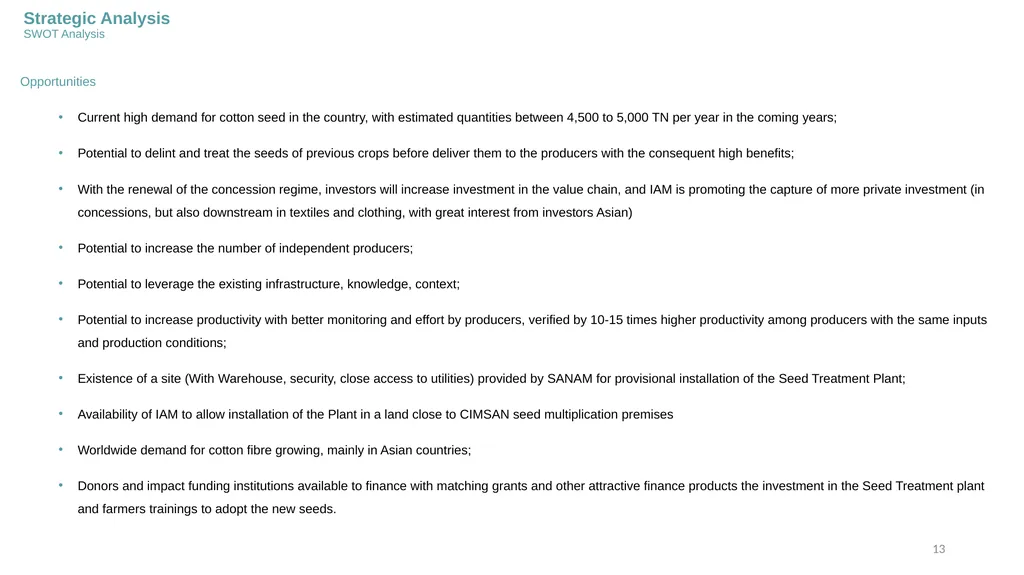
Current high demand for cotton seed in the country, with estimated quantities between 4,500 to 5,000 TN per year in the coming years;
Potential to delint and treat the seeds of previous crops before deliver them to the producers with the consequent high benefits;
With the renewal of the concession regime, investors will increase investment in the value chain, and IAM is promoting the capture of more private investment (in concessions, but also downstream in textiles and clothing, with great interest from investors Asian)
Potential to increase the number of independent producers;
Potential to leverage the existing infrastructure, knowledge, context;
Potential to increase productivity with better monitoring and effort by producers, verified by 10-15 times higher productivity among producers with the same inputs and production conditions;
Existence of a site (With Warehouse, security, close access to utilities) provided by SANAM for provisional installation of the Seed Treatment Plant;
Availability of IAM to allow installation of the Plant in a land close to CIMSAN seed multiplication premises
Worldwide demand for cotton fibre growing, mainly in Asian countries;
Donors and impact funding institutions available to finance with matching grants and other attractive finance products the investment in the Seed Treatment plant and farmers trainings to adopt the new seeds. 13<br>
Current high demand for cotton seed in the country, with estimated quantities between 4,500 to 5,000 TN per year in the coming years;
Potential to delint and treat the seeds of previous crops before deliver them to the producers with the consequent high benefits;
With the renewal of the concession regime, investors will increase investment in the value chain, and IAM is promoting the capture of more private investment (in concessions, but also downstream in textiles and clothing, with great interest from investors Asian)
Potential to increase the number of independent producers;
Potential to leverage the existing infrastructure, knowledge, context;
Potential to increase productivity with better monitoring and effort by producers, verified by 10-15 times higher productivity among producers with the same inputs and production conditions;
Existence of a site (With Warehouse, security, close access to utilities) provided by SANAM for provisional installation of the Seed Treatment Plant;
Availability of IAM to allow installation of the Plant in a land close to CIMSAN seed multiplication premises
Worldwide demand for cotton fibre growing, mainly in Asian countries;
Donors and impact funding institutions available to finance with matching grants and other attractive finance products the investment in the Seed Treatment plant and farmers trainings to adopt the new seeds. 13<br>
14
Strategic Analysis
SWOT Analysis Threats
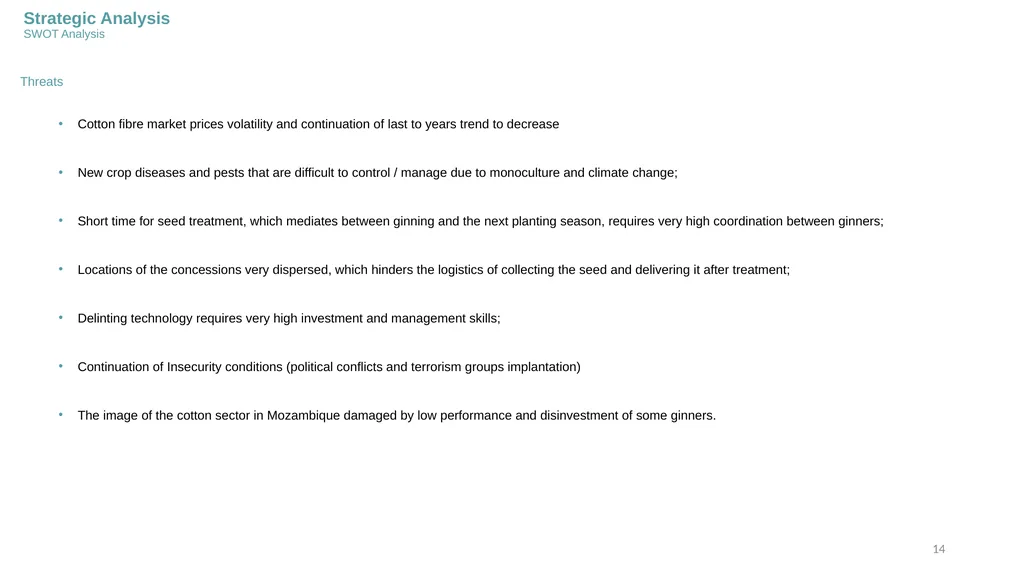
Cotton fibre market prices volatility and continuation of last to years trend to decrease
New crop diseases and pests that are difficult to control / manage due to monoculture and climate change;
Short time for seed treatment, which mediates between ginning and the next planting season, requires very high coordination between ginners;
Locations of the concessions very dispersed, which hinders the logistics of collecting the seed and delivering it after treatment;
Delinting technology requires very high investment and management skills;
Continuation of Insecurity conditions (political conflicts and terrorism groups implantation)
The image of the cotton sector in Mozambique damaged by low performance and disinvestment of some ginners. 14<br>
Cotton fibre market prices volatility and continuation of last to years trend to decrease
New crop diseases and pests that are difficult to control / manage due to monoculture and climate change;
Short time for seed treatment, which mediates between ginning and the next planting season, requires very high coordination between ginners;
Locations of the concessions very dispersed, which hinders the logistics of collecting the seed and delivering it after treatment;
Delinting technology requires very high investment and management skills;
Continuation of Insecurity conditions (political conflicts and terrorism groups implantation)
The image of the cotton sector in Mozambique damaged by low performance and disinvestment of some ginners. 14<br>
15
Strategic Analysis
PESTAL Analysis Political Factors
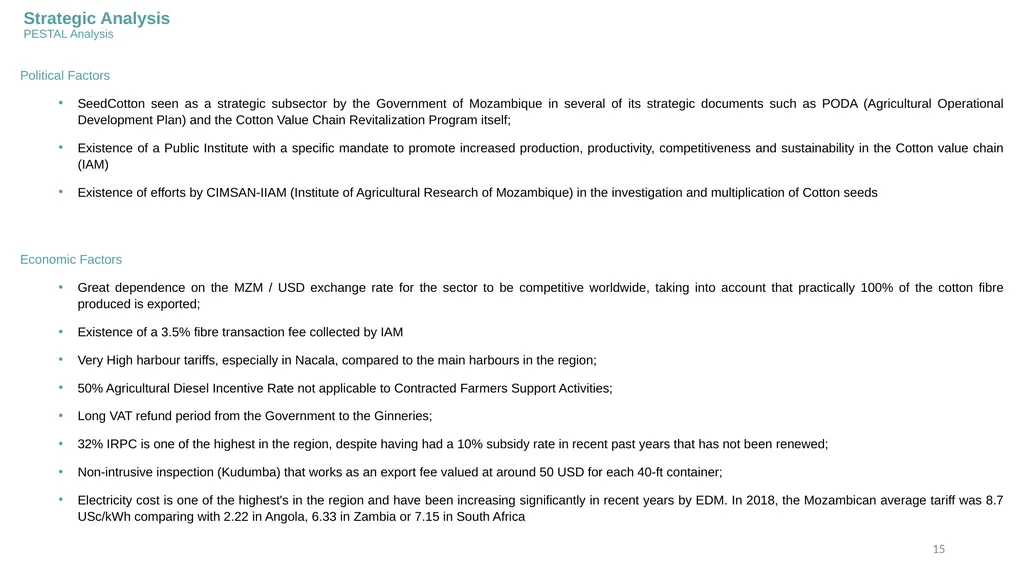
SeedCotton seen as a strategic subsector by the Government of Mozambique in several of its strategic documents such as PODA (Agricultural Operational Development Plan) and the Cotton Value Chain Revitalization Program itself;
Existence of a Public Institute with a specific mandate to promote increased production, productivity, competitiveness and sustainability in the Cotton value chain (IAM)
Existence of efforts by CIMSAN-IIAM (Institute of Agricultural Research of Mozambique) in the investigation and multiplication of Cotton seeds
Economic Factors
Great dependence on the MZM / USD exchange rate for the sector to be competitive worldwide, taking into account that practically 100% of the cotton fibre produced is exported;
Existence of a 3.5% fibre transaction fee collected by IAM
Very High harbour tariffs, especially in Nacala, compared to the main harbours in the region;
50% Agricultural Diesel Incentive Rate not applicable to Contracted Farmers Support Activities;
Long VAT refund period from the Government to the Ginneries;
32% IRPC is one of the highest in the region, despite having had a 10% subsidy rate in recent past years that has not been renewed;
Non-intrusive inspection (Kudumba) that works as an export fee valued at around 50 USD for each 40-ft container;
Electricity cost is one of the highest's in the region and have been increasing significantly in recent years by EDM. In 2018, the Mozambican average tariff was 8.7 USc/kWh comparing with 2.22 in Angola, 6.33 in Zambia or 7.15 in South Africa 15<br>
SeedCotton seen as a strategic subsector by the Government of Mozambique in several of its strategic documents such as PODA (Agricultural Operational Development Plan) and the Cotton Value Chain Revitalization Program itself;
Existence of a Public Institute with a specific mandate to promote increased production, productivity, competitiveness and sustainability in the Cotton value chain (IAM)
Existence of efforts by CIMSAN-IIAM (Institute of Agricultural Research of Mozambique) in the investigation and multiplication of Cotton seeds
Economic Factors
Great dependence on the MZM / USD exchange rate for the sector to be competitive worldwide, taking into account that practically 100% of the cotton fibre produced is exported;
Existence of a 3.5% fibre transaction fee collected by IAM
Very High harbour tariffs, especially in Nacala, compared to the main harbours in the region;
50% Agricultural Diesel Incentive Rate not applicable to Contracted Farmers Support Activities;
Long VAT refund period from the Government to the Ginneries;
32% IRPC is one of the highest in the region, despite having had a 10% subsidy rate in recent past years that has not been renewed;
Non-intrusive inspection (Kudumba) that works as an export fee valued at around 50 USD for each 40-ft container;
Electricity cost is one of the highest's in the region and have been increasing significantly in recent years by EDM. In 2018, the Mozambican average tariff was 8.7 USc/kWh comparing with 2.22 in Angola, 6.33 in Zambia or 7.15 in South Africa 15<br>
16
Strategic Analysis
PESTAL Analysis Social Factors
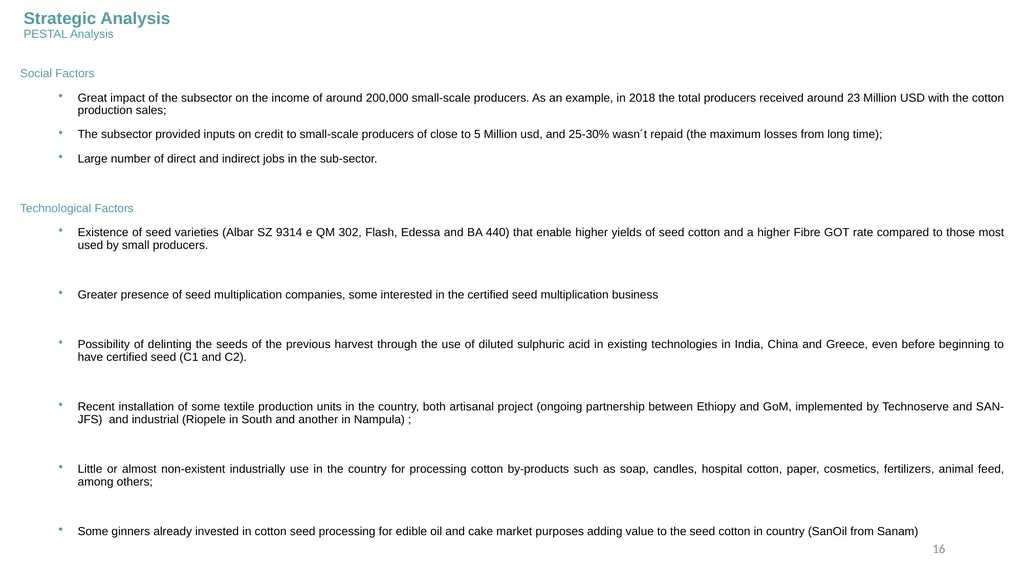
Great impact of the subsector on the income of around 200,000 small-scale producers. As an example, in 2018 the total producers received around 23 Million USD with the cotton production sales;
The subsector provided inputs on credit to small-scale producers of close to 5 Million usd, and 25-30% wasn´t repaid (the maximum losses from long time);
Large number of direct and indirect jobs in the sub-sector.
Technological Factors
Existence of seed varieties (Albar SZ 9314 e QM 302, Flash, Edessa and BA 440) that enable higher yields of seed cotton and a higher Fibre GOT rate compared to those most used by small producers.
Greater presence of seed multiplication companies, some interested in the certified seed multiplication business
Possibility of delinting the seeds of the previous harvest through the use of diluted sulphuric acid in existing technologies in India, China and Greece, even before beginning to have certified seed (C1 and C2).
Recent installation of some textile production units in the country, both artisanal project (ongoing partnership between Ethiopy and GoM, implemented by Technoserve and SAN-JFS) and industrial (Riopele in South and another in Nampula) ;
Little or almost non-existent industrially use in the country for processing cotton by-products such as soap, candles, hospital cotton, paper, cosmetics, fertilizers, animal feed, among others;
Some ginners already invested in cotton seed processing for edible oil and cake market purposes adding value to the seed cotton in country (SanOil from Sanam) 16<br>
Great impact of the subsector on the income of around 200,000 small-scale producers. As an example, in 2018 the total producers received around 23 Million USD with the cotton production sales;
The subsector provided inputs on credit to small-scale producers of close to 5 Million usd, and 25-30% wasn´t repaid (the maximum losses from long time);
Large number of direct and indirect jobs in the sub-sector.
Technological Factors
Existence of seed varieties (Albar SZ 9314 e QM 302, Flash, Edessa and BA 440) that enable higher yields of seed cotton and a higher Fibre GOT rate compared to those most used by small producers.
Greater presence of seed multiplication companies, some interested in the certified seed multiplication business
Possibility of delinting the seeds of the previous harvest through the use of diluted sulphuric acid in existing technologies in India, China and Greece, even before beginning to have certified seed (C1 and C2).
Recent installation of some textile production units in the country, both artisanal project (ongoing partnership between Ethiopy and GoM, implemented by Technoserve and SAN-JFS) and industrial (Riopele in South and another in Nampula) ;
Little or almost non-existent industrially use in the country for processing cotton by-products such as soap, candles, hospital cotton, paper, cosmetics, fertilizers, animal feed, among others;
Some ginners already invested in cotton seed processing for edible oil and cake market purposes adding value to the seed cotton in country (SanOil from Sanam) 16<br>
17
Strategic Analysis
PESTAL Analysis Environmental Factors
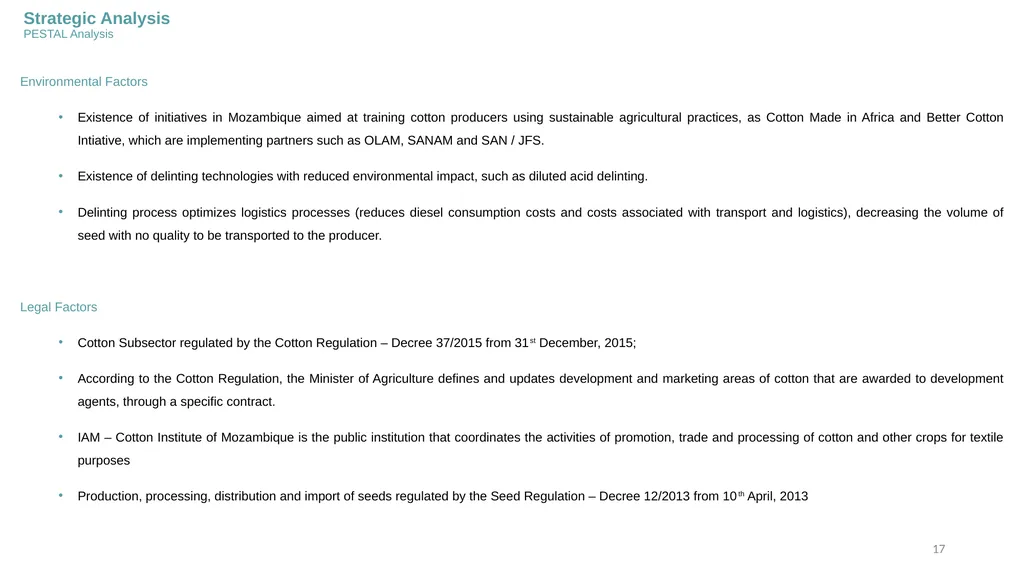
Existence of initiatives in Mozambique aimed at training cotton producers using sustainable agricultural practices, as Cotton Made in Africa and Better Cotton Intiative, which are implementing partners such as OLAM, SANAM and SAN / JFS.
Existence of delinting technologies with reduced environmental impact, such as diluted acid delinting.
Delinting process optimizes logistics processes (reduces diesel consumption costs and costs associated with transport and logistics), decreasing the volume of seed with no quality to be transported to the producer.
Legal Factors
Cotton Subsector regulated by the Cotton Regulation – Decree 37/2015 from 31st December, 2015;
According to the Cotton Regulation, the Minister of Agriculture defines and updates development and marketing areas of cotton that are awarded to development agents, through a specific contract.
IAM – Cotton Institute of Mozambique is the public institution that coordinates the activities of promotion, trade and processing of cotton and other crops for textile purposes
Production, processing, distribution and import of seeds regulated by the Seed Regulation – Decree 12/2013 from 10th April, 2013 17<br>
Existence of initiatives in Mozambique aimed at training cotton producers using sustainable agricultural practices, as Cotton Made in Africa and Better Cotton Intiative, which are implementing partners such as OLAM, SANAM and SAN / JFS.
Existence of delinting technologies with reduced environmental impact, such as diluted acid delinting.
Delinting process optimizes logistics processes (reduces diesel consumption costs and costs associated with transport and logistics), decreasing the volume of seed with no quality to be transported to the producer.
Legal Factors
Cotton Subsector regulated by the Cotton Regulation – Decree 37/2015 from 31st December, 2015;
According to the Cotton Regulation, the Minister of Agriculture defines and updates development and marketing areas of cotton that are awarded to development agents, through a specific contract.
IAM – Cotton Institute of Mozambique is the public institution that coordinates the activities of promotion, trade and processing of cotton and other crops for textile purposes
Production, processing, distribution and import of seeds regulated by the Seed Regulation – Decree 12/2013 from 10th April, 2013 17<br>
18
Strategic Analysis
Strategic Goals, Vision and Mission Statement Strategic Goals
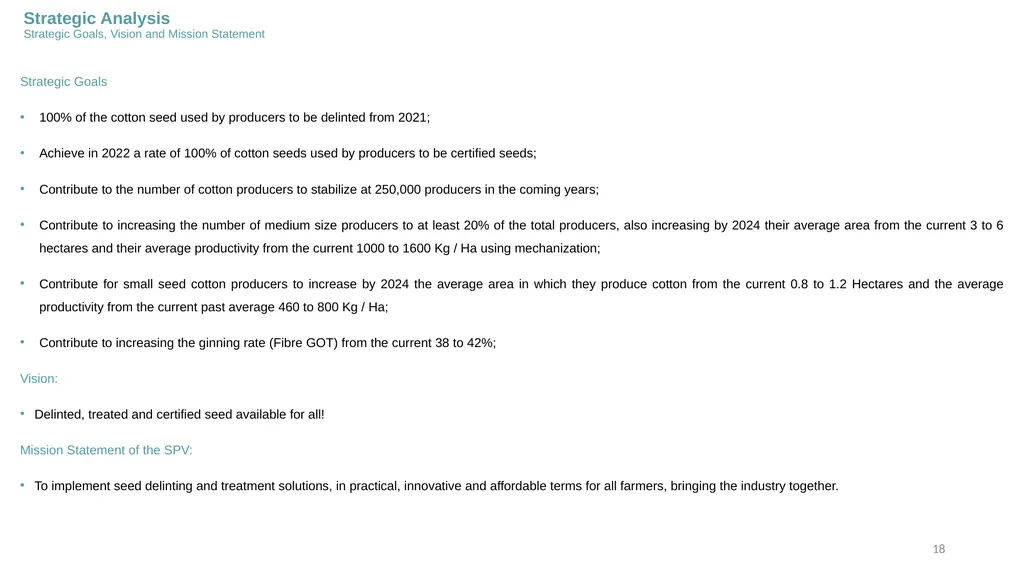
100% of the cotton seed used by producers to be delinted from 2021;
Achieve in 2022 a rate of 100% of cotton seeds used by producers to be certified seeds;
Contribute to the number of cotton producers to stabilize at 250,000 producers in the coming years;
Contribute to increasing the number of medium size producers to at least 20% of the total producers, also increasing by 2024 their average area from the current 3 to 6 hectares and their average productivity from the current 1000 to 1600 Kg / Ha using mechanization;
Contribute for small seed cotton producers to increase by 2024 the average area in which they produce cotton from the current 0.8 to 1.2 Hectares and the average productivity from the current past average 460 to 800 Kg / Ha;
Contribute to increasing the ginning rate (Fibre GOT) from the current 38 to 42%;
Vision:
Delinted, treated and certified seed available for all!
Mission Statement of the SPV:
To implement seed delinting and treatment solutions, in practical, innovative and affordable terms for all farmers, bringing the industry together. 18<br>
100% of the cotton seed used by producers to be delinted from 2021;
Achieve in 2022 a rate of 100% of cotton seeds used by producers to be certified seeds;
Contribute to the number of cotton producers to stabilize at 250,000 producers in the coming years;
Contribute to increasing the number of medium size producers to at least 20% of the total producers, also increasing by 2024 their average area from the current 3 to 6 hectares and their average productivity from the current 1000 to 1600 Kg / Ha using mechanization;
Contribute for small seed cotton producers to increase by 2024 the average area in which they produce cotton from the current 0.8 to 1.2 Hectares and the average productivity from the current past average 460 to 800 Kg / Ha;
Contribute to increasing the ginning rate (Fibre GOT) from the current 38 to 42%;
Vision:
Delinted, treated and certified seed available for all!
Mission Statement of the SPV:
To implement seed delinting and treatment solutions, in practical, innovative and affordable terms for all farmers, bringing the industry together. 18<br>
19
6. Special Purpose Vehicle
Legal Entity Option Pros & Cons Possible Options
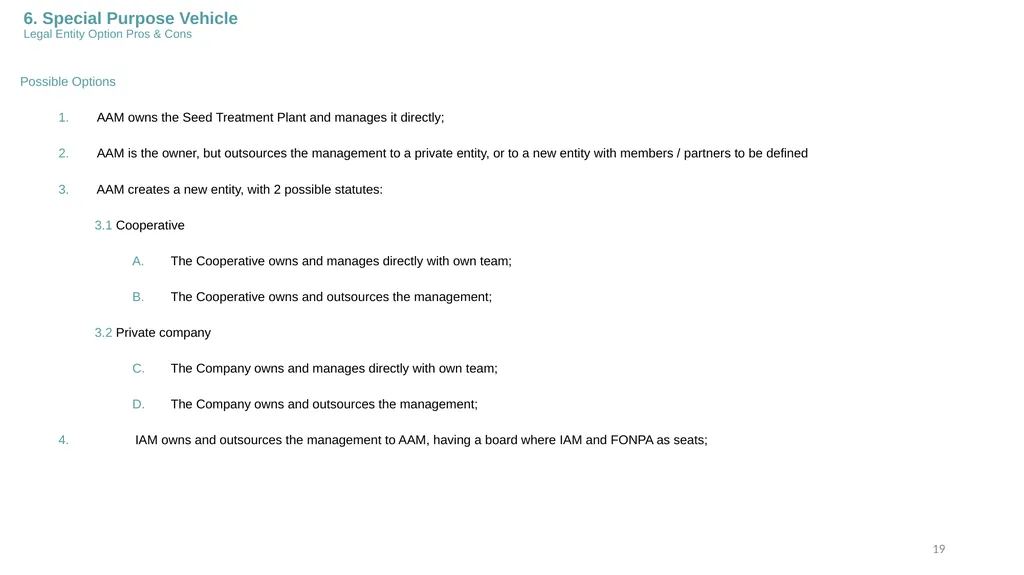
AAM owns the Seed Treatment Plant and manages it directly;
AAM is the owner, but outsources the management to a private entity, or to a new entity with members / partners to be defined
3. AAM creates a new entity, with 2 possible statutes:
3.1 Cooperative
The Cooperative owns and manages directly with own team;
The Cooperative owns and outsources the management;
3.2 Private company
The Company owns and manages directly with own team;
The Company owns and outsources the management;
4. IAM owns and outsources the management to AAM, having a board where IAM and FONPA as seats; 19<br>
AAM owns the Seed Treatment Plant and manages it directly;
AAM is the owner, but outsources the management to a private entity, or to a new entity with members / partners to be defined
3. AAM creates a new entity, with 2 possible statutes:
3.1 Cooperative
The Cooperative owns and manages directly with own team;
The Cooperative owns and outsources the management;
3.2 Private company
The Company owns and manages directly with own team;
The Company owns and outsources the management;
4. IAM owns and outsources the management to AAM, having a board where IAM and FONPA as seats; 19<br>
20
Special Purpose Vehicle
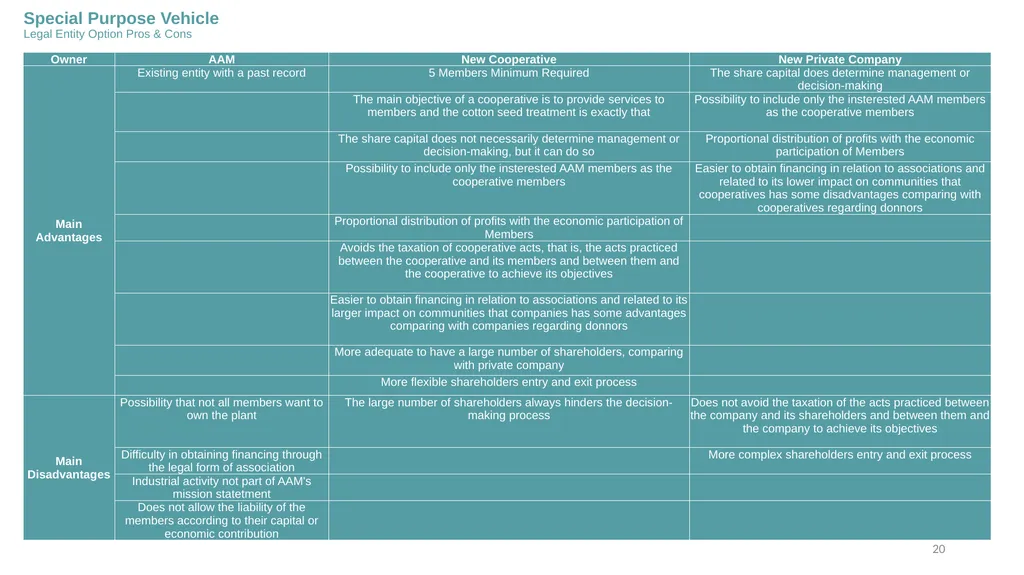
Legal Entity Option Pros & Cons 20<br>
21
Special Purpose Vehicle
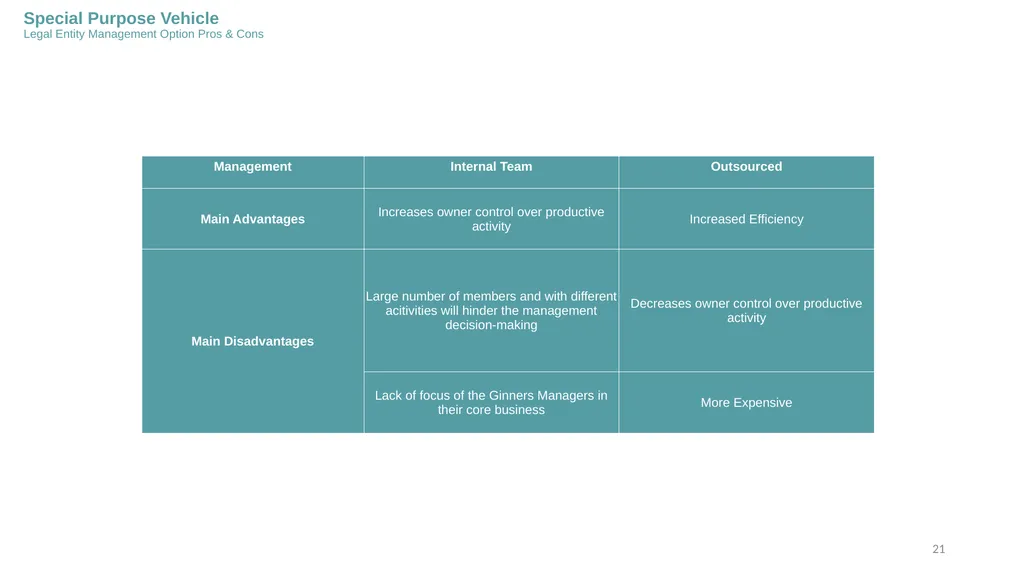
Legal Entity Management Option Pros & Cons 21<br>
22
Special Purpose Vehicle
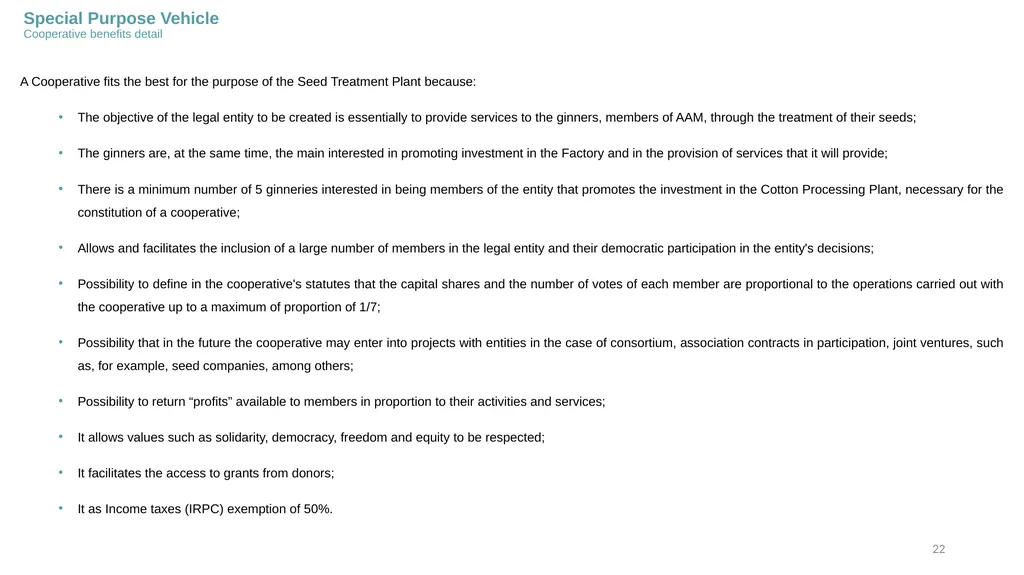
Cooperative benefits detail A Cooperative fits the best for the purpose of the Seed Treatment Plant because:
The objective of the legal entity to be created is essentially to provide services to the ginners, members of AAM, through the treatment of their seeds;
The ginners are, at the same time, the main interested in promoting investment in the Factory and in the provision of services that it will provide;
There is a minimum number of 5 ginneries interested in being members of the entity that promotes the investment in the Cotton Processing Plant, necessary for the constitution of a cooperative;
Allows and facilitates the inclusion of a large number of members in the legal entity and their democratic participation in the entity's decisions;
Possibility to define in the cooperative's statutes that the capital shares and the number of votes of each member are proportional to the operations carried out with the cooperative up to a maximum of proportion of 1/7;
Possibility that in the future the cooperative may enter into projects with entities in the case of consortium, association contracts in participation, joint ventures, such as, for example, seed companies, among others;
Possibility to return “profits” available to members in proportion to their activities and services;
It allows values such as solidarity, democracy, freedom and equity to be respected;
It facilitates the access to grants from donors;
It as Income taxes (IRPC) exemption of 50%. 22<br>
The objective of the legal entity to be created is essentially to provide services to the ginners, members of AAM, through the treatment of their seeds;
The ginners are, at the same time, the main interested in promoting investment in the Factory and in the provision of services that it will provide;
There is a minimum number of 5 ginneries interested in being members of the entity that promotes the investment in the Cotton Processing Plant, necessary for the constitution of a cooperative;
Allows and facilitates the inclusion of a large number of members in the legal entity and their democratic participation in the entity's decisions;
Possibility to define in the cooperative's statutes that the capital shares and the number of votes of each member are proportional to the operations carried out with the cooperative up to a maximum of proportion of 1/7;
Possibility that in the future the cooperative may enter into projects with entities in the case of consortium, association contracts in participation, joint ventures, such as, for example, seed companies, among others;
Possibility to return “profits” available to members in proportion to their activities and services;
It allows values such as solidarity, democracy, freedom and equity to be respected;
It facilitates the access to grants from donors;
It as Income taxes (IRPC) exemption of 50%. 22<br>
23
Special Purpose Vehicle
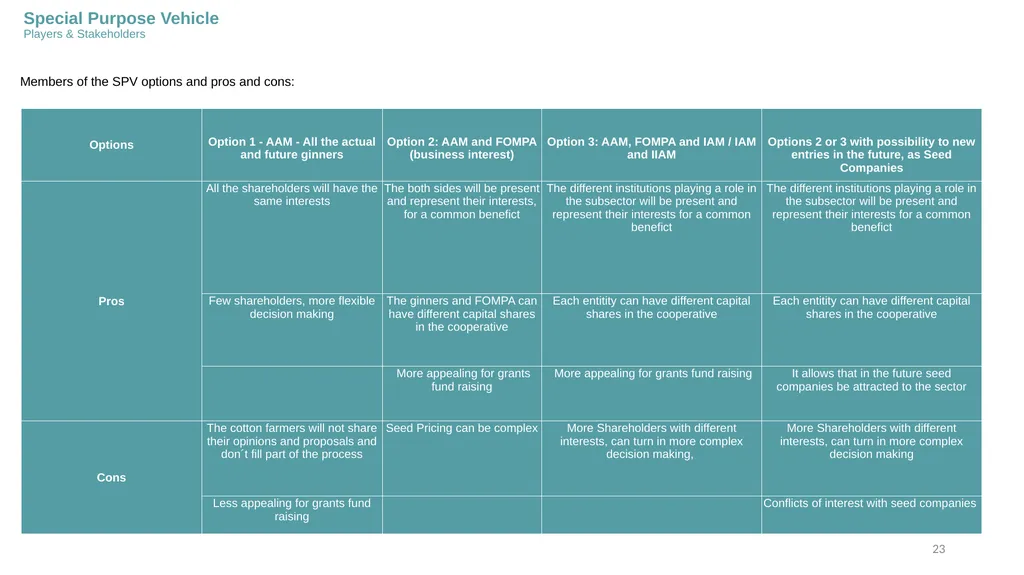
Players & Stakeholders Members of the SPV options and pros and cons: 23<br>
24
Special Purpose Vehicle
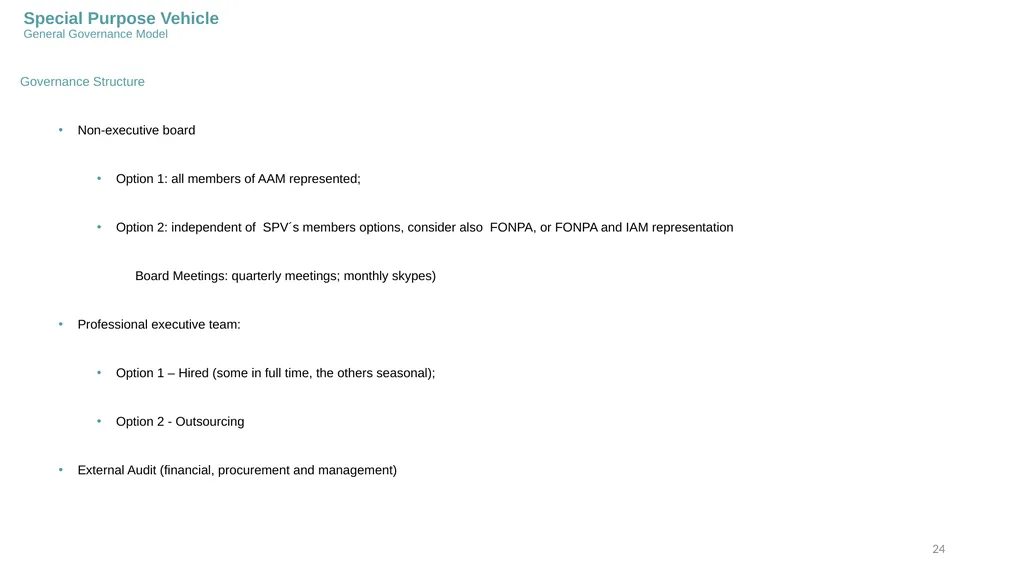
General Governance Model Governance Structure
Non-executive board
Option 1: all members of AAM represented;
Option 2: independent of SPV´s members options, consider also FONPA, or FONPA and IAM representation
Board Meetings: quarterly meetings; monthly skypes)
Professional executive team:
Option 1 – Hired (some in full time, the others seasonal);
Option 2 - Outsourcing
External Audit (financial, procurement and management) 24<br>
Non-executive board
Option 1: all members of AAM represented;
Option 2: independent of SPV´s members options, consider also FONPA, or FONPA and IAM representation
Board Meetings: quarterly meetings; monthly skypes)
Professional executive team:
Option 1 – Hired (some in full time, the others seasonal);
Option 2 - Outsourcing
External Audit (financial, procurement and management) 24<br>
25
Special Purpose Vehicle
Bylaws Main Principles of SPV Bylaws
List of at least 5 initial members
Article 1: Cooperative Legal name – To be Defined;
Article 2: Headquarters address – To be Defined
Article 3: Coop Objective: To improve the Cotton Seed Quality by Seed Delinting, Treatment and Test;
Article 4: Share Capital
Coop Total Share Capital – To be Defined
Coop Members minimum Share Capital – To be Defined
Article 5:
Definition of who can be a Coop member (according to the options of slide 6.2)
New members admission process;
Members dismissal process;
Article 6: Coop members rights
Participation in General Meetings
Elect and be elected to membership of the Coop Management Team;
Participate in all activities that are the object of the cooperative;
Resign from the cooperative at any time.
Received the delivered seed after treatment; 25<br>
List of at least 5 initial members
Article 1: Cooperative Legal name – To be Defined;
Article 2: Headquarters address – To be Defined
Article 3: Coop Objective: To improve the Cotton Seed Quality by Seed Delinting, Treatment and Test;
Article 4: Share Capital
Coop Total Share Capital – To be Defined
Coop Members minimum Share Capital – To be Defined
Article 5:
Definition of who can be a Coop member (according to the options of slide 6.2)
New members admission process;
Members dismissal process;
Article 6: Coop members rights
Participation in General Meetings
Elect and be elected to membership of the Coop Management Team;
Participate in all activities that are the object of the cooperative;
Resign from the cooperative at any time.
Received the delivered seed after treatment; 25<br>
26
Special Purpose Vehicle
Bylaws Main Principles of SPV Bylaws - Continuation
Article 7: Coop members Duties
Subscribing and paying the capital shares;
Deliver the cotton seed for treatment as defined in the pre-season of each year;
Do not carry out competitive activities with those carried out by the cooperative;
Ensuring loyalty to the cooperative;
Article 8: Coop Corporate Bodies
a) The General Meeting;
b) The Management Team;
c) The Fiscal Council.
Article 9: Coop Corporate Bodies election process and term of office 26<br>
Article 7: Coop members Duties
Subscribing and paying the capital shares;
Deliver the cotton seed for treatment as defined in the pre-season of each year;
Do not carry out competitive activities with those carried out by the cooperative;
Ensuring loyalty to the cooperative;
Article 8: Coop Corporate Bodies
a) The General Meeting;
b) The Management Team;
c) The Fiscal Council.
Article 9: Coop Corporate Bodies election process and term of office 26<br>
27
Special Purpose Vehicle
Accounting & Auditing Requirements Accounting Regime
Tax Obligations;
VAT – Normal Regime
IRPC – Organized Accounting – Income Taxes exemption (TBC)
IRPS
INSS
Accounting Services;
External Services Supplied
Internal responsible;
Administrative Responsible
Auditing Requirements
Internal Auditing
Procedures, responsible and responsibilities
External Auditing
Procedures, schedule and responsible
Transparency
Annual Report and Auditing presentation to Cooperative members;
Annual Operational and Financial Plan presentation to Cooperative members; 27<br>
Tax Obligations;
VAT – Normal Regime
IRPC – Organized Accounting – Income Taxes exemption (TBC)
IRPS
INSS
Accounting Services;
External Services Supplied
Internal responsible;
Administrative Responsible
Auditing Requirements
Internal Auditing
Procedures, responsible and responsibilities
External Auditing
Procedures, schedule and responsible
Transparency
Annual Report and Auditing presentation to Cooperative members;
Annual Operational and Financial Plan presentation to Cooperative members; 27<br>
28
7. Management Model
Management Body Managing body structure
1 Plant Manager + One Supervisor for the 2nd Shift with 2 Administrative Support Staff (1+1 per Shift)
Management Analysis and Decisions by the Plant Manager in team
Managing body members profile
1 Plant Manager, with good experience in Cotton Seed Diluted Acid Delinting and treatment industrial process management;
Term of Office
2 Years with possible extension
Responsibilities
Plant Management;
Technical Staff Management;
Administrative Support staff management;
Report to Board; 28<br>
1 Plant Manager + One Supervisor for the 2nd Shift with 2 Administrative Support Staff (1+1 per Shift)
Management Analysis and Decisions by the Plant Manager in team
Managing body members profile
1 Plant Manager, with good experience in Cotton Seed Diluted Acid Delinting and treatment industrial process management;
Term of Office
2 Years with possible extension
Responsibilities
Plant Management;
Technical Staff Management;
Administrative Support staff management;
Report to Board; 28<br>
29
Management Model
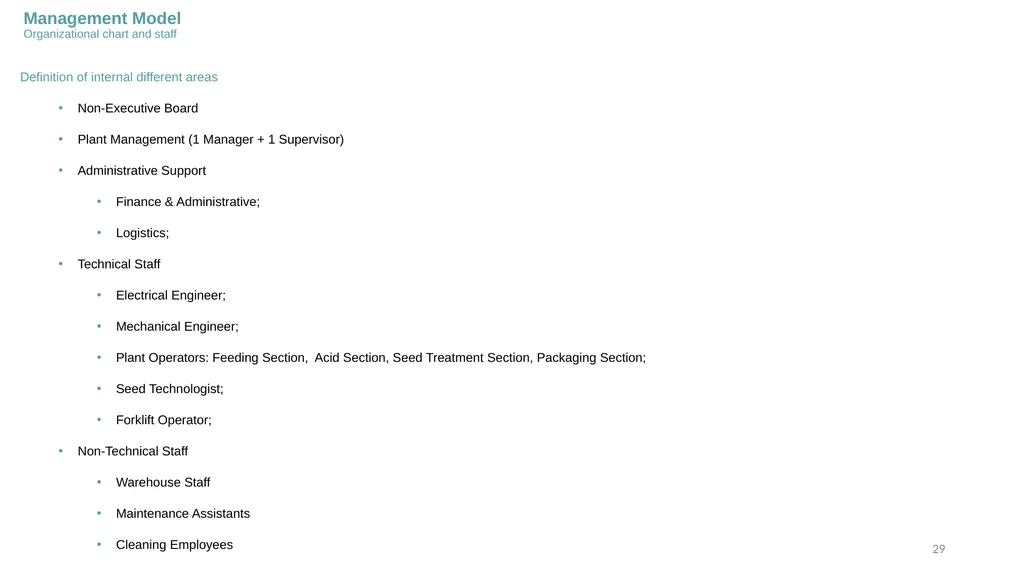
Organizational chart and staff Definition of internal different areas
Non-Executive Board
Plant Management (1 Manager + 1 Supervisor)
Administrative Support
Finance & Administrative;
Logistics;
Technical Staff
Electrical Engineer;
Mechanical Engineer;
Plant Operators: Feeding Section, Acid Section, Seed Treatment Section, Packaging Section;
Seed Technologist;
Forklift Operator;
Non-Technical Staff
Warehouse Staff
Maintenance Assistants
Cleaning Employees 29<br>
Non-Executive Board
Plant Management (1 Manager + 1 Supervisor)
Administrative Support
Finance & Administrative;
Logistics;
Technical Staff
Electrical Engineer;
Mechanical Engineer;
Plant Operators: Feeding Section, Acid Section, Seed Treatment Section, Packaging Section;
Seed Technologist;
Forklift Operator;
Non-Technical Staff
Warehouse Staff
Maintenance Assistants
Cleaning Employees 29<br>
30
Management Model
Organizational chart and staff Definition of internal areas organization
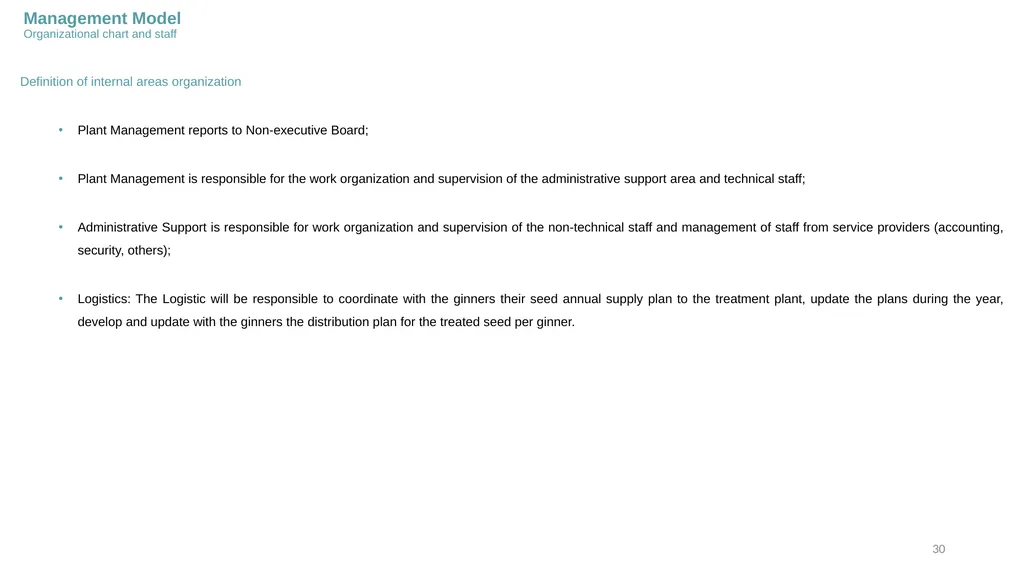
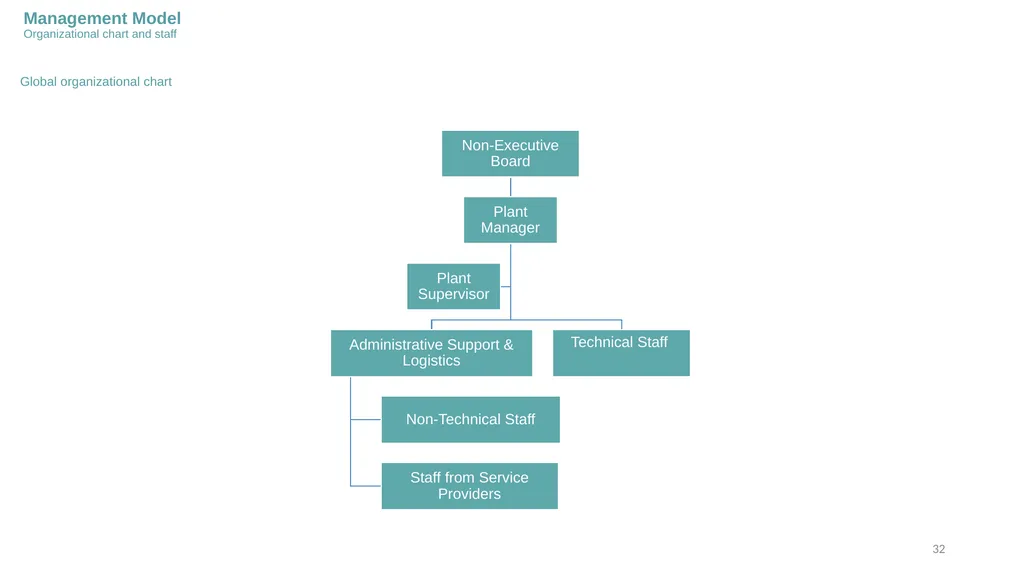
Plant Management reports to Non-executive Board;
Plant Management is responsible for the work organization and supervision of the administrative support area and technical staff;
Administrative Support is responsible for work organization and supervision of the non-technical staff and management of staff from service providers (accounting, security, others);
Logistics: The Logistic will be responsible to coordinate with the ginners their seed annual supply plan to the treatment plant, update the plans during the year, develop and update with the ginners the distribution plan for the treated seed per ginner. 30<br>
Plant Management reports to Non-executive Board;
Plant Management is responsible for the work organization and supervision of the administrative support area and technical staff;
Administrative Support is responsible for work organization and supervision of the non-technical staff and management of staff from service providers (accounting, security, others);
Logistics: The Logistic will be responsible to coordinate with the ginners their seed annual supply plan to the treatment plant, update the plans during the year, develop and update with the ginners the distribution plan for the treated seed per ginner. 30<br>
31
Management Model
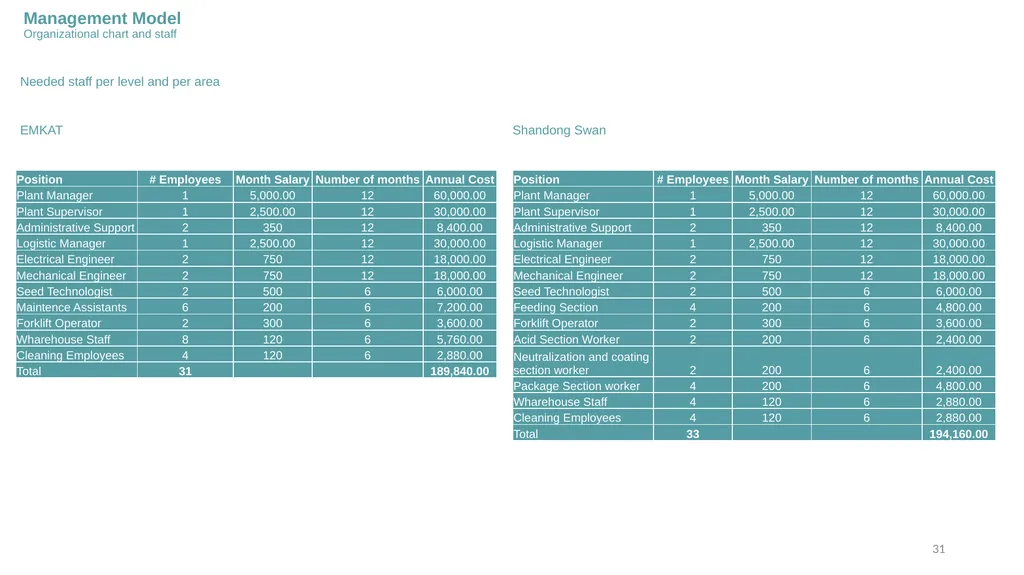
Organizational chart and staff Needed staff per level and per area
EMKAT Shandong Swan 31<br>
EMKAT Shandong Swan 31<br>
32
Management Model
Organizational chart and staff Global organizational chart 32<br>
33
Management Model
Recruitment and procurement policy Recruitment philosophy
National and Local staff priority when complies with the requirements;
No discrimination of any kind;
Prioritize experience in the management, technical staff and logistics;
For the plant managers, prioritize the indication or recommendation from the equipment's supplier for someone who managed some similar equipment's in other country or someone directly from the supplier;
Recruitment procedures
Responsible
Plant Managers: Recruitment Professional Services with final approval from the non executive board;
Administrative Support: Recruitment Professional Services with final approval from Plant Manager
Technical and Non-Technical Staff: Recruitment Professional Services with final approval from Plant Manager
Source-of-hire
Plant Manager: 1st option: Equipment Supplier indication, 2nd Option: Regional Procurement
Others: National Recruitment Services 33<br>
National and Local staff priority when complies with the requirements;
No discrimination of any kind;
Prioritize experience in the management, technical staff and logistics;
For the plant managers, prioritize the indication or recommendation from the equipment's supplier for someone who managed some similar equipment's in other country or someone directly from the supplier;
Recruitment procedures
Responsible
Plant Managers: Recruitment Professional Services with final approval from the non executive board;
Administrative Support: Recruitment Professional Services with final approval from Plant Manager
Technical and Non-Technical Staff: Recruitment Professional Services with final approval from Plant Manager
Source-of-hire
Plant Manager: 1st option: Equipment Supplier indication, 2nd Option: Regional Procurement
Others: National Recruitment Services 33<br>
34
Management Model
Recruitment and procurement policy Procurement
Procurement Philosophy
Administrative and Finance responsible must prepare an internal procedures guide, after consultation with logistic and technical responsible, in the short-term to be approved by Plant Manager and Presented to Non-Executive Board;
Competitive Biddings (Publication in National Newspaper and bid analysis;
Procurement procedures (to be detailed in the Internal procedures guide)
Responsible – Administrative Support Staff with Plant Manager Approval
Expenditure Limits
0>5.000 USD : 3 Proposals Tenders
5.000 USD > Max : Public Tender 34<br>
Procurement Philosophy
Administrative and Finance responsible must prepare an internal procedures guide, after consultation with logistic and technical responsible, in the short-term to be approved by Plant Manager and Presented to Non-Executive Board;
Competitive Biddings (Publication in National Newspaper and bid analysis;
Procurement procedures (to be detailed in the Internal procedures guide)
Responsible – Administrative Support Staff with Plant Manager Approval
Expenditure Limits
0>5.000 USD : 3 Proposals Tenders
5.000 USD > Max : Public Tender 34<br>
35
Management Model
Operational Criteria & Requirements Operational Criteria
Functional parameters
Time frames
Seed Reception – June and July
Seed Delinting and Treatment – August and September
Delinted and Treated Seed Deliver – September and October
Weights
5 and 25KG Seed Bags
Operational Requirements
Concept of operations
Diluted Acid Delinting, Treatment, Packaging
Operational functions/capabilities
10TN/Hour 35<br>
Functional parameters
Time frames
Seed Reception – June and July
Seed Delinting and Treatment – August and September
Delinted and Treated Seed Deliver – September and October
Weights
5 and 25KG Seed Bags
Operational Requirements
Concept of operations
Diluted Acid Delinting, Treatment, Packaging
Operational functions/capabilities
10TN/Hour 35<br>
36
8. Technical solution and feasibility
Delinting process type Possible Delinting Solutions
Mechanical delinting: It is a traditional process of delinting using brushes and is common in the oil industries but not for seed treatment. Mechanical delinting is not suitable for seed classification or for removing low density seeds, as the process does not remove all of the seed fibres.
Dry Gas Delinting with Hydrochloride Gas: The Hydrochloride Gas delinting process is used mainly in arid areas, where the moisture content of the cotton seed is less than 9% and the low humidity reduces the corrosion of equipment and installations. Hydrochloric gas is used to degrade fibres so that they can be removed from the seed by frictional forces. The Hydrochloride gas delinting process requires very sophisticated equipment, rigorous monitoring and strict control of the various operations for effective removal without damaging the seed. The main causes of seed damage in this process are very high reaction temperatures and gas concentration, very long reaction time and "excessive" neutralization with ammonia. Disintegration with poorly controlled and managed hydrochloride gas can cause a drastic reduction in seed germination and vigor.
Wet Acid Delinting: The wet sulphuric acid delinting system is preferred in wet areas. The process is relatively simple and does not require sophisticated equipment. The cotton seeds are fed into a reactor trough or tank and mixed with concentrated sulphuric acid. The main problem with this method is the high cost of sulphuric acid and the high negative environmental impact caused by the disposal of acid and washing water after the process.
Diluted Acid Delinting: The advantages of this process in relation to Wet-acid are a great reduction in the amount of sulphuric acid needed, having a great impact in reducing the cost of the process and still in the elimination of the effluent produced in wet-acid delinting, eliminating the existing environmental cost in the wet-acid process. For these reasons, the Diluted Sulphuric Acid method has been the most used worldwide for the process of delinting cotton seeds for seed treatment, resulting in a lower processing cost and reduced environmental impacts of the operation. 36<br>
Mechanical delinting: It is a traditional process of delinting using brushes and is common in the oil industries but not for seed treatment. Mechanical delinting is not suitable for seed classification or for removing low density seeds, as the process does not remove all of the seed fibres.
Dry Gas Delinting with Hydrochloride Gas: The Hydrochloride Gas delinting process is used mainly in arid areas, where the moisture content of the cotton seed is less than 9% and the low humidity reduces the corrosion of equipment and installations. Hydrochloric gas is used to degrade fibres so that they can be removed from the seed by frictional forces. The Hydrochloride gas delinting process requires very sophisticated equipment, rigorous monitoring and strict control of the various operations for effective removal without damaging the seed. The main causes of seed damage in this process are very high reaction temperatures and gas concentration, very long reaction time and "excessive" neutralization with ammonia. Disintegration with poorly controlled and managed hydrochloride gas can cause a drastic reduction in seed germination and vigor.
Wet Acid Delinting: The wet sulphuric acid delinting system is preferred in wet areas. The process is relatively simple and does not require sophisticated equipment. The cotton seeds are fed into a reactor trough or tank and mixed with concentrated sulphuric acid. The main problem with this method is the high cost of sulphuric acid and the high negative environmental impact caused by the disposal of acid and washing water after the process.
Diluted Acid Delinting: The advantages of this process in relation to Wet-acid are a great reduction in the amount of sulphuric acid needed, having a great impact in reducing the cost of the process and still in the elimination of the effluent produced in wet-acid delinting, eliminating the existing environmental cost in the wet-acid process. For these reasons, the Diluted Sulphuric Acid method has been the most used worldwide for the process of delinting cotton seeds for seed treatment, resulting in a lower processing cost and reduced environmental impacts of the operation. 36<br>
37
Technical solution and feasibility
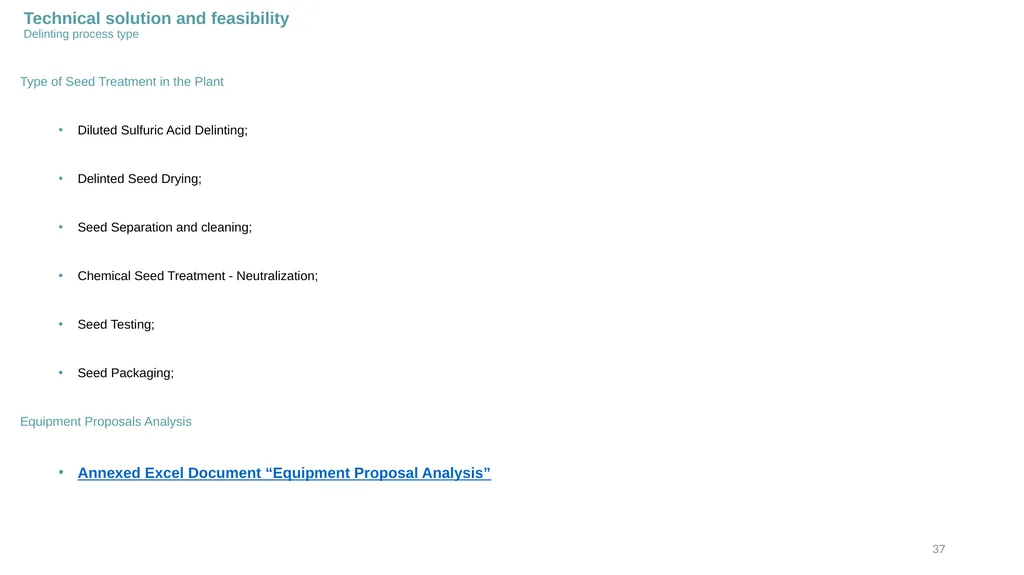
Delinting process type Type of Seed Treatment in the Plant
Diluted Sulfuric Acid Delinting;
Delinted Seed Drying;
Seed Separation and cleaning;
Chemical Seed Treatment - Neutralization;
Seed Testing;
Seed Packaging;
Equipment Proposals Analysis
Annexed Excel Document “Equipment Proposal Analysis” 37<br>
Diluted Sulfuric Acid Delinting;
Delinted Seed Drying;
Seed Separation and cleaning;
Chemical Seed Treatment - Neutralization;
Seed Testing;
Seed Packaging;
Equipment Proposals Analysis
Annexed Excel Document “Equipment Proposal Analysis” 37<br>
38
Technical solution and feasibility
Equipment Capacity Equipment capacity
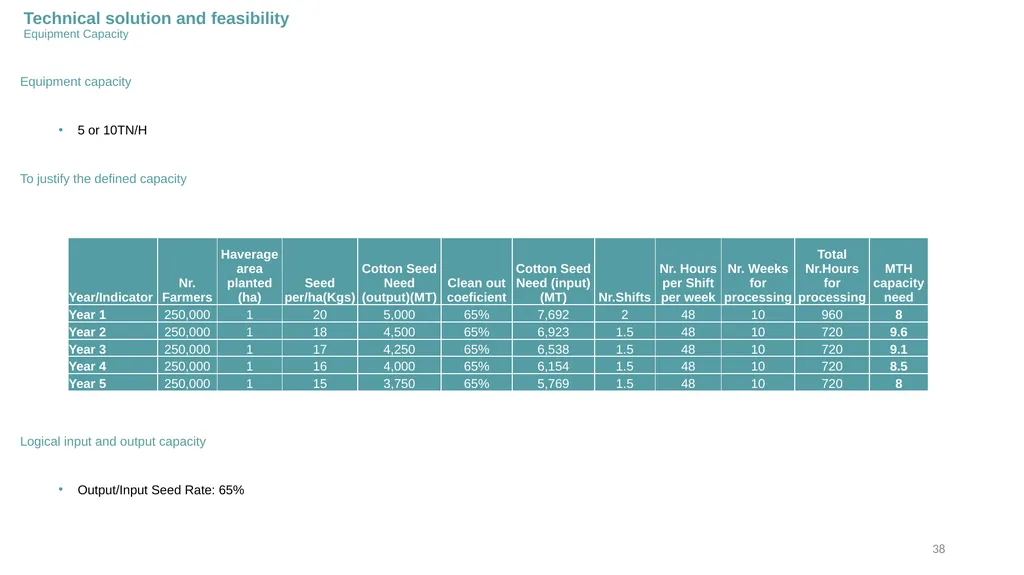
5 or 10TN/H
To justify the defined capacity
Logical input and output capacity
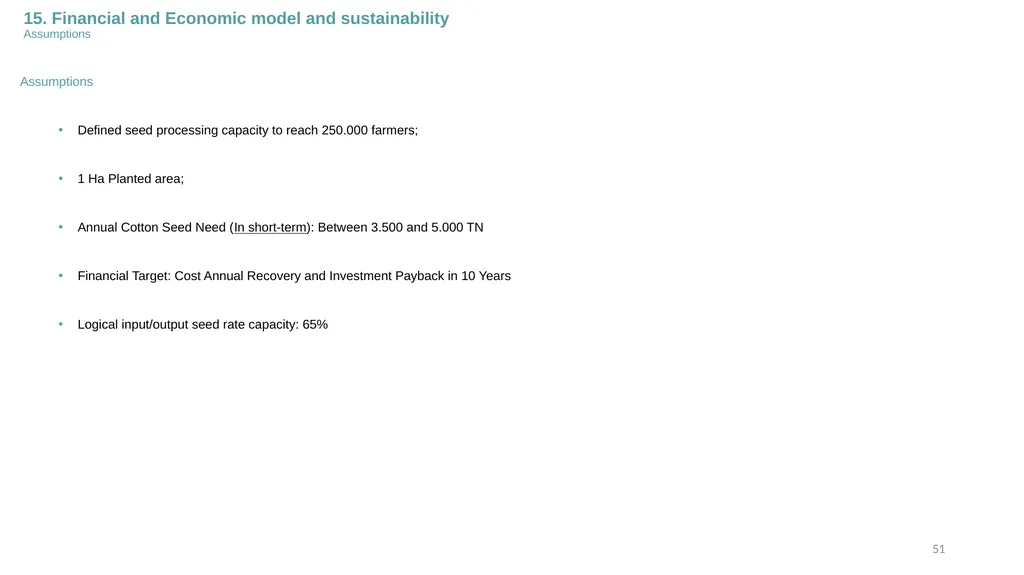
Output/Input Seed Rate: 65% 38<br>
5 or 10TN/H
To justify the defined capacity
Logical input and output capacity
Output/Input Seed Rate: 65% 38<br>
39
Technical solution and feasibility
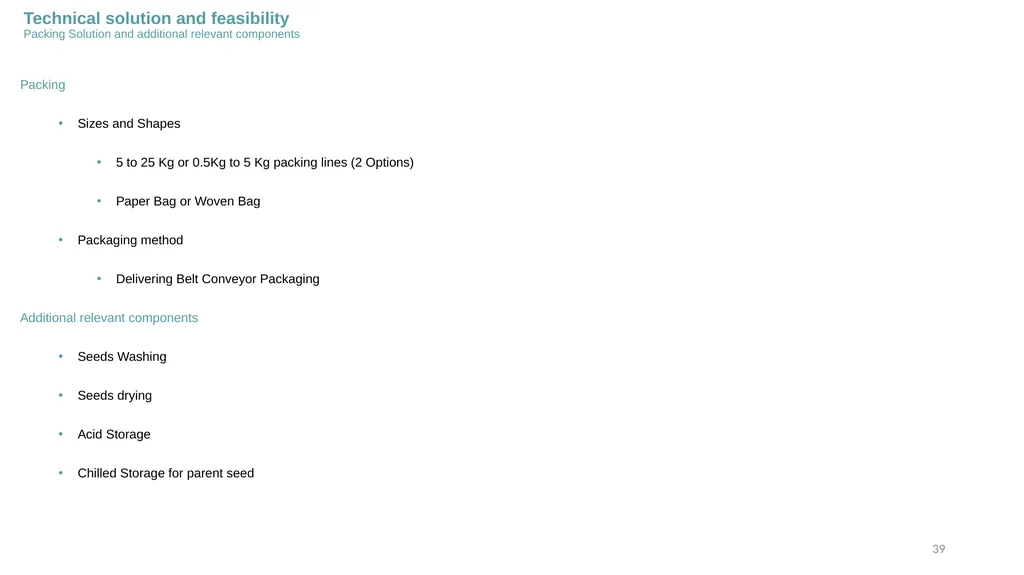
Packing Solution and additional relevant components Packing
Sizes and Shapes
5 to 25 Kg or 0.5Kg to 5 Kg packing lines (2 Options)
Paper Bag or Woven Bag
Packaging method
Delivering Belt Conveyor Packaging
Additional relevant components
Seeds Washing
Seeds drying
Acid Storage
Chilled Storage for parent seed 39<br>
Sizes and Shapes
5 to 25 Kg or 0.5Kg to 5 Kg packing lines (2 Options)
Paper Bag or Woven Bag
Packaging method
Delivering Belt Conveyor Packaging
Additional relevant components
Seeds Washing
Seeds drying
Acid Storage
Chilled Storage for parent seed 39<br>
40
9. Operational model
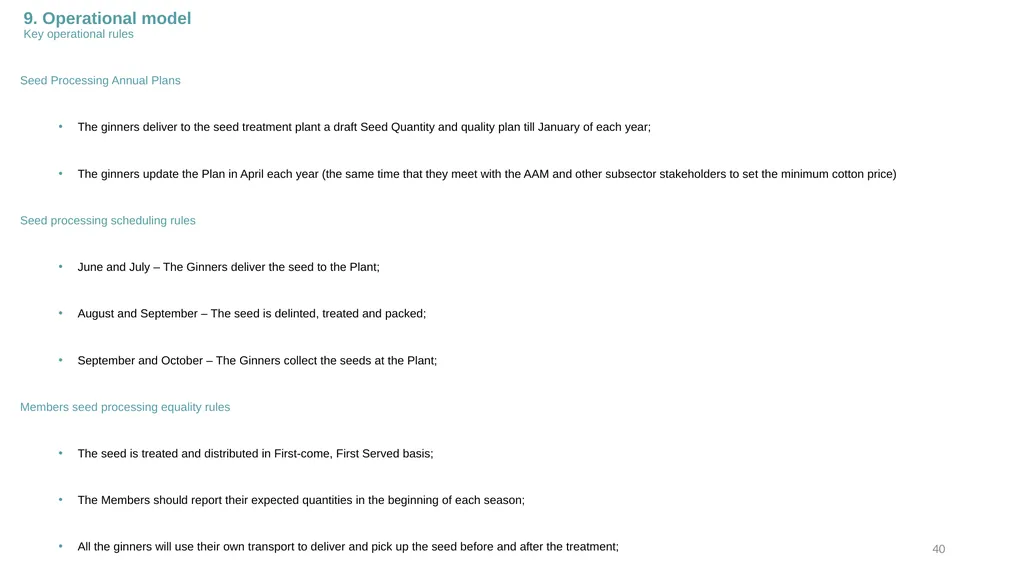
Key operational rules Seed Processing Annual Plans
The ginners deliver to the seed treatment plant a draft Seed Quantity and quality plan till January of each year;
The ginners update the Plan in April each year (the same time that they meet with the AAM and other subsector stakeholders to set the minimum cotton price)
Seed processing scheduling rules
June and July – The Ginners deliver the seed to the Plant;
August and September – The seed is delinted, treated and packed;
September and October – The Ginners collect the seeds at the Plant;
Members seed processing equality rules
The seed is treated and distributed in First-come, First Served basis;
The Members should report their expected quantities in the beginning of each season;
All the ginners will use their own transport to deliver and pick up the seed before and after the treatment; 40<br>
The ginners deliver to the seed treatment plant a draft Seed Quantity and quality plan till January of each year;
The ginners update the Plan in April each year (the same time that they meet with the AAM and other subsector stakeholders to set the minimum cotton price)
Seed processing scheduling rules
June and July – The Ginners deliver the seed to the Plant;
August and September – The seed is delinted, treated and packed;
September and October – The Ginners collect the seeds at the Plant;
Members seed processing equality rules
The seed is treated and distributed in First-come, First Served basis;
The Members should report their expected quantities in the beginning of each season;
All the ginners will use their own transport to deliver and pick up the seed before and after the treatment; 40<br>
41
10. Location & Facilities
Location Site location options pros & cons
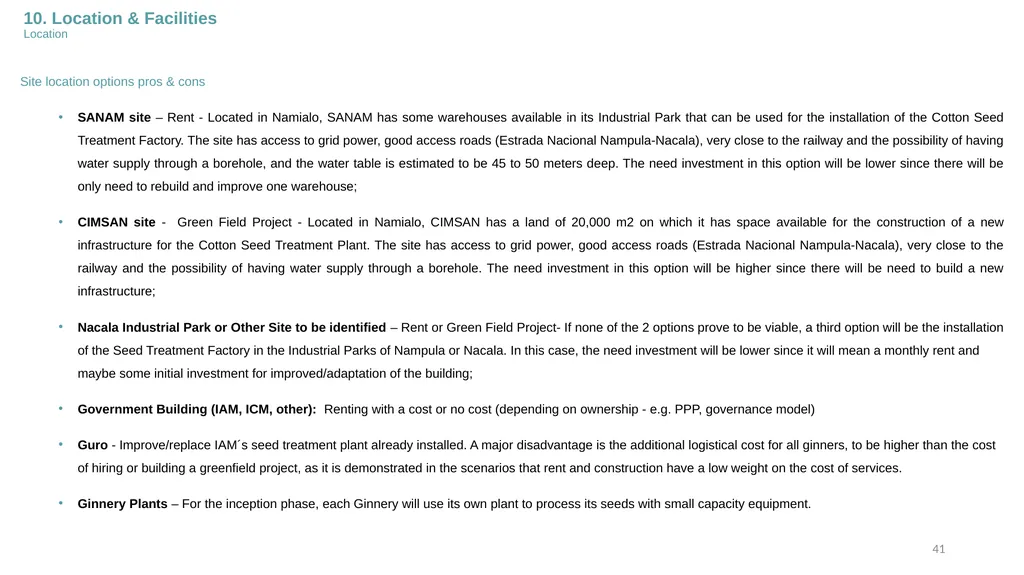
SANAM site – Rent - Located in Namialo, SANAM has some warehouses available in its Industrial Park that can be used for the installation of the Cotton Seed Treatment Factory. The site has access to grid power, good access roads (Estrada Nacional Nampula-Nacala), very close to the railway and the possibility of having water supply through a borehole, and the water table is estimated to be 45 to 50 meters deep. The need investment in this option will be lower since there will be only need to rebuild and improve one warehouse;
CIMSAN site - Green Field Project - Located in Namialo, CIMSAN has a land of 20,000 m2 on which it has space available for the construction of a new infrastructure for the Cotton Seed Treatment Plant. The site has access to grid power, good access roads (Estrada Nacional Nampula-Nacala), very close to the railway and the possibility of having water supply through a borehole. The need investment in this option will be higher since there will be need to build a new infrastructure;
Nacala Industrial Park or Other Site to be identified – Rent or Green Field Project- If none of the 2 options prove to be viable, a third option will be the installation of the Seed Treatment Factory in the Industrial Parks of Nampula or Nacala. In this case, the need investment will be lower since it will mean a monthly rent and maybe some initial investment for improved/adaptation of the building;
Government Building (IAM, ICM, other): Renting with a cost or no cost (depending on ownership - e.g. PPP, governance model)
Guro - Improve/replace IAM´s seed treatment plant already installed. A major disadvantage is the additional logistical cost for all ginners, to be higher than the cost of hiring or building a greenfield project, as it is demonstrated in the scenarios that rent and construction have a low weight on the cost of services.
Ginnery Plants – For the inception phase, each Ginnery will use its own plant to process its seeds with small capacity equipment. 41<br>
SANAM site – Rent - Located in Namialo, SANAM has some warehouses available in its Industrial Park that can be used for the installation of the Cotton Seed Treatment Factory. The site has access to grid power, good access roads (Estrada Nacional Nampula-Nacala), very close to the railway and the possibility of having water supply through a borehole, and the water table is estimated to be 45 to 50 meters deep. The need investment in this option will be lower since there will be only need to rebuild and improve one warehouse;
CIMSAN site - Green Field Project - Located in Namialo, CIMSAN has a land of 20,000 m2 on which it has space available for the construction of a new infrastructure for the Cotton Seed Treatment Plant. The site has access to grid power, good access roads (Estrada Nacional Nampula-Nacala), very close to the railway and the possibility of having water supply through a borehole. The need investment in this option will be higher since there will be need to build a new infrastructure;
Nacala Industrial Park or Other Site to be identified – Rent or Green Field Project- If none of the 2 options prove to be viable, a third option will be the installation of the Seed Treatment Factory in the Industrial Parks of Nampula or Nacala. In this case, the need investment will be lower since it will mean a monthly rent and maybe some initial investment for improved/adaptation of the building;
Government Building (IAM, ICM, other): Renting with a cost or no cost (depending on ownership - e.g. PPP, governance model)
Guro - Improve/replace IAM´s seed treatment plant already installed. A major disadvantage is the additional logistical cost for all ginners, to be higher than the cost of hiring or building a greenfield project, as it is demonstrated in the scenarios that rent and construction have a low weight on the cost of services.
Ginnery Plants – For the inception phase, each Ginnery will use its own plant to process its seeds with small capacity equipment. 41<br>
42
Location & Facilities
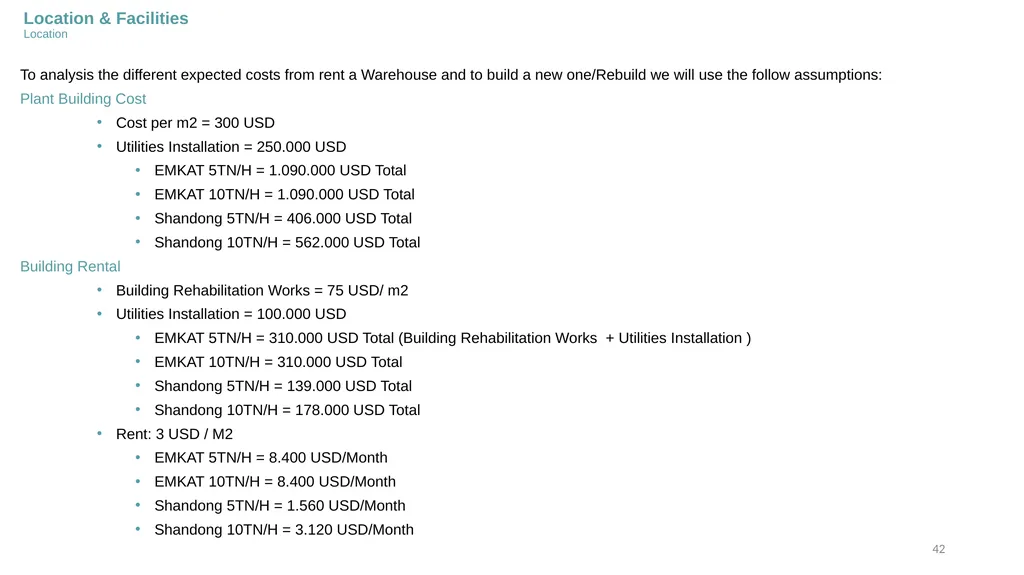
Location To analysis the different expected costs from rent a Warehouse and to build a new one/Rebuild we will use the follow assumptions:
Plant Building Cost
Cost per m2 = 300 USD
Utilities Installation = 250.000 USD
EMKAT 5TN/H = 1.090.000 USD Total
EMKAT 10TN/H = 1.090.000 USD Total
Shandong 5TN/H = 406.000 USD Total
Shandong 10TN/H = 562.000 USD Total
Building Rental
Building Rehabilitation Works = 75 USD/ m2
Utilities Installation = 100.000 USD
EMKAT 5TN/H = 310.000 USD Total (Building Rehabilitation Works + Utilities Installation )
EMKAT 10TN/H = 310.000 USD Total
Shandong 5TN/H = 139.000 USD Total
Shandong 10TN/H = 178.000 USD Total
Rent: 3 USD / M2
EMKAT 5TN/H = 8.400 USD/Month
EMKAT 10TN/H = 8.400 USD/Month
Shandong 5TN/H = 1.560 USD/Month
Shandong 10TN/H = 3.120 USD/Month 42<br>
Plant Building Cost
Cost per m2 = 300 USD
Utilities Installation = 250.000 USD
EMKAT 5TN/H = 1.090.000 USD Total
EMKAT 10TN/H = 1.090.000 USD Total
Shandong 5TN/H = 406.000 USD Total
Shandong 10TN/H = 562.000 USD Total
Building Rental
Building Rehabilitation Works = 75 USD/ m2
Utilities Installation = 100.000 USD
EMKAT 5TN/H = 310.000 USD Total (Building Rehabilitation Works + Utilities Installation )
EMKAT 10TN/H = 310.000 USD Total
Shandong 5TN/H = 139.000 USD Total
Shandong 10TN/H = 178.000 USD Total
Rent: 3 USD / M2
EMKAT 5TN/H = 8.400 USD/Month
EMKAT 10TN/H = 8.400 USD/Month
Shandong 5TN/H = 1.560 USD/Month
Shandong 10TN/H = 3.120 USD/Month 42<br>
43
Location & Facilities
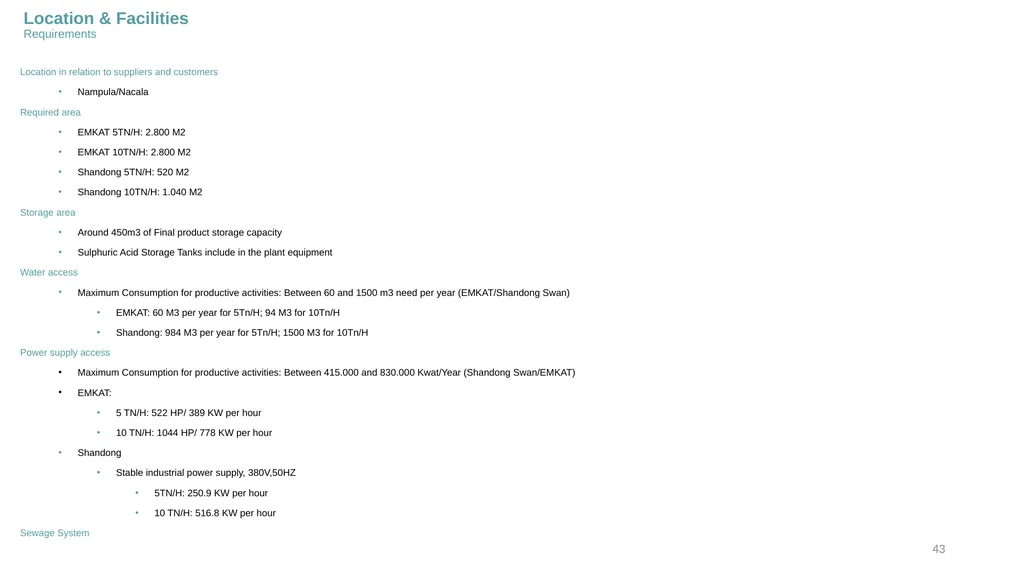
Requirements Location in relation to suppliers and customers
Nampula/Nacala
Required area
EMKAT 5TN/H: 2.800 M2
EMKAT 10TN/H: 2.800 M2
Shandong 5TN/H: 520 M2
Shandong 10TN/H: 1.040 M2
Storage area
Around 450m3 of Final product storage capacity
Sulphuric Acid Storage Tanks include in the plant equipment
Water access
Maximum Consumption for productive activities: Between 60 and 1500 m3 need per year (EMKAT/Shandong Swan)
EMKAT: 60 M3 per year for 5Tn/H; 94 M3 for 10Tn/H
Shandong: 984 M3 per year for 5Tn/H; 1500 M3 for 10Tn/H
Power supply access
Maximum Consumption for productive activities: Between 415.000 and 830.000 Kwat/Year (Shandong Swan/EMKAT)
EMKAT:
5 TN/H: 522 HP/ 389 KW per hour
10 TN/H: 1044 HP/ 778 KW per hour
Shandong
Stable industrial power supply, 380V,50HZ
5TN/H: 250.9 KW per hour
10 TN/H: 516.8 KW per hour
Sewage System 43<br>
Nampula/Nacala
Required area
EMKAT 5TN/H: 2.800 M2
EMKAT 10TN/H: 2.800 M2
Shandong 5TN/H: 520 M2
Shandong 10TN/H: 1.040 M2
Storage area
Around 450m3 of Final product storage capacity
Sulphuric Acid Storage Tanks include in the plant equipment
Water access
Maximum Consumption for productive activities: Between 60 and 1500 m3 need per year (EMKAT/Shandong Swan)
EMKAT: 60 M3 per year for 5Tn/H; 94 M3 for 10Tn/H
Shandong: 984 M3 per year for 5Tn/H; 1500 M3 for 10Tn/H
Power supply access
Maximum Consumption for productive activities: Between 415.000 and 830.000 Kwat/Year (Shandong Swan/EMKAT)
EMKAT:
5 TN/H: 522 HP/ 389 KW per hour
10 TN/H: 1044 HP/ 778 KW per hour
Shandong
Stable industrial power supply, 380V,50HZ
5TN/H: 250.9 KW per hour
10 TN/H: 516.8 KW per hour
Sewage System 43<br>
44
Location & Facilities
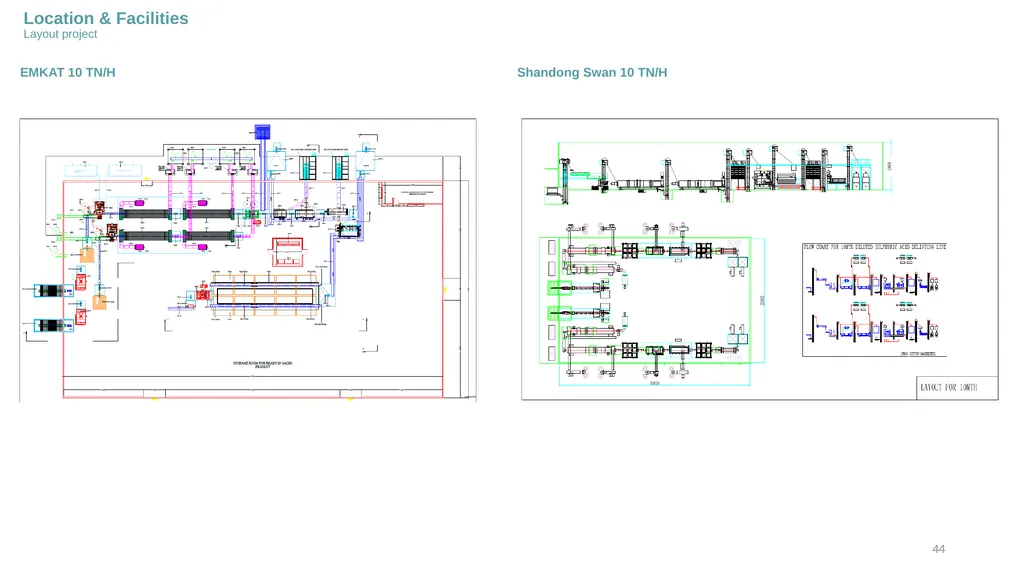
Layout project EMKAT 10 TN/H Shandong Swan 10 TN/H 44<br>
45
11. Environmental assessment requirements Definition of Environmental Assessment grade that applies (B or C):
The Seed Treatment Plant does not fall into category A as long as its location is not in protected areas or areas with specific conditions;
The activity “Processing or seed treatment” is not included as an example in any of the Categories B or C. Although “delinting” with diluted sulphuric acid is considered a delinting method without major environmental impacts, due to the use of sulphuric acid in the process of treatment of cotton seeds it appears that it will be included in Category B, to be confirmed after the submission of the Process Instruction at MITADER.
Requirement for EIA (Environmental impact study) or EAS (Simplified Environmental Study)
Step 1: Registration or Instruction of the Process through the Provincial Directorate of Land, Environment and Rural Development (DPTADER) of Nampula using the attached form.
If the feedback of DPTADER is into category B, there is a need for a Simplified Environmental Study (EAS).
If the feedback of DPTADER is into category C, the project is exempt from EIA or EAS;
Timeline
Pre-evaluation feedback: up to 8 working days;
Terms of reference for EAS feedback: up to 15 working days
Simplified environmental study feedback: up to 30 working days;
Issuance of the environmental license: 8 working days, after payment of the fees due;
Applicable fees
Category B: 0.1% of the total investment amount.
Category C: 0.01% of the total investment amount. 45<br>
The Seed Treatment Plant does not fall into category A as long as its location is not in protected areas or areas with specific conditions;
The activity “Processing or seed treatment” is not included as an example in any of the Categories B or C. Although “delinting” with diluted sulphuric acid is considered a delinting method without major environmental impacts, due to the use of sulphuric acid in the process of treatment of cotton seeds it appears that it will be included in Category B, to be confirmed after the submission of the Process Instruction at MITADER.
Requirement for EIA (Environmental impact study) or EAS (Simplified Environmental Study)
Step 1: Registration or Instruction of the Process through the Provincial Directorate of Land, Environment and Rural Development (DPTADER) of Nampula using the attached form.
If the feedback of DPTADER is into category B, there is a need for a Simplified Environmental Study (EAS).
If the feedback of DPTADER is into category C, the project is exempt from EIA or EAS;
Timeline
Pre-evaluation feedback: up to 8 working days;
Terms of reference for EAS feedback: up to 15 working days
Simplified environmental study feedback: up to 30 working days;
Issuance of the environmental license: 8 working days, after payment of the fees due;
Applicable fees
Category B: 0.1% of the total investment amount.
Category C: 0.01% of the total investment amount. 45<br>
46
Environmental assessment requirements 46<br>
47
12. Legal & Legislation requirements
Operation License Operation Licenses that applies
Alvará – MIC/BAU
Licensing with the National Seed Authority – ANS (Autoridade Nacional de Sementes) 47<br>
Alvará – MIC/BAU
Licensing with the National Seed Authority – ANS (Autoridade Nacional de Sementes) 47<br>
48
13. Marketing Mix Product
Delinted and Treated Cotton Seed
Price
~
Place
The Input Seed is delivered in the plant by the ginneries responsibility;
The Delinted and treated seed is collected by the ginneries in the plant; 48<br>
Delinted and Treated Cotton Seed
Price
~
Place
The Input Seed is delivered in the plant by the ginneries responsibility;
The Delinted and treated seed is collected by the ginneries in the plant; 48<br>
49
14. Investment and Operational budget
Investment Needs CAPEX (excel sheet with details in annex)
Bayer Option: SeedGrowth – ONLY Seed Treatment.
Purchase: Equipment Options CBT 12TN/H – 155.594.62 USD Cash / RH800 35 T/H – 106.520.25 USD Cash
Loan/Financing Model (Average): 0,42– 0,45 USD/Kg (delinted)
Shandong Doyen – Small Capacity Individual Equipment for each Ginner
Capacity: 150-200KG/H ( Acid Delinter, Seed Cleaner, Seed Coating and Packaging, TA, Building works ) – 183.971,00 USD
OPEX/Working Capital
1st Option: The ginneries pay in advance a portion (e.g. 50%) of the service to be provided regarding their expected seed to treat;
2nd Option: Increase the funding amount in between 1.1 M and 1.4 M USD depending on the chosen equipment for working capital 49<br>
Bayer Option: SeedGrowth – ONLY Seed Treatment.
Purchase: Equipment Options CBT 12TN/H – 155.594.62 USD Cash / RH800 35 T/H – 106.520.25 USD Cash
Loan/Financing Model (Average): 0,42– 0,45 USD/Kg (delinted)
Shandong Doyen – Small Capacity Individual Equipment for each Ginner
Capacity: 150-200KG/H ( Acid Delinter, Seed Cleaner, Seed Coating and Packaging, TA, Building works ) – 183.971,00 USD
OPEX/Working Capital
1st Option: The ginneries pay in advance a portion (e.g. 50%) of the service to be provided regarding their expected seed to treat;
2nd Option: Increase the funding amount in between 1.1 M and 1.4 M USD depending on the chosen equipment for working capital 49<br>
50
Investment and Operational budget
Waste treatment plan EMKAT
They consider their plants as zero waste plants. The cyclones receiving the hydrolysed fibre are only 95% efficient. That means 5% is wasted in the air. For an extra cost of €60,000 they can provide a complete dedusting technology.
Shandong Swan
Cyclone system in the proposal can catch more than 80% dust and the other less than 20% dust to the air or surrounding area. There is a pulse dust collector, which help to catch the rest dust to 99%. The investment is about USD15, 000. Sulphide Air to atmosphere. It needs a separate system to dealing after pulse dust collector, which need USD285000 already included in the investment plan. 50<br>
They consider their plants as zero waste plants. The cyclones receiving the hydrolysed fibre are only 95% efficient. That means 5% is wasted in the air. For an extra cost of €60,000 they can provide a complete dedusting technology.
Shandong Swan
Cyclone system in the proposal can catch more than 80% dust and the other less than 20% dust to the air or surrounding area. There is a pulse dust collector, which help to catch the rest dust to 99%. The investment is about USD15, 000. Sulphide Air to atmosphere. It needs a separate system to dealing after pulse dust collector, which need USD285000 already included in the investment plan. 50<br>
51
15. Financial and Economic model and sustainability
Assumptions Assumptions
Defined seed processing capacity to reach 250.000 farmers;
1 Ha Planted area;
Annual Cotton Seed Need (In short-term): Between 3.500 and 5.000 TN
Financial Target: Cost Annual Recovery and Investment Payback in 10 Years
Logical input/output seed rate capacity: 65% 51<br>
Defined seed processing capacity to reach 250.000 farmers;
1 Ha Planted area;
Annual Cotton Seed Need (In short-term): Between 3.500 and 5.000 TN
Financial Target: Cost Annual Recovery and Investment Payback in 10 Years
Logical input/output seed rate capacity: 65% 51<br>
52
Financial and Economic model and sustainability
Assumptions 52<br>
53
Financial and Economic model and sustainability
Different Scenarios – Feasibility Indicator 53<br>
54
16. Risk Assessment & Mitigation Strategy 54<br>
55
17. Impact and Sustainability
At Farmer level 55<br>
56
Impact and Sustainability
At Ginneries level 56<br>
57
18. Decision Phase 1 - Inception Phase
Each of the ginners will purchase individual equipment, at it´s own seed capacity need, with co-funding raised by AAM and Technical assistance and training provided to all ginners staff, who will run the small seed plant and field team.
A data collection system will be installed and M&E reports will be developed to learn from the challenges and the real impact in the SHF´s yields, etc.
This will run for 2 years, and then start the 2nd phase, with an update/review of the full plant for the sector.
Phase 2 - Full plant for the sector
With the learnings from the 2 years inception phase and visits during third year to seed delinting plants from the two selected offers, update/review the procurement process, decide and start implementation.
Decision Advantages
Less Investment with the inception phase. Each ginner will invest 160.000 USD per 200Kg/H unit instead of 1.2M USD ( most economical option from SWAN) or 3.2M USD (most economical option from EMKAT);
There is no reliable information about the impact in terms of the increase in yields in general, and the inception phase will allow to have reliable information about it;
It allows learning time for the ginners contributing to reduce mistakes in phase 2 after a higher investment;
Following the Liebig law of the minimum, will be more efficient to invest less in the seed technology in the inception phase and also invest in Technical Assistance regarding delinted seed benefits research and small holder farmers motivation. In this model, the investment in the phase 2 will be more efficient and less risky. 57<br>
Each of the ginners will purchase individual equipment, at it´s own seed capacity need, with co-funding raised by AAM and Technical assistance and training provided to all ginners staff, who will run the small seed plant and field team.
A data collection system will be installed and M&E reports will be developed to learn from the challenges and the real impact in the SHF´s yields, etc.
This will run for 2 years, and then start the 2nd phase, with an update/review of the full plant for the sector.
Phase 2 - Full plant for the sector
With the learnings from the 2 years inception phase and visits during third year to seed delinting plants from the two selected offers, update/review the procurement process, decide and start implementation.
Decision Advantages
Less Investment with the inception phase. Each ginner will invest 160.000 USD per 200Kg/H unit instead of 1.2M USD ( most economical option from SWAN) or 3.2M USD (most economical option from EMKAT);
There is no reliable information about the impact in terms of the increase in yields in general, and the inception phase will allow to have reliable information about it;
It allows learning time for the ginners contributing to reduce mistakes in phase 2 after a higher investment;
Following the Liebig law of the minimum, will be more efficient to invest less in the seed technology in the inception phase and also invest in Technical Assistance regarding delinted seed benefits research and small holder farmers motivation. In this model, the investment in the phase 2 will be more efficient and less risky. 57<br>
58
19. Implementation plan & Schedule 58<br>
59
20. Bibliography Maleia, Manuel Pedro (2014) Avaliação da Adaptabilidade de Variedades de Algodão em Moçambique, CIMSAN, Namialo
P. Van der ven C. Viot and C. Montagnon (2017), Cotton Variety Intelligence Mozambique, RD2 Vision, Saint-Mathieu-de-Tréviers
AAM (2018), Updating the subsector's priorities from the perspective of the AAM
AAM (2015), AAM report on support and softening mechanisms for cotton prices (2015)
Ministério da Agricultura da República de Moçambique (2013), Sub-program to revitalize the cotton value chain in Mozambique, Maputo
Boletim da República (2015), Regulation for cotton culture
CIMSAN (2019), Mechanisms for improving cotton seed quality, Nampula
Ministério da Agricultura da República de Moçambique (2019), International Cotton Price Dynamics, Nampula
Autoridade Tributária de Moçambique (2019), Diesel Incident Rate Incentives - Agriculture Sector, Nampula
Instituto do Algodão de Moçambique (2019), Implementation of the Craft Textiles Initiative, Nampula
Instituto do Algodão de Moçambique (2019), Matrix of the Decisions of the I Advisory Council for Cotton and Other Textile Fibers, Nampula
Delouche, James C. (1981), Harvest and Post-harvest Factors Affecting the Quality of Cotton Planting Seed and Seed Quality Evaluation, Mississippi Agricultural and Forestry Experiment Station, USA
Decreto 12/2013 (2013), Seed Regulation, Moçambique
Lei nº 23/2009 (2009), New Law of Modern Cooperatives, Moçambique
OECD/FAO (2019), “OECD-FAO Agricultural Outlook”, OECD Agriculture statistics (database), http://dx.doi.org/10.1787/agr-outl-data-en.
Mozambique Cotton Institute : https://www.iam.gov.mz/
Better Cotton Initiative: https://bettercotton.org/where-is-better-cotton-grown/mozambique/ 59<br>
P. Van der ven C. Viot and C. Montagnon (2017), Cotton Variety Intelligence Mozambique, RD2 Vision, Saint-Mathieu-de-Tréviers
AAM (2018), Updating the subsector's priorities from the perspective of the AAM
AAM (2015), AAM report on support and softening mechanisms for cotton prices (2015)
Ministério da Agricultura da República de Moçambique (2013), Sub-program to revitalize the cotton value chain in Mozambique, Maputo
Boletim da República (2015), Regulation for cotton culture
CIMSAN (2019), Mechanisms for improving cotton seed quality, Nampula
Ministério da Agricultura da República de Moçambique (2019), International Cotton Price Dynamics, Nampula
Autoridade Tributária de Moçambique (2019), Diesel Incident Rate Incentives - Agriculture Sector, Nampula
Instituto do Algodão de Moçambique (2019), Implementation of the Craft Textiles Initiative, Nampula
Instituto do Algodão de Moçambique (2019), Matrix of the Decisions of the I Advisory Council for Cotton and Other Textile Fibers, Nampula
Delouche, James C. (1981), Harvest and Post-harvest Factors Affecting the Quality of Cotton Planting Seed and Seed Quality Evaluation, Mississippi Agricultural and Forestry Experiment Station, USA
Decreto 12/2013 (2013), Seed Regulation, Moçambique
Lei nº 23/2009 (2009), New Law of Modern Cooperatives, Moçambique
OECD/FAO (2019), “OECD-FAO Agricultural Outlook”, OECD Agriculture statistics (database), http://dx.doi.org/10.1787/agr-outl-data-en.
Mozambique Cotton Institute : https://www.iam.gov.mz/
Better Cotton Initiative: https://bettercotton.org/where-is-better-cotton-grown/mozambique/ 59<br>