BY - Dr. B. Kumar ASSISTANT PROFESSOR DEPT. OF ANIMAL GENETICS AND BREEDING Bihar Veterinary College, Patna-14 BASU Computer Classified on the Basis of Purpose Size Computers Classified on the Basis of purpose The computers are also
"BY - Dr. B. Kumar ASSISTANT PROFESSOR DEPT. OF" is the property of its rightful owner. Permission is granted to
download and print the materials on this website for personal, non-commercial use only, and to display it
on your personal computer provided you do not modify the materials and that you retain all copyright
notices contained in the materials. By downloading content from our website, you accept the terms of this
agreement.
Presentation Transcript
01
BY - Dr. B. Kumar ASSISTANT PROFESSOR DEPT. OF ANIMAL GENETICS AND BREEDING Bihar Veterinary College, Patna-14 BASU<br>
02
Computer Classified on the Basis of Purpose & Size<br>
03
Computers Classified on the Basis of purpose The computers are also classified according to the purpose, i.e., the type of data to be processed. You know that a computer accepts the data in digital form. However, there are computers, which accept data in analogous form.
Classification of computers based on purpose: Three types
Analog Computer
Digital Computer
Hybrid Computer<br>
04
Analog computer An Analog computer works on varying physical quantities. The data input to a computer is continuous in nature and the result is obtained after comparison. Examples are Meter scale, Thermometer, Speedometer, Voltmeter, etc.<br>
05
Digital computert The Digital computer accepts the data in binary form (0’s and 1’s). Zero (0) means OFF, i.e. low signal and (1) means ON, i.e. high signal. It gives result in terms of digital. All personal computers and laptops are digital in nature. The devices like calculators, digital watches and digital cricket scoreboards fall under this category.<br>
06
Hybrid computer A Hybrid computer has combined features of both the digital and analog computers. The result obtained can be compared with the known value of the system and can also be directly visualized. Thus, it has the advantage of both, the system.<br>
07
Computers Classified on the Basis of Size Computers are also categorized on the basis of their size. To deal with a lot of data, the size of a computer also changes (in terms of processing speed and storage capacity). Generally, we use Personal Computers and they are seen at homes, shops and schools, etc.
Classification of computers based on size : These are mainly Four Type
Microcomputer
Minicomputer
Mainframe computer
Supercomputer<br>
08
Microcomputers Microcomputers, due to their compact (small) size multiple uses, are widely used in homes, offices, business, shops and schools. The microcomputers were first developed by IBM (International Business Machines) Corporation. These computers are also known as Personal Computers.<br>
09
Minicomputers Minicomputers are smaller than mainframe computers but bigger than microcomputers. These computers have higher capacity to store data and also support multi-user system and Local Area Network (LAN). Example is Apple Minicomputer.<br>
10
Mainframe computers Mainframe computers are large computers with huge storage capacity. These computers are generally used in large industries, banking organizations and advanced scientific research centers, etc.<br>
11
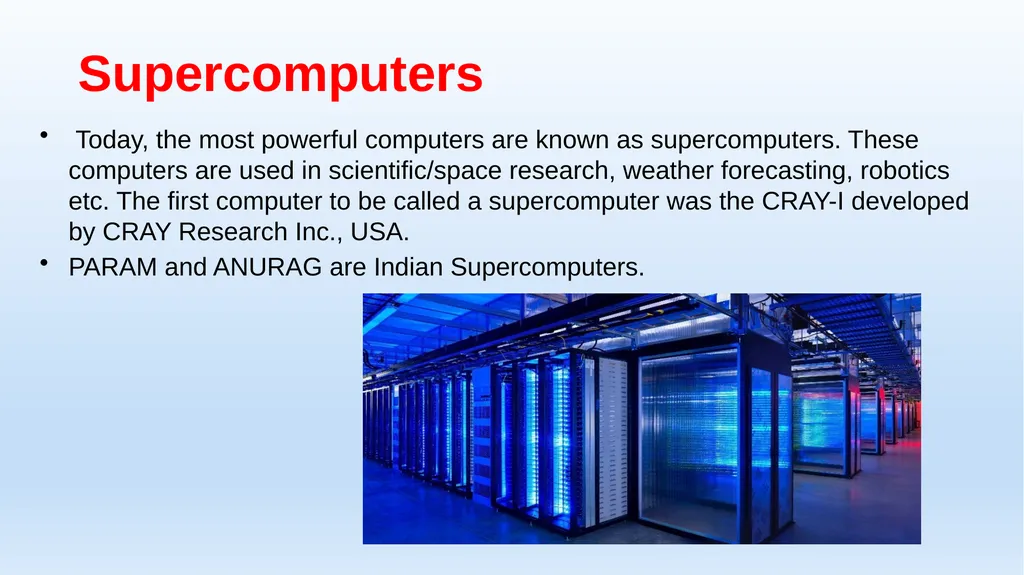
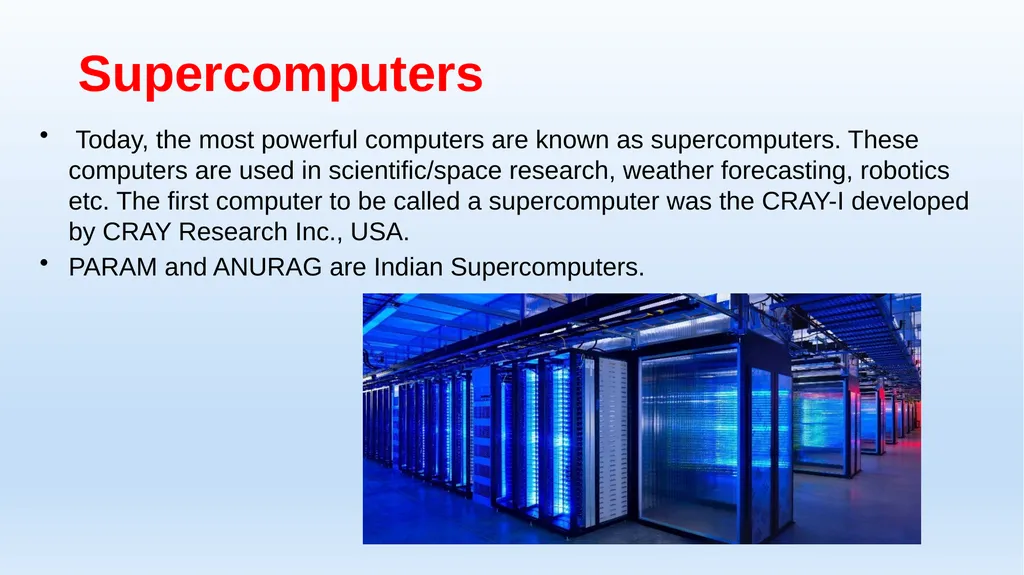
Supercomputers Today, the most powerful computers are known as supercomputers. These computers are used in scientific/space research, weather forecasting, robotics etc. The first computer to be called a supercomputer was the CRAY-I developed by CRAY Research Inc., USA.
PARAM and ANURAG are Indian Supercomputers.<br>
12
Supercomputers Today, the most powerful computers are known as supercomputers. These computers are used in scientific/space research, weather forecasting, robotics etc. The first computer to be called a supercomputer was the CRAY-I developed by CRAY Research Inc., USA.
PARAM and ANURAG are Indian Supercomputers.<br>