
Call For Proposals Skills development for
T
Published · 47 slides · 0 views
1 / 1

Description
Call For Proposals Skills development for increased employability of vulnerable youth, women and girls in Kampala Metropolitan Information sessions proposal stage Presentation outline Introduction objectives (Emmanuel) Selection process
Related Topics
Share
Embed code
Download this presentation From Below
"Call For Proposals Skills development for" is the property of its rightful owner. Permission is granted to download and print the materials on this website for personal, non-commercial use only, and to display it on your personal computer provided you do not modify the materials and that you retain all copyright notices contained in the materials. By downloading content from our website, you accept the terms of this agreement.
Presentation Transcript
01
Call For Proposals
Skills development for increased employability of vulnerable youth, women and girls in Kampala Metropolitan Information sessions – proposal stage<br>
02
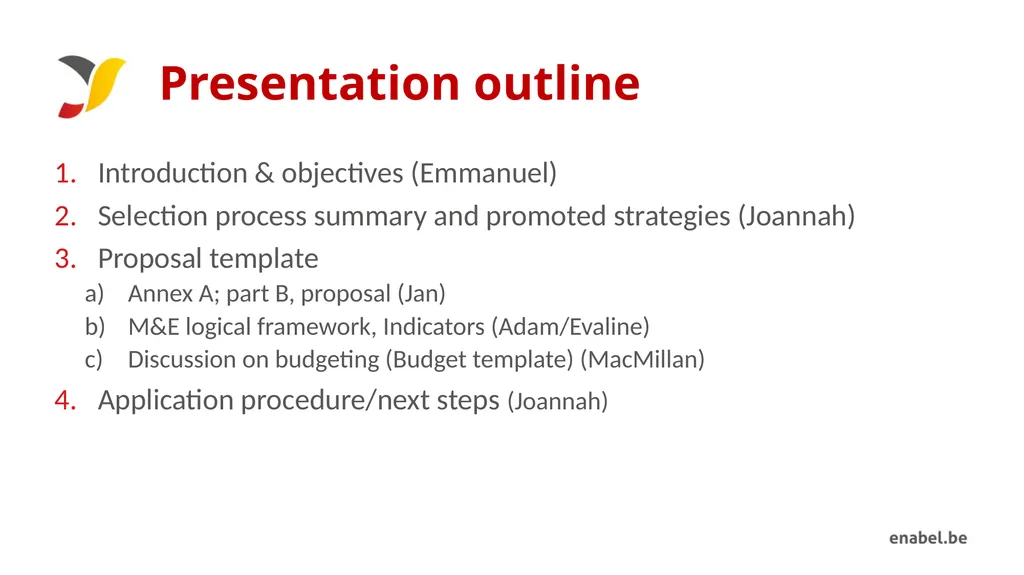
Presentation outline Introduction & objectives (Emmanuel)
Selection process summary and promoted strategies (Joannah)
Proposal template
Annex A; part B, proposal (Jan)
M&E logical framework, Indicators (Adam/Evaline)
Discussion on budgeting (Budget template) (MacMillan)
Application procedure/next steps (Joannah)<br>
Selection process summary and promoted strategies (Joannah)
Proposal template
Annex A; part B, proposal (Jan)
M&E logical framework, Indicators (Adam/Evaline)
Discussion on budgeting (Budget template) (MacMillan)
Application procedure/next steps (Joannah)<br>
03
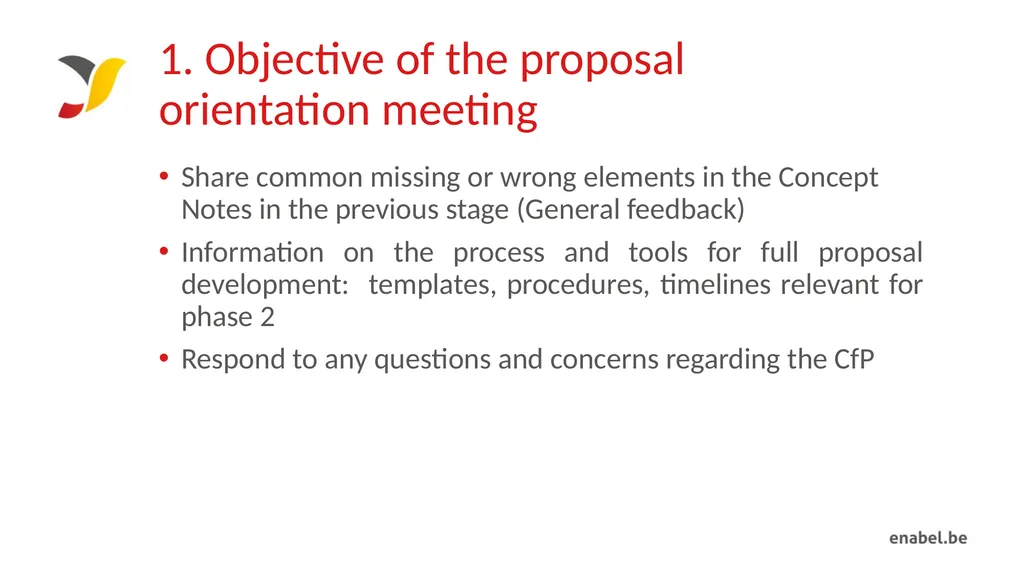
1. Objective of the proposal orientation meeting Share common missing or wrong elements in the Concept Notes in the previous stage (General feedback)
Information on the process and tools for full proposal development: templates, procedures, timelines relevant for phase 2
Respond to any questions and concerns regarding the CfP<br>
Information on the process and tools for full proposal development: templates, procedures, timelines relevant for phase 2
Respond to any questions and concerns regarding the CfP<br>
04
1. Objectives of the call Guidelines, annexes, clarifications (Q&A) and all other communication:
https://www.enabel.be/grants/
Call reference number: UGA22003-10008
Call Title: SKILLS DEVELOPMENT FOR INCREASED EMPLOYABILITY OF VULNERABLE YOUTH, REFUGEES, WOMEN AND GIRLS IN KAMPALA METROPOLITAN AREA<br>
https://www.enabel.be/grants/
Call reference number: UGA22003-10008
Call Title: SKILLS DEVELOPMENT FOR INCREASED EMPLOYABILITY OF VULNERABLE YOUTH, REFUGEES, WOMEN AND GIRLS IN KAMPALA METROPOLITAN AREA<br>
05
1. Call Objectives General objective
The livelihoods of vulnerable youth are improved through enhanced access to quality, demand-driven skills development and employment support services
Specific objective
The provision of skills development is more equitable, qualitative, innovative, and labour market-driven for increased employment opportunities 1. Introduction & objectives - RECAP of the CfPs<br>
The livelihoods of vulnerable youth are improved through enhanced access to quality, demand-driven skills development and employment support services
Specific objective
The provision of skills development is more equitable, qualitative, innovative, and labour market-driven for increased employment opportunities 1. Introduction & objectives - RECAP of the CfPs<br>
06
1. Call objectives Partnerships between training providers and private sector actors in skills development are promoted
2000 vulnerable youth are equipped with quality, labour market relevant skills
2000 vulnerable youth have enhanced access to wage and self-employment through post-training support services
Good practices in skills development are identified, documented and supported to scale up 1. Introduction & objectives - RECAP of the CfPs<br>
2000 vulnerable youth are equipped with quality, labour market relevant skills
2000 vulnerable youth have enhanced access to wage and self-employment through post-training support services
Good practices in skills development are identified, documented and supported to scale up 1. Introduction & objectives - RECAP of the CfPs<br>
07
1. Call Objectives Target groups:
Vulnerable youth who are low or non-skilled and face barriers to access employment and socio-economic integration and residing in the eligible districts and city authorities
Vulnerable = (a combination of) different categories of youth:
Urban refugees (registered as refugees by OPM/UNHCR)
Young women
Youth with disabilities / chronic diseases
Youth in poverty
Youth not in employment, education or training<br>
Vulnerable youth who are low or non-skilled and face barriers to access employment and socio-economic integration and residing in the eligible districts and city authorities
Vulnerable = (a combination of) different categories of youth:
Urban refugees (registered as refugees by OPM/UNHCR)
Young women
Youth with disabilities / chronic diseases
Youth in poverty
Youth not in employment, education or training<br>
08
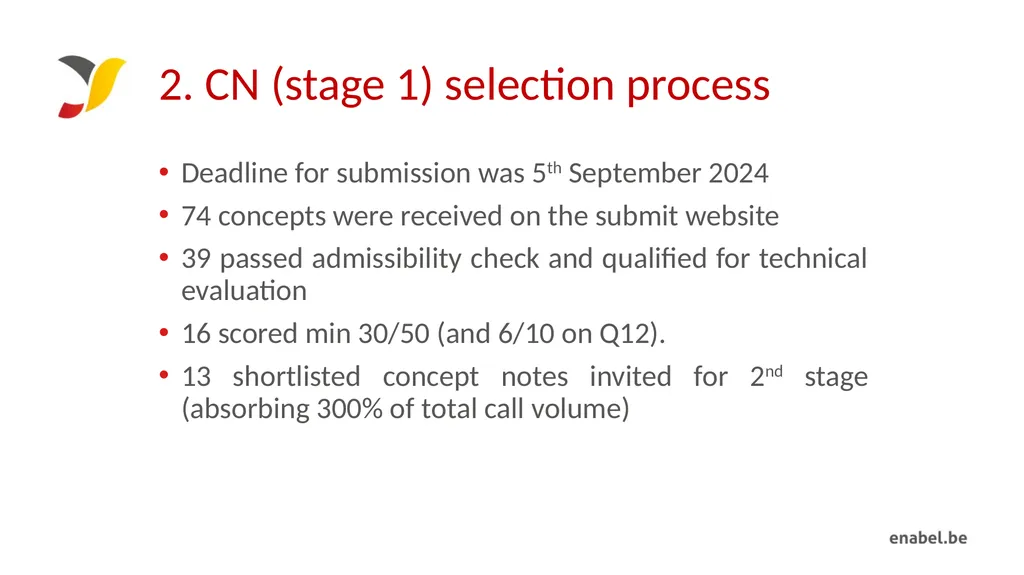
2. CN (stage 1) selection process Deadline for submission was 5th September 2024
74 concepts were received on the submit website
39 passed admissibility check and qualified for technical evaluation
16 scored min 30/50 (and 6/10 on Q12).
13 shortlisted concept notes invited for 2nd stage (absorbing 300% of total call volume)<br>
74 concepts were received on the submit website
39 passed admissibility check and qualified for technical evaluation
16 scored min 30/50 (and 6/10 on Q12).
13 shortlisted concept notes invited for 2nd stage (absorbing 300% of total call volume)<br>
09
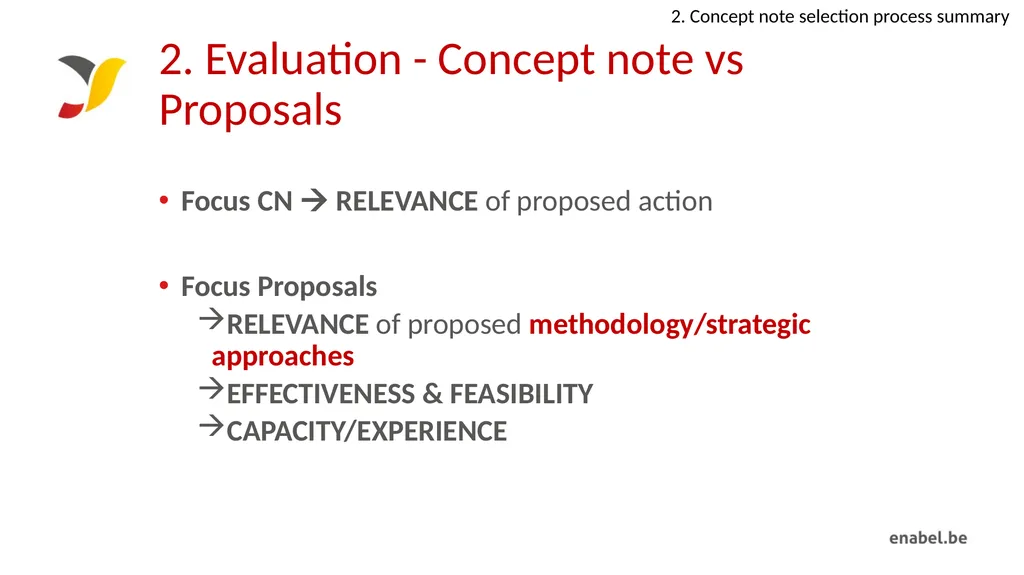
2. Evaluation - Concept note vs Proposals Focus CN RELEVANCE of proposed action
Focus Proposals
RELEVANCE of proposed methodology/strategic approaches
EFFECTIVENESS & FEASIBILITY
CAPACITY/EXPERIENCE 2. Concept note selection process summary<br>
Focus Proposals
RELEVANCE of proposed methodology/strategic approaches
EFFECTIVENESS & FEASIBILITY
CAPACITY/EXPERIENCE 2. Concept note selection process summary<br>
10
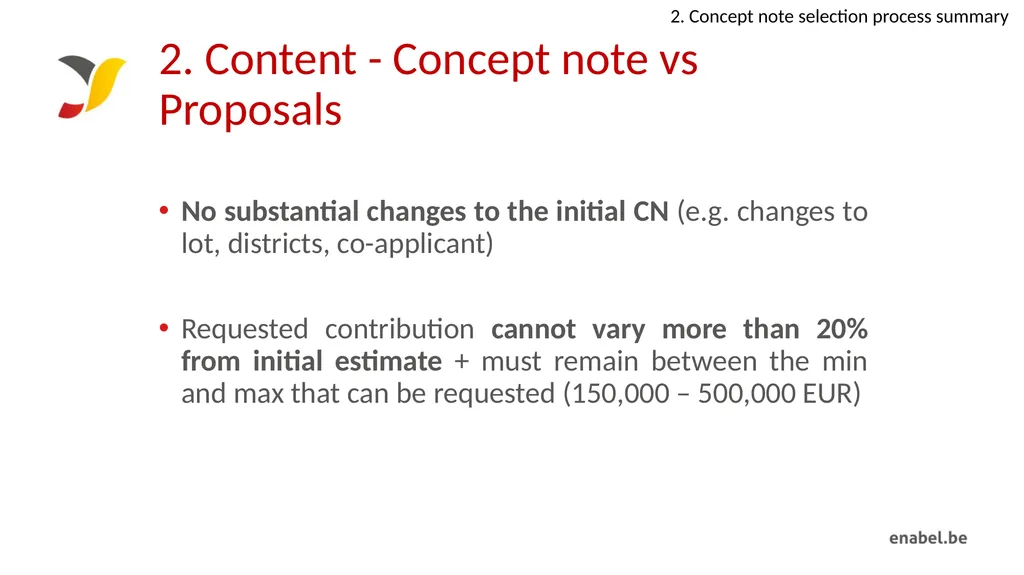
2. Content - Concept note vs Proposals No substantial changes to the initial CN (e.g. changes to lot, districts, co-applicant)
Requested contribution cannot vary more than 20% from initial estimate + must remain between the min and max that can be requested (150,000 – 500,000 EUR) 2. Concept note selection process summary<br>
Requested contribution cannot vary more than 20% from initial estimate + must remain between the min and max that can be requested (150,000 – 500,000 EUR) 2. Concept note selection process summary<br>
11
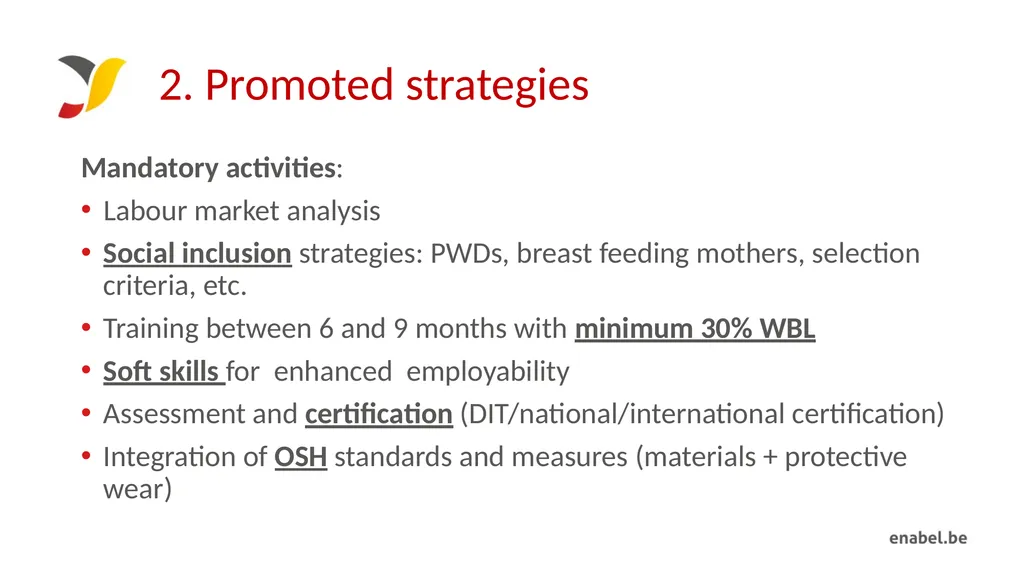
2. Promoted strategies Mandatory activities:
Labour market analysis
Social inclusion strategies: PWDs, breast feeding mothers, selection criteria, etc.
Training between 6 and 9 months with minimum 30% WBL
Soft skills for enhanced employability
Assessment and certification (DIT/national/international certification)
Integration of OSH standards and measures (materials + protective wear)<br>
Labour market analysis
Social inclusion strategies: PWDs, breast feeding mothers, selection criteria, etc.
Training between 6 and 9 months with minimum 30% WBL
Soft skills for enhanced employability
Assessment and certification (DIT/national/international certification)
Integration of OSH standards and measures (materials + protective wear)<br>
12
2. Promoted strategies Engagement of private sector in all stages to enhance employability and employment prospects
Provision of relevant start-up kits and/or micro business grants
Minimum 6 months extensive and innovative post-training employment support/business startup support services<br>
Provision of relevant start-up kits and/or micro business grants
Minimum 6 months extensive and innovative post-training employment support/business startup support services<br>
13
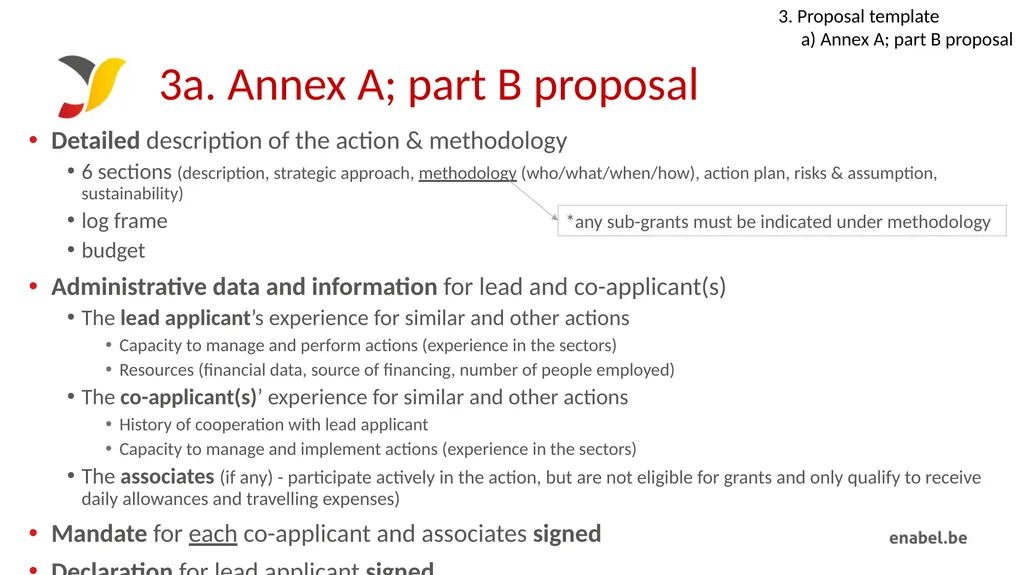
3a. Annex A; part B proposal Detailed description of the action & methodology
6 sections (description, strategic approach, methodology (who/what/when/how), action plan, risks & assumption, sustainability)
log frame
budget
Administrative data and information for lead and co-applicant(s)
The lead applicant’s experience for similar and other actions
Capacity to manage and perform actions (experience in the sectors)
Resources (financial data, source of financing, number of people employed)
The co-applicant(s)’ experience for similar and other actions
History of cooperation with lead applicant
Capacity to manage and implement actions (experience in the sectors)
The associates (if any) - participate actively in the action, but are not eligible for grants and only qualify to receive daily allowances and travelling expenses)
Mandate for each co-applicant and associates signed
Declaration for lead applicant signed 3. Proposal template
a) Annex A; part B proposal *any sub-grants must be indicated under methodology<br>
6 sections (description, strategic approach, methodology (who/what/when/how), action plan, risks & assumption, sustainability)
log frame
budget
Administrative data and information for lead and co-applicant(s)
The lead applicant’s experience for similar and other actions
Capacity to manage and perform actions (experience in the sectors)
Resources (financial data, source of financing, number of people employed)
The co-applicant(s)’ experience for similar and other actions
History of cooperation with lead applicant
Capacity to manage and implement actions (experience in the sectors)
The associates (if any) - participate actively in the action, but are not eligible for grants and only qualify to receive daily allowances and travelling expenses)
Mandate for each co-applicant and associates signed
Declaration for lead applicant signed 3. Proposal template
a) Annex A; part B proposal *any sub-grants must be indicated under methodology<br>
14
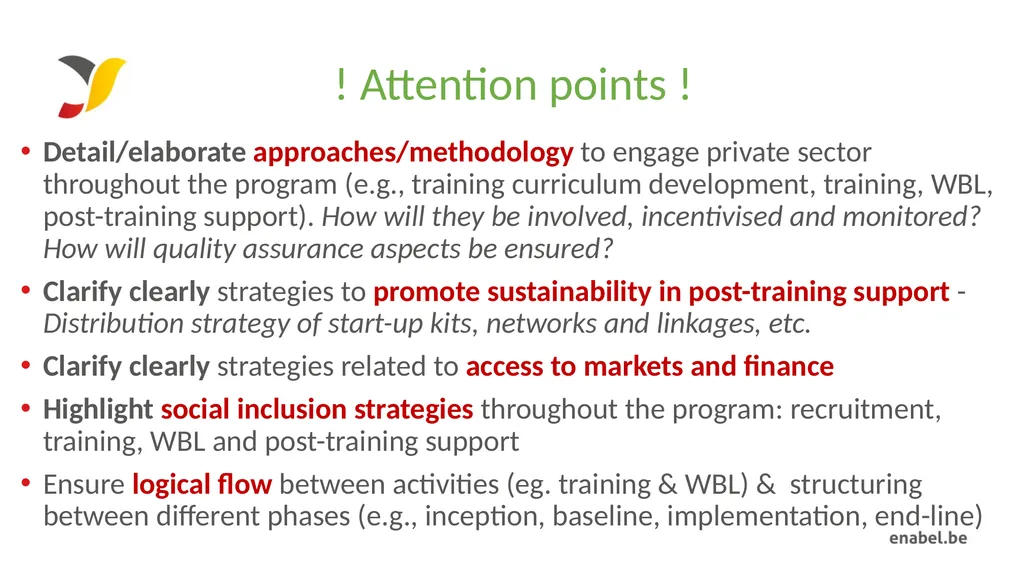
! Attention points ! Detail/elaborate approaches/methodology to engage private sector throughout the program (e.g., training curriculum development, training, WBL, post-training support). How will they be involved, incentivised and monitored? How will quality assurance aspects be ensured?
Clarify clearly strategies to promote sustainability in post-training support - Distribution strategy of start-up kits, networks and linkages, etc.
Clarify clearly strategies related to access to markets and finance
Highlight social inclusion strategies throughout the program: recruitment, training, WBL and post-training support
Ensure logical flow between activities (eg. training & WBL) & structuring between different phases (e.g., inception, baseline, implementation, end-line)<br>
Clarify clearly strategies to promote sustainability in post-training support - Distribution strategy of start-up kits, networks and linkages, etc.
Clarify clearly strategies related to access to markets and finance
Highlight social inclusion strategies throughout the program: recruitment, training, WBL and post-training support
Ensure logical flow between activities (eg. training & WBL) & structuring between different phases (e.g., inception, baseline, implementation, end-line)<br>
15
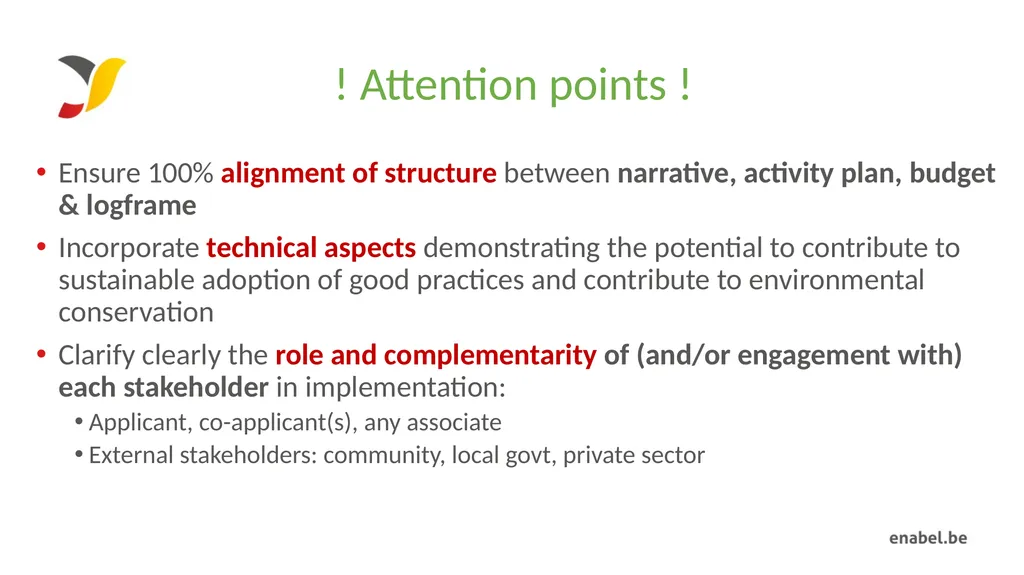
! Attention points ! Ensure 100% alignment of structure between narrative, activity plan, budget & logframe
Incorporate technical aspects demonstrating the potential to contribute to sustainable adoption of good practices and contribute to environmental conservation
Clarify clearly the role and complementarity of (and/or engagement with) each stakeholder in implementation:
Applicant, co-applicant(s), any associate
External stakeholders: community, local govt, private sector<br>
Incorporate technical aspects demonstrating the potential to contribute to sustainable adoption of good practices and contribute to environmental conservation
Clarify clearly the role and complementarity of (and/or engagement with) each stakeholder in implementation:
Applicant, co-applicant(s), any associate
External stakeholders: community, local govt, private sector<br>
16
Provision of start-up kits and/or micro business grants, tailored to specific business needs or business plans developed by targeted youth (if applicable)
Start-up kits maximum 15% of the budget
to provide a strategy on how the kits will effectively promote sustainable business development and not distort the local ecosystem and market
Micro business grants can only be rewarded to maximum 20% of the supported youth ! Attention points !<br>
Start-up kits maximum 15% of the budget
to provide a strategy on how the kits will effectively promote sustainable business development and not distort the local ecosystem and market
Micro business grants can only be rewarded to maximum 20% of the supported youth ! Attention points !<br>
17
3a. Sub-grants RECAP (if applicable) Sub-granting to sub-recipients of sub-grants is allowed in the form of;
Micro-business grants to graduates for investment/capital RECAP of the CfPs Sub- granting is optional not mandatory
In application form, the following details should be clearly provided:
The description of the objectives and results to be achieved with these sub- grants, the fundamental principles, the key concepts, the mechanisms, the actors and their role in the management process;
The criteria and modalities for the allocation of grants, accessibility conditions sub-beneficiaries, conditions for the admissibility of sub-projects, eligibility conditions for activities, costs and expenses;
The procedures for examining and awarding applications;
The maximum amount that can be allocated by sub-beneficiary;
The terms of contractualization with the sub-beneficiary;
The procedures and modalities for disbursing resources;
The procedures and modalities for technical and financial monitoring;
The procedures and modalities of control.<br>
Micro-business grants to graduates for investment/capital RECAP of the CfPs Sub- granting is optional not mandatory
In application form, the following details should be clearly provided:
The description of the objectives and results to be achieved with these sub- grants, the fundamental principles, the key concepts, the mechanisms, the actors and their role in the management process;
The criteria and modalities for the allocation of grants, accessibility conditions sub-beneficiaries, conditions for the admissibility of sub-projects, eligibility conditions for activities, costs and expenses;
The procedures for examining and awarding applications;
The maximum amount that can be allocated by sub-beneficiary;
The terms of contractualization with the sub-beneficiary;
The procedures and modalities for disbursing resources;
The procedures and modalities for technical and financial monitoring;
The procedures and modalities of control.<br>
18
I. Micro-business sub-grants – conditions:
The maximum amount for the sub-grants under this category is EUR 250 per supported youth/youth owned business;
Maximum 20% of supported youth/youth-owned businesses under the action can be eligible for a micro business grant;
To be eligible for a micro business grant, supported youth must have successfully completed the training organized under the action, be certified and present a sound and viable business plan/model;
Approval of micro business grants for supported youth/youth-owned businesses will be done by a selection committee which is to include representatives of Enabel, and by applying different evaluation criteria including (but not limited to) the viability of the business plan/model, vision/sound projections, financial need and relevance, technical and economic feasibility, experience and motivation of the applicant, etc.
Types of activities eligible for micro business grants include purchase of equipment, raw materials and inventory, marketing and advertising activities, or start-up related costs for newly developed businesses;
The following costs are ineligible for sub-granting: non-business-related costs (e.g. personal expenses or assets) and repayment of existing debts or loans.
Payment modalities cannot include any payment in cash. 3a. Sub-grants RECAP (if applicable) RECAP of the CfPs<br>
The maximum amount for the sub-grants under this category is EUR 250 per supported youth/youth owned business;
Maximum 20% of supported youth/youth-owned businesses under the action can be eligible for a micro business grant;
To be eligible for a micro business grant, supported youth must have successfully completed the training organized under the action, be certified and present a sound and viable business plan/model;
Approval of micro business grants for supported youth/youth-owned businesses will be done by a selection committee which is to include representatives of Enabel, and by applying different evaluation criteria including (but not limited to) the viability of the business plan/model, vision/sound projections, financial need and relevance, technical and economic feasibility, experience and motivation of the applicant, etc.
Types of activities eligible for micro business grants include purchase of equipment, raw materials and inventory, marketing and advertising activities, or start-up related costs for newly developed businesses;
The following costs are ineligible for sub-granting: non-business-related costs (e.g. personal expenses or assets) and repayment of existing debts or loans.
Payment modalities cannot include any payment in cash. 3a. Sub-grants RECAP (if applicable) RECAP of the CfPs<br>
19
3. Proposal template
a) Annex A; part B proposal<br>
20
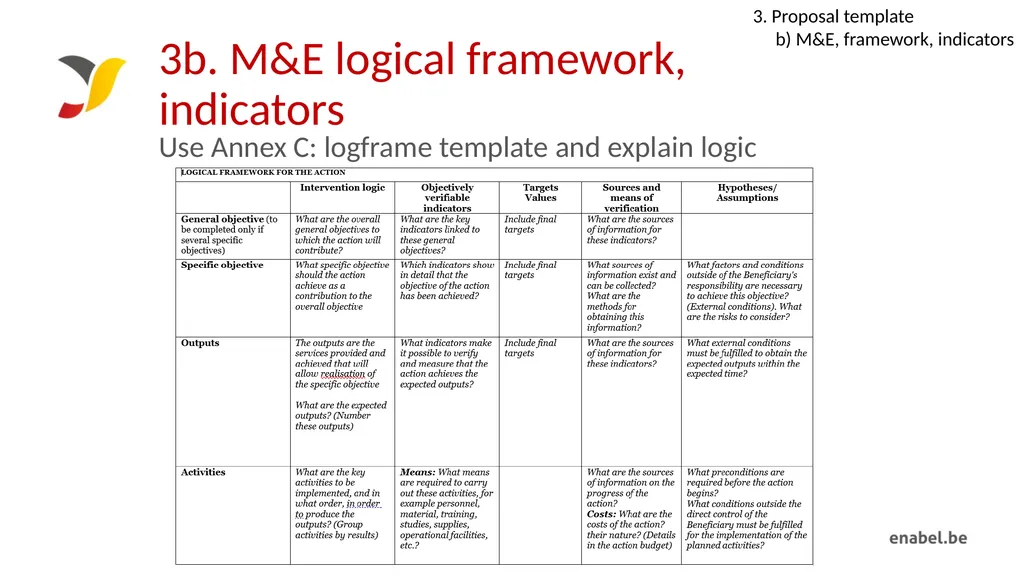
3b. M&E logical framework, indicators Use Annex C: logframe template and explain logic 3. Proposal template
b) M&E, framework, indicators<br>
b) M&E, framework, indicators<br>
21
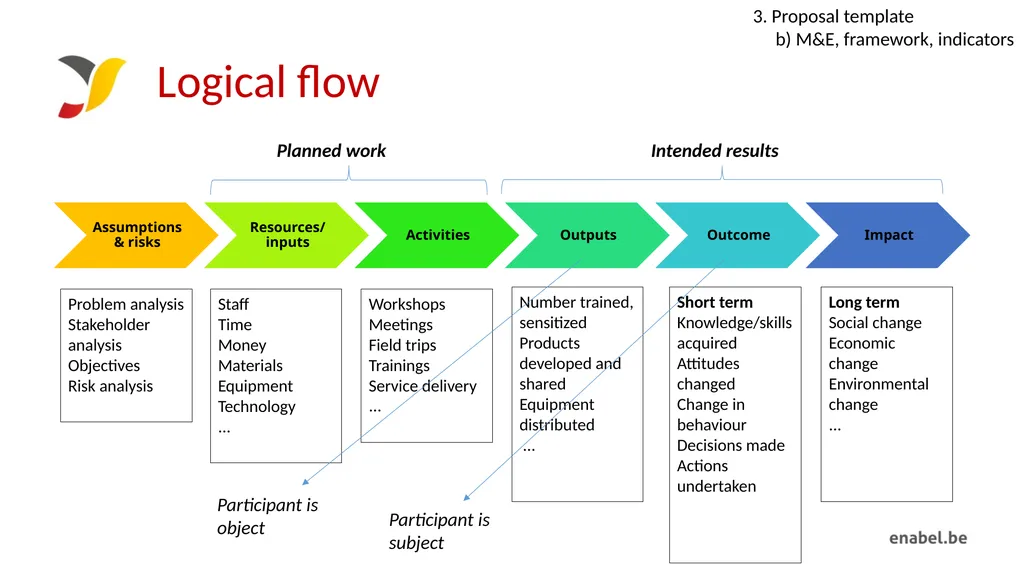
Logical flow Planned work Intended results Problem analysis
Stakeholder analysis
Objectives
Risk analysis Staff
Time
Money
Materials
Equipment
Technology
... Workshops
Meetings
Field trips
Trainings
Service delivery
... Number trained, sensitized
Products developed and shared
Equipment distributed
… Short term
Knowledge/skills acquired
Attitudes changed
Change in behaviour
Decisions made
Actions undertaken Long term
Social change
Economic change
Environmental change
... Participant is object Participant is subject 3. Proposal template
b) M&E, framework, indicators<br>
Stakeholder analysis
Objectives
Risk analysis Staff
Time
Money
Materials
Equipment
Technology
... Workshops
Meetings
Field trips
Trainings
Service delivery
... Number trained, sensitized
Products developed and shared
Equipment distributed
… Short term
Knowledge/skills acquired
Attitudes changed
Change in behaviour
Decisions made
Actions undertaken Long term
Social change
Economic change
Environmental change
... Participant is object Participant is subject 3. Proposal template
b) M&E, framework, indicators<br>
22
3. Proposal template
b) M&E, framework, indicators<br>
b) M&E, framework, indicators<br>
23
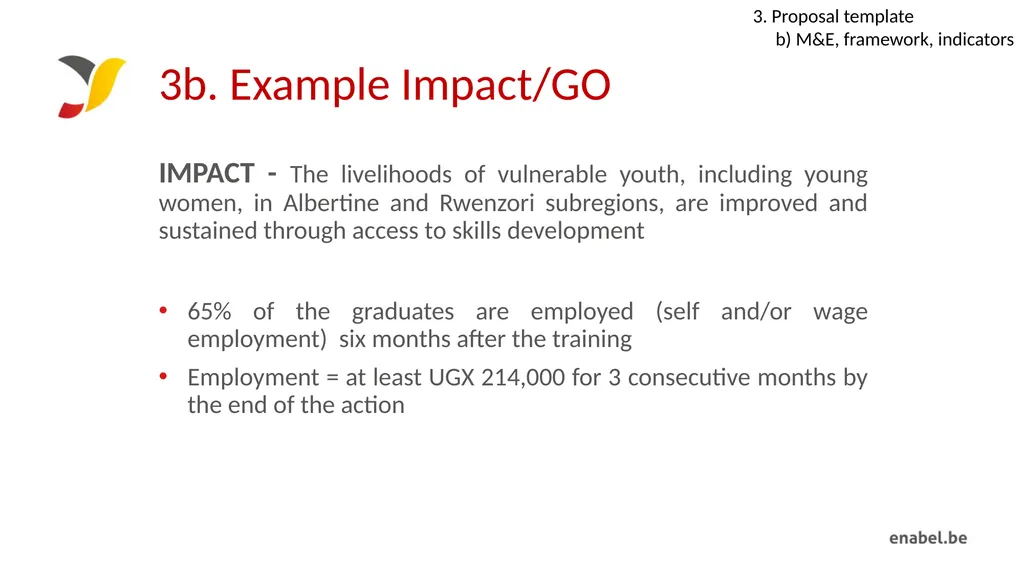
3b. Example Impact/GO IMPACT - The livelihoods of vulnerable youth, including young women, in Albertine and Rwenzori subregions, are improved and sustained through access to skills development
65% of the graduates are employed (self and/or wage employment) six months after the training
Employment = at least UGX 214,000 for 3 consecutive months by the end of the action 3. Proposal template
b) M&E, framework, indicators<br>
65% of the graduates are employed (self and/or wage employment) six months after the training
Employment = at least UGX 214,000 for 3 consecutive months by the end of the action 3. Proposal template
b) M&E, framework, indicators<br>
24
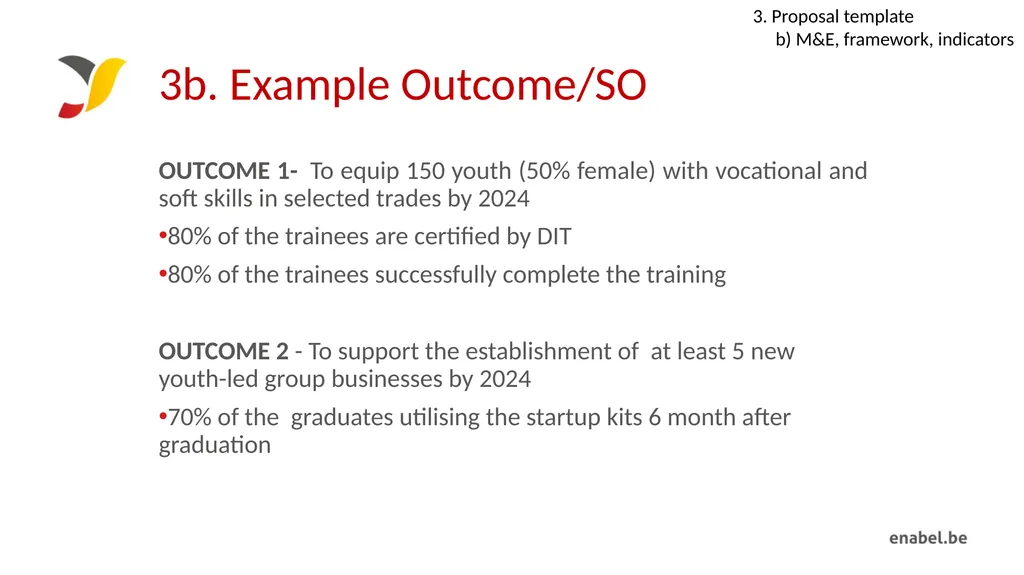
3b. Example Outcome/SO OUTCOME 1- To equip 150 youth (50% female) with vocational and soft skills in selected trades by 2024
80% of the trainees are certified by DIT
80% of the trainees successfully complete the training
OUTCOME 2 - To support the establishment of at least 5 new youth-led group businesses by 2024
70% of the graduates utilising the startup kits 6 month after graduation 3. Proposal template
b) M&E, framework, indicators<br>
80% of the trainees are certified by DIT
80% of the trainees successfully complete the training
OUTCOME 2 - To support the establishment of at least 5 new youth-led group businesses by 2024
70% of the graduates utilising the startup kits 6 month after graduation 3. Proposal template
b) M&E, framework, indicators<br>
25
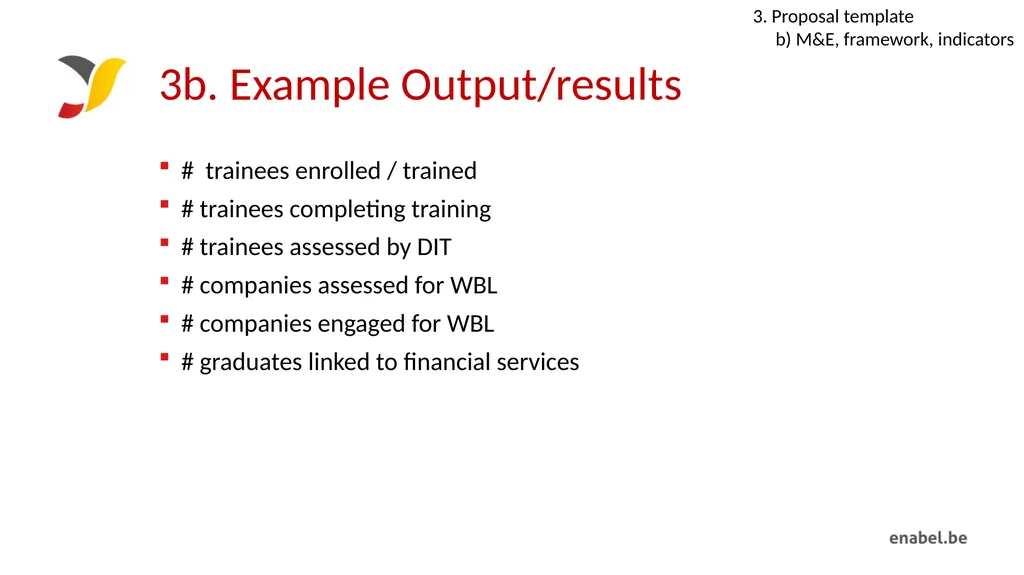
3b. Example Output/results # trainees enrolled / trained
# trainees completing training
# trainees assessed by DIT
# companies assessed for WBL
# companies engaged for WBL
# graduates linked to financial services 3. Proposal template
b) M&E, framework, indicators<br>
# trainees completing training
# trainees assessed by DIT
# companies assessed for WBL
# companies engaged for WBL
# graduates linked to financial services 3. Proposal template
b) M&E, framework, indicators<br>
26
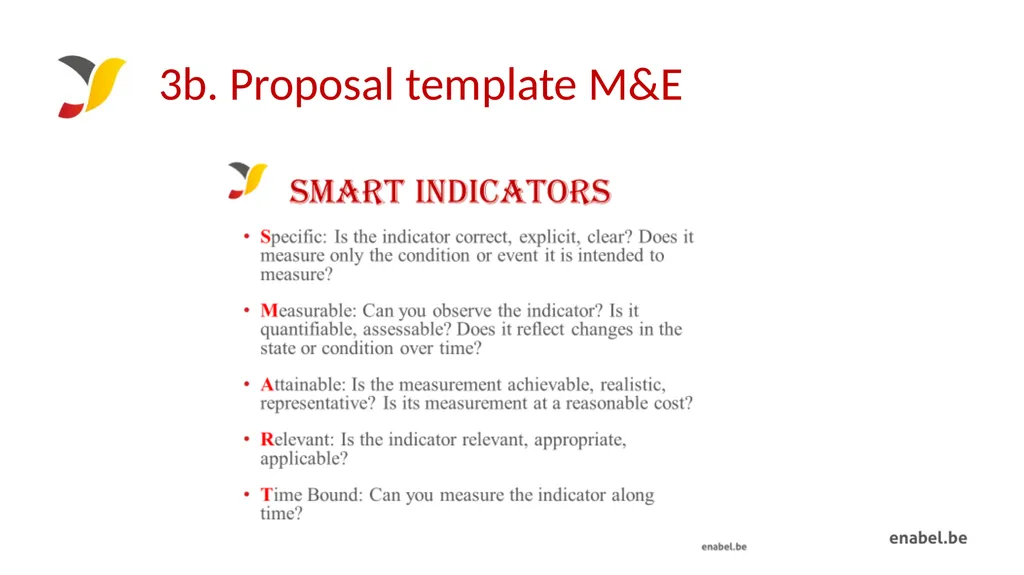
3b. Proposal template M&E<br>
27
3b. Proposal template M&E<br>
28
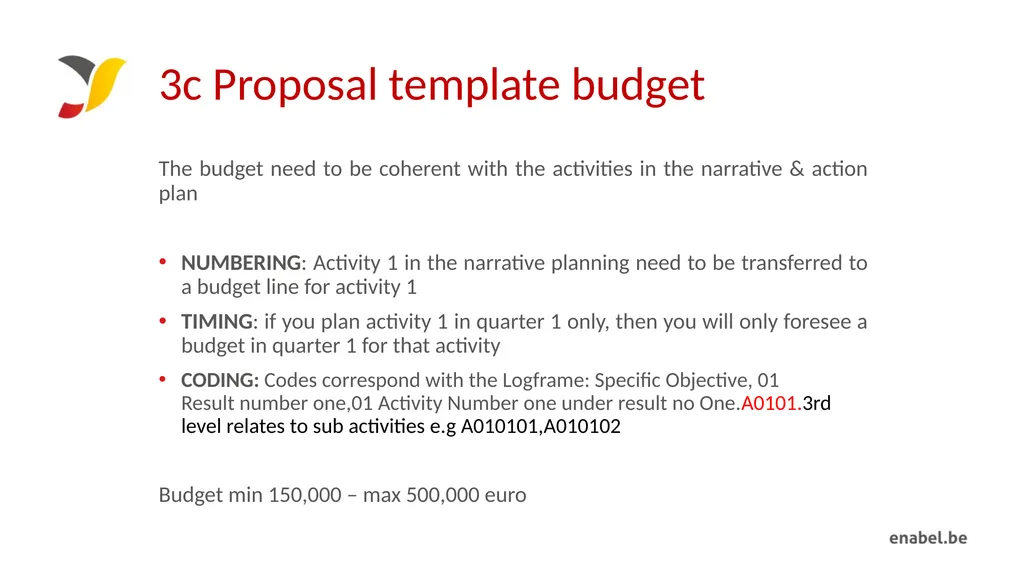
3c Proposal template budget The budget need to be coherent with the activities in the narrative & action plan
NUMBERING: Activity 1 in the narrative planning need to be transferred to a budget line for activity 1
TIMING: if you plan activity 1 in quarter 1 only, then you will only foresee a budget in quarter 1 for that activity
CODING: Codes correspond with the Logframe: Specific Objective, 01 Result number one,01 Activity Number one under result no One.A0101.3rd level relates to sub activities e.g A010101,A010102
Budget min 150,000 – max 500,000 euro<br>
NUMBERING: Activity 1 in the narrative planning need to be transferred to a budget line for activity 1
TIMING: if you plan activity 1 in quarter 1 only, then you will only foresee a budget in quarter 1 for that activity
CODING: Codes correspond with the Logframe: Specific Objective, 01 Result number one,01 Activity Number one under result no One.A0101.3rd level relates to sub activities e.g A010101,A010102
Budget min 150,000 – max 500,000 euro<br>
29
On a daily basis you will work with UGX, but the official max grant amount is in euro which you cannot exceed, so follow up of execution in euro is needed.
FX rate of UGX 3800: 1 EUR (grantees can use their own exchange rate (based on a reliable source) to estimate the budget
Exchange rate losses are ineligible costs and should be covered by the grantees themselves (e.g. through structure costs). Additionally, since the purpose of the grant is not to make money, any gains (exchange or interest) made on the funds received from Enabel must be re-used for the activities after Enabel approval. 3c. Proposal template - Budget<br>
FX rate of UGX 3800: 1 EUR (grantees can use their own exchange rate (based on a reliable source) to estimate the budget
Exchange rate losses are ineligible costs and should be covered by the grantees themselves (e.g. through structure costs). Additionally, since the purpose of the grant is not to make money, any gains (exchange or interest) made on the funds received from Enabel must be re-used for the activities after Enabel approval. 3c. Proposal template - Budget<br>
30
The budget is broken down in 3 cost components;
Operational costs (actual activity costs - general means cost): necessary and indispensable cost for achieving the objectives and results of the action, including the cost for achieving verifiable deliverables
Ex : fees for instructors, consultancy fees, fuel for transporting, workshop costs, training materials, food for trainees, fees for trainees etc.
Management costs (costs to support the management team): identified costs related to management, supervision, coordination, monitoring, control, evaluation and financial audit which specifically originate in the implementation of the action or the justification of the Grant
Ex : Salary for staff, Mid-term evaluation, special audit costs
Structure costs (7% max of eligible operational costs) costs related to the achievement of the social purpose of the beneficiary, which cannot be separated or charged to the budget of this action even though they are affected by the implementation of the action. They are a max of 7% of the eligible operational costs.
Ex: supporting staff (those that cannot be justified under management costs through timesheets e.g., procurement), water & electricity & internet of the office etc. 3c. Proposal template - Budget<br>
Operational costs (actual activity costs - general means cost): necessary and indispensable cost for achieving the objectives and results of the action, including the cost for achieving verifiable deliverables
Ex : fees for instructors, consultancy fees, fuel for transporting, workshop costs, training materials, food for trainees, fees for trainees etc.
Management costs (costs to support the management team): identified costs related to management, supervision, coordination, monitoring, control, evaluation and financial audit which specifically originate in the implementation of the action or the justification of the Grant
Ex : Salary for staff, Mid-term evaluation, special audit costs
Structure costs (7% max of eligible operational costs) costs related to the achievement of the social purpose of the beneficiary, which cannot be separated or charged to the budget of this action even though they are affected by the implementation of the action. They are a max of 7% of the eligible operational costs.
Ex: supporting staff (those that cannot be justified under management costs through timesheets e.g., procurement), water & electricity & internet of the office etc. 3c. Proposal template - Budget<br>
31
What are the rules concerning structure costs?
The percentage (max.7%) must be justified before signature of the Grant Agreement and correspond to the general structure costs of the grantee
It’s a lump-sum and maximum 7% of operational costs
Once the % has been set and confirmed by the analysis of the grantee’s accounts, no supporting document have to be provided by the grantee. In the reporting, it just appears as a separate line at the end (+ 7%). 3c. Proposal template - Budget<br>
The percentage (max.7%) must be justified before signature of the Grant Agreement and correspond to the general structure costs of the grantee
It’s a lump-sum and maximum 7% of operational costs
Once the % has been set and confirmed by the analysis of the grantee’s accounts, no supporting document have to be provided by the grantee. In the reporting, it just appears as a separate line at the end (+ 7%). 3c. Proposal template - Budget<br>
32
Ineligible costs (1/2):
Expenses that are included in the ineligible list (see guidelines)
Expenses that are incurred before or after the duration of this grant agreement
Expenses that cannot be identified, verified and are not included in the grantee's accounts
Expenses not in line with applicable legal fiscal and social provisions
Expenses that are not reasonable, justified, not respecting the principle of good financial management, in particular concerning cost efficiency and effectiveness
Expenses not in line with the action plan, not necessary to achieve the results
No contributions in kind are considered 3c. Proposal template - Budget<br>
Expenses that are included in the ineligible list (see guidelines)
Expenses that are incurred before or after the duration of this grant agreement
Expenses that cannot be identified, verified and are not included in the grantee's accounts
Expenses not in line with applicable legal fiscal and social provisions
Expenses that are not reasonable, justified, not respecting the principle of good financial management, in particular concerning cost efficiency and effectiveness
Expenses not in line with the action plan, not necessary to achieve the results
No contributions in kind are considered 3c. Proposal template - Budget<br>
33
Ineligible costs (2/2):
Accounting entries not leading to payments
Provisions for liabilities and charges, losses, debts or possible future debts
Debts and debit interests
Doubtful debts
Currency exchange losses
Loans to third parties
Guarantees and securities;
Costs already financed by another grant
Invoices made out by other organisations for goods and services already subsidized Subcontracting by means of service or consultancy contracts to personnel members, Board members or General Assembly members of the organisation subsidized
Any sub-letting to oneself
Purchases of land or buildings;
Compensation for damage falling under the civil liability of the organisation
Employment termination compensation for the term of notice not performed
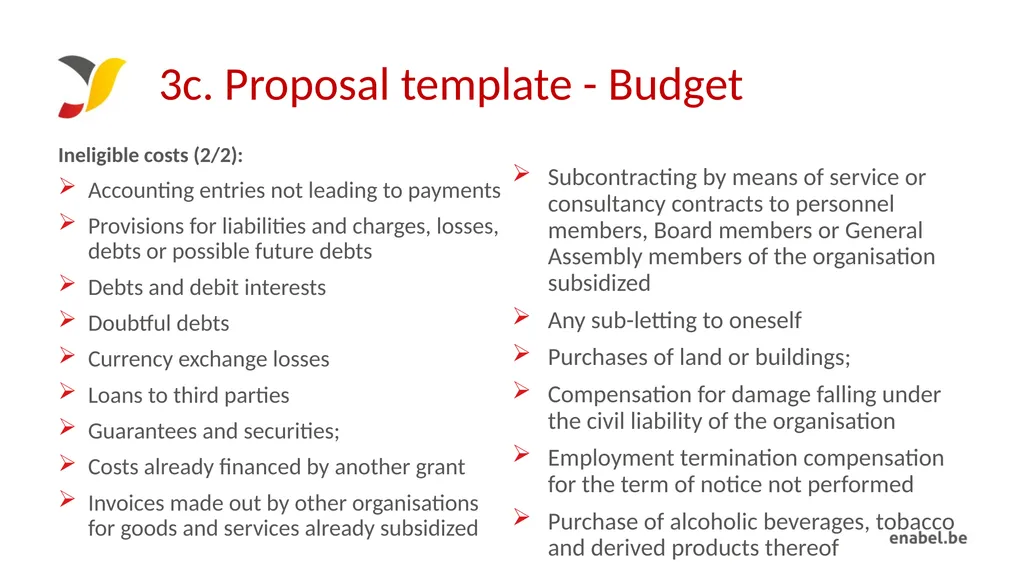
Purchase of alcoholic beverages, tobacco and derived products thereof 3c. Proposal template - Budget<br>
Accounting entries not leading to payments
Provisions for liabilities and charges, losses, debts or possible future debts
Debts and debit interests
Doubtful debts
Currency exchange losses
Loans to third parties
Guarantees and securities;
Costs already financed by another grant
Invoices made out by other organisations for goods and services already subsidized Subcontracting by means of service or consultancy contracts to personnel members, Board members or General Assembly members of the organisation subsidized
Any sub-letting to oneself
Purchases of land or buildings;
Compensation for damage falling under the civil liability of the organisation
Employment termination compensation for the term of notice not performed
Purchase of alcoholic beverages, tobacco and derived products thereof 3c. Proposal template - Budget<br>
34
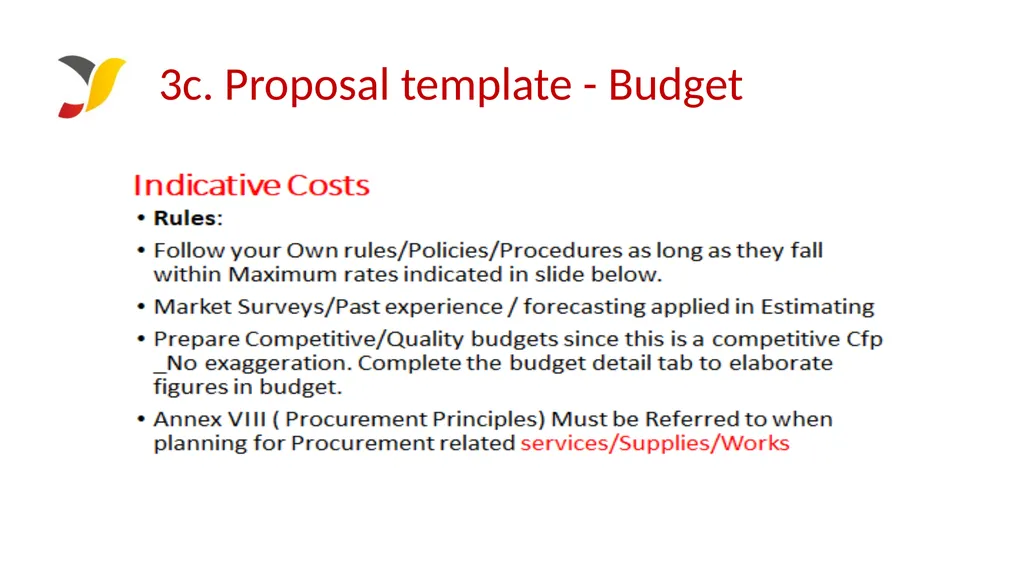
3c. Proposal template - Budget<br>
35
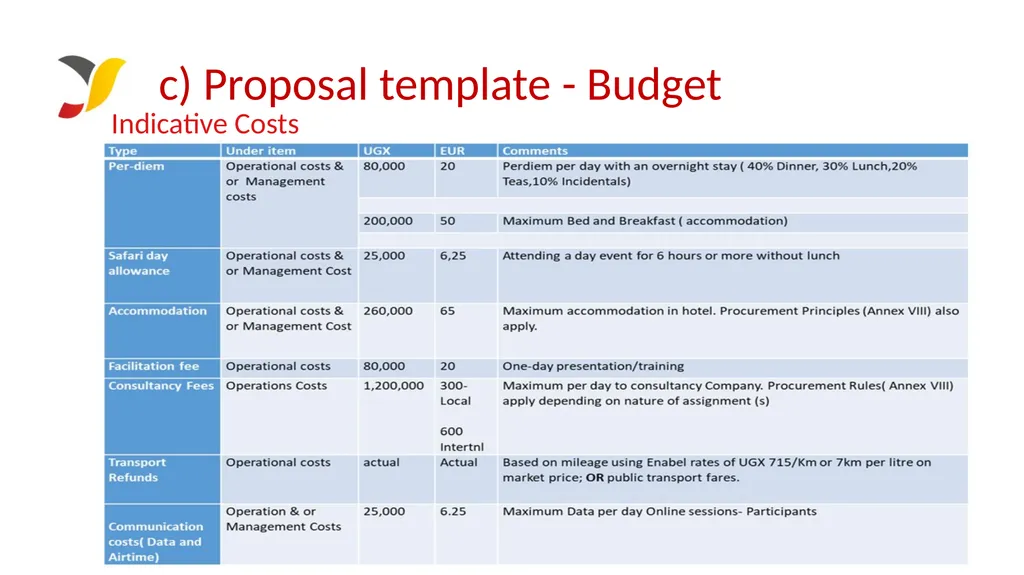
c) Proposal template - Budget Indicative Costs<br>
36
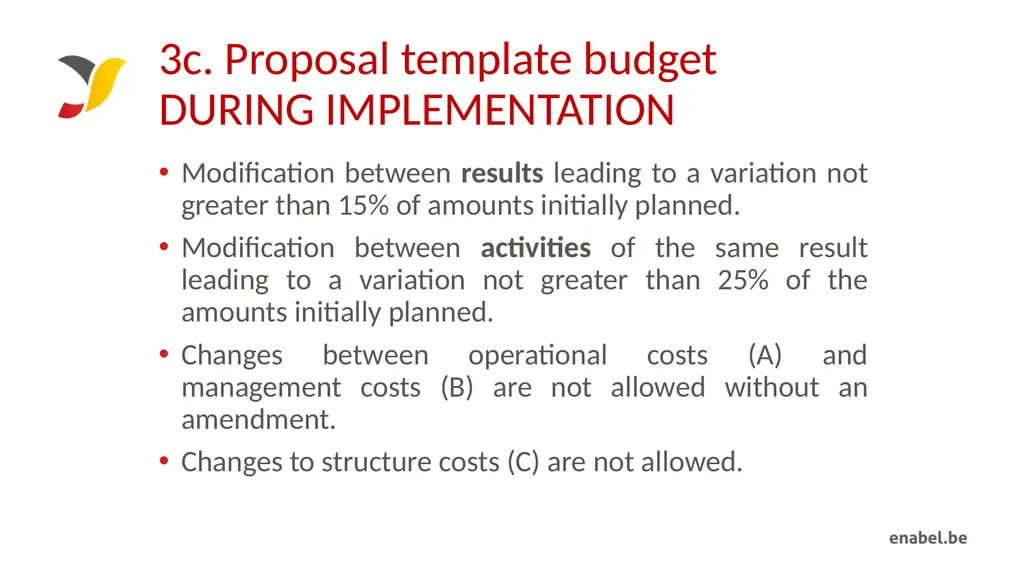
3c. Proposal template budget DURING IMPLEMENTATION Modification between results leading to a variation not greater than 15% of amounts initially planned.
Modification between activities of the same result leading to a variation not greater than 25% of the amounts initially planned.
Changes between operational costs (A) and management costs (B) are not allowed without an amendment.
Changes to structure costs (C) are not allowed.<br>
Modification between activities of the same result leading to a variation not greater than 25% of the amounts initially planned.
Changes between operational costs (A) and management costs (B) are not allowed without an amendment.
Changes to structure costs (C) are not allowed.<br>
37
3c. Proposal template budget Budget proposal may not differ more than 20% from the initial concept note budget and must remain within the minimum and maximum amounts
Budget min 150,000 – max 500,000 euro
Budget presentation in excel (Annex B of the grant agreement)<br>
Budget min 150,000 – max 500,000 euro
Budget presentation in excel (Annex B of the grant agreement)<br>
38
3c. Proposal template budget<br>
39
4. Application procedure / Next steps Use the complete Annex A Grant Application File, Part B. Do not use own templates & do not tweak the template
Concept note may not be modified by the applicant in the proposal (no substantial change to key activities/approaches)
Submission in English only
Provide a detailed budget (annex B)- Amount requested in the proposal may not vary more than 20% in relation to the initial estimate
Errors or major inconsistencies concerning the points mentioned in the instructions of the form may result in rejection (e.g., content required, pages, …)
Enabel reserves the right to request clarification where the information provided does not enable it to carry out an objective evaluation 4. Application procedure / Next steps<br>
Concept note may not be modified by the applicant in the proposal (no substantial change to key activities/approaches)
Submission in English only
Provide a detailed budget (annex B)- Amount requested in the proposal may not vary more than 20% in relation to the initial estimate
Errors or major inconsistencies concerning the points mentioned in the instructions of the form may result in rejection (e.g., content required, pages, …)
Enabel reserves the right to request clarification where the information provided does not enable it to carry out an objective evaluation 4. Application procedure / Next steps<br>
40
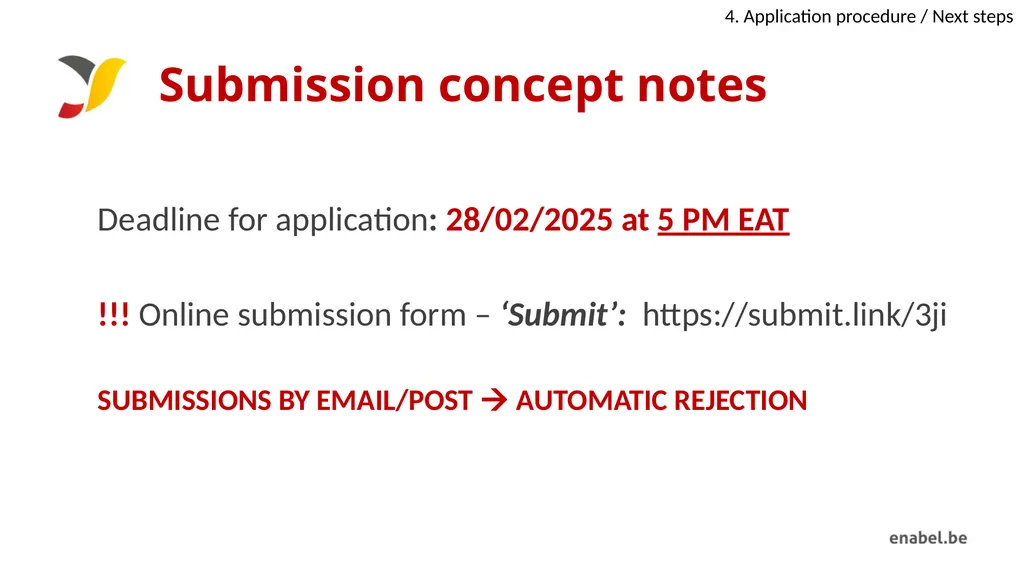
Submission concept notes Deadline for application: 28/02/2025 at 5 PM EAT
!!! Online submission form – ‘Submit’: https://submit.link/3ji
SUBMISSIONS BY EMAIL/POST AUTOMATIC REJECTION 4. Application procedure / Next steps<br>
!!! Online submission form – ‘Submit’: https://submit.link/3ji
SUBMISSIONS BY EMAIL/POST AUTOMATIC REJECTION 4. Application procedure / Next steps<br>
41
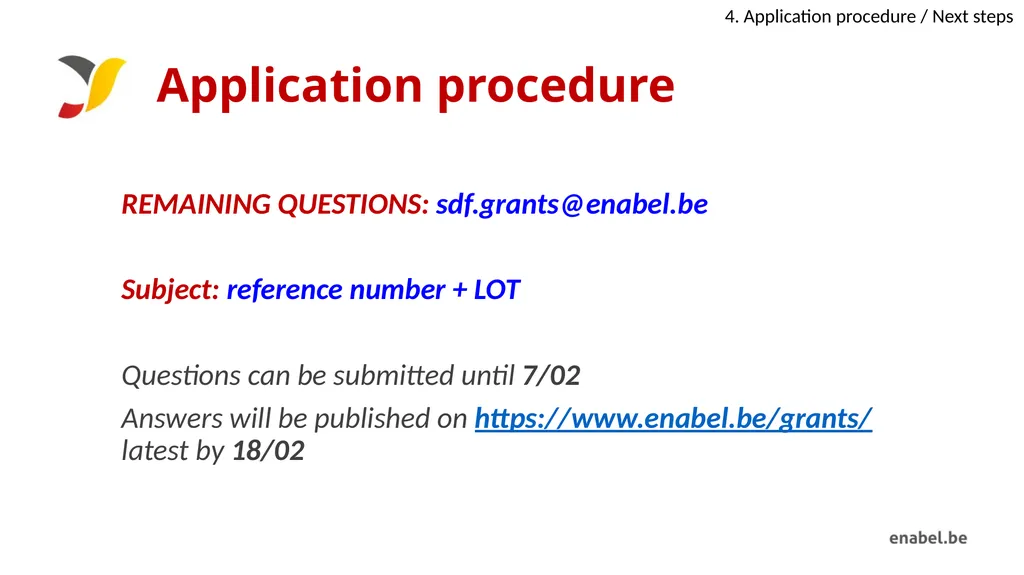
Application procedure Remaining questions: sdf.grants@enabel.be
Subject: reference number + LOT
Questions can be submitted until 7/02
Answers will be published on https://www.enabel.be/grants/ latest by 18/02 4. Application procedure / Next steps<br>
Subject: reference number + LOT
Questions can be submitted until 7/02
Answers will be published on https://www.enabel.be/grants/ latest by 18/02 4. Application procedure / Next steps<br>
42
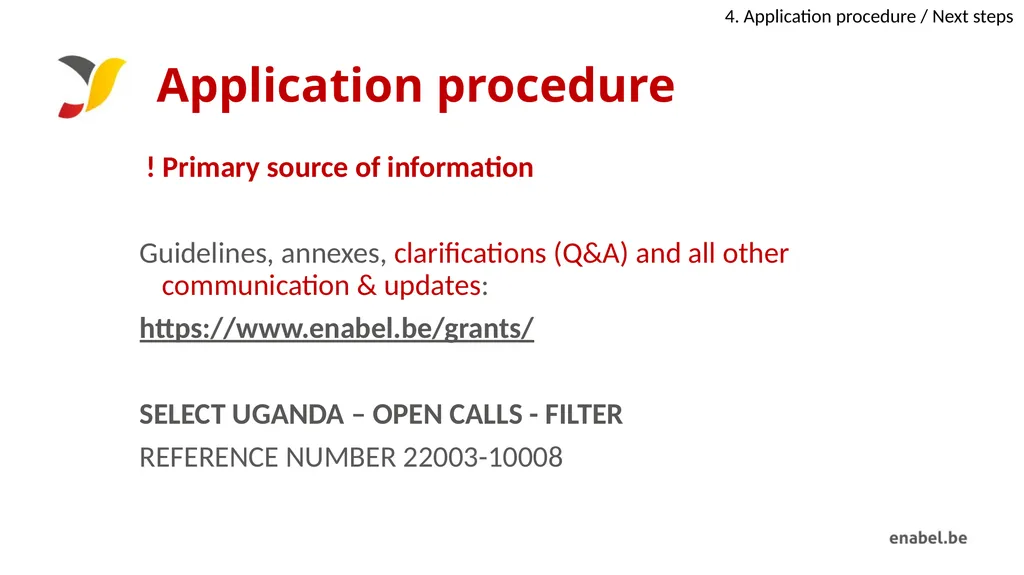
! Primary source of information
Guidelines, annexes, clarifications (Q&A) and all other communication & updates:
https://www.enabel.be/grants/
Select UGANDA – OPEN CALLS - FILTER
reference number 22003-10008 4. Application procedure / Next steps Application procedure<br>
Guidelines, annexes, clarifications (Q&A) and all other communication & updates:
https://www.enabel.be/grants/
Select UGANDA – OPEN CALLS - FILTER
reference number 22003-10008 4. Application procedure / Next steps Application procedure<br>
43
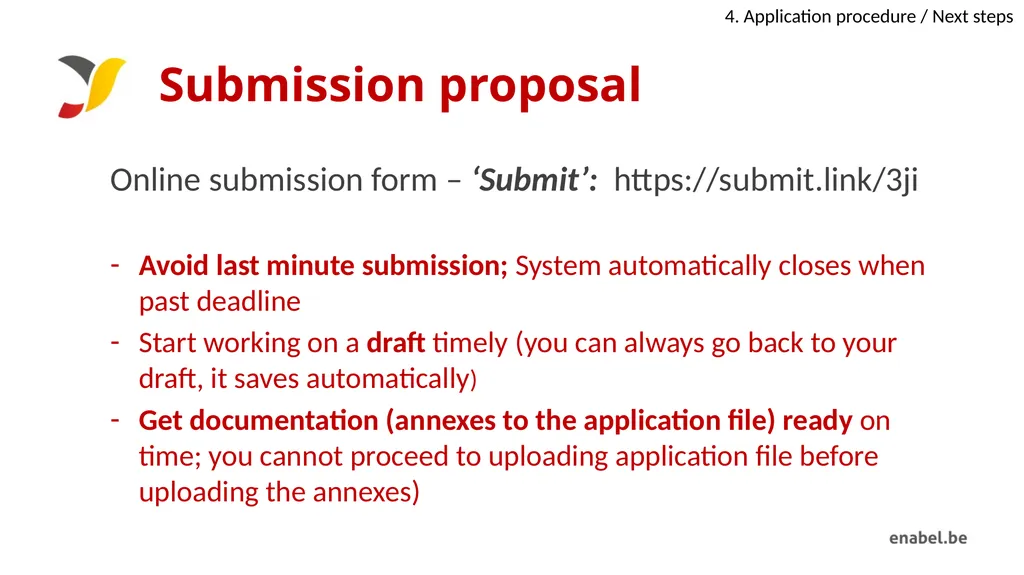
Submission proposal Online submission form – ‘Submit’: https://submit.link/3ji
Avoid last minute submission; System automatically closes when past deadline
Start working on a draft timely (you can always go back to your draft, it saves automatically)
Get documentation (annexes to the application file) ready on time; you cannot proceed to uploading application file before uploading the annexes) 4. Application procedure / Next steps<br>
Avoid last minute submission; System automatically closes when past deadline
Start working on a draft timely (you can always go back to your draft, it saves automatically)
Get documentation (annexes to the application file) ready on time; you cannot proceed to uploading application file before uploading the annexes) 4. Application procedure / Next steps<br>
44
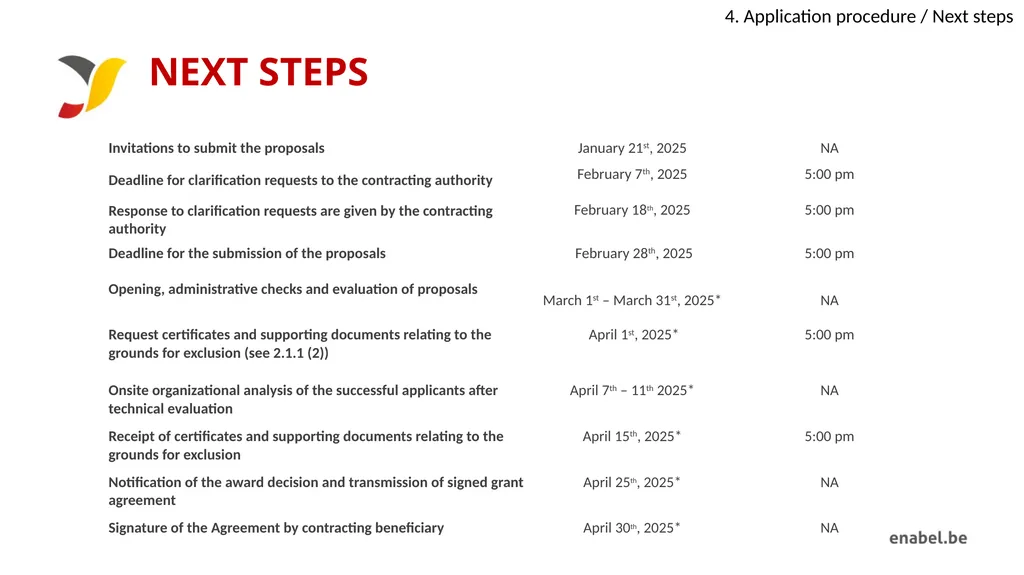
NEXT STEPS 4. Application procedure / Next steps<br>
45
5. Next steps – PART 2 Pre-selected applicants will be invited to submit – time = 15 days
Criminal record clearance (Interpol) certificate for the main authorized representatives of your organization (e.g. chairman of the board of directors AND the executive director) those that will sign the grant agreement – Can take 2 weeks, ask timely!!
Tax clearance certificate from Uganda Revenue Authority (URA)
NSSF Clearance Certificate
Documents cannot be older than 2 years<br>
Criminal record clearance (Interpol) certificate for the main authorized representatives of your organization (e.g. chairman of the board of directors AND the executive director) those that will sign the grant agreement – Can take 2 weeks, ask timely!!
Tax clearance certificate from Uganda Revenue Authority (URA)
NSSF Clearance Certificate
Documents cannot be older than 2 years<br>
46
5. Next steps – PART 2 Organisational assessments
Assessment to confirm whether applicant has the capacity to implement the proposed activities. The purpose is to verify general characteristics, technical capacities, control environment, financial management, audit, procurements and context.
Done by consultant & Enabel
Visits of half a day to 1 day
Can be organized on short notice – be prepared<br>
Assessment to confirm whether applicant has the capacity to implement the proposed activities. The purpose is to verify general characteristics, technical capacities, control environment, financial management, audit, procurements and context.
Done by consultant & Enabel
Visits of half a day to 1 day
Can be organized on short notice – be prepared<br>
47
End<br>