
Call For Proposals Supporting vulnerable youth to



Description: Call For Proposals Supporting vulnerable youth to develop sustainable micro- and small businesses for enhanced resilience and economic integration in Kampala Metropolitan area Information sessions Presentation outline Introduction to WeWork
Related Topics
Download Presentation
"Call For Proposals Supporting vulnerable youth to" is the property of its rightful owner. Permission is granted to download and print the materials on this website for personal, non-commercial use only, and to display it on your personal computer provided you do not modify the materials and that you retain all copyright notices contained in the materials. By downloading content from our website, you accept the terms of this agreement.
Presentation Transcript
slide1. Call For Proposals
Supporting vulnerable youth to develop sustainable micro- and small businesses for enhanced resilience and economic integration in Kampala Metropolitan area Information sessions<br>
slide2. Presentation outline Introduction to WeWork and the Call for Proposals
Objectives of the call
Admissibility criteria
Actors
Actions
Costs
Concept note application form
Application and selection procedure<br>
slide3. Call for Proposals Guidelines, annexes, clarifications (Q&A) and all other communication:
www.enabel.be/grants
Call reference number: UGA22003-10023
Call Title: Supporting vulnerable youth to develop sustainable micro- and small businesses for enhanced resilience and economic integration in Kampala Metropolitan area.
Procedure: 2 phased : (1) Concept note stage, (2) proposal stage<br>
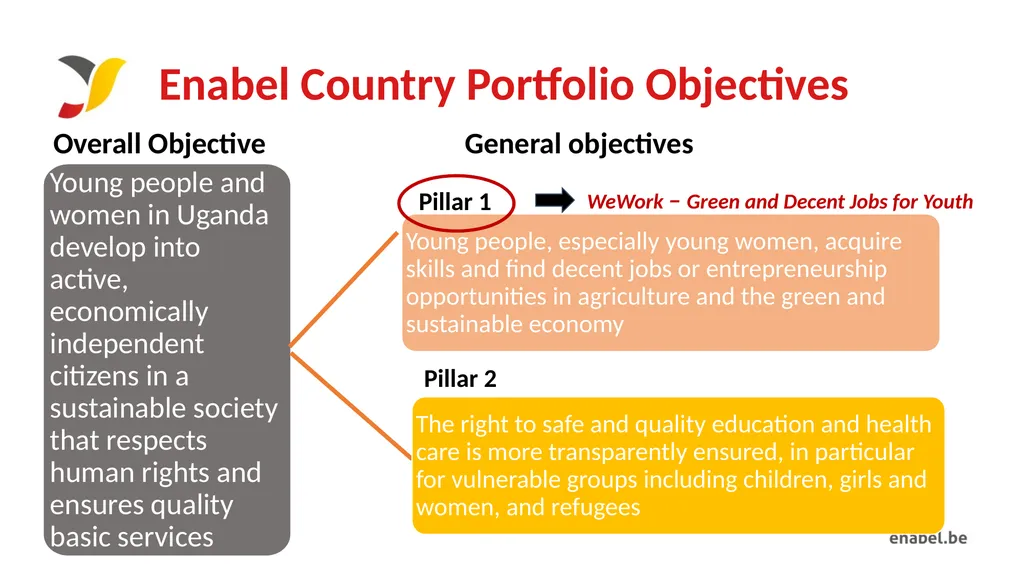
slide4. Enabel Country Portfolio Objectives Young people and women in Uganda develop into active, economically independent citizens in a sustainable society that respects human rights and ensures quality basic services Young people, especially young women, acquire skills and find decent jobs or entrepreneurship opportunities in agriculture and the green and sustainable economy The right to safe and quality education and health care is more transparently ensured, in particular for vulnerable groups including children, girls and women, and refugees General objectives Overall Objective Pillar 1 Pillar 2 WeWork – Green and Decent Jobs for Youth<br>
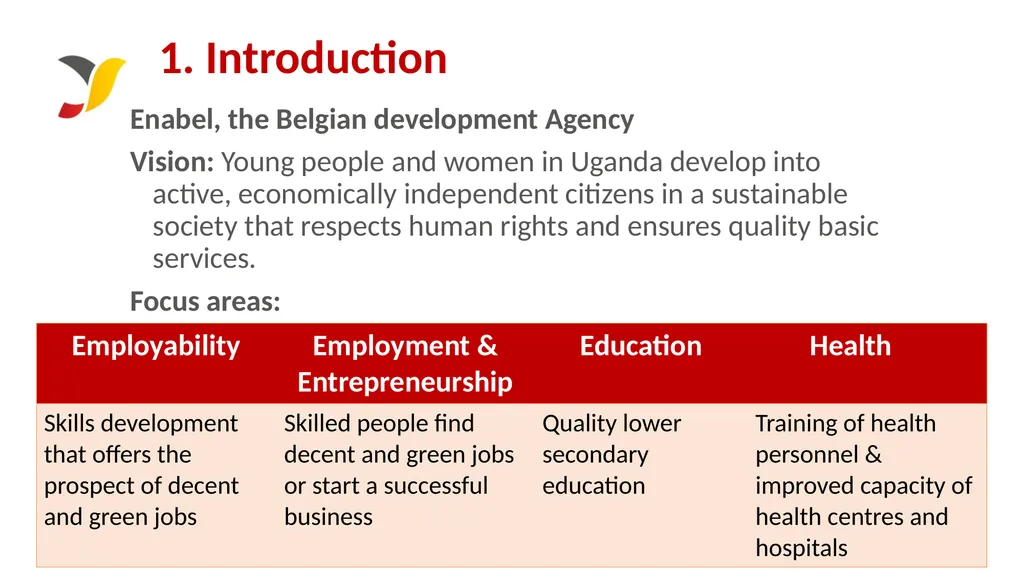
slide5. 1. Introduction Enabel, the Belgian development Agency
Vision: Young people and women in Uganda develop into active, economically independent citizens in a sustainable society that respects human rights and ensures quality basic services.
Focus areas:<br>
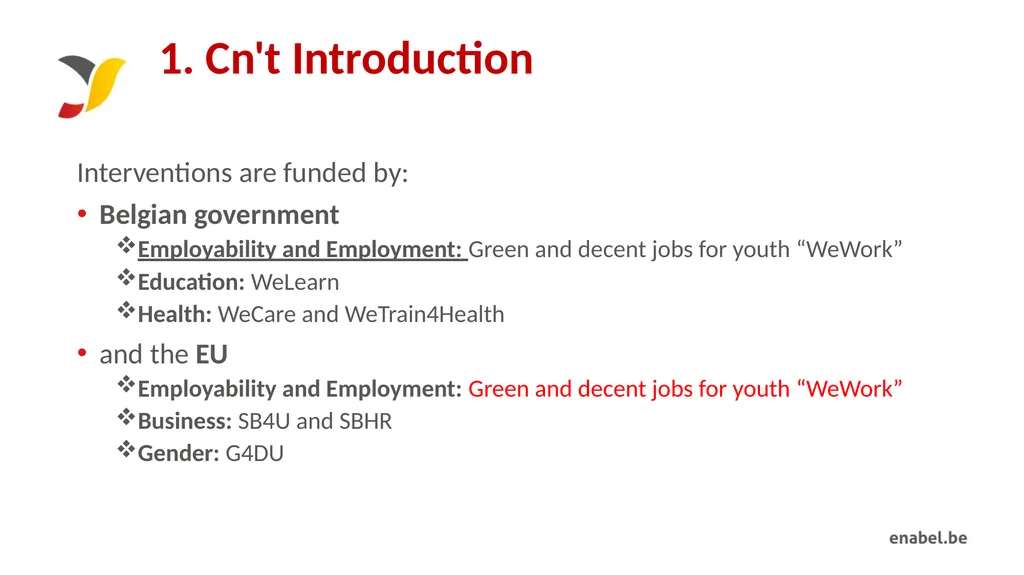
slide6. 1. Cn't Introduction Interventions are funded by:
Belgian government
Employability and Employment: Green and decent jobs for youth “WeWork”
Education: WeLearn
Health: WeCare and WeTrain4Health
and the EU
Employability and Employment: Green and decent jobs for youth “WeWork”
Business: SB4U and SBHR
Gender: G4DU<br>
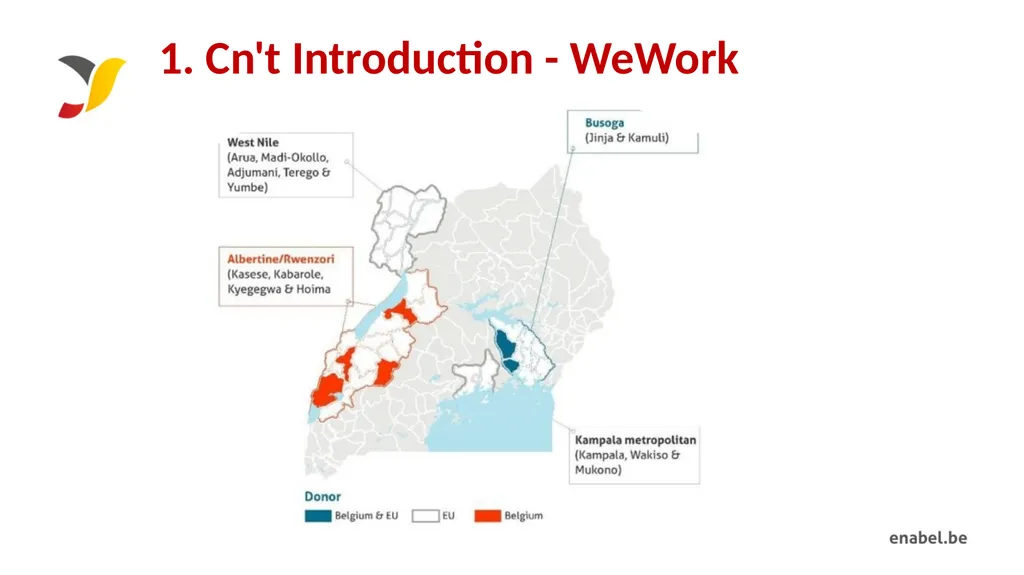
slide7. 1. Cn't Introduction - WeWork<br>
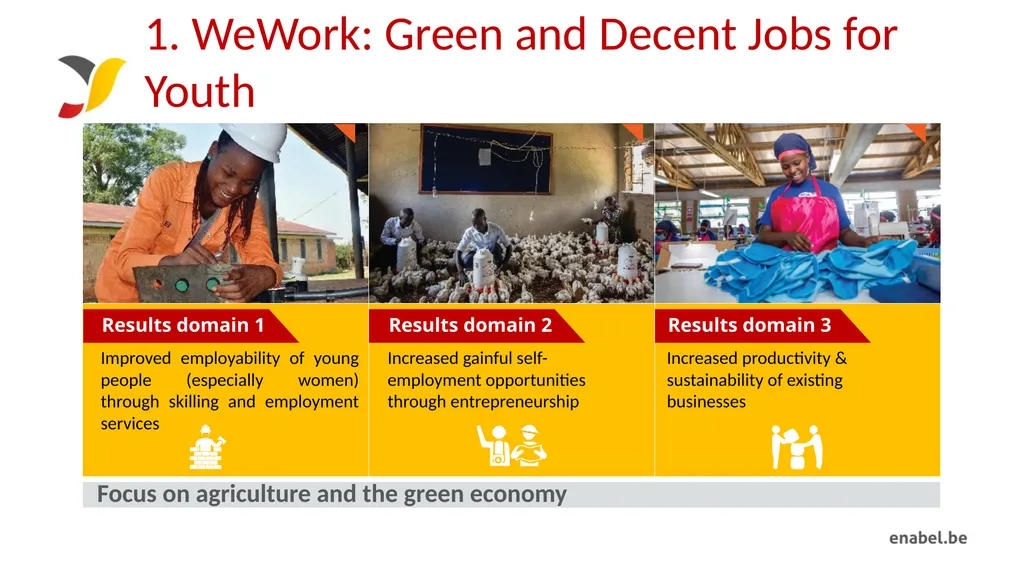
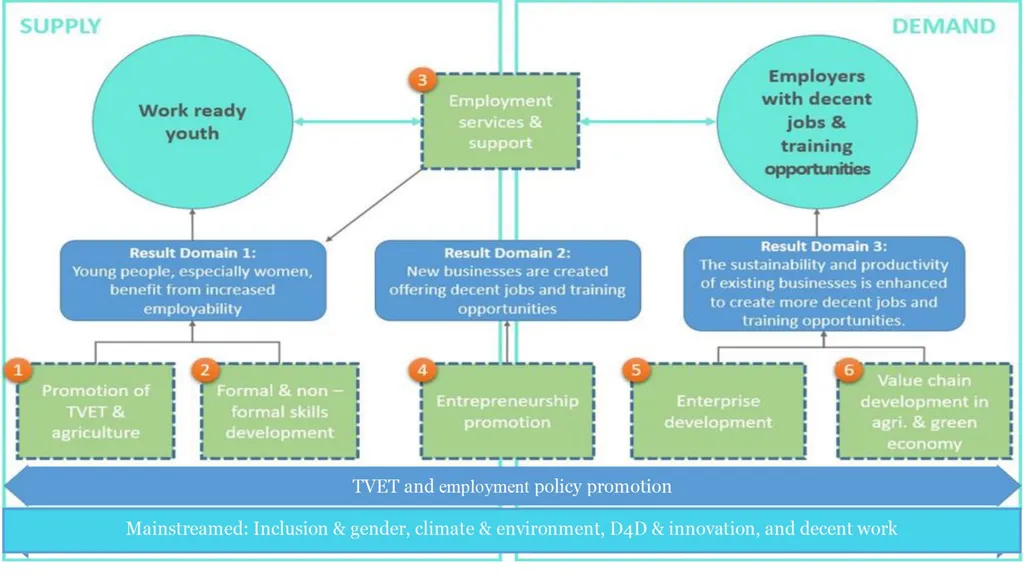
slide8. 1. WeWork: Green and Decent Jobs for Youth Focus on agriculture and the green economy Results domain 1 Improved employability of young people (especially women) through skilling and employment services Results domain 2 Increased gainful self- employment opportunities
through entrepreneurship Results domain 3 Increased productivity &
sustainability of existing
businesses<br>
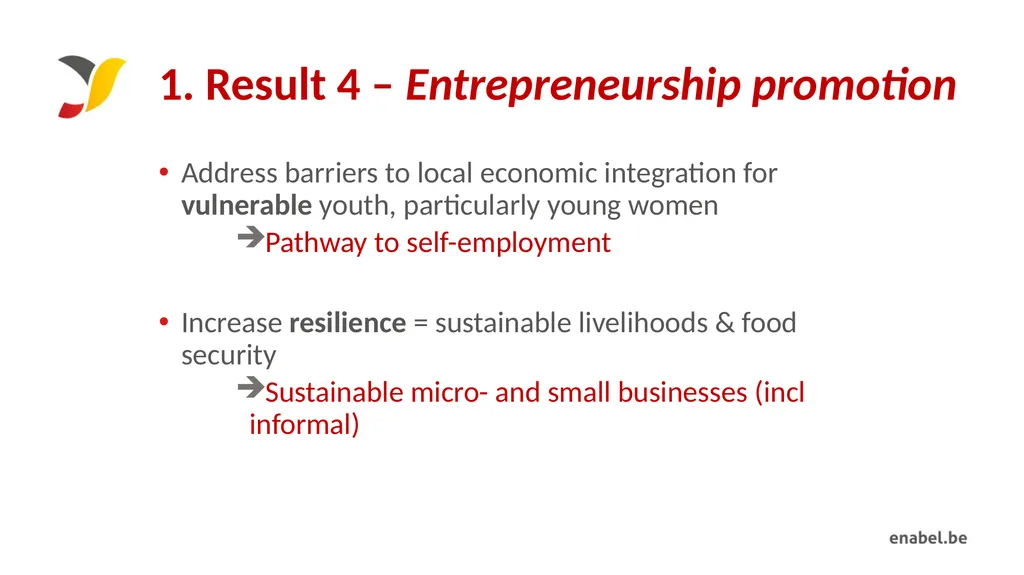
slide10. 1. Result 4 – Entrepreneurship promotion Address barriers to local economic integration for vulnerable youth, particularly young women
Pathway to self-employment
Increase resilience = sustainable livelihoods & food security
Sustainable micro- and small businesses (incl informal)<br>
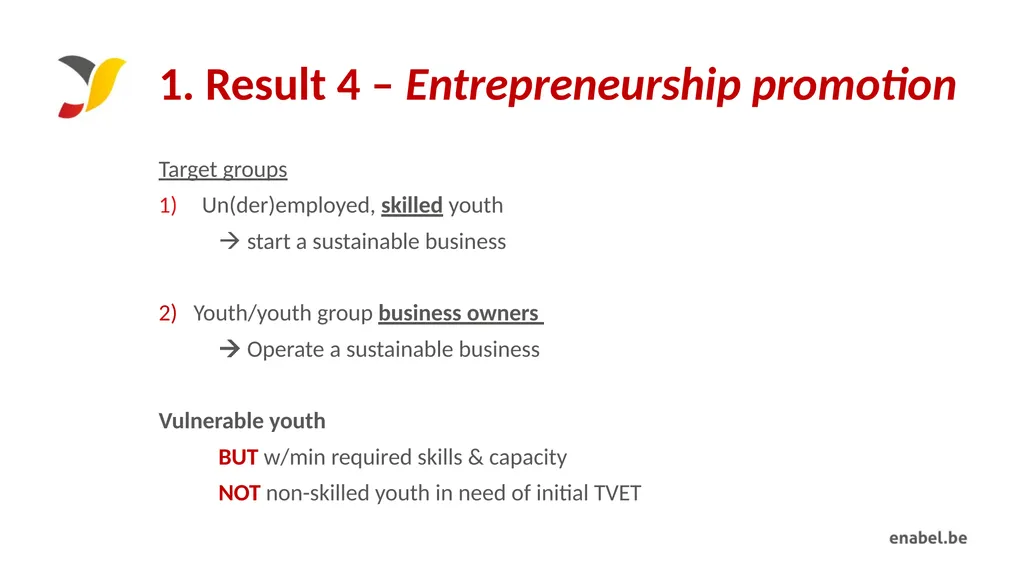
slide11. 1. Result 4 – Entrepreneurship promotion Target groups
Un(der)employed, skilled youth
start a sustainable business
2) Youth/youth group business owners
Operate a sustainable business
Vulnerable youth
BUT w/min required skills & capacity
NOT non-skilled youth in need of initial TVET<br>
slide12. 2. Call Objectives 2 phased procedure
- Concept note stage
- Proposal stage<br>
slide13. 2. Call Objectives General objective
The livelihoods of vulnerable youth, including young women, in Kampala Metropolitan region, are improved and sustained through access to self-employment opportunities
Specific objective
Vulnerable youth, including young women, start and grow sustainable micro- or small businesses, through enhanced access to quality business development support<br>
slide14. 2. Call objectives – Results (overall) 650 vulnerable youth, including young women (ie. Skilled, unemployed youth as well as youth business-owners), are supported to start or grow sustainable micro- and small businesses through quality business development support;
650 vulnerable youth (the same target group as under expected result 1), are supported to access affordable finance and capital to start or grow their micro- or small businesses;
Good practices in (green/climate-smart) business development services for the economic integration of vulnerable youth are scaled-up.<br>
slide15. 2. Call objectives – ‘Sustainable livelihoods’ Criteria for established ‘sustainable livelihoods’:
Minimum of 3 consecutive months with stable income;
Stable income will be defined at a level of a minimum net income of UGX 214,000 per month;
Enhanced incomes of targeted beneficiaries by at least 20% of monthly income. The income increase should raise the income of the targeted beneficiary to at least UGX 214,000 net and above.<br>
slide16. 2. Call volume and grant amounts Total call volume is 650,000 EUR
Grant applications must fall between minimum 150,000 and maximum 325,000 EUR<br>
slide17. 3. Admissibility criteria – 3 levels The actors: Admissible applicants
The actions: Admissible actions for grants
The costs: Admissible types of costs that may be included in grants<br>
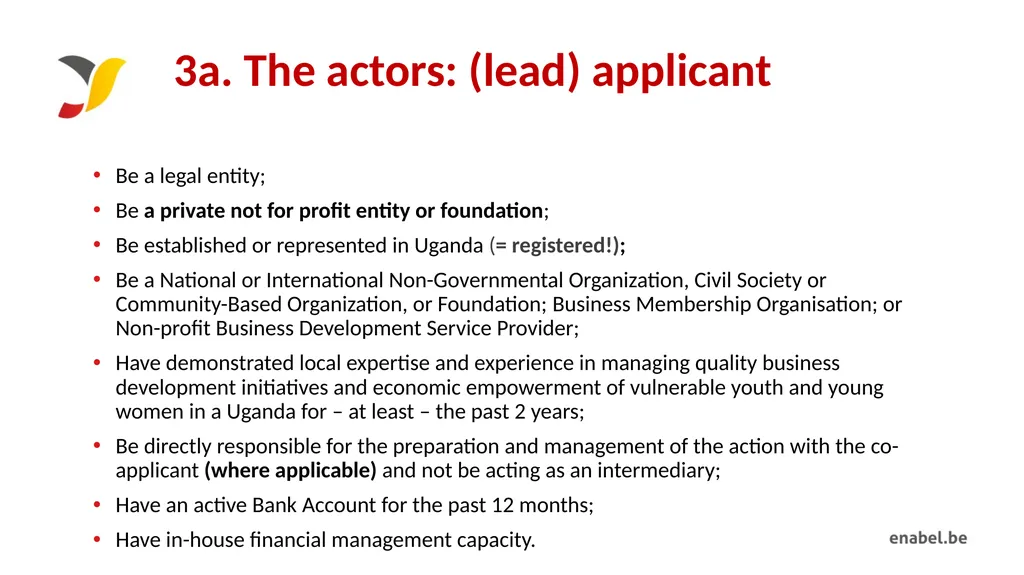
slide18. 3a. The actors: (lead) applicant Be a legal entity;
Be a private not for profit entity or foundation;
Be established or represented in Uganda (= registered!);
Be a National or International Non-Governmental Organization, Civil Society or Community-Based Organization, or Foundation; Business Membership Organisation; or Non-profit Business Development Service Provider;
Have demonstrated local expertise and experience in managing quality business development initiatives and economic empowerment of vulnerable youth and young women in a Uganda for – at least – the past 2 years;
Be directly responsible for the preparation and management of the action with the co-applicant (where applicable) and not be acting as an intermediary;
Have an active Bank Account for the past 12 months;
Have in-house financial management capacity.<br>
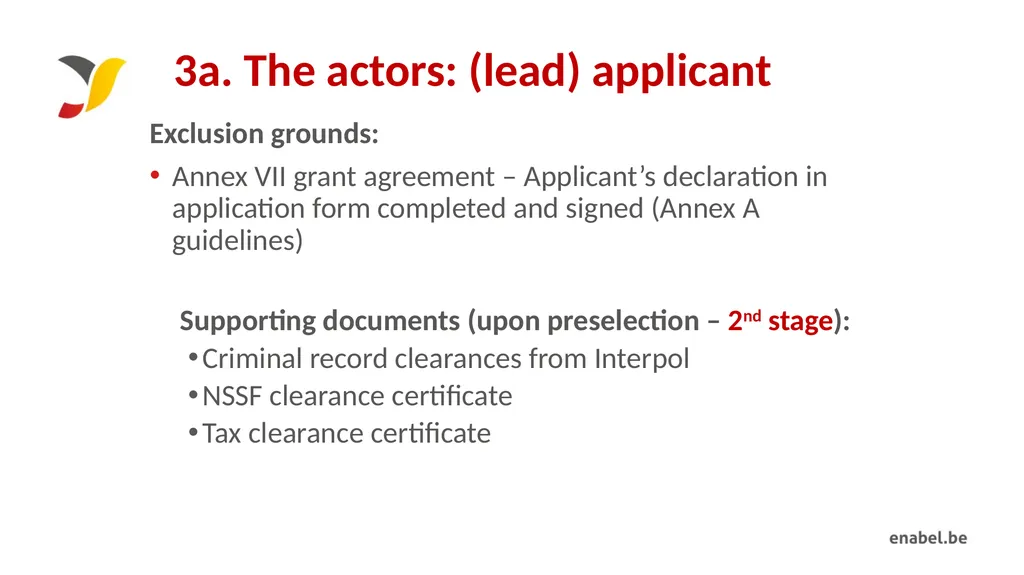
slide19. 3a. The actors: (lead) applicant Exclusion grounds:
Annex VII grant agreement – Applicant’s declaration in application form completed and signed (Annex A guidelines)
Supporting documents (upon preselection – 2nd stage):
Criminal record clearances from Interpol
NSSF clearance certificate
Tax clearance certificate<br>
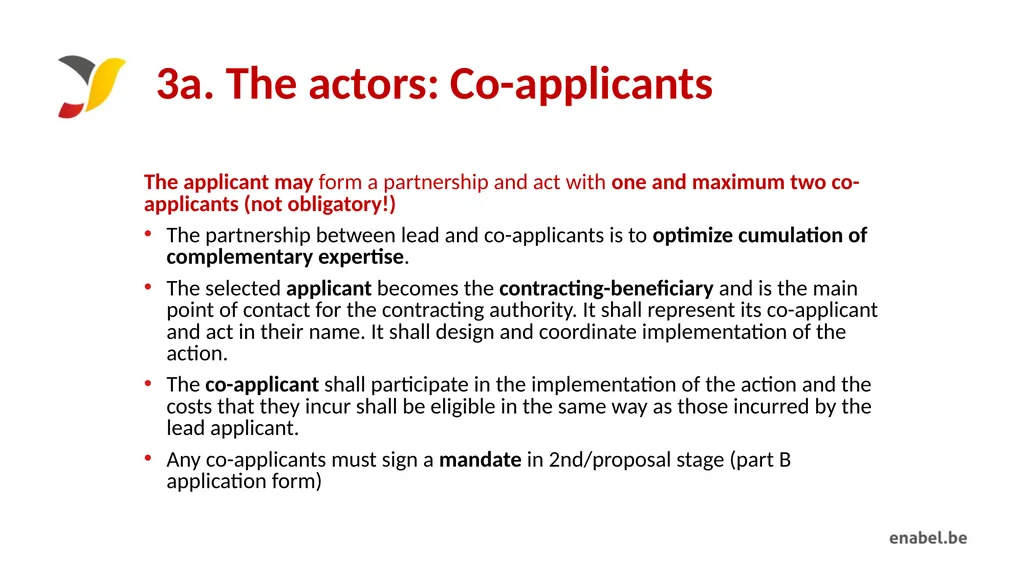
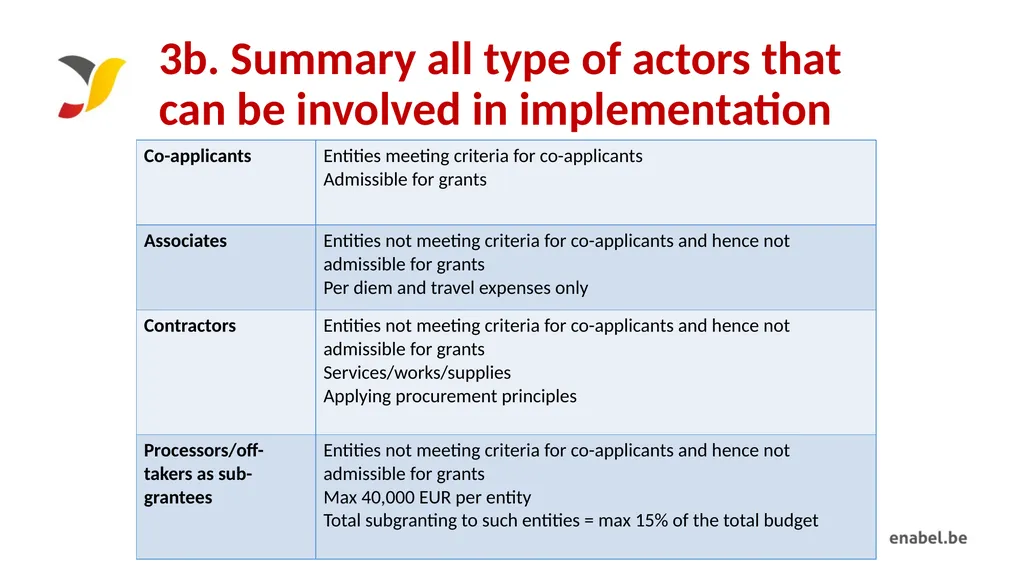
slide20. 3a. The actors: Co-applicants The applicant may form a partnership and act with one and maximum two co-applicants (not obligatory!)
The partnership between lead and co-applicants is to optimize cumulation of complementary expertise.
The selected applicant becomes the contracting-beneficiary and is the main point of contact for the contracting authority. It shall represent its co-applicant and act in their name. It shall design and coordinate implementation of the action.
The co-applicant shall participate in the implementation of the action and the costs that they incur shall be eligible in the same way as those incurred by the lead applicant.
Any co-applicants must sign a mandate in 2nd/proposal stage (part B application form)<br>
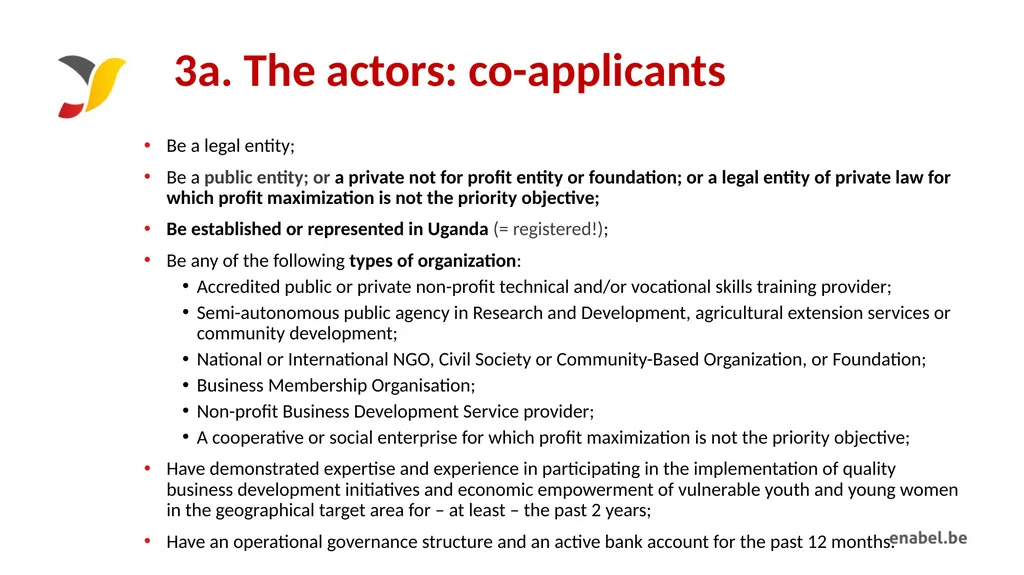
slide21. 3a. The actors: co-applicants Be a legal entity;
Be a public entity; or a private not for profit entity or foundation; or a legal entity of private law for which profit maximization is not the priority objective;
Be established or represented in Uganda (= registered!);
Be any of the following types of organization:
Accredited public or private non-profit technical and/or vocational skills training provider;
Semi-autonomous public agency in Research and Development, agricultural extension services or community development;
National or International NGO, Civil Society or Community-Based Organization, or Foundation;
Business Membership Organisation;
Non-profit Business Development Service provider;
A cooperative or social enterprise for which profit maximization is not the priority objective;
Have demonstrated expertise and experience in participating in the implementation of quality business development initiatives and economic empowerment of vulnerable youth and young women in the geographical target area for – at least – the past 2 years;
Have an operational governance structure and an active bank account for the past 12 months.<br>
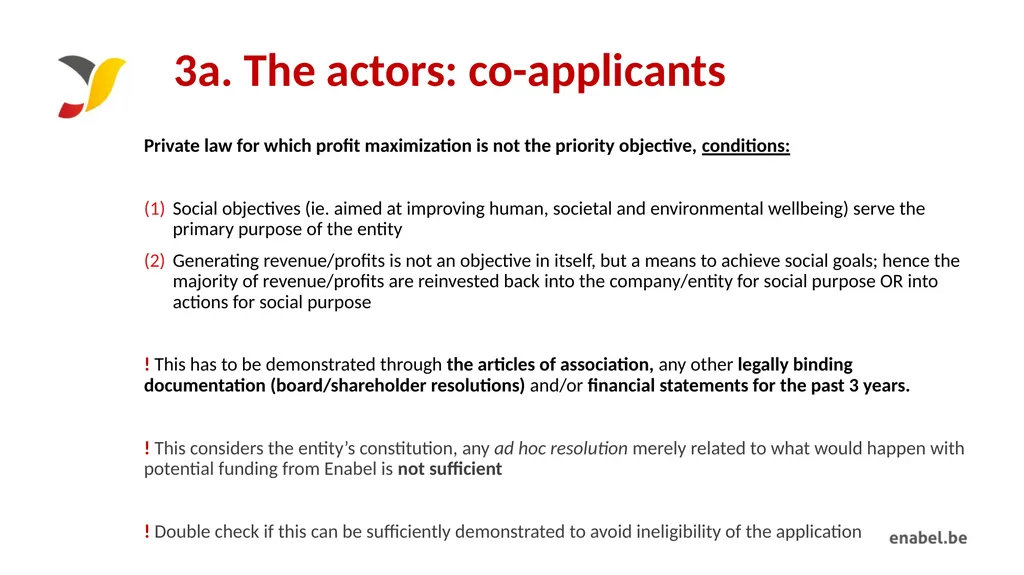
slide22. 3a. The actors: co-applicants Private law for which profit maximization is not the priority objective, conditions:
Social objectives (ie. aimed at improving human, societal and environmental wellbeing) serve the primary purpose of the entity
Generating revenue/profits is not an objective in itself, but a means to achieve social goals; hence the majority of revenue/profits are reinvested back into the company/entity for social purpose OR into actions for social purpose
! This has to be demonstrated through the articles of association, any other legally binding documentation (board/shareholder resolutions) and/or financial statements for the past 3 years.
! This considers the entity’s constitution, any ad hoc resolution merely related to what would happen with potential funding from Enabel is not sufficient
! Double check if this can be sufficiently demonstrated to avoid ineligibility of the application<br>
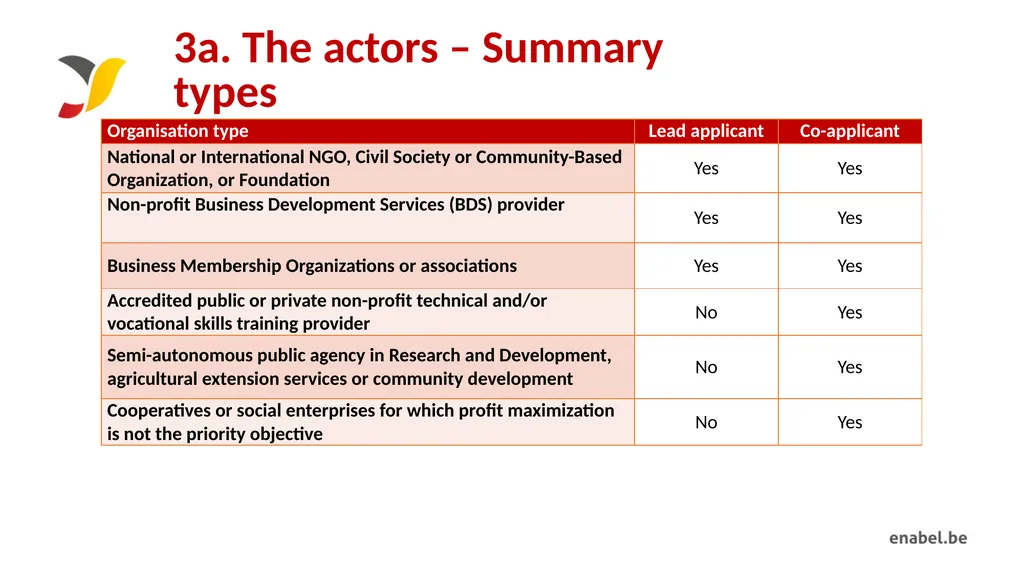
slide23. 3a. The actors – Summary types<br>
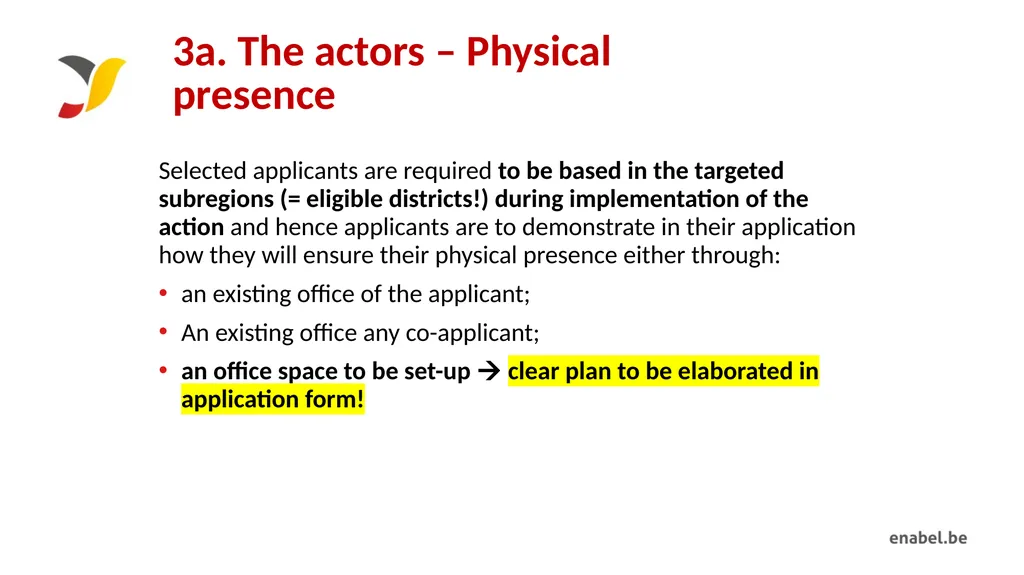
slide24. 3a. The actors – Physical presence Selected applicants are required to be based in the targeted subregions (= eligible districts!) during implementation of the action and hence applicants are to demonstrate in their application how they will ensure their physical presence either through:
an existing office of the applicant;
An existing office any co-applicant;
an office space to be set-up clear plan to be elaborated in application form!<br>
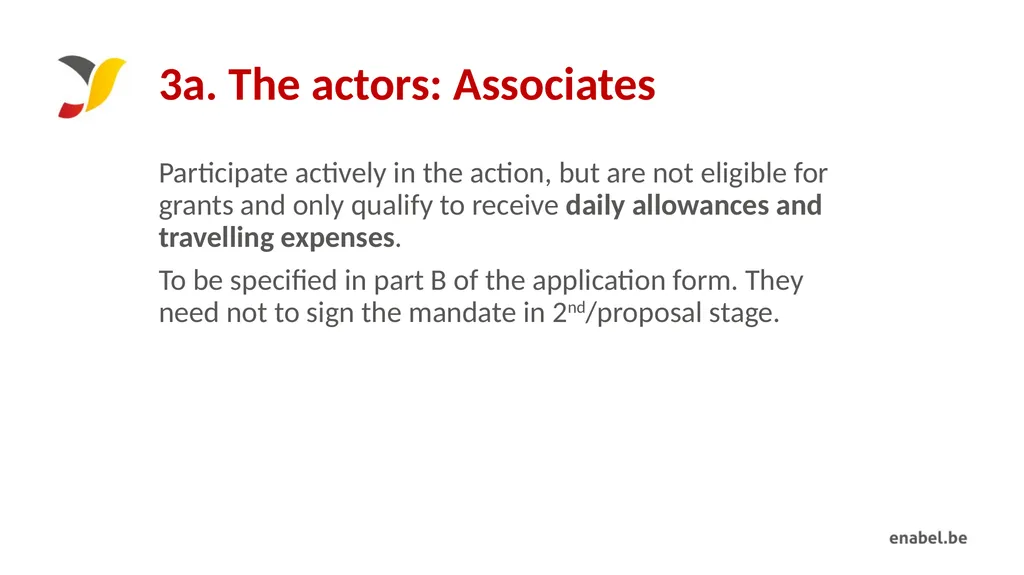
slide25. 3a. The actors: Associates Participate actively in the action, but are not eligible for grants and only qualify to receive daily allowances and travelling expenses.
To be specified in part B of the application form. They need not to sign the mandate in 2nd/proposal stage.<br>
slide26. 3a. The actors: Contractors These are contractors for services, works and equipment. These must be sourced through a procurement process using relevant procedures i.e. PPDA (public procurement law) for public entities and annex VIII of the Grant Agreement for private entities<br>
slide27. Questions?<br>
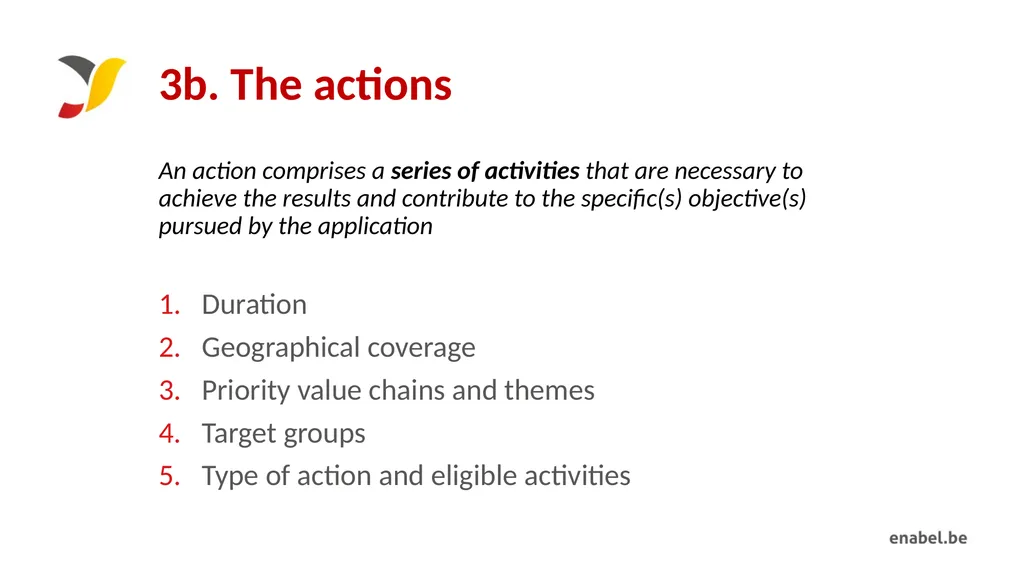
slide28. 3b. The actions An action comprises a series of activities that are necessary to achieve the results and contribute to the specific(s) objective(s) pursued by the application
Duration
Geographical coverage
Priority value chains and themes
Target groups
Type of action and eligible activities<br>
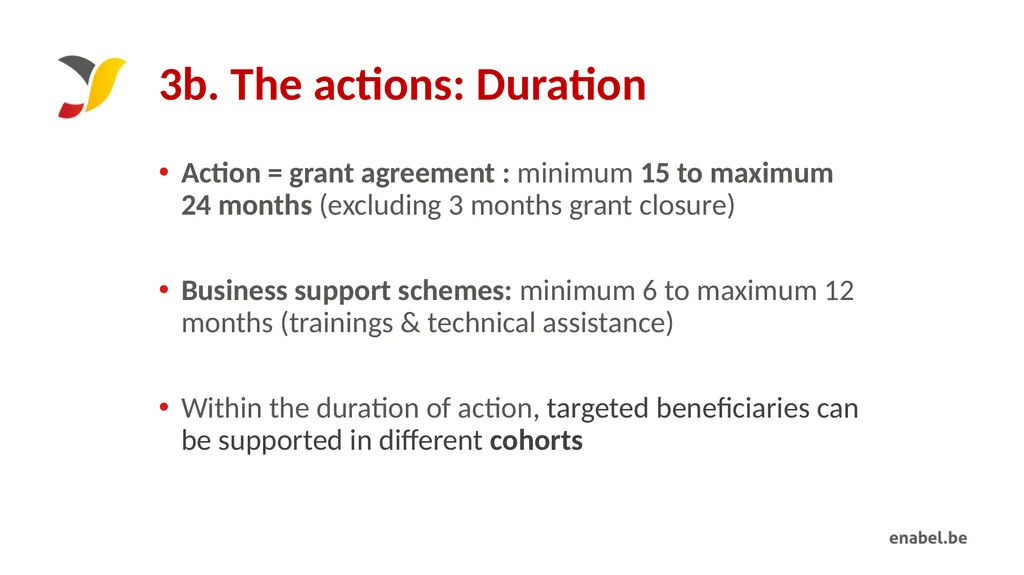
slide29. 3b. The actions: Duration Action = grant agreement : minimum 15 to maximum 24 months (excluding 3 months grant closure)
Business support schemes: minimum 6 to maximum 12 months (trainings & technical assistance)
Within the duration of action, targeted beneficiaries can be supported in different cohorts<br>
slide30. 3b. The actions: Geographical coverage The actions must be implemented in Uganda, Kampala Metropolitan sub region in at least one of the following districts:
Kampala
Mukono
Wakiso
The actions may not be implemented in other districts
Target groups/youth must reside in the target districts
Majority of activities take place in target districts
Applicants are encouraged to distribute their resources and targets over more than one district<br>
slide31. 3b. The actions: Priority value chains Agriculture:
Apiary value chain;
Coffee and cocoa value chains
Small livestock (poultry and piggery) or other agricultural value chains may be considered in a mixed farming context in which income generation in the listed priority value chains constitute a significant part of focus.
Green economy:
Sustainable tourism and hospitality value chains;
Sustainable forestry value chains (sustainable timber and non-timber, including agro-forestry);
Renewable energy value chains
Transversal: integration of organic and solid waste management can be considered for all targeted value chains<br>
slide32. 3b. The actions: Priority value chains – Green economy Sustainable tourism and hospitality value chains:
! takes full account of its current and future economic, social and environmental impacts, addressing the 3Ps (People, Planet, Profit) = sustainable microbusiness development in leisure and business tourism, while contributing to the conservation of the natural environment and cultural heritage, and inclusion of the local community
Sustainable forestry value chains:
“non-timber forest product” (NTFP) includes “all biological materials other than timber which are extracted from forests for human use. These include foods, medicines, spices, essential oils, resins, gums, latexes, tannins, dyes, ornamental plants, wildlife (products and live animals), fuelwood and raw materials, notably rattan, bamboo, small wood and fibres”
Renewable Energy value chains:
Eg. Solar value chains<br>
slide33. 3b. The actions: Priority value chains Other value chains may be considered if applicants can demonstrate a tangible link with the development of prioritized value chains and clearly substantiate the relevance of the promoted business models in these other value chains for sustainable livelihoods.
The call encourages actions supporting the sustainable development of targeted micro- or small business models in more than one value chain – especially if establishing linkage between different value chains – and/or more than one segment of a value chain (i.e. beyond production)
! For agricultural value chains actions must promote agroecological, sustainable and integrated/mixed farming approaches that combine diversified agricultural practices, enhance food security, and diversify income<br>
slide34. 3b. The actions: Targeted business models Youth-owned micro- and small businesses, including in the informal economy (considering all segments of the prioritized value chains - from production to consumption),
conducive to the following conditions:
(1) Inclusiveness/accessibility for the target group
(2) Environmental sustainability/contribution to the green transition
(3) Economical viability of the business models
Subject to evaluation!<br>
slide35. 3b. The actions: Target beneficiaries Vulnerable youth residing in the eligible districts (different vulnerability categories, to be demonstrated in application)
At least 80% youth between the ages of 15 and 35 years
At least 50% young women<br>
slide36. 3b. The actions: Two types of target groups (Semi-)skilled unemployed or underemployed individual youth or youth groups (i.e. youth that have participated in formal or non-formal technical or vocational training) who need further support to successfully start and operate a sustainable micro- or small, with optimal market access and integration in value chain and business networks;
Individual youth, youth groups or youth farmer organizations who have established a micro- or small business, whose businesses are not sustainable or at risk of failure, and who need support to overcome start-up challenges, become resilient and maximize their business potential/market access/value chain integration.
! Low or non-skilled youth who are in need of initial formal or non-formal technical and vocational training are not considered as a target group under this call.<br>
slide37. 3b. The actions – admissible Sustainable micro- and small business development initiatives, integrating:
Business development support (training, technical assistance, coaching)
Innovative approaches, (best-available) technologies and good practices;
Engagement of other private sector actors to mobilize expertise and/or to support development of business relationship;
Strategies to enhance beneficiaries’ access to affordable finance and capital;
Where relevant, strategies towards enhanced access to assets, including land & inputs (without distorting the local ecosystem and market);
Strategies to support adherence to quality standards of products and services;
Support to formalization and/or occupational licensing where relevant (ie. When strongly linked to market access);
Support to product diversification through value addition;
Outreach and awareness activities;
Other social inclusion strategies that help remove gender and other vulnerability-related barriers<br>
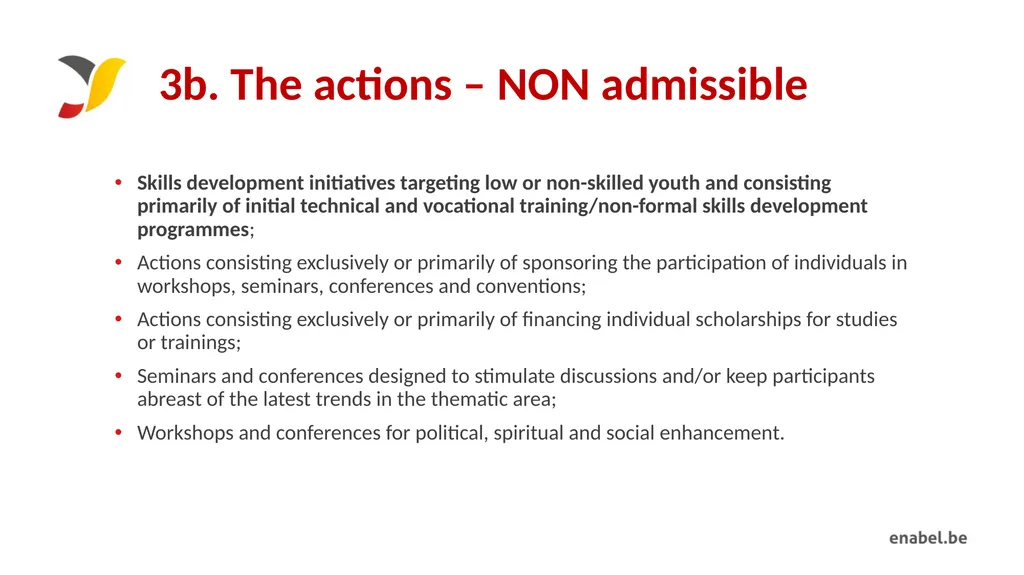
slide38. 3b. The actions – NON admissible Skills development initiatives targeting low or non-skilled youth and consisting primarily of initial technical and vocational training/non-formal skills development programmes;
Actions consisting exclusively or primarily of sponsoring the participation of individuals in workshops, seminars, conferences and conventions;
Actions consisting exclusively or primarily of financing individual scholarships for studies or trainings;
Seminars and conferences designed to stimulate discussions and/or keep participants abreast of the latest trends in the thematic area;
Workshops and conferences for political, spiritual and social enhancement.<br>
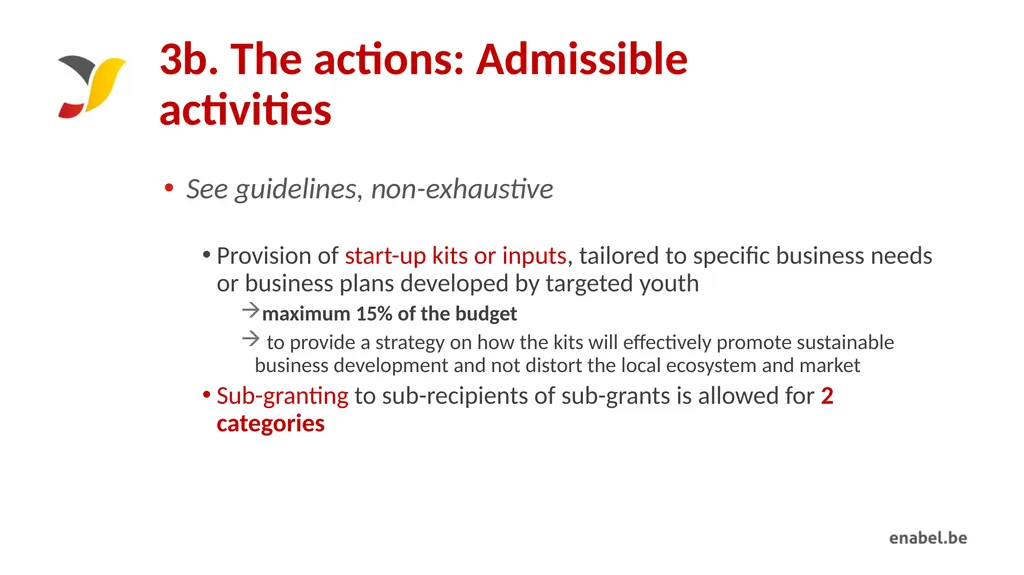
slide39. 3b. The actions: Admissible activities See guidelines, non-exhaustive
Provision of start-up kits or inputs, tailored to specific business needs or business plans developed by targeted youth
maximum 15% of the budget
to provide a strategy on how the kits will effectively promote sustainable business development and not distort the local ecosystem and market
Sub-granting to sub-recipients of sub-grants is allowed for 2 categories<br>
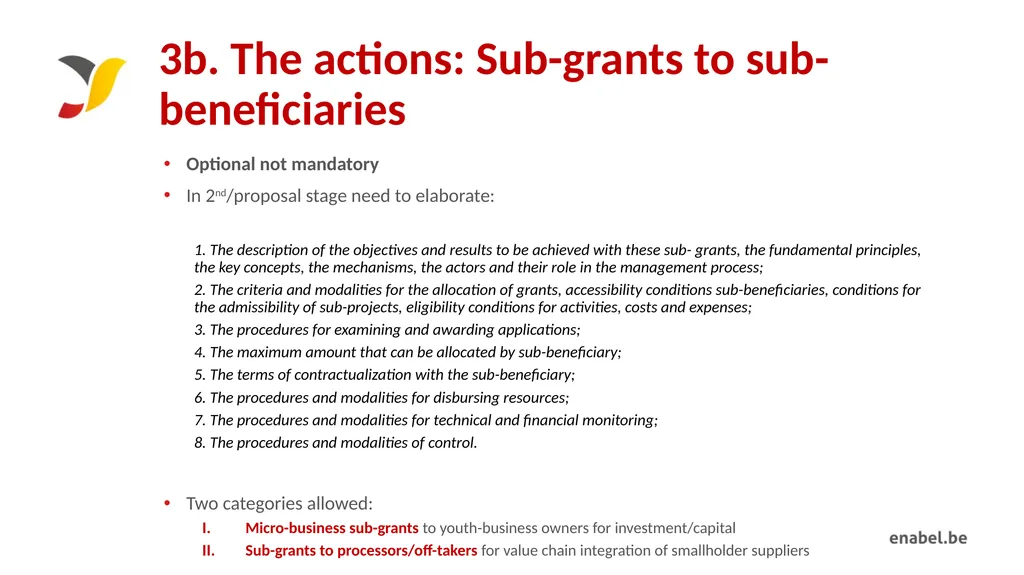
slide40. 3b. The actions: Sub-grants to sub-beneficiaries Optional not mandatory
In 2nd/proposal stage need to elaborate:
1. The description of the objectives and results to be achieved with these sub- grants, the fundamental principles, the key concepts, the mechanisms, the actors and their role in the management process;
2. The criteria and modalities for the allocation of grants, accessibility conditions sub-beneficiaries, conditions for the admissibility of sub-projects, eligibility conditions for activities, costs and expenses;
3. The procedures for examining and awarding applications;
4. The maximum amount that can be allocated by sub-beneficiary;
5. The terms of contractualization with the sub-beneficiary;
6. The procedures and modalities for disbursing resources;
7. The procedures and modalities for technical and financial monitoring;
8. The procedures and modalities of control.
Two categories allowed:
Micro-business sub-grants to youth-business owners for investment/capital
Sub-grants to processors/off-takers for value chain integration of smallholder suppliers<br>
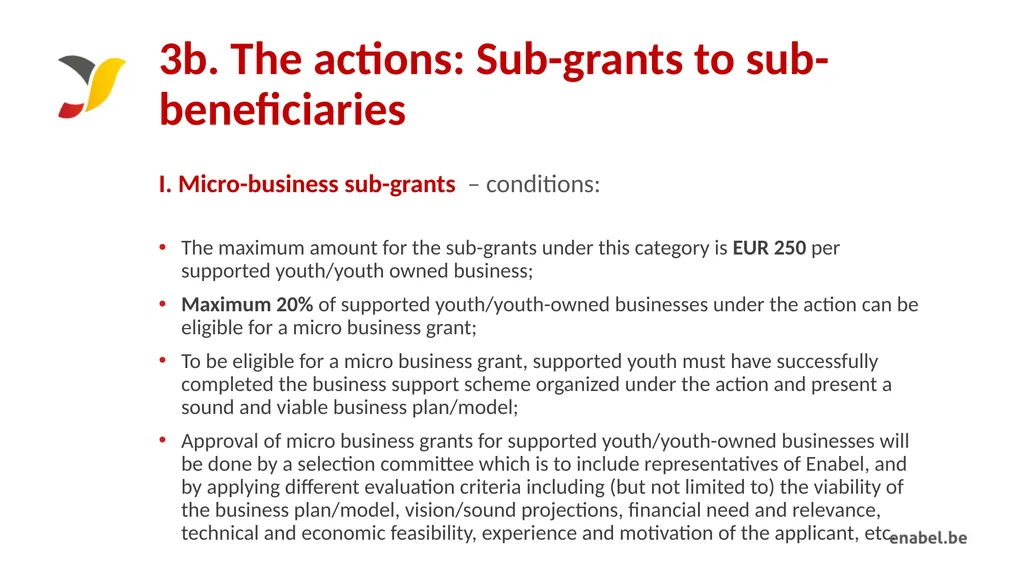
slide41. 3b. The actions: Sub-grants to sub-beneficiaries I. Micro-business sub-grants – conditions:
The maximum amount for the sub-grants under this category is EUR 250 per supported youth/youth owned business;
Maximum 20% of supported youth/youth-owned businesses under the action can be eligible for a micro business grant;
To be eligible for a micro business grant, supported youth must have successfully completed the business support scheme organized under the action and present a sound and viable business plan/model;
Approval of micro business grants for supported youth/youth-owned businesses will be done by a selection committee which is to include representatives of Enabel, and by applying different evaluation criteria including (but not limited to) the viability of the business plan/model, vision/sound projections, financial need and relevance, technical and economic feasibility, experience and motivation of the applicant, etc.<br>
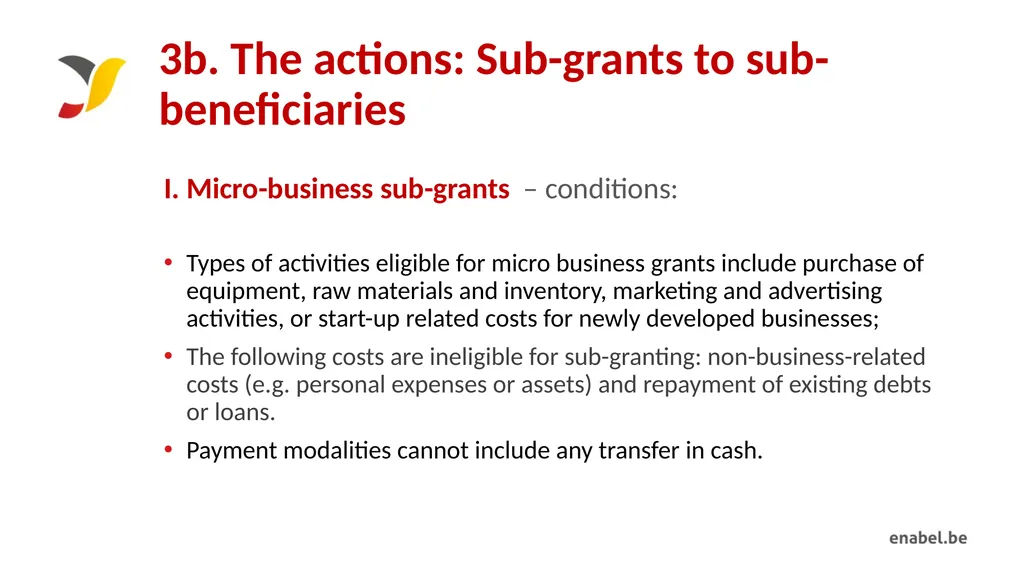
slide42. 3b. The actions: Sub-grants to sub-beneficiaries I. Micro-business sub-grants – conditions:
Types of activities eligible for micro business grants include purchase of equipment, raw materials and inventory, marketing and advertising activities, or start-up related costs for newly developed businesses;
The following costs are ineligible for sub-granting: non-business-related costs (e.g. personal expenses or assets) and repayment of existing debts or loans.
Payment modalities cannot include any transfer in cash.<br>
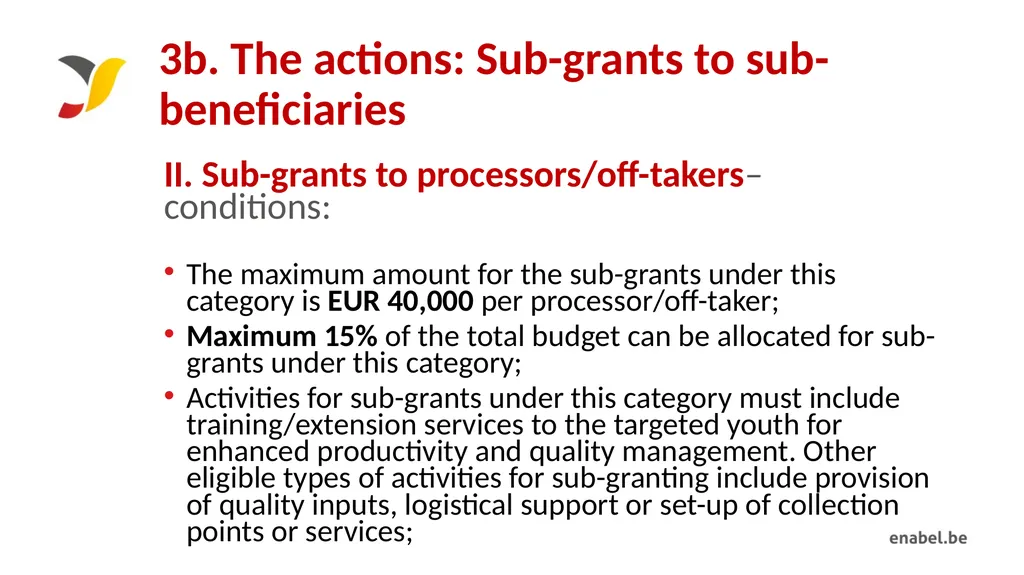
slide43. 3b. The actions: Sub-grants to sub-beneficiaries II. Sub-grants to processors/off-takers– conditions:
The maximum amount for the sub-grants under this category is EUR 40,000 per processor/off-taker;
Maximum 15% of the total budget can be allocated for sub-grants under this category;
Activities for sub-grants under this category must include training/extension services to the targeted youth for enhanced productivity and quality management. Other eligible types of activities for sub-granting include provision of quality inputs, logistical support or set-up of collection points or services;<br>
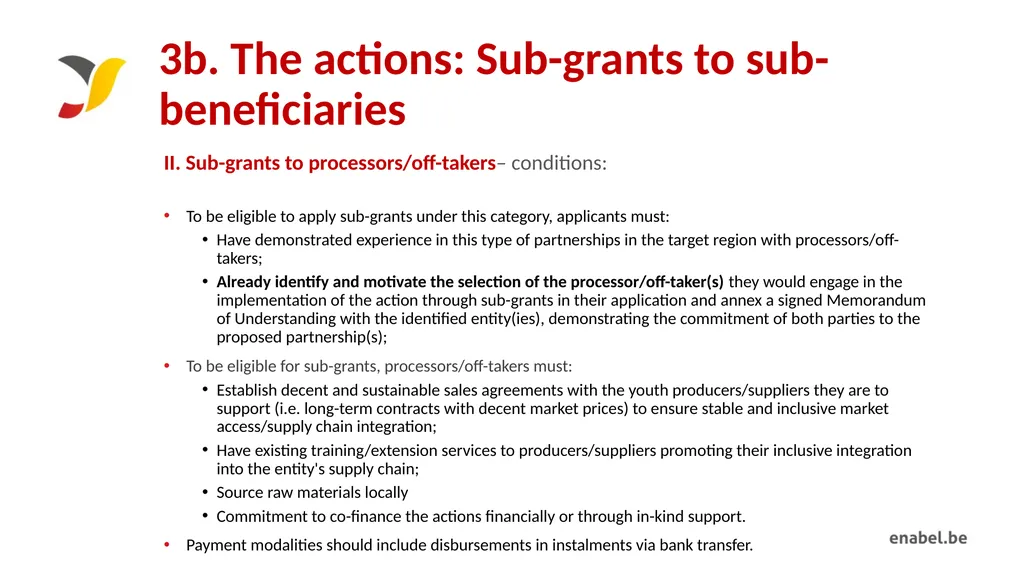
slide44. 3b. The actions: Sub-grants to sub-beneficiaries II. Sub-grants to processors/off-takers– conditions:
To be eligible to apply sub-grants under this category, applicants must:
Have demonstrated experience in this type of partnerships in the target region with processors/off-takers;
Already identify and motivate the selection of the processor/off-taker(s) they would engage in the implementation of the action through sub-grants in their application and annex a signed Memorandum of Understanding with the identified entity(ies), demonstrating the commitment of both parties to the proposed partnership(s);
To be eligible for sub-grants, processors/off-takers must:
Establish decent and sustainable sales agreements with the youth producers/suppliers they are to support (i.e. long-term contracts with decent market prices) to ensure stable and inclusive market access/supply chain integration;
Have existing training/extension services to producers/suppliers promoting their inclusive integration into the entity's supply chain;
Source raw materials locally
Commitment to co-finance the actions financially or through in-kind support.
Payment modalities should include disbursements in instalments via bank transfer.<br>
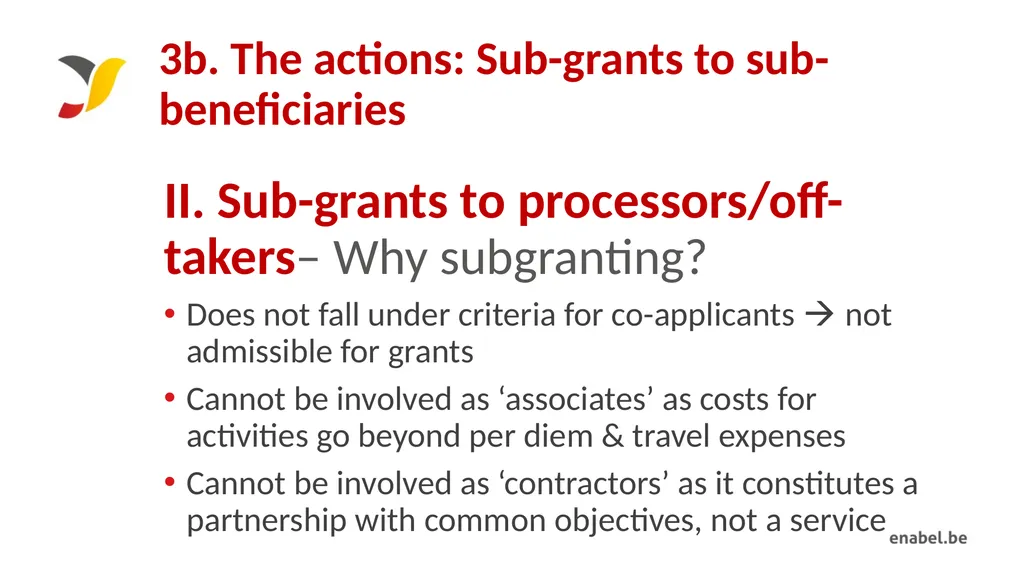
slide45. 3b. The actions: Sub-grants to sub-beneficiaries II. Sub-grants to processors/off-takers– Why subgranting?
Does not fall under criteria for co-applicants not admissible for grants
Cannot be involved as ‘associates’ as costs for activities go beyond per diem & travel expenses
Cannot be involved as ‘contractors’ as it constitutes a partnership with common objectives, not a service<br>
slide46. 3b. Summary all type of actors that can be involved in implementation<br>
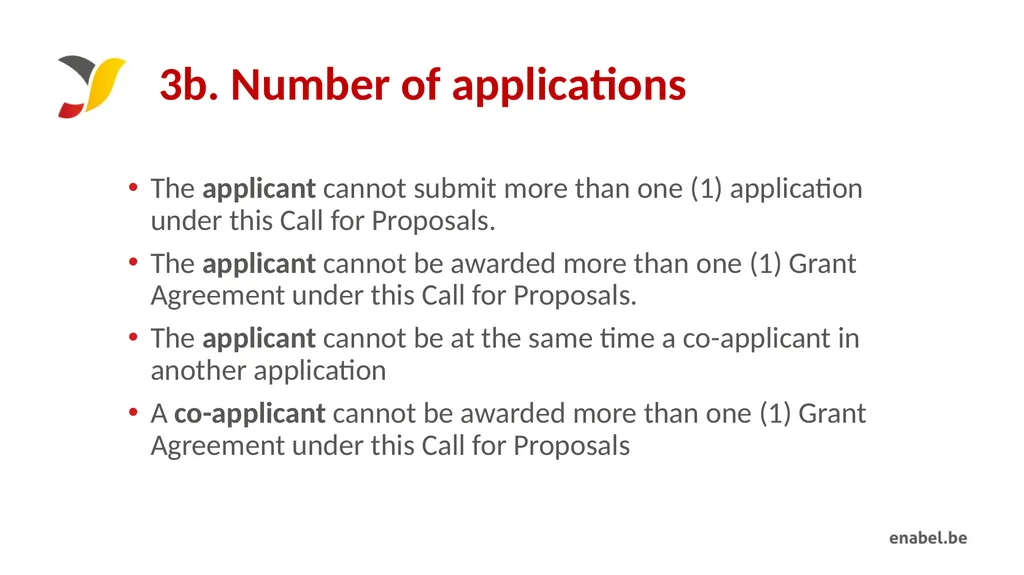
slide47. 3b. Number of applications The applicant cannot submit more than one (1) application under this Call for Proposals.
The applicant cannot be awarded more than one (1) Grant Agreement under this Call for Proposals.
The applicant cannot be at the same time a co-applicant in another application
A co-applicant cannot be awarded more than one (1) Grant Agreement under this Call for Proposals<br>
slide48. Questions?<br>
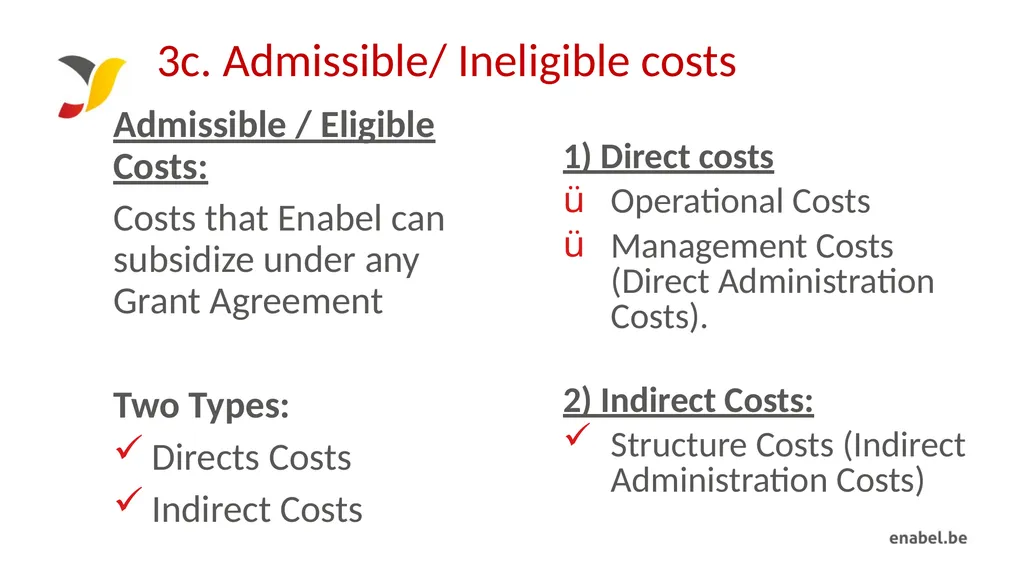
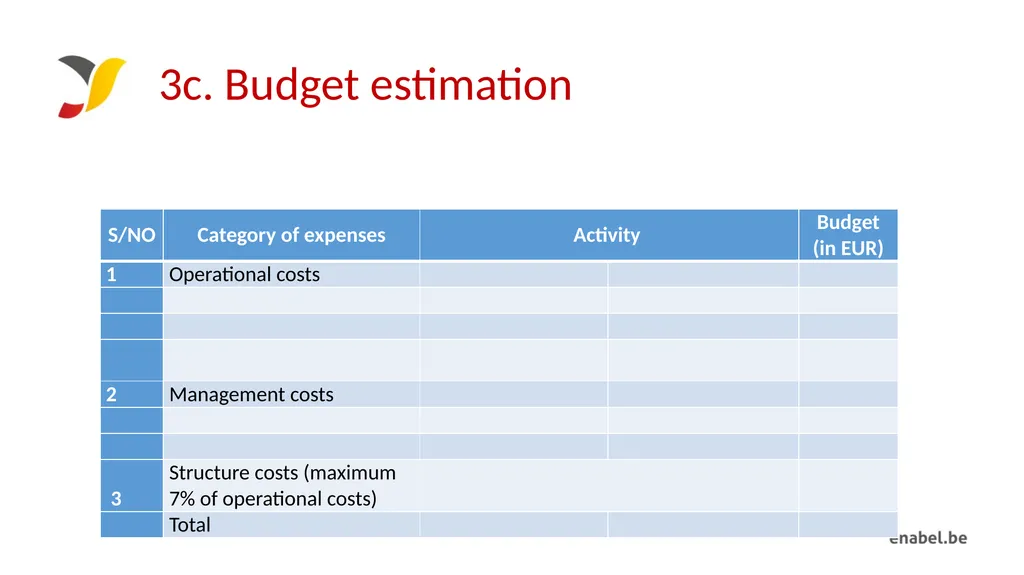
slide49. 3c. Admissible/ Ineligible costs Admissible / Eligible Costs:
Costs that Enabel can subsidize under any Grant Agreement
Two Types:
Directs Costs
Indirect Costs 1) Direct costs
Operational Costs
Management Costs (Direct Administration Costs).
2) Indirect Costs:
Structure Costs (Indirect Administration Costs)<br>
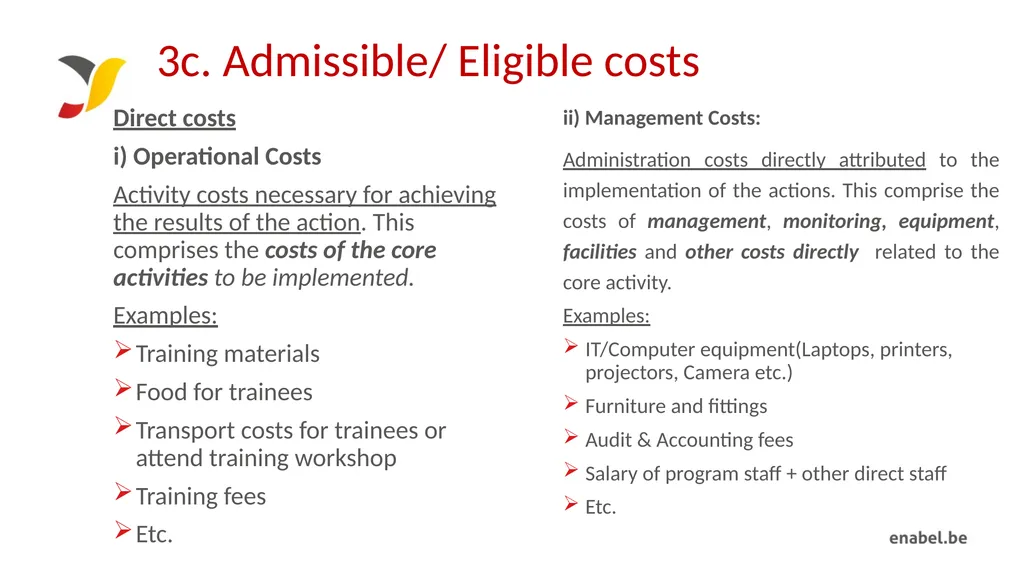
slide50. 3c. Admissible/ Eligible costs Direct costs
i) Operational Costs
Activity costs necessary for achieving the results of the action. This comprises the costs of the core activities to be implemented.
Examples:
Training materials
Food for trainees
Transport costs for trainees or attend training workshop
Training fees
Etc. ii) Management Costs:
Administration costs directly attributed to the implementation of the actions. This comprise the costs of management, monitoring, equipment, facilities and other costs directly related to the core activity.
Examples:
IT/Computer equipment(Laptops, printers, projectors, Camera etc.)
Furniture and fittings
Audit & Accounting fees
Salary of program staff + other direct staff
Etc.<br>
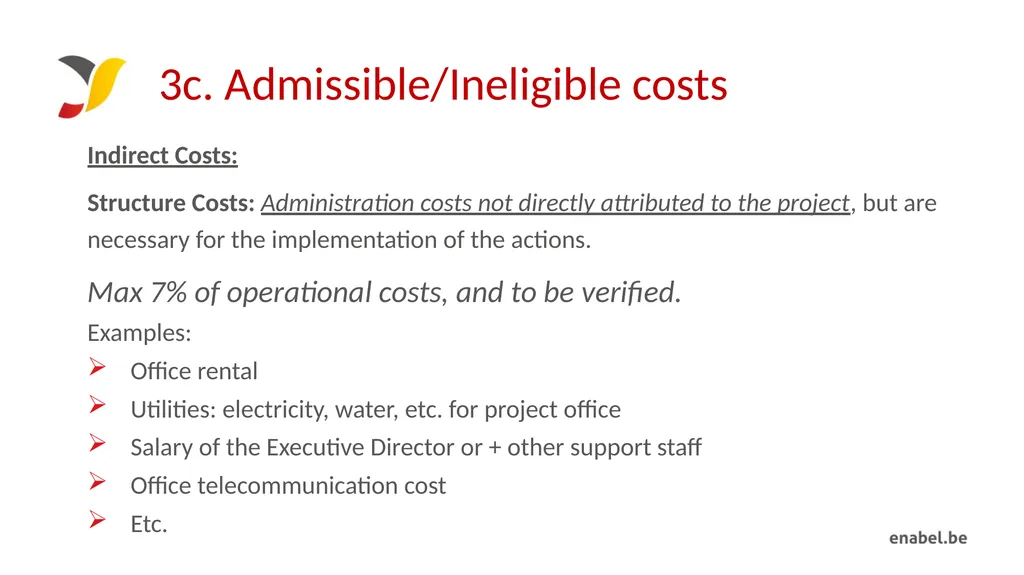
slide51. 3c. Admissible/Ineligible costs Indirect Costs:
Structure Costs: Administration costs not directly attributed to the project, but are necessary for the implementation of the actions.
Max 7% of operational costs, and to be verified.
Examples:
Office rental
Utilities: electricity, water, etc. for project office
Salary of the Executive Director or + other support staff
Office telecommunication cost
Etc.<br>
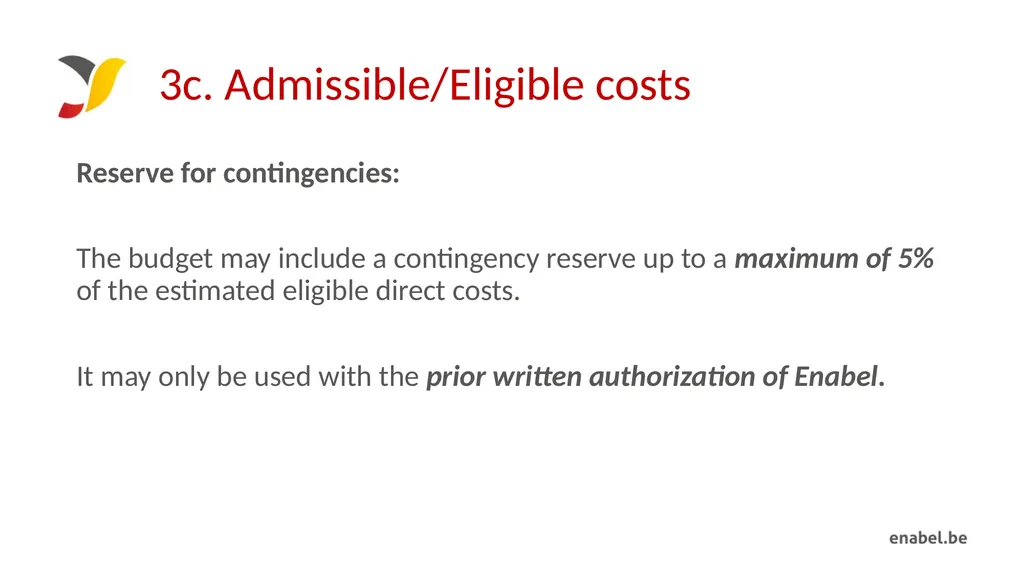
slide52. 3c. Admissible/Eligible costs Reserve for contingencies:
The budget may include a contingency reserve up to a maximum of 5% of the estimated eligible direct costs.
It may only be used with the prior written authorization of Enabel.<br>
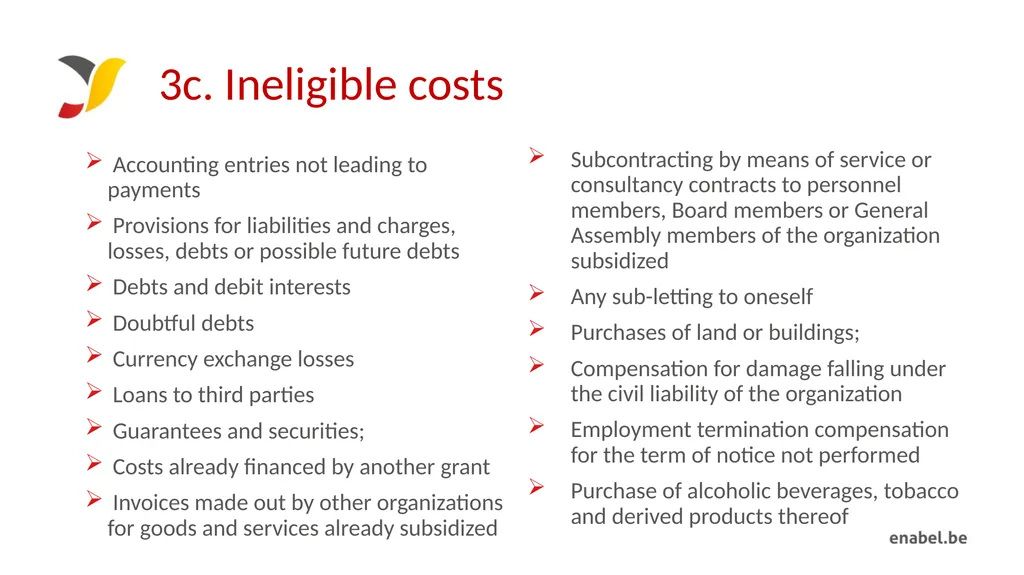
slide53. 3c. Ineligible costs Accounting entries not leading to payments
Provisions for liabilities and charges, losses, debts or possible future debts
Debts and debit interests
Doubtful debts
Currency exchange losses
Loans to third parties
Guarantees and securities;
Costs already financed by another grant
Invoices made out by other organizations for goods and services already subsidized Subcontracting by means of service or consultancy contracts to personnel members, Board members or General Assembly members of the organization subsidized
Any sub-letting to oneself
Purchases of land or buildings;
Compensation for damage falling under the civil liability of the organization
Employment termination compensation for the term of notice not performed
Purchase of alcoholic beverages, tobacco and derived products thereof<br>
slide54. 3c. Budget estimation<br>
slide55. Questions?<br>
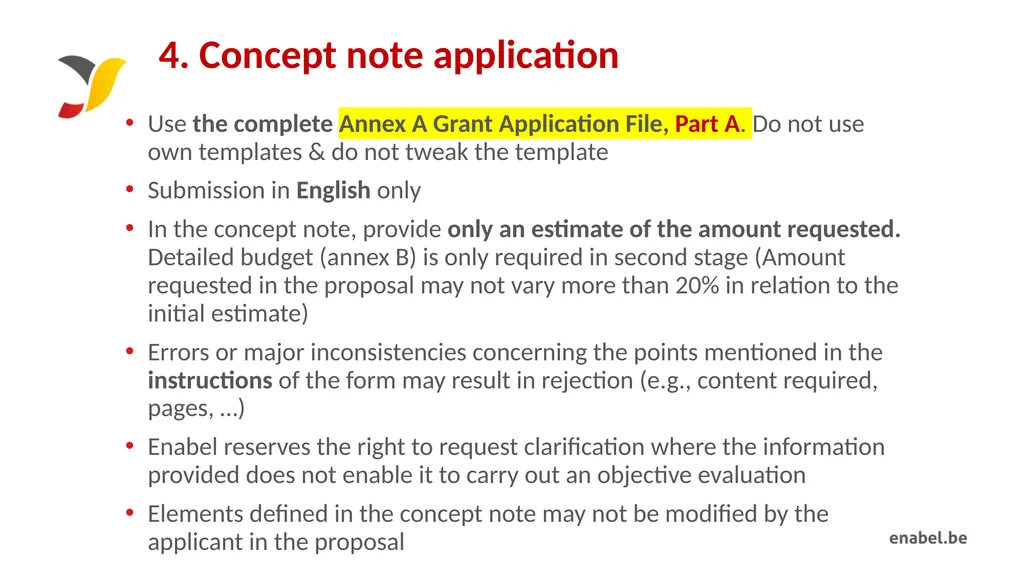
slide56. 4. Concept note application Use the complete Annex A Grant Application File, Part A. Do not use own templates & do not tweak the template
Submission in English only
In the concept note, provide only an estimate of the amount requested. Detailed budget (annex B) is only required in second stage (Amount requested in the proposal may not vary more than 20% in relation to the initial estimate)
Errors or major inconsistencies concerning the points mentioned in the instructions of the form may result in rejection (e.g., content required, pages, …)
Enabel reserves the right to request clarification where the information provided does not enable it to carry out an objective evaluation
Elements defined in the concept note may not be modified by the applicant in the proposal<br>
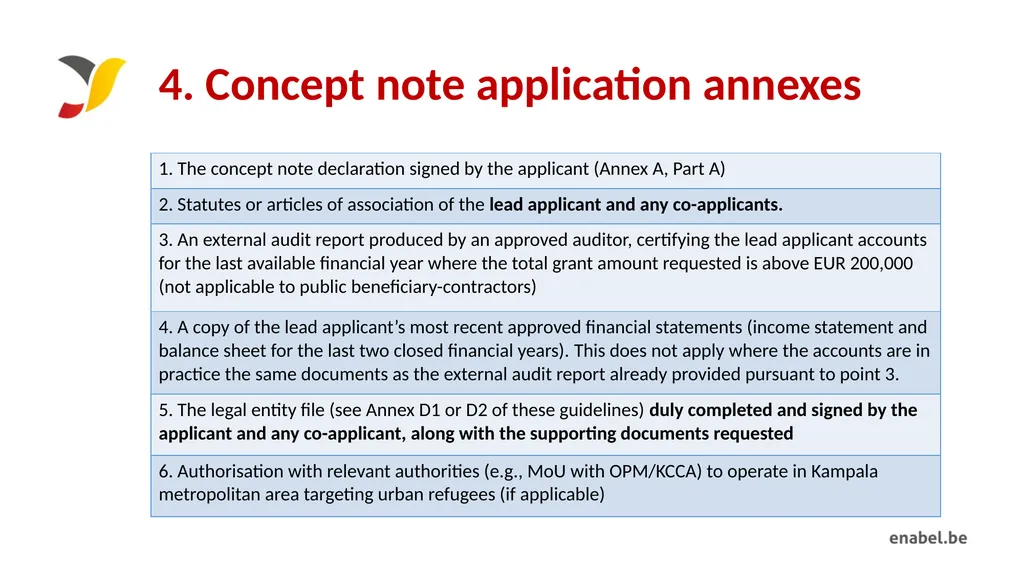
slide57. 4. Concept note application annexes<br>
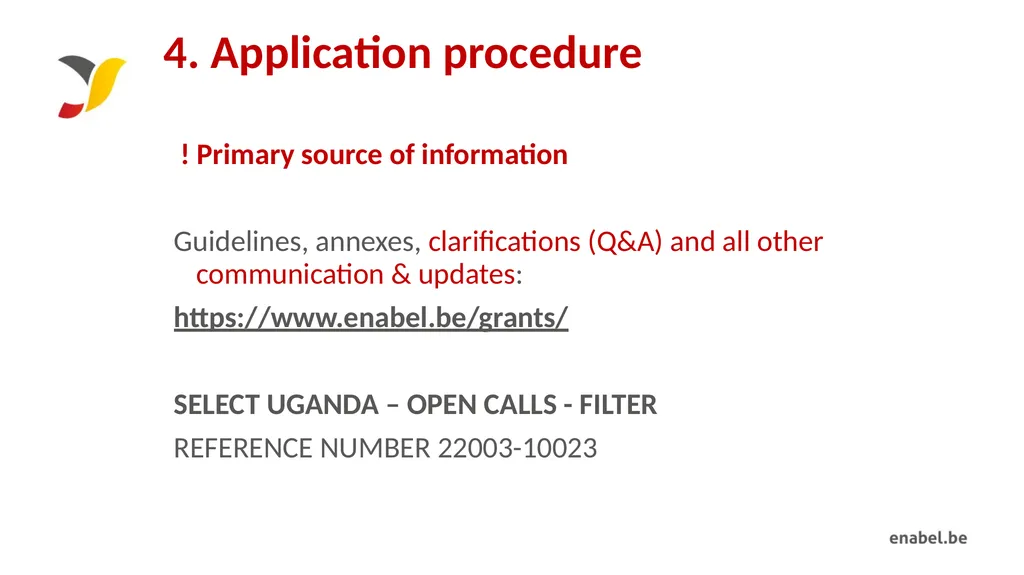
slide58. 4. Application procedure ! Primary source of information
Guidelines, annexes, clarifications (Q&A) and all other communication & updates:
https://www.enabel.be/grants/
Select UGANDA – OPEN CALLS - FILTER
reference number 22003-10023<br>
slide59. 5. Application procedure Remaining questions: uga_csc_grants@enabel.be
Subject: reference number + name<br>
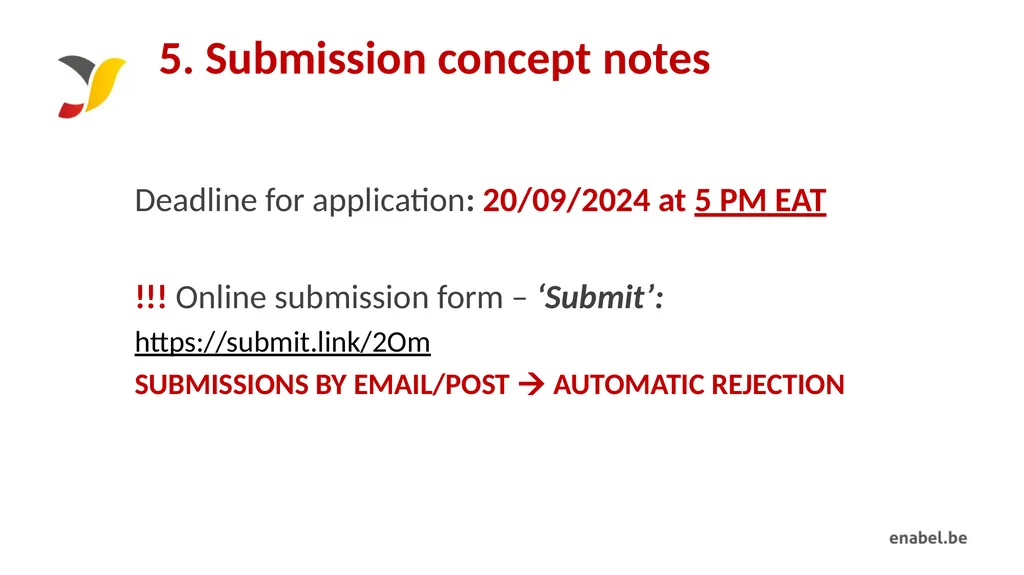
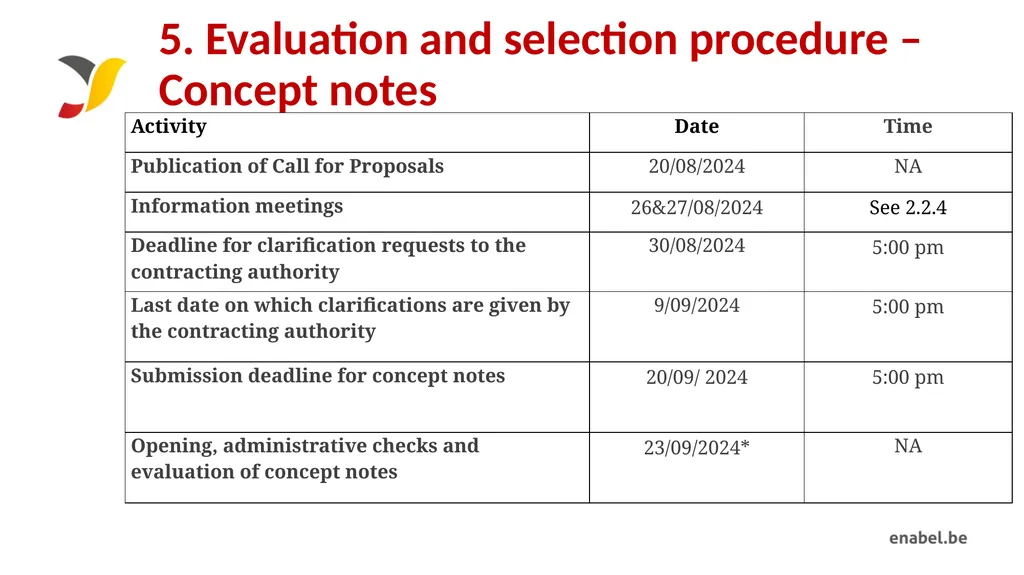
slide60. 5. Submission concept notes Deadline for application: 20/09/2024 at 5 PM EAT
!!! Online submission form – ‘Submit’:
https://submit.link/2Om
SUBMISSIONS BY EMAIL/POST AUTOMATIC REJECTION<br>
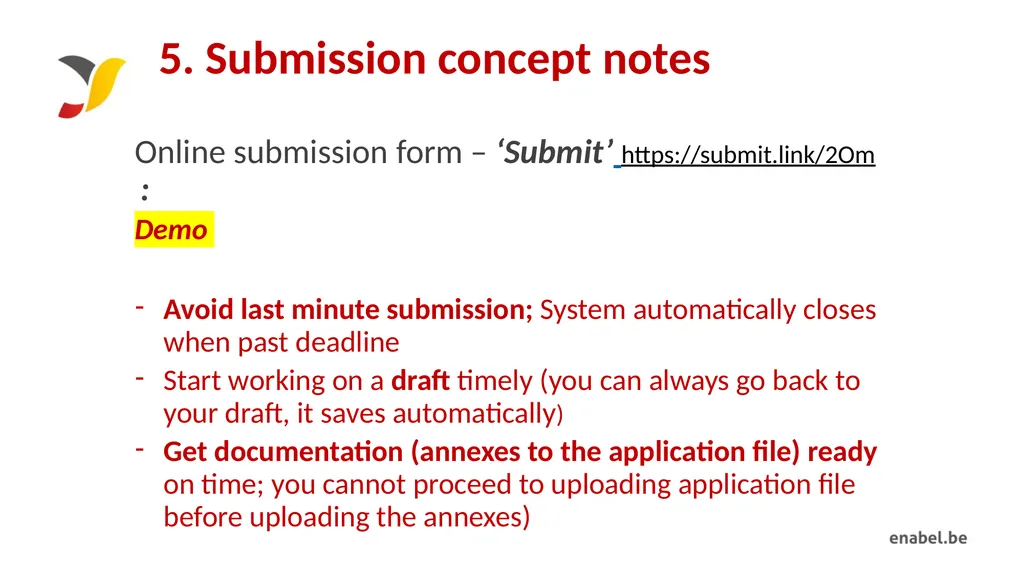
slide61. 5. Submission concept notes Online submission form – ‘Submit’ https://submit.link/2Om :
Demo
Avoid last minute submission; System automatically closes when past deadline
Start working on a draft timely (you can always go back to your draft, it saves automatically)
Get documentation (annexes to the application file) ready on time; you cannot proceed to uploading application file before uploading the annexes)<br>
slide62. 5. Submission concept notes Timely
Complete (guide + declaration + annexes)
and following the procedure (use the template!)<br>
slide63. 5. Evaluation and selection procedure – Concept notes<br>
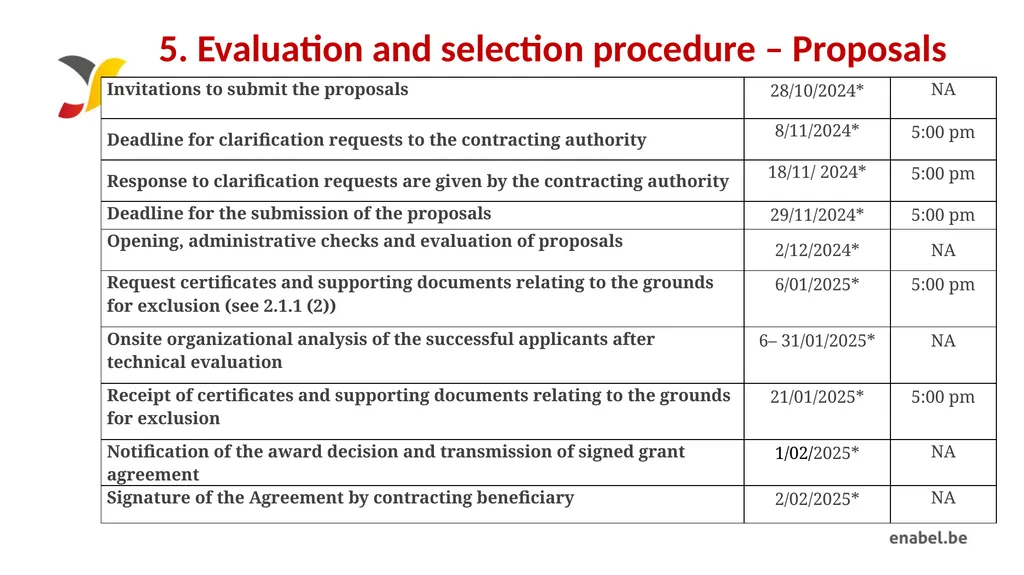
slide64. 5. Evaluation and selection procedure – Proposals<br>
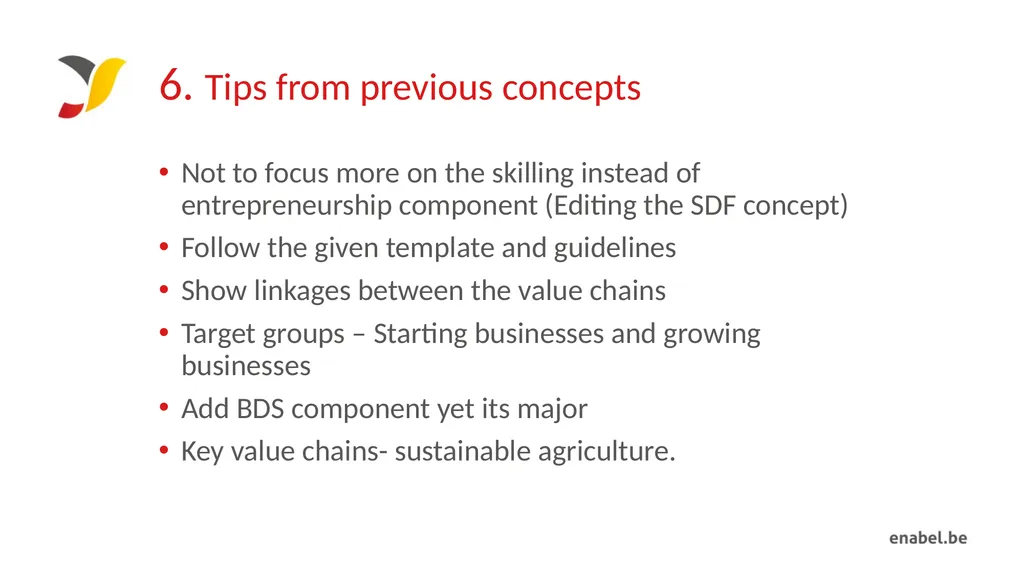
slide65. 6. Tips from previous concepts Not to focus more on the skilling instead of entrepreneurship component (Editing the SDF concept)
Follow the given template and guidelines
Show linkages between the value chains
Target groups – Starting businesses and growing businesses
Add BDS component yet its major
Key value chains- sustainable agriculture.<br>
slide66. Thank you! Q&A<br>
slide2. Presentation outline Introduction to WeWork and the Call for Proposals
Objectives of the call
Admissibility criteria
Actors
Actions
Costs
Concept note application form
Application and selection procedure<br>
slide3. Call for Proposals Guidelines, annexes, clarifications (Q&A) and all other communication:
www.enabel.be/grants
Call reference number: UGA22003-10023
Call Title: Supporting vulnerable youth to develop sustainable micro- and small businesses for enhanced resilience and economic integration in Kampala Metropolitan area.
Procedure: 2 phased : (1) Concept note stage, (2) proposal stage<br>
slide4. Enabel Country Portfolio Objectives Young people and women in Uganda develop into active, economically independent citizens in a sustainable society that respects human rights and ensures quality basic services Young people, especially young women, acquire skills and find decent jobs or entrepreneurship opportunities in agriculture and the green and sustainable economy The right to safe and quality education and health care is more transparently ensured, in particular for vulnerable groups including children, girls and women, and refugees General objectives Overall Objective Pillar 1 Pillar 2 WeWork – Green and Decent Jobs for Youth<br>
slide5. 1. Introduction Enabel, the Belgian development Agency
Vision: Young people and women in Uganda develop into active, economically independent citizens in a sustainable society that respects human rights and ensures quality basic services.
Focus areas:<br>
slide6. 1. Cn't Introduction Interventions are funded by:
Belgian government
Employability and Employment: Green and decent jobs for youth “WeWork”
Education: WeLearn
Health: WeCare and WeTrain4Health
and the EU
Employability and Employment: Green and decent jobs for youth “WeWork”
Business: SB4U and SBHR
Gender: G4DU<br>
slide7. 1. Cn't Introduction - WeWork<br>
slide8. 1. WeWork: Green and Decent Jobs for Youth Focus on agriculture and the green economy Results domain 1 Improved employability of young people (especially women) through skilling and employment services Results domain 2 Increased gainful self- employment opportunities
through entrepreneurship Results domain 3 Increased productivity &
sustainability of existing
businesses<br>
slide10. 1. Result 4 – Entrepreneurship promotion Address barriers to local economic integration for vulnerable youth, particularly young women
Pathway to self-employment
Increase resilience = sustainable livelihoods & food security
Sustainable micro- and small businesses (incl informal)<br>
slide11. 1. Result 4 – Entrepreneurship promotion Target groups
Un(der)employed, skilled youth
start a sustainable business
2) Youth/youth group business owners
Operate a sustainable business
Vulnerable youth
BUT w/min required skills & capacity
NOT non-skilled youth in need of initial TVET<br>
slide12. 2. Call Objectives 2 phased procedure
- Concept note stage
- Proposal stage<br>
slide13. 2. Call Objectives General objective
The livelihoods of vulnerable youth, including young women, in Kampala Metropolitan region, are improved and sustained through access to self-employment opportunities
Specific objective
Vulnerable youth, including young women, start and grow sustainable micro- or small businesses, through enhanced access to quality business development support<br>
slide14. 2. Call objectives – Results (overall) 650 vulnerable youth, including young women (ie. Skilled, unemployed youth as well as youth business-owners), are supported to start or grow sustainable micro- and small businesses through quality business development support;
650 vulnerable youth (the same target group as under expected result 1), are supported to access affordable finance and capital to start or grow their micro- or small businesses;
Good practices in (green/climate-smart) business development services for the economic integration of vulnerable youth are scaled-up.<br>
slide15. 2. Call objectives – ‘Sustainable livelihoods’ Criteria for established ‘sustainable livelihoods’:
Minimum of 3 consecutive months with stable income;
Stable income will be defined at a level of a minimum net income of UGX 214,000 per month;
Enhanced incomes of targeted beneficiaries by at least 20% of monthly income. The income increase should raise the income of the targeted beneficiary to at least UGX 214,000 net and above.<br>
slide16. 2. Call volume and grant amounts Total call volume is 650,000 EUR
Grant applications must fall between minimum 150,000 and maximum 325,000 EUR<br>
slide17. 3. Admissibility criteria – 3 levels The actors: Admissible applicants
The actions: Admissible actions for grants
The costs: Admissible types of costs that may be included in grants<br>
slide18. 3a. The actors: (lead) applicant Be a legal entity;
Be a private not for profit entity or foundation;
Be established or represented in Uganda (= registered!);
Be a National or International Non-Governmental Organization, Civil Society or Community-Based Organization, or Foundation; Business Membership Organisation; or Non-profit Business Development Service Provider;
Have demonstrated local expertise and experience in managing quality business development initiatives and economic empowerment of vulnerable youth and young women in a Uganda for – at least – the past 2 years;
Be directly responsible for the preparation and management of the action with the co-applicant (where applicable) and not be acting as an intermediary;
Have an active Bank Account for the past 12 months;
Have in-house financial management capacity.<br>
slide19. 3a. The actors: (lead) applicant Exclusion grounds:
Annex VII grant agreement – Applicant’s declaration in application form completed and signed (Annex A guidelines)
Supporting documents (upon preselection – 2nd stage):
Criminal record clearances from Interpol
NSSF clearance certificate
Tax clearance certificate<br>
slide20. 3a. The actors: Co-applicants The applicant may form a partnership and act with one and maximum two co-applicants (not obligatory!)
The partnership between lead and co-applicants is to optimize cumulation of complementary expertise.
The selected applicant becomes the contracting-beneficiary and is the main point of contact for the contracting authority. It shall represent its co-applicant and act in their name. It shall design and coordinate implementation of the action.
The co-applicant shall participate in the implementation of the action and the costs that they incur shall be eligible in the same way as those incurred by the lead applicant.
Any co-applicants must sign a mandate in 2nd/proposal stage (part B application form)<br>
slide21. 3a. The actors: co-applicants Be a legal entity;
Be a public entity; or a private not for profit entity or foundation; or a legal entity of private law for which profit maximization is not the priority objective;
Be established or represented in Uganda (= registered!);
Be any of the following types of organization:
Accredited public or private non-profit technical and/or vocational skills training provider;
Semi-autonomous public agency in Research and Development, agricultural extension services or community development;
National or International NGO, Civil Society or Community-Based Organization, or Foundation;
Business Membership Organisation;
Non-profit Business Development Service provider;
A cooperative or social enterprise for which profit maximization is not the priority objective;
Have demonstrated expertise and experience in participating in the implementation of quality business development initiatives and economic empowerment of vulnerable youth and young women in the geographical target area for – at least – the past 2 years;
Have an operational governance structure and an active bank account for the past 12 months.<br>
slide22. 3a. The actors: co-applicants Private law for which profit maximization is not the priority objective, conditions:
Social objectives (ie. aimed at improving human, societal and environmental wellbeing) serve the primary purpose of the entity
Generating revenue/profits is not an objective in itself, but a means to achieve social goals; hence the majority of revenue/profits are reinvested back into the company/entity for social purpose OR into actions for social purpose
! This has to be demonstrated through the articles of association, any other legally binding documentation (board/shareholder resolutions) and/or financial statements for the past 3 years.
! This considers the entity’s constitution, any ad hoc resolution merely related to what would happen with potential funding from Enabel is not sufficient
! Double check if this can be sufficiently demonstrated to avoid ineligibility of the application<br>
slide23. 3a. The actors – Summary types<br>
slide24. 3a. The actors – Physical presence Selected applicants are required to be based in the targeted subregions (= eligible districts!) during implementation of the action and hence applicants are to demonstrate in their application how they will ensure their physical presence either through:
an existing office of the applicant;
An existing office any co-applicant;
an office space to be set-up clear plan to be elaborated in application form!<br>
slide25. 3a. The actors: Associates Participate actively in the action, but are not eligible for grants and only qualify to receive daily allowances and travelling expenses.
To be specified in part B of the application form. They need not to sign the mandate in 2nd/proposal stage.<br>
slide26. 3a. The actors: Contractors These are contractors for services, works and equipment. These must be sourced through a procurement process using relevant procedures i.e. PPDA (public procurement law) for public entities and annex VIII of the Grant Agreement for private entities<br>
slide27. Questions?<br>
slide28. 3b. The actions An action comprises a series of activities that are necessary to achieve the results and contribute to the specific(s) objective(s) pursued by the application
Duration
Geographical coverage
Priority value chains and themes
Target groups
Type of action and eligible activities<br>
slide29. 3b. The actions: Duration Action = grant agreement : minimum 15 to maximum 24 months (excluding 3 months grant closure)
Business support schemes: minimum 6 to maximum 12 months (trainings & technical assistance)
Within the duration of action, targeted beneficiaries can be supported in different cohorts<br>
slide30. 3b. The actions: Geographical coverage The actions must be implemented in Uganda, Kampala Metropolitan sub region in at least one of the following districts:
Kampala
Mukono
Wakiso
The actions may not be implemented in other districts
Target groups/youth must reside in the target districts
Majority of activities take place in target districts
Applicants are encouraged to distribute their resources and targets over more than one district<br>
slide31. 3b. The actions: Priority value chains Agriculture:
Apiary value chain;
Coffee and cocoa value chains
Small livestock (poultry and piggery) or other agricultural value chains may be considered in a mixed farming context in which income generation in the listed priority value chains constitute a significant part of focus.
Green economy:
Sustainable tourism and hospitality value chains;
Sustainable forestry value chains (sustainable timber and non-timber, including agro-forestry);
Renewable energy value chains
Transversal: integration of organic and solid waste management can be considered for all targeted value chains<br>
slide32. 3b. The actions: Priority value chains – Green economy Sustainable tourism and hospitality value chains:
! takes full account of its current and future economic, social and environmental impacts, addressing the 3Ps (People, Planet, Profit) = sustainable microbusiness development in leisure and business tourism, while contributing to the conservation of the natural environment and cultural heritage, and inclusion of the local community
Sustainable forestry value chains:
“non-timber forest product” (NTFP) includes “all biological materials other than timber which are extracted from forests for human use. These include foods, medicines, spices, essential oils, resins, gums, latexes, tannins, dyes, ornamental plants, wildlife (products and live animals), fuelwood and raw materials, notably rattan, bamboo, small wood and fibres”
Renewable Energy value chains:
Eg. Solar value chains<br>
slide33. 3b. The actions: Priority value chains Other value chains may be considered if applicants can demonstrate a tangible link with the development of prioritized value chains and clearly substantiate the relevance of the promoted business models in these other value chains for sustainable livelihoods.
The call encourages actions supporting the sustainable development of targeted micro- or small business models in more than one value chain – especially if establishing linkage between different value chains – and/or more than one segment of a value chain (i.e. beyond production)
! For agricultural value chains actions must promote agroecological, sustainable and integrated/mixed farming approaches that combine diversified agricultural practices, enhance food security, and diversify income<br>
slide34. 3b. The actions: Targeted business models Youth-owned micro- and small businesses, including in the informal economy (considering all segments of the prioritized value chains - from production to consumption),
conducive to the following conditions:
(1) Inclusiveness/accessibility for the target group
(2) Environmental sustainability/contribution to the green transition
(3) Economical viability of the business models
Subject to evaluation!<br>
slide35. 3b. The actions: Target beneficiaries Vulnerable youth residing in the eligible districts (different vulnerability categories, to be demonstrated in application)
At least 80% youth between the ages of 15 and 35 years
At least 50% young women<br>
slide36. 3b. The actions: Two types of target groups (Semi-)skilled unemployed or underemployed individual youth or youth groups (i.e. youth that have participated in formal or non-formal technical or vocational training) who need further support to successfully start and operate a sustainable micro- or small, with optimal market access and integration in value chain and business networks;
Individual youth, youth groups or youth farmer organizations who have established a micro- or small business, whose businesses are not sustainable or at risk of failure, and who need support to overcome start-up challenges, become resilient and maximize their business potential/market access/value chain integration.
! Low or non-skilled youth who are in need of initial formal or non-formal technical and vocational training are not considered as a target group under this call.<br>
slide37. 3b. The actions – admissible Sustainable micro- and small business development initiatives, integrating:
Business development support (training, technical assistance, coaching)
Innovative approaches, (best-available) technologies and good practices;
Engagement of other private sector actors to mobilize expertise and/or to support development of business relationship;
Strategies to enhance beneficiaries’ access to affordable finance and capital;
Where relevant, strategies towards enhanced access to assets, including land & inputs (without distorting the local ecosystem and market);
Strategies to support adherence to quality standards of products and services;
Support to formalization and/or occupational licensing where relevant (ie. When strongly linked to market access);
Support to product diversification through value addition;
Outreach and awareness activities;
Other social inclusion strategies that help remove gender and other vulnerability-related barriers<br>
slide38. 3b. The actions – NON admissible Skills development initiatives targeting low or non-skilled youth and consisting primarily of initial technical and vocational training/non-formal skills development programmes;
Actions consisting exclusively or primarily of sponsoring the participation of individuals in workshops, seminars, conferences and conventions;
Actions consisting exclusively or primarily of financing individual scholarships for studies or trainings;
Seminars and conferences designed to stimulate discussions and/or keep participants abreast of the latest trends in the thematic area;
Workshops and conferences for political, spiritual and social enhancement.<br>
slide39. 3b. The actions: Admissible activities See guidelines, non-exhaustive
Provision of start-up kits or inputs, tailored to specific business needs or business plans developed by targeted youth
maximum 15% of the budget
to provide a strategy on how the kits will effectively promote sustainable business development and not distort the local ecosystem and market
Sub-granting to sub-recipients of sub-grants is allowed for 2 categories<br>
slide40. 3b. The actions: Sub-grants to sub-beneficiaries Optional not mandatory
In 2nd/proposal stage need to elaborate:
1. The description of the objectives and results to be achieved with these sub- grants, the fundamental principles, the key concepts, the mechanisms, the actors and their role in the management process;
2. The criteria and modalities for the allocation of grants, accessibility conditions sub-beneficiaries, conditions for the admissibility of sub-projects, eligibility conditions for activities, costs and expenses;
3. The procedures for examining and awarding applications;
4. The maximum amount that can be allocated by sub-beneficiary;
5. The terms of contractualization with the sub-beneficiary;
6. The procedures and modalities for disbursing resources;
7. The procedures and modalities for technical and financial monitoring;
8. The procedures and modalities of control.
Two categories allowed:
Micro-business sub-grants to youth-business owners for investment/capital
Sub-grants to processors/off-takers for value chain integration of smallholder suppliers<br>
slide41. 3b. The actions: Sub-grants to sub-beneficiaries I. Micro-business sub-grants – conditions:
The maximum amount for the sub-grants under this category is EUR 250 per supported youth/youth owned business;
Maximum 20% of supported youth/youth-owned businesses under the action can be eligible for a micro business grant;
To be eligible for a micro business grant, supported youth must have successfully completed the business support scheme organized under the action and present a sound and viable business plan/model;
Approval of micro business grants for supported youth/youth-owned businesses will be done by a selection committee which is to include representatives of Enabel, and by applying different evaluation criteria including (but not limited to) the viability of the business plan/model, vision/sound projections, financial need and relevance, technical and economic feasibility, experience and motivation of the applicant, etc.<br>
slide42. 3b. The actions: Sub-grants to sub-beneficiaries I. Micro-business sub-grants – conditions:
Types of activities eligible for micro business grants include purchase of equipment, raw materials and inventory, marketing and advertising activities, or start-up related costs for newly developed businesses;
The following costs are ineligible for sub-granting: non-business-related costs (e.g. personal expenses or assets) and repayment of existing debts or loans.
Payment modalities cannot include any transfer in cash.<br>
slide43. 3b. The actions: Sub-grants to sub-beneficiaries II. Sub-grants to processors/off-takers– conditions:
The maximum amount for the sub-grants under this category is EUR 40,000 per processor/off-taker;
Maximum 15% of the total budget can be allocated for sub-grants under this category;
Activities for sub-grants under this category must include training/extension services to the targeted youth for enhanced productivity and quality management. Other eligible types of activities for sub-granting include provision of quality inputs, logistical support or set-up of collection points or services;<br>
slide44. 3b. The actions: Sub-grants to sub-beneficiaries II. Sub-grants to processors/off-takers– conditions:
To be eligible to apply sub-grants under this category, applicants must:
Have demonstrated experience in this type of partnerships in the target region with processors/off-takers;
Already identify and motivate the selection of the processor/off-taker(s) they would engage in the implementation of the action through sub-grants in their application and annex a signed Memorandum of Understanding with the identified entity(ies), demonstrating the commitment of both parties to the proposed partnership(s);
To be eligible for sub-grants, processors/off-takers must:
Establish decent and sustainable sales agreements with the youth producers/suppliers they are to support (i.e. long-term contracts with decent market prices) to ensure stable and inclusive market access/supply chain integration;
Have existing training/extension services to producers/suppliers promoting their inclusive integration into the entity's supply chain;
Source raw materials locally
Commitment to co-finance the actions financially or through in-kind support.
Payment modalities should include disbursements in instalments via bank transfer.<br>
slide45. 3b. The actions: Sub-grants to sub-beneficiaries II. Sub-grants to processors/off-takers– Why subgranting?
Does not fall under criteria for co-applicants not admissible for grants
Cannot be involved as ‘associates’ as costs for activities go beyond per diem & travel expenses
Cannot be involved as ‘contractors’ as it constitutes a partnership with common objectives, not a service<br>
slide46. 3b. Summary all type of actors that can be involved in implementation<br>
slide47. 3b. Number of applications The applicant cannot submit more than one (1) application under this Call for Proposals.
The applicant cannot be awarded more than one (1) Grant Agreement under this Call for Proposals.
The applicant cannot be at the same time a co-applicant in another application
A co-applicant cannot be awarded more than one (1) Grant Agreement under this Call for Proposals<br>
slide48. Questions?<br>
slide49. 3c. Admissible/ Ineligible costs Admissible / Eligible Costs:
Costs that Enabel can subsidize under any Grant Agreement
Two Types:
Directs Costs
Indirect Costs 1) Direct costs
Operational Costs
Management Costs (Direct Administration Costs).
2) Indirect Costs:
Structure Costs (Indirect Administration Costs)<br>
slide50. 3c. Admissible/ Eligible costs Direct costs
i) Operational Costs
Activity costs necessary for achieving the results of the action. This comprises the costs of the core activities to be implemented.
Examples:
Training materials
Food for trainees
Transport costs for trainees or attend training workshop
Training fees
Etc. ii) Management Costs:
Administration costs directly attributed to the implementation of the actions. This comprise the costs of management, monitoring, equipment, facilities and other costs directly related to the core activity.
Examples:
IT/Computer equipment(Laptops, printers, projectors, Camera etc.)
Furniture and fittings
Audit & Accounting fees
Salary of program staff + other direct staff
Etc.<br>
slide51. 3c. Admissible/Ineligible costs Indirect Costs:
Structure Costs: Administration costs not directly attributed to the project, but are necessary for the implementation of the actions.
Max 7% of operational costs, and to be verified.
Examples:
Office rental
Utilities: electricity, water, etc. for project office
Salary of the Executive Director or + other support staff
Office telecommunication cost
Etc.<br>
slide52. 3c. Admissible/Eligible costs Reserve for contingencies:
The budget may include a contingency reserve up to a maximum of 5% of the estimated eligible direct costs.
It may only be used with the prior written authorization of Enabel.<br>
slide53. 3c. Ineligible costs Accounting entries not leading to payments
Provisions for liabilities and charges, losses, debts or possible future debts
Debts and debit interests
Doubtful debts
Currency exchange losses
Loans to third parties
Guarantees and securities;
Costs already financed by another grant
Invoices made out by other organizations for goods and services already subsidized Subcontracting by means of service or consultancy contracts to personnel members, Board members or General Assembly members of the organization subsidized
Any sub-letting to oneself
Purchases of land or buildings;
Compensation for damage falling under the civil liability of the organization
Employment termination compensation for the term of notice not performed
Purchase of alcoholic beverages, tobacco and derived products thereof<br>
slide54. 3c. Budget estimation<br>
slide55. Questions?<br>
slide56. 4. Concept note application Use the complete Annex A Grant Application File, Part A. Do not use own templates & do not tweak the template
Submission in English only
In the concept note, provide only an estimate of the amount requested. Detailed budget (annex B) is only required in second stage (Amount requested in the proposal may not vary more than 20% in relation to the initial estimate)
Errors or major inconsistencies concerning the points mentioned in the instructions of the form may result in rejection (e.g., content required, pages, …)
Enabel reserves the right to request clarification where the information provided does not enable it to carry out an objective evaluation
Elements defined in the concept note may not be modified by the applicant in the proposal<br>
slide57. 4. Concept note application annexes<br>
slide58. 4. Application procedure ! Primary source of information
Guidelines, annexes, clarifications (Q&A) and all other communication & updates:
https://www.enabel.be/grants/
Select UGANDA – OPEN CALLS - FILTER
reference number 22003-10023<br>
slide59. 5. Application procedure Remaining questions: uga_csc_grants@enabel.be
Subject: reference number + name<br>
slide60. 5. Submission concept notes Deadline for application: 20/09/2024 at 5 PM EAT
!!! Online submission form – ‘Submit’:
https://submit.link/2Om
SUBMISSIONS BY EMAIL/POST AUTOMATIC REJECTION<br>
slide61. 5. Submission concept notes Online submission form – ‘Submit’ https://submit.link/2Om :
Demo
Avoid last minute submission; System automatically closes when past deadline
Start working on a draft timely (you can always go back to your draft, it saves automatically)
Get documentation (annexes to the application file) ready on time; you cannot proceed to uploading application file before uploading the annexes)<br>
slide62. 5. Submission concept notes Timely
Complete (guide + declaration + annexes)
and following the procedure (use the template!)<br>
slide63. 5. Evaluation and selection procedure – Concept notes<br>
slide64. 5. Evaluation and selection procedure – Proposals<br>
slide65. 6. Tips from previous concepts Not to focus more on the skilling instead of entrepreneurship component (Editing the SDF concept)
Follow the given template and guidelines
Show linkages between the value chains
Target groups – Starting businesses and growing businesses
Add BDS component yet its major
Key value chains- sustainable agriculture.<br>
slide66. Thank you! Q&A<br>