Cambridge International A Level Computer Science (9618) Revision Notes This pack is intended for students to who are taking CIE A Level in Computer Science, either in preparation for their A Level exam, or more likely alongside year 2 of
"Cambridge International A Level Computer Science" is the property of its rightful owner. Permission is granted to
download and print the materials on this website for personal, non-commercial use only, and to display it
on your personal computer provided you do not modify the materials and that you retain all copyright
notices contained in the materials. By downloading content from our website, you accept the terms of this
agreement.
Presentation Transcript
01
Cambridge International A Level Computer Science (9618) – Revision Notes This pack is intended for students to who are taking CIE A Level in Computer Science, either in preparation for their A Level exam, or more likely alongside year 2 of the course to improve fluency, recall and pace on AS & A topics. It could be used as lesson starters, or supplied to students for independent use. Programming Paradigms<br>
02
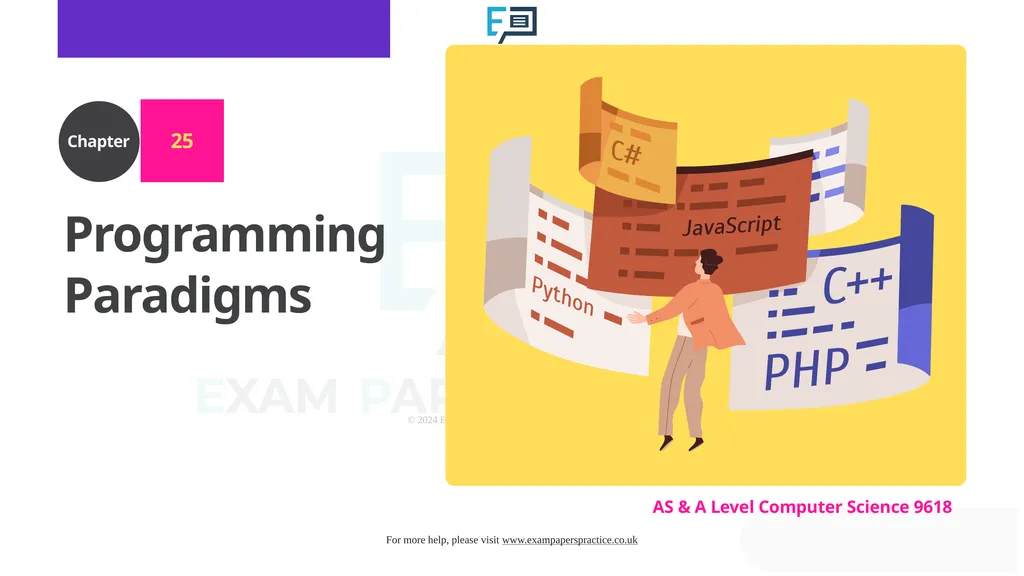
Programming Paradigms AS & A Level Computer Science 9618 Chapter 25<br>
03
Programming Paradigms Definition A programming paradigm is a set of principles, concepts, and guidelines that dictate the organisation, structure, and execution of computer programs, providing a framework for developers to design and implement software.
Paradigms are supported by programming language features. Some programming language support more than one paradigm.<br>
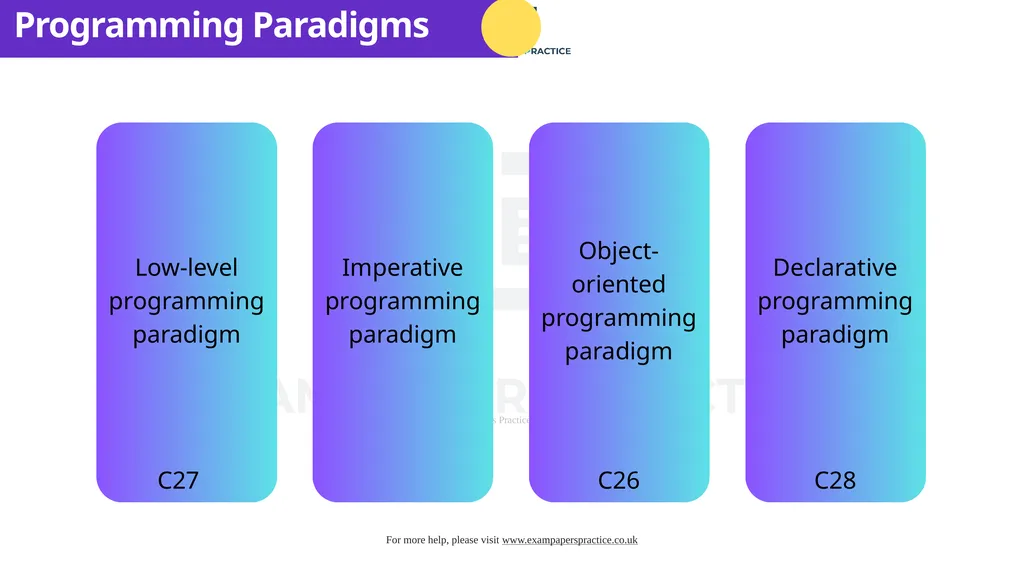
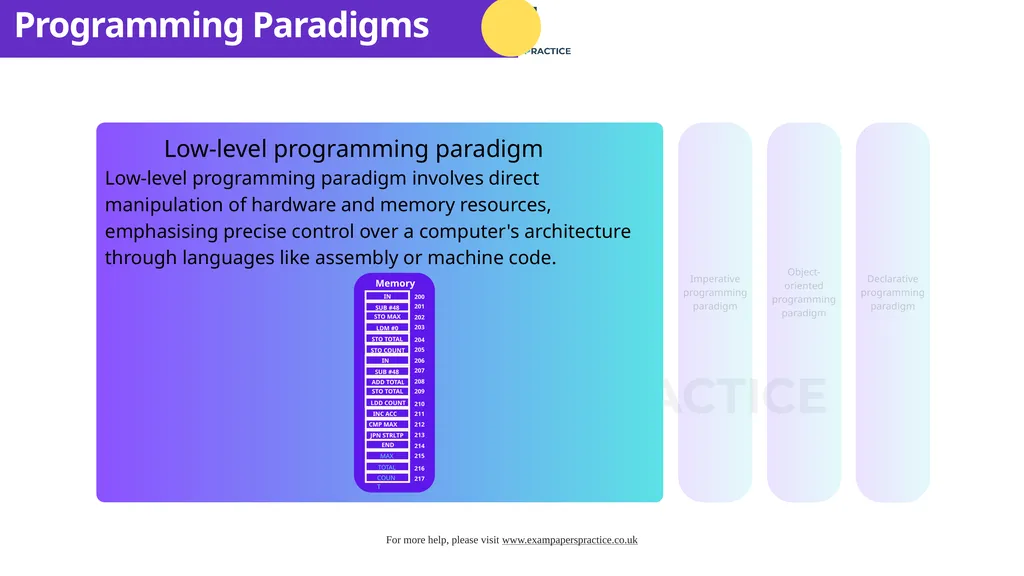
Programming Paradigms Low-level programming paradigm Imperative programming paradigm Object-oriented programming paradigm Declarative programming paradigm Low-level programming paradigm involves direct manipulation of hardware and memory resources, emphasising precise control over a computer's architecture through languages like assembly or machine code.<br>
06
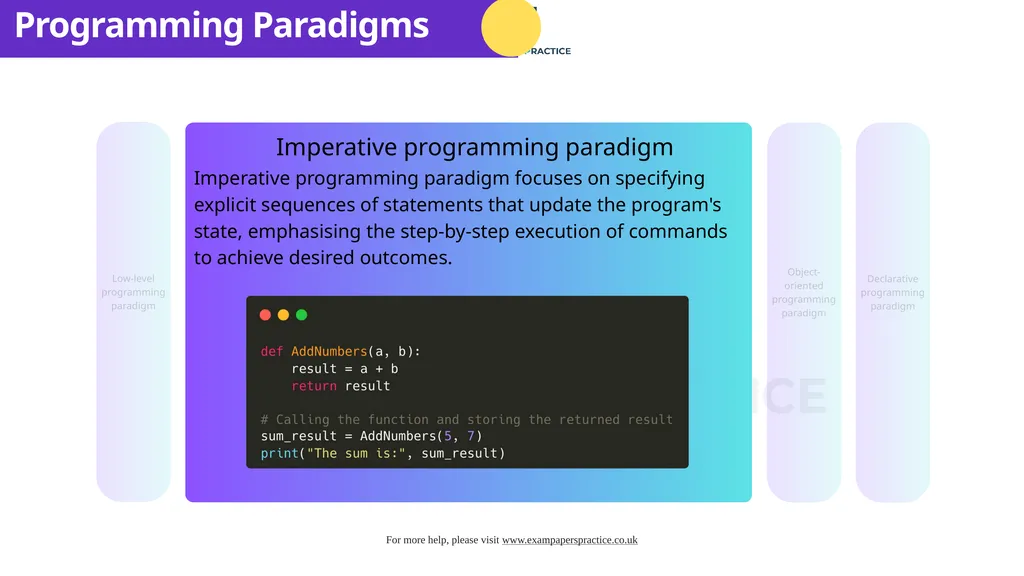
Programming Paradigms Imperative programming paradigm Low-level programming paradigm Object-oriented programming paradigm Declarative programming paradigm Imperative programming paradigm focuses on specifying explicit sequences of statements that update the program's state, emphasising the step-by-step execution of commands to achieve desired outcomes.<br>
07
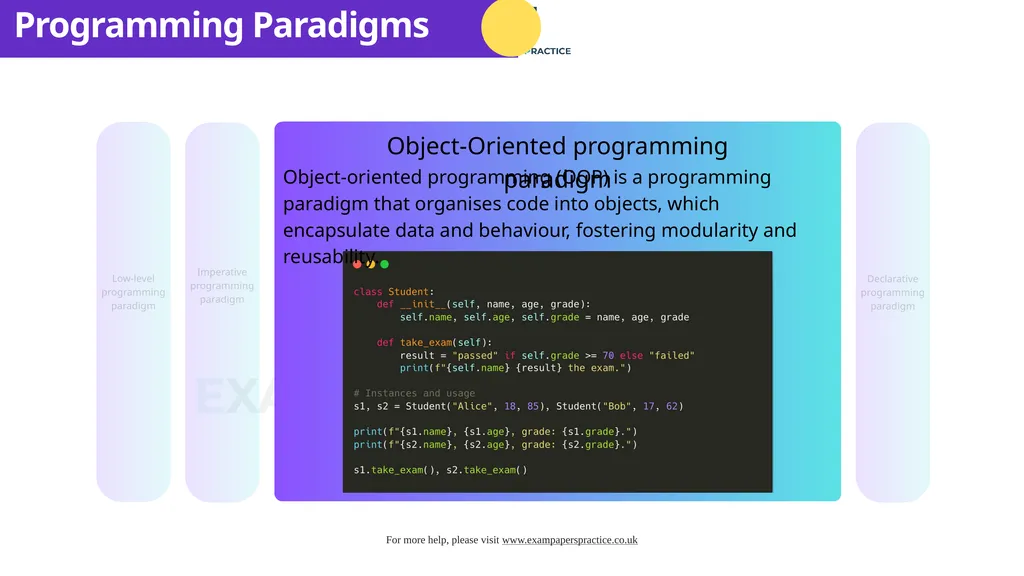
Programming Paradigms Object-Oriented programming paradigm Low-level programming paradigm Imperative programming paradigm Declarative programming paradigm Object-oriented programming (OOP) is a programming paradigm that organises code into objects, which encapsulate data and behaviour, fostering modularity and reusability.<br>
08
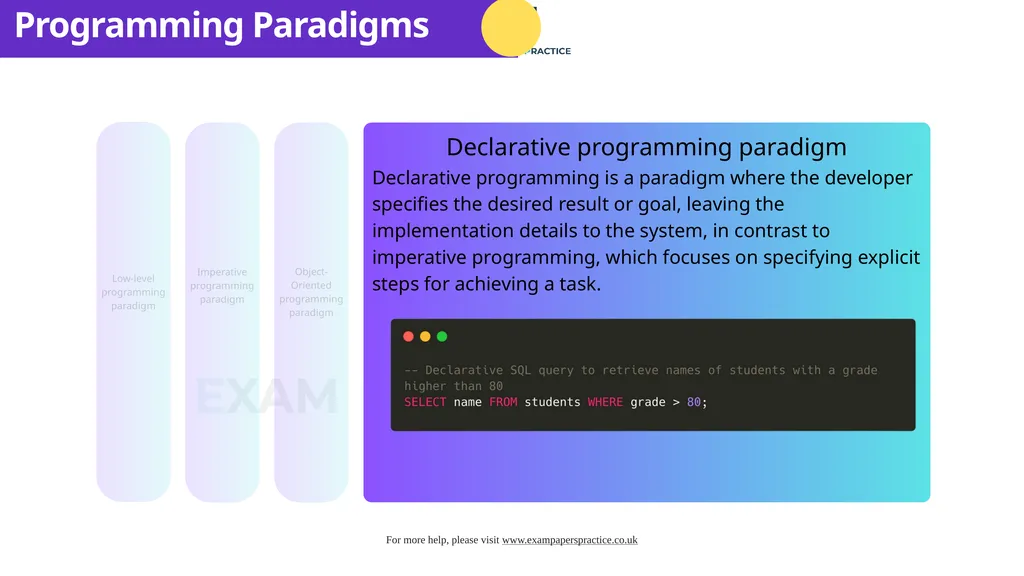
Programming Paradigms Declarative programming paradigm Low-level programming paradigm Imperative programming paradigm Object-Oriented programming paradigm Declarative programming is a paradigm where the developer specifies the desired result or goal, leaving the implementation details to the system, in contrast to imperative programming, which focuses on specifying explicit steps for achieving a task.<br>