
Can you trust your brain? Lets delve into the





Description: Can you trust your brain? Lets delve into the world of illusion, where you get to test your memory, attention and whether or not you can see the future! There is going to be a couple of questions to help you along the way. Whenever you see
Related Topics
Download Presentation
"Can you trust your brain? Lets delve into the" is the property of its rightful owner. Permission is granted to download and print the materials on this website for personal, non-commercial use only, and to display it on your personal computer provided you do not modify the materials and that you retain all copyright notices contained in the materials. By downloading content from our website, you accept the terms of this agreement.
Presentation Transcript
slide1. Can you trust your brain?<br>
slide2. Lets delve into the world of illusion, where you get to test your memory, attention and whether or not you can see the future!
There is going to be a couple of questions to help you along the way. Whenever you see this icon…
…make sure to refer to your activity sheet.<br>
slide3. Take a look at the following illusion: Question 1:
Can you see the difference between square A
and B?
Write your answer on your answer sheet<br>
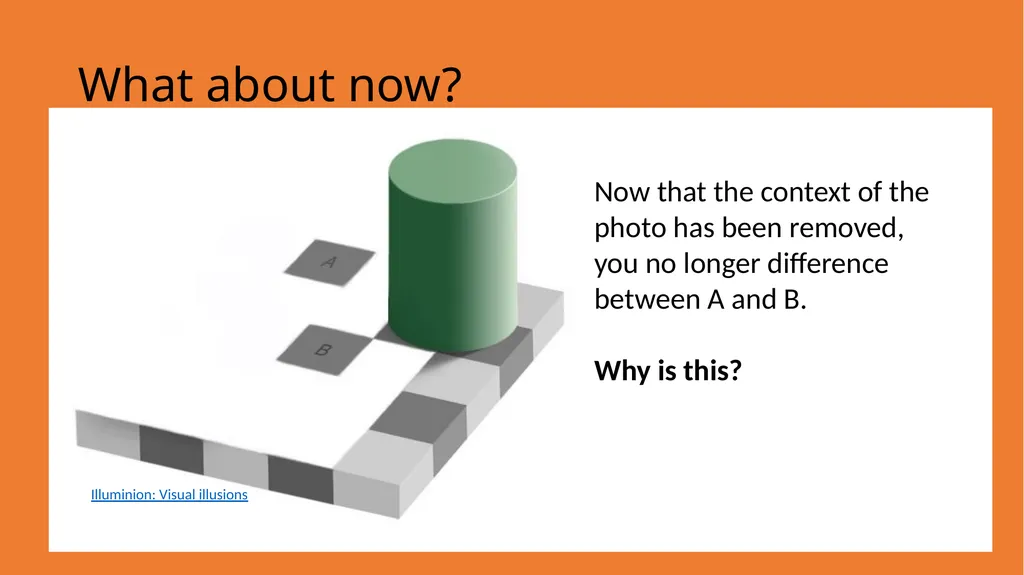
slide4. What about now? Now that the context of the photo has been removed, you no longer difference between A and B.
Why is this? Illuminion: Visual illusions<br>
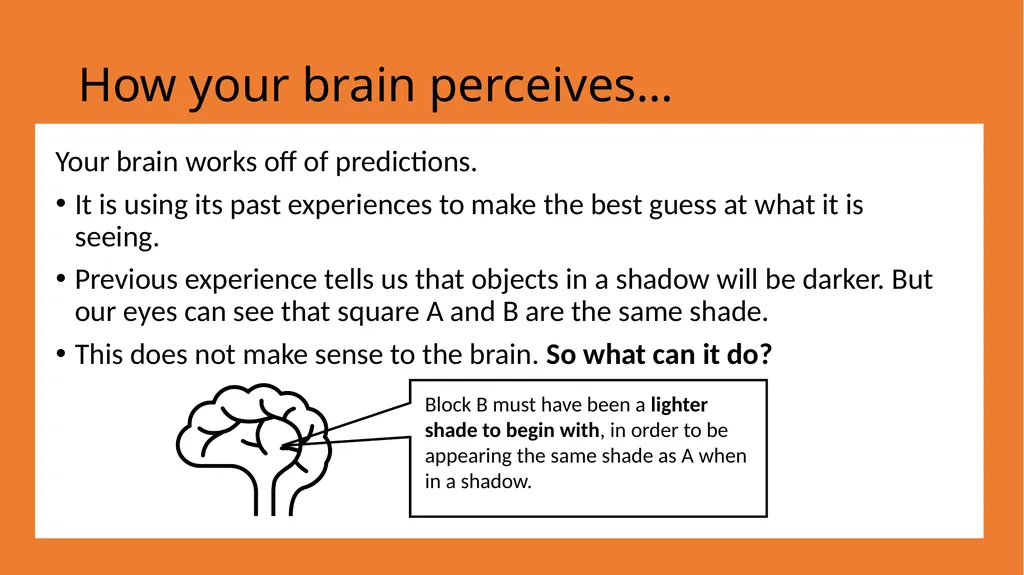
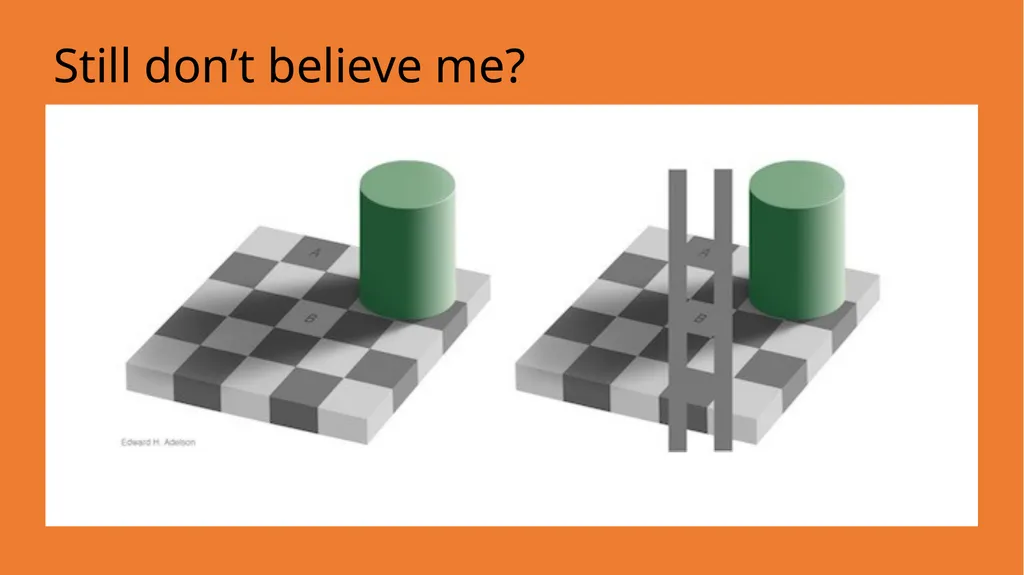
slide5. How your brain perceives… Block B must have been a lighter shade to begin with, in order to be appearing the same shade as A when in a shadow. Your brain works off of predictions.
It is using its past experiences to make the best guess at what it is seeing.
Previous experience tells us that objects in a shadow will be darker. But our eyes can see that square A and B are the same shade.
This does not make sense to the brain. So what can it do? Block B must have been a lighter shade to begin with, in order to be appearing the same shade as A when in a shadow.<br>
slide6. Still don’t believe me?<br>
slide7. It is not just our eyes that experience illusions… Take a listen to this clip:
https://youtu.be/GCtTtKKAhyE QUESTION 2: Can you think why it was easier for your brain to hear what was being said the second time round?
Tip: think about your brains prior knowledge.<br>
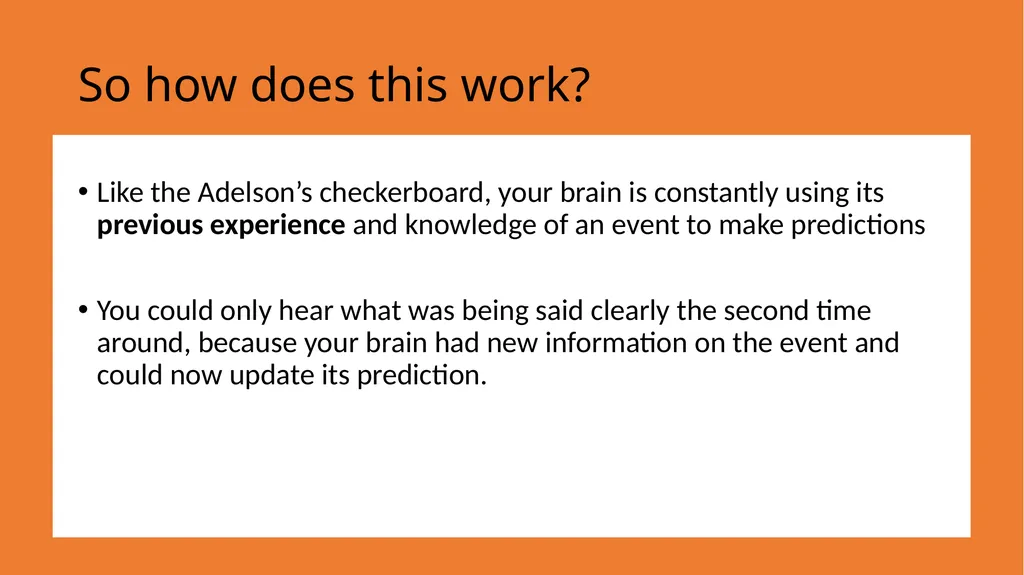
slide8. So how does this work? Like the Adelson’s checkerboard, your brain is constantly using its previous experience and knowledge of an event to make predictions
You could only hear what was being said clearly the second time around, because your brain had new information on the event and could now update its prediction.<br>
slide9. How good is your attention? Watch this video and follow the instructions:
https://youtu.be/vJG698U2Mvo
You can use the box labelled QUESTION 4 on your activity sheet to make notes.
QUESTION 5: Did you see the gorilla?<br>
slide10. How did you miss that Gorilla?! You can now see that whilst we might be ‘seeing’, we are not really perceiving.
This is called ‘inattentional blindness’.
Inattentional blindness= the failure to perceive an unexpected object or event due to lack of attention.
What is the likelihood of seeing a gorilla in that scenario?
Your brain has no previous experience of this occurring, so it is even less likely to notice it even when it plain sight!
QUESTION 6: Write down a definition of ‘Inattentional Blindness’<br>
slide11. If we cant trust our perception, what about our memory? Listen to this video and follow the instructions.
Use your activity sheet to write down which words you remember
https://youtu.be/hvu4D1jngCY<br>
slide12. Why might this be a problem? QUESTION 7:Can you think of any examples where not being able to recall something accurately might be a problem?
Elizabeth Loftus has done lots of work on Eye witness testimony reliability. Things that can have large impacts on the recall of memory:
Leading questions (from police etc)
Post- event discussion
These can lead to wrongful convictions<br>
slide13. Finally, can you see the future? If I told you that you could see the future, you might think I was mad, but hear me out.
Watch this clip and note down what you see on QUESTION 8 of your activity sheet:
https://youtu.be/mc0gQcP20pg<br>
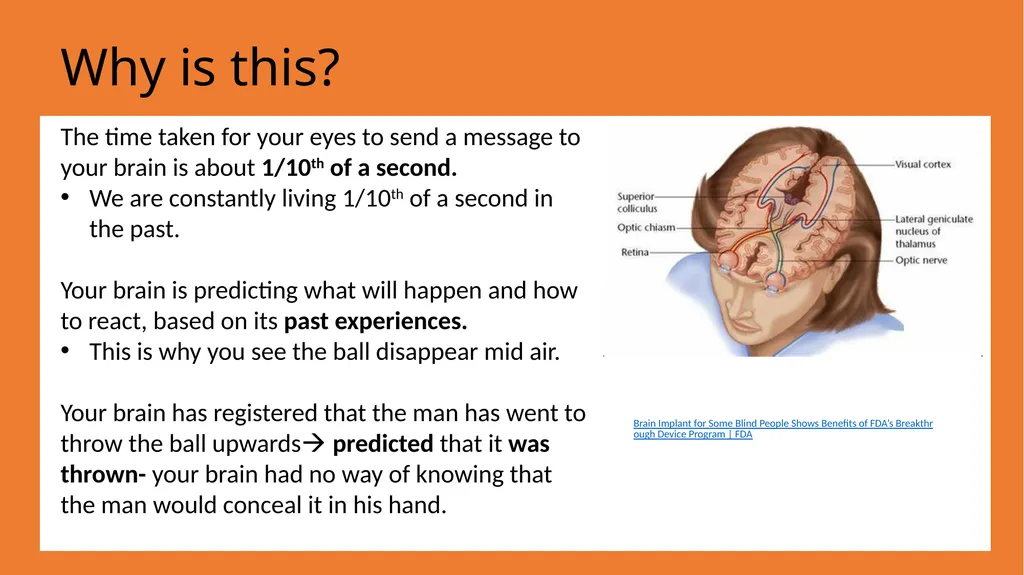
slide14. Why is this? The time taken for your eyes to send a message to your brain is about 1/10th of a second.
We are constantly living 1/10th of a second in the past.
Your brain is predicting what will happen and how to react, based on its past experiences.
This is why you see the ball disappear mid air.
Your brain has registered that the man has went to throw the ball upwards predicted that it was thrown- your brain had no way of knowing that the man would conceal it in his hand. Brain Implant for Some Blind People Shows Benefits of FDA’s Breakthrough Device Program | FDA<br>
slide15. Your brain is a powerful tool… …but don’t be fooled!
Summary:
Seeing and perceiving really is believing. Everything you see, and the way you understand it, is a product of YOU.
Your emotions, memories and biases
Don’t believe everything you see or hear!
Never stop questioning and challenging your reality, it might even help you see it from another’s perspective.<br>
slide2. Lets delve into the world of illusion, where you get to test your memory, attention and whether or not you can see the future!
There is going to be a couple of questions to help you along the way. Whenever you see this icon…
…make sure to refer to your activity sheet.<br>
slide3. Take a look at the following illusion: Question 1:
Can you see the difference between square A
and B?
Write your answer on your answer sheet<br>
slide4. What about now? Now that the context of the photo has been removed, you no longer difference between A and B.
Why is this? Illuminion: Visual illusions<br>
slide5. How your brain perceives… Block B must have been a lighter shade to begin with, in order to be appearing the same shade as A when in a shadow. Your brain works off of predictions.
It is using its past experiences to make the best guess at what it is seeing.
Previous experience tells us that objects in a shadow will be darker. But our eyes can see that square A and B are the same shade.
This does not make sense to the brain. So what can it do? Block B must have been a lighter shade to begin with, in order to be appearing the same shade as A when in a shadow.<br>
slide6. Still don’t believe me?<br>
slide7. It is not just our eyes that experience illusions… Take a listen to this clip:
https://youtu.be/GCtTtKKAhyE QUESTION 2: Can you think why it was easier for your brain to hear what was being said the second time round?
Tip: think about your brains prior knowledge.<br>
slide8. So how does this work? Like the Adelson’s checkerboard, your brain is constantly using its previous experience and knowledge of an event to make predictions
You could only hear what was being said clearly the second time around, because your brain had new information on the event and could now update its prediction.<br>
slide9. How good is your attention? Watch this video and follow the instructions:
https://youtu.be/vJG698U2Mvo
You can use the box labelled QUESTION 4 on your activity sheet to make notes.
QUESTION 5: Did you see the gorilla?<br>
slide10. How did you miss that Gorilla?! You can now see that whilst we might be ‘seeing’, we are not really perceiving.
This is called ‘inattentional blindness’.
Inattentional blindness= the failure to perceive an unexpected object or event due to lack of attention.
What is the likelihood of seeing a gorilla in that scenario?
Your brain has no previous experience of this occurring, so it is even less likely to notice it even when it plain sight!
QUESTION 6: Write down a definition of ‘Inattentional Blindness’<br>
slide11. If we cant trust our perception, what about our memory? Listen to this video and follow the instructions.
Use your activity sheet to write down which words you remember
https://youtu.be/hvu4D1jngCY<br>
slide12. Why might this be a problem? QUESTION 7:Can you think of any examples where not being able to recall something accurately might be a problem?
Elizabeth Loftus has done lots of work on Eye witness testimony reliability. Things that can have large impacts on the recall of memory:
Leading questions (from police etc)
Post- event discussion
These can lead to wrongful convictions<br>
slide13. Finally, can you see the future? If I told you that you could see the future, you might think I was mad, but hear me out.
Watch this clip and note down what you see on QUESTION 8 of your activity sheet:
https://youtu.be/mc0gQcP20pg<br>
slide14. Why is this? The time taken for your eyes to send a message to your brain is about 1/10th of a second.
We are constantly living 1/10th of a second in the past.
Your brain is predicting what will happen and how to react, based on its past experiences.
This is why you see the ball disappear mid air.
Your brain has registered that the man has went to throw the ball upwards predicted that it was thrown- your brain had no way of knowing that the man would conceal it in his hand. Brain Implant for Some Blind People Shows Benefits of FDA’s Breakthrough Device Program | FDA<br>
slide15. Your brain is a powerful tool… …but don’t be fooled!
Summary:
Seeing and perceiving really is believing. Everything you see, and the way you understand it, is a product of YOU.
Your emotions, memories and biases
Don’t believe everything you see or hear!
Never stop questioning and challenging your reality, it might even help you see it from another’s perspective.<br>