Candidate Formulary Development For Exploration Missions Human Research Program Exploration Medical Capability Element February 2, 2021 Sincy Kurian, PharmD, RPh Tina Bayuse, PharmD, RPh Rebecca Blue, MD Dana Levin, MD Expanding the
"Candidate Formulary Development For Exploration" is the property of its rightful owner. Permission is granted to
download and print the materials on this website for personal, non-commercial use only, and to display it
on your personal computer provided you do not modify the materials and that you retain all copyright
notices contained in the materials. By downloading content from our website, you accept the terms of this
agreement.
Presentation Transcript
01
Candidate Formulary Development For Exploration Missions Human Research Program
Exploration Medical Capability Element
February 2, 2021
Sincy Kurian, PharmD, RPh
Tina Bayuse, PharmD, RPh
Rebecca Blue, MD
Dana Levin, MD “Expanding the Boundaries of Space Medicine and Technology”<br>
Objective Create a draft exploration formulary, tracing medical conditions and capabilities documented in SysML* models reflecting Level of Care IV and V medical systems
*SysML – Systems Modeling Language 3<br>
04
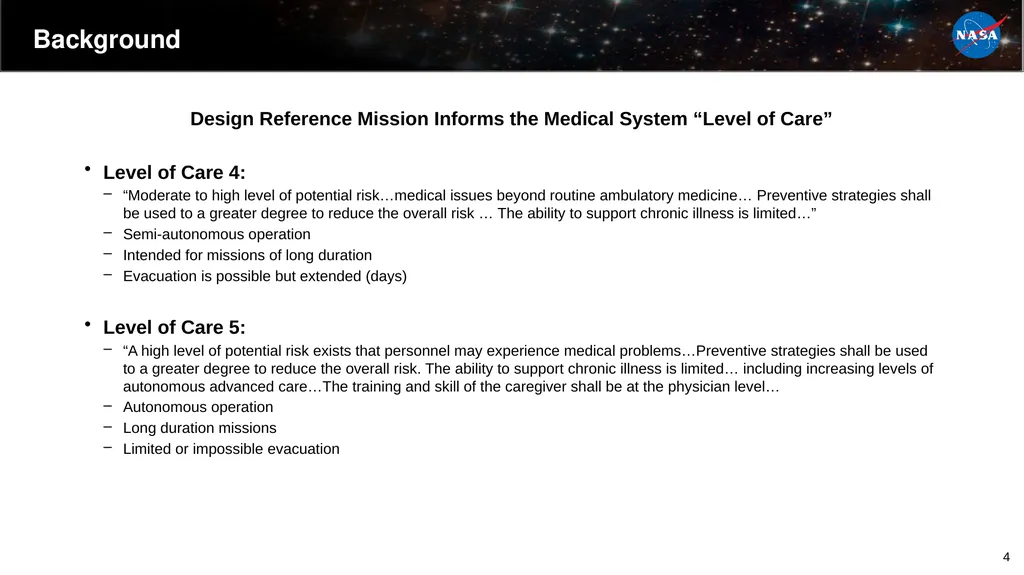
Background Design Reference Mission Informs the Medical System “Level of Care”
Level of Care 4:
“Moderate to high level of potential risk…medical issues beyond routine ambulatory medicine… Preventive strategies shall be used to a greater degree to reduce the overall risk … The ability to support chronic illness is limited…”
Semi-autonomous operation
Intended for missions of long duration
Evacuation is possible but extended (days)
Level of Care 5:
“A high level of potential risk exists that personnel may experience medical problems…Preventive strategies shall be used to a greater degree to reduce the overall risk. The ability to support chronic illness is limited… including increasing levels of autonomous advanced care…The training and skill of the caregiver shall be at the physician level…
Autonomous operation
Long duration missions
Limited or impossible evacuation 4<br>
05
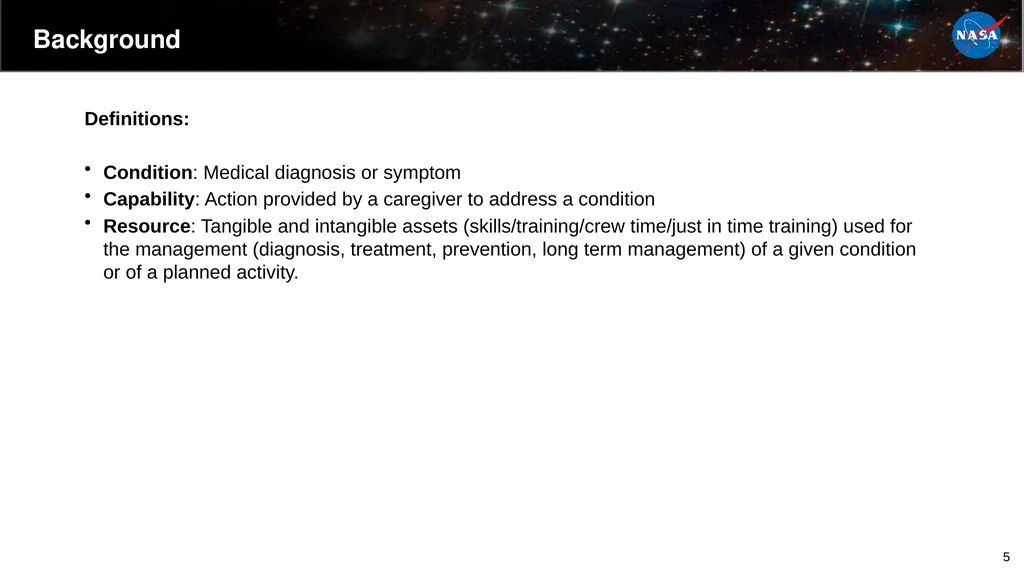
Background Definitions:
Condition: Medical diagnosis or symptom
Capability: Action provided by a caregiver to address a condition
Resource: Tangible and intangible assets (skills/training/crew time/just in time training) used for the management (diagnosis, treatment, prevention, long term management) of a given condition or of a planned activity. 5<br>
06
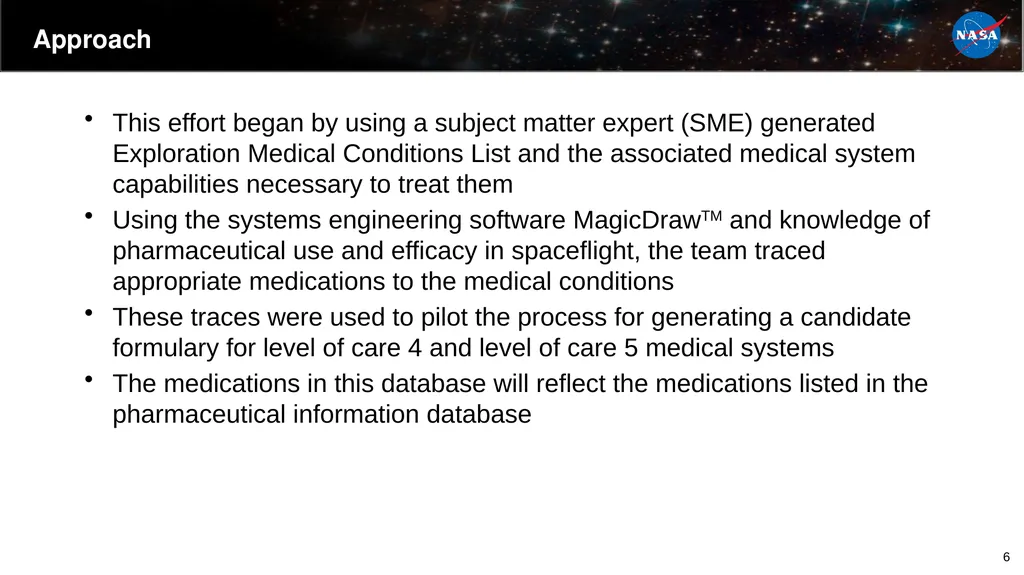
Approach This effort began by using a subject matter expert (SME) generated Exploration Medical Conditions List and the associated medical system capabilities necessary to treat them
Using the systems engineering software MagicDrawTM and knowledge of pharmaceutical use and efficacy in spaceflight, the team traced appropriate medications to the medical conditions
These traces were used to pilot the process for generating a candidate formulary for level of care 4 and level of care 5 medical systems
The medications in this database will reflect the medications listed in the pharmaceutical information database 6<br>
07
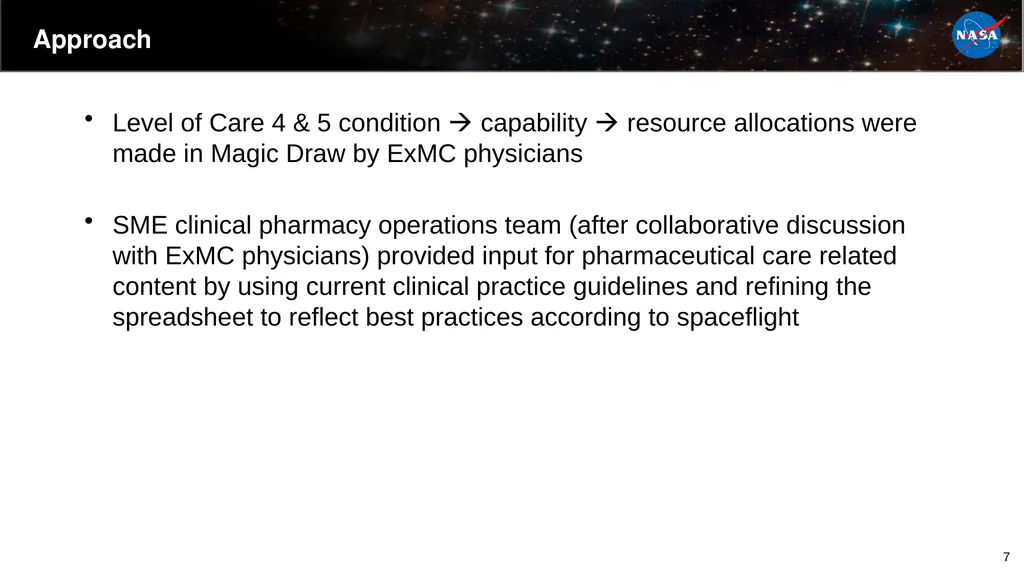
Approach Level of Care 4 & 5 condition capability resource allocations were made in Magic Draw by ExMC physicians
SME clinical pharmacy operations team (after collaborative discussion with ExMC physicians) provided input for pharmaceutical care related content by using current clinical practice guidelines and refining the spreadsheet to reflect best practices according to spaceflight 7<br>
08
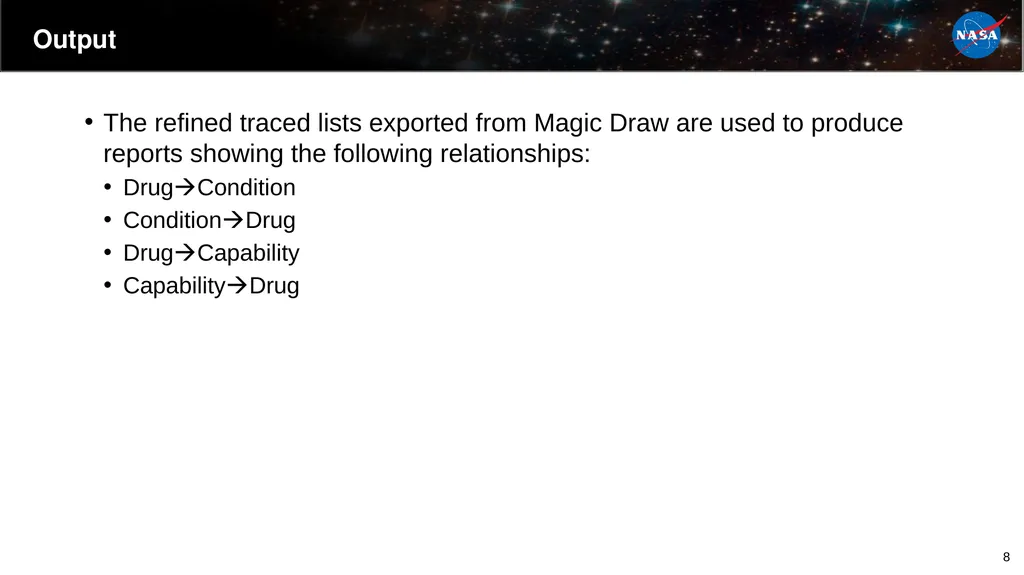
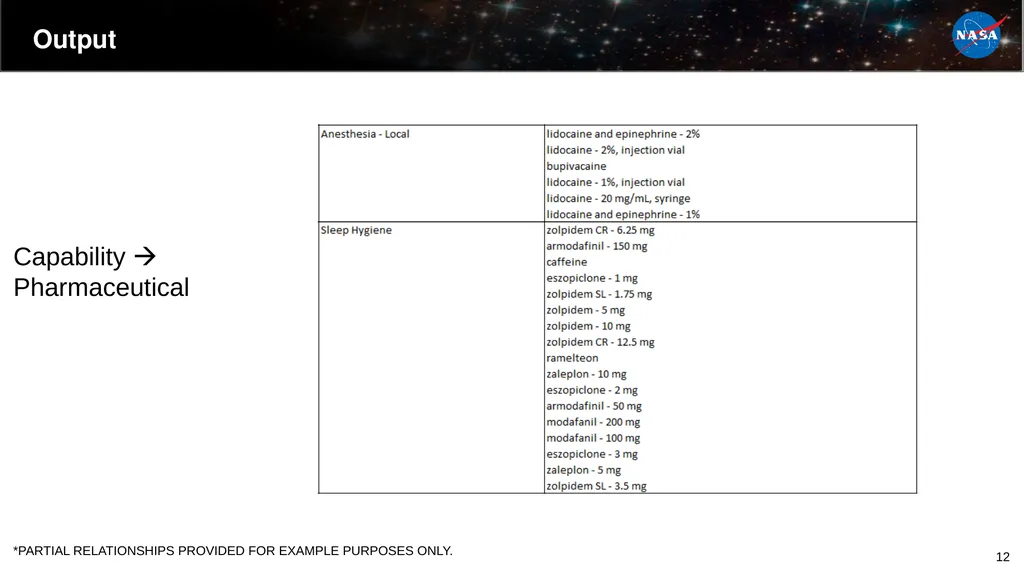
Output The refined traced lists exported from Magic Draw are used to produce reports showing the following relationships:
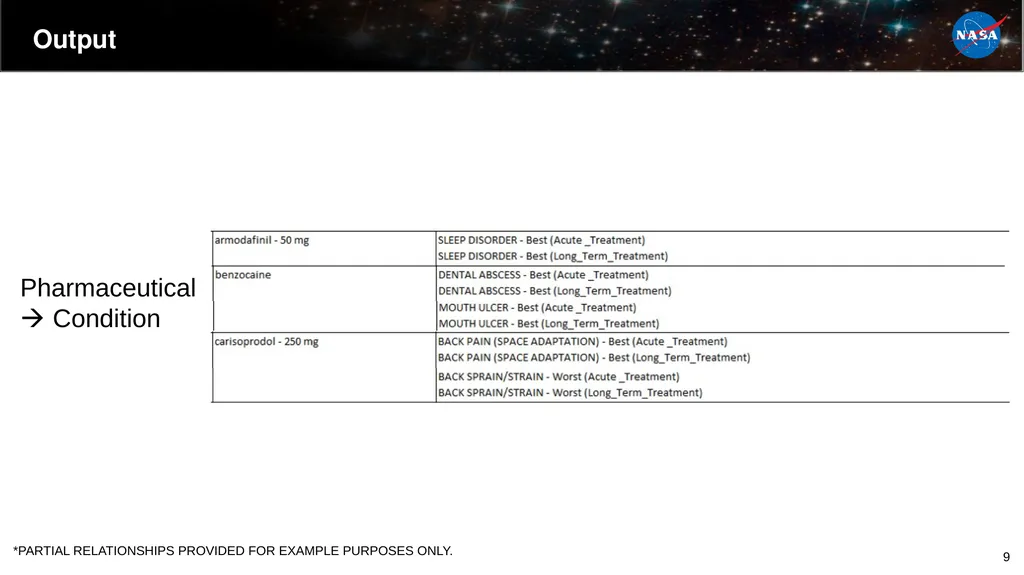
DrugCondition
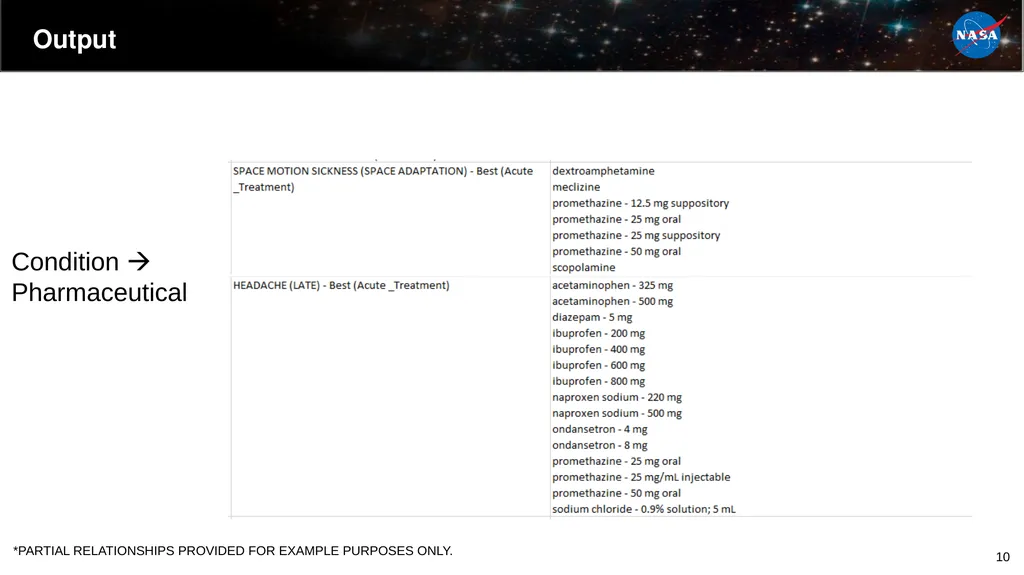
ConditionDrug
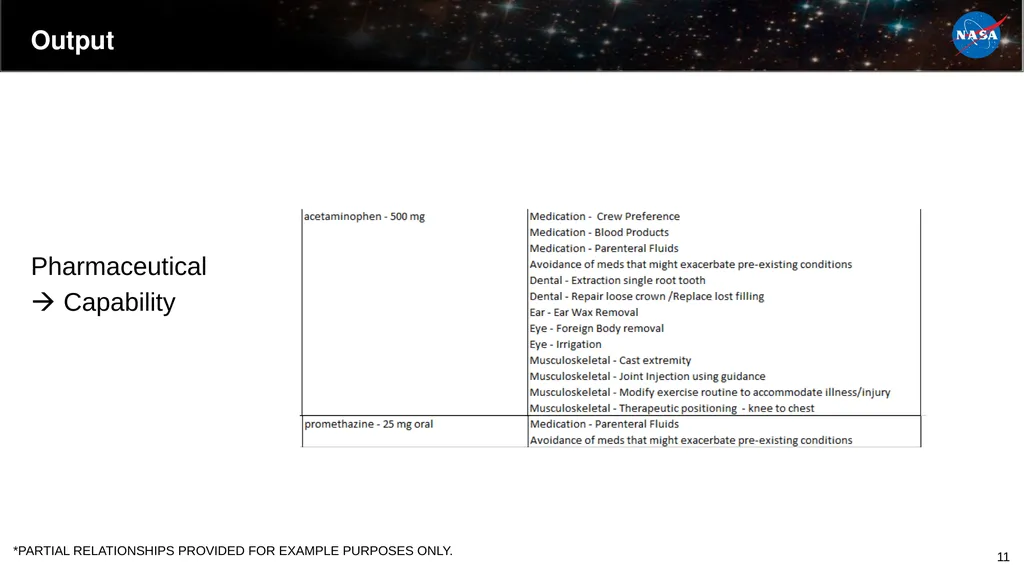
DrugCapability
CapabilityDrug 8<br>
09
9 Pharmaceutical Condition Output *PARTIAL RELATIONSHIPS PROVIDED FOR EXAMPLE PURPOSES ONLY.<br>
10
10 Condition Pharmaceutical Output *PARTIAL RELATIONSHIPS PROVIDED FOR EXAMPLE PURPOSES ONLY.<br>
11
Output 11 Pharmaceutical
Capability *PARTIAL RELATIONSHIPS PROVIDED FOR EXAMPLE PURPOSES ONLY.<br>
12
Output 12 Capability Pharmaceutical *PARTIAL RELATIONSHIPS PROVIDED FOR EXAMPLE PURPOSES ONLY.<br>
13
Challenges/Limitations Challenging user interface to assess and input data
Extensive mapping of data resulting in large time commitment and potential for errors
Existing list contains >100 conditions (with both best & worst cases)
Condition definitions make it difficult to neatly assign medications, especially when the definitions are quite broad
Not all applicable medications were included in the list – SME pharmacist team provided additions accordingly
Split time: the entire SME team of physicians and pharmacists had to work on this separately 13<br>
14
Lessons Learned Inconsistency in recorded data
(e.g. not every medication has a strength/dosage form listed with it)
Live communication works best
Working on this simultaneously would have been more productive instead of having to email the large data set back & forth
Multiple disciplines looking at the data made it overall well-rounded (including multiple perspectives) 14<br>
15
References Antonsen, E., Hailey, M., Reyes, D., Urbina, M. Interpretation of NASA-STD-3001 Levels of Care for Exploration Medical System Development. (2017).
Medical System Foundation for Level of Care IV: Short-Duration Lunar Orbit HTML Report Medical System Level of Care IV Foundation (nasa.gov)
Mindock, J., Reilly, J., Rubin, D., et al. Systems Engineering for Space Exploration Medical Capabilities. (2017). AIAA SPACE Forum. 15<br>