
CANMAT and ISBD 2018 guidelines for the management
MT
Published · 21 slides · 0 views

1 / 1
Description
CANMAT and ISBD 2018 guidelines for the management of patients with bipolar disorder Bipolar Disord. 2018 Mar;20(2):97-170. doi: 10.1111bdi.12609. Epub 2018 Mar 14. Bipolar II Disorder: Content Clinical presentation of bipolar II disorder
Related Topics
Share
Embed code
Download this presentation From Below
"CANMAT and ISBD 2018 guidelines for the management" is the property of its rightful owner. Permission is granted to download and print the materials on this website for personal, non-commercial use only, and to display it on your personal computer provided you do not modify the materials and that you retain all copyright notices contained in the materials. By downloading content from our website, you accept the terms of this agreement.
Presentation Transcript
01
CANMAT and ISBD 2018 guidelines for the management of patients with bipolar disorder Bipolar Disord. 2018 Mar;20(2):97-170. doi: 10.1111/bdi.12609. Epub 2018 Mar 14.<br>
02
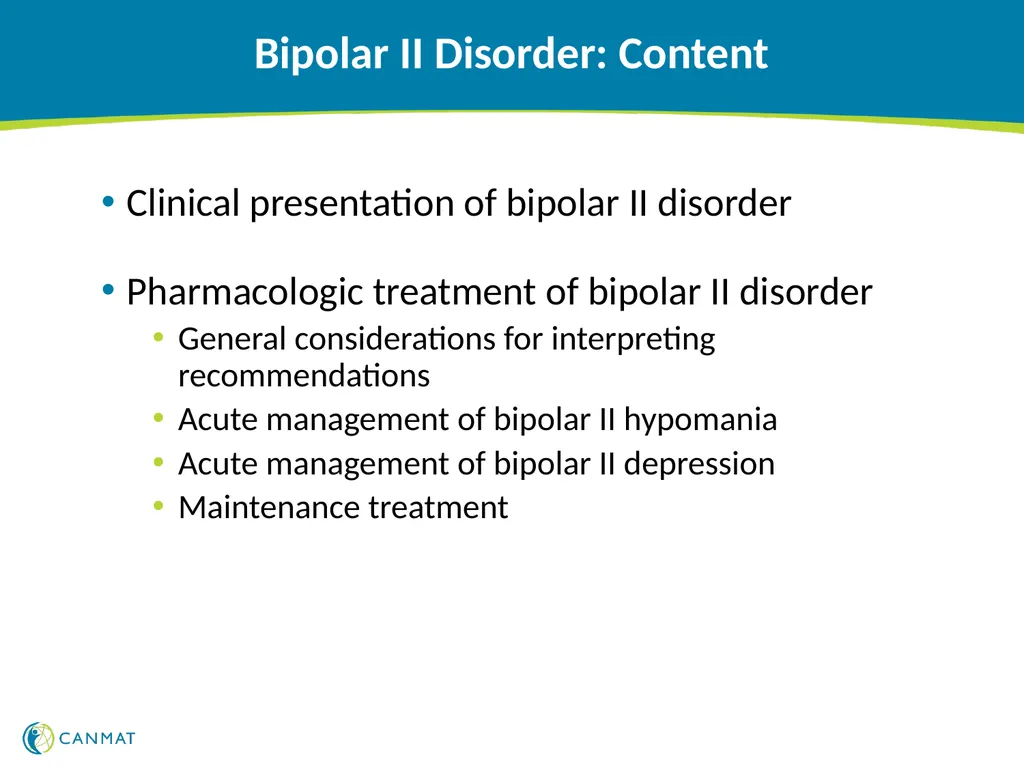
Bipolar II Disorder: Content Clinical presentation of bipolar II disorder
Pharmacologic treatment of bipolar II disorder
General considerations for interpreting recommendations
Acute management of bipolar II hypomania
Acute management of bipolar II depression
Maintenance treatment<br>
Pharmacologic treatment of bipolar II disorder
General considerations for interpreting recommendations
Acute management of bipolar II hypomania
Acute management of bipolar II depression
Maintenance treatment<br>
03
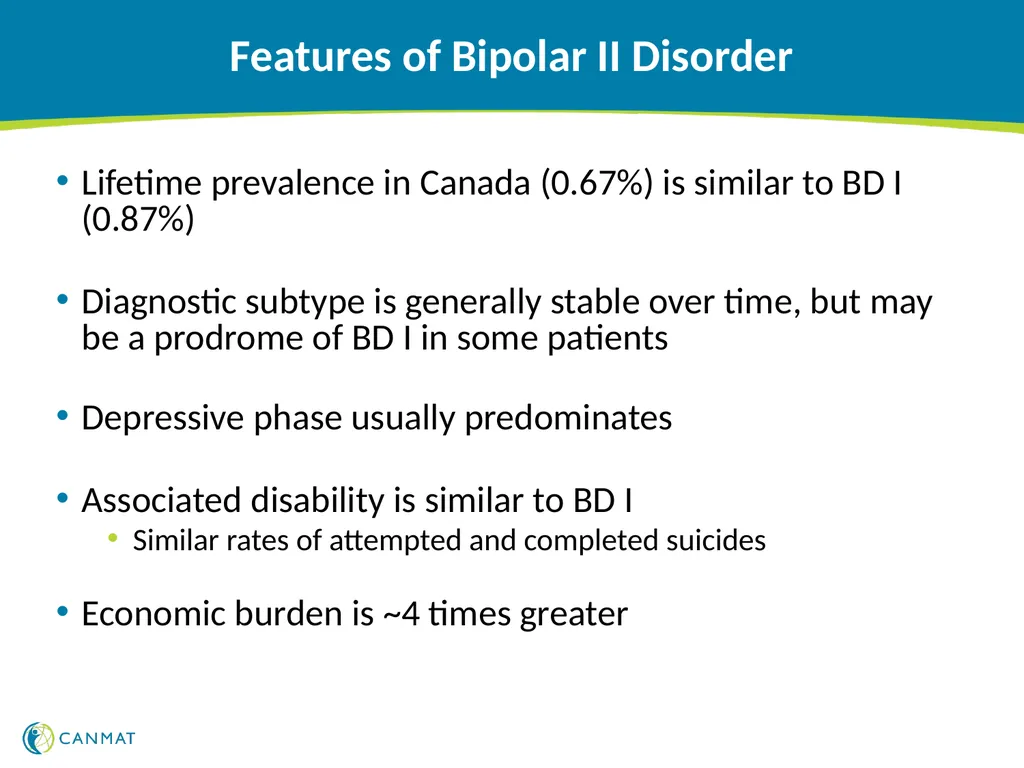
Features of Bipolar II Disorder Lifetime prevalence in Canada (0.67%) is similar to BD I (0.87%)
Diagnostic subtype is generally stable over time, but may be a prodrome of BD I in some patients
Depressive phase usually predominates
Associated disability is similar to BD I
Similar rates of attempted and completed suicides
Economic burden is ~4 times greater<br>
Diagnostic subtype is generally stable over time, but may be a prodrome of BD I in some patients
Depressive phase usually predominates
Associated disability is similar to BD I
Similar rates of attempted and completed suicides
Economic burden is ~4 times greater<br>
04
Diagnosis of Bipolar II Disorder Diagnosis is based on
≥1 episode of hypomania
≥1 episode of major depression
Absence of manic episodes
Addition of DSM-5 mixed features specifier to hypomania<br>
≥1 episode of hypomania
≥1 episode of major depression
Absence of manic episodes
Addition of DSM-5 mixed features specifier to hypomania<br>
05
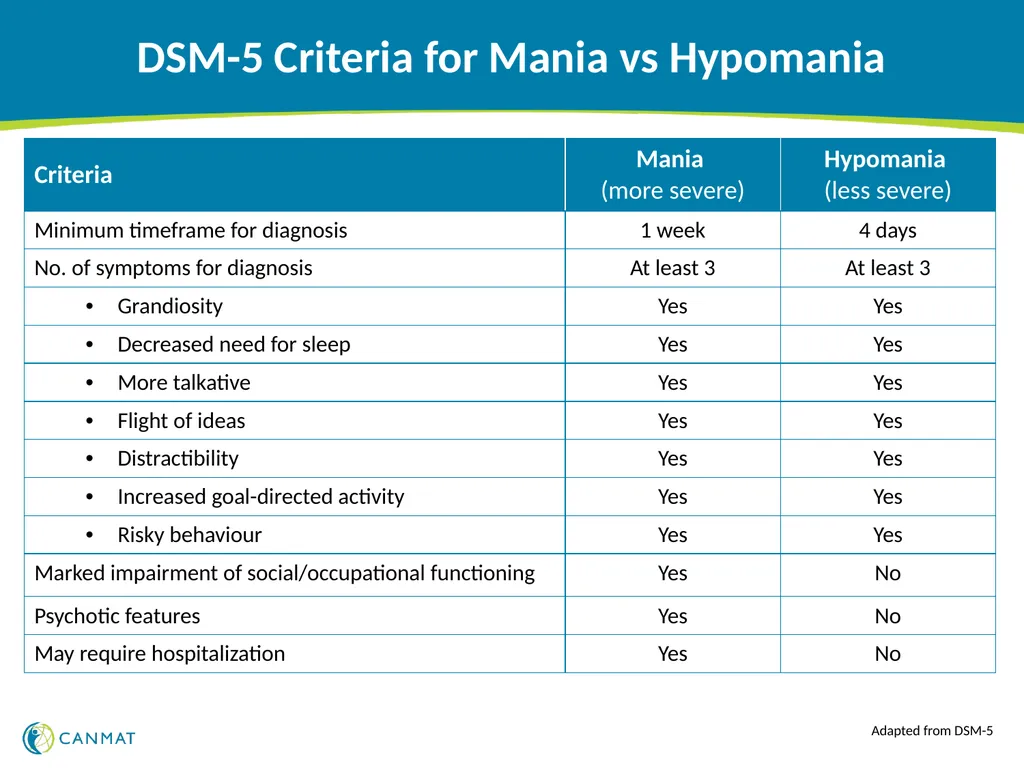
DSM-5 Criteria for Mania vs Hypomania Adapted from DSM-5<br>
06
General Considerations for Interpreting Recommendations Understudied relative to BD I
Fewer studies
Underpowered
Lower quality evidence
Often combined populations of BD I and BD II
Studies that enrolled <50% of patients with BD II and did not report results separately are Level 4 evidence (expert opinion)<br>
Fewer studies
Underpowered
Lower quality evidence
Often combined populations of BD I and BD II
Studies that enrolled <50% of patients with BD II and did not report results separately are Level 4 evidence (expert opinion)<br>
07
Acute Management of Hypomania General principles for assessing mania apply to hypomania Discontinue agents that can worsen or prolong symptoms, e.g. antidepressants and stimulants
Initiate appropriate pharmacotherapy<br>
Initiate appropriate pharmacotherapy<br>
08
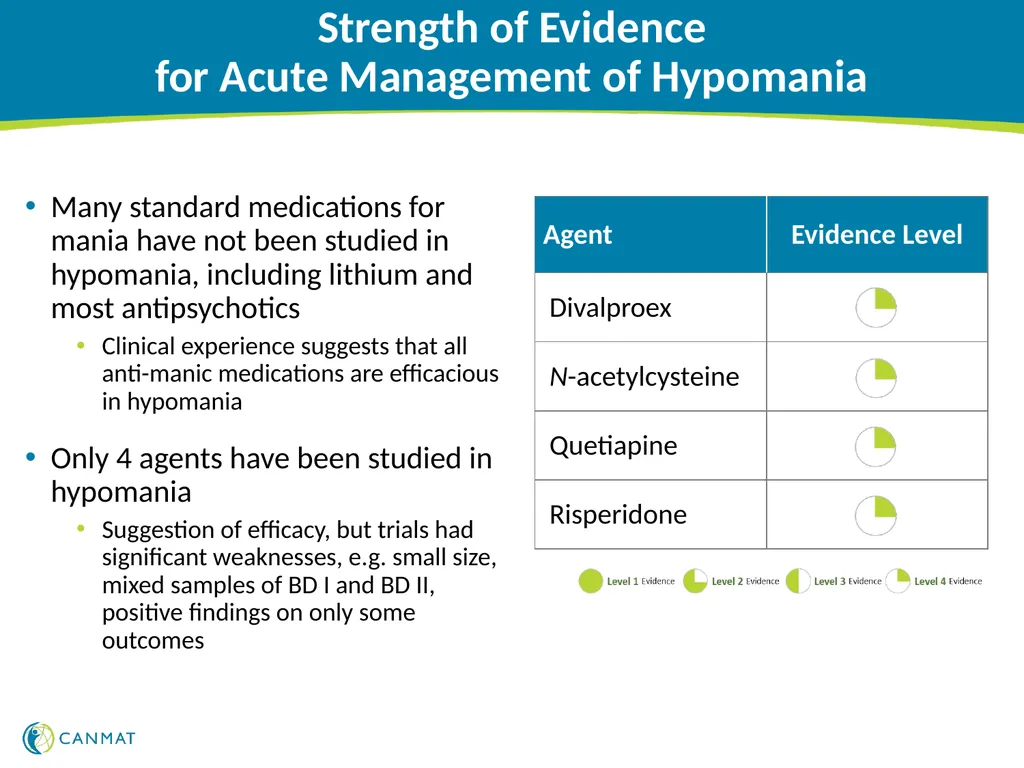
Strength of Evidence
for Acute Management of Hypomania Many standard medications for mania have not been studied in hypomania, including lithium and most antipsychotics
Clinical experience suggests that all anti-manic medications are efficacious in hypomania
Only 4 agents have been studied in hypomania
Suggestion of efficacy, but trials had significant weaknesses, e.g. small size, mixed samples of BD I and BD II, positive findings on only some outcomes<br>
Clinical experience suggests that all anti-manic medications are efficacious in hypomania
Only 4 agents have been studied in hypomania
Suggestion of efficacy, but trials had significant weaknesses, e.g. small size, mixed samples of BD I and BD II, positive findings on only some outcomes<br>
09
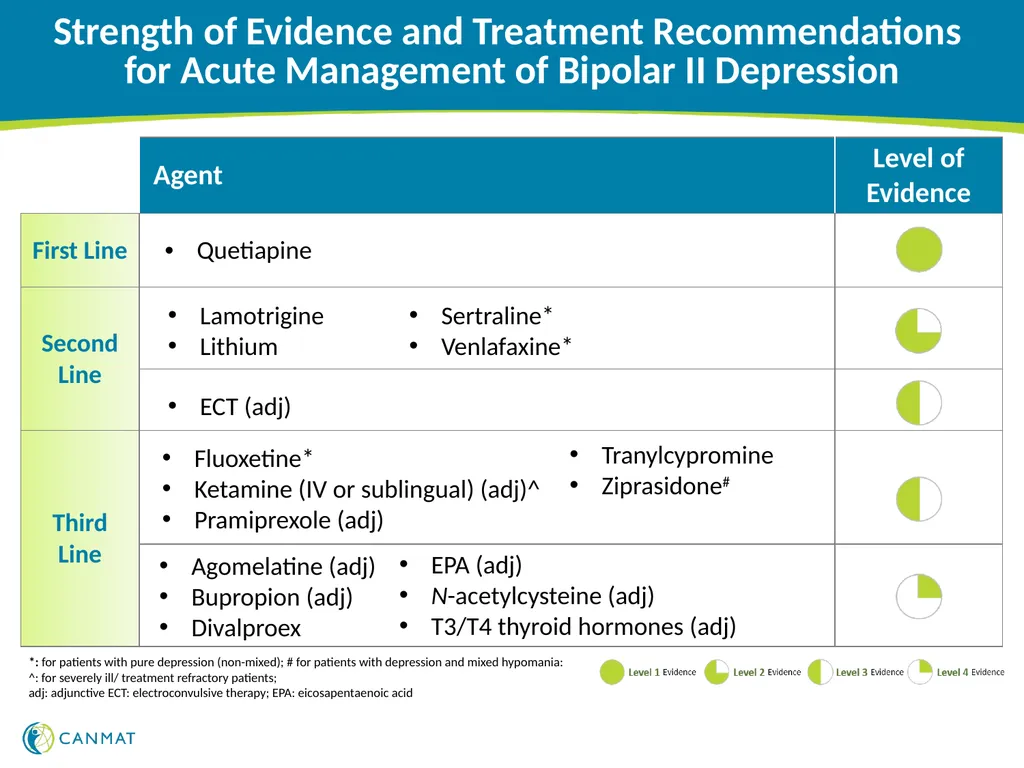
Strength of Evidence and Treatment Recommendations
for Acute Management of Bipolar II Depression *: for patients with pure depression (non-mixed); # for patients with depression and mixed hypomania:
^: for severely ill/ treatment refractory patients;
adj: adjunctive ECT: electroconvulsive therapy; EPA: eicosapentaenoic acid Lamotrigine
Lithium Sertraline*
Venlafaxine* Fluoxetine*
Ketamine (IV or sublingual) (adj)^
Pramiprexole (adj) Tranylcypromine
Ziprasidone# Agomelatine (adj)
Bupropion (adj)
Divalproex EPA (adj)
N-acetylcysteine (adj)
T3/T4 thyroid hormones (adj) ECT (adj)<br>
adj: adjunctive ECT: electroconvulsive therapy; EPA: eicosapentaenoic acid Lamotrigine
Lithium Sertraline*
Venlafaxine* Fluoxetine*
Ketamine (IV or sublingual) (adj)^
Pramiprexole (adj) Tranylcypromine
Ziprasidone# Agomelatine (adj)
Bupropion (adj)
Divalproex EPA (adj)
N-acetylcysteine (adj)
T3/T4 thyroid hormones (adj) ECT (adj)<br>
10
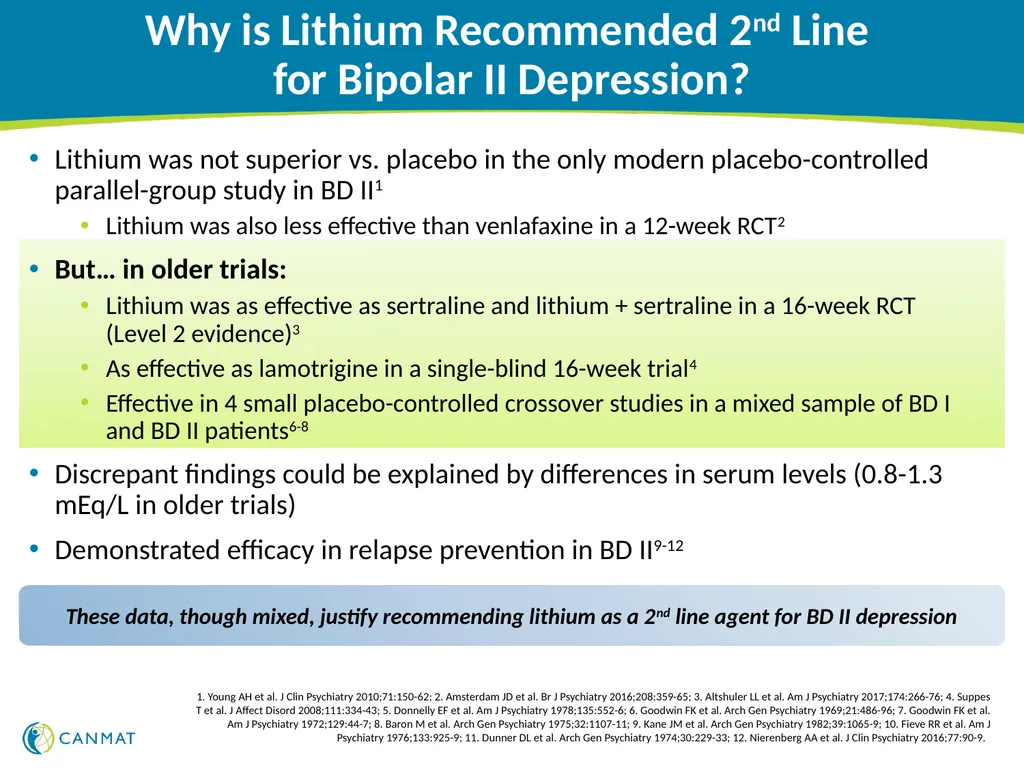
Why is Lithium Recommended 2nd Line
for Bipolar II Depression? Lithium was not superior vs. placebo in the only modern placebo-controlled parallel-group study in BD II1
Lithium was also less effective than venlafaxine in a 12-week RCT2
But… in older trials:
Lithium was as effective as sertraline and lithium + sertraline in a 16-week RCT (Level 2 evidence)3
As effective as lamotrigine in a single-blind 16-week trial4
Effective in 4 small placebo-controlled crossover studies in a mixed sample of BD I and BD II patients6-8
Discrepant findings could be explained by differences in serum levels (0.8-1.3 mEq/L in older trials)
Demonstrated efficacy in relapse prevention in BD II9-12 These data, though mixed, justify recommending lithium as a 2nd line agent for BD II depression 1. Young AH et al. J Clin Psychiatry 2010;71:150-62; 2. Amsterdam JD et al. Br J Psychiatry 2016;208:359-65; 3. Altshuler LL et al. Am J Psychiatry 2017;174:266-76; 4. Suppes T et al. J Affect Disord 2008;111:334-43; 5. Donnelly EF et al. Am J Psychiatry 1978;135:552-6; 6. Goodwin FK et al. Arch Gen Psychiatry 1969;21:486-96; 7. Goodwin FK et al. Am J Psychiatry 1972;129:44-7; 8. Baron M et al. Arch Gen Psychiatry 1975;32:1107-11; 9. Kane JM et al. Arch Gen Psychiatry 1982;39:1065-9; 10. Fieve RR et al. Am J Psychiatry 1976;133:925-9; 11. Dunner DL et al. Arch Gen Psychiatry 1974;30:229-33; 12. Nierenberg AA et al. J Clin Psychiatry 2016;77:90-9.<br>
Lithium was also less effective than venlafaxine in a 12-week RCT2
But… in older trials:
Lithium was as effective as sertraline and lithium + sertraline in a 16-week RCT (Level 2 evidence)3
As effective as lamotrigine in a single-blind 16-week trial4
Effective in 4 small placebo-controlled crossover studies in a mixed sample of BD I and BD II patients6-8
Discrepant findings could be explained by differences in serum levels (0.8-1.3 mEq/L in older trials)
Demonstrated efficacy in relapse prevention in BD II9-12 These data, though mixed, justify recommending lithium as a 2nd line agent for BD II depression 1. Young AH et al. J Clin Psychiatry 2010;71:150-62; 2. Amsterdam JD et al. Br J Psychiatry 2016;208:359-65; 3. Altshuler LL et al. Am J Psychiatry 2017;174:266-76; 4. Suppes T et al. J Affect Disord 2008;111:334-43; 5. Donnelly EF et al. Am J Psychiatry 1978;135:552-6; 6. Goodwin FK et al. Arch Gen Psychiatry 1969;21:486-96; 7. Goodwin FK et al. Am J Psychiatry 1972;129:44-7; 8. Baron M et al. Arch Gen Psychiatry 1975;32:1107-11; 9. Kane JM et al. Arch Gen Psychiatry 1982;39:1065-9; 10. Fieve RR et al. Am J Psychiatry 1976;133:925-9; 11. Dunner DL et al. Arch Gen Psychiatry 1974;30:229-33; 12. Nierenberg AA et al. J Clin Psychiatry 2016;77:90-9.<br>
11
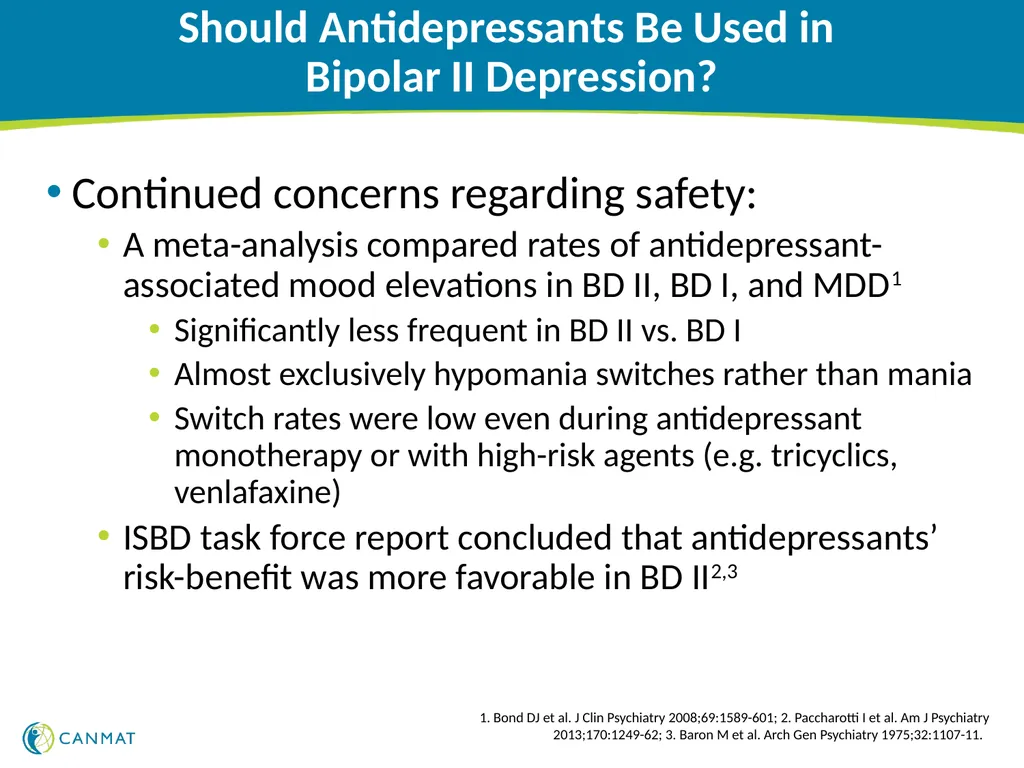
Should Antidepressants Be Used in
Bipolar II Depression? Continued concerns regarding safety:
A meta-analysis compared rates of antidepressant-associated mood elevations in BD II, BD I, and MDD1
Significantly less frequent in BD II vs. BD I
Almost exclusively hypomania switches rather than mania
Switch rates were low even during antidepressant monotherapy or with high-risk agents (e.g. tricyclics, venlafaxine)
ISBD task force report concluded that antidepressants’ risk-benefit was more favorable in BD II2,3 1. Bond DJ et al. J Clin Psychiatry 2008;69:1589-601; 2. Paccharotti I et al. Am J Psychiatry 2013;170:1249-62; 3. Baron M et al. Arch Gen Psychiatry 1975;32:1107-11.<br>
A meta-analysis compared rates of antidepressant-associated mood elevations in BD II, BD I, and MDD1
Significantly less frequent in BD II vs. BD I
Almost exclusively hypomania switches rather than mania
Switch rates were low even during antidepressant monotherapy or with high-risk agents (e.g. tricyclics, venlafaxine)
ISBD task force report concluded that antidepressants’ risk-benefit was more favorable in BD II2,3 1. Bond DJ et al. J Clin Psychiatry 2008;69:1589-601; 2. Paccharotti I et al. Am J Psychiatry 2013;170:1249-62; 3. Baron M et al. Arch Gen Psychiatry 1975;32:1107-11.<br>
12
Limited Evidence for Efficacy of
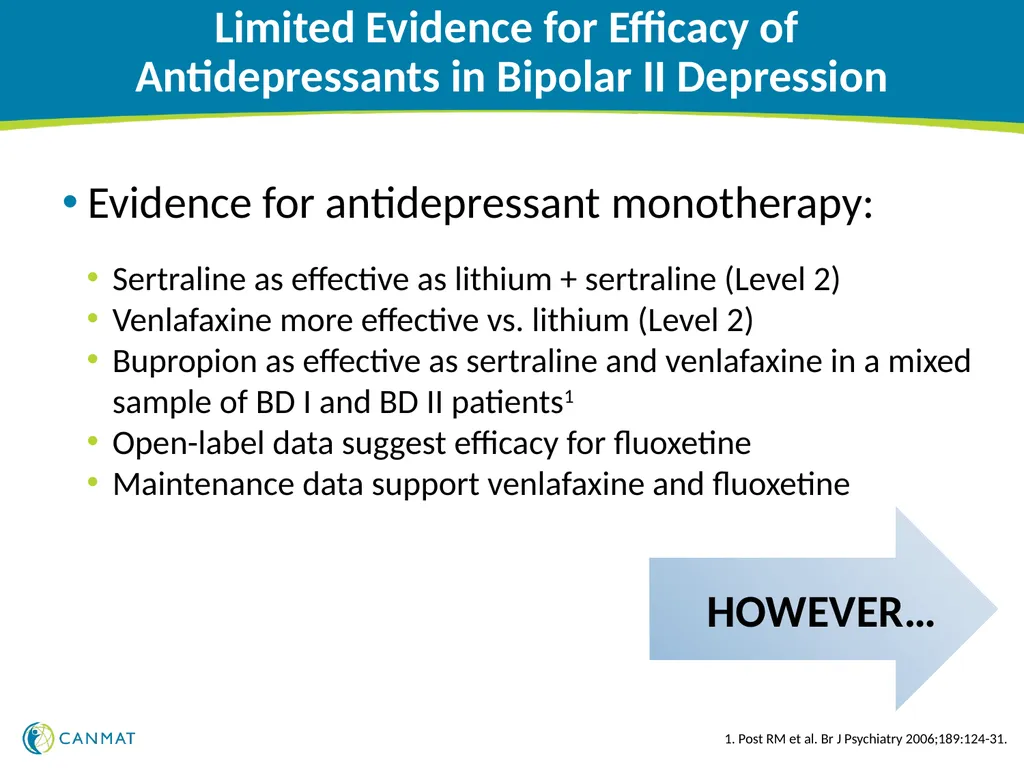
Antidepressants in Bipolar II Depression Evidence for antidepressant monotherapy:
Sertraline as effective as lithium + sertraline (Level 2)
Venlafaxine more effective vs. lithium (Level 2)
Bupropion as effective as sertraline and venlafaxine in a mixed sample of BD I and BD II patients1
Open-label data suggest efficacy for fluoxetine
Maintenance data support venlafaxine and fluoxetine 1. Post RM et al. Br J Psychiatry 2006;189:124-31. HOWEVER…<br>
Sertraline as effective as lithium + sertraline (Level 2)
Venlafaxine more effective vs. lithium (Level 2)
Bupropion as effective as sertraline and venlafaxine in a mixed sample of BD I and BD II patients1
Open-label data suggest efficacy for fluoxetine
Maintenance data support venlafaxine and fluoxetine 1. Post RM et al. Br J Psychiatry 2006;189:124-31. HOWEVER…<br>
13
Limited Evidence for Efficacy of
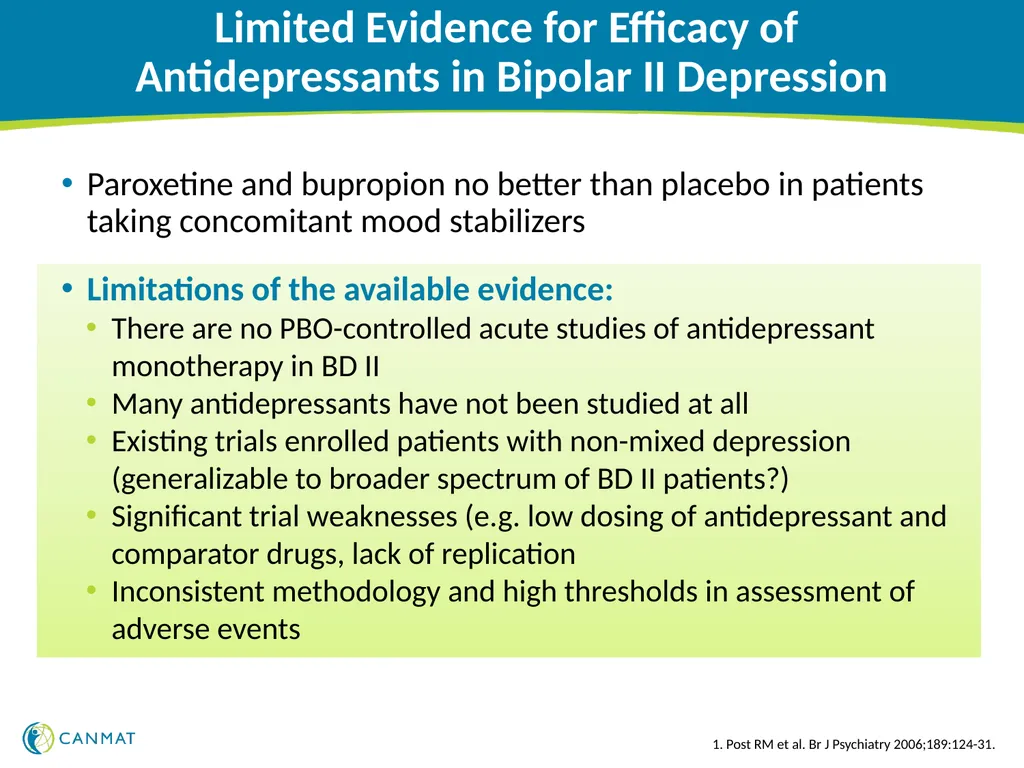
Antidepressants in Bipolar II Depression Paroxetine and bupropion no better than placebo in patients taking concomitant mood stabilizers
Limitations of the available evidence:
There are no PBO-controlled acute studies of antidepressant monotherapy in BD II
Many antidepressants have not been studied at all
Existing trials enrolled patients with non-mixed depression (generalizable to broader spectrum of BD II patients?)
Significant trial weaknesses (e.g. low dosing of antidepressant and comparator drugs, lack of replication
Inconsistent methodology and high thresholds in assessment of adverse events 1. Post RM et al. Br J Psychiatry 2006;189:124-31.<br>
Limitations of the available evidence:
There are no PBO-controlled acute studies of antidepressant monotherapy in BD II
Many antidepressants have not been studied at all
Existing trials enrolled patients with non-mixed depression (generalizable to broader spectrum of BD II patients?)
Significant trial weaknesses (e.g. low dosing of antidepressant and comparator drugs, lack of replication
Inconsistent methodology and high thresholds in assessment of adverse events 1. Post RM et al. Br J Psychiatry 2006;189:124-31.<br>
14
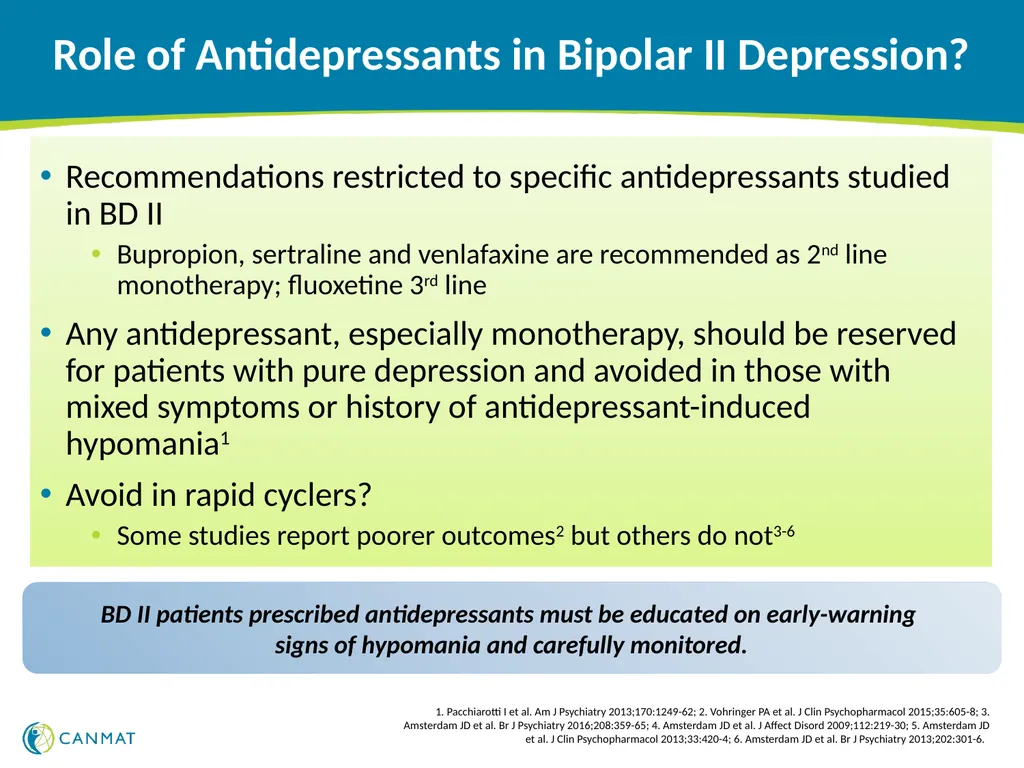
Role of Antidepressants in Bipolar II Depression? Recommendations restricted to specific antidepressants studied in BD II
Bupropion, sertraline and venlafaxine are recommended as 2nd line monotherapy; fluoxetine 3rd line
Any antidepressant, especially monotherapy, should be reserved for patients with pure depression and avoided in those with mixed symptoms or history of antidepressant-induced hypomania1
Avoid in rapid cyclers?
Some studies report poorer outcomes2 but others do not3-6 BD II patients prescribed antidepressants must be educated on early-warning
signs of hypomania and carefully monitored. 1. Pacchiarotti I et al. Am J Psychiatry 2013;170:1249-62; 2. Vohringer PA et al. J Clin Psychopharmacol 2015;35:605-8; 3. Amsterdam JD et al. Br J Psychiatry 2016;208:359-65; 4. Amsterdam JD et al. J Affect Disord 2009;112:219-30; 5. Amsterdam JD et al. J Clin Psychopharmacol 2013;33:420-4; 6. Amsterdam JD et al. Br J Psychiatry 2013;202:301-6.<br>
Bupropion, sertraline and venlafaxine are recommended as 2nd line monotherapy; fluoxetine 3rd line
Any antidepressant, especially monotherapy, should be reserved for patients with pure depression and avoided in those with mixed symptoms or history of antidepressant-induced hypomania1
Avoid in rapid cyclers?
Some studies report poorer outcomes2 but others do not3-6 BD II patients prescribed antidepressants must be educated on early-warning
signs of hypomania and carefully monitored. 1. Pacchiarotti I et al. Am J Psychiatry 2013;170:1249-62; 2. Vohringer PA et al. J Clin Psychopharmacol 2015;35:605-8; 3. Amsterdam JD et al. Br J Psychiatry 2016;208:359-65; 4. Amsterdam JD et al. J Affect Disord 2009;112:219-30; 5. Amsterdam JD et al. J Clin Psychopharmacol 2013;33:420-4; 6. Amsterdam JD et al. Br J Psychiatry 2013;202:301-6.<br>
15
Why is Lamotrigine Recommended
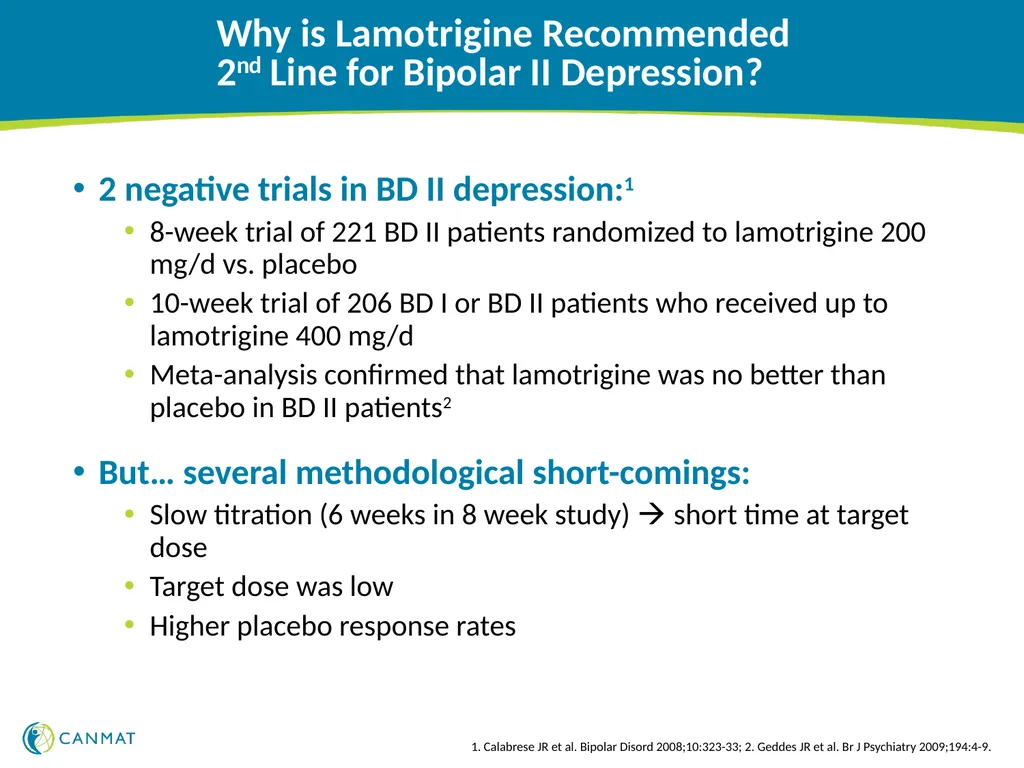
2nd Line for Bipolar II Depression? 2 negative trials in BD II depression:1
8-week trial of 221 BD II patients randomized to lamotrigine 200 mg/d vs. placebo
10-week trial of 206 BD I or BD II patients who received up to lamotrigine 400 mg/d
Meta-analysis confirmed that lamotrigine was no better than placebo in BD II patients2
But… several methodological short-comings:
Slow titration (6 weeks in 8 week study) short time at target dose
Target dose was low
Higher placebo response rates 1. Calabrese JR et al. Bipolar Disord 2008;10:323-33; 2. Geddes JR et al. Br J Psychiatry 2009;194:4-9.<br>
8-week trial of 221 BD II patients randomized to lamotrigine 200 mg/d vs. placebo
10-week trial of 206 BD I or BD II patients who received up to lamotrigine 400 mg/d
Meta-analysis confirmed that lamotrigine was no better than placebo in BD II patients2
But… several methodological short-comings:
Slow titration (6 weeks in 8 week study) short time at target dose
Target dose was low
Higher placebo response rates 1. Calabrese JR et al. Bipolar Disord 2008;10:323-33; 2. Geddes JR et al. Br J Psychiatry 2009;194:4-9.<br>
16
Reconciling Conflicting Data for Lamotrigine in
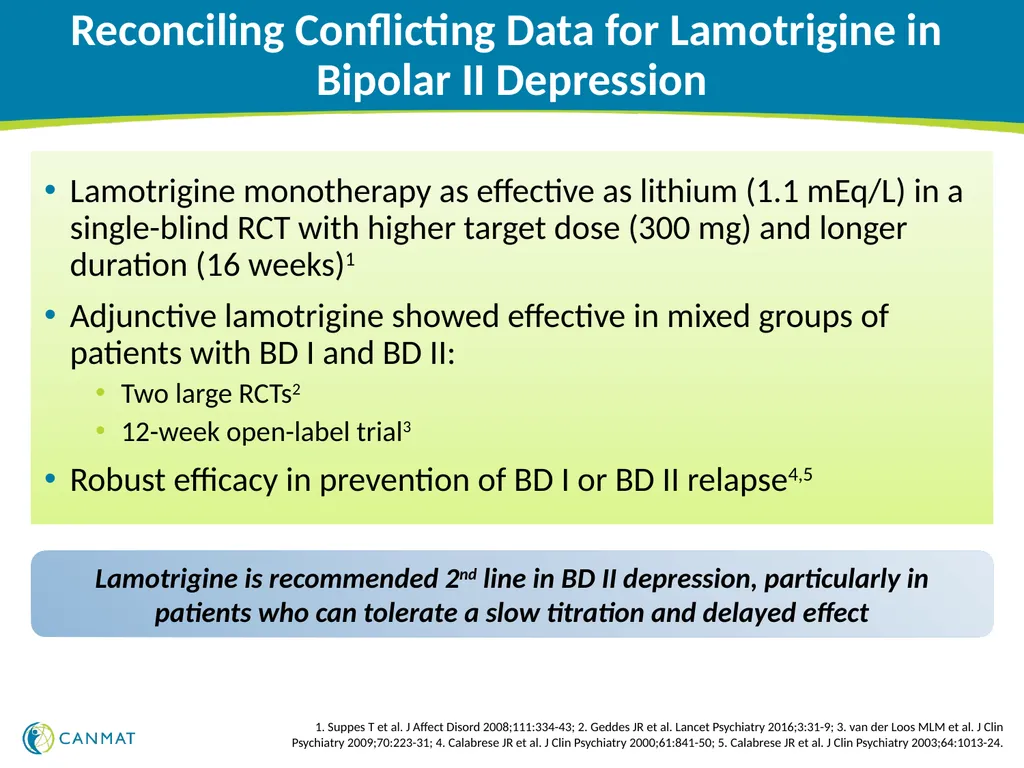
Bipolar II Depression Lamotrigine monotherapy as effective as lithium (1.1 mEq/L) in a single-blind RCT with higher target dose (300 mg) and longer duration (16 weeks)1
Adjunctive lamotrigine showed effective in mixed groups of patients with BD I and BD II:
Two large RCTs2
12-week open-label trial3
Robust efficacy in prevention of BD I or BD II relapse4,5 1. Suppes T et al. J Affect Disord 2008;111:334-43; 2. Geddes JR et al. Lancet Psychiatry 2016;3:31-9; 3. van der Loos MLM et al. J Clin Psychiatry 2009;70:223-31; 4. Calabrese JR et al. J Clin Psychiatry 2000;61:841-50; 5. Calabrese JR et al. J Clin Psychiatry 2003;64:1013-24. Lamotrigine is recommended 2nd line in BD II depression, particularly in patients who can tolerate a slow titration and delayed effect<br>
Adjunctive lamotrigine showed effective in mixed groups of patients with BD I and BD II:
Two large RCTs2
12-week open-label trial3
Robust efficacy in prevention of BD I or BD II relapse4,5 1. Suppes T et al. J Affect Disord 2008;111:334-43; 2. Geddes JR et al. Lancet Psychiatry 2016;3:31-9; 3. van der Loos MLM et al. J Clin Psychiatry 2009;70:223-31; 4. Calabrese JR et al. J Clin Psychiatry 2000;61:841-50; 5. Calabrese JR et al. J Clin Psychiatry 2003;64:1013-24. Lamotrigine is recommended 2nd line in BD II depression, particularly in patients who can tolerate a slow titration and delayed effect<br>
17
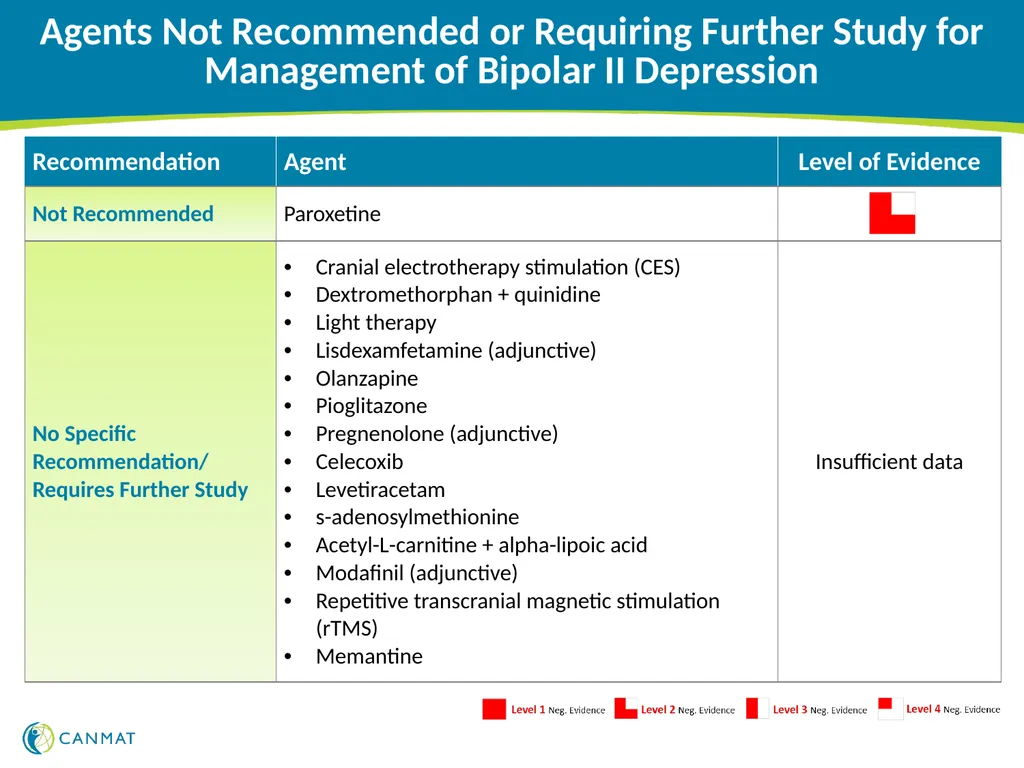
Agents Not Recommended or Requiring Further Study for Management of Bipolar II Depression<br>
18
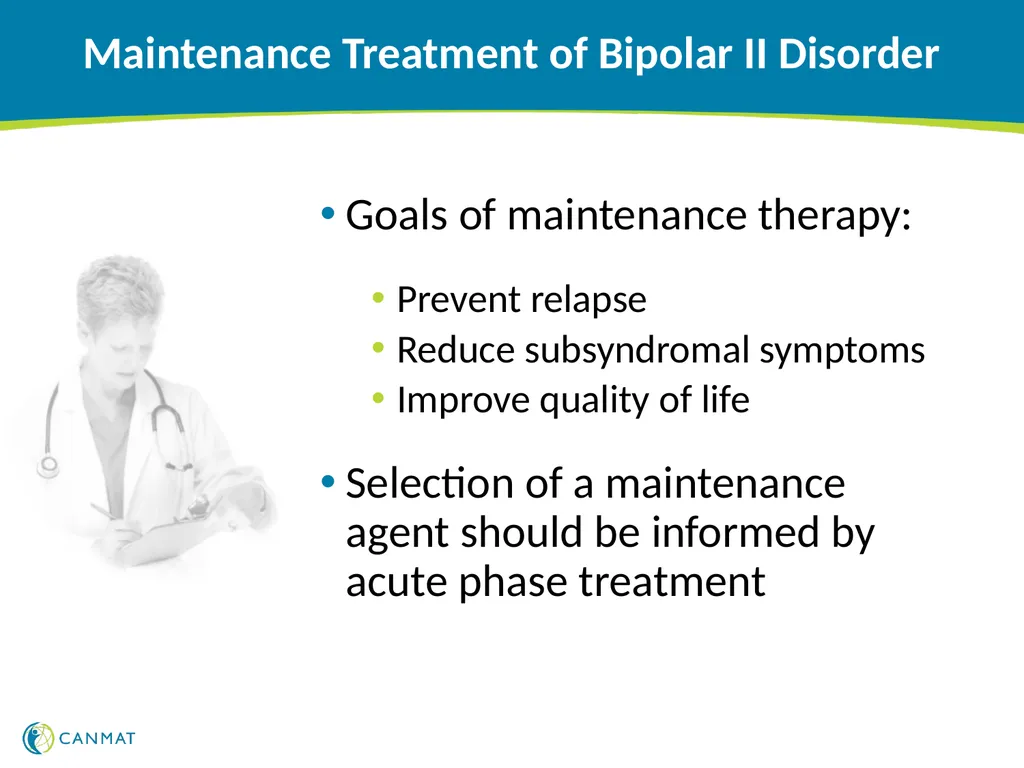
Maintenance Treatment of Bipolar II Disorder Goals of maintenance therapy:
Prevent relapse
Reduce subsyndromal symptoms
Improve quality of life
Selection of a maintenance agent should be informed by acute phase treatment<br>
Prevent relapse
Reduce subsyndromal symptoms
Improve quality of life
Selection of a maintenance agent should be informed by acute phase treatment<br>
19
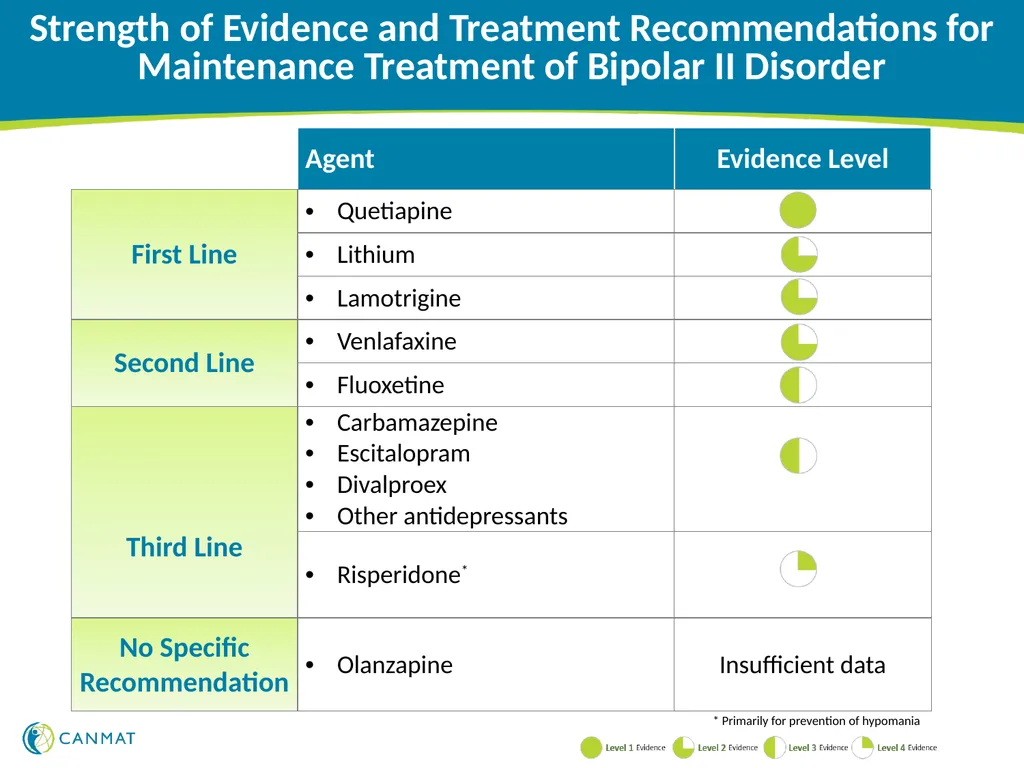
Strength of Evidence and Treatment Recommendations for Maintenance Treatment of Bipolar II Disorder * Primarily for prevention of hypomania<br>