
CASC 2023 Legislative Update For Virginia Law
FD
Published · 80 slides · 0 views

1 / 1















Description
CASC 2023 Legislative Update For Virginia Law Enforcement This document is provided for Law Enforcement by the Virginia Commonwealths Attorneys Services Council pursuant to Va. Code 2.2-3705.7(29) for the training of state prosecutors
Related Topics
Share
Embed code
Download this presentation From Below
"CASC 2023 Legislative Update For Virginia Law" is the property of its rightful owner. Permission is granted to download and print the materials on this website for personal, non-commercial use only, and to display it on your personal computer provided you do not modify the materials and that you retain all copyright notices contained in the materials. By downloading content from our website, you accept the terms of this agreement.
Presentation Transcript
01
CASC 2023
Legislative Update
For Virginia
Law Enforcement This document is provided for Law Enforcement by the Virginia Commonwealth’s Attorneys’ Services Council
pursuant to Va. Code § 2.2-3705.7(29) for the training of state prosecutors and law-enforcement personnel.<br>
pursuant to Va. Code § 2.2-3705.7(29) for the training of state prosecutors and law-enforcement personnel.<br>
02
Materials This PowerPoint attempts to identify the legislation from the 2023 General Assembly Regular Session that has the greatest impact on law enforcement and public safety.
Consult the 2023 Legislative Update Master List outline for full listing of bills of interest.
This presentation will NOT cover every bill.<br>
Consult the 2023 Legislative Update Master List outline for full listing of bills of interest.
This presentation will NOT cover every bill.<br>
03
Materials You must rely only upon the final language of the bill after passage.
Slides summarize each bill, but you should read the actual law before acting.
You can find the bill on the LIS website at: http://lis.virginia.gov/lis.htm.<br>
Slides summarize each bill, but you should read the actual law before acting.
You can find the bill on the LIS website at: http://lis.virginia.gov/lis.htm.<br>
04
Topics for this Presentation Criminal Investigations
Criminal Procedure
New and Amended Crimes and Offenses
Traffic Offenses Marijuana and Hemp
FOIA
ECO and TDO Procedure
Law Enforcement Procedural Guarantees and Requirements<br>
Criminal Procedure
New and Amended Crimes and Offenses
Traffic Offenses Marijuana and Hemp
FOIA
ECO and TDO Procedure
Law Enforcement Procedural Guarantees and Requirements<br>
05
Note:
Effective Date of Legislation All legislation from the Session, unless otherwise noted in this presentation, is effective on July 1, 2023.<br>
06
Criminal Investigations<br>
07
Ch. 170: Child Interviews Amends § 63.2-1505 to state that if a local multidisciplinary team has determined during an investigation of a report of child abuse or neglect that an interview of the child by a child advocacy center recognized by the National Children's Alliance is needed and an interview with a recognized child advocacy center within the jurisdiction cannot be completed within 14 days, the local department of social services may facilitate the interview with a recognized child advocacy center located in another jurisdiction.<br>
08
Ch. 487/488: APS Referrals Removes the requirement from § 63.2-1605 that the adult protective services hotline immediately refer certain reports of alleged adult abuse, neglect, or exploitation to the appropriate local law-enforcement agency and removes the duty of local law-enforcement agencies to provide the adult protective services hotline with a preferred point of contact for such referrals.
Bill retains the requirement for the local department of social services to immediately refer such reports to the appropriate local law-enforcement agency and the duty of local law-enforcement agencies to provide local departments of social services with a preferred point of contact for such referrals.<br>
Bill retains the requirement for the local department of social services to immediately refer such reports to the appropriate local law-enforcement agency and the duty of local law-enforcement agencies to provide local departments of social services with a preferred point of contact for such referrals.<br>
09
§18.2-356.1: Creates a Class 5 felony for any person who offers money or other valuable thing to another for the purpose of purchasing or otherwise obtaining custody or control of a minor and thereafter does any substantial act in furtherance of such offer of purchase or obtaining custody or control of such minor.
Bill also creates a Class 5 felony for any parent, legal guardian, or other person having custody or control of a minor who receives any money or other valuable thing for or on account of selling or otherwise transferring custody or control of such minor or who offers to sell or otherwise transfer custody or control of such minor.
Bill creates exceptions for any person entering into a surrogacy contract, seeking to adopt a child or place his child for adoption pursuant to relevant law, or who is a person with a legitimate interest, as defined in §20-124.1, in such minor. Ch. 359: Trafficking Minors<br>
Bill also creates a Class 5 felony for any parent, legal guardian, or other person having custody or control of a minor who receives any money or other valuable thing for or on account of selling or otherwise transferring custody or control of such minor or who offers to sell or otherwise transfer custody or control of such minor.
Bill creates exceptions for any person entering into a surrogacy contract, seeking to adopt a child or place his child for adoption pursuant to relevant law, or who is a person with a legitimate interest, as defined in §20-124.1, in such minor. Ch. 359: Trafficking Minors<br>
10
CRIMINAL PROCEDURE<br>
11
Ch. 564: Virginia Victims Fund (aka Criminal Injury Compensation Fund) Amends §19.2-368.10 and creates exception when law enforcement certifies that the victim was willing but did not due to a good faith belief of harm and no protection services were provided despite a request for such services by law enforcement.
Current law allowed the Commission of the CICF to deny or reduce funds to victims who did not cooperate fully with law enforcement.<br>
Current law allowed the Commission of the CICF to deny or reduce funds to victims who did not cooperate fully with law enforcement.<br>
12
Ch. 680/681
Victims – Testing Offender for STIs Provides that as soon as practicable following arrest, or following indictment, arrest by warrant, or service of a petition in the case of a juvenile, the attorney for the Commonwealth may request after consultation with any complaining witness, or shall request upon the request of the complaining witness, that any person charged with certain specified crimes be requested to submit to testing for sexually transmitted infections, as that term is defined in the bill.
The bill provides that if the person charged refuses to submit to testing or the competency of the person to submit to testing is at issue, a court finding probable cause that the complaining witness was exposed to body fluids of the person charged in a manner that may transmit a sexually transmitted infection shall order such testing.<br>
The bill provides that if the person charged refuses to submit to testing or the competency of the person to submit to testing is at issue, a court finding probable cause that the complaining witness was exposed to body fluids of the person charged in a manner that may transmit a sexually transmitted infection shall order such testing.<br>
13
Ch. 746/784: Victim Notification about Plea Amends §19.2-11.01(A)(4)(d) to require an attorney for the Commonwealth to consult with a crime victim in a felony case to (i) inform the victim of the contents of a proposed plea agreement and (ii) obtain the victim's views about the disposition of the case.
Bill provides that the victim shall be notified of any proceeding in which the plea agreement will be tendered to the court.
Under current law, such consultation and notification is required only upon the victim's request.<br>
Bill provides that the victim shall be notified of any proceeding in which the plea agreement will be tendered to the court.
Under current law, such consultation and notification is required only upon the victim's request.<br>
14
NEW AND AMENDED
CRIMES AND OFFENSES<br>
15
Ch. 24: Drones Trespassing over Jails & Prisons Amends § 18.2-121.3 to expand the Class 1 misdemeanor for Trespass by Drone to include:
Using a drone to drop any item within the boundaries of state or local correctional facilities or juvenile correctional center.
Using a drone to obtain any video or still image of an inmate or resident of state or local correctional facilities or juvenile correctional center.<br>
Using a drone to drop any item within the boundaries of state or local correctional facilities or juvenile correctional center.
Using a drone to obtain any video or still image of an inmate or resident of state or local correctional facilities or juvenile correctional center.<br>
16
Creates a Class 1 misdemeanor when a false emergency communication results in an emergency response.
Creates a Class 6 felony if the emergency response to a false emergency communication results in serious bodily injury to any person.
Creates a Class 5 felony if the emergency response to a false emergency communication results in any person’s death.
The person convicted of such false emergency communication shall be liable for the reasonable expense in responding to such false emergency communication. Ch. 22/23: “Anti-swatting” §18.2-461.1<br>
Creates a Class 6 felony if the emergency response to a false emergency communication results in serious bodily injury to any person.
Creates a Class 5 felony if the emergency response to a false emergency communication results in any person’s death.
The person convicted of such false emergency communication shall be liable for the reasonable expense in responding to such false emergency communication. Ch. 22/23: “Anti-swatting” §18.2-461.1<br>
17
Ch. 200: Threats Against Healthcare Providers Removes the location element from § 18.2-60 that specifies a health care provider must be in a hospital or in an emergency room on the premises of a clinic or other facility rendering emergency medical care from the crime of making an oral threat to kill or to do bodily injury to a health care provider.<br>
18
Ch. 201/202: Update to Phone Threats Amends § 18.2-429 to now state:
B. Any person who, with or without intent to communicate but with intent to annoy, harass, hinder, or delay emergency personnel in the performance of their duties as such, causes a telephone to ring or other device to signal, which is owned or leased for the purpose of receiving communications by a public or private entity providing fire, police, or emergency medical services, and any person who knowingly permits the use of a telephone or other device under his control for such purpose, is guilty of a Class 1 misdemeanor.<br>
B. Any person who, with or without intent to communicate but with intent to annoy, harass, hinder, or delay emergency personnel in the performance of their duties as such, causes a telephone to ring or other device to signal, which is owned or leased for the purpose of receiving communications by a public or private entity providing fire, police, or emergency medical services, and any person who knowingly permits the use of a telephone or other device under his control for such purpose, is guilty of a Class 1 misdemeanor.<br>
19
Ch. 330: Venue for Vulnerable Adults Provides that, in addition to the county or city in which any act was performed in furtherance of the offense or the accused resided at the time of the offense, venue for the trial of an accused charged with Financial Exploitation of a Vulnerable Adult under §18.2-178.1 may be in any county or city in which:
the vulnerable adult resides or resided at the time of the offense or
the vulnerable adult sustained a financial loss as a result of the offense.<br>
the vulnerable adult resides or resided at the time of the offense or
the vulnerable adult sustained a financial loss as a result of the offense.<br>
20
§18.2-103.1 Creates a Class 3 felony (5-20 yrs & up to $100k) for anyone to conspire or act in concert with one or more people to steal retail merchandise with a value exceeding $5,000 in a 90-day period, with the intent to sell the stolen goods for profit. §18.2-103.1
Retail theft in more than one county or city may be aggregated. §18.2-103.1(D)
Venue lies where any act in furtherance or where the person charged with the offense lived at the time of the offense. §18.2-103.1(E) Ch. 357 / 358: Organized Retail Theft<br>
Retail theft in more than one county or city may be aggregated. §18.2-103.1(D)
Venue lies where any act in furtherance or where the person charged with the offense lived at the time of the offense. §18.2-103.1(E) Ch. 357 / 358: Organized Retail Theft<br>
21
Adds this new crime of Organized Retail Theft to the list of crimes denoted as “racketeering activity”. §18.2-51.3
Creates the Organized Retail Crime Fund to receive gifts, donations, grants, etc. for the purpose of awarding grants to Commonwealth’s Attorneys and law enforcement agencies to investigate, indict and prosecute organized retail theft and associated fraud and property crimes. §2.2-511.2 Ch. 357 / 358: Organized Retail Theft (cont.)<br>
Creates the Organized Retail Crime Fund to receive gifts, donations, grants, etc. for the purpose of awarding grants to Commonwealth’s Attorneys and law enforcement agencies to investigate, indict and prosecute organized retail theft and associated fraud and property crimes. §2.2-511.2 Ch. 357 / 358: Organized Retail Theft (cont.)<br>
22
Ch. 360: Locally-Created Curfews Enables the chief law-enforcement officer of a locality to enact a curfew under certain circumstances during a civil disturbance.
Bill clarifies that such action in cities shall be in concurrence with the city manager and the mayor.
Bill requires that such action specify the hours of the curfew and the geographic area to which the curfew applies and provide for various specified exceptions.
The action authorizing the curfew shall provide for reasonable efforts to inform the public in advance of the curfew, which shall be valid for no more than 24 hours.
Bill provides that such curfew shall not be extended or renewed unless by recorded vote of the local governing body or by judicial order.
Bill provides that any violation is a Class 1 misdemeanor.<br>
Bill clarifies that such action in cities shall be in concurrence with the city manager and the mayor.
Bill requires that such action specify the hours of the curfew and the geographic area to which the curfew applies and provide for various specified exceptions.
The action authorizing the curfew shall provide for reasonable efforts to inform the public in advance of the curfew, which shall be valid for no more than 24 hours.
Bill provides that such curfew shall not be extended or renewed unless by recorded vote of the local governing body or by judicial order.
Bill provides that any violation is a Class 1 misdemeanor.<br>
23
Ch. 379/380: Sexually Violent Predators Creates a Class 6 felony (§37.2-912(C)) for any civilly committed sexually violent predator who tampers with or in any way attempts to circumvent the operation of his GPS equipment while on conditional release.<br>
24
Ch. 381: Peeping by Drone Creates new subsection: §18.2-130.1(B) that prohibits any person from knowingly and intentionally causing an unmanned aircraft system to secretly or furtively peep, spy, or attempt to peep or spy into or through a window, door, or other aperture of any building, structure, or other enclosure occupied or intended for occupancy as a dwelling, whether or not such building, structure, or enclosure is permanently situated or transportable and whether or not such occupancy is permanent or temporary, without just cause, under circumstances that would violate the occupant's reasonable expectation of privacy.
Class 1 Misdemeanor<br>
Class 1 Misdemeanor<br>
25
Ch. 383/384
Weapon of Terrorism – Fentanyl Includes any mixture or substance containing a detectable amount of fentanyl, including its isomers, esters, ethers, salts, and salts of isomers, as a weapon of terrorism for the purpose of defining terrorism offenses.
Bill provides that any person who knowingly and intentionally manufactures or knowingly and intentionally distributes a weapon of terrorism when such person knows that such weapon of terrorism is, or contains, any mixture or substance containing a detectable amount of fentanyl is guilty of a Class 4 felony.<br>
Bill provides that any person who knowingly and intentionally manufactures or knowingly and intentionally distributes a weapon of terrorism when such person knows that such weapon of terrorism is, or contains, any mixture or substance containing a detectable amount of fentanyl is guilty of a Class 4 felony.<br>
26
Ch. 396/397: Gang Participation Provides that the definition of “predicate criminal act” under §18.2-46.1 includes all violent felony offenses listed in subsection C of §17.2-805 for purposes of predicate criminal acts for street gangs.
The law already includes offenses listed under subsection A of §19.2-297.1.
The bill also increases various penalties for gang crimes in §18.2-46.2, §18.2-46.3:1 and §18.2-46.3:3.<br>
The law already includes offenses listed under subsection A of §19.2-297.1.
The bill also increases various penalties for gang crimes in §18.2-46.2, §18.2-46.3:1 and §18.2-46.3:3.<br>
27
Ch. 549:
A&B of Public Transport Operator Makes it a Class 1 misdemeanor under § 18.2-57 for a person to commit an assault and/or battery against another knowing or having reason to know that such individual is an operator of a vehicle operated by a public transportation service who is engaged in the performance of his duties.
Bill requires the sentence of such person, upon conviction, to prohibit such person from entering or riding in any vehicle operated by the public transportation service that employed such operator for a period of not less than six months as a term and condition of such sentence.
Class 1 misdemeanor to defy that ban and enter or ride again.<br>
Bill requires the sentence of such person, upon conviction, to prohibit such person from entering or riding in any vehicle operated by the public transportation service that employed such operator for a period of not less than six months as a term and condition of such sentence.
Class 1 misdemeanor to defy that ban and enter or ride again.<br>
28
Amends the definition of “Abused and neglected child” in §16.2-228 and §63.2.100 to provide that allowing a child to engage in independent activities cannot, on that fact alone, be considered abused or neglected, provided that:
the activities are appropriate for the child’s age, maturity and physical & mental abilities, and
the lack of supervision isn’t grossly negligent.
States “[s]uch independent activities include traveling to or from school or nearby locations by bicycle or on foot, playing outdoors, remaining at home for a reasonable period of time.” Ch. 568: Child Abuse/Neglect<br>
the activities are appropriate for the child’s age, maturity and physical & mental abilities, and
the lack of supervision isn’t grossly negligent.
States “[s]uch independent activities include traveling to or from school or nearby locations by bicycle or on foot, playing outdoors, remaining at home for a reasonable period of time.” Ch. 568: Child Abuse/Neglect<br>
29
Ch. 604: Trespass - “Person Lawfully In Charge” Provides in § 15.2-1717.1 that the maintenance code official of a locality is considered a person lawfully in charge of real property that has been declared a derelict building, unless the owner of such property objects, for the purpose of posting a sign or signs to prohibit any person to go upon the premises of such property without the authority of law.<br>
30
Ch. 611:
CCW - Switchblades and Stilettos Removes switchblade knives from the list of concealed weapons the carrying of which is prohibited in public.
Adds stiletto knives to the list of concealed weapons the carrying of which is prohibited in public.
New language in statute does not define “stiletto.”<br>
Adds stiletto knives to the list of concealed weapons the carrying of which is prohibited in public.
New language in statute does not define “stiletto.”<br>
31
Ch. 607/608: Racketeering Adds the new crime of Organized Retail Theft to the list of crimes denoted as “racketeering activity”. §18.2-51.3
Adds petit larceny to the list of offenses included in the definition of “racketeering activity” under §18.2-513.
Also amends §18.2-514 to broaden the parties and the conduct that violates the racketeering prohibition to cover “any person who is directed by an organizer, supervisor, or manager of an enterprise” and to cover distribution of proceeds or anything else of value.<br>
Adds petit larceny to the list of offenses included in the definition of “racketeering activity” under §18.2-513.
Also amends §18.2-514 to broaden the parties and the conduct that violates the racketeering prohibition to cover “any person who is directed by an organizer, supervisor, or manager of an enterprise” and to cover distribution of proceeds or anything else of value.<br>
32
Creates Class 5 Felony, §18.2-59.1, for sexual extortion when an offender maliciously threatens in writing to distribute nude photos or refuse to remove or delete the distributed nude photos unless the person engages in a sex act with that person and the victim does engage in a sex act with the offender as a result of the threats.
Offense is punishable by 1-20 years and fine not more than $100k if an adult violates this section with a minor.
Venue: County, city or town in which the communication was made or received. Ch. 612: Sexual Extortion<br>
Offense is punishable by 1-20 years and fine not more than $100k if an adult violates this section with a minor.
Venue: County, city or town in which the communication was made or received. Ch. 612: Sexual Extortion<br>
33
Adds §18.2-47(C), which makes the abduction of a minor a Class 2 felony, unless such abduction is committed by the parent or a family or household member who has been ordered custody or visitation of the person abducted, for which there is a prescribed punishment.
Under current law, abduction of any person is punishable as a Class 5 felony if there is no other prescribed punishment.
The bill also makes an abduction committed by a family or household member who has been ordered custody or visitation of the person abducted punishable the same as an abduction committed by the parent of the person abducted. Ch. 400: Abduction of a Minor<br>
Under current law, abduction of any person is punishable as a Class 5 felony if there is no other prescribed punishment.
The bill also makes an abduction committed by a family or household member who has been ordered custody or visitation of the person abducted punishable the same as an abduction committed by the parent of the person abducted. Ch. 400: Abduction of a Minor<br>
34
Ch. 631: Naloxone Administration Allows anyone to possess and administer naloxone (or similar) with a hypodermic needle or syringe and removes requirement to have training.
Also requires Department of Health to create the Opioid Impact Reduction Registry.
Directs DOC to require that training in the administration of naloxone be provided to every inmate prior to release.<br>
Also requires Department of Health to create the Opioid Impact Reduction Registry.
Directs DOC to require that training in the administration of naloxone be provided to every inmate prior to release.<br>
35
Amends §18.2-51.6 to add subsection (B): that any person who, without consent, impedes the blood circulation or respiration of another person by knowingly, intentionally, and unlawfully blocking or obstructing the airway of such person resulting in the wounding or bodily injury of such person is guilty of suffocation, a Class 6 felony. Ch. 709/710: Suffocation<br>
36
Ch. 90/91: Sale, Purchase or Possession
of a Used Catalytic Converter Amends §18.2-146
Creates a permissive inference that a person in possession of a catalytic converter that was removed from a car is in violation of felony tampering with an automobile under §18.2-146.
Exceptions provided for:
motor vehicle dealers, repair shops, and salvage yards,
scrap metal purchaser that has adhered to the required compliance provisions, and
someone who has proof the possession is a result of installing one in their registered vehicle.<br>
Creates a permissive inference that a person in possession of a catalytic converter that was removed from a car is in violation of felony tampering with an automobile under §18.2-146.
Exceptions provided for:
motor vehicle dealers, repair shops, and salvage yards,
scrap metal purchaser that has adhered to the required compliance provisions, and
someone who has proof the possession is a result of installing one in their registered vehicle.<br>
37
Marijuana & Hemp<br>
38
Ch. 744 / 794: Hemp & Marijuana Limits the amount of tetrahydrocannabinol (THC) that can be included in a hemp product or industrial hemp extract to 0.3 percent and two milligrams per package. See §3.2-4112 and § 3.2-5145.1.
Limits the application of THC limits to retail sales and allows a hemp product or industrial hemp extract to contain more than two milligrams of THC if the product or extract contains an amount of cannabidiol (CBD) that is at least 25 times greater than the amount of THC.
Bill creates certain packaging, labeling, and testing requirements for regulated hemp products and requires that topical hemp products bear a label stating that the product is not intended for human consumption.<br>
Limits the application of THC limits to retail sales and allows a hemp product or industrial hemp extract to contain more than two milligrams of THC if the product or extract contains an amount of cannabidiol (CBD) that is at least 25 times greater than the amount of THC.
Bill creates certain packaging, labeling, and testing requirements for regulated hemp products and requires that topical hemp products bear a label stating that the product is not intended for human consumption.<br>
39
Ch. 744 / 794: New Definition Per the Bill, the term "tetrahydrocannabinol" now means:
“any naturally occurring or synthetic tetrahydrocannabinol, including its salts, isomers, and salts of isomers whenever the existence of such salts, isomers, and salts of isomers is possible within the specific chemical designation and any preparation, mixture, or substance containing, or mixed or infused with, any detectable amount of tetrahydrocannabinol.”
For the purposes of this definition, "isomer" means the optical, position, and geometric isomers.
See §3.2-4112, §18.2-247(F)&(G), §54.1-3401<br>
“any naturally occurring or synthetic tetrahydrocannabinol, including its salts, isomers, and salts of isomers whenever the existence of such salts, isomers, and salts of isomers is possible within the specific chemical designation and any preparation, mixture, or substance containing, or mixed or infused with, any detectable amount of tetrahydrocannabinol.”
For the purposes of this definition, "isomer" means the optical, position, and geometric isomers.
See §3.2-4112, §18.2-247(F)&(G), §54.1-3401<br>
40
Ch. 744/794: Civil Penalties §3.2-5145.2:1(B) – Civil Penalties for :
(a) manufacturing, selling, or offering for sale an industrial hemp extract or food containing an industrial hemp extract without a permit; (b) continuing to manufacture, sell, or offer for sale an industrial hemp extract or food containing an industrial hemp extract after revocation or suspension of such permit; (c) failing to disclose on a form prescribed by the Commissioner of the Virginia Department of Agriculture and Consumer Services that he intends to manufacture, sell, or offer for sale a substance intended to be consumed orally that contains an industrial hemp-derived cannabinoid; (d) manufacturing, selling, or offering for sale a food that contains more than 0.3 percent of THC or more than two milligrams of THC per package; (e) manufacturing, offering for sale, or selling in violation of food and drink laws or regulations a substance intended to be consumed orally that is advertised or labeled as containing an industrial hemp-derived cannabinoid; or (f) otherwise violating any provision of the Commonwealth's food and drink laws or regulations.
Penalties are collected by Dept. of Agriculture<br>
(a) manufacturing, selling, or offering for sale an industrial hemp extract or food containing an industrial hemp extract without a permit; (b) continuing to manufacture, sell, or offer for sale an industrial hemp extract or food containing an industrial hemp extract after revocation or suspension of such permit; (c) failing to disclose on a form prescribed by the Commissioner of the Virginia Department of Agriculture and Consumer Services that he intends to manufacture, sell, or offer for sale a substance intended to be consumed orally that contains an industrial hemp-derived cannabinoid; (d) manufacturing, selling, or offering for sale a food that contains more than 0.3 percent of THC or more than two milligrams of THC per package; (e) manufacturing, offering for sale, or selling in violation of food and drink laws or regulations a substance intended to be consumed orally that is advertised or labeled as containing an industrial hemp-derived cannabinoid; or (f) otherwise violating any provision of the Commonwealth's food and drink laws or regulations.
Penalties are collected by Dept. of Agriculture<br>
41
Ch. 744/794: Criminal Penalties §3.2-5145.2:1(B) – Class 1 Misdemeanor for all of the previous items except (d): to wit:
(a) manufacturing, selling, or offering for sale an industrial hemp extract or food containing an industrial hemp extract without a permit; (b) continuing to manufacture, sell, or offer for sale an industrial hemp extract or food containing an industrial hemp extract after revocation or suspension of such permit; (c) failing to disclose on a form prescribed by the Commissioner of the Virginia Department of Agriculture and Consumer Services that he intends to manufacture, sell, or offer for sale a substance intended to be consumed orally that contains an industrial hemp-derived cannabinoid; (e) manufacturing, offering for sale, or selling in violation of food and drink laws or regulations a substance intended to be consumed orally that is advertised or labeled as containing an industrial hemp-derived cannabinoid; or (f) otherwise violating any provision of the Commonwealth's food and drink laws or regulations.
NO new penalty added for item (d) on previous list: manufacturing, selling, or offering for sale a food that contains more than 0.3 percent of THC or more than two milligrams of THC per package.<br>
(a) manufacturing, selling, or offering for sale an industrial hemp extract or food containing an industrial hemp extract without a permit; (b) continuing to manufacture, sell, or offer for sale an industrial hemp extract or food containing an industrial hemp extract after revocation or suspension of such permit; (c) failing to disclose on a form prescribed by the Commissioner of the Virginia Department of Agriculture and Consumer Services that he intends to manufacture, sell, or offer for sale a substance intended to be consumed orally that contains an industrial hemp-derived cannabinoid; (e) manufacturing, offering for sale, or selling in violation of food and drink laws or regulations a substance intended to be consumed orally that is advertised or labeled as containing an industrial hemp-derived cannabinoid; or (f) otherwise violating any provision of the Commonwealth's food and drink laws or regulations.
NO new penalty added for item (d) on previous list: manufacturing, selling, or offering for sale a food that contains more than 0.3 percent of THC or more than two milligrams of THC per package.<br>
42
Ch. 744/794: Criminal Penalties The bill makes it unlawful under the Consumer Protection Act to
Sell or offer for sale any substance intended for human consumption that contains a synthetic derivative of THC or
Sell or offer for sale a topical hemp product that does not include a label stating that the product is not intended for human consumption.<br>
Sell or offer for sale any substance intended for human consumption that contains a synthetic derivative of THC or
Sell or offer for sale a topical hemp product that does not include a label stating that the product is not intended for human consumption.<br>
43
Ch. 711: Restrictions on Marijuana Advertising Creates Class 1 misdemeanor for advertising marijuana products (incl. synthetic or synthetic derivative tetrahydrocannabinol) that are not legally sold in Virginia. §4.1-1116
Class 4 misdemeanor for violations of §4.1-1405 (distance and zoning restriction on outdoor advertising) if the advertiser doesn’t take corrective action within 30 days of notice by the Board.<br>
Class 4 misdemeanor for violations of §4.1-1405 (distance and zoning restriction on outdoor advertising) if the advertiser doesn’t take corrective action within 30 days of notice by the Board.<br>
44
Bill also establishes numerous restrictions on marijuana advertisements, including provisions that prohibit advertisements from:
targeting minors; being placed near schools, playgrounds, and certain other places;
being displayed at a sporting event or on a billboard;
being misleading, deceptive, or false;
referencing the intoxicating effects of marijuana; or
promoting overconsumption or consumption by minors. Ch. 711: Marijuana Advertising (Con’d)<br>
targeting minors; being placed near schools, playgrounds, and certain other places;
being displayed at a sporting event or on a billboard;
being misleading, deceptive, or false;
referencing the intoxicating effects of marijuana; or
promoting overconsumption or consumption by minors. Ch. 711: Marijuana Advertising (Con’d)<br>
45
TRAFFIC<br>
46
Review: 2022 Changes to Farm Use Tags Amended §§ 46.2-665, 46.2-666, 46.2-670, 46.2-672, and 46.2-673 and adds § 46.2-684.2
Change would have required an owner or lessee of a vehicle claiming a farm use exemption from the registration, licensing, and decal requirements for a motor vehicle, trailer, or semitrailer to obtain a nontransferable permanent farm use placard from the Department of Motor Vehicles and to display the farm use placard on the vehicle at all times.
Law required the applicant to provide specified information about the vehicle and its usage, pay a $15 fee, and certify that the vehicle is insured.
Provisions of the bill requiring the owner or lessee of a farm vehicle to obtain and display a farm use placard had a delayed effective date of July 1, 2023.<br>
Change would have required an owner or lessee of a vehicle claiming a farm use exemption from the registration, licensing, and decal requirements for a motor vehicle, trailer, or semitrailer to obtain a nontransferable permanent farm use placard from the Department of Motor Vehicles and to display the farm use placard on the vehicle at all times.
Law required the applicant to provide specified information about the vehicle and its usage, pay a $15 fee, and certify that the vehicle is insured.
Provisions of the bill requiring the owner or lessee of a farm vehicle to obtain and display a farm use placard had a delayed effective date of July 1, 2023.<br>
47
Ch. 85/86: ”Farm Use” Placards - 2023 Changes Delays from July 1, 2023, to July 1, 2024, the date by which vehicles claiming a farm use exemption are required to obtain a farm use placard from the Department of Motor Vehicles and display such placard at all times.
The bill provides that the requirement to display a permanent ”Farm Use” placard only applies to pickup or panel trucks and sport utility vehicles.
Does not apply to “Farm Use” vehicles having a gross vehicle weight rating greater than 7,500 pounds or “Farm Use” trailers and semi-trailers.
Does not apply to farm machinery or tractors.
The bill adds to the authorized uses the use of “Farm Use” vehicle for disposing of incidental household refuse.<br>
The bill provides that the requirement to display a permanent ”Farm Use” placard only applies to pickup or panel trucks and sport utility vehicles.
Does not apply to “Farm Use” vehicles having a gross vehicle weight rating greater than 7,500 pounds or “Farm Use” trailers and semi-trailers.
Does not apply to farm machinery or tractors.
The bill adds to the authorized uses the use of “Farm Use” vehicle for disposing of incidental household refuse.<br>
48
Ch. 85/86:
Other 2023 “Farm Use” Changes The bill removes certain requirements on the application for a farm use placard, prohibits requesting additional information on such application, and prohibits disclosure of application information.
The bill authorizes the use of a seasonal transportation vehicle for driving to a storage house, packing plant, or market regardless of distance.
The bill clarifies that the exemption for transporting back to a farm essential food includes procuring a meal for a farmer or his employees and that such exemption applies while engaged in authorized farm vehicle uses. (A permanent placard may still be required.)
The bill exempts vehicles required to obtain a farm use placard from the motor vehicle sales and use tax and authorizes localities to exempt such vehicles from personal property tax.<br>
The bill authorizes the use of a seasonal transportation vehicle for driving to a storage house, packing plant, or market regardless of distance.
The bill clarifies that the exemption for transporting back to a farm essential food includes procuring a meal for a farmer or his employees and that such exemption applies while engaged in authorized farm vehicle uses. (A permanent placard may still be required.)
The bill exempts vehicles required to obtain a farm use placard from the motor vehicle sales and use tax and authorizes localities to exempt such vehicles from personal property tax.<br>
49
Ch. 117: Stopping for Pedestrians Amends § 46.2-924 to require the driver of a vehicle on a highway approaching a pedestrian who is crossing such highway to stop when such pedestrian is within the driver's lane or within an adjacent lane and approaching the driver's lane.
Currently, a driver is required to yield the right-of-way to such pedestrian by stopping and remaining stopped.
Bill also provides that localities that are already authorized to install signs directing motor vehicles to yield the right-of-way to pedestrians crossing or attempting to cross a highway may also install signs directing motor vehicles to stop for such pedestrians.<br>
Currently, a driver is required to yield the right-of-way to such pedestrian by stopping and remaining stopped.
Bill also provides that localities that are already authorized to install signs directing motor vehicles to yield the right-of-way to pedestrians crossing or attempting to cross a highway may also install signs directing motor vehicles to stop for such pedestrians.<br>
50
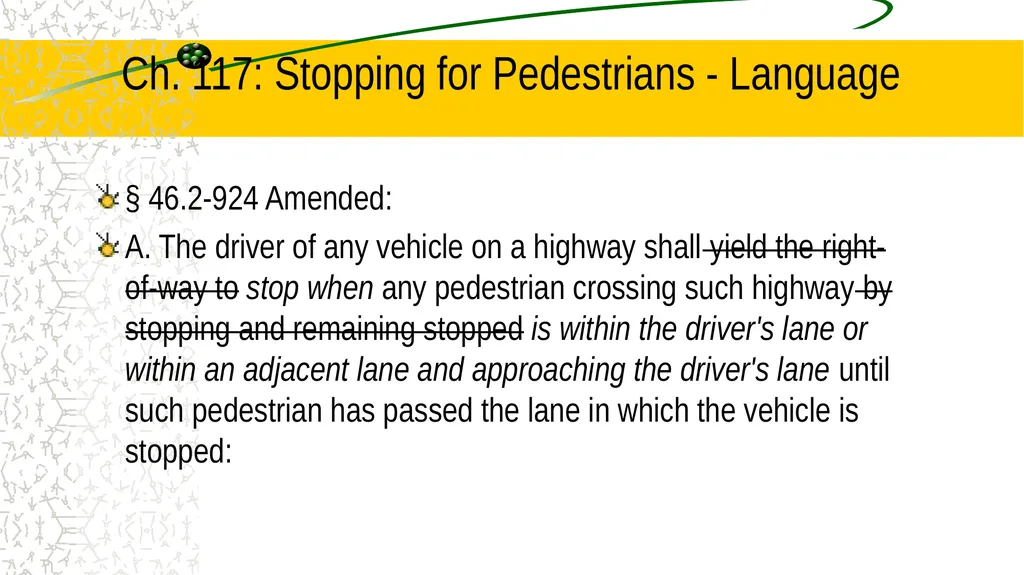
Ch. 117: Stopping for Pedestrians - Language § 46.2-924 Amended:
A. The driver of any vehicle on a highway shall yield the right-of-way to stop when any pedestrian crossing such highway by stopping and remaining stopped is within the driver's lane or within an adjacent lane and approaching the driver's lane until such pedestrian has passed the lane in which the vehicle is stopped:<br>
A. The driver of any vehicle on a highway shall yield the right-of-way to stop when any pedestrian crossing such highway by stopping and remaining stopped is within the driver's lane or within an adjacent lane and approaching the driver's lane until such pedestrian has passed the lane in which the vehicle is stopped:<br>
51
Ch. 235: Obstructed View and Dashcams Exception to § 46.2-1054 (obstructed view) that allows the suspension and use of any dashboard camera and any accompanying wires or attachments in or on a motor vehicle, provided that:
such suspension and use are not otherwise prohibited by the provisions of Title 49 of the Code of Federal Regulations, and
such camera, wires, and attachments are wholly or mostly concealed behind the rear view mirror without any additional obstruction to the driver's view.<br>
such suspension and use are not otherwise prohibited by the provisions of Title 49 of the Code of Federal Regulations, and
such camera, wires, and attachments are wholly or mostly concealed behind the rear view mirror without any additional obstruction to the driver's view.<br>
52
Ch. 324: Lights on Animal-Drawn Vehicles Clarifies that the existing requirements in § 46.2-1016 for vehicles to display white lights in the front and red lights in the rear or approved reflectors applies to animal-drawn vehicles.
The bill also provides that such lights may be battery-operated.<br>
The bill also provides that such lights may be battery-operated.<br>
53
Ch. 355: Removal by Locality of
Unattended or Immobile Vehicles Amended § 46.2-1213 to allow for the removal of certain unattended or immobile vehicles by the locality's civil code enforcement division.
Current law provides that such removal must be carried out under the direction of a law-enforcement officer or other uniformed employee of the local law-enforcement agency who specifically is authorized to do so.<br>
Current law provides that such removal must be carried out under the direction of a law-enforcement officer or other uniformed employee of the local law-enforcement agency who specifically is authorized to do so.<br>
54
Ch. 382: Passing School Buses Makes evidence that a bus was stopped with at least one warning device activated prima facie evidence that the bus was stopped for the purpose of taking on or discharging children, the elderly, or mentally or physically handicapped persons.
Also: Chapter 401 / Chapter 402: Extends from 10 days to 30 business days the deadline for issuing a summons for an alleged violation of passing a stopped school bus in order for proof that the motor vehicle passed a stopped school bus and that the defendant was the registered owner of the vehicle to give rise to a rebuttable presumption that the owner of the vehicle was the operator during the violation.<br>
Also: Chapter 401 / Chapter 402: Extends from 10 days to 30 business days the deadline for issuing a summons for an alleged violation of passing a stopped school bus in order for proof that the motor vehicle passed a stopped school bus and that the defendant was the registered owner of the vehicle to give rise to a rebuttable presumption that the owner of the vehicle was the operator during the violation.<br>
55
Ch. 394/395: CMV Inspection Requirement Amends § 46.2-1158.01 to provide that a commercial vehicle operating in interstate commerce is exempt from the vehicle safety inspection requirement if, in addition to other criteria, such vehicle is inspected in accordance with the federal requirements for annual inspection by complying with federal periodic inspection requirements.
Current law requires annual inspection through self-inspection, a third-party inspection, a Commercial Vehicle Safety Alliance inspection, or a periodic inspection performed by any state with a program in order for the vehicle to be exempt.<br>
Current law requires annual inspection through self-inspection, a third-party inspection, a Commercial Vehicle Safety Alliance inspection, or a periodic inspection performed by any state with a program in order for the vehicle to be exempt.<br>
56
Ch. 600: Towing & Recovery Amends § 46.2-118 to prohibit towing and recovery operators from refusing to allow, consistent with current law, the owner of a towed vehicle, upon presenting proof of ownership, to access and recover any personal items without retrieving the vehicle and without paying any fee.<br>
57
Ch. 616/617: “Move Over” Amendments § 46.2-861.1 Amendment requires drivers to make a lane change or reduce speed when passing stationary vehicles that have activated the vehicular hazard warning signal flashers, displayed caution signs, or been marked with properly lit flares or torches on certain highways when safe and reasonable to do so and makes a violation of this requirement a traffic infraction.<br>
58
Ch. 689: Blue Headlights Amendment to §§ 46.2-1011, 46.2-1012, and 46.2-1015
Prohibits the use of headlights on motor vehicles, motorcycles, autocycles, bicycles, electric personal assistive mobility devices, personal delivery devices, electric power-assisted bicycles, mopeds, and motorized skateboards or scooters with aftermarket modifications that make such headlights appear as a blue light.<br>
Prohibits the use of headlights on motor vehicles, motorcycles, autocycles, bicycles, electric personal assistive mobility devices, personal delivery devices, electric power-assisted bicycles, mopeds, and motorized skateboards or scooters with aftermarket modifications that make such headlights appear as a blue light.<br>
59
CIVIL PROCEDURE<br>
60
Ch. 442/443: Writs of Eviction Amends § 8.01-471 to require the sheriff executing a writ of eviction to return such executed writ to the clerk of court who issued such writ.<br>
61
Ch. 554/555: Expungement and Sealing Bill makes a series of technical changes to expungement statutes and the sealing statutes that take effect on or about July 1, 2025.
Repeals the special statute providing for the limitation on the dissemination of criminal history record information related to the possession of marijuana and the statute related to automatic sealing for mistaken identity or unauthorized use of identifying information.
Bill also repeals the special provisions related to the automatic and petition-based expungement of former marijuana offenses and instead provides for the sealing of such offenses.
Bill also removes the provisions related to the automatic sealing of underage possession of alcohol offenses and instead provides for petition-based sealing of such offenses.<br>
Repeals the special statute providing for the limitation on the dissemination of criminal history record information related to the possession of marijuana and the statute related to automatic sealing for mistaken identity or unauthorized use of identifying information.
Bill also repeals the special provisions related to the automatic and petition-based expungement of former marijuana offenses and instead provides for the sealing of such offenses.
Bill also removes the provisions related to the automatic sealing of underage possession of alcohol offenses and instead provides for petition-based sealing of such offenses.<br>
62
Ch. 554/555:
Expungement and Sealing (cont.) The bill creates an electronic, name-based criminal history record search to be used when an expungement or sealing petition is filed and requires the court to maintain a copy of a sealing order and send an electronic notification, rather than an order as current law requires, to the Department of State Police after an offense is sealed.
Bill also allows courts and attorneys for the Commonwealth to access sealed records in instances where the court or parties failed to strictly comply with sealing procedures or an order for sealing was entered contrary to law and clarifies that a petition for sealing can only include offenses that arose out of the same transaction or occurrence.
Bill makes additional changes to the processes for expungement and sealing, including updates to the process of forwarding a petitioner's criminal history record to the court and maintaining expungement pleadings under seal.
Bill provides a petition process by which the person who was charged with an offense that was ordered to be expunged may request access to such expunged court or police record.<br>
Bill also allows courts and attorneys for the Commonwealth to access sealed records in instances where the court or parties failed to strictly comply with sealing procedures or an order for sealing was entered contrary to law and clarifies that a petition for sealing can only include offenses that arose out of the same transaction or occurrence.
Bill makes additional changes to the processes for expungement and sealing, including updates to the process of forwarding a petitioner's criminal history record to the court and maintaining expungement pleadings under seal.
Bill provides a petition process by which the person who was charged with an offense that was ordered to be expunged may request access to such expunged court or police record.<br>
63
Ch. 620 / 621:
Protective Order – Temporary Extension Allows the Court to temporarily extend a protective order under certain circumstances after expiration but before the hearing can be held.
See §16.1-253.1, §16.1-279.1, §19.2-152.9 & §19.2-152.10
Requires a written motion to extend a permanent protective order, and permits an ex parte protective order until the extension hearing.
Bill also provides that if the respondent was personally served, where the petitioner shows by clear and convincing evidence that a continuance is necessary to meet the ends of justice or the respondent shows good cause, the court may continue the extension hearing and such ex parte preliminary protective order shall remain in effect until the extension hearing.<br>
See §16.1-253.1, §16.1-279.1, §19.2-152.9 & §19.2-152.10
Requires a written motion to extend a permanent protective order, and permits an ex parte protective order until the extension hearing.
Bill also provides that if the respondent was personally served, where the petitioner shows by clear and convincing evidence that a continuance is necessary to meet the ends of justice or the respondent shows good cause, the court may continue the extension hearing and such ex parte preliminary protective order shall remain in effect until the extension hearing.<br>
64
Ch. 370: Protective Order - Passwords Amends §§16.1-253.1 & 16.1-279.1
Provides that as a condition to be imposed by the court on the respondent, a petitioner with a protective order issued in a case that alleges family abuse and, where appropriate, any other family or household member, must be given the relevant password when being granted exclusive use and possession of a cellular telephone or other electronic device.
Bill further provides that the court may enjoin the respondent from using a cellular telephone or other electronic device to surveille the petitioner.<br>
Provides that as a condition to be imposed by the court on the respondent, a petitioner with a protective order issued in a case that alleges family abuse and, where appropriate, any other family or household member, must be given the relevant password when being granted exclusive use and possession of a cellular telephone or other electronic device.
Bill further provides that the court may enjoin the respondent from using a cellular telephone or other electronic device to surveille the petitioner.<br>
65
FOIA<br>
66
Ch. 420: FOIA and Personnel Records Clarifies that personnel records excluded from disclosure under the Virginia Freedom of Information Act include those of persons employed by
a public body engaged in emergency medical services or fire protection services,
a law-enforcement agency, or
an emergency 911 system or any other equivalent reporting system.<br>
a public body engaged in emergency medical services or fire protection services,
a law-enforcement agency, or
an emergency 911 system or any other equivalent reporting system.<br>
67
Ch. 534: Payment for FOIA requests Amends § 2.2-3704(F) to provide that any local public body may provide an electronic method for payment for production of records requested under FOIA.<br>
68
ECO and TDO Procedure<br>
69
Ch. 168 / 169:
Release Prior to TDO Transport Permits the director of a facility where a person is awaiting transport to the facility of temporary detention pursuant to a temporary detention order to release the person if an employee or a designee of the local community services board, in consultation with the person's treating physician,
conducts an evaluation of the person,
determines that the person no longer meets the commitment criteria,
authorizes the release of the person, and
provides a discharge plan.<br>
conducts an evaluation of the person,
determines that the person no longer meets the commitment criteria,
authorizes the release of the person, and
provides a discharge plan.<br>
70
Ch. 174 / 175: Intoxication TDO Clarifies that when a mental or physical condition appears to be a result of intoxication, a licensed physician who has attempted to obtain informed consent of an adult person for treatment of such mental or physical condition appearing to be a result of intoxication may seek an order from the magistrate or court in the jurisdiction where the respondent is located authorizing temporary detention of the adult person in a hospital emergency department or other appropriate facility for testing, observation, or treatment, provided that certain conditions are met.<br>
71
Ch. 327:
ECO / TDO Alternative Transport Requires magistrates to authorize alternative transportation of a person subject to an emergency custody order or temporary detention order if appropriate alternative transportation is available.
The bill allows an employee or contractor of an entity providing alternative transportation services pursuant to a contract with the Department of Behavioral Health and Developmental Services who has completed training approved by the Department in the proper and safe use of restraint to use restraint
if restraint is necessary to ensure the safety of the person or others or prevent escape, and
if less restrictive techniques have been determined to be ineffective to protect the person or others from harm or to prevent escape.<br>
The bill allows an employee or contractor of an entity providing alternative transportation services pursuant to a contract with the Department of Behavioral Health and Developmental Services who has completed training approved by the Department in the proper and safe use of restraint to use restraint
if restraint is necessary to ensure the safety of the person or others or prevent escape, and
if less restrictive techniques have been determined to be ineffective to protect the person or others from harm or to prevent escape.<br>
72
Ch. 636:
TDO Expiration and Clerk’s Holidays Includes the termination of a period of involuntary temporary detention, if the minor or individual has been admitted to a facility of temporary detention, on any day or part of a day on which the clerk's office is lawfully closed as a reason to extend the duration of the period of involuntary temporary detention for adults and juveniles.
Current law allows the period to extend past 72 hours for an adult only if the detention would terminate on a Saturday, Sunday, legal holiday, or day on which the court is closed and allows the period to extend past 96 hours for a juvenile only if the detention terminates on a Saturday, Sunday, or legal holiday.<br>
Current law allows the period to extend past 72 hours for an adult only if the detention would terminate on a Saturday, Sunday, legal holiday, or day on which the court is closed and allows the period to extend past 96 hours for a juvenile only if the detention terminates on a Saturday, Sunday, or legal holiday.<br>
73
Law Enforcement Procedural Guarantees and Regulations<br>
74
Ch. 26: Badge Retention at Retirement Provides that on and after July 1, 2023, upon the retirement of a state law-enforcement officer who is not a State Police officer, the employing department or agency shall, upon request of the retiree, award the retiree his badge or other insignia of his office for permanent keeping, provided that the employing department or agency has the badge or insignia mounted in such a manner that it will be impossible for anyone to display such badge or insignia upon his person.
Under current law, only a State Police officer may keep a mounted badge or insignia after his retirement.<br>
Under current law, only a State Police officer may keep a mounted badge or insignia after his retirement.<br>
75
Ch 215/216: Fire Marshal Police Powers Amends § 27-34.2:1 to provide that a local fire marshal or assistant shall not exercise any police powers until such person has satisfactorily completed a basic law-enforcement course for fire marshals with police powers and maintains satisfactory participation in in-service and advanced courses and programs.
Bill also provides that current or prior certification as a law-enforcement officer may satisfy the police powers training requirements.
See also Ch. 672: Provides that fire marshals who have been appointed with police powers are included in the definition of law-enforcement officer that applies in numerous applications in the Code.<br>
Bill also provides that current or prior certification as a law-enforcement officer may satisfy the police powers training requirements.
See also Ch. 672: Provides that fire marshals who have been appointed with police powers are included in the definition of law-enforcement officer that applies in numerous applications in the Code.<br>
76
Ch 220: Firearm Safety Tax Credit Establishes a nonrefundable income tax credit for taxable years 2023 through 2027 for individuals who purchase one or more firearm safety devices, as defined in the bill, in an eligible transaction, as defined in the bill.
An individual who properly claims this credit shall be allowed a credit in the amount of up to $300 for the cost incurred in such purchase.
The aggregate amount of credits allowable under the provisions of the bill shall not exceed $5 million per taxable year.<br>
An individual who properly claims this credit shall be allowed a credit in the amount of up to $300 for the cost incurred in such purchase.
The aggregate amount of credits allowable under the provisions of the bill shall not exceed $5 million per taxable year.<br>
77
Ch 220: Terms of Credit For taxable years beginning on and after January 1, 2023, but before January 1, 2028, a taxpayer shall be allowed a nonrefundable credit against the tax levied pursuant to § 58.1-320 for up to $300 for the cost incurred in the purchase of one or more firearm safety devices in an eligible transaction.
A taxpayer shall be allowed only one credit under this section per taxable year.
The taxpayer shall submit purchase receipts with the income tax return to verify the amount of purchase price paid for the firearm safety device or firearm safety devices.
The aggregate amount of credits allowable under this section shall not exceed $5 million per taxable year.
Credits shall be allocated by the Department on a first-come, first-served basis.<br>
A taxpayer shall be allowed only one credit under this section per taxable year.
The taxpayer shall submit purchase receipts with the income tax return to verify the amount of purchase price paid for the firearm safety device or firearm safety devices.
The aggregate amount of credits allowable under this section shall not exceed $5 million per taxable year.
Credits shall be allocated by the Department on a first-come, first-served basis.<br>
78
Ch. 243/244: Worker’s Comp & PTSD Provides that an anxiety disorder or depressive disorder, as both are defined in the bill, incurred by a law-enforcement officer or firefighter is compensable under the Virginia Workers' Compensation Act on the same basis as post-traumatic stress disorder, except in the case of responding to crime scenes for investigation.
The bill provides that a mental health professional must diagnose the covered individual as suffering from anxiety disorder or depressive disorder as a result of a qualifying event, defined in the bill as an incident or exposure occurring in the line of duty on or after July 1, 2023, and includes other conditions for compensability.<br>
The bill provides that a mental health professional must diagnose the covered individual as suffering from anxiety disorder or depressive disorder as a result of a qualifying event, defined in the bill as an incident or exposure occurring in the line of duty on or after July 1, 2023, and includes other conditions for compensability.<br>
79
Ch. 692: Return to VRS Work after Retirement Reduces from 12 to six the number of months for the required break in service for a teacher, bus driver, school administrator, or school security officer to return to work full time and continue to receive his pension under the Virginia Retirement System (VRS).
Bill adds specialized student support positions to the list of employees that may return to work, with a six-month break in service.
The employer of such individuals shall include such employees' compensation in membership payroll for purposes of the employer contribution to VRS.
Bill has a delayed effective date of January 1, 2024.
Bill has an expiration date of July 1, 2028, for the reduction of the required break in service for all classes of employees.<br>
Bill adds specialized student support positions to the list of employees that may return to work, with a six-month break in service.
The employer of such individuals shall include such employees' compensation in membership payroll for purposes of the employer contribution to VRS.
Bill has a delayed effective date of January 1, 2024.
Bill has an expiration date of July 1, 2028, for the reduction of the required break in service for all classes of employees.<br>
80
Questions? Elliott Casey
Staff Attorney
Commonwealth’s Attorneys’ Services Council
William and Mary Law School, Room 220
613 South Henry Street
P.O.Box 3549
Williamsburg, Virginia 23187
757.585.4370
ejcasey@wm.edu<br>
Staff Attorney
Commonwealth’s Attorneys’ Services Council
William and Mary Law School, Room 220
613 South Henry Street
P.O.Box 3549
Williamsburg, Virginia 23187
757.585.4370
ejcasey@wm.edu<br>