
Case-Based Triage Scenarios These case-based
CM
Published · 35 slides · 0 views
1 / 1

Description
Case-Based Triage Scenarios These case-based scenarios have been developed as an educational training tool to illustrate application of the National Guideline for the Field Triage of Injured Patients. EMS and trauma systems vary
Related Topics
Share
Embed code
Download this presentation From Below
"Case-Based Triage Scenarios These case-based" is the property of its rightful owner. Permission is granted to download and print the materials on this website for personal, non-commercial use only, and to display it on your personal computer provided you do not modify the materials and that you retain all copyright notices contained in the materials. By downloading content from our website, you accept the terms of this agreement.
Presentation Transcript
01
Case-Based Triage Scenarios<br>
02
These case-based scenarios have been developed as an educational training tool to illustrate application of the National Guideline for the Field Triage of Injured Patients.
EMS and trauma systems vary significantly across the US. Consider your own specific circumstances throughout these cases to help you make timely triage decisions in real-life about patient destination, bypassing other hospitals, and transport mode.<br>
EMS and trauma systems vary significantly across the US. Consider your own specific circumstances throughout these cases to help you make timely triage decisions in real-life about patient destination, bypassing other hospitals, and transport mode.<br>
03
In each scenario there will be one patient to assess and make a triage decision.
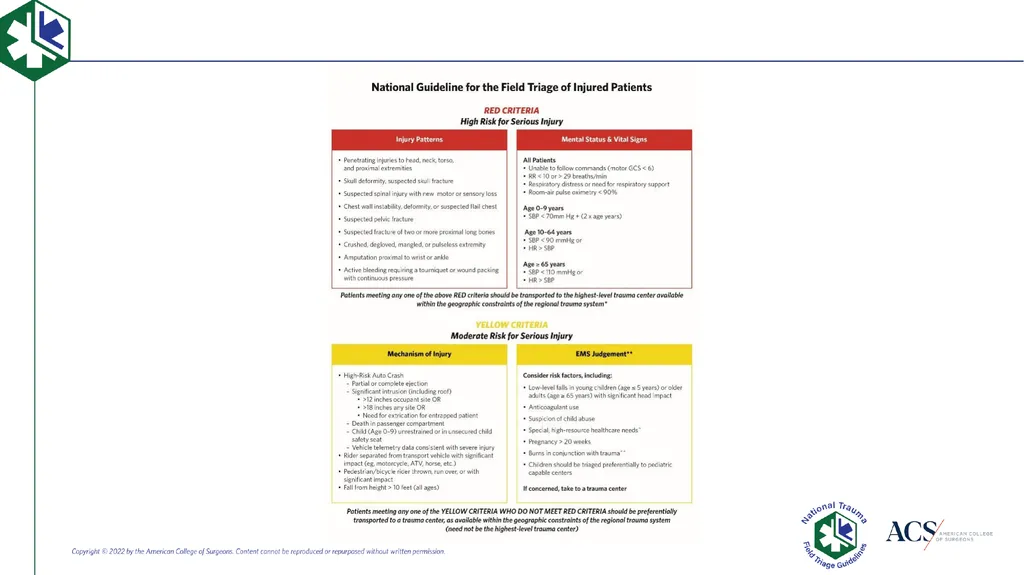
The Field Triage Guideline was developed using the best available evidence to identify patients that are most likely to benefit from the resources of a trauma center. They are not meant to supersede local trauma triage protocols and are not intended for mass casualty incident (MCI) triage.<br>
The Field Triage Guideline was developed using the best available evidence to identify patients that are most likely to benefit from the resources of a trauma center. They are not meant to supersede local trauma triage protocols and are not intended for mass casualty incident (MCI) triage.<br>
04
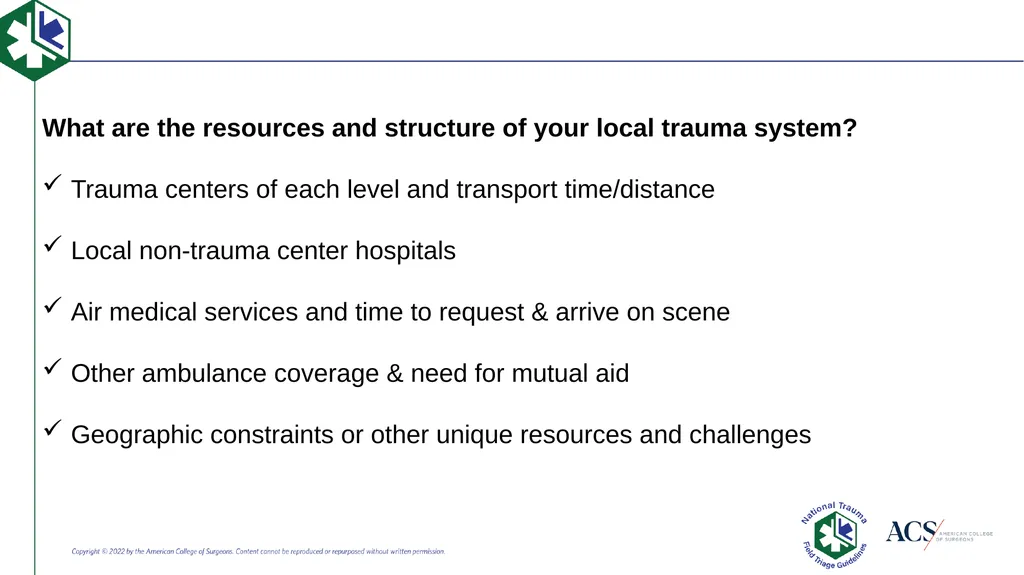
What are the resources and structure of your local trauma system?
Trauma centers of each level and transport time/distance
Local non-trauma center hospitals
Air medical services and time to request & arrive on scene
Other ambulance coverage & need for mutual aid
Geographic constraints or other unique resources and challenges<br>
Trauma centers of each level and transport time/distance
Local non-trauma center hospitals
Air medical services and time to request & arrive on scene
Other ambulance coverage & need for mutual aid
Geographic constraints or other unique resources and challenges<br>
05
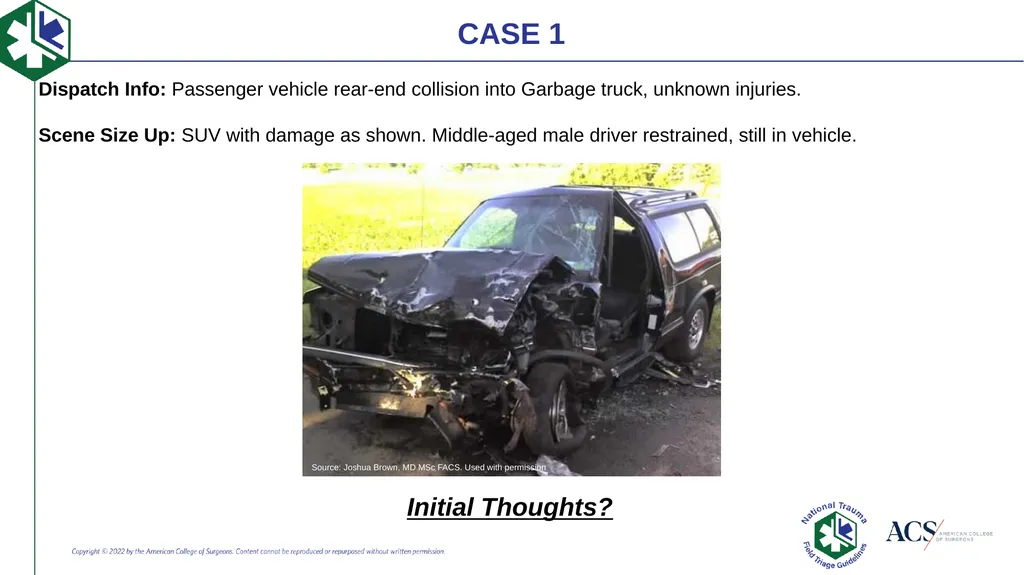
Dispatch Info: Passenger vehicle rear-end collision into Garbage truck, unknown injuries.
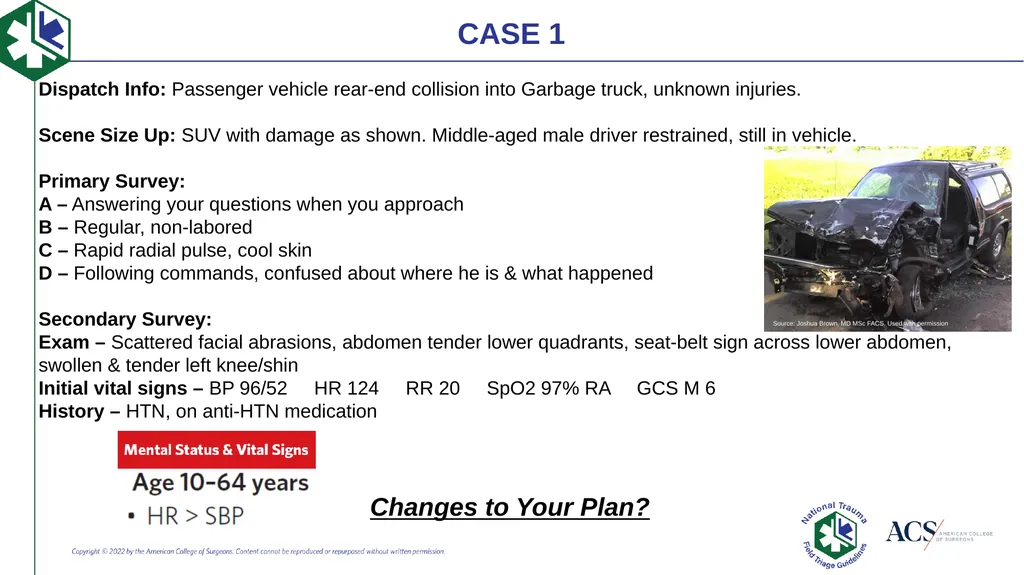
Scene Size Up: SUV with damage as shown. Middle-aged male driver restrained, still in vehicle.
Primary survey:
A – Answering your questions when you approach
B – Regular, non-labored
C – Rapid radial pulse, cool skin
D – Following commands, confused about where he is & what happened
Secondary survey:
Exam – Scattered facial abrasions, abdomen tender lower quadrants, seat-belt sign across lower abdomen, swollen & tender left knee/shin
Initial vital signs – BP 96/52 HR 124 RR 20 SpO2 97% RA GCS 14 (E4 V4 M6)
History – HTN, on anti-HTN medication
Initial Thoughts? Case 1 Source: Joshua Brown, MD MSc FACS. Used with permission<br>
Scene Size Up: SUV with damage as shown. Middle-aged male driver restrained, still in vehicle.
Primary survey:
A – Answering your questions when you approach
B – Regular, non-labored
C – Rapid radial pulse, cool skin
D – Following commands, confused about where he is & what happened
Secondary survey:
Exam – Scattered facial abrasions, abdomen tender lower quadrants, seat-belt sign across lower abdomen, swollen & tender left knee/shin
Initial vital signs – BP 96/52 HR 124 RR 20 SpO2 97% RA GCS 14 (E4 V4 M6)
History – HTN, on anti-HTN medication
Initial Thoughts? Case 1 Source: Joshua Brown, MD MSc FACS. Used with permission<br>
06
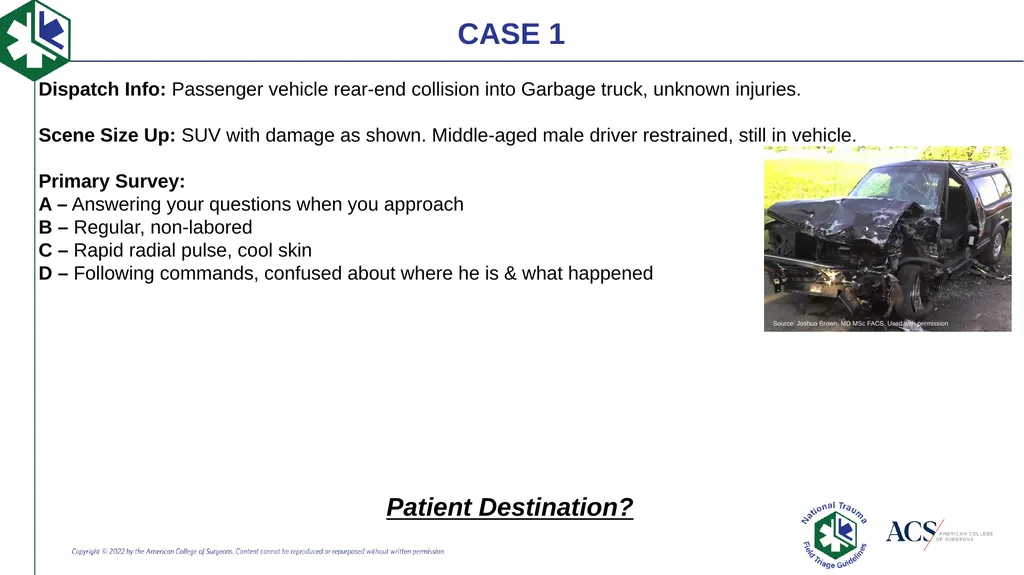
Dispatch Info: Passenger vehicle rear-end collision into Garbage truck, unknown injuries.
Scene Size Up: SUV with damage as shown. Middle-aged male driver restrained, still in vehicle.
Primary Survey:
A – Answering your questions when you approach
B – Regular, non-labored
C – Rapid radial pulse, cool skin
D – Following commands, confused about where he is & what happened
Secondary survey:
Exam – Scattered facial abrasions, abdomen tender lower quadrants, seat-belt sign across lower abdomen, swollen & tender left knee/shin
Initial vital signs – BP 96/52 HR 124 RR
20 SpO2 97% RA GCS 14 (E4 V4 M6)
History – HTN, on anti-HTN medication
Patient Destination? Case 1 Source: Joshua Brown, MD MSc FACS. Used with permission<br>
Scene Size Up: SUV with damage as shown. Middle-aged male driver restrained, still in vehicle.
Primary Survey:
A – Answering your questions when you approach
B – Regular, non-labored
C – Rapid radial pulse, cool skin
D – Following commands, confused about where he is & what happened
Secondary survey:
Exam – Scattered facial abrasions, abdomen tender lower quadrants, seat-belt sign across lower abdomen, swollen & tender left knee/shin
Initial vital signs – BP 96/52 HR 124 RR
20 SpO2 97% RA GCS 14 (E4 V4 M6)
History – HTN, on anti-HTN medication
Patient Destination? Case 1 Source: Joshua Brown, MD MSc FACS. Used with permission<br>
07
Dispatch Info: Passenger vehicle rear-end collision into Garbage truck, unknown injuries.
Scene Size Up: SUV with damage as shown. Middle-aged male driver restrained, still in vehicle.
Primary Survey:
A – Answering your questions when you approach
B – Regular, non-labored
C – Rapid radial pulse, cool skin
D – Following commands, confused about where he is & what happened
Secondary Survey:
Exam – Scattered facial abrasions, abdomen tender lower quadrants, seat-belt sign across lower abdomen, swollen & tender left knee/shin
Initial vital signs – BP 96/52 HR 124 RR 20 SpO2 97% RA GCS M 6
History – HTN, on anti-HTN medication
Changes to Your Plan? Case 1 Source: Joshua Brown, MD MSc FACS. Used with permission<br>
Scene Size Up: SUV with damage as shown. Middle-aged male driver restrained, still in vehicle.
Primary Survey:
A – Answering your questions when you approach
B – Regular, non-labored
C – Rapid radial pulse, cool skin
D – Following commands, confused about where he is & what happened
Secondary Survey:
Exam – Scattered facial abrasions, abdomen tender lower quadrants, seat-belt sign across lower abdomen, swollen & tender left knee/shin
Initial vital signs – BP 96/52 HR 124 RR 20 SpO2 97% RA GCS M 6
History – HTN, on anti-HTN medication
Changes to Your Plan? Case 1 Source: Joshua Brown, MD MSc FACS. Used with permission<br>
08
Dispatch Info: Two-car MVC, one car over embankment, possible injuries. You and a second unit are dispatched.
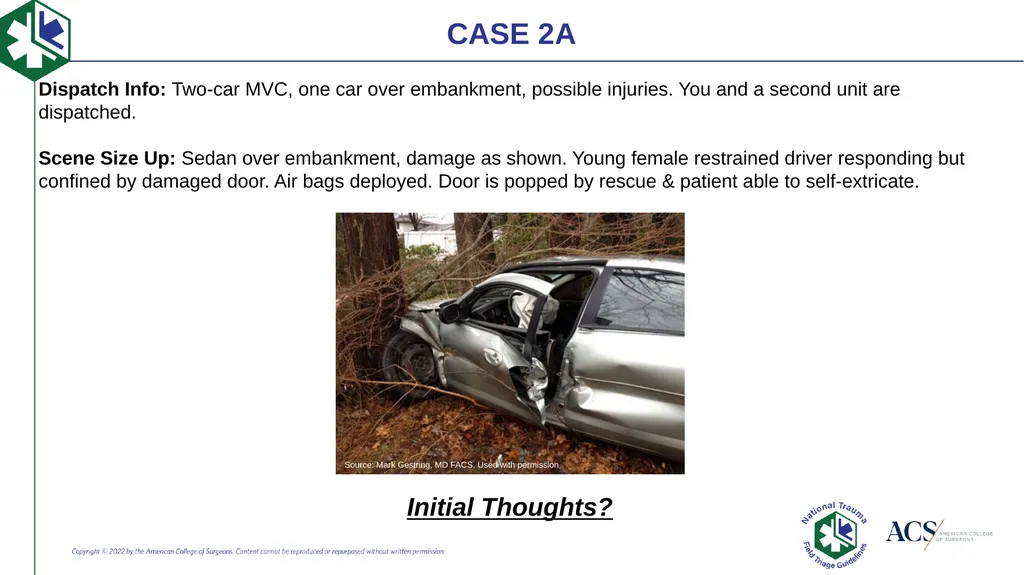
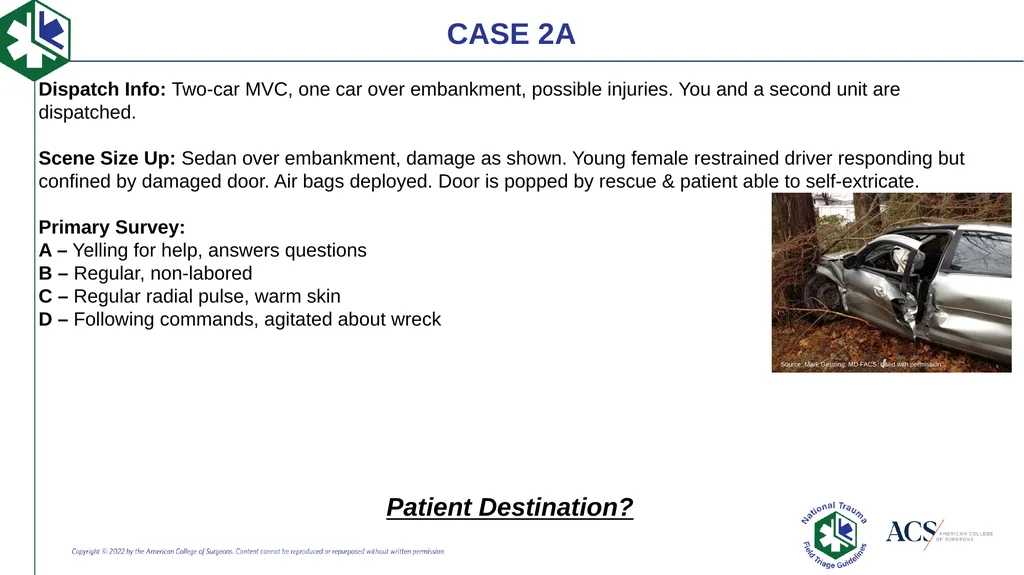
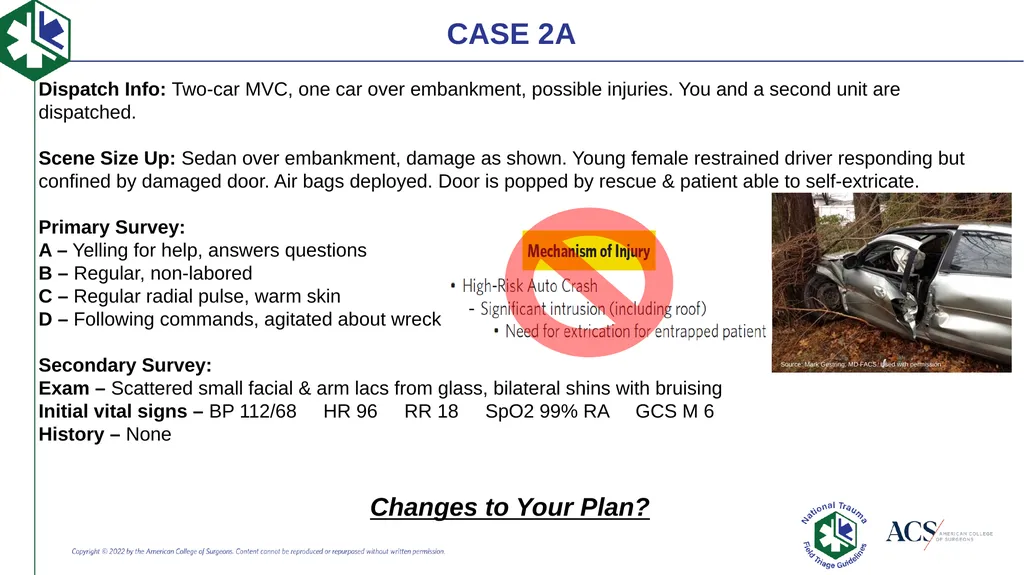
Scene Size Up: Sedan over embankment, damage as shown. Young female restrained driver responding but confined by damaged door. Air bags deployed. Door is popped by rescue & patient able to self-extricate.
Primary survey:
A – Yelling for help, answers questions
B – Regular, non-labored
C – Regular radial pulse, warm skin
D – Following commands,
agitated about wreck
Secondary
survey:
Exam – Scattered small facial & arm lacs from glass, obviously deformed right shin with bruising
Initial vital signs – BP 112/68 HR 96 RR 18 SpO2 99% RA GCS 15
Initial Thoughts? Case 2A Source: Mark Gestring, MD FACS. Used with permission<br>
Scene Size Up: Sedan over embankment, damage as shown. Young female restrained driver responding but confined by damaged door. Air bags deployed. Door is popped by rescue & patient able to self-extricate.
Primary survey:
A – Yelling for help, answers questions
B – Regular, non-labored
C – Regular radial pulse, warm skin
D – Following commands,
agitated about wreck
Secondary
survey:
Exam – Scattered small facial & arm lacs from glass, obviously deformed right shin with bruising
Initial vital signs – BP 112/68 HR 96 RR 18 SpO2 99% RA GCS 15
Initial Thoughts? Case 2A Source: Mark Gestring, MD FACS. Used with permission<br>
09
Dispatch Info: Two-car MVC, one car over embankment, possible injuries. You and a second unit are dispatched.
Scene Size Up: Sedan over embankment, damage as shown. Young female restrained driver responding but confined by damaged door. Air bags deployed. Door is popped by rescue & patient able to self-extricate.
Primary Survey:
A – Yelling for help, answers questions
B – Regular, non-labored
C – Regular radial pulse, warm skin
D – Following commands, agitated about wreck
Secondary survey:
Exam – Scattered small facial & arm lacs from glass, obviously deformed right shin with bruising
Initial vital signs – BP 112/68 HR 96 RR 18 SpO2 99% RA GCS 15
History – None
Patient Destination? Case 2A Source: Mark Gestring, MD FACS. Used with permission<br>
Scene Size Up: Sedan over embankment, damage as shown. Young female restrained driver responding but confined by damaged door. Air bags deployed. Door is popped by rescue & patient able to self-extricate.
Primary Survey:
A – Yelling for help, answers questions
B – Regular, non-labored
C – Regular radial pulse, warm skin
D – Following commands, agitated about wreck
Secondary survey:
Exam – Scattered small facial & arm lacs from glass, obviously deformed right shin with bruising
Initial vital signs – BP 112/68 HR 96 RR 18 SpO2 99% RA GCS 15
History – None
Patient Destination? Case 2A Source: Mark Gestring, MD FACS. Used with permission<br>
10
Dispatch Info: Two-car MVC, one car over embankment, possible injuries. You and a second unit are dispatched.
Scene Size Up: Sedan over embankment, damage as shown. Young female restrained driver responding but confined by damaged door. Air bags deployed. Door is popped by rescue & patient able to self-extricate.
Primary Survey:
A – Yelling for help, answers questions
B – Regular, non-labored
C – Regular radial pulse, warm skin
D – Following commands, agitated about wreck
Secondary Survey:
Exam – Scattered small facial & arm lacs from glass, bilateral shins with bruising
Initial vital signs – BP 112/68 HR 96 RR 18 SpO2 99% RA GCS M 6
History – None
Changes to Your Plan? Case 2A Source: Mark Gestring, MD FACS. Used with permission<br>
Scene Size Up: Sedan over embankment, damage as shown. Young female restrained driver responding but confined by damaged door. Air bags deployed. Door is popped by rescue & patient able to self-extricate.
Primary Survey:
A – Yelling for help, answers questions
B – Regular, non-labored
C – Regular radial pulse, warm skin
D – Following commands, agitated about wreck
Secondary Survey:
Exam – Scattered small facial & arm lacs from glass, bilateral shins with bruising
Initial vital signs – BP 112/68 HR 96 RR 18 SpO2 99% RA GCS M 6
History – None
Changes to Your Plan? Case 2A Source: Mark Gestring, MD FACS. Used with permission<br>
11
Dispatch Info: Two-car MVC, one car over embankment, possible injuries. You and a second unit are dispatched.
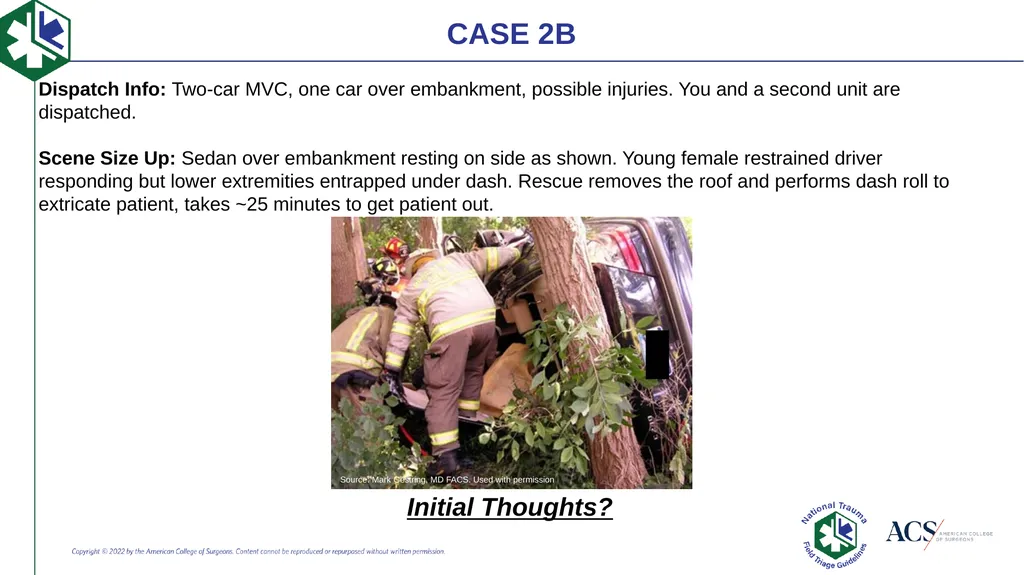
Scene Size Up: Sedan over embankment resting on side as shown. Young female restrained driver responding but lower extremities entrapped under dash. Rescue removes the roof and performs dash roll to extricate patient, takes ~25 minutes to get patient out.
Primary survey:
A – Yelling for help, answers questions
B – Regular, non-labored
C – Regular radial pulse, warm skin
D – Following commands, agitated about wreck
Exam – Scattered small facial & arm lacs from glass, obviously deformed right shin with bruising
Initial vital signs – BP 112/68 HR 96 RR 18 SpO2 99% RA GCS 15
History – None
Initial Thoughts? Case 2B Source: Mark Gestring, MD FACS. Used with permission<br>
Scene Size Up: Sedan over embankment resting on side as shown. Young female restrained driver responding but lower extremities entrapped under dash. Rescue removes the roof and performs dash roll to extricate patient, takes ~25 minutes to get patient out.
Primary survey:
A – Yelling for help, answers questions
B – Regular, non-labored
C – Regular radial pulse, warm skin
D – Following commands, agitated about wreck
Exam – Scattered small facial & arm lacs from glass, obviously deformed right shin with bruising
Initial vital signs – BP 112/68 HR 96 RR 18 SpO2 99% RA GCS 15
History – None
Initial Thoughts? Case 2B Source: Mark Gestring, MD FACS. Used with permission<br>
12
Dispatch Info: Two-car MVC, one car over embankment, possible injuries. You and a second unit are dispatched.
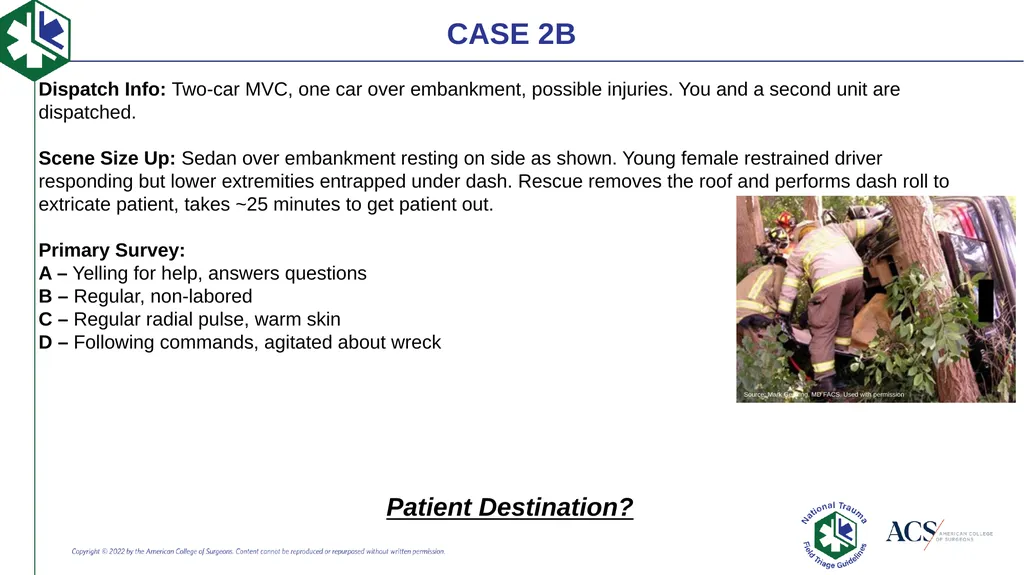
Scene Size Up: Sedan over embankment resting on side as shown. Young female restrained driver responding but lower extremities entrapped under dash. Rescue removes the roof and performs dash roll to extricate patient, takes ~25 minutes to get patient out.
Primary Survey:
A – Yelling for help, answers questions
B – Regular, non-labored
C – Regular radial pulse, warm skin
D – Following commands, agitated about wreck
Secondary surve
y: facial & arm lacs from glass, obviously deformed right shin with bruising
Initial vital signs – BP 112/68 HR 96 RR 18 SpO2 99% RA GCS 15
History – None
Patient Destination? Case 2B Source: Mark Gestring, MD FACS. Used with permission<br>
Scene Size Up: Sedan over embankment resting on side as shown. Young female restrained driver responding but lower extremities entrapped under dash. Rescue removes the roof and performs dash roll to extricate patient, takes ~25 minutes to get patient out.
Primary Survey:
A – Yelling for help, answers questions
B – Regular, non-labored
C – Regular radial pulse, warm skin
D – Following commands, agitated about wreck
Secondary surve
y: facial & arm lacs from glass, obviously deformed right shin with bruising
Initial vital signs – BP 112/68 HR 96 RR 18 SpO2 99% RA GCS 15
History – None
Patient Destination? Case 2B Source: Mark Gestring, MD FACS. Used with permission<br>
13
Dispatch Info: Two-car MVC, one car over embankment, possible injuries. You and a second unit are dispatched.
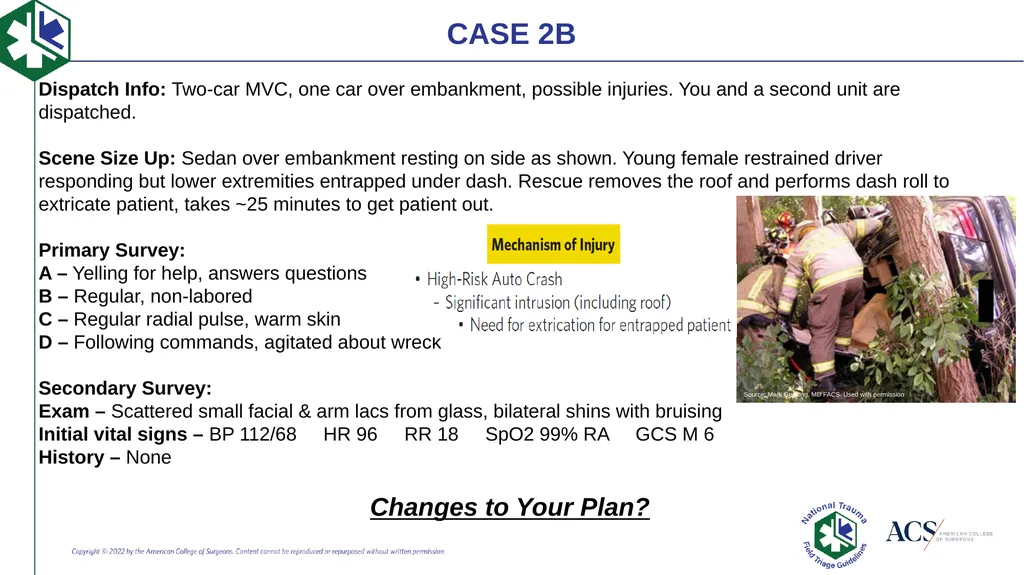
Scene Size Up: Sedan over embankment resting on side as shown. Young female restrained driver responding but lower extremities entrapped under dash. Rescue removes the roof and performs dash roll to extricate patient, takes ~25 minutes to get patient out.
Primary Survey:
A – Yelling for help, answers questions
B – Regular, non-labored
C – Regular radial pulse, warm skin
D – Following commands, agitated about wreck
Secondary Survey:
Exam – Scattered small facial & arm lacs from glass, bilateral shins with bruising
Initial vital signs – BP 112/68 HR 96 RR 18 SpO2 99% RA GCS M 6
History – None
Changes to Your Plan? Case 2B Source: Mark Gestring, MD FACS. Used with permission<br>
Scene Size Up: Sedan over embankment resting on side as shown. Young female restrained driver responding but lower extremities entrapped under dash. Rescue removes the roof and performs dash roll to extricate patient, takes ~25 minutes to get patient out.
Primary Survey:
A – Yelling for help, answers questions
B – Regular, non-labored
C – Regular radial pulse, warm skin
D – Following commands, agitated about wreck
Secondary Survey:
Exam – Scattered small facial & arm lacs from glass, bilateral shins with bruising
Initial vital signs – BP 112/68 HR 96 RR 18 SpO2 99% RA GCS M 6
History – None
Changes to Your Plan? Case 2B Source: Mark Gestring, MD FACS. Used with permission<br>
14
Dispatch Info: Young female fell while standing on a chair, significant bleeding reported from leg wound.
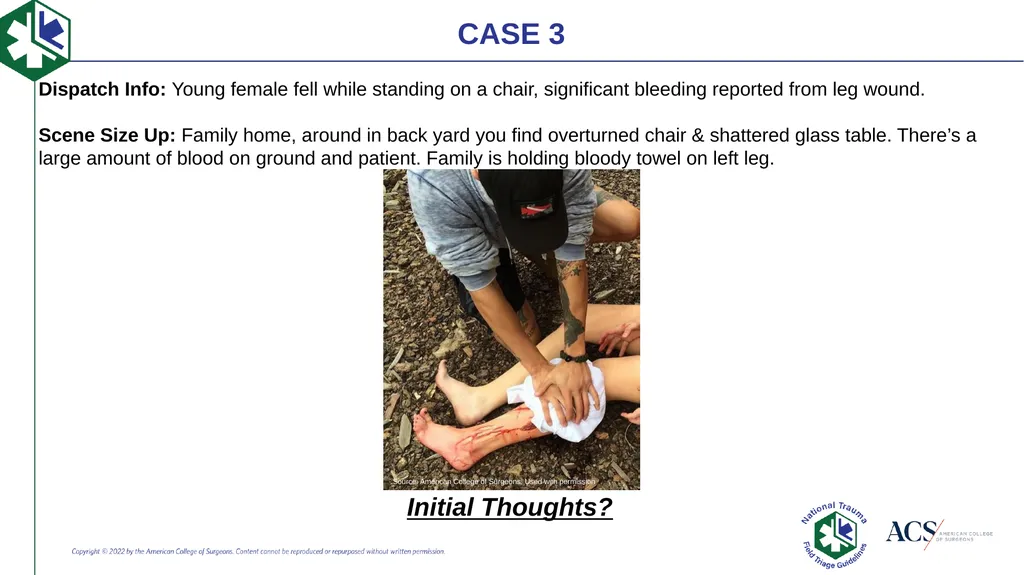
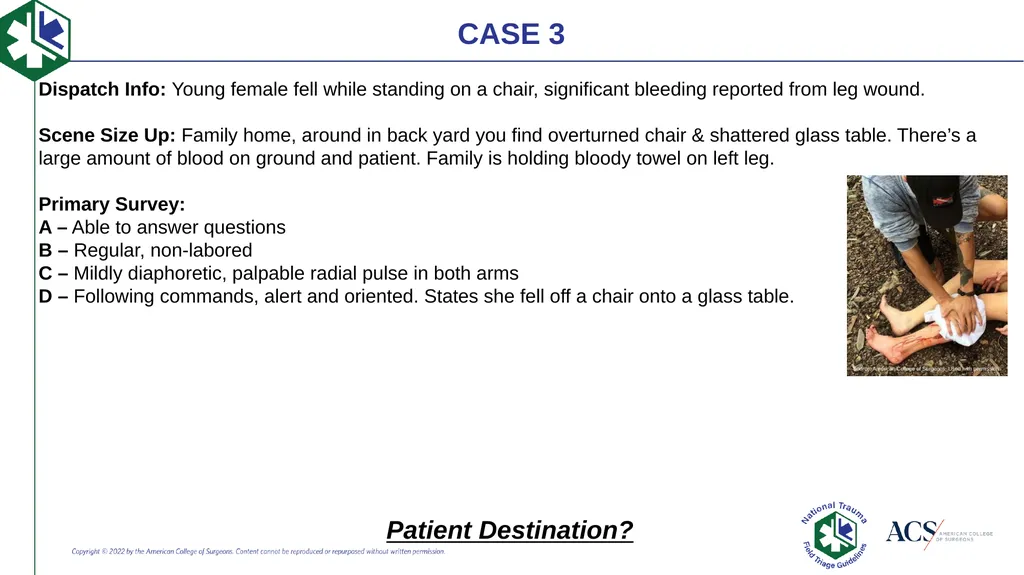
Scene Size Up: Family home, around in back yard you find overturned chair & shattered glass table. There’s a large amount of blood on ground and patient. Family is holding bloody towel on left leg.
Primary survey:
A – Able to answer questions
B – Regular, non-labored
C – Mildly diaphoretic, palpable radial pulse in both arms
D – Following commands, alert and oriented
Secondary survey:
Exam – Multiple
deep lacerations to the right upper arm and forearm, down to muscle. One laceration has spurting blood when removing the towel
bystanders are using, HTN, HLD. No anticoagulant meds, baby aspirin
Initial Thoughts? Case 3 Source: American College of Surgeons. Used with permission<br>
Scene Size Up: Family home, around in back yard you find overturned chair & shattered glass table. There’s a large amount of blood on ground and patient. Family is holding bloody towel on left leg.
Primary survey:
A – Able to answer questions
B – Regular, non-labored
C – Mildly diaphoretic, palpable radial pulse in both arms
D – Following commands, alert and oriented
Secondary survey:
Exam – Multiple
deep lacerations to the right upper arm and forearm, down to muscle. One laceration has spurting blood when removing the towel
bystanders are using, HTN, HLD. No anticoagulant meds, baby aspirin
Initial Thoughts? Case 3 Source: American College of Surgeons. Used with permission<br>
15
Dispatch Info: Young female fell while standing on a chair, significant bleeding reported from leg wound.
Scene Size Up: Family home, around in back yard you find overturned chair & shattered glass table. There’s a large amount of blood on ground and patient. Family is holding bloody towel on left leg.
Primary Survey:
A – Able to answer questions
B – Regular, non-labored
C – Mildly diaphoretic, palpable radial pulse in both arms
D – Following commands, alert and oriented. States she fell off a chair onto a glass table.
Secondary surve
y:
Exam – Multiple deep lacerations to the right upper arm and forearm, down to mt slows the bleeding.
Initial vital sign
s – BP 110/72 – CAD, DM, HTN, HLD. No anticoagulant meds, baby aspirin
Patient Destination? Case 3 Source: American College of Surgeons. Used with permission<br>
Scene Size Up: Family home, around in back yard you find overturned chair & shattered glass table. There’s a large amount of blood on ground and patient. Family is holding bloody towel on left leg.
Primary Survey:
A – Able to answer questions
B – Regular, non-labored
C – Mildly diaphoretic, palpable radial pulse in both arms
D – Following commands, alert and oriented. States she fell off a chair onto a glass table.
Secondary surve
y:
Exam – Multiple deep lacerations to the right upper arm and forearm, down to mt slows the bleeding.
Initial vital sign
s – BP 110/72 – CAD, DM, HTN, HLD. No anticoagulant meds, baby aspirin
Patient Destination? Case 3 Source: American College of Surgeons. Used with permission<br>
16
Dispatch Info: Young female fell while standing on a chair, significant bleeding reported from leg wound.
Scene Size Up: Family home, around in back yard you find overturned chair & shattered glass table. There’s a large amount of blood on ground and patient. Family is holding bloody towel on left leg.
Primary Survey:
A – Able to answer questions
B – Regular, non-labored
C – Mildly diaphoretic, palpable radial pulse in both arms
D – Following commands, alert and oriented. States she fell off a chair onto a glass table.
Secondary Survey:
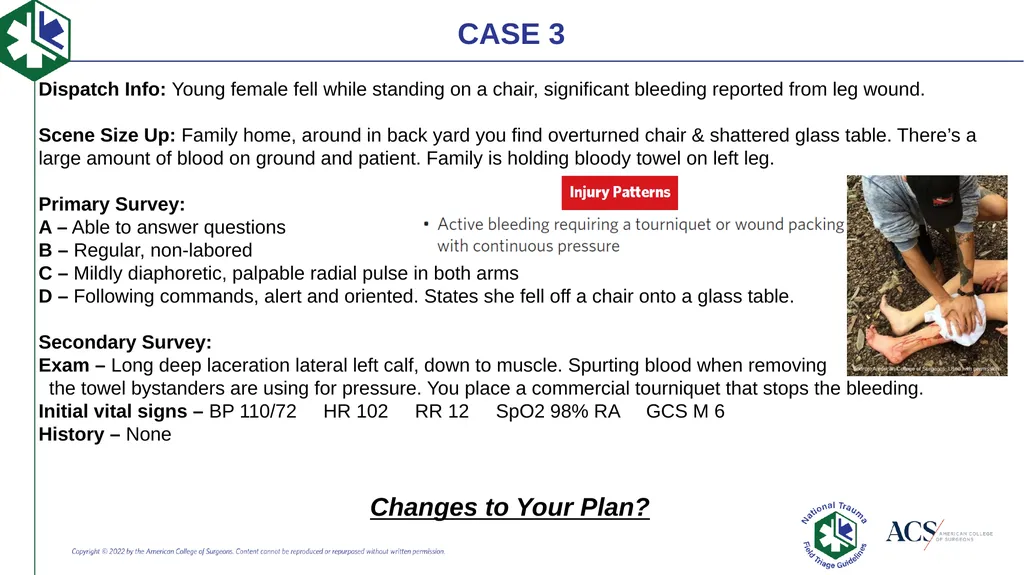
Exam – Long deep laceration lateral left calf, down to muscle. Spurting blood when removing the towel bystanders are using for pressure. You place a commercial tourniquet that stops the bleeding.
Initial vital signs – BP 110/72 HR 102 RR 12 SpO2 98% RA GCS M 6
History – None
Changes to Your Plan? Case 3 Source: American College of Surgeons. Used with permission<br>
Scene Size Up: Family home, around in back yard you find overturned chair & shattered glass table. There’s a large amount of blood on ground and patient. Family is holding bloody towel on left leg.
Primary Survey:
A – Able to answer questions
B – Regular, non-labored
C – Mildly diaphoretic, palpable radial pulse in both arms
D – Following commands, alert and oriented. States she fell off a chair onto a glass table.
Secondary Survey:
Exam – Long deep laceration lateral left calf, down to muscle. Spurting blood when removing the towel bystanders are using for pressure. You place a commercial tourniquet that stops the bleeding.
Initial vital signs – BP 110/72 HR 102 RR 12 SpO2 98% RA GCS M 6
History – None
Changes to Your Plan? Case 3 Source: American College of Surgeons. Used with permission<br>
17
Dispatch Info: Elderly male ground level fall.
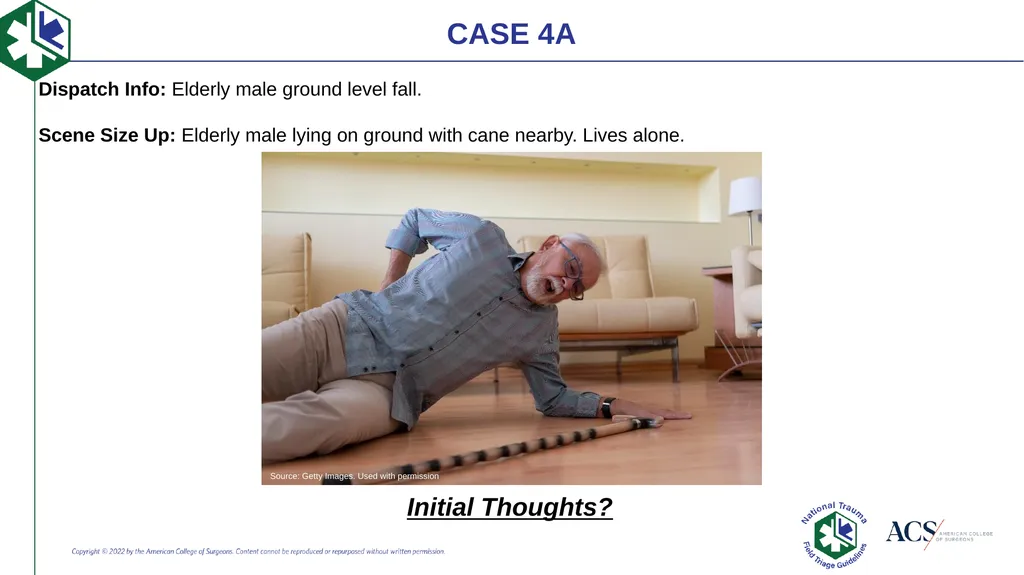
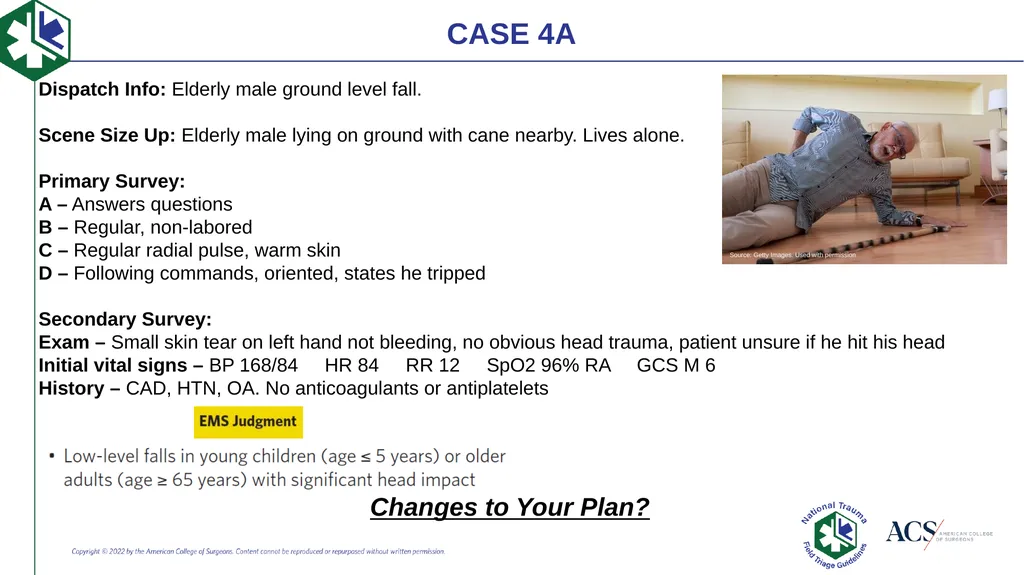
Scene Size Up: Elderly male lying on ground with cane nearby. Lives alone.
Primary survey:
A – Answers questions
B – Regular, non-labored
C – Regular radial pulse, warm skin
D – Following commands, oriented, states he tripped when was not using his walker
Secondary survey:
Exam – Small skin tear on left hand not bleeding, no obvious head trauma, patient unsure if he hit his head
Initial vital signs – BP 168/84 HR 84 RR 12 SpO2 96% RA GCS 15
History – CAD, HTN, OA. No anticoagulants o
antiplatelets
Initial Thoughts? Case 4A Source: Getty Images. Used with permission<br>
Scene Size Up: Elderly male lying on ground with cane nearby. Lives alone.
Primary survey:
A – Answers questions
B – Regular, non-labored
C – Regular radial pulse, warm skin
D – Following commands, oriented, states he tripped when was not using his walker
Secondary survey:
Exam – Small skin tear on left hand not bleeding, no obvious head trauma, patient unsure if he hit his head
Initial vital signs – BP 168/84 HR 84 RR 12 SpO2 96% RA GCS 15
History – CAD, HTN, OA. No anticoagulants o
antiplatelets
Initial Thoughts? Case 4A Source: Getty Images. Used with permission<br>
18
Dispatch Info: Elderly male ground level fall.
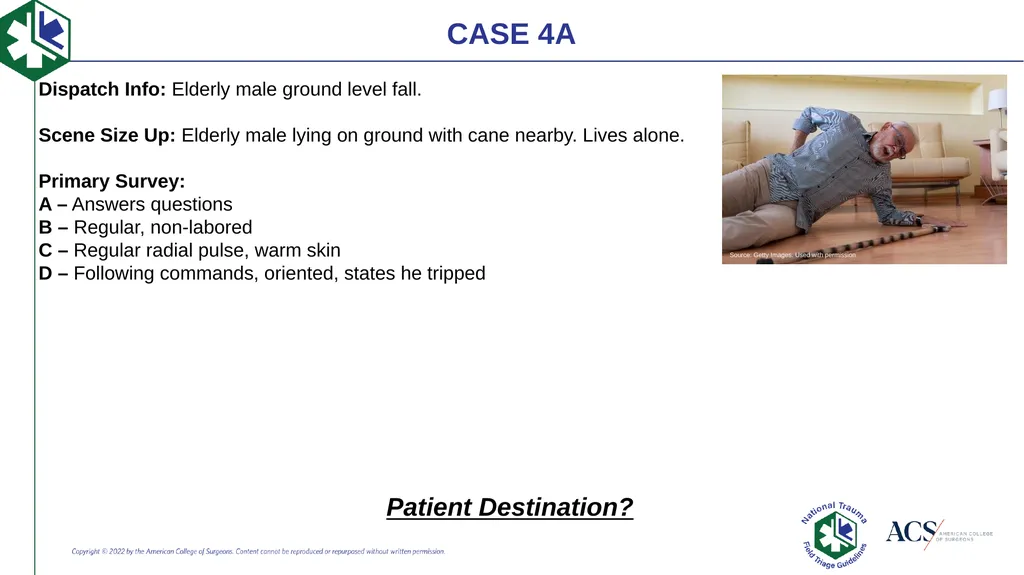
Scene Size Up: Elderly male lying on ground with cane nearby. Lives alone.
Primary Survey:
A – Answers questions
B – Regular, non-labored
C – Regular radial pulse, warm skin
D – Following commands, oriented, states he tripped
Secondary survey:
Exam – Small skin tear on left hand not bleeding, no obvious head trauma, patient unsure if he hit his head
Initial vital signs – BP 168/84 HR 84 RR 12 SpO2 96% RA GCS 15
History – CAD, HTN, OA. No anticoagulants or antiplatelets
Patient Destination? Case 4A Source: Getty Images. Used with permission<br>
Scene Size Up: Elderly male lying on ground with cane nearby. Lives alone.
Primary Survey:
A – Answers questions
B – Regular, non-labored
C – Regular radial pulse, warm skin
D – Following commands, oriented, states he tripped
Secondary survey:
Exam – Small skin tear on left hand not bleeding, no obvious head trauma, patient unsure if he hit his head
Initial vital signs – BP 168/84 HR 84 RR 12 SpO2 96% RA GCS 15
History – CAD, HTN, OA. No anticoagulants or antiplatelets
Patient Destination? Case 4A Source: Getty Images. Used with permission<br>
19
Dispatch Info: Elderly male ground level fall.
Scene Size Up: Elderly male lying on ground with cane nearby. Lives alone.
Primary Survey:
A – Answers questions
B – Regular, non-labored
C – Regular radial pulse, warm skin
D – Following commands, oriented, states he tripped
Secondary Survey:
Exam – Small skin tear on left hand not bleeding, no obvious head trauma, patient unsure if he hit his head
Initial vital signs – BP 168/84 HR 84 RR 12 SpO2 96% RA GCS M 6
History – CAD, HTN, OA. No anticoagulants or antiplatelets
Changes to Your Plan? Case 4A Source: Getty Images. Used with permission<br>
Scene Size Up: Elderly male lying on ground with cane nearby. Lives alone.
Primary Survey:
A – Answers questions
B – Regular, non-labored
C – Regular radial pulse, warm skin
D – Following commands, oriented, states he tripped
Secondary Survey:
Exam – Small skin tear on left hand not bleeding, no obvious head trauma, patient unsure if he hit his head
Initial vital signs – BP 168/84 HR 84 RR 12 SpO2 96% RA GCS M 6
History – CAD, HTN, OA. No anticoagulants or antiplatelets
Changes to Your Plan? Case 4A Source: Getty Images. Used with permission<br>
20
Dispatch Info: Elderly male ground level fall.
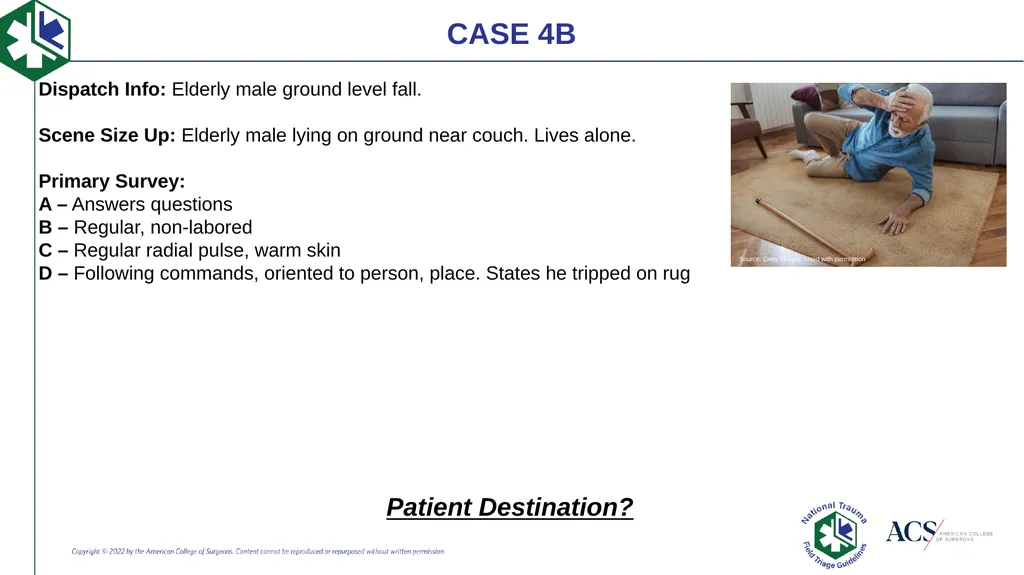
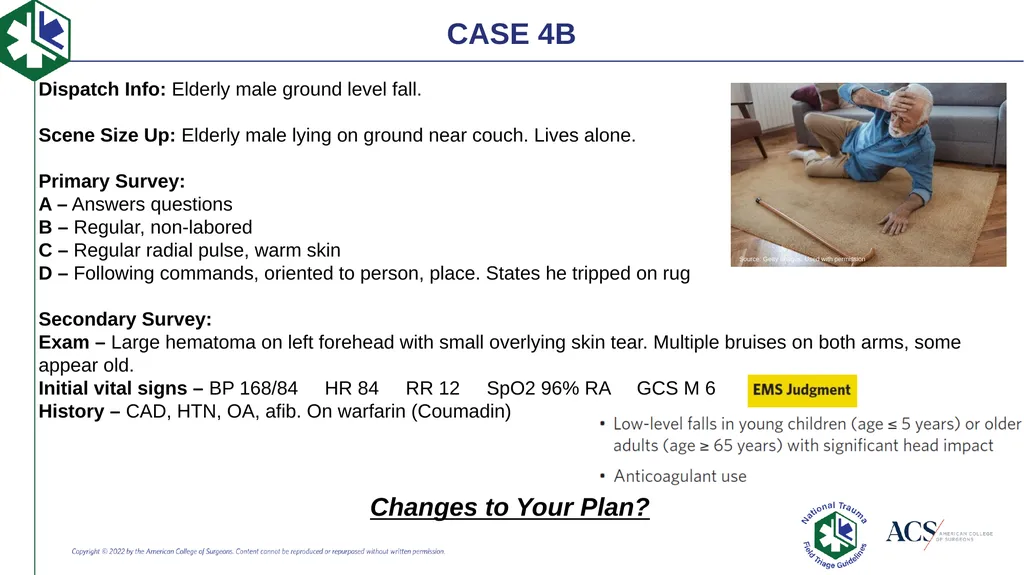
Scene Size Up: Elderly male lying on ground near couch. Lives alone.
Primary survey:
A – Answers questions
B – Regular, non-labored
C – Regular radial pulse, warm skin
D – Following commands, oriented to person, place. States he tripped on rug
Secondary survey:
Exam – Large hematoma on left forehead with small overlying skin tear. Multiple bruises on both arms, some appear old.
Initial vital signs – BP 168/84 HR 84 RR 12 SpO2 96% RA GCS 15
History – CAD, HTN, OA, afib. On warfarin (Coumadin)
Initial Thoughts? Case 4B Source: Getty Images. Used with permission<br>
Scene Size Up: Elderly male lying on ground near couch. Lives alone.
Primary survey:
A – Answers questions
B – Regular, non-labored
C – Regular radial pulse, warm skin
D – Following commands, oriented to person, place. States he tripped on rug
Secondary survey:
Exam – Large hematoma on left forehead with small overlying skin tear. Multiple bruises on both arms, some appear old.
Initial vital signs – BP 168/84 HR 84 RR 12 SpO2 96% RA GCS 15
History – CAD, HTN, OA, afib. On warfarin (Coumadin)
Initial Thoughts? Case 4B Source: Getty Images. Used with permission<br>
21
Dispatch Info: Elderly male ground level fall.
Scene Size Up: Elderly male lying on ground near couch. Lives alone.
Primary Survey:
A – Answers questions
B – Regular, non-labored
C – Regular radial pulse, warm skin
D – Following commands, oriented to person, place. States he tripped on rug
Secondary survey:
Exam – Large hematoma on left forehead with small overlying skin tear. Multiple bruises on both arms, some appear old.
Initial vital signs – BP 168/84 HR 84 RR 12 SpO2 96% RA GCS 15
History – CAD, HTN, OA, afib. On warfarin (Coumadin)
Patient Destination? Case 4B Source: Getty Images. Used with permission<br>
Scene Size Up: Elderly male lying on ground near couch. Lives alone.
Primary Survey:
A – Answers questions
B – Regular, non-labored
C – Regular radial pulse, warm skin
D – Following commands, oriented to person, place. States he tripped on rug
Secondary survey:
Exam – Large hematoma on left forehead with small overlying skin tear. Multiple bruises on both arms, some appear old.
Initial vital signs – BP 168/84 HR 84 RR 12 SpO2 96% RA GCS 15
History – CAD, HTN, OA, afib. On warfarin (Coumadin)
Patient Destination? Case 4B Source: Getty Images. Used with permission<br>
22
Dispatch Info: Elderly male ground level fall.
Scene Size Up: Elderly male lying on ground near couch. Lives alone.
Primary Survey:
A – Answers questions
B – Regular, non-labored
C – Regular radial pulse, warm skin
D – Following commands, oriented to person, place. States he tripped on rug
Secondary Survey:
Exam – Large hematoma on left forehead with small overlying skin tear. Multiple bruises on both arms, some appear old.
Initial vital signs – BP 168/84 HR 84 RR 12 SpO2 96% RA GCS M 6
History – CAD, HTN, OA, afib. On warfarin (Coumadin)
Changes to Your Plan? Case 4B Source: Getty Images. Used with permission<br>
Scene Size Up: Elderly male lying on ground near couch. Lives alone.
Primary Survey:
A – Answers questions
B – Regular, non-labored
C – Regular radial pulse, warm skin
D – Following commands, oriented to person, place. States he tripped on rug
Secondary Survey:
Exam – Large hematoma on left forehead with small overlying skin tear. Multiple bruises on both arms, some appear old.
Initial vital signs – BP 168/84 HR 84 RR 12 SpO2 96% RA GCS M 6
History – CAD, HTN, OA, afib. On warfarin (Coumadin)
Changes to Your Plan? Case 4B Source: Getty Images. Used with permission<br>
23
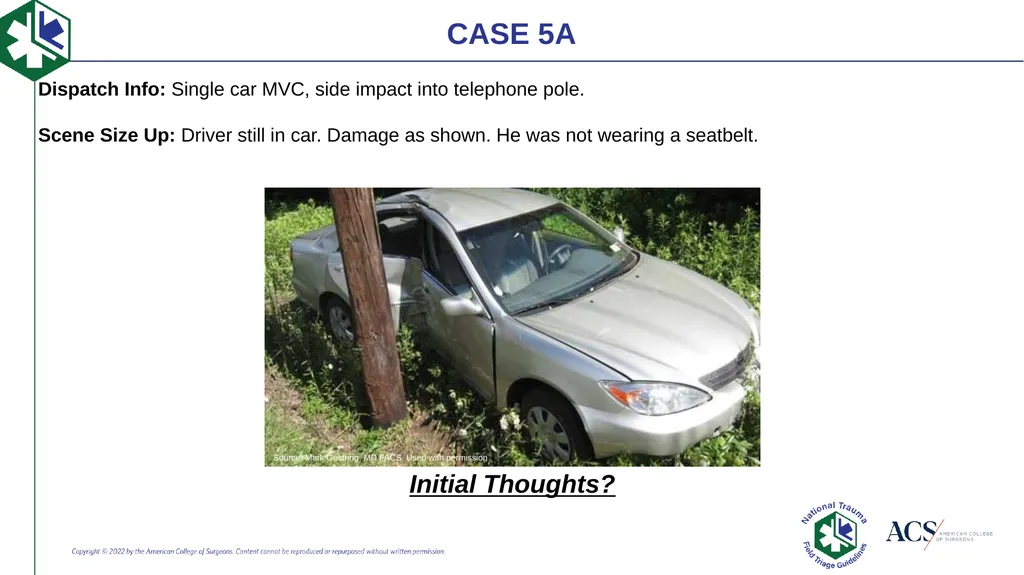
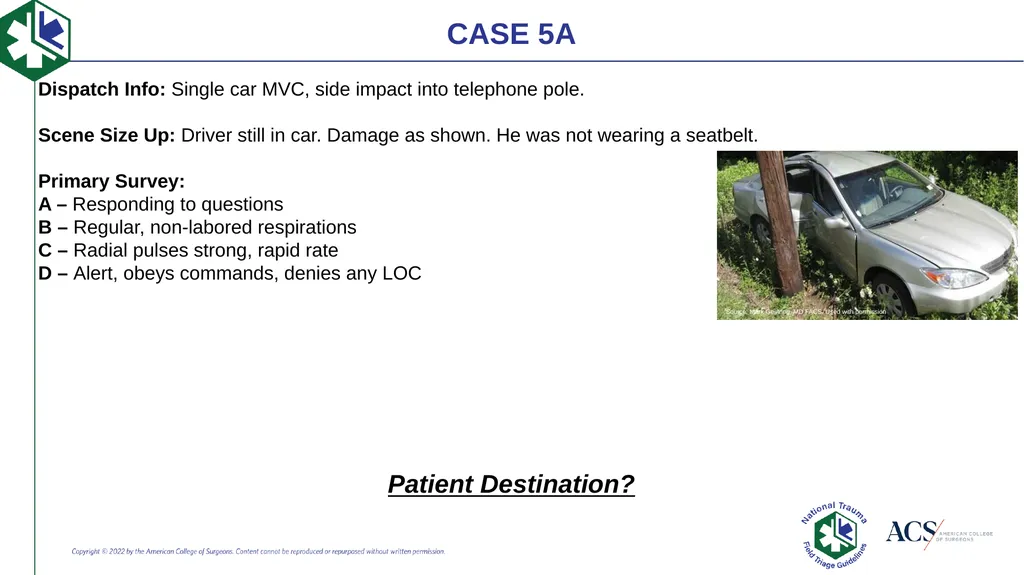
Dispatch Info: Single car MVC, side impact into telephone pole.
Scene Size Up: Driver still in car. Damage as shown. He was not wearing a seatbelt.
Initial Thoughts? Case 5A Source: Mark Gestring, MD FACS. Used with permission<br>
Scene Size Up: Driver still in car. Damage as shown. He was not wearing a seatbelt.
Initial Thoughts? Case 5A Source: Mark Gestring, MD FACS. Used with permission<br>
24
Dispatch Info: Single car MVC, side impact into telephone pole.
Scene Size Up: Driver still in car. Damage as shown. He was not wearing a seatbelt.
Primary Survey:
A – Responding to questions
B – Regular, non-labored respirations
C – Radial pulses strong, rapid rate
D – Alert, obeys commands, denies any LOC
Patient Destination? Case 5A Source: Mark Gestring, MD FACS. Used with permission<br>
Scene Size Up: Driver still in car. Damage as shown. He was not wearing a seatbelt.
Primary Survey:
A – Responding to questions
B – Regular, non-labored respirations
C – Radial pulses strong, rapid rate
D – Alert, obeys commands, denies any LOC
Patient Destination? Case 5A Source: Mark Gestring, MD FACS. Used with permission<br>
25
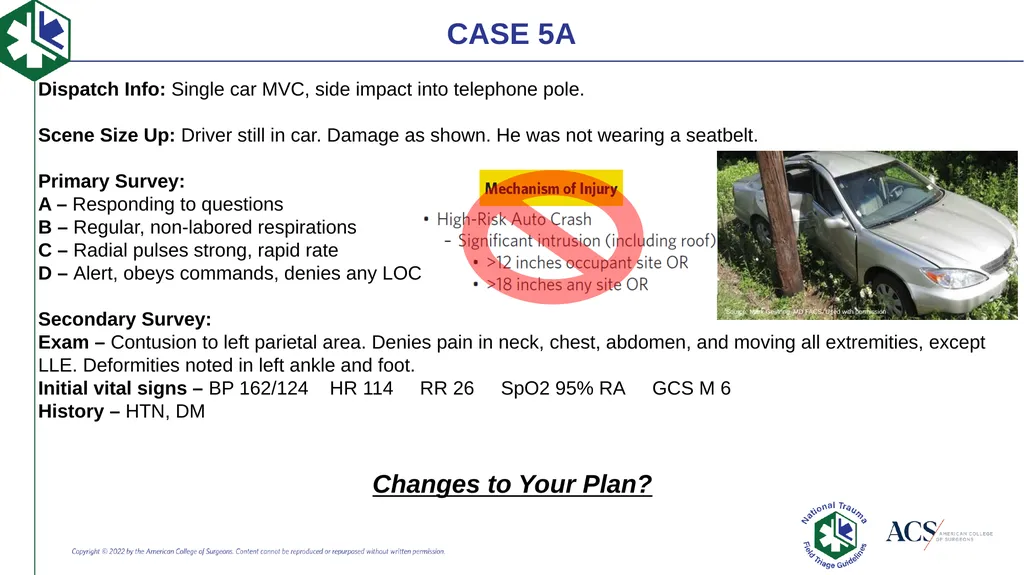
Dispatch Info: Single car MVC, side impact into telephone pole.
Scene Size Up: Driver still in car. Damage as shown. He was not wearing a seatbelt.
Primary Survey:
A – Responding to questions
B – Regular, non-labored respirations
C – Radial pulses strong, rapid rate
D – Alert, obeys commands, denies any LOC
Secondary Survey:
Exam – Contusion to left parietal area. Denies pain in neck, chest, abdomen, and moving all extremities, except LLE. Deformities noted in left ankle and foot.
Initial vital signs – BP 162/124 HR 114 RR 26 SpO2 95% RA GCS M 6
History – HTN, DM
Changes to Your Plan? Case 5A Source: Mark Gestring, MD FACS. Used with permission<br>
Scene Size Up: Driver still in car. Damage as shown. He was not wearing a seatbelt.
Primary Survey:
A – Responding to questions
B – Regular, non-labored respirations
C – Radial pulses strong, rapid rate
D – Alert, obeys commands, denies any LOC
Secondary Survey:
Exam – Contusion to left parietal area. Denies pain in neck, chest, abdomen, and moving all extremities, except LLE. Deformities noted in left ankle and foot.
Initial vital signs – BP 162/124 HR 114 RR 26 SpO2 95% RA GCS M 6
History – HTN, DM
Changes to Your Plan? Case 5A Source: Mark Gestring, MD FACS. Used with permission<br>
26
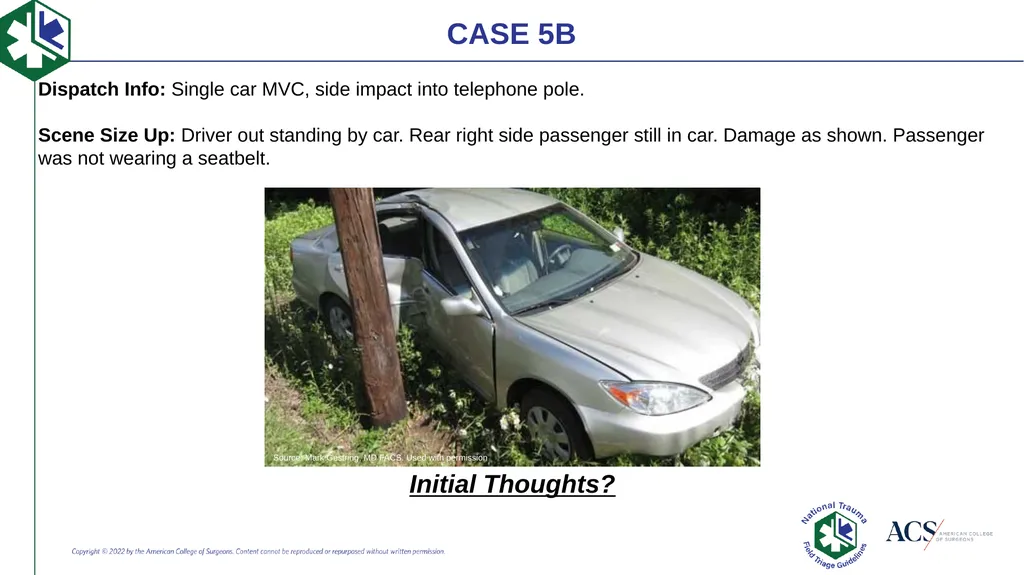
Dispatch Info: Single car MVC, side impact into telephone pole.
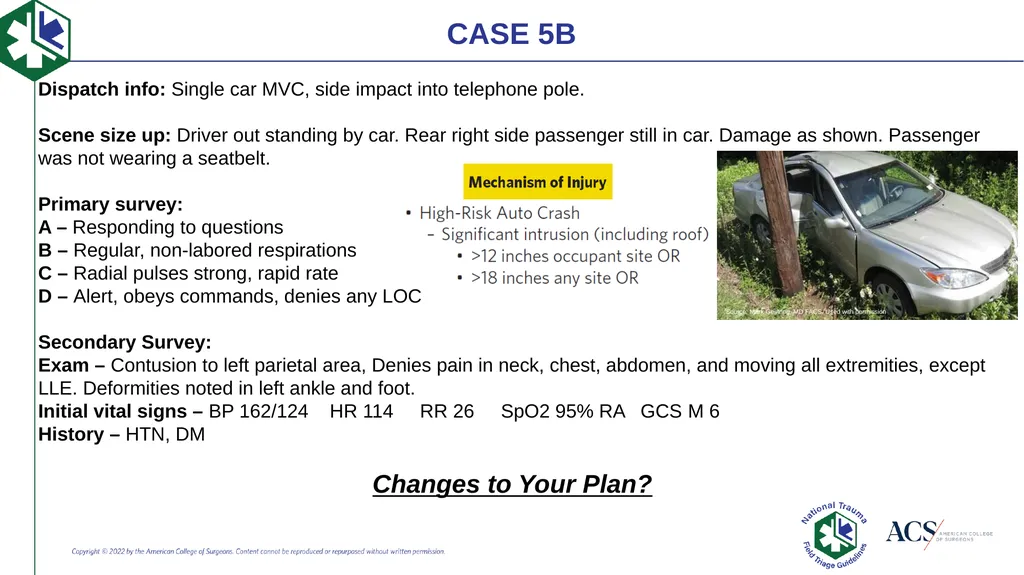
Scene Size Up: Driver out standing by car. Rear right side passenger still in car. Damage as shown. Passenger was not wearing a seatbelt.
Initial Thoughts? Case 5B Source: Mark Gestring, MD FACS. Used with permission<br>
Scene Size Up: Driver out standing by car. Rear right side passenger still in car. Damage as shown. Passenger was not wearing a seatbelt.
Initial Thoughts? Case 5B Source: Mark Gestring, MD FACS. Used with permission<br>
27
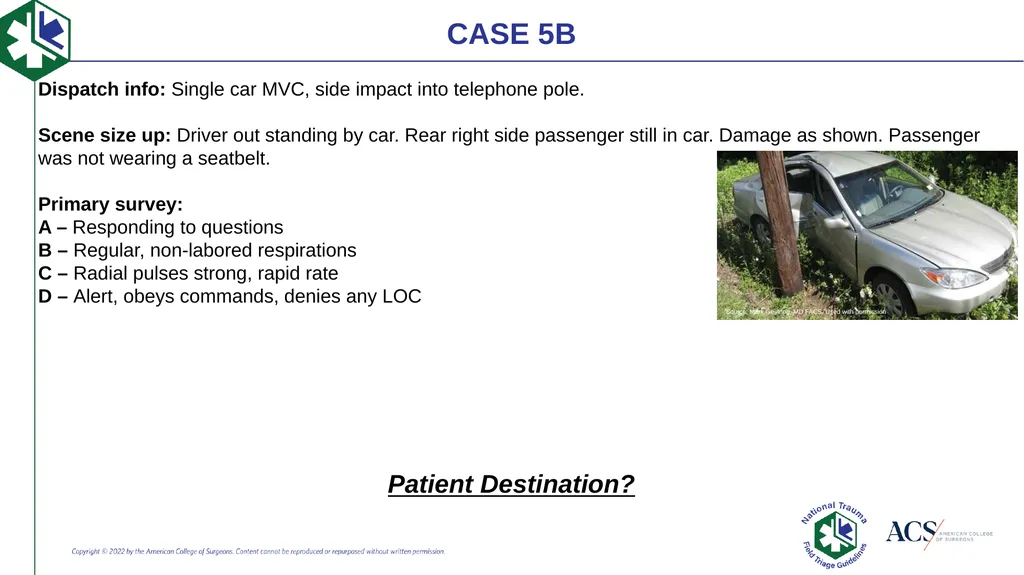
Dispatch info: Single car MVC, side impact into telephone pole.
Scene size up: Driver out standing by car. Rear right side passenger still in car. Damage as shown. Passenger was not wearing a seatbelt.
Primary survey:
A – Responding to questions
B – Regular, non-labored respirations
C – Radial pulses strong, rapid rate
D – Alert, obeys commands, denies any LOC
Patient Destination? Case 5B Source: Mark Gestring, MD FACS. Used with permission<br>
Scene size up: Driver out standing by car. Rear right side passenger still in car. Damage as shown. Passenger was not wearing a seatbelt.
Primary survey:
A – Responding to questions
B – Regular, non-labored respirations
C – Radial pulses strong, rapid rate
D – Alert, obeys commands, denies any LOC
Patient Destination? Case 5B Source: Mark Gestring, MD FACS. Used with permission<br>
28
Dispatch info: Single car MVC, side impact into telephone pole.
Scene size up: Driver out standing by car. Rear right side passenger still in car. Damage as shown. Passenger was not wearing a seatbelt.
Primary survey:
A – Responding to questions
B – Regular, non-labored respirations
C – Radial pulses strong, rapid rate
D – Alert, obeys commands, denies any LOC
Secondary Survey:
Exam – Contusion to left parietal area, Denies pain in neck, chest, abdomen, and moving all extremities, except LLE. Deformities noted in left ankle and foot.
Initial vital signs – BP 162/124 HR 114 RR 26 SpO2 95% RA GCS M 6
History – HTN, DM
Changes to Your Plan? Case 5B Source: Mark Gestring, MD FACS. Used with permission<br>
Scene size up: Driver out standing by car. Rear right side passenger still in car. Damage as shown. Passenger was not wearing a seatbelt.
Primary survey:
A – Responding to questions
B – Regular, non-labored respirations
C – Radial pulses strong, rapid rate
D – Alert, obeys commands, denies any LOC
Secondary Survey:
Exam – Contusion to left parietal area, Denies pain in neck, chest, abdomen, and moving all extremities, except LLE. Deformities noted in left ankle and foot.
Initial vital signs – BP 162/124 HR 114 RR 26 SpO2 95% RA GCS M 6
History – HTN, DM
Changes to Your Plan? Case 5B Source: Mark Gestring, MD FACS. Used with permission<br>
29
Dispatch Info: Single car MVC, side impact into telephone pole.
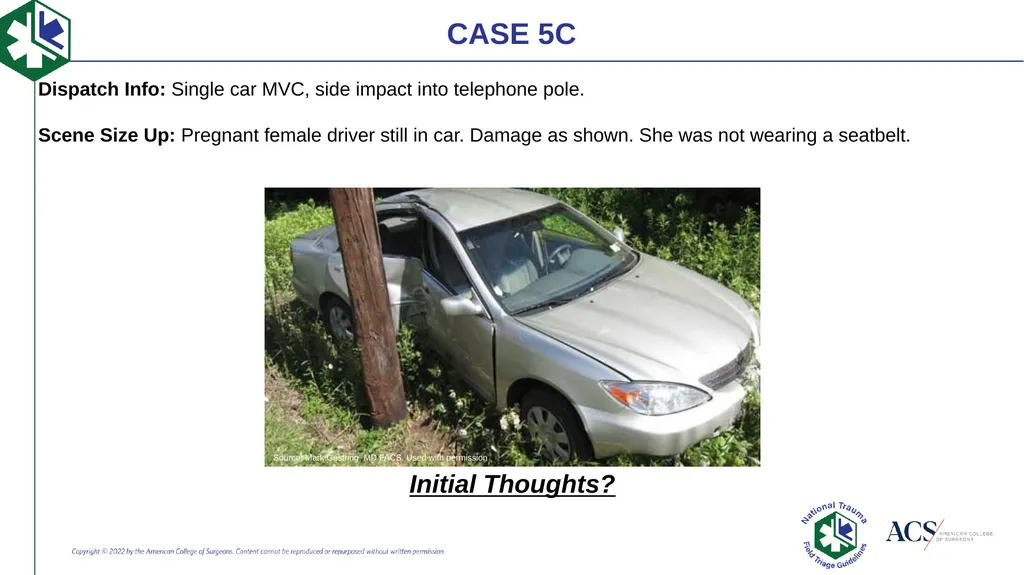
Scene Size Up: Pregnant female driver still in car. Damage as shown. She was not wearing a seatbelt.
Initial Thoughts? Case 5C Source: Mark Gestring, MD FACS. Used with permission<br>
Scene Size Up: Pregnant female driver still in car. Damage as shown. She was not wearing a seatbelt.
Initial Thoughts? Case 5C Source: Mark Gestring, MD FACS. Used with permission<br>
30
Dispatch Info: Single car MVC, side impact into telephone pole.
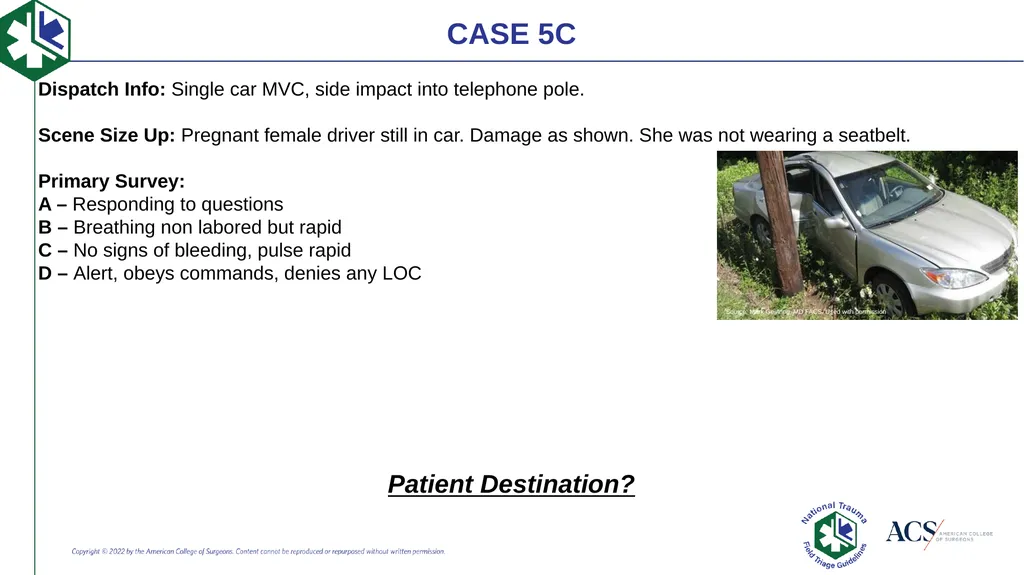
Scene Size Up: Pregnant female driver still in car. Damage as shown. She was not wearing a seatbelt.
Primary Survey:
A – Responding to questions
B – Breathing non labored but rapid
C – No signs of bleeding, pulse rapid
D – Alert, obeys commands, denies any LOC
Patient Destination? Case 5C Source: Mark Gestring, MD FACS. Used with permission<br>
Scene Size Up: Pregnant female driver still in car. Damage as shown. She was not wearing a seatbelt.
Primary Survey:
A – Responding to questions
B – Breathing non labored but rapid
C – No signs of bleeding, pulse rapid
D – Alert, obeys commands, denies any LOC
Patient Destination? Case 5C Source: Mark Gestring, MD FACS. Used with permission<br>
31
Dispatch Info: Single car MVC, side impact into telephone pole.
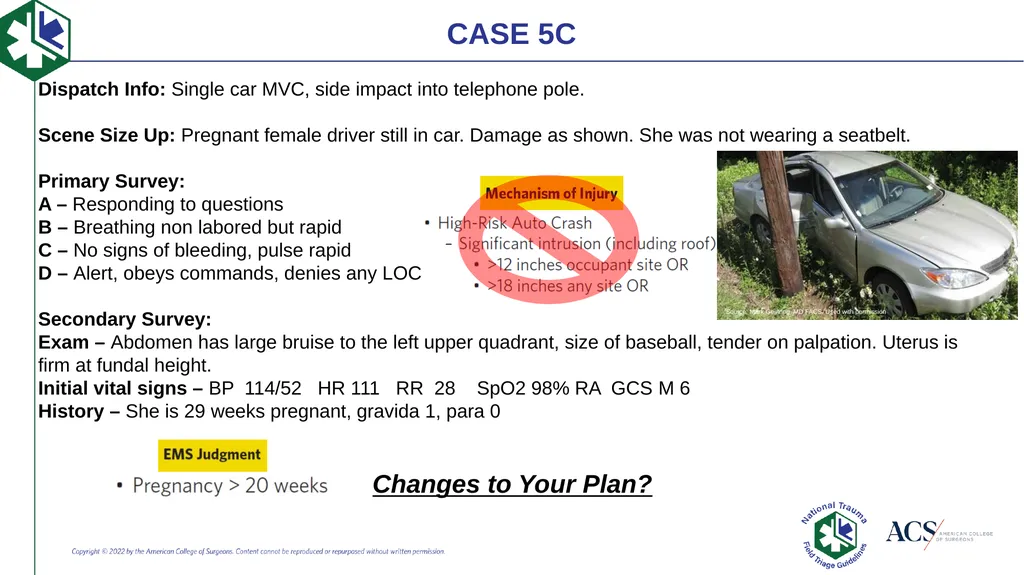
Scene Size Up: Pregnant female driver still in car. Damage as shown. She was not wearing a seatbelt.
Primary Survey:
A – Responding to questions
B – Breathing non labored but rapid
C – No signs of bleeding, pulse rapid
D – Alert, obeys commands, denies any LOC
Secondary Survey:
Exam – Abdomen has large bruise to the left upper quadrant, size of baseball, tender on palpation. Uterus is firm at fundal height.
Initial vital signs – BP 114/52 HR 111 RR 28 SpO2 98% RA GCS M 6
History – She is 29 weeks pregnant, gravida 1, para 0
Changes to Your Plan? Case 5C Source: Mark Gestring, MD FACS. Used with permission<br>
Scene Size Up: Pregnant female driver still in car. Damage as shown. She was not wearing a seatbelt.
Primary Survey:
A – Responding to questions
B – Breathing non labored but rapid
C – No signs of bleeding, pulse rapid
D – Alert, obeys commands, denies any LOC
Secondary Survey:
Exam – Abdomen has large bruise to the left upper quadrant, size of baseball, tender on palpation. Uterus is firm at fundal height.
Initial vital signs – BP 114/52 HR 111 RR 28 SpO2 98% RA GCS M 6
History – She is 29 weeks pregnant, gravida 1, para 0
Changes to Your Plan? Case 5C Source: Mark Gestring, MD FACS. Used with permission<br>
32
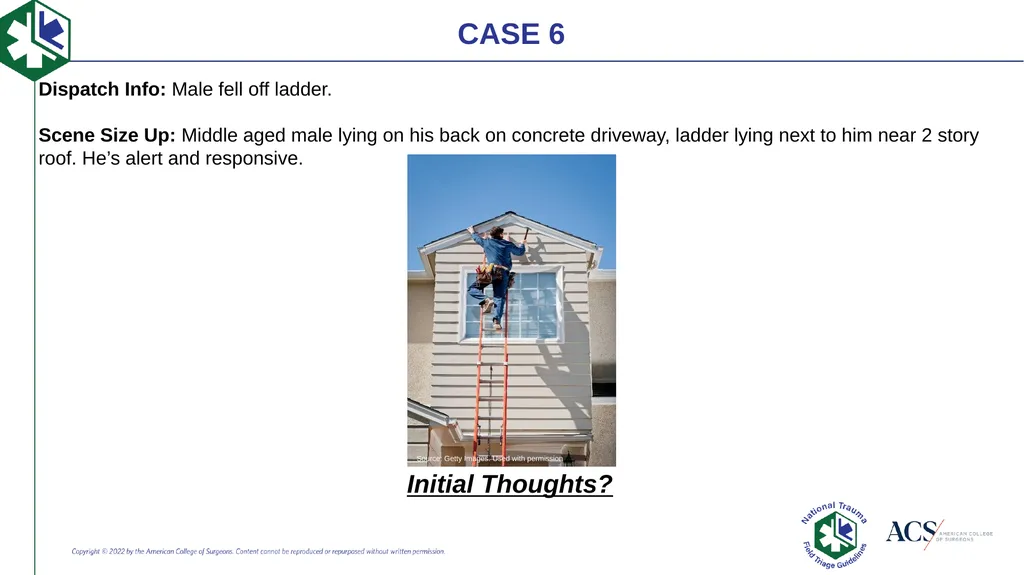
Dispatch Info: Male fell off ladder.
Scene Size Up: Middle aged male lying on his back on concrete driveway, ladder lying next to him near 2 story roof. He’s alert and responsive.
Initial Thoughts? Case 6 Source: Getty Images. Used with permission<br>
Scene Size Up: Middle aged male lying on his back on concrete driveway, ladder lying next to him near 2 story roof. He’s alert and responsive.
Initial Thoughts? Case 6 Source: Getty Images. Used with permission<br>
33
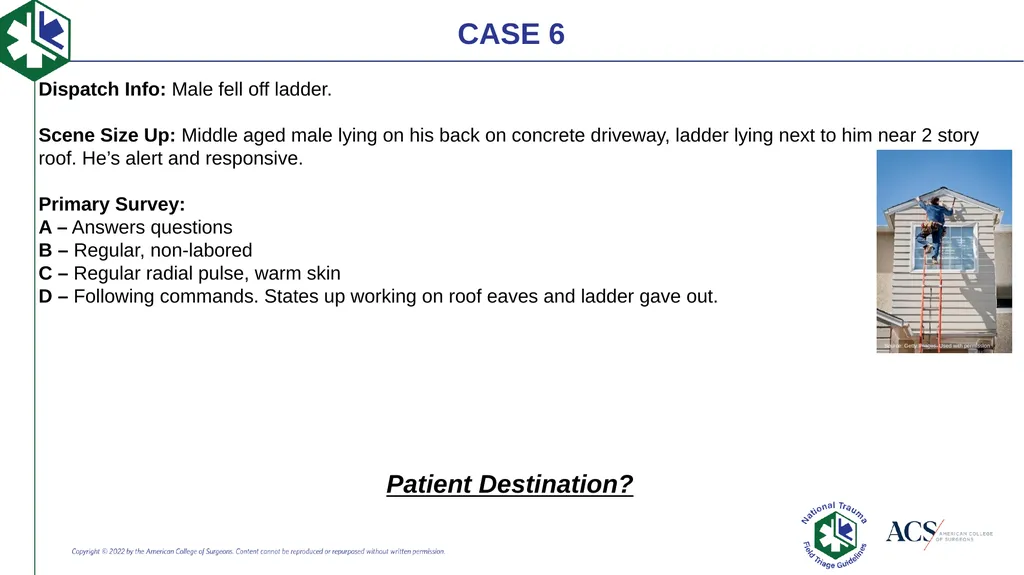
Dispatch Info: Male fell off ladder.
Scene Size Up: Middle aged male lying on his back on concrete driveway, ladder lying next to him near 2 story roof. He’s alert and responsive.
Primary Survey:
A – Answers questions
B – Regular, non-labored
C – Regular radial pulse, warm skin
D – Following commands. States up working on roof eaves and ladder gave out.
Patient Destination? Case 6 Source: Getty Images. Used with permission<br>
Scene Size Up: Middle aged male lying on his back on concrete driveway, ladder lying next to him near 2 story roof. He’s alert and responsive.
Primary Survey:
A – Answers questions
B – Regular, non-labored
C – Regular radial pulse, warm skin
D – Following commands. States up working on roof eaves and ladder gave out.
Patient Destination? Case 6 Source: Getty Images. Used with permission<br>
34
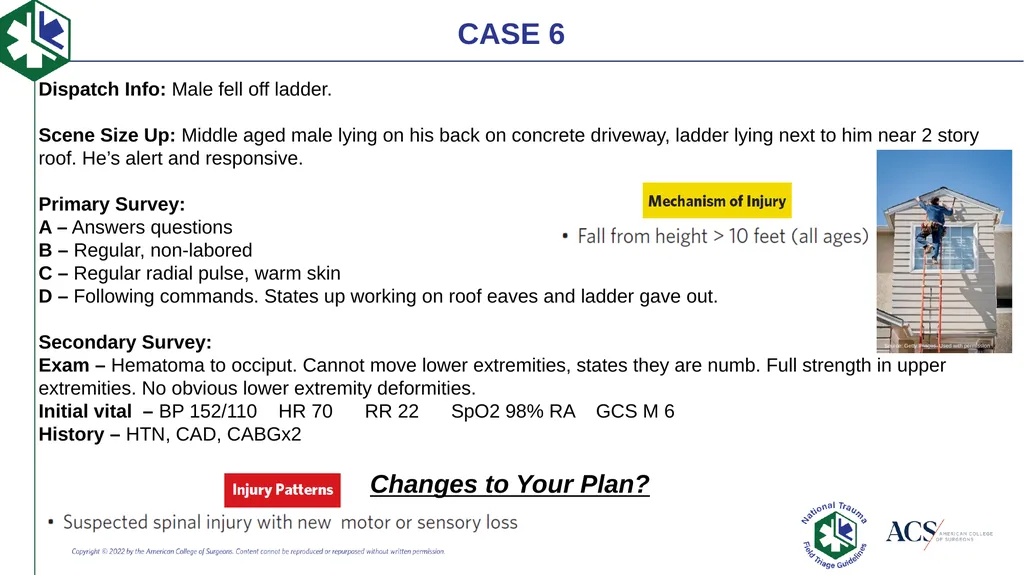
Dispatch Info: Male fell off ladder.
Scene Size Up: Middle aged male lying on his back on concrete driveway, ladder lying next to him near 2 story roof. He’s alert and responsive.
Primary Survey:
A – Answers questions
B – Regular, non-labored
C – Regular radial pulse, warm skin
D – Following commands. States up working on roof eaves and ladder gave out.
Secondary Survey:
Exam – Hematoma to occiput. Cannot move lower extremities, states they are numb. Full strength in upper extremities. No obvious lower extremity deformities.
Initial vital – BP 152/110 HR 70 RR 22 SpO2 98% RA GCS M 6
History – HTN, CAD, CABGx2
Changes to Your Plan? Case 6 Source: Getty Images. Used with permission<br>
Scene Size Up: Middle aged male lying on his back on concrete driveway, ladder lying next to him near 2 story roof. He’s alert and responsive.
Primary Survey:
A – Answers questions
B – Regular, non-labored
C – Regular radial pulse, warm skin
D – Following commands. States up working on roof eaves and ladder gave out.
Secondary Survey:
Exam – Hematoma to occiput. Cannot move lower extremities, states they are numb. Full strength in upper extremities. No obvious lower extremity deformities.
Initial vital – BP 152/110 HR 70 RR 22 SpO2 98% RA GCS M 6
History – HTN, CAD, CABGx2
Changes to Your Plan? Case 6 Source: Getty Images. Used with permission<br>