
CASE STUDIES OF THE FOLLOWING ECOSYSTEMS---
MY
Published · 36 slides · 0 views

1 / 1




Description
CASE STUDIES OF THE FOLLOWING ECOSYSTEMS--- a.Forest Ecosystem, b.Grassland Ecosystem, c.Aquatic Ecosystem(Ponds,StreamsRivers, Lakes), d. Mountain Ecosystem By Anuradha Roy NAMCE(B.Ed) a. FOREST ECOSYSTEM What is Forest Ecosystem? The
Related Topics
Share
Embed code
Download this presentation From Below
"CASE STUDIES OF THE FOLLOWING ECOSYSTEMS---" is the property of its rightful owner. Permission is granted to download and print the materials on this website for personal, non-commercial use only, and to display it on your personal computer provided you do not modify the materials and that you retain all copyright notices contained in the materials. By downloading content from our website, you accept the terms of this agreement.
Presentation Transcript
01
CASE STUDIES OF THE FOLLOWING ECOSYSTEMS---
a.Forest Ecosystem,
b.Grassland Ecosystem,
c.Aquatic Ecosystem(Ponds,Streams/Rivers, Lakes),
d. Mountain Ecosystem By Anuradha Roy
NAMCE(B.Ed)<br>
NAMCE(B.Ed)<br>
02
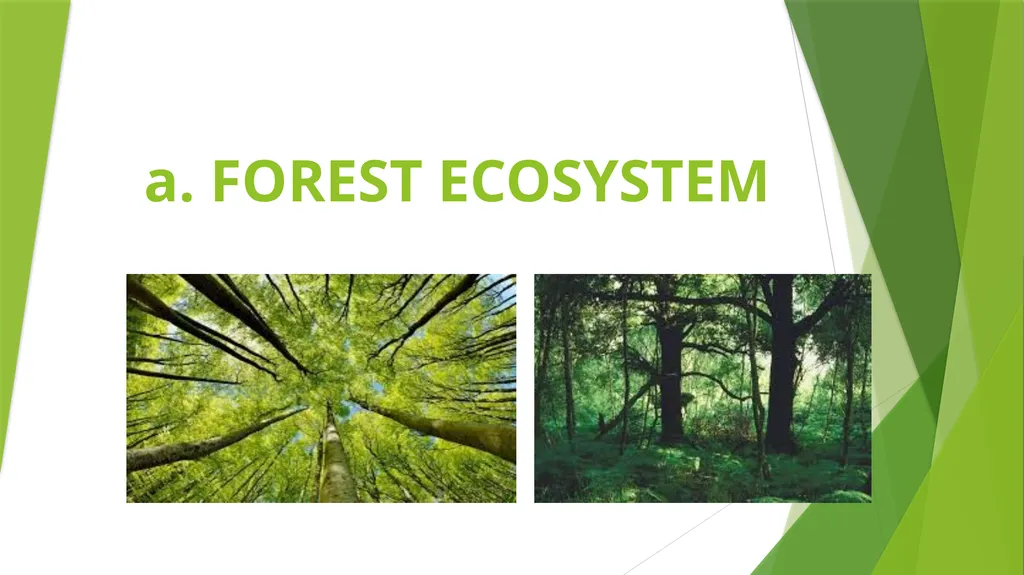
a. FOREST ECOSYSTEM<br>
03
What is Forest Ecosystem? ‘The biotic component of a forest includes both large(macrophytes) and microscopic plants and animals’.
A forest ecosystem is a functional unit or a system which comprises of soil, trees, insects, animals, birds, and man as its interacting units. A forest is a large and complex ecosystem and hence has greater species diversity.
Also, it is much more stable and resistant to the detrimental changes as compared to the small ecosystems such as wetlands and grasslands.
A forest ecosystem, similar to any other ecosystem, also comprises of abiotic and biotic components. Abiotic components refer to inorganic materials like air, water, temperature, rainfall and soil. Biotic components include producers, consumers, and decomposers.
These components interact with each other in an ecosystem and thus, this interaction among them makes it self-sustainable.<br>
04
Structural Features of the Forest Ecosystem The two main structural features of a forest ecosystem are:
Species composition: It refers to the identification and enumeration of the plant and animal species of a forest ecosystem.
Stratification: It refers to the vertical distribution of different species which occupy different levels in the forest ecosystem. Every organism occupies a place in an ecosystem on the basis of source of nutrition. For example, in a forest ecosystem, trees occupy the top level, shrubs occupy the second and the herbs and grasses occupy the bottom level.<br>
05
Components of a Forest Ecosystem The components of a forest ecosystem are as follows:
1.Productivity
The basic requirement for any ecosystem to function and sustain is the constant input of solar energy. Plants are also the producers in a forest ecosystem.
There are two types of productivity in a forest ecosystem, primary and secondary. Primary productivity means the rate of capture of solar energy or biomass production per unit area over a period of time by the plants during photosynthesis.
It is further divided into Gross Primary Productivity (GPP) and Net Primary Productivity (NPP). GPP of an ecosystem is the rate of capture of solar energy or the total production of biomass. However, plants also use a significant amount of GPP in respiration.
Thus, NPP is the amount of biomass left after the utilization by plants or the producers. We can hence say that NPP is the amount which is available for the consumption to herbivores and decomposers. Secondary productivity means the rate of absorption of food energy by the consumers.<br>
06
2. Decomposition
Decomposition is an extremely oxygen-requiring process. In the process of decomposition, decomposers convert the complex organic compounds of detritus into inorganic substances such as carbon dioxide, water and nutrients.
Detritus is the remains of the dead plant such as leaves, bark, flowers and also the dead remains of the animals including their faecal matter. The steps involved in the process of decomposition are fragmentation, leaching, catabolism, humification and mineralization.
In the process of fragmentation, detritivores break down the detritus into smaller particles. In the process of leaching, water-soluble inorganic nutrients descend down into the soil and settle as unavailable salts.
Under the process of catabolism, bacterial and fungal enzymes reduce detritus into simpler inorganic substances. Humification and mineralization processes take place during the decomposition of soil and not detritus.
The process of humification leads to the accumulation of humus which undergoes decomposition at a very slow rate. In the process of mineralization, the humus gets further degraded by microbes and inorganic nutrients are released.<br>
07
3. Energy flow
Energy flows in a single direction. Firstly, plants capture solar energy and then, transfer the food to decomposers. Organisms of different trophic levels are connected to each other for food or energy relationship and thus form a food chain.
Energy Pyramid is always upright because energy flows from one trophic level to the next trophic level and in this process, some energy is always lost as heat at each step.
4. Nutrient Cycling
Nutrient cycling refers to the storage and movement of nutrient elements through the various components of the ecosystem. There are two types of Nutrient cycling, gaseous and sedimentary.
For Gaseous cycle (i.e. nitrogen, carbon), atmosphere or hydrosphere is the reservoir whereas for the sedimentary cycle (i.e. phosphorus) Earth’s crust is the reservoir.<br>
08
Forest Types of India Coniferous Forests
Broad-leaved Forests
Evergreen forests grow in high rainfall area
Deciduous Forests
Thorn Forests
Mangrove Forests<br>
Broad-leaved Forests
Evergreen forests grow in high rainfall area
Deciduous Forests
Thorn Forests
Mangrove Forests<br>
09
Forest Utilisation Direct Uses of Forest Products: Fruits, Roots, Medicine, Fuel wood, Grass for grazing, bamboo for baskets.
Indirect uses of Forest Products: Building material for construction and furniture for urban sector, Medicinal products, Gums and resins, Raw materials for industrial products and chemicals, paper from bamboo and soft woods, all herbal products for medicines, cosmetics.<br>
Indirect uses of Forest Products: Building material for construction and furniture for urban sector, Medicinal products, Gums and resins, Raw materials for industrial products and chemicals, paper from bamboo and soft woods, all herbal products for medicines, cosmetics.<br>
10
What are the threats to the Forest Ecosystems We cannot use more resources than forests can produce a growing season as they grow very slowly. The increasing use of wood for timber, wood –pulp for making paper and the extensive use of fuel wood, results in continual forest loss. If timber is felled beyond a certain limit, the forests can not regenerate. The varied flora if substituted by monoculture plantations for timber or other products, impoverishes the local people as the economic benefit usually flows to people who use it extensively or market by manufacturing products.
Developmental activities together with urbanisation, industrialisation and the increasing use of consumer goods, made from forest resources lead to over- utilisation of the forest ecosystems altering food chains, the web of life and food pyramid. Forests are rapidly shrinking as the need for agricultural land increases. It is estimated that India’s forest cover has decreased from about 33% to 11% in the last century. Large parts of good forests are lost by mining and building dams.<br>
Developmental activities together with urbanisation, industrialisation and the increasing use of consumer goods, made from forest resources lead to over- utilisation of the forest ecosystems altering food chains, the web of life and food pyramid. Forests are rapidly shrinking as the need for agricultural land increases. It is estimated that India’s forest cover has decreased from about 33% to 11% in the last century. Large parts of good forests are lost by mining and building dams.<br>
11
How can forest ecosystem can be conserved? We can conserve forests only if we use its resources carefully. This can be done by leading sustainable lifestyles. Some examples include reducing , reusing and recycling goods made out of forest products .Reusing paper and packaging switching to alternative sources of energy instead of fuelwood or thermal power(Since this is produced from coal mined in forest areas should be followed. There is a need to grow more trees to replace those that are cut down from forests every year for timber.
Afforestation needs to be done continuously from which fuel wood and timber can be judiciously used. An important aspect to remember is that a large and unsustainable overuse of Non-Timber-Forest-Products, especially medicinal plants, is damaging forests and leading down the pathway to extinction. The natural forests with all their diverse species must be protected as national parka and wildlife sanctuaries to preserve the full range of plants and animals.<br>
Afforestation needs to be done continuously from which fuel wood and timber can be judiciously used. An important aspect to remember is that a large and unsustainable overuse of Non-Timber-Forest-Products, especially medicinal plants, is damaging forests and leading down the pathway to extinction. The natural forests with all their diverse species must be protected as national parka and wildlife sanctuaries to preserve the full range of plants and animals.<br>
12
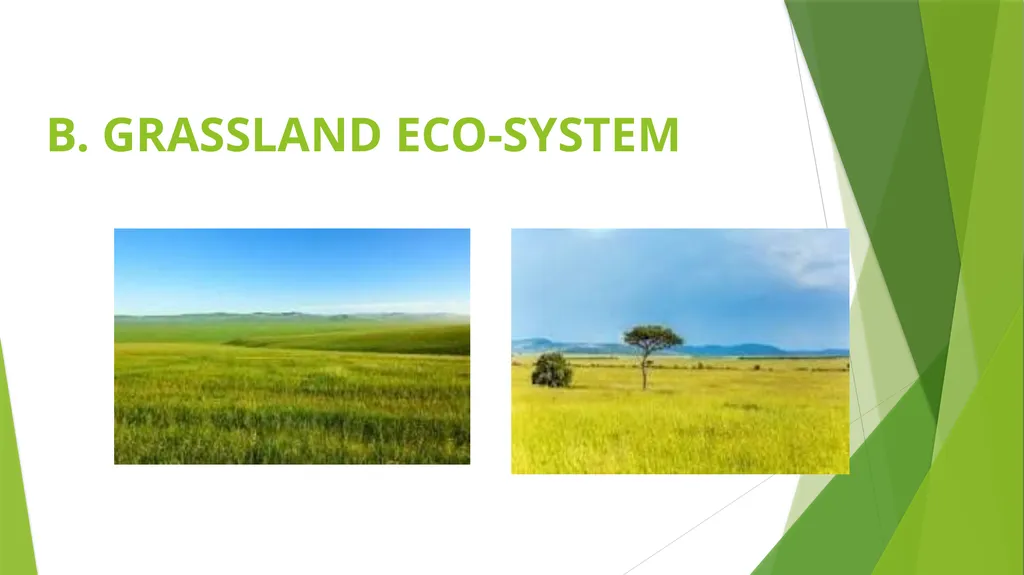
B. GRASSLAND ECO-SYSTEM<br>
13
What is Grassland Ecosystem? The terrestrial ecosystem in which grasses and herbaceous plants are dominant is referred to as the grassland ecosystem.
Grass controls the grassland ecosystems with few or no trees where there is not enough for a forest and too much for a desert. Hence, it is also called a transitional landscape.
The grassland ecosystem is called the largest biomes on earth and it covers about 10 per cent of the earth’s surface. It is mainly found where rainfall is about 15-75 cm per year, not enough to support a forest, but more than that of a true desert.
The Grassland ecosystems are called by various names in several regions, such as pampas in South America, Veldt in South Africa, Steppes in Europe and Asia, and Downs in Australia.
In India, these ecosystems are found mainly high in the Himalayas. The rest of India’s grasslands are primarily composed of the Savanna and Steppes.<br>
14
Types of Grassland ecosystems This ecosystem contains five types of grasslands that are:
Desert Grasslands
Flooded Grasslands
Montane Grasslands
Tropical Grasslands
Temperate Grasslands<br>
Desert Grasslands
Flooded Grasslands
Montane Grasslands
Tropical Grasslands
Temperate Grasslands<br>
15
Importance of Grassland ecosystem A Grassland Ecosystem is a mixture of small herbs, weeds, grass, trefoil, dicotyledonous, shrubs and other leguminous species, contributing to a high degree of preservation. The economic importance of the grassland ecosystem is that it serves in the maintenance of the crop of many domesticated and wild herbivores such as cattle, sheep, goats, ass, pigs, horses, mules, camels, deer, zebras, etc. These animals provide food, milk, wool and transportation to man.<br>
16
Structure Of Grassland The physical features include both biotic and abiotic aspects. Grasses are the main producers of biomass in each of these regions. Each grassland ecosystem has a wide varieties of species of grasses and herbs. Some grass and herb species are more sensitive to excessive grazing and their growth is suppressed if the area is overgrazed.<br>
17
Functions of Grassland Eco-system Bio-chemical factors control the quality of grasses and fauna, grasslands sequester carbon above the ground in the grazing season and retain it in the roots during the non-grazing season . This is a vital system that addresses the effects of climate change.
Others are destroyed by repeated fires and and cannot regenerate. These overused or frequently burnt grasslands are degraded and are poor in plant species diversity. They are incorrectly labelled as wasteland as most of them are used by local people as their pastureland. Such areas should be used sustainably by rotating grazing cycles so that they have time to regenerate . They should not be planted with trees as this would destroy an important ecosystem.<br>
Others are destroyed by repeated fires and and cannot regenerate. These overused or frequently burnt grasslands are degraded and are poor in plant species diversity. They are incorrectly labelled as wasteland as most of them are used by local people as their pastureland. Such areas should be used sustainably by rotating grazing cycles so that they have time to regenerate . They should not be planted with trees as this would destroy an important ecosystem.<br>
18
Utilisation of Grassland Grasslands are the grazing areas of many rural communities. Farmers keep cattle or goats for milk or dung. Shepherds have herds of sheep that migrate across grasslands; they are highly dependent on grasslands to supply food for their livestock.
Fodder is collected and stored to feed cattle when there is no grass left for them to graze in summer.
Grass is also used to thatch houses and farm-sheds.
The thorny bushes and branches of the few trees that are seen in grasslands are used as the main source of fuelwood. Grasslands maintain unique bio-diversity of specialised flora and fauna.
They serve as a storehouse for carbon. Grassland protected areas provide recreational use and wildlife viewing.<br>
19
What are the threats to the Grassland Ecosystems Overgrazing
Repeated fires
Conversion to other type of landuse
Tree plantation
Thinking of them<br>
Repeated fires
Conversion to other type of landuse
Tree plantation
Thinking of them<br>
20
How can grassland ecosystem be conserved? There is a pressing need to preserve the few natural grasslands that still survive, by creating national parks and wildlife sanctuaries in different types of grasslands .Public awareness and political will through your advocacy.
Animals such as wolf , blackbuck and chinkara as well as birds such as the Great Indian Bustard and Florican have now become rare. They must be carefully protected in the few national parks and wildlife sanctuaries that have natural grassland habitat.
Grasslands for grazing cattle and sheep must be managed appropriately help bring about a better understanding about pastoral people.
We need to create awareness among people that grasslands are of great value. If we are all concerned about our disappearing grasslands and their wildlife, the govt. will be motivated to protect them.
Keeping grasslands alive should be made a national priority.<br>
21
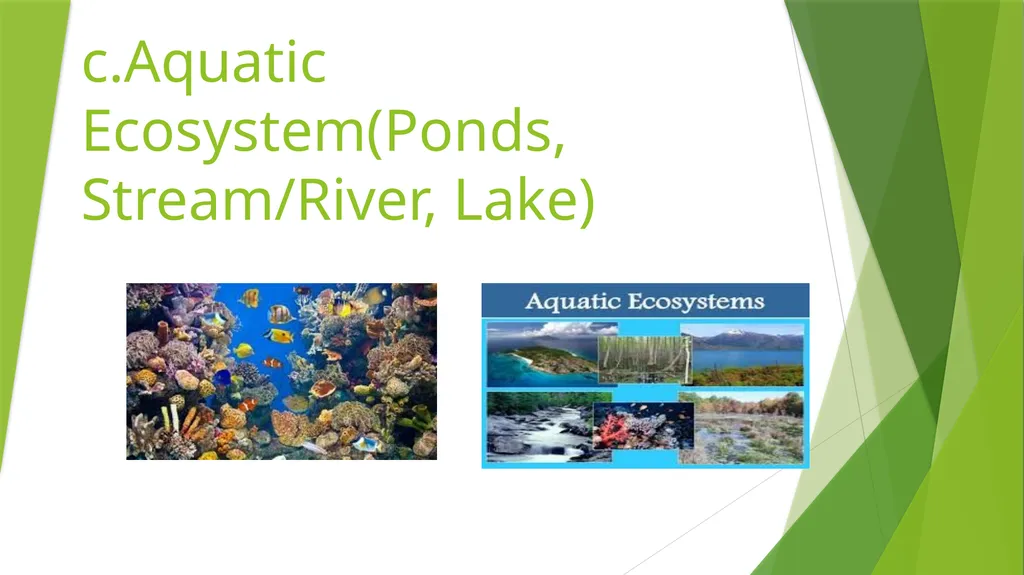
c.Aquatic Ecosystem(Ponds, Stream/River, Lake)<br>
22
What is an Aquatic Eco-system? The aquatic ecosystems comprise marine environments of the sea and freshwater lakes, rivers, ponds and wetlands.
In aquatic ecosystem plants and animal live mainly in water .Many plant and animal species are adapted to live in different types of aquatic habitats.<br>
In aquatic ecosystem plants and animal live mainly in water .Many plant and animal species are adapted to live in different types of aquatic habitats.<br>
23
Structure of an Aquatic Ecosystem The special abiotic features are its physical aspects such as the quality of the water, which includes its clarity, salinity, oxygen content and rate of flow. Aquatic ecosystems may be classified as being still water eco-systems(lentic) or flowing water (lotic) eco-systems. The mud, gravel or rocks that from the bed of the aquatic ecosystems alter its characteristics and influence its plant and animal species composition.
Aquatic ecosystems are classified into freshwater, brackish and marine ecosystems, which are based on salinity levels. The freshwater ecosystems that have running water are streams and rivers. Ponds, tanks and lakes are ecosystem where water does not flow. Wetlands are special eco-systems in which the water level fluctuates dramatically in different seasons. They have expanses of shallow water with aquatic vegetation , which forms an ideal habitat for fish and waterbirds. The richest coral reefs in India are round the Andaman & Nicobar Islands and in the Gulf of Kutch. Brackish water system in river deltas are covered by mangrove forests and are among the world’s most productive ecosystems in terms of biomass production. The largest mangrove swamps are in the Sundarban in delta of the Ganges river.<br>
Aquatic ecosystems are classified into freshwater, brackish and marine ecosystems, which are based on salinity levels. The freshwater ecosystems that have running water are streams and rivers. Ponds, tanks and lakes are ecosystem where water does not flow. Wetlands are special eco-systems in which the water level fluctuates dramatically in different seasons. They have expanses of shallow water with aquatic vegetation , which forms an ideal habitat for fish and waterbirds. The richest coral reefs in India are round the Andaman & Nicobar Islands and in the Gulf of Kutch. Brackish water system in river deltas are covered by mangrove forests and are among the world’s most productive ecosystems in terms of biomass production. The largest mangrove swamps are in the Sundarban in delta of the Ganges river.<br>
24
Composition of an Aquatic Ecosystem The vegetation of this ecosystem is related to the level of sunlight, the depth of water, its quality and seasonality. Thus, each type has its own flora and fauna.<br>
25
Functions of Aquatic Eco-system Water is where life first evolved into complex food chains and pyramids through multiple chemical reactions. Each aquatic ecosystem has varied functional aspects in its biogeochemical nature.
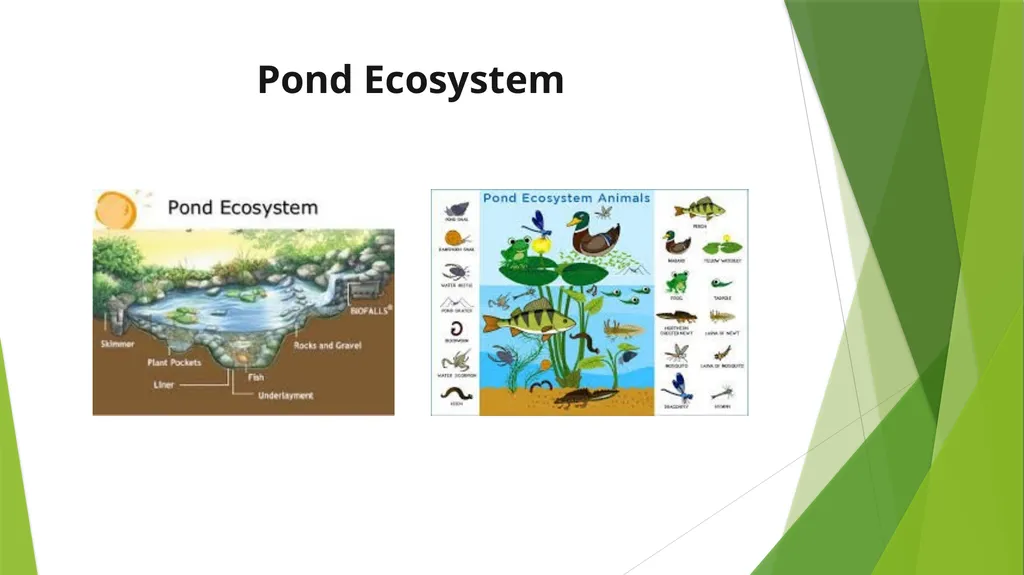
Pond Eco-system: The pond is the simplest aquatic ecosystem observe to cyclic changes. There are differences are Ecosystems between temporary pond that has water only in the monsoon season, and larger tank lake that is an aquatic ecosystem throughout the year. Most small ponds become dry after the rains Over and are covered by terrestrial plants for the rest of the year.
Characteristics of pond Eco-system:
The water in the pond ecosystem is stagnant.
Either natural or artificial boundaries surround the pond ecosystem.
The pond ecosystem exhibits three distinct zones, the littoral zone, limnetic zone, profundal zone, and benthic zone.<br>
26
The biotic components of the pond ecosystem occupy different levels in the pond ecosystem, therefore, avoiding the competition for survival. Scavengers and decomposers occupy the bottom level, and fish occupy the middle level. The plants enclose the pond’s boundaries and provide shelter to small animals and insects.
Pond ecosystems show a wide range of variety in their size.
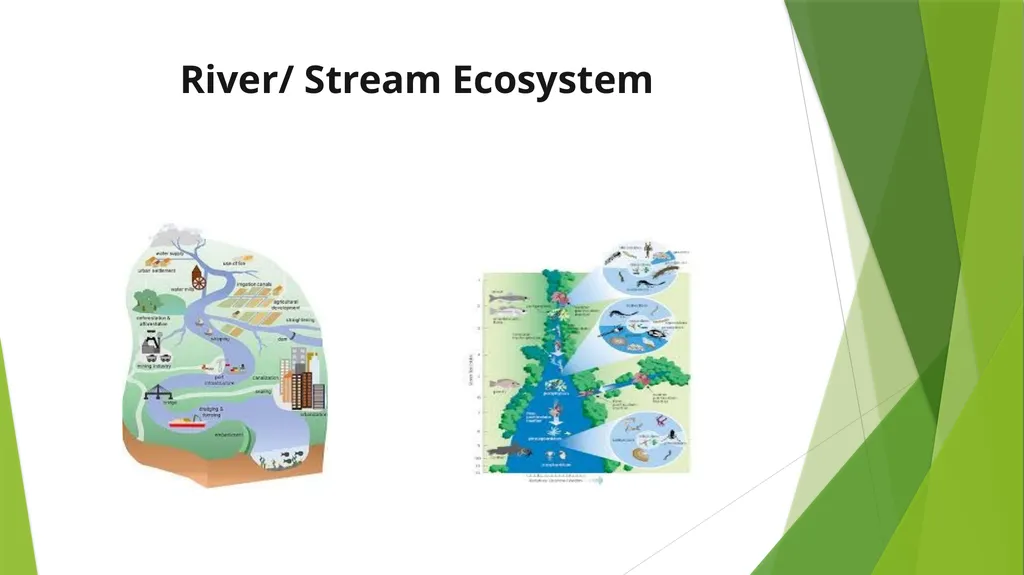
Stream Eco-system: A stream ecosystem refers to a unique and vital system found on Earth's surface, characterized by its rich biodiversity and the numerous services it provides to humans. It is crucial to understand and conserve the structure and function of these ecosystems due to their rarity and susceptibility to disturbance.
Condition of this Ecosystem:
Some species of fish, like the Mahseer, move upstream from rivers to hill-streams for breeding. They need crystal clear water to be able to breed successfully. As perennial streams dry up due to deforestation and misuse, the Mahseer of the Himalaya and Western Ghats have become highly endangered.
Many hill-stream fish are likely to become extinct unless protected.<br>
27
The community of flora and fauna of streams and rivers depends on the clarity, flow and Oxygen content as well as the nature of stream beds.
The stream or river can have a sandy, rocky or muddy bed, each type having its own species of plants and animals.
As deforestation occurs in the hills, the water in the streams that once flowed throughout the year becomes seasonal. This leads to flash floods during the rains and water shortage when the streams dry up after the monsoon.
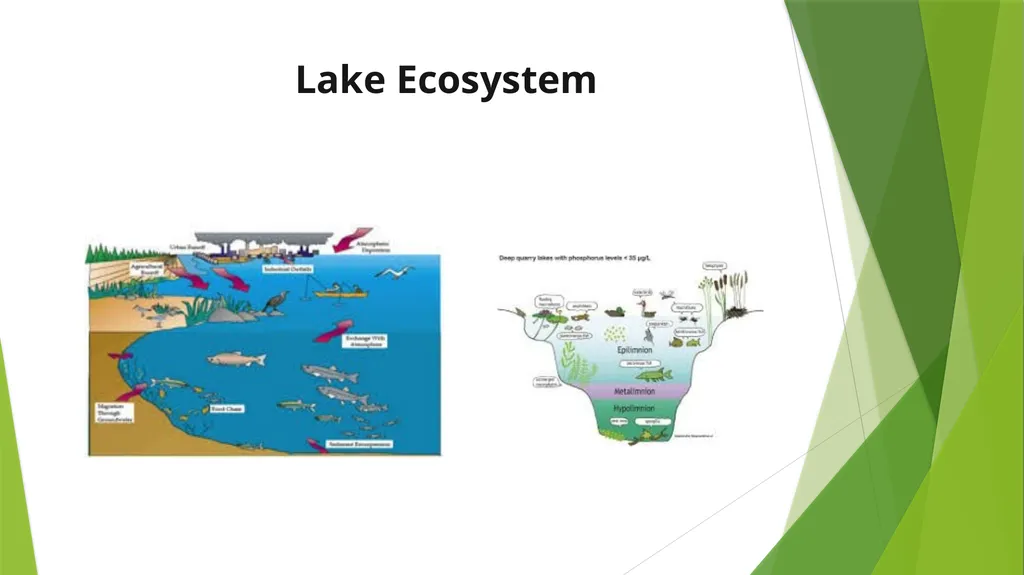
Lake Eco-system: Lakes are freshwater ecosystems that may be natural or more frequently, artificially created by the construction of dams and tanks. Damming rivers alters a flowing ecosystem to a still water ecosystem. This is usually developed for irrigation , or for storage for urban or industrial use a nd hydroelectric power generation.
Types: They are several types like– i.Oligotrophic, ii. Dystrophic iii. Eutrophic Iv.Endemic v.Volcanic vi. Meromictic and vii. Artificial.
Their biodiversity includes algae which derives energy from sun and transferred it to microscopic animals for feeding the algae, Herbivores fish are also depends on algae and weeds. Then small animals such as snails are eaten by carnivores fish. Some special fish like Catfish feeded on detritus muddy lake bed, that’s why they are called bottom feeders.<br>
28
What are the threats of Aquatic Ecosystem? Water pollution occurs from urban sewage and poorly-managed solid waste. Sewage leads to a process called eutrophication, which destroys life in the water when the oxygen content is severely reduced. Fish and crustaceans cannot breathe and are at times killed in large numbers. A foul odour is produced. The natural flora and fauna of the aquatic ecosystem is damaged and eliminated.
Pollution also occurs from waste water of irrigated agriculture that uses chemicals fertilisers and industry that produces toxic chemicals.
In rural areas, the excessive use of fertilisers causes an increase in nutrients, which also leads to eutrophication. Pesticides used in adjacent fields pollute the water and kill its aquatic animals.
Chemical pollution from industry kills a large number of life forms in adjacent aquatic ecosystems. Contamination by heavy metals and other toxic chemicals affects the health of people who live near these areas and depend on this water.
Thermal power plants release hot water into aquatic ecosystems that seriously affects its natural ecosystem.
Over-fishing has led to a serious decline in the quantity of catch and has become a long-term loss of income for the fisherfolk.<br>
29
How can Aquatic Ecosystem be Conserved? For the sustainable use of an Aquatic ecosystem, the first need is to prevent water pollution, as cleaning up or treating polluted water is an expensive reactive approach.
Prevention of pollution through public awareness and generating a new ethic of avoiding activities that damage water quality and depletes its year round quantity is the key to sustainable approach.
Options for meeting water and energy needs must be explored.
Proper planning and assessment must be carried out to protect affected people who are displaced by large dams to ensure a more equitable distribution of benefits from dams.
Aquatic Ecosystem, especially wetlands , need protection by including them in sanctuaries or national parks in the same way in which we protect our natural forests.
Wetland Sanctuaries and national parks are the greatest importance, as they are among the most threatened of our ecosystems.<br>
30
Pond Ecosystem<br>
31
River/ Stream Ecosystem<br>
32
Lake Ecosystem<br>
33
D. MOUNTAIN ECOSYSTEM<br>
34
What is Mountain Ecosystem? Mountain ecosystems are fragile and vulnerable, and land-use and climate change are threatening the last remaining natural ecosystems and putting pressure on mountain agriculture and forestry, with main implications for biodiversity and ecosystem services.
Mountain ecosystems require particular protection , not the least given how important their intactness is for the safety of people down their slopes. Nowhere else do people and their infrastructures depend more on erosion control than in steep terrain. Moreover, because of their steep climatic gradients and their topographic diversity, hardly any other terrestrial ecosystem occurs on earth where as much terrestrial biodiversity (i.e., species and intraspecific genetic diversity) can be protected per unit area as in mountains. Yet, despite the importance of intact mountain biodiversity as a pillar of sustainable development and the teleconnection between mountains and commonly densely populated forelands<br>
Mountain ecosystems require particular protection , not the least given how important their intactness is for the safety of people down their slopes. Nowhere else do people and their infrastructures depend more on erosion control than in steep terrain. Moreover, because of their steep climatic gradients and their topographic diversity, hardly any other terrestrial ecosystem occurs on earth where as much terrestrial biodiversity (i.e., species and intraspecific genetic diversity) can be protected per unit area as in mountains. Yet, despite the importance of intact mountain biodiversity as a pillar of sustainable development and the teleconnection between mountains and commonly densely populated forelands<br>
35
How we conserve Mountain Ecosystem By 2030, ensure the conservation of mountain ecosystems, including their biodiversity, in order to enhance their capacity to provide benefits that are essential for sustainable development.
Our collections matter indicators
Proportion of mountain ecosystems, including their biodiversity, in a good ecological condition.
Information on, programmes relating to, collections development, and partnerships relating to mountain ecosystems and their biodiversity drawing on collections in place, to support their protection and effective functioning.<br>