Cavalieris Principle: Area and Volume Jim King University of Washington NWMI 2013 Cavalieri for Area 2-dimensional case: Suppose two regions in a plane are included between two parallel lines in that plane. If every line parallel to these
"Cavalieri's Principle: Area and Volume Jim King" is the property of its rightful owner. Permission is granted to
download and print the materials on this website for personal, non-commercial use only, and to display it
on your personal computer provided you do not modify the materials and that you retain all copyright
notices contained in the materials. By downloading content from our website, you accept the terms of this
agreement.
Presentation Transcript
01
Cavalieri's Principle: Area and Volume Jim King
University of Washington NWMI 2013<br>
02
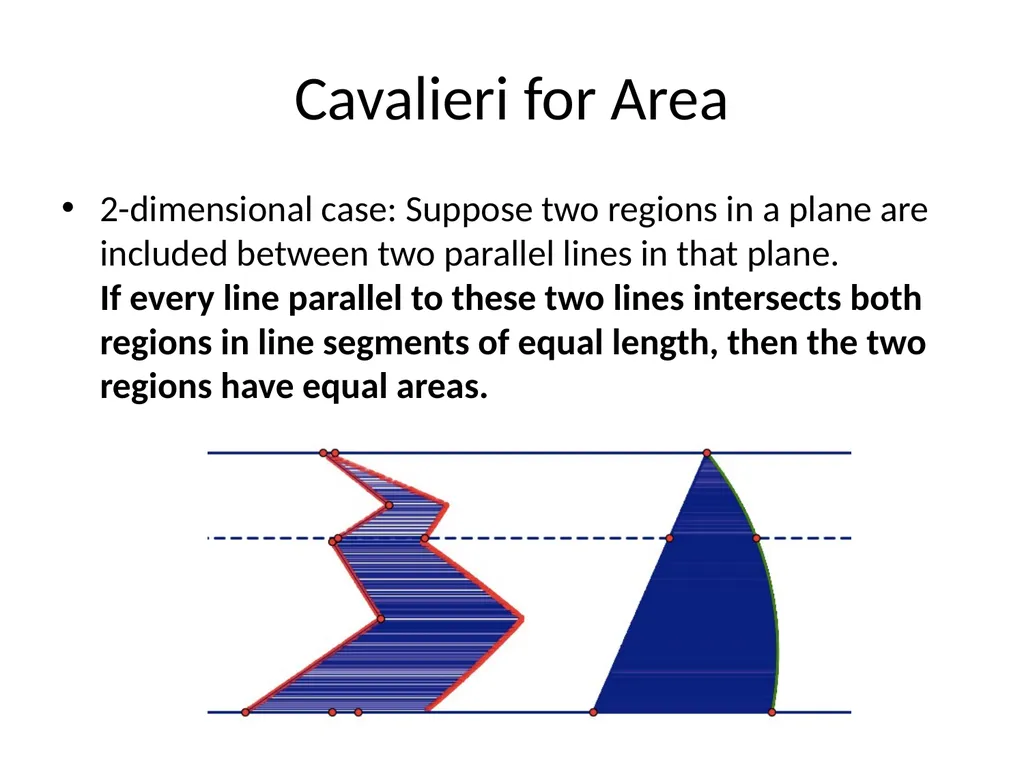
Cavalieri for Area 2-dimensional case: Suppose two regions in a plane are included between two parallel lines in that plane. If every line parallel to these two lines intersects both regions in line segments of equal length, then the two regions have equal areas.<br>
03
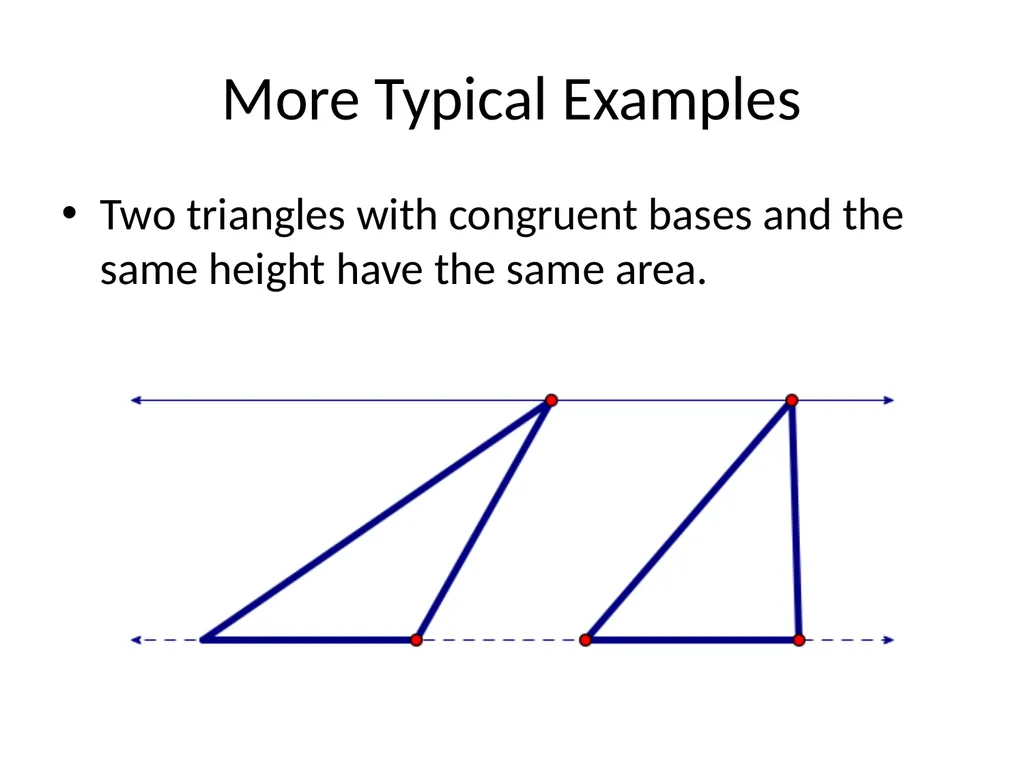
More Typical Examples Two triangles with congruent bases and the same height have the same area.<br>
04
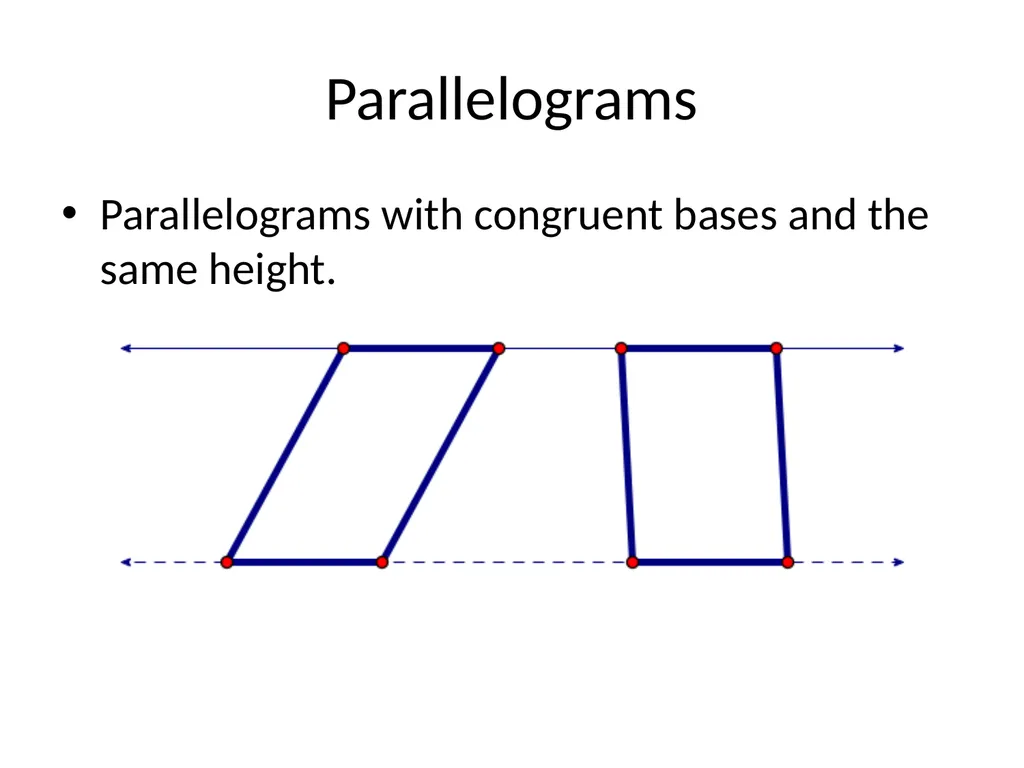
Parallelograms Parallelograms with congruent bases and the same height.<br>
05
Even if there is no common base<br>
06
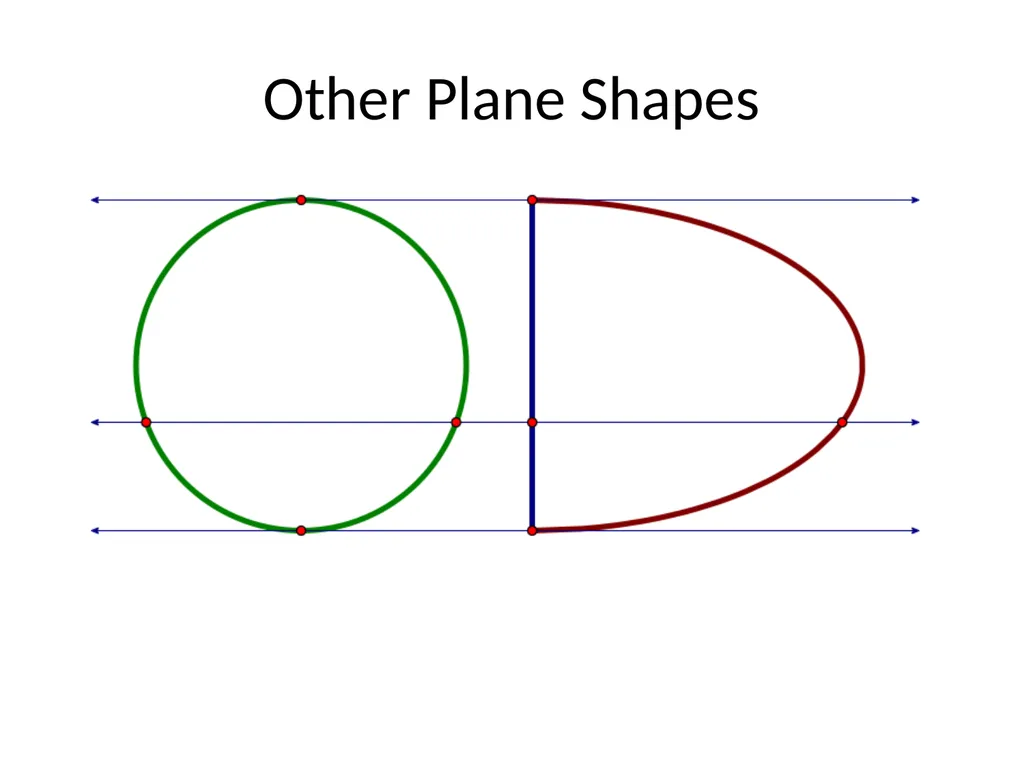
Other Plane Shapes<br>
07
Cavalieri for Volume 3-dimensional case: Suppose two regions in three-space (solids) are included between two parallel planes. If every plane parallel to these two planes intersects both regions in cross-sections of equal area, then the two regions have equal volumes.<br>
08
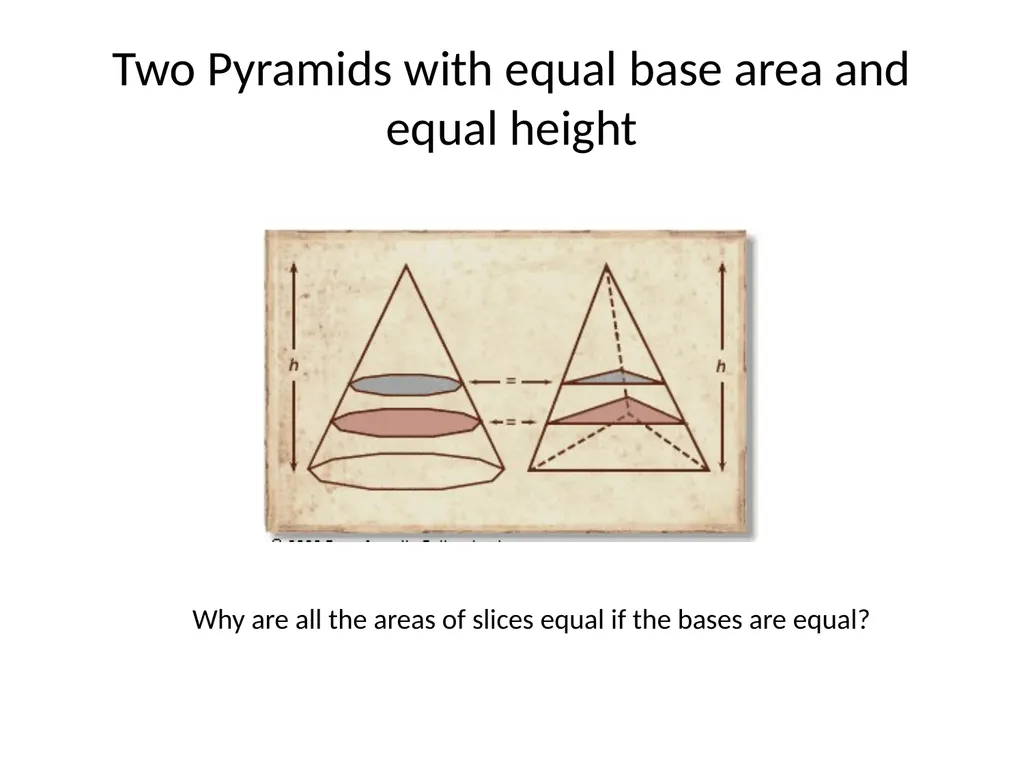
Two Pyramids with equal base area and equal height Why are all the areas of slices equal if the bases are equal?<br>
09
Key to why the volumes are equal The volumes are approximately the sum of the volumes of the slabs of equal volume. The exact volume is a limit.<br>
10
Decks of cards and stacks of CDs or pennies provide examples of equal volume<br>
11
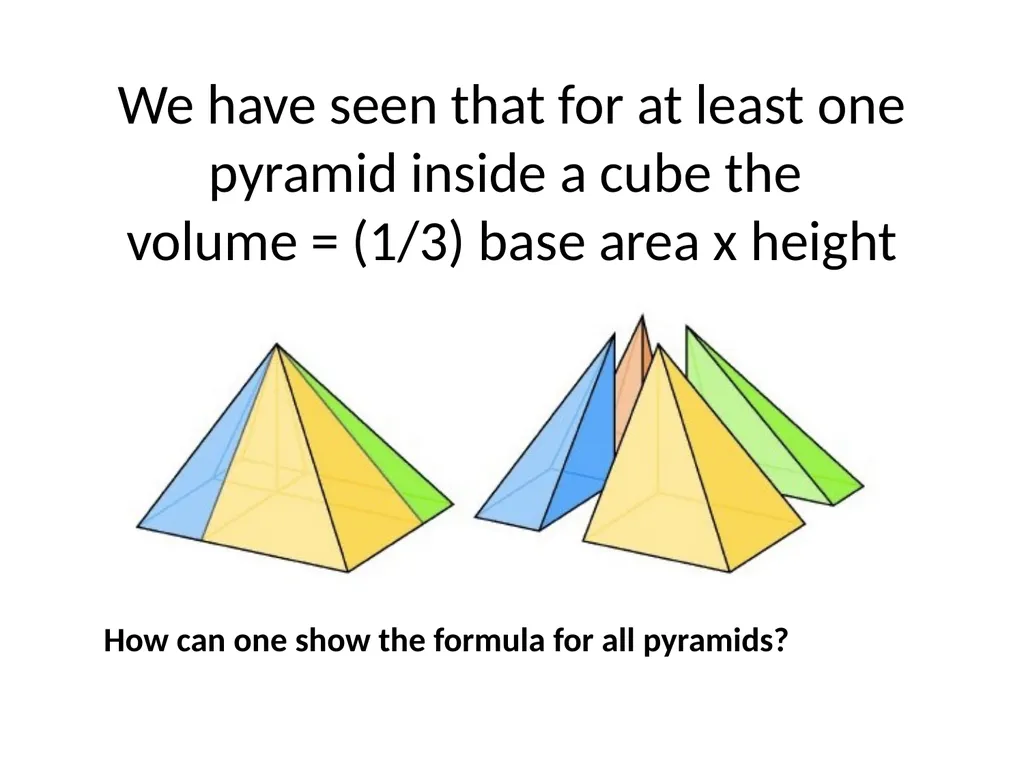
We have seen that for at least one pyramid inside a cube the volume = (1/3) base area x height How can one show the formula for all pyramids?<br>
12
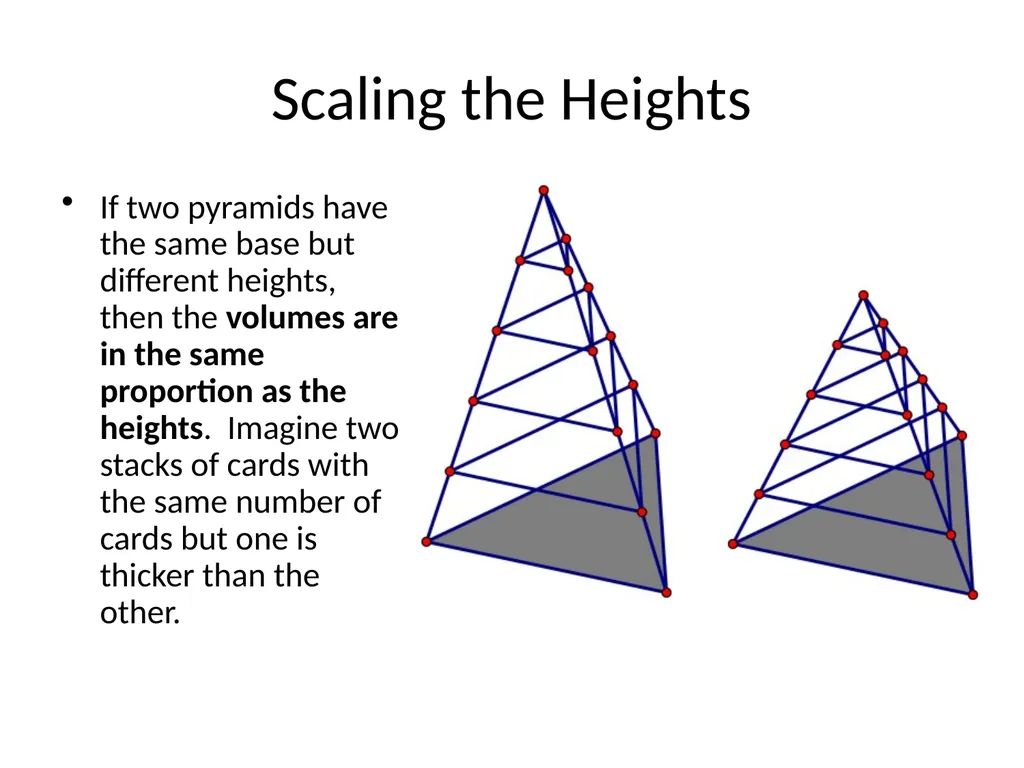
Scaling the Heights If two pyramids have the same base but different heights, then the volumes are in the same proportion as the heights. Imagine two stacks of cards with the same number of cards but one is thicker than the other.<br>
13
Changing the Base If two pyramids have bases of different shape but the same area, one can break up the bases (approximately) into congruent small squares whose area sum is approximately the area of the base, so if one knows the formula for square bases, the formula is true for all bases.
Thus Volume = (1/3) area of base x height holds for all “pyramids”.<br>
14
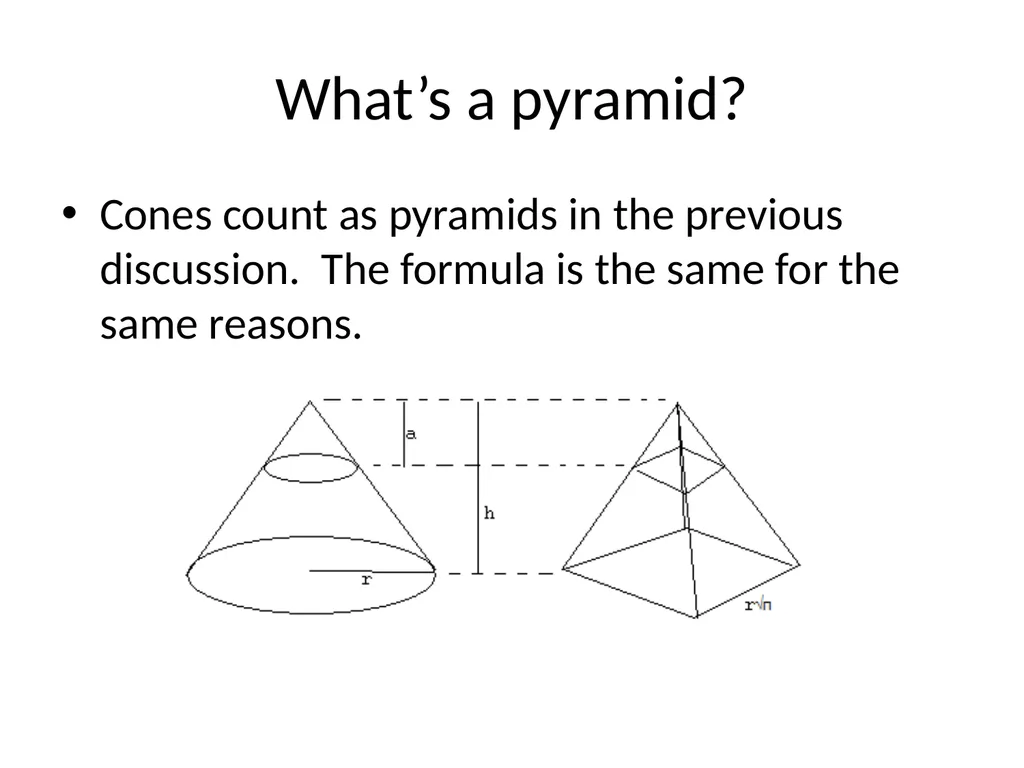
What’s a pyramid? Cones count as pyramids in the previous discussion. The formula is the same for the same reasons.<br>
15
When Cavalieri is NOT true Do NOT try to apply Cavalieri to areas of planes or surfaces in 3-space. This is just not true. Think of the example of a two slanting rectangles of the same height but different slope.<br>
16
Circle Area = (1/2) radius x circumference Instead of an arrangement of straight sticks, one can view a circle as a collection of concentric rings. When straightened, the area formula for a triangle becomes the area formula for a circle.<br>
17
Sphere Volume = (1/3) radius x spherical area The sphere can be cut (approximately) into pyramids. The “base area” = 4πr2.<br>
18
Even cooler proof of sphere volume Use the Pythagorean Theorem to see that these slices have the same area.<br>
19
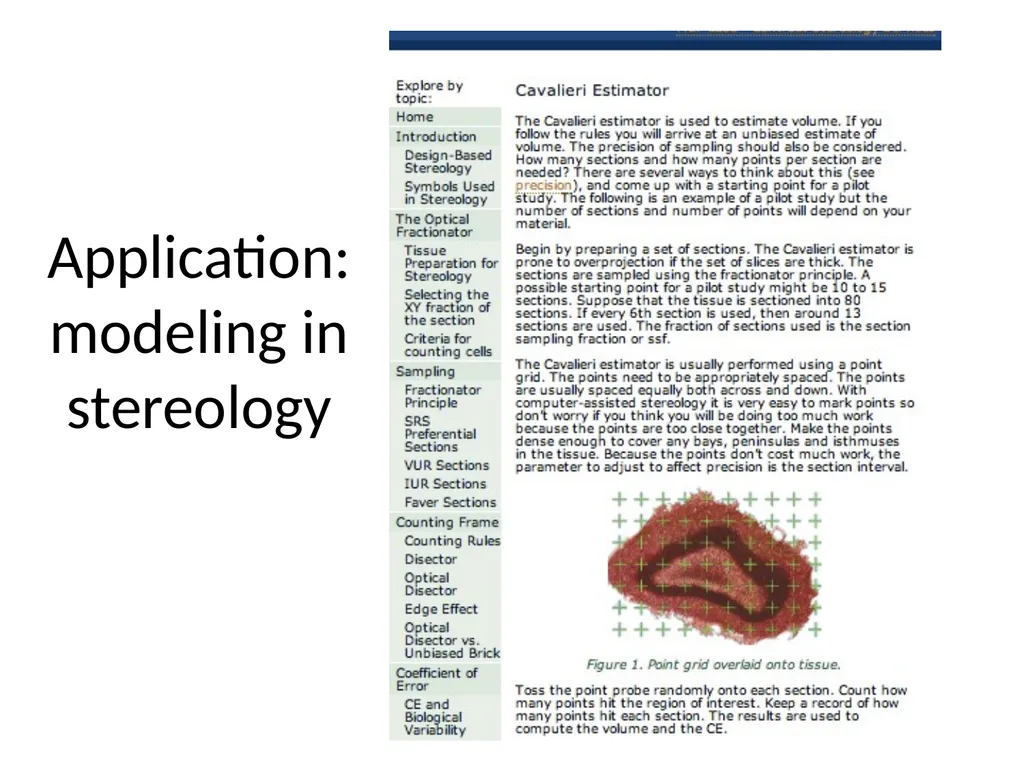
Application: modeling in stereology<br>
20
Thanks, Sr. Cavalieri … & Zu Geng Bonaventura Cavalieri(1598-1647) was an italian mathematician. He was a precursor of infinitesimal calculus. Cavalieri, Kepler and other mathematicians, who lived during the century preceding Newton and Leibniz, invented and used intuitive infinitesimal methods to solve area and volume problems.
Twenty years after the publication of Kepler's Stereometria Doliorum, Cavalieri wrote a very popular book: Geometria indivisibilibus (1635). In this book, the Italian mathematician used what is now known as Cavalieri's Principle.
Zu Geng, born about 450, was a chinese mathematician who used what is now know as the Principle of Liu Hui and Zu Geng to calculate the volume of a sphere. Liu-Zu theory is equivalent to Cavalieri's Principle.<br>