CD-JEV Japanese Encephalitis Vaccine Introduction Training Modules for Health Care Workers Module 3 JE vaccine eligibility Learning objectives At the end of the module, the participant will be able to: Describe the recommended immunization
"CD-JEV Japanese Encephalitis Vaccine Introduction" is the property of its rightful owner. Permission is granted to
download and print the materials on this website for personal, non-commercial use only, and to display it
on your personal computer provided you do not modify the materials and that you retain all copyright
notices contained in the materials. By downloading content from our website, you accept the terms of this
agreement.
Presentation Transcript
01
CD-JEV Japanese Encephalitis Vaccine Introduction Training Modules for Health Care Workers Module 3
JE vaccine eligibility<br>
02
Learning objectives At the end of the module, the participant will be able to:
Describe the recommended immunization schedule for CD-JEV.
Describe when a child is eligible for CD-JEV and when he/she is not eligible.
Describe the contraindications for vaccination.
Duration:
15 minutes<br>
03
Key issues<br>
04
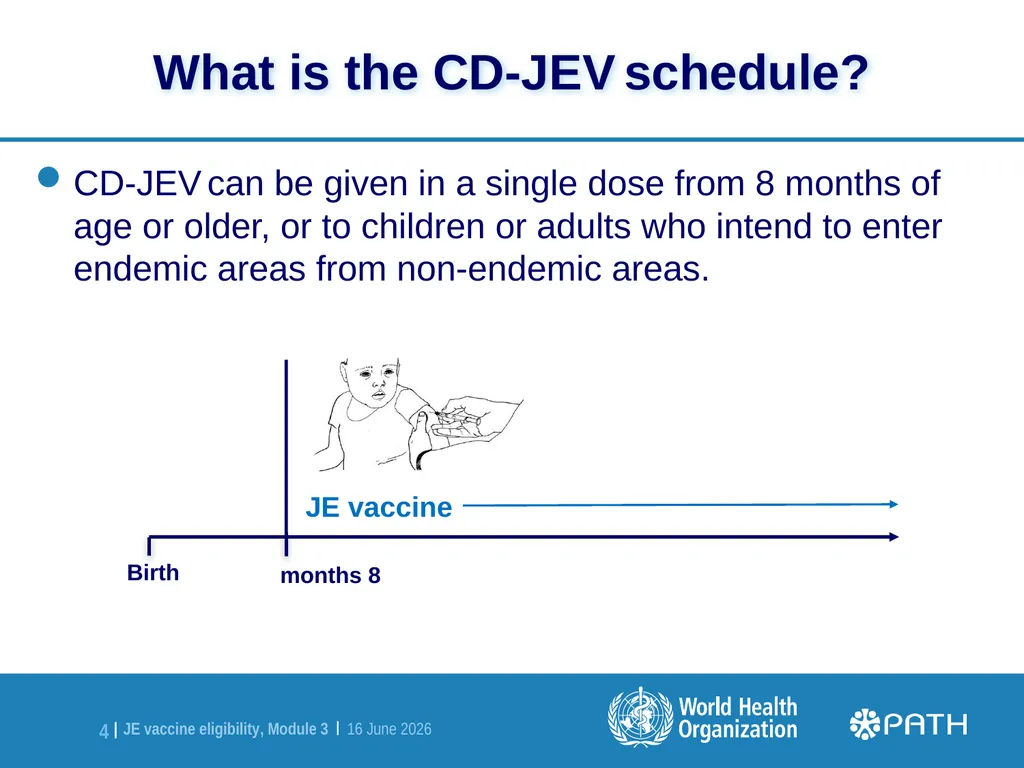
CD-JEV can be given in a single dose from 8 months of age or older, or to children or adults who intend to enter endemic areas from non-endemic areas. What is the CD-JEV schedule? 8 months Birth<br>
05
Children 8 months of age or older.
Adults travelling to endemic areas.
A child who has received a different JE vaccine in the past (e.g., mouse brain-derived JE vaccine), even more than once, can be vaccinated with CD-JEV. CD-JEV eligibility<br>
06
According to WHO, it is acceptable to give CD-JEV with other vaccines, such as measles and measles-rubella. No safety concerns have been identified in co-administration.
The preferred time to administer CD-JEV to children in JE-endemic areas is:
Close to the earliest recommended age (for maximum protection)
During other routine immunizations (for ease of administration) Can CD-JEV be given at the same time as other childhood vaccines?<br>
07
Precautions and contraindications (1/2)<br>
08
Precautions and contraindications (2/2) A very severe adverse reaction or a severe hypersensitivity reaction (anaphylaxis) to a prior dose of CD-JEV, or to any vaccine component (e.g., gelatin, gentamicin, kanamycin).
Fever higher than 38.5⁰C. Vaccination should be postponed and an appointment should be made for vaccination as soon as possible after the fever settles.
Immunosuppression (due to disease or medication) or having the signs and symptoms of AIDS.
Pregnant and lactating women: If the JE risk is sufficient to warrant vaccination of pregnant women, inactivated Vero cell-derived vaccines should be used preferentially over CD-JEV.<br>
09
Key messages CD-JEV should be given in a single dose at 8 months of age or older.
Vaccination should be postponed when a fever is higher than 38.5⁰C and not given if there has been a prior severe hypersensitivity reaction to any vaccine component.
It is safe to give CD-JEV to a patient with a mild illness.<br>
10
End of module Thank you for your attention! Next is Module 4: JE vaccine administration<br>