
CDC Science Ambassador Workshop 2014 Supplemental
CS
Published · 19 slides · 0 views
1 / 1
Description
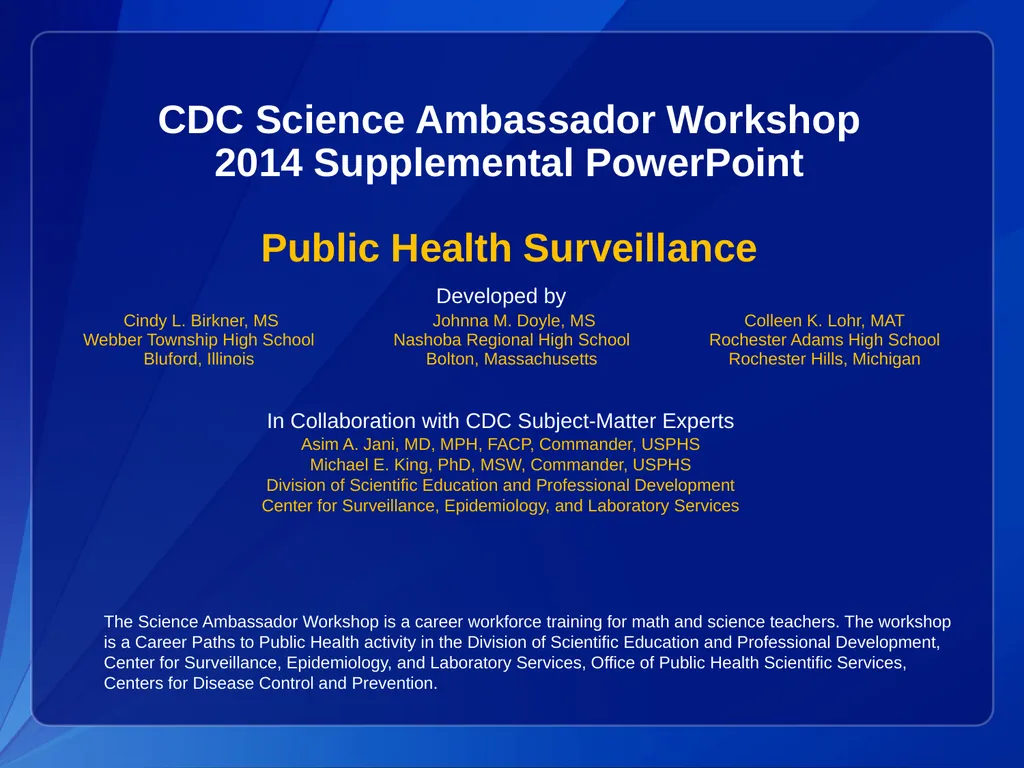
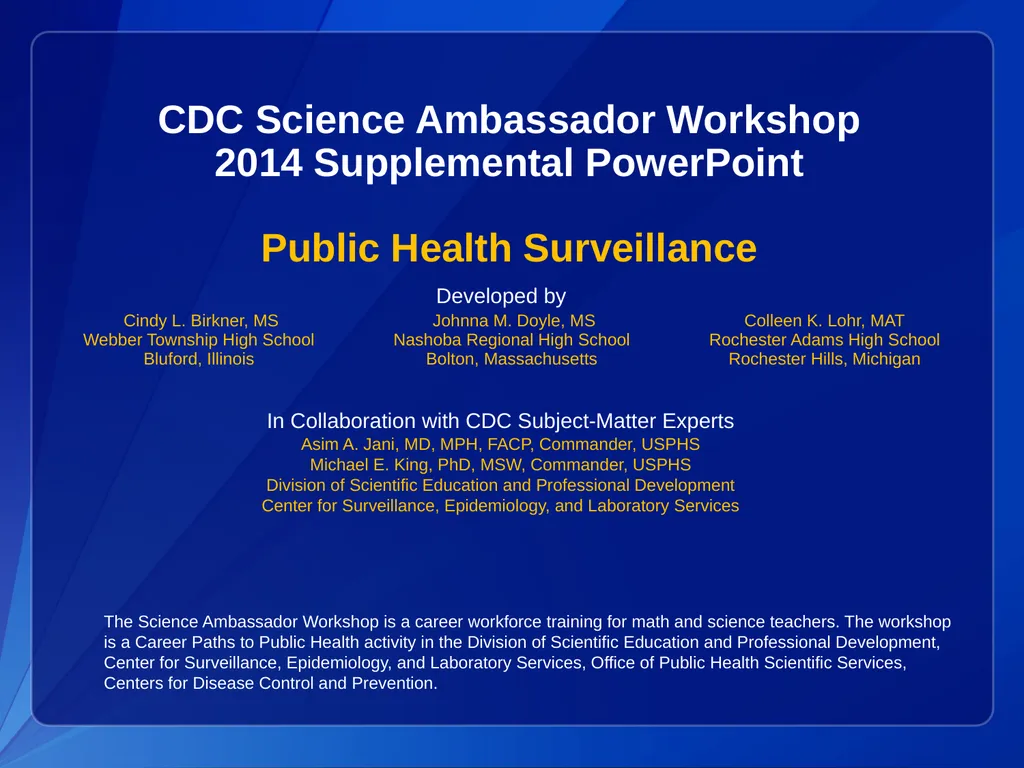
CDC Science Ambassador Workshop 2014 Supplemental PowerPoint Public Health Surveillance In Collaboration with CDC Subject-Matter Experts Asim A. Jani, MD, MPH, FACP, Commander, USPHS Michael E. King, PhD, MSW, Commander, USPHS Division of
Related Topics
Download this presentation From Below
"CDC Science Ambassador Workshop 2014 Supplemental" is the property of its rightful owner. Permission is granted to download and print the materials on this website for personal, non-commercial use only, and to display it on your personal computer provided you do not modify the materials and that you retain all copyright notices contained in the materials. By downloading content from our website, you accept the terms of this agreement.
Share
Embed code
Presentation Transcript
01
CDC Science Ambassador Workshop
2014 Supplemental PowerPoint
Public Health Surveillance In Collaboration with CDC Subject-Matter Experts
Asim A. Jani, MD, MPH, FACP, Commander, USPHS
Michael E. King, PhD, MSW, Commander, USPHS
Division of Scientific Education and Professional Development
Center for Surveillance, Epidemiology, and Laboratory Services Developed by The Science Ambassador Workshop is a career workforce training for math and science teachers. The workshop is a Career Paths to Public Health activity in the Division of Scientific Education and Professional Development, Center for Surveillance, Epidemiology, and Laboratory Services, Office of Public Health Scientific Services, Centers for Disease Control and Prevention.<br>
Asim A. Jani, MD, MPH, FACP, Commander, USPHS
Michael E. King, PhD, MSW, Commander, USPHS
Division of Scientific Education and Professional Development
Center for Surveillance, Epidemiology, and Laboratory Services Developed by The Science Ambassador Workshop is a career workforce training for math and science teachers. The workshop is a Career Paths to Public Health activity in the Division of Scientific Education and Professional Development, Center for Surveillance, Epidemiology, and Laboratory Services, Office of Public Health Scientific Services, Centers for Disease Control and Prevention.<br>
02
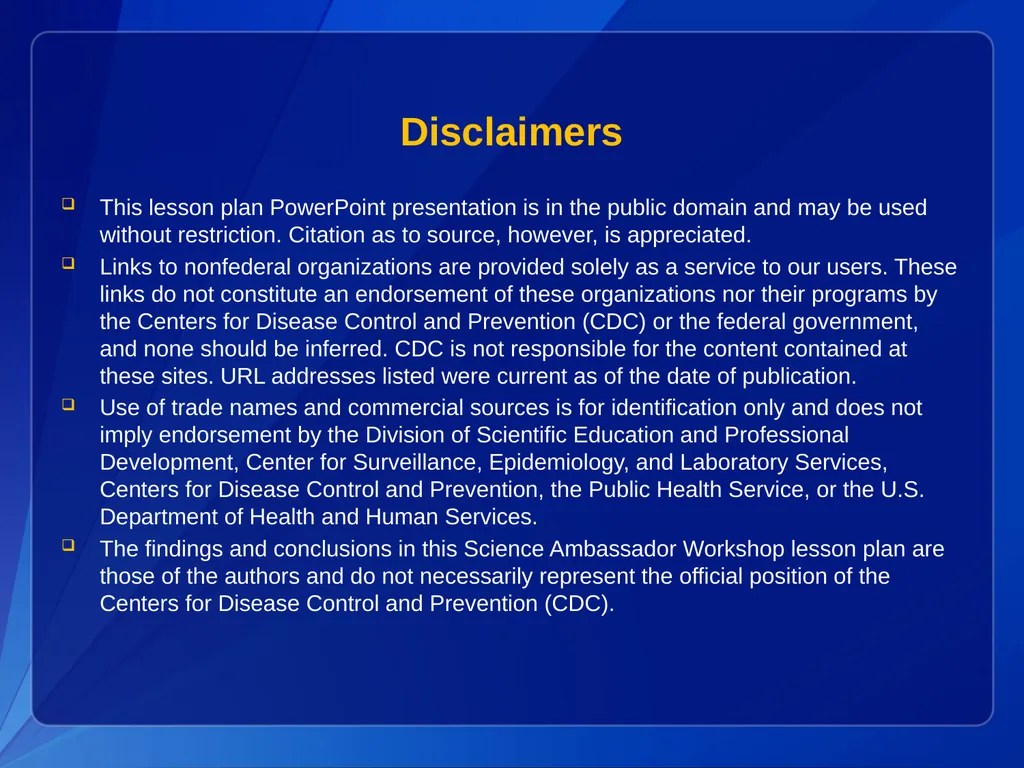
Disclaimers This lesson plan PowerPoint presentation is in the public domain and may be used without restriction. Citation as to source, however, is appreciated.
Links to nonfederal organizations are provided solely as a service to our users. These links do not constitute an endorsement of these organizations nor their programs by the Centers for Disease Control and Prevention (CDC) or the federal government, and none should be inferred. CDC is not responsible for the content contained at these sites. URL addresses listed were current as of the date of publication.
Use of trade names and commercial sources is for identification only and does not imply endorsement by the Division of Scientific Education and Professional Development, Center for Surveillance, Epidemiology, and Laboratory Services, Centers for Disease Control and Prevention, the Public Health Service, or the U.S. Department of Health and Human Services.
The findings and conclusions in this Science Ambassador Workshop lesson plan are those of the authors and do not necessarily represent the official position of the Centers for Disease Control and Prevention (CDC).<br>
Links to nonfederal organizations are provided solely as a service to our users. These links do not constitute an endorsement of these organizations nor their programs by the Centers for Disease Control and Prevention (CDC) or the federal government, and none should be inferred. CDC is not responsible for the content contained at these sites. URL addresses listed were current as of the date of publication.
Use of trade names and commercial sources is for identification only and does not imply endorsement by the Division of Scientific Education and Professional Development, Center for Surveillance, Epidemiology, and Laboratory Services, Centers for Disease Control and Prevention, the Public Health Service, or the U.S. Department of Health and Human Services.
The findings and conclusions in this Science Ambassador Workshop lesson plan are those of the authors and do not necessarily represent the official position of the Centers for Disease Control and Prevention (CDC).<br>
03
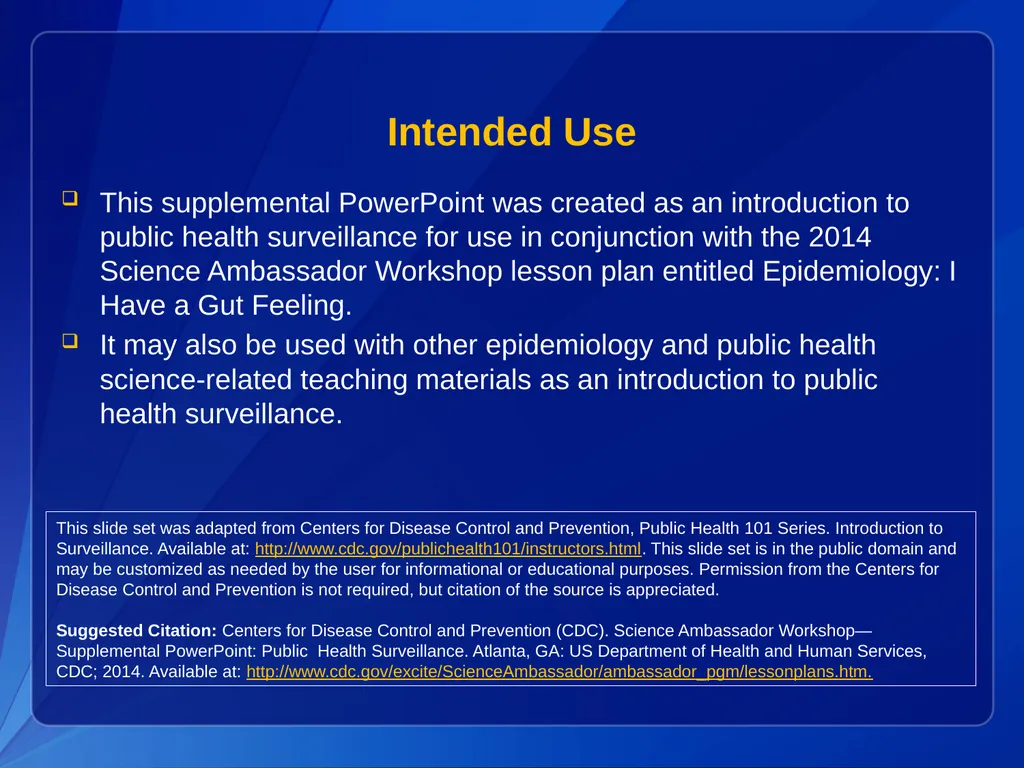
Intended Use This supplemental PowerPoint was created as an introduction to public health surveillance for use in conjunction with the 2014 Science Ambassador Workshop lesson plan entitled Epidemiology: I Have a Gut Feeling.
It may also be used with other epidemiology and public health science-related teaching materials as an introduction to public health surveillance. This slide set was adapted from Centers for Disease Control and Prevention, Public Health 101 Series. Introduction to Surveillance. Available at: http://www.cdc.gov/publichealth101/instructors.html. This slide set is in the public domain and may be customized as needed by the user for informational or educational purposes. Permission from the Centers for Disease Control and Prevention is not required, but citation of the source is appreciated.
Suggested Citation: Centers for Disease Control and Prevention (CDC). Science Ambassador Workshop—Supplemental PowerPoint: Public Health Surveillance. Atlanta, GA: US Department of Health and Human Services, CDC; 2014. Available at: http://www.cdc.gov/excite/ScienceAmbassador/ambassador_pgm/lessonplans.htm.<br>
It may also be used with other epidemiology and public health science-related teaching materials as an introduction to public health surveillance. This slide set was adapted from Centers for Disease Control and Prevention, Public Health 101 Series. Introduction to Surveillance. Available at: http://www.cdc.gov/publichealth101/instructors.html. This slide set is in the public domain and may be customized as needed by the user for informational or educational purposes. Permission from the Centers for Disease Control and Prevention is not required, but citation of the source is appreciated.
Suggested Citation: Centers for Disease Control and Prevention (CDC). Science Ambassador Workshop—Supplemental PowerPoint: Public Health Surveillance. Atlanta, GA: US Department of Health and Human Services, CDC; 2014. Available at: http://www.cdc.gov/excite/ScienceAmbassador/ambassador_pgm/lessonplans.htm.<br>
04
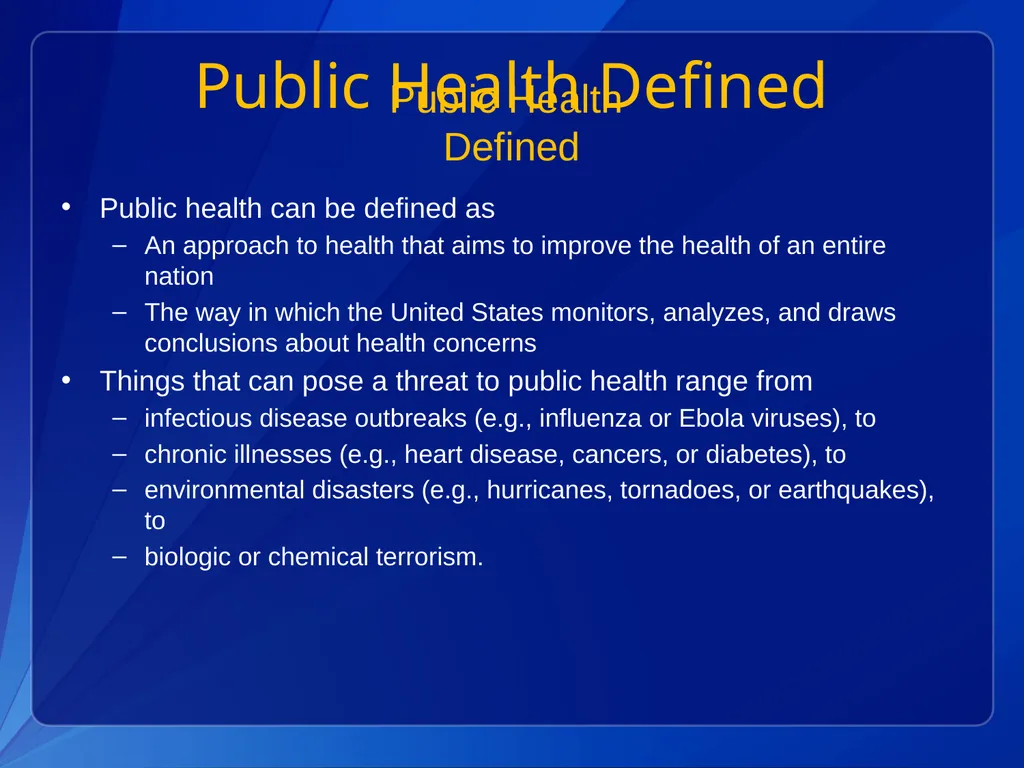
Public Health
Defined Public health can be defined as
An approach to health that aims to improve the health of an entire nation
The way in which the United States monitors, analyzes, and draws conclusions about health concerns
Things that can pose a threat to public health range from
infectious disease outbreaks (e.g., influenza or Ebola viruses), to
chronic illnesses (e.g., heart disease, cancers, or diabetes), to
environmental disasters (e.g., hurricanes, tornadoes, or earthquakes), to
biologic or chemical terrorism. Public Health Defined<br>
Defined Public health can be defined as
An approach to health that aims to improve the health of an entire nation
The way in which the United States monitors, analyzes, and draws conclusions about health concerns
Things that can pose a threat to public health range from
infectious disease outbreaks (e.g., influenza or Ebola viruses), to
chronic illnesses (e.g., heart disease, cancers, or diabetes), to
environmental disasters (e.g., hurricanes, tornadoes, or earthquakes), to
biologic or chemical terrorism. Public Health Defined<br>
05
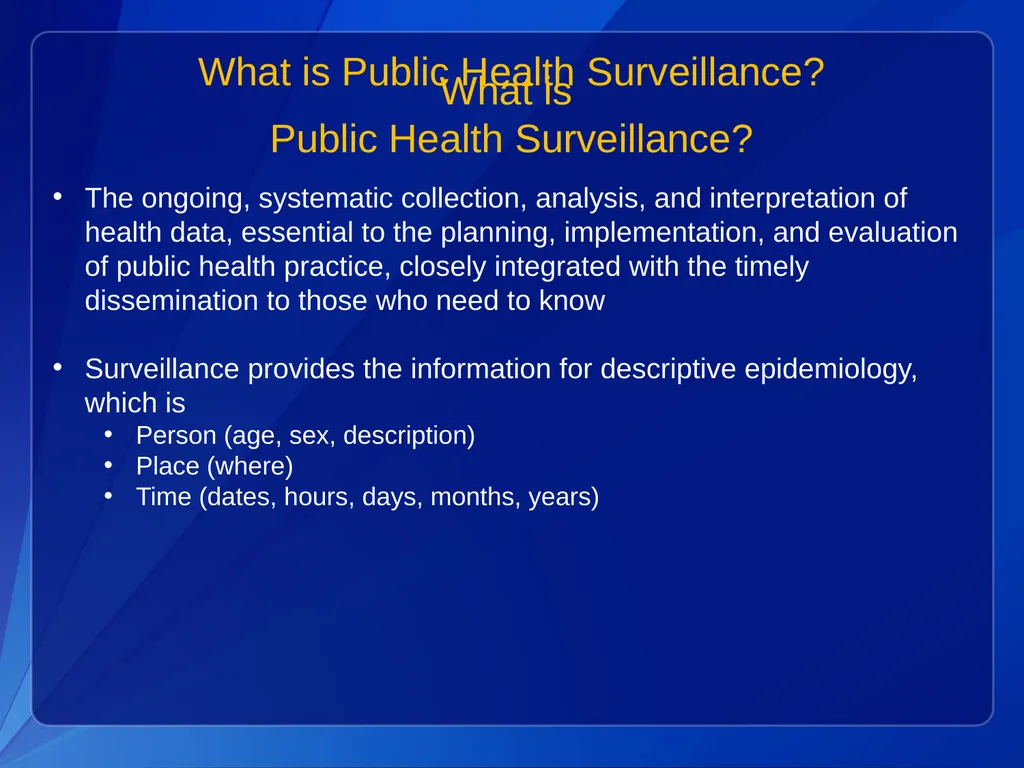
What is
Public Health Surveillance? The ongoing, systematic collection, analysis, and interpretation of health data, essential to the planning, implementation, and evaluation of public health practice, closely integrated with the timely dissemination to those who need to know
Surveillance provides the information for descriptive epidemiology, which is
Person (age, sex, description)
Place (where)
Time (dates, hours, days, months, years) What is Public Health Surveillance?<br>
Public Health Surveillance? The ongoing, systematic collection, analysis, and interpretation of health data, essential to the planning, implementation, and evaluation of public health practice, closely integrated with the timely dissemination to those who need to know
Surveillance provides the information for descriptive epidemiology, which is
Person (age, sex, description)
Place (where)
Time (dates, hours, days, months, years) What is Public Health Surveillance?<br>
06
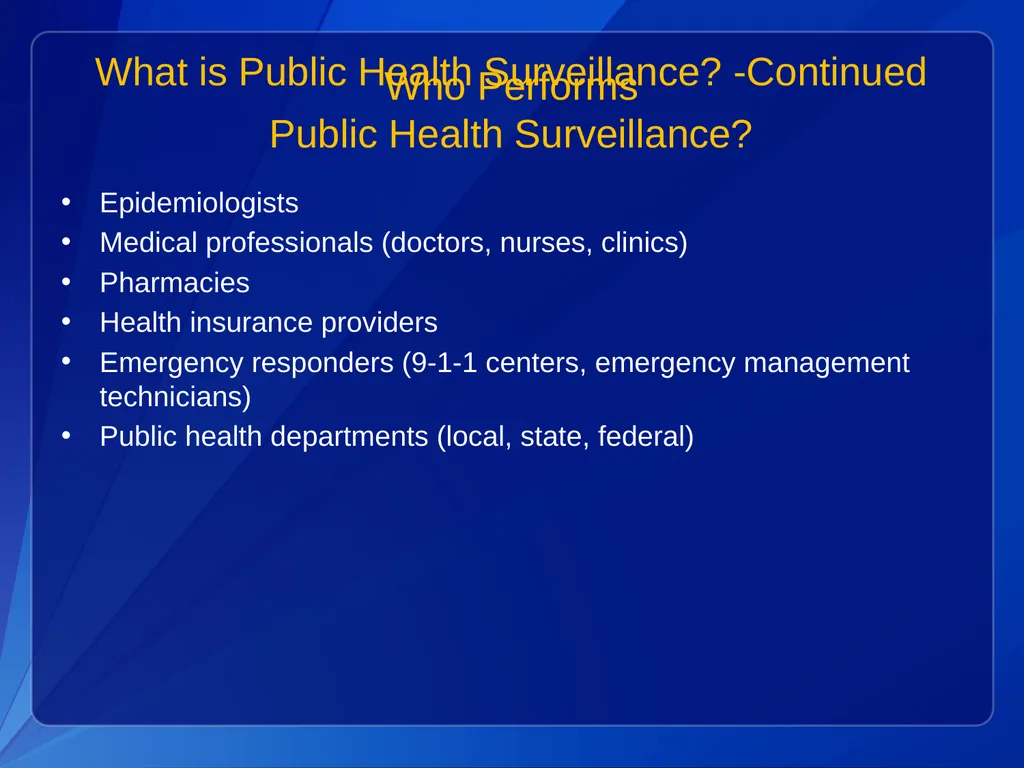
Who Performs
Public Health Surveillance? Epidemiologists
Medical professionals (doctors, nurses, clinics)
Pharmacies
Health insurance providers
Emergency responders (9-1-1 centers, emergency management technicians)
Public health departments (local, state, federal) What is Public Health Surveillance? -Continued<br>
Medical professionals (doctors, nurses, clinics)
Pharmacies
Health insurance providers
Emergency responders (9-1-1 centers, emergency management technicians)
Public health departments (local, state, federal) What is Public Health Surveillance? -Continued<br>
07
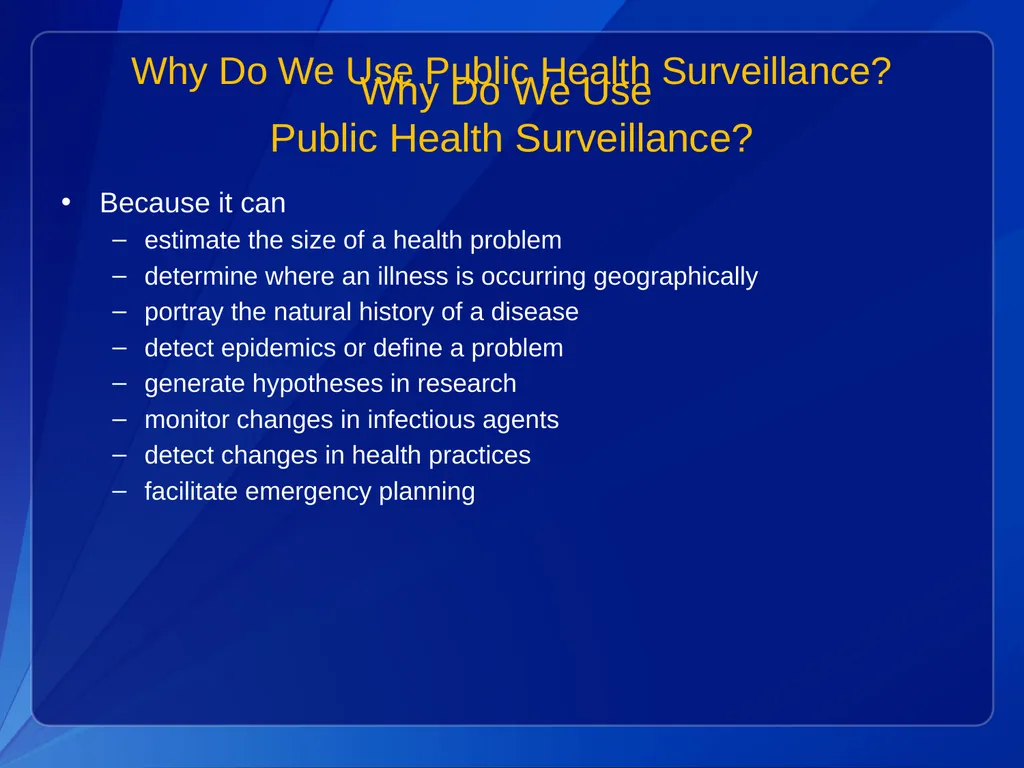
Why Do We Use
Public Health Surveillance? Because it can
estimate the size of a health problem
determine where an illness is occurring geographically
portray the natural history of a disease
detect epidemics or define a problem
generate hypotheses in research
monitor changes in infectious agents
detect changes in health practices
facilitate emergency planning Why Do We Use Public Health Surveillance?<br>
Public Health Surveillance? Because it can
estimate the size of a health problem
determine where an illness is occurring geographically
portray the natural history of a disease
detect epidemics or define a problem
generate hypotheses in research
monitor changes in infectious agents
detect changes in health practices
facilitate emergency planning Why Do We Use Public Health Surveillance?<br>
08
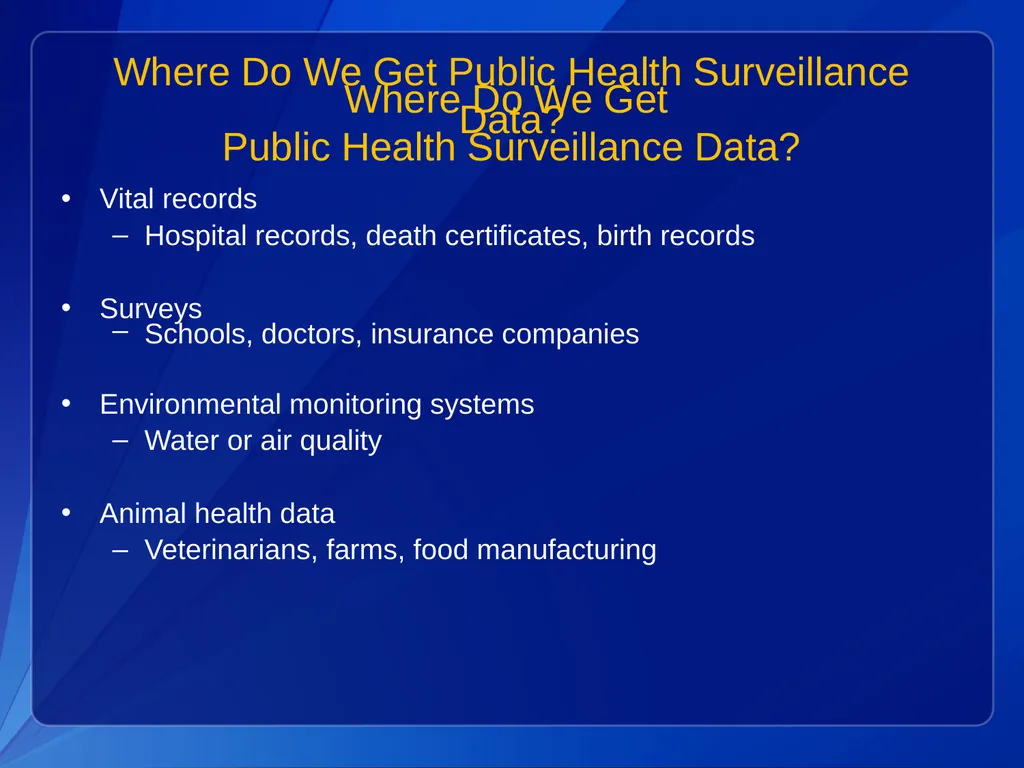
Where Do We Get
Public Health Surveillance Data? Vital records
Hospital records, death certificates, birth records
Surveys
Schools, doctors, insurance companies
Environmental monitoring systems
Water or air quality
Animal health data
Veterinarians, farms, food manufacturing Where Do We Get Public Health Surveillance Data?<br>
Public Health Surveillance Data? Vital records
Hospital records, death certificates, birth records
Surveys
Schools, doctors, insurance companies
Environmental monitoring systems
Water or air quality
Animal health data
Veterinarians, farms, food manufacturing Where Do We Get Public Health Surveillance Data?<br>
09
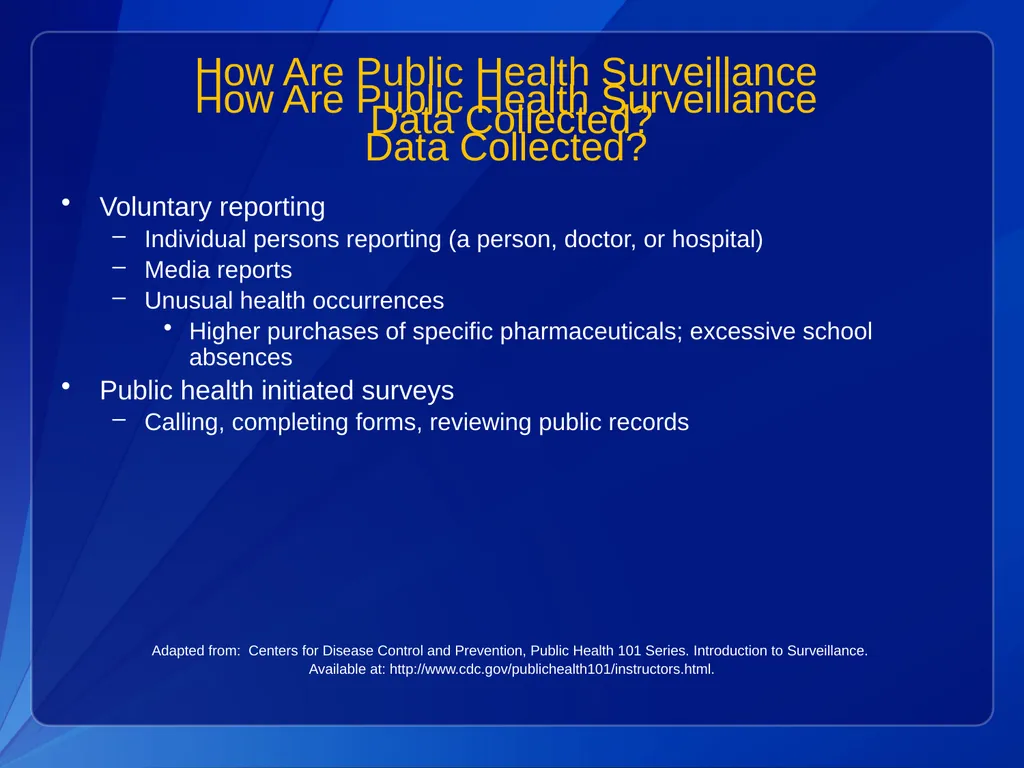
How Are Public Health Surveillance
Data Collected? Voluntary reporting
Individual persons reporting (a person, doctor, or hospital)
Media reports
Unusual health occurrences
Higher purchases of specific pharmaceuticals; excessive school absences
Public health initiated surveys
Calling, completing forms, reviewing public records
Adapted from: Centers for Disease Control and Prevention, Public Health 101 Series. Introduction to Surveillance.
Available at: http://www.cdc.gov/publichealth101/instructors.html. How Are Public Health Surveillance
Data Collected?<br>
Data Collected? Voluntary reporting
Individual persons reporting (a person, doctor, or hospital)
Media reports
Unusual health occurrences
Higher purchases of specific pharmaceuticals; excessive school absences
Public health initiated surveys
Calling, completing forms, reviewing public records
Adapted from: Centers for Disease Control and Prevention, Public Health 101 Series. Introduction to Surveillance.
Available at: http://www.cdc.gov/publichealth101/instructors.html. How Are Public Health Surveillance
Data Collected?<br>
10
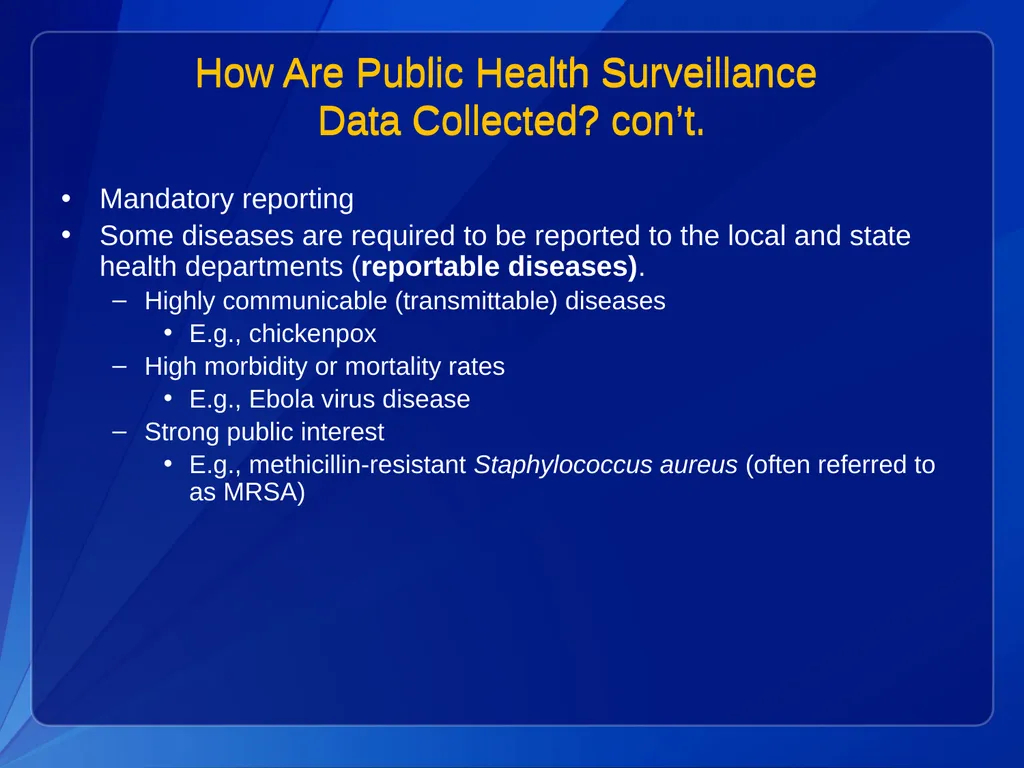
How Are Public Health Surveillance
Data Collected? con’t. Mandatory reporting
Some diseases are required to be reported to the local and state health departments (reportable diseases).
Highly communicable (transmittable) diseases
E.g., chickenpox
High morbidity or mortality rates
E.g., Ebola virus disease
Strong public interest
E.g., methicillin-resistant Staphylococcus aureus (often referred to as MRSA) How Are Public Health Surveillance
Data Collected? con’t.<br>
Data Collected? con’t. Mandatory reporting
Some diseases are required to be reported to the local and state health departments (reportable diseases).
Highly communicable (transmittable) diseases
E.g., chickenpox
High morbidity or mortality rates
E.g., Ebola virus disease
Strong public interest
E.g., methicillin-resistant Staphylococcus aureus (often referred to as MRSA) How Are Public Health Surveillance
Data Collected? con’t.<br>
11
Public Health Surveillance
Types Different ways of collecting surveillance data fall into 3 categories
Passive
Active
Syndromic Public Health Surveillance
Types<br>
Types Different ways of collecting surveillance data fall into 3 categories
Passive
Active
Syndromic Public Health Surveillance
Types<br>
12
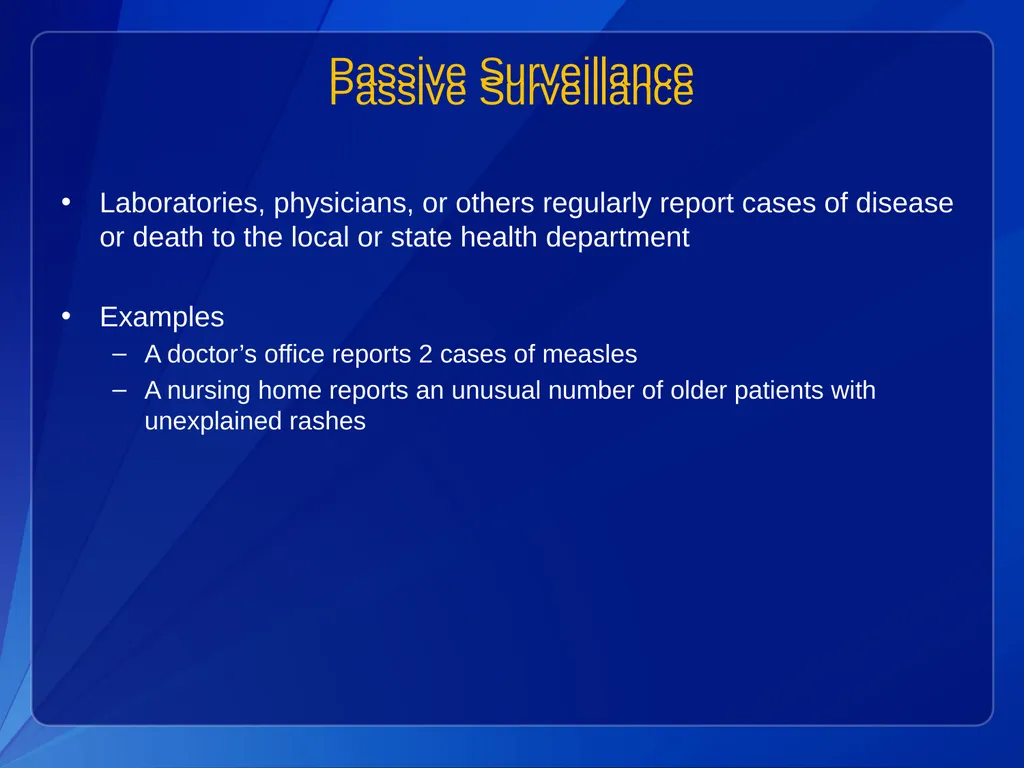
Passive Surveillance Laboratories, physicians, or others regularly report cases of disease or death to the local or state health department
Examples
A doctor’s office reports 2 cases of measles
A nursing home reports an unusual number of older patients with unexplained rashes Passive Surveillance<br>
Examples
A doctor’s office reports 2 cases of measles
A nursing home reports an unusual number of older patients with unexplained rashes Passive Surveillance<br>
13
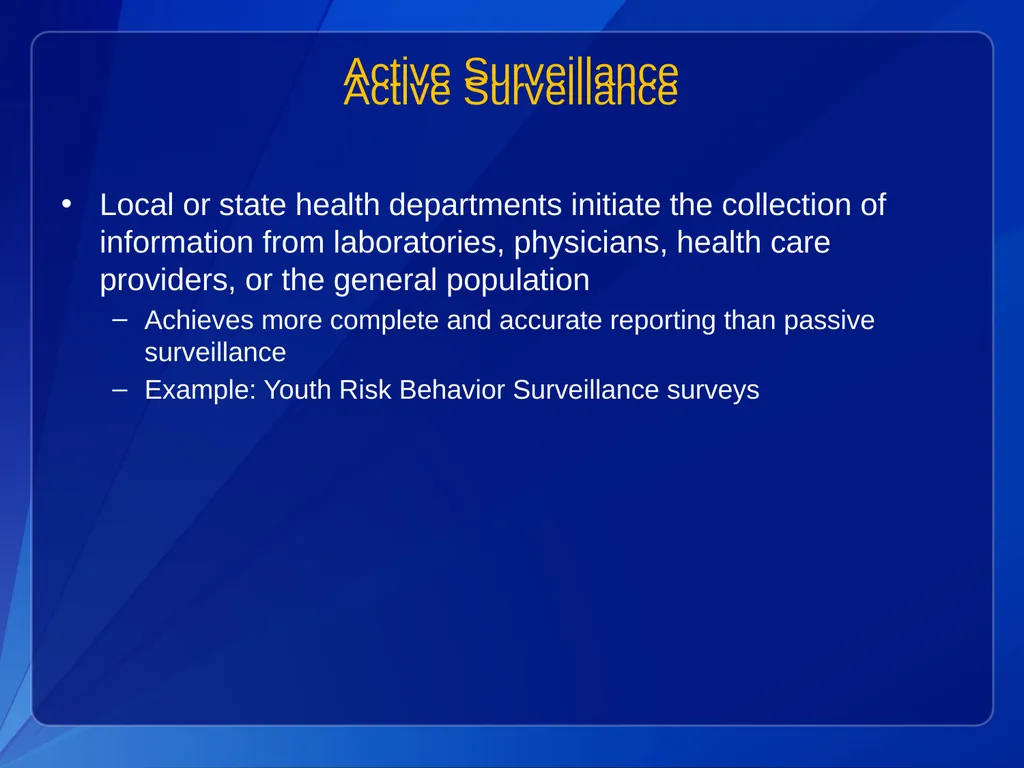
Active Surveillance Local or state health departments initiate the collection of information from laboratories, physicians, health care providers, or the general population
Achieves more complete and accurate reporting than passive surveillance
Example: Youth Risk Behavior Surveillance surveys Active Surveillance<br>
Achieves more complete and accurate reporting than passive surveillance
Example: Youth Risk Behavior Surveillance surveys Active Surveillance<br>
14
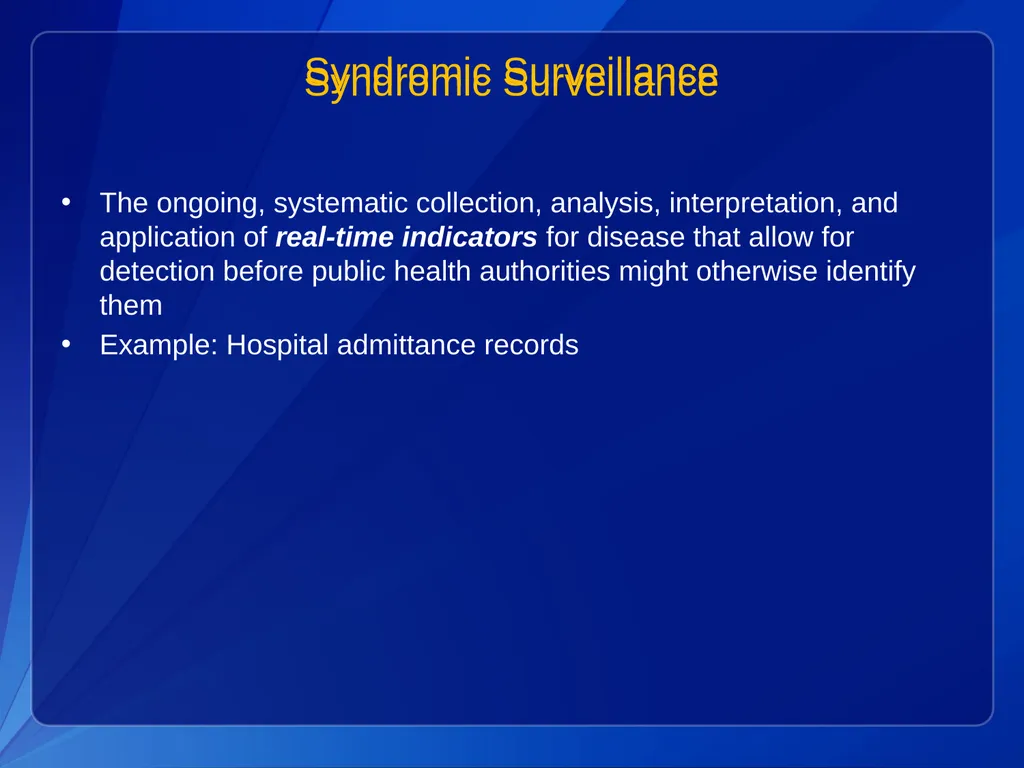
Syndromic Surveillance The ongoing, systematic collection, analysis, interpretation, and application of real-time indicators for disease that allow for detection before public health authorities might otherwise identify them
Example: Hospital admittance records Syndromic Surveillance<br>
Example: Hospital admittance records Syndromic Surveillance<br>
15
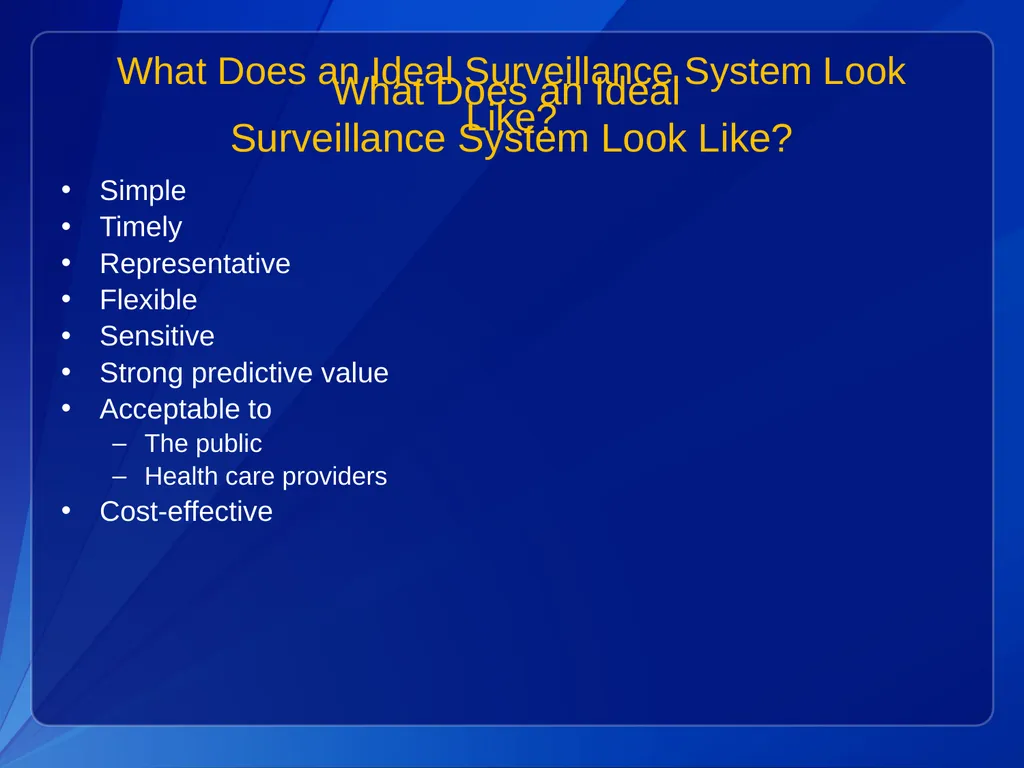
What Does an Ideal
Surveillance System Look Like? Simple
Timely
Representative
Flexible
Sensitive
Strong predictive value
Acceptable to
The public
Health care providers
Cost-effective What Does an Ideal Surveillance System Look Like?<br>
Surveillance System Look Like? Simple
Timely
Representative
Flexible
Sensitive
Strong predictive value
Acceptable to
The public
Health care providers
Cost-effective What Does an Ideal Surveillance System Look Like?<br>
16
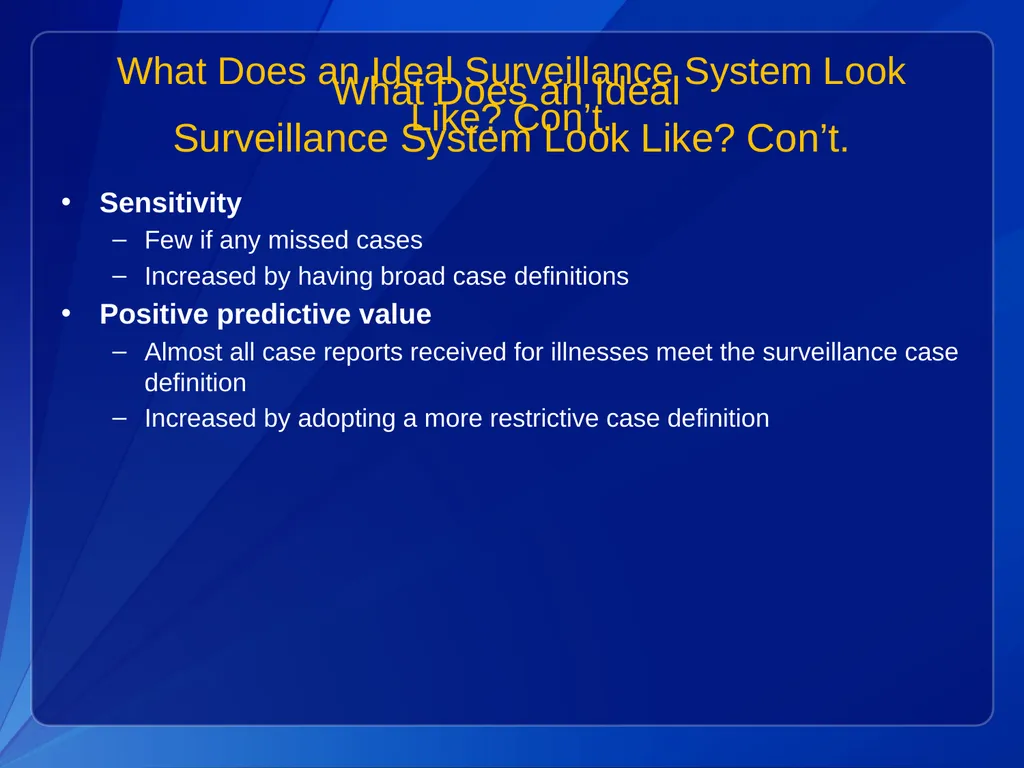
What Does an Ideal
Surveillance System Look Like? Con’t. Sensitivity
Few if any missed cases
Increased by having broad case definitions
Positive predictive value
Almost all case reports received for illnesses meet the surveillance case definition
Increased by adopting a more restrictive case definition What Does an Ideal Surveillance System Look Like? Con’t.<br>
Surveillance System Look Like? Con’t. Sensitivity
Few if any missed cases
Increased by having broad case definitions
Positive predictive value
Almost all case reports received for illnesses meet the surveillance case definition
Increased by adopting a more restrictive case definition What Does an Ideal Surveillance System Look Like? Con’t.<br>
17
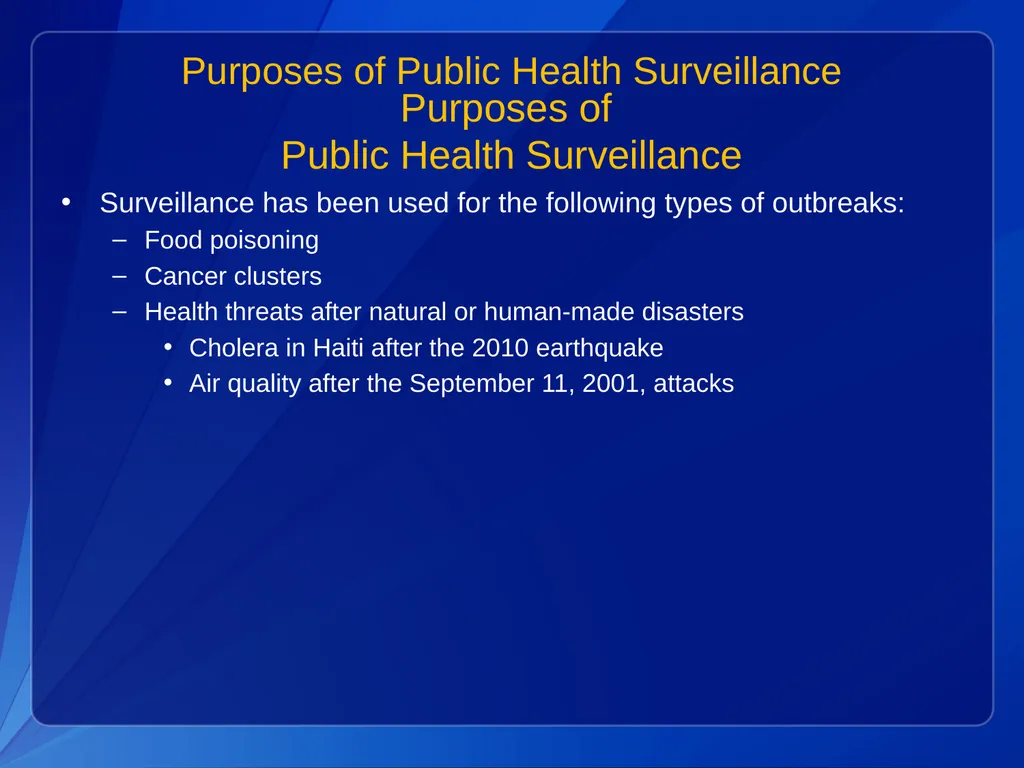
Purposes of
Public Health Surveillance Surveillance has been used for the following types of outbreaks:
Food poisoning
Cancer clusters
Health threats after natural or human-made disasters
Cholera in Haiti after the 2010 earthquake
Air quality after the September 11, 2001, attacks Purposes of Public Health Surveillance<br>
Public Health Surveillance Surveillance has been used for the following types of outbreaks:
Food poisoning
Cancer clusters
Health threats after natural or human-made disasters
Cholera in Haiti after the 2010 earthquake
Air quality after the September 11, 2001, attacks Purposes of Public Health Surveillance<br>
18
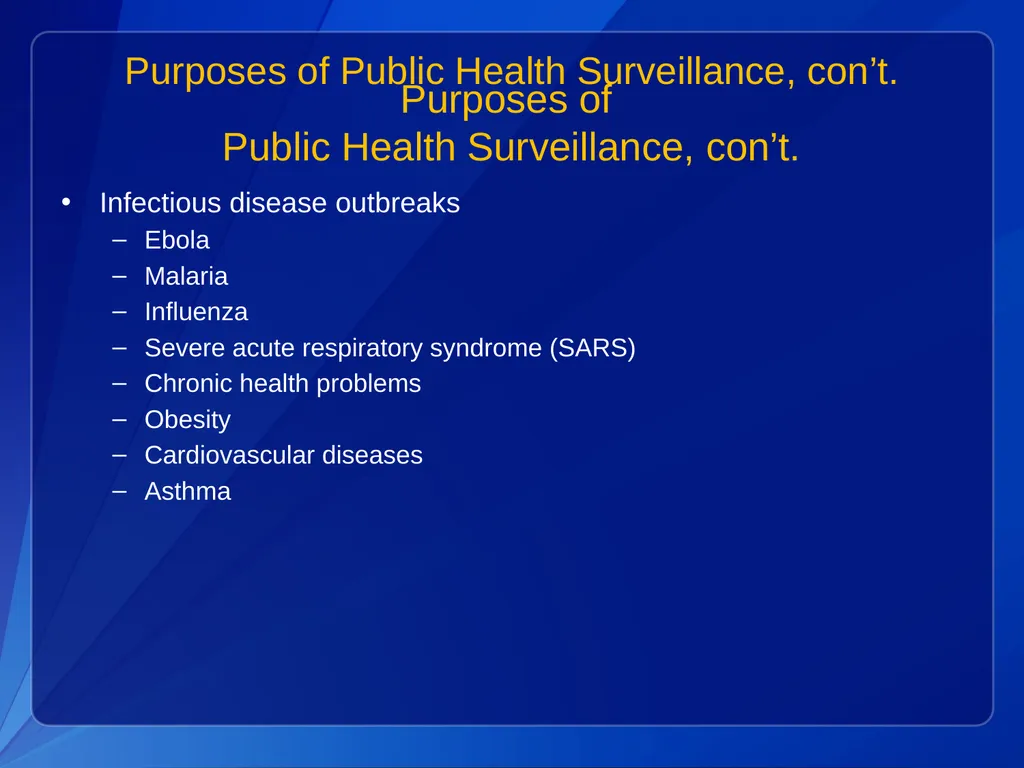
Purposes of
Public Health Surveillance, con’t. Infectious disease outbreaks
Ebola
Malaria
Influenza
Severe acute respiratory syndrome (SARS)
Chronic health problems
Obesity
Cardiovascular diseases
Asthma Purposes of Public Health Surveillance, con’t.<br>
Public Health Surveillance, con’t. Infectious disease outbreaks
Ebola
Malaria
Influenza
Severe acute respiratory syndrome (SARS)
Chronic health problems
Obesity
Cardiovascular diseases
Asthma Purposes of Public Health Surveillance, con’t.<br>
19
For more information, please contact the Centers for Disease Control and Prevention
Telephone: 1-800-CDC-INFO (232-4636)/TTY: 1-888-232-6348
Visit: http://www.cdc.gov | Contact CDC at: 1-800-CDC-INFO or http://www.cdc.gov/info
The findings and conclusions in this course are those of the authors and do not necessarily represent the official position of the Centers for Disease Control and Prevention. Please send questions and comments to
scienceambassador@cdc.gov. Please send questions and comments<br>
Telephone: 1-800-CDC-INFO (232-4636)/TTY: 1-888-232-6348
Visit: http://www.cdc.gov | Contact CDC at: 1-800-CDC-INFO or http://www.cdc.gov/info
The findings and conclusions in this course are those of the authors and do not necessarily represent the official position of the Centers for Disease Control and Prevention. Please send questions and comments to
scienceambassador@cdc.gov. Please send questions and comments<br>