
CDIC Taiwan’s Solution to Address Poor Data

Description: CDIC Taiwans Solution to Address Poor Data Quality Ying-Ying Lin Deputy Director 2 December, 2013 Outline Introduction of CDIC (Taiwan) Establishment of the E-data Files Inspection of the E-data Files Challenges and Conclusion 2 1.
Related Topics
Download Presentation
"CDIC Taiwan’s Solution to Address Poor Data" is the property of its rightful owner. Permission is granted to download and print the materials on this website for personal, non-commercial use only, and to display it on your personal computer provided you do not modify the materials and that you retain all copyright notices contained in the materials. By downloading content from our website, you accept the terms of this agreement.
Presentation Transcript
slide1. CDIC Taiwan’s Solution to Address Poor Data Quality Ying-Ying Lin
Deputy Director
2 December, 2013<br>
slide2. Outline Introduction of CDIC (Taiwan)
Establishment of the E-data Files
Inspection of the E-data Files
Challenges and Conclusion 2<br>
slide3. 1. Introduction of CDIC (Taiwan) 3<br>
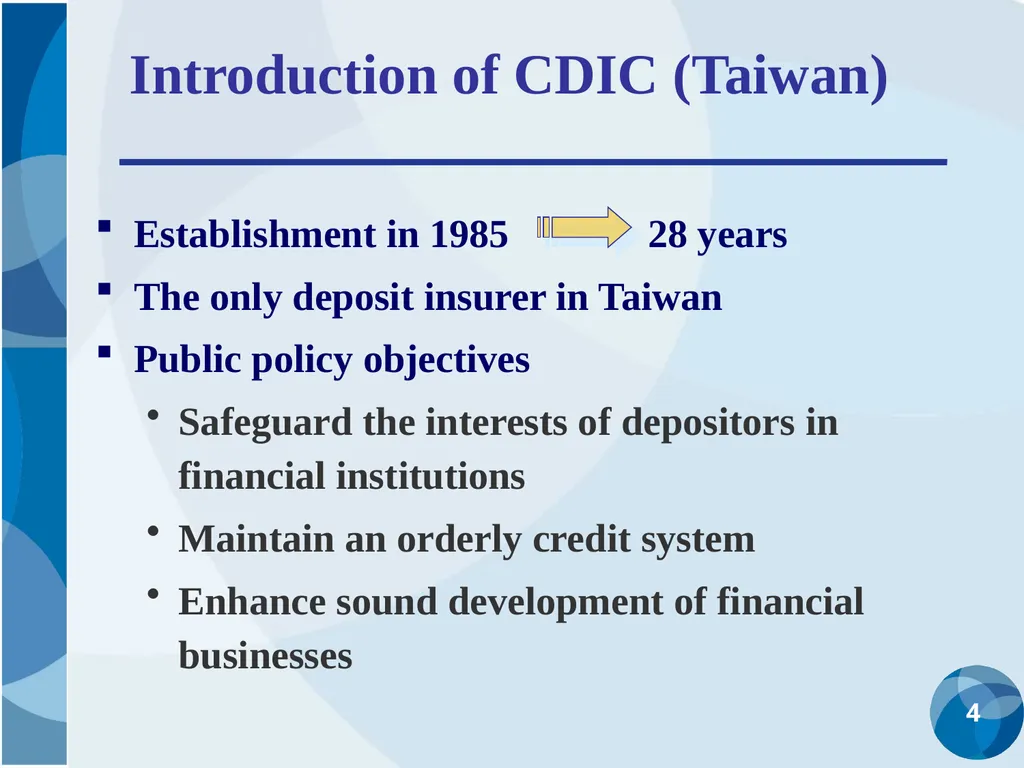
slide4. 4 Introduction of CDIC (Taiwan) Establishment in 1985 28 years
The only deposit insurer in Taiwan
Public policy objectives
Safeguard the interests of depositors in financial institutions
Maintain an orderly credit system
Enhance sound development of financial businesses<br>
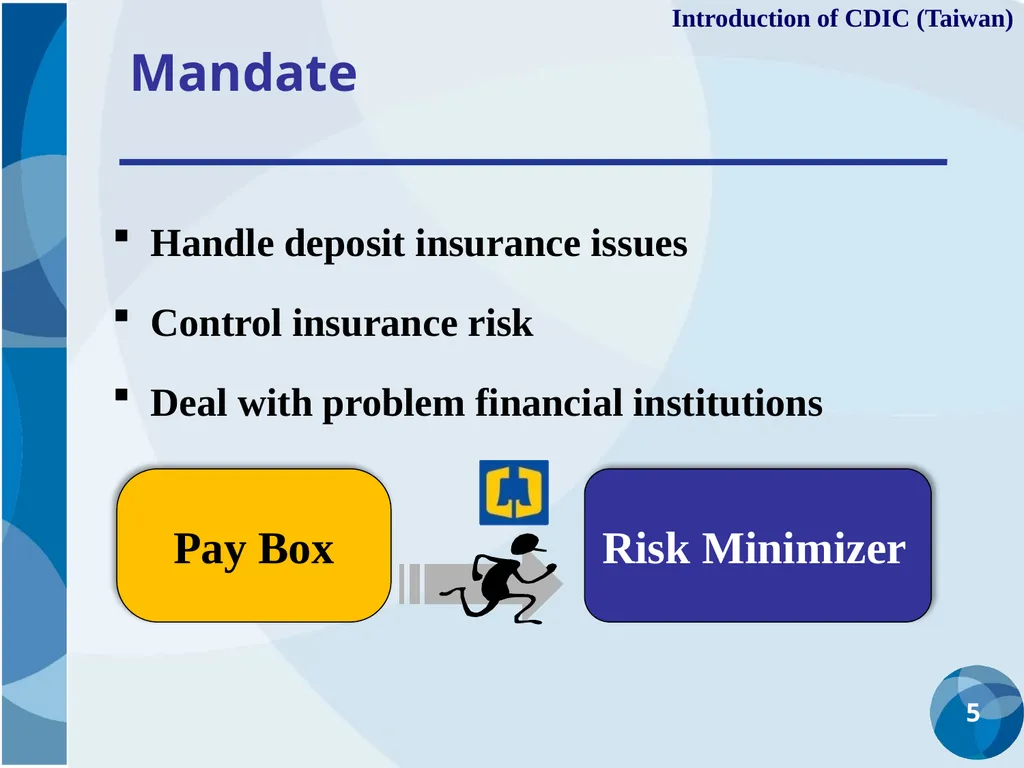
slide5. 5 Mandate Handle deposit insurance issues
Control insurance risk
Deal with problem financial institutions Pay Box Risk Minimizer Introduction of CDIC (Taiwan)<br>
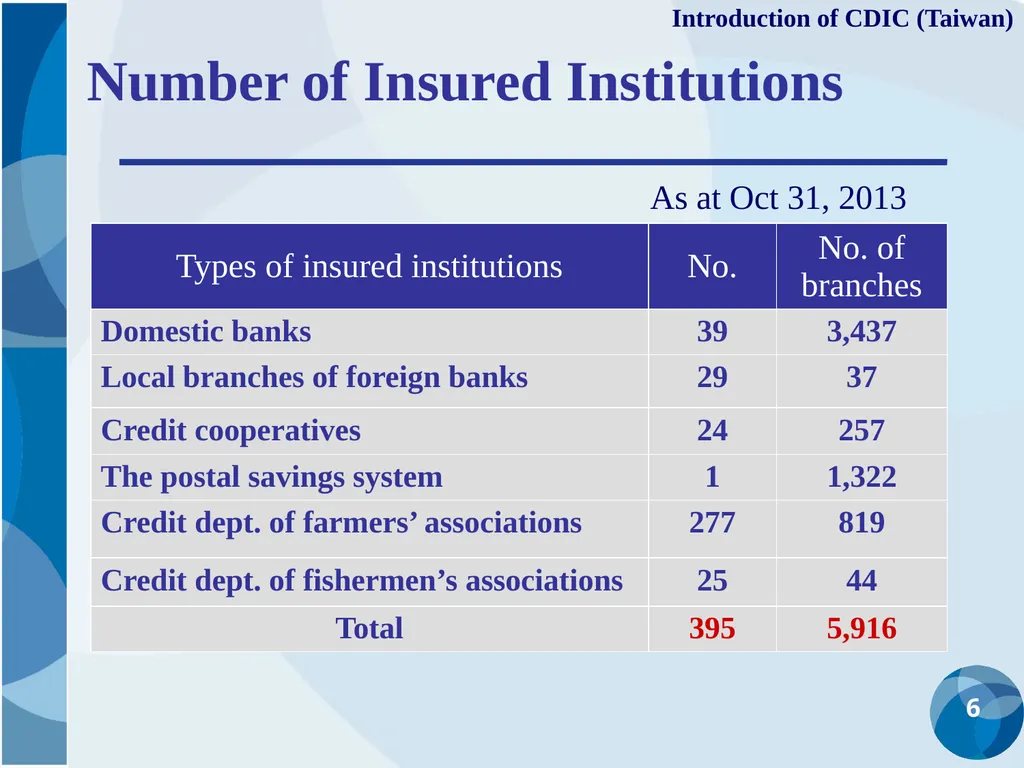
slide6. 6 Number of Insured Institutions As at Oct 31, 2013 Introduction of CDIC (Taiwan)<br>
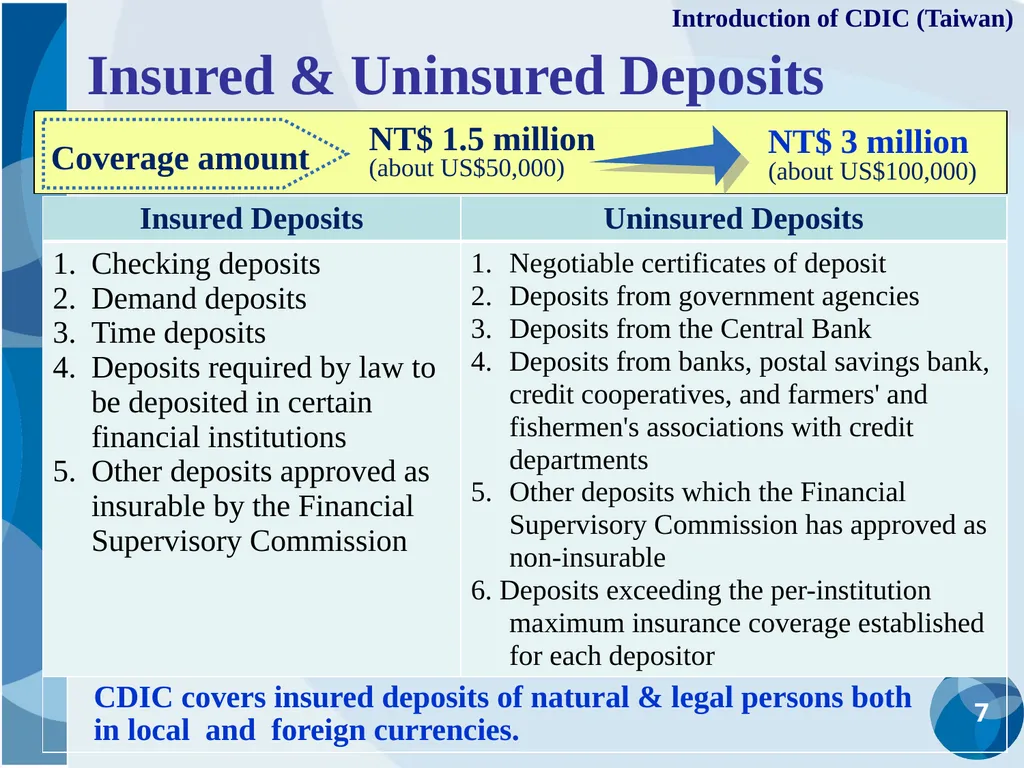
slide7. Insured & Uninsured Deposits Introduction of CDIC (Taiwan) 7<br>
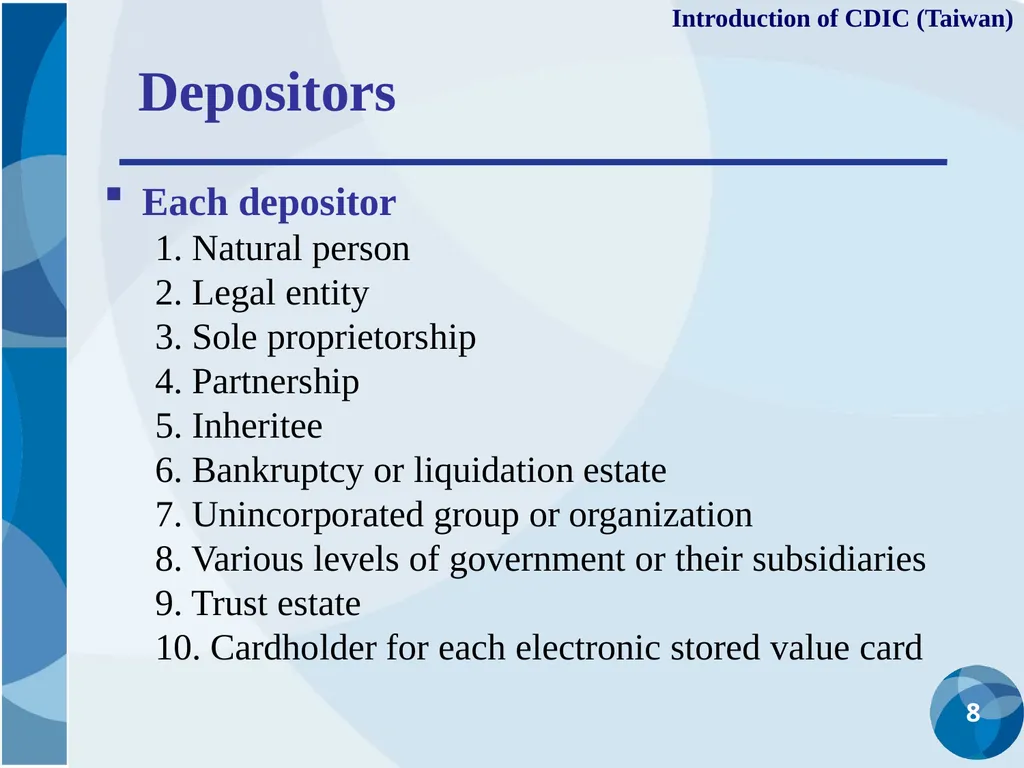
slide8. 8 Depositors Each depositor
1. Natural person
2. Legal entity
3. Sole proprietorship
4. Partnership
5. Inheritee
6. Bankruptcy or liquidation estate
7. Unincorporated group or organization
8. Various levels of government or their subsidiaries
9. Trust estate
10. Cardholder for each electronic stored value card Introduction of CDIC (Taiwan)<br>
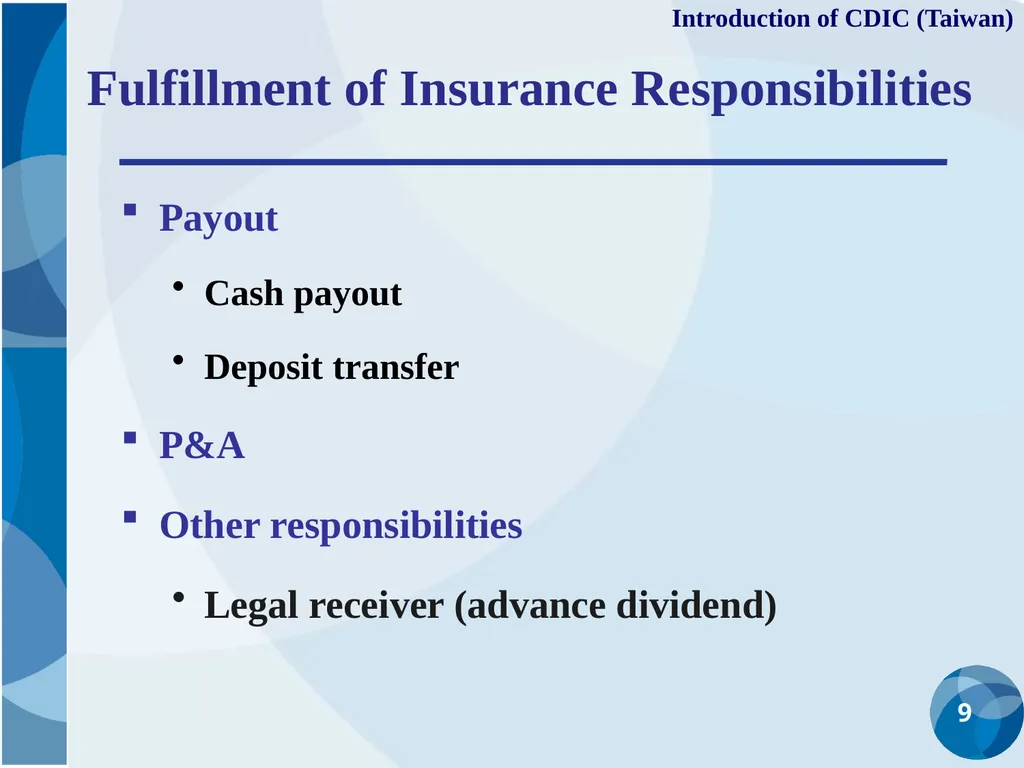
slide9. 9 Fulfillment of Insurance Responsibilities Payout
Cash payout
Deposit transfer
P&A
Other responsibilities
Legal receiver (advance dividend) Introduction of CDIC (Taiwan)<br>
slide10. 2. Establishment of
the E-data Files 10<br>
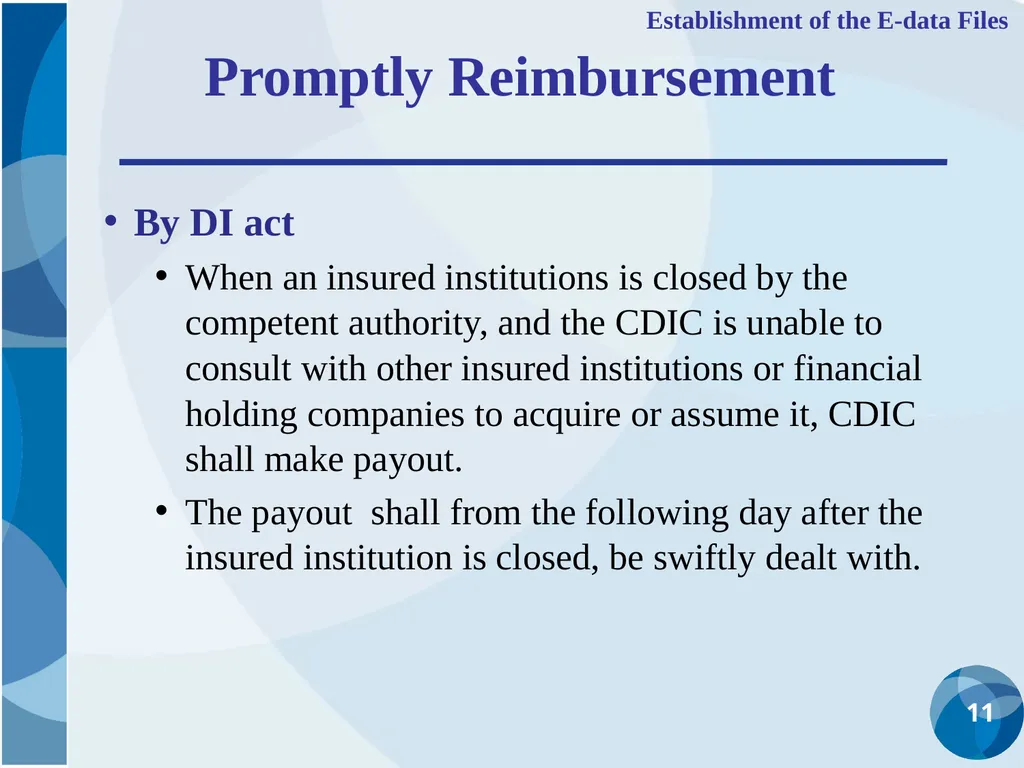
slide11. By DI act
When an insured institutions is closed by the competent authority, and the CDIC is unable to consult with other insured institutions or financial holding companies to acquire or assume it, CDIC shall make payout.
The payout shall from the following day after the insured institution is closed, be swiftly dealt with. 11 Promptly Reimbursement Establishment of the E-data Files<br>
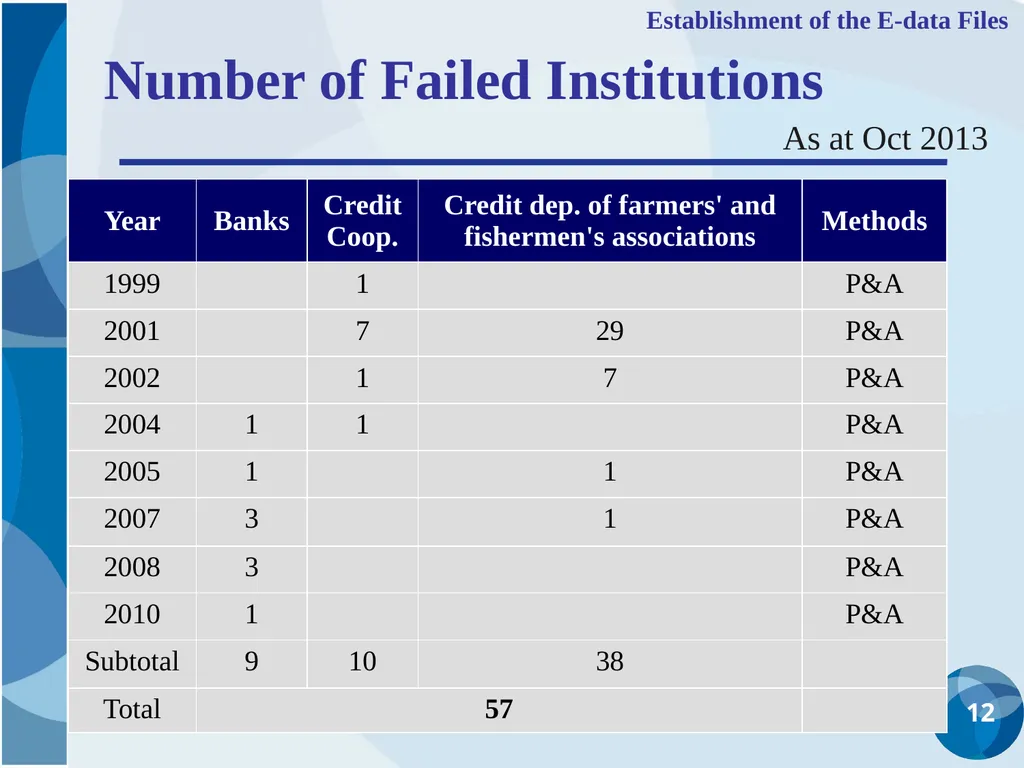
slide12. 12 Number of Failed Institutions As at Oct 2013 Establishment of the E-data Files<br>
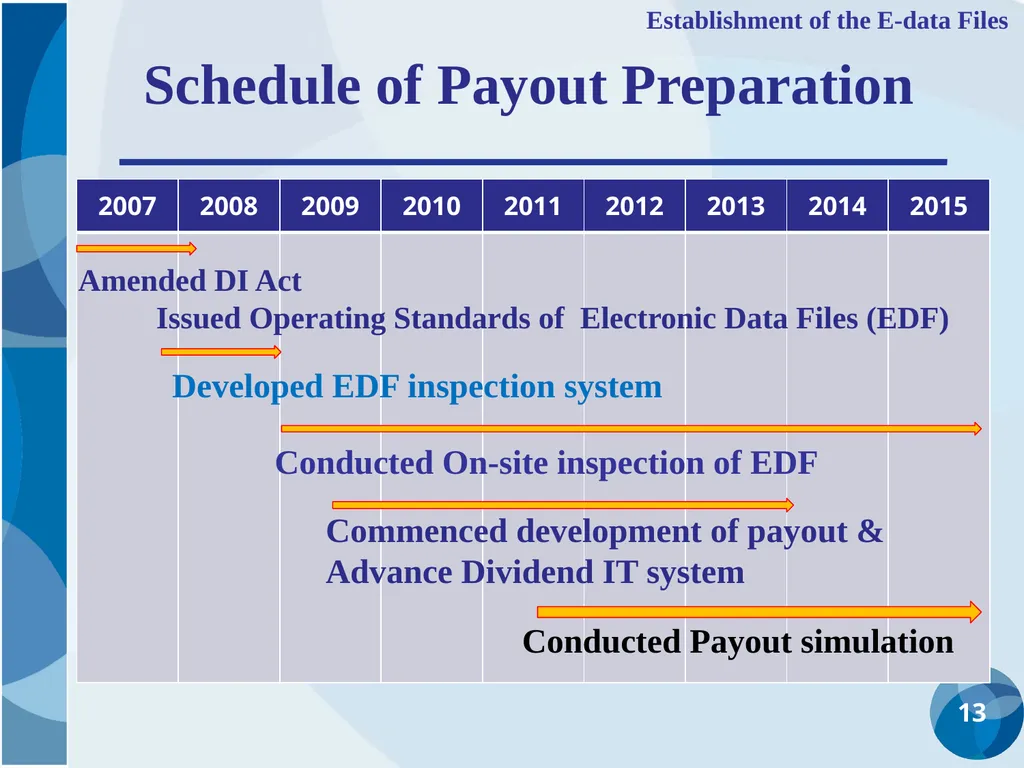
slide13. Schedule of Payout Preparation 13 Amended DI Act
Issued Operating Standards of Electronic Data Files (EDF) Developed EDF inspection system Conducted On-site inspection of EDF Commenced development of payout & Advance Dividend IT system Conducted Payout simulation Establishment of the E-data Files<br>
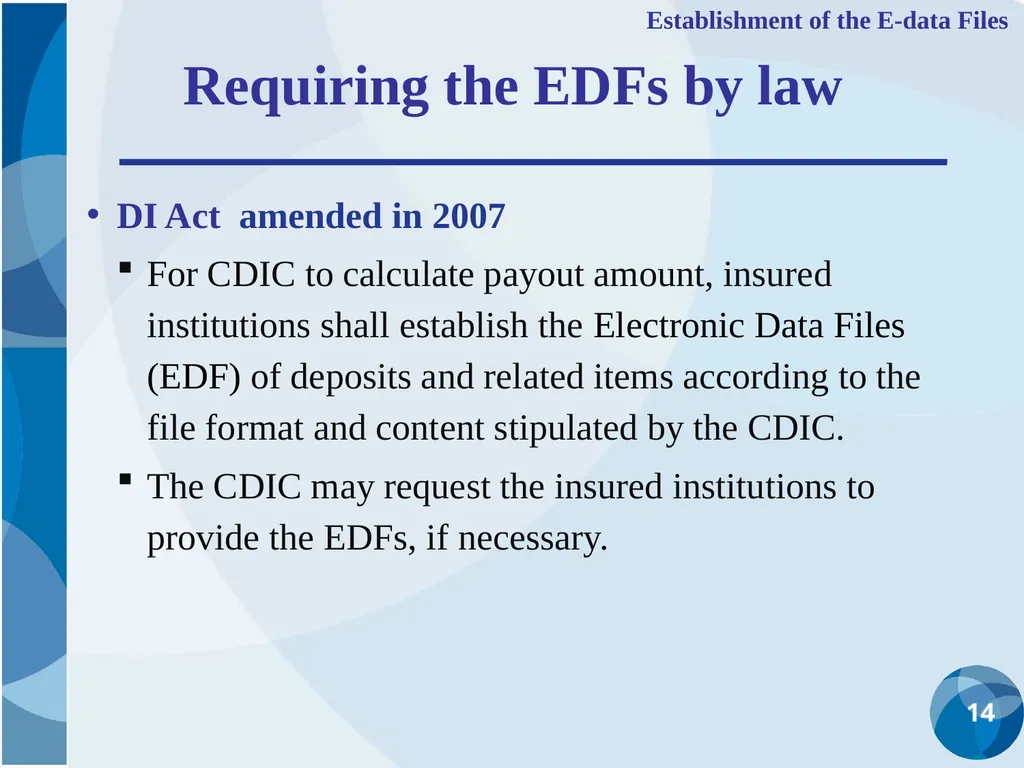
slide14. DI Act amended in 2007
For CDIC to calculate payout amount, insured institutions shall establish the Electronic Data Files (EDF) of deposits and related items according to the file format and content stipulated by the CDIC.
The CDIC may request the insured institutions to provide the EDFs, if necessary. 14 Requiring the EDFs by law Establishment of the E-data Files<br>
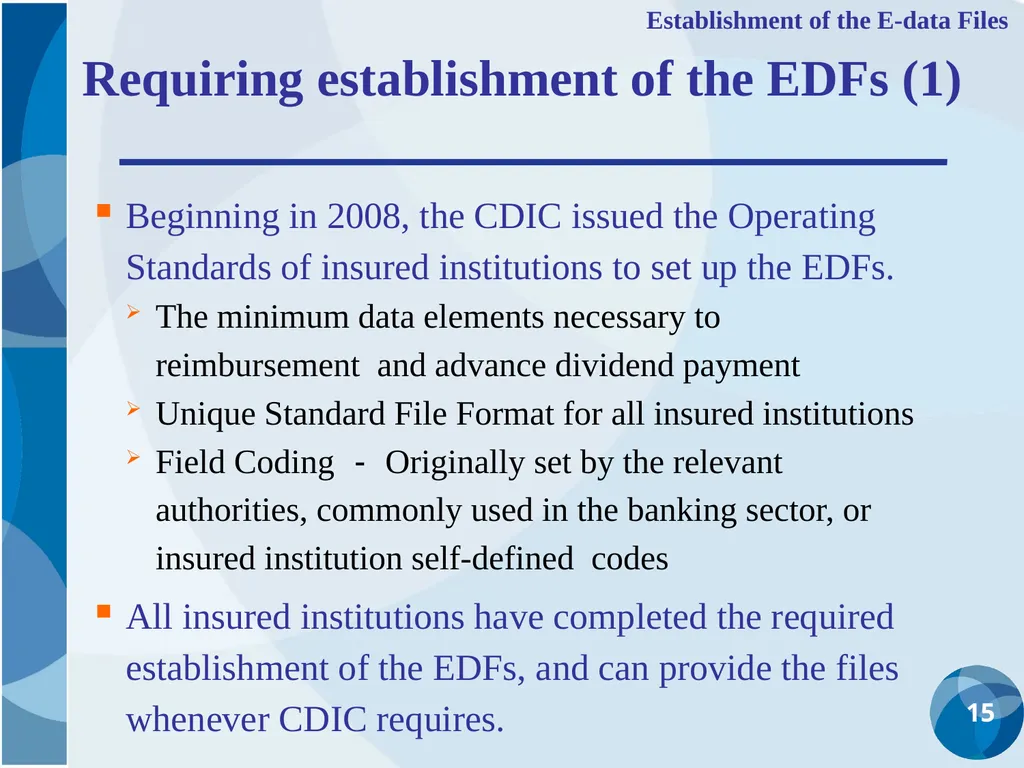
slide15. Requiring establishment of the EDFs (1) Beginning in 2008, the CDIC issued the Operating Standards of insured institutions to set up the EDFs.
The minimum data elements necessary to reimbursement and advance dividend payment
Unique Standard File Format for all insured institutions
Field Coding-Originally set by the relevant authorities, commonly used in the banking sector, or insured institution self-defined codes
All insured institutions have completed the required establishment of the EDFs, and can provide the files whenever CDIC requires. 15 Establishment of the E-data Files<br>
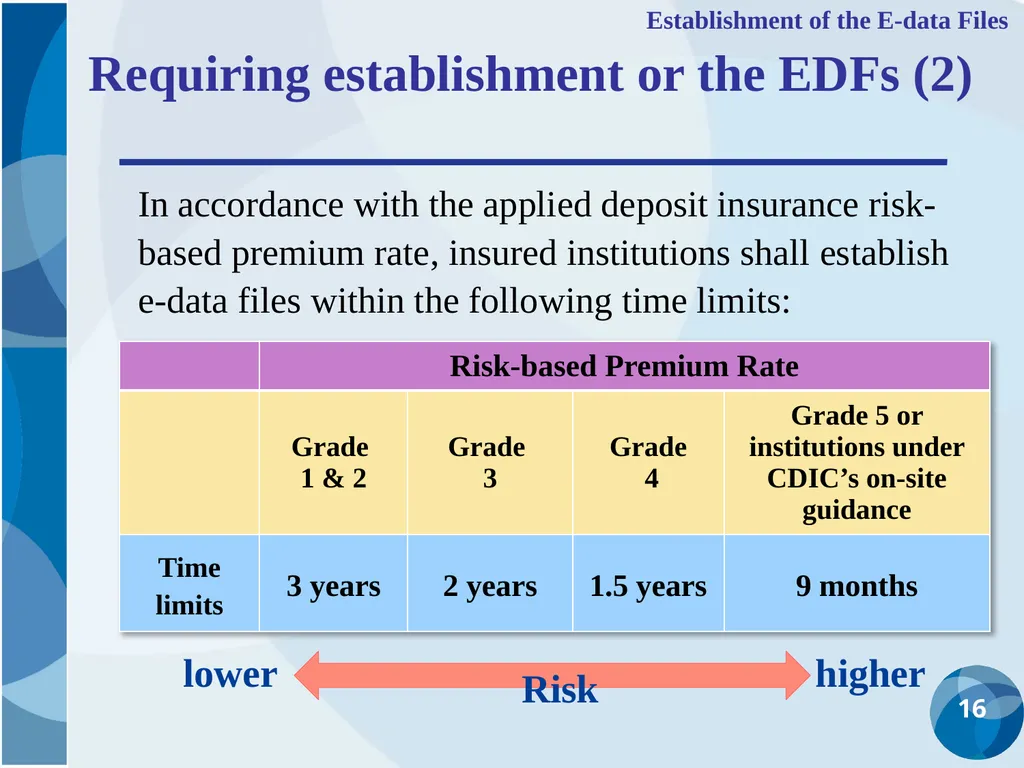
slide16. 16 In accordance with the applied deposit insurance risk-based premium rate, insured institutions shall establish e-data files within the following time limits: Requiring establishment or the EDFs (2) Risk lower higher Establishment of the E-data Files<br>
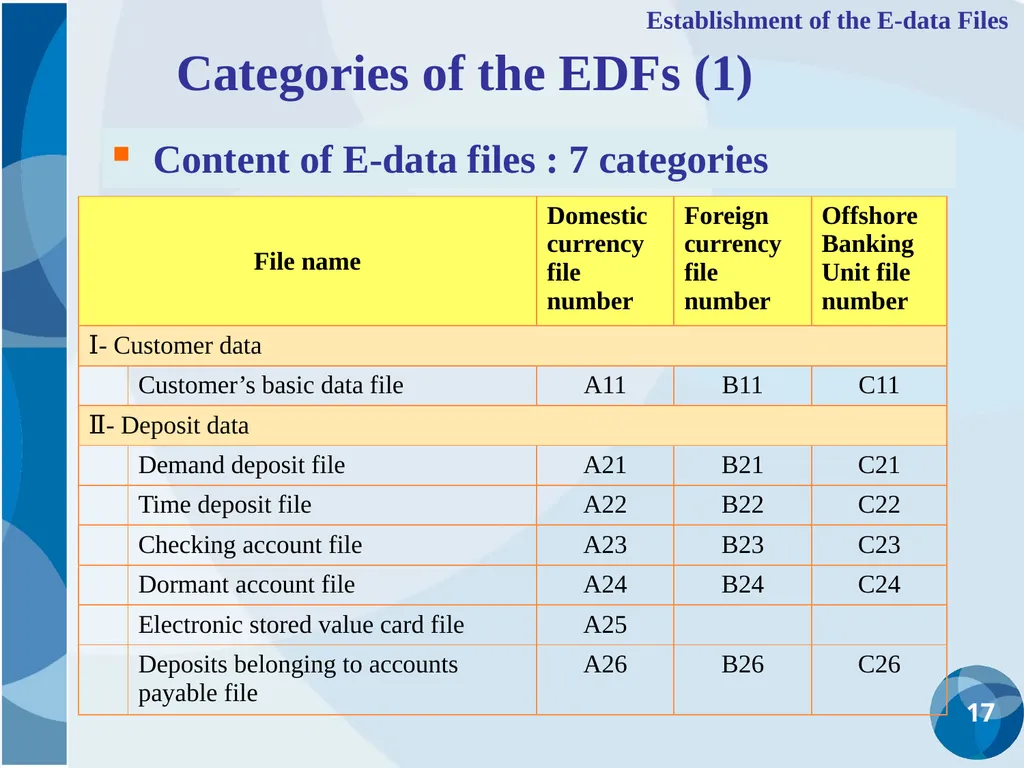
slide17. 17 Categories of the EDFs (1) Content of E-data files : 7 categories Establishment of the E-data Files<br>
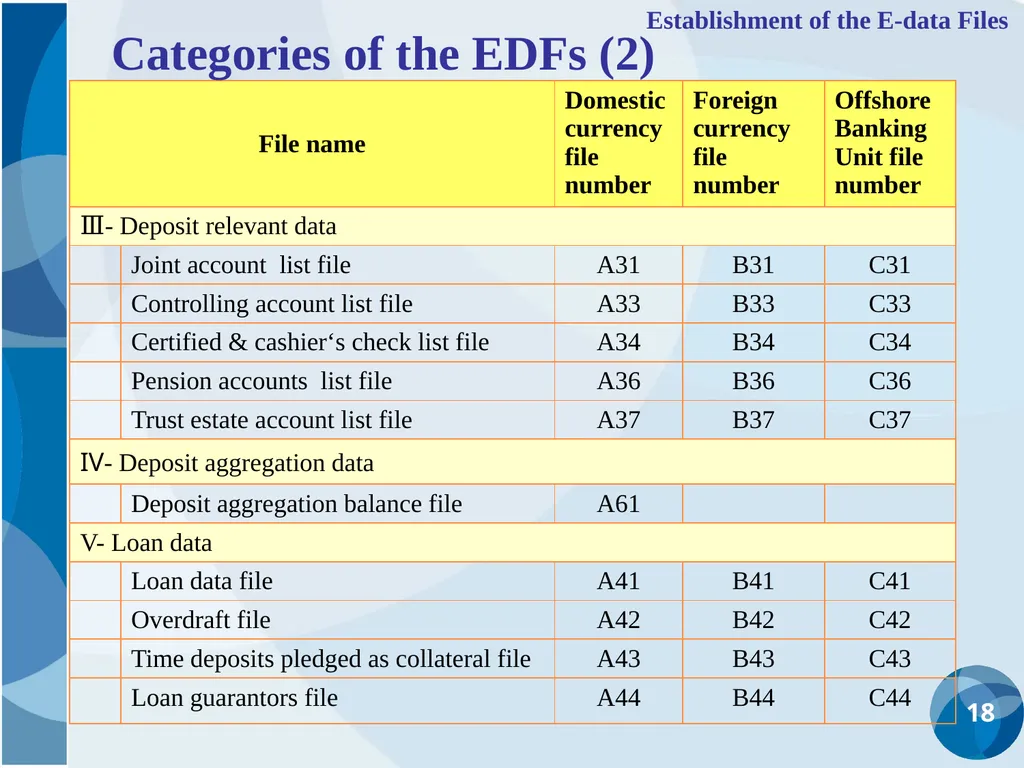
slide18. 18 Categories of the EDFs (2) Establishment of the E-data Files<br>
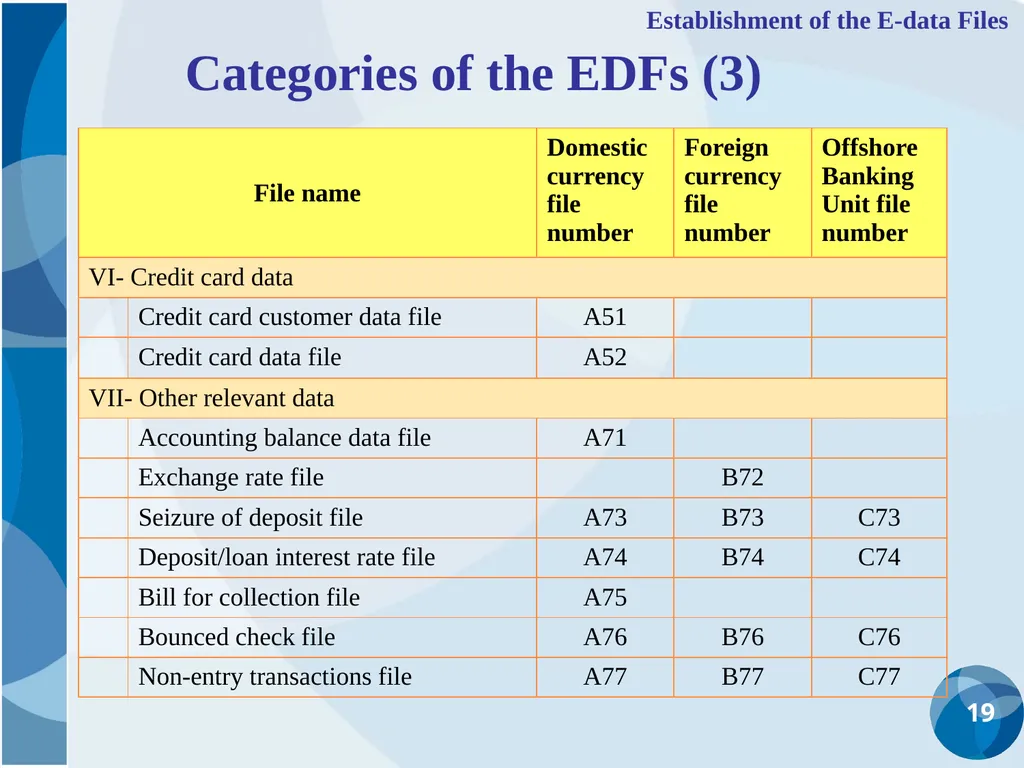
slide19. 19 Categories of the EDFs (3) Establishment of the E-data Files<br>
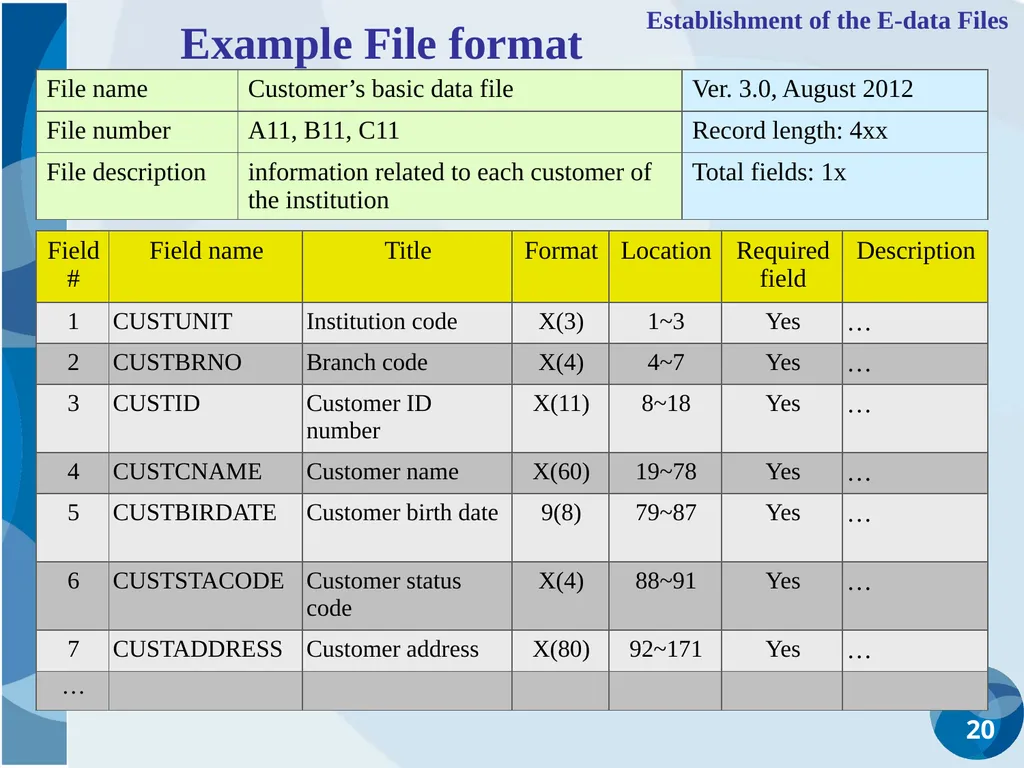
slide20. 20 Example File format Establishment of the E-data Files<br>
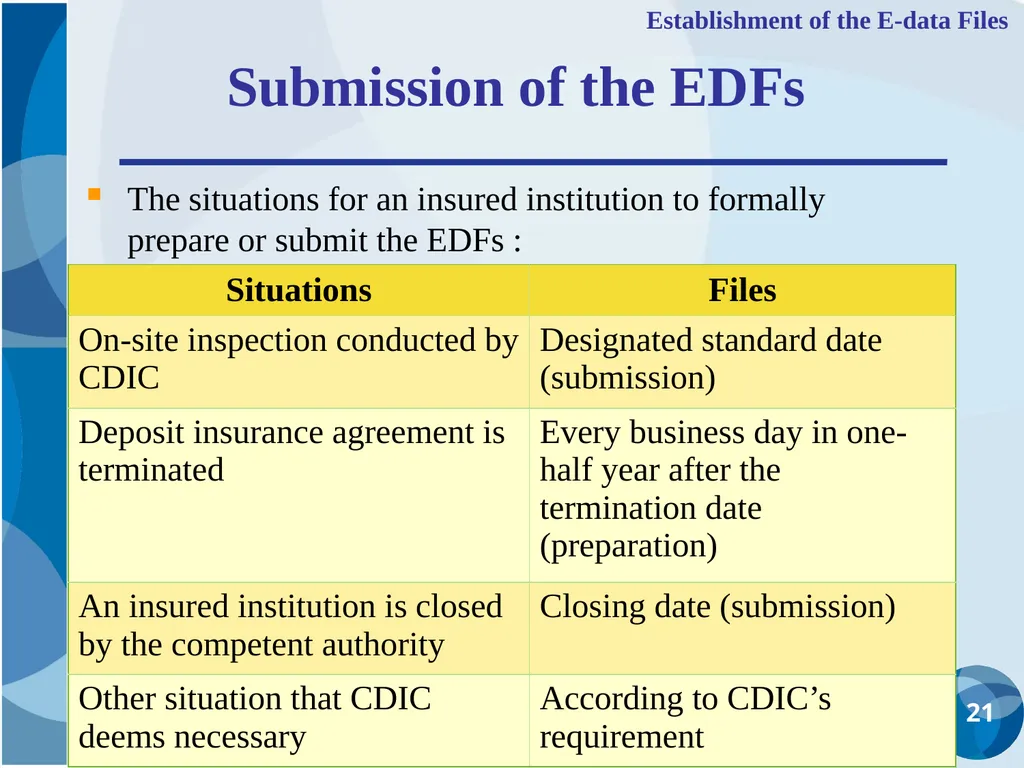
slide21. 21 The situations for an insured institution to formally prepare or submit the EDFs : Submission of the EDFs Establishment of the E-data Files<br>
slide22. 3. Inspection of the E-data Files 22<br>
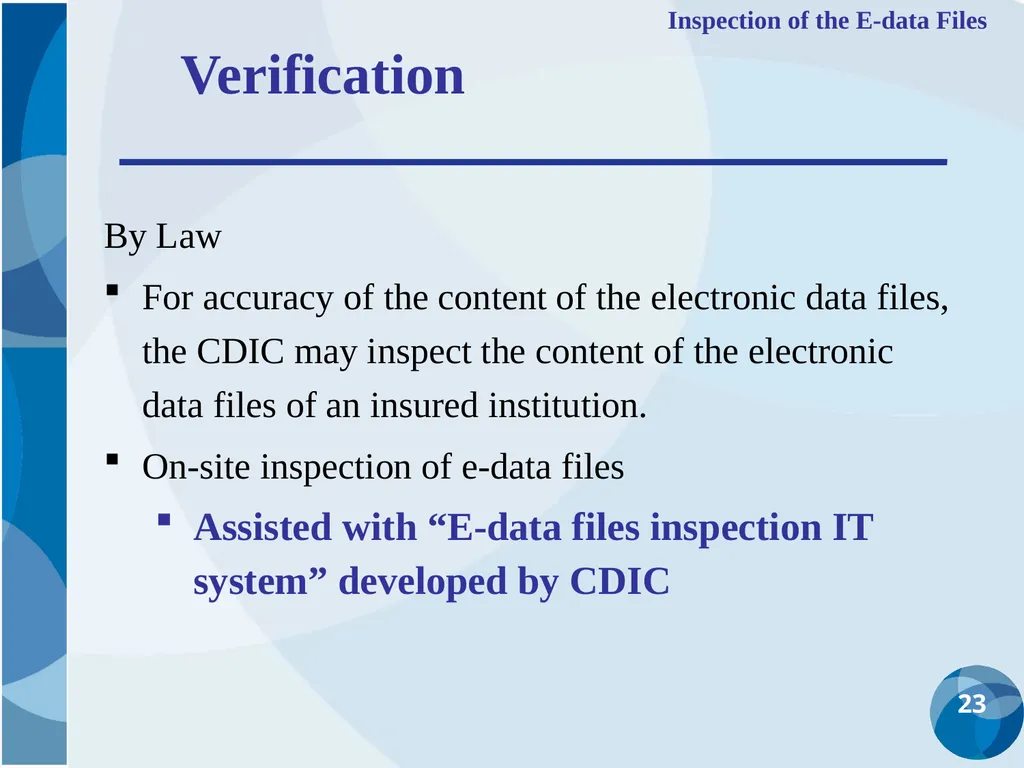
slide23. 23 Verification By Law
For accuracy of the content of the electronic data files, the CDIC may inspect the content of the electronic data files of an insured institution.
On-site inspection of e-data files
Assisted with “E-data files inspection IT system” developed by CDIC Inspection of the E-data Files<br>
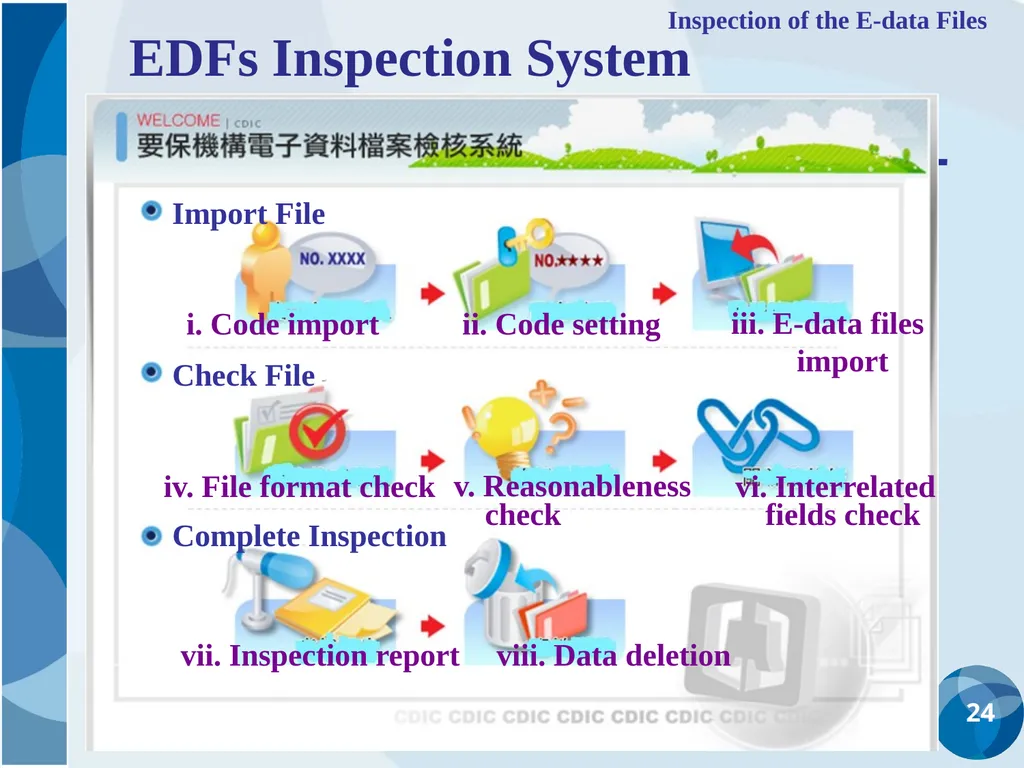
slide24. 24 EDFs Inspection System Inspection of the E-data Files<br>
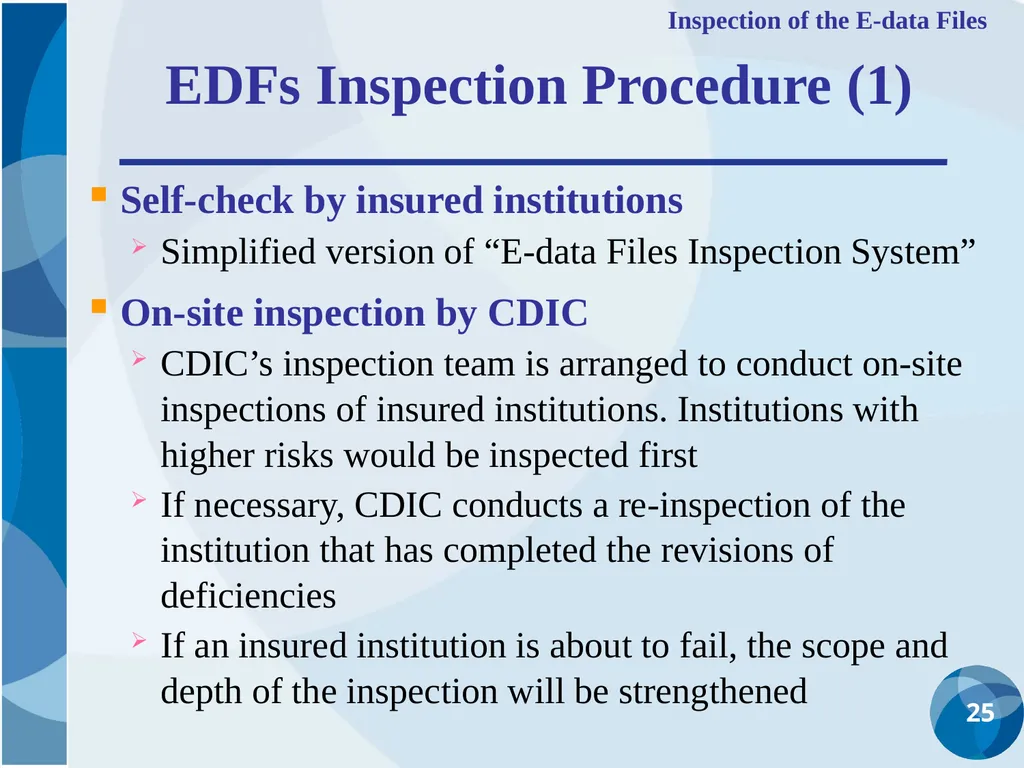
slide25. 25 EDFs Inspection Procedure (1) Self-check by insured institutions
Simplified version of “E-data Files Inspection System”
On-site inspection by CDIC
CDIC’s inspection team is arranged to conduct on-site inspections of insured institutions. Institutions with higher risks would be inspected first
If necessary, CDIC conducts a re-inspection of the institution that has completed the revisions of deficiencies
If an insured institution is about to fail, the scope and depth of the inspection will be strengthened Inspection of the E-data Files<br>
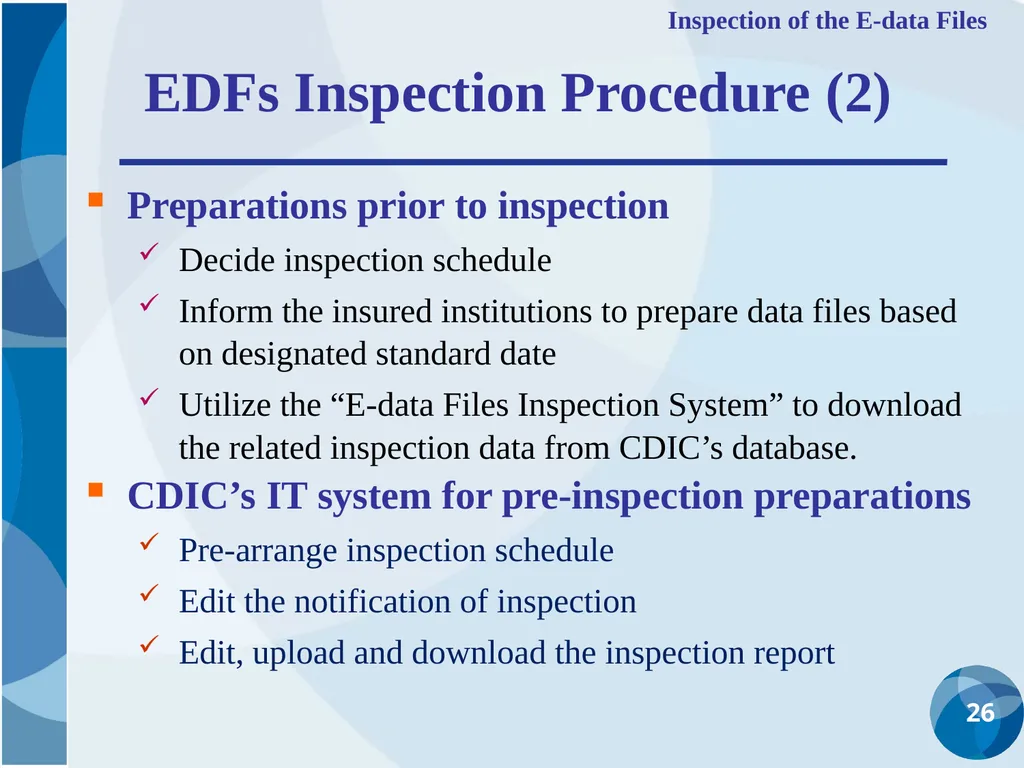
slide26. 26 EDFs Inspection Procedure (2) Preparations prior to inspection
Decide inspection schedule
Inform the insured institutions to prepare data files based on designated standard date
Utilize the “E-data Files Inspection System” to download the related inspection data from CDIC’s database.
CDIC’s IT system for pre-inspection preparations
Pre-arrange inspection schedule
Edit the notification of inspection
Edit, upload and download the inspection report Inspection of the E-data Files<br>
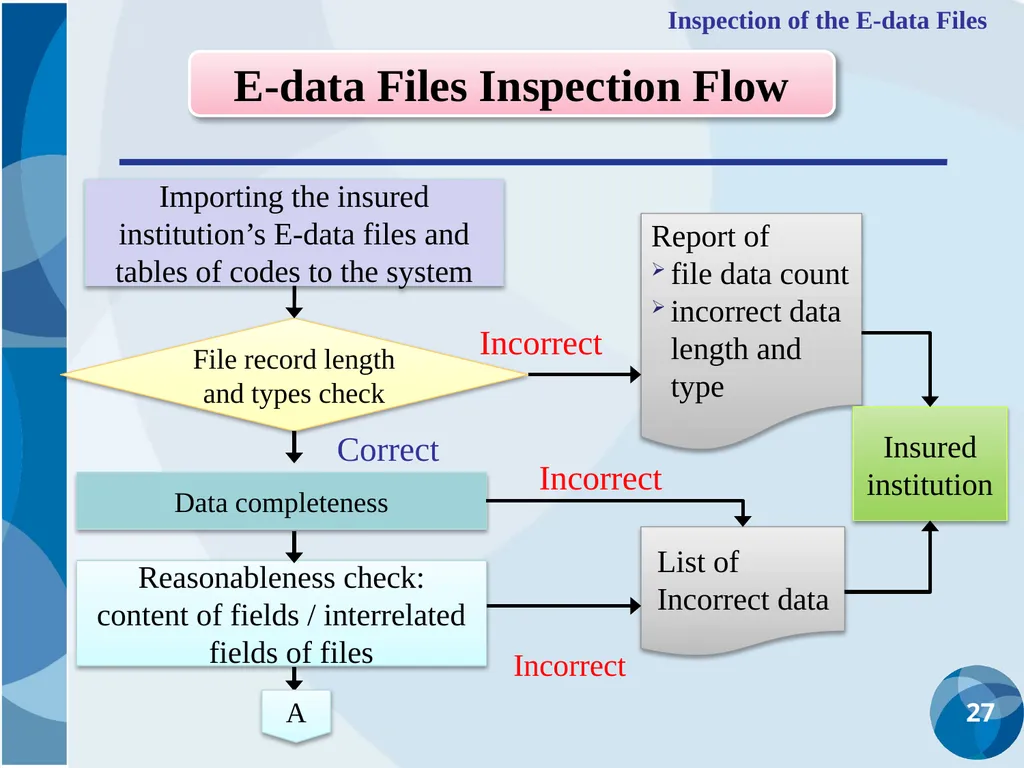
slide27. 27 Importing the insured institution’s E-data files and tables of codes to the system File record length and types check Data completeness Correct Incorrect Report of
file data count
incorrect data length and type Reasonableness check:
content of fields / interrelated fields of files List of Incorrect data Incorrect Incorrect A Insured institution E-data Files Inspection Flow Inspection of the E-data Files<br>
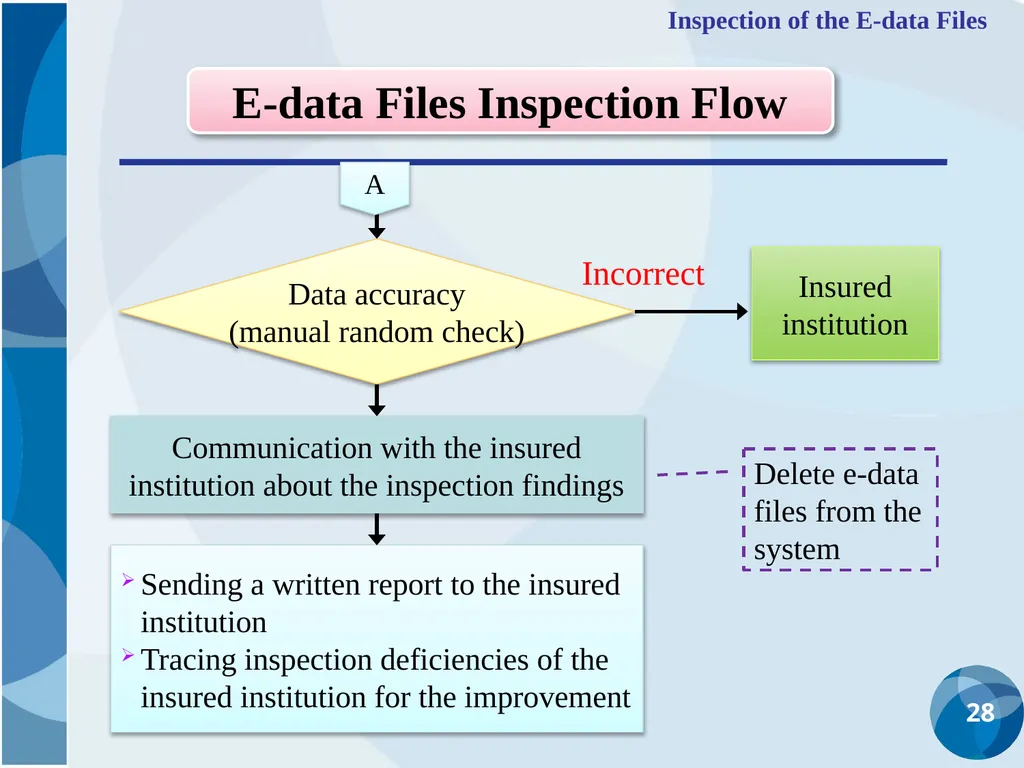
slide28. 28 Communication with the insured institution about the inspection findings Data accuracy
(manual random check) Sending a written report to the insured institution
Tracing inspection deficiencies of the insured institution for the improvement Incorrect A Insured institution Delete e-data files from the system E-data Files Inspection Flow Inspection of the E-data Files<br>
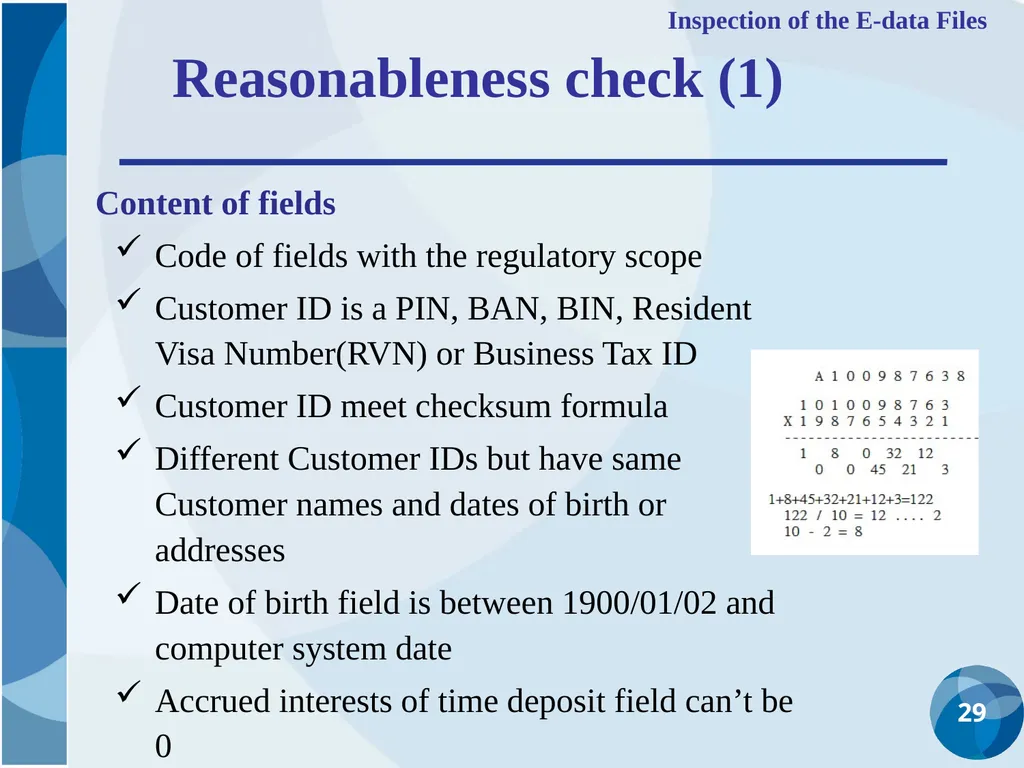
slide29. Content of fields
Code of fields with the regulatory scope
Customer ID is a PIN, BAN, BIN, Resident Visa Number(RVN) or Business Tax ID
Customer ID meet checksum formula
Different Customer IDs but have same Customer names and dates of birth or addresses
Date of birth field is between 1900/01/02 and computer system date
Accrued interests of time deposit field can’t be 0 29 Reasonableness check (1) Inspection of the E-data Files<br>
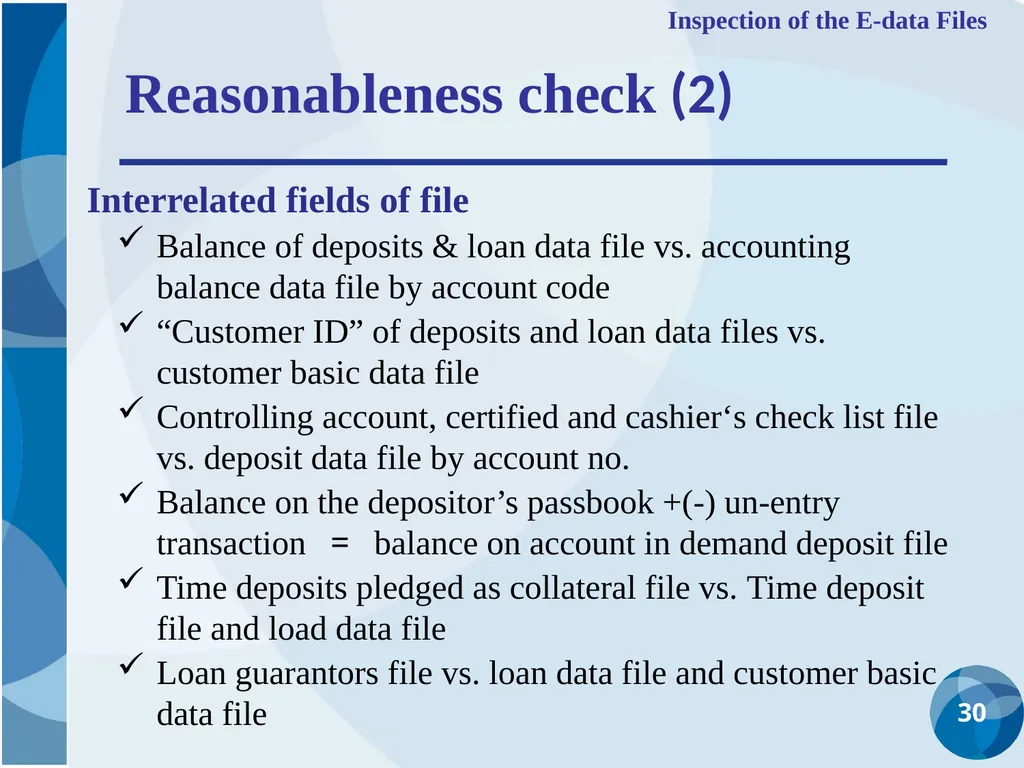
slide30. Interrelated fields of file
Balance of deposits & loan data file vs. accounting balance data file by account code
“Customer ID” of deposits and loan data files vs. customer basic data file
Controlling account, certified and cashier‘s check list file vs. deposit data file by account no.
Balance on the depositor’s passbook +(-) un-entry transaction = balance on account in demand deposit file
Time deposits pledged as collateral file vs. Time deposit file and load data file
Loan guarantors file vs. loan data file and customer basic data file 30 Reasonableness check (2) Inspection of the E-data Files<br>
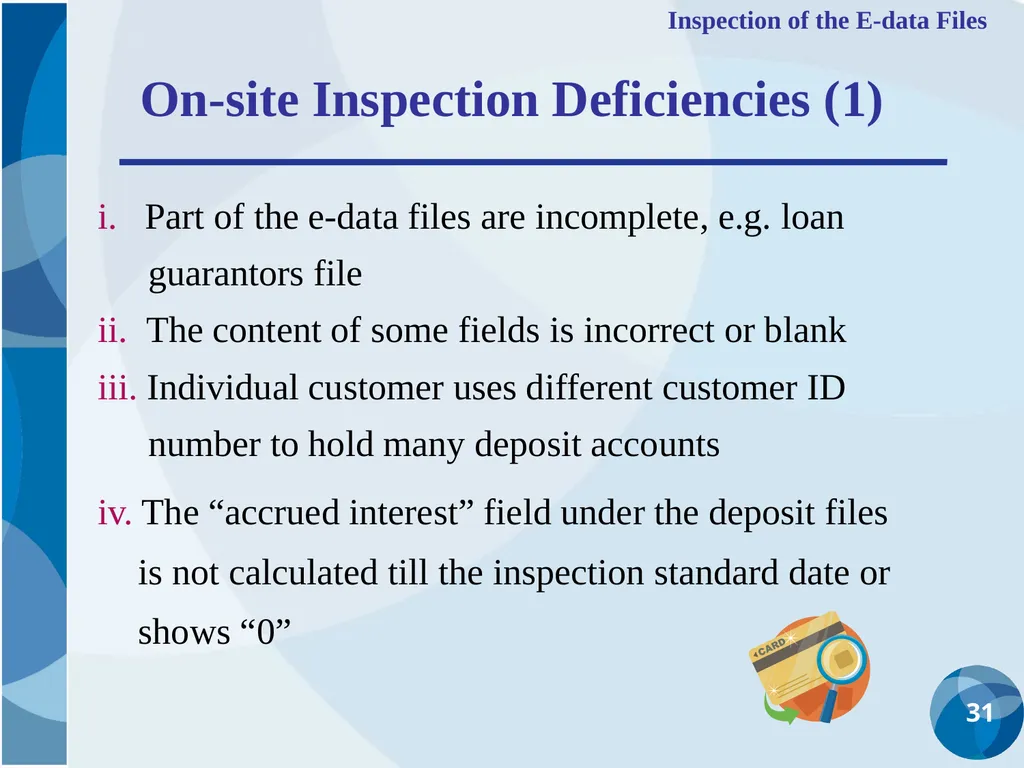
slide31. On-site Inspection Deficiencies (1) i. Part of the e-data files are incomplete, e.g. loan guarantors file
ii. The content of some fields is incorrect or blank
iii. Individual customer uses different customer ID number to hold many deposit accounts
iv. The “accrued interest” field under the deposit files is not calculated till the inspection standard date or shows “0” 31 Inspection of the E-data Files<br>
slide32. v. Inconsistency among interrelated fields of cross-files
vi. Operation of establishing e-data files is not included in the internal audit of insured institutions
vii. In respect of joint accounts and dormant custodian accounts, the detailed information of related customers is not complete
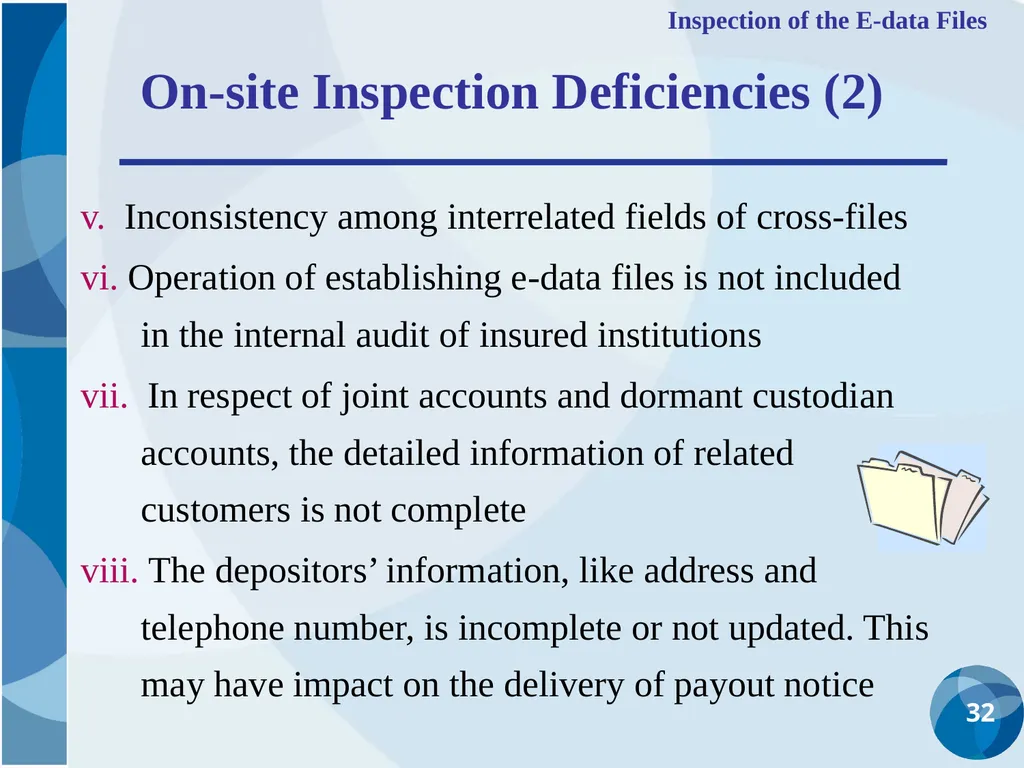
viii. The depositors’ information, like address and telephone number, is incomplete or not updated. This may have impact on the delivery of payout notice 32 On-site Inspection Deficiencies (2) Inspection of the E-data Files<br>
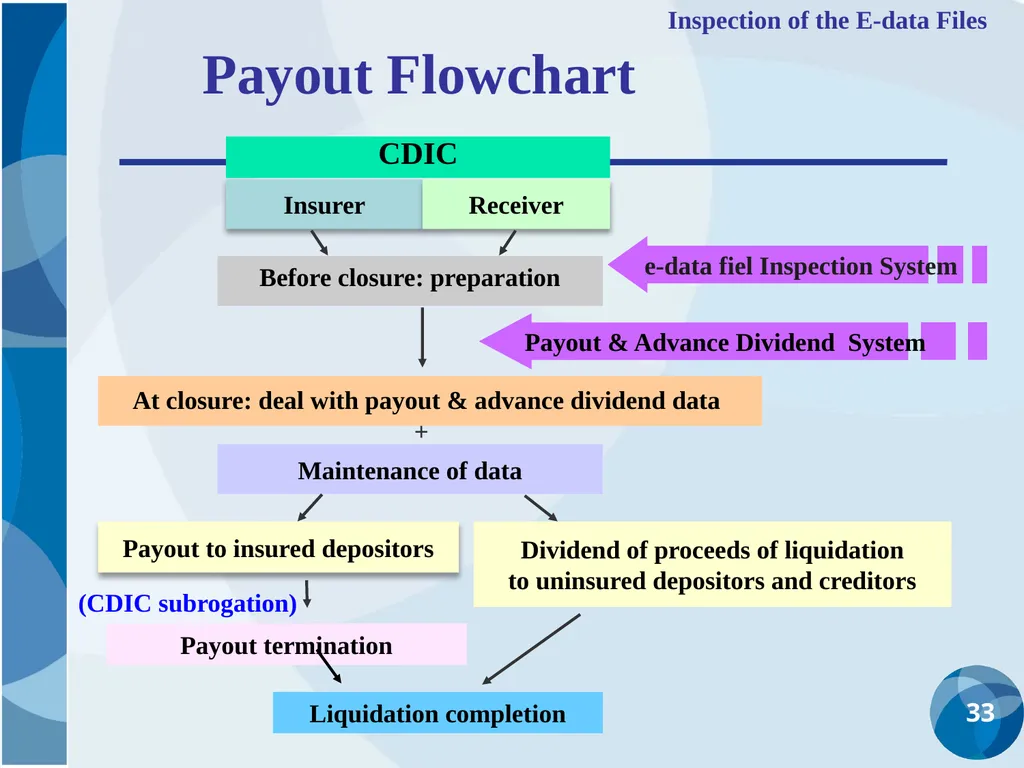
slide33. 33 Payout Flowchart Inspection of the E-data Files<br>
slide34. 34 Schedule of developing the IT System
1st stage (by the end of 2011)
Simple payout without netting and on-line processing for all payout locations
2nd stage (by the end of 2013)
Whole payout system completed
Payout simulation plan
Scheduled to conduct simulations Payout & Advance Dividend IT System Inspection of the E-data Files<br>
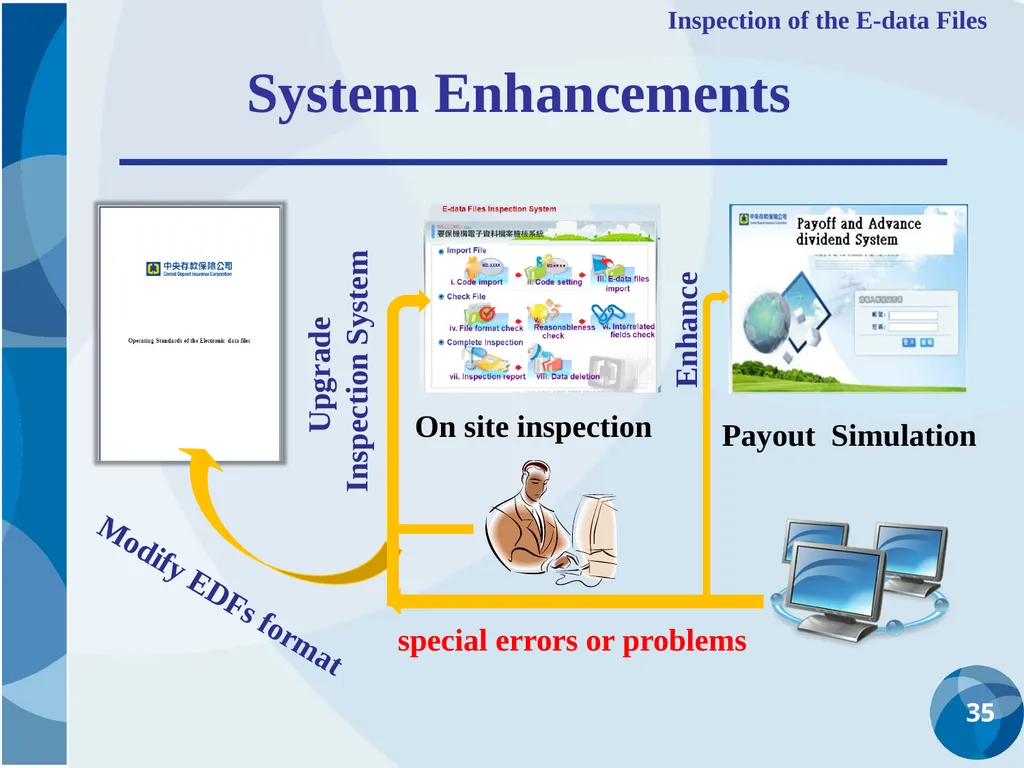
slide35. 35 System Enhancements Inspection of the E-data Files<br>
slide36. 4. Challenges and Conclusion 36<br>
slide37. 37 Challenges in Establishing the EDFs (1) Insured institutions cannot submit the complete e-data files because business transactions in early stages were done manually and accounting books were simplified, but the customers currently no longer carry on any business with the insured institutions.
The data file format, items and processing method of each insured institution are slightly different, so the institutions’ IT systems have to be revised. Challenges and Conclusion<br>
slide38. 38 Challenges in Establishing the EDFs (2) Some insured institutions outsource the information operation, so inspection deficiencies have to be handled with the assistance of outsourcing companies. It takes much longer time.
Some individual customers use different customer identity codes to open many deposit accounts, but the insured institutions failed to update those data until depositors come to counter. Challenges and Conclusion<br>
slide39. Require insured institutions to establish e-data files in advance and make the requirement stipulated by law or regulation
Conduct inspection and pay attention to the institutions revision of deficiency
Build up an IT system to assist with handling e-data inspections and management
Strengthen the scope and depth of inspection when the institution is about to fail 39 Conclusion Challenges and Conclusion<br>
slide40. Thank You!<br>
Deputy Director
2 December, 2013<br>
slide2. Outline Introduction of CDIC (Taiwan)
Establishment of the E-data Files
Inspection of the E-data Files
Challenges and Conclusion 2<br>
slide3. 1. Introduction of CDIC (Taiwan) 3<br>
slide4. 4 Introduction of CDIC (Taiwan) Establishment in 1985 28 years
The only deposit insurer in Taiwan
Public policy objectives
Safeguard the interests of depositors in financial institutions
Maintain an orderly credit system
Enhance sound development of financial businesses<br>
slide5. 5 Mandate Handle deposit insurance issues
Control insurance risk
Deal with problem financial institutions Pay Box Risk Minimizer Introduction of CDIC (Taiwan)<br>
slide6. 6 Number of Insured Institutions As at Oct 31, 2013 Introduction of CDIC (Taiwan)<br>
slide7. Insured & Uninsured Deposits Introduction of CDIC (Taiwan) 7<br>
slide8. 8 Depositors Each depositor
1. Natural person
2. Legal entity
3. Sole proprietorship
4. Partnership
5. Inheritee
6. Bankruptcy or liquidation estate
7. Unincorporated group or organization
8. Various levels of government or their subsidiaries
9. Trust estate
10. Cardholder for each electronic stored value card Introduction of CDIC (Taiwan)<br>
slide9. 9 Fulfillment of Insurance Responsibilities Payout
Cash payout
Deposit transfer
P&A
Other responsibilities
Legal receiver (advance dividend) Introduction of CDIC (Taiwan)<br>
slide10. 2. Establishment of
the E-data Files 10<br>
slide11. By DI act
When an insured institutions is closed by the competent authority, and the CDIC is unable to consult with other insured institutions or financial holding companies to acquire or assume it, CDIC shall make payout.
The payout shall from the following day after the insured institution is closed, be swiftly dealt with. 11 Promptly Reimbursement Establishment of the E-data Files<br>
slide12. 12 Number of Failed Institutions As at Oct 2013 Establishment of the E-data Files<br>
slide13. Schedule of Payout Preparation 13 Amended DI Act
Issued Operating Standards of Electronic Data Files (EDF) Developed EDF inspection system Conducted On-site inspection of EDF Commenced development of payout & Advance Dividend IT system Conducted Payout simulation Establishment of the E-data Files<br>
slide14. DI Act amended in 2007
For CDIC to calculate payout amount, insured institutions shall establish the Electronic Data Files (EDF) of deposits and related items according to the file format and content stipulated by the CDIC.
The CDIC may request the insured institutions to provide the EDFs, if necessary. 14 Requiring the EDFs by law Establishment of the E-data Files<br>
slide15. Requiring establishment of the EDFs (1) Beginning in 2008, the CDIC issued the Operating Standards of insured institutions to set up the EDFs.
The minimum data elements necessary to reimbursement and advance dividend payment
Unique Standard File Format for all insured institutions
Field Coding-Originally set by the relevant authorities, commonly used in the banking sector, or insured institution self-defined codes
All insured institutions have completed the required establishment of the EDFs, and can provide the files whenever CDIC requires. 15 Establishment of the E-data Files<br>
slide16. 16 In accordance with the applied deposit insurance risk-based premium rate, insured institutions shall establish e-data files within the following time limits: Requiring establishment or the EDFs (2) Risk lower higher Establishment of the E-data Files<br>
slide17. 17 Categories of the EDFs (1) Content of E-data files : 7 categories Establishment of the E-data Files<br>
slide18. 18 Categories of the EDFs (2) Establishment of the E-data Files<br>
slide19. 19 Categories of the EDFs (3) Establishment of the E-data Files<br>
slide20. 20 Example File format Establishment of the E-data Files<br>
slide21. 21 The situations for an insured institution to formally prepare or submit the EDFs : Submission of the EDFs Establishment of the E-data Files<br>
slide22. 3. Inspection of the E-data Files 22<br>
slide23. 23 Verification By Law
For accuracy of the content of the electronic data files, the CDIC may inspect the content of the electronic data files of an insured institution.
On-site inspection of e-data files
Assisted with “E-data files inspection IT system” developed by CDIC Inspection of the E-data Files<br>
slide24. 24 EDFs Inspection System Inspection of the E-data Files<br>
slide25. 25 EDFs Inspection Procedure (1) Self-check by insured institutions
Simplified version of “E-data Files Inspection System”
On-site inspection by CDIC
CDIC’s inspection team is arranged to conduct on-site inspections of insured institutions. Institutions with higher risks would be inspected first
If necessary, CDIC conducts a re-inspection of the institution that has completed the revisions of deficiencies
If an insured institution is about to fail, the scope and depth of the inspection will be strengthened Inspection of the E-data Files<br>
slide26. 26 EDFs Inspection Procedure (2) Preparations prior to inspection
Decide inspection schedule
Inform the insured institutions to prepare data files based on designated standard date
Utilize the “E-data Files Inspection System” to download the related inspection data from CDIC’s database.
CDIC’s IT system for pre-inspection preparations
Pre-arrange inspection schedule
Edit the notification of inspection
Edit, upload and download the inspection report Inspection of the E-data Files<br>
slide27. 27 Importing the insured institution’s E-data files and tables of codes to the system File record length and types check Data completeness Correct Incorrect Report of
file data count
incorrect data length and type Reasonableness check:
content of fields / interrelated fields of files List of Incorrect data Incorrect Incorrect A Insured institution E-data Files Inspection Flow Inspection of the E-data Files<br>
slide28. 28 Communication with the insured institution about the inspection findings Data accuracy
(manual random check) Sending a written report to the insured institution
Tracing inspection deficiencies of the insured institution for the improvement Incorrect A Insured institution Delete e-data files from the system E-data Files Inspection Flow Inspection of the E-data Files<br>
slide29. Content of fields
Code of fields with the regulatory scope
Customer ID is a PIN, BAN, BIN, Resident Visa Number(RVN) or Business Tax ID
Customer ID meet checksum formula
Different Customer IDs but have same Customer names and dates of birth or addresses
Date of birth field is between 1900/01/02 and computer system date
Accrued interests of time deposit field can’t be 0 29 Reasonableness check (1) Inspection of the E-data Files<br>
slide30. Interrelated fields of file
Balance of deposits & loan data file vs. accounting balance data file by account code
“Customer ID” of deposits and loan data files vs. customer basic data file
Controlling account, certified and cashier‘s check list file vs. deposit data file by account no.
Balance on the depositor’s passbook +(-) un-entry transaction = balance on account in demand deposit file
Time deposits pledged as collateral file vs. Time deposit file and load data file
Loan guarantors file vs. loan data file and customer basic data file 30 Reasonableness check (2) Inspection of the E-data Files<br>
slide31. On-site Inspection Deficiencies (1) i. Part of the e-data files are incomplete, e.g. loan guarantors file
ii. The content of some fields is incorrect or blank
iii. Individual customer uses different customer ID number to hold many deposit accounts
iv. The “accrued interest” field under the deposit files is not calculated till the inspection standard date or shows “0” 31 Inspection of the E-data Files<br>
slide32. v. Inconsistency among interrelated fields of cross-files
vi. Operation of establishing e-data files is not included in the internal audit of insured institutions
vii. In respect of joint accounts and dormant custodian accounts, the detailed information of related customers is not complete
viii. The depositors’ information, like address and telephone number, is incomplete or not updated. This may have impact on the delivery of payout notice 32 On-site Inspection Deficiencies (2) Inspection of the E-data Files<br>
slide33. 33 Payout Flowchart Inspection of the E-data Files<br>
slide34. 34 Schedule of developing the IT System
1st stage (by the end of 2011)
Simple payout without netting and on-line processing for all payout locations
2nd stage (by the end of 2013)
Whole payout system completed
Payout simulation plan
Scheduled to conduct simulations Payout & Advance Dividend IT System Inspection of the E-data Files<br>
slide35. 35 System Enhancements Inspection of the E-data Files<br>
slide36. 4. Challenges and Conclusion 36<br>
slide37. 37 Challenges in Establishing the EDFs (1) Insured institutions cannot submit the complete e-data files because business transactions in early stages were done manually and accounting books were simplified, but the customers currently no longer carry on any business with the insured institutions.
The data file format, items and processing method of each insured institution are slightly different, so the institutions’ IT systems have to be revised. Challenges and Conclusion<br>
slide38. 38 Challenges in Establishing the EDFs (2) Some insured institutions outsource the information operation, so inspection deficiencies have to be handled with the assistance of outsourcing companies. It takes much longer time.
Some individual customers use different customer identity codes to open many deposit accounts, but the insured institutions failed to update those data until depositors come to counter. Challenges and Conclusion<br>
slide39. Require insured institutions to establish e-data files in advance and make the requirement stipulated by law or regulation
Conduct inspection and pay attention to the institutions revision of deficiency
Build up an IT system to assist with handling e-data inspections and management
Strengthen the scope and depth of inspection when the institution is about to fail 39 Conclusion Challenges and Conclusion<br>
slide40. Thank You!<br>