
Census Administrator Training NOTE: This training
LO
Published · 46 slides · 0 views
1 / 1

Description
Census Administrator Training NOTE: This training contains visual elements including data forms and geographical maps. To meet accessibility standards, visual elements are tagged andor described in readable text. If you have any difficulty
Related Topics
Share
Embed code
Download this presentation From Below
"Census Administrator Training NOTE: This training" is the property of its rightful owner. Permission is granted to download and print the materials on this website for personal, non-commercial use only, and to display it on your personal computer provided you do not modify the materials and that you retain all copyright notices contained in the materials. By downloading content from our website, you accept the terms of this agreement.
Presentation Transcript
01
Census Administrator Training<br>
02
NOTE: This training contains visual elements including data forms and geographical maps. To meet accessibility standards, visual elements are tagged and/or described in readable text. If you have any difficulty or need assistance accessing any of the information contained in this training, please contact the Office of Financial Management, Forecasting and Research Division, by phone at 360-902-0599, or by email at pop.annexations@ofm.wa.gov<br>
03
3 Table of Contents General Information
Pre-Census Preparation
Monitoring Census Progress
Tabulation and Filing Procedure<br>
Pre-Census Preparation
Monitoring Census Progress
Tabulation and Filing Procedure<br>
04
4 General Information<br>
05
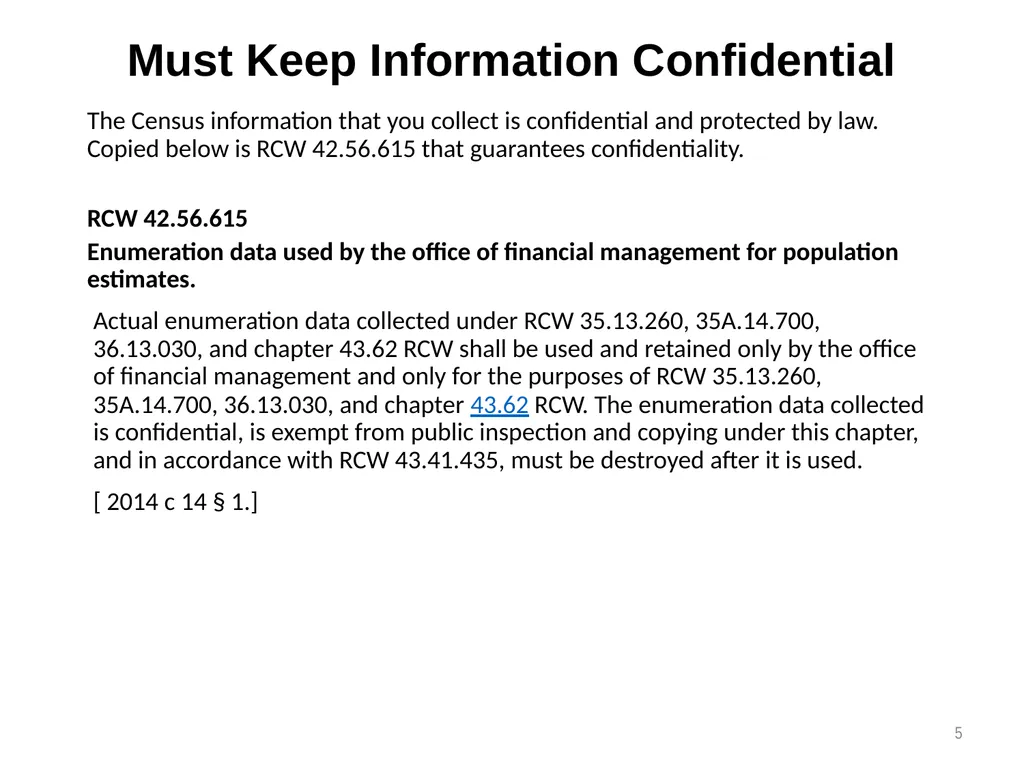
Must Keep Information Confidential 5 The Census information that you collect is confidential and protected by law.
Copied below is RCW 42.56.615 that guarantees confidentiality.
RCW 42.56.615
Enumeration data used by the office of financial management for population estimates.
Actual enumeration data collected under RCW 35.13.260, 35A.14.700, 36.13.030, and chapter 43.62 RCW shall be used and retained only by the office of financial management and only for the purposes of RCW 35.13.260, 35A.14.700, 36.13.030, and chapter 43.62 RCW. The enumeration data collected is confidential, is exempt from public inspection and copying under this chapter, and in accordance with RCW 43.41.435, must be destroyed after it is used.
[ 2014 c 14 § 1.]<br>
06
6 Annexation census is required by law.
Per RCW 35.13.260 and RCW 35A.14.700, cities/towns must enumerate residents in an annexed area and file with OFM for certification.
April 1 census can replace OFM estimate.
Cities may chose to census instead of using OFM estimate for funding allocation if it believes that federal decennial census or OFM estimate are not accurate. Census Considerations<br>
07
7 A census is an investment of time and resources for both the city and OFM.
A census administrator and his/her staff must follow OFM specifications to achieve a quality census that OFM will approve.
OFM may reject all or parts of a census where administrators/enumerators failed to follow OFM procedures.
A rejected annexation census will result in a partial or total re-do of the census.
A rejected April 1 census will result in a population estimate for that year. Census Quality<br>
08
8 Pre-Census Preparation<br>
09
9 The administrator must complete the preparation for the following five areas before the census date:
Identify a census window
Staffing
Training
Mapping census area
Office space, publicity, and census supplies
It is important to plan early since pre-census activities can take a large amount of time. Pre-Census Preparations<br>
Identify a census window
Staffing
Training
Mapping census area
Office space, publicity, and census supplies
It is important to plan early since pre-census activities can take a large amount of time. Pre-Census Preparations<br>
10
10 A census should be completed within 30 days.
An annexation census cannot start before it is legally effective. And, by statute, the documentation has to be sent to OFM within 30 days of the effective date.
With preapproval, the enumeration period may be extended up to two weeks prior to the effective date.
April 1 city wide census used in place of OFM April 1 estimates may only be conducted during the time frame specified by OFM. See: http://www.ofm.wa.gov/pop/april1/info.asp for more information. Identify Census Window<br>
11
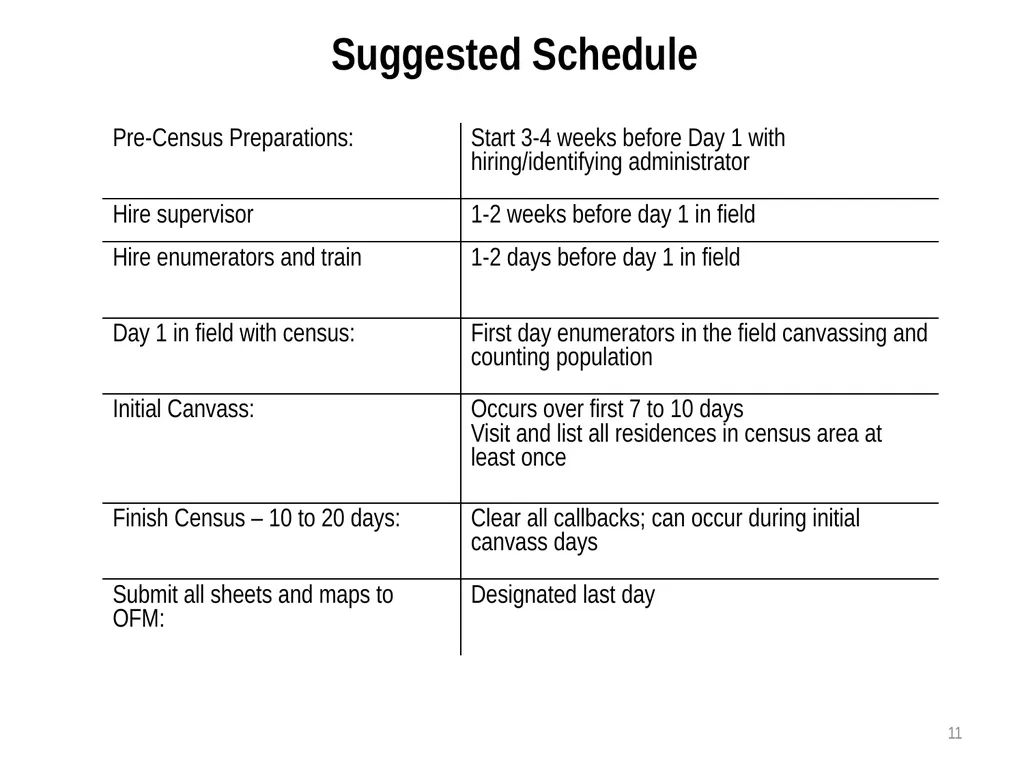
Suggested Schedule 11<br>
12
12 Use an estimated population for the area to get a sense of the time needed.
If administrator, supervisors and/or enumerators will be comprised of city staff, make sure their other duties will not conflict with census work. Census work takes priority. Weekend and evening hours should be required.
If city staff do not have the time/skills needed to conduct a census or the census is large, consider hiring a contractor to do the entire census.
If you decide to hire a contractor keep in mind that for a larger census they need to be onboard 3 to 4 weeks before fieldwork begins.
The contractor must use OFM training materials him/herself and understand the requirements.
The city must monitor the contractor and make sure OFM procedures are being followed. Use City Staff vs Hire Contractor<br>
13
13 The state does not assume any liability for conducting the census.
Insurance coverage is the city’s responsibility.
Decisions about insurance should be made before hiring anyone. Obtain Insurance<br>
Insurance coverage is the city’s responsibility.
Decisions about insurance should be made before hiring anyone. Obtain Insurance<br>
14
14 Responsibilities:
Assigning work to the enumerators, gathering and checking all completed census sheets, evaluating enumerators’ job performance, and assisting the administrator. Depending on the work load the supervisors can enumerate as well.
Qualifications:
Must have good communication skills, a good understanding of census procedures and requirements, and be able to manage the daily operation of the census canvassing process
Time of hire:
Supervisors should be hired one to two weeks prior to the census to learn the job and be able to train the enumerators and provide assistance to the administrator
Number of supervisors needed:
Usually 1 supervisor for every 5 to 10 enumerators is efficient. Hire Supervisors<br>
15
15 Enumerators should be hired early enough for training. They should:
be able to maintain confidentiality.
be able to read census maps.
be meticulous and willing to ask questions.
be able to work evenings and weekends and have good physical endurance
Good enumerators are key to a good quality census. Applicants should be screened carefully. And they need to be evaluated daily once hired. Hire Enumerators<br>
16
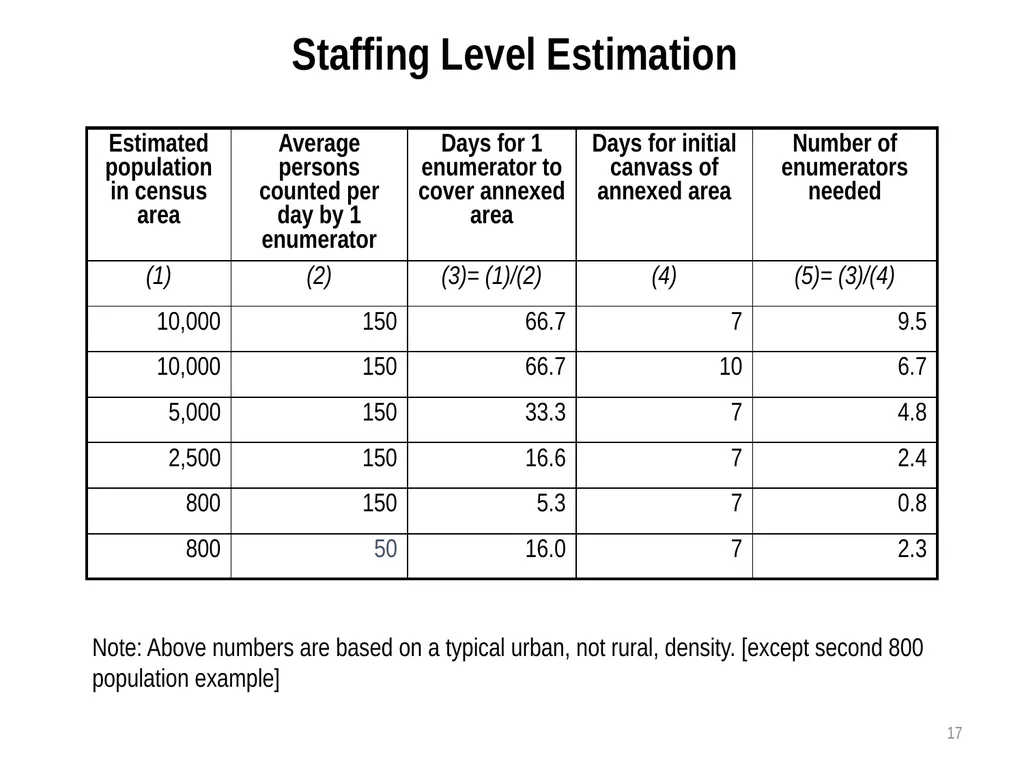
How Many Enumerators Are Needed? The number of enumerators needed depends on:
Size of the annexation
How difficult the area will be to enumerate at the time of the census. Factors affecting difficulty include:
Housing density
Attitudes towards government and/or the annexation
High crime area
Bad weather and evening darkness can slow down the cavass speed.
Holiday seasons can be difficult time to capture residents at home.
Work hours are influenced by the need to catch people at home. 16<br>
17
17 Staffing Level Estimation Note: Above numbers are based on a typical urban, not rural, density. [except second 800 population example]<br>
18
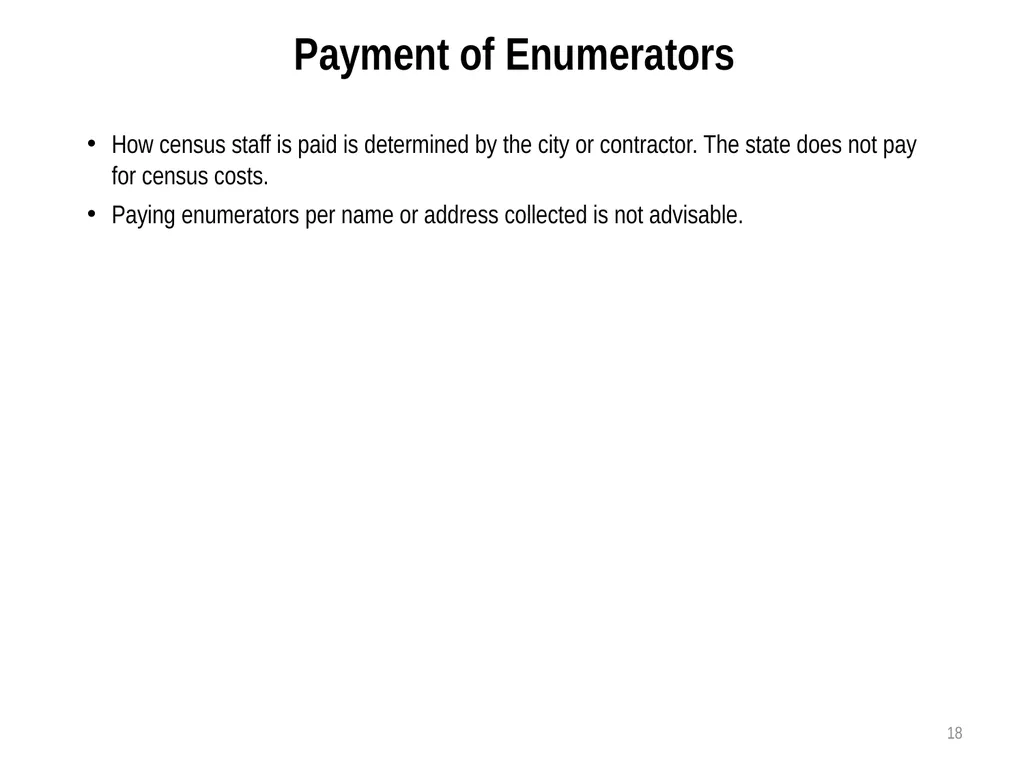
18 How census staff is paid is determined by the city or contractor. The state does not pay for census costs.
Paying enumerators per name or address collected is not advisable. Payment of Enumerators<br>
Paying enumerators per name or address collected is not advisable. Payment of Enumerators<br>
19
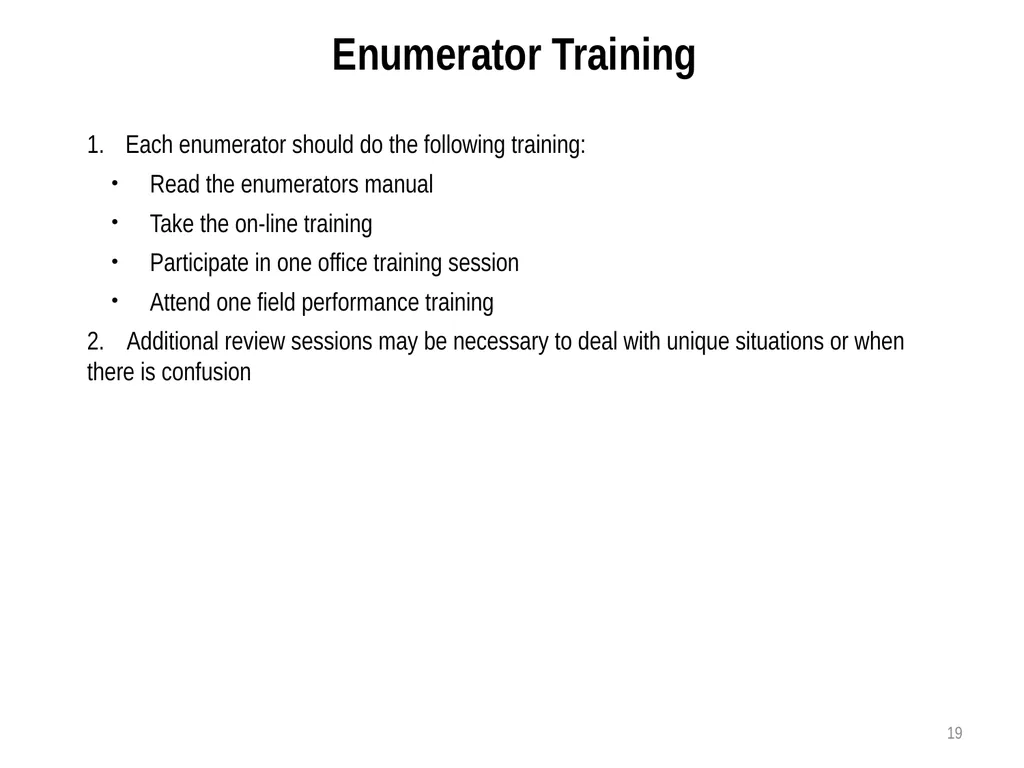
19 Each enumerator should do the following training:
Read the enumerators manual
Take the on-line training
Participate in one office training session
Attend one field performance training
2. Additional review sessions may be necessary to deal with unique situations or when there is confusion Enumerator Training<br>
Read the enumerators manual
Take the on-line training
Participate in one office training session
Attend one field performance training
2. Additional review sessions may be necessary to deal with unique situations or when there is confusion Enumerator Training<br>
20
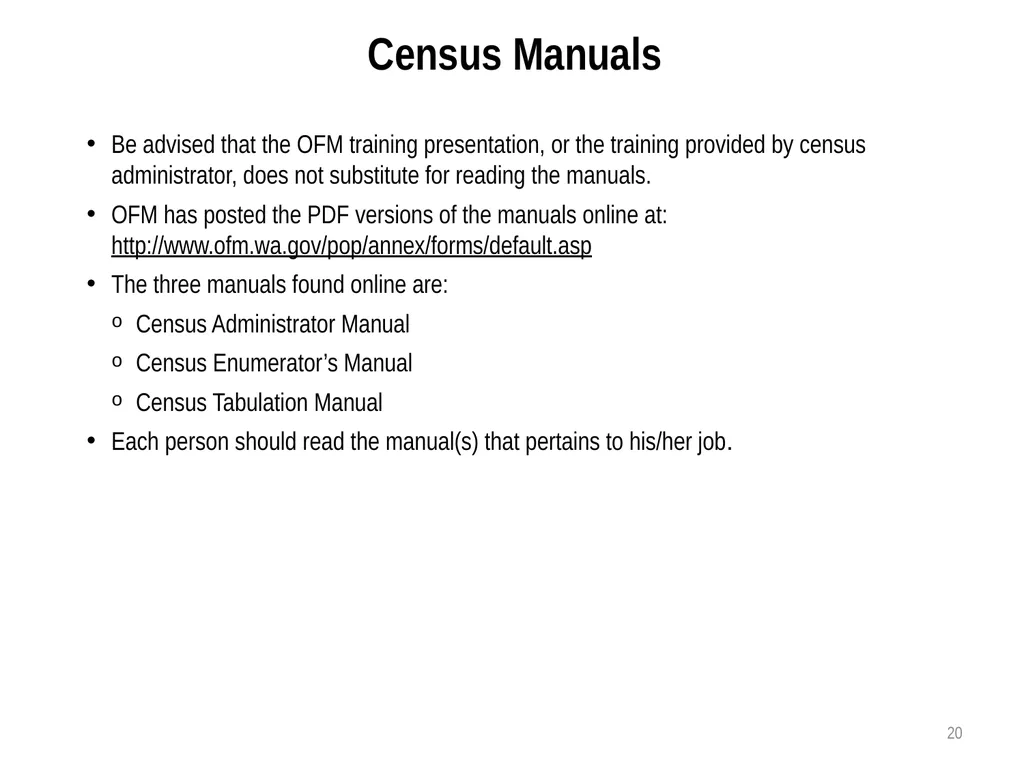
Census Manuals Be advised that the OFM training presentation, or the training provided by census administrator, does not substitute for reading the manuals.
OFM has posted the PDF versions of the manuals online at: http://www.ofm.wa.gov/pop/annex/forms/default.asp
The three manuals found online are:
Census Administrator Manual
Census Enumerator’s Manual
Census Tabulation Manual
Each person should read the manual(s) that pertains to his/her job. 20<br>
OFM has posted the PDF versions of the manuals online at: http://www.ofm.wa.gov/pop/annex/forms/default.asp
The three manuals found online are:
Census Administrator Manual
Census Enumerator’s Manual
Census Tabulation Manual
Each person should read the manual(s) that pertains to his/her job. 20<br>
21
Enumerator In-Office Training The office training should achieve the following goals:
All enumerators must understand confidentiality rules and agree to follow them.
All enumerators need to understand the housing unit/facility concepts.
All enumerators need to understand the definition of a resident.
All enumerators need to understand canvassing techniques and read maps well.
All enumerators need to have interviewing skills. Everyone should practice interviews with one another in the office
Every enumerator should read the enumerator’s manual before the in-office training. Then practice interview techniques and fill out practice field enumeration sheets. They should thoroughly understand the concepts listed above before going into the field. 21<br>
22
22 Enumerator Field Training The administrator/supervisor should take trainees to the field for a test.
Ask a trainee to determine the first house to be enumerated
One at a time each enumerator should go to a housing unit to conduct the interview with the supervisor observing.
Afterwards, the whole team should critique each interview.
Check and recheck each person’s understanding of census definitions before that person is released in the field to enumerate on their own<br>
23
23 Do not approach a house with a “No-trespassing” sign
Talk to city/town attorney and/or sheriff in advance about “No Trespassing” signs and how they affect enumeration
Try to collect information from the neighbors
Try to find phone number of the household and enumerate over the phone Residences with No-Trespassing Sign<br>
Talk to city/town attorney and/or sheriff in advance about “No Trespassing” signs and how they affect enumeration
Try to collect information from the neighbors
Try to find phone number of the household and enumerate over the phone Residences with No-Trespassing Sign<br>
24
24 The Master Control Map is an important census tool for the administrator because it shows the entire census area and can be used to track progress.
Besides the Master Control Map, supervisor and enumerator maps are needed.
All maps need to be marked in a specific manner.
Instructions on how to create census maps are included in census mapping training section. Create Census Maps<br>
Besides the Master Control Map, supervisor and enumerator maps are needed.
All maps need to be marked in a specific manner.
Instructions on how to create census maps are included in census mapping training section. Create Census Maps<br>
25
25 Locate a secure location to house census documentation and for census administrator to work
If at city hall, find an office that can be locked when no census worker is present. This room cannot be used for any other function.
If not at city hall, rent a place just for the census. You can not use a person’s dining room, or leave census materials in the family car.
A dedicated phone line is necessary for residents’ questions. Location for Census Headquarters<br>
26
26 All census personnel need to have picture ID badges
Badges should have a specified effective period
Enumerators should return the badges as soon as their employment is terminated Prepare Census Badges<br>
Badges should have a specified effective period
Enumerators should return the badges as soon as their employment is terminated Prepare Census Badges<br>
27
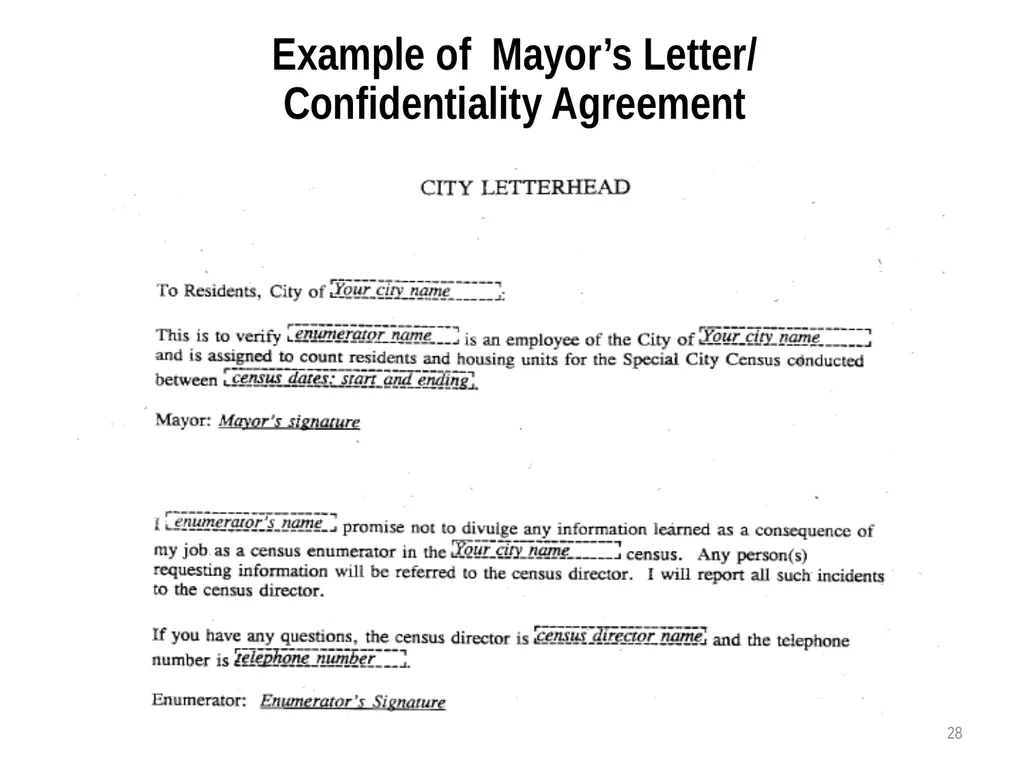
27 A confidentiality agreement is a very useful tool for the census. This document is signed by both the mayor and the enumerator. It serves two purposes. It verifies that the enumerator is hired by the city and that he/she has sworn to never share the census information with anybody.
The enumerator needs to show this agreement to the residents before the interview. Once the authenticity of the enumerator and the confidentiality of the data are established, residents are more cooperative. Prepare Confidentiality Agreement<br>
The enumerator needs to show this agreement to the residents before the interview. Once the authenticity of the enumerator and the confidentiality of the data are established, residents are more cooperative. Prepare Confidentiality Agreement<br>
28
28 Example of Mayor’s Letter/
Confidentiality Agreement<br>
Confidentiality Agreement<br>
29
29 Problems and bad attitudes can be tempered with proper publicity. The following methods have been used effectively in the past:
Newspaper articles
Insert a flyer in utility billing
Electronic bulletin board at road entrances to the census area
Social media
Notifying law enforcement about enumeration plans Prepare Publicity<br>
Newspaper articles
Insert a flyer in utility billing
Electronic bulletin board at road entrances to the census area
Social media
Notifying law enforcement about enumeration plans Prepare Publicity<br>
30
30 Certain areas may contain a large non-English speaking population. If possible, identify those blocks while you are updating the master control map.
If possible hire enumerators that speak identified languages.
Print explanation/informational handouts/door-hangers in applicable languages
Print Confidentiality Agreement in applicable languages
Print pre-census publicity in applicable languages
Have all enumerators carry a copy of alternate language material. Prepare Materials in Other Languages<br>
31
Print and Prepare Field Enumeration Sheet The Administrator needs to know, and be familiar with, all census forms. OFM paper forms must be used and can be found on our website at: http://www.ofm.wa.gov/pop/annex/forms/default.asp
For enumeration you need OFM Census Sheet A – Field Enumeration Sheet
Pre-enter the city/town name and year or ordinance number only.
Need one sheet per housing unit, whether occupied or vacant
Do not use any electronic means to collect and store name and address information. Confidentiality cannot be guaranteed. 31<br>
32
32 When a group of unrelated persons live together in a facility, such a living arrangement is called group quarters (GQ). Examples of GQ’s include: military barracks, and student dorms. For more details on GQ definitions, please go to the enumerator training.
The administrator should locate such facilities prior to the start of the census, preferably during the field check of the master control map.
Then contact the facility and ask them to prepare a list of all residents as of April 1st (for a city census) or as of an annexation effective date. Ask them to include the facilities' administrator’s name and phone number.
The enumerator will pick up the list of residents as he/she works the block the group quarter facility is located in. Contact Group Quarter Facilities<br>
33
33 Contact Large Multi-Unit Structures and
Gated Communities All large multi-unit structures should be contacted, preferably prior to the census.
Contact the appropriate management.
Explain census activities.
Ask that a list of vacancies be prepared for the approximate date the enumerators are scheduled to come through the block.
Explain the difference between “occupied” and “rented”.
You can never share the census information with the managers under any circumstance.
For gated communities, make arrangements to get in over a certain period to complete the census.<br>
34
34 Contact Shelters/Youth homes/ Hotels Motels in advance
Contact the managers and tell them about the census and its purpose
Let them know the dates when enumerators are coming.
Ask them to be prepared to provide housing and resident information
Shelters for abused women may not be willing to give names. In these cases, mark “Refused”.
Juvenile group homes are not allowed by law to give names. Be sure to get counts per unit.
Hotels/motels may have units that can be counted as housing units
Make arrangements for homeless encampments. Contact the service agencies that currently work with the homeless in this area for help and advice.
See the Enumerator training for detailed instructions on how to handle these unique housing. Contact Other Unique Housing<br>
35
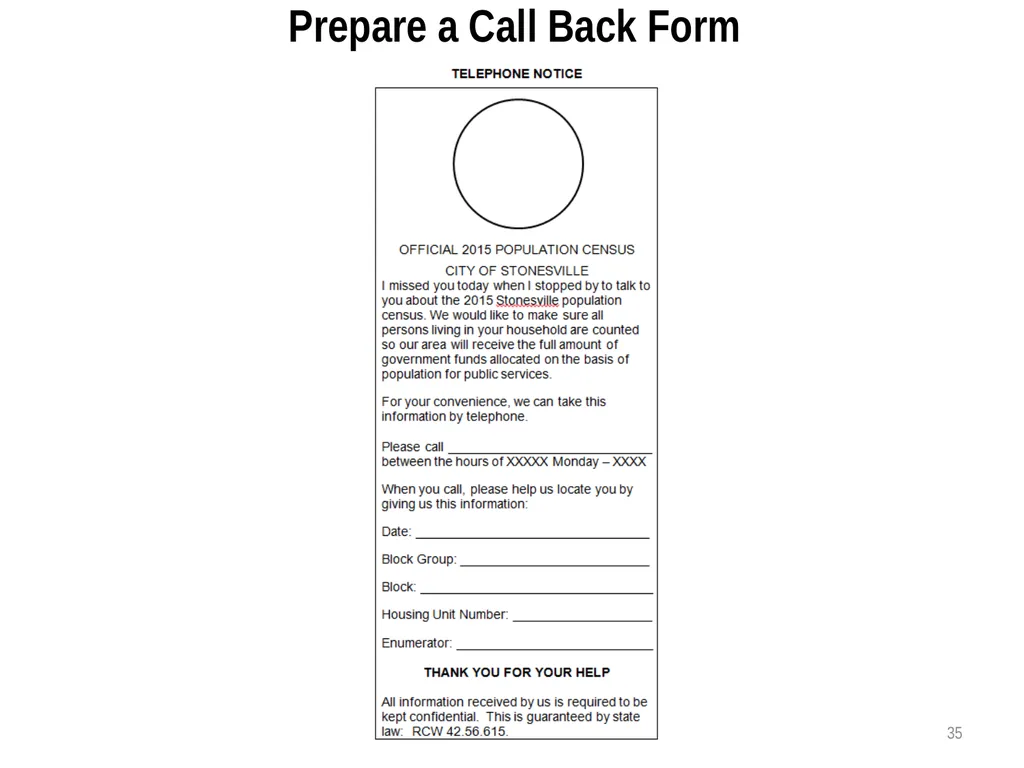
35 Prepare a Call Back Form<br>
36
36 Pre-prepared List for Callback Utility or county assessor’s records can help determine if the unit is being used. Names from these sources can be used to locate phone numbers for contact purposes only.
Names found via administrative sources should not be used by itself to enumerate the household. The owner of the house may not be the same as residents who occupy the house. The homeowners may also have other people (kids, relatives, roommates) living in the household.
It may take enumerators multiple times before reaching the residents. If residents are very difficult to reach, the unit may be held for occasional use. Until proven otherwise, it is vacant.<br>
37
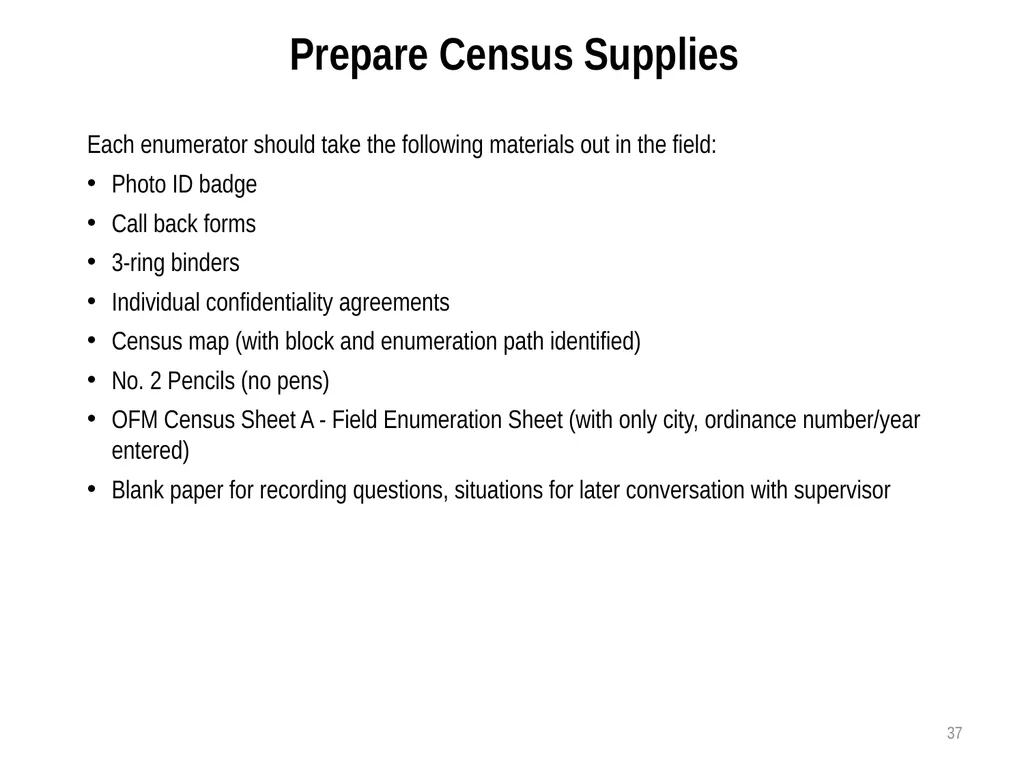
37 Each enumerator should take the following materials out in the field:
Photo ID badge
Call back forms
3-ring binders
Individual confidentiality agreements
Census map (with block and enumeration path identified)
No. 2 Pencils (no pens)
OFM Census Sheet A - Field Enumeration Sheet (with only city, ordinance number/year entered)
Blank paper for recording questions, situations for later conversation with supervisor Prepare Census Supplies<br>
38
Monitoring Census Progress<br>
39
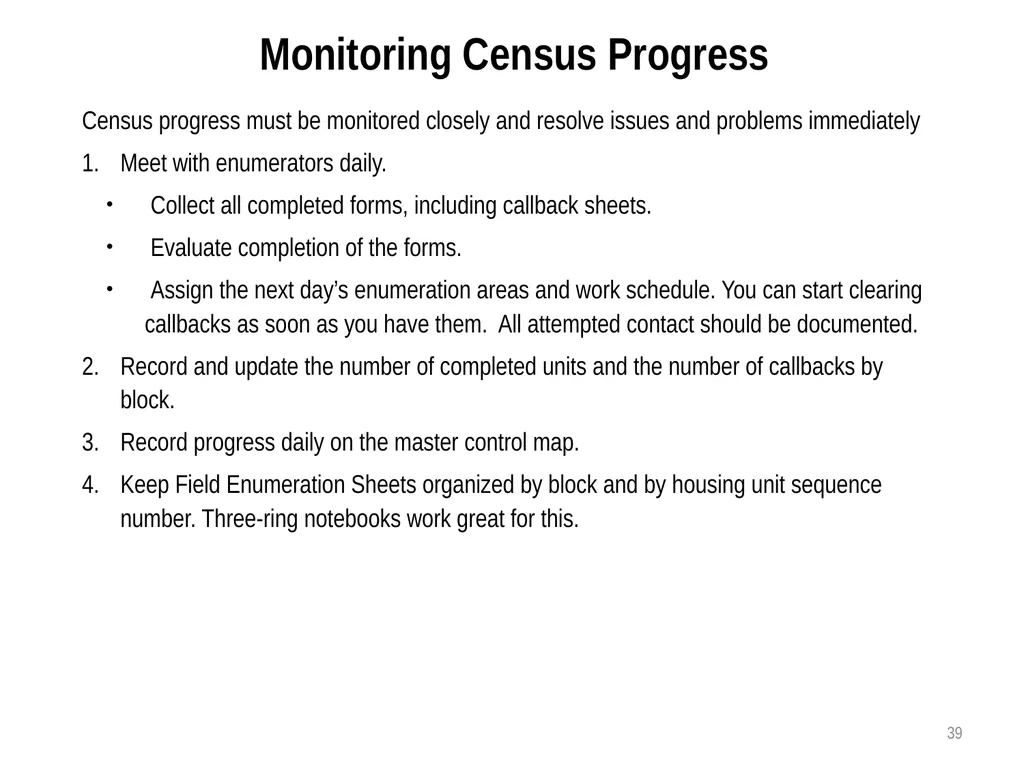
39 Monitoring Census Progress Census progress must be monitored closely and resolve issues and problems immediately
Meet with enumerators daily.
Collect all completed forms, including callback sheets.
Evaluate completion of the forms.
Assign the next day’s enumeration areas and work schedule. You can start clearing callbacks as soon as you have them. All attempted contact should be documented.
Record and update the number of completed units and the number of callbacks by block.
Record progress daily on the master control map.
Keep Field Enumeration Sheets organized by block and by housing unit sequence number. Three-ring notebooks work great for this.<br>
40
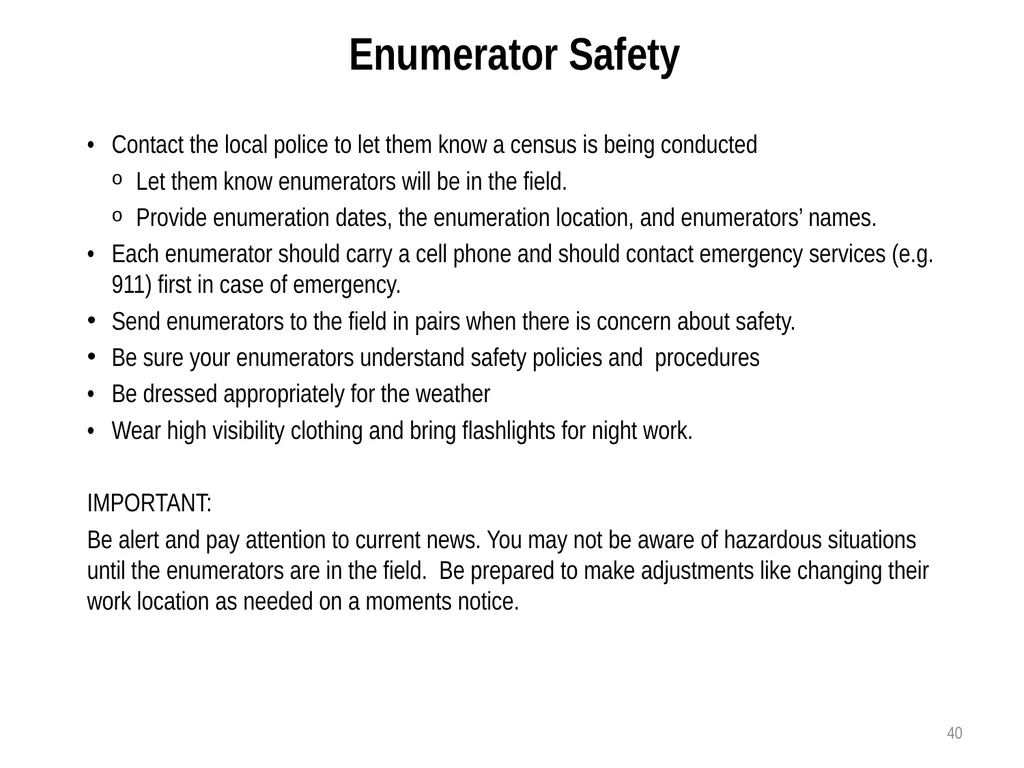
40 • Contact the local police to let them know a census is being conducted
Let them know enumerators will be in the field.
Provide enumeration dates, the enumeration location, and enumerators’ names.
• Each enumerator should carry a cell phone and should contact emergency services (e.g. 911) first in case of emergency.
Send enumerators to the field in pairs when there is concern about safety.
Be sure your enumerators understand safety policies and procedures
• Be dressed appropriately for the weather
• Wear high visibility clothing and bring flashlights for night work.
IMPORTANT:
Be alert and pay attention to current news. You may not be aware of hazardous situations until the enumerators are in the field. Be prepared to make adjustments like changing their work location as needed on a moments notice. Enumerator Safety<br>
41
41 Evaluating Enumerators Administrator /supervisor should evaluate the enumerators on daily basis. Make assessments in the first couple of days to find and keep those with high performance. Those who
Submit more completed forms, and fewer refusals,
Can get better neighbor cooperation
And have more complete names of residents
And let go of those unable to do the job, especially as the workload decreases with each day’s progress.<br>
Submit more completed forms, and fewer refusals,
Can get better neighbor cooperation
And have more complete names of residents
And let go of those unable to do the job, especially as the workload decreases with each day’s progress.<br>
42
Common Mistakes Underestimate the time required to do a census
Underestimate the number of enumerators needed
Unclear chain of command / responsibilities
Inadequately prepared maps
Inadequate checking of enumerator/supervisor performance
Inadequate checking of census progress
Failure to use pre-census publicity materials 42<br>
Underestimate the number of enumerators needed
Unclear chain of command / responsibilities
Inadequately prepared maps
Inadequate checking of enumerator/supervisor performance
Inadequate checking of census progress
Failure to use pre-census publicity materials 42<br>
43
Tabulation and Filing Procedure<br>
44
Tabulating Census Results Field Enumeration forms (Sheet A) need to be tabulated. OFM tabulation forms must be used. Tabulation instructions are included in a separate manual and online training.
OFM’s advice is:
Either do the tabulation yourself
Or have a good enumerator do the tabulation.
Enumerators should not tabulate their own forms. 44<br>
OFM’s advice is:
Either do the tabulation yourself
Or have a good enumerator do the tabulation.
Enumerators should not tabulate their own forms. 44<br>
45
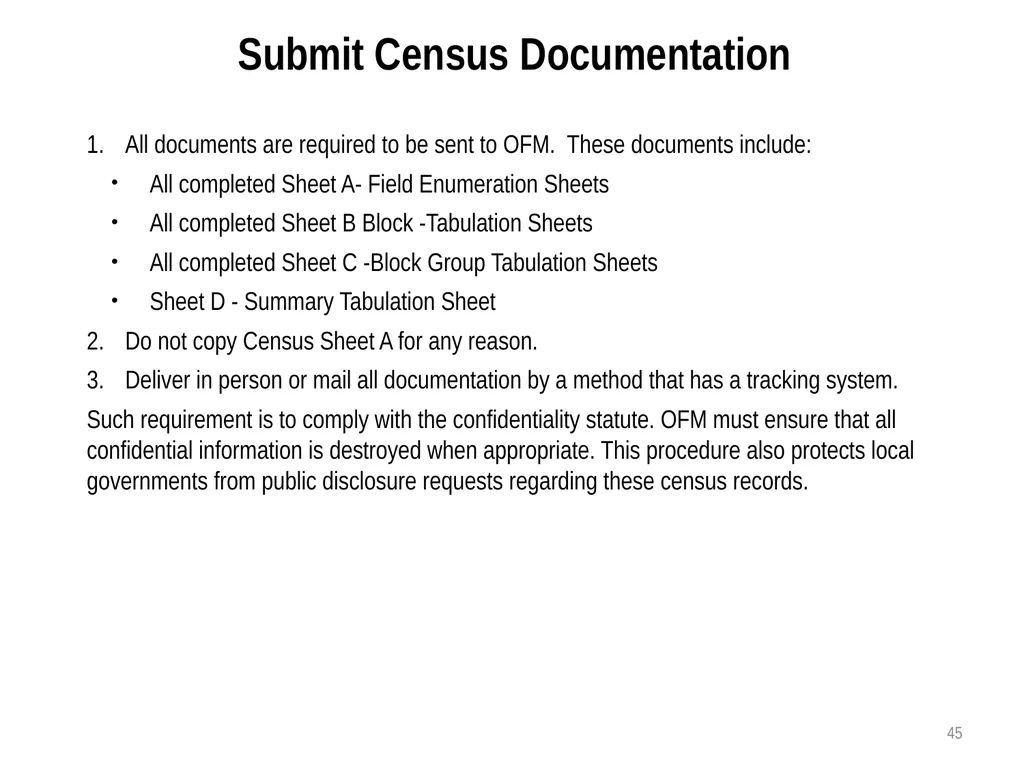
45 Submit Census Documentation All documents are required to be sent to OFM. These documents include:
All completed Sheet A- Field Enumeration Sheets
All completed Sheet B Block -Tabulation Sheets
All completed Sheet C -Block Group Tabulation Sheets
Sheet D - Summary Tabulation Sheet
Do not copy Census Sheet A for any reason.
Deliver in person or mail all documentation by a method that has a tracking system.
Such requirement is to comply with the confidentiality statute. OFM must ensure that all confidential information is destroyed when appropriate. This procedure also protects local governments from public disclosure requests regarding these census records.<br>
46
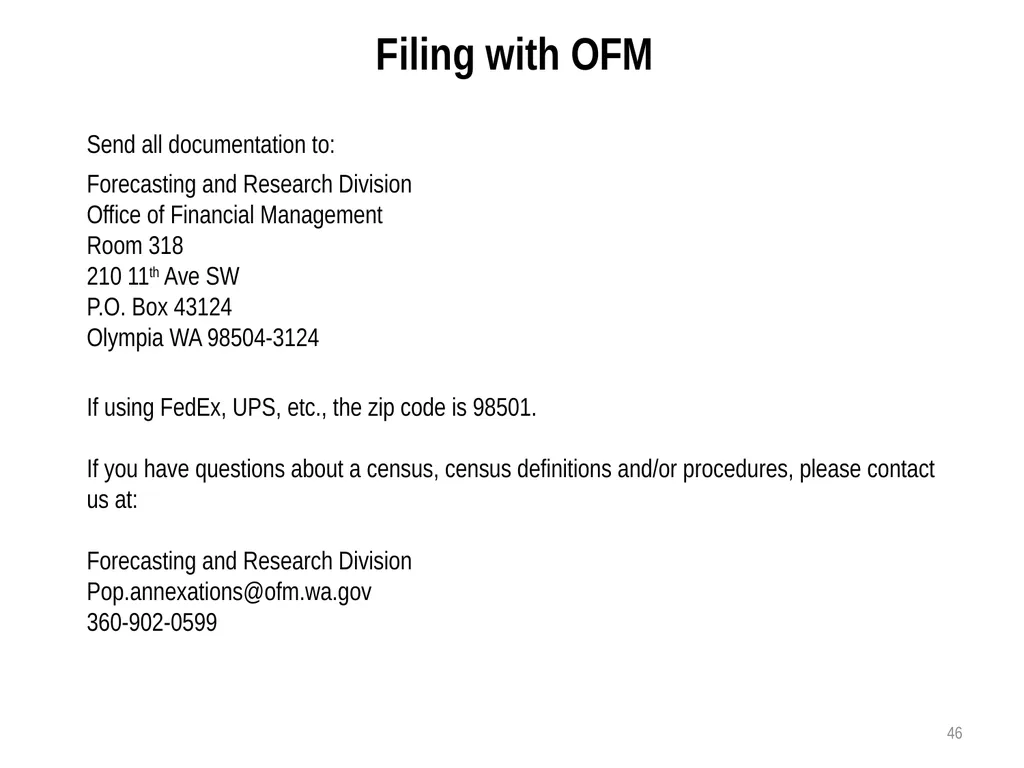
46 Filing with OFM Send all documentation to:
Forecasting and Research Division
Office of Financial Management
Room 318
210 11th Ave SW
P.O. Box 43124
Olympia WA 98504-3124
If using FedEx, UPS, etc., the zip code is 98501.
If you have questions about a census, census definitions and/or procedures, please contact us at:
Forecasting and Research Division
Pop.annexations@ofm.wa.gov
360-902-0599<br>
Forecasting and Research Division
Office of Financial Management
Room 318
210 11th Ave SW
P.O. Box 43124
Olympia WA 98504-3124
If using FedEx, UPS, etc., the zip code is 98501.
If you have questions about a census, census definitions and/or procedures, please contact us at:
Forecasting and Research Division
Pop.annexations@ofm.wa.gov
360-902-0599<br>