
Central Banks in the World Today © 2017
LS
Published · 59 slides · 0 views

1 / 1



Description
Central Banks in the World Today 2017 McGraw-Hill Education. All Rights Reserved. Authorized only for instructor use in the classroom. No reproduction or distribution without the prior written consent of McGraw-Hill Education. Learning
Related Topics
Share
Embed code
Download this presentation From Below
"Central Banks in the World Today © 2017" is the property of its rightful owner. Permission is granted to download and print the materials on this website for personal, non-commercial use only, and to display it on your personal computer provided you do not modify the materials and that you retain all copyright notices contained in the materials. By downloading content from our website, you accept the terms of this agreement.
Presentation Transcript
01
Central Banks in the World Today © 2017 McGraw-Hill Education. All Rights Reserved. Authorized only for instructor use in the classroom. No reproduction or distribution without the prior written consent of McGraw-Hill Education.<br>
02
Learning Objectives Explain the origin and functions of central banks.
Analyze the objectives of central banks.
Describe the features of an effective central bank.
Discuss the relationship between monetary and fiscal policy. 15-2 © 2017 McGraw-Hill Education. All Rights Reserved.<br>
03
Introduction The central bank of the U.S. is the Federal Reserve (Fed).
The people who work there are responsible for making sure that our financial system functions smoothly so that the average citizen can carry on without worrying about it. 15-3 © 2017 McGraw-Hill Education. All Rights Reserved.<br>
04
The Government’s Bank King William of Orange created the central bank to finance wars.
Napoleon Bonaparte did it in an effort to stabilize his country’s economic and financial system.
These examples are more an exception because central banking is largely a 20th century phenomenon. 15-4 © 2017 McGraw-Hill Education. All Rights Reserved.<br>
05
The Government’s Bank In 1900, only 18 countries had a central bank.
The U.S. Federal Reserve began operation in 1914.
As the government’s bank, the central bank has a privileged position:
It has the monopoly on the issuance of currency.
The central bank creates money.
Early central banks kept sufficient reserves to redeem their notes in gold.
Today, the Fed has the sole legal authority to issue U.S. dollar bills. 15-5 © 2017 McGraw-Hill Education. All Rights Reserved.<br>
06
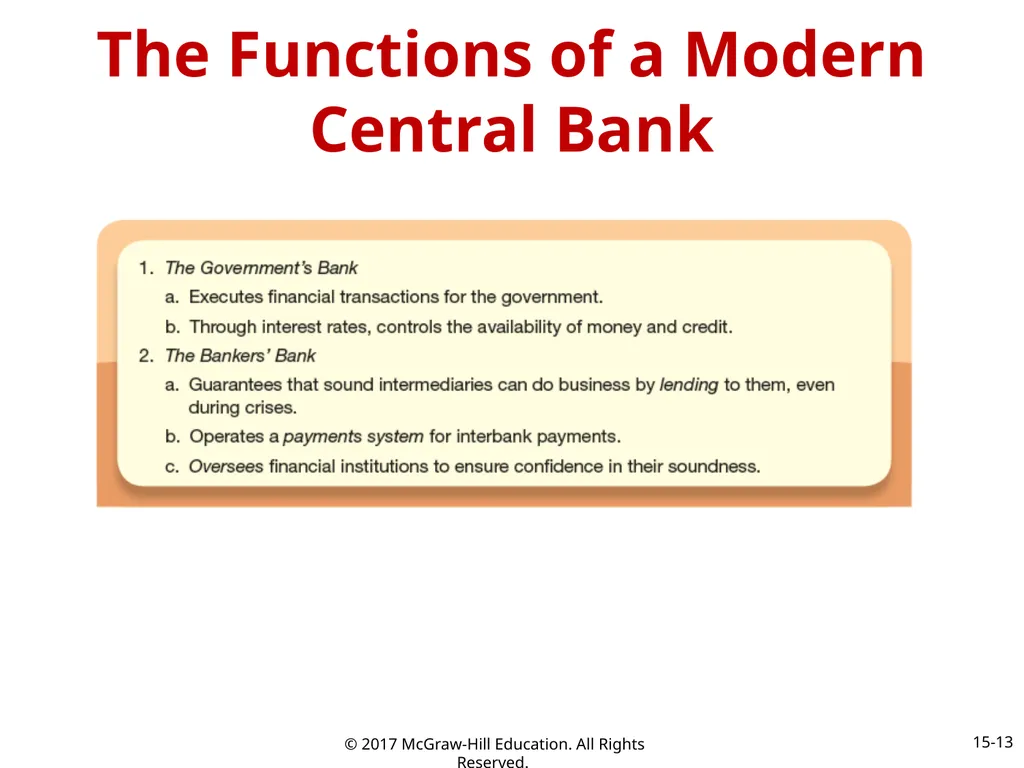
The Government’s Bank The central bank can control the availability of money and credit in a country's economy.
Most central banks go about this by adjusting short-term interest rates: monetary policy.
They use it to stabilize economic growth and information. 15-6 © 2017 McGraw-Hill Education. All Rights Reserved.<br>
07
The Government’s Bank At its most basic level, printing money is a very profitable business.
A bill only costs a few cents to print.
Government officials also know that losing control of the printing presses means losing control of inflation.
A high rate of money growth creates a high inflation rate. 15-7 © 2017 McGraw-Hill Education. All Rights Reserved.<br>
08
Counterfeiting has been used as a weapon in wartime.
The goal was to destabilize the enemy’s currency.
Without a stable currency it is difficult for an economy to run efficiently.
This is why preserving the value of a nation’s currency is one of the central bank’s most important responsibilities. 15-8 © 2017 McGraw-Hill Education. All Rights Reserved.<br>
09
The Banker’s Bank As the banker’s bank, the central bank took on key roles it plays today:
To provide loans during times of financial stress,
To manage the payments system, and
To oversee commercial banks and the financial system.
The ability to create money means that the central bank can make loans even when no one else can. 15-9 © 2017 McGraw-Hill Education. All Rights Reserved.<br>
10
The Banker’s Bank Every country needs a secure and efficient payments system.
Financial institutions need a cheap and reliable way to transfer funds to one another.
The fact that all banks have account at the central bank makes the it the natural place for interbank payments to be settled.
In 2015, an average of more than $3.3 trillion per day was transferred over Fedwire. 15-10 © 2017 McGraw-Hill Education. All Rights Reserved.<br>
11
The Banker’s Bank Commercial banks and nonbank financial institutions have to be monitored so that savers and investors can be confident these institutions are sound.
Government examiners and supervisors are the only ones who can handle such sensitive information without conflict of interest.
As the government’s bank and the banker’s bank, central banks are the biggest, most powerful players in a country’s financial and economic system. 15-11 © 2017 McGraw-Hill Education. All Rights Reserved.<br>
12
The Banker’s Bank It is essential that we understand what a central bank is not.
It does not control securities markets, though it may monitor and participate in bond and stock markets.
It does not control the government’s budget.
That is determined by Congress and the president through fiscal policy.
The Fed only acts as the Treasury’s bank. 15-12 © 2017 McGraw-Hill Education. All Rights Reserved.<br>
13
The Functions of a Modern Central Bank 15-13 © 2017 McGraw-Hill Education. All Rights Reserved.<br>
14
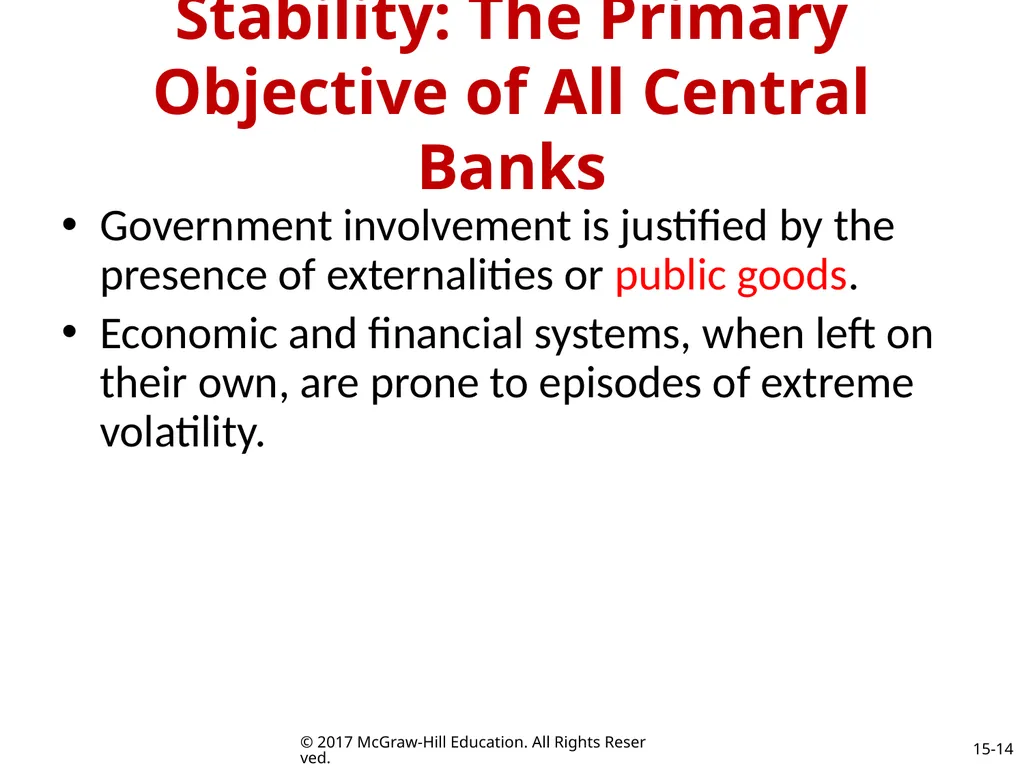
Stability: The Primary Objective of All Central Banks Government involvement is justified by the presence of externalities or public goods.
Economic and financial systems, when left on their own, are prone to episodes of extreme volatility. 15-14 © 2017 McGraw-Hill Education. All Rights Reserved.<br>
15
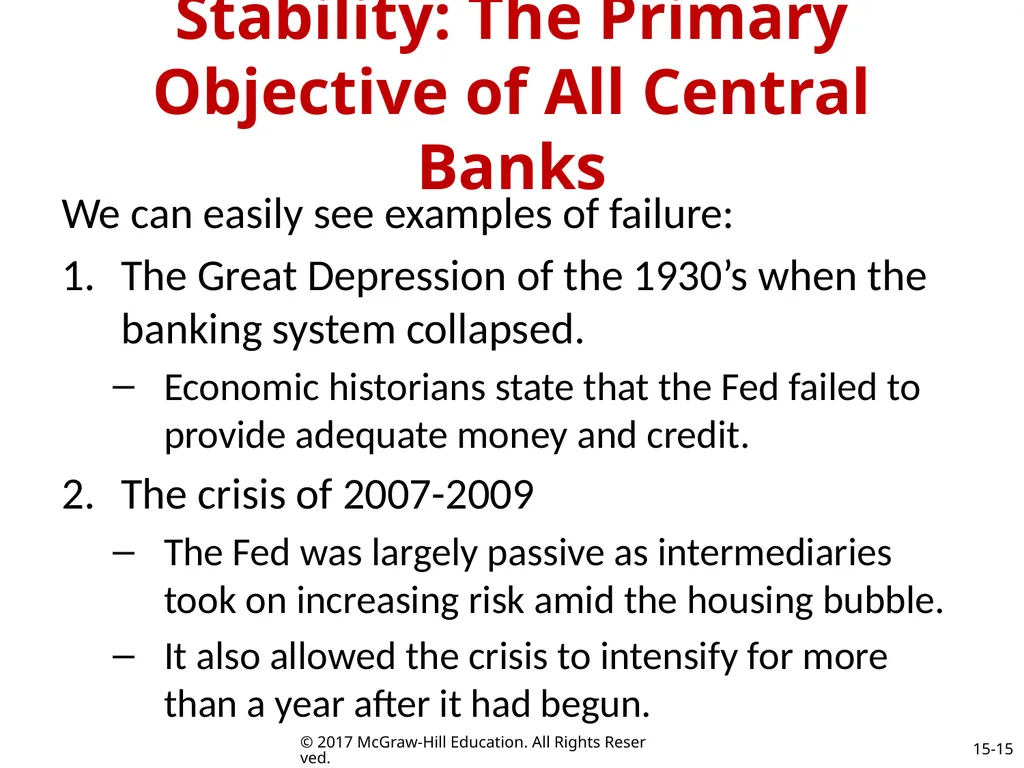
Stability: The Primary Objective of All Central Banks We can easily see examples of failure:
The Great Depression of the 1930’s when the banking system collapsed.
Economic historians state that the Fed failed to provide adequate money and credit.
The crisis of 2007-2009
The Fed was largely passive as intermediaries took on increasing risk amid the housing bubble.
It also allowed the crisis to intensify for more than a year after it had begun. 15-15 © 2017 McGraw-Hill Education. All Rights Reserved.<br>
16
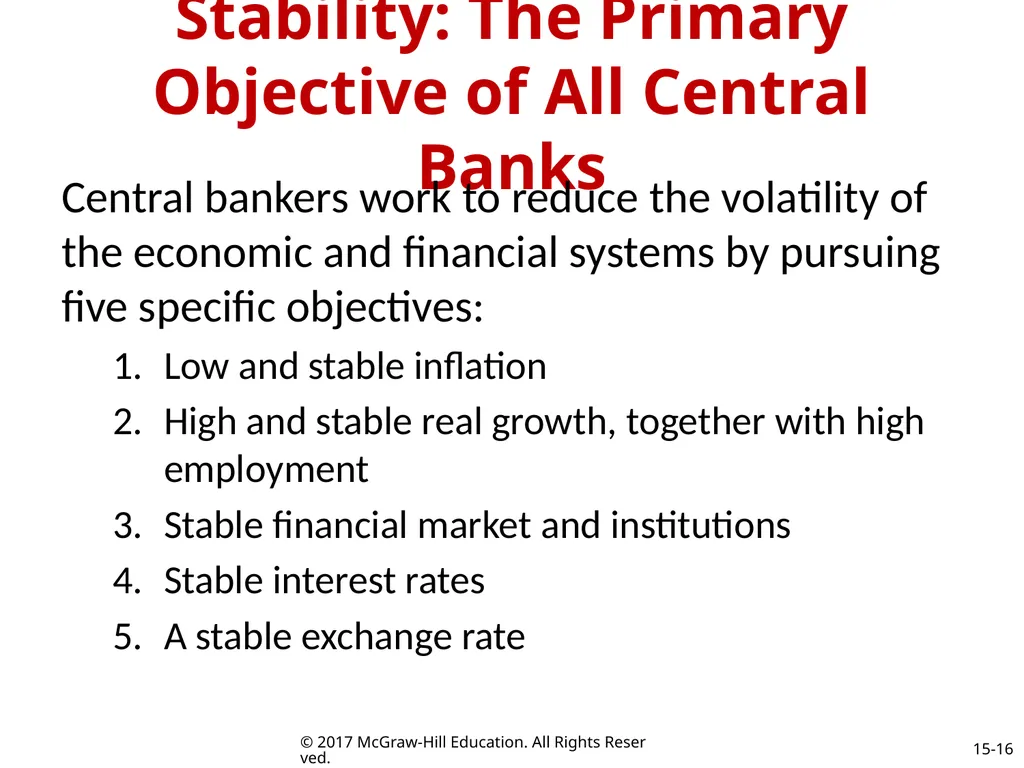
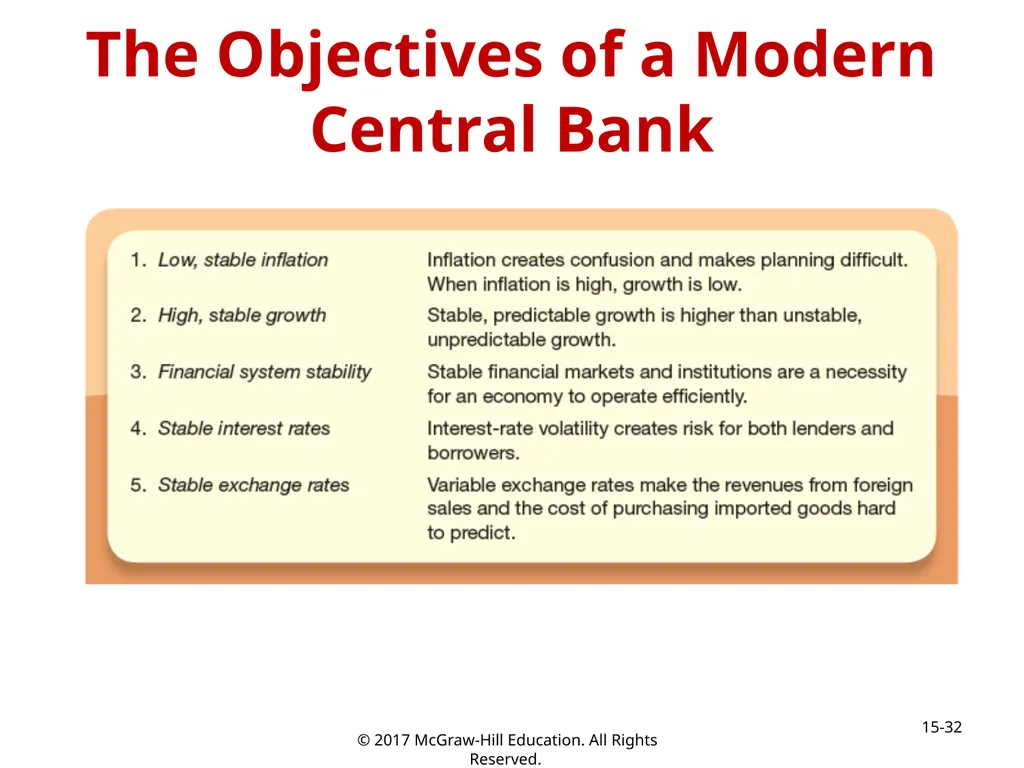
Stability: The Primary Objective of All Central Banks Central bankers work to reduce the volatility of the economic and financial systems by pursuing five specific objectives:
Low and stable inflation
High and stable real growth, together with high employment
Stable financial market and institutions
Stable interest rates
A stable exchange rate 15-16 © 2017 McGraw-Hill Education. All Rights Reserved.<br>
17
Stability: The Primary Objective of All Central Banks The job of the central bank is to improve general economic welfare by managing and reducing systematic risk.
Instability in any of these five objectives poses a systematic or economy-wide risk.
It is probably impossible to achieve all five of their objectives simultaneously.
Tradeoffs must be made. 15-17 © 2017 McGraw-Hill Education. All Rights Reserved.<br>
18
Low, Stable Inflation Many central banks take their primary job as the maintenance of price stability.
They strive to eliminate inflation.
The consensus is that when inflation rises too high or falls too low for an extended period, the central bank is at fault.
The purchasing power of one dollar, one yen, or one euro should remain stable over long periods of time.
Maintaining price stability enhances money’s usefulness both as a unit of account and as a store of value. 15-18 © 2017 McGraw-Hill Education. All Rights Reserved.<br>
19
Low, Stable Inflation Prices provide the information individuals and firms need to ensure that resources are allocated to their most productive uses.
But volatile inflation degrades the information content of prices.
If the economy is to run efficiently, we need to be able to tell the reason why prices are changing. 15-19 © 2017 McGraw-Hill Education. All Rights Reserved.<br>
20
Low, Stable Inflation The higher inflation is, the less predictable it is, and the more systematic risk it creates.
High inflation is also bad for growth.
In cases of hyperinflation,
Prices contain virtually no information, and
People use all their energy just coping with the crisis so growth plummets. 15-20 © 2017 McGraw-Hill Education. All Rights Reserved.<br>
21
Low, Stable Inflation Most people agree that low inflation should be the primary objective of monetary policy.
Zero inflation is probably too low.
There would be a risk of deflation.
This makes debts more difficult to repay, increasing default, affecting the health of banks.
Zero inflation would also be difficult for companies.
If an employer wished to cut labor costs, it would need to cut nominal wages which is difficult to do.
So, a small amount of inflation makes labor markets work better, at least from an employer’s point of view. 15-21 © 2017 McGraw-Hill Education. All Rights Reserved.<br>
22
High inflation is more volatile than low inflation.
Volatile inflation means more risk which requires compensation.
High inflation means a higher risk premium, so loan rates are higher.
Volatile inflation makes long-term planning even more difficult. 15-22 © 2017 McGraw-Hill Education. All Rights Reserved.<br>
23
High & Stable Real Growth To foster maximum sustainable growth in output and employment was one of Chairman Bernanke’s goals.
This means working to dampen the fluctuations of the business cycle.
By adjusting interest rates, central bankers work to moderate these cycles and stabilize growth and employment. 15-23 © 2017 McGraw-Hill Education. All Rights Reserved.<br>
24
High & Stable Real Growth The idea is that there is some long-run normal level of production called potential output, which depends on things like
Technology
The size of the capital stock
The number of people who can work
Usual working hours.
Growth in these inputs leads to growth in potential output -- sustainable growth. 15-24 © 2017 McGraw-Hill Education. All Rights Reserved.<br>
25
High & Stable Real Growth A period of above-average growth has to be followed by a period of below-average growth.
The job of the central bank during such periods is to change interest rates to adjust growth.
In the long run, stability leads to higher growth.
The greater the uncertainty about future business conditions, the more cautious people will be in making investments of all kinds. 15-25 © 2017 McGraw-Hill Education. All Rights Reserved.<br>
26
High & Stable Real Growth Fluctuations in general business conditions are the primary source of systematic risk, so stability is important.
Uncertainty about the future make planning more difficult, so less uncertainty makes everyone better off. 15-26 © 2017 McGraw-Hill Education. All Rights Reserved.<br>
27
Financial System Stability The Fed was founded to stop the financial panics that plagued the U.S. during the late 19th and early 20th centuries.
Financial system stability is an integral part of every modern central banker’s job. 15-27 © 2017 McGraw-Hill Education. All Rights Reserved.<br>
28
Financial System Stability If people lose faith in financial institutions and markets, they will rush to low-risk alternatives.
Intermediation will stop.
The possibility of a severe disruption in the financial markets is a type of systematic risk.
Central banks must control this risk.
The value at risk measures the risk of the maximum potential loss of a specific intermediary.
Newer measures of risk seek to quantify the impact that losses at an individual intermediary could have on the stability of the financial system as a whole. 15-28 © 2017 McGraw-Hill Education. All Rights Reserved.<br>
29
Interest-Rate and Exchange-Rate Stability In the hierarchy, interest-rate stability and exchange-rate stability are means for achieving the ultimate goal of stabilizing the economy.
They are not ends unto themselves. 15-29 © 2017 McGraw-Hill Education. All Rights Reserved.<br>
30
Interest-Rate and Exchange-Rate Stability Why is interest-rate volatility a problem?
Most people respond to low interest rates by borrowing and spending more and vice versa.
Interest-rate volatility makes output unstable.
Interest-rate volatility means higher risk and therefore a higher risk premium.
Risk makes financial decisions more difficult, lower productivity, and lessen efficiency. 15-30 © 2017 McGraw-Hill Education. All Rights Reserved.<br>
31
Interest-Rate an Exchange-Rate Stability The value of a country’s currency affects the cost of imports to domestic consumers and the cost of exports to foreign buyers.
When the exchange rate is stable, the dollar price of goods is predictable and planning ahead is easier for everyone.
For emerging market countries, exports and imports are central to the structure of the economy.
Stable exchange rates are very important. 15-31 © 2017 McGraw-Hill Education. All Rights Reserved.<br>
32
The Objectives of a Modern Central Bank 15-32 © 2017 McGraw-Hill Education. All Rights Reserved.<br>
33
During the crisis, did the Fed sacrifice its monetary policy independence and its objective of low, stable inflation?
Many Fed actions in the crisis were radical and precedent-setting.
In a financial crisis, the policy goals may be mutually consistent.
An independent central bank may wish to cooperate with fiscal authorities to promote financial stability and forestall deflation. 15-33 © 2017 McGraw-Hill Education. All Rights Reserved.<br>
34
An independent central bank must also be prepared to reverse course when necessary to keep inflation low.
The difficulty is knowing when to exit.
Political backlash following the bailouts of big banks and nonbanks during the crisis 15-34 © 2017 McGraw-Hill Education. All Rights Reserved.<br>
35
Meeting the Challenge: Creating a Successful Central Bank Prior to the global financial crisis of 2007-2009, inflation was low and stable for over 25 years
Technology sparked a boom just as central banks became better at their jobs.
Monetary policymakers realized that sustainable growth had gone up, so they could keep interest rates low without worrying about inflation.
Central banks were redesigned. 15-35 © 2017 McGraw-Hill Education. All Rights Reserved.<br>
36
Meeting the Challenge: Creating a Successful Central Bank To be successful, a central bank must:
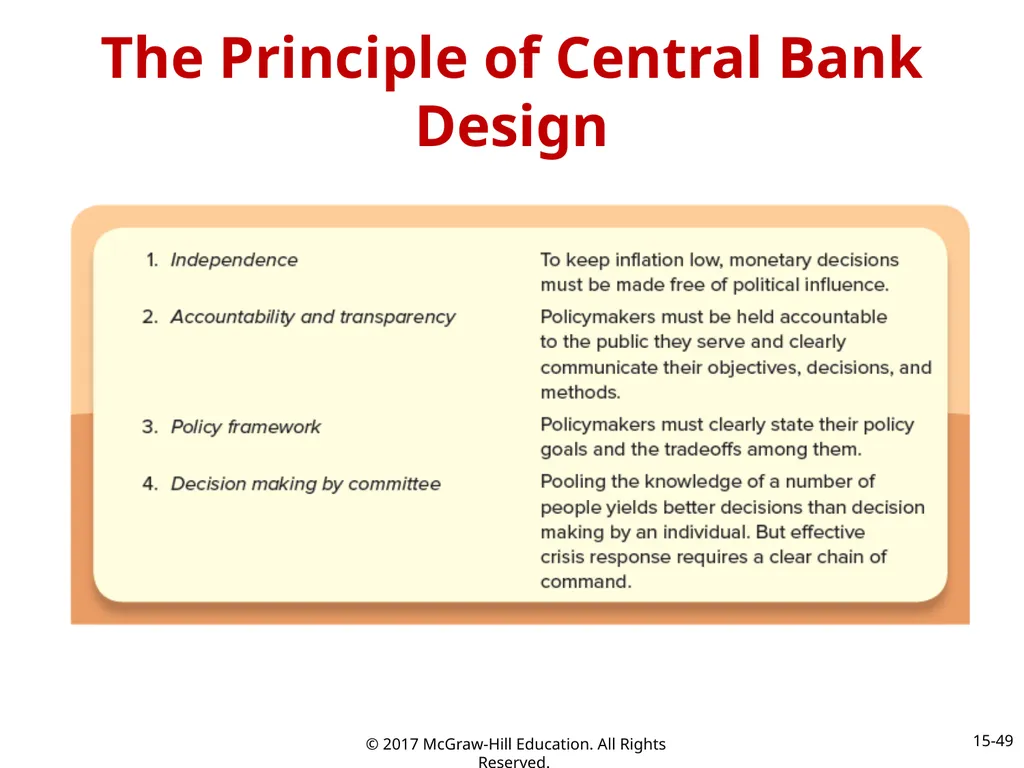
Be independent of political pressure.
Be accountable to the public and transparent in communicating its policy actions.
Operate within an explicit framework that clearly states its goals and makes clear the trade-offs among them.
Make decisions by committee. 15-36 © 2017 McGraw-Hill Education. All Rights Reserved.<br>
37
The Need for Independence The idea of central bank independence, that central banks should be independent of political pressure, is a new one.
Independence has two operational components:
Monetary policymakers must be free to control their own budgets.
The bank’s policies must not be reversible by people outside the central bank.
The U.S. Federal Open Market Committee’s decisions cannot be overridden by the President, Congress or the Supreme Court. 15-37 © 2017 McGraw-Hill Education. All Rights Reserved.<br>
38
The Need for Independence Successful monetary policy requires a long time horizon.
The temptation to forsake long-term goals for short-term gains is impossible for most politicians to resist.
Knowing these tendencies, governments have moved responsibility for monetary policy into a separate, largely apolitical, institution. 15-38 © 2017 McGraw-Hill Education. All Rights Reserved.<br>
39
The Need for Independence The Fed’s extraordinary actions during the crisis of 2007-2009 led to political backlash in the U.S. against central bank independence.
The lingering political question is whether Congress will choose to sacrifice the hard-won gains on the inflation front by weakening central bank independence.
It would be another costly legacy of the financial crisis. 15-39 © 2017 McGraw-Hill Education. All Rights Reserved.<br>
40
What drove politicians to give up control over monetary policy?
Realization that independent central bankers would deliver lower inflation than they themselves could. 15-40 © 2017 McGraw-Hill Education. All Rights Reserved.<br>
41
The Need for Accountability and Transparency Politicians would establish a set of goals.
The policymakers would publicly report their progress in pursuing those goals.
Explicit goals foster accountability and disclosure requirements create transparency.
Legislatures usually grant central banks instrument independence not goal independence
The institutional means for assuring accountability and transparency differ from one country to the next. 15-41 © 2017 McGraw-Hill Education. All Rights Reserved.<br>
42
The Need for Accountability and Transparency Today every central bank announces its policy actions almost immediately.
However the extent of the statements that accompany the announcement and the willingness to answer questions vary.
Central bank statements are far more informative today than they were in the early 1990s.
Secrecy is now understood to damage both the policymakers and the economies they are trying to manage. 15-42 © 2017 McGraw-Hill Education. All Rights Reserved.<br>
43
The Need for Accountability and Transparency The economy and financial markets should respond to information that everyone received, not to speculation about what policymakers are doing.
Policy makers need to be as clear as possible.
Transparency can help counter the uncertainties and anxieties that feed liquidity and deleveraging spirals. 15-43 © 2017 McGraw-Hill Education. All Rights Reserved.<br>
44
The Policy Framework, Policy Tradeoffs, and Credibility To meet these objectives, central bankers must be independent, accountable, and good communicators.
These qualities make up the monetary policy framework.
This exists to resolve ambiguities that arise in the course of the central bank’s work.
Officials have told us what they are going to do.
This helps people plan and keeps officials accountable to the public. 15-44 © 2017 McGraw-Hill Education. All Rights Reserved.<br>
45
The Policy Framework, Policy Tradeoffs, and Credibility The monetary policy framework also clarifies the likely responses when goals conflict with one another.
All objectives cannot be reached at the same time, and often the Fed only has one instrument.
It is impossible to use a single instrument to achieve a long list of objectives.
The goal of keeping inflation low and stable, then, can be inconsistent with the goal of avoiding a recession. 15-45 © 2017 McGraw-Hill Education. All Rights Reserved.<br>
46
The Policy Framework, Policy Tradeoffs, and Credibility Central bankers face the tradeoff between inflation and growth on a daily basis.
In 2008 the FOMC judged that it was more important to cut the policy rate in an effort to halt the financial contagion that has resulted form the run on Bear Stearns.
Policymakers were forced to choose among competing objectives amid great uncertainty. 15-46 © 2017 McGraw-Hill Education. All Rights Reserved.<br>
47
The Policy Framework, Policy Tradeoffs, and Credibility Because policy goals often conflict, central bankers must make their priorities clear.
The public needs to know:
What policymakers are focusing on and what they are willing to allow to change, and
The roles that interest-rate and exchange-rate stability play in policy deliberations.
This limits the discretionary authority of the central bankers, ensuring that they will do the job with which they have been entrusted. 15-47 © 2017 McGraw-Hill Education. All Rights Reserved.<br>
48
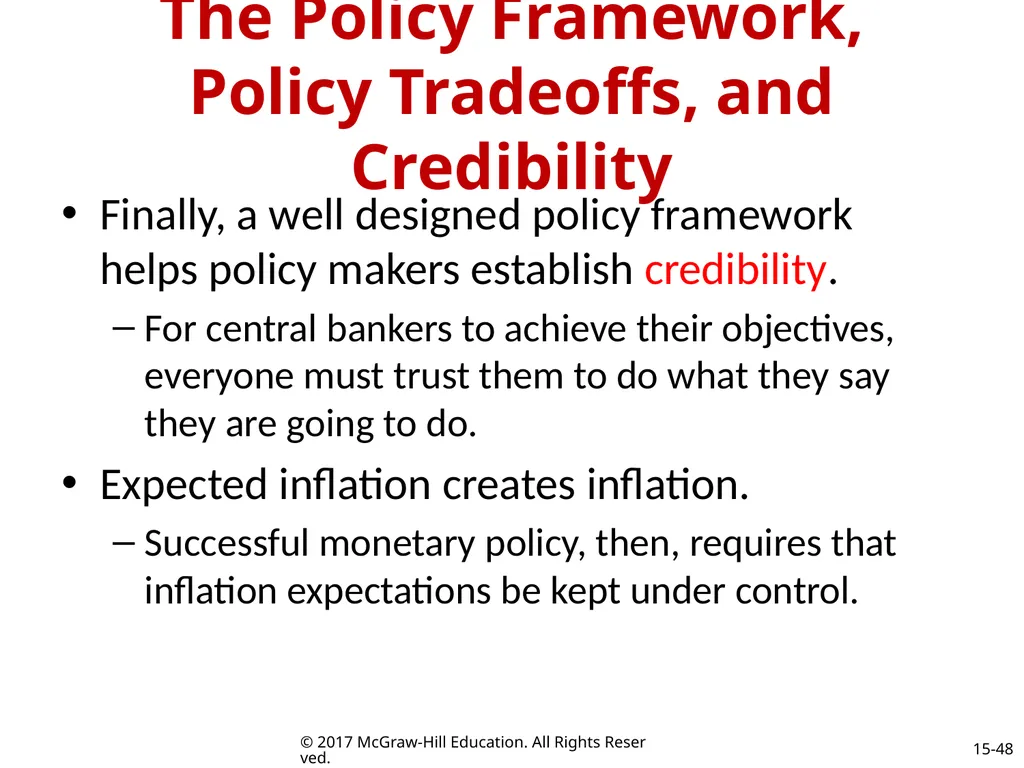
The Policy Framework, Policy Tradeoffs, and Credibility Finally, a well designed policy framework helps policy makers establish credibility.
For central bankers to achieve their objectives, everyone must trust them to do what they say they are going to do.
Expected inflation creates inflation.
Successful monetary policy, then, requires that inflation expectations be kept under control. 15-48 © 2017 McGraw-Hill Education. All Rights Reserved.<br>
49
The Principle of Central Bank Design 15-49 © 2017 McGraw-Hill Education. All Rights Reserved.<br>
50
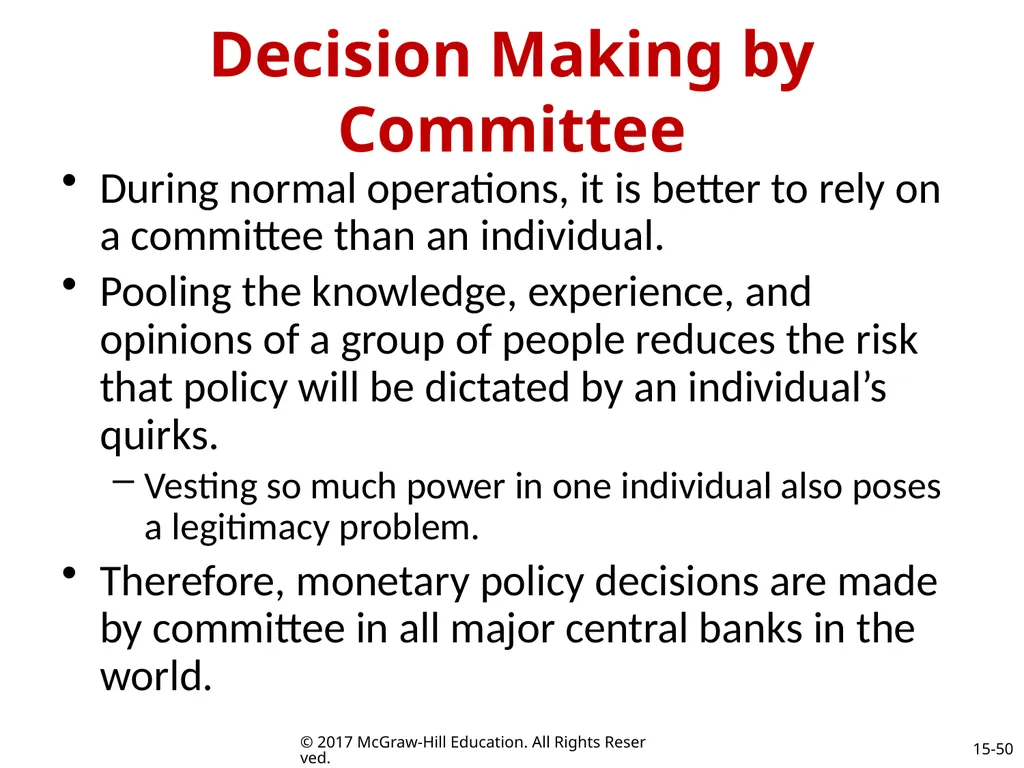
Decision Making by Committee During normal operations, it is better to rely on a committee than an individual.
Pooling the knowledge, experience, and opinions of a group of people reduces the risk that policy will be dictated by an individual’s quirks.
Vesting so much power in one individual also poses a legitimacy problem.
Therefore, monetary policy decisions are made by committee in all major central banks in the world. 15-50 © 2017 McGraw-Hill Education. All Rights Reserved.<br>
51
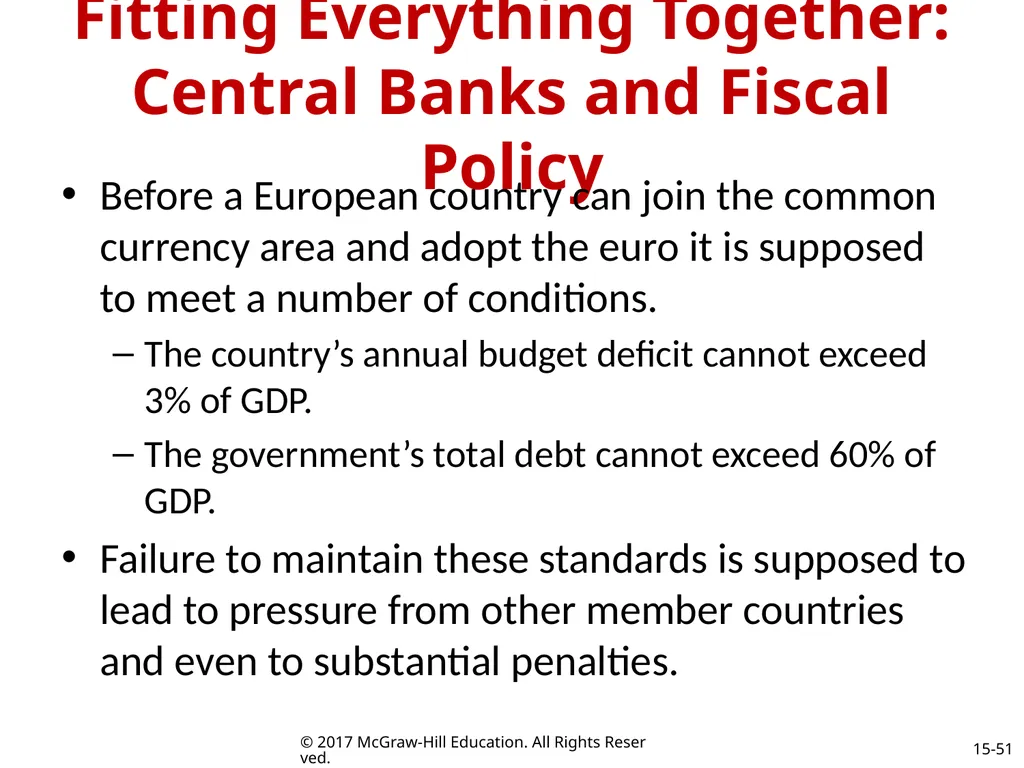
Fitting Everything Together: Central Banks and Fiscal Policy Before a European country can join the common currency area and adopt the euro it is supposed to meet a number of conditions.
The country’s annual budget deficit cannot exceed 3% of GDP.
The government’s total debt cannot exceed 60% of GDP.
Failure to maintain these standards is supposed to lead to pressure from other member countries and even to substantial penalties. 15-51 © 2017 McGraw-Hill Education. All Rights Reserved.<br>
52
Fitting Everything Together: Central Banks and Fiscal Policy By specifying a range of “acceptable” levels of borrowing, Europeans are trying to restrict the fiscal policies that member countries enact.
For the European Central Bank to do its job effectively, all the member countries’ governments must behave responsibly.
Funding needs create a natural conflict between monetary and fiscal policy makers. 15-52 © 2017 McGraw-Hill Education. All Rights Reserved.<br>
53
Fitting Everything Together: Central Banks and Fiscal Policy Central bankers, in their effort to stabilize prices and provide the foundation for high sustainable growth, take a long-term view.
They impose limits on how fast the quantity of money and credit can grow.
In contrast, fiscal policymakers tend to ignore the long-term inflationary effects of their actions.
They look for ways to spend resources today at the expense of prosperity tomorrow. 15-53 © 2017 McGraw-Hill Education. All Rights Reserved.<br>
54
Fitting Everything Together: Central Banks and Fiscal Policy Some fiscal policymakers resort to actions intended to get around restrictions imposed by the central bank.
This erodes what is otherwise an effective and responsible monetary policy.
Today the central bank’s autonomy leaves fiscal policymakers with two options for financing government spending.
Take a share of income and wealth through taxes.
Borrow by issuing bonds in the financial markets. 15-54 © 2017 McGraw-Hill Education. All Rights Reserved.<br>
55
Fitting Everything Together: Central Banks and Fiscal Policy If officials can’t raise taxes and are having trouble borrowing, inflation is the only way out.
While central bankers hate it, inflation is a real temptation to shortsighted fiscal policymakers.
Inflation is a way for governments to default on a portion of the debt they owe. 15-55 © 2017 McGraw-Hill Education. All Rights Reserved.<br>
56
Fitting Everything Together: Central Banks and Fiscal Policy U.S. fiscal and monetary policies to combat the crisis of 2007-2009 led many observers to worry both about future inflation risks and about renewed financial instability.
On the fiscal side, in 2009, the federal government’s deficit surpassed 10% of GDP for the first time since WWII
On the monetary policy side, the Fed lowered the policy interest rate close to zero and accumulated assets at an unprecedented pace as it sought to prevent a meltdown of the financial system. 15-56 © 2017 McGraw-Hill Education. All Rights Reserved.<br>
57
Fitting Everything Together: Central Banks and Fiscal Policy Both these policies eventually must be reversed to prevent a large future inflation.
When faced with a fiscal crisis, politicians often look for the easiest way out.
Monetary policy can meet its objective of price stability only if the government lives within its budget and never forces the central bank to finance a fiscal deficit. 15-57 © 2017 McGraw-Hill Education. All Rights Reserved.<br>
58
Fitting Everything Together: Central Banks and Fiscal Policy Responsible fiscal policy is essential to the success of monetary policy.
A poorly designed central bank cannot stabilize prices, output, the financial system, and interest and exchange rates, regardless of the government’s behavior.
To be successful, a central bank must be independent, accountable, and clear about its goals.
It must have a well-articulated communications strategy and a sound decision-making mechanism. 15-58 © 2017 McGraw-Hill Education. All Rights Reserved.<br>
59
Capital banks can operate safely with negative capital
A central bank can issue liabilities regardless of its net worth—it can never be illiquid
The central bank’s balance sheet can be consolidated with the government’s broader balance sheet
Future profits will offset a moderate capital shortfall in a reasonable time frame
The real threat arising from significant losses is political, not economic
Interest rate risk on both sides of the balance sheet
On the asset side, rising bonds would lower the value of its long term bonds
On the liabilities side, the Fed pays interest on excess reserves © 2017 McGraw-Hill Education. All Rights Reserved. 15-59<br>