
Certified Hospital Emergency Coordinator (CHEC)
SB
Published · 37 slides · 0 views
1 / 1

Description
Certified Hospital Emergency Coordinator (CHEC) Training Program Designing and Functioning in a Hospital Command Center (HCC) Objectives After completing this lesson, you should be able to: Identify favorable aspects of design for a
Related Topics
Share
Embed code
Download this presentation From Below
"Certified Hospital Emergency Coordinator (CHEC)" is the property of its rightful owner. Permission is granted to download and print the materials on this website for personal, non-commercial use only, and to display it on your personal computer provided you do not modify the materials and that you retain all copyright notices contained in the materials. By downloading content from our website, you accept the terms of this agreement.
Presentation Transcript
01
Certified Hospital
Emergency Coordinator (CHEC) Training Program Designing and Functioning in a
Hospital Command Center (HCC)<br>
Hospital Command Center (HCC)<br>
02
Objectives After completing this lesson, you should be able to:
Identify favorable aspects of design for a Hospital Command Center (HCC)
Identify ways to use these designs within your HCC<br>
Identify favorable aspects of design for a Hospital Command Center (HCC)
Identify ways to use these designs within your HCC<br>
03
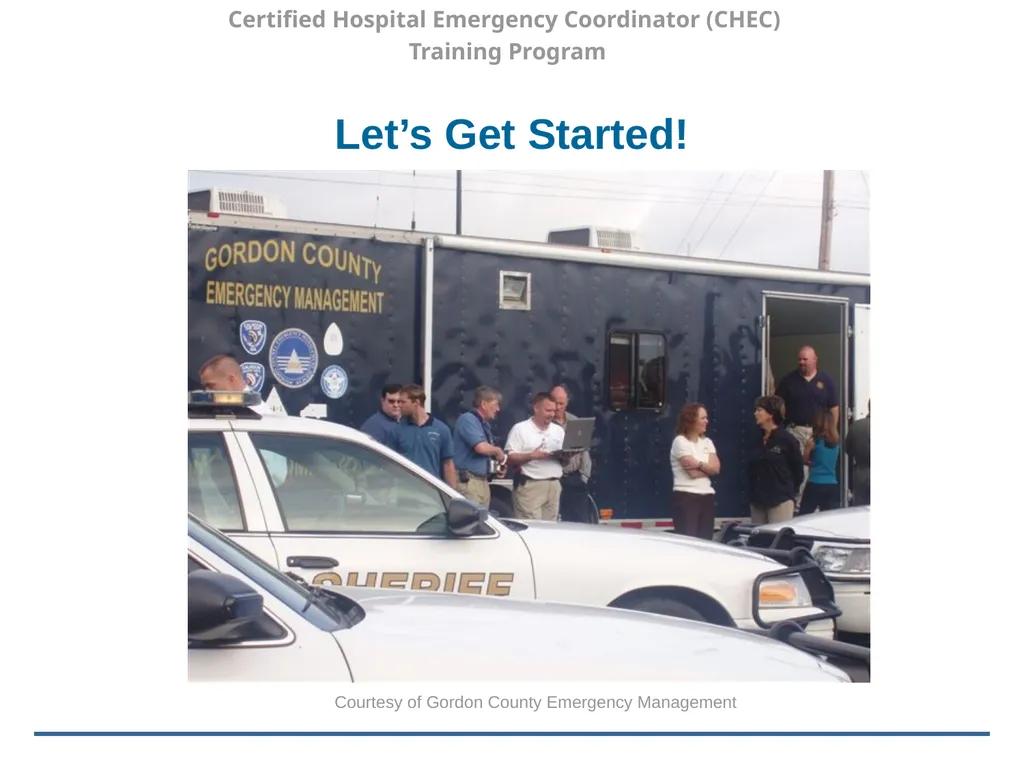
Let’s Get Started! Courtesy of Gordon County Emergency Management<br>
04
In this lesson we will discuss ways to: Organize Your Staff Members
Design of an HCC
Process Information
Manage Resources
Manage Public Information<br>
Design of an HCC
Process Information
Manage Resources
Manage Public Information<br>
05
The exterior of the new "Arlen Specter Headquarters and Emergency Operations Center", otherwise known as Building 21, located on CDC's Roybal campus in Atlanta, Georgia. (Photo by James Gathany) CDC Presentation by Julie L. Gerberding, M.D., M.P.H.
Before the U.S. House Appropriations Subcommittee
On Labor, Health and Human Services, and Education
March 9, 2007 Take a look at this Command Center:<br>
Before the U.S. House Appropriations Subcommittee
On Labor, Health and Human Services, and Education
March 9, 2007 Take a look at this Command Center:<br>
06
BUT!<br>
07
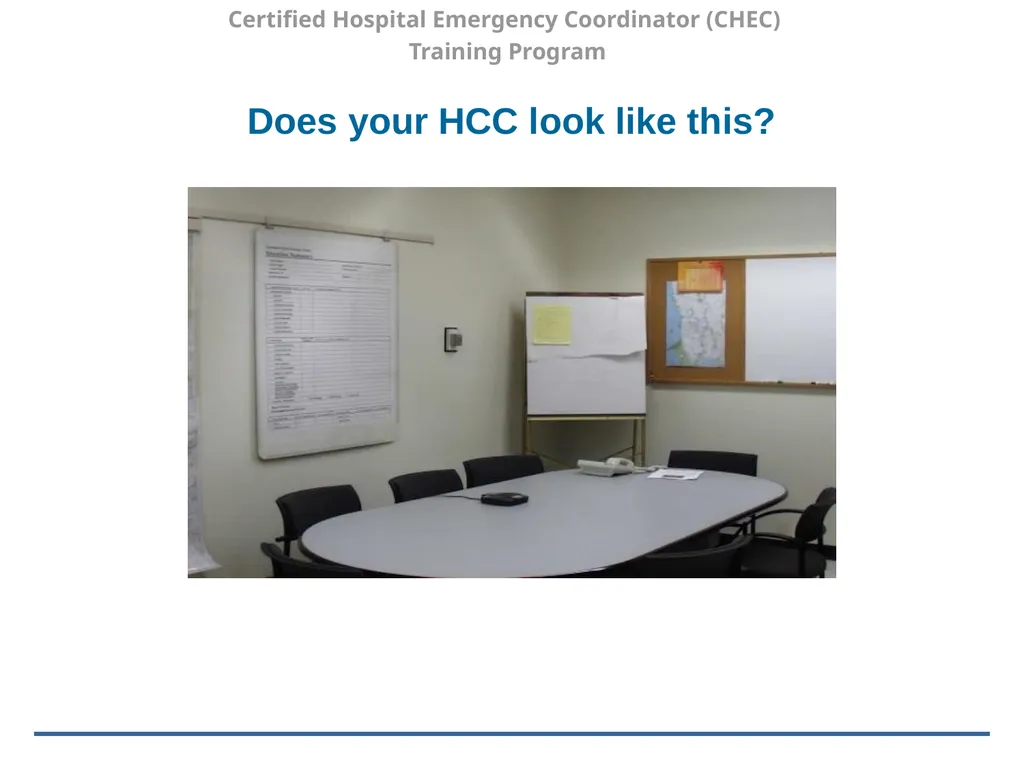
BUT! Does your HCC look like this?<br>
08
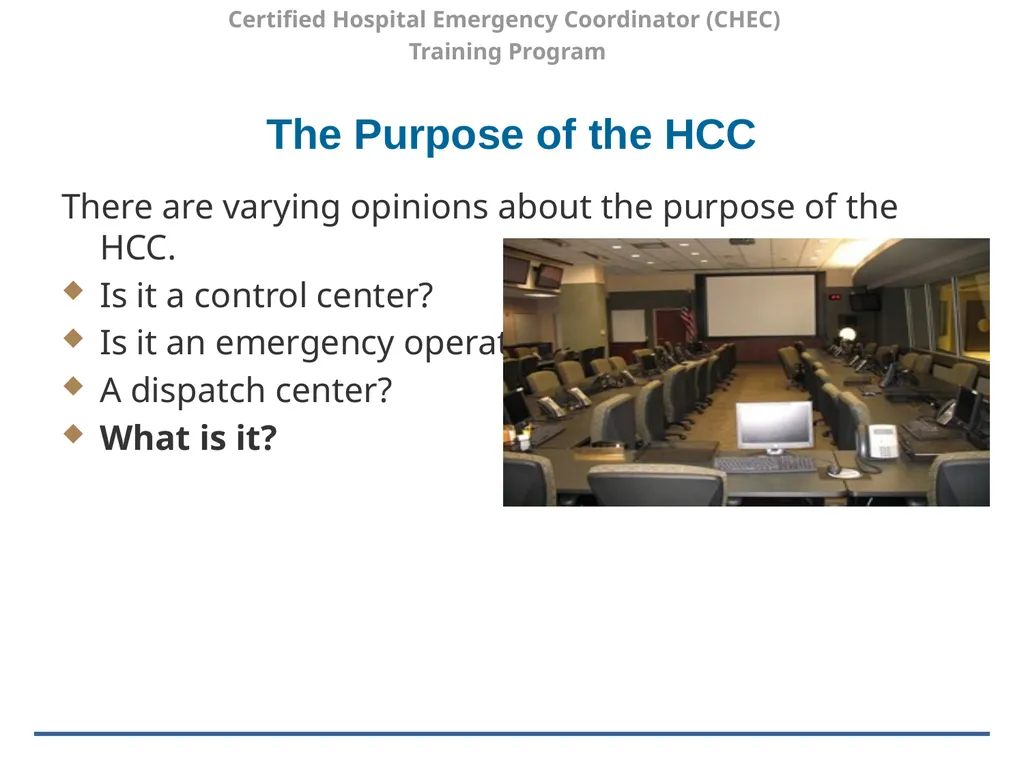
The Purpose of the HCC There are varying opinions about the purpose of the HCC.
Is it a control center?
Is it an emergency operations center?
A dispatch center?
What is it?<br>
Is it a control center?
Is it an emergency operations center?
A dispatch center?
What is it?<br>
09
Tasks of the HCC Simply put: The HCC’s purpose is to coordinate incident information and resources for management.
The HCC must receive, analyze, and display information about the incident to enable staff members in decision-making.
The HCC must find, prioritize, deploy, and track critical resources.
The HCC must enhance decision making, communication, collaboration, and coordination.<br>
The HCC must receive, analyze, and display information about the incident to enable staff members in decision-making.
The HCC must find, prioritize, deploy, and track critical resources.
The HCC must enhance decision making, communication, collaboration, and coordination.<br>
10
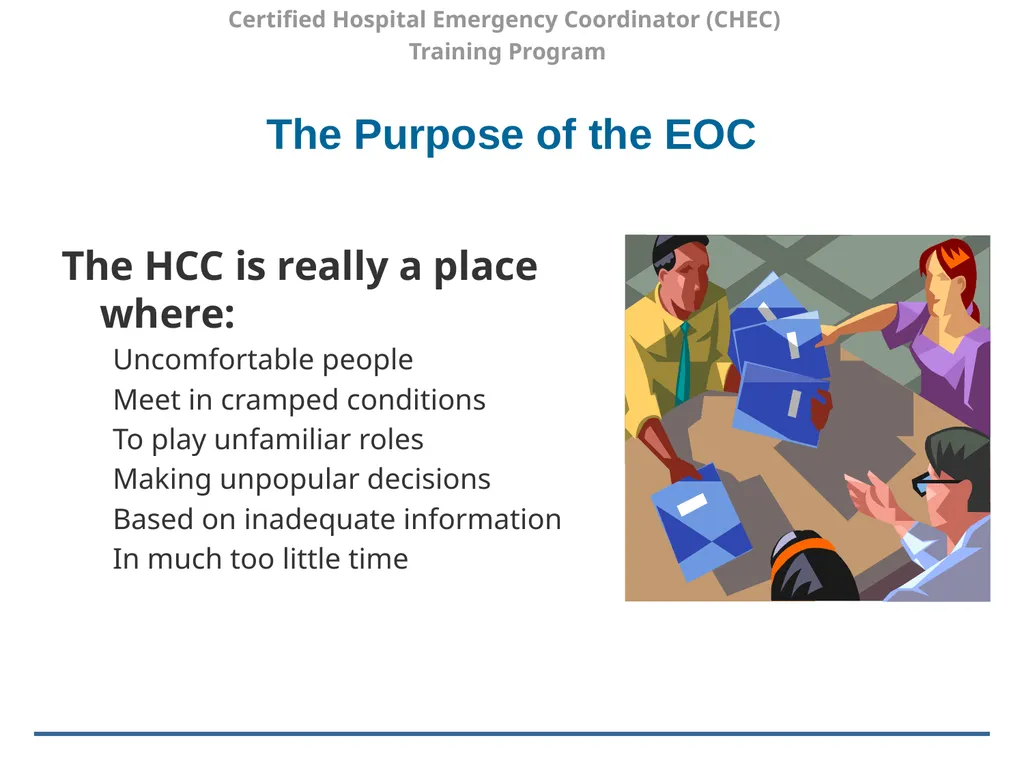
The Purpose of the EOC The HCC is really a place where:
Uncomfortable people
Meet in cramped conditions
To play unfamiliar roles
Making unpopular decisions
Based on inadequate information
In much too little time<br>
Uncomfortable people
Meet in cramped conditions
To play unfamiliar roles
Making unpopular decisions
Based on inadequate information
In much too little time<br>
11
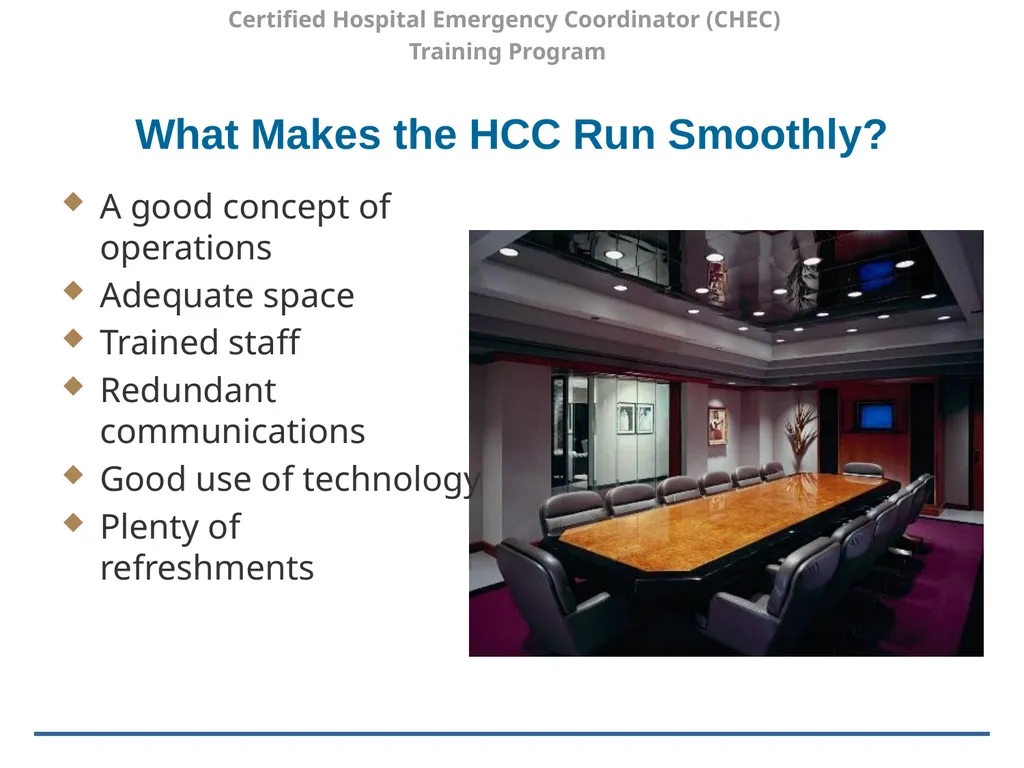
What Makes the HCC Run Smoothly? A good concept of operations
Adequate space
Trained staff
Redundant communications
Good use of technology
Plenty of refreshments<br>
Adequate space
Trained staff
Redundant communications
Good use of technology
Plenty of refreshments<br>
12
What Makes the HCC Work? Basic management functions
Objective-based
Incident action planning
Unity of Command
Delegation
Span of control
Support staff<br>
Objective-based
Incident action planning
Unity of Command
Delegation
Span of control
Support staff<br>
13
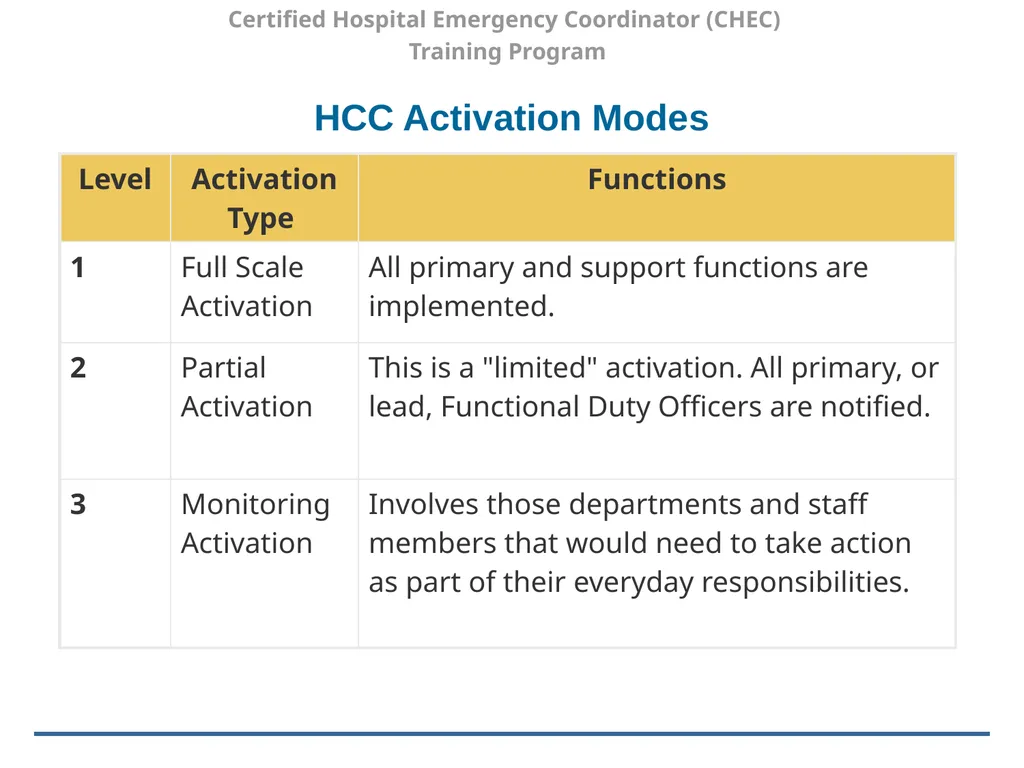
HCC Activation Modes<br>
14
Organizing the Hospital Command Center Team<br>
15
Organizational Issues Based on the Hospital Incident Command System (HICS)
Maximize the team, minimize the plan
Cross-training is essential
Succession planning important
Include all functional units<br>
Maximize the team, minimize the plan
Cross-training is essential
Succession planning important
Include all functional units<br>
16
Typical HCC Organization Based on Hospital Incident Command System<br>
17
HICS —Purpose and Application ICS is used for:
Incidents
Events—planned and unplanned
Key principles
Critical action guidance
Internal and external agency coordination<br>
Incidents
Events—planned and unplanned
Key principles
Critical action guidance
Internal and external agency coordination<br>
18
HICS Management Functions Management functions:
Command
Planning
Logistics
Operations
Finance/ administration Management principles:
Management by objectives
Shifts focus to event
Manageable span of control
Clear responsibility
Accountability and control<br>
Command
Planning
Logistics
Operations
Finance/ administration Management principles:
Management by objectives
Shifts focus to event
Manageable span of control
Clear responsibility
Accountability and control<br>
19
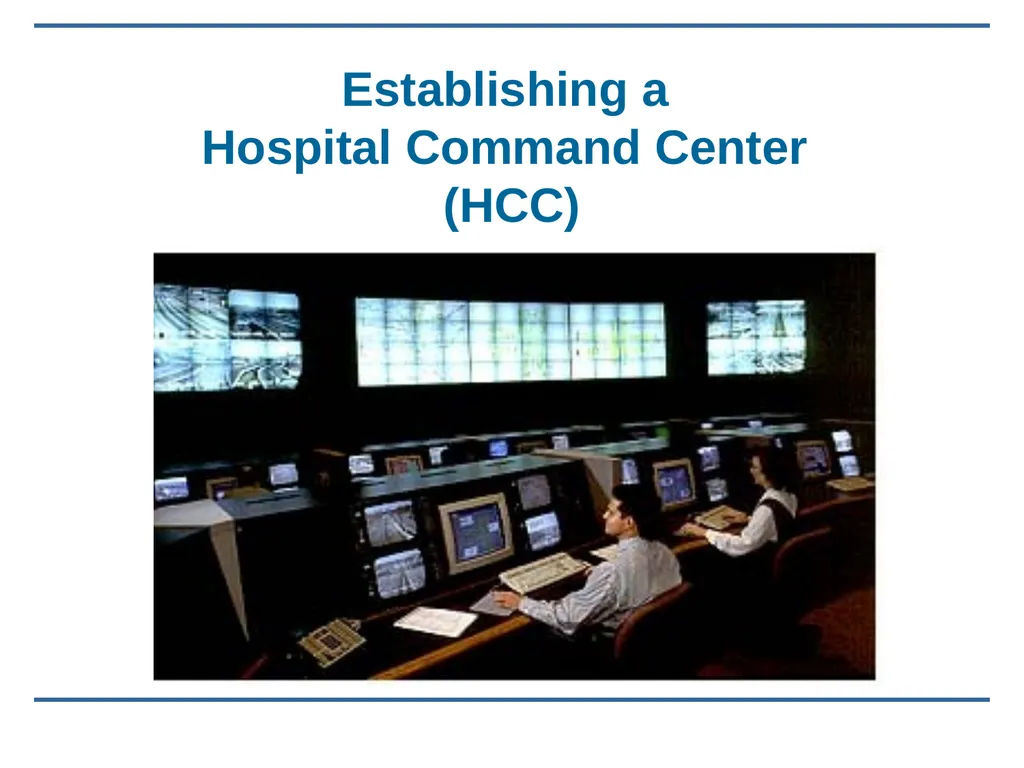
Establishing a
Hospital Command Center
(HCC)<br>
20
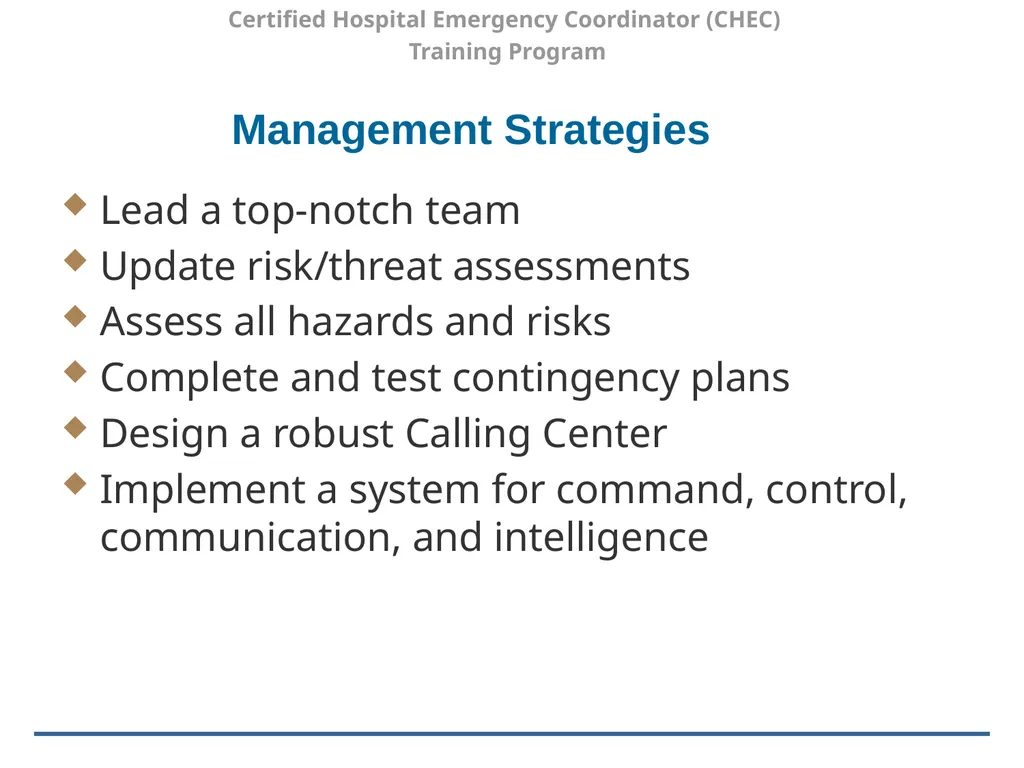
Management Strategies Lead a top-notch team
Update risk/threat assessments
Assess all hazards and risks
Complete and test contingency plans
Design a robust Calling Center
Implement a system for command, control, communication, and intelligence<br>
Update risk/threat assessments
Assess all hazards and risks
Complete and test contingency plans
Design a robust Calling Center
Implement a system for command, control, communication, and intelligence<br>
21
The Challenge of Coordination:
Processing Calls in the HCC In the HCC there are roughly five steps + one in processing a call:
Receive
Prioritize
Route
Write
Deliver
… and always follow-up!<br>
Receive
Prioritize
Route
Write
Deliver
… and always follow-up!<br>
22
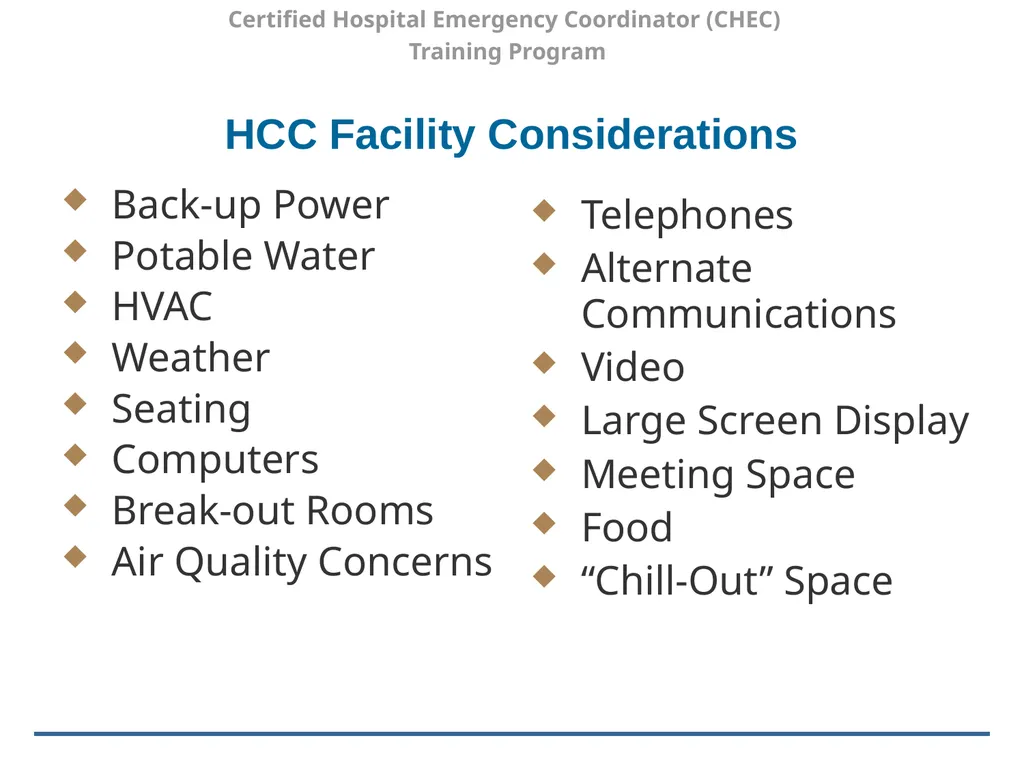
HCC Facility Considerations Back-up Power
Potable Water
HVAC
Weather
Seating
Computers
Break-out Rooms
Air Quality Concerns Telephones
Alternate Communications
Video
Large Screen Display
Meeting Space
Food
“Chill-Out” Space<br>
Potable Water
HVAC
Weather
Seating
Computers
Break-out Rooms
Air Quality Concerns Telephones
Alternate Communications
Video
Large Screen Display
Meeting Space
Food
“Chill-Out” Space<br>
23
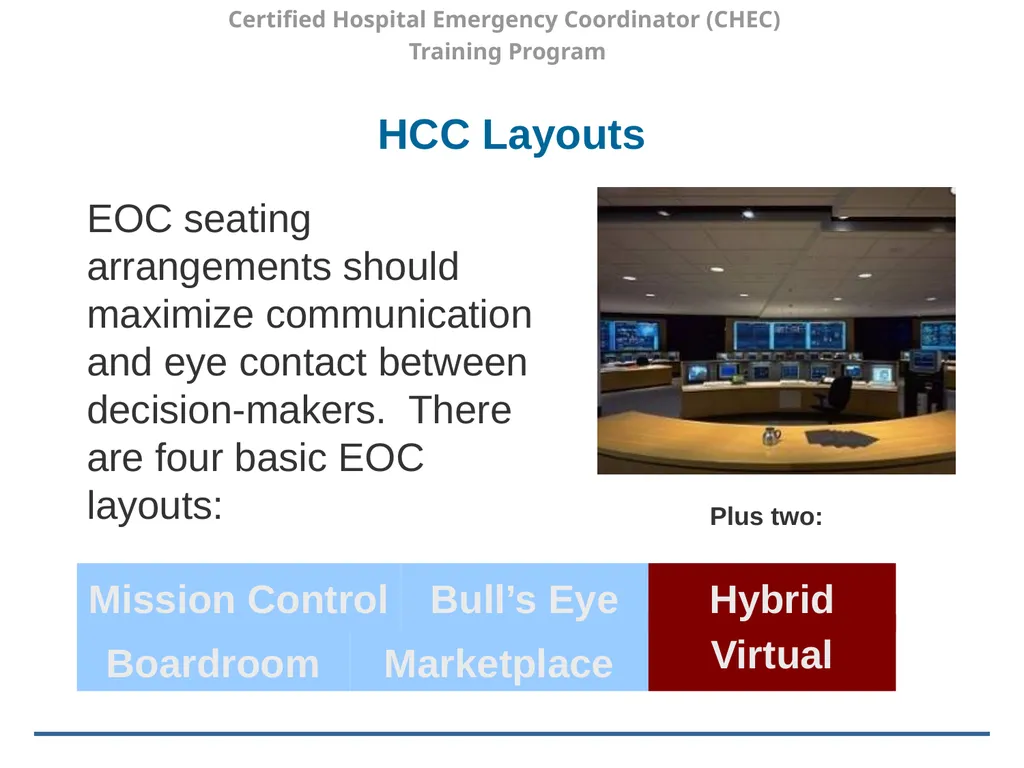
HCC Layouts EOC seating arrangements should maximize communication and eye contact between decision-makers. There are four basic EOC layouts: Boardroom Marketplace Mission Control Bull’s Eye Virtual Hybrid Plus two:<br>
24
Design Issues Technology
Joint Information
Data Links
Physical Proximity
Information Priority
Filtering Capability
Communication Links
Control Over Resources
Ergonomics Shared Displays
Multiple Displays
Push and Pull Capabilities
Zoom-in/Zoom-out Capabilities
Optimizing Information Space
Keeping Information Load Manageable<br>
Joint Information
Data Links
Physical Proximity
Information Priority
Filtering Capability
Communication Links
Control Over Resources
Ergonomics Shared Displays
Multiple Displays
Push and Pull Capabilities
Zoom-in/Zoom-out Capabilities
Optimizing Information Space
Keeping Information Load Manageable<br>
25
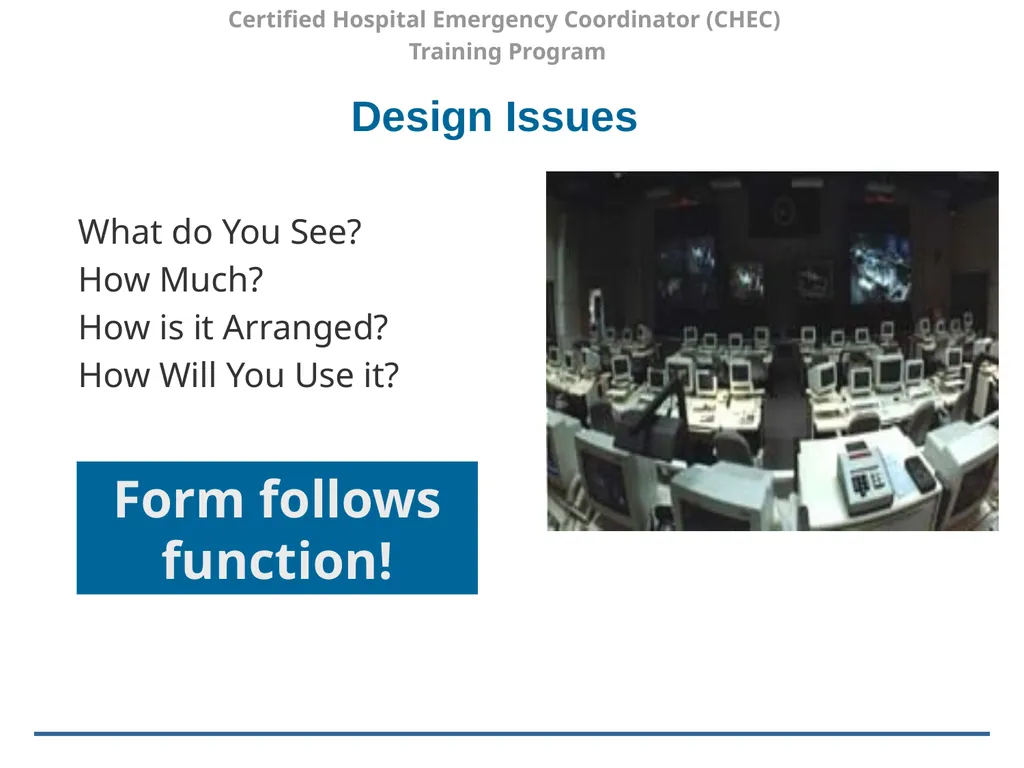
What do You See?
How Much?
How is it Arranged?
How Will You Use it? Design Issues Form follows function!<br>
How Much?
How is it Arranged?
How Will You Use it? Design Issues Form follows function!<br>
26
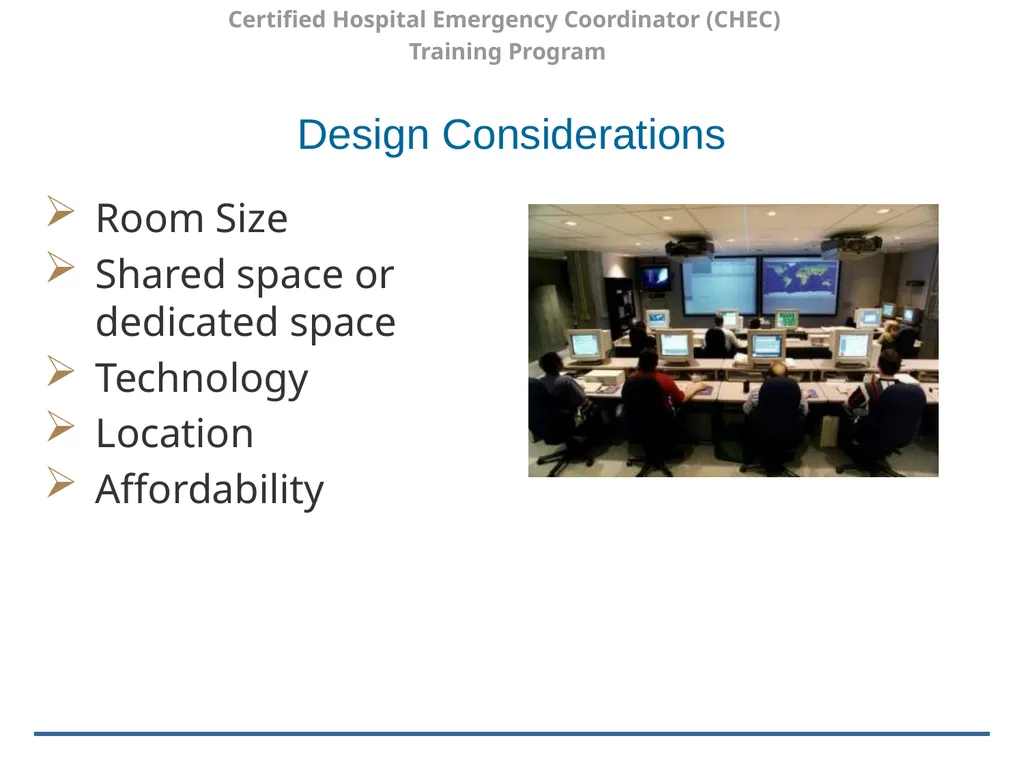
Room Size
Shared space or dedicated space
Technology
Location
Affordability Design Considerations<br>
Shared space or dedicated space
Technology
Location
Affordability Design Considerations<br>
27
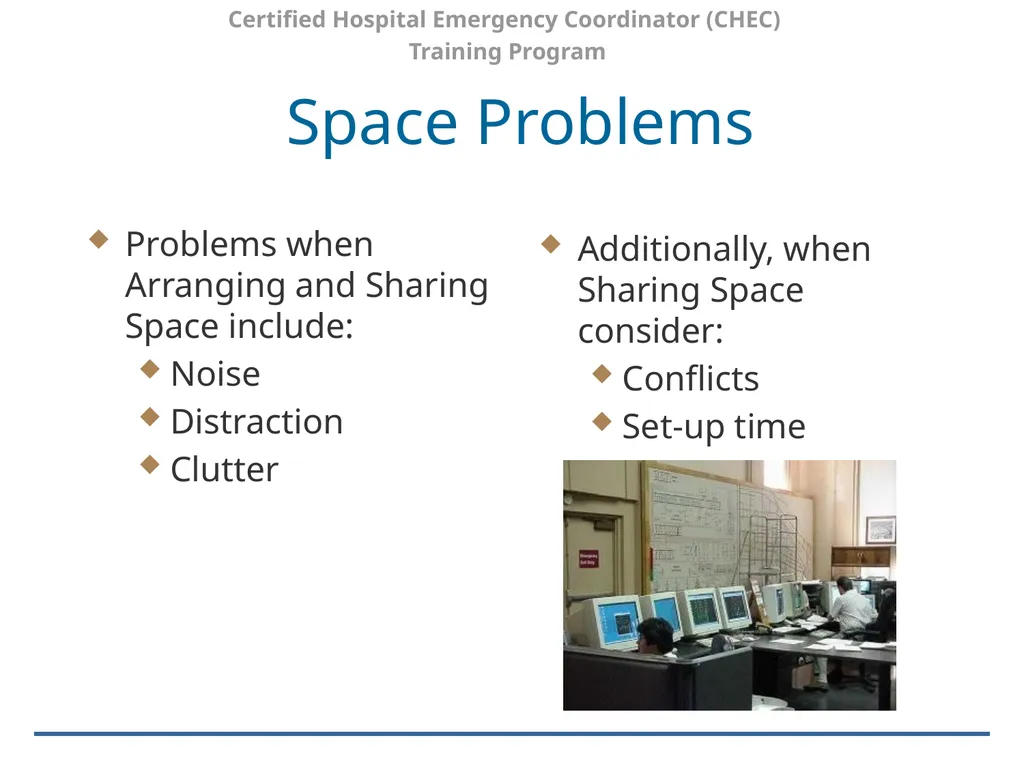
Problems when Arranging and Sharing Space include:
Noise
Distraction
Clutter Space Problems Additionally, when Sharing Space consider:
Conflicts
Set-up time<br>
Noise
Distraction
Clutter Space Problems Additionally, when Sharing Space consider:
Conflicts
Set-up time<br>
28
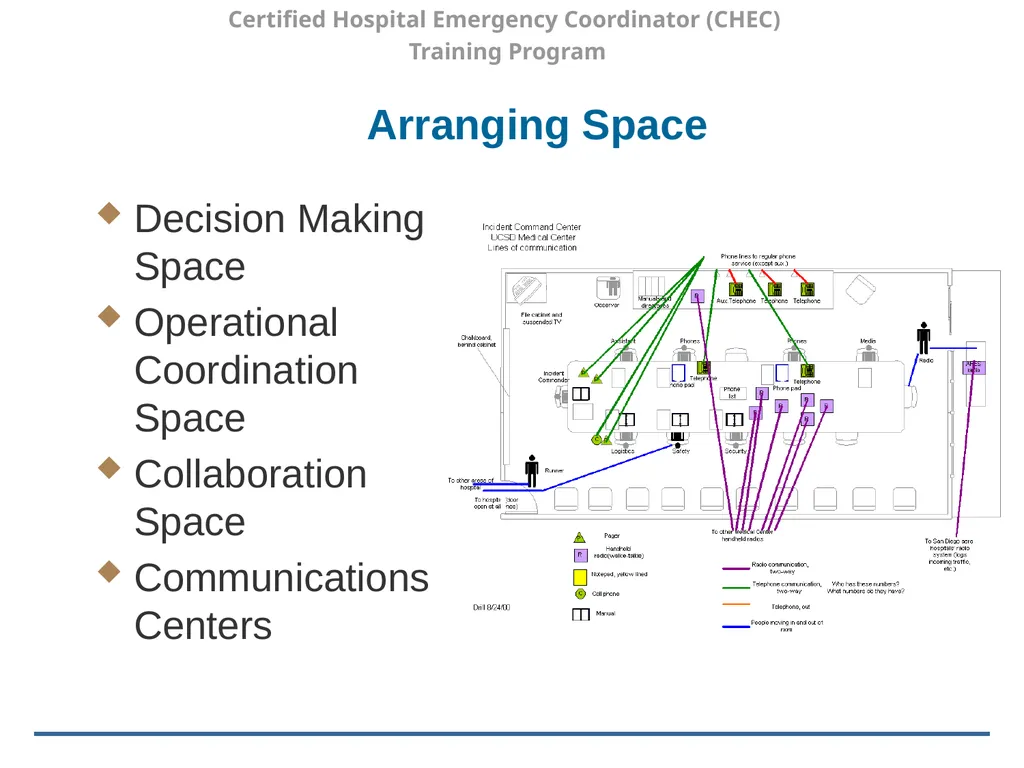
Decision Making Space
Operational Coordination Space
Collaboration Space
Communications Centers Arranging Space<br>
Operational Coordination Space
Collaboration Space
Communications Centers Arranging Space<br>
29
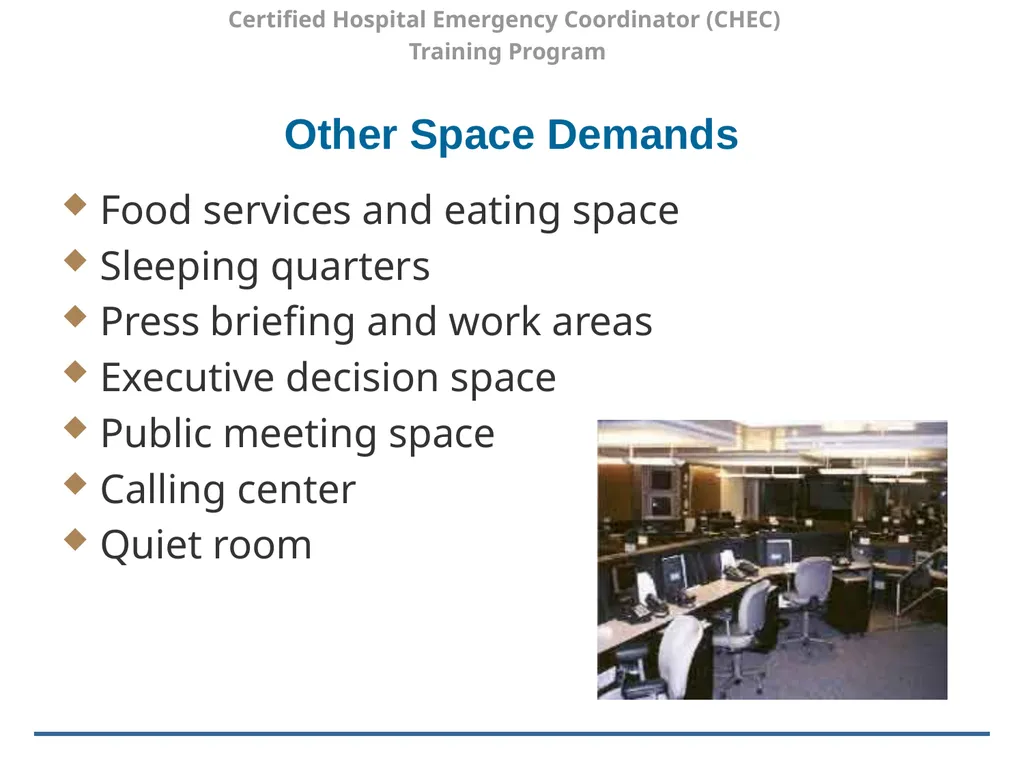
Other Space Demands Food services and eating space
Sleeping quarters
Press briefing and work areas
Executive decision space
Public meeting space
Calling center
Quiet room<br>
Sleeping quarters
Press briefing and work areas
Executive decision space
Public meeting space
Calling center
Quiet room<br>
30
Space is Important HCCs have a way of growing over time because everyone wants in the act.
This usually results in crowded, shoe-horned rooms that become ineffective.
Make sure you plan space based on full implementation.
Control access and scope creep.<br>
This usually results in crowded, shoe-horned rooms that become ineffective.
Make sure you plan space based on full implementation.
Control access and scope creep.<br>
31
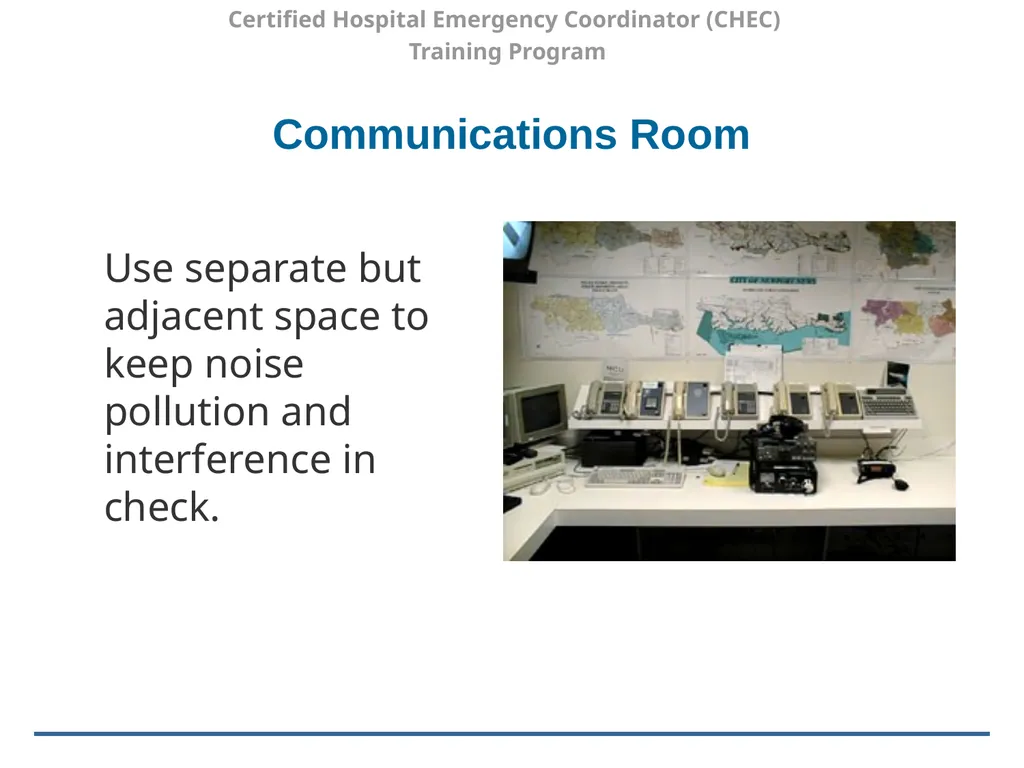
Communications Room Use separate but adjacent space to keep noise pollution and interference in check.<br>
32
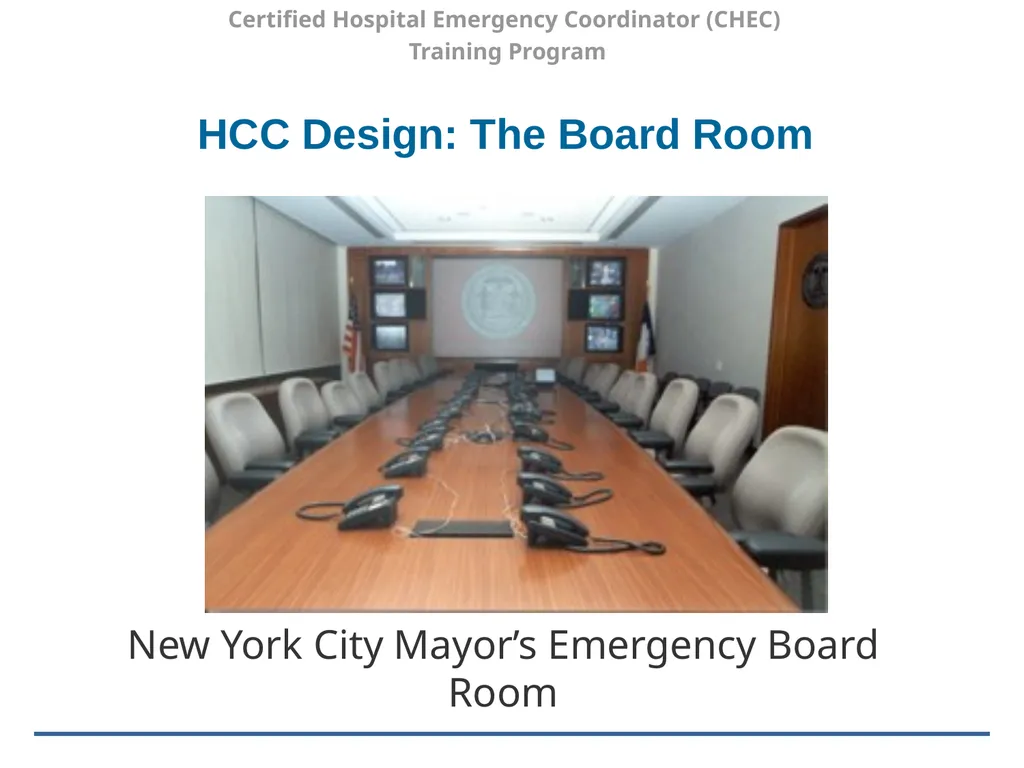
HCC Design: The Board Room New York City Mayor’s Emergency Board Room<br>
33
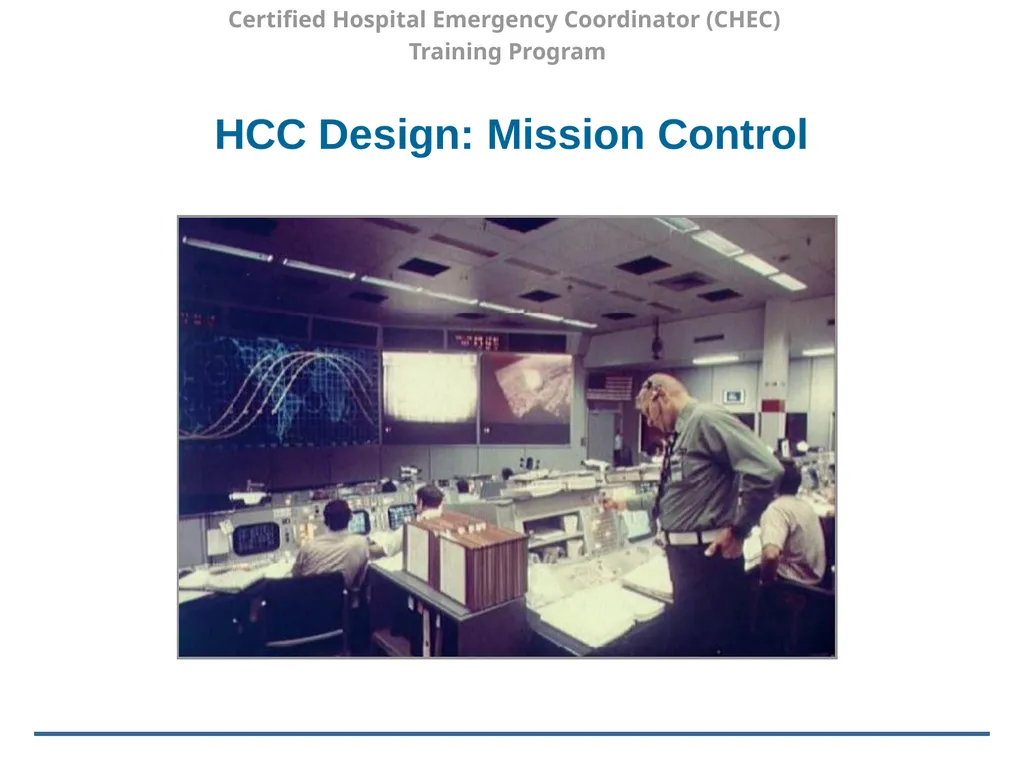
HCC Design: Mission Control<br>
34
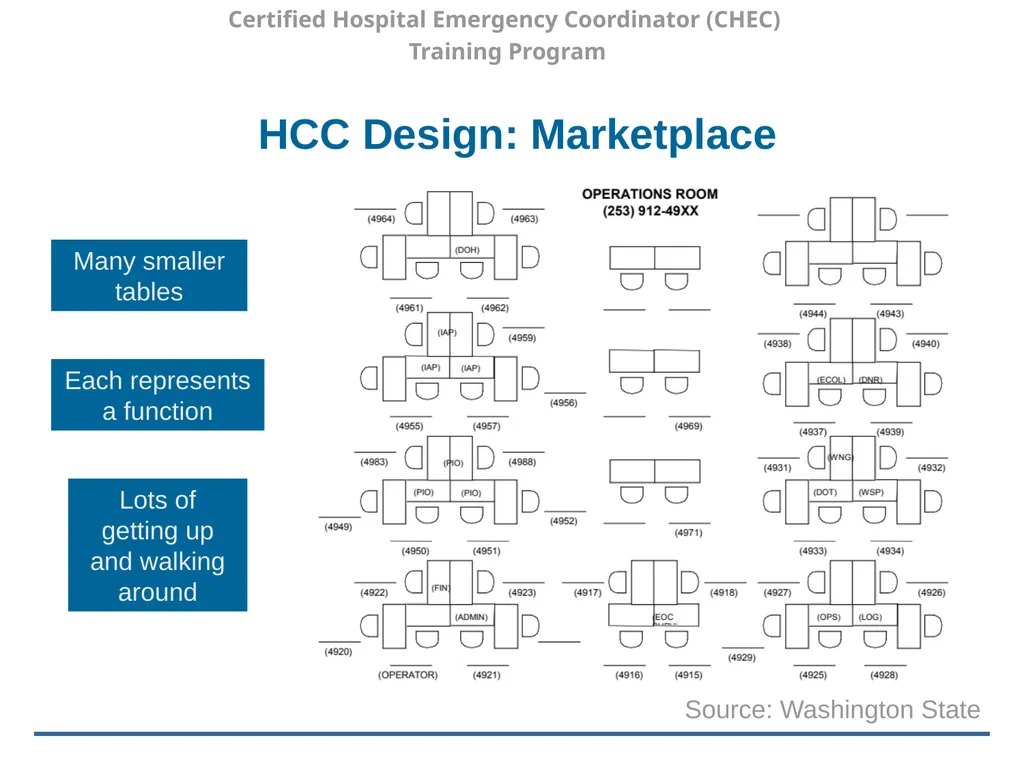
HCC Design: Marketplace Source: Washington State Each represents a function Many smaller tables Lots of getting up and walking around<br>
35
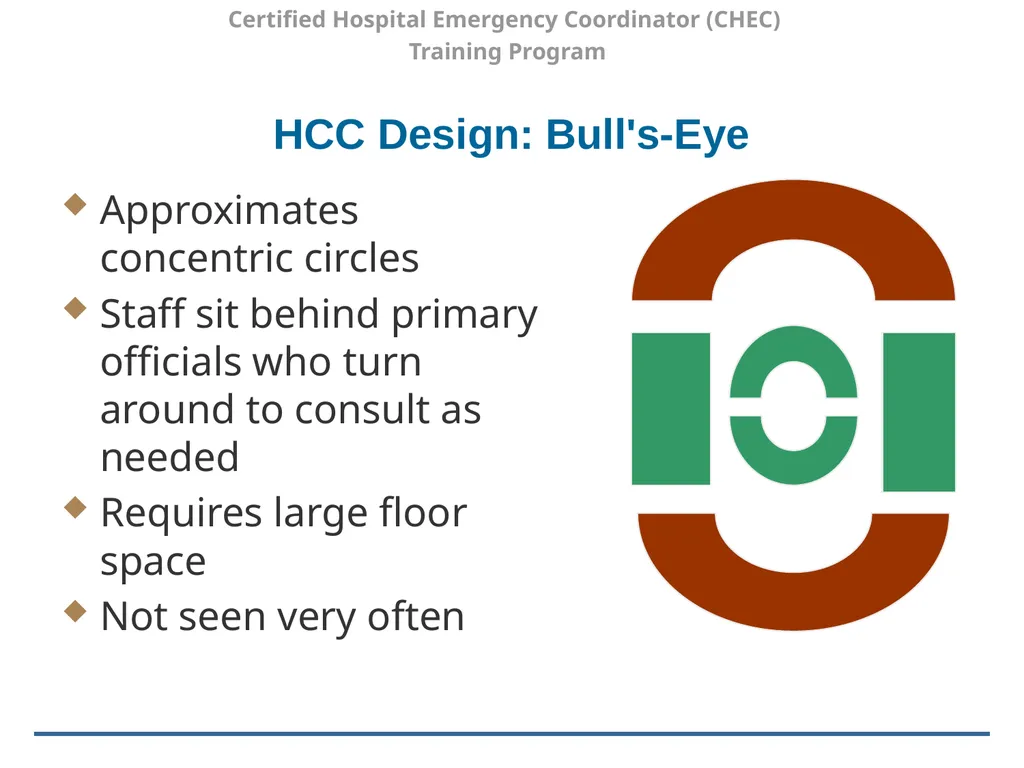
HCC Design: Bull's-Eye Approximates concentric circles
Staff sit behind primary officials who turn around to consult as needed
Requires large floor space
Not seen very often<br>
Staff sit behind primary officials who turn around to consult as needed
Requires large floor space
Not seen very often<br>
36
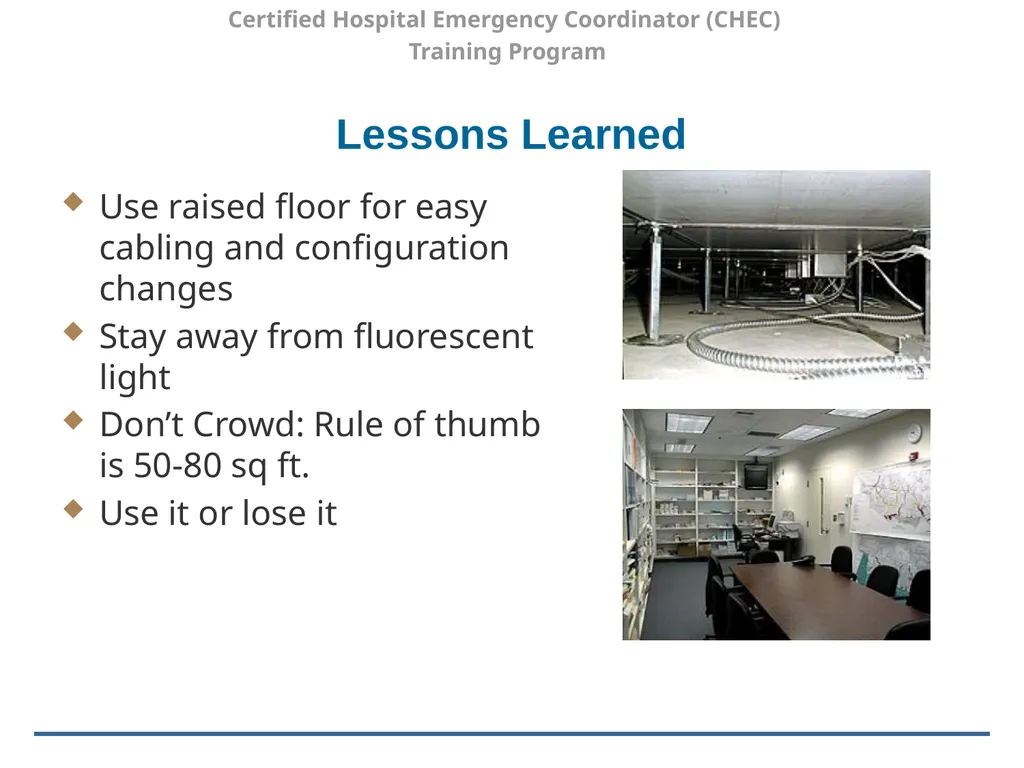
Lessons Learned Use raised floor for easy cabling and configuration changes
Stay away from fluorescent light
Don’t Crowd: Rule of thumb is 50-80 sq ft.
Use it or lose it<br>
Stay away from fluorescent light
Don’t Crowd: Rule of thumb is 50-80 sq ft.
Use it or lose it<br>
37
Implementing Information Management<br>
38
Information Management HECs need a robust command, control, and monitoring function that will:
Be easy and efficient to use
Collect information rapidly
Coordinate activities and resources
Track multiple incidents and resources
Communicate activities across the enterprise
Provide documentation<br>
Be easy and efficient to use
Collect information rapidly
Coordinate activities and resources
Track multiple incidents and resources
Communicate activities across the enterprise
Provide documentation<br>
39
Event Information Tracking 1. Stakeholder notices possible disruption
2. Alert message sent to the HCC
3. Alert message evaluated by functional duty officers
4. Incident Log opened to track each event
5. SOPs implemented using checklists
6. Tasks assigned according to plan
7. Resource allocation tracked in log
8. Task performance tracked in log
9. Status briefings and updates to stakeholders<br>
2. Alert message sent to the HCC
3. Alert message evaluated by functional duty officers
4. Incident Log opened to track each event
5. SOPs implemented using checklists
6. Tasks assigned according to plan
7. Resource allocation tracked in log
8. Task performance tracked in log
9. Status briefings and updates to stakeholders<br>
40
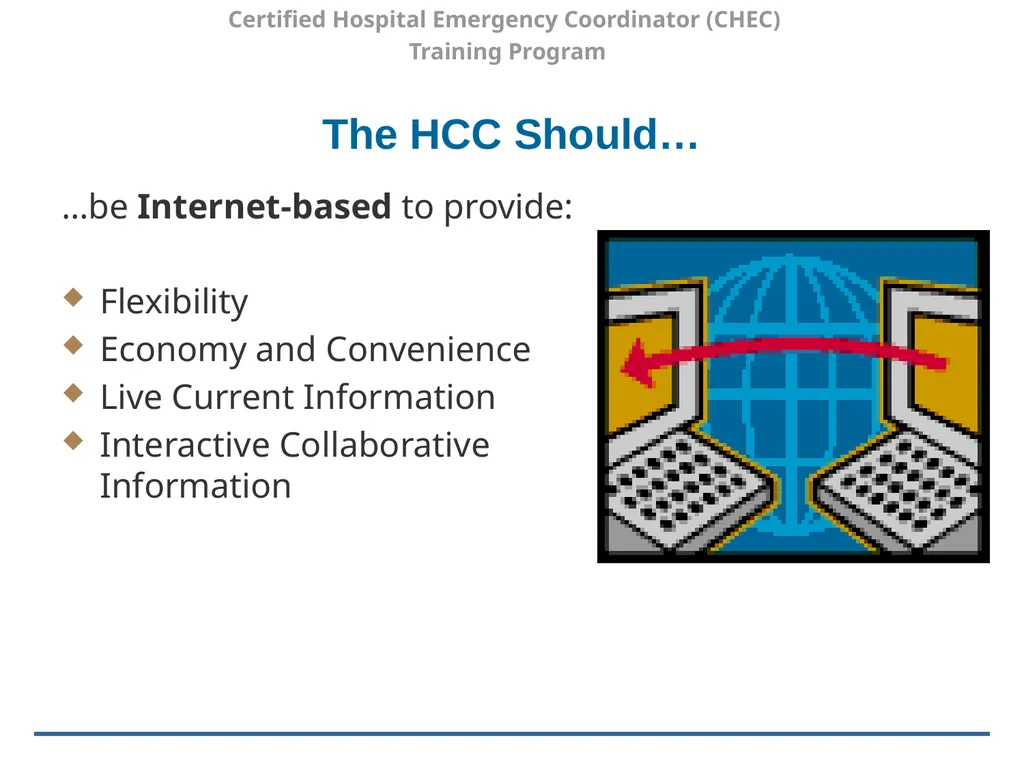
The HCC Should… …be Internet-based to provide:
Flexibility
Economy and Convenience
Live Current Information
Interactive Collaborative Information<br>
Flexibility
Economy and Convenience
Live Current Information
Interactive Collaborative Information<br>
41
Virtual System A “Virtual HCC” enables managers to:
Participate in critical decision-making processes regardless of physical location
Effectively direct and control resources
Automate processes and methodologies
Assign and track tasks
Efficiently communicate real-time information
Protect communication and data with needed redundancy and flexibility<br>
Participate in critical decision-making processes regardless of physical location
Effectively direct and control resources
Automate processes and methodologies
Assign and track tasks
Efficiently communicate real-time information
Protect communication and data with needed redundancy and flexibility<br>
42
Advantages of a Virtual HCC Augments physical centers
Anyone, anywhere can participate
Lower investment
Ease of use and flexibility
Requires shared communications and data
Data can be hosted off-site using redundant servers in hardened sites
Little or no infrastructure required – uses readily available Internet technology<br>
Anyone, anywhere can participate
Lower investment
Ease of use and flexibility
Requires shared communications and data
Data can be hosted off-site using redundant servers in hardened sites
Little or no infrastructure required – uses readily available Internet technology<br>
43
The HCC A Hospital Command Center should:
Update threat and vulnerability assessments
Test and exercise the plans
Revise plans based on tests and assessments
Monitor the enterprise for problems
Aggregate Problem Data
Manage response and recovery operations Be prepared to use your plans!<br>
Update threat and vulnerability assessments
Test and exercise the plans
Revise plans based on tests and assessments
Monitor the enterprise for problems
Aggregate Problem Data
Manage response and recovery operations Be prepared to use your plans!<br>
44
The Ideal Information System Easy to use, robust information and decision management system
Central command and control
Early alert communications function
Event tracking and logging
SOP and automated checklists
Resource management
Documentation of response actions for due diligence<br>
Central command and control
Early alert communications function
Event tracking and logging
SOP and automated checklists
Resource management
Documentation of response actions for due diligence<br>
45
Managing Resources<br>
46
Managing Resources Predetermine available human and material resources
Build resources into the crisis information management system data base
Triage problems to maximize utility of resources
Assign and track utilization of resources through the HEOC<br>
Build resources into the crisis information management system data base
Triage problems to maximize utility of resources
Assign and track utilization of resources through the HEOC<br>
47
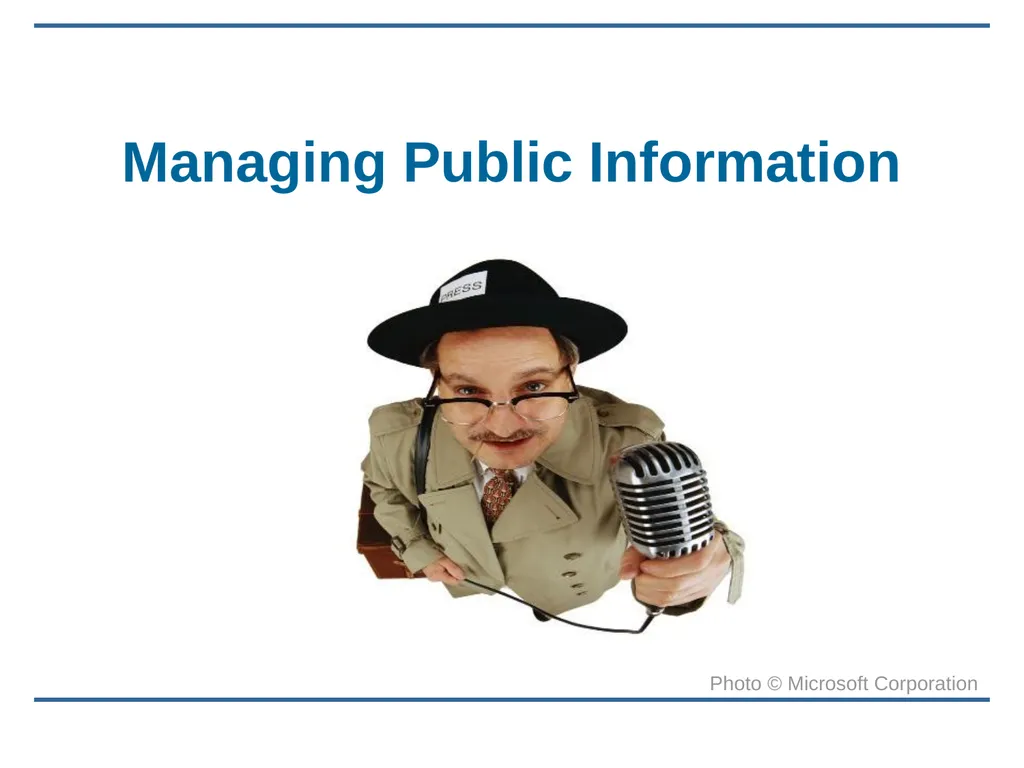
Managing Public Information Photo © Microsoft Corporation<br>
48
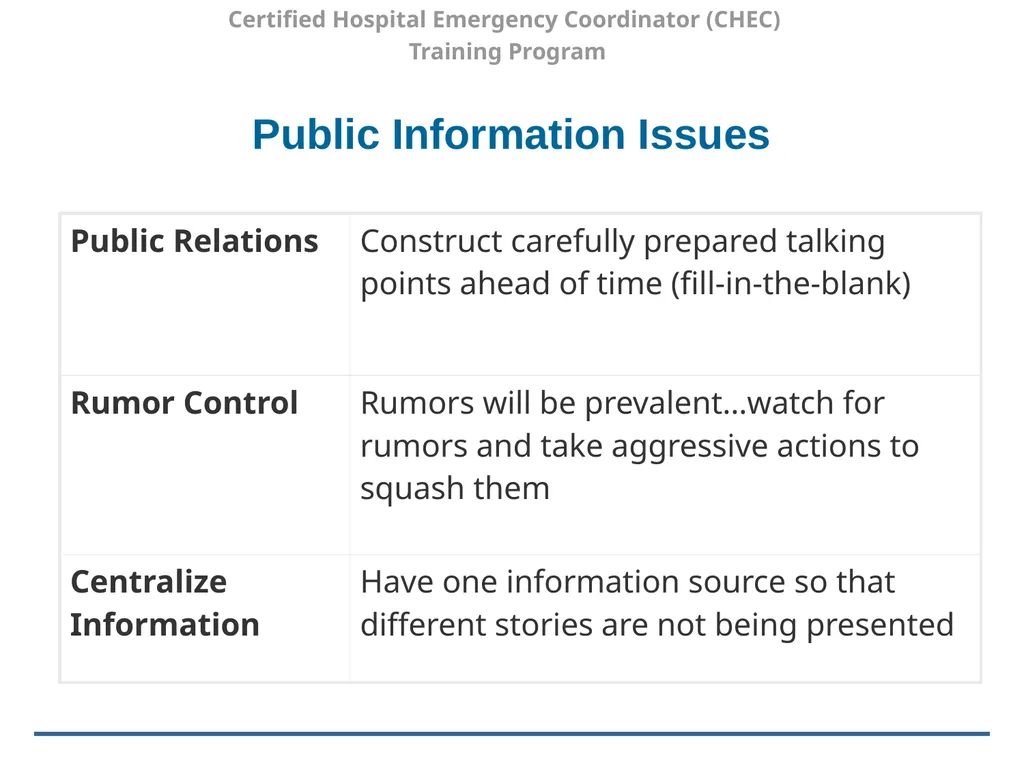
Public Information Issues<br>
49
Certified Hospital Emergency Coordinator (CHEC) Training Program Designing and Functioning in
a Hospital Command Center (HCC) Questions?<br>
a Hospital Command Center (HCC) Questions?<br>