
CERTIFIED PROTECTION PROFESSIONAL (CPP)


























































Description: CERTIFIED PROTECTION PROFESSIONAL (CPP) Certification Examination Review Dennis Shepp, CPP October 2017 Crisis Management Information Security Physical Security Personnel Security Investigations Business Principles Practices Security
Related Topics
Download Presentation
"CERTIFIED PROTECTION PROFESSIONAL (CPP)" is the property of its rightful owner. Permission is granted to download and print the materials on this website for personal, non-commercial use only, and to display it on your personal computer provided you do not modify the materials and that you retain all copyright notices contained in the materials. By downloading content from our website, you accept the terms of this agreement.
Presentation Transcript
slide1. CERTIFIED PROTECTION PROFESSIONAL (CPP)
Certification Examination Review Dennis Shepp, CPP October 2017<br>
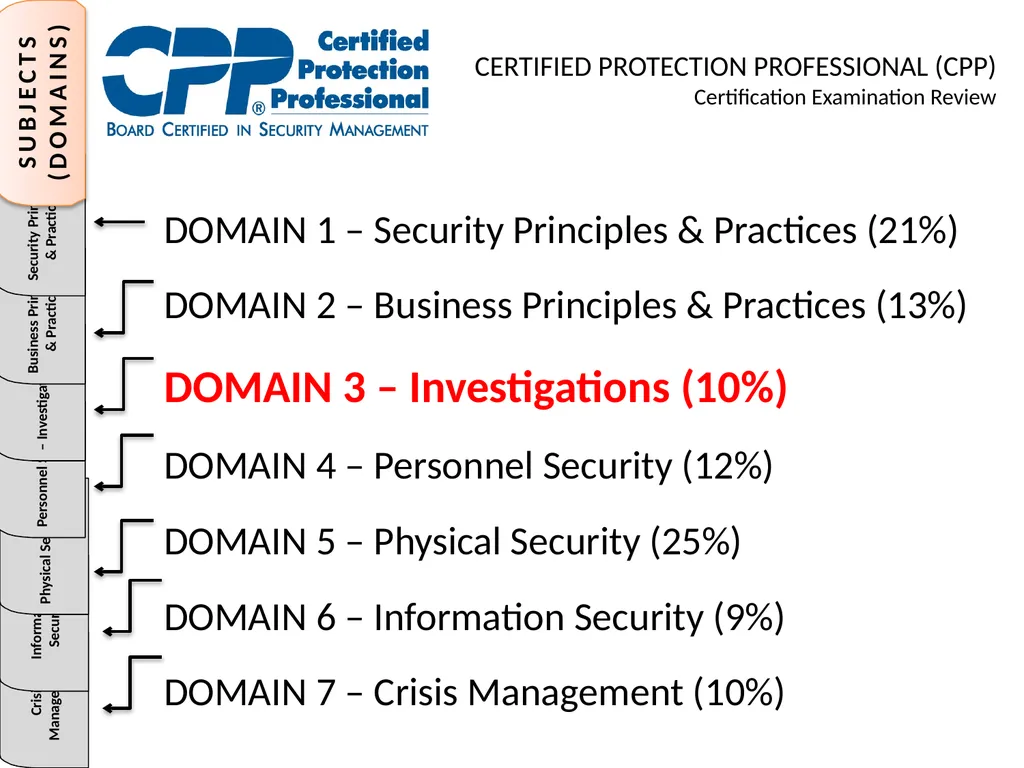
slide2. Crisis Management Information Security Physical Security Personnel Security – Investigations Business Principles & Practices Security Principles & Practices DOMAIN 1 – Security Principles & Practices (21%)
DOMAIN 2 – Business Principles & Practices (13%)
DOMAIN 3 – Investigations (10%)
DOMAIN 4 – Personnel Security (12%)
DOMAIN 5 – Physical Security (25%)
DOMAIN 6 – Information Security (9%)
DOMAIN 7 – Crisis Management (10%) SUBJECTS
(DOMAINS) CERTIFIED PROTECTION PROFESSIONAL (CPP)
Certification Examination Review<br>
slide3. CERTIFIED PROTECTION PROFESSIONAL (CPP)
Certification Examination Review Dennis Shepp, CPP October 2017 3 DOMAIN<br>
slide4. Task 03/01 Identify, develop, implement, and manage investigative functions
Task 03/02 Manage or conduct the collection and preservation of evidence to support investigation actions
Task 03/03 Manage or conduct surveillance processes
Task 03/04 Manage and conduct investigations requiring specialized tools, techniques, and resources<br>
slide5. Task 03/05 Manage or conduct investigative interviews
Task 03/06 Provide coordination, assistance, and evidence such as documentation and testimony to support legal counsel in actual or potential criminal and/or civil proceedings<br>
slide6. Task 03/01 Identify, develop, implement, and manage investigative functions<br>
slide7. 03/01/01 Principles and techniques of policy and procedure development
03/01/02 Organizational objectives and cross-functional collaboration
03/01/03 Types of investigations (for example, incident, misconduct, compliance)
03/01/04 Internal and external resources to support investigative functions
03/01/05 Report preparation for internal purposes and legal proceedings
03/01/06 Laws pertaining to developing and managing investigative programs<br>
slide8. Task 03/01 Identify, develop, implement, and manage investigative functions Knowledge of:
03/01/01 Principles and techniques of policy and procedure development<br>
slide9. Definition of investigation – “a systematic and thorough examination or inquiry into something or someone (the collection of facts and information) and the recording of that examination in a report.”
Applies to private & public sector
CHAPTER 1.1 THE NATURE OF INVESTIGATION MANAGEMENT; POA: Investigation (Kindle Locations 15904).<br>
slide10. Investigation purposes:
Documenting incidents
Identifying incident cause
Documenting facts surrounding situation/incident
Identifying suspects
Proving or disproving allegations
Allowing a decision – trust, suitability determination
CHAPTER 1.1 THE NATURE OF INVESTIGATION MANAGEMENT; POA: Investigation (Kindle Locations 15904).<br>
slide11. 5-qualities of effective & reliable investigation:
Objectivity
Thoroughness
Relevance
Accuracy
Timeliness
Investigative process – science & art
CHAPTER 1.1.1 THE QUALITIES OF AN EFFECTIVE INVESTIGATION; POA: Investigation (Kindle Locations 15928-15929).<br>
slide12. Objectivity
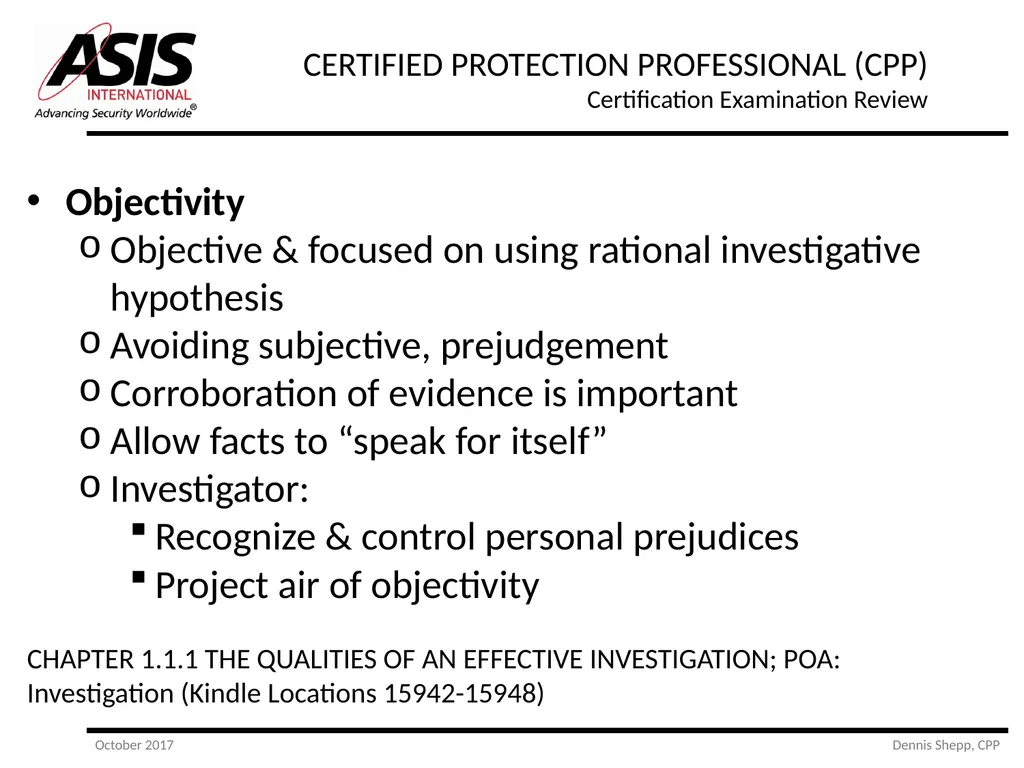
Objective & focused on using rational investigative hypothesis
Avoiding subjective, prejudgement
Corroboration of evidence is important
Allow facts to “speak for itself”
Investigator:
Recognize & control personal prejudices
Project air of objectivity
CHAPTER 1.1.1 THE QUALITIES OF AN EFFECTIVE INVESTIGATION; POA: Investigation (Kindle Locations 15942-15948)<br>
slide13. Thoroughness
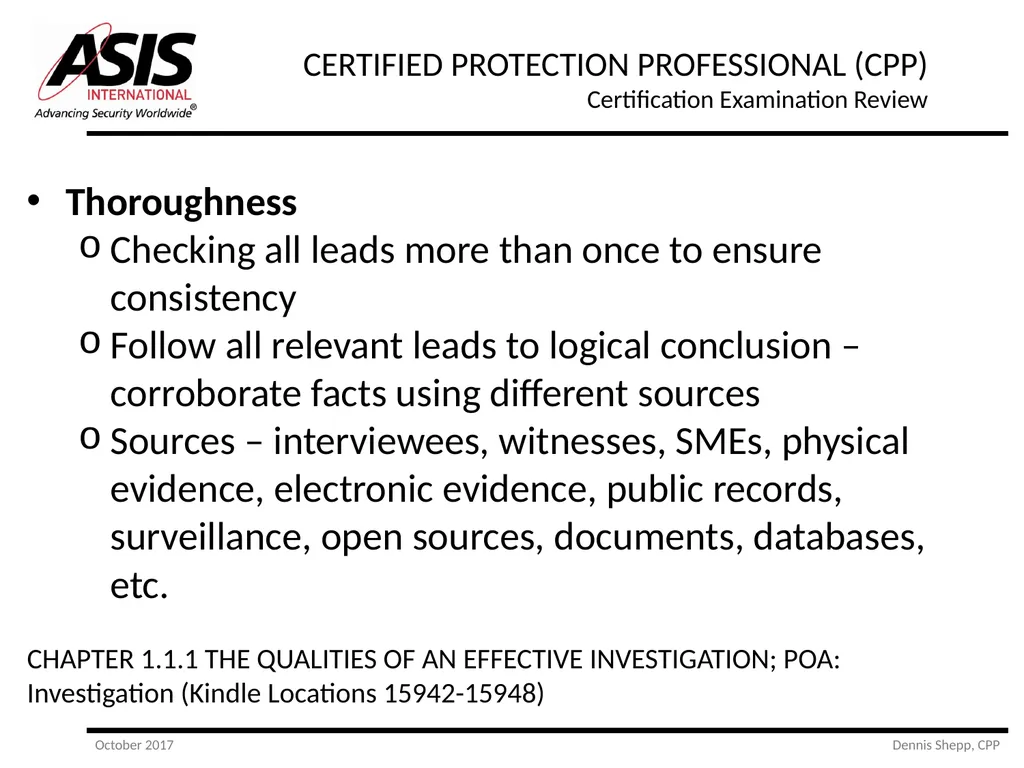
Checking all leads more than once to ensure consistency
Follow all relevant leads to logical conclusion – corroborate facts using different sources
Sources – interviewees, witnesses, SMEs, physical evidence, electronic evidence, public records, surveillance, open sources, documents, databases, etc.
CHAPTER 1.1.1 THE QUALITIES OF AN EFFECTIVE INVESTIGATION; POA: Investigation (Kindle Locations 15942-15948)<br>
slide14. Relevance
Collecting adequate range & depth of details – not too much!
Collected information relates to the subject of investigation in appropriate detail – how deep to dig!
Skilled investigators can guide interviews to proper depth of detail
Cause & effect relationships can impact relevance
CHAPTER 1.1.1 THE QUALITIES OF AN EFFECTIVE INVESTIGATION; POA: Investigation (Kindle Locations 15942-15948).<br>
slide15. Accuracy
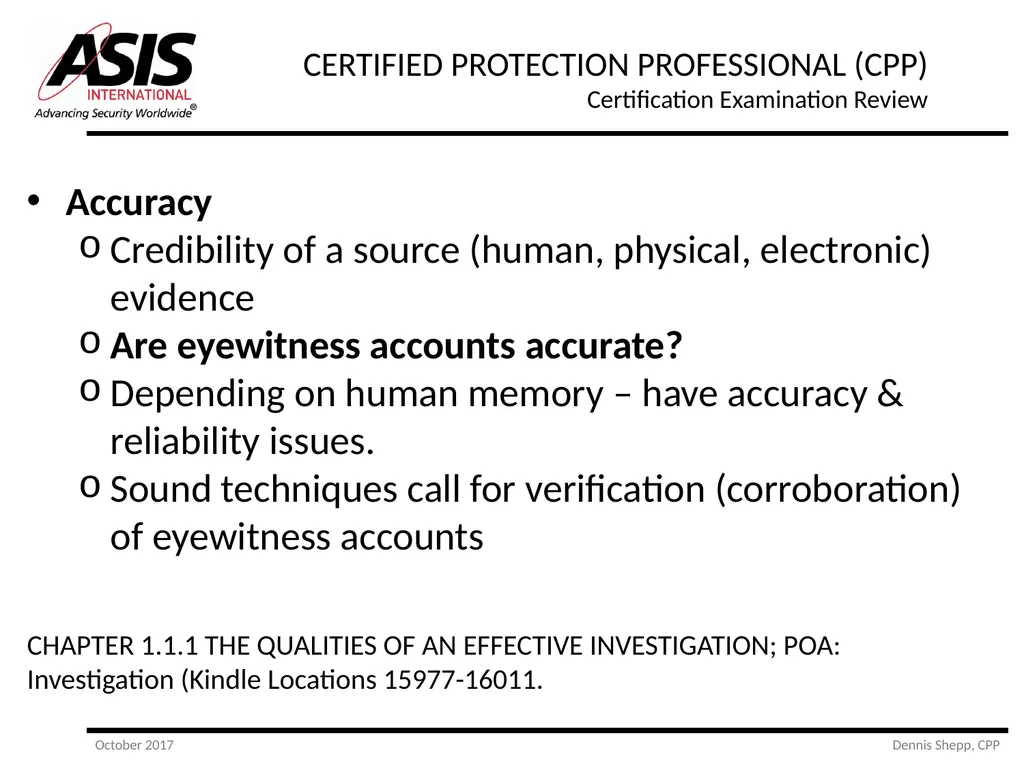
Credibility of a source (human, physical, electronic) evidence
Are eyewitness accounts accurate?
Depending on human memory – have accuracy & reliability issues.
Sound techniques call for verification (corroboration) of eyewitness accounts
CHAPTER 1.1.1 THE QUALITIES OF AN EFFECTIVE INVESTIGATION; POA: Investigation (Kindle Locations 15977-16011.<br>
slide16. Timeliness
Ability to complete an investigation quickly (not too quickly) – timely – avoid pressures to rush.
Open the case ASAP
Complete the investigation ASAP
Avoid closing the investigation prematurely
Timeliness important due to memory accuracy
Quick & decisive investigations reflect professionalism of investigative personnel
CHAPTER 1.1.1 THE QUALITIES OF AN EFFECTIVE INVESTIGATION; POA: Investigation (Kindle Locations 16011-1620).<br>
slide17. Functional Charters and Policy Statements
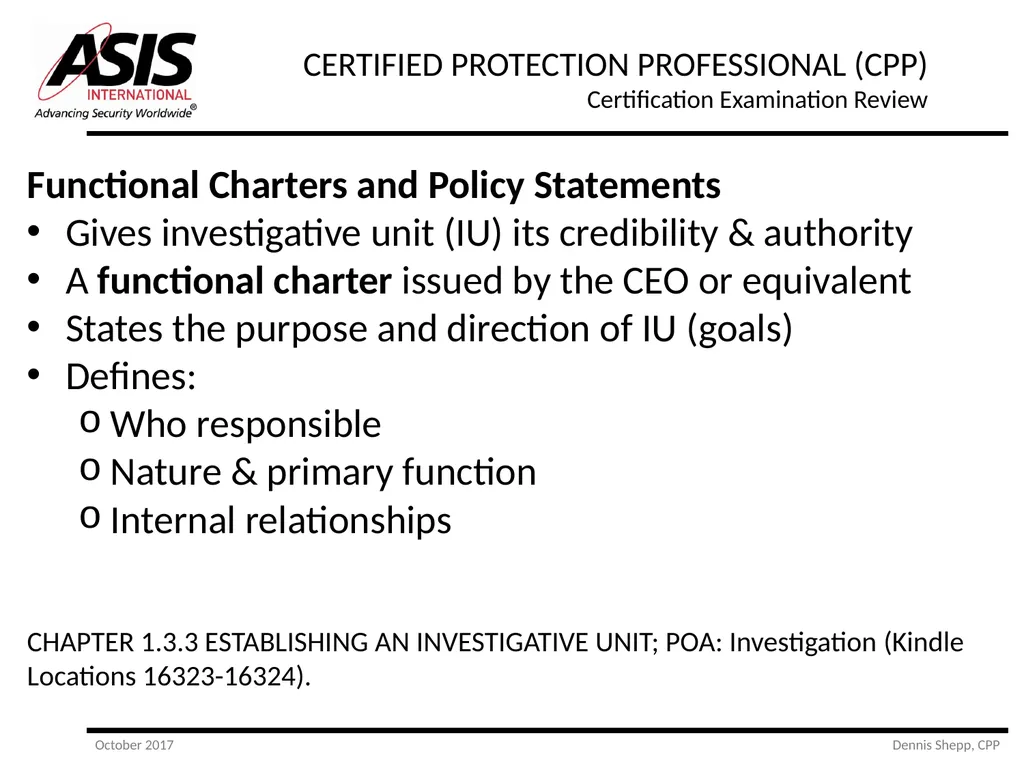
Gives investigative unit (IU) its credibility & authority
A functional charter issued by the CEO or equivalent
States the purpose and direction of IU (goals)
Defines:
Who responsible
Nature & primary function
Internal relationships
CHAPTER 1.3.3 ESTABLISHING AN INVESTIGATIVE UNIT; POA: Investigation (Kindle Locations 16323-16324).<br>
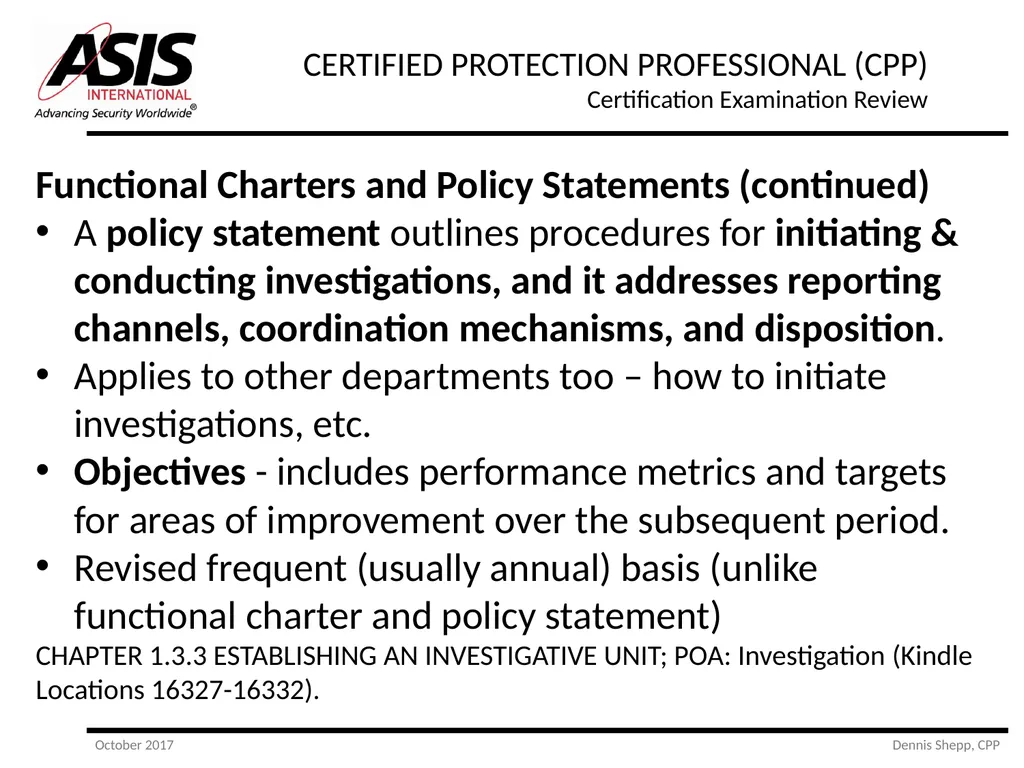
slide18. Functional Charters and Policy Statements (continued)
A policy statement outlines procedures for initiating & conducting investigations, and it addresses reporting channels, coordination mechanisms, and disposition.
Applies to other departments too – how to initiate investigations, etc.
Objectives - includes performance metrics and targets for areas of improvement over the subsequent period.
Revised frequent (usually annual) basis (unlike functional charter and policy statement)
CHAPTER 1.3.3 ESTABLISHING AN INVESTIGATIVE UNIT; POA: Investigation (Kindle Locations 16327-16332).<br>
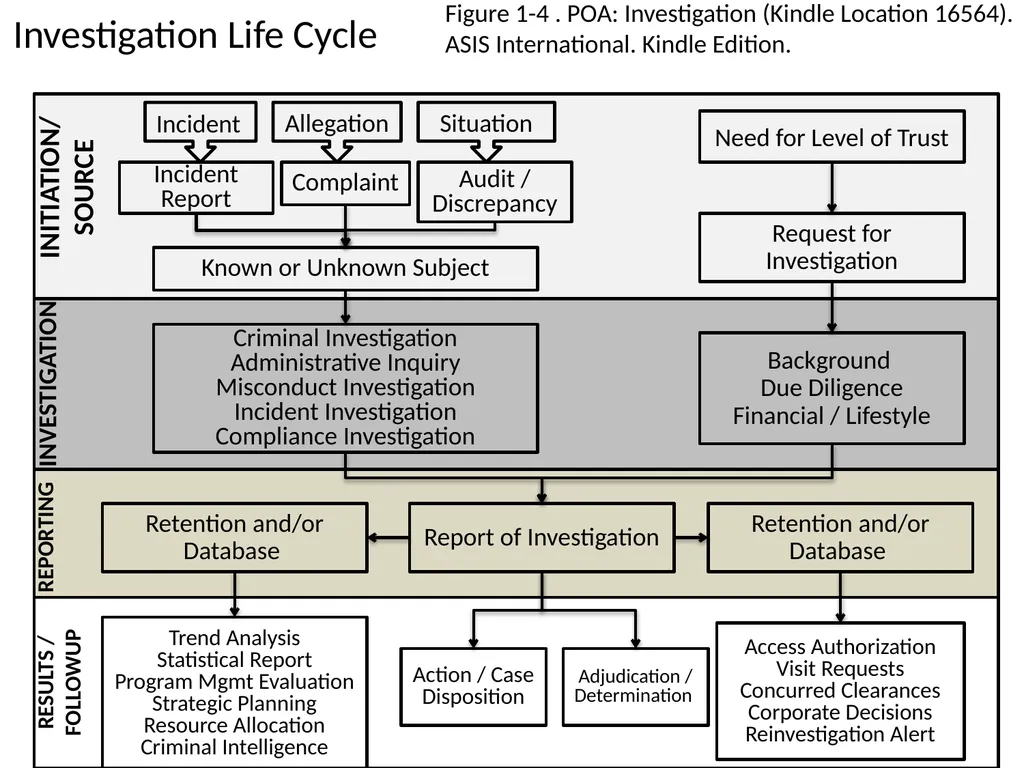
slide19. Investigation Life Cycle INITIATION/SOURCE Need for Level of Trust Incident Allegation Situation Incident Report Complaint Audit / Discrepancy Known or Unknown Subject Request for Investigation INVESTIGATION Criminal Investigation
Administrative Inquiry
Misconduct Investigation
Incident Investigation
Compliance Investigation Background
Due Diligence
Financial / Lifestyle REPORTING Report of Investigation Retention and/or Database Retention and/or Database Trend Analysis
Statistical Report
Program Mgmt Evaluation
Strategic Planning
Resource Allocation
Criminal Intelligence RESULTS / FOLLOWUP Access Authorization
Visit Requests
Concurred Clearances
Corporate Decisions
Reinvestigation Alert Action / Case Disposition Adjudication / Determination Figure 1-4 . POA: Investigation (Kindle Location 16564). ASIS International. Kindle Edition.<br>
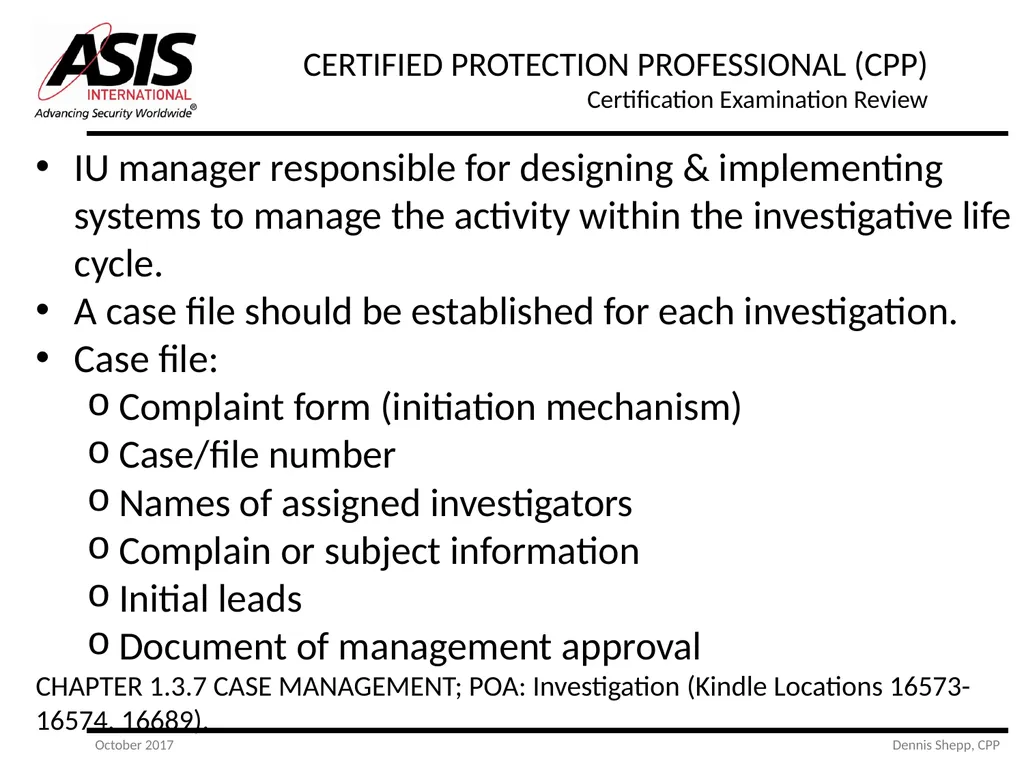
slide20. IU manager responsible for designing & implementing systems to manage the activity within the investigative life cycle.
A case file should be established for each investigation.
Case file:
Complaint form (initiation mechanism)
Case/file number
Names of assigned investigators
Complain or subject information
Initial leads
Document of management approval
CHAPTER 1.3.7 CASE MANAGEMENT; POA: Investigation (Kindle Locations 16573-16574, 16689).<br>
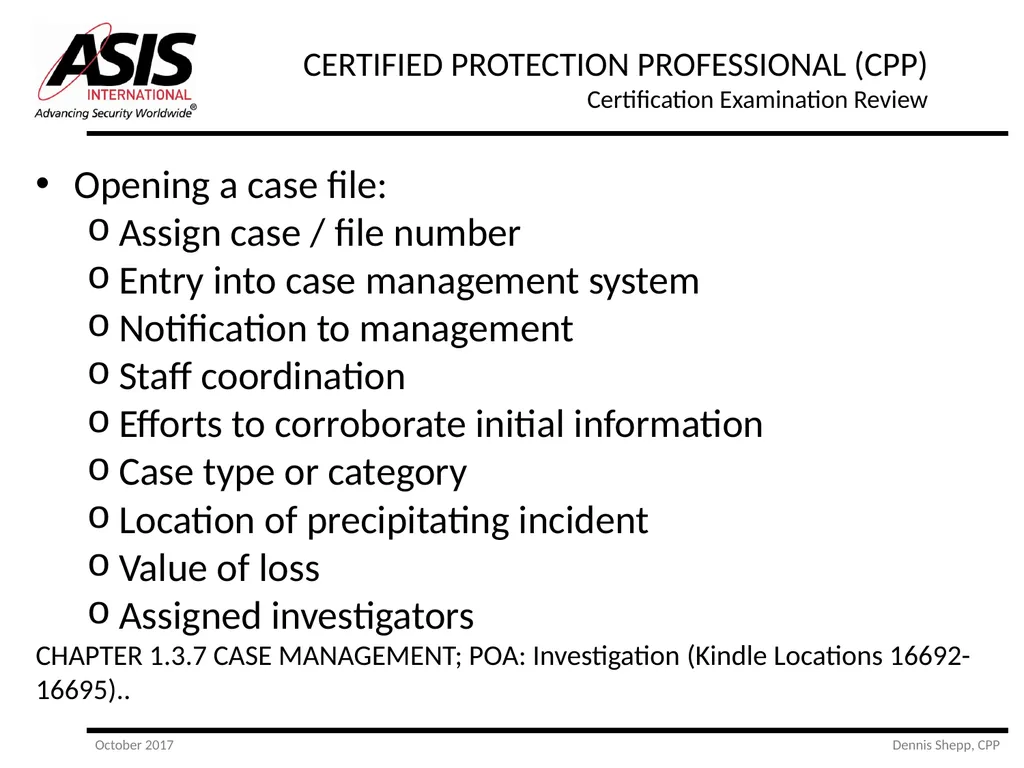
slide21. Opening a case file:
Assign case / file number
Entry into case management system
Notification to management
Staff coordination
Efforts to corroborate initial information
Case type or category
Location of precipitating incident
Value of loss
Assigned investigators
CHAPTER 1.3.7 CASE MANAGEMENT; POA: Investigation (Kindle Locations 16692-16695)..<br>
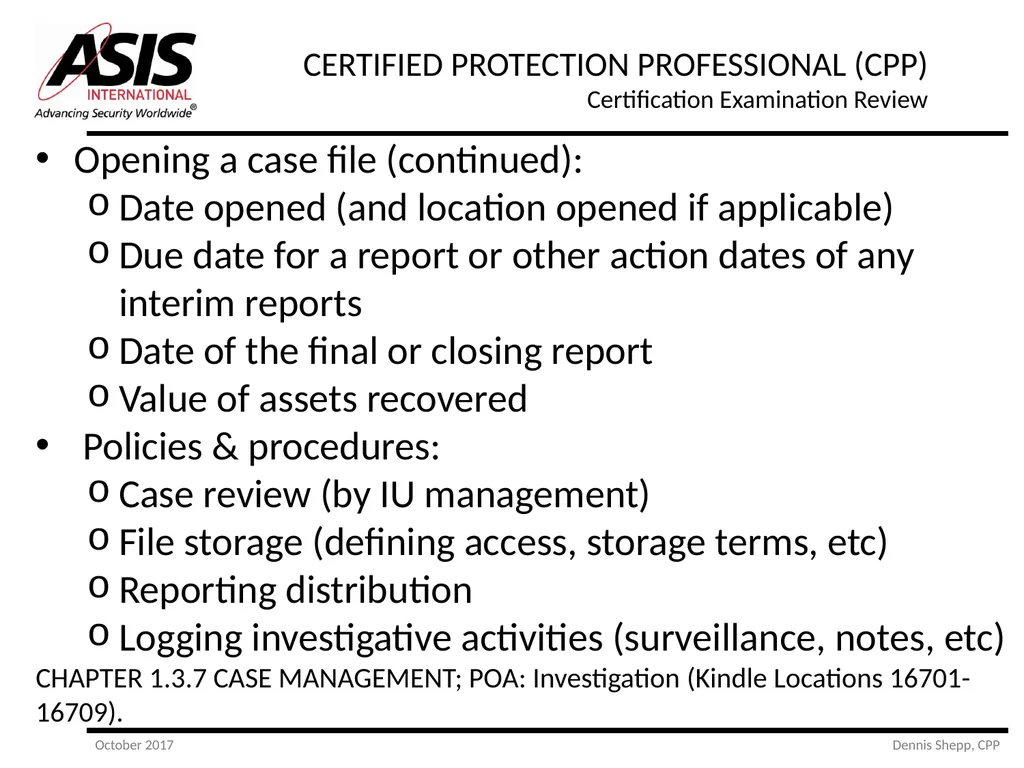
slide22. Opening a case file (continued):
Date opened (and location opened if applicable)
Due date for a report or other action dates of any interim reports
Date of the final or closing report
Value of assets recovered
Policies & procedures:
Case review (by IU management)
File storage (defining access, storage terms, etc)
Reporting distribution
Logging investigative activities (surveillance, notes, etc)
CHAPTER 1.3.7 CASE MANAGEMENT; POA: Investigation (Kindle Locations 16701-16709).<br>
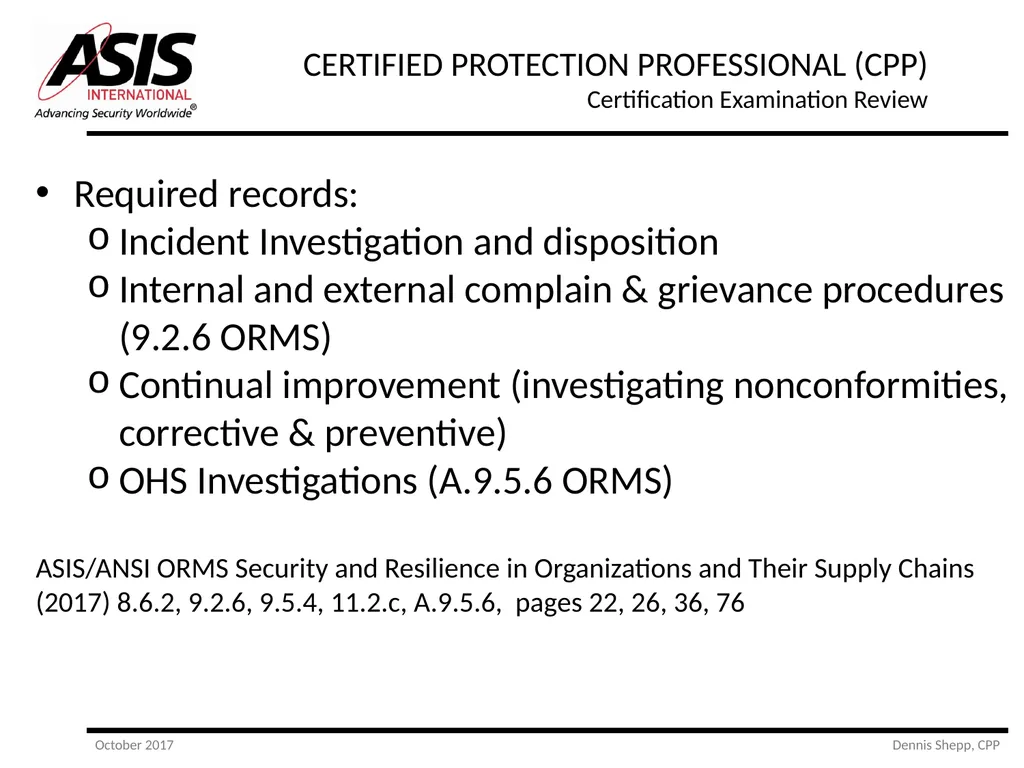
slide23. Required records:
Incident Investigation and disposition
Internal and external complain & grievance procedures (9.2.6 ORMS)
Continual improvement (investigating nonconformities, corrective & preventive)
OHS Investigations (A.9.5.6 ORMS)
ASIS/ANSI ORMS Security and Resilience in Organizations and Their Supply Chains (2017) 8.6.2, 9.2.6, 9.5.4, 11.2.c, A.9.5.6, pages 22, 26, 36, 76<br>
slide24. Task 03/01 Identify, develop, implement, and manage investigative functions Knowledge of:
03/01/02 Organizational objectives and cross-functional collaboration<br>
slide25. Objectives of Corporate Investigations:
Thoroughly documenting incidents.
Identifying the cause of undesirable situations (notable losses, sudden decrease in income or market share, unexplained shrinkage, inventory discrepancies, defalcation {failure to properly account for money held in a fiduciary capacity}, etc.)
Documenting and correlating facts surrounding any situation or allegation
Identifying suspects
CHAPTER 1 INVESTIGATIVE MANAGEMENT; POA: Investigation (Kindle Locations 15912-15917).<br>
slide26. Objectives of Corporate Investigations (continued):
Compiling information that proves or disproves an allegation or that implicates or exonerates an individual suspected of committing a crime or misconduct
Allowing a decision to be made, often with respect to a level of trust or suitability determination, regarding an individual (e.g., in a personnel security clearance) or an organization (e.g., a potential partner firm or acquisition target)
CHAPTER 1 INVESTIGATIVE MANAGEMENT; POA: Investigation (Kindle Locations 15912-15920).<br>
slide27. Objectives of Corporate Investigations (continued):
What is the focus? (HR support, Security, Audit, ?)
IU placement in an organization (Security, Audit, HR, ?)
Reporting lines?
Use of internal & external resources
Outsourcing (specialized cases or ALL cases)
Reasons:
Cost benefit
Prefer independence
Expertise
CHAPTER 1 INVESTIGATIVE MANAGEMENT; POA: Investigation (Kindle Locations 15912-16256).<br>
slide28. Objectives of Corporate Investigations (continued):
Goals and objectives are critical to investigative functions
Goals articulate long-term and overarching end states
May be stated in general terms
Goals should be consistent with the parent organization’s strategic direction
Incorporated into the IU’s mission statement
CHAPTER 1 INVESTIGATIVE MANAGEMENT; POA: Investigation (Kindle Locations 16109-16111).<br>
slide29. Objectives of Corporate Investigations (continued):
Objectives are based on the goals - more specific & may be more short-lived
Generally measurable & used to gauge the progress, success, or achievement of a unit.
SMART goals also known as metrics
Metrics used to evaluate the performance of individuals, teams, and organizations
Investigative strategies developed must be compatible with the organization’s overall strategic business plan
CHAPTER 1 INVESTIGATIVE MANAGEMENT; POA: Investigation (Kindle Locations 16109-16115).<br>
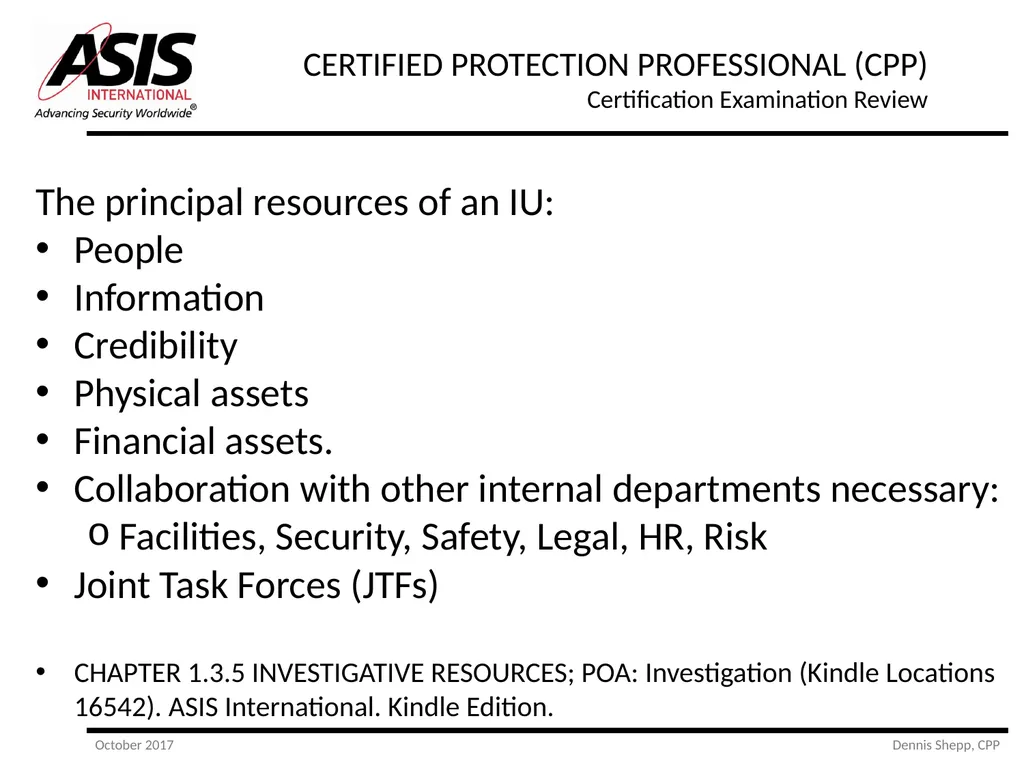
slide30. The principal resources of an IU:
People
Information
Credibility
Physical assets
Financial assets.
Collaboration with other internal departments necessary:
Facilities, Security, Safety, Legal, HR, Risk
Joint Task Forces (JTFs)
CHAPTER 1.3.5 INVESTIGATIVE RESOURCES; POA: Investigation (Kindle Locations 16542). ASIS International. Kindle Edition.<br>
slide31. Collaboration using JTFs
Diversity of members in a task force introduces many benefits, but it can also lead to misunderstanding, conflict, and inefficiencies
Issues: parochialism (close-minded), protection of sensitive information, data management, and reporting chains.
Organizational liaison (internal & external)
CHAPTER 1.3.5 INVESTIGATIVE RESOURCES; POA: Investigation (Kindle Locations 17355-17358). ASIS International. Kindle Edition.<br>
slide32. Task 03/01 Identify, develop, implement, and manage investigative functions<br>
slide33. 1.4 TYPES OF INVESTIGATIONS, POA: Investigations, (page 50)
Incident investigations
Misconduct
Internal company investigations – policy/legal violations
Compliance
Equal Opportunity, harassment, workplace safety,
Undercover (page 91)
Background (page 159)
1.3.4 INVESTIGATIVE FUNCTIONS . POA: Investigation (Kindle Locations 16502-16503; page 50)
Incident investigations Task 3.1.3 Identify, develop, implement, and manage investigative functions describing the types of investigations (for example, incident, misconduct, compliance).<br>
slide34. This is the most common type of investigation in many business and organizational settings.
Detailed, direct procedural guidance is recommended for incident investigations.
Operational Supervisory level – under $1000, Simple assault, Safety hazard, Vehicle accident, Property damage or vandalism (estimated loss ≤ $ 1000), Unsecured area
IU investigators handle excess of $1000 - Theft (estimated loss > $ 1000), Unknown loss (estimated loss > $ 1000), Aggravated assault, Property damage or vandalism (estimated loss > $ 1000), Employee misconduct, Executive misconduct Workplace violence (actual or potential), Sexual harassment Sexual assault Proprietary information loss, Fraud…<br>
slide35. …Contract irregularities Unsecured area or forced entry.
Each enterprise should establish its own loss thresholds to determine investigation parameters.
The same facts to establish a crime, civil action tort or other actionable civil misconduct.
1.4.2 MISCONDUCT INVESTIGATIONS
Internal investigation conducted when an employee or other individual affiliated with the organization suspected of violating a written corporate policy, a directive, terms of employment, or a federal, state, or local law
Exposes employer to legal action by employees or former employees who feel they have been treated unfairly (discrimination, wrongful termination, sexual harassment, defamation, and false arrest)<br>
slide36. Types of misconduct are conflict of interest, corporate resource abuse, employee theft, workplace violence, and substance abuse.
Important: management make corporate policy clear & “ensure that no employee or manager can plausibly claim not to have been well informed of its meaning and consequences.”
1.4.3 COMPLIANCE INVESTIGATIONS
Protect the organization against violations of law, lapses in business ethics, and concomitant legal sanctions.
An effective program encourages enforcement, monitoring, and employee training<br>
slide37. Covers - equal employment opportunity, harassment workplace, safety, confidential/proprietary information, copyright, patent, and trademark, company property and records, computing systems, information access, and authorized uses conflict of interest, government entities, antitrust violations, political activities and lobbying securities requirements from various jurisdictions, regulatory violations
Compliance issues may harm the company’s bottom line, it is important that employees be trained so they can immediately identify when a violation has occurred and know to whom to report the issue<br>
slide38. A key element of any compliance program is an effective employee reporting program.
A consolidated hot line with well-trained and professional operators, combined with an effective system for distribution and follow-up, can result in high-quality, valid, and useful reporting.<br>
slide39. 1.3.5 INVESTIGATIVE RESOURCES POA Investigations page 42
The principal resources of an IU are people, information, credibility, physical assets, and financial assets.
Internal resources: cross-functional - Legal services, HR, Finance, Safety, security, operations, supervisors, managers, other employees, public relations (media relations), IT, purchasing.
External: police, public sources, fire department, military, visitors, guests, associations, SMEs, Utility services, contract investigations/services
Costs for personnel and outside services generally represent the largest budget items for an IU. Task 3.1.4 Identify, develop, implement, and manage investigative functions describing the internal and external resources to support investigative functions.<br>
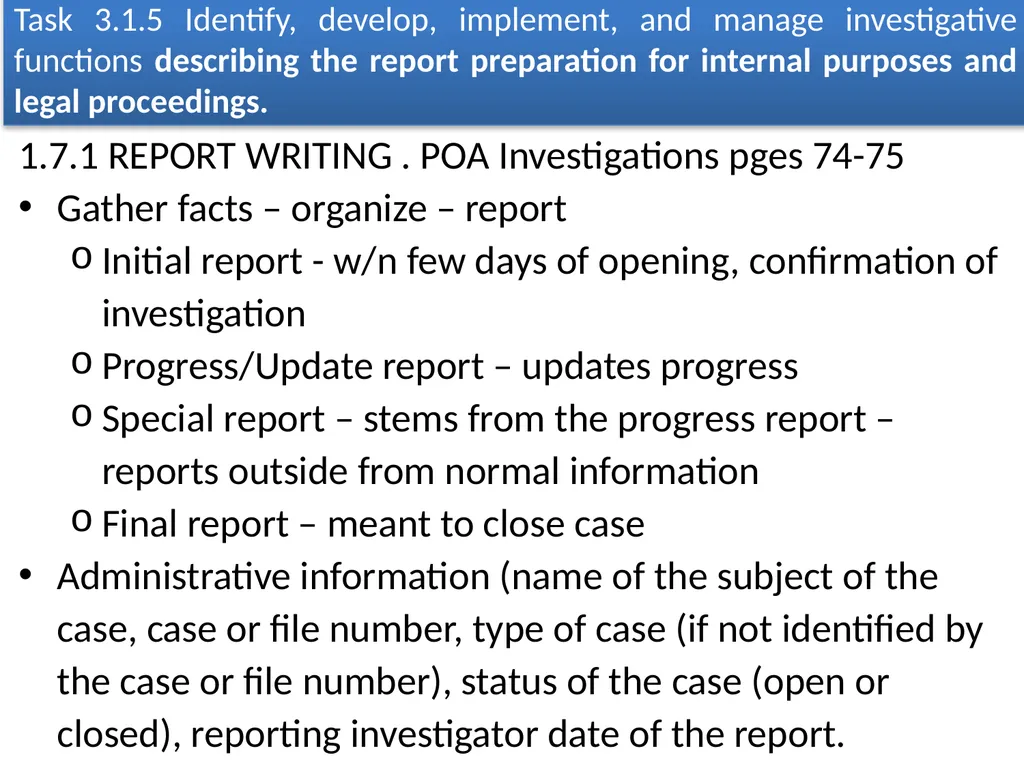
slide41. 1.7.1 REPORT WRITING . POA Investigations pges 74-75
Gather facts – organize – report
Initial report - w/n few days of opening, confirmation of investigation
Progress/Update report – updates progress
Special report – stems from the progress report – reports outside from normal information
Final report – meant to close case
Administrative information (name of the subject of the case, case or file number, type of case (if not identified by the case or file number), status of the case (open or closed), reporting investigator date of the report. Task 3.1.5 Identify, develop, implement, and manage investigative functions describing the report preparation for internal purposes and legal proceedings.<br>
slide42. Summary – executive summary, every major point covered by the report requires at least one sentence in the synopsis.
Narrative – detailed outline of activities, each step in the investigation should be covered in a separate paragraph, should be clear, simple, and brief, vocabulary should be easily understood, avoid technical terms (or explained)
Conclusion – caution about recommendations – investigator is the collector of facts.
Enclosures – initial complaint, documents, reports, evidence analysis reports, photos, statements, surveillance logs.<br>
slide43. Enclosures – initial complaint, documents, reports, evidence analysis reports, photos, statements, surveillance logs.
An IU can be compelled to release its report and other files to outside parties and the opposing party.
A report might be subject to “privilege” or protection from external access – consult legal counsel.<br>
slide44. POA: Legal Issues, CHAPTER 1 Security & Labor Relations page 26) (Kindle Location 19960)
Uniformed security officer/investigator clearly an agent of the employer, insofar as duties relating to the employer.
POA: Investigation CHAPTER 5.10 GENERAL LEGAL ASPECTS Interviewers should have a clear understanding of the legal requirements regarding interviews in the jurisdiction in which they work.
A confession/sworn statement must be competent, material, relevant, and obtained voluntarily under legally acceptable circumstances = to be admissible. Task 3.1.6 Identify, develop, implement, and manage investigative functions describing the laws pertaining to developing and managing investigative programs.<br>
slide45. POA: Investigation CHAPTER 5.10 GENERAL LEGAL ASPECTS (Kindle Location 19960).
The interviewer should avoid making any promise or guarantee, explicit or implied, that is illegal, that cannot be confirmed by the client or senior management, or that cannot be fulfilled.
An interviewee may ask for an opinion as to the outcome of the matter under investigation. The investigator usually cannot guarantee a specific outcome and, in fact, should not be in a position to do so.
The function of the investigator is to gather the facts.
Any coercion, duress, or psychological constraint placed on the interviewee is unacceptable and may make a confession inadmissible.<br>
slide46. Interviewees must understand that they are free to leave the interview location. An indication, expressed or implied, that the interviewee is not free to leave creates the conditions for allegations of false imprisonment.
The interviewee must consent to the interview and to making any statement. The consent must be fully voluntary and cannot be coerced in any manner.
The interviewee must be legally competent to give consent.
The interviewee must have access to restroom facilities at reasonable intervals and especially on request.<br>
slide47. The interviewee must have access to restroom facilities at reasonable intervals and especially on request.
All interviews and interrogations should be conducted in such a manner that they can withstand the scrutiny of judicial review.
What is a fact? “A piece of information used as evidence or as part of a report.”<br>
slide48. Task 03/02 Manage or conduct the collection and preservation of evidence to support investigation actions<br>
slide49. Knowledge of:
03/02/01 Evidence collection techniques
03/02/02 Protection/preservation of crime scene
03/02/03 Requirements of chain of custody
03/02/04 Methods for preservation of evidence
03/02/05 Laws pertaining to the collection and preservation of evidence<br>
slide50. POA: Investigations CHAPTER 1.5.3 EVIDENCE COLLECTION AND HANDLING (page 61)
Physical, technical, and other forms of evidence can be absolutely critical to case resolution and resultant action determinations (judicial, administrative, etc.) in all investigative settings.
Proper procedures in gathering, protecting, examining, storing, and presenting evidence are crucial to the successful resolution of a case. Task 3.2.1 Manage or conduct the collection and preservation of evidence to support investigation actions describing evidence collection techniques.<br>
slide51. POA: Legal, CHAPTER 9.0 EVIDENCE Page 229
“Evidence is that which provides proof or an indication of an assertion.”
Even if the evidence will not be used in a criminal case, handle it according to that standard.
Evidence is oral, documentary, and physical.
All evidence must be collected legally
2 basic categories: direct (real) and indirect (circumstantial and hearsay).
Direct evidence is first-hand knowledge. For example, if a witness sees a driver in an automobile pass through a red light and strike another automobile, that witness has direct evidence of the incident.<br>
slide52. Indirect evidence is a highly informed inference. For example, perhaps a witness was around the corner, heard a screech of brakes and then the impact of two cars, ran to the scene, and saw the damaged vehicles. That witness did not directly witness the collision – but infers what occurred.
Also known as circumstantial evidence where something is inferred to have happened because testimony given on a series of events leads one to believe that it happened.
Hearsay evidence is normally not admissible in a trial. The rule that applies most often in determining the importance of evidence and its ability to prove a point is called materiality.<br>
slide53. Collection – 3-P’s:
Principle – policy – procedure<br>
slide54. POA: Legal Issues CHAPTER 9.3.1 EVIDENCE SEARCHES (Kindle Locations 13482-13484), page 51
Protect the scene – perimeter designation – perimeter tape, barriers, barricades
Do not handle evidence unless collecting
Take notes and log the collection, location and details of collected evidence
Secure and Protect the Scene:
Take control of the scene immediately.
Determine the extent to which the scene has been protected. Task 3.2.2 Manage or conduct the collection and preservation of evidence to support investigation actions describing the protection/preservation of crime scene.<br>
slide55. Obtain information from personnel who have knowledge of its original condition.
A crime scene investigation is an example of a reactive measure.
The collection, handling, processing, and use of evidence is a key component of investigation. (protecting crime scene)
Proper procedures in gathering, protecting, examining, storing, and presenting evidence are crucial to the successful resolution of a case.<br>
slide56. Evidence tasks can be tedious and resource-intensive (including the possible consumption of a large amount of secure storage space).
Physical, technical, and other forms of evidence can be absolutely critical to case resolution and resultant action determinations (judicial, administrative, etc.) in all investigative settings.<br>
slide57. POA Legal Issues Chapter 9.0 EVIDENCE pages 230-245) and POA: Investigation; CHAPTER 1.5.3 EVIDENCE COLLECTION AND HANDLING
How to seize physical evidence and preserve the chain of custody before analysis and court
Must be marked, time/date stamped at time of collection
Properly preserved – type of bagging, refrigeration, storage, etc.
After an incident, security practitioners should gather evidence carefully, regardless of whether law enforcement will become involved. Task 3.2.3 Manage or conduct the collection and preservation of evidence to support investigation actions describing the requirements of chain of custody.<br>
slide58. Such evidence can be used to resolve the issue, analyze how the incident occurred, and if necessary modify security measures to prevent future incidents.
POA Legal Issues Chapter 9 EVIDENCE (pages 230-245)
Chain of custody (the uninterrupted control of evidence) must be clearly shown
The evidence must be properly identified, and it must be relevant to the case before the court.
Evidence should be marked at the time it is gathered.
Limiting the individuals who handle the evidence to the smallest number possible and properly documenting each transfer will maintain the chain of custody and assist the prosecution when introducing evidence in a legal proceeding.<br>
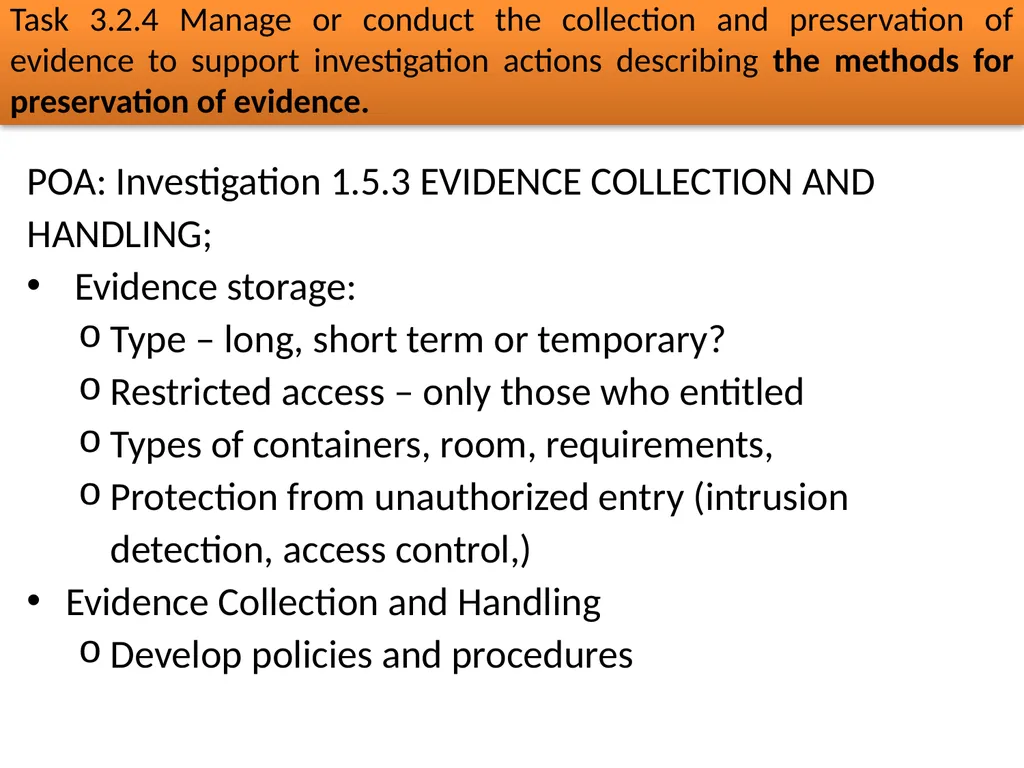
slide59. POA: Investigation 1.5.3 EVIDENCE COLLECTION AND HANDLING;
Evidence storage:
Type – long, short term or temporary?
Restricted access – only those who entitled
Types of containers, room, requirements,
Protection from unauthorized entry (intrusion detection, access control,)
Evidence Collection and Handling
Develop policies and procedures Task 3.2.4 Manage or conduct the collection and preservation of evidence to support investigation actions describing the methods for preservation of evidence.<br>
slide60. Task 03/03 Manage or conduct surveillance processes<br>
slide61. Knowledge of:
03/03/01 Surveillance techniques
03/03/02 Technology/equipment and personnel to conduct surveillance
03/03/03 Laws pertaining to managing surveillance processes<br>
slide62. POA: Legal Issues, pge 101)
Governed in USA by State
RECOMMEND CONSULTING WITH LEGAL COUNSEL
Organization should implement organizational policies and procedures for how IU conducts & manages surveillance ops.
Differs by country and individual State
ASIS Investigation Guideline 5.5.22
Follow local laws and right to privacy in local jurisdiction Task 3.3.3. Manage or conduct the collection and preservation of evidence to support investigation actions, describing the laws pertaining to managing surveillance processes.<br>
slide63. POA: Investigation CHAPTER 4.8.4 DATA ANALYSIS pages 175-176
When all investigative results & data is obtained – data analysis may begin
CHAPTER 2.9 THE COST OF UNDERCOVER OPERATIONS
Successful undercover investigations are expensive.
Size, scope and nature of problem will determine the budget.
CHAPTER 1.3.5 INVESTIGATIVE RESOURCES
Investigative funding is difficult to project because they can be drastically affected by one or a few major cases or new regulatory requirements. Task 3.3.1 Manage or conduct surveillance processes explaining surveillance techniques.<br>
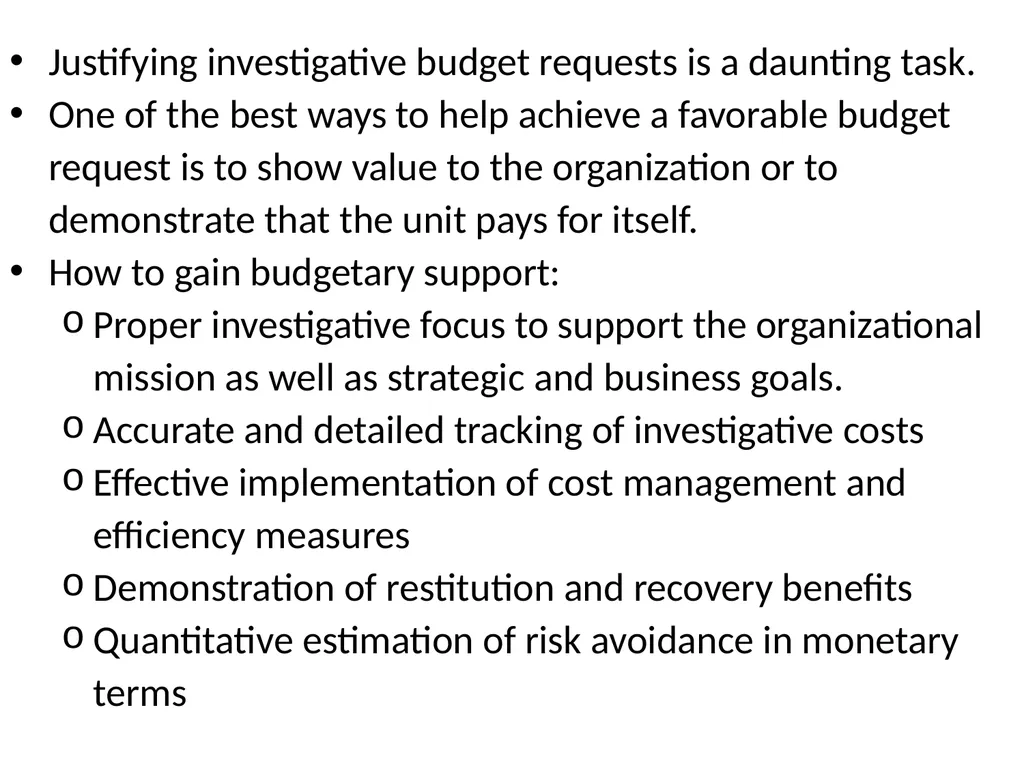
slide64. Justifying investigative budget requests is a daunting task.
One of the best ways to help achieve a favorable budget request is to show value to the organization or to demonstrate that the unit pays for itself.
How to gain budgetary support:
Proper investigative focus to support the organizational mission as well as strategic and business goals.
Accurate and detailed tracking of investigative costs
Effective implementation of cost management and efficiency measures
Demonstration of restitution and recovery benefits
Quantitative estimation of risk avoidance in monetary terms<br>
slide65. Carefully tracking and managing operational and overhead costs can significantly improve the response to funding requests.
Costs can be tracked by case type, location, business unit, or other variable.
Recoveries and restitution figures should be tracked and reported to senior management to help demonstrate a financial benefit to the organization and support return on investment (ROI) arguments.
IUs can demonstrate ROI through civil recovery efforts, recovering not only the losses but also the related investigative costs.<br>
slide66. Costs for personnel and outside services generally represent the largest budget items for an IU.
Overhead costs are often the easiest to control.
IU managers should leverage the use of liaison contacts and other organizational departments (such as IT, facilities, accounting and finance, legal, and risk management) to conserve financial resources.<br>
slide67. POA: Investigation; CHAPTER 4.9 Technology in Investigations
Technology is improving how information is gathered and disseminated throughout the enterprise.
Technological improvements can make a time-consuming and sometimes tedious process simpler and help ensure that employment information is collected, protected, and shared in an efficient and secure manner.
A key investigative tool, surveillance can be broken down into three broad categories:
Physical (i.e., human observation or tracking) Task 3.3.2 Manage or conduct surveillance processes explaining the technology/equipment and personnel to conduct surveillance..<br>
slide68. Psychological (i.e., behavioral analysis)
Data (e.g., technical or electronic). 1.6.1 Technical Surveillance Countermeasures POA: Physical Security
Technical surveillance countermeasures (TSCM) are services, equipment, and techniques designed to locate, identify, and neutralize technical surveillance activities (electronic eavesdropping).
TSCM should be part of an organization’s overall protection strategy.
Regular inspection of telecommunications equipment, cables, and terminals using equipment, methods, and personnel capable of detecting current threats.
Most effective is a layered approach that integrates physical, procedural, and logical protection measures.<br>
slide69. Task 03/04 Manage and conduct investigations requiring specialized tools, techniques, and resources<br>
slide70. Knowledge of:
03/04/01 Techniques, tools and resources related to:
financial and fraud related crimes
intellectual property and industrial espionage crimes
arson and property crimes
cybercrimes<br>
slide71. POA: Investigation; CHAPTER 1.5.2 RECORDS AND DATABASE CHECKS
Records and database checks represent a key element of almost any investigation.
The core of any investigation is information.
Anything that significantly improves the speed and efficiency of information gathering, collation, analysis, or organization is an important force multiplier (Databases; collaboration tools; automated analysis tools; information on vendors (experts, laboratories, etc.)
Established caller “Hotlines” for frauds
Certified Fraud Examiners (experts & forensic investigators) Task 3.4.1 Manage and conduct investigations requiring specialized tools, techniques, and resources for financial and fraud related crimes.<br>
slide72. ASIS Information & Asset Protection Guideline, 05-2007, 12.9 Investigating loss or Compromise, page 15 Task 3.4.1 Manage and conduct investigations requiring specialized tools, techniques, and resources for intellectual property and espionage crimes<br>
slide73. ASIS Information & Asset Protection Guideline, 05-2007, 12.9 Investigating loss or Compromise, page 15<br>
slide74. POA: Investigations; CHAPTER 1.5.3 Detecting Drugs, Explosives and Accelerants,
Accelerant detection dogs can be used to search fire scenes, equipment, vehicles, and crowds.
The mobility & keen sense of smell a K9 possesses can significantly reduce the time required for the fire investigation.
Forensic investigators to detect chemicals.
CCV can provide valuable evidence for investigation property crimes. Task 3.4.1 Manage and conduct investigations requiring specialized tools, techniques, and resources for arson and property crimes<br>
slide75. POA; Information Security, CHAPTER 2.6 CYBERCRIME: A NATIONAL CHALLENGE
Cybercrime— the use of information systems to commit crime. Task 3.4.1 Manage and conduct investigations requiring specialized tools, techniques, and resources for cybercrimes<br>
slide76. Task 03/05 Manage or conduct investigative interviews<br>
slide77. Knowledge of:
03/05/01 Methods and techniques of eliciting information
03/05/02 Techniques for detecting deception
03/05/03 The nature of non-verbal communication and cultural considerations
03/05/04 Rights of interviewees
03/05/05 Required components of written statements
03/05/06 Laws pertaining to managing investigative interviews<br>
slide78. POA: Investigation CHAPTER 1.5.1 INTERVIEWING AND INTERROGATION (Kindle Location 17143)
The success of an investigator is sometimes measured by his or her ability to interview or interrogate people.
Techniques can be learned, the skill required to be a successful investigator may take years to develop.
POA: Investigation CHAPTER 5.0 INTERVIEW AND INTERROGATION
The purpose of an investigation is to determine the truth in a matter under question. Task 3.5.1 & 3.5.2 Manage or conduct investigative interviews describing methods and techniques of eliciting information and techniques for detecting deception<br>
slide79. Three tools investigator uses (3-I’s): information, interrogation, and instrumentation.
Primary source of information - victims, witnesses, informants and confidential informants are considered the most critical aspect of an investigation (cost-effectively & on-time).
The value of each interview or interrogation is based on the investigator’s knowledge, skills in eliciting information, and ability to evaluate the veracity (truth) of the information obtained.
The most prize talent an investigator can have is the ability to obtain information from individuals through questioning.<br>
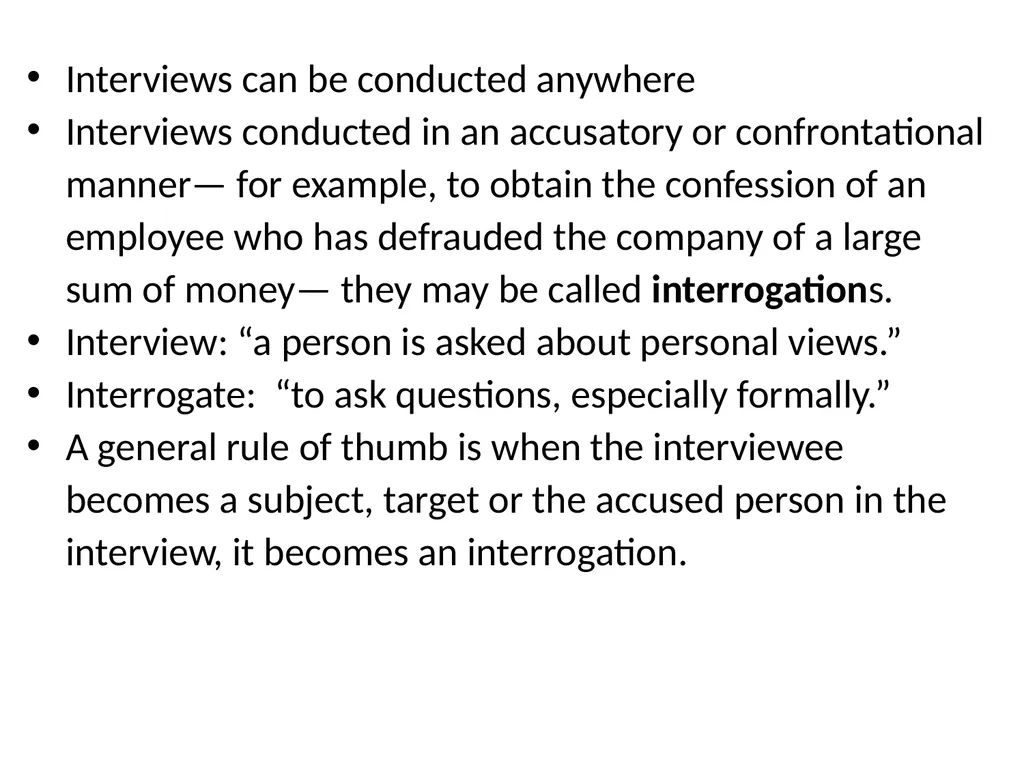
slide80. Interviews can be conducted anywhere
Interviews conducted in an accusatory or confrontational manner— for example, to obtain the confession of an employee who has defrauded the company of a large sum of money— they may be called interrogations.
Interview: “a person is asked about personal views.”
Interrogate: “to ask questions, especially formally.”
A general rule of thumb is when the interviewee becomes a subject, target or the accused person in the interview, it becomes an interrogation.<br>
slide81. The administrative interview, is simple and usually unstructured, is the process of interviewing witnesses, friends, supervisors, and anyone other than the subject or suspect in the investigation.
The investigatory interview is a complex, structured process used when the subject is known to have committed the offense alone or with others and the investigator has reason to believe the subject committed the offense.<br>
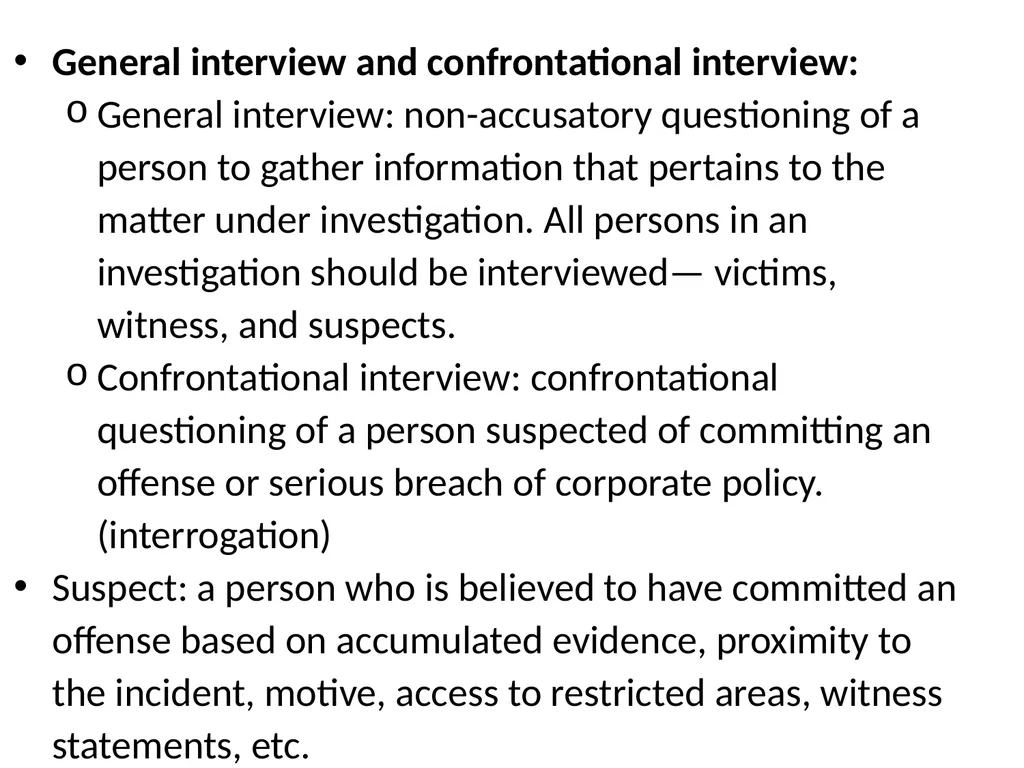
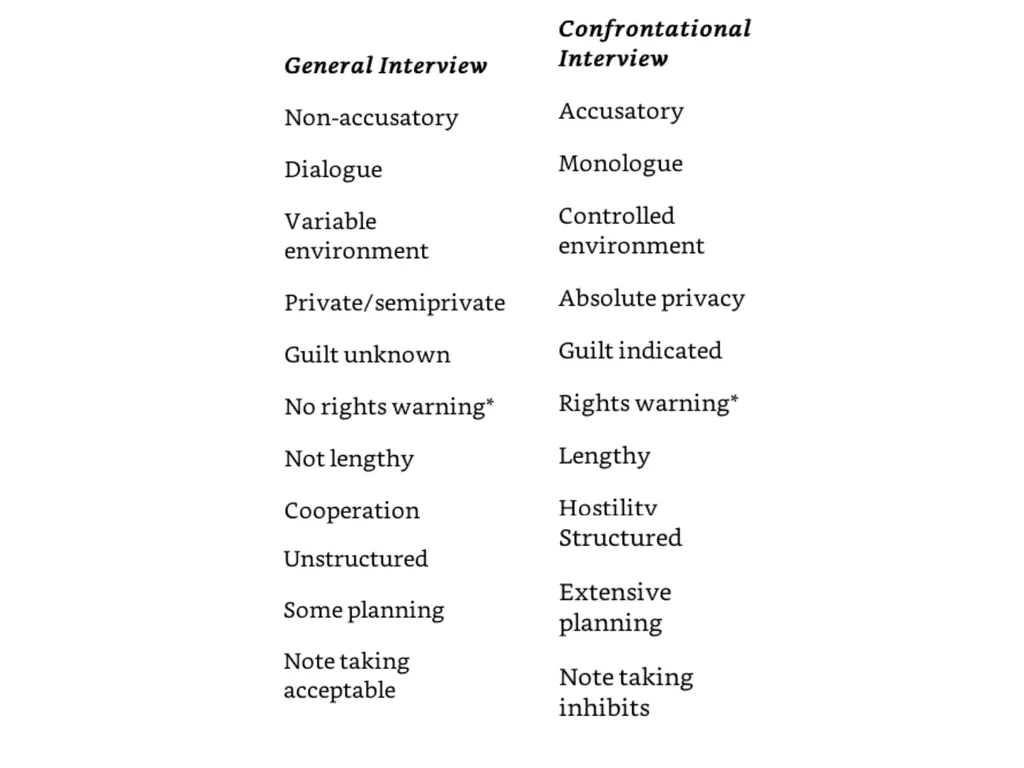
slide82. General interview and confrontational interview:
General interview: non-accusatory questioning of a person to gather information that pertains to the matter under investigation. All persons in an investigation should be interviewed— victims, witness, and suspects.
Confrontational interview: confrontational questioning of a person suspected of committing an offense or serious breach of corporate policy. (interrogation)
Suspect: a person who is believed to have committed an offense based on accumulated evidence, proximity to the incident, motive, access to restricted areas, witness statements, etc.<br>
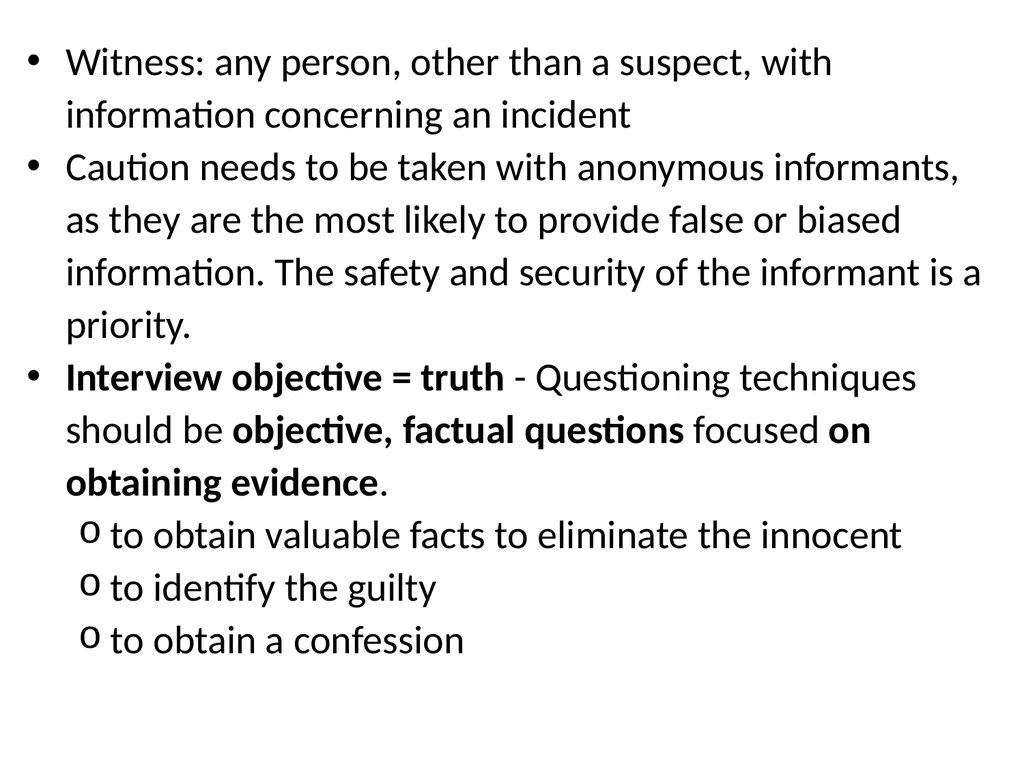
slide83. Witness: any person, other than a suspect, with information concerning an incident
Caution needs to be taken with anonymous informants, as they are the most likely to provide false or biased information. The safety and security of the informant is a priority.
Interview objective = truth - Questioning techniques should be objective, factual questions focused on obtaining evidence.
to obtain valuable facts to eliminate the innocent
to identify the guilty
to obtain a confession<br>
slide85. Confrontational interview: confrontational questioning of a person suspected of committing an offense or serious breach of corporate policy. (interrogation)
Suspect: a person who is believed to have committed an offense based on accumulated evidence, proximity to the incident, motive, access to restricted areas, witness statements, etc.
Witness: any person, other than a suspect, with information concerning an incident.
Caution needs to be taken with anonymous informants, as they are the most likely to provide false or biased information. The safety and security of the informant is a priority.<br>
slide86. Interview objective = truth - Questioning techniques should be objective, factual questions focused on obtaining evidence.
to obtain valuable facts to eliminate the innocent
to identify the guilty
to obtain a confession<br>
slide87. POA: Investigation; CHAPTER 5.7 VERBAL AND NONVERBAL BEHAVIOR .
Collection of information is based upon communication and observation, particularly as the subject answers questions about the details of the matter, any alibi, and the subject’s relationship to the victim.
In the primary phase this is important.
Interviewer must analyze and compare both the factual evidence or information and the behavior of the person who is the source of the information. Task 3.5.3 Manage or conduct investigative interviews describing the nature of non-verbal communication and cultural considerations.<br>
slide88. Verbal responses include both spoken words and gestures that serve as word substitutes, such as nodding the head to indicate yes or a shaking the head to indicate no.
Also within the category of verbal responses are such vocal characteristics as tone, speed, pitch, and clarity.
Careful listener considers not only the words themselves but also the interviewee’s timing and emphasis.
Normal socialized individual does not enjoy lying.
Deception leads to a conflict that results in anxiety and stress.
A suspect offers an evasive answer or objection in response to a direct question does so because of an attempt to avoid internal anxiety.<br>
slide89. Nonverbal responses include body movements and position changes, gestures, facial expressions, and eye contact.
Nonverbal behavior is internally motivated to reduce anxiety.
Distraction behavior - shifts in body posture, bringing a hand to the face, or crossing the arms
Displacement behavior - such as picking the lint off clothing, pacing, or repetitious fast movement
All nonverbal behavior that accompanies a deceptive response emanates from a guilty suspect’s efforts to relieve anxiety (stress).<br>
slide90. POA: Investigation; CHAPTER 5.7.2 PRELIMINARY CAUTIONS
No single word or nonverbal behavior automatically means a person is lying or telling the truth.
Each behavior characteristic displayed must be considered in the context of the environment and intensity of the setting and in comparison to the subject’s normal behavior.
The assessment of a subject’s truthfulness should be based on the overall behavioral pattern displayed, not on any single observation.
Behavioral indications should be evaluated on the basis of when they occur (timing) and how often they occur (consistency).
To be reliable indicators of truth or deception, behavioral changes should occur immediately in response to a question.<br>
slide91. Evaluation of behavior symptoms should consider the subject’s intelligence, sense of social responsibility, and maturity.
More reliable behaviors are displayed by socially responsible persons — who have more at stake in the outcome of a case (such as their family, job, or reputation), or are more mature.
Caution must be used in evaluating the behavior of persons who are emotionally or psychologically unstable.
Some behavioral characteristics that suggest deception may also be displayed by a truthful subject who feels fear, anxiety, anger, or mistrust.<br>
slide92. POA: Investigation; CHAPTER 5.10 GENERAL LEGAL ASPECTS
Interviewers should have a clear understanding of the legal requirements regarding interviews in the jurisdiction in which they work.
A confession or sworn statement must be competent, material, relevant, and obtained voluntarily under legally acceptable circumstances so it will be admissible in any subsequent legal proceeding or hearing.
If interviewer makes a promise to the interviewee, be certain that whatever is promised can be legally performed (explicit or implied) Task 3.5.4 & 3.5.6 Manage or conduct investigative interviews describing the rights of interviewees and the laws pertaining managing investigative interviews.<br>
slide93. The investigator usually cannot guarantee a specific outcome and, should not be in a position to do so.
The function of the investigator is to gather the facts.
The interviewer should NOT (express or imply) that cooperation on the part of the interviewee will lead to a more favorable outcome – probably will invalidate any confession obtained
Any coercion, duress, or psychological constraint placed on the interviewee is unacceptable - may make a confession inadmissible.
Verbal abuse, threats, and intimidation are unprofessional, unethical, and unacceptable.
Interviewees must understand that they are free to leave the interview location.<br>
slide94. Expressed or implied notions the interviewee is not free to leave creates allegations of false imprisonment.
Interviewee must consent to the interview and any statement.
Consent must be fully voluntary and not coerced in any manner. (Confession or statement could be ruled inadmissible in subsequent legal proceedings).
The interviewee must be legally competent to give consent. (minor cannot give consent, nor can a person under the influence of alcohol or other intoxicants).
Interviewee must also understand that consent may be withdrawn at anytime.<br>
slide95. Interviewee must have access to restroom facilities at reasonable intervals and especially on request.
Meals and breaks can enhance communication between the interviewer and interviewee.
Skilled interviewers must be patient, persistent, and prepared.
Conduct every interview treating the subject with respect and carefully adhering to all legal requirements - interviews and interrogations should withstand the scrutiny of judicial review.<br>
slide96. POA: Investigations; CHAPTER 5.8 BEHAVIOR ANALYSIS INTERVIEW
BAI a systematic evaluation of a subject’s verbal and nonverbal behavior during the course of a structured interview in which both investigative and behavior-provoking questions are asked.
Investigative questions (who, what, when, where, why, and how of the incident).
Behavior-provoking questions in a BAI are designed to draw out specific verbal responses or behavior that can be studied to distinguish between a truthful and deceitful person. Task 3.5.5 Manage or conduct investigative interviews describing the required components of written statements.<br>
slide97. POA: Investigations; CHAPTER 5.8.1 CONFRONTATIONAL INTERVIEW
When general interviews conducted and evidence points to a specific person as the likely perpetrator, a confrontational interview or interrogation should be conducted.
Reid Nine Steps of Interrogation process: (RECOMMEND REVIEWING)
Positive Confrontation
Theme Development
Handling Denials
Overcoming Objections
Keeping a Suspect’s Attention
Handling a Suspect’s Passive Mood<br>
slide98. Presenting an Alternative Question
Having a Suspect Relate Details
Converting an Oral Confession
Convert an oral confession into a written one.
Statement written by the suspect
Statement authored by the interrogator but read and signed by the suspect.
Statement taken down by a secretary or stenographer and transcribed into a typed document for the suspect to read and sign
Recorded statement (audio or video) by the suspect.
Statement (of guilt) must be legible and understandable by someone who is not familiar with case.<br>
slide99. Must include a recitation (presentation) of the facts or events.
Statement should use general vocabulary, grammatical irregularities, profanity, and idiomatic abnormalities that the person making the statement would use in everyday speech.
Any errors, changes, or crossed-out words should be initialed with an OK written in the margin by the suspect.
Statement should reflect that the suspect was treated properly, that no threats or promises were made, and that the statement was freely given by the suspect.
Avoid directing the suspect who has completed reading the written statement to sign name to statement.<br>
slide100. Written statement or confession to be credible and admissible - must be given voluntarily, be trustworthy.
Include the following essential information:
date, time, and place where the statement was prepared
complete identification of the person making the statement: full name, date and place of birth, residence address, and social security number or driver’s license number.
all pertinent points of the interview discussion, with particular emphasis on the elements of proof of the crime under investigation.<br>
slide101. affirmation that the statement is made freely after fair treatment in the course of the interview and without remuneration, threat, coercion, or promises.
sequential numbering of every page, with each page signed by the person making the statement
initialing of any additions to, deletions from, or alterations of the statement by the person making the statement.
signature, on the last page of the statement, of the person making the statement, the interviewer, and a witness.
Every effort should be made to verify the statement and obtain the supporting evidence necessary.<br>
slide102. Prior to going to trial, a formal deposition, given under oath, may be requested by either counsel to determine how the investigator conducted the investigation, what evidence was obtained, and what the witness( es) and suspect( s) said during the investigation.<br>
slide103. Task 03/06 Provide coordination, assistance, and evidence such as documentation and testimony to support legal counsel in actual or potential criminal and/or civil proceedings<br>
slide104. Knowledge of:
03/06/01 Statutes, regulations and case law governing or affecting the security industry and the protection of people, property and information
03/06/02 Criminal law and procedures
03/06/03 Civil law and procedures
03/06/04 Employment law (e.g., wrongful termination, discrimination and harassment)<br>
slide105. POA: Legal Issues; CHAPTER 1.4.1 ETHICAL VERSUS LEGAL
Business ethics imply compliance with legal standards?
Obeying all laws because the consequences of failing to do so could be very costly in terms of fines and damage to a company’s reputation.
A company is seen as having a social responsibility, then going beyond legal requirements makes sense. Task 3.6.1 Provide coordination, assistance, and evidence such as documentation and testimony to support legal counsel in actual or potential criminal and/or civil proceedings describing Statutes, regulations and case law governing or affecting the security industry and the protection of people, property and information.<br>
slide106. Businesses skirt the ethical dilemma by philosophizing that, in a competitive business environment, the companies that survive are the ones that recognize that their only role is to maximize profits.
A related problem arises when a company faces multiple legal standards because it operates in numerous jurisdictions (especially in different countries).
POA: Legal Issues; CHAPTER 1.8 BUSINESS ETHICS CODES AND PROGRAMS
Security professional is an employee (or an agent or representative) of the organization for which he or she provides protective services and therefore is bound by the same ethical standards that apply to other organizational employees and representatives.<br>
slide107. The nature of a security professional’s duties holds him or her to a higher ethical standard than that of fellow employees.
The security professional may be tasked with developing a company’s ethics program and code or monitoring compliance with the existing program and code.
CHAPTER 1.8.1 RELATIONSHIP BETWEEN AN ETHICS CODE AND AN ETHICS PROGRAM
Establishing a company ethics code is a fundamental step in setting the correct standards of ethical behavior.<br>
slide108. A company’s reasons for ethics - altruistic (a belief that it is the right way to do business) to the practical (a belief that being perceived as ethical is a good business decision, or a belief that conducting business ethically will avoid problems caused by unethical behavior).
An ethics code is a statement of the organization’s shared values— accepted concepts and beliefs related to the organization’s responsibilities and ethical ambitions.
It should be built on the traditions and personality of the organization, also known as the corporate culture.<br>
slide109. Ethics code:
Supporting statement from CEO
Statement of the specific nature of the business
Enumeration of organizational values, including reference to — employees — customers — shareholders or stakeholders — partners (vendors, contractors, etc.) — society and the communityStatement of commitment to the code (including implementation, training, oversight, etc.) to show that the code is underpinned by a structure for implementing it.
Mission statement proclaiming values.
CHAPTER 3 and 4 POA: Legal Issues (focus on USA only)<br>
slide110. POA: Legal Issues; CHAPTER 10.1.3 TESTIMONY PREPARATION
Preparation begins long before litigation.
Accurate and timely capture of facts and impressions of the incident in a report or notes.
Shortly before testimony, preparation may consist of a site visit and a review of notes, reports, photos, and diagrams.
Security professional’ testimony - “parol” or “spoken word,” and legal counsel will want to make sure it supports the case. Task 3.6.2 Provide coordination, assistance, and evidence such as documentation and testimony to support legal counsel in actual or potential criminal and/or civil proceedings describing criminal law and procedures.<br>
slide111. Normal to have a pretrial meeting to exchange information that each side believes is necessary.
POA: Legal Issues; CHAPTERS 10.2 COURTROOM PARTICIPANTS 10.2.1 JUDGES
Judges are public officials authorized to decide questions of law brought before a court and are the ultimate authority in regulating the litigation before them.
In all trials, they are responsible for requiring adherence to procedural rules.
Judges may also decide the outcome (guilt or innocence, fault or no fault) if no jury.<br>
slide112. Juries consist of jurors, selected citizens required to render a decision based on the facts presented to them.
CHAPTER 10.2.3 COUNSEL Counsel, attorneys, lawyers
Advocates hired to represent their client to the best of their ability within the rules of procedure and bounds of integrity.
CHAPTER 10.2.4 WITNESSES
Security employees called to testify may serve as either fact witnesses or opinion/ expert/ forensic witnesses, and their testimony may be sought either to support or to contradict other evidence.<br>
slide113. POA: Legal Issues, CHAPTER 4 CIVIL LAW,
CIVIL LAW ASPECTS RELATE TO US/CANADA/UK WITH GENERAL PRINCIPLES APPLICABLE GLOBALLY.
Civil law deals with private rights and remedies.
Sometimes government is a party in civil law matters, but mainly civil law handles rights between private persons, organizations or organizations.
If persons or organizations act in a negligent manner or commit another wrong that does not involve a criminal investigation, they can be sued for either money damages or injunctive relief (court order) Task 3.6.3 Provide coordination, assistance, and evidence such as documentation and testimony to support legal counsel in actual or potential criminal and/or civil proceedings describing civil law and procedures.<br>
slide114. POA: Legal Issues, CHAPTER 4.2 CIVIL COMMON LAW, (Kindle Locations 11041-11045)
Divided into two branches: contract common law and tort common law.
The majority of common-law disputes fall into one of these branches.
The contract branch deals with matters arising from agreements, express or implied, between persons.
The tort branch deals with alleged wrongs, intentional or negligent, done by one party to another.
CHAPTER 4.2.1 CONTRACT LAW
A contract may be defined as “an agreement between two or more persons that creates an obligation to do or not do a particular thing”<br>
slide115. Warranties are statements by persons that things done or said by them, or products or services rendered by them, are as described.
The warranty generally becomes an obligation enforceable against the warrantor (the one making the statement).
Some warranties are stated on products.
The manufacturer or supplier, or both, agree that, for a stated period, the product will perform as described.
Limitations of Liability – to protect against liability and having insurance, usually rely on specific language in the contract, service agreement, or purchase memorandum to limit liability.<br>
slide116. Agency—whether one person is acting on behalf of another, or an organization— is an important question in security.
Security officer acting for contract or company.
Vicarious liability, or liability for the acts of another without personal fault of the one liable.
The significance of vicarious liability is that, while the agent may not have resources worth pursuing by another wronged party – the organization would.
Understand torts!<br>
slide117. Legal Aspects relate to international ethics and standards – outlined in earlier Tasks. Task 3.6.4 Provide coordination, assistance, and evidence such as documentation and testimony to support legal counsel in actual or potential criminal and/or civil proceedings describing employment law.<br>
slide118. PRACTICE EXAM QUESTIONS<br>
slide119. “Avoiding subjective attitudes and focusing on the use of a rational investigative hypothesis while carefully avoiding the interjection of prejudgment”, BEST explains which of the following terms?
Objectivity
Thoroughness
Relevance
Accuracy<br>
slide120. “Avoiding subjective attitudes and focusing on the use of a rational investigative hypothesis while carefully avoiding the interjection of prejudgment”, BEST explains which of the following terms?
Objectivity
Thoroughness
Relevance
Accuracy
POA: Investigation (Kindle Locations 15933-15934). ASIS International. Kindle Edition.<br>
slide121. Which of the following terms BEST describes an investigator being objective when interviewing a witness to an incident?
The investigator pressing the witness to remember more details of the incident.
The investigator avoids body language and facial expressions that may display prejudice.
The investigator seeks corroborative information to confirm the witnesses statement.
The investigator seeks information specific to the incident scene.<br>
slide122. Which of the following terms BEST describes an investigator being objective when interviewing a witness to an incident?
The investigator pressing the witness to remember more details of the incident.
The investigator avoids body language and facial expressions that may display prejudice.
The investigator seeks corroborative information to confirm the witnesses statement.
The investigator seeks information specific to the incident scene.
POA: Investigation (Kindle Locations 15942). ASIS International. Kindle Edition.<br>
slide123. What type of evidence is considered among the least accurate forms of investigative information.
Direct physical evidence
Documented physical evidence
Eyewitness evidence
Corroborated statements<br>
slide124. What type of evidence is considered among the least accurate forms of investigative information.
Direct physical evidence
Documented physical evidence
Eyewitness evidence
Corroborated statements
POA: Investigation (Kindle Location 15986). ASIS International. Kindle Edition.<br>
slide125. These are based on the investigative goals but are more specific and may be more short-lived. They are generally measurable and can be used to gauge the progress, success, or achievement of an investigative unit. They are BEST described as:
Metrics
Objectives
Strategies
Ethics<br>
slide126. These are based on the investigative goals but are more specific and may be more short-lived. They are generally measurable and can be used to gauge the progress, success, or achievement of an investigative unit. They are BEST described as:
Metrics
Objectives
Strategies
Ethics
POA: Investigation (Kindle Locations 16111-16113). ASIS International. Kindle Edition<br>
slide127. In almost all situations, what is considered a major factor in the decision to outsource or maintain an internal investigative capability.
Objectives
Goals
Cost
Expertise<br>
slide128. In almost all situations, what is considered a major factor in the decision to outsource or maintain an internal investigative capability.
Objectives
Goals
Cost
Expertise
POA: Investigation (Kindle Locations 16163-16164). ASIS International. Kindle Edition<br>
slide129. When dealing with allegations of defamation, false imprisonment, false arrest, and harassment, what type of law would BEST describe this?
Civil law
Criminal law
Administrative law
Property law<br>
slide130. When dealing with allegations of defamation, false imprisonment, false arrest, and harassment, what type of law would BEST describe this?
Civil law
Criminal law
Administrative law
Property law
POA: Investigation (Kindle Location 16751). ASIS International. Kindle Edition.<br>
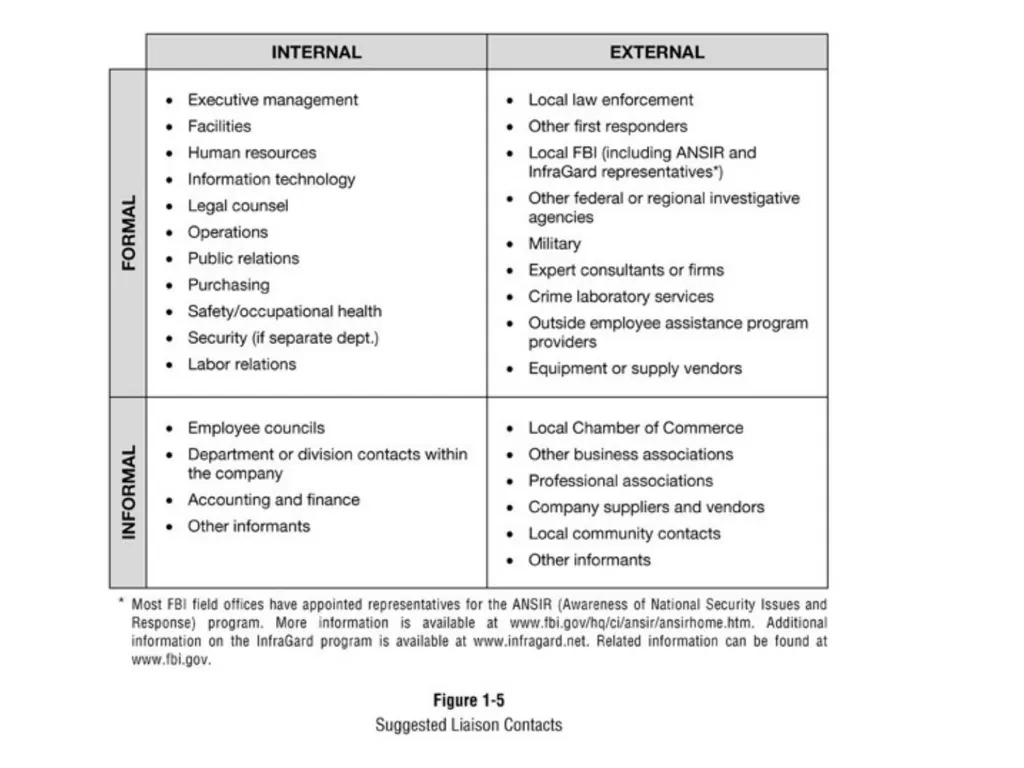
slide131. Investigators depend on reliable resources and liaisons with both internal and external organizations and people. When an investigator is seeking assistance form police or other first responders, they can be categorized as which type of liaison?
Internal-Formal
External-Formal
Internal-Informal
External-Informal<br>
slide132. Investigators depend on reliable resources and liaisons with both internal and external organizations and people. When an investigator is seeking assistance form police or other first responders, they can be categorized as which type of liaison?
Internal-Formal
External-Formal
Internal-Informal
External-Informal
POA: Investigation (Kindle Location 16769, Figure 1-5). ASIS International. Kindle Edition.<br>
slide133. Investigations which often focus on conflict of interest, corporate resource abuse, employee theft, workplace violence, and substance abuse are types of _____________ investigations.
Criminal
Financial
Employee
Misconduct<br>
slide134. Investigations which often focus on conflict of interest, corporate resource abuse, employee theft, workplace violence, and substance abuse are types of _____________ investigations.
Criminal
Financial
Employee
Misconduct
POA: Investigation (Kindle Location 17021-17022). ASIS International. Kindle Edition.<br>
slide135. In this type of investigation, a worker is investigated for breaching employee guidelines, which are clearly defined in corporate policy and procedures. The information was clearly communicated to all employees. Which type of investigation is this?
Employee theft
Conflict of interest
Criminal incident
Fraud investigation<br>
slide136. In this type of investigation, a worker is investigated for breaching employee guidelines, which are clearly defined in corporate policy and procedures. The information was clearly communicated to all employees. Which type of investigation is this?
Employee theft
Conflict of interest
Criminal incident
Fraud investigation
POA: Investigation (Kindle Location 17042). ASIS International. Kindle Edition<br>
slide137. A joint effort where the local police service’s crime prevention programs bring together local law enforcement and various local security organizations from industry and businesses to focus on specific high-profile crime issues. Such collaboration conserves valuable resources, encourages information sharing, eliminates duplication of effort, and effectively reduces crime. This type of effort is BEST described as a:
Force multiplier
Crime prevention
Natural surveillance
Cooperative policing<br>
slide138. A joint effort where the local police service’s crime prevention programs bring together local law enforcement and various local security organizations from industry and businesses to focus on specific high-profile crime issues. Such collaboration conserves valuable resources, encourages information sharing, eliminates duplication of effort, and effectively reduces crime. This type of effort is BEST described as a:
Force multiplier
Crime prevention
Natural surveillance
Cooperative policing POA: Investigation (Kindle Locations 17198-17201). ASIS International. Kindle Edition.<br>
slide139. Which of the following is one of the most significant force multipliers in the investigative function?
Law enforcement
Liaison
Management
Volunteers<br>
slide140. Which of the following is one of the most significant force multipliers in the investigative function?
Law enforcement
Liaison
Management
Volunteers
POA: Investigation (Kindle Locations 17267-17268). ASIS International. Kindle Edition<br>
slide141. In an investigative report, the name of the subject of the investigation and type of case, are considered which of the following?
Report summary
Administrative information
Report narrative
Conclusion information<br>
slide142. In an investigative report, the name of the subject of the investigation and type of case, are considered which of the following?
Report summary
Administrative information
Report narrative
Conclusion information
POA: Investigation (Kindle Locations 17460). ASIS International. Kindle Edition.<br>
slide143. Which of the following scenarios would warrant an acceptable undercover investigation?
Investigate activities that are permitted or protected by a government statute, rule, or regulation.
To replace some other form of investigation method that will likely produce the same results with less time and resources.
To investigate protected union organizing activities.
Investigate alleged or suspected employee theft in the workplace.<br>
slide144. Which of the following scenarios would warrant an acceptable undercover investigation?
Investigate activities that are permitted or protected by a government statute, rule, or regulation.
To replace some other form of investigation method that will likely produce the same results with less time and resources.
To investigate protected union organizing activities.
Investigate alleged or suspected employee theft in the workplace.
POA: Investigation (Kindle Locations 17750-17753). ASIS International. Kindle Edition.<br>
slide145. When pursuing the selection of an undercover agency, the client should NOT consider which one of the following requirements?
A contractor with specialized experience and references for the specific type of investigation.
A contractor with a solid reputation but not licenced by governmental authorities.
A contractor that can provide evidence of no litigation or claims history for negligence in this specialty.
Require a certificate of suitable liability insurance and workers’ compensation benefits.<br>
slide146. When pursuing the selection of an undercover agency, the client should NOT consider which one of the following requirements?
A contractor with specialized experience and references for the specific type of investigation.
A contractor with a solid reputation but not licenced by governmental authorities.
A contractor that can provide evidence of no litigation or claims history for negligence in this specialty.
Require a certificate of suitable liability insurance and workers’ compensation benefits.
POA: Investigation (Kindle Locations 17799). ASIS International. Kindle Edition.<br>
slide147. The timing of the removal of the undercover operative is one of the most frequently debated subjects among undercover supervisors. How long should the operative be kept in place?
Removed as soon as possible to save costs
Should be kept in place as long as possible.
Should be removed as soon as possible when evidence is gained
Removed upon direction from the senior management.<br>
slide148. The timing of the removal of the undercover operative is one of the most frequently debated subjects among undercover supervisors. How long should the operative be kept in place?
Removed as soon as possible to save costs
Should be kept in place as long as possible.
Should be removed as soon as possible when evidence is gained
Removed upon direction from the senior management.
POA: Investigation (Kindle Locations 18023-18024). ASIS International. Kindle Edition.<br>
slide149. “A measure of prudence or activity that is to be expected from a reasonable and prudent person under the particular circumstances; not measured by an absolute standard, but dependent upon circumstances of a particular case”. The preceding is the definition for:
Ethics conduct
Due diligence
Compliance metric
Prudence metric<br>
slide150. “A measure of prudence or activity that is to be expected from a reasonable and prudent person under the particular circumstances; not measured by an absolute standard, but dependent upon circumstances of a particular case”. The preceding is the definition for:
Ethics conduct
Due diligence
Compliance metric
Prudence metric
POA: Investigation (Kindle Locations 18310-18311). ASIS International. Kindle Edition.<br>
slide151. When an investigator is questioning an employee suspected of stealing funds from the organization, this is BEST defined as an:
Interview
Interrogation
Informational interview
Non-accusatory interview<br>
slide152. When an investigator is questioning an employee suspected of stealing funds from the organization, this is BEST defined as an:
Interview
Interrogation
Informational interview
Non-accusatory interview
POA: Investigation (Kindle Locations 19341). ASIS International. Kindle Edition.<br>
slide153. The primary goal of an interview is which of the following?
Truthful information
Confession to a crime
Admission of guilt
Recollection of facts<br>
slide154. The primary goal of an interview is which of the following?
Truthful information
Confession to a crime
Admission of guilt
Recollection of facts
POA: Investigation (Kindle Locations 19403). ASIS International. Kindle Edition.<br>
slide155. This theorizes that once the primary needs are satisfied, they are no longer driving needs and are replaced by needs higher in the order. Thus, when primary needs are satisfied, higher-order needs are predominant. This is considered:
Herzberg’s Theory
Motivation-Hygiene Theory
Maslow’s Theory
Self-Esteem Theory<br>
slide156. This theorizes that once the primary needs are satisfied, they are no longer driving needs and are replaced by needs higher in the order. Thus, when primary needs are satisfied, higher-order needs are predominant. This is considered:
Herzberg’s Theory
Motivation-Hygiene Theory
Maslow’s Theory
Self-Esteem Theory
POA: Investigation (Kindle Locations 19415-19417). ASIS International. Kindle Edition.<br>
slide157. Explanations of why people steal have historically referred to the theft triangle, which consists of which of the following motivations?
Desire; Need and Opportunity
Desire; Motive and Opportunity
Want; Need and Motive
Want; Need and Lack of Controls<br>
slide158. Explanations of why people steal have historically referred to the theft triangle, which consists of which of the following motivations?
Desire; Need and Opportunity
Desire; Motive and Opportunity
Want; Need and Motive
Want; Need and Lack of Controls
POA: Investigation (Kindle Locations 19423-19424). ASIS International. Kindle Edition.<br>
slide159. When describing an investigative interviewer’s “attentiveness, concentration, acceptance, detachment, and patience”, this BEST describes which of the following skills?
Active listening
Objective demeanor
Nonverbal attention
Interviewer attentiveness<br>
slide160. When describing an investigative interviewer’s “attentiveness, concentration, acceptance, detachment, and patience”, this BEST describes which of the following skills?
Active listening
Objective demeanor
Nonverbal attention
Interviewer attentiveness
POA: Investigation (Kindle Locations 19439-19440). ASIS International. Kindle Edition.<br>
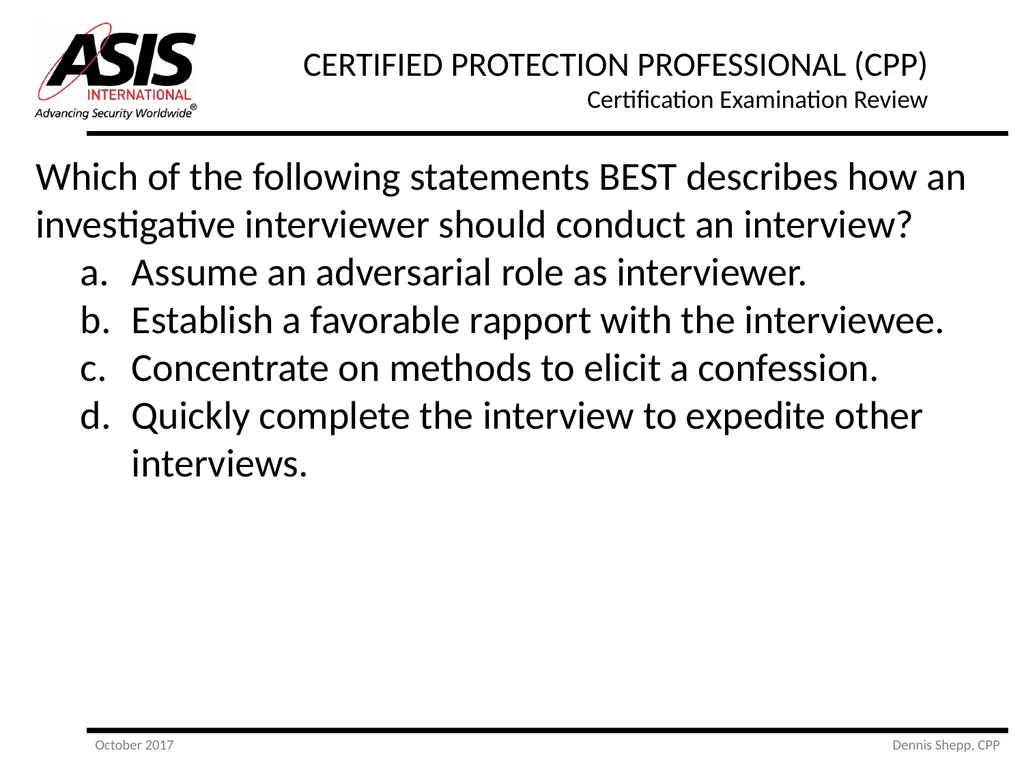
slide161. Which of the following statements BEST describes how an investigative interviewer should conduct an interview?
Assume an adversarial role as interviewer.
Establish a favorable rapport with the interviewee.
Concentrate on methods to elicit a confession.
Quickly complete the interview to expedite other interviews.<br>
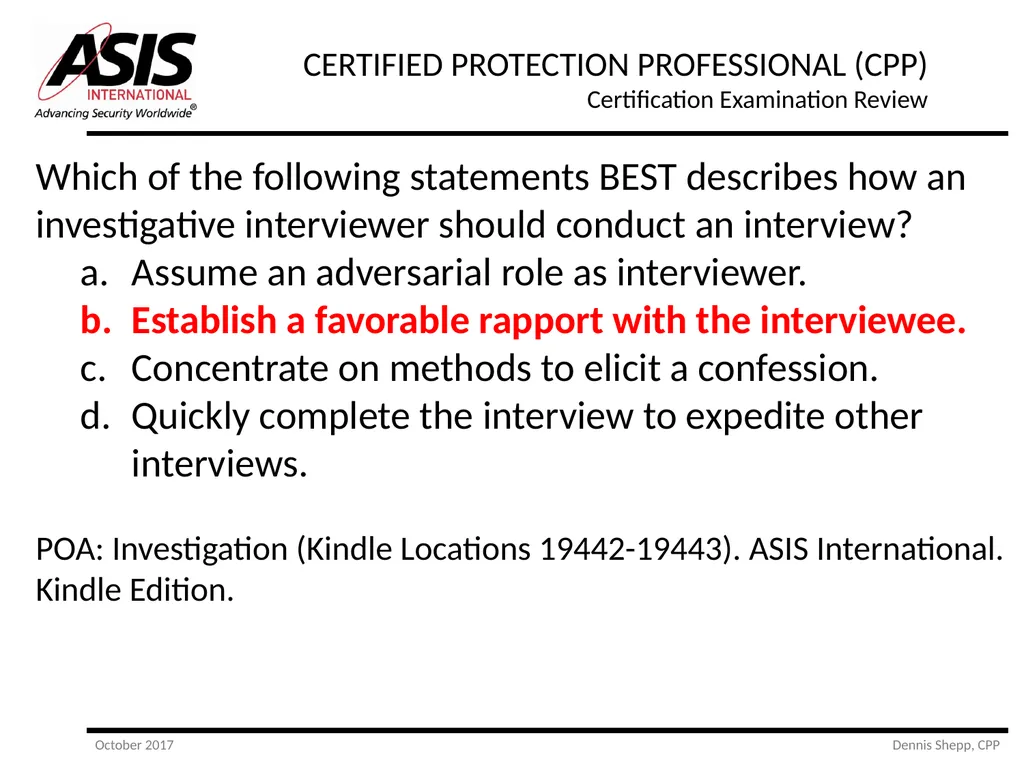
slide162. Which of the following statements BEST describes how an investigative interviewer should conduct an interview?
Assume an adversarial role as interviewer.
Establish a favorable rapport with the interviewee.
Concentrate on methods to elicit a confession.
Quickly complete the interview to expedite other interviews.
POA: Investigation (Kindle Locations 19442-19443). ASIS International. Kindle Edition.<br>
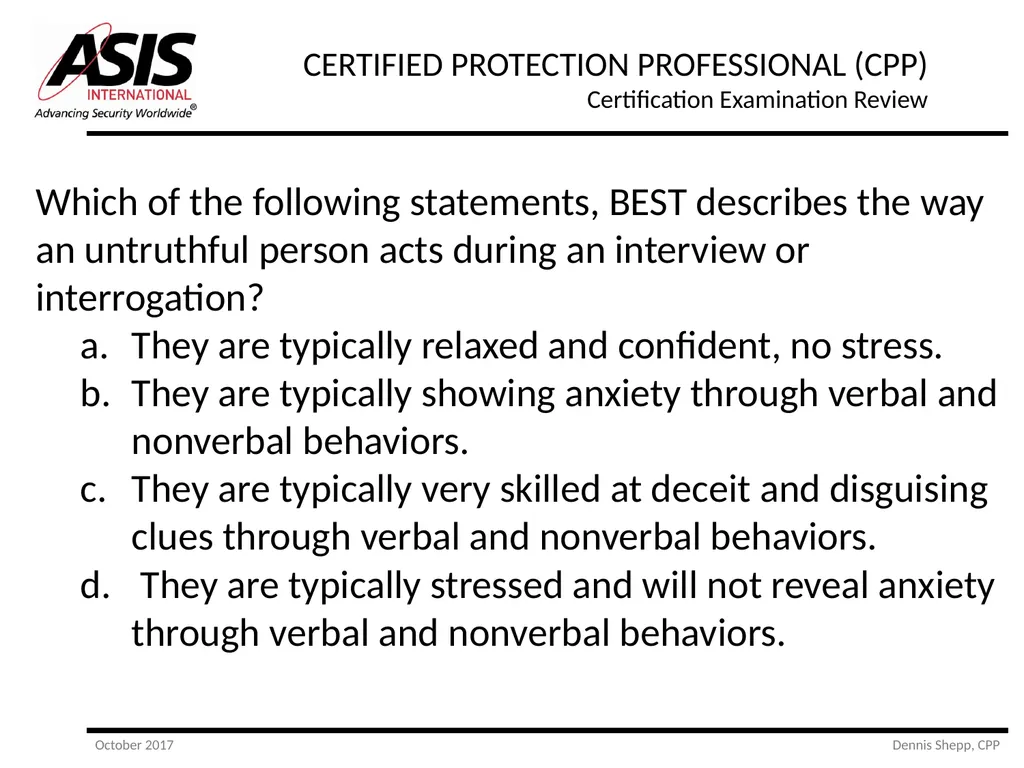
slide163. Which of the following statements, BEST describes the way an untruthful person acts during an interview or interrogation?
They are typically relaxed and confident, no stress.
They are typically showing anxiety through verbal and nonverbal behaviors.
They are typically very skilled at deceit and disguising clues through verbal and nonverbal behaviors.
They are typically stressed and will not reveal anxiety through verbal and nonverbal behaviors.<br>
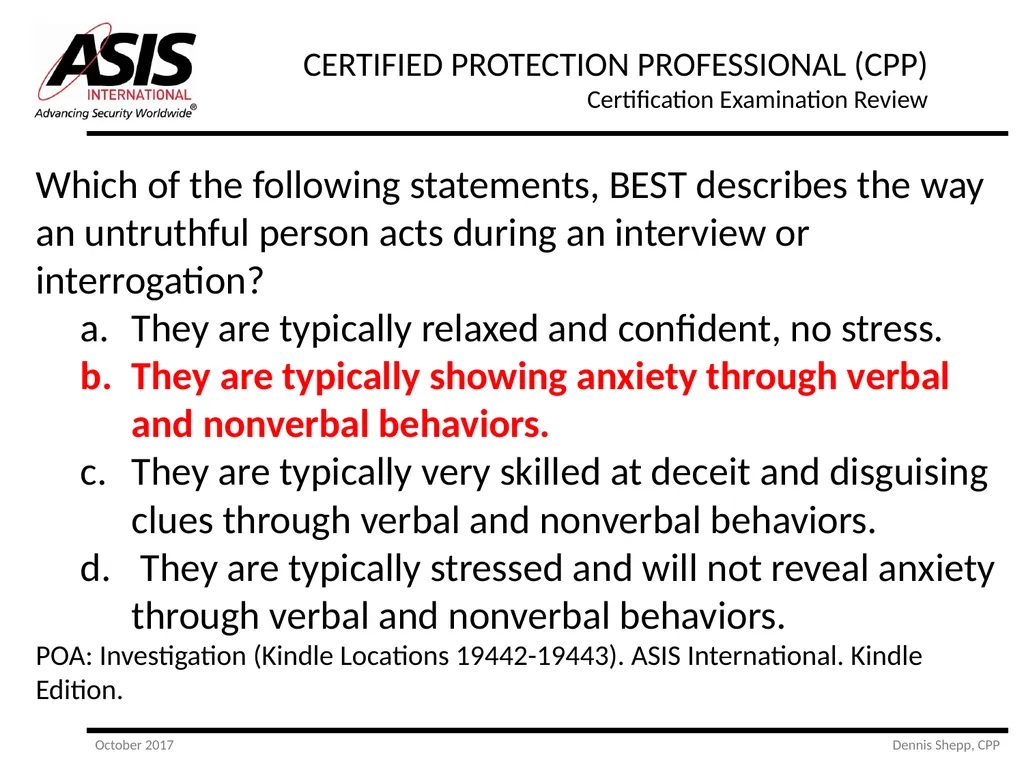
slide164. Which of the following statements, BEST describes the way an untruthful person acts during an interview or interrogation?
They are typically relaxed and confident, no stress.
They are typically showing anxiety through verbal and nonverbal behaviors.
They are typically very skilled at deceit and disguising clues through verbal and nonverbal behaviors.
They are typically stressed and will not reveal anxiety through verbal and nonverbal behaviors.
POA: Investigation (Kindle Locations 19442-19443). ASIS International. Kindle Edition.<br>
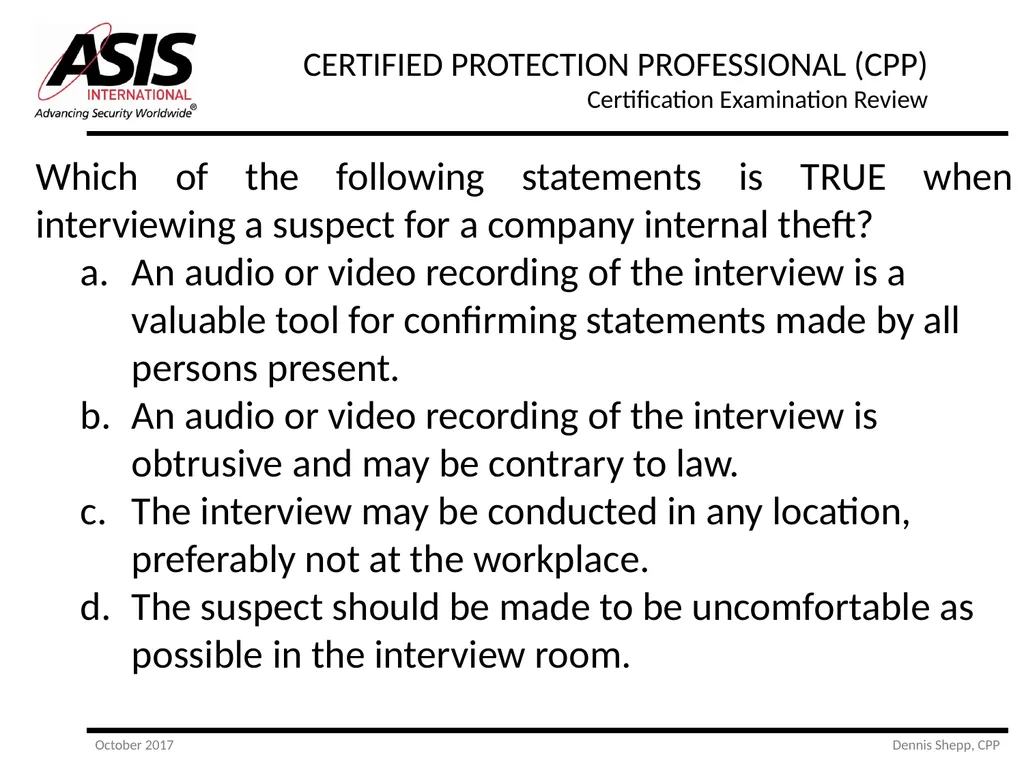
slide165. Which of the following statements is TRUE when interviewing a suspect for a company internal theft?
An audio or video recording of the interview is a valuable tool for confirming statements made by all persons present.
An audio or video recording of the interview is obtrusive and may be contrary to law.
The interview may be conducted in any location, preferably not at the workplace.
The suspect should be made to be uncomfortable as possible in the interview room.<br>
slide166. Which of the following statements is TRUE when interviewing a suspect for a company internal theft?
An audio or video recording of the interview is a valuable tool for confirming statements made by all persons present.
An audio or video recording of the interview is obtrusive and may be contrary to law.
The interview may be conducted in any location, preferably not at the workplace.
The suspect should be made to be uncomfortable as possible in the interview room.
POA: Investigation (Kindle Location 19573). ASIS International. Kindle Edition.<br>
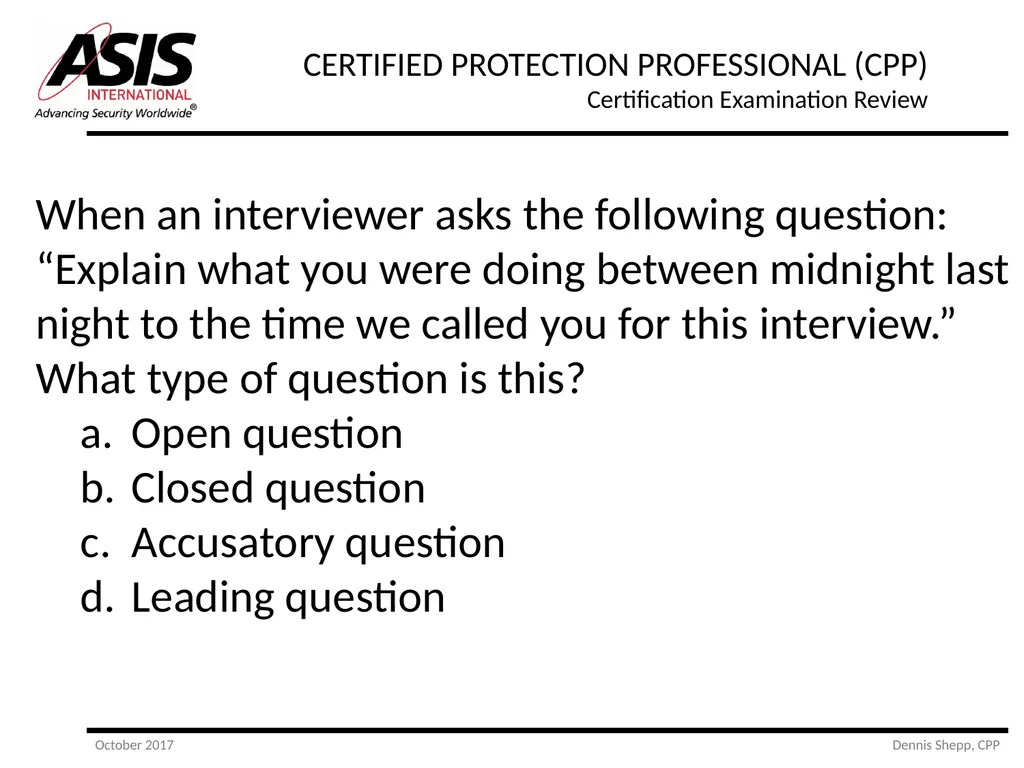
slide167. When an interviewer asks the following question: “Explain what you were doing between midnight last night to the time we called you for this interview.” What type of question is this?
Open question
Closed question
Accusatory question
Leading question<br>
slide168. When an interviewer asks the following question: “Explain what you were doing between midnight last night to the time we called you for this interview.” What type of question is this?
Open question
Closed question
Accusatory question
Leading question
POA: Investigation (Kindle Locations 19696). ASIS International. Kindle Edition.<br>
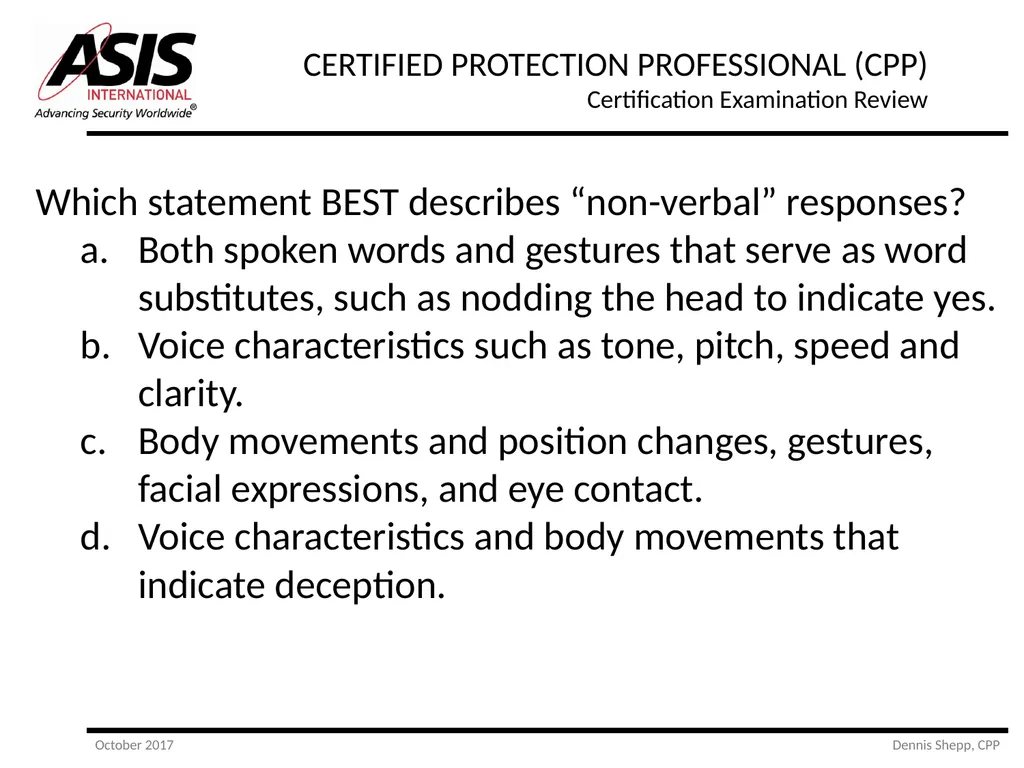
slide169. Which statement BEST describes “non-verbal” responses?
Both spoken words and gestures that serve as word substitutes, such as nodding the head to indicate yes.
Voice characteristics such as tone, pitch, speed and clarity.
Body movements and position changes, gestures, facial expressions, and eye contact.
Voice characteristics and body movements that indicate deception.<br>
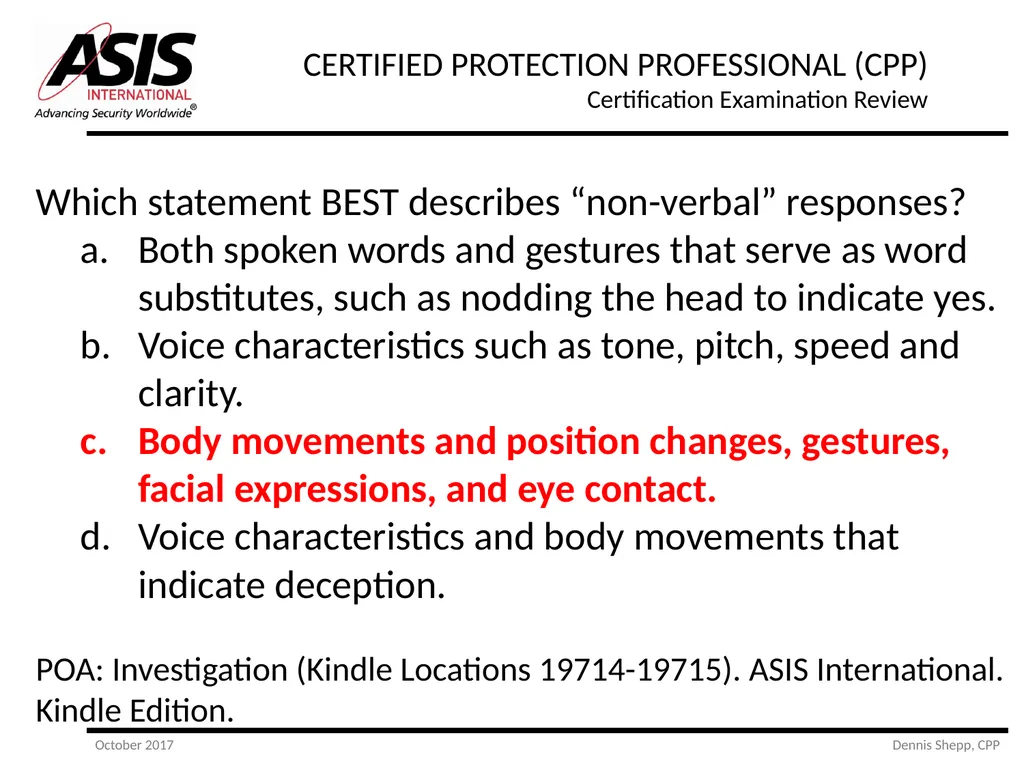
slide170. Which statement BEST describes “non-verbal” responses?
Both spoken words and gestures that serve as word substitutes, such as nodding the head to indicate yes.
Voice characteristics such as tone, pitch, speed and clarity.
Body movements and position changes, gestures, facial expressions, and eye contact.
Voice characteristics and body movements that indicate deception.
POA: Investigation (Kindle Locations 19714-19715). ASIS International. Kindle Edition.<br>
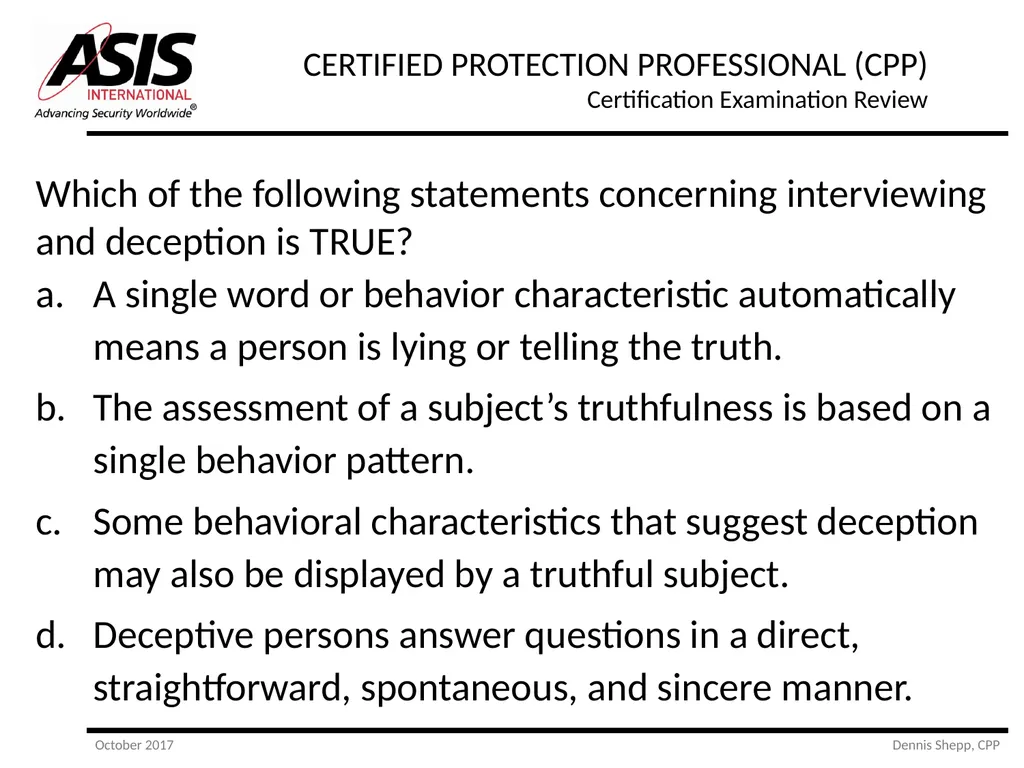
slide171. Which of the following statements concerning interviewing and deception is TRUE?
A single word or behavior characteristic automatically means a person is lying or telling the truth.
The assessment of a subject’s truthfulness is based on a single behavior pattern.
Some behavioral characteristics that suggest deception may also be displayed by a truthful subject.
Deceptive persons answer questions in a direct, straightforward, spontaneous, and sincere manner.<br>
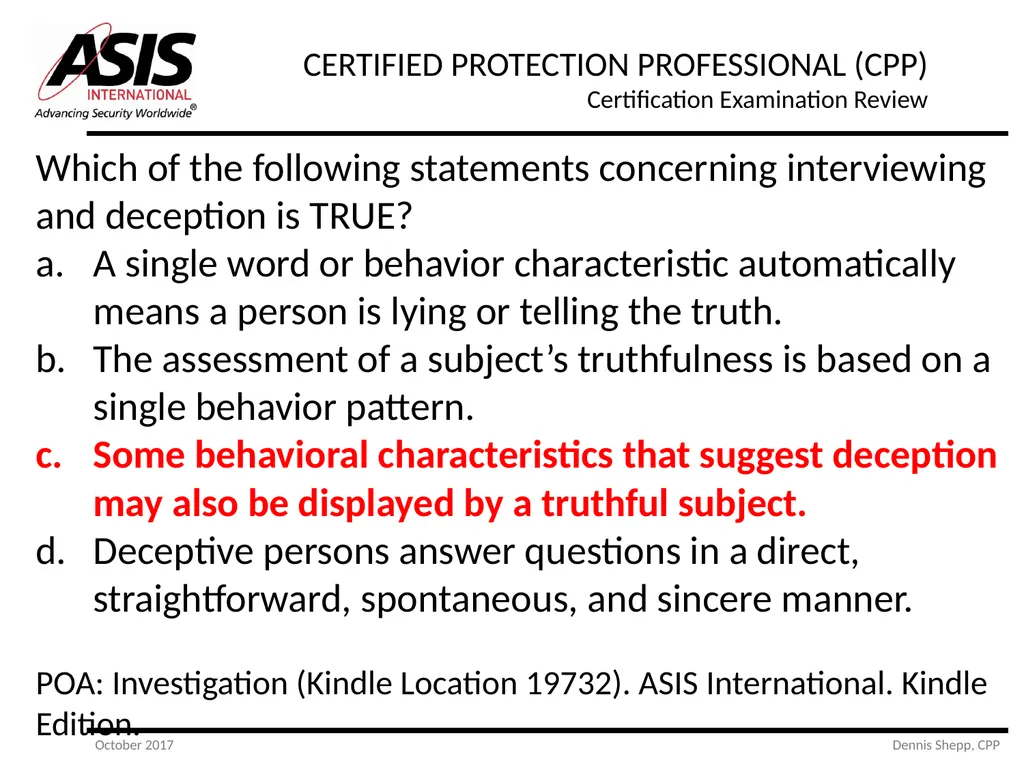
slide172. Which of the following statements concerning interviewing and deception is TRUE?
A single word or behavior characteristic automatically means a person is lying or telling the truth.
The assessment of a subject’s truthfulness is based on a single behavior pattern.
Some behavioral characteristics that suggest deception may also be displayed by a truthful subject.
Deceptive persons answer questions in a direct, straightforward, spontaneous, and sincere manner.
POA: Investigation (Kindle Location 19732). ASIS International. Kindle Edition.<br>
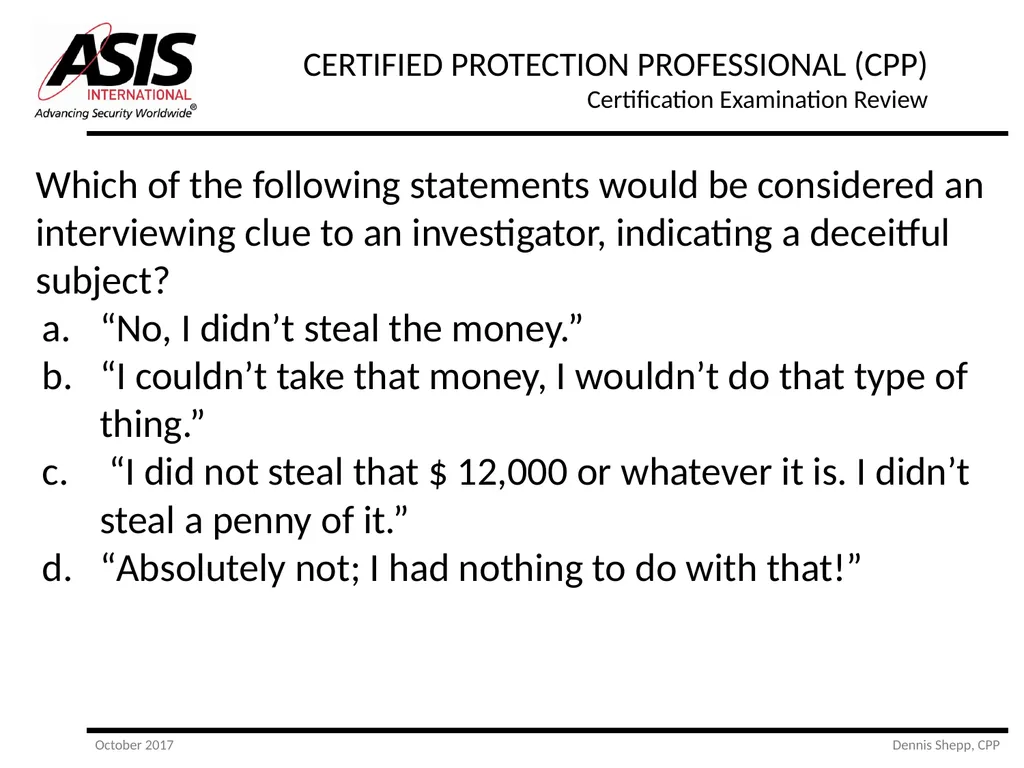
slide173. Which of the following statements would be considered an interviewing clue to an investigator, indicating a deceitful subject?
“No, I didn’t steal the money.”
“I couldn’t take that money, I wouldn’t do that type of thing.”
“I did not steal that $ 12,000 or whatever it is. I didn’t steal a penny of it.”
“Absolutely not; I had nothing to do with that!”<br>
slide174. Which of the following repeated statements would be considered an interviewing clue to an investigator, indicating a deceitful subject?
“No, I didn’t steal the money.”
“I couldn’t take that money, I wouldn’t do that type of thing.”
“I did not steal that $ 12,000 or whatever it is. I didn’t steal a penny of it.”
“Absolutely not; I had nothing to do with that!”
POA: Investigation (Kindle Locations 19779-19780). ASIS International. Kindle Edition.<br>
slide175. “A systematic evaluation of a subject’s verbal and nonverbal behavior during the course of a structured interview in which both investigative and behavior-provoking questions are asked.” BEST describes which of the following?
Statement analysis
Behavior analysis interview
Non confrontational interview
Fact-finding interview<br>
slide176. “A systematic evaluation of a subject’s verbal and nonverbal behavior during the course of a structured interview in which both investigative and behavior-provoking questions are asked.” BEST describes which of the following?
Statement analysis
Behavior analysis interview
Non confrontational interview
Fact-finding interview
POA: Investigation (Kindle Locations 19829-19830). ASIS International. Kindle Edition.<br>
slide177. Dennis Shepp, CPP October 2017 3 DOMAIN<br>
Certification Examination Review Dennis Shepp, CPP October 2017<br>
slide2. Crisis Management Information Security Physical Security Personnel Security – Investigations Business Principles & Practices Security Principles & Practices DOMAIN 1 – Security Principles & Practices (21%)
DOMAIN 2 – Business Principles & Practices (13%)
DOMAIN 3 – Investigations (10%)
DOMAIN 4 – Personnel Security (12%)
DOMAIN 5 – Physical Security (25%)
DOMAIN 6 – Information Security (9%)
DOMAIN 7 – Crisis Management (10%) SUBJECTS
(DOMAINS) CERTIFIED PROTECTION PROFESSIONAL (CPP)
Certification Examination Review<br>
slide3. CERTIFIED PROTECTION PROFESSIONAL (CPP)
Certification Examination Review Dennis Shepp, CPP October 2017 3 DOMAIN<br>
slide4. Task 03/01 Identify, develop, implement, and manage investigative functions
Task 03/02 Manage or conduct the collection and preservation of evidence to support investigation actions
Task 03/03 Manage or conduct surveillance processes
Task 03/04 Manage and conduct investigations requiring specialized tools, techniques, and resources<br>
slide5. Task 03/05 Manage or conduct investigative interviews
Task 03/06 Provide coordination, assistance, and evidence such as documentation and testimony to support legal counsel in actual or potential criminal and/or civil proceedings<br>
slide6. Task 03/01 Identify, develop, implement, and manage investigative functions<br>
slide7. 03/01/01 Principles and techniques of policy and procedure development
03/01/02 Organizational objectives and cross-functional collaboration
03/01/03 Types of investigations (for example, incident, misconduct, compliance)
03/01/04 Internal and external resources to support investigative functions
03/01/05 Report preparation for internal purposes and legal proceedings
03/01/06 Laws pertaining to developing and managing investigative programs<br>
slide8. Task 03/01 Identify, develop, implement, and manage investigative functions Knowledge of:
03/01/01 Principles and techniques of policy and procedure development<br>
slide9. Definition of investigation – “a systematic and thorough examination or inquiry into something or someone (the collection of facts and information) and the recording of that examination in a report.”
Applies to private & public sector
CHAPTER 1.1 THE NATURE OF INVESTIGATION MANAGEMENT; POA: Investigation (Kindle Locations 15904).<br>
slide10. Investigation purposes:
Documenting incidents
Identifying incident cause
Documenting facts surrounding situation/incident
Identifying suspects
Proving or disproving allegations
Allowing a decision – trust, suitability determination
CHAPTER 1.1 THE NATURE OF INVESTIGATION MANAGEMENT; POA: Investigation (Kindle Locations 15904).<br>
slide11. 5-qualities of effective & reliable investigation:
Objectivity
Thoroughness
Relevance
Accuracy
Timeliness
Investigative process – science & art
CHAPTER 1.1.1 THE QUALITIES OF AN EFFECTIVE INVESTIGATION; POA: Investigation (Kindle Locations 15928-15929).<br>
slide12. Objectivity
Objective & focused on using rational investigative hypothesis
Avoiding subjective, prejudgement
Corroboration of evidence is important
Allow facts to “speak for itself”
Investigator:
Recognize & control personal prejudices
Project air of objectivity
CHAPTER 1.1.1 THE QUALITIES OF AN EFFECTIVE INVESTIGATION; POA: Investigation (Kindle Locations 15942-15948)<br>
slide13. Thoroughness
Checking all leads more than once to ensure consistency
Follow all relevant leads to logical conclusion – corroborate facts using different sources
Sources – interviewees, witnesses, SMEs, physical evidence, electronic evidence, public records, surveillance, open sources, documents, databases, etc.
CHAPTER 1.1.1 THE QUALITIES OF AN EFFECTIVE INVESTIGATION; POA: Investigation (Kindle Locations 15942-15948)<br>
slide14. Relevance
Collecting adequate range & depth of details – not too much!
Collected information relates to the subject of investigation in appropriate detail – how deep to dig!
Skilled investigators can guide interviews to proper depth of detail
Cause & effect relationships can impact relevance
CHAPTER 1.1.1 THE QUALITIES OF AN EFFECTIVE INVESTIGATION; POA: Investigation (Kindle Locations 15942-15948).<br>
slide15. Accuracy
Credibility of a source (human, physical, electronic) evidence
Are eyewitness accounts accurate?
Depending on human memory – have accuracy & reliability issues.
Sound techniques call for verification (corroboration) of eyewitness accounts
CHAPTER 1.1.1 THE QUALITIES OF AN EFFECTIVE INVESTIGATION; POA: Investigation (Kindle Locations 15977-16011.<br>
slide16. Timeliness
Ability to complete an investigation quickly (not too quickly) – timely – avoid pressures to rush.
Open the case ASAP
Complete the investigation ASAP
Avoid closing the investigation prematurely
Timeliness important due to memory accuracy
Quick & decisive investigations reflect professionalism of investigative personnel
CHAPTER 1.1.1 THE QUALITIES OF AN EFFECTIVE INVESTIGATION; POA: Investigation (Kindle Locations 16011-1620).<br>
slide17. Functional Charters and Policy Statements
Gives investigative unit (IU) its credibility & authority
A functional charter issued by the CEO or equivalent
States the purpose and direction of IU (goals)
Defines:
Who responsible
Nature & primary function
Internal relationships
CHAPTER 1.3.3 ESTABLISHING AN INVESTIGATIVE UNIT; POA: Investigation (Kindle Locations 16323-16324).<br>
slide18. Functional Charters and Policy Statements (continued)
A policy statement outlines procedures for initiating & conducting investigations, and it addresses reporting channels, coordination mechanisms, and disposition.
Applies to other departments too – how to initiate investigations, etc.
Objectives - includes performance metrics and targets for areas of improvement over the subsequent period.
Revised frequent (usually annual) basis (unlike functional charter and policy statement)
CHAPTER 1.3.3 ESTABLISHING AN INVESTIGATIVE UNIT; POA: Investigation (Kindle Locations 16327-16332).<br>
slide19. Investigation Life Cycle INITIATION/SOURCE Need for Level of Trust Incident Allegation Situation Incident Report Complaint Audit / Discrepancy Known or Unknown Subject Request for Investigation INVESTIGATION Criminal Investigation
Administrative Inquiry
Misconduct Investigation
Incident Investigation
Compliance Investigation Background
Due Diligence
Financial / Lifestyle REPORTING Report of Investigation Retention and/or Database Retention and/or Database Trend Analysis
Statistical Report
Program Mgmt Evaluation
Strategic Planning
Resource Allocation
Criminal Intelligence RESULTS / FOLLOWUP Access Authorization
Visit Requests
Concurred Clearances
Corporate Decisions
Reinvestigation Alert Action / Case Disposition Adjudication / Determination Figure 1-4 . POA: Investigation (Kindle Location 16564). ASIS International. Kindle Edition.<br>
slide20. IU manager responsible for designing & implementing systems to manage the activity within the investigative life cycle.
A case file should be established for each investigation.
Case file:
Complaint form (initiation mechanism)
Case/file number
Names of assigned investigators
Complain or subject information
Initial leads
Document of management approval
CHAPTER 1.3.7 CASE MANAGEMENT; POA: Investigation (Kindle Locations 16573-16574, 16689).<br>
slide21. Opening a case file:
Assign case / file number
Entry into case management system
Notification to management
Staff coordination
Efforts to corroborate initial information
Case type or category
Location of precipitating incident
Value of loss
Assigned investigators
CHAPTER 1.3.7 CASE MANAGEMENT; POA: Investigation (Kindle Locations 16692-16695)..<br>
slide22. Opening a case file (continued):
Date opened (and location opened if applicable)
Due date for a report or other action dates of any interim reports
Date of the final or closing report
Value of assets recovered
Policies & procedures:
Case review (by IU management)
File storage (defining access, storage terms, etc)
Reporting distribution
Logging investigative activities (surveillance, notes, etc)
CHAPTER 1.3.7 CASE MANAGEMENT; POA: Investigation (Kindle Locations 16701-16709).<br>
slide23. Required records:
Incident Investigation and disposition
Internal and external complain & grievance procedures (9.2.6 ORMS)
Continual improvement (investigating nonconformities, corrective & preventive)
OHS Investigations (A.9.5.6 ORMS)
ASIS/ANSI ORMS Security and Resilience in Organizations and Their Supply Chains (2017) 8.6.2, 9.2.6, 9.5.4, 11.2.c, A.9.5.6, pages 22, 26, 36, 76<br>
slide24. Task 03/01 Identify, develop, implement, and manage investigative functions Knowledge of:
03/01/02 Organizational objectives and cross-functional collaboration<br>
slide25. Objectives of Corporate Investigations:
Thoroughly documenting incidents.
Identifying the cause of undesirable situations (notable losses, sudden decrease in income or market share, unexplained shrinkage, inventory discrepancies, defalcation {failure to properly account for money held in a fiduciary capacity}, etc.)
Documenting and correlating facts surrounding any situation or allegation
Identifying suspects
CHAPTER 1 INVESTIGATIVE MANAGEMENT; POA: Investigation (Kindle Locations 15912-15917).<br>
slide26. Objectives of Corporate Investigations (continued):
Compiling information that proves or disproves an allegation or that implicates or exonerates an individual suspected of committing a crime or misconduct
Allowing a decision to be made, often with respect to a level of trust or suitability determination, regarding an individual (e.g., in a personnel security clearance) or an organization (e.g., a potential partner firm or acquisition target)
CHAPTER 1 INVESTIGATIVE MANAGEMENT; POA: Investigation (Kindle Locations 15912-15920).<br>
slide27. Objectives of Corporate Investigations (continued):
What is the focus? (HR support, Security, Audit, ?)
IU placement in an organization (Security, Audit, HR, ?)
Reporting lines?
Use of internal & external resources
Outsourcing (specialized cases or ALL cases)
Reasons:
Cost benefit
Prefer independence
Expertise
CHAPTER 1 INVESTIGATIVE MANAGEMENT; POA: Investigation (Kindle Locations 15912-16256).<br>
slide28. Objectives of Corporate Investigations (continued):
Goals and objectives are critical to investigative functions
Goals articulate long-term and overarching end states
May be stated in general terms
Goals should be consistent with the parent organization’s strategic direction
Incorporated into the IU’s mission statement
CHAPTER 1 INVESTIGATIVE MANAGEMENT; POA: Investigation (Kindle Locations 16109-16111).<br>
slide29. Objectives of Corporate Investigations (continued):
Objectives are based on the goals - more specific & may be more short-lived
Generally measurable & used to gauge the progress, success, or achievement of a unit.
SMART goals also known as metrics
Metrics used to evaluate the performance of individuals, teams, and organizations
Investigative strategies developed must be compatible with the organization’s overall strategic business plan
CHAPTER 1 INVESTIGATIVE MANAGEMENT; POA: Investigation (Kindle Locations 16109-16115).<br>
slide30. The principal resources of an IU:
People
Information
Credibility
Physical assets
Financial assets.
Collaboration with other internal departments necessary:
Facilities, Security, Safety, Legal, HR, Risk
Joint Task Forces (JTFs)
CHAPTER 1.3.5 INVESTIGATIVE RESOURCES; POA: Investigation (Kindle Locations 16542). ASIS International. Kindle Edition.<br>
slide31. Collaboration using JTFs
Diversity of members in a task force introduces many benefits, but it can also lead to misunderstanding, conflict, and inefficiencies
Issues: parochialism (close-minded), protection of sensitive information, data management, and reporting chains.
Organizational liaison (internal & external)
CHAPTER 1.3.5 INVESTIGATIVE RESOURCES; POA: Investigation (Kindle Locations 17355-17358). ASIS International. Kindle Edition.<br>
slide32. Task 03/01 Identify, develop, implement, and manage investigative functions<br>
slide33. 1.4 TYPES OF INVESTIGATIONS, POA: Investigations, (page 50)
Incident investigations
Misconduct
Internal company investigations – policy/legal violations
Compliance
Equal Opportunity, harassment, workplace safety,
Undercover (page 91)
Background (page 159)
1.3.4 INVESTIGATIVE FUNCTIONS . POA: Investigation (Kindle Locations 16502-16503; page 50)
Incident investigations Task 3.1.3 Identify, develop, implement, and manage investigative functions describing the types of investigations (for example, incident, misconduct, compliance).<br>
slide34. This is the most common type of investigation in many business and organizational settings.
Detailed, direct procedural guidance is recommended for incident investigations.
Operational Supervisory level – under $1000, Simple assault, Safety hazard, Vehicle accident, Property damage or vandalism (estimated loss ≤ $ 1000), Unsecured area
IU investigators handle excess of $1000 - Theft (estimated loss > $ 1000), Unknown loss (estimated loss > $ 1000), Aggravated assault, Property damage or vandalism (estimated loss > $ 1000), Employee misconduct, Executive misconduct Workplace violence (actual or potential), Sexual harassment Sexual assault Proprietary information loss, Fraud…<br>
slide35. …Contract irregularities Unsecured area or forced entry.
Each enterprise should establish its own loss thresholds to determine investigation parameters.
The same facts to establish a crime, civil action tort or other actionable civil misconduct.
1.4.2 MISCONDUCT INVESTIGATIONS
Internal investigation conducted when an employee or other individual affiliated with the organization suspected of violating a written corporate policy, a directive, terms of employment, or a federal, state, or local law
Exposes employer to legal action by employees or former employees who feel they have been treated unfairly (discrimination, wrongful termination, sexual harassment, defamation, and false arrest)<br>
slide36. Types of misconduct are conflict of interest, corporate resource abuse, employee theft, workplace violence, and substance abuse.
Important: management make corporate policy clear & “ensure that no employee or manager can plausibly claim not to have been well informed of its meaning and consequences.”
1.4.3 COMPLIANCE INVESTIGATIONS
Protect the organization against violations of law, lapses in business ethics, and concomitant legal sanctions.
An effective program encourages enforcement, monitoring, and employee training<br>
slide37. Covers - equal employment opportunity, harassment workplace, safety, confidential/proprietary information, copyright, patent, and trademark, company property and records, computing systems, information access, and authorized uses conflict of interest, government entities, antitrust violations, political activities and lobbying securities requirements from various jurisdictions, regulatory violations
Compliance issues may harm the company’s bottom line, it is important that employees be trained so they can immediately identify when a violation has occurred and know to whom to report the issue<br>
slide38. A key element of any compliance program is an effective employee reporting program.
A consolidated hot line with well-trained and professional operators, combined with an effective system for distribution and follow-up, can result in high-quality, valid, and useful reporting.<br>
slide39. 1.3.5 INVESTIGATIVE RESOURCES POA Investigations page 42
The principal resources of an IU are people, information, credibility, physical assets, and financial assets.
Internal resources: cross-functional - Legal services, HR, Finance, Safety, security, operations, supervisors, managers, other employees, public relations (media relations), IT, purchasing.
External: police, public sources, fire department, military, visitors, guests, associations, SMEs, Utility services, contract investigations/services
Costs for personnel and outside services generally represent the largest budget items for an IU. Task 3.1.4 Identify, develop, implement, and manage investigative functions describing the internal and external resources to support investigative functions.<br>
slide41. 1.7.1 REPORT WRITING . POA Investigations pges 74-75
Gather facts – organize – report
Initial report - w/n few days of opening, confirmation of investigation
Progress/Update report – updates progress
Special report – stems from the progress report – reports outside from normal information
Final report – meant to close case
Administrative information (name of the subject of the case, case or file number, type of case (if not identified by the case or file number), status of the case (open or closed), reporting investigator date of the report. Task 3.1.5 Identify, develop, implement, and manage investigative functions describing the report preparation for internal purposes and legal proceedings.<br>
slide42. Summary – executive summary, every major point covered by the report requires at least one sentence in the synopsis.
Narrative – detailed outline of activities, each step in the investigation should be covered in a separate paragraph, should be clear, simple, and brief, vocabulary should be easily understood, avoid technical terms (or explained)
Conclusion – caution about recommendations – investigator is the collector of facts.
Enclosures – initial complaint, documents, reports, evidence analysis reports, photos, statements, surveillance logs.<br>
slide43. Enclosures – initial complaint, documents, reports, evidence analysis reports, photos, statements, surveillance logs.
An IU can be compelled to release its report and other files to outside parties and the opposing party.
A report might be subject to “privilege” or protection from external access – consult legal counsel.<br>
slide44. POA: Legal Issues, CHAPTER 1 Security & Labor Relations page 26) (Kindle Location 19960)
Uniformed security officer/investigator clearly an agent of the employer, insofar as duties relating to the employer.
POA: Investigation CHAPTER 5.10 GENERAL LEGAL ASPECTS Interviewers should have a clear understanding of the legal requirements regarding interviews in the jurisdiction in which they work.
A confession/sworn statement must be competent, material, relevant, and obtained voluntarily under legally acceptable circumstances = to be admissible. Task 3.1.6 Identify, develop, implement, and manage investigative functions describing the laws pertaining to developing and managing investigative programs.<br>
slide45. POA: Investigation CHAPTER 5.10 GENERAL LEGAL ASPECTS (Kindle Location 19960).
The interviewer should avoid making any promise or guarantee, explicit or implied, that is illegal, that cannot be confirmed by the client or senior management, or that cannot be fulfilled.
An interviewee may ask for an opinion as to the outcome of the matter under investigation. The investigator usually cannot guarantee a specific outcome and, in fact, should not be in a position to do so.
The function of the investigator is to gather the facts.
Any coercion, duress, or psychological constraint placed on the interviewee is unacceptable and may make a confession inadmissible.<br>
slide46. Interviewees must understand that they are free to leave the interview location. An indication, expressed or implied, that the interviewee is not free to leave creates the conditions for allegations of false imprisonment.
The interviewee must consent to the interview and to making any statement. The consent must be fully voluntary and cannot be coerced in any manner.
The interviewee must be legally competent to give consent.
The interviewee must have access to restroom facilities at reasonable intervals and especially on request.<br>
slide47. The interviewee must have access to restroom facilities at reasonable intervals and especially on request.
All interviews and interrogations should be conducted in such a manner that they can withstand the scrutiny of judicial review.
What is a fact? “A piece of information used as evidence or as part of a report.”<br>
slide48. Task 03/02 Manage or conduct the collection and preservation of evidence to support investigation actions<br>
slide49. Knowledge of:
03/02/01 Evidence collection techniques
03/02/02 Protection/preservation of crime scene
03/02/03 Requirements of chain of custody
03/02/04 Methods for preservation of evidence
03/02/05 Laws pertaining to the collection and preservation of evidence<br>
slide50. POA: Investigations CHAPTER 1.5.3 EVIDENCE COLLECTION AND HANDLING (page 61)
Physical, technical, and other forms of evidence can be absolutely critical to case resolution and resultant action determinations (judicial, administrative, etc.) in all investigative settings.
Proper procedures in gathering, protecting, examining, storing, and presenting evidence are crucial to the successful resolution of a case. Task 3.2.1 Manage or conduct the collection and preservation of evidence to support investigation actions describing evidence collection techniques.<br>
slide51. POA: Legal, CHAPTER 9.0 EVIDENCE Page 229
“Evidence is that which provides proof or an indication of an assertion.”
Even if the evidence will not be used in a criminal case, handle it according to that standard.
Evidence is oral, documentary, and physical.
All evidence must be collected legally
2 basic categories: direct (real) and indirect (circumstantial and hearsay).
Direct evidence is first-hand knowledge. For example, if a witness sees a driver in an automobile pass through a red light and strike another automobile, that witness has direct evidence of the incident.<br>
slide52. Indirect evidence is a highly informed inference. For example, perhaps a witness was around the corner, heard a screech of brakes and then the impact of two cars, ran to the scene, and saw the damaged vehicles. That witness did not directly witness the collision – but infers what occurred.
Also known as circumstantial evidence where something is inferred to have happened because testimony given on a series of events leads one to believe that it happened.
Hearsay evidence is normally not admissible in a trial. The rule that applies most often in determining the importance of evidence and its ability to prove a point is called materiality.<br>
slide53. Collection – 3-P’s:
Principle – policy – procedure<br>
slide54. POA: Legal Issues CHAPTER 9.3.1 EVIDENCE SEARCHES (Kindle Locations 13482-13484), page 51
Protect the scene – perimeter designation – perimeter tape, barriers, barricades
Do not handle evidence unless collecting
Take notes and log the collection, location and details of collected evidence
Secure and Protect the Scene:
Take control of the scene immediately.
Determine the extent to which the scene has been protected. Task 3.2.2 Manage or conduct the collection and preservation of evidence to support investigation actions describing the protection/preservation of crime scene.<br>
slide55. Obtain information from personnel who have knowledge of its original condition.
A crime scene investigation is an example of a reactive measure.
The collection, handling, processing, and use of evidence is a key component of investigation. (protecting crime scene)
Proper procedures in gathering, protecting, examining, storing, and presenting evidence are crucial to the successful resolution of a case.<br>
slide56. Evidence tasks can be tedious and resource-intensive (including the possible consumption of a large amount of secure storage space).
Physical, technical, and other forms of evidence can be absolutely critical to case resolution and resultant action determinations (judicial, administrative, etc.) in all investigative settings.<br>
slide57. POA Legal Issues Chapter 9.0 EVIDENCE pages 230-245) and POA: Investigation; CHAPTER 1.5.3 EVIDENCE COLLECTION AND HANDLING
How to seize physical evidence and preserve the chain of custody before analysis and court
Must be marked, time/date stamped at time of collection
Properly preserved – type of bagging, refrigeration, storage, etc.
After an incident, security practitioners should gather evidence carefully, regardless of whether law enforcement will become involved. Task 3.2.3 Manage or conduct the collection and preservation of evidence to support investigation actions describing the requirements of chain of custody.<br>
slide58. Such evidence can be used to resolve the issue, analyze how the incident occurred, and if necessary modify security measures to prevent future incidents.
POA Legal Issues Chapter 9 EVIDENCE (pages 230-245)
Chain of custody (the uninterrupted control of evidence) must be clearly shown
The evidence must be properly identified, and it must be relevant to the case before the court.
Evidence should be marked at the time it is gathered.
Limiting the individuals who handle the evidence to the smallest number possible and properly documenting each transfer will maintain the chain of custody and assist the prosecution when introducing evidence in a legal proceeding.<br>
slide59. POA: Investigation 1.5.3 EVIDENCE COLLECTION AND HANDLING;
Evidence storage:
Type – long, short term or temporary?
Restricted access – only those who entitled
Types of containers, room, requirements,
Protection from unauthorized entry (intrusion detection, access control,)
Evidence Collection and Handling
Develop policies and procedures Task 3.2.4 Manage or conduct the collection and preservation of evidence to support investigation actions describing the methods for preservation of evidence.<br>
slide60. Task 03/03 Manage or conduct surveillance processes<br>
slide61. Knowledge of:
03/03/01 Surveillance techniques
03/03/02 Technology/equipment and personnel to conduct surveillance
03/03/03 Laws pertaining to managing surveillance processes<br>
slide62. POA: Legal Issues, pge 101)
Governed in USA by State
RECOMMEND CONSULTING WITH LEGAL COUNSEL
Organization should implement organizational policies and procedures for how IU conducts & manages surveillance ops.
Differs by country and individual State
ASIS Investigation Guideline 5.5.22
Follow local laws and right to privacy in local jurisdiction Task 3.3.3. Manage or conduct the collection and preservation of evidence to support investigation actions, describing the laws pertaining to managing surveillance processes.<br>
slide63. POA: Investigation CHAPTER 4.8.4 DATA ANALYSIS pages 175-176
When all investigative results & data is obtained – data analysis may begin
CHAPTER 2.9 THE COST OF UNDERCOVER OPERATIONS
Successful undercover investigations are expensive.
Size, scope and nature of problem will determine the budget.
CHAPTER 1.3.5 INVESTIGATIVE RESOURCES
Investigative funding is difficult to project because they can be drastically affected by one or a few major cases or new regulatory requirements. Task 3.3.1 Manage or conduct surveillance processes explaining surveillance techniques.<br>
slide64. Justifying investigative budget requests is a daunting task.
One of the best ways to help achieve a favorable budget request is to show value to the organization or to demonstrate that the unit pays for itself.
How to gain budgetary support:
Proper investigative focus to support the organizational mission as well as strategic and business goals.
Accurate and detailed tracking of investigative costs
Effective implementation of cost management and efficiency measures
Demonstration of restitution and recovery benefits
Quantitative estimation of risk avoidance in monetary terms<br>
slide65. Carefully tracking and managing operational and overhead costs can significantly improve the response to funding requests.
Costs can be tracked by case type, location, business unit, or other variable.
Recoveries and restitution figures should be tracked and reported to senior management to help demonstrate a financial benefit to the organization and support return on investment (ROI) arguments.
IUs can demonstrate ROI through civil recovery efforts, recovering not only the losses but also the related investigative costs.<br>
slide66. Costs for personnel and outside services generally represent the largest budget items for an IU.
Overhead costs are often the easiest to control.
IU managers should leverage the use of liaison contacts and other organizational departments (such as IT, facilities, accounting and finance, legal, and risk management) to conserve financial resources.<br>
slide67. POA: Investigation; CHAPTER 4.9 Technology in Investigations
Technology is improving how information is gathered and disseminated throughout the enterprise.
Technological improvements can make a time-consuming and sometimes tedious process simpler and help ensure that employment information is collected, protected, and shared in an efficient and secure manner.
A key investigative tool, surveillance can be broken down into three broad categories:
Physical (i.e., human observation or tracking) Task 3.3.2 Manage or conduct surveillance processes explaining the technology/equipment and personnel to conduct surveillance..<br>
slide68. Psychological (i.e., behavioral analysis)
Data (e.g., technical or electronic). 1.6.1 Technical Surveillance Countermeasures POA: Physical Security
Technical surveillance countermeasures (TSCM) are services, equipment, and techniques designed to locate, identify, and neutralize technical surveillance activities (electronic eavesdropping).
TSCM should be part of an organization’s overall protection strategy.
Regular inspection of telecommunications equipment, cables, and terminals using equipment, methods, and personnel capable of detecting current threats.
Most effective is a layered approach that integrates physical, procedural, and logical protection measures.<br>
slide69. Task 03/04 Manage and conduct investigations requiring specialized tools, techniques, and resources<br>
slide70. Knowledge of:
03/04/01 Techniques, tools and resources related to:
financial and fraud related crimes
intellectual property and industrial espionage crimes
arson and property crimes
cybercrimes<br>
slide71. POA: Investigation; CHAPTER 1.5.2 RECORDS AND DATABASE CHECKS
Records and database checks represent a key element of almost any investigation.
The core of any investigation is information.
Anything that significantly improves the speed and efficiency of information gathering, collation, analysis, or organization is an important force multiplier (Databases; collaboration tools; automated analysis tools; information on vendors (experts, laboratories, etc.)
Established caller “Hotlines” for frauds
Certified Fraud Examiners (experts & forensic investigators) Task 3.4.1 Manage and conduct investigations requiring specialized tools, techniques, and resources for financial and fraud related crimes.<br>
slide72. ASIS Information & Asset Protection Guideline, 05-2007, 12.9 Investigating loss or Compromise, page 15 Task 3.4.1 Manage and conduct investigations requiring specialized tools, techniques, and resources for intellectual property and espionage crimes<br>
slide73. ASIS Information & Asset Protection Guideline, 05-2007, 12.9 Investigating loss or Compromise, page 15<br>
slide74. POA: Investigations; CHAPTER 1.5.3 Detecting Drugs, Explosives and Accelerants,
Accelerant detection dogs can be used to search fire scenes, equipment, vehicles, and crowds.
The mobility & keen sense of smell a K9 possesses can significantly reduce the time required for the fire investigation.
Forensic investigators to detect chemicals.
CCV can provide valuable evidence for investigation property crimes. Task 3.4.1 Manage and conduct investigations requiring specialized tools, techniques, and resources for arson and property crimes<br>
slide75. POA; Information Security, CHAPTER 2.6 CYBERCRIME: A NATIONAL CHALLENGE
Cybercrime— the use of information systems to commit crime. Task 3.4.1 Manage and conduct investigations requiring specialized tools, techniques, and resources for cybercrimes<br>
slide76. Task 03/05 Manage or conduct investigative interviews<br>
slide77. Knowledge of:
03/05/01 Methods and techniques of eliciting information
03/05/02 Techniques for detecting deception
03/05/03 The nature of non-verbal communication and cultural considerations
03/05/04 Rights of interviewees
03/05/05 Required components of written statements
03/05/06 Laws pertaining to managing investigative interviews<br>
slide78. POA: Investigation CHAPTER 1.5.1 INTERVIEWING AND INTERROGATION (Kindle Location 17143)
The success of an investigator is sometimes measured by his or her ability to interview or interrogate people.
Techniques can be learned, the skill required to be a successful investigator may take years to develop.
POA: Investigation CHAPTER 5.0 INTERVIEW AND INTERROGATION
The purpose of an investigation is to determine the truth in a matter under question. Task 3.5.1 & 3.5.2 Manage or conduct investigative interviews describing methods and techniques of eliciting information and techniques for detecting deception<br>
slide79. Three tools investigator uses (3-I’s): information, interrogation, and instrumentation.
Primary source of information - victims, witnesses, informants and confidential informants are considered the most critical aspect of an investigation (cost-effectively & on-time).
The value of each interview or interrogation is based on the investigator’s knowledge, skills in eliciting information, and ability to evaluate the veracity (truth) of the information obtained.
The most prize talent an investigator can have is the ability to obtain information from individuals through questioning.<br>
slide80. Interviews can be conducted anywhere
Interviews conducted in an accusatory or confrontational manner— for example, to obtain the confession of an employee who has defrauded the company of a large sum of money— they may be called interrogations.
Interview: “a person is asked about personal views.”
Interrogate: “to ask questions, especially formally.”
A general rule of thumb is when the interviewee becomes a subject, target or the accused person in the interview, it becomes an interrogation.<br>
slide81. The administrative interview, is simple and usually unstructured, is the process of interviewing witnesses, friends, supervisors, and anyone other than the subject or suspect in the investigation.
The investigatory interview is a complex, structured process used when the subject is known to have committed the offense alone or with others and the investigator has reason to believe the subject committed the offense.<br>
slide82. General interview and confrontational interview:
General interview: non-accusatory questioning of a person to gather information that pertains to the matter under investigation. All persons in an investigation should be interviewed— victims, witness, and suspects.
Confrontational interview: confrontational questioning of a person suspected of committing an offense or serious breach of corporate policy. (interrogation)
Suspect: a person who is believed to have committed an offense based on accumulated evidence, proximity to the incident, motive, access to restricted areas, witness statements, etc.<br>
slide83. Witness: any person, other than a suspect, with information concerning an incident
Caution needs to be taken with anonymous informants, as they are the most likely to provide false or biased information. The safety and security of the informant is a priority.
Interview objective = truth - Questioning techniques should be objective, factual questions focused on obtaining evidence.
to obtain valuable facts to eliminate the innocent
to identify the guilty
to obtain a confession<br>
slide85. Confrontational interview: confrontational questioning of a person suspected of committing an offense or serious breach of corporate policy. (interrogation)
Suspect: a person who is believed to have committed an offense based on accumulated evidence, proximity to the incident, motive, access to restricted areas, witness statements, etc.
Witness: any person, other than a suspect, with information concerning an incident.
Caution needs to be taken with anonymous informants, as they are the most likely to provide false or biased information. The safety and security of the informant is a priority.<br>
slide86. Interview objective = truth - Questioning techniques should be objective, factual questions focused on obtaining evidence.
to obtain valuable facts to eliminate the innocent
to identify the guilty
to obtain a confession<br>
slide87. POA: Investigation; CHAPTER 5.7 VERBAL AND NONVERBAL BEHAVIOR .
Collection of information is based upon communication and observation, particularly as the subject answers questions about the details of the matter, any alibi, and the subject’s relationship to the victim.
In the primary phase this is important.
Interviewer must analyze and compare both the factual evidence or information and the behavior of the person who is the source of the information. Task 3.5.3 Manage or conduct investigative interviews describing the nature of non-verbal communication and cultural considerations.<br>
slide88. Verbal responses include both spoken words and gestures that serve as word substitutes, such as nodding the head to indicate yes or a shaking the head to indicate no.
Also within the category of verbal responses are such vocal characteristics as tone, speed, pitch, and clarity.
Careful listener considers not only the words themselves but also the interviewee’s timing and emphasis.
Normal socialized individual does not enjoy lying.
Deception leads to a conflict that results in anxiety and stress.
A suspect offers an evasive answer or objection in response to a direct question does so because of an attempt to avoid internal anxiety.<br>
slide89. Nonverbal responses include body movements and position changes, gestures, facial expressions, and eye contact.
Nonverbal behavior is internally motivated to reduce anxiety.
Distraction behavior - shifts in body posture, bringing a hand to the face, or crossing the arms
Displacement behavior - such as picking the lint off clothing, pacing, or repetitious fast movement
All nonverbal behavior that accompanies a deceptive response emanates from a guilty suspect’s efforts to relieve anxiety (stress).<br>
slide90. POA: Investigation; CHAPTER 5.7.2 PRELIMINARY CAUTIONS
No single word or nonverbal behavior automatically means a person is lying or telling the truth.
Each behavior characteristic displayed must be considered in the context of the environment and intensity of the setting and in comparison to the subject’s normal behavior.
The assessment of a subject’s truthfulness should be based on the overall behavioral pattern displayed, not on any single observation.
Behavioral indications should be evaluated on the basis of when they occur (timing) and how often they occur (consistency).
To be reliable indicators of truth or deception, behavioral changes should occur immediately in response to a question.<br>
slide91. Evaluation of behavior symptoms should consider the subject’s intelligence, sense of social responsibility, and maturity.
More reliable behaviors are displayed by socially responsible persons — who have more at stake in the outcome of a case (such as their family, job, or reputation), or are more mature.
Caution must be used in evaluating the behavior of persons who are emotionally or psychologically unstable.
Some behavioral characteristics that suggest deception may also be displayed by a truthful subject who feels fear, anxiety, anger, or mistrust.<br>
slide92. POA: Investigation; CHAPTER 5.10 GENERAL LEGAL ASPECTS
Interviewers should have a clear understanding of the legal requirements regarding interviews in the jurisdiction in which they work.
A confession or sworn statement must be competent, material, relevant, and obtained voluntarily under legally acceptable circumstances so it will be admissible in any subsequent legal proceeding or hearing.
If interviewer makes a promise to the interviewee, be certain that whatever is promised can be legally performed (explicit or implied) Task 3.5.4 & 3.5.6 Manage or conduct investigative interviews describing the rights of interviewees and the laws pertaining managing investigative interviews.<br>
slide93. The investigator usually cannot guarantee a specific outcome and, should not be in a position to do so.
The function of the investigator is to gather the facts.
The interviewer should NOT (express or imply) that cooperation on the part of the interviewee will lead to a more favorable outcome – probably will invalidate any confession obtained
Any coercion, duress, or psychological constraint placed on the interviewee is unacceptable - may make a confession inadmissible.
Verbal abuse, threats, and intimidation are unprofessional, unethical, and unacceptable.
Interviewees must understand that they are free to leave the interview location.<br>
slide94. Expressed or implied notions the interviewee is not free to leave creates allegations of false imprisonment.
Interviewee must consent to the interview and any statement.
Consent must be fully voluntary and not coerced in any manner. (Confession or statement could be ruled inadmissible in subsequent legal proceedings).
The interviewee must be legally competent to give consent. (minor cannot give consent, nor can a person under the influence of alcohol or other intoxicants).
Interviewee must also understand that consent may be withdrawn at anytime.<br>
slide95. Interviewee must have access to restroom facilities at reasonable intervals and especially on request.
Meals and breaks can enhance communication between the interviewer and interviewee.
Skilled interviewers must be patient, persistent, and prepared.
Conduct every interview treating the subject with respect and carefully adhering to all legal requirements - interviews and interrogations should withstand the scrutiny of judicial review.<br>
slide96. POA: Investigations; CHAPTER 5.8 BEHAVIOR ANALYSIS INTERVIEW
BAI a systematic evaluation of a subject’s verbal and nonverbal behavior during the course of a structured interview in which both investigative and behavior-provoking questions are asked.
Investigative questions (who, what, when, where, why, and how of the incident).
Behavior-provoking questions in a BAI are designed to draw out specific verbal responses or behavior that can be studied to distinguish between a truthful and deceitful person. Task 3.5.5 Manage or conduct investigative interviews describing the required components of written statements.<br>
slide97. POA: Investigations; CHAPTER 5.8.1 CONFRONTATIONAL INTERVIEW
When general interviews conducted and evidence points to a specific person as the likely perpetrator, a confrontational interview or interrogation should be conducted.
Reid Nine Steps of Interrogation process: (RECOMMEND REVIEWING)
Positive Confrontation
Theme Development
Handling Denials
Overcoming Objections
Keeping a Suspect’s Attention
Handling a Suspect’s Passive Mood<br>
slide98. Presenting an Alternative Question
Having a Suspect Relate Details
Converting an Oral Confession
Convert an oral confession into a written one.
Statement written by the suspect
Statement authored by the interrogator but read and signed by the suspect.
Statement taken down by a secretary or stenographer and transcribed into a typed document for the suspect to read and sign
Recorded statement (audio or video) by the suspect.
Statement (of guilt) must be legible and understandable by someone who is not familiar with case.<br>
slide99. Must include a recitation (presentation) of the facts or events.
Statement should use general vocabulary, grammatical irregularities, profanity, and idiomatic abnormalities that the person making the statement would use in everyday speech.
Any errors, changes, or crossed-out words should be initialed with an OK written in the margin by the suspect.
Statement should reflect that the suspect was treated properly, that no threats or promises were made, and that the statement was freely given by the suspect.
Avoid directing the suspect who has completed reading the written statement to sign name to statement.<br>
slide100. Written statement or confession to be credible and admissible - must be given voluntarily, be trustworthy.
Include the following essential information:
date, time, and place where the statement was prepared
complete identification of the person making the statement: full name, date and place of birth, residence address, and social security number or driver’s license number.
all pertinent points of the interview discussion, with particular emphasis on the elements of proof of the crime under investigation.<br>
slide101. affirmation that the statement is made freely after fair treatment in the course of the interview and without remuneration, threat, coercion, or promises.
sequential numbering of every page, with each page signed by the person making the statement
initialing of any additions to, deletions from, or alterations of the statement by the person making the statement.
signature, on the last page of the statement, of the person making the statement, the interviewer, and a witness.
Every effort should be made to verify the statement and obtain the supporting evidence necessary.<br>
slide102. Prior to going to trial, a formal deposition, given under oath, may be requested by either counsel to determine how the investigator conducted the investigation, what evidence was obtained, and what the witness( es) and suspect( s) said during the investigation.<br>
slide103. Task 03/06 Provide coordination, assistance, and evidence such as documentation and testimony to support legal counsel in actual or potential criminal and/or civil proceedings<br>
slide104. Knowledge of:
03/06/01 Statutes, regulations and case law governing or affecting the security industry and the protection of people, property and information
03/06/02 Criminal law and procedures
03/06/03 Civil law and procedures
03/06/04 Employment law (e.g., wrongful termination, discrimination and harassment)<br>
slide105. POA: Legal Issues; CHAPTER 1.4.1 ETHICAL VERSUS LEGAL
Business ethics imply compliance with legal standards?
Obeying all laws because the consequences of failing to do so could be very costly in terms of fines and damage to a company’s reputation.
A company is seen as having a social responsibility, then going beyond legal requirements makes sense. Task 3.6.1 Provide coordination, assistance, and evidence such as documentation and testimony to support legal counsel in actual or potential criminal and/or civil proceedings describing Statutes, regulations and case law governing or affecting the security industry and the protection of people, property and information.<br>
slide106. Businesses skirt the ethical dilemma by philosophizing that, in a competitive business environment, the companies that survive are the ones that recognize that their only role is to maximize profits.
A related problem arises when a company faces multiple legal standards because it operates in numerous jurisdictions (especially in different countries).
POA: Legal Issues; CHAPTER 1.8 BUSINESS ETHICS CODES AND PROGRAMS
Security professional is an employee (or an agent or representative) of the organization for which he or she provides protective services and therefore is bound by the same ethical standards that apply to other organizational employees and representatives.<br>
slide107. The nature of a security professional’s duties holds him or her to a higher ethical standard than that of fellow employees.
The security professional may be tasked with developing a company’s ethics program and code or monitoring compliance with the existing program and code.
CHAPTER 1.8.1 RELATIONSHIP BETWEEN AN ETHICS CODE AND AN ETHICS PROGRAM
Establishing a company ethics code is a fundamental step in setting the correct standards of ethical behavior.<br>
slide108. A company’s reasons for ethics - altruistic (a belief that it is the right way to do business) to the practical (a belief that being perceived as ethical is a good business decision, or a belief that conducting business ethically will avoid problems caused by unethical behavior).
An ethics code is a statement of the organization’s shared values— accepted concepts and beliefs related to the organization’s responsibilities and ethical ambitions.
It should be built on the traditions and personality of the organization, also known as the corporate culture.<br>
slide109. Ethics code:
Supporting statement from CEO
Statement of the specific nature of the business
Enumeration of organizational values, including reference to — employees — customers — shareholders or stakeholders — partners (vendors, contractors, etc.) — society and the communityStatement of commitment to the code (including implementation, training, oversight, etc.) to show that the code is underpinned by a structure for implementing it.
Mission statement proclaiming values.
CHAPTER 3 and 4 POA: Legal Issues (focus on USA only)<br>
slide110. POA: Legal Issues; CHAPTER 10.1.3 TESTIMONY PREPARATION
Preparation begins long before litigation.
Accurate and timely capture of facts and impressions of the incident in a report or notes.
Shortly before testimony, preparation may consist of a site visit and a review of notes, reports, photos, and diagrams.
Security professional’ testimony - “parol” or “spoken word,” and legal counsel will want to make sure it supports the case. Task 3.6.2 Provide coordination, assistance, and evidence such as documentation and testimony to support legal counsel in actual or potential criminal and/or civil proceedings describing criminal law and procedures.<br>
slide111. Normal to have a pretrial meeting to exchange information that each side believes is necessary.
POA: Legal Issues; CHAPTERS 10.2 COURTROOM PARTICIPANTS 10.2.1 JUDGES
Judges are public officials authorized to decide questions of law brought before a court and are the ultimate authority in regulating the litigation before them.
In all trials, they are responsible for requiring adherence to procedural rules.
Judges may also decide the outcome (guilt or innocence, fault or no fault) if no jury.<br>
slide112. Juries consist of jurors, selected citizens required to render a decision based on the facts presented to them.
CHAPTER 10.2.3 COUNSEL Counsel, attorneys, lawyers
Advocates hired to represent their client to the best of their ability within the rules of procedure and bounds of integrity.
CHAPTER 10.2.4 WITNESSES
Security employees called to testify may serve as either fact witnesses or opinion/ expert/ forensic witnesses, and their testimony may be sought either to support or to contradict other evidence.<br>
slide113. POA: Legal Issues, CHAPTER 4 CIVIL LAW,
CIVIL LAW ASPECTS RELATE TO US/CANADA/UK WITH GENERAL PRINCIPLES APPLICABLE GLOBALLY.
Civil law deals with private rights and remedies.
Sometimes government is a party in civil law matters, but mainly civil law handles rights between private persons, organizations or organizations.
If persons or organizations act in a negligent manner or commit another wrong that does not involve a criminal investigation, they can be sued for either money damages or injunctive relief (court order) Task 3.6.3 Provide coordination, assistance, and evidence such as documentation and testimony to support legal counsel in actual or potential criminal and/or civil proceedings describing civil law and procedures.<br>
slide114. POA: Legal Issues, CHAPTER 4.2 CIVIL COMMON LAW, (Kindle Locations 11041-11045)
Divided into two branches: contract common law and tort common law.
The majority of common-law disputes fall into one of these branches.
The contract branch deals with matters arising from agreements, express or implied, between persons.
The tort branch deals with alleged wrongs, intentional or negligent, done by one party to another.
CHAPTER 4.2.1 CONTRACT LAW
A contract may be defined as “an agreement between two or more persons that creates an obligation to do or not do a particular thing”<br>
slide115. Warranties are statements by persons that things done or said by them, or products or services rendered by them, are as described.
The warranty generally becomes an obligation enforceable against the warrantor (the one making the statement).
Some warranties are stated on products.
The manufacturer or supplier, or both, agree that, for a stated period, the product will perform as described.
Limitations of Liability – to protect against liability and having insurance, usually rely on specific language in the contract, service agreement, or purchase memorandum to limit liability.<br>
slide116. Agency—whether one person is acting on behalf of another, or an organization— is an important question in security.
Security officer acting for contract or company.
Vicarious liability, or liability for the acts of another without personal fault of the one liable.
The significance of vicarious liability is that, while the agent may not have resources worth pursuing by another wronged party – the organization would.
Understand torts!<br>
slide117. Legal Aspects relate to international ethics and standards – outlined in earlier Tasks. Task 3.6.4 Provide coordination, assistance, and evidence such as documentation and testimony to support legal counsel in actual or potential criminal and/or civil proceedings describing employment law.<br>
slide118. PRACTICE EXAM QUESTIONS<br>
slide119. “Avoiding subjective attitudes and focusing on the use of a rational investigative hypothesis while carefully avoiding the interjection of prejudgment”, BEST explains which of the following terms?
Objectivity
Thoroughness
Relevance
Accuracy<br>
slide120. “Avoiding subjective attitudes and focusing on the use of a rational investigative hypothesis while carefully avoiding the interjection of prejudgment”, BEST explains which of the following terms?
Objectivity
Thoroughness
Relevance
Accuracy
POA: Investigation (Kindle Locations 15933-15934). ASIS International. Kindle Edition.<br>
slide121. Which of the following terms BEST describes an investigator being objective when interviewing a witness to an incident?
The investigator pressing the witness to remember more details of the incident.
The investigator avoids body language and facial expressions that may display prejudice.
The investigator seeks corroborative information to confirm the witnesses statement.
The investigator seeks information specific to the incident scene.<br>
slide122. Which of the following terms BEST describes an investigator being objective when interviewing a witness to an incident?
The investigator pressing the witness to remember more details of the incident.
The investigator avoids body language and facial expressions that may display prejudice.
The investigator seeks corroborative information to confirm the witnesses statement.
The investigator seeks information specific to the incident scene.
POA: Investigation (Kindle Locations 15942). ASIS International. Kindle Edition.<br>
slide123. What type of evidence is considered among the least accurate forms of investigative information.
Direct physical evidence
Documented physical evidence
Eyewitness evidence
Corroborated statements<br>
slide124. What type of evidence is considered among the least accurate forms of investigative information.
Direct physical evidence
Documented physical evidence
Eyewitness evidence
Corroborated statements
POA: Investigation (Kindle Location 15986). ASIS International. Kindle Edition.<br>
slide125. These are based on the investigative goals but are more specific and may be more short-lived. They are generally measurable and can be used to gauge the progress, success, or achievement of an investigative unit. They are BEST described as:
Metrics
Objectives
Strategies
Ethics<br>
slide126. These are based on the investigative goals but are more specific and may be more short-lived. They are generally measurable and can be used to gauge the progress, success, or achievement of an investigative unit. They are BEST described as:
Metrics
Objectives
Strategies
Ethics
POA: Investigation (Kindle Locations 16111-16113). ASIS International. Kindle Edition<br>
slide127. In almost all situations, what is considered a major factor in the decision to outsource or maintain an internal investigative capability.
Objectives
Goals
Cost
Expertise<br>
slide128. In almost all situations, what is considered a major factor in the decision to outsource or maintain an internal investigative capability.
Objectives
Goals
Cost
Expertise
POA: Investigation (Kindle Locations 16163-16164). ASIS International. Kindle Edition<br>
slide129. When dealing with allegations of defamation, false imprisonment, false arrest, and harassment, what type of law would BEST describe this?
Civil law
Criminal law
Administrative law
Property law<br>
slide130. When dealing with allegations of defamation, false imprisonment, false arrest, and harassment, what type of law would BEST describe this?
Civil law
Criminal law
Administrative law
Property law
POA: Investigation (Kindle Location 16751). ASIS International. Kindle Edition.<br>
slide131. Investigators depend on reliable resources and liaisons with both internal and external organizations and people. When an investigator is seeking assistance form police or other first responders, they can be categorized as which type of liaison?
Internal-Formal
External-Formal
Internal-Informal
External-Informal<br>
slide132. Investigators depend on reliable resources and liaisons with both internal and external organizations and people. When an investigator is seeking assistance form police or other first responders, they can be categorized as which type of liaison?
Internal-Formal
External-Formal
Internal-Informal
External-Informal
POA: Investigation (Kindle Location 16769, Figure 1-5). ASIS International. Kindle Edition.<br>
slide133. Investigations which often focus on conflict of interest, corporate resource abuse, employee theft, workplace violence, and substance abuse are types of _____________ investigations.
Criminal
Financial
Employee
Misconduct<br>
slide134. Investigations which often focus on conflict of interest, corporate resource abuse, employee theft, workplace violence, and substance abuse are types of _____________ investigations.
Criminal
Financial
Employee
Misconduct
POA: Investigation (Kindle Location 17021-17022). ASIS International. Kindle Edition.<br>
slide135. In this type of investigation, a worker is investigated for breaching employee guidelines, which are clearly defined in corporate policy and procedures. The information was clearly communicated to all employees. Which type of investigation is this?
Employee theft
Conflict of interest
Criminal incident
Fraud investigation<br>
slide136. In this type of investigation, a worker is investigated for breaching employee guidelines, which are clearly defined in corporate policy and procedures. The information was clearly communicated to all employees. Which type of investigation is this?
Employee theft
Conflict of interest
Criminal incident
Fraud investigation
POA: Investigation (Kindle Location 17042). ASIS International. Kindle Edition<br>
slide137. A joint effort where the local police service’s crime prevention programs bring together local law enforcement and various local security organizations from industry and businesses to focus on specific high-profile crime issues. Such collaboration conserves valuable resources, encourages information sharing, eliminates duplication of effort, and effectively reduces crime. This type of effort is BEST described as a:
Force multiplier
Crime prevention
Natural surveillance
Cooperative policing<br>
slide138. A joint effort where the local police service’s crime prevention programs bring together local law enforcement and various local security organizations from industry and businesses to focus on specific high-profile crime issues. Such collaboration conserves valuable resources, encourages information sharing, eliminates duplication of effort, and effectively reduces crime. This type of effort is BEST described as a:
Force multiplier
Crime prevention
Natural surveillance
Cooperative policing POA: Investigation (Kindle Locations 17198-17201). ASIS International. Kindle Edition.<br>
slide139. Which of the following is one of the most significant force multipliers in the investigative function?
Law enforcement
Liaison
Management
Volunteers<br>
slide140. Which of the following is one of the most significant force multipliers in the investigative function?
Law enforcement
Liaison
Management
Volunteers
POA: Investigation (Kindle Locations 17267-17268). ASIS International. Kindle Edition<br>
slide141. In an investigative report, the name of the subject of the investigation and type of case, are considered which of the following?
Report summary
Administrative information
Report narrative
Conclusion information<br>
slide142. In an investigative report, the name of the subject of the investigation and type of case, are considered which of the following?
Report summary
Administrative information
Report narrative
Conclusion information
POA: Investigation (Kindle Locations 17460). ASIS International. Kindle Edition.<br>
slide143. Which of the following scenarios would warrant an acceptable undercover investigation?
Investigate activities that are permitted or protected by a government statute, rule, or regulation.
To replace some other form of investigation method that will likely produce the same results with less time and resources.
To investigate protected union organizing activities.
Investigate alleged or suspected employee theft in the workplace.<br>
slide144. Which of the following scenarios would warrant an acceptable undercover investigation?
Investigate activities that are permitted or protected by a government statute, rule, or regulation.
To replace some other form of investigation method that will likely produce the same results with less time and resources.
To investigate protected union organizing activities.
Investigate alleged or suspected employee theft in the workplace.
POA: Investigation (Kindle Locations 17750-17753). ASIS International. Kindle Edition.<br>
slide145. When pursuing the selection of an undercover agency, the client should NOT consider which one of the following requirements?
A contractor with specialized experience and references for the specific type of investigation.
A contractor with a solid reputation but not licenced by governmental authorities.
A contractor that can provide evidence of no litigation or claims history for negligence in this specialty.
Require a certificate of suitable liability insurance and workers’ compensation benefits.<br>
slide146. When pursuing the selection of an undercover agency, the client should NOT consider which one of the following requirements?
A contractor with specialized experience and references for the specific type of investigation.
A contractor with a solid reputation but not licenced by governmental authorities.
A contractor that can provide evidence of no litigation or claims history for negligence in this specialty.
Require a certificate of suitable liability insurance and workers’ compensation benefits.
POA: Investigation (Kindle Locations 17799). ASIS International. Kindle Edition.<br>
slide147. The timing of the removal of the undercover operative is one of the most frequently debated subjects among undercover supervisors. How long should the operative be kept in place?
Removed as soon as possible to save costs
Should be kept in place as long as possible.
Should be removed as soon as possible when evidence is gained
Removed upon direction from the senior management.<br>
slide148. The timing of the removal of the undercover operative is one of the most frequently debated subjects among undercover supervisors. How long should the operative be kept in place?
Removed as soon as possible to save costs
Should be kept in place as long as possible.
Should be removed as soon as possible when evidence is gained
Removed upon direction from the senior management.
POA: Investigation (Kindle Locations 18023-18024). ASIS International. Kindle Edition.<br>
slide149. “A measure of prudence or activity that is to be expected from a reasonable and prudent person under the particular circumstances; not measured by an absolute standard, but dependent upon circumstances of a particular case”. The preceding is the definition for:
Ethics conduct
Due diligence
Compliance metric
Prudence metric<br>
slide150. “A measure of prudence or activity that is to be expected from a reasonable and prudent person under the particular circumstances; not measured by an absolute standard, but dependent upon circumstances of a particular case”. The preceding is the definition for:
Ethics conduct
Due diligence
Compliance metric
Prudence metric
POA: Investigation (Kindle Locations 18310-18311). ASIS International. Kindle Edition.<br>
slide151. When an investigator is questioning an employee suspected of stealing funds from the organization, this is BEST defined as an:
Interview
Interrogation
Informational interview
Non-accusatory interview<br>
slide152. When an investigator is questioning an employee suspected of stealing funds from the organization, this is BEST defined as an:
Interview
Interrogation
Informational interview
Non-accusatory interview
POA: Investigation (Kindle Locations 19341). ASIS International. Kindle Edition.<br>
slide153. The primary goal of an interview is which of the following?
Truthful information
Confession to a crime
Admission of guilt
Recollection of facts<br>
slide154. The primary goal of an interview is which of the following?
Truthful information
Confession to a crime
Admission of guilt
Recollection of facts
POA: Investigation (Kindle Locations 19403). ASIS International. Kindle Edition.<br>
slide155. This theorizes that once the primary needs are satisfied, they are no longer driving needs and are replaced by needs higher in the order. Thus, when primary needs are satisfied, higher-order needs are predominant. This is considered:
Herzberg’s Theory
Motivation-Hygiene Theory
Maslow’s Theory
Self-Esteem Theory<br>
slide156. This theorizes that once the primary needs are satisfied, they are no longer driving needs and are replaced by needs higher in the order. Thus, when primary needs are satisfied, higher-order needs are predominant. This is considered:
Herzberg’s Theory
Motivation-Hygiene Theory
Maslow’s Theory
Self-Esteem Theory
POA: Investigation (Kindle Locations 19415-19417). ASIS International. Kindle Edition.<br>
slide157. Explanations of why people steal have historically referred to the theft triangle, which consists of which of the following motivations?
Desire; Need and Opportunity
Desire; Motive and Opportunity
Want; Need and Motive
Want; Need and Lack of Controls<br>
slide158. Explanations of why people steal have historically referred to the theft triangle, which consists of which of the following motivations?
Desire; Need and Opportunity
Desire; Motive and Opportunity
Want; Need and Motive
Want; Need and Lack of Controls
POA: Investigation (Kindle Locations 19423-19424). ASIS International. Kindle Edition.<br>
slide159. When describing an investigative interviewer’s “attentiveness, concentration, acceptance, detachment, and patience”, this BEST describes which of the following skills?
Active listening
Objective demeanor
Nonverbal attention
Interviewer attentiveness<br>
slide160. When describing an investigative interviewer’s “attentiveness, concentration, acceptance, detachment, and patience”, this BEST describes which of the following skills?
Active listening
Objective demeanor
Nonverbal attention
Interviewer attentiveness
POA: Investigation (Kindle Locations 19439-19440). ASIS International. Kindle Edition.<br>
slide161. Which of the following statements BEST describes how an investigative interviewer should conduct an interview?
Assume an adversarial role as interviewer.
Establish a favorable rapport with the interviewee.
Concentrate on methods to elicit a confession.
Quickly complete the interview to expedite other interviews.<br>
slide162. Which of the following statements BEST describes how an investigative interviewer should conduct an interview?
Assume an adversarial role as interviewer.
Establish a favorable rapport with the interviewee.
Concentrate on methods to elicit a confession.
Quickly complete the interview to expedite other interviews.
POA: Investigation (Kindle Locations 19442-19443). ASIS International. Kindle Edition.<br>
slide163. Which of the following statements, BEST describes the way an untruthful person acts during an interview or interrogation?
They are typically relaxed and confident, no stress.
They are typically showing anxiety through verbal and nonverbal behaviors.
They are typically very skilled at deceit and disguising clues through verbal and nonverbal behaviors.
They are typically stressed and will not reveal anxiety through verbal and nonverbal behaviors.<br>
slide164. Which of the following statements, BEST describes the way an untruthful person acts during an interview or interrogation?
They are typically relaxed and confident, no stress.
They are typically showing anxiety through verbal and nonverbal behaviors.
They are typically very skilled at deceit and disguising clues through verbal and nonverbal behaviors.
They are typically stressed and will not reveal anxiety through verbal and nonverbal behaviors.
POA: Investigation (Kindle Locations 19442-19443). ASIS International. Kindle Edition.<br>
slide165. Which of the following statements is TRUE when interviewing a suspect for a company internal theft?
An audio or video recording of the interview is a valuable tool for confirming statements made by all persons present.
An audio or video recording of the interview is obtrusive and may be contrary to law.
The interview may be conducted in any location, preferably not at the workplace.
The suspect should be made to be uncomfortable as possible in the interview room.<br>
slide166. Which of the following statements is TRUE when interviewing a suspect for a company internal theft?
An audio or video recording of the interview is a valuable tool for confirming statements made by all persons present.
An audio or video recording of the interview is obtrusive and may be contrary to law.
The interview may be conducted in any location, preferably not at the workplace.
The suspect should be made to be uncomfortable as possible in the interview room.
POA: Investigation (Kindle Location 19573). ASIS International. Kindle Edition.<br>
slide167. When an interviewer asks the following question: “Explain what you were doing between midnight last night to the time we called you for this interview.” What type of question is this?
Open question
Closed question
Accusatory question
Leading question<br>
slide168. When an interviewer asks the following question: “Explain what you were doing between midnight last night to the time we called you for this interview.” What type of question is this?
Open question
Closed question
Accusatory question
Leading question
POA: Investigation (Kindle Locations 19696). ASIS International. Kindle Edition.<br>
slide169. Which statement BEST describes “non-verbal” responses?
Both spoken words and gestures that serve as word substitutes, such as nodding the head to indicate yes.
Voice characteristics such as tone, pitch, speed and clarity.
Body movements and position changes, gestures, facial expressions, and eye contact.
Voice characteristics and body movements that indicate deception.<br>
slide170. Which statement BEST describes “non-verbal” responses?
Both spoken words and gestures that serve as word substitutes, such as nodding the head to indicate yes.
Voice characteristics such as tone, pitch, speed and clarity.
Body movements and position changes, gestures, facial expressions, and eye contact.
Voice characteristics and body movements that indicate deception.
POA: Investigation (Kindle Locations 19714-19715). ASIS International. Kindle Edition.<br>
slide171. Which of the following statements concerning interviewing and deception is TRUE?
A single word or behavior characteristic automatically means a person is lying or telling the truth.
The assessment of a subject’s truthfulness is based on a single behavior pattern.
Some behavioral characteristics that suggest deception may also be displayed by a truthful subject.
Deceptive persons answer questions in a direct, straightforward, spontaneous, and sincere manner.<br>
slide172. Which of the following statements concerning interviewing and deception is TRUE?
A single word or behavior characteristic automatically means a person is lying or telling the truth.
The assessment of a subject’s truthfulness is based on a single behavior pattern.
Some behavioral characteristics that suggest deception may also be displayed by a truthful subject.
Deceptive persons answer questions in a direct, straightforward, spontaneous, and sincere manner.
POA: Investigation (Kindle Location 19732). ASIS International. Kindle Edition.<br>
slide173. Which of the following statements would be considered an interviewing clue to an investigator, indicating a deceitful subject?
“No, I didn’t steal the money.”
“I couldn’t take that money, I wouldn’t do that type of thing.”
“I did not steal that $ 12,000 or whatever it is. I didn’t steal a penny of it.”
“Absolutely not; I had nothing to do with that!”<br>
slide174. Which of the following repeated statements would be considered an interviewing clue to an investigator, indicating a deceitful subject?
“No, I didn’t steal the money.”
“I couldn’t take that money, I wouldn’t do that type of thing.”
“I did not steal that $ 12,000 or whatever it is. I didn’t steal a penny of it.”
“Absolutely not; I had nothing to do with that!”
POA: Investigation (Kindle Locations 19779-19780). ASIS International. Kindle Edition.<br>
slide175. “A systematic evaluation of a subject’s verbal and nonverbal behavior during the course of a structured interview in which both investigative and behavior-provoking questions are asked.” BEST describes which of the following?
Statement analysis
Behavior analysis interview
Non confrontational interview
Fact-finding interview<br>
slide176. “A systematic evaluation of a subject’s verbal and nonverbal behavior during the course of a structured interview in which both investigative and behavior-provoking questions are asked.” BEST describes which of the following?
Statement analysis
Behavior analysis interview
Non confrontational interview
Fact-finding interview
POA: Investigation (Kindle Locations 19829-19830). ASIS International. Kindle Edition.<br>
slide177. Dennis Shepp, CPP October 2017 3 DOMAIN<br>