
Ch-1-T162 BASIC CONCEPTS The neutron is

Description: Ch-1-T162 BASIC CONCEPTS The neutron is electrically neutral and has a mass about equal to the proton mass (actually about 0.1 larger). A nucleus has Z protons and A - Z neutrons . a specific nuclear species, or nuclide, is enoted by use
Related Topics
Download Presentation
"Ch-1-T162 BASIC CONCEPTS The neutron is" is the property of its rightful owner. Permission is granted to download and print the materials on this website for personal, non-commercial use only, and to display it on your personal computer provided you do not modify the materials and that you retain all copyright notices contained in the materials. By downloading content from our website, you accept the terms of this agreement.
Presentation Transcript
slide1. Ch-1-T162
BASIC CONCEPTS<br>
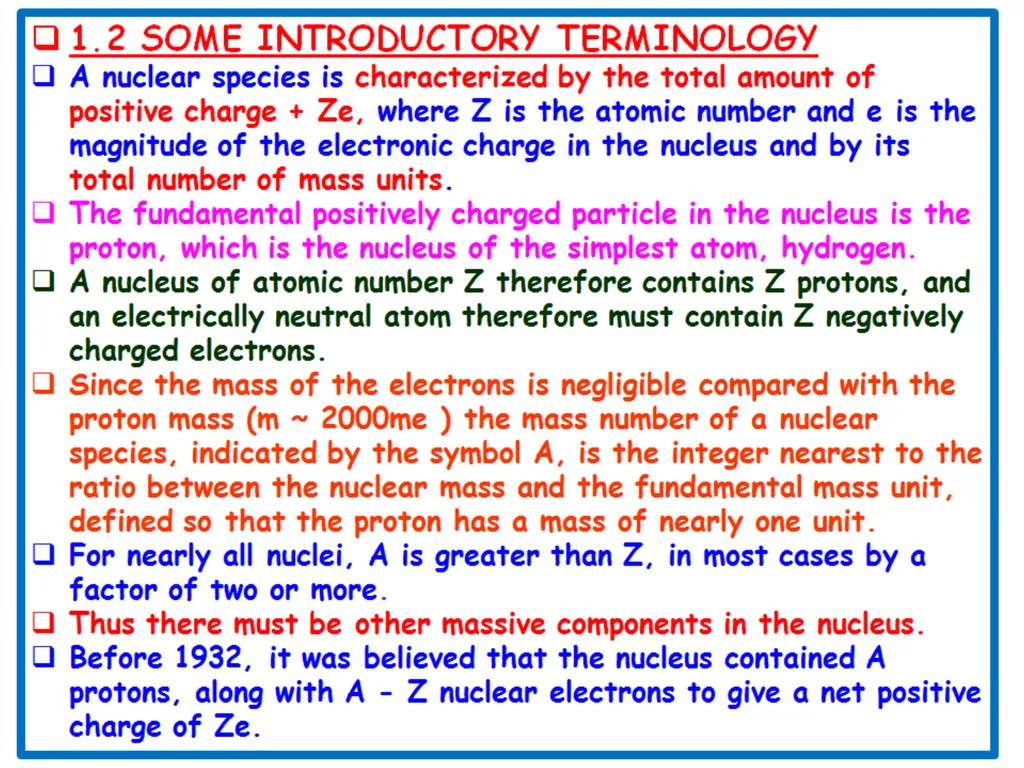
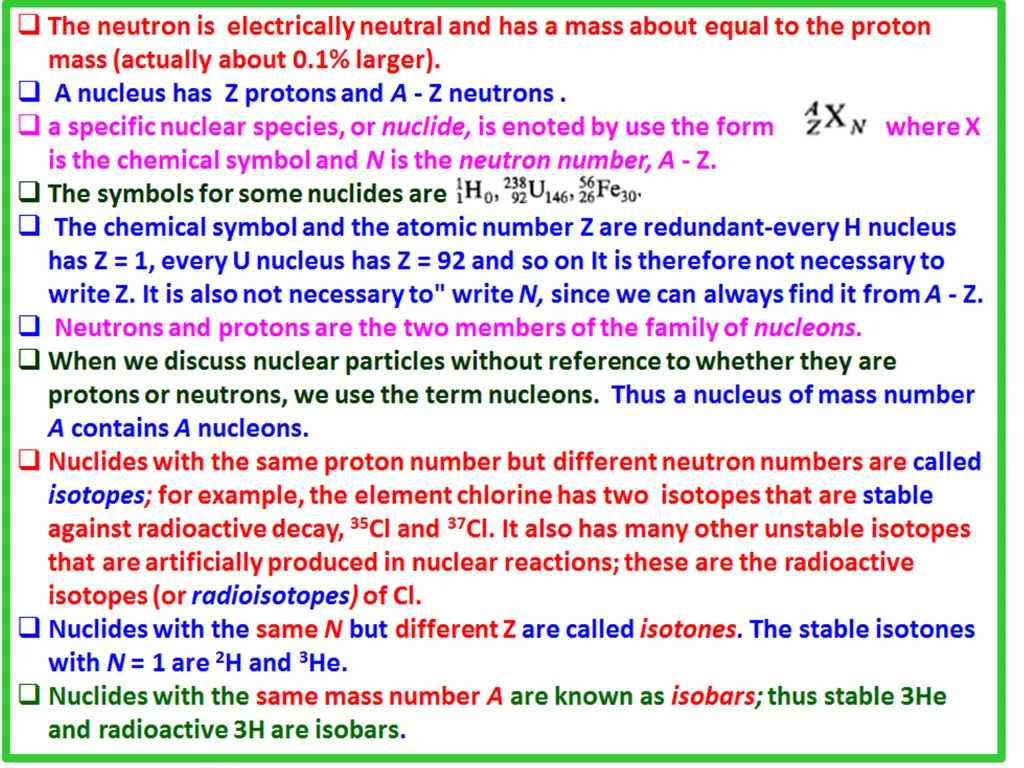
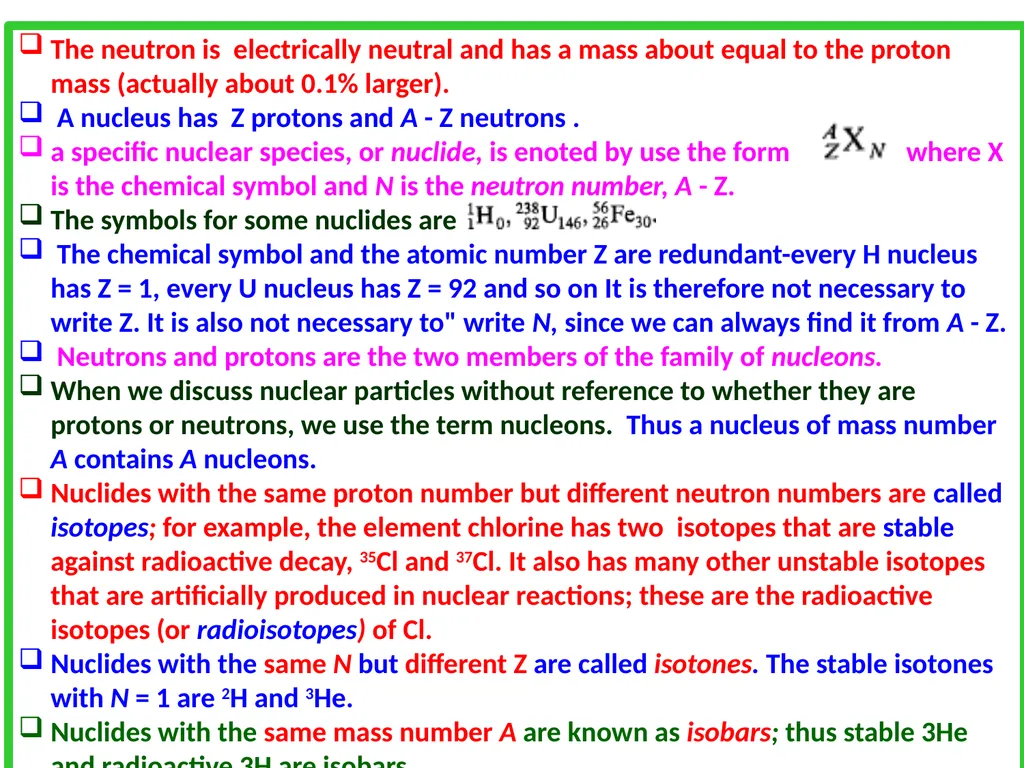
slide11. The neutron is electrically neutral and has a mass about equal to the proton mass (actually about 0.1% larger).
A nucleus has Z protons and A - Z neutrons .
a specific nuclear species, or nuclide, is enoted by use the form where X is the chemical symbol and N is the neutron number, A - Z.
The symbols for some nuclides are
The chemical symbol and the atomic number Z are redundant-every H nucleus has Z = 1, every U nucleus has Z = 92 and so on It is therefore not necessary to write Z. It is also not necessary to" write N, since we can always find it from A - Z.
Neutrons and protons are the two members of the family of nucleons.
When we discuss nuclear particles without reference to whether they are protons or neutrons, we use the term nucleons. Thus a nucleus of mass number A contains A nucleons.
Nuclides with the same proton number but different neutron numbers are called isotopes; for example, the element chlorine has two isotopes that are stable against radioactive decay, 35Cl and 37Cl. It also has many other unstable isotopes that are artificially produced in nuclear reactions; these are the radioactive isotopes (or radioisotopes) of Cl.
Nuclides with the same N but different Z are called isotones. The stable isotones with N = 1 are 2H and 3He.
Nuclides with the same mass number A are known as isobars; thus stable 3He and radioactive 3H are isobars.<br>
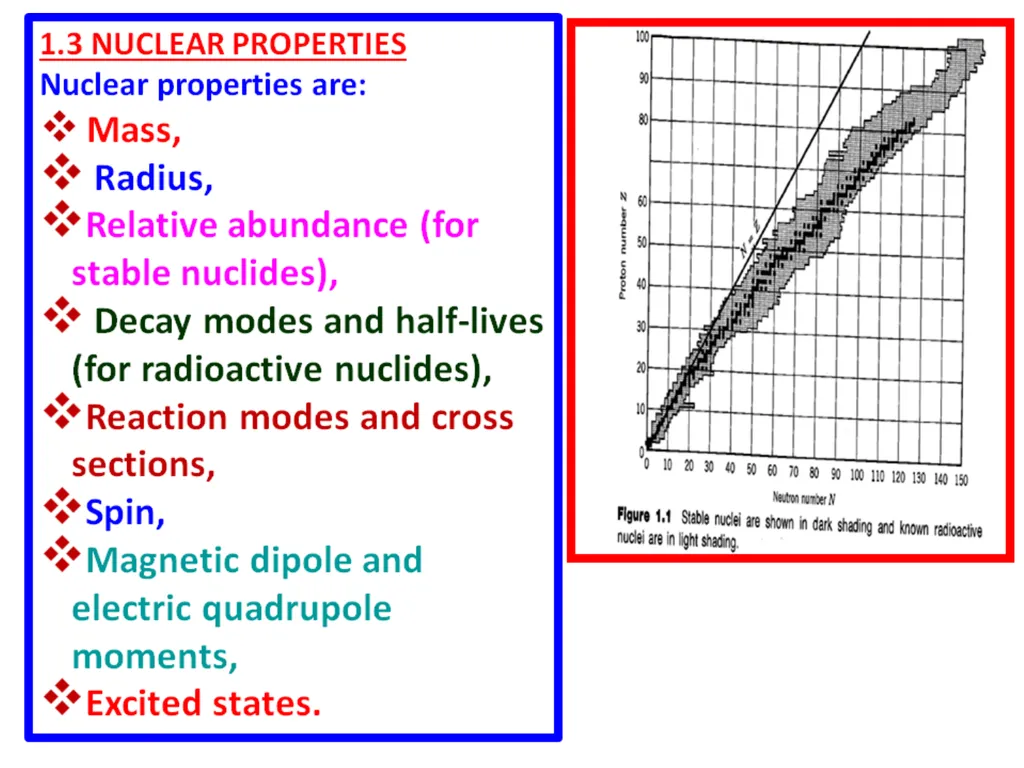
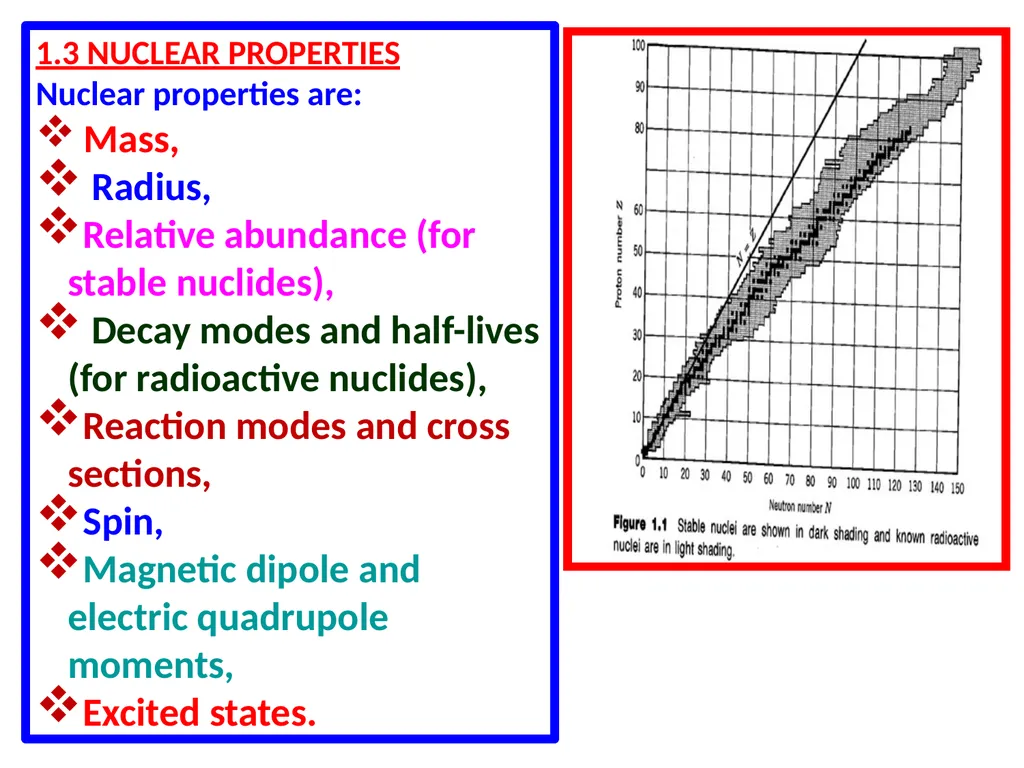
slide12. 1.3 NUCLEAR PROPERTIES
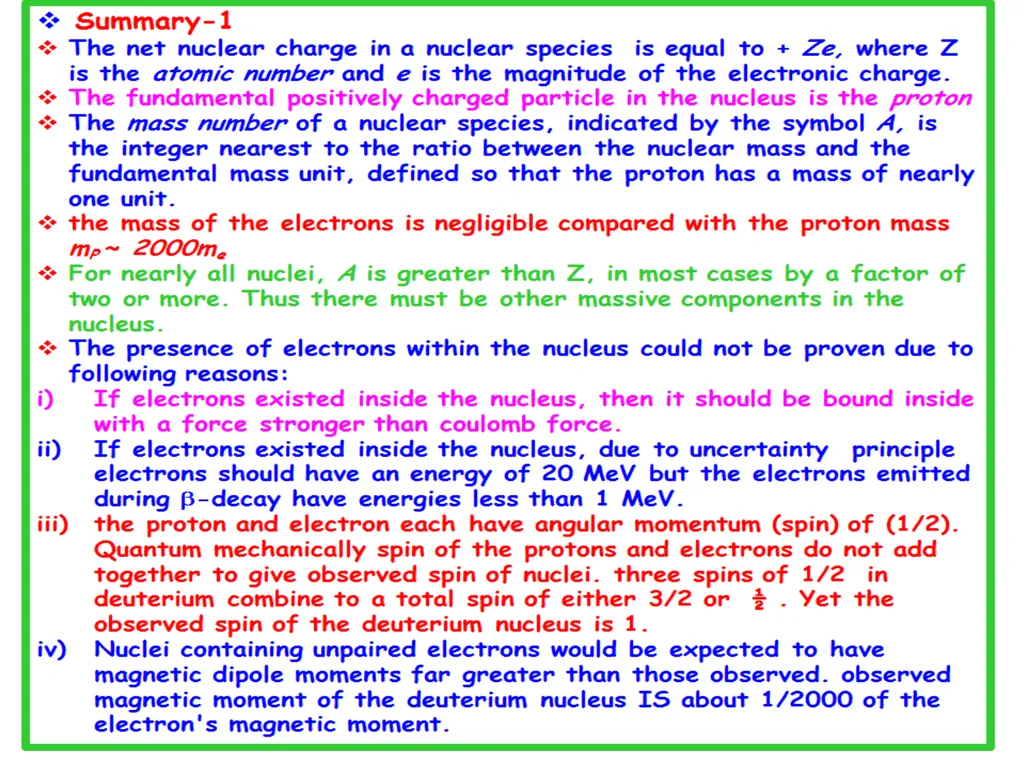
Nuclear properties are:
Mass,
Radius,
Relative abundance (for stable nuclides),
Decay modes and half-lives (for radioactive nuclides),
Reaction modes and cross sections,
Spin,
Magnetic dipole and electric quadrupole moments,
Excited states.<br>
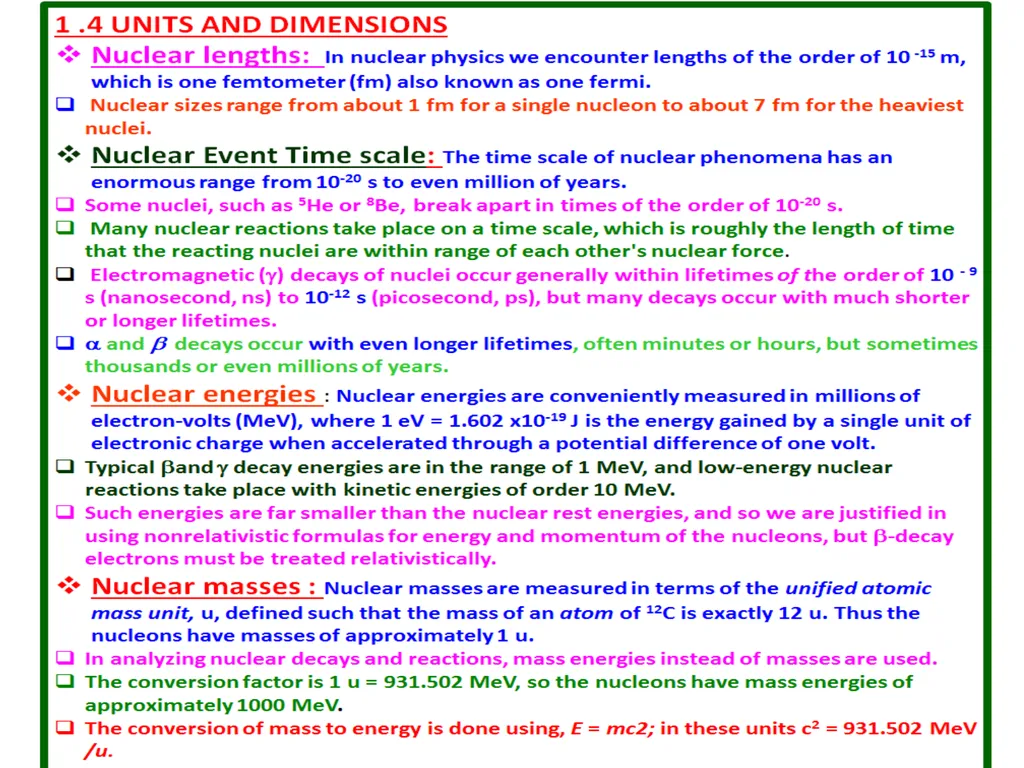
slide13. 1 .4 UNITS AND DIMENSIONS
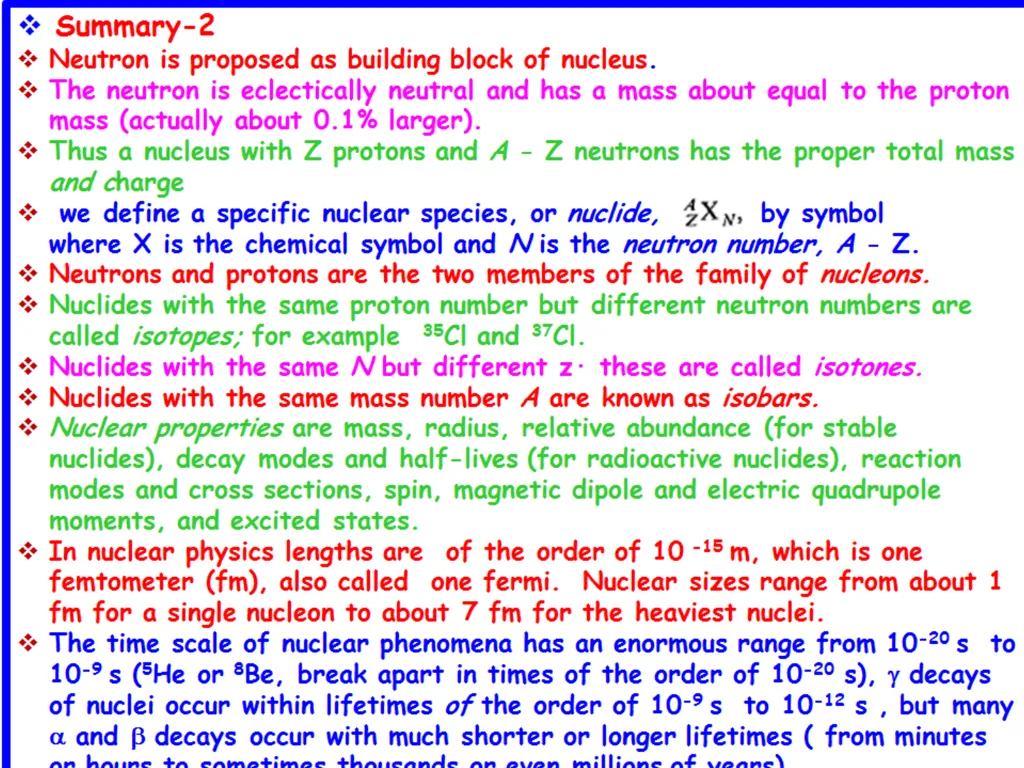
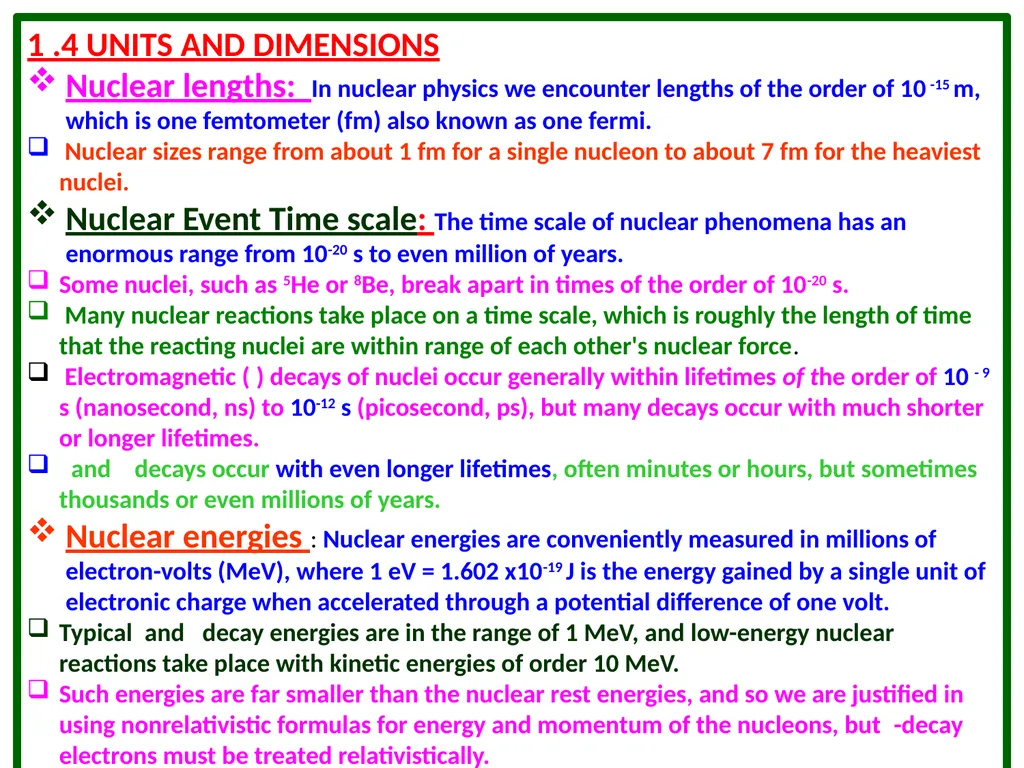
Nuclear lengths: In nuclear physics we encounter lengths of the order of 10 -15 m, which is one femtometer (fm) also known as one fermi.
Nuclear sizes range from about 1 fm for a single nucleon to about 7 fm for the heaviest nuclei.
Nuclear Event Time scale: The time scale of nuclear phenomena has an enormous range from 10-20 s to even million of years.
Some nuclei, such as 5He or 8Be, break apart in times of the order of 10-20 s.
Many nuclear reactions take place on a time scale, which is roughly the length of time that the reacting nuclei are within range of each other's nuclear force.
Electromagnetic () decays of nuclei occur generally within lifetimes of the order of 10 - 9 s (nanosecond, ns) to 10-12 s (picosecond, ps), but many decays occur with much shorter or longer lifetimes.
and decays occur with even longer lifetimes, often minutes or hours, but sometimes thousands or even millions of years.
Nuclear energies : Nuclear energies are conveniently measured in millions of electron-volts (MeV), where 1 eV = 1.602 x10⁻¹⁹ J is the energy gained by a single unit of electronic charge when accelerated through a potential difference of one volt.
Typical and decay energies are in the range of 1 MeV, and low-energy nuclear reactions take place with kinetic energies of order 10 MeV.
Such energies are far smaller than the nuclear rest energies, and so we are justified in using nonrelativistic formulas for energy and momentum of the nucleons, but -decay electrons must be treated relativistically.
Nuclear masses : Nuclear masses are measured in terms of the unified atomic mass unit, u, defined such that the mass of an atom of 12C is exactly 12 u. Thus the nucleons have masses of approximately 1 u.
In analyzing nuclear decays and reactions, mass energies instead of masses are used.
The conversion factor is 1 u = 931.502 MeV, so the nucleons have mass energies of approximately 1000 MeV.
The conversion of mass to energy is done using, E = mc2; in these units c2 = 931.502 MeV /u.<br>
slide11. The neutron is electrically neutral and has a mass about equal to the proton mass (actually about 0.1% larger).
A nucleus has Z protons and A - Z neutrons .
a specific nuclear species, or nuclide, is enoted by use the form where X is the chemical symbol and N is the neutron number, A - Z.
The symbols for some nuclides are
The chemical symbol and the atomic number Z are redundant-every H nucleus has Z = 1, every U nucleus has Z = 92 and so on It is therefore not necessary to write Z. It is also not necessary to" write N, since we can always find it from A - Z.
Neutrons and protons are the two members of the family of nucleons.
When we discuss nuclear particles without reference to whether they are protons or neutrons, we use the term nucleons. Thus a nucleus of mass number A contains A nucleons.
Nuclides with the same proton number but different neutron numbers are called isotopes; for example, the element chlorine has two isotopes that are stable against radioactive decay, 35Cl and 37Cl. It also has many other unstable isotopes that are artificially produced in nuclear reactions; these are the radioactive isotopes (or radioisotopes) of Cl.
Nuclides with the same N but different Z are called isotones. The stable isotones with N = 1 are 2H and 3He.
Nuclides with the same mass number A are known as isobars; thus stable 3He and radioactive 3H are isobars.<br>
slide12. 1.3 NUCLEAR PROPERTIES
Nuclear properties are:
Mass,
Radius,
Relative abundance (for stable nuclides),
Decay modes and half-lives (for radioactive nuclides),
Reaction modes and cross sections,
Spin,
Magnetic dipole and electric quadrupole moments,
Excited states.<br>
slide13. 1 .4 UNITS AND DIMENSIONS
Nuclear lengths: In nuclear physics we encounter lengths of the order of 10 -15 m, which is one femtometer (fm) also known as one fermi.
Nuclear sizes range from about 1 fm for a single nucleon to about 7 fm for the heaviest nuclei.
Nuclear Event Time scale: The time scale of nuclear phenomena has an enormous range from 10-20 s to even million of years.
Some nuclei, such as 5He or 8Be, break apart in times of the order of 10-20 s.
Many nuclear reactions take place on a time scale, which is roughly the length of time that the reacting nuclei are within range of each other's nuclear force.
Electromagnetic () decays of nuclei occur generally within lifetimes of the order of 10 - 9 s (nanosecond, ns) to 10-12 s (picosecond, ps), but many decays occur with much shorter or longer lifetimes.
and decays occur with even longer lifetimes, often minutes or hours, but sometimes thousands or even millions of years.
Nuclear energies : Nuclear energies are conveniently measured in millions of electron-volts (MeV), where 1 eV = 1.602 x10⁻¹⁹ J is the energy gained by a single unit of electronic charge when accelerated through a potential difference of one volt.
Typical and decay energies are in the range of 1 MeV, and low-energy nuclear reactions take place with kinetic energies of order 10 MeV.
Such energies are far smaller than the nuclear rest energies, and so we are justified in using nonrelativistic formulas for energy and momentum of the nucleons, but -decay electrons must be treated relativistically.
Nuclear masses : Nuclear masses are measured in terms of the unified atomic mass unit, u, defined such that the mass of an atom of 12C is exactly 12 u. Thus the nucleons have masses of approximately 1 u.
In analyzing nuclear decays and reactions, mass energies instead of masses are used.
The conversion factor is 1 u = 931.502 MeV, so the nucleons have mass energies of approximately 1000 MeV.
The conversion of mass to energy is done using, E = mc2; in these units c2 = 931.502 MeV /u.<br>