"Challenges Encountered in CAD Implementation Ashok" is the property of its rightful owner. Permission is granted to
download and print the materials on this website for personal, non-commercial use only, and to display it
on your personal computer provided you do not modify the materials and that you retain all copyright
notices contained in the materials. By downloading content from our website, you accept the terms of this
agreement.
Share
Embed code
Presentation Transcript
01
Challenges Encountered in CAD Implementation Ashok Goel, Chief Engineer,
Yamuna Basin Organisation, CWC,
New Delhi<br>
02
Agenda Inherent Shortcomings
Practical Difficulties
Way Forward<br>
03
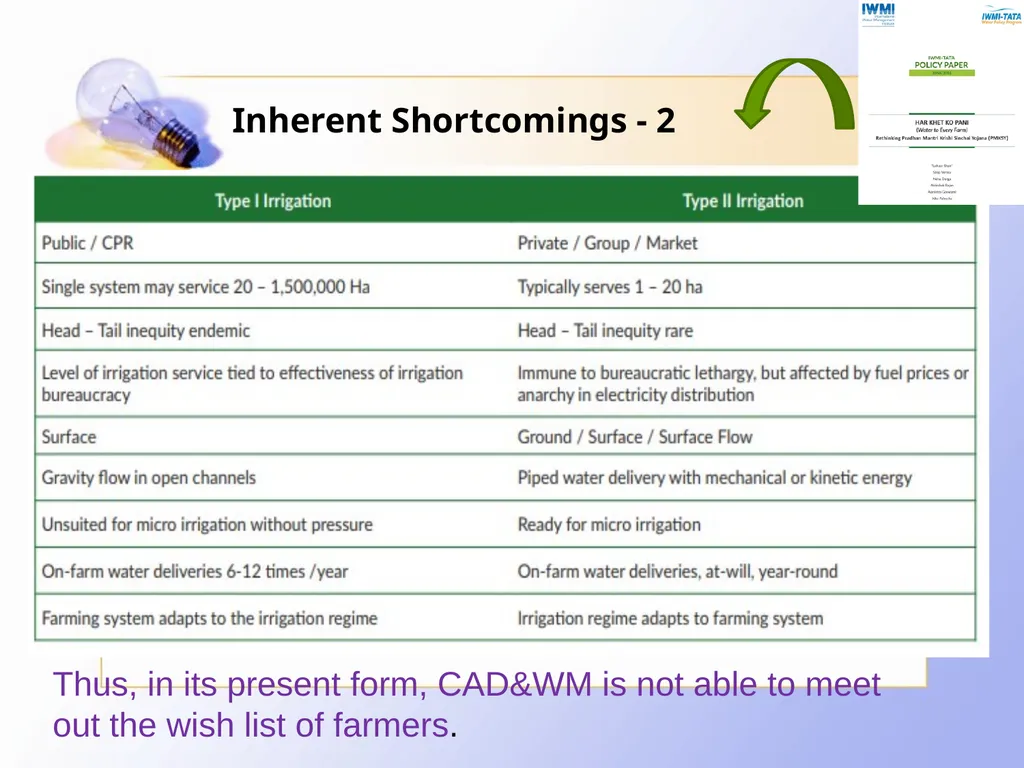
Inherent Shortcomings - 1 Two distinct patterns in Irrigation:
Type I : Typically based on Govt. constructed, owned, and operated structures as Major/ Medium/ Minor Irrigation Projects, and traditional structures.
Type II: Privately owned ponds, tube wells or lifting from water bodies/ rivers/ canals.
Wherever possible, farmers have gone for Type II irrigation, even if Type I is available.<br>
04
Inherent Shortcomings - 2 Thus, in its present form, CAD&WM is not able to meet out the wish list of farmers.<br>
05
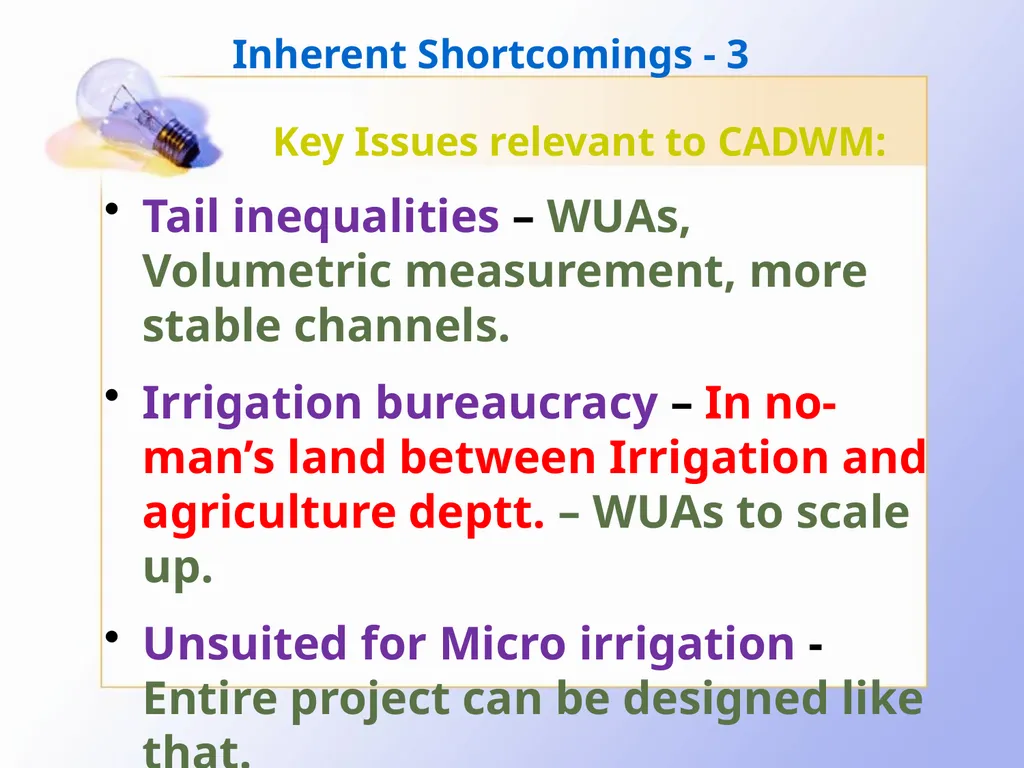
Inherent Shortcomings - 3 Key Issues relevant to CADWM:
Tail inequalities – WUAs, Volumetric measurement, more stable channels.
Irrigation bureaucracy – In no-man’s land between Irrigation and agriculture deptt. – WUAs to scale up.
Unsuited for Micro irrigation - Entire project can be designed like that.<br>
06
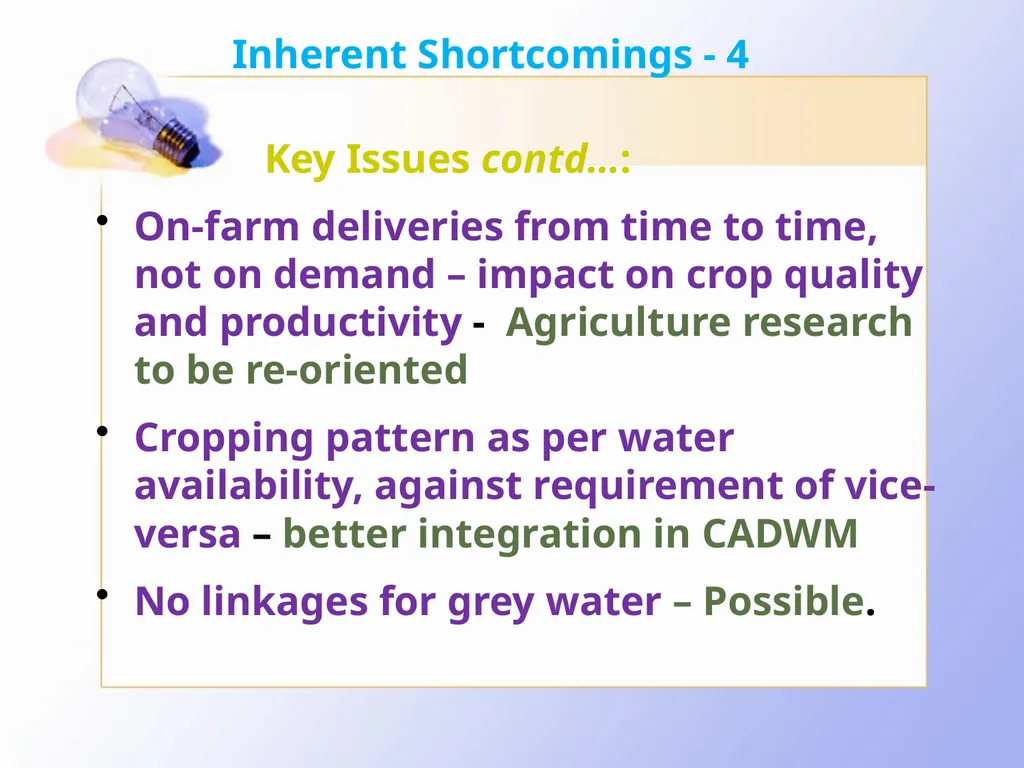
Inherent Shortcomings - 4 Key Issues contd…:
On-farm deliveries from time to time, not on demand – impact on crop quality and productivity - Agriculture research to be re-oriented
Cropping pattern as per water availability, against requirement of vice-versa – better integration in CADWM
No linkages for grey water – Possible.<br>
07
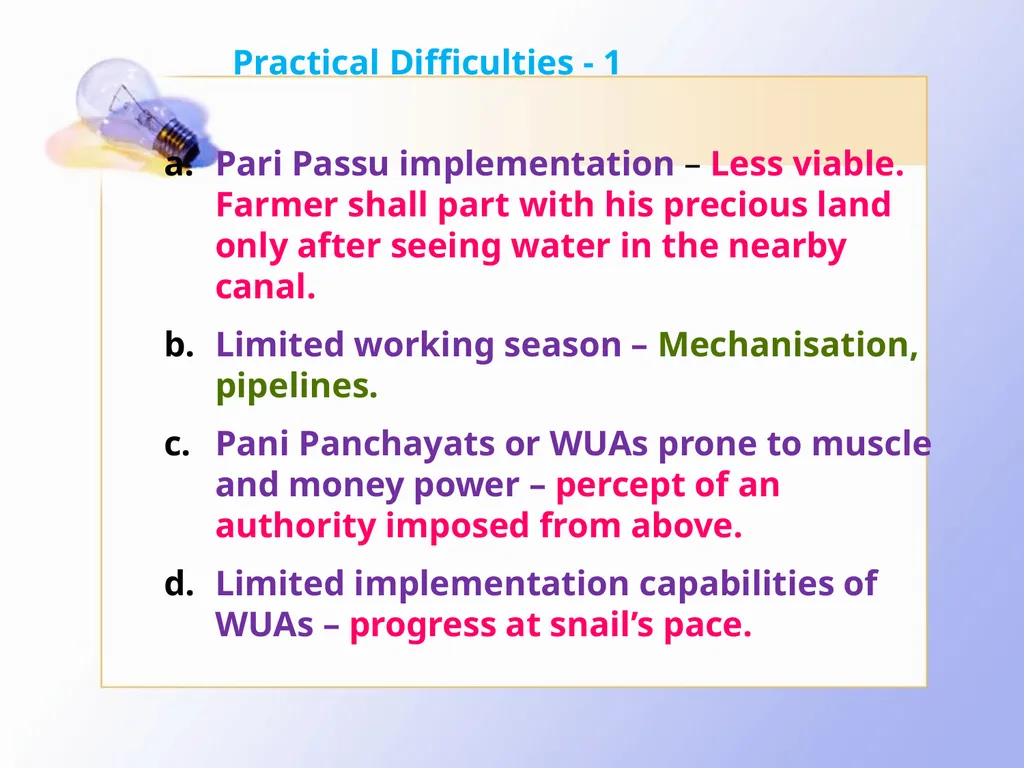
Practical Difficulties - 1 Pari Passu implementation – Less viable. Farmer shall part with his precious land only after seeing water in the nearby canal.
Limited working season – Mechanisation, pipelines.
Pani Panchayats or WUAs prone to muscle and money power – percept of an authority imposed from above.
Limited implementation capabilities of WUAs – progress at snail’s pace.<br>
08
Practical Difficulties - 2 e. Earthen field channels difficult to maintain. No central scheme for R&M.
Area specific challenges require out-of-the-box solutions (eg. Bandhies, spring management, ice stupas).
Farm to field – WUAs in-capable.
WUAs in no-man’s land between bored Agriculturists and indifferent Irrigationists<br>
09
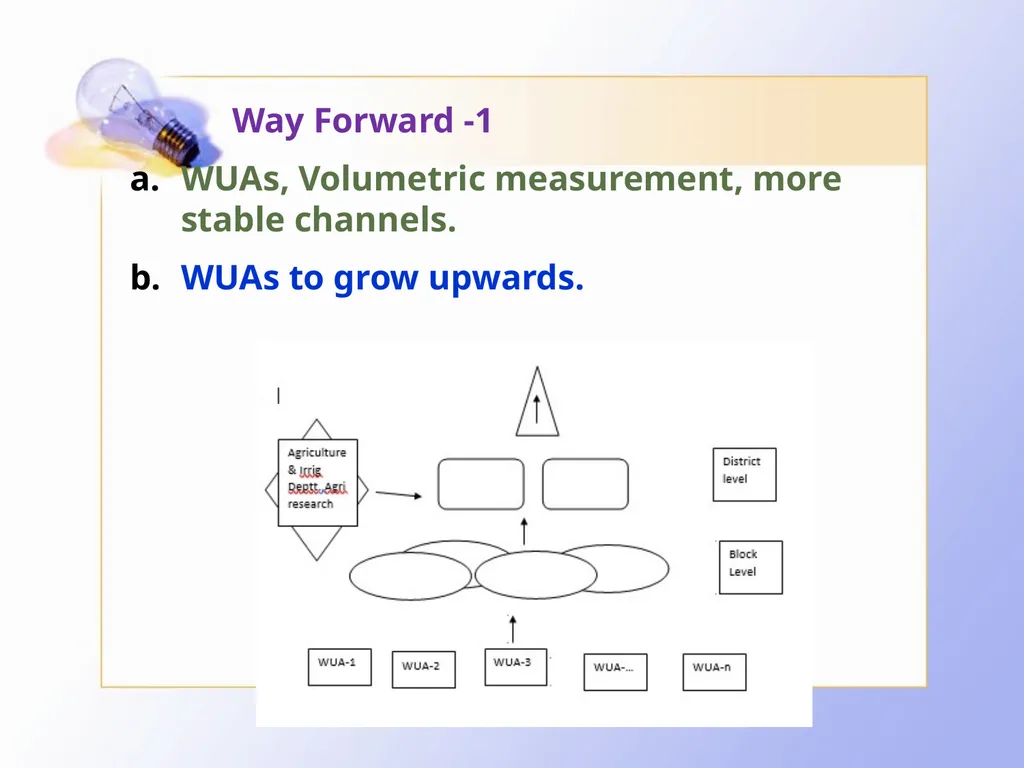
Way Forward -1 WUAs, Volumetric measurement, more stable channels.
WUAs to grow upwards.<br>
10
Way Forward - 2 More Sanchore models.
Re-orient of agriculture research – would interest agriculturists also.
Development of linkages with ground water, grey water and traditional structures, etc.
f. Area specific approach
Develop integrated peri-urban irrigation to promote planned wastewater irrigation.<br>
11
Way Forward - 3 Cluster solar power – for CADWM use.
Preference in CADWM based on availability of Type II irrigation facility and gap data, instead of traditional.
Greater role required in financial management, but checks to be strengthened. 11<br>