04
“The field of Clinical Psychology integrates science, theory, and practice to understand, predict, and alleviate maladjustment, disability, and discomfort as well as to promote human adaptation, adjustment, and personal development. Clinical Psychology focuses on the intellectual, emotional, biological, psychological, social, and behavioral aspects of human functioning across the life span, in varying cultures, and at all socioeconomic levels.” (APA, 2012) APA Division 12 Definition of Clinical Psychology<br>
05
Commonalities among most training programs
Doctoral degree
Most enter with bachelor’s, some with master’s degree
Required coursework
Thesis/dissertation
Predoctoral internship (more information in later slides) Education and Training in Clinical Psychology<br>
06
In recent decades, specialty tracks have emerged, including:
Child
Health
Forensic
Family
Neuropsychology
More on these specialty areas in later chapters Education and Training: Specialty Tracks<br>
07
Scientist-practitioner model (or Boulder model)
Practitioner-scholar model (or Vail model)
Clinical scientist model Three Models of Training<br>
08
Created in 1949 at a conference in Boulder, Colorado of directors of clinical psychology training programs
Emphasizes both practice and research
Graduates should be able to competently practice (e.g., therapy, assessment) and conduct research
A balanced approach Scientist-Practitioner Model (Boulder Model): Balancing Practice and Science<br>
09
Created in 1973 in a conference in Vail, Colorado
Also known as practitioner-scholar model
Emphasizes practice over research
Yields the Psy.D. degree (not the traditional Ph.D.)
Higher acceptance rates and larger classes
Proliferated in recent years Practitioner-Scholar Model (Vail Model): Emphasizing Practice<br>
10
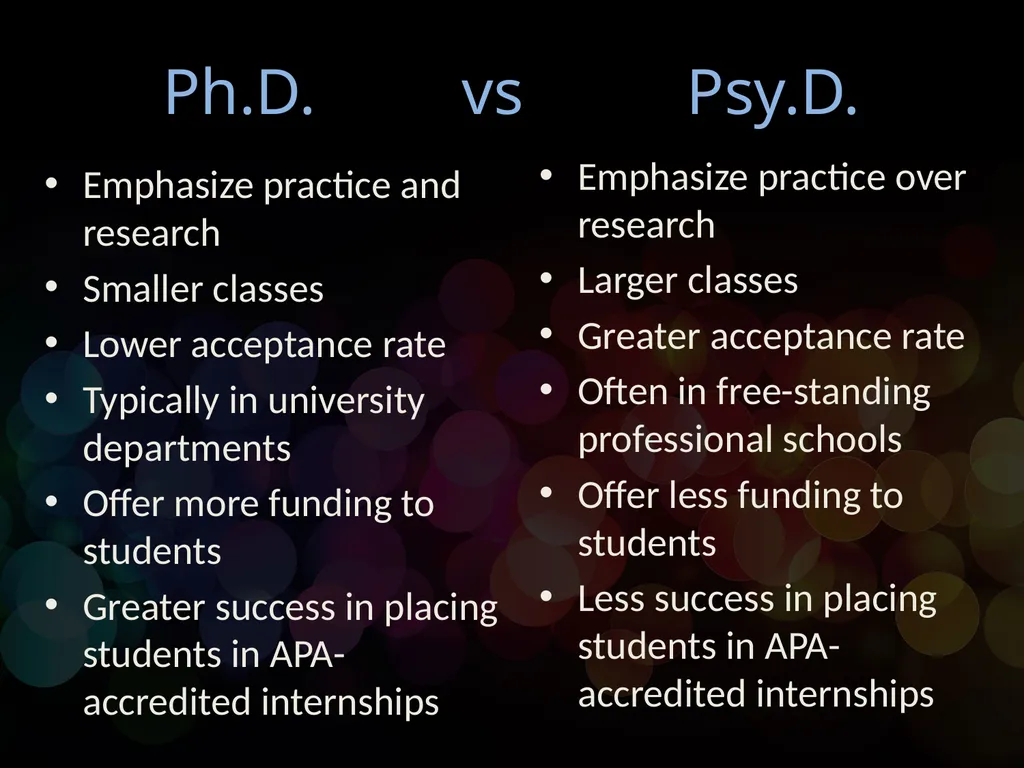
Emphasize practice and research
Smaller classes
Lower acceptance rate
Typically in university departments
Offer more funding to students
Greater success in placing students in APA-accredited internships Emphasize practice over research
Larger classes
Greater acceptance rate
Often in free-standing professional schools
Offer less funding to students
Less success in placing students in APA-accredited internships Ph.D. vs Psy.D.<br>
11
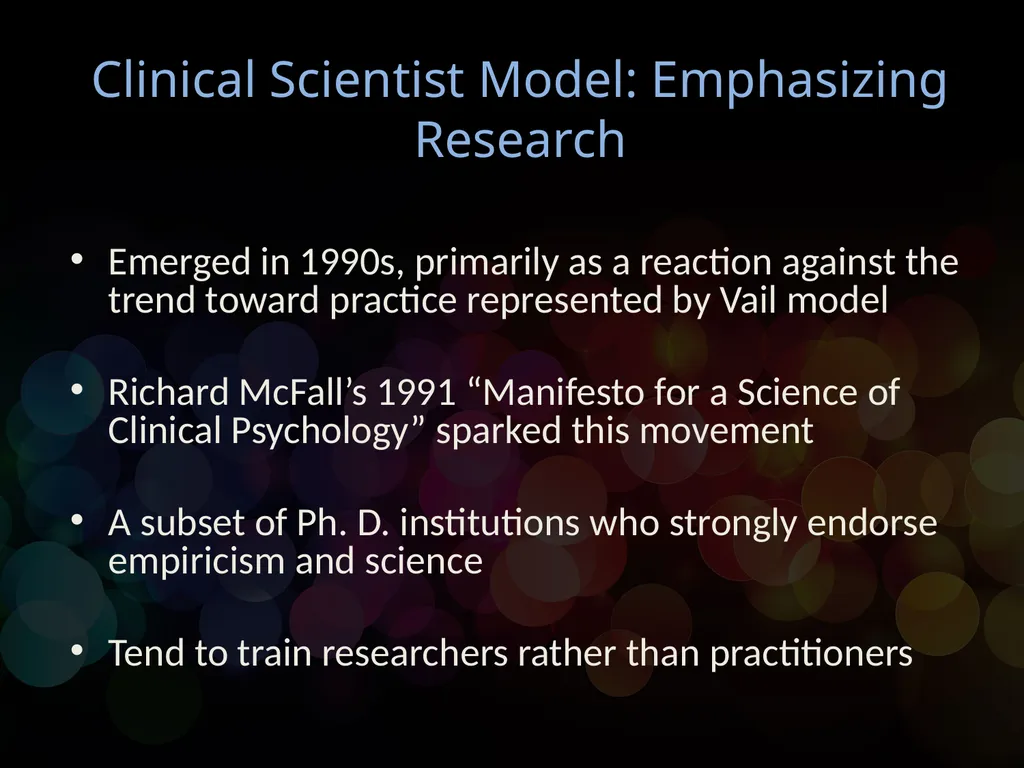
Emerged in 1990s, primarily as a reaction against the trend toward practice represented by Vail model
Richard McFall’s 1991 “Manifesto for a Science of Clinical Psychology” sparked this movement
A subset of Ph. D. institutions who strongly endorse empiricism and science
Tend to train researchers rather than practitioners Clinical Scientist Model: Emphasizing Research<br>
12
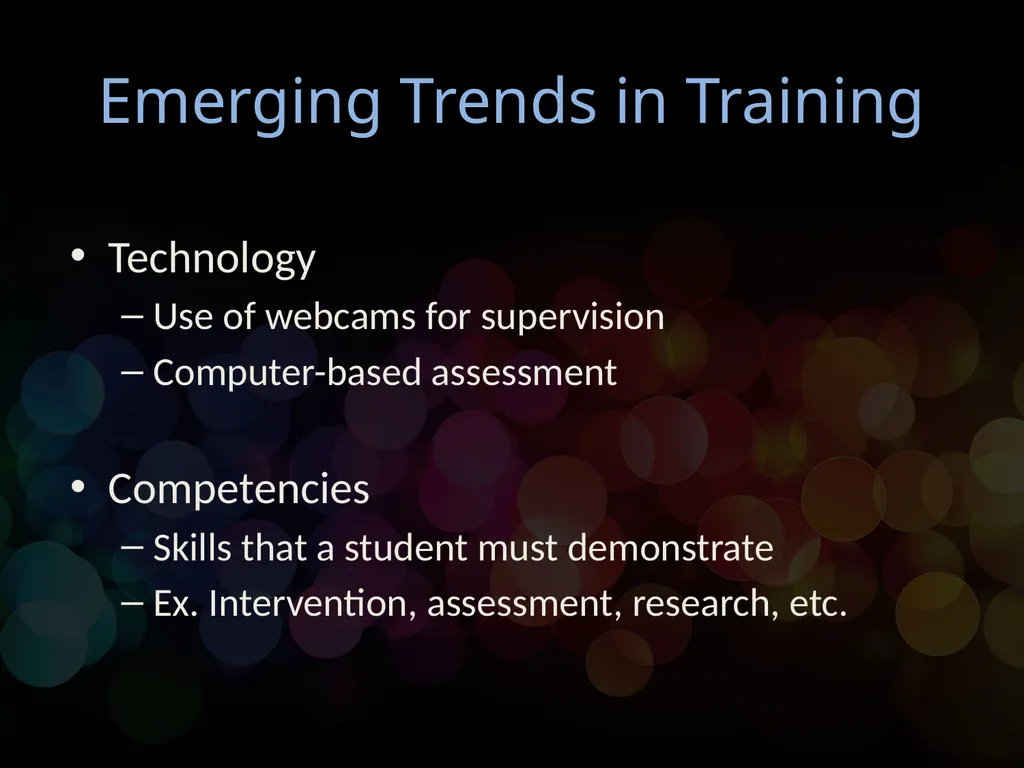
Technology
Use of webcams for supervision
Computer-based assessment
Competencies
Skills that a student must demonstrate
Ex. Intervention, assessment, research, etc. Emerging Trends in Training<br>
13
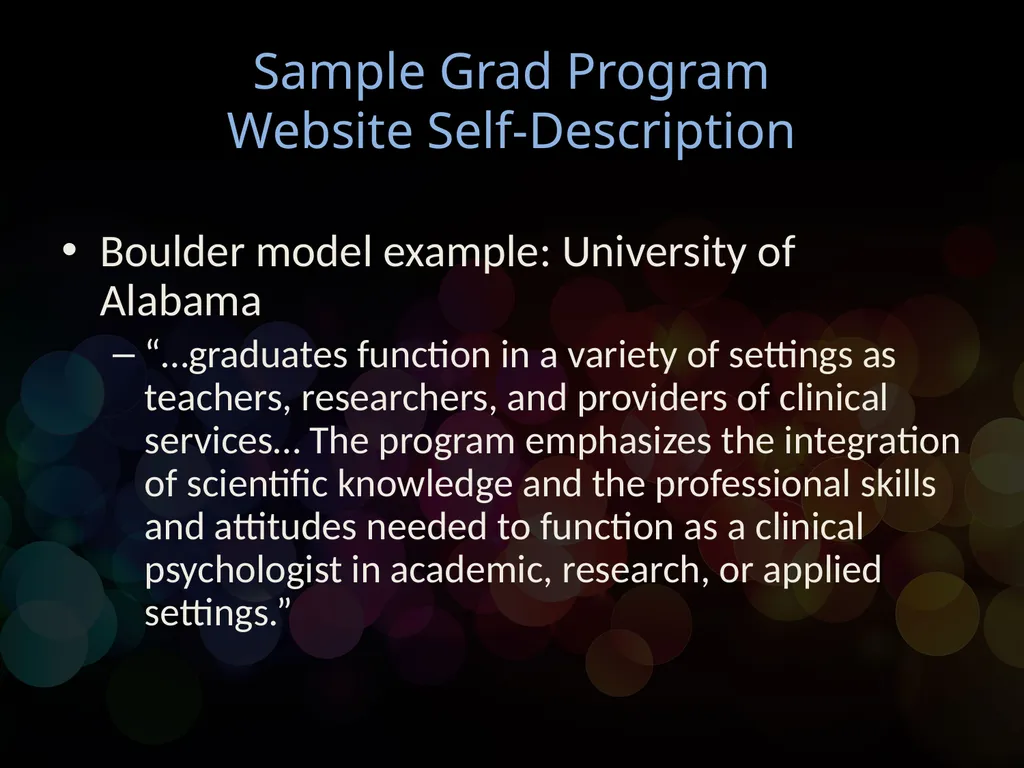
Boulder model example: University of Alabama
“…graduates function in a variety of settings as teachers, researchers, and providers of clinical services… The program emphasizes the integration of scientific knowledge and the professional skills and attitudes needed to function as a clinical psychologist in academic, research, or applied settings.” Sample Grad Program�Website Self-Description<br>
14
Vail model example: Chicago School of Professional Psychology
“As a professional school, our focus is not strictly on research and theory, but on preparing students to become outstanding practitioners, providing direct service to help individuals and organizations thrive.” Sample Grad Program�Website Self-Description<br>
15
Clinical scientist model example: Indiana University
“Indiana University’s Clinical Training Program is designed with a special mission in mind: To train first-rate clinical scientists… applicants with primary interests in pursuing careers as service providers are not likely to thrive here.” Sample Grad Program�Website Self-Description<br>
16
Know your professional options
Take the appropriate undergraduate courses
Get to know your professors
Get research experience
Get clinically relevant experience
Maximize your GRE score
Select graduate programs wisely
Write effective personal statements
Prepare well for admissions interviews
Consider your long-term goals Getting in to Graduate School in Clinical Psychology<br>
17
Predoctoral internship
Takes place at the end of doctoral training programs (before Ph.D. or Psy.D. is awarded)
A full year of supervised clinical experience in an applied setting
An apprenticeship of sorts, to transition from student to professional Internships: Predoc and Postdoc<br>
18
Postdoctoral internship
Takes place after the doctoral degree is awarded
Typically lasts 1-2 years
Still supervised, but more independence
Often specialized training
Often required for state licensure Internships: Predoc and Postdoc<br>
19
Licensure enables independent practice and identification as a member of the profession
Requires appropriate graduate coursework, postdoctoral internship, and licensing exams
Each state has its own licensing requirements
To stay licensed, most states require continuing education units (CEUs) Getting Licensed<br>
20
A variety of settings, but private practice is most common
True since 1980s
Other common work settings include
Universities
Psychiatric and general hospitals
Community mental health centers
Other settings Where Do Clinical Psychologists Work?<br>
21
A variety of activities, but psychotherapy is most common
True since 1970s
Other common professional activities include:
Diagnosis/assessment
Teaching/supervision
Research/writing
Other activities What do Clinical Psychologists Do?<br>
22
Counseling Psychologists:
Tend to see less seriously disturbed clients
Tend to work less often in settings like inpatient hospitals or units
Tend to endorse humanism more and behaviorism less
Tend to be more interested in vocational and career counseling How Are Clinical Psychologists Different From Other Professionals?<br>
23
Psychiatrists:
Go to medical school and are physicians
Have prescription privileges (this is changing for clinical psychologists—see Chapter 3)
Increasingly emphasize biological/pharmaceutical rather than “talk therapy” intervention How Are Clinical Psychologists Different From Other Professionals?<br>
24
Social Workers
Tend to emphasize social factors in client’s problems
Earn a master’s degree rather than a doctorate
Training emphasizes treatment and fieldwork over research or formalized assessment How Are Clinical Psychologists Different From Other Professionals?<br>
25
School Psychologists:
Tend to work in schools
Tend to have a more limited professional focus than clinical psychologists (student wellness and learning)
Frequently conduct school-related testing and determine LD and ADHD diagnoses
Consult with adults in children’s lives (e.g., teachers, staff, parents) How Are Clinical Psychologists Different From Other Professionals?<br>
26
Professional Counselors:
Earn a master’s degree
Complete training in two years
Little emphasis on psychological testing or research
May specialized in career, school, college counseling How Are Clinical Psychologists Different From Other Professionals?<br>